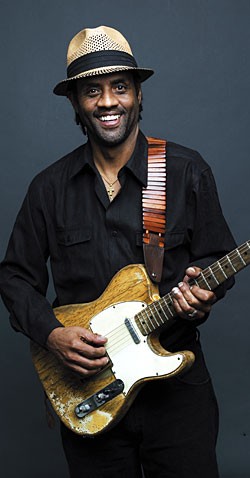
Recent times have been tough for veteran bluesman Kenny Neal. After recently contracting Hepatitis C and undergoing treatment, for the first time in 30 years he was forced to stay off the road. Also, in an eleven-month span, Neal lost his dad, sister, and brother. But those negatives helped create a positive, as he proves on his new album, Let Life Flow.
“To lift my spirit during treatment, I’d pick up the guitar and play a little, and I decided to write. So the CD popped out of the last three years of my life.” Those songs include the soaring soul/gospel of “Fly Away,” an affirmation of life and afterlife that was the result, Neal says, of the deaths in his family. And he also experienced a bit of luck.
“My son, Kenny Jr. and I, put most of the CD together while I was at home. When I started to feel a little better, I started doing a TV show in Palo Alto, California, called ‘The Neals’ Place.’ I’d bring in guests. I needed to do something – I’m not one to sit around. I told one of my guests I was looking for a home for the disc and someone from Blind Pig just happened to hear, and called. Then my buddies started calling, saying, “I’ve got this song…” It all just came together. I’d been through a lot the last three years and it was just like something was watching over me and saying “Okay, we got your back.” It was like magic!”
That magic has been a family affair for most of Neal’s life. His dad, Raful, was known for his harmonica playing with the likes of Buddy and Phil Guy. “From the time I was a baby, I was into the music. I’d crawl up on dad’s knee during rehearsals – we always had great musicians hanging around the house. That was my environment.”
In ’75, Neal joined Buddy Guy and Junior Wells’ band. He was playing bass, but at one point things changed. “I got to Chicago to play with Buddy and Junior, and I saw the folks playing there and thought, ‘Wow! Some of these guys are good, but some are not so good, and they’re going to Europe and everything.’ I thought, ‘I can do that.’ Bells went off in my head. I was an excellent bass player, but after about a year in Chicago, I didn’t want to see the bass! I decided to jump on the wagon and be a front man. I wasn’t too good on guitar, at first, but I had enough guts to try it. And it worked!”
After marrying a Canadian woman, Neal moved his brothers to Canada to play in a band with him. It was, again, a case of intestinal fortitude that got the gigs. “I went to a little place called the Isabella Hotel. They had a blues joint on the top floor and went in and told the manager I could bring in guests and have a house band, and he fell for the story. I didn’t know who I’d bring in. I got back to Louisiana and grabbed my brothers. We bought a van and drove back up. I started calling people like Junior Wells. Then another week, I’d have Big Mama Thornton. The next week, John Lee Hooker. It worked, and at the same time I was learning to play guitar. I guess I just put myself on the spot. I got the job before I had the equipment!”
While he was learning the six-string, Neal’s influences were wide and varied. He points to obvious ones like Muddy Waters and Jimmy Reed, but also cites Louisiana guys like Rudy Richard and James Johnson, who are well-known locally but haven’t had a widespread impact. Anyone who listens to his music also knows there’s a strong gospel and soul influence. “The church was a major thing for us growing up,” he said. “All that gospel stuff you just soaked up. And Otis Redding was always my favorite singer, along with guys like Wilson Pickett and O.V. Wright back in the day.”
Whether onstage or in the studio, Neal’s favorite guitar is a mid-’60s Fender Tele. “Old Betsy; I’ve been playing her the last 30 years, every night. I must have 50 or 60 guitars at home, and I can’t get to ’em – I don’t even touch them. When I go out to work, I’ve gotta take Betsy with me. I’d be lost without her.” He acquired Betsy from a brother-in-law in Canada. “I gave him a ’59 Gibson Melody Maker because I’d fallen in love with his guitar and he didn’t want to sell it. When I pulled that out, it changed his mind. I think Betsy’s a ’65, but all the serial numbers are gone because it’s been there and back.” With a laugh, he adds, “If only that guitar could talk.”
For two decades, his amp of choice has been a Roland Jazz Chorus, but he recently acquired a new amp – the Uptown 33 from King Amplification. “It’s a great amp. It combines the dirty and clean and has a real fat sound.”
As for the future, Neal says after the past three years, he says it’s good to be out playing for folks again. “I just saw the doctor. I’m clear of everything. It’s all gone and I’m back to health, back on the road, and I’m really, really happy about it.”
This article originally appeared in VG‘s August 2008 issue. All copyrights are by the author and Vintage Guitar magazine. Unauthorized replication or use is strictly prohibited. Bobby “Blue” Bland & Kenny Neal – LRBC06- Vista Lounge
When you hear the words “Do you feel,” what comes to mind? If you’re of a certain age demographic, you know how ubiquitous Peter Frampton’s Frampton Comes Alive was in the 1970s. It made Frampton an international mega-star.
Commercial success aside, Frampton’s abilities with the guitar are somewhat underappreciated. He wrote great tunes and fronted his band with aplomb. And whether with Humble Pie or solo, his guitar tone was always incredible.
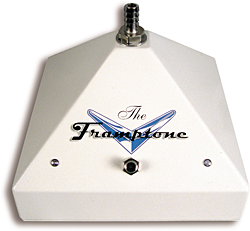
With the help of “Do You Feel Like We Do,” from Comes Alive, Frampton put the talkbox effect on the map. And more recently, he put it back into the guitar mainstream when his high-end effects/accessories company, Framptone, launched its Talk Box.
What can I call the talk box? Is it a pedal? Is it an effect? Regardless, it’s basically a speaker driver without a basket, in a box, hooked between a guitar amp and speaker cab. One end of a vinyl tube is connected to the driver, the other end to a player’s mic stand, right in front of the mic. The mic end of the tube is inserted partially into the player’s mouth (watch the gag factor!). While playing, the player changes the cavity of their mouth using the tongue and lips, while their mouth is next to their mic. The talkbox then produces wah-type (among other) effects through the PA. It’s strange, but it works – and sounds very cool!
The Framptone Talkbox is housed in a near-bullet-proof pyramid-shaped powdercoated steel box. Inside is a custom-designed Alnico/phenolic speaker driver. A 250-volt mylar capacitor provides a smooth, warm frequency crossover. At the top of the pyramid is the connector that can be changed to accommodate different-size hoses. The box has speaker input and output jacks and an on/off switch with two LEDs. All components are of the highest grade. The LEDs are powered by a 9-volt battery, and peeking inside one finds very neat workmanship designed to be roadworthy (there’s even a bumper under the driver, to support its weight).
I ran the Framptone between our all-tube Peavey Butcher head and a 2×12″ speaker cab. Playing an Ibanez Artist, I set up the amp for clean tones, grabbed the tube with my mouth and started playing. Just moving my tongue in different ways gave me an incredible range of wah-like effects. Opening and closing my lips enhanced it. If you can coordinate your mouth for rhythm you could do the into of “Voodoo Child, Slight Return” without a wah. Of course, the unit can reproduce Frampton’s talkbox effect to a T. It’ll also do a number of robotic effects by talking and just playing the same note. My dog freaked and started barking when I called his name.
Next, I set the amp to overdrive. Wow! That’s where the Framptone really shines. I could get an Octavia-like effect, plus numerous wah effects that a wah pedal or envelope filter couldn’t touch.
The Framptone Talk box offers tons of tonal possibilities. I had far more fun with it than I could’ve anticipated. And it’s built like a tank, using top-quality components. Grab one, and see if you don’t feel like I do.
Framptone Talkbox Features Powder-coated steel chassis, custom-built Alnico/phenolic driver, 250-volt Mylar capacitor, steel-milled “sound transference chamber,” high-intensity LED indicators. Price $399. Contact Framptone Manufacturing, 113 Dictum Court, Brooklyn, NY 11229; phone (718) 934-4196; www.framptone.com. This article originally appeared in VG‘s July ’05 issue. All copyrights are by the author and Vintage Guitar magazine. Unauthorized replication or use is strictly prohibited.
Tommy Castro makes the move to Chicago’s Alligator Records, and fittingly serves up one of the most focused and toughest records of his considerable career.
Contributing no doubt to the great guitar sounds, the fine songwriting, and the overall feel of the record is the production of veteran John Porter, who has worked with folks like Keb Mo, Otis Rush, B.B. King, and Elvis Costello.
It’s always been obvious Castro has the goods and while his records on Blind Pig have been well-done, they’ve never reached this level in a number of ways, including something as simple as guitar tone. “It Is What It Is” is just a shuffle, but Castro’s nasty vocal and guitar helps carry the song to another level. “Monkey’s Paradise” is a soul-funk tune that’s basically just a one-chord vamp with a gritty vocal and a meandering solo that mixes masterful soul playing with a mid-eastern feel mixed in. It’s easy to forget how a song that simple can sound so good in the right hands. “Trimmin’ Fat” has a very clever lyric that deals with today’s economic reality while maintaining a good-time feel. Porter, who supplies rhythm guitar throughout the record, fills up that tune with a nasty slide solo. All of the Castro originals work on pretty much every level. He even touches the jazzy side of soul on “The Trouble With Soul.” Great changes and a soulful solo make it the perfect closer for the record. Castro’s got one of those voices that sounds like he gargles dirt and smokes Camels. Like his guitar playing, it also is full of soul. His choice of covers is pretty much perfect. “Ninety-Nine and One Half” is a slice of Memphis soul that the Bay area stalwart has absolutely no problem bringing to the West Coast. His version of Allen Toussaint’s “Victims of the Darkness” is a plea for understanding. And, his version of the Righteous Brothers “My Babe” is a loud soul shuffle that fits his style perfectly. It’s obvious with Hard Believer that Castro is upping the ante. In the R&B world of 2009, he has to be considered one of the top contenders for the crown.
This article originally appeared in VG‘s Dec. ’09 issue. All copyrights are by the author and Vintage Guitar magazine. Unauthorized replication or use is strictly prohibited.
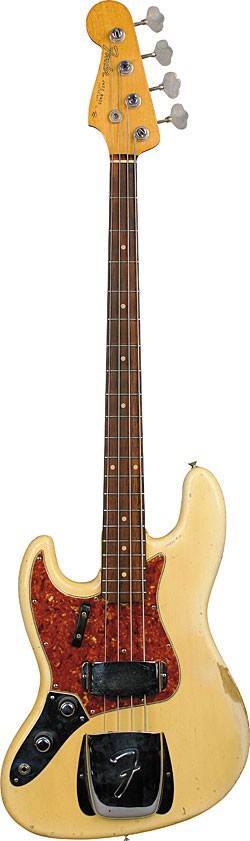
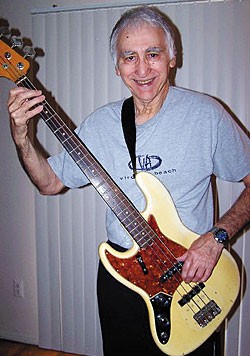
Joe Long’s “stack-knob” Fender Jazz Bass, serial number 57392. Instrument and photo courtesy of Nadav Galimidi.
If you’re a fan or aficionado of vintage instruments, odds are that any early-’60s Fender Jazz Bass catches your eye. And “lefty” versions are especially intriguing, given their rarity.
The Jazz was Fender’s second electric bass, following the groundbreaking Precision, which was introduced in late 1951 and underwent three stylistic changes by the time the Jazz Bass came along in 1960. Seeking to take versatility and comfort beyond the P-Bass, the Jazz incorporated a thinner neck that was 17/16″ wide at the nut, compared to the Precision’s 13/4″. The original Jazz also had an unbound rosewood fretboard with dot markers, and a 34″ scale – considering the success of both models, it’s not surprising that the 34″ scale ultimately became the industry standard. The Fender logo on the Jazz’s headstock was a new style that replaced the “spaghetti” logo with what became known as the “transitional” logo, in erroneous reference to CBS’ purchase of Fender in ’65. In reality, the Jazz Bass had this logo from the get-go.
Among the Jazz’s most distinct design elements are its offset carves in the midsection of its alder body; the carves on the P-Bass were symmetrical, but the offset “waist” made the Jazz more comfortable for playing while seated.
One drawback may have been that the Jazz Bass was slightly larger and (usually) heavier than the Precision. It was 3/4″ longer (461/4″ vs. 453/4″) and 1″ wider (14″ vs. 13″) than its predecessor, but maintained the same 11/4″ body thickness. However, in the eyes (and hands) of many players, the ergonomic innovations on the Jazz more than made up for minor differences in size or weight.
The electronics of the Jazz went beyond the fact that it was a two-pickup instrument, while the P-Bass had one. Jazz pickups are single-coil units with two pole pieces for each string, and their location on the body help it create a variety of tones. The controls on the first-generation Jazz consisted of two Volume controls and two Tone controls (one for each pickup) on concentric knobs mounted on a chromed-metal plate, with the Volume being the upper/smaller knob, while the lower/larger knob controlled its tone/EQ. The knobs at the junction of the plate and the pickguard controlled the pickup closer to the neck, and the knobs closer to the jack controlled the bridge/treble pickup. This “stack-knob” configuration was short-lived, and evolved into a three-knob (two Volume controls, one master Tone control) in early 1962. Like the Precision, the Jazz’s bridge had intonatable saddles for each string.
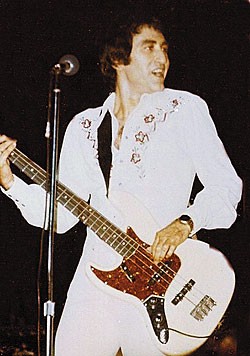
Long onstage with his Jazz Bass during the glory days of the Four Seasons.
Long in 2008.
The Jazz Bass was introduced in a standard sunburst finish with a tortoiseshell pickguard. Blond or custom finishes became available within two years.
The instrument shown here belonged to southpaw bassist Joe Long, who started his first band, the Rockets, in 1957. “We were a five-man group that played R&B and the rock of the day,” he said. “A number of groups followed, until I joined the Four Seasons in 1965.”
Long ordered the bass prior to joining the Four Seasons. “Left-handed instruments were made to order at that time,” he said, adding that the blond finish was also a custom request. It served as his primary bass for recording and concert appearances, and has never been modified. He played it when the band recorded many of its hits, including “Can’t Take My Eyes Off Of You,” “Opus 17,” “I’ve Got You Under My Skin,” “Beggin’,” and “C’mon Marianne.” It was also played on the Four Seasons’ Genuine Imitation Life Gazette album from 1968 – the group’s “concept album” response to the Beatles’ Sgt. Pepper. And Long used it onstage at Carnegie Hall, Madison Square Garden (four times), the Coconut Grove in Los Angeles, and London’s Palladium.
Long left the Four Seasons in ’76, and subsequently worked as a session musician. Today, at age 75, he is “…retired, for the most part. I still do some assistant production work.” And while he parted with this bass in 2008, it was never retired or stored, remaining a working instrument until it was sold.
This article originally appeared in VG‘s May 2009 issue. All copyrights are by the author and Vintage Guitar magazine. Unauthorized replication or use is strictly prohibited. Opus 17 Frankie Valli Bass Cover (using Joe Long’s Bass)
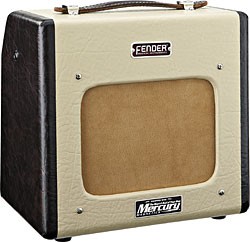
Fender’s tiny Champion 600 is aimed at the guitarist who requires rich power-tube distortion at low volume levels. With just one 6V6 power tube putting out five watts, getting the little Champ to scream is no problem.
Introduced after Epiphone’s similarly-sized Valve Junior, the Champ 600 has a smaller (6″ compared to the Epi’s 8″) speaker, but the Champ is much more compact at 11″ wide x 12″ high and 71/2″ deep. And at only 15 pounds, travelers can appreciate that it easily fits into a large suitcase (and leaves 35 pounds for jeans, toothpaste and Rogaine before the friendly ticket agent demands an additional $25).
Out of the box, the Champion 600 is an acceptable practice amp. But the word “acceptable” doesn’t mean much to the folks at Mercury Magnetics. Just as they did with the Epi Junior, Mercury conscripted Alan Cyr to devise a circuit that would bring the new Champion 600 closer to the sound of the coveted and increasingly rare Champ of the 1950s.
First thing to go was the speaker, which Cyr deemed the most limiting feature of the stock package. A suitable replacement came from Ted Weber. Next thing to be addressed was – believe it or not – volume. “The stock unit was not very loud, even for five watts,” Cyr noted. “There’s a tone stack without tone controls built in to the stock unit with fixed resistor values. Also, there were some slope resistors to make the tone less harsh. They were trying to mimic a ’50s amp that had an octal tube socket with a miniature nine-pin dual-triode tube. Running the signal through a resistor bleeds off high frequencies as a sort of low-pass filter.”
What Cyr ended up with was not a purely Champ circuit because it lacked a negative-feedback loop. Then Mercury changed the preamp and power amp transformers, and added a choke to create some filtering. They also eliminated about a dozen parts, greatly reducing parasitic loss of tone, which means the circuit most closely resembled a blackface Champ with a couple of changed cap and resistor values, with the goal of keeping the character of the 6V6 tube without having to push too hard.
Mercury says anyone who has replaced pickups or a tone switch should be able to accomplish this mod in a few hours (but of course anyone should very carefully read the instructions).
Without a guitar plugged in and even with the Volume knob all the way up, the modded Champ is nearly silent. A Gibson Les Paul Special with Rio Grande P-90s plugged into the High input produced respectable, chimey clean tones, especially through the Special’s bridge pickup with the Champ’s Volume knob at 4 or lower. Moving the Volume dial clockwise revealed a variety of distortion tones. It starts with a nice edginess and works its way up to full song. While the stock unit got a little shrill toward the end of the dial’s sweep, the Mercury-modded amp stays smooth all the way to the stop.
Next up was an equally practical Traveler Escape EG-1 with humbucker in the bridge. Plugged into the High input, the EG-1 sang away with the Volume at 5 (this amp bests Nigel Tufnel by going to 12, by the way). After 6 it’s Dicky Betts, and 10 or beyond gives a fuzz that would have felt at home four decades ago in Golden Gate Park.
Plugging into the Low draws more character from the humbucker. There’s just a little more clarity and some nice Tom-Petty-style chime on the lower volume settings with the EG’s Tone knob on max. Twisting the amp’s Volume knob brings more distortion, but in refined degrees. Note clarity and definition remain through the entire sweep, and the amp is extremely touch-sensitive, even through the humbucker.
Combining the middle and bridge pickups through notch position four on a DeTemple ’56 plugged into the Low input, the Champion offered an amazing and well-balanced cluck. Position one (neck pickup) produced all the glass and steel it was intended to make, the middle position was clear yet warm, and the bridge pickup could be coaxed to an aggressive, Telecaster-like attack.
The High input got all three pickups searing with sustain in any combination at any volume setting above 5. Most notably, the bridge pickup came alive and the Champion scored a knockout by providing great note clarity in the notch two position, which combines the neck and middle pickups. If an amp is going to fail on clarity in the ninth round, this is where it’s going to happen.
This article originally appeared in VG‘s November 2008 issue. All copyrights are by the author and Vintage Guitar magazine. Unauthorized replication or use is strictly prohibited.
Singer/ accordionist/ keyboardist Stanley “Buckwheat” Dural became a popular solo act in the zydeco world years before the unchallenged King Of Zydeco, mentor (and former bandleader) Clifton Chenier, passed away in 1987. While helping to fill that void, he (like Zachary Richard and the late Beau Jocque) had no compunctions about zydeco-izing rock and pop material – including a remake of “Why Does Love Got To Be So Sad” (on 1988’s Taking It Home), with Eric Clapton cameoing on guitar.
After his major-label stint with Island, he bounced around to various indies, and has now arrived at Alligator. The eclecticism is still very much a part of his M.O. – if anything, better achieved here, likely thanks in part to producer Steve Berlin, of Los Lobos fame – embracing everyone from Bruce Springsteen to Jimmy Cliff to Captain Beefheart.
The album kicks off with “When The Levee Breaks,” entering with the guitar of Sonny Landreth, who proved that slide and zydeco are a perfect marriage during his (and Buckwheat’s) stint with Chenier. Most fans know the song from Led Zeppelin’s version, but it dates back to Memphis Minnie and its composer, Kansas Joe McCoy. This eerie reading packs a powerful punch, no doubt fueled by the fact that both Dural and Landreth hail from South Louisiana – Hurricane Central in recent years.
Landreth is also onboard for J.J. Grey’s “The Wrong Side” – a melodic shuffle in the vein of Doyle Bramhall’s “Is It News” – delivering more beautifully slippery fills and solos. Allman Brother (and Gov’t Mule leader) Warren Haynes supplies the tasty solo on the album’s title track, which he co-wrote.
But the portion of the CD not inhabited by such star power is far from lacking, thanks to Buckwheat’s crack band, augmented by Trombone Shorty and Berlin’s baritone sax. Guitarists Olivier Scoazec and Michael Melchione are no slouches, and you’d be hard-pressed to find a funkier bassist than Lee Allen Zeno. Likewise, the talents and charisma of Dural, who had a hand in writing five of the set’s 11 tunes, shine brightest, as usual.
This article originally appeared in VG‘s Aug. ’09 issue. All copyrights are by the author and Vintage Guitar magazine. Unauthorized replication or use is strictly prohibited.
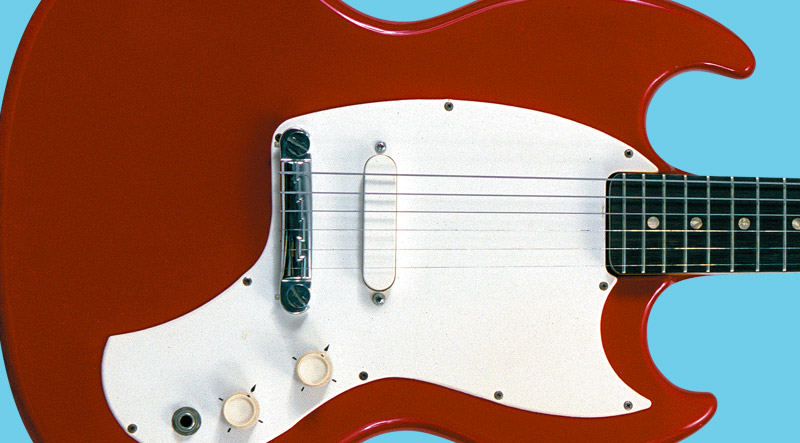
Collectible value in guitars can be defined any number of ways, and not just by having a popular brand name such as Fender or Gibson. That’s certainly the case with this little guitar! Ask virtually any guitar collector for his or her favorite brand, and Kalamazoo is probably not going to be the first name to come to mind. Or the second, or the… Nevertheless, there’s an awful lot more to this humble circa-1968 Kalamazoo U.S.A. KG-1 to make it special. Not the least of which is the fact that it features a good bit of technological innovation and is, well… actually a real Gibson guitar!
Kalamazoo was a budget brand created by Gibson around 1965, the height of the ’60s guitar boom and lasting until 1970 or thereabouts. Gibson was, of course, located in Kalamazoo, Michigan, from the 1890s until the final transition of its headquarters to Nashville in 1984. Gibson previously used the Kalamazoo name on its budget acoustic archtop and flat-top guitars, mandolins, and banjos between 1933 and World War II. The Kalamazoo line also included a few electric archtops and some Hawaiian lap steels. There were even a few Kalamazoo amplifiers produced from 1938 to ’40.
The Kalamazoo solidbody electric line was conceived at a time when guitar companies could sell just about anything they could make or lay their hands on. Gibson was one of the premium brands in the world and its guitars were expensive. In 1957, Gibson purchased arch rival Epiphone to be its “budget” brand – a bit of an insult, to say the least! Still, Epiphones had glued-in necks and were actually a mid-level brand by this time. Gibson wanted something truly inexpensive. The answer was to come up with the company’s first bolt-neck guitars, a strategy Gibson has tried with little success frequently over the years. To distinguish them from the plethora of imported guitars dominating the lower end of the market, Gibson added “U.S.A.” to the burned-in logo.
But simply making a bolt-neck guitar wasn’t the whole solution. Gibson turned to an innovative, low-cost material to construct its Kalamazoos. Innovation was no stranger to Gibson, which was born of Orville Gibson’s innovative carved, arched top instruments. Instead of solid woods, Gibson made its Kalamazoo line out of Medium Density Fiberboard, or MDF – a composite material made up of wood chips combined with wax and resin and then compressed by heat and pressure. MDF, better known to you and I as Masonite, was invented by William H. Mason in 1924. However, there were no commercial uses for MDF until the mid ’60s.
Unlike the cheap furniture you get at the big-box store, MDF is more “engineered,” denser and stronger. Kalamazoo guitars were the first instruments and among the earliest commercial applications of MDF!
The first Kalamazoos introduced in 1965 were basically copies of Fender Mustangs, which is pretty ironic considering Gibson’s later objection to “copies!” There were four guitars and a bass. All were equipped with bolt-on maple necks, MDF bodies, and Melody-Maker-style single-coil pickups; the K-1 had one, the K-1a added a simple vibrato, the K-2 had two pickups, K-2a a vibrato, and the KB was a one-pickup bass. The electronics – including the jack – were mounted on a simple plastic pickguard (no laminates), to save on production. Tuners were primitive open-back strip-style. There was also a small-bodied mahogany K-10 acoustic. Finish options were Flame Red, Glacier White, and Las Vegas Blue. All usually shipped in a chipboard case. There was a matching line of solidstate Kalamazoo amplifiers, but they were defunct before this guitar was made.
The first line of Mustang-shaped Kalamazoos lasted until around 1968, when they were replaced by the new SG shape seen here. This was a simplified form of SG, without the contours on the cutaways, though there is a little beveling on the tips and a chest/belly contour on the back.
Despite the use of downscale materials and construction, these little Kalamazoos are pretty nice guitars. Find your back aching a bit after a night of jamming with a Les Paul? That won’t happen with a Kalamazoo. The MDF is super light and surprisingly resonant. The neck is very thin for a Gibson, not quite a Kapa, but close. It’s extremely well-made and easy to play. The cutaways and pocket placement let you play all the way up the neck and the pickups have pretty good output for small units. Combined with the MDF, this guitar is especially loud on the high-end, with a curious “funky” tone that rounds out nicely when you roll the tone control to treble. The response is clean and bright. Playing this guitar easily reminds one of picking the Fender Mustang that the first models were designed to imitate, and indeed that contemporary guitar filled a very similar marketing purpose. In short, this guitar has a unique voice you’ll probably not find on any other guitar!
Kalamazoos have a stamped serial number on the back of the headstock that generally follows regular Gibson date ranges, though apparently there are plenty of exceptions. This example is stamped 529967 which, according to Gruhn’s Guide to Vintage Guitars, put this toward the end of 1968. That fits with the style.
Are these Kalamazoos rare birds? Just how many Kalamazoos were built is unknown. While Gibson kept pretty good production records at the time, they didn’t bother to track these lowly guitars. And lowly though they may be, these play extremely well and have a swell sound you couldn’t duplicate if you tried! Plus, they’re genuine Gibson-made and historically significant for their use of MDF. With prime timbers getting scarce and guitarmakers looking for suitable replacements, you might say that these little Kalamazoos were way ahead of their time! And certainly worthy of collectibility status… at a considerably lower price than guitars carrying the Fender or Gibson brand name!
This article originally appeared in VG‘s December 2008 issue. All copyrights are by the author and Vintage Guitar magazine. Unauthorized replication or use is strictly prohibited.
When Pete Townshend writes liner notes for an album that commemorates your career, and guitar players with names like May, Knopfler, Blackmore, Frampton, Iommi, and Green all plug in to participate, you’ve obviously got some clout. Such is the case with the Hank Marvin tribute Twang! A Tribute To Hank Marvin and The Shadows.
While his accomplishments are not that well documented in the U.S., Marvin is duly recognized in England as one of his country’s authentic guitar legends. Born Brian Radkin on October 28, 1941, he adopted the stage name Hank B. Marvin in 1958, a ploy to sound more “American.”
Having started out playing piano, clarinet, and banjo, his 16th birthday present was a Hofner f-hole acoustic, to which he attached a small pickup alongside the neck. Like most British guitars at the time, its strings were extremely heavy, in the neighborhood of .024.
That year, 1957, the bespectled teenager joined a skiffle group called the Railroaders, which included a young rhythm guitarist named Bruce Welch. Attempting to adapt to the newly amplified sounds of rock and roll, Marvin purchased an American-made Vega electric guitar.
The iconic musician, who has lived in Australia for the last 36 years, recalls, “It was a black archtop with a huge chrome arch over the pickup. It looked incredible, but you couldn’t bend the strings because the pickup covered the area where you put your hand. The interesting thing was that it had very good action, and a real twanging sound that was the nearest to what we’d been hearing on American records.”
Marvin was performing with that guitar at the renowned The Two I’s club in North London’s Soho area, when fate intervened. The aspiring young guitarist was offered the opportunity of joining the band of a then undiscovered teenaged singer named Cliff Richard.
Hank and the Shadows in the early ’60s: Angus McBean/EMI Music Ltd.
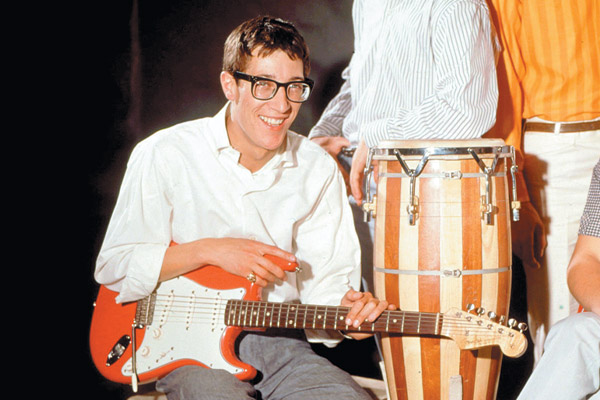
As Richard’s career soon took off, the young star wanted the leader of his backing band, then struggling with a cheaply made Japanese Antoria, to have the best available electric. Knowing Marvin fancied the Fender Stratocaster, Richard offered to buy one, which at the time cost the equivalent of five weeks of his guitarist’s salary. Marvin’s preference for the Strat developed through mistakenly believing it was the model used by his personal favorite, James Burton, who then played with pop idol Ricky Nelson.
“I’d never heard anyone bending strings like that before,” he still marvels. “We had very heavy strings, and couldn’t work out how he was able to bend them,” he said, laughing. “We thought it must have had something to do with his great American diet – you know, steak, orange juice, and milk – that gave him these incredibly strong fingers to be able to bend those thick strings. Of course, I later found out that he was using incredibly light strings.”
While Burton was actually playing a Telecaster, Marvin explains why he assumed the guitarist was using the Stratocaster.
“We loved the sound he and Buddy Holly had, and we’d seen the cover of The Chirping Crickets, where Buddy is holding a Strat. We just assumed that James would be using the same, because it seemed to be the top model.
“That’s how I got my Strat. And it was a beautiful guitar, [Fiesta Red] with a birdseye maple neck and gold-plated hardware.”
Except for a few years in late ’60s when he switched to a signature model Burns after losing his prized Strat, he has always been loyal to his trademark red axe. His current Fender signature model is based on the ’58, updated with Kinman noiseless pickups, Sperzel locking tuners, and a slightly wider neck and fret finish.
Key to Marvin’s love affair with the Strat was its vibrato.
“I took to the it like a duck takes to water,” he said of the device, which became key to his sound. “I learned to hit a note, drop off, and just pull it up… Just give it a hell of a shake on certain things to create a kind of dramatic effect. I have never used, except on rare occasions, tremolo on an amplifier.”
The Shadows – The Final Tour.
While Marvin and the Shadows were gaining popularity as Cliff Richard’s backup band, with their mentor’s blessings, they decided to cut some instrumental singles under their own name. The group’s breakthrough 1960 hit “Apache” spent 21 weeks on the U.K. charts (six at number one) and would be the first of more than 30 hit singles. Fourteen of them, like “FBI,” “Wonderful Land” and “Man Of Mystery” reached the top 10, making them England’s most successful pre-Beatles band.
However, newer, harder British outfits like the Rolling Stones, Who, Kinks, Yardbirds, Cream, etc., eventually rendered the middle-of-the road music of Cliff and the Shadows anachronistic. To contemporary rock music fans, they seemed like relics from a bygone era, and the Shadows split from Richard in December, 1968.
Since then, Marvin has mostly pursued a solo career, while stopping along the way in 1974 to form the vocally-oriented Marvin, Welch, and Faraar. After disbanding a short while later, and re-forming the Shadows for several brief spells, the veteran reformed the iconic band again in 1990. That effort ended acrimoniously, but in 2004 Marvin was offered the opportunity of doing one last farewell tour with the band, with one concert captured for posterity on DVD and CD called The Shadows – The Final Tour.
Reflecting on it now, Marvin says with obvious affection and pride, “You know, a lot of years have gone under the bridge with the Shadows going back to 1958. You could see the tears in the eyes of people in the audience thinking they’re never going to see us working again.
“This all wells up inside you,” the unassuming member of British rock royalty concludes, adding, “Yes, it was very, very emotional. Very involved.”
This article originally appeared in VG‘s April ’06 issue. All copyrights are by the author and Vintage Guitar magazine. Unauthorized replication or use is strictly prohibited.
Wariner has scored more than 40 Top 30 country singles on his own, about a dozen of them reaching #1. But rarely does guitar playing place you at the top of the charts, no matter how good you are. Much like George Benson or pianist Nat King Cole, the instrumental prowess of Wariner, like country stars Brad Paisley and Vince Gill, is just extremely tasty icing on the cake – secondary to his singing and songwriting in terms of commercial success.
As with Paisley’s The Guitar Album, it’s refreshing when such a superstar puts out an album filled with picking, just for us guitar fans – and for themselves. In the case of Wariner (who released a fine, all-instrumental outing with 1996’s No More Mr. Nice Guy), it’s especially heartening, because, while displaying his own six-string talents, the 54-year-old’s latest CD focuses on his mentor, Chet Atkins.
Steve (who played bass in Atkins’ band) provides the bass on several tracks, in tandem with brother Terry’s drums on the opening original, “Leaving Luttrell,” named for Chet’s Tennessee hometown. The keys to the song’s (indeed all the songs’) success are Wariner’s mastery of the subtleties of Atkins’ style, not the flash – something as simple as the way Chet would dip the whammy bar “just so.”
Two cuts simultaneously pay tribute to Chet and acts he signed to RCA: Jerry Reed (“Reeding Out Loud”) and Los Indios Tabajaras (“Blue Angel”). On the latter and the poignant closer, “Silent Strings,” Steve gets a beautiful tone from his Del Vecchio gut-string resophonic.
Wariner may not be as dazzling as, say, Tommy Emmanuel (another of Chet’s mutual admirers), but he probably comes as close to Chet’s spirit – that ability to be laid-back and energetic at the same time, making daunting passages appear effortless – as anyone ever has.
This article originally appeared in VG‘s Sept. ’09 issue. All copyrights are by the author and Vintage Guitar magazine. Unauthorized replication or use is strictly prohibited.
When a guitar junkie hears the words “soapbar” and “P-90,” the mental image is usually that of a cream-colored rectangle seated deep in a sea of metallic gold, accentuating the curves of one of the most beautiful, sexy guitars ever created – the Gibson Les Paul. Combined with its pure, raw, in-your-face tone, it gave birth and voice to rock and roll.
Of course, Les Paul had another sound in mind when he decided to let his name grace the peghead of that first solid slab of Gibson ingenuity. Given all that has been revealed about the accomplishments of Les Paul, it’s rare that a new tile can be placed in the mosaic that forms a picture of his life. But here is such a piece of history.
In May of 1935, Gibson general manager Guy Hart, realizing the newfangled electric guitar craze was catching on, made a move to get Gibson in the race. He enlisted the help of longtime Gibson endorser Alvino Rey, the most popular electric player of the period. The 27-year-old Rey, who had a background in electronics and fascination with design, was teamed with John Kutilek, a radio and audio engineer at the Lyon and Healy manufacturing facility in the West Loop of Chicago. Working together at Lyon and Healy when Rey’s schedule permitted, they attempted to develop a unique pickup that would not infringe on existing designs. Unfortunately (or in hindsight maybe not), they were unable, given Rey’s hectic schedule and limited time, to come up with a successful design (see “Crude Beginnings,” VG, February ’97).
By mid summer, the project was transferred to the Gibson factory, where a young Walter Fuller, head of Gibson’s new electric department, made the pickup functional and fitted it into hollow cast-aluminum electric Hawaiian guitar bodies. By the end of October, 1935, Gibson had shipped its first electric Hawaiian.
Les Paul playing the ’39 L-7.
While Mr. Fuller was working on the pickup design in Kalamazoo, Kutilek was working on an amp in Chicago. Fuller sent pickups to Lyon and Healy, and Kutilek would tweak the amp design to complement the pickup, staying within industry-established audio specs for distortion. Fuller and Kutilek became good friends and for years continued to exchange ideas.
By the mid 1930s, Gibson had already formed a relationship with Les Paul, a.k.a., Rhubarb Red. He appeared, sporting a Super 400 with what looks to be a black finish, in a photo on a piece of sheet music from ’35, and the same image is used in a 1937 Gibson catalog.
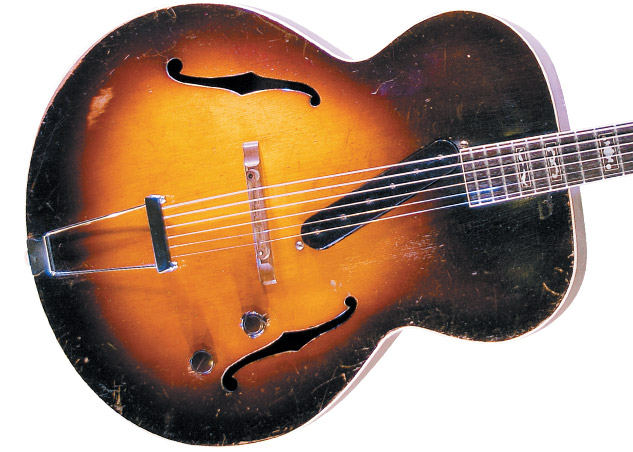
Gibson shipping records are peppered with entries for instruments the company sent to him, including a 1936 L-7, with later-installed prototype ES-300 pickup. Gibson shipped this L-7 (serial number 93713) to Les Paul on March 23, 1939, and he immediately put it to use. In April he was photographed with the Fred Waring Orchestra using it, prior to the installation of the pickup. Unique to this guitar are a very slim-profile neck and later factory-installed Grover Deluxe stairstep tuners, which did not exist when the instrument was shipped to Lyon and Healy October 25, 1936.
A New Direction: The First P-90
In the spring of 1940, Gibson was still using the bar pickup developed in ’35 for their electric Spanish guitars. Most of its competition had modified pickup designs by this time, with the notable exception of L.A.-based Rickenbacker, whose main focus was electric Hawaiian instruments. Gibson’s most formidable rival, Epiphone, had moved from using the Rickenbacker-inspired horseshoe design to the True Balance pickup, which used a single transformer-wound coil with adjustable poles. Across the lake in Chicago, National-Dobro had developed a rectangular, metal-covered unit with two rows of staggered, height-adjustable poles, each with its own coil. Between the coils were two magnets placed in a hum-canceling design, with one set charged with a South polarity, the other North. The use of hum canceling was not new to National-Dobro, which used it in 1933 on the Dobro All Electric.
(Left to Right) Ad from the May ’41 issue of Metronome touting Les and his playing with the Fred Waring Orchestra. Note that the peghead is an L-5! Gibson brochure from October, 1940. Rhubarb Red as shown in a 1937 Gibson catalog.
Gibson’s team, headed by Fuller, had also initiated changes. By late fall of ’37, the dual nickel-steel heavy double bar magnets of the electric Hawaiian guitars had been replaced by a smaller, lighter, cast horseshoe-shaped unit that was attached to the bottom of a now split bar polepiece. The design’s inaugural use was in Gibson’s first electric banjo, custom made for Roy Smeck and shipped November 11, 1937.
Fuller had realized early the need for balancing output from string to string. This is evident in the split poles of the first EH guitars. By early ’38, Gibson’s interest in height-adjustable poles is evident in patent number 2145490, filed April 18. Another variation on the theme was the “designed for height adjustable poles” Charlie Christian-style pickup found in a Gibson-built Cromwell G-6. Yet another example was found in a two-pickup ES-150 shipped May 11 of that year. The instrument was returned to Gibson, where a matching P-90 disguised as a Charlie Christian pickup was installed in the bridge position in early ’41.
In late 1939, Walter Fuller was experimenting with magnets made from the lighter, stronger alloy called Alnico, searching not only for a competitive design, but also proper placement for the best tone in the new generation of ES guitars. The idea for the 6 3/4″ P-90 was to capture “full tonal range,” as close to an acoustic as an electric could get. The length allowed him to span the distance from the end of the fingerboard to the bridge. He positioned it diagonally closer to the bridge on the treble side to capture the highs, and farther away on the bass side for a richer, deeper tone. Utilizing the basics of the original bar-pickup design, this new coil is comprised of an iron core threaded for the height-adjustable polepieces; a top and bottom of tortoiseshell celluloid complete the coils of the new thinner-profile bobbin. The iron core extends below the bottom plate, and along its exposed length are four Alnico magnets. The coil is attached with two screws to a mounting frame, which has threaded inserts and springs at the ends to allow for height adjustment.
Height-adjustable “Charlie Christian” pickup from a Gibson-built Cromwell G-6.
This hand-built pre-production unit differs from production examples in a number of ways. The mounting frame shows signs of having been placed in a vice and bent at 90-degree angles, and retains the hand-drawn markings for the holes. The magnets are installed with the North polarities butted next to the iron core. In order to counteract the repulsion of like poles and keep the magnets in place, they are glued to the bottom of the bobbin plate and retained with three brackets. The square ends of the mounting frame have been rounded by hand-grinding. Production mounting frames show rounded smooth bends, as though formed in a press, and have no brackets to secure the magnets. The top and bottom celluloid plates of this early unit are the same size in length and width. Production units have a smaller bottom plate, so the coil can be wrapped with a thin celluloid tortoiseshell cover for appearance, protection, and to help secure the magnets. The heads of the screws used for the polepieces on the early example have been hand-ground smaller than their original diameter, and they are all different sizes and out-of-round. Production examples use stock, slightly larger-headed screws.
No doubt the folks at Gibson had a keen interest in Les Paul as a rising star. His two main electrics at the time were a Gibson ES-100 and ES-150. Les could have been informed about the development of the new pickup on one of his visits to Gibson, hanging out at Lyon and Healy with Kutilek, or could have been told about it on one of his visits to the company’s East Coast showroom, New York Band. But one thing is clear; he took Gibson up on its offer and returned his L-7 to Kalamazoo. Fuller installed his new pickup and on July 12, 1940, Gibson returned the upgraded L-7 to Les Paul.
(Left to Right) Bottom of the prototype ES-300 pickup, showing four Alnico magnets. Side view of production “long” P-90 from a late-1940 ES-300. The second-generation “Charlie Christian” pickup, from 1939. Side view of prototype ES-300 pickup. Note the bent corners and brackets used to secure the magnets.
The Chicago Musical Instrument Trades Show (today known as NAMM) held in late July, 1940, heralded the debut of Gibson’s new electric lineup. The new ES-300, in blond finish, made its formal debut. The new ES-100 and ES-150 would be fitted with a smaller version of the new P-90 hidden under a metal cover next to the bridge. This new positioning gave the guitars a more defined lead tone – Gibson’s response to the changing use of the electric guitar from a background rhythm to the single-note lead instrument Charlie Christian had proven it could be. Electric Hawaiian models were also outfitted with the new design. This point marked the end of regular production for the flagship bar magnet design that had five years earlier launched Gibson into the electric race. It was now firmly in first place.
Robb Lawrence, author of the recently released The Early Years of the Les Paul Legacy, showed the pictures to Paul, who immediately recognized the guitar and said Gibson had installed the pickup for him. After using it for a while, he found he wasn’t fond of the sound, so he returned it. Alvino Rey said the same of his ES-300s, and that he preferred his ES-250 with the original bar pickups.
This and other artist feedback may be the reason for the model’s short life span. Approximately 60 were shipped with the long P-90, making this one of the rarest production instruments Gibson has ever built. By the spring of ’41, the long P-90 had been replaced by the smaller unit which, though still at a slight angle, was placed just in front of the bridge.
As was common practice at Gibson, this guitar was shipped again, on October 17, 1941, to Davitt and Hanser in Seattle. Its new owner had no idea of its place in Gibson history.
Special thanks to Arian Sheets at the National Music Museum.
This article originally appeared in VG‘s October 2008 issue. All copyrights are by the author and Vintage Guitar magazine. Unauthorized replication or use is strictly prohibited.