Brothers Brad and Matt Schultz had a rough youth in small-town Kentucky, where music, money and hope were hard to find. Growing up in an eventually broken home with six people squeezed into a two-bedroom apartment, they sneaked in Bob Dylan and Jimi Hendrix music behind the backs of disapproving parents.
When Brad was 12, he spent 20 hard-to-come-by dollars on a used guitar. That it fell apart before the brothers could afford a replacement is testimony to the spirit behind Cage The Elephant.
The band writes and plays like it’s important, the way you’d expect from a bunch of misfits who grew up in a town where success meant working at the same plant where your parents worked. The brothers chose a different path, joining Jared Champion (drums) and Brad Tichenor (bass) to form Cage; though their songs about alienation (“In One Ear”), crooked preachers (the title cut), and borderline hopelessness (“Lotus”) give the impression there wasn’t much choice involved – it was more a soul-salvaging need.
On “Ain’t No Rest For The Wicked” powerful semi-metal rhythms meld with Brad’s impressively sophisticated, sometimes wrenching, psychedelic guitar sounds while brother Matt spits defiant mile-a-minute lyrics in a perfect garage-band voice; Cage The Elephant plays like they’ve been listening to 13th Floor Elevators and watching Jim Jarmusch movies every day since elementary school. They play like they mean it; there’s just no way their music could be this viscerally charged, this real, this good, if they didn’t.
This article originally appeared in VG‘s Nov. ’09 issue. All copyrights are by the author and Vintage Guitar magazine. Unauthorized replication or use is strictly prohibited.
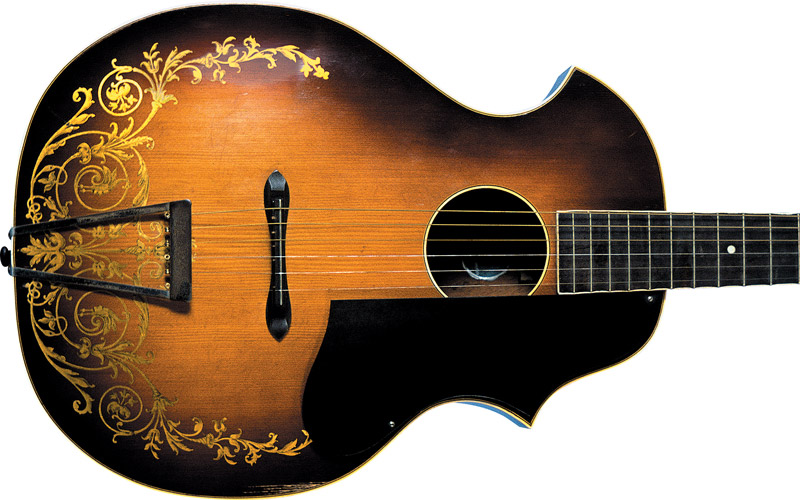
Almost any guitar can be viewed in terms of a confluence of influences that produced it, from the company history to the history of guitar evolution to the kind of music it was meant to play. But it’s rare that you get one so fully loaded as this circa 1933 KayKraft Style A that’s just brimming with those confluences plus a Sicilian connection, union busting, and even a World’s Fair! All in this guitar!
Let’s begin with the company. The KayKraft name appeared at a momentous time, just as the Kay brand was emerging as a powerhouse. KayKraft guitars were built by the Stromberg-Voisinet Company (pronounced to rhyme with “bet”) of Chicago. S-V was founded in 1892 as the Groehsl Company, just as the Chicago musical instrument manufacturing scene was exploding. This was partially due to the proximity of plentiful natural resources – the forests of the upper Midwest – partially to the availability of skilled labor, and partially due to its geography and numerous railroad lines. Another factor was the success of catalog retailers such as Montgomery Ward and Sears, both of whom drew upon local manufacturers to supply the growing nation’s demand for guitars.
In 1921, Groehsl was taken over by C.G. Stromberg (no relation to the Boston guitarmaker) and presumably someone named Voisinet. In ’23, the company was joined by Henry Kay Kurhmeyer, who was secretary of S-V by 1925. In ’27, S-V introduced a new line of guitars called KayKraft, including a set-neck Venetian guitar. The established wisdom is that the line was named after secretary Kuhrmeyer’s middle name, though S-V was already importing German violins and cellos made by the Kreuzinger factory, which could also have been a factor.
By 1931, Kurhmeyer was president of S-V. KayKraft guitars were increasingly promoted. S-V guitars disappeared by ’32. The company continued to be known as S-V, but by ’34 had made the full transition to the Kay Musical Instrument Company, on the back of KayKraft guitars. The guitar shown here reflects that changeover.
The first thing you notice is that the KayKraft guitar is basically shaped like a Venetian mandolin, a design that dates back at least to 19th-century Italy. No coincidence, since the Venetian shape appeared right after the luthier Joseph (Giuseppe) Zorzi – a descendent of the famous Sicilian Panormo family – moved from Lyon & Healy (L&H) to S-V.
In 1924, general disgruntlement about wages led to the formation of the American Guild of Luthiers, though it was more of a drinking club than an activist organization. In ’26, Zorzi posted notice of a Guild meeting at L&H and was fired. He immediately took over managing production at S-V. The Venetian shape appeared the next year, though there has been speculation that it owes more to Philip Gilbert, another luthier who followed Zorzi.
Whoever we thank for the shape, Zorzi kept experimenting with the form. The first KayKrafts were set-neck flat-tops. But interest was growing in a new form, the archtop. Beginning about the time of World War I, America began to become increasingly interested in jazz and the jazz band. While this kind of music was dominated by wind instruments, the rhythm section was often built around the cutting power of the tenor banjo.
Tracing that fascinating story is more than we can do here, but the tenor emerged from the banjo orchestra work of James Reese Europe, music director for the first American professional dance team of Vernon and Irene Castle, who returned from Europe in 1914 and introduced America to the Argentinean dance rage, the tango. Europe featured lots of banjos because he liked African-American instruments. One of these was a short-necked version of the four-string plectrum banjo tuned like a mandolin and known as the tango banjo. This became the tenor banjo that powered the dance bands of the 1920s Jazz Age.
Circa 1924, Gibson’s genius Lloyd Loar developed the Gibson L-4, the first modern archtop guitar. It didn’t take long for guitarists, bandleaders, and manufacturers to appreciate the power of this new design, often touted as “violin construction.” Many early archtops were tenor guitars, emulating the tuning of the tenor banjo and thus facilitating conversion. By the late 1920s, jazz bands were switching from banjos to guitars. The arrival of electricity would, of course, hasten that change, but that’s also another story.
So, we return to the KayKraft Style A. In 1929, Joseph Zorzi took the original flat-top Venetians and made significant improvements. First, in tune with the times, he arched the top and back. Unlike the carved creations of Loar/Gibson, this was “stressed,” a.k.a. bent. This idea was not new to Chicago luthiers; the Larson Brothers had used this method early in the 20th century, bending a solid piece of wood over curved braces to produce additional stress presumably for increased projection. To be honest, you ain’t gonna power a jazz orchestra with a KayKraft, but the idea wasn’t bad.
Perhaps more interesting was the construction of the neck-body joint; Zorzi came up with a bolt-neck design with a threaded bolt sticking out from the neck heel into the body cavity, where it was secured with a wing nut. The heel was given a convex profile. Then, between the heel and the upper bout Zorzi inserted a piece of wood with a concave profile. Loosen the strings a bit, loosen the wing-nut, and slide the neck along the shim and the angle changes, helping adjust the action. A brilliant idea (and one that probably could have used two bolts for better stability)!
KayKrafts came with spruce tops and ribbon mahogany (Style A), flamed maple (Style B), and rosewood (Style C) bodies. They were produced until 1934. Would you take one over a contemporary Martin, Gibson, or Larson? No. But they have a nice, funky sound typical of the era.
Most KayKrafts shown in catalogs are plain. The one seen here has a gold “decalomania” belly decoration. While this can’t be confirmed, we suspect these were special models made in celebration of the 1933 Chicago World’s Fair, much like Gibson’s fancy Century of Progress flat-tops.
Production numbers are unknown, but they show up fairly frequently in snapshots from the era, so they’re probably not rare birds, or rather, weren’t in the ’30s. And today, no one is reproducing these cool relics from the Great Depression.
This article originally appeared in VG‘s May 2008 issue. All copyrights are by the author and Vintage Guitar magazine. Unauthorized replication or use is strictly prohibited.
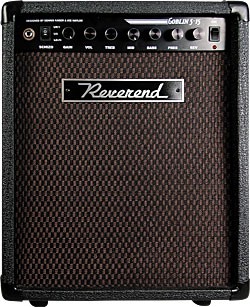
Reverend’s Goblin 5-15 is the brainchild of Reverend founder Joe Naylor and Dennis Kager, of Pignose and Ampeg fame. The Goblin was designed as a simple single-channel, all-tube amp with certain boutique features in small package.
At 163/4″ x 131/2″ x 91/2″ and 22 pounds, the Goblin certainly is transportable. Its lack of weight can mostly be attributed to the 10″ Jensen neodymium-magnet speaker, which weighs about half of what a standard speaker weighs, but delivers better low-end response and power-handling capability.
Like other Reverend amps, the Goblin employs an all-tube design and switchable power amp section with a matched pair of Electro-Harmonix 6V6 tubes, a preamp with hum-eliminating DC-filament 12AX7s, and a 12AX7 tube reverb circuit with an Accutronics tank. The all-plywood cabinet is covered in black tolex with hardware and spun-aluminum knobs in black, and a black faceplate with white silkscreen. The checkerboard grillecloth and retro-style Reverend logo add vintage flair.
Like a lot of other U.S. manufacturers, Reverend uses imported and American-made parts, then assembles and tests its amps in the U.S. All controls, switches, tube sockets, and jacks are mounted to the chassis, as are the PC boards.
Controls on the Goblin include Gain, Volume, Treble, Midrange, Bass, Presence, and Reverb, as well as Reverend’s trademark Schizo switch for punching up three voicings; the “US” setting has transparent mids, crisp highs, and beefy low-end for a Fender sound; “LO-FI” uses more mids and softer highs, for a warm vintage tone, and the “UK” has even more aggressive mids and crunchy highs for that British sound.
The back-panel layout includes a switch for setting output at either 5 watts or 15 watts. It also houses 1/4″ send/return jacks for the passive effects loop and three 1/4″ speaker output jacks – one each for 4-, 8-, and 16-ohm speakers. The “one jack for each impedance” setup is arguably better than the typical impedance switch (which is often forgotten when going between cabinets) or the confusing multi-impedance combination jacks.
With a Fender ’60 Relic Strat plugged in and the Schizo switch set to “US,” the amp delivered a remarkably big sound for a 15-watt 1×10″ combo – clean, crisp highs and big low-end you’d expect more from a 12″ combo. Dialing in some of the Goblin’s tube-driven reverb made the sound even bigger, with a lush ambience. Even with the bass and volume turned up, it stayed tight and responsive with all three pickups. Moving the Schizo switch into the “LO-FI” position fattened up the mids and smoothed out the highs, and added a bit of grit to the sound – all without losing its round, Fender-like tone.
With the Schizo in the “UK” setting and the gain control straight up, the amp started to break up nicely with that British bite in the upper midrange. One very notable absence was noise and microphonics from the preamp tube; it was nice to hear (or not hear) that quality tested tubes were used in the preamp section.
Next, we plugged in a Duncan humbucker-loaded Hamer Studio, and again the “US” and “LO-FI” settings produced a spacious clean sound that could be dirtied by just playing a little harder. The “UK” setting had more bark with the humbuckers than with the single-coils, though it got a bit mushy if we pushed the gain too far. The preamp stayed together better with the lower-gain single-coils in the Strat.
We checked the Goblin’s performance running straight into a Celestion-loaded Randall 4×12″ with the Hamer. We were pleasantly surprised as it delivered a loud, crunchy British-flavored overdrive that wasn’t mushy or harsh. Note separation was good and, with the Schizo in the “UK” setting, the amp offered a fair amount of gain. The 5-/15-watt power feature definitely made the amp “apartment friendly,” allowing it to be used more as a practice amp – without sucking the life out of the tone. In 15-watt mode, the amp is plenty loud, both clean and overdriven, for rehearsals, studio work, or even some small gigs. And it’s a breeze to tote.
The Reverend Goblin 5-15 is a remarkably big-sounding little amp. Its versatile Schizo switch, quality construction, and tube-driven reverb circuit make it a very nice, very versatile bargain. It’s easy to scare up good sounds with this Goblin!
Reverend Goblin 5-15 Features Electro-Harmonix 6V6 power tube, 12AX7 preamp tubes, 5- or 15-watt selectable output, tube-driven Accutronics reverb tank, three-way US/LO-FI/UK Schizo switch, Jensen Neo 10/100 10″ speaker, passive effects loop, four-band tone control Price $549 (direct). Contact Reverend Musical Instruments, 27300 Gloede, Unit D, Warren, MI 48088; phone (586)775-1025; www.reverenddirect.com. This article originally appeared in VG‘s May 2005 issue. All copyrights are by the author and Vintage Guitar magazine. Unauthorized replication or use is strictly prohibited.
Singer/guitarist Cris Jacobs and singer/mandolinist Kenny Liner co-write the music for this Baltimore-based band. Jacobs writes songs with inherent soul. Whether slinky funk (like the opener, “Honey Bee”) or blues/rock with a ragtime feel (“Old White Lightning”) they ooze soul and taste. The latter even includes an understated wah solo. And though it would seem a contradiction in terms, it works perfectly.
Jacobs’ slinky, popping guitar through the former is about as simultaneously out-front and unobtrusive as a guitar part can get. His playing is never in the way, but the song couldn’t exist without it. Jacobs’ vocals are gutsy, gritty, and perfectly complement his writing.
It all mixes perfectly with the songs by Liner, whose “Dirtball Blues” is bluegrass/country heaven. He has a lighter, more airy voice than Jacobs and his lyrics tend to be a little funnier, often with an edge. His mandolin skills are excellent, and he complements Jacobs perfectly while soloing. While most of the songs with a country feel are written by Liner, Jacobs’ “country” solos are killer – check out his banjo rolls that kick off “Born Ramblin’.”
As long as bands like this are around, roots music will survive.
This article originally appeared in VG‘s Mar. ’09 issue. All copyrights are by the author and Vintage Guitar magazine. Unauthorized replication or use is strictly prohibited.
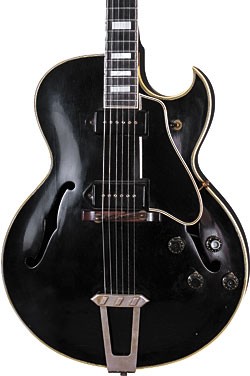
From Gibson’s early years through the 1960s, the company made many custom instruments that mixed and matched specifications from various models. Few have been as intriguing as this custom ES-175 from 1955, made for musician Andy Nelson.
The guitar is interesting even without a connection to a player. Serial number A-20852 puts it in 1955. The label says “ES-175 SPEC,” and the special features start with the body. The 16″ body with Florentine pointed cutaway would appear to be an ES-175D (D for double-pickup) or an ES-225TD, which was built as a thinline version of the 175; no other Gibson electrics had a pointed cutaway until 1960. The double-pickup ES-225TD didn’t appear until 1956, so unless this was an early example that didn’t ship until ’56, ES-175D seems to be the only possibility.
The body, however, is 2 1/2″ deep. That’s a full inch shallower than the standard ES-175 but almost an inch deeper than the thinline ES-225T (single-pickup) and ES-350T that Gibson introduced in 1955. It’s only a 1/4″ deeper than the Byrdland, the short-scale, thinner-bodied version of the ES-5 that was also introduced in ’55. Apparently, Billy Byrd and Hank Garland (for whom the Byrdland was named) were not the only musicians who thought a medium-depth guitar would be the most comfortable.
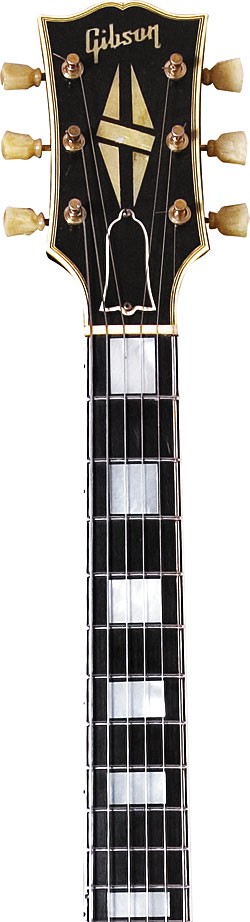
The ornamentation is obviously custom – for an ES-175, that is. It would be completely standard on a Les Paul Custom, which had been introduced only a year earlier. Standard custom specs include the black finish, multi-layered binding, mother-of-pearl block fretboard inlays, and five-piece split-diamond peghead inlay.
Again, the mixing of model specs is nothing unusual for Gibson. In the 1970s, Gibson even did it on official models, such as the Super V (an L-5CES with Super 400 neck) or the Les Paul Artisan (which featured banjo-style hearts & flowers on the fingerboard). In that context, this mid-depth ES-175 with Les Paul Custom ornamentation is a rather typical custom order. Gibson’s ledger books, however, tell a much more interesting story.
On May 24, 1955, the entry for A-20852 shows “ES-175 Spec. Wurlitzer – for Andy Nelson – WBBM.” All three elements of the entry have some connection to guitar history.
Special Wurlitzer
The Rudolph Wurlitzer company may be best known today for jukeboxes, pianos, and the Mighty Wurlitzer theater organs, but in the mid 20th century, Wurlitzer was a full-line musical instrument distributor and retailer. The Martin company made special guitars for Wurlitzer in the 1920s. In 1955, Martin made some 12-fret solid-peghead models for a different Wurlitzer, the E.U. Wurlitzer store in Boston; those models led to the D-28SW and D-35SW models, with SW designating “Special Wurlitzer.” Coincidentally, Gibson president Ted McCarty had worked for Rudolph Wurlitzer before coming to Gibson, but we’re not aware of any guitars that Gibson might have made for Wurlitzer.
WBBM
This Chicago radio station, AM 790, has had a news-talk format for over 35 years now, but in 1934 it introduced Chicago to a country singer named Sunny Joe Wolverton and his hotshot guitarist, Rhubarb Red, later to be known as Les Paul. It’s reasonable to assume that WBBM still served up music in ’55, but any connection to Wurlitzer, or to Andy Nelson, is unknown.
Nelson is not unknown in Gibson history of the 1950s and ’60s. Born in 1921, he grew up in Chicago, where he was making a living playing guitar in clubs while still a teenager. After World War II, he traded one or more of his three Gibson ES-150s for a blond cutaway L-5 and promptly customized it by adding an ES-150 “Charlie Christian” pickup. It would be the first of many custom guitars for Nelson.
Through the first half of the ’50s, he played with a music/comedy act called the Tune Toppers. His decision in ’55 to leave the band (and road work) was pivotal to his career. He quickly worked his way into recording sessions, including what would become one of the biggest hits of 1956 – “The Auctioneer,” by Leroy Van Dyke. He also landed a position as bass player in the staff band at Chicago’s WGN.
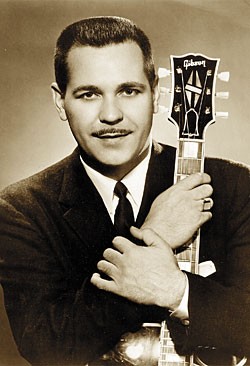
Nelson had been playing a single-pickup blond ES-175 and an ES-295 (essentially a gold-finished, two-pickup version of the ES-175). Gibson introduced the fancy black-finished Les Paul Custom in 1954, and sometime in ’55 Nelson custom-ordered his thinner ES-175 trimmed out like the high-end Les Paul. Why it was logged in as Special Wurlitzer – WBBN is a matter for speculation. It’s possible that Nelson had a spot on WBBN that Wurlitzer sponsored, or that he was pitching a custom Gibson model to Wurlitzer. What is certain is that Nelson received the guitar and liked it enough to hold it in a studio portrait. The photo is included in a book about Nelson, written and published by his nephew, Lawrence Grinnell.
Andy Nelson
The most important event of ’55 for Nelson came when he was hired by Gibson as a clinician, a job that expanded in ’57 to include sales. Gibson got more than they bargained for, as Nelson was constantly coming up with new ideas. He was the driving force behind Gibson’s first amps with reverb. He came up with L-5CT, a thinbody, shorter-scale (243/4″) version of the L-5C, for comedian/musician George Gobel. He was the “poster boy” for Gibson’s semi-hollowbody line of ’58, appearing in literature playing an ES-355 – customized (or possibly a prototype) with an L-5-style flowerpot inlay on the headstock, rather than the standard split-diamond.
In 1962, Gibson made Nelson an Epiphone salesman. His first good guitar had been an Epiphone Triumph, and he threw himself into the job. He sketched out an entire new line of Epiphones, including a highly ornamented flat-top called the Excellente. By Nelson’s account, he was too successful with Epiphone, to the point that Gibson president Ted McCarty felt that Epi was threatening Gibson’s prestige. Nelson resigned in frustration in ’65 and went to work for Fender. A heart attack in 1970 forced him into early retirement, and he played only for recreation from then until his death in 1995.
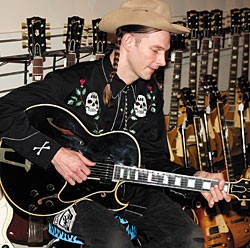
The custom black ES-175 remains a part of Andy Nelson’s legacy, and it has recently taken a place in another famous legacy. Somewhere along the way, Nelson parted with it, and it ended up in an Ohio music store, where it was discovered and purchased last year by Nashville artist Shelton Williams, a.k.a. third-generation country star Hank Williams III.
Shelton Hank Williams, III with the ES-175 Special Wurlitzer.
Son of a superstar, grandson of a legend, Shelton Hank Williams, III first played in public when he jumped behind the drum kit with Bocephus’ band at the tender age of 10. And though one would think his pedigree had him following in his daddy’s bootsteps, the youngest Hank was much more about Black Sabbath, Kiss, and Ted Nugent.
From his teens through today, the 36-year-old Williams has spent time in several bands, always flaunting a penchant for raw musical diversity; he has long played drums in punk bands, and today does so for the punk-metallers Arson Anthem, which is fronted by former Pantera vocalist Phil Anselmo. Williams also fronts his own group, which in the course of a gig transforms from playing neo-traditionalist country/rockabilly as Damn Band to (with minor personnel and equipment changes) to cramming all-out punk as Assjack.
Williams’ 2008 album Damn Right, Rebel Proud, became the third of his five to reach Top 20 on the country charts, peaking at #2. – Ward Meeker
This article originally appeared in VG‘s May 2009 issue. All copyrights are by the author and Vintage Guitar magazine. Unauthorized replication or use is strictly prohibited.
For a guy born in New Zealand and reared in Australia, Keith Urban certainly knows how to grab the attention of Yankee music fans.
The supertalented artist not only writes hit songs, gather accolades, and recently married a movie star (that’d be Nicole Kidman!), he is also a straight-up hellacious guitar picker and gear lover of the highest order.
Urban’s songs, heard mostly on country radio, are loaded with decidedly “un-country” arrangements propelled by his rock-influenced guitar style. And when he recently received the Country Music Association’s Entertainer of the Year award, the hitmaker joined an exclusive cadre of country artists/guitarists that includes Glen Campbell, Ricky Skaggs, and Vince Gill. Other new prizes include his first Grammy Award, and being chosen – along with the likes of Sting, Jackson Browne, and Bruce Springsteen – to pay tribute to James Taylor when the latter was chosen 2006 MusiCares Person of the Year.
Urban’s musical education began when he took up the ukulele at age 4, followed by guitar a couple years later. Through lessons, time, and listening to the likes of Mark Knopfler, Lindsey Buckingham, and Ray Flacke, Urban began to hammer out his own style. He then played in cover bands and eventually began writing his own music. Diligence, patience, and dedication would eventually lead Urban to write the majority of his own material, including his hits.
After spending years on the club scene in Australia, he signed and recorded an album for EMI/Australia that did well in his homeland. But his sights were set on a bigger prize – the U.S. After several visits, he moved to the U.S. in 1992. The change of locale also brought about a change in label affiliation when Warner Brothers signed him to a developmental deal that would sustain him as he wrote songs and created his sound.
Audiences in the U.S. were introduced to Urban through the country-rock trio The Ranch, which spent years recording and playing in Nashville clubs until their self-titled debut was released in ’97. The album didn’t produce any hits, but did help Urban score guest appearances on records by other artists, including the Dixie Chicks and Garth Brooks, who used his funky, twangy Tele playing to dress up their music. After The Ranch split, Urban resumed his solo career with a self-titled release in 1999.
In ’02, veteran studio guitarist Dann Huff signed on as Urban’s producer. The fruits of the union came quickly, as their first collaboration in the studio, “Somebody Like You,” spent eight weeks atop the country singles charts and the album Golden Road introduced a new, more guitar-oriented sound that mixed acoustic instruments, overdriven guitars, and a driving beat. Songs like “Who Wouldn’t Want To Be Me,” kicked off with the sound Urban’s Telecaster being tuned down, followed by twang-filled licks and distorted wah fills: the “Keith Urban sound” had taken shape. The followup, 2004’s Be Here, further cemented the sound with more hits and platinum sales. And this time, Urban hit the road with a band of studio players and top touring veterans.
His newest release, Love, Pain & The Whole Crazy Thing, finds Urban’s songwriting and guitar-playing muscle flexing in a whole new way, melding influences and guitar tones with the freedom granted by multi-platinum sales, hit singles, and sell-out concerts.
Vintage Guitar recently sat with Urban to talk about his musical beginnings in Australia, his hardfought rise to prominence in the world of country music, and of course, guitars.
Vintage Guitar: How did you start playing the guitar? Keith Urban My dad gave me a ukulele when I was four years old. I never learned to play any chords with it or anything – I just used to strum it in time to the radio. Dad was a drummer, and I kind of inherited his love of music.
What kind of music did he perform?
He played in a band in the 1950s, so they were playing Top 40 stuff of that era. He loved Bill Haley and the Comets, Elvis, and Buddy Holly; the beginnings of rock and roll. In the ’70s he moved to country music. I strummed the ukulele until I was 6, when my parents decided that an acoustic guitar might be a good idea.
Did you take lessons?
My parents had a general store, and one day a lady came by, wanting to put a sign in the store offering lessons. They told her that if she taught me, she could put a sign in the window. That’s how it started.
What was your first guitar?
I think it was a Suzuki, a 3/4-size guitar. I don’t know why, but I put a Pizza Hut sticker on the front, and when I took it off, it left this sticky mess… I seem to have picked up this “not so precious” look at guitars.
What was the first song you learned how to play?
I’m not sure. I think maybe “When the Day is Done,” by Pete Seeger, or a Peter, Paul, and Mary song.
What was the first guitar riff you wanted to learn?
Probably something by either Ray Flacke or Mark Knopfler. I think Ray’s playing on Ricky Skaggs’ records like “Highway 40 Blues”… he had such a distinctive guitar style, the chicken-picking thing. It really got my attention.
Did you work out any of their solos?
Yes, especially Mark Knopfler’s solos on “Sultans of Swing.” I slowed down the vinyl and learned all of the solos, note for note – or at least what I thought was note for note (laughs)! “Tunnel of Love,” was another one I learned. The end solo on that is just unbelievable.
What happened next with the young lad with the “Pizza Hut” guitar? Did you perform with your dad?
Dad had long given up on performing – he had to get a real job. I was in a guitar group with a dozen or more players, and we would go to retirement homes to play. Those were my first performances, kind of guitar recitals. Then I joined a theatre group that was kind of like the Mouseketeers. We did musicals and I had to learn a bit of dialog and do a bit of dancing. I did a bit of guitar playing and singing, also, which taught me a lot about melodic structure, which came in handy when I started to write songs.
Did you continue to take lessons?
Yes, but we moved around a bit at the time, and I ended up not liking my teacher. So I started just listening to records and picking things up by ear. I disliked the teacher so much that I would scoot away on my bike when it was time for my lesson. That really infuriated my dad, who was by that point paying for my lessons. But I just started to learn songs that I heard on the radio. Then, when I was eight or nine, my parents joined a country music club. At that time, there were lots of them in Australia, and we would go to gatherings once a month where there would be house bands. Eventually, I wound up doing a couple songs with the house band, then I started competing in festivals; I’d do Dolly Parton, Tanya Tucker, and Charlie Pride stuff – whatever was going on at the time. That’s how I started performing on my own, at these country festivals.
What instruments did you have by then?
I was nine when I bought my first electric – an Ibanez Tele Deluxe copy. It was a dark walnut color with a fake mother-of-pearl pickguard. I had an amp made by a company called Coronet. It was about 30 watts. I also had a Morley Fuzz Wah… I don’t know why I bought it; I certainly didn’t use it with the country stuff. I also had to have a curly cable – that was important! This was about 1976, so it was all about pedals and curly cords and such!
This 1993 Fender Telecaster is the go-to axe when Urban needs its B bender, and this Fender Custom Shop 40th Anniversary Telecaster serves as backup to Urban’s other 40th Anniversary Tele.
Were you playing your own lead at that point?
I was trying to learn a few simple things. Tanya Tucker had a song at the time called “San Antonio Stroll” that has the most rudimentary one-string solo. I’d play it, and it’d go over big at these country festivals.
Did you eventually start your own band?
I think when I was 12, I began sitting in with a band. They had a singer, so I just played guitar. My mom and dad would drive me to the gigs, wait for me, then drive me home. Then I’d get up and go to school the next morning. That gave me a taste for playing gigs at night. When I was 13 or 14, I put together my first band – California Suite. I don’t know why, but I thought it was a good name. We did a lot of West Coast rock like Fleetwood Mac, Jackson Browne, Eagles, and Linda Ronstadt. So we thought a West Coast name would be good. The bass player and drummer were brothers – the bass player was the old man of the group at 17. He had a license and would drive us. I was 14, and my girlfriend was 14 – she was the Stevie Nicks of the group [laughs]! And we, of course, had the Lindsey and Stevie ending – it was a bit inevitable!
Were you still playing the Ibanez?
No, I’d moved on to a Candy Apple Red Fender Stratocaster with a matching headstock – Mark Knopfler had one, so I had to have one, it was that simple! When I started /I>really looking at guitars, the first electric I ever wanted – this was about 1976 and I was completely into ABBA – was a black Les Paul Custom with gold pickups, like Bjorn (Ulvaeus) played. And they had a copy of one that I kept playing at this guitar store. Then the guy saw me one time and said, “You oughta get the Tele copy, it’s a much better guitar.” I kept thinking I wanted the Paul copy, but my dad, who was paying for the instrument, took the advice of the expert and went for the Ibanez! But I’m glad he got me that guitar. It was pretty cool.
And when did the Strat come along?
I got it in about ’81.
With just the “Strat” logo on the headstock?
Yes.
So it was a Fender The Strat model…
Yeah. It had heavy brass hardware and weighed a ton! My friend had a cream-colored Strat and a Roland JC-120 amp. I loved its chorus sound, and the clean Strat sound. So I ended up buying the red Strat and a little JC-50. I don’t know why I got the smaller one.
That was your rig in California Suite?
I also bought a Peavey Renown, and I loved that amp! I still love that amp. It was just incredibly loud and reliable. The JC-50 had an output that you could send to another amp for a faux stereo effect. So between the Roland JC-50 and the Peavey Renown, it sounded pretty stellar. I used those two amps for a long time.
What was your next band?
I was in a duo for a while. I’d record backing tracks – bass and drums – on a cassette, and we’d play along with them. We both sang, I played guitar, and she played keyboards. It ended up getting pretty elaborate. We bought a truck and a P.A. and started playing five nights a week.
Describe the rest of your time in Australia.
The duo ended because we were dating, and I thought we could work together even after we broke up. Didn’t really work out. We parted ways and I joined a band led by a guy from Florida named Rusty. He had a popular cover band that I’d go out and see in Brisbane. My day gig at the time was working for a lighting company. I’d assemble lights and sometimes go out as an operator. I ended up joining a band as their lighting director. It was a way that I could be at every gig and learn all the material, and also be there in case their guitar player didn’t show up. The crew would show up and unload this eight-ton truck. I’d get there at noon, set all this stuff up, change clothes, and play as the opening act, doing a half hour set of C.C.R., Leo Sayer – all these cover songs – then get changed into my black clothing to go back to being a lighting operator.
I finally ended up joining the band when their guitar player left. I joined as guitarist and keyboard player, and played with them for about a year, then formed a three-piece of my own, with a drummer and bass player. I wanted to do original material.
How did you get into playing the ganjo (banjo with a guitar neck)?
I got one at Corner Music, here in Nashville, in 1995. I was working on what would become the first record by The Ranch. We were at a studio called the Castle, working on a tune I really wanted banjo on – I just wanted that sound. We had a session guy come over, and I was trying to explain what I wanted, and it was driving me insane. I could hear it in my head, but I couldn’t articulate it. I realized that I was probably hearing what a guitar player would play if he played banjo. The banjo player was completely lost, and maybe the things I was hearing in my head required six strings, not five, and the different tuning. So I wanted more of the texture without the technique. The session guy and I were both frustrated, and I remember thinking “If I just had a six-string banjo – if such a thing existed – I’d be in heaven.” So I went down to Corner Music just to get some strings or something, and there sat this six-string Deering banjo… It was amazing because it was on a stand, and I saw the six tuning pegs and thought “No way!” I picked it up and played it, and it was like a $1,000, so I bought it right there, went back to the studio the next morning, and the song came to life. I put the ganjo on four songs on that record. It’s a good, energetic, tempo lifter. You can lift choruses with it.
Urban‘s amp rack is an all-Marshall affair, while his effects rack includes some vintage-inspired pedals, including a Boss Digital Delay and Blues Driver, as well as a Klon Centaur, ProCo Rat, and two FullTone Full Drive 2 units. The rig runs in stereo through Marshall 4×12″ and Bogner 2×12″ cabinets.
You were already writing songs?
I started about then, while in Rusty’s band. But every time we came to one of the original songs in the set list, Rusty would skip it and do “Brown Eyed Girl.”
Why did you start writing?
Frustration. I thought, “Where are you going to go, playing covers?” You can only go so far, and by that stage, in 1988, I’d found Lonesome Jubilee by John Mellencamp, and it changed my whole world. I couldn’t decide if I was going to do rock or country. Then along comes Lonesome Jubilee – here was a guy with these really rural lyrics, with fiddle, accordion, acoustic guitar, and this badass rhythm section with straight-up rock guitars. I didn’t hear it and think, “Oh, I’m going to do that,” but what I heard was that you could blend all of your influences. That’s what John really inspired me to do.
So I broke away and formed a band. We played covers to make money, but at least we did mix some originals into the set. We played as a three-piece for a couple of years, then moved to the States. Our bass player left, and after we found another, we became The Ranch.
Who were some of your other guitar influences?
Besides Knopfler and Ricky Skaggs, it was Fleetwood Mac. I’m a huge fan of Lindsey Buckingham. He was an enormous influence on my playing. I saw him play the other night, and was reminded how much of an influence he was.
Was he one of the reasons you play a ganjo?
Yeah, I think so. I got to talk to him about that after a concert the other night. I’d never met him before, and I couldn’t get it out of my mind. It was very cool and casual backstage, then, as I drove home, I thought, “That’s pretty amazing, that was Lindsey Buckingham!” I asked him about the banjo, and it was defiantly an influence on his guitar playing. I think his fingerpicking was also influenced by the Chet Atkins thing, as was Mark Knopfler’s playing. Even though Chet didn’t influence me directly, I think pretty much all roads lead to Chet.
What sort of things did you talk about with Lindsey?
We mostly talked about living in Tennessee. I didn’t want to bother him, especially right after a show. I was so fascinated by the myriad tones he got on those Fleetwood Mac records. Most guitar players layer parts with similar tones, but he had the ability to do these radically different layers. Sometimes the parts would come in for one or two bars, then they’d be gone. They didn’t sound like anything else. He’s the only guitar player I can think of who layers so distinctly.
The guitar was so precious that I didn’t want to play it live, so I played my beat up old Strat. I just kept the Tele under the bed. I’d come home after a gig and pull it out and play it, and just marvel at the neck. It was incredibly easy to play. And finally I thought, “Why am I not playing this live?” It was so much easier to play than my Squier. So I took it to a gig, and watched my belt, making sure it didn’t get scratched. But after it got one or two knocks, I didn’t care – I let it get beat up.When you moved to the U.S. in 1992, did you have most of the same gear?
Yeah, plus a Squier Strat that I wish I hadn’t sold. It was a great guitar. The red Strat was my main guitar when I came to the States. In 1989, I came over with my manager for a new-music seminar in New York. I went to Manny’s and saw this amazing 40th Anniversary Custom Shop Telecaster. It was unbelievable, and it had my name written all over it. I think it cost maybe $2,500, which was a fortune. So I borrowed money from friends, took it back to Australia, and used it to cut my first solo album for EMI/Australia in 1990.
Is that your main guitar?
Yeah, but I just bought a second one.
Is it sunburst, also?
Yes, they’re part of a run of 300. My first one is number 188, and the newer one is 279. What’s funny is that over the years, my original one has gone through pickup changes and such. I’ve changed pickguards around and ended up with just the back pickup, because it was all chicken-picking stuff I was doing, anyway, and even on rock stuff, it still sounded best back there. I ripped out the neck pickup, and for a while had three pickups in there – I was trying to get a Strat sound out of it. For some reason, though, the guitar never responded well to trying to be a Strat! So I ended up with two holes in the pickguard, which my tech at the time replaced with a nice clean one. But it ended up looking like an Esquire, so I asked him to put the original back on, and that’s the way I have it set up now.
What type of bridge pickup does it have?
An EMG. We were in Los Angeles, and my tech was at the Guitar Center, and he calls saying, “You won’t believe this, there is a 40th Anniversary Tele here for sale.” So I went over and tried it, and it felt amazing. It was all stock. I took it to soundcheck, plugged it in, and it just ate my other one. It sounded so amazing, I couldn’t believe it. All these years of changing pickups, and this thing sounded incredible, including the neck pickup. I’m using that guitar almost all the time now – I almost never play my other Tele.
Urban’s primary guitar is this heavily-played and customized 1989 Fender Custom Shop 40th Anniversary Telecaster.
So you’re using the newer one that’s bone stock?
Yes.
Have you picked up anything else lately?
That same day, I bought a ’63 Gibson Melody Maker that I ended up using on the long guitar outro on “Stupid Boy.”
What were you plugged into?
I think I used a Diezel that Dann Huff was borrowing; it might have been John Shank’s. He turned me on to those amps. Also, Justin Niebank has a ’64 Fender Deluxe we used on “Faster Car.” James Burton used that amp on a session for Brad Paisley, and the week before, Albert Lee used it on a Patty Loveless record. It’s such a good amp – turn it up to 10… done!
How did you end up making The Ranch?
We had a deal with Warner Brothers. I had started recording an album, and went through so many producers and session players. It all sounded like karaoke to me. I couldn’t find my voice in the studio. So finally, I said, “Why can’t I just use my band? I’ve got a bass player and a drummer.”
So we cut a couple of tracks, and I thought it was great. But Warner Brothers didn’t like it. Then we were shuffled around to different producers – everyone from Barry Beckett to Monty Powell. We sort of ran the gamut, and nothing really panned out. We ended up recording at 12 different studios with 17 different engineers and four different producers. And we had three or four versions of every song -just a mountain of stuff. Then the band started to implode.
So we picked the best versions of the songs we loved, put 12 together, and went to Warner Brothers and said, “Here’s your record.” Well, they rejected the whole thing; said there were no singles, and told us to go do it again. Right at that time, Scott Hendricks, who had just taken the helm at Capitol Nashville, heard the record and signed us. And Capitol put out the record just as it was.
During the process, I got so tired of being tossed around by the machine that I lost so much of my self-esteem. So when we went to Capitol, I moved on the condition that all three of us would be signed. I figured I had nothing to lose if it got rejected, being part of a band.
How did your first solo album for Capitol come about?
Again, a lot of trial and error. Trying different producers, and ended up with Matt Rollings. I saw him producing an album that I was asked to play ganjo on, and as I was watching him direct traffic, I was impressed with his sense of rhythm. I thought he would be really good to work with in the studio. He was a bit of a rookie, but he knew how to work the players, since he was one of them. Matt has a great sense of rhythm, and that’s what I was struggling to find. I went to Capitol and asked if he could produce me. And of course they asked, “What blockbuster records has he produced?” and he had never done anything. So they told us to go and record a handful of songs, and if they liked what they heard, they would let us know. We recorded four songs, and all four of them became singles. So they indicated for us to go ahead and do the whole record.
Your tone got a bit gainier after The Ranch made its record. What do you attribute that to?
The problem with The Ranch was that it was a three-piece, and bass and drums were not enough to support a chicken-pickin’ solo. So I started adding a bit of overdrive. That’s where it started shifting. If anything, The Ranch did so much touring that the songs started to take on more of an edge and grit. When I went to do the solo record, things calmed down a bit. I had gone through a lot, the band ended, and I didn’t know how to record myself. Lots of dark stuff. Relational stuff, personal stuff. By the time we did the solo record, I had a lot of humility. So the record has a lot of calm safety, because that’s where I was. Glad to be alive and happy to make music.
Besides the 40th Anniversary Tele, what other guitars do we hear on that record?
I also used a Levinson Blade on things that had a Strat vibe like, “But For The Grace Of God.” It was again harkening back to the Knopfler thing.
(left to right) Urban uses this recent Gibson Les Paul Junior in the studio and onstage. Gibson Billie Joe. Armstrong signature Les Paul Junior. 1963 Gibson Melody Maker. Duesenberg John Platania model.
How did you start working with producer Dann Huff?
Through my manager, Gary Borman, who also manages Faith Hill, who Dann also produces. He suggested Dann, and I wasn’t that thrilled at first, because his records didn’t reflect the kind of record I wanted to make. But I knew he was a great guitar player. But I thought “Here’s a guy who could help me achieve better tone in the studio.” I thought it might be cool to bring out more of the guitar. I had scheduled a week of sessions out at the Sound Kitchen in Franklin (Tennessee). I’d worked with so many producers that really didn’t do anything – didn’t really justify their role or their title, and certainly didn’t justify their percentage points on the record. So I was a bit wary of what Dann was going to bring to the table. So I made it very difficult for him. I decided he would have to use my engineer, my players, and the studio I chose. Basically, he was going to get to walk in and I was going to see what he actually brings. Not people, but what does he bring to the session. So we did a week of recording at the Sound Kitchen. I had already assembled the band, and I had a song to work on, called “Somebody like You.” And it was extraordinary how he affected the session just by being there. Everybody played better, he had a great sense of arrangement, where to put accents, how to lift choruses, turnarounds, it was amazing. By the end of the track, I was totally sold on his musicality and the fact that we could really work together. He’s incredible. I don’t know many producers who could walk into a session and do what he did. On his own, he elevated the whole thing. It was very impressive. We’ve been together ever since.
What players did you assemble on that first session with Dann Huff?
Chris McHugh on drums, Jimmie Lee Sloas on bass, and Tom Bukovac on guitar.
How did you start working with Tom Bukovac?
Through Chris McHugh, same as Jimmie Lee Sloas.
What does Bukovac bring to your records?
(laughs) A real “brown” sound – and an approach I wish I could play more like. He kind of comes from that Mike Campbell school. Vintage cool, and great textures. And he comes up with very cool riffs. Like in the beginning of “You’ll Think Of Me,” the predominant electric riff. It’s almost David Lynch in its cinematic eeriness. Buk is so eclectic. I just love his playing. He’s really good at listening to what I am playing, and playing stuff to complement it. He is great at that.
What does Dann bring, playing-wise, to your albums?
He’s got the wrist. That’s Dann’s thing. He’s got this particular wrist. His pocket is incredible, he has a very particular touch, and he can shimmer across stuff real well. The three of us don’t play anything alike. I think that’s what works so well.
How do you prefer to track songs, with acoustic or electric?
Depends on the song. On the new album, things were different, and I even tracked some songs on piano. Other songs were acoustic or electric. I wrote “Faster Car” on the bass, so that’s the way we tracked it – just me and Chris McHugh, drums and bass. And I added two electrics, both Dann’s guitars. One was this really great old Rick from ’64, and a ’60s Gibson 335. Those through the classic ’64 Deluxe amp.
What are some of your favorite tracks on the new album, guitar-wise?
“Faster Car” I really dig because it was the last song we did for the record, and the combination of the Rick and 335 panned left and right. A lot of time, they’re playing the exact same thing. They were both played through the ’64 Deluxe through a Bogner 4×12″ cabinet. No pedals, no nothing. And I learned to play a whole lot lighter. I have always played very hard, and Dann said that on a lot of records, like the AC/DC records, the guitars were not played hard at all. Angus has quite a light touch, and so does Malcolm. So I gave that a shot – I turned it up and played a lot lighter, and was blown away by how cool the tone was. I wished we had started the record at that point. I’m looking forward to the next one.
Gibson Custom Shop EDS-1275
Tell us about getting to perform with John Fogerty on CMT’s “Crossroads” series.
It was amazing. CMT asked me long ago to do a “Crossroads” special, and I couldn’t think of anyone. Then I thought about Credence, and about how many of their songs I had performed in my life. I thought it would be great to play with John, and I knew the songs – no rehearsing those! He had performed at the Ryman, here in Nashville, and I went and saw him. When I played in California, he came to see me at the Wilshire, in Los Angeles. We met a couple weeks before the taping at somebody’s house, and we sat in a room with two acoustics. He’d learned a couple of my songs, and I knew everything of his. And I must say, it was amazing to sit that close to him and hear him sing. It’s mind-blowing – so good and so loud. He is an amazing singer.
How did performing with him impact you?
It was just overwhelming… the conviction he sings with is very inspiring. Nothing is half-hearted when he sings or plays.
Can you list a few guitar players who currently inspire you?
Mike Campbell with Tom Petty, and (U2 guitarist) The Edge. I tend to gravitate to guitar players who play interesting stuff in the context of the song. I have a lot of respect for the Eddie Van Halens and guys like Eric Johnson, but that’s not my thing. I like the textural guys, the ones who elevate a song. David Gilmour would be another one… and Clapton. The guys that just keep getting better and better with age. Also, I sat in with Sheryl Crow last night, and her guitarist, Peter Stroud, is a bad mamajammer. I ended up playing through his 65 amps – crazy good. I’m going to end up taking some of those out on the road with me next year.
What is your current stage rig?
I’m using Marshall JCM 800 heads through an old Marshall cabinet. I bought a ’73 head and matching cabinet with light grey covering. It’s a little ratty, but it sounds amazing. I use it on the road, along with two 4x12s onstage, almost laying flat, Springsteen-style. The first time I saw him, I couldn’t figure out why he had them leaned back so far. But then I realized you could crank the hell out of them without it blasting through the vocal mic. I adopted that, and it’s working rather well.
Guitar wise, what do you carry with you out on the road?
The 40th Anniversary, plus two new Les Paul Juniors in sunburst, which I love. I probably used those on four or five songs on the new album, including the first single, “Once In A Lifetime,” plus “When God Made Woman,” and I used one on the solo to “Shine.” They’re great guitars. I just played one with Sheryl Crow last night, and through the 65 amp, it sounded killer. I love the simplicity of a P-90, with a neck that’s a little chunky. So I have been using that quite a bit. The Melody Maker is proving troublesome because it’s a bit microphonic. It freaks out a bit. On tour last year, I had two cabinets under the grill in front of me onstage. Which was good for me to keep a guitar near the amp and not have it in the microphone, but it sort of freaked out the little pickup in the Melody Maker. I couldn’t use it as much as I wanted to. I also used it on “Stupid Boy.” I have a Clapton signature Strat I use on a song – I love that mid boost. I used it on “I Can’t Stop Loving You,” on the new record. I used the Tele on “Raise the Barn” with Ronnie Dunn.
(left) Gibson Songwriter Deluxe 12-string with Fishman electronics. (right) This Deering Boston 6 six-string banjo has given a unique tone and feel to many of Urban’s hits.
What about working with vocalist Ronnie Dunn, of Brooks and Dunn?
(laughs) We recorded our vocals separately, at the barn at his home, where he likes to record. I went over there because I wanted particular things. And it was pretty amazing, being four feet from Ronnie at his microphone, and me telling him what I liked. You just sit there marveling at the tone. I think he has a Nieve console in his throat. He has an amazing voice. I call him “Nieve throat.”
What about co-writing with guitarist/producer John Shanks?
I also met him through my manager, Gary. I looked at the songs John had written, and him being a guitar player had quite an appeal. The first time I wrote with him, we wrote “Somebody Like You.” Great chemistry, great guitar player.
Who are some guitar players you’ve heard recently who’ve impressed you?
John Mayer. He was on the bill with Sheryl. I stood side stage and listened to him. He’s got the tone going on. He’s great, and he’s still so young. He is certainly an artist to watch. Also, the two guys who play with Paul McCartney, Rusty Anderson and Brian Ray. They are fantastic players, as well.
Other than the 65 Amp, are you on the lookout for any other pieces of gear?
I just bought a 2002 Marshall JTM 45 offset reissue. Bukovac recommended it, and Frampton had said that it was one of the best amps he had played through. I just got that last week, and have not had a chance to play through it yet. I’d also like to pick up a couple of old Voxes. Can’t go wrong with a good Top Boost Vox in your arsenal. And I’m definitely on the search for a Fender Deluxe after using Justin’s on the record. I have a long list of amps I’d like to get. I think Orange is making great amps. And a Dumble would be nice if I could find one and not have to mortgage the house for it.
This article originally appeared in VG’s March 2007 issue. All copyrights are by the author and Vintage Guitar magazine. Unauthorized replication or use is strictly prohibited.
John Butler Trio & Keith Urban – Funky Tonight (Live)
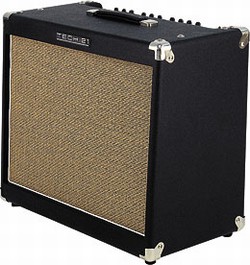
Tech 21 has long been the purveyor of cool solidstate gear that replicates the sound of tube amps, like the famed SansAmp pedals and their wide array of preamps and amplifiers. Here are two of their combo amps, one for electric players and the other for acoustic folks. Let’s fire ’em up.
Trademark 60
In a snapshot, the Trademark 60 is a 60-watt combo with two channels and one 12″ speaker. That may sound like the same features on a lot of other amps, but believe me, any similarities end right there.
For example, you’ll find a powerful active EQ with mid controls on each channel (in Channel 1 it’s called “Punch,” in Channel 2 it’s “Growl”). Channel 1 also has a Bite control for brightness, a gain knob and master volume. Channel 2’s control selection also has one called Weep, which adds a bit of that Class A singing tonality to your guitar.
The master section has another round of “Low” and “High” knobs to tweak the tone to fit whatever room you’re in, along with Reverb and Boost. In my opinion, Boost is one of the most practical amp features of all time – I mean, how many times have you wanted to have a crunchy rhythm tone, but then a real volume boost for solos? This circuit can add up to a 9dB boost for leads. When I was a kid, I spent years trying to figure out how to do that; on this amp, you just step on the footswitch and – voila – there it is! This Boost can also include reverb if you push the Link button. Then your volume increase can also be accompanied by a new reverb sound. Very cool.
Back-panel features include an effects loop and a SansAmp DI output for recording or playing through a PA without mics. A triple-function footswitch is included, so you can activate the effects loop, switch channels, or the Boost/Reveb functions.
As for tone, the Trademark incorporates the company’s SansAmp technology into its preamp to create that “tube-like” sound. Now, many companies – no, wait a minute – every company that makes solid-state gear claims that their products “sound just like tubes, man!” Actually, most of them don’t, but Tech 21 has long had a secret circuit to give their analog boards a pretty realistic tube sound. It’s hard to describe, but when you crank up the gain you get some tube-like compression and interesting low and mid frequencies which further give it a valve flavor.
There are great hard-rock tones to be found, but more impressively, the softly overdriven “Stevie Ray” tones are here in abundance. Pair this amp with a good Stratocaster (and I mean a good one) and you’ll find fabulous Texas blues tones in here. I feel confident that in a blindfold test, a number of players would swear this is a 100 percent tube amp. It certainly sounds better than many “hybrid” amps I’ve tested (i.e., those with a solidstate power amp and preamp featuring one or two 12AX7 tubes).
So go listen for yourself. The Trademark 60 is a very impressive little amp. It sounds great as it is and I’m sure it would be devastating if you added a 1×12″ extension cabinet. Nice job, Tech 21 (they also make a 2×12″ version as well as a smaller 1×10″ combo).
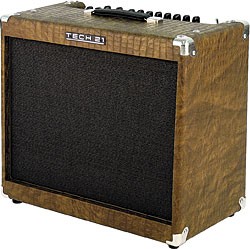
Bronzewood 60 Acoustic Combo.
Bronzewood 60 Acoustic Combo
The Bronzewood is a compact, 60-watt combo for acoustic-electric players. Right off the bat, it has a few obvious things going for it, namely a separate microphone channel (for you coffeehouse performers who sing) and a guitar channel packed with performance-grade tools to optimize your tone.
As someone who’s tested most of the so-called “acoustic amps” on the market, I was impressed with the wide array of EQ controls on the Bronzewood. For acoustic-electric guitarists who use instruments fitted with piezo pickups, this is helpful, since piezos can sound either very good or very bad, depending on what kind of preamp they’re going through. Among the controls on the Guitar Channel are an active three-band EQ with semi-parametric, sweepable mids and a Sansamp tube/mic emulation circuit to help tame that nasty piezo quack. There’s even a Blend knob, so you can dial in just the right amount of SansAmp and direct guitar signal. There’s a Phase switch, too.
If this sounds like techo jargon to you, in simple terms, the Bronzewood gives you several knobs to tweak the tone of your guitar, so you can find the sound that suits you best. This definitely is not a one-tone amp – it has a Whitman’s Sampler of acoustic tones, which is a tremendous asset to the performing guitarist.
Okay, the Bronzewood has EQ controls up the wazoo. “But,” you ask, “What else you got?”
Well, it’s got two more essential tools for acoustic players, namely a built-in compressor and a footswitchable reverb. The adjustable compressor does a respectable job of taming the highs and lows of the acoustic signal (ranging from 1:1 to 5:1), while the reverb is a full-length, six-spring unit that sounds nice. And to round off the guitar channel, you have a notch filter to kick the crap out of any offending feedback squawks.
Over to the Mic channel, treats include an XLR mic input, another three-band active EQ and a Reverb Mix knob to control the balance of reverb between the guitar and vocals. For microphones, Tech 21 supplies a +24 volt phantom switch to fuel a powered microphone or an another phantom-powered device. Keep in mind that most powered mics are calibrated for +48 volts, so it’s possible that your specific mic won’t work with this amp. Solution? Bring your mic along when you test one. On the other hand, many dynamic vocal mics don’t require another power source, so perhaps it’s a moot issue.
Finally, on the back of the amp is an effects loop and a SansAmp Direct Out jack for recording or going direct into the PA. Its cabinet houses a single 12″ speaker and a special high-end horn.
How does it sound? Darn good. I spent quite a bit of time looking for the sweet spot, since I had so many tonal options to choose from. But when I found the magic tone, it was quite pleasing. Another acid test for acoustic amps is “headroom,” i.e., how loud you can crank it before the sound starts breaking up. I’m happy to report that the Bronzewood got pretty dang loud before I heard any clipping. Remember, an acoustic guitar amp is in some ways like a mini-PA system, so you want as much headroom as possible.
Any-hoo, I give the Bronzewood a big thumb’s up for functionality and tone. Plus it comes in a cool brown-alligator vinyl covering that adds to its allure.
Tech 21 Trademark 60 Features Single 12″ speaker, two channels, spring reverb, SansAmp tube emulation, effects loop, three-band active EQ. Price $695 (list).
Tech 21 Bronzewood 60 Features Single 12″ speaker with separate horn, spring reverb, analog compressor, effects loop, three-band active EQ on both channels Price $645 (list). Contact Tech 21, phone (973) 777-6996, www.tech21nyc.com.
This article originally appeared in VG‘s February 2005 issue. All copyrights are by the author and Vintage Guitar magazine. Unauthorized replication or use is strictly prohibited.
While Robert Bradley’s Blackwater Surprise deals in styles of music done by many bands – R&B, rock, soul, and jazz – it always brings an edge most bands don’t offer.
Out of the Wilderness, the band’s first studio record in five years, has that feel. The inherent soulfulness of Bradley’s vocals lets the band do things others cannot. For example, the title cut is a droning stomper where guitarists Matthew Ruffino and Zachary Throne weave around each other’s playing, while Bradley’s plaintive and soulful voice dips in and out, displaying one of the strengths that carry throughout this record – slide guitar and loud electric that mix nicely. Same goes for “Good Times In My Life,” a slice of soulful rock with guitars that lock like pieces of a puzzle. “Americaland” features funky wah chords and single notes that mix beautifully. The rock/soul mix of “Cryin’ My Eyes Out” features churning rhythm guitars, nice fills, and a solo that would make Carlos Santana proud. “Beautiful Girl” is an old-fashioned soul tune that lets one guitarist play lovely changes while the other pops in and out with single notes. The interplay and vocals are the key; everything is slightly off-kilter, but in the best way possible.
This article originally appeared in VG‘s Oct. ’09 issue. All copyrights are by the author and Vintage Guitar magazine. Unauthorized replication or use is strictly prohibited.
In the July issue we looked at affordable L-style flat-tops for the acoustic blues player. This month, we look at similarly inspired instruments, but at a premium price point. All three are American-made, one comes from a cadre of skilled workers, one was made by the hands of a solo luthier, and the third is the product of an industry stalwart.
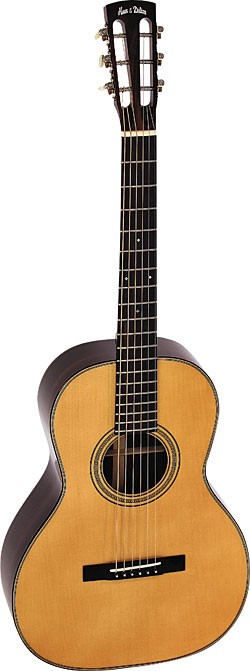
Huss & Dalton’s 00-SP casts a first impression of striking simplicity, with its natural-finish spruce top with cross-grained figure – a sign of quality, quartersawn timbers. Trimmed with wooden purfling, bindings, and a herringbone rosette, a quick look reveals fine detail such as the perfectly sculpted pyramid bridge, figured Brazilian rosewood headstock veneer, and quadrangular, slotted-diamond pearl inlay at frets 5, 7, and 9.
In the simple strum of a few chords, the 00-SP offers a loud, full-spectrum sound that’s almost unnerving coming from its diminutive 141/8″ body. With back and sides of Indian rosewood, domed Engleman spruce top braced with Adirondack red spruce, a slotted headstock for enhanced string tension, and hefty Honduran mahogany 12-frets-to-the-body neck all working together, the 00-SP is orchestral in its response and even in its tone, with well-defined highs and mids and a rumbling bass. The subtly V-shaped neck, with a 24.9″-scale ebony fingerboard, 17/8″-wide nut, and 16″ radius, might take some getting used to for a small-handed player (Huss & Dalton offers several options, including neck and fingerboard details). But the setup was ideal for the fingerstylist, and the craftsmanship of the fretwork, nut, and saddle is impeccable.
It’s easy to understand why H&D has risen to the level of one of America’s premium guitar makers in just over 10 years; virtually all elements of craft, playability, materials and sound put the 00-SP among the finest modern L-style guitars.
Running Dog Mini Jumbo Price $3,950 Contact Running Dog Guitars, 118 North 35th Street, Suite 105, Seattle, WA 98103; phone (206) 547-1407; vtguitars.com.
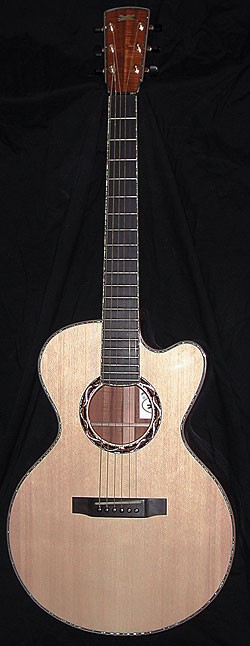
The Running Dog Mini Jumbo by Seattle-based luthier Rick Davis is a showcase for the inspired options only an indie builder can provide – Adirondack top, flamed koa back and sides, spiral rosette, thin abalone “micro-pearl” purfling, and sycamore binding. Blue-dyed wooden purfling tastefully enhances the color of the shell, and the sycamore exhibits an attractive, reflective fleck.
Davis’ mahogany/maple neck with two-way truss rod is reinforced with two lengths of carbon graphite, adding to its stability and stiffness and allowing more vibration to pass to the body. An ebony fingerboard with 25.4″ scale, 14″ radius, and 13/4″ nut is fitted with artfully dressed medium-small frets and an unbleached bone nut.
Rounded at the tailblock with soft waist curves, the Mini Jumbo body has an optional wedge design attributed to luthier Linda Manzer. Deeper on the treble side, the ergonomic body makes it easier for any juke-joint blues man to knock out hours of dance music.
The Mini Jumbo inspires blues, ragtime, jazz and Latin styles, both pick and fingerstyle, with its direct attack and even voicing. Even the most emphatic right hand histrionics explode under a heavy touch without compressing, with fine single-note sustain and superior chord articulation. One wonders if the Manzer wedge enhances the sound by eliminating sympathetic hot/dead spots created when backs and tops are too close to parallel. The reinforced neck, the fine tonewoods, and the unique care and craft all add up to a noteworthy example of a 1930s-inspired guitar with a contemporary character.
Gibson Robert Johnson L-1 Price $3,171
Contact: gibson.com.
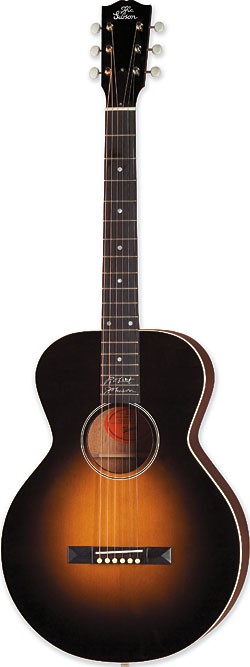
Among L-style guitars, it makes sense that the ultimate reissue would come from Gibson – the Robert Johnson L-1. Strung with .011s, the Robert Johnson L-1 shows the extra work that the Gibson’s crew in Bozeman (Montana) puts into the Signature Artist Series. Feather-light, the L-1 is predictably responsive, with an acoustic shimmer that would make it a fine choice for old blues or new-age fingerstyle playing. The V neck with 13/4″ nut width and 25″ scale makes for a very easy playing experience.
The quality materials – Sitka spruce, mahogany, and ebony (bridge and fingerboard) are a step up from what Gibson of the late ’30s might have used on a budget model, but the white-button Gotoh tuners and old-style “The Gibson” logo bring it all home, appearance-wise. The tone braces look familiar to anyone accustomed to peering into old Gibsons, although we sort of missed the occasional saw kerf marks often visible inside the original models. The dovetail neck joints and nitrocellulose lacquer finishes will please old school purists.
Does the Robert Johnson L-1 have the legendary mojo – that almost indefinable quality of mysterious allure that helps a musician connect with both music and audience? Period-authentic vibe aside, it carries a right-hand thumb/bass thump with a round, satisfying sound a solo bluesman would appreciate as jukejoint dancers start swaying. The ebony bridge and fingerboard help with the treble punch for slide and single-note work.
In the same way that access to the internet doesn’t necessarily impart a user with the spiritual wisdom of the ages, possession (not that midnight/Delta crossroads type!) of an RJ L-1 is not going to suddenly give any player the sudden ability to translate left- and right-hand movements into a powerful, hypnotic expression of the blues. That mojo is in a player’s mind, heart, and fingers, and could certainly be expressed in any of these L-style guitars.
Special thanks to International Vintage Guitars, New Orleans. This article originally appeared in VG‘s December 2008 issue. All copyrights are by the author and Vintage Guitar magazine. Unauthorized replication or use is strictly prohibited. Huss & Dalton 00-SP Love in vain – Robert Johnson – Gibson L1 – Ariberto osio
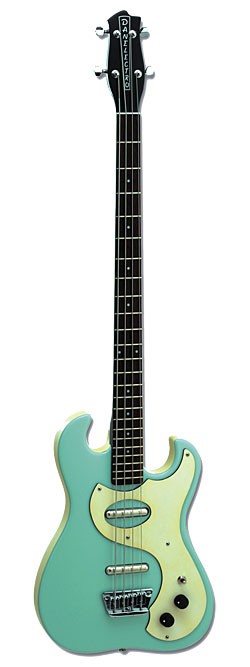
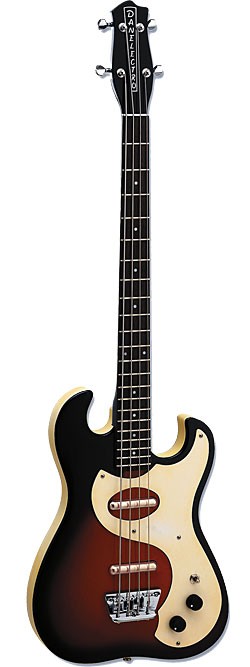
Danelectro Dano ’63 long-scale bass in Aqua. Photos courtesy of Evets.
Danelectro Dano ’63 short-scale bass in Red Burst. Photos courtesy of Evets.
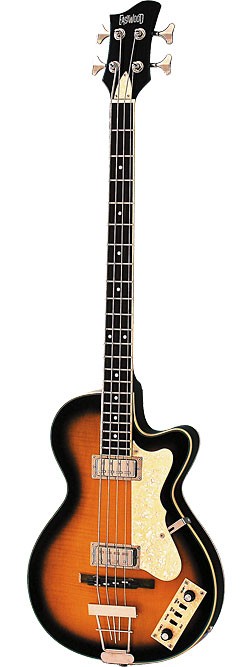
Eastwood Club Bass in Sunburst. Photos courtesy of Eastwood.
As with fashion, cars, motorcycles, music, and many other elements of current pop culture, today’s electric bass market is chock full of instruments designed to look, sound, and play like classics from decades past.
Perhaps more than that, though, these basses appeal to the nostalgic side of anyone who followed music, even casually, in decades past, or has since acquired an appreciation for that music. Babyboomers might wistfully recall their strange silhouettes, while younger players think they’re simply cool and different.
Are they “reissues?” Maybe, maybe not. But some are accurate reproductions of the originals, often refined in terms of hardware or construction. One example is the Ampeg Plexiglas bass, which was initially made from 1969 through ’71. It certainly has a following amongst players and collectors, but the modern version offers a vastly improved bridge.
Other retro basses may not have had an exact progenitor, but can be classified in one of several ways. There’s a) the contemporary bass that references (but doesn’t exactly copy) an original model; b) the bass that looks like something from the 1950s or ’60s, even if no such instrument was made then, and; c) a bass that references an original and has unique features found on other guitars or basses.
A number of brands and models today are exploiting the “time warp” factor, and they are as diverse and fascinating as the originals. True, nearly all are imported; but it’s also true their materials and build quality are superior to the original.
Danelectro
In the ’50s and ’60s, many aspiring guitarists and bassists began their musical sojourn with inexpensive Masonite-over-wood-frame instruments that had pickups made from lipstick tubes. More often than not, these bore the Silvertone brand name (which was sold by catalog retailer Sears) on their headstocks, but were made by the Danelectro company of New Jersey.
Fans of these entry-level classics had reason to rejoice in 1996, when the Evets Corporation purchased the Danelectro name and began making new instruments based on classic “Dano” models. Their first guitar was marketed in ’98, and first bass (the 58 Longhorn) debuted in ’99. The 58 Longhorn was a fairly accurate copy of its short-scale progenitor, with improvements such as an adjustable truss rod and an improved bridge/tailpiece.
“The very first Danelectro reissues we introduced were pretty much dead-on with the originals,” recalled Evets president Steve Ridinger. “Non-adjustable rosewood saddle bridge, stacked pots… The tuners were enclosed, but were only marginally better than the originals.”
The company quickly diversified and improved the quality of specific parts. Basses introduced in the ensuing years included a long-scale Shorthorn bass (the original was short-scale), and Mosrite-shaped instruments such as the Hodad and Rumor, the latter being a solidbody guitar with built-in effects. More recently, Danelectro has taken to offering models for a limited time before moving to another.
“The first thing we had to learn is that we aren’t Fender!” he explained. “We’re a niche brand known for tone, coolness, and affordability. It doesn’t make sense to make 50 models and expect dealers to hang all of them on the walls. So we now make one model per year, discontinue it, then offer a new model.”
The newest incarnation is the Dano ’63 series, based on the early-’60s two-pickup Silvertone 1457L. Sears didn’t market a corresponding bass, so the new basses and baritone guitar are definitive of something that gives only a cosmetic tip of the hat to the past.
All Dano ’63 instruments – guitars, basses, and baritones – use the same body, with pressboard/Masonite-style top and back over a plywood frame. Ridinger says the plywood frame offers better tone than pine or poplar frames, which his company had tested. The necks are made from Canadian maple, the nut is aluminum, and the much-improved bridge offers individual string intonation.
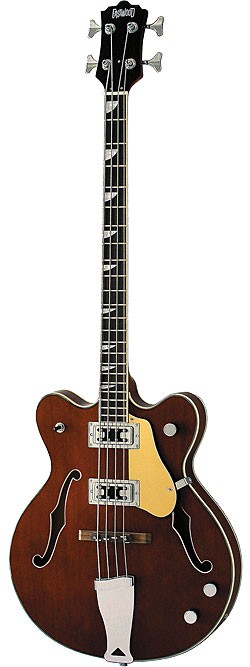
Eastwood Classic 4 in Walnut. Photos courtesy of Eastwood.
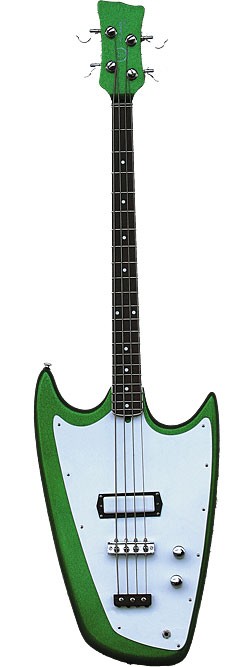
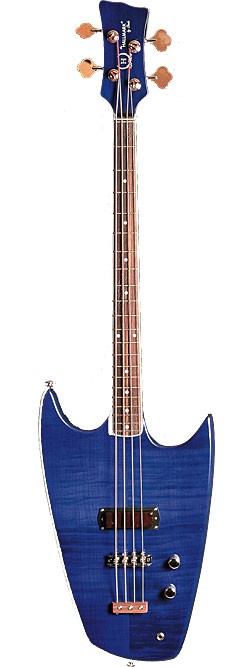
Hallmark Vintage Series Swept-Wing in Alien Sparkle Green. Photo by Willie G. Moseley.
Hallmark Custom Series Swept-Wing in Transparent Blue. Photo by Willie G. Moseley.
As for the electronics and controls, Ridinger noted, “Our engineer, who used to work with Seymour Duncan, did a great job analyzing the lipstick-tube pickups from the ’50s, and coming up with a ‘new’ – meaning old – design that has really great tone. It is quite close to the sound of the originals.” The instruments, he added, have a master Tone, master Volume, and a three-way pickup switch. They may revisit the stacked tone and volume controls in the future.
Eastwood
Eastwood Guitars founder Mike Robinson is among those who take the “better than the original” approach.
“We pride ourselves in the look and feel of our replicas, without them being replicas at all,” he said. “I refer to our guitars as ‘tributes,’ because the goal is not to replicate the original. For the most part, the guitars we are ‘replicating’ were not that good in the first place. They looked good, they had great style, but they were never great players. Our goal is to meet the criteria of original look and style, but also to greatly improve the playability of the instrument, at an affordable price point.”
Eastwood offers numerous styles of guitars, basses, mandolins, baritone guitars, and resonator guitars, almost all of which have a connection to a classic brand and model. Each of its eight basses have a spiritual ancestor: the Club Bass is inspired by the Höfner Club; the EEB-1 and EUB-1 by ’60s Ampeg AUB; the Airline by Valco’s Airline series; Airline Map by National’s Valco-branded map-shaped instruments; Hi-Flyer by Univox’s Hi-Flyer; the Rocket by Eko’s Rokes; and the Classic 4 by Gretsch’s Country Gentleman guitar. All are short-scale, with the exception of the EEB-1 and EUB-1, which are full-scale (VG “Gear Reviews,” May ’08).
The Valco-inspired Airline models are intriguing in part because Eastwood now owns the Airline trademark and the early-’60s Res-O-Glas Airline two-pickup model has recently seen a surge in popularity thanks to Jack White, guitarist and front man for the White Stripes. Eastwood’s Valco basses differ from the originals in several ways, including having bodies made of chambered mahogany instead of Res-O-Glas, flush-mount pickguards (instead of elevated), and top binding instead of a center strip on the body (the original was a rubber grommet that attached the two Res-O-Glas body halves). “We polled customers to see whether they’d be willing to pay extra for the white strip down the middle – $100? $200? The answer came back loud and clear – zero!
“The Classic series is available in four-, six- and 12-string models,” he added. “All have the same body design, loosely reminiscent of the Beatles-era Gretsch Country Gentleman. These are semi-hollowbody guitars – maple top, back, and sides, with a center block. Our initial Classic 4 had a floating wooden bridge, true to the ’60s look and feel. However, a few customers complained about difficulty changing strings, then maneuvering the bridge to correct intonation. So it now has a fixed bridge; less than 100 were made using the floating bridge.”
The Airline Map bass is the company’s best-selling bass, with the EEB/EUB gaining ground.
Gibson
The legendary guitar company that began making stringed instruments more than a century ago does make faithful reissues of its most soughtafter vintage guitars. In 2005 it began offering a bass that may seem like a tribute but actually cops cosmetic and construction ideas from an even more desirable guitar from the ’50s.
The short-scale EB-3 was a two-pickup bass popularized in the ’60s by players such as Jack Bruce of Cream and Andy Fraser of Free. The new model was known as the SG Reissue Bass, and while purists might consider the application of “reissue” specious, its silhouette did match that of the EB-3 as well as that of the SG guitar, Gibson’s mainstay guitar in the ’60s.
The SG Reissue Bass still has one large humbucking pickup and one mini-humbucker like the EB-3, but its two Volume controls and master Tone control are simpler than those of its ’60s progenitor. Moreover, the bridge/tailpiece assembly is the improved three-point style first seen on ’70s Gibson such as the Ripper and RD Bass.
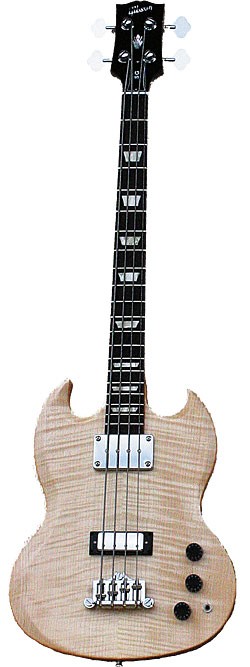
Gibson SG Supreme basses. Photo by Willie G. Moseley.
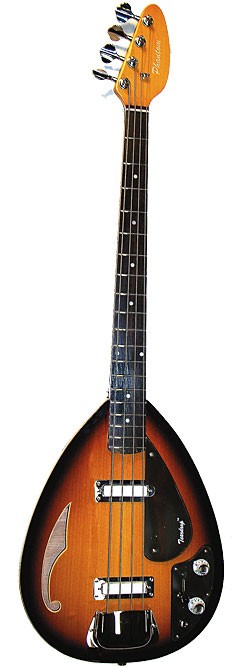
Phantom Teardrop hollow body in Tri-burst. Photo courtesy of PGW.
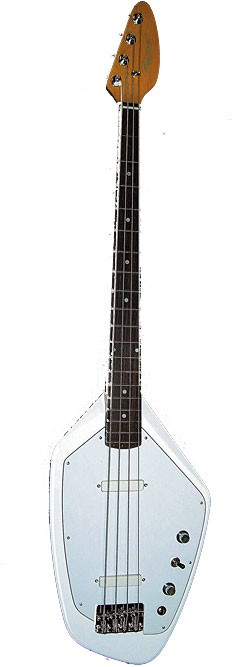
“Phantom IV” in White. Photo courtesy of PGW.
In 2007, Gibson launched its Guitar of the Week program, where it offers guitars and basses with unique woods, extra pickups, special finishes and/or hardware, etc. The very first instrument offered was the SG Supreme Bass, which while it retains the classic body shape, uses trapezoid fretboard markers instead of dots, and black “speed knobs” instead of the “top hat” knobs with silver inserts found on the SG Reissue. Its most eye-catching amenity is a flame-maple top that makes up half of the thickness of the body, the other half being mahogany.
Hallmark
Hallmark was among the names that emerged from the often-controversial Bakersfield (California) guitar-building scene of the mid 1960s. The brand was in business from ’65 to ’68, but barely got into production and showed instruments at just one NAMM show, in ’67. Its primary model was the Swept-Wing, which had a modernistic silhouette and was available in six-and 12-string configurations as a guitar and short-scale bass. An estimated 15 to 25 basses were built, mostly solidbodies, with one pickup. However, some solidbody Swept-Wing basses had two pickups, and a small number of hollowbody Swept-Wing basses may have been built.
A few years ago, Maryland luthier Bob Shade acquired the rights to the brand and the Swept-Wing design, and has been marketing “Hallmark by Shade” Swept-Wing instruments. Most are produced overseas using Hallmark’s own U.S.-made parts, but Shade and ex-Mosrite employee Bill Gruggett also handcraft certain models in their custom shop.
“From a visual standpoint, there’s the obvious ’60s sex appeal,” Shade said of his affection for the Swept-Wing design. “But equally important is that it’s very well balanced and offers a unique tone, as well as access to the upper frets.”
Production Swept-Wings are made in two configurations; the Vintage series is cosmetically faithful to its ’60s predecessors and has a zero fret, maple bolt-on neck that is 11/2″-wide at the nut, and wood tailpiece. It offers refinements such as improved string rollers in its silo-shaped bridge saddles. The upgrade Custom series has a figured maple top, set mahogany neck, and tortoiseshell pickup cover.
“With the popularity of some high-end guitars with set necks and decorative maple caps over mahogany, I thought it would be good to offer a model to expand and complement what was available from Hallmark in the ’60s,” said Shade. Basses in both series are short-scale, single-pickup models, and the Swept-Wing line uses neck binding.
Phantom
Phantom Guitar Works has been in the “retro” business since 1992, designing guitars, basses, and mandoguitars that offer a chronological and aesthetic nod to classic ’60s Vox instruments from England’s Jennings Musical Industries, which were made in Great Britain, and later, by Eko in Italy.
“I always thought they were cool,” PGW founder Jack Charles said of body styles like the Teardrop and Phantom. “But in their day, they were considered camp. I never even wanted to make a bass because many players felt like the original basses were horrible – very difficult to play.”
But Charles, who spent several years working at Jackson Guitars, had such affection for the look of oddly-shaped instruments that when he started his own guitar company he decided to create improved instruments that referenced old silhouettes. Those refinements include better woods and humbucking pickups (the originals were notoriously microphonic), and relocating pickups for improved sonic reproduction.
“I think JMI was one of the most innovative companies ever, and I wanted to approach this as, ‘What would (Tom) Jennings be doing now?’” Charles enthused. “I can guarantee you he wouldn’t be making them the way they were made in ’65. I’m sort of caught in an awkward place, because the everybody in the States is acquainted with the Italian guitars, but I’m inspired more by the original English versions, which are quite rare.”
Charles keeps his line limited to three basses – the Phantom IV, a solidbody Teardrop, and a semi-hollow Teardrop. The latter, which has a single f-hole, was inspired by the Bill Wyman model from the ’60s, which was the only signature Vox instrument from that era.
Wilson Bros. VMB-75 in Candy Apple Red. Photo by Willie G. Moseley.
Wilson Bros. VCMB-2001 in Candy Apple Red. Photo by Willie G. Moseley. Silver surrounds
All PGW basses have maple necks with rosewood fingerboards. The Phantom IV and the Teardrop solidbody have mahogany bodies, while the Teardrop semi-hollow has an arched maple top as well as maple sides and back. A wood center block runs from the neck to a termination point just past the bridge. All three have a 32.5″ scale.
“Phil Volk (of Paul Revere & the Raiders) put a Fender neck on his Phantom IV bass a long time ago,” he noted. “But that bass will not balance with a 34″ scale, even if you used a piece of heavy ash for the body. I tried! But I felt I couldn’t make or market a bass that had to be held up by the neck when played, which was the design problem back then. I wasn’t going to copy that. So I used the Bill Wyman headstock shape, and combined with the slightly-shorter scale, it makes for a balanced bass. And the 32.5″ scale is the reason the pickups and the bridge are in different locations compared to the original.”
Wilson Bros.
One of the more unique ventures (pun intended) in the retro-guitar/bass market was founded in 2002, though one of the principles was crafting guitar-based music for more than four decades beforehand.
Under the aegis of Ventures founding guitarist Don Wilson, his son, Tim, and James Fox, the Wilson Bros. line offers what the younger Wilson terms a “hybrid” of the best features of other brands associated with the Ventures, including Fender, Mosrite, and Aria.
“We wanted to come up with a line that we designed, not simply something we endorsed,” Don Wilson said, noting that the brand does indeed reference classic aesthetic and sonic facets associated with the Ventures.
There are five basses in the Wilson Bros. lineup, all 20-fret, bolt-neck models with a 34″ scale.
The entry-level VPB-30 is a generic, P-Bass-style. But the rest use a body silhouette more associated with the Ventures. Their development came from Ventures bassist Bob Bogle, as well as “fifth Venture” Bob Spalding (VG, March ’08), and while the body evokes a Mosrite vibe, the cutaway horn on the bass side is still longer, a la Fender. Other common turf includes two single-coil pickups – the neck unit being angled in another Mosrite reference, parallel to the offset end of the fretboard – two Volume controls and a master Tone control.
The VMB-55 has the standard layout for the trademark models, but a relatively plain body. The VMB-75, though, has the fabled “German carve” seen on Mosrites. And while all trademark-body models have bound necks, the VMB-75 has binding on the upper edge of the body. The pickguard is a three-layer “mint green color – the only pickguard that is a different (but historically appropriate) color. The fretboard is flat, and has a semi-gloss finish. Finally, the VMB-75 has an upgraded bridge/tailpiece.
The VMB-100 adds a zero fret, brass nut, upgrade Duncan Design pickups, multiple-layer binding, and upgrade control knobs. The ultimate Wilson Bros. bass is the VCMB-2001, handcrafted in Aria’s Custom Shop in Japan (the Ventures endorse Aria in Japan, therefore Wilson Bros. instruments are not sold there), with Seymour Duncan/Bassline SJB-2 pickups, fancier fretboard inlay, and a bone nut.
As more guitar/bass builders and distributors jump aboard the retro bandwagon, the panache of time-warp instruments like these should equate to more styles from the past to choose from in the future.
This article originally appeared in VG‘s August 2008 issue. All copyrights are by the author and Vintage Guitar magazine. Unauthorized replication or use is strictly prohibited.