Year: 2014

  • Kenny Wayne Shepherd

    Kenny Wayne Shepherd

    The latest from Kenny Wayne Shepherd is an homage to players and songs that influenced him while he was coming up. For the most part, it’s a splendid collection with some of the blistering guitar work you expect.

    Kenny Wayne Shepherd“Palace Of The King” is soul heaven. Shepherd’s playing channels Jimi Hendrix complete with blistering sharp-nine chords throughout. His version of the Muddy Water’s classic “I Love The Life I Live” has the perfect laid-back feel that is cut only by a down-and-dirty Shepherd solo.

    There are a number of friends who appear on the record, including Robert Randolph, Joe Walsh, and Ringo Starr, among others. The slinky blues of “Breaking Up Someone’s Home” gets a lift from the guitar and voice of guest Warren Haynes.

    The main attraction remains Shepherd’s guitar work. His energy and chops help make the droning boogie of “Still A Fool” a highpoint of the record.

    While he honors his heroes, one song seems misplaced. Given folks penchant for saying he started his career as a Stevie Ray Vaughan clone, why do a note-for-note cover of “The House Is Rockin’”?

    This article originally appeared in VG‘s August ’14 issue. All copyrights are by the author and Vintage Guitar magazine. Unauthorized replication or use is strictly prohibited.

    <iframe width=”420″ height=”315″ src=”//www.youtube.com/embed/-ThtdPj6KvA” frameborder=”0″ allowfullscreen></iframe>

  • D’Angelico’s EXL-1 and EX-SS

    D’Angelico’s EXL-1 and EX-SS

    DANGELICO_01_EXL-1_Natural

    3rd Power Solo Dream/Switchback amps
    Price: $1,859 list/$1,149 street (EXL-1); $1,999 list/$1,409 street (EX-SS)
    Info: www.dangelicoguitars.com
    .

    Images of John D’Angelico crafting masterpieces in his Little Italy shop haunt guitar enthusiasts to this day, implying an era of lost glory. Happily, D’Angelico guitars, long inaccessible to average guitarists, are being revived and reinterpreted in a manner that the master himself might have appreciated: exquisite art deco-inspired designs made affordable yet suitable for the spectrum of players.

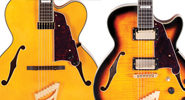
    The new five-guitar Standard Series resurrects classic D’Angelico features, down to the brass headstock ornament. Two guitars in the Standard Series, the single-cutaway EXL-1 and EX-SS, ought to satisfy most players’ lust for D’Angelico. Stairstep tailpieces and pickguards, mother-of-pearl inlays, flamed maple, pediment headstocks, Grover Rotomatics with Imperial buttons, and multibound bodies – they’re all here. Both test models featured a Vintage Sunburst poly finish morphing to black on the edges and at the maple/walnut headstock and neck heel. (Natural finish is also available.) Pickups are by Kent Armstrong, longtime go-to maker for jazz guitarists.

    The EXL-1 is a 17″ archtop measuring a comfortable 3″ deep with a 25.5″ scale. Laminated spruce tops the soundboard’s grand arch while highly flamed laminated maple decorates the back and sides. These timbers are affordable choices that also happen to be ideal for a warm, balanced electric response. Remember, John D’Angelico marketed the laminated G-7 model specifically for electric use. (The upscale D’Angelico Masterbuilt line offers solid timbers all around, at significantly higher cost.)

    The EXL-1’s bridge and fingerboard are rosewood, and the floating humbucking pickup is wired through tone and volume controls mounted closely together on the beveled tortoise pickguard. The quality of workmanship is preternaturally flawless, more so than even many classic-era models. But does the sound match the looks?

    The designers have coaxed an impressive acoustic response from the laminate top, which features parallel braces. With a set of .012-.054″ nickel roundwounds, a stiff pick produced gratifying volume for acoustic chord and single-note work. The setup was easygoing enough for pianistic fingerstyle, particularly satisfying when amplified at a solo jazz guitar gig. Warm but defined, single-note lines were balanced up and down the fingerboard, though the discerning ear might desire some pole-piece tweaking.

    The EX-SS has a similar jazzbox vibe, but with crucial differences. The lightweight body is 15″ wide and 1.25″ deep. The scale length is 25″, and the headstock, dressed up like the EXL-1, is proportionately smaller. The top is capped with flamed maple, and an interior U-shaped sustain block supports the tune-o-matic-type bridge. Two humbuckers are top-mounted, with a selector switch and stylish tone and volume controls for each. The EX-SS has all the rich detail of the EXL-1 in tailpiece, engraved pearl, tortoise pickguard – the works. And neither guitar feels neck heavy, despite the expansive headstocks.

    The EX-SS was shipped artfully set up with .010-.046″ strings, including an unwound G. The light strings had flexibility without feeling floppy, thanks to the neck/headstock angle and the extra string length resulting from the ornate tailpiece. There was enough acoustic sound to make unamplified solo practice viable. Through a tube amp, however, fat jazz electric sounds were dialed in with the neck pickup, the rhythm was funkified with the pickups blended, and a good cutting lead was achieved from the bridge pickup. Clarity balanced with warmth. An Ibanez Tube Screamer thrown into the mix resulted in serious volume with satisfying, controllable feedback. Jazz, blues, rock, and fusion players would be at home digging into this distinctive axe.

    The affordable D’Angelico EXL-1 and EX-SS offer great playability and aural response, along with enough bling to make any guitar aficionado’s heart flutter. Plus, any guitarist taking to the bandstand with either model will likely earn a note of approbation from audience and bandmates… at least if his tux isn’t too badly wrinkled.


    This article originally appeared in VG December 2013 issue. All copyrights are by the author and Vintage Guitar magazine. Unauthorized replication or use is strictly prohibited.

  • Keith Cameron

    Keith Cameron

    Keith CameronThe Year (or so) of Mudhoney rolls on. The long-running Seattle foursome has experienced a resurgence of interest lately. The latest example: this well-researched and crisply written biography from rock journalist Keith Cameron, who’s followed the band ever since a London appearance 25 years ago.

    Most everyone knows the drill by now: Mudhoney fused punk and metal to basically invent “grunge” while its peers (Nirvana, Pearl Jam, Soundgarden) reaped most of the accolades. But an endearing sense of humor coupled with a we-don’t-give-a-crap attitude and top-shelf garage rock riffology has fueled a long and productive career.

    Cameron covers everything in grand detail, providing a trove of biographical info. He also expertly deconstructs the entire Seattle scene, aided by interviews with all the big players (producer Jack Endino, the Sub Pop label folks, etc.) and a refreshing across-the-pond perspective shaped in real time as everything went down. The book boasts a great collection of rare photos as well, many in color.

    “They’re four guys who got together and played music for fun, and the grand plan ended there,” Cameron notes. “Their firm hold on what’s important about their band also explains why they’re still here; it’s about integrity and civility, about growing older together, about making records with a real time/real life vitality; about knowing the identities of ‘them’ and ‘us’.”

    That sums things up nicely.

    This article originally appeared in VG‘s August ’14 issue. All copyrights are by the author and Vintage Guitar magazine. Unauthorized replication or use is strictly prohibited.

    <iframe width=”420″ height=”315″ src=”//www.youtube.com/embed/_nGsT_qFMBs” frameborder=”0″ allowfullscreen></iframe>

  • Alairex H.A.L.O.

    Alairex H.A.L.O.

    ALAIREX_HALO_OVERDRIVE

    Alairex H.A.L.O.
    Price: $399
    Info: www.alairex.com.

    Guitarist Alex Aguilar is a veteran player, former guitar-mag columnist, and today runs an effects company that recently released its first box, the Alairex H.A.L.O., an overdrive pedal designed to produce rich overdrive and multidimensional sounds.

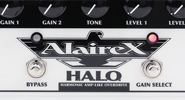
    H.A.L.O. is an acronym for Harmonic Amp-Like Overdrive, and the box is two analog ODs in one, with separate Gain and Level controls. Its left and right footswitches correspond to LEDs that indicate which channels are active.

    Designed to run through a clean amp and be a fundamental component of a guitarist’s tonal footprint, the H.A.L.O. sports a three-way Shape toggle that controls distortion characteristics. The left position offers asymmetrical clipping and a darker overdrive/distortion, the middle position offers a clean boost, and the right position is a symmetrical clipping mode with brighter overdrive/distortion.

    The Saturation toggle offers three post-gain options. The left position is on in both Gain 1 and Gain 2 settings, middle is off, and right is the on position for Gain 2 only. There are separate Gain and Level knobs for each channel and a Tone control that governs both circuits. The icing on the cake, however, is a tone-sculpting Bass knob that controls low-end, a Contour knob for the midrange, and a Presence knob that covers high-midrange frequencies.

    Tested with Teles, Strats, combo amps, and high-gain heads, the H.A.L.O. offered a universe of clean boost, natural overdrive, and even-order harmonic distortion. Patient manipulation resulted in steroid-infused country leads or filthy heaviosity, all with a luminous sheen. The H.A.L.O. doesn’t do full-on metal, but it’ll push a high-gain amp over the cliff with upscale complexity and dynamic responsiveness.

    Despite the number of knobs and switches, the H.A.L.O.’s functionality is easy to decipher and adds a luxurious quality to even the dullest amp. Both circuits offer rich crunchiness, but Gain 2 has more saturation and treble. Everything about the H.A.L.O. yields serious sustain and super-dynamic touch-sensitivity. It adapts to myriad musical styles and yields angelic harmonic overtones. It’s powered by a 9-volt battery or an external power supply of 9 or 18 volts DC.

    The H.A.L.O. is an excellent tool for creating inspired variations in sag, dirt, or EQ-boosting to push blackfaces, tweeds, or dirty heads. It’s a solidly constructed effect that should live on your pedal board for years to come.


    This article originally appeared in VG April 2014 issue. All copyrights are by the author and Vintage Guitar magazine. Unauthorized replication or use is strictly prohibited.


  • Eventide H9

    Eventide H9

    EVENTIDE_H9

    Eventide H9
    Price: $499
    Info: www.eventide.com.

    Stompbox evolution is getting to the point where huge libraries of sound are coming out of single pedals. You might say, “Well, those are just regular ol’ multi-effects pedals – big deal!” That’s partially true, but the latest twist is that now there are “studio-grade” effects that fit neatly on a pedalboard. Take the Eventide H9, for example – for a few hundred bucks, you can add a monster effects rack to your board (or your home studio) for a fraction of the price that the individual rack or pedal effects would cost. What’s more, they’re the famous Eventide studio sounds – the legendary echoes and delays, choruses, tremolo, and, of course, the famous Harmonizer effect, all derived from Eventide’s Factor series (Time Factor, Pitch Factor, Mod Factor, and Space).

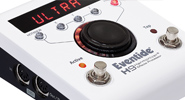
    The H9 looks a little different from normal pedals in that it has a big control knob in the middle of the unit, along with two footswitches and a handful of buttons that provide the interface. The connectivity – i.e., the part that excites studio geeks – is quite impressive. The H9 sports a pair each of mono ins and outs, as well as a ¼” jack for an expression pedal, a MIDI in/out, and USB connectivity to control the effects with a PC or Apple computer. But get this – there’s also Bluetooth, allowing the user to control the sounds on the H9 wirelessly via iPad, iPhone, or iPod (using a downloadable app).

    For the gigging guitarist, the thrill is connecting the H9 into a computer, tablet, or phone at home, adjusting the sounds to taste, and then saving them back to the pedal for live dates. Sounds complicated if you’ve never done it before, but trust me, it ain’t. If Hendrix were alive today, he’d toss his Fuzz Face and Octavia out the window and dive into this hip technology headfirst. Think of it as having Eddie Kramer right on your pedalboard.

    What does the Eventide H9 sound like? A player can easily nail the chugging, echo-repeated triplets in Pink Floyd’s “Run Like Hell” or the classic echo repeats in U2’s “Where the Streets Have No Name.” Rockabilly slap-back echo and that modulated ping in Van Halen’s “Panama” are a piece of cake. Or look for dreamy, ethereal Bill Frissell-type sounds or effects that sound like a distant string section, complete with slow swells. These sounds can really be exploited with a stereo rig (or a pair of tracks when recording), which makes the H9 effects even fatter and lusher, with all kinds of swooshing, swelling sounds that art-rock masters like Bill Nelson and Adrian Belew would go crazy over. Naturally, adding a fuzz, distortion, or overdrive in front of the H9 can send one off into the stratosphere, with sounds from Hendrix to Fripp to Vai and beyond. Dig deep into the H9, adjusting parameters until you’re blue in the face, or just have fun with its 99 presets.

    Those who’ve never worked with a pedal like this should think of it as a brain that’s full of millions of adjustable sounds, which is why controlling it with a computer, tablet, or other digital device makes it so simple – the “editor” programs and apps feature easy interfaces that anyone can explore. Moreover, when Eventide comes up with a new sound, it can be purchased and downloaded via the Apple iTunes store. One certainly doesn’t need an external device to manipulate sounds in the pedal – that can be done with the H9’s controls. But again, an external device will allow the user to tweak at home, load new sounds, and then bring it to the gig. No one in the crowd will know where those amazing, otherworldly sounds are coming from; other guitarists will definitely be jealous!

    In all, the Eventide H9 is an exciting, powerful pedal that is pushing the idea of the “stompbox” into new territory. Is it just a foot pedal or a complete, mini-sized effects rack? The answer to both is yes. If you’re beginning to salivate, go watch some videos online and see how cool this pedal sounds. It’s hard not to be impressed.


    This article originally appeared in VG April 2014 issue. All copyrights are by the author and Vintage Guitar magazine. Unauthorized replication or use is strictly prohibited.


  • Grammatico LaGrange

    Grammatico LaGrange

    GRAMMATICO_LaGRANGE_01

    Grammatico LaGrange
    Price: $1,850
    Info: www.grammaticoamps.com.

    Stop the presses! John Grammatico has added a second amp to his line.

    Of course, this wouldn’t be headline news with most amp-makers, who boast dizzying lines of models and variations with added doohickeys and miscellaneous whatnot. But, Mr. Grammatico has chosen to get it right – really right – with a small, pure offering. The arrival of his second model, the LaGrange, is indeed noteworthy.

    The Texas-based boutique builder’s mission is to create modern versions of great vintage amps, using reliable and tighter-tolerance components. His first amp, the Kingsville, was inspired by the ’59 tweed 5F6-A Bassman. Legend has it that Jimmie Vaughan pulled out his checkbook after picking just a couple riffs through a test model.

    The maestro’s new LaGrange is based on the tweed 5E3 Deluxe. Grammatico says he aimed to capture the tones of early ZZ Top, Neil Young, Keith Richards, George Thorogood, Kenny Burrell, and T-Bone Walker, but his goal was to get those sounds with a guitar plugged straight into the amp

    In other words, shelve your Fuzz Face. Let your Tube Screamer gather dust. The LaGrange is designed to do it all, au naturel.

    The amp’s specs are pure simplicity. It pumps out 15 watts through two 6V6 power tubes and two 12AX7 preamp tubes plus a single 5Y3 rectifier. The sound comes via a single Jensen P12Q 12-incher in a cabinet that mimics the dimensions of a tweed Deluxe, all in a handy 23-pound package.

    The controls are similarly straightforward. As Grammatico aficionado Redd Volkaert explains, “It’s got a Tone knob and two Volumes and two channels, a switch and a fuse, and a real nice light.” What more do you need to play Texas blues or classic rock and roll?

    The LaGrange’s fit and finish are sublime, but there’s more to it than just a pretty face. It’s hand-wired and beauteous to the core. There’s something jaw-dropping about the exquisite soldering, crisp wire routing, and all-around electronics artistry that guitar fans never seem to get over.

    But the truth is in the tone, of course, so we tried out a LaGrange with a ’56 Strat, a Gretsch 6120 ’55 reissue with single-coil DynaSonics, and a ’90s Les Paul Classic with humbuckers. We also compared it alongside an original 5E3 Deluxe.

    With the Volume set low, the LaGrange offers extremely sweet pop and articulation – its tube tone simply blooms. Think T-Bone Walker with woody, warm, and fat mids. Yes, you read right – it can make a Strat sound like a big old archtop.

    Turn the Volume up to 6 and that promised distortion starts kicking in. And that’s just at the midpoint. A slight turn to the right and the LaGrange overdrives the sound until it gets lowdown and grungy. With the Les Paul’s higher-gain pickups, the volume and dirt are everything you’d want to impress a small club. And as with the original 5E3, the Volume knob goes to 12. Eat your heart out, Mr. Tufnel.

    The Normal channel was a bit subdued, but ditto the vintage Deluxe. Plug into the Bright side, though, and the tone rings. Dial it in to be raw and biting, or get just an edge of grind while retaining rich harmonics. Amazingly, it keeps the articulation of a single note or a full power chord even when fully saturated.

    The LaGrange is a glorious amp for classic country, rockabilly, rock and roll, and blues of all flavors, from Mississippi and Texas north to Chicago. And, yes, you can leave your Fuzz-Tone at home for paperweight duty. Clean or cranked, the Grammatico LaGrange is simply great fun to play. And that makes you want to play it more and play it harder. Which in turn drives inspiration – which is what a good amp’s for, right?


    This article originally appeared in VG April 2014 issue. All copyrights are by the author and Vintage Guitar magazine. Unauthorized replication or use is strictly prohibited.


  • Pat Martino

    Pat Martino

    Pat Martino Open Road
    Pat Martino live at Ethel's Place
    The re-release of these films on DVD gives jazz guitar fans a glimpse at one of the all-time greats. Pat Martino’s story is known well: surgery for a brain aneurysm in 1980 left him with no memory – and no ability to play guitar. The documentary lets folks in on the struggles he and his family endured when his health sidetracked his career.

    We hear from Pat and others, especially his dad, how he was able to recover his guitar playing. The film also has glowing tributes from the likes of George Benson, the late, great Emily Remler, Les Paul, John Abercrombie, and more.

    The extras include a lesson with Martino that could literally take a year to study and you’d still have more to discover. While his playing is great, it’s almost as much fun to hear him talk about music as an extension of life as it is to hear his playing.

    The concert film features footage from 1987 with Martino, drummer Joey Baron, and bassist Harvie Swartz having a blast playing and flying through half a dozen numbers.

    This article originally appeared in VG‘s September ’14 issue. All copyrights are by the author and Vintage Guitar magazine. Unauthorized replication or use is strictly prohibited.

  • Musicvox Spaceranger Guitar and Bass HT

    Musicvox Spaceranger Guitar and Bass HT

    MUSICVOX_02_Spaceranger_GUITARS

    Musicvox Spaceranger Guitar and Bass HT
    Price: $799 (guitar); $899 (bass)
    Info: www.musicvox.com
    .

    Popularized in film and television, Musicvox Spacerangers have drawn attention for their mondo lower horn and freakishly huge headstock. Purists turn up their noses, but countless others dig the Euro-cheapo aesthetic. Users have included country star Keith Urban, of all people, and the late jam-band bass hero Allen Woody.

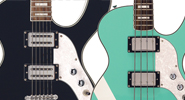
    The Spaceranger Guitar is a straight-ahead rock and roll axe with a triple-bound mahogany body and 243/4″-scale bound maple neck, 19-fret rosewood fingerboard with block pearloid inlays, humbuckers (in Gretsch-style housings), tune-o-matic tailpiece, three-way toggle, master volume and tone, and vintage Kluson-style tuners on that gi-normous headstock. Incidentally, the thought of tuning a Spaceranger with those pegs located on the butt-end of the headstock might cause some to scratch their heads, but it’s not as strange as it might seem. There’s considerable space between each tuner, making them easy to grab, and with the shorter Les Paul-like scale, they’re also easy to reach. It may take a few seconds to get oriented to the new layout, but after that, it’s as easy as pie. The only debit to the large headstock is a bit of neck-dive, but that can be remedied with a non-skid guitar strap.

    Plugged in, the Spaceranger is an animal. It feels great in the hand – the neck and fingerboard are set up well with a low action and a thin profile as befitting the Spaceranger’s Asian origins. The bridge humbucker delivered plenty of heavy rock flashes, while the neck pickup was good for bluesier stuff. Even with the humbuckers, there’s a nice dash of Strat or P-90 quack in the middle position with both pickups on. This is very useful on a lot of ’60s cover tunes. The three-way toggle worked fine, though it was stuck a bit too snugly between the tone knob and cable jack.

    The Bass HT takes the Spaceranger design to new stratospheres of retro cool. With a 30″ neck scale, the Bass HT is a very likeable instrument for the bassist looking for something different. In addition to a bevy of finishes, this four-string has a fully adjustable bass tune-o-matic bridge, vintage tuners, 20-fret rosewood fingerboard, bass humbuckers, block pearloid inlays, master volume and tone, and a three-position pickup switch.

    Like its guitar battery mate, the Bass HT is a rockin’ electric, and it provides the kind of fun for which short-scale basses are famous. Both the bridge and neck humbuckers deliver big sound whether clean or with a little dirt dialed in. The middle position, however, sounds better on clean settings; otherwise, things can get a little muddy. For more Fender-y sounds, use the neck ’bucker and roll down the tone a bit. One thing that jumps out after playing the Bass HT for a while is that the short scale and fast set up are great for players more used to a guitar-scaled neck than, say, a long-scale Fender Precision. Similarly, it sounds good with both fingers and a pick, which is a more authentic form of ’60s bass-playing (playing electric bass with fingers didn’t become the norm until the ’70s).

    In all, both the Spaceranger Guitar and Bass HT performed great, not to mention those knockout looks. Granted, the design is not for everyone, but if you like that campy retro vibe, the Spaceranger shape is a flat-out classic.


    This article originally appeared in VG December 2013 issue. All copyrights are by the author and Vintage Guitar magazine. Unauthorized replication or use is strictly prohibited.


  • Rod Stewart

    Rod Stewart

    Rod Stewart
    During the span covered by these four CDs, Stewart charted 41 singles – 14 of them in the Top 10 – and he had earlier hits like “Maggie May” and “You Wear It Well” to weave into his high-wattage concerts. He always employed first-rate sidemen and paid them well, but for all their talent, with maybe a couple of exceptions, Rod’s guitarists might as well be in the witness protection plan. In fact, the rhythm section of drummer Carmine Appice and bassist Phil Chen became better known than Jim Cregan, Gary Grainger, Billy Peek, Robin LeMesurier, Wally Stocker, Todd Sharp, Jeff Golub, Oliver Leiber, and John Shanks.

    Which is ironic, considering Stewart’s repertoire requires true versatility – from soul ballads to post-disco to old-time rock. Unfortunately, the mix on “Sweet Little Rock ’N’ Roller” renders almost inaudible an excellent Chuck Berry impersonation courtesy of Cregan, who combines with Golub for a Them-inspired “Baby Please Don’t Go.”

    Five hours of previously unreleased Stewart at the peak of his powers and pre-“Songbook” popularity; what’s not to recommend?

    This article originally appeared in VG‘s September ’14 issue. All copyrights are by the author and Vintage Guitar magazine. Unauthorized replication or use is strictly prohibited.

  • Blues-Guitar Legend Johnny Winter Passes

    Johnny Winter passesJohnny Winter, among the elite guitarists in the blues and blues-rock idioms, died July 16 in Zurich, Switzerland, two days after he performed at a festival in Austria. He was 70, and at press time, no cause of death had been given.

    Winter grew up in Beaumont, Texas. His parents, John II and Edwina, encouraged him and his younger brother, Edgar, to pursue music. Both born with albinism, they found it challenging to fit in, socially, so they took to instruments – Johnny to the ukulele, Edgar to piano and saxophone. They began performing at an early age and, when Johnny was 10, appeared together on a children’s TV show in Houston, playing and singing Everly Brothers songs.

    Struck by the music of Muddy Waters, B.B. King, and Bobby Bland, Winter soon gravitated to blues guitar. When he was 15, his band, Johnny and the Jammers, released its first recording, called “School Day Blues,” on a local Houston label. While playing in Chicago in 1963, he jammed with Michael Bloomfield. In ’67, he recorded a single, “Tramp,” with the Traits, followed in ’68 by his first solo album, The Progressive Blues Experiment, with bassist Tommy Shannon and drummer Uncle John Turner. The album marked Winter’s emergence and was released at a time when blues-based acts – mostly white kids from England and suburban America – reigned in terms of mass popularity.

    In ’68, Bloomfield invited Winter to sit in with him and Al Kooper at Fillmore East in New York City. There, staff from Columbia Records watched as Winter brought down the house with a rendition of B.B. King’s “It’s My Own Fault.” The appearance famously earned him a $600,000 advance on a record deal. His self-titled first album for Columbia featured the same band that helped him record The Progressive Blues Experiment, along with brother Edgar and blues legends Willie Dixon (on bass) and Walter Horton (or harmonica).

    In the years that followed, his career reached its apex, propelled by his fiery playing – especially with his ’64 Gibson Firebird V, which he used to record much of his early material and more recently dedicated to slide work. He released Second Winter with Edgar as a full-time member of the band, then in 1970 formed Johnny Winter And… with former members of the McCoys – Rick Derringer (also on guitar), bassist Randy Jo Hobbs, and drummer Randy Z. As the ’70s elapsed, he briefly battled drug addiction, then recovered to produce three Grammy Award-winning albums for Muddy Waters and record several Grammy-nominated blues albums of his own. In 1988, he was inducted to the Blues Foundation Hall of Fame.

    Throughout his career, Winter was a top-notch live draw in North America and Europe. He appeared at the original Woodstock festival, and at various times played the New Orleans Jazz & Heritage Festival, Chicago Blues Festival, the Sweden Rock Festival, the Warren Haynes Christmas Jam, Rockpalast, and Eric Clapton’s Crossroads Guitar Festival.

    Fellow Texan/guitar legend Billy F Gibbons released a statement saying, “When I first saw Johnny perform, I was 12 or 13 and he was known as ‘Johnny Cool Daddy Winter’ and we’ve always thought of him as exactly that – One Cool Daddy.

    “Johnny became a dear and passionate friend as well as the accomplished bluesman we have come to admire. It’s now a moment for celebration of his brilliance frozen for all time. We’ve lost another of the gifted guitar greats and a truly soulful spirit.”

    A new album, Step Back, is slated for release September 2. A collection of blues and rock cover songs, it includes collaborations with Gibbons, Eric Clapton, Joe Perry, Leslie West, Brian Setzer, Joe Bonamassa, and others. – Ward Meeker

    (For more on Winter, see Dan Forte’s feature interview in the July ’14 issue and his further recollections in “Check This Action” column next month.)