




Silvertone’s 1449 and 1423
Price: $739 list/$479 street (1423); $629 list/$399 street (1449)
Info: www.silvertoneclassic.com
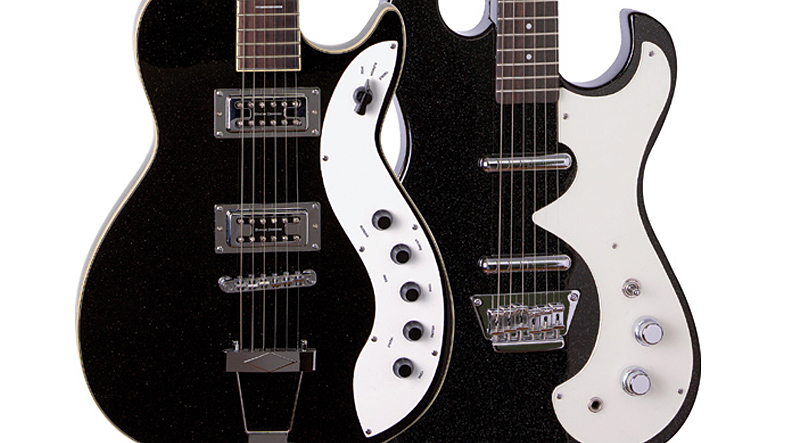
With an up-swell of interest in vintage Silvertones, current parent company Samick has begun to reissue some of the most requested models. The first offering, the 1303/U2, with its famous “coke bottle” headstock and lipstick pickups, was followed by a Bigsby-equipped 1478, known for its Jaguar-influenced body shape. The latest offerings are the pivotal 1449 and 1423.
Originally offered in 1963-’64, the 1449 is a two-pickup version of the most popular Silvertone, the “beginner” 1448. Vintage models, some will recall, included a tube amp built into the case. While the reissue 1449 does not include a case with integrated amp, when compared to a pristine original, the feel of the reissue is nearly dead-on. Likewise, the reissue’s lipstick pickups are true to the sound of a vintage original. However, it must be noted that the sound of the vintage lipsticks varied greatly from guitar to guitar. According to Tony De La Rosa of Silvertone, the Samick folks sift through as many originals as is necessary to find an exemplary guitar on which to base a reissue.
The new 1449 has a full 24.75″ scale, and the pickups are controlled by the same stacked volume and tone controls as on the original. Perhaps the most obvious difference is that the reissue 1449 is made of solid mahogany rather than the original’s Masonite-covered pine frame. Plugged in, however, the difference is slim, with the vintage model having just a bit more woody lower midrange. Thanks to a modern dual-action truss rod, sealed tuners, and a through-body bridge with individual string saddles, the reissue can be made to tune, intonate, and play consistently. (The same can seldom be said of a vintage example.) Like the original, the fingerboard is rosewood, but the original’s aluminum nut is replaced with polymer.
In use, the new 1449 produces nearly the same tones as the original – perfect for a working guitarist who desires the tone and aesthetic appeal of an original but requires consistency and the ability to fully tweak action and intonation.
The Silvertone 1423 Jupiter adds ivory binding to the neck and body and sports a trapeze tailpiece and tune-o-matic-style bridge. Where the original (known as the Jupiter H49 in the Harmony line) featured DeArmond-made pickups, the new Jupiter has Seymour Duncan-designed Filter’Tron-style humbuckers. The control arrangement is exactly as the original’s, with individual Volume and Tone knobs for each pickup and a three-way chicken-head switch for the bridge and neck pickup positions (labeled “Bass” and “Treble,” respectively), and an unusual middle position labeled “Blender” that engages both pickups and a passive circuit that rolls off highs and boosts mids, the frequency of which is varied by the blender pot. The effect is similar to a wah pedal, and the position of the control facilitates pinky-finger manipulation.
In use, the most notable difference between a vintage and reissue 1423 is the pickups. While DeArmonds were warm and woolly to an almost unusable degree, the reissue provides a wide range of contemporary and more usable tones. The feel of the reissue is also much more playable, with greatly improved action and intonation. The guitar covers diverse musical styles surprisingly well, and its retro looks definitely draw attention.
The reissue Silvertones all retain the vibe of the originals, but include modern elements that make them fully functional. In other words, these reissues pay homage to the originals, but they are not slavish replicas.
This article originally appeared in VG March 2014 issue. All copyrights are by the author and Vintage Guitar magazine. Unauthorized replication or use is strictly prohibited.
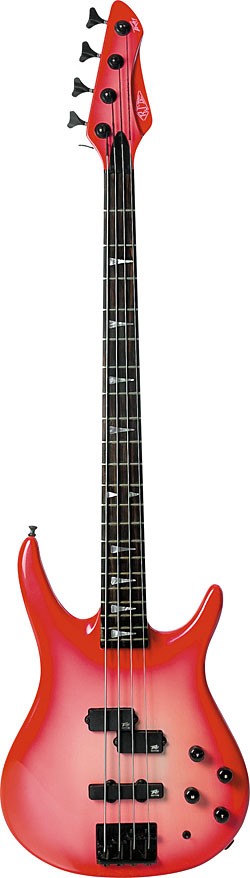
Peavey RJ-IV bass, serial number 04938996. Photo: Bill Ingalls Jr. Instrument courtesy of Naffaz Skota.
Americans by the millions “know” Randy Jackson. But not many realize that his gig as one of three judges on TV’s “American Idol” is just the tip of the iceberg in his long musical career.
The veteran bassist has played alongside, recorded with, and/or produced musicians ranging from Jean Luc-Ponty to Bob Dylan to Jerry Garcia to Mariah Carey to Bruce Springsteen to Charlie Daniels (at the Grand Ole Opry, no less). He also played on Journey’s 1986 album Raised on Radio, and toured with the band. In fact, most Americans’ first Randy Jackson sighting was in a performance video for Journey’s hit single from that album, “Girl Can’t Help It,” where he played a green Jackson bass decorated with gambling-table graphics.
A few years later, Jackson (the man) collaborated with Peavey to design and build the RJ-IV, one of several artist endorsement models marketed by Peavey in the late 1980s and early ’90s. It debuted in 1990, a year after the TL-5 (designed with the input of Tim Landers), and the Rudy Sarzo Signature Bass and a year before the Palaedium (inspired by Jeff Berlin’s “parts” bass).
The RJ-IV has its share of interesting elements. For instance, Peavey spec sheets of the day referred to the model as the “RJ4,” while the headstock and owner’s manual actually say “RJ-IV.” And while company literature noted its neck-through configuration, touted its “select maple body” and “eastern maple bilaminated neck construction with graphite reinforcement,” its finish made it impossible to see and/or appreciate these qualities!
The headstock profile was similar to other up-market Peaveys of the time, with a carved portion below the trendy black tuners.
The RJ-IV was equipped with a Hipshot D-tuner on its E string and its 1.6″-wide nut is made of Peavey’s trademark Graphlon material. The scale is standard 34″ and the neck profile was described in literature as having a “…thin oval back profile.”
Its fingerboard is macassar ebony, and has a 10″ radius and 21 frets. Its funky “icicle” mother-of-pearl fretboard inlays are unique among Peavey instruments. Company literature also hyped the “…reduced body size with four-way radial contour.” The body is 18″ long and 13″ wide.
As for its electronics and controls, the RJ-IV came off as practical and simple-to-operate… on the surface. Its pickups are active, powered by a 9-volt battery that installs on the back of the body, in a small compartment separate from the rear control cavity. The control knobs are labeled “V” (volume), “B” (bass), “M” (midrange) and “T” (treble), and each of the three tone knobs has a center detent. Pickup selection is accomplished by a three-position mini-toggle. So far, so good…
The Bass control is centered at 50 Hz and has a +8 dB boost and a -8 dB cut. The Treble control is centered at 2 kHz and has a +/-12 dB boost/cut. The Midrange knob is on the upper row, behind the Volume knob. The midrange tonal sweep of the RJ-IV can be pre-set for several frequency ranges with variable-notch centers. And for real fine-tuning of the tone, the rear cavity houses an eight-position dual in-line package (DIP) switch that the owner’s manual says adjusts thusly: “1 on – 6 dB pad on preamp input; 2 on – shift high from 2 kHz to 1 kHz; 3 and 6 on – shift mid from 1 kHz to 500 Hz; 3,4,6, and 7 on – shift mid to 250 Hz; 3, 4, 5, 6, 7, and 8 on – shift mid to 125 Hz.” Given its relative complexity, one wonders how many RJ-IV owners actually went to the trouble of changing the DIP switches.
The Red Pearl Burst finish on the RJ-IV shown here might evoke comparison to Rickenbacker’s Fire-Glo finish, which is also pink-to-red, and its fret markers have a Ric vibe, as well, resembling the wedge shapes found on up-market Rics. The RJ-IV, however was available in three other Pearl Burst finishes (Black, Blue, and Purple) as well as solid Pearl Black, Pearl White, Pearl Blue, and Sunfire Red. There may even have been one in natural-finish koa. In 1992, Jackson filmed an instructional video called Mastering the Groove, where he appeared on the cover brandishing an RJ-IV in Red Pearl Burst.
The RJ-IV lasted four years in Peavey’s lineup. While it’s debatable to what extent Jackson’s high profile today might bolster collector interest in this model, it, like most Peavey basses, is well-built and remains a practical value in the market.
This article originally appeared in VG‘s October 2008 issue. All copyrights are by the author and Vintage Guitar magazine. Unauthorized replication or use is strictly prohibited.
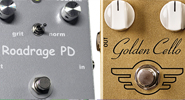

Goodtone Roadrage PD, Mad Professor Golden Cello
Price: $155
Info: www.goodtone.com.
Goodtone Amps builder Norm Matthews has a rep for building noteable guitar amps, and more recently he delved into effects pedals. Matthews’ first box is the Roadrage PD, a true-bypass, two-stage MOSFET-based unit designed to deliver neutral clean gain boost or overdrive. In other words, it’s the latest twist on an age-old concept almost every electric-guitar player can appreciate – an “uncolored” clean boost.
Plugged into a series of amps, the Roadrage is impressively transparent – and usable – especially when coupled with vintage/non-master-volume amps that produce enough hair for rhythm guitar parts but typically require an overdrive for leads. Unlike overdrive pedals, the Roadrage does not change the sound of the guitar – it simply makes it louder by making the amp’s preamp stage produce a slightly more compressed, singing tone. Plugged in between a Stratocaster and a vintage Vibrolux Reverb, the box delivers in a number of tonal areas. Though not a compressor, per se, it works very well for slide playing, providing a bit of squash/sustain for a bottleneck-slide sound. Tested with a Les Paul and a vintage 50-watt Marshall, it gave the extra kick that made the amp sing. Placed in front of a vintage Ibanez TS-9, it restored some of the dynamics the TS-9 tends to suppress.
Like most pedals, the Roadrage uses a 9-volt battery and can also be powered by an external power plug (with tip-ground). But it stands out in part because it’s built using point-to-point writing, with high-end components like Sprague Orange Drop caps and carbon-film resistors. Its controls are simple: a Volume pot controls output and a Gain pot adjusts the level going from the first to the second FET stage, pushing the second into a bit of compression followed by a slight distortion. There’s also a Grit/Norm switch that changes the gain structure of the pedal, allowing more clipping in the Grit position. Despite being MOSFET, the Grit setting provides a very warm, tube-like distortion.
The Golden Cello by Mad Professor is a combination overdrive and delay pedal engineered to marry the two effects. Equipped with four external controls and three internal trim switches, the Golden Cello packs a lot of functionality in a super-small footprint. On top of the pedal are controls for Volume, Tone, Drive, and Delay (level). The internal trimmers control the amount of repeats and delay length (which, according to the manufacturer, must remain in balance with each other) and the final trimmer determines the amount of volume going into the delay stage.
We followed the advice of the owner’s manual and plugged into a clean-toned amplifier. While such a set up is generally limited, in practice it makes sense given the design of the Golden Cello. One way to think of the relationship between this pedal and a clean amp would be to consider the Golden Cello as a preamp and an amplifier as the power amp, with the delay being between the two as an effects loop. And while many might think it better to plug an overdrive into an already dirty amp, such a setup would render the repeats of the delay muddled and indistinct.
Plugging into a clean amp with a humbucker-equipped guitar, we found the overdrive to be surprisingly thick and powerful, capable of handling drive and distortion duties all by itself. The distortion shared the same strong, rich musical characteristics that power-tube distortion has. Combined with the tape echo-styled delay, the Golden Cello transforms licks into singing lead lines that sound slick and professional.
Depending on what one’s needs might be, the Golden Cello could serve as the only pedal needed in a given setup. Though adjusting the internal trim pots require opening the back, the pedal ships with optimum settings and, in reality they’re more about “set and forget” than regular tweaking. No one-trick pony, you’d be hard-pressed to find a better-sounding combination of overdrive and delay in a single box.
This article originally appeared in VG September 2012 issue. All copyrights are by the author and Vintage Guitar magazine. Unauthorized replication or use is strictly prohibited.
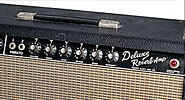

In the June ’07 issue of VG, amp profiler extraordinaire Dave Hunter said of the Fender Deluxe Reverb, “If guitarists were to vote for the one ‘best amp for all occasions,’ [it] would very likely earn a majority decision’.”
And while this year’s nominees in the VG Hall of Fame “Instrument” category pitted the “DR” against three stalwart guitars, the results speak, um… volumes.
The overwhelming winner (trouncing Gibson’s Firebird and Les Paul Junior as well as Gretsch’s Duo-Jet), the Deluxe Reverb is viewed by many vintage-tone purists as the ultimate guitar amp. Why? Well, for starters (and we’ll recall Hunter’s words here), the DR is “…small enough to crank up into tone territory for recording, rehearsal, or bar gigs, yet loud enough to fill a room and be heard above the drummer in a medium-sized club with just a vocal P.A.”
Introduced in 1963, the DR came along as part of Fender’s storied “blackface” line, and was a fairly dramatic reinterpretation of the previous-generation tweed Deluxe. Though it kept the tweed’s two 6V6 output tubes and 12″ speaker, its circuit was entirely new even beyond the addition of reverb and tremolo (which, by the way, sounded gloriously lush), and there’s precious little not to like! The key changes included a move away from cathode-bias and the addition of a negative-feedback loop around the output stage, giving it class AB operation, rather than the straight class A of the tweed. Also, its split-load phase inverter was replaced with a long-tailed-pair PI, which let it use more of the 6V6s’ headroom. And, the tweed’s Tone control was replaced with controls for separate Treble and Bass. Overall, this configuration was “hotter” and more dynamic than most of the DR’s bigger-brother Fender amps, giving it more focus and headroom while allowing it to retain a deliciously tactile playing feel.
So, what’s it all mean, in meat-and-potatoes terms? We’ll let Hunter’s June ’07 text lay it out (and take us on out)…
“The Deluxe Reverb is a great amp for anything from blues to country to rock and roll, and even jazz. Consequently, it has long been a go-to combo for countless first-call Nashville and L.A. session players.”

Adomono was a guitar hero in part because he had a secret weapon in his arsenal.
“John played alone, but most people thought there were five or six players on his records,” remembers Lu Woolley, his promoter and booking agent. “People were absolutely wowed by him. Nobody played like him.”
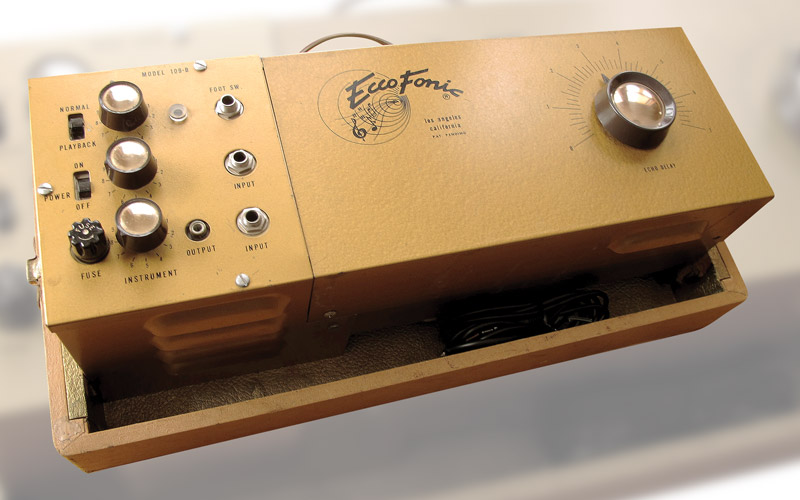
Adomono’s secret weapon was the Ecco-Fonic, a cutting-edge tape-echo machine. Alongside DeArmond’s Tremolo Control, it was one of the first stand-alone effects for the guitar. The Ecco-Fonic was also a testy, fidgety machine to use. It was never produced in great numbers, embraced by guitarists, nor widely distributed. Yet it remains a guitar milestone. And Adomono was one of the early testers, promoters, and endorsers.
Adomono was Romani. Born in the 1930s, he was playing guitar on the streets of New York City for spare change when he was five years old. He met fellow Roma Django Reinhardt during his sole U.S. visit in 1946, and was inspired to play jazz. But it was Adomono’s introduction to one of Ray Butts’ EchoSonic amps that spurred his fascination with echo and helped create the sound that made him famous.
In the late ’50s or early ’60s, Adomono was playing in Memphis when he met local guitarist John Arnold and borrowed his Gretsch 6120 and EchoSonic amp with built-in tape echo. “He would just play the crap out of it,” Arnold says. “He was amazing. He could get more out of a guitar than anyone that I had ever heard. This was his first time playing with a portable echo chamber. He was so enamored with the thing doing echo and making him sound like more guitars.”

Butts built the EchoSonic in small numbers and mostly sold them by word of mouth, primarily around Memphis. Adomono was on his way west (he would play for decades in Las Vegas at the Thunderbird Hotel, in Honolulu and L.A. at Donn Beach’s Don the Beachcomber lounges, and up and down the West Coast). While in Southern California, he discovered the Ecco-Fonic, which, like the EchoSonic, was largely a regional “secret” despite the builders’ best efforts.
The Ecco-Fonic was the creation of Ray Stolle, who ran a radio-and-TV repair shop on Sunset Boulevard in L.A. No one seems to remember his inspiration or motivation for the tape-echo machine. He built a prototype circa 1959 that differed from the EchoSonic in that the second playback head was adjustable, allowing musicians to fine-tune the time between the original note and echo. As an early flyer touted, “The Variable Delay Control permits the player to select any rate of straight echo playback desired. This can be from a microsecond to as much as a full half-second delay.”

The first Ecco-Fonic had two control knobs: one for delay, the other for Reverberation, which was supposed to control volume decay on the echo. The machine also included an Echo Selector Switch that allowed players to record a short segment, then play along with the loop.
Stolle somehow hooked up with Fender, and the Ecco-Fonic was first promoted in a single-page Fender Sales flyer in summer ’59 as well as Fender’s ad insert in the annual Down Beat magazine guitar issue. But, as John Teagle reported in Vintage Guitar in 1998, Fender Sales chief Don Randall, “reportedly was not impressed with the reliability and test-user satisfaction” of the machine. Among other issues, the first Ecco-Fonic was mounted in a gold-painted metal box with a one-piece top that hampered easy servicing – and as Ecco-Fonic users quickly discovered, the unit needed constant oiling of the motor, head cleaning, and tape replacement.
Stolle lacked the finances to develop his design, so he sold out to E.S. “Eddie” Tubin, who started manufacture of the Ecco-Fonic at 905 S. Vermont Avenue, Los Angeles. Tubin refined the device with the aid of Adomono, guitarist Del Casher, and other early testers. A three-knob version appeared in late ’59, followed in 1960 with the four-knob Model 109, which added an Instrument volume pot blending wet and dry signals.
Tubin’s revised Ecco-Fonic sported a two-piece top, making service access simple. And the tape speed was revised from the 15-inches-per-second of the initial versions to 7.5 IPS, for better fidelity.
Tubin began promoting the 109 in music magazines with endorsements from Adomono, Casher, his accordionist bandmate Tony Lovello, mandolin maestro Dave Apollon, harmonica ace Leo Diamond, Joe Maphis, and Hank Thompson.
The 109 was superseded in autumn, 1960, by the 109-B with a rearranged four-knob control panel and the elimination of the Reverb switch. Thanks to the updates and advertising, the 109 was likely the first Ecco-Fonic to sell in significant numbers; as one ad shouted, “Stepped up production is our response to phenomenal acceptance.”
In 1961, the company was sold again, this time to industrialist Milton Brucker. Early 109-B models carried the legend “Los Angeles California” below the modernistic Ecco-Fonic logo; later versions sported a straighter logo and the address “Hollywood 28 California,” as production moved to Santa Monica Boulevard.
The 109-B was followed by a 109-C with multiple playback heads. This version came in a black-painted case and was likely built in small numbers. Brucker also announced plans for other Ecco-Fonics for churches, auditoriums, and radio stations with the model names Singalong, Vaudevillian, and Encore as well as the console Broadcaster model. It’s unknown how many – if any – of these others were ever made.

Teagle believes overall tube Ecco-Fonic production began with serial number 1001 (Casher’s Stolle/Tubin prototype is number 1012) and likely ran into the 3000s before switching to the solidstate version.
In the fall of ’62, Ecco-Fonic was bought out by electrical engineer Bob Marks, who moved shop to Pico Boulevard. With help from chief designer Russ Allee, Marks spearheaded the creation of a solidstate Ecco-Fonic to be distributed exclusively by Fender. Chicago Musical Instruments had taken over production of the Echoplex tape-echo machine under its Maestro line to accompany its Gibson guitars. So Fender rechristened the Ecco-Fonic as the Fender Echo.
The quirkiness of the Ecco-Fonic design always held it back, whereas the Echoplex, thanks in large part to its tape cassette, proved reliable and easy to operate. Fender offered its solidstate machine for several years starting in ’63, but it never sounded as good, and the Echoplex dominated the market. Orders dwindled, and the Fender tape machine was retired. The company soon switched to Tel-Ray’s simpler, but less-effective oil-can echo unit.
John Adomono never gave up on his Ecco-Fonic, however. As a solo guitarist, it was vital to his sound.
“He always used that echo,” promoter Woolley remembers. “He was just one person with one instrument, but the sound blew people away. Women from age 21 to 80 would go crazy for him, and send napkins with notes, trying to make contact.”
One of the most astounding examples of Adomono’s guitar work appears on his 1974 private-label LP Gypsy, which was funded by Woolley and others. Picking his archtop Guild through his tried-and-true Ecco-Fonic, he plays Rimsky-Korsakov’s virtuosic showpiece “Flight Of The Bumblebee,” his fleet picking resounding in multiple layers of warm echo, thanks to his old echo chamber in a box. It’s a masterpiece of guitar music.

This article originally appeared in VG June 2014 issue. All copyrights are by the author and Vintage Guitar magazine. Unauthorized replication or use is strictly prohibited.
Ecco Fonic
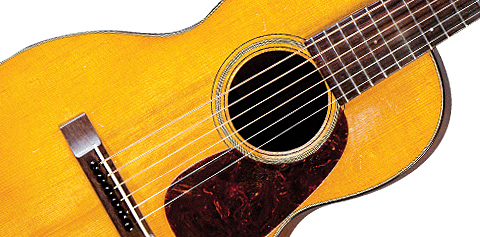

The Martin style 5-18 is the smallest guitar in Martin catalogs; at the lower bout, it measures 11.25″, while at the upper bout it is 8.25″. And its body is just 16″ in length, with a scale of 21.4″. In 1930s catalogs, the style 5-18 and the less expensive matching size 5-17 were listed with the caption “Junior, or three-quarter, sizes fine for children; easy to hold and to play.”
Though most players viewed size 5 guitars as “junior” instruments, in the 1950s and ’60s, the style 5-18 was popularized by Marty Robbins, who used it extensively onstage.
Early in the history of the Martin company, guitars of this size were not viewed as a junior or three-quarter instruments, but were part of the Germanic tradition of “terz” guitars, designed to be tuned to a minor third – three frets higher than standard pitch and suitable for solo performances and harmony work. Terz guitars were produced by many 19th-century Germanic makers, and many European composers in the early/mid 19th century – most notably Giuliani and Sor – wrote solo and ensemble music that included parts for terz guitar. C.F. Martin, Sr. was deeply influenced by the designs of Johan Stauffer and was familiar with Stauffer’s terz guitars. Some surviving Martins of the 1830s and ’40s are terz guitars, and have a scale of 22″.
From the 1840s through the 1850s, Martin’s style designation system became increasingly standardized. Guitars were offered in sizes 1, 2, 3, 4, and 5, with the largest (size 1) measuring 12.75″ wide and the smallest being the size 5 terz. The very rare size 4 was also designated a terz. As larger guitars became popular during the 1800s, Martin introduced the size 0 measuring 13.5″ wide and later the size 00 measuring 14.125″ wide. It was not until after 1900 that the 15″-wide size 000 was introduced.
The 5-18 was listed as early as 1898 in Martin literature and last appeared in their catalog in 1989, though a Marty Robbins reissue 5-18 has been offered since 2006. With the exception of the slotted peghead, which was discontinued in the late 1940s in favor of a solid peghead, the 1935 5-18 shown here is virtually the same in appearance. This guitar has an Adirondack spruce top, whereas the post-war 5-18 has Sitka spruce. The ’35 has a Brazilian rosewood bridge, fingerboard, and peghead veneer, while those made from 1970 onward have Indian rosewood. The ’35 also has mahogany neck, back, and sides, as do the post-war models.
Though Martin offered size 5 models ranging from style 15 through the elaborately ornamented style 45, the only ones made in any significant quantity prior to World War II were the style 17, 18, and 21 in six-string guitars and styles 17, 18, and 21 tenors, as well as some style 15 post-war size 5 tenors. In recent years, Martin has offered highly ornamented size 5 models.
While terz guitars tuned a minor third above standard are a common instrument in the Germanic tradition, requinto guitars tuned a fourth higher (five frets above standard) are common part of Spanish and Latin American tradition. The requinto used in mariachi music is smaller than the standard-tuned guitars in the band, but has greater volume and projection and plays a significant role in the music. From the mid 1990s until recently, the Tacoma Papoose (tuned five frets above standard) was part of that company’s line, which ranged from the Papoose to standard-size instruments and a baritone guitar as well as acoustic four- and five-string basses.
Though size 5 terz guitars are smaller, they produce as much volume and have as much (if not more) projection than a full-sized/standard-tuned instrument. Many other small instruments have similar qualities; a fine violin can be used to play a solo heard above an entire symphony orchestra without amplification, a mandolin is fully as loud if not more so than any guitar, and the sound from the lone piccolo in a large symphony orchestra can carry throughout a concert hall. In spite of their size, small instruments designed with the proper ratio of air-chamber size to pitch are capable of tremendous volume and projection.
It’s ironic that although size 5 instruments were designed to be tuned three frets above standard pitch and have a scale length very similar to a standard guitar capoed at the third fret, pre-war Martin catalogs, as well as those of the 1950s through ’80s, referred to them as simply three-quarter-sized guitars. They are quite playable tuned to standard pitch, but tuned at least two frets above standard pitch, their sound comes alive. The short scale and smaller body results in a very different sound with excellent tone, volume, and projection. Though three of the four strings of the violin and viola are tuned the same, their tone remains quite different; the same applies to the terz, which has a voice all its own.
Martin’s description for the Marty Robbins 5-18 instructs players to tune the instrument three frets above standard pitch, finally acknowledging (and paying homage to) the fact these are descendents of early terz guitar designs from the homeland of C.F. Martin, Sr.
This article originally appeared in VG June 2014 issue. All copyrights are by the author and Vintage Guitar magazine. Unauthorized replication or use is strictly prohibited.


Bassist/vocalist/songwriter Greg Lake came to notice in 1969 as member of King Crimson and his membership in Emerson, Lake and Palmer cemented his place in the pantheon of progressive-rock icons. He also recorded numerous solo albums; his most recent, Songs of a Lifetime, is a career retrospective.
“The idea came during the writing of my autobiography,” Lake said. “Every so often, a song would crop up that was in pivotal in the development of my career, [and] I realized they represented the journey the audience and I have shared over the past 40 years.”
There are plenty of classic King Crimson and ELP songs among the 20 tracks on Songs, along with tributes to Elvis and the Beatles. “Both changed the course of musical history, and played a role in my musical development.”

The between-song monologues are entertaining – sometimes extensive – and among them are memories of the art design of King Crimson’s first album as well as how one of ELP’s signature songs, “Lucky Man” evolved from its start with acoustic guitar and drums. Lake declined, however, to cite a particular performance as a favorite or “most interesting.”
“That’s rather like someone asking you to choose between your own children,” he said. “They are all dear to me in one way or another, otherwise they wouldn’t be in the show. Each time I perform a song or a piece of music, I give 100 percent of myself and to try and make it as good as it possibly can be.”
While the album isn’t “unplugged,” acoustic guitars figure prominently.
“I tend to play a lot of the songs on various Gibson J-200s,” Lake said. “I also use a John Lennon Epiphone to play ‘You’ve Got To Hide Your Love Away.’ On occasion, I also play a Taylor 12-string and sometimes take out one of my Martin acoustics, just for a change.”
Only one electric bass appears on the album – a gold sparkle, custom-made Sadowsky four-string he describes as “…absolutely superb. Roger Sadowsky is one of the great master guitar builders.”
One of the electric guitars Lake plays is a longtime favorite. “I have a great fondness for the Gretsch 6120,” he said. “Everything about the design and the way it’s finished and appointed makes it one of the best electric guitars. I own an original ’59 and a new one I use for touring. Both are really great guitars.”
The penultimate track on Songs is a plaintive cover of the Impressions’ “People Get Ready,” and not surprisingly, the album concludes with “Karn Evil 9 – 1st Impression, Part 2,” which is better-known to fans by its keystone lyric, “Welcome back my friends, to the show that never ends.”
While Emerson, Lake and Palmer have re-grouped more than once, Lake doesn’t anticipate further reunions, noting the band’s three erstwhile members are all following their muses in solo careers.
Likewise, Lake has further plans. “I’m going to perform in Japan soon, and then Italy,” he said. “And, discussions are taking place for future tours.”
This article originally appeared in VG November 2013 issue. All copyrights are by the author and Vintage Guitar magazine. Unauthorized replication or use is strictly prohibited.
Read Lake’s exclusive interviews with VG May and June 1994.
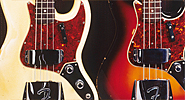

“Stack-knob” is a catch phrase that for decades has perked the ears of collectors; these relatively rare examples of the earliest Fender Jazz Bass are among the first electric basses to be “collected” instead of just bought, sold, and played! Along with the ’50s Precision, they stand as the ultimate Fender bass – sought for their tone, feel, and aura of cool. Built during the transition between the ’50s and ’60s, they combine the craftsmanship of Fender’s pre-guitar boom period with the modern look.
Nobody knows how many Jazz basses were made before Fender switched to the three-knob configuration, but, as a new and more-expensive model in an era when the electric was considered an illegitimate upstart, the Jazz took time to establish itself as a popular alternative. The number of extant examples is small compared to the number of surviving early-’60s Precisions.
Fender took its time getting a second bass to market. The Precision had been an increasingly familiar sight for about eight years before the Jazz made its debut. Basses from Gibson (the Electric Bass, or EB-1, followed by the semi-hollow EB-2) Rickenbacker (Model 4000), and companies like Kay must have shown Leo and his crew how the market for electric basses was big enough to include a “deluxe” model. Instead of simply updating its one model, as Fender had done in ’54 and again in ’57, it decided to complement the Precision Bass with an upscale sister. Borrowing the new “Offset Contour” body from the Jazzmaster but keeping the long “horns” needed to balance a bass neck, Fender created a beautiful and harmonious design. The pickups were new, keeping the dual polepieces from the ’57 Precision, but with narrower, more-focused field. The stacked knobs gave individual Tone and Volume controls for each pickup – a novel feature for a bass at the time. The three-knob configuration was at the prototype stage, but got the commercial nod, only to be discontinued within two years. A 1960 Fender catalog bound into the July 21 issue of Down Beat shows on its cover what appears to be a three-knob Jazz with a ‘50s-style Fender logo. The bass in the catalog, and the ad in the January ’61 International Musician, is a stack-knob with no logo. Other distinctive “stack” features include the adjustable mute pads under the chrome tailpiece, prominently featured in promotional literature (but eventually removed by most players), the “patent pending” fine print on the headstock decal, and – on the earliest examples – the beloved “’50s bump” on tthe lower cutaway. Fender also promoted the new narrower neck as permitting “rapid technique” – one wonders if a young Jaco Pastorious took this to heart. The original catalog blurb for the Jazz says, “this… is the standard by which others will be compared” and for once a bit of ad copy has held true through the years! The early Jazz is still the standard by which any electric bass can be judged, and most are found wanting.
This article originally appeared in Vintage Guitar Classics No. 2 issue. All copyrights are by the author and Vintage Guitar magazine. Unauthorized replication or use is strictly prohibited.


Veteran jazz guitarist John Scofield has released a second album with Uberjam, which includes drummer Adam Detich, guitarist Avi Bortnick, and guest keyboardist John Medeski. It’s full of funk and soul, and we talked with Scofield shortly after the group started its current tour.
Why the second record?
We played a lot at the beginning of the millennium, then didn’t for awhile, and I thought it’d be fun to see how we could approach the music after a few years. Once you’ve grown as a group, it’s fun to reunite.
Your career has taken so many roads a traditional jazz player may not. Any particular reason?
Part of me would like to have just one group all the time. The way the market works today, they want a different group every time, if you’re an old, established person like me. They’ve had you at their festival or concert series and they want to bring you back, but they want it to be something else. That’s a pain in the neck, on one hand. On the other hand, it fits with what I like to do; I can be restless. It helps the music in that you never have time to get bored, and one project will feed the other.
Do you see yourself as a restless musician?
After doing it for a while, I think everybody realizes that things change. The best stuff you come up with is kind of spur-of-the-moment. We have to put ourselves in situations that make us come up with new stuff. We have to be restless. Part of me thinks if I could just practice “All the Things You Are” for my whole life and really get it down, that’s the way to go. Part of me feels like that, but I don’t do that.
The record has a real soul vibe.
I realize now, looking back at it, that I grew up during the time when soul was really happening, with James Brown and Aretha in the ’60s. I was aware of the music then and loved it and was a huge fan. I played in bands since I was a kid that tried to play soul music. So, it just seems part of what I love.
It seems like you’re always on tour, usually with someone.
I’m lucky I get to play a lot. This summer, it’s a lot of the jam-band festivals with my band. More in the U.S., and then we’ll hit Europe and Asia.
Speaking of the jam-band thing, you’ve made friends in a lot of genres. People think you’re a jazz guitarist, but there you are hanging with folks like Warren Haynes.
Yeah, yeah, he’s not a jazz guitarist, but he likes jazz. I’m the “jazziest” guy Warren would play with, but when we play, it works. If he played with Tal Farlow, it wouldn’t work. I love blues and I love to play electric and loud. It’s fun for me to get to play with guys who are blues players or funk players and into a different thing.
Speaking of, a year ago you did shows with Robben Ford.
I thought it was completely natural, and I think Robben did, too. We had a lot of fun playing and I hope we do some more. I’ve known Robben… well, I’ve known of him since I saw him at Hop Sing’s, a Chinese restaurant in L.A. that was also a club. He was playing with the group that later became the Yellowjackets. He knocked me out. And then when I [left Miles Davis’ band], he became the guitar player. I remember going to hear them and thinking “Oh s**t, this sounds really good. I wish I’d been able to play the gig like that.” I’m a big Robben Ford fan.
What guitars are you playing these days?
I played my Ibanez AS200 on the record, but I also played a Fender Custom Shop Stratocaster on about half the tunes. My Ibanez is still my number one axe, but I got the Strat a few years ago. I was embarrassed to buy it; I went into Sam Ash in New York and tried a bunch of guitars, and this Strat was great. The thing is, it was all relic’ed up – had a fake cigarette burn on it. And it’s pink. But I got over the shock and got it. Now, I think whatever they do to make it look old actually makes it sound better. It’s a good one.
What about amp on the record?
On this one I used the Vox AC30 that I’ve been playing since the late ’90s. It’s a reissue from then. I didn’t use a lot of effects. All the distortion is just the amp.
This month’s “Fretprints” column by Wolf Marshall focuses on Scofield’s work. See it on page 72.
This article originally appeared in VG November 2013 issue. All copyrights are by the author and Vintage Guitar magazine. Unauthorized replication or use is strictly prohibited.