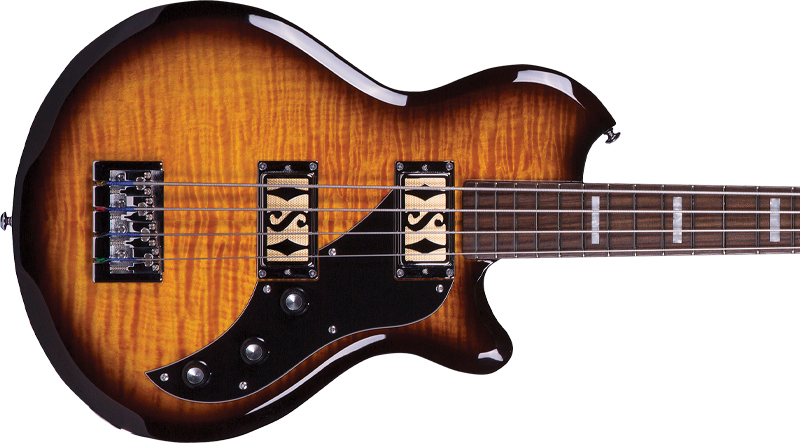
Looking supremely ’60s-like with its gorgeous, vintage-y cherry-red finish, petite body, and fancy-topped pickups, the Supro Huntington is inviting as all get-out. A short-scale axe, it combines a classic shape (think Ozark/Supro Pocket Bass) and passive electronics with a modern touch or two.
The Huntington’s gold-foil pickups are, according to Supro, replicas of the Pocket Bass’s Clear-Tones: high-output single-coils that produce very usable tones that stay warm and balanced even with the Tone knob dialed all the way dark or bright – and they never buzz or hiss. Supro places them in single, double, and triple configurations on the model’s three variations (an optional piezo offers versatility). Control knobs are arranged logically – Volume(s) first, following the order of each pickup’s placement; Tone is last in line. The high-mass bridge is one of the modern touches and it does its part to bolster overall sound.
Supro offers the Huntington with mahogany, ash, or alder bodies in a handful of finish options. All have maple necks with rosewood fretboards and block inlays. Piezo models ship with flatwound strings. The 30″ scale and matte-black finish on the back of the neck give the instrument a comfortable, super-smooth playing feel that makes those first few hours of “get acquainted” time downright fun. It’s different in a really good way.
Finally, lest you’re thinking, “Short scale and flatwounds – gotta sound thuddy…” well, allow Supro’s website to set your mind at ease with help from demos by Doug Wimbish and a couple other heavy hitters who (ahem) capably reveal the Huntington’s full potential.
This article originally appeared in VG February 2018 issue. All copyrights are by the author and Vintage Guitar magazine. Unauthorized replication or use is strictly prohibited.
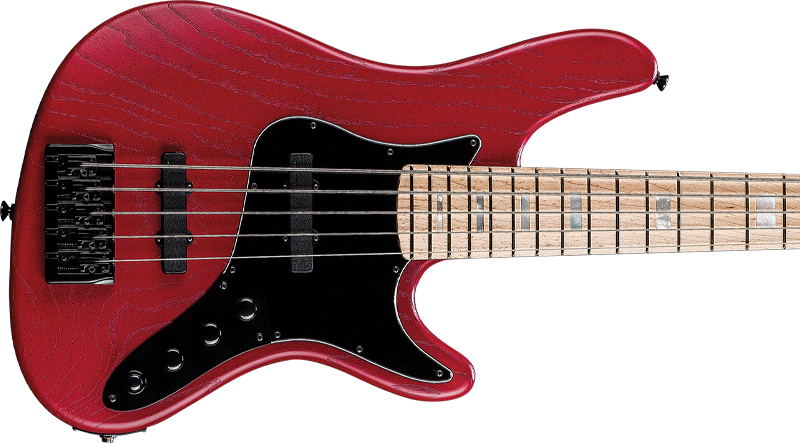
The look and feel of Kiesel’s JB5 Classic align well with what a bassist expects when they gaze upon it – modern take on a Fender Jazz, with similar cuts and contours. Unless you’re that last bassist on earth to have picked up a Jazz (or one of the million clones), you know it.
Sitting or standing, the JB5 is beautifully balanced. With an average weight under nine pounds, its 44.5″ x 13.25″ x 1.65″ body (built using one of several wood options) will spare you that kink in the rhomboids after a gig or long rehearsal. Its oiled-maple bolt-on neck is nicely shaped – 0.78″ thick at the first fret up to 0.88″ at the 12th, it’s thin enough to keep notes in easy reach for the typical adult-male hand right on past the nicely contoured neck heel at the 17th fret (but like Mundell Lowe says in his feature in this issue, “Don’t play notes the audience can’t hear!”). The 34″-scale ebony fretboard has a 14″ radius, white-pearl dot inlays, and Kiesel’s Luminlay side dots. It measures 1.77″ wide at the nut, 2.98″ at the 22nd fret. The bridge is a proprietary unit with adjustable saddles and string-through or top-loading options.
The Kiesel’s JVA single-coil pickups use Alnico V magnets, and its 18-volt active/passive electronics offer impressive range, with controls that are logical and no-nonsense. Activating the passive function involves pulling the push/pull master Tone pot. In commonly used manipulations of EQ and pickup balance/output, the JB5 does admirable work, especially for an instrument in its price range. Even at the muddier end of usable, the B string sounds round and clear. At the other extreme, through the bridge pickup only and with lows completely cut and highs fully boosted, the JB5 sounds pocket-radio-like in its thin-ness – something employable as an effect, perhaps.
No matter the style, players will find plenty to use here.
This article originally appeared in VG February 2018 issue. All copyrights are by the author and Vintage Guitar magazine. Unauthorized replication or use is strictly prohibited.
Over the last few years Xotic has grown its rep thanks to top players who have endorsed its Leo-inspired guitars and basses. Now Xotic’s new import ProVintage series endeavors to bring the company’s noted build quality to a mid-price segment.
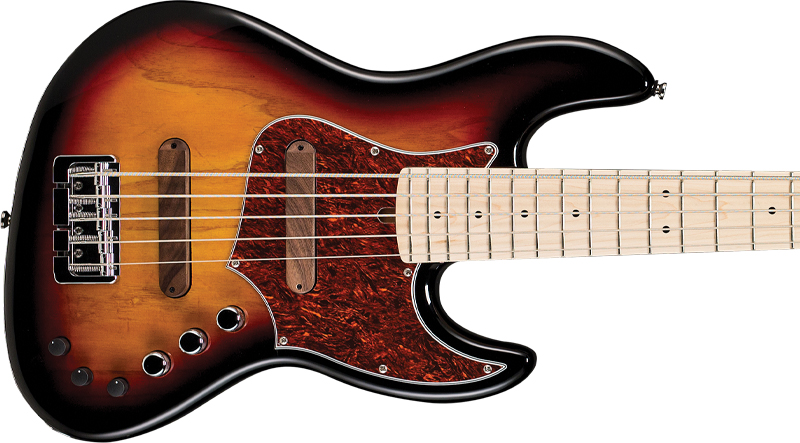
Built in Indonesia, the ProVintage 5-String has its pickups installed, its neck Plek’d, and the whole works run through a final setup and inspection at the company’s California facility. Inspired by Xotic’s popular XJ series, this bass is descended from the classic Fender Jazz design with a double-cutaway ash body, a 34″-scale maple neck and 22-fret maple board, and a sunburst finish with tortoiseshell pickguard. Its fingerboard has a nut width of 1.75″ that tapers to 2.625″at the 12th fret. And it all supports that low B string.
Things get even more interesting with the electronics, starting with two single-coils with elegant wood covers. There are the familiar chrome knobs for volume, tone, and a balance that pans between the pickups. The push/pull Volume knob jumps between active and passive systems. The active side brings online a powerful three-band EQ and a substantial volume boost that lets the player fine-tune their tone; the active circuit can also serve as a sort of lead channel for solos and louder sections – all without a footswitch. Other amenities include Hipshot Ultralite tuners and B-style bridge, and two battery compartments to provide 18 volts of power for increased headroom.
The ProVintage 5-String’s flat D-profile neck is beautifully set up with low action and excellent tones. The bass weighs in around 9.5 pounds and its construction is rock solid. If you’ve been jonesin’ for an Xotic but don’t have the benjamins, you’ll dig the ProVintage line – it’s a lot of bass for the money, and it more than lives up to the Xotic name.
This article originally appeared in VG February 2018 issue. All copyrights are by the author and Vintage Guitar magazine. Unauthorized replication or use is strictly prohibited.
Alembic basses are the stuff of low-end legend, famed for magical tones in the hands of Stanley Clarke, Jack Casady, and John McVie, among others. The newer Essence 4 series is meant to capture that Alembic experience with a body lighter than the company’s hefty axes of the 1970s.
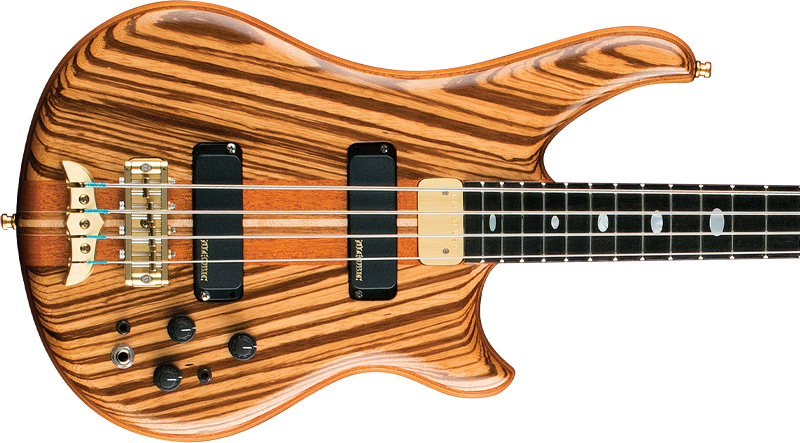
Like most Alembics, the Essence 4 body and neck are made with exotic woods, neck-through construction, and gorgeous laminate combos. Our test bass had a 34″ long-scale neck of walnut and maple stripes between mahogany pieces topped with a 24-fret ebony fingerboard and oval mother-of-pearl inlays. The mahogany body included maple/walnut accents and a richly grained zebrawood top.
The famed active circuitry includes a master Volume control and two proprietary MXY4 pickups selected via a seamless Pan knob. The real star of the show is the Filter control, which evokes a massive EQ sweep, from that Alembic snap to a deep, seamless roar, like the bass pedals on a pipe organ. In the latter setting, the adjacent Q switch gives the tone an 8dB boost for added bottom. For even more fun, an on/off switch activates an array of LEDs on the side of the fingerboard, their brightness controlled by a trim pot in the cavity (another on the internal preamp card controls overall gain).
As for playability, the legend is true; this Alembic is as fast as anything out there. Its smaller C-profile neck is meant for speed and comfort. The Essence also retains all the tonal magic expected from an Alembic, particularly in the upper range. There aren’t many basses that possess such a massive EQ span and let the player pinpoint exact frequencies to emphasize. As beautiful as this Essence is to look at, one has to marvel at the beauty of its preamp and pickups.
This article originally appeared in VG February 2018 issue. All copyrights are by the author and Vintage Guitar magazine. Unauthorized replication or use is strictly prohibited.
Hard-edged face of the British Invasion, the Rolling Stones introduced the world to the implements, trappings, and accessories of rock-and-roll superstardom. With help from radio, television, and teen ’zines, the band’s music beget mobs at public appearances before conflict and substance abuse fueled a frenzy that lasted more than two decades. Stones lore is rich, and in numerous examples extends to gear like this ’58 Les Paul Standard.
Instrument photos courtesy of Hard Rock International.
Now one of several Stones guitars in the Vault at Hard Rock International’s Orlando headquarters, the guitar entered the band’s realm in 1968 or ’69, roughly coinciding with the arrival of guitarist Mick Taylor. Coming from John Mayall’s band – which he’d joined at age 17 in 1966 – Taylor cut his teeth playing electric blues and thus brought an edge to the Stones, giving it a grittier sound more reliant on guitar. His first recordings with the band were dubbed guitar parts on two sessions for Let It Bleed – “Country Honk” and “Live With Me” – as well as the single “Honky Tonk Women,” released in July of ’69. He role was elevated on Sticky Fingers and Exile On Main Street – held today as perhaps the Stones’ best album. The final representation of Taylor’s work in the group was 1974’s It’s Only Rock ‘n Roll, and he departed late that year.
The guitar was used extensively by Taylor and Keith Richards as part of a communal arsenal. Through the years, its identity has been crossed and confused with other ’Bursts in assorted Stones road cases. During a 1980 interview with Guitar Player, Taylor identified it as a ’58 and said he still owned it. Other references, though, have labeled it as the guitar Taylor bought from Richards before he joined the Stones. However, Andy Babiuk, author of the formidable tomes Beatles Gear and Rolling Stones Gear, has documented that particular instrument and designated it a ’59.
Inspection by Hard Rock guitar tech Kip Elder reaffirms it is indeed a ’58.
“I went over it with a fine-toothed comb,” said Elder. “The neck is much thicker than later models –.905″ at the first fret, graduated to .983 at the 12th. Its nut is also wide compared to later models, measuring just over 1.7″. And while it’s considerably worn, the first digit of the serial number is definitely an eight.”
The guitar’s finish is suitably faded, worn, and checked. Its control knobs are era-accurate reproductions.The guitar was shown on the cover of Get Yer Ya Ya’s Out!
He further notes the dramatic fade in its “now lemonburst” finish, and adds that it’s very likely the guitar being held by Charlie Watts on the cover of the 1970 live album, Get Yer Ya Ya’s Out! The Rolling Stones in Concert; colloquially, it’s referenced as the “Ya Ya’s Guitar.”
Being so versed in the blues, Taylor played a lot of slide with the Stones, which means this guitar spent time in his favored tuning, Open G. He also played it during the Stones’ set on that fateful day at the Altamont Speedway Free Festival in December, 1969.
The headstock bears testament to the guitar’s high-mileage history.
In its prime, the guitar was just one tool employed by the Stones, subject to its share of modification and upgrades. Taylor once acknowledged that a Bigsby vibrato had been removed and replaced with a standard Gibson stop tailpiece; two mounting-screw holes confirm his statement. Babiuk’s book identifies it as originally having a pair of double-black PAF pickups. Extensive measurements by Elder led Hard Rock staff to conclude the covered pickups in it now are not original.
“We got a 10.2k-ohm reading for the bridge pickup – likely too hot to be an original PAF, which typically register about 8.5k,” he said. “I have little doubt these are aftermarket.”
“In the early ’70s, it was not so unusual to put Grover tuners on Les Pauls because the plastic keys on the originals typically deteriorated with time,” noted Jeff Nolan, Hard Rock’s Director of Memorabilia. “Also, new pickups weren’t uncommon. It came to the Stones simply as a used guitar, not coveted as ‘vintage.’ They liked the way it sounded, so they put it to good use in a day-to-day gig environment, not being precious about it or refusing to re-fret it, change a dead pickup, or replace the tuning keys. I actually love how not precious they were about the instrument!
“Of course, now we’re rather precious about it,” he added with a laugh. “But that’s because its provenance is so amazing.”
This article originally appeared in VG February 2018 issue. All copyrights are by the author and Vintage Guitar magazine. Unauthorized replication or use is strictly prohibited.
Lowe with his Gibson Byrdland, modified with an ES-150 pickup and non-spec elements.
Mundell Lowe is arguably the most successful jazz guitarist of his era. He routinely performed with such luminaries as Charlie Parker, Lester Young, Billie Holiday, Dizzy Gillespie, Bill Evans, Sarah Vaughn, and many others. He perpetuated a career as a major name on the jazz circuit for seven decades and can look back on a life of composing scores and soundtracks for myriad films and television shows. In addition, his days as staff guitarist at NBC complemented a body of work that showcases many of jazz guitar’s most-progressive recordings. Moreover, Lowe served several years as music director for the famed Monterey Jazz Festival.
Lowe was born and grew up in the Mississippi Delta farming community of Laurel, between Jackson and the Gulf Coast. Formative years spent in a rural area during the depths of the Depression provided the impetus for the young, ambitious artist to make his way to New Orleans.
“I got tired of two things – working on a farm and bad country music,” he said.
From the Big Easy, he found his way to Broadway via the Grand Ol’ Opry, where at 16 he worked as a sideman for the Sons of the Pioneers. The future would hold many more extraordinary events, from producing storied guitarslinger Roy Buchanan, playing sessions for Elvis Presley and other seminal rock artists, and a gig as staff guitarist at NBC in New York City, which included playing for the original “Today” show and broadcasting pioneer Dave Garroway.
“Record companies were selling widgets on pieces of vinyl that had nothing to do with art.”
Along with many famous peers, Lowe became a fixture on the 52nd Street jazz-club scene in NYC before being hired to compose for Columbia Pictures in Hollywood.
Despite his status as a world-class artist, the guitarist still has a soft spot for authentic country music.
“My dad’s group was the Shady Grove Ramblers, so I can appreciate real roots music,” he said. “But so much of what we hear today is not country music at all. It’s created in a studio. The same thing happened to rock and roll. I went through the era of Johnnie Ray, who was a precursor of rock and roll and played on his huge hit, ‘Cry.’ And of course, the Four Lads, the Four Aces, the Four Coins and so forth, but in those days we were just trying to make a living in a tough racket, so whoever rang the phone got us. I did, however do sessions with Presley, Jackie Wilson, Bobby Darin, Big Joe Turner, Ruth Brown, and a few more. But too much of the other stuff was simply formulated to make money. Record companies were selling widgets on pieces of vinyl that had nothing to do with art.”
Photo: Bob Barry. Lowe in ’04.
John Hammond
Lowe is among the coterie of artists whose careers were furthered by producer John Hammond. It includes Charlie Christian, Billie Holiday, Aretha Franklin, Bruce Springsteen, Benny Goodman, Leonard Cohen, Stevie Ray Vaughan, Count Basie, Big Joe Turner, and Bob Dylan. Hammond also oversaw the reissue of the indispensable Robert Johnson recordings.
“I met John when I was in basic training at Camp Plachet, outside of New Orleans. I didn’t know who he was and had barely heard of Benny Goodman, though I knew Charlie Christian was in his band. John and I became good friends. He liked jazz and would set up jam sessions at the enlisted men’s club. Back then, things were segregated; Buck Clayton, Basie’s trumpet player, guitarist Al Casey, and many others were situated across the road, but John managed to get us together for jams. John wrote an article for Esquire magazine that eventually became a book and included a piece about me that drew some attention.
“When I was separated from the service in 1945, I sent him a telegram. John was living in New York City and called to let me know that Ray McKinley was putting a band together and wanted me to be part of it; Ray took over the Glenn Miller Band after Glenn disappeared in the war. I spent about a year and a half with Ray, then went with Benny Goodman for a short time and later left to settle back in New York to work at Cafe Society. In fact, I quit Goodman twice and he fired me three times (laughs). After that, I got the staff job at NBC.”
New York, NBC, and the Today Show
“When I was working on the ‘Today’ show with drummer Ed Shaughnessy and bassist George Duvivier, at night we’d often work Birdland. Sometimes after a long night, I’d go back to the musicians’ room at NBC and I’d fall out until 6:00 or 6:30, when it was time to rehearse. That was of course when Dave Garroway had ‘Today.’ He went to bat for me many times, God bless him.
“Once, I got a message to go upstairs and see Lee something or other, who turned out to be NBC president David Sarnoff’s son-in-law. He was in charge of the legal department. He said, ‘Mr. Lowe, I’m sorry to tell you this but we don’t allow black players on camera.’ I said, ‘Namely who?’ He said, ‘Your bass player, Mr. Duvivier.’ I said, ‘Lee, take this up with Dave and I’ll do whatever he wants done. In the meantime, because Dave hired me, George Duvivier will be on camera.’ He said, ‘Oh, no, I don’t want to bother Dave. We just signed a contract with him and I don’t want to upset anything.’ I said, ‘Well then, you’re gonna have a black bass player on camera.’
“Dave wouldn’t tolerate such a ridiculous policy. He was such a terrific person.”
During that time, Lowe would arrange his schedule to play “outside” gigs like working weekends with Tommy and Jimmy Dorsey.
“Even during the jazz scene on 52nd Street, the words ‘greatness’ and ‘genius’ came [later]. I’ve said this to many who’ve asked what it was like to work with Charlie Parker. It was wonderful, but he had the same problem – we were simply trying to pay the rent. There was no thought of ‘Is this genius stuff?’ We were workaday musicians.”
Working studio and outside gigs enhanced Lowe’s visibility and cachet among fellow jazz artists. For instance, after a stint with vibraphonist Red Norvo, Lowe was asked by Norvo to find a replacement for himself before he returned to NBC.
“I told Red about was a wonderful player at The Little Club in New York City. I said, ‘He doesn’t have much of a name, but he can play the guitar.’ It took me three or four days to convince him that this guy, Tal Farlow, could handle it. And honestly, Tal did have a bit of a time at first with Red’s fast tempos. But he learned, which is what I had to do with Charlie Parker. You can’t practice it; the only way to learn to play fast is to play fast. You can’t sit around and think about it. Years later, I ran into Red and asked, ‘How did that guitar player work out?’ (laughs). Red, Charlie Mingus, and Tal Farlow became one of jazz’s classic trios.”
At the North Wales Jazz Guitar Festival in 2007.
Comp skills and the West Coast
In 1960, Lowe assumed a dual role at NBC. Reuben Frank, who ran the Department of Special Events, employed the guitarist’s composing and arranging skills for several documentaries including Castro’s Year of Power, The Changing Profile of Baseball, The Marriage Racket, and a few others.
“That’s how it began,” he said. “But I could see the handwriting on the wall with staff-musician jobs.
“In ’65, I visited friends for Christmas in California and ran into Jackie Cooper, who hired me to compose scores for TV and film at Columbia Pictures/Screen Gems. I’ve always been curious about what made music work; I studied with a lot of seriously good people including Hall Overton, Walter Piston, and then Professor LaGourge, who’d been the headmaster at the Paris Conservatory. I studied 12-tone composition for seven years.
“I once heard a conversation with [Antonio Carlos] Jobim, who had a way of instinctively working with tone rows. He set up rows so he didn’t have to go looking for notes when we wanted to compose. I did the same; I’d look at a phone dial or a clock face and translate the numbers into scale steps. The 12-tone approach is the greatest vehicle I discovered for writing film music and dramatic things. You take a series of numbers – five, four, three, eight, and so on, and you convert those into the key of C. From that you get your motifs and expand on them. But, you have to listen to what’s being said on the screen, convey the mood, and translate that into some kind of sound. There’s your starting point. If you have lovers in a soft scene, you’re not going to have a brass band playing underneath. That would call for woodwinds or strings.
“Another technique involves writing a melody with a complementary bass line. That will insinuate the harmony – what the chords will be. Still, you have to use your ear to make it logical. Speaking of using ears, Walter Piston said, ‘If you can’t hear it, don’t play it. Because if you can’t hear it the listener won’t hear it.’
“After seven years at Columbia, working from 8 a.m. until 6 p.m., I got so worn out I couldn’t play at night. And Dave Grusin was there and having the same problem. I finally had to leave. Jackie was so nice and said I could do what I needed and that he’d give me enough outside work to keep me busy and encouraged me to go back to playing. He was that kind of guy. So, I began to freelance at other studios and did some things for Woody Allen. I also did a series called ‘The Courtship of Eddie’s Father,’ another called ‘In Name Only,’ and a picture with Glenn Ford called The Long Ride Home. I was lucky and got to do projects I really liked.”
Finding a Good Guitar
Lowe is famous among jazz guitarists for tuning his low E string to D. “I discovered Drop D tuning and liked how it gave the bottom a little room to spread out. Evidently, Johnny Smith liked it, as well. I like how it facilitates the accompanying aspects of the guitar. If you lay your finger across the fretboard, you have a root and a fifth on the bottom, then almost anything will work on top. That supplies the overtones that make everything else work.
“Finding a good guitar is like finding the right woman – you can’t keep your hands off. Right now, I’m playing one that Jim Mapson and I designed – a hollowbody electric [that] does not feed back. It does what I want it to.”
Lowe in 2000, playing at a Guitar Night event hosted by John Pisano.
Charlie Christian
“When Charlie came out in 1939 or ’40, I was living in Jackson, Mississippi, where they had a couple of his tunes on the jukebox – ‘Sheik of Araby’ and ‘Rose Room’ – and he had the sound I wanted. John Hammond was also responsible for Charlie Christian coming to Beverly Hills to join Benny Goodman’s band. Time goes by, Charlie dies, and his mother comes in from St. Louis to clean out his hotel room. He had four or five guitars including one ES-150 he’d brought to New York. Through John, I was able to buy it from her, along with his little round-shouldered amplifier. You can see it in many pictures of me with Goodman and, later, with Nick Grido at the Commodore Hotel.
“A couple of years later, I asked John D’Angelico to take the black paint off and put one of his wonderful new necks on it, and he did a beautiful job; it was a gorgeous-playing guitar. I played it for a while, including with my quintet in the Embers on the East Side. As the story unfolds, my daughter, Debbie, was being born while I was on the gig, so before I left, I put the guitar in the liquor room, under lock and key. I came in the next night and it was not there. I looked and looked. Fast-forward to after (alto saxophonist) Richie Kamuca died and we were playing a tribute to him at the Palladium. A bass player approached me and said, ‘Mundy, I have to tell you something… I took your guitar.’ I asked where it was and he said, ‘I don’t know… I was a stoned-out junkie in those days and gave it to somebody for a fix.’
“That was a sad situation. It’s probably still out there somewhere.”
The Movies
Lowe helped create the score for the film Billy Jack, but didn’t write its theme, “One Tin Soldier.”
“A couple of guys from Canada did, but I created the arrangement. Peggy Lee and I had composed a song we thought captured the story line, and made a demo. Then, one day on my way to a meeting with Laughlin, I heard ‘One Tin Soldier’ on the radio. I headed straight for Tower Records, got the single, and went to my meeting with Tom. I said, ‘This is the perfect song for the movie’s main and end titles.’
“I found the group, Coven, living in the Hollywood Hills. I don’t think they had any idea we were doing a motion picture when we re-recorded the thing. But we got through it and it stayed [high on the charts] for about six months.”
“Tom and I listened to 20 or 30 groups who just didn’t have the right feeling, and Coven really didn’t have good musicians – couldn’t read and it was a mess. But the girl who sang was interesting. It was tricky; I put her in a booth away from the group, then brought in an orchestra and scored the thing with just her.”
Lowe also spoke about working for Woody Allen.
“He was a strange little dude. I used to see him when I was on ‘The Merv Griffin Show’ and he was doing standup. He and Richard Pryor and George Carlin would come on – Merv could get them for scale and they needed the exposure. I worked with Allen on Everything You Wanted to Know About Sex. They shot part of it in Agoura Hills, just outside L.A., and I remember that while we tried to arrange one of the shots, he took his clarinet and walked a hundred yards to sit in the grass and play. All you could see was this little hat with clarinet music coming from it.
“I remember recording the soundtrack at A&R in New York, and I was using Toots Thielemans to play harmonica, guitar, and to whistle because the theme was built around a harmonica solo. Woody was sitting at the board in the control room with a little C harmonica and Toots said, ‘Let me borrow that.’ And though Toots had all these involved chromatic harmonicas, damned if he didn’t do the thing on that little Marine Band C harp. By bending the notes, he got through it brilliantly. It was amazing – everybody applauded, including Woody, who thought it was wonderful. Woody also liked my idea to have Dick Hyman play Bach on the organ in one of the scenes. It was a sequence in which the organ just made it that much funnier.”
Charlie Parker
When asked about what it was like to work with Charlie Parker, Lowe asked, “Have you ever been on stage with God?
“That’s what it was like. I understand talent and I understand ‘best you can hear,’ but there’s nothing like an original. When you’re working with someone extraordinary, a special thing that happens that’s indescribable.
“I remember that first gig with Bird. It was the first night we started recording Bird is Free. We were playing ‘Yardbird Suite’ when he walked up to the microphone and took a couple of choruses that were thrilling. Then, he stepped back and motioned for me to come up and play. I played a chorus and started back, but he kept saying, ‘No, let me hear you.’ Another chorus, and ‘No, no, no…’ So I played four or five choruses. He had a gold tip on one of this teeth, so when he smiled, I could see it gleaming and knew I’d made a friend.
“I knew him for a long time. He used to hang out when I was living downtown in the Cafe Society building. I was rooming with (clarinetist) Tony Scott, who’d introduced us. Bird and I talked many, many times, but never about music. We’d talk about physics, mathematics, chemistry… you name it. He’d had a good education. His mother had seen to that. He was an extraordinary human being, a true genius.”
With Howard Alden in ’04.
Roy Buchanan
In black-and-white video from the ’70s, Lowe is shown producing a session with guitarist Roy Buchanan. He had Buchanan play “Misty,” and it displays impressive communication between a straight-ahead jazz guitarist and a down-home, yet flashy rocker.
“We did that at Donte’s in L.A.,” Lowe said. “We had a lot of fun, but he had a wife who was bugging him about something all afternoon. I finally had to tell someone, ‘Take that lady outside and buy her a hamburger or something’ (laughs). ‘Just keep her away for an hour so I can get this work done.’ I got him to chow down on ‘Misty’ and the result was amazing. I knew he had so much talent and could give us what we were looking for. That was a hell of a time.”
Mose
“I toured with Mose Allison down south once, and we did a concert at Ole Miss. The school wanted him to speak because he’d attended. I said, ‘We’re gonna have to put you in front of the mic and you’ll have to say a few words.’ So the time comes and Mose steps up and says, ‘I came here walking and left on the run.’ They’d caught him growing pot in his room!” (laughs)
At 94, Lowe offers sage advice to young players: “Don’t sit and practice scales all day. Learn tunes. Because when you get on the bandstand, you’re going to be playing tunes, not scales. And harmonize the melody, don’t melodize the harmony. And I reiterate, ’If you can’t hear it, don’t play it. Because if you can’t hear it the listener can’t hear it.’”
Special thanks to Mitch Holder and Adam Lowe.
This article originally appeared in VG February 2018 issue. All copyrights are by the author and Vintage Guitar magazine. Unauthorized replication or use is strictly prohibited.
Contrary to what longtime fans may have heard, Ernie Isley didn’t take guitar lessons from Jimi Hendrix. Though Ernie hung out with Hendrix in the Isley’s home while Jimi was a member of the family band, it was before Ernie had picked up the guitar. That brush with the legend may have inspired the youngest Isley, and certainly, his surroundings led the way to a long career as a multi-instrumentalist, prolific songwriter – and guitar hero in his own right.
Isley was just 14 when played bass on the Brothers’ hit “It’s Your Thing,” but came into his own as a guitarist in the early ’70s. He wrote several hits and introduced fuzz guitar to a generation of R&B fans who had never experienced the power of rock guitar. “That Lady,” “Summer Breeze,” “Voyage To Atlantis,” “Fight The Power,” “Harvest For The World,” “Footsteps In The Dark,” “Hello It’s Me,” and “Climbing Up The Ladder” became hugely popular with a generation of soul fans.
“If you’re standing onstage with me with your guitar, you’ve got a 10-speed and I’ve got a Harley Davidson!”
Isley’s latest recording is a collaboration with Carlos Santana called Power Of Peace. A riveting soul-rock effort, it blends the velvet tones of vocalist Ronald Isley with the mighty guitars of Carlos and Ernie.
Ernie Isley: Tracy Isley. Isley’s Zeal #3 Stratocaster is dressed front and back for good reason. Here, he emulates Hendrix during a solo.
You and Carlos Santana have very different – but complementary – playing styles.
It’s true. As we were tracking, I had a silly grin on my face. At certain points, he’d stop and point to me. I’d start playing and when I looked up, he’d have this same grin! I was thinking, “That’s the sound! He’s that guy!” This is Carlos Santana, no doubt about it! From that point on, we complemented each other quite well.
Were it not for you, a generation raised on soul music wouldn’t be exposed to fuzz and lead guitar…
I’ve heard that, and I appreciate it. The fact I was able to have an identifiable tone and sound made it all that much more sweet. When “That Lady” came out, there was some mystery about who was playing it: “Is that Jimi Hendrix or Carlos Santana?” Then someone finally said, “That’s Ernie?” and of course someone else would ask, “Who’s Ernie?” CBS Records was like that, too. They didn’t know what category to put that song in, but it found its way to what it was – a groundbreaking change maker of a record.
The Isley Brothers resumé is quite remarkable. No other artist started in the ’50s and has Jimi Hendrix as a house guest and employee. From when The Beatles covered “Twist and Shout” to rapper Biggie Smalls doing “Between The Sheets.” To this day, everybody still plays “Shout.”
People forget The Beatles came to America singing Isley Brothers songs.
This is true. When they played Shea Stadium, “Twist and Shout” was the first song they did. It stopped the show. It also has an emotional connection. I ran into Paul McCartney once and I said, “You guys are just wonderful.” He said, “Ernie, if it wasn’t for The Isley Brothers, The Beatles would still be in Liverpool.” Then we got a Lifetime Achievement Award at the Grammys in 2014, the same year as The Beatles. When I met Ringo, he said, “You guys are the reason we were able to hit our stride.”
Your lead guitar sound is so memorable. What goes into it?
On “That Lady” there was a Big Muff, a Maestro Phase Shifter, and a Fender Twin. That was pretty much it. I went to a music store on Sunset Boulevard with a certain sound in mind. I tried different pedals until I was like, “That’s it!” I wanted to use it on “That Lady,” which is a funky-but-melodious track, but it didn’t have lead guitar on it. When I plugged in and hit the first note, the song changed. The engineers were like, “This doesn’t sound like anything or anybody!” There was a great deal of love, excitement, and adventure in the room. My oldest brother, Kelly, who was standing in the studio, didn’t blink for 45 minutes (laughs).
We were all astounded. I played two takes; on the first, I played everywhere. It was wonderful. Then they said, “You gotta cut it back for the vocals (laughs).” I was ticked off, but I played it anyway. The second take is what went on the record. When it came out, people were like, “You gotta hear this new record by The Isleys! It doesn’t sound like ‘It’s Your Thing.’ It doesn’t have saxophones or trumpets.”
Was there an overriding theme that you, Ronald, and Carlos wanted to achieve on Power Of Peace?
For the songs, Carlos wanted to try something with a vocal sound. Ronald was strong in assistance to that. Carlos’ band was another level of wow. It just worked. We did 16 songs in four days. We were dead on. Put a microphone in front of Ronald and kaboom, we’d have it.
We had an idea, but the combination of the band and Ronald, and what Carlos and I did, guitar-wise, was unlike what either Santana or The Isley Brothers had done before. Carlos and I played together and I enjoyed hearing and watching the band play. The next thing I know it was over. I’d listen back and think, “That’s wonderful!” Then Carlos would say, “Next!” (laughs). I wanted to linger, but that’s how we were able to get four tracks done in a day.
Ernie Isley: Jerome Brunet/ZUMA.
There are some great, weaving solos on “Body Talk.”
Carlos is on the Mount Rushmore of guitar. I had to be up for it, and I’m glad I was. It’s like I’m in new water with his band. He’s familiar with working and playing with them, but it was my first time in that swimming pool. It worked like a charm.
Many people focus on your lead playing, but your rhythm style is equally noteworthy. “Footsteps In The Dark” and “Voyage To Atlantis” have become requisite study.
It’s about listening. When you listen, you’re open to a lot of different things. When people approach an instrument, there’s a specific thing they’re trying to get. Perhaps they get it, but there’s other stuff that’s left out. One of the defining aspects of “That Lady” is the rhythm. It’s not just a strumming chord. It’s fingers. On “Footsteps In The Dark,” the rhythm aspect is quite important.
One of the songs that made me want to get a guitar was Jose Feliciano’s version of “Light My Fire.” The way he voices chords shows just how essential it is. The way you voice a chord can make all the difference in the world in terms of the mood and the ear. Sometimes, people don’t know what they’re hearing, they just know they like it. It’s the voicings on “Voyage To Atlantis,” “Choosey Lover,” and “Groove With You.” There are all kinds of ways to get a certain kind of feeling by the way you voice a chord.
How did you get the rhythm sound on “Voyage To Atlantis?”
I used one clean guitar and an Electric Mistress on another track. Music companies sell equipment, but if the player is there, you don’t need the equipment. If you wear Michael Jordan’s shoes, you’re not going to play like Michael Jordan. It’s the player. In the studio, Carlos had six or seven guitars on a stand, but he was playing a Strat. He’s a very dynamic musician. Everything he does on a guitar ultimately sounds like him.
Ernie Isley: Jeff Moore/ZUMA.
What’s in your main rig?
Usually, there’s a Mesa Boogie and a Marshall. They’re pretty consistent in getting the sound I want. With the Boogie, I usually go for a straight tone to begin with. Whatever it is I’m playing on the floor may enhance it. When it’s time to do a lead, like on “Summer Breeze” or “Voyage To Atlantis,” I’ll use a pedal through the same amps. I have a Crybaby wah, a couple of Rat pedals, a Boss BF-2 Flanger, and a Rotovibe.
And your guitar?
I went to the Fender Custom Shop and said, “I want a guitar that’s hand-carved with roses on it.” I told them I wanted the letters Z-E-A-L on the neck, and no dots. I also wanted two Doves Of Peace in mother of pearl at the 12th fret. The white one has lavender roses, a diamond in her navel between the G and D strings, and a hand-carved rose on back. That’s the Zeal Guitar #3.
Zeal is burning desire – the thing that keeps you alive with a heartbeat. The essence of your life is zeal. To be playing from that place is a spiritual foundation. That’s really what it’s about. The three Zeal Guitars I have are the best-looking instruments to ever come out of the Fender Musical Instrument Corporation, bar none. Anybody who sees them is like, “Wow!” Anybody who plays a Strat that don’t look like mine, I feel sorry for them (laughs). If you’re standing onstage with me with your guitar, you’ve got a 10-speed and I’ve got a Harley Davidson (laughs)! Fender can do a production model, but they need to give me a couple of bucks (laughs)!
Any chance of another solo record like High Wire?
We’ll have to see where this goes with the Santana-Isley project. With a Santana-Isley tour, we can do all kinds of things. We could do “That Lady” or “Everybody’s Everything.” I’ll be smiling like the Joker. We had a series of shows and played with Carlos during his residency in Las Vegas. It was a great experience. Playing with him and his band is like, “Wow!”
This article originally appeared in VG February 2018 issue. All copyrights are by the author and Vintage Guitar magazine. Unauthorized replication or use is strictly prohibited.
By the early 1960s, Europe’s industrial bases had mostly recovered from World War II. Many musical-instrument manufacturers stuck to products popular in their respective countries, but some were innovating, especially those building solidbody electric guitars.
Instrument photos by Willie G. Moseley. Instrument courtesy of Joe Cutthroat and Chris Smart. The Eko 1100/2 and its mother-of-pearl back.
Oliviero Pigini founded Eko in 1959 to make accordions before an abrupt decline in interest pushed the company into guitar production; its earliest stringed offerings included acoustic flat-tops and archtops, jazz boxes, solidbody electrics, and a few basses.
Early promo referenced their Italian manufacture – a brochure from the England-based distributor Dallas used phrases such as “…styled the Italian way, which has set the post-war fashion from clothes to cars!” and “Consider the buzz-free fingerboard laminated with woods air-dried under the Italian sun.”
The new solidbodies had “glitter finishes vacuum-bonded on to smooth streamlined bodies.” Basically, Pigini was taking leftover sparkle and pearloid accordion material and attaching it to wooden guitar bodies. The earliest incarnations had push-button pickup controls and rollers/thumbwheels for Volume and Tone controls on the upper bass bout.
By the time Eko’s 500- and 700-series guitars were shown in a 1962 catalog, Volume and Tone controls were traditional knobs in traditional locations, while pickup switches remained upstairs. The 500 had a slightly-offset shape a la Fender’s Jazzmaster, while the 700 had a map-shaped/triple-cutaway silhouette with a knee notch on the lower treble bout (it debuted around the time of American instruments such as the National Glenwood).
Two Eko basses sporting flamboyant plastic finishes were also proffered in ’62. The 1100/2 had the 500 body (133⁄4" wide, 17" long, and 15⁄8" deep), while the relatively-rare 1150/2 was a violin-shaped instrument (111⁄2" wide, 18" long, and 15⁄8" deep).
The 1100/2’s pushbutton pickup controls.
While the 1100/2 was promoted as matching the 500-series guitars, the 1150/2 did not have a guitar counterpart, just as the model 700 guitar did not have a bass sibling.
The basses had a 30″ scale on a bound neck with 20 frets and pearloid markers on the third, fifth, seventh, ninth, and 12th frets. The headstocks had silhouettes coordinated with their body styles – the 1100/2’s being bound and Fender-like (four on a side), the 1150/2’s a scroll. Truss rods could be accessed through a three-screw plate on the front of the head.
Both had two pickups touted as “double-polarity” (indicating a humbucking design). The four switches on top were labeled “M” (both pickups), “1” (neck pickup), “2” (bridge pickup) and “0” (off).Electronics were installed through a top-mounted pickguard that was usually five-layer with a tortoiseshell pattern and the edges of the celluloid were covered with a gold strip along the rim of the body. Color options were listed as “NO” (hazel top, mahogany back), “MB” (white mother-of-pearl top, black back), “TA” (silver-sparkle top, black back), “TB” (blue-sparkle top, black back), “TO” (gold-sparkle top, mother-of-pearl back), “TR” (red-sparkle top, mother-of-pearl back), and “RN” (brown-striped top, striped-mahogany back).
Basses in Eko’s ’64 catalog.
The ’63 brochure showed solidbody guitars and basses with traditional finishes while the availability of accordion finishes was nebulous – the text touted “celluloid-covered bodies” (saying nothing about colors of the tops and backs), and RN was no longer an option. The lack of specificity may have hinted the celluloid series was available with any combination of colors, though it’s doubtful Pigini was offering a pick-and-choose concept. Three new basses – two hollowbodies and a solid “all-wood” model – were shown, and others listed including the 1100/2 and 1150/2 “celluloid” models.
Eko’s ’64 catalogs used color illustrations and the two celluloid basses were back on display; the 1100/2 illustrated as “3 Dimensional – Peroxlin (Mother of Pearl)” and “Double Cutaway Style fully covered with Peroxlin.” Electronics, dimensions, and hardware were unchanged.
Catalog images courtesy of Steve Brown.
The 1100/2 shown here is a definitive example if Eko’s celluloid instruments, sporting a blue-sparkle top and white mother-of-pearl back separated by the gold strip. Sparkle/pearloid models were out of Eko’s catalog by ’65. And while their wild aesthetic debuted at the front edge of the “guitar boom,” the garish instruments didn’t carry over into the phenomenon.
One might also speculate just how the 1150/2 affected the design and development of Eko’s violin-shaped 995 bass (VG, February ’11), which debuted in the mid ’60s and became one of the company’s best-known instruments.
While Eko’s sparkle and pearloid solidbodies aren’t memorable in terms of tone, they often lead discussions about the aesthetics of ’60s kitschy (and now retro-cool) instruments.
This article originally appeared in VG February 2018 issue. All copyrights are by the author and Vintage Guitar magazine. Unauthorized replication or use is strictly prohibited.
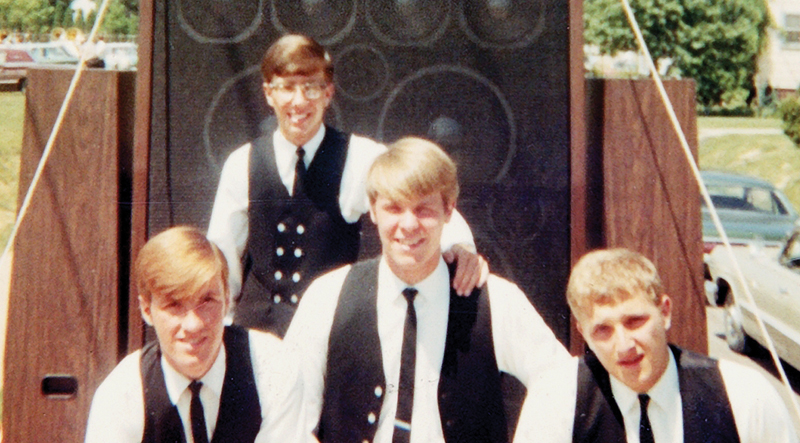
Photos courtesy of D. Moniot, M. Ordy, D. Metrick, and D. Lytle. The Sequins (from left, Marvin Ordy, Drew Moniot, Dave Lytle, Dan Metrick) with The Monster after a job well (and loudly!) done.
Drew Moniot and his band, The Sequins, were on top of the world, playing Gibson SGs through endorsement-deal amp stacks as 16-year-olds in 1967. Among their many favorite memories was playing through the Magnatone Monster – the world’s largest guitar amp.
If you happen to be a fan of Neil Young and Crazy Horse and you’re thinking, “That looks really familiar,” you’d be right. Young has owned one of its matched speaker cabs and used it as a stage prop for years. But The Sequins actually played through the thing.
Moniot’s path to the Monster came via another then-new amp that was gargantuan up against anything else, and traces a tale that could only have transpired in a long-ago age when innocence, innovation, and youthful enthusiasm for rock and roll could still crash headlong into some joyous alchemy of pop-cultural splendor. Moniot lends context to our dreamscape…
“We were a local high-school rock band in our hometown of Butler, Pennsylvania, playing Top 40 music and learning one or two new songs a week, usually playing two gigs a week earning money for college and expenses – and having the time of our lives!” he relates. “I was the lead guitarist, lead vocalist, and leader of the band, which had two guitars, bass, and drums. At one point, myself and the other guitarist, Marvin Ordy, both had Cherry Red ’63 Gibson SGs while the bassist, Dave Lytle, had a matching EB. Those made us the envy of many local bands.”
The Sequins at the Zelienople Fourth of July parade, 1967.
What really propelled The Sequins toward their brush with gear history was not the SGs, but the Vox and Gretsch amps they first plugged into.
“The Vox amps were routinely blowing up,” Moniot said, recalling repeated trips to have them serviced at a music store in Pittsburgh, an hour away. But a solution was at hand.
“In ’66, Dave saw a newspaper article in the Butler Eagle about a music plant opening (in nearby Harmony) – the Estey Music Company – to manufacture electric guitars and amplifiers.”
In the mid/late ’50s, Magnatone guitar amps (with stereo and vibrato) were manufactured by Magna Electronics, in California. But, as Douglas Ahern writes on magnatoneamps.com, by the early ’60s, Magna had been bought by the Estey Organ Company (later Estey Electronics) and aimed to plunge headlong into solidstate designs while also locating more centrally. An executive named Jack McClintock had been hired by parent company Commercial Credit to sort the stumbling Magnatone and Estey operations, and it just so happened McClintock was from western Pennsylvania, where Commercial Credit held a long-term lease on a dormant manufacturing facility in Harmony.
“We called Estey and made an appointment to check out the new equipment they were going to be manufacturing,” said Moniot. “They head of the company was a guy named Hank Milano, and we hit it off from the start. He invited us to visit the plant and play for the employees. We set up and played to workers and managers right on the floor of their assembly line. They loved it and offered us an endorsement deal; we would play their state-of-the-art solidstate amps, which they’d sell to us at a 50 percent discount, and they’d service and repair the equipment free of charge during the length of the agreement.”
The amps Moniot and Ordy took home were Magnatone’s M35 The Killer, which made 300 watts output into two 15″ speakers and two high-frequency horns. They had two independent channels, each comprising the same modular preamp board with controls for Volume, Bass, and Treble, and a three-way tone switch that delivered Normal, Mellow, and Brite settings. Onboard effects included transistorized reverb and true pitch-shifting vibrato, a trademark carried over from Magnatone’s better-known tube amps. The bass amp acquired by Lytle was the matching 300-watt M32 Big Henry, with the same modular preamps, dual 15″ speakers, and no effects (pity the poor drummer, Dan Metrick, with all this firepower behind him). These brutes aped the popular head-and-cabinet styling used for most big amps of the era, but the “heads” were attached to the tops of the cabs, effectively rendering them giant combos measuring 12″ x 24″ x 45″ and each weighing 105 pounds.
“They were like nothing we’d seen in terms of power and performance,” Moniot remembers. “Then a few months later, Magnatone asked if they could install a fuzz circuit in one of the channels. We gladly hauled the amps down and traded them out while the new circuits were being installed. We were invited into their audio lab to talk to the technicians, who wanted to speak to us about the songs we were playing and the sound we were after. Here were guys in black-rimmed glasses with pocket protectors full of pens who had Jimi Hendrix albums sitting on their work benches next to their oscilloscopes, apparently analyzing the parameters of his overdriven Marshall amp sounds. They really wanted us to work the amps, and we did! We were playing some large venues back then and really cranked them up. Occasionally, we’d blow a speaker and were given a replacement amp until we could get back. It was a dream!”
As massive as two Killers and a Big Henry must have sounded echoing around gyms, cafeterias, and rec centers, it was nothing compared to what was in store for the young Sequins.
In the early summer of ’67, the band got another call from Milano, asking if they’d like to appear on a Magnatone-sponsored flatbed truck in Zelienople’s Fourth of July parade.
The Sequins (Ordy, Moniot, Metrick, Lytle) with Magnatone M35 amps in their publicity photo.
“Hank said, ‘No need to bring your amps, we’ve got you covered,’” Moniot recalls. “We assumed they’d have the flatbed rigged with amps identical to ours, so we just brought our guitars, drums, and my Farfisa combo organ. When we arrived that morning, they took us to the flatbed and we stood in awe at the sight of this enormous amplifier. We thought it was a prop, but were told it was a fully functioning guitar and bass amp… and that it had 1,000 watts of power.”
This would likely have been among the first amps dubbed “The Monster,” a.k.a. “Tiny Tim.” Apparently, only a few were ever built, one of which made its debut that day in Zelienople before heading to the NAMM show a year later. None were offered for commercial sale, but they were sent to guitar stores and trade shows as promotional props, no doubt as some declaration of Magnatone’s intent to dominate the wattage wars – which the company might have briefly done, according to specs at least, but never did in terms of sales volume.
According to Ahern, all Monsters were shortly called back to the plant to be destroyed, the one retained by Neil Young remaining the only known extant example.
“We were speechless,” Moniot declares of their encounter with The Monster. “The whole thing was dreamlike; it was hard to believe the amp was real. But it was. We plugged in, set the levels – which were pretty deafening – and braced ourselves for one of the highlights of our young musical lives. As the parade got underway, we hit our first song and were blown away by the power. It was loud – so loud, in fact, that we were drowning out the marching band behind us… they seemed to have difficulty staying in step. The crowd loved it. Afterward, one of our parents snapped photos of us with the amp on the back of the truck. We knew it this was something we’d treasure forever.”
The Sequins continued playing their own 300-watt Magnatones for the next couple of years, until college and day jobs took them in different directions, Moniot to a career in broadcasting that keeps him occupied to this day. After occasionally plugging into the M35 while home from grad school through the ’70s, he sold it in 1978 to acquire something less mega-amp-like. He still has his SG. Through it all, however, Moniot has never forgotten the experience of crushing Zelienople with the 1,000-watt Monster.
This article originally appeared in VG February 2018 issue. All copyrights are by the author and Vintage Guitar magazine. Unauthorized replication or use is strictly prohibited.
Soul-pop stylist Jackie Venson has been conquering the road-warrior touring circuit, and gained an enviable spot on Gary Clark, Jr.’s tour. The Strat-wielding songstress’ new EP, Transcends, extends her melodic reach to a wider audience with a bundle of passion, fretboard acumen, and conviction. With a pleasing voice, an ear for melody, composing chops, and emotionally intelligent lyrics, Venson brings grit and a fresh perspective to the pop genre, paired with a visceral guitar intensity.
What was your mindset when you began writing Transcends?
Transcends is about how we all live our individual lives. We all go through things that are difficult, but we’re all in the same boat. We’re all in it together. We’re all going through the same things, so why don’t we just forget about our miniscule differences and come together. My Rollin’ On EP was rather bluesy, so I was centered around that. Then I realized I don’t write only blues. When I did The Light In Me, I was like, “Well I also like hip-hop, Motown, rock, and a bunch of other stuff. I also like being able to sing a bit softer rather than always cranking out rocker blues tunes. That’s when I realized that maybe I’m not a person who wants to be tied down to one genre. That’s exactly what The Light In Me was all about. There’s something different on every track.
The live album was like, “Hey, I can actually play the guitar now! Check this out (laughs)!” Rollin’ On and The Light In Me had songs that were really composed, but still long. The live album was completely unleashed. On Transcends, I wanted to take all of that and fine-tune it. I want to stick with this endeavor of doing different genres, but I don’t want to lose people as listeners. I want to make the songs more radio-friendly, so the guitar solos aren’t as jam-bandy.
People who find you on YouTube might pigeonhole you as more of a blues artist.
“Soul pop” is a better description. People who come to my shows expecting blues are going to be sorely disappointed. I do one or two blues songs, but for the most part it’s a crazy mixture of everything. Soul could be considered a multifaceted genre, and pop just because the melodies are hooky. It’s easier to carry the soul pop tag than the blues tag. Even Gary Clark, Jr. isn’t straight blues. He’s a lot heavier, but he can correspond to the blues a little better than I can. My stuff is light and poppy by comparison.
Did going to Berklee help you as a songwriter?
It was hard. Everybody was very critical. I was coming from a place where everybody was encouraging. When I get there I got smacked in the face with reality. That’s hard when you’re 18, grew up in the same house your whole life, and had the same friends your entire life. Then you go to this school and they’re like, “That thing you’re doing… That’s not going to make you any money or be of any use to you. You can continue, but good luck turning that into a job (laughs).” I was like, “Wow!”
I went in as a classical pianist. But just being alive has helped me as a songwriter. Going through pain helps me write songs. I went through a break-up and I wrote a whole album.
I didn’t learn anything new at Berklee. My dad is a songwriter and he taught me about forms and the different possibilities. You can change the key, you can write a bridge, and you can do a breakdown. He showed me all the things you can do to vary a song after you’ve gone through a verse and a chorus. The emotion writes the songs for me. That’s the stuff you can’t learn in school. You write songs over and over again until you find your voice.
Your Strat is super-cool looking.
It’s a Fender American Elite. I love that guitar. I’m not a gearhead, but I like how I can make the pickups go out of phase; I love the sound of that. It helps thicken my distortion sound. The humbucker really cuts through. I have a Keeley modded Boss DS-1 and a Boss DD-7 Digital Delay. I usually use it with a Fender Deluxe or Twin. If I’m lucky, I’ll use a Peavey Classic 30. That’s the golden amp for me.
You tour a lot.
I’ll be touring all over the United States, but mostly on the East Coast. Then I’m going to Memphis for some recording.
This article originally appeared in VG February 2018 issue. All copyrights are by the author and Vintage Guitar magazine. Unauthorized replication or use is strictly prohibited.









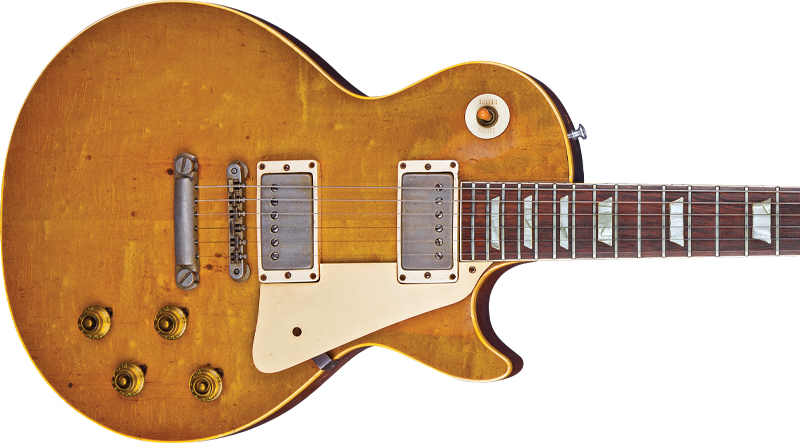
 Hard-edged face of the British Invasion, the Rolling Stones introduced the world to the implements, trappings, and accessories of rock-and-roll superstardom. With help from radio, television, and teen ’zines, the band’s music beget mobs at public appearances before conflict and substance abuse fueled a frenzy that lasted more than two decades. Stones lore is rich, and in numerous examples extends to gear like this ’58 Les Paul Standard.




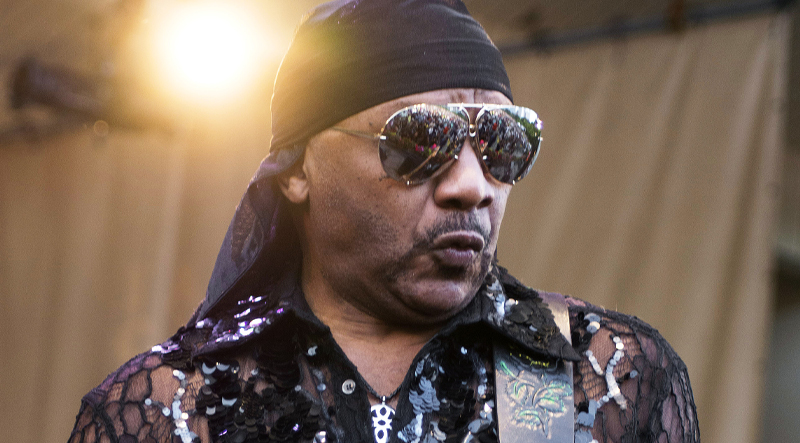


 You and Carlos Santana have very different – but complementary – playing styles.

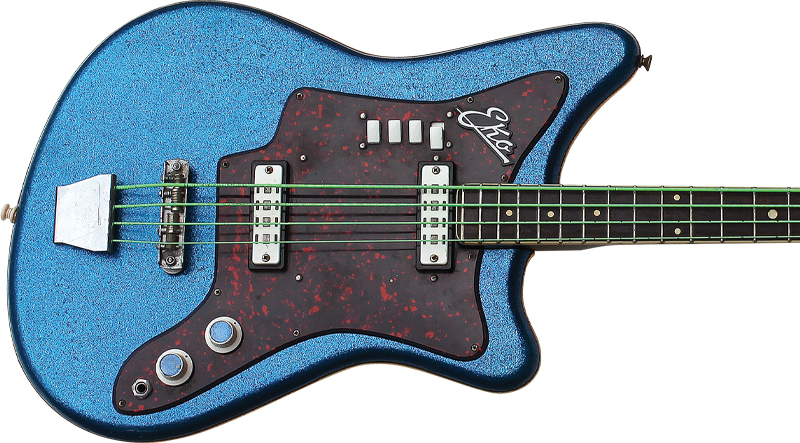
 By the early 1960s, Europe’s industrial bases had mostly recovered from World War II. Many musical-instrument manufacturers stuck to products popular in their respective countries, but some were innovating, especially those building solidbody electric guitars.

 The basses had a 30″ scale on a bound neck with 20 frets and pearloid markers on the third, fifth, seventh, ninth, and 12th frets. The headstocks had silhouettes coordinated with their body styles – the 1100/2’s being bound and Fender-like (four on a side), the 1150/2’s a scroll. Truss rods could be accessed through a three-screw plate on the front of the head.



 “We called Estey and made an appointment to check out the new equipment they were going to be manufacturing,” said Moniot. “They head of the company was a guy named Hank Milano, and we hit it off from the start. He invited us to visit the plant and play for the employees. We set up and played to workers and managers right on the floor of their assembly line. They loved it and offered us an endorsement deal; we would play their state-of-the-art solidstate amps, which they’d sell to us at a 50 percent discount, and they’d service and repair the equipment free of charge during the length of the agreement.”