Tag: features

  • The Real Story of Martin’s 14-Fret Orchestra Models

    The Real Story of Martin’s 14-Fret Orchestra Models

    Martin Orchestra Model (OM) guitars made prior to World War II are some of the finest ever made for fingerpicking. That’s rather ironic, considering they were created specifically for flatpickers. • Much has been written about the OM-28, but some of that info, including how it was designed for Perry Bechtel, is a bit misleading. The real story is more complicated.

    Guitars with 14-fret necks were hardly a new concept when the OM-28 was introduced in late 1929. All too often, the debut of the 14-fret neck on the OM has been portrayed as a marvelous innovation by Martin, when in fact the Gibson L-5 had one from its inception in 1923; the even earlier Gibson Style O had a 15-fret neck.

    Bechtel (1902-’82) was a phenomenal plectrum-banjo player and jazz guitarist who performed with a Style O prior to ’29, so there’s little credibility in the idea Martin made a guitar with a longer neck simply because he was accustomed to playing plectrum banjo. And because he was an expert guitarist, it makes no sense to think he wanted a long neck to be more like a banjo, especially when he already had the Style O. By ’29, he certainly would have been familiar with the L-5.

    Martin archives reveal another important factor was the development of the “Carl Fisher” tenor guitar (with 14 frets clear of the body), which preceded the OM by several months and was developed at the urging of Al Esposito, employee of New York City retailer Carl Fisher, specifically to keep customers Frank Victor and Frank Petrucci from purchasing Gibsons. The design eventually became the Martin O-18T, the company’s most popular tenor guitar.

    Numerous documents in Martin archives prove Bechtel’s critical role in the development of the OM. But, his special guitar was created after the Carl Fisher model. Correspondence makes reference to Perry’s Gibson model O, initially asking for 15 frets clear of the body and a duplicate neck profile (neither request was granted).

    When Martin designed the OM-28, it essentially based it on the 000-28, but shortened the body rather than moving the bridge to accommodate a 14-fret neck. The 12-fret 000 had a 25.4″ scale which was continued with the OM-28. In ’34, the OM designation was discontinued along with the 12-fret 000. Specs of a ’33 OM-28 are identical to an early-’34 000-28. By September of ’34, the 000 scale was reduced to 24.9″, a change that coincided with the introduction of modern-style frets with curved top and narrow tang extending into the fingerboard, as well as the T-bar neck reinforcement.

    The earliest OMs have rectangular pyramid-end bridges, a feature discontinued shortly after the model was introduced. More-standard early OMs had banjo pegs, a small pickguard, and inlays at the fifth, seventh, and ninth positions; a larger pickguard appeared in March of ’31 and the first batch of OM guitars with Grover right-angle guitar tuners was produced in June. By late ’31, inlays started at the fifth fret and extended to the 15th.

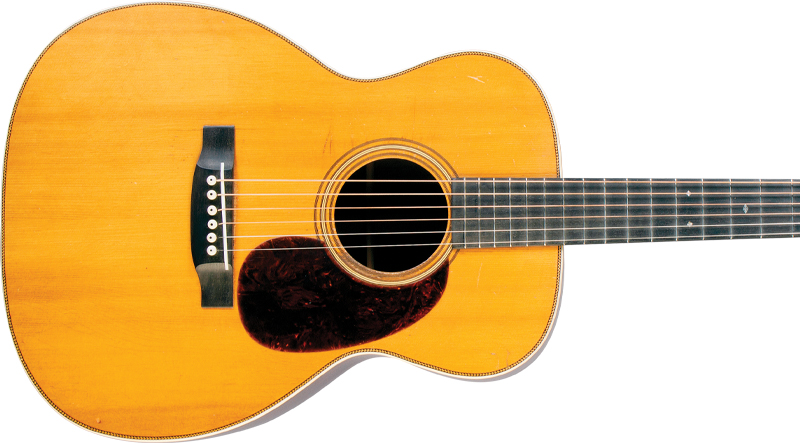
    The example shown here was part of a batch produced June 24, 1931, and conforms to specs of the period, with Adirondack-spruce top, Brazilian-rosewood back, sides and peghead overlay, a center back strip of “zig-zag” marquetry, celluloid tortoiseshell-grain pickguard (one of the first of modern size), multi-ply white-and-black (5/9/5) soundhole rosette, ebony “lower-belly” bridge with long saddle, white bridge pins with black center dots, mahogany neck with ivoroid heel cap, die-stamped logo on the peghead rear, open-back nickel-plated Grover tuners with metal buttons (first batch with them instead of banjo tuners), 20-fret ebony fingerboard (14 clear of the body) with slotted diamond inlays, single-ply ivoroid binding and herringbone trim on the top edge of the body, multi-ply binding with ivoroid exterior ply on the back edge.


    This article originally appeared in VG March 2018 issue. All copyrights are by the author and Vintage Guitar magazine. Unauthorized replication or use is strictly prohibited.
  • Watkins Scout

    Watkins Scout

    Amp courtesy of Marcel Cavallé, photos by Andrea Nieto.
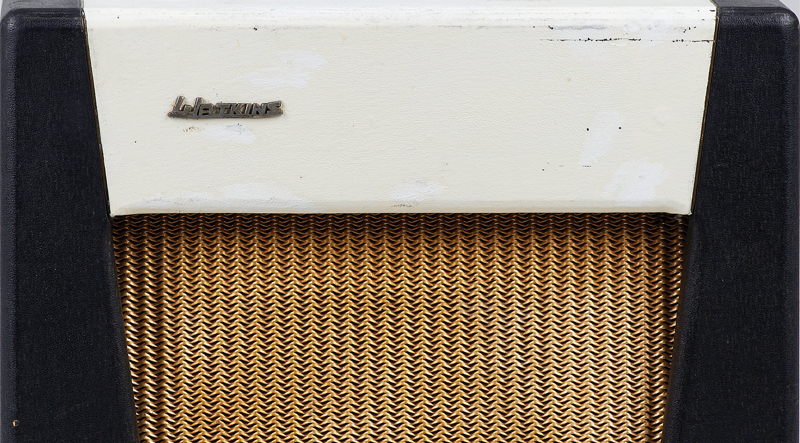
    1963 Watkins Scout
    • 
Preamp tubes: three Mullard ECC83 (12AX7 equivalent
    • Output tubes: two Mullard EL84
    • Rectifier: Mullard EZ81
    • 
Controls: Microphone Volume, Instrument Volume, Tone, Mic Type/Tone switch, tremolo Speed and Depth
    • Speaker: 10″ Elac Alnico speaker

    Watkins amps never landed big stars, or at least didn’t hold on to the endorsements of guitarists once they became big stars. Various Beatles shared a small late-’50s Westminster from the time they were still The Quarry Men, and other notables made their mark with Charlie Watkins’ compact, affordable Copicat tape echo. But prominent celebrity sightings? Nada. 

    Nonetheless, perhaps more than any other maker, Watkins played a significant role in launching the British guitar boom; Charlie’s amps veritably fueled the craze among younger musicians on their way up, and his more-affordable models launched the careers of players who went on to be huge stars standing in front of Voxes, Marshalls, Fenders, and Hiwatts. 

    The Scout’s chassis carries a basic printed circuit board, which is nevertheless loaded with tasty British components of the period, including desirable “mustard cap” signal capacitors.

    With that in mind, this ’63 Watkins Scout is one of the cooler combos to have ever been propped behind a British-beat hopeful playing pubs and dance halls of the early ’60s. A tidy means of making a guitar as loud as anything shy of the big amps used by pros were using; today, it’s a fast track to a classic lower-watt Brit-rock tone, with an enticingly original twist.

    Watkins’ best-known amp of the late ’50s and early ’60s was the Dominator, a hip, wedge-shaped 2×10″ combo (VG, March ’17) that was otherwise not greatly dissimilar to this Scout inside. With a slightly larger output transformer (OT) to drive its dual speakers, the Dominator put out a whopping 17-watts, which was then the company’s topping-out point, until the first 30-watters – the Control ER30 and HR30 – arrived in 1964. Around the same time, Charlie changed the brand from his surname to the snappier WEM, which he felt nicely echoed the popular Vox logo. In any case, their relatively low decibel-generating capability was likely one of the things that kept them out of professional hands, and by the time Watkins/WEM amps did get louder, they were already seen by many players as second-tier. That doesn’t stop them from being utterly hip, though, especially as seen through the rose-tinted retro glow of hindsight.

    The Scout has two channels, one for microphone and one for instrument, with an individual volume control for each, shared Tone, and built-in tremolo with controls for Speed and Depth. There’s also a nifty Tone switch for the microphone channel, really more of a voicing/level switch to match the mic type correctly (note the “RIB” setting, for ribbon microphone, popular in the era). The chassis layout and circuit were much like those of other Watkins models, as well as the WEMs that followed in the mid ’60s. The Scout appears to have taken the place of the similarly spec’d Westminster that was deleted from the catalog at about the time this combo arrived. The tube complement includes three ECC83s (a European 12AX7 equivalent) for preamp, tremolo, and phase inverter; two EL84s in the output stage; and an EZ81 rectifier – Mullards all, and all apparently original to the fine amp on display here. The amp was rated at 14 watts, and that’s likely accurate given the duet of EL84s in cathode-bias with no negative feedback. 

    With that configuration, the Scout could have been a more formidable beast with a stouter 12″ speaker instead of its 10″ Elac with Alnico magnet, but Watkins wasn’t thinking very far in that direction. Until he busted out big-time in a different avenue of the volume wars (more below), Watkins was all about supplying a notoriously under-served domestic market with affordable gear to help get the guitar boom in motion. 

    An accordionist who played professionally for a time after serving in the Merchant Navy during World War II, in 1949, Charlie opened a record shop with his brother, Reg. Two years later they moved from Tooting Market to their home turf in Balham, another south-London borough, where they also sold accordions and other instruments. Charlie saw the guitar’s potential popularity, but despaired of fellow musicians’ inability to be heard amid the noise of horns and accordions while also being aware of the shallow pockets most had in ration-choked post-War Britain. After fledgling efforts that were supplied by an outside manufacturer in 1952, Watkins’ first semi-successful own-brand guitar amps emerged in ’54, the same year that the British government lifted 14-year restrictions on the sale of meat and bacon. Yet his primary guitar market – the London “skiffle” players that preceded rock and roll – was still a backroom/coffee-shop scene that involved no real money, and Watkins’ amps consistently reflected that ethos.

    With channels for both instrument and microphone, the Scout’s control panel also carries a Tone switch for the mic channel, with a “RIB” setting for ribbon microphones, which were popular at the time.

    At a glance, and from a little distance, the Scout’s circuit looks like a typical hand-wired affair from the era, and in one sense it is. But those components are all hand-soldered to a relatively crude printed circuit board (PCB) with wide traces in evidence once you look more closely. Even so, the board carries lust-worthy components such as yellow Mullard/Phillips “mustard caps” like those found in the most desirable vintage Marshalls, plus some of the WIMA capacitors that were standard equipment for Vox. Even so, these were simply off-the-shelf parts in their day, which is why so many British makers used them. Otherwise, the Scout’s construction is largely consumer-grade – not badly put together, but soldering is a bit blobby and the wiring is of a standard commensurate with a product intended to meet a price point.

    And yet, who cares? For all that, this Scout can sound superb, with a clear, slightly edgy clean tone and a snarly bite when cranked to the point where sweet, swirly overtones and an inherently British midrange grind emerge. It has a soft, round-sounding tremolo, too, operated on this example via mini-toggle installed by a previous owner in place of the footswitch jack. 

    Charlie Watkins photo courtesy of The Guitar Magazine, UK. Charlie Watkins in the early 2010s, seated on a mid-’70s WEM Dominator combo.

    Just a few years on from the release of this combo, Charlie Watkins and company were probing heavily into solidstate technology and devising far more powerful creations that would assist musicians in another realm of the volume wars. Watkins’ mighty WEM public-address systems were among the first to successfully power large outdoor rock festivals in the U.K. The first big test involved Watkins’ 1,000-watt WEM P.A. rig at the 1967 Windsor Jazz and Blues Festival for performances by Small Faces, Cream, Fleetwood Mac, and others. Though 1,000 watts might today seem a paltry output rating, it was unprecedented at the time; the previous year, the festival used a system totaling 200 watts! After pushing the knobs to full for headliner The Crazy World of Arthur Brown (who at the time had the #1 hit single with “Fire”), Watkins was visited right there at the mixing desk by the Windsor constabulary and ordered to appear in Reading Crown Court on charges of disturbing the peace. He was acquitted, and would provide WEM systems of up to 4,500 watts for future Isle of Wight and Hyde Park festivals before abandoning the festival-P.A. side of the business later in the ’70s. 

    Charlie Watkins lived to be 91 years old and died in his south-London home on October 28, 2014. 


    This article originally appeared in VG March 2018 issue. All copyrights are by the author and Vintage Guitar magazine. Unauthorized replication or use is strictly prohibited.

  • Hands On

    Hands On

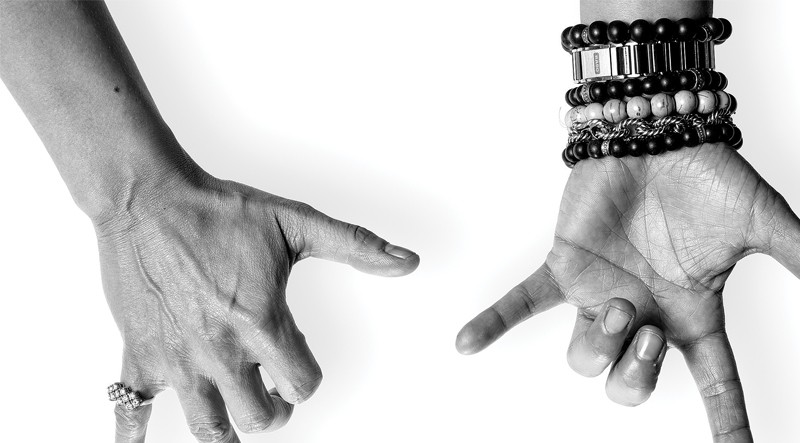
    The hands of Rhonda Smith.

    In 2012, photographer Marc Mennigmann conceived of shooting musician portraits in a very different way – looking beyond faces and instruments. The result is the Hands Project, a growing collection of images focused on phalanges.

    Also a pianist and Chapman Stick player, Mennigmann realized that most casual fans don’t realize the role played by their hero’s hands. So, when the opportunity arises, he takes his beloved Leica Monochrom, a small outboard flash, white background, and a few minutes to position each subject’s hands a few ways. For each pose, he pushes the shutter once or twice. So far, more than 200 have taken part including guitarists Joe Satriani, Mike Stern, Al Di Meola, Ike Willis, and Pat Martino, as well as bassists Lee Sklar, Billy Sheehan, Rhonda Smith, Stu Hamm, and Bakithi Kumalo (to see a list, visit hands-project.de/participating-artists).

    Mennigmann has auctioned prints signed by the musicians, exhibited at galleries in Germany and Portugal, and is looking for a publisher to release a book highlighting the work.

    Al Di Meola

    What spurred you to start this?

    I thought it was a great way to connect photography with my love for music. I’d been thinking about something deeper than the musician’s face or them with an instrument – which every photographer can do – and thought about what makes a musician special, unique, or outstanding. For guitarists, bassists, pianists, and other instrumentalists, the hands are the last piece of their body through which music is transported to the instrument. They are the gateway to a player’s own sound. Plus, the huge amount of time a musician spends practicing and playing affects their hands, from string marks on fingertips to bent fingers and deformed bones. Nobody else has documented it in such detail.

    When and where did you shoot the first set of hands?

    The first was my daughter, Lia, who’s a bass player. My first professional was Julie Slick, bassist in the Adrian Belew Power Trio. I shot them same day, in my living room, while we were recording their band, SAM. The idea came to me when Lia and Julie were comparing hands and talking about how practicing was affecting them. I experimented with light, background, and depth of field on a simple setup. The pictures were really bad, but it was a beginning. A few years later, I did a re-shoot of Julie’s hands with Adrian and drummer Tobias Ralph.

    What is the typical reaction amongst performers you approach for the project?

    They’re mostly excited, and it helps when I show them a mock-up of the book, which illustrates the quality of the pictures. The reaction to their photo is always touching even though the display on my camera is very small. These are portraits, and in them musicians find themselves in a new, very private way because the hands tell their stories.

    Not every musician has a clear visual of the result, so I talk to them about their style – if they use a pick, which fingers they use, position of their fingers. Within a few minutes, we sculpt a picture. Billy Sheehan knew his pose right away, others need guidance. In those moments, I don’t see myself as the artist; I’m more a catalyst. David Rhodes liked his shot so much he used it on his new homepage. Drummer Peter Erskine wrote a touching e-mail in response to his picture; he really understood the concept, so I asked if he could write a foreword for the book, which he did.

    I could do several books with all the great musicians out there. It’s so much fun working with them and giving them something back with their portrait.


    This article originally appeared in VG March 2018 issue. All copyrights are by the author and Vintage Guitar magazine. Unauthorized replication or use is strictly prohibited.

  • The City of Guitars

    The City of Guitars

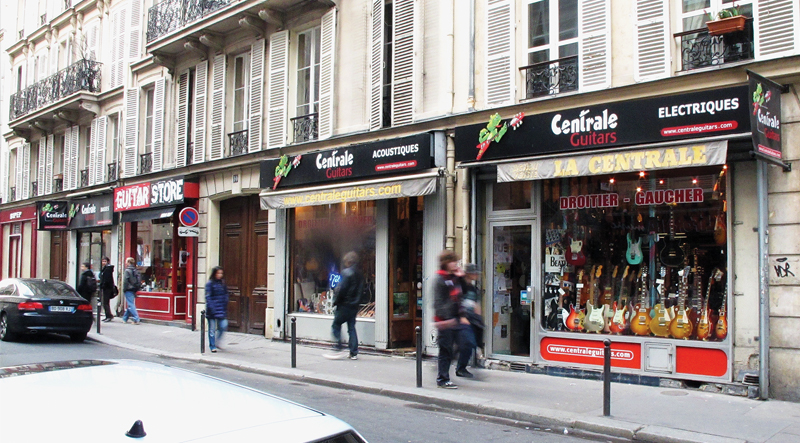
    Could this be the eighth wonder of the world? Paris’ Rue Victor Massé, a street devoted to guitars, basses, and amps.

    On your way to Paris for a romantic getaway? Wanting to see the sights in the City of Light? Then take this advice; forget Rick Steves, think Stevie Ray.

    Skip the Eiffel Tower (don’t they have one of those in Las Vegas, anyway?). Make a detour around the Arc de Triomphe (ditto). Catch a quick glimpse of Notre Dame and Sacré-Cœur (you’ve already seen them in Woody Allen movies).

    La Pédale lives up to its name: the whole store carries nothing but stompboxes.

    Instead, direct your feet to Rue Victor Massé in the Pigalle district of the 9th arrondissement. There’s nothing quite like it anywhere in the world: A street of guitar shops running as far as the eye can see.

    Talk about a sight worth traveling halfway around the globe.

    Pigalle is the site of the Moulin Rouge cabaret of can-can dancing fame, a red-light district of seedy sex shops and suspicious bars. During the Jazz Age of the 1920s, Pigalle and its neighboring Montmartre district was home to many a loud nightclub, the destinations of Ernest Hemingway, F. Scott Fitzgerald, and their Lost Generation.

    Elvis is the king in France as well, as proven at Guitare Collection.

    It was homebase, too, for Django Reinhardt and the Hot Club de France from the 1930s through the early ’50s. In the ancestors of these Pigalle shops, Django and fellow Gypsy musicians picked up their Selmer guitars and the surrounding cabarets where they played their hot jazz. During World War II, it was where German soldiers came to hear the American-accented swing and, after the Liberation, where GIs made pilgrimage seeking wine, women, and song in Gay Paree’s infamous “Pig Alley.”

    Pigalle remains a tourist destination today, monstrous charter buses unload tour groups to gawk at the Museum of Eroticism, strip clubs, and drag bars. But most visitors sadly miss out on the best part – those guitar stores still lining Rue Victor Massé.

    In a half-mile stretch are more musical-instrument stores than you can count, catering to vintage and new guitars and basses, amps, several shops devoted just to effects or custom-made cables, drums, sheet music, repair shops and luthiers, and miscellaneous bizarre instruments from French musette bagpipes to bouzoukis to Theremins.

    Paris remains today a global capital for world music. On any given evening, you can see bands in nightclubs, theaters, coffee shops, or cave-like underground bars playing everything from Django’s Gypsy jazz to that special French rock and roll, African blues to flamenco. And it’s to this grubby street the musicians all come to buy strings and things. When in Paris, do as the Parisians do.

    “It’s historic,” explains Philippe Turpault with a Gallic shrug of the shoulders, describing the street’s wares. 

    Turpault is owner of one of the best shops on the street, Oldies Guitars (31, rue Victor Massé). His shop may be a small boîte – or “box,” as the French like to say. Yet it’s a world of wonders for vintage instruments.

    Oldies Guitars is chock full of known and unknown instruments that will be a marvel to visitors.

    Among numerous other guitars, Oldies’ inventory recently included a ’30s National Duolian, a Model 65 Dobro with etched-wood body, a ’20s Weissenborn Hawaiian, and a ’57 Gretsch 6120 in front of a line of well-traveled ’50s Fender tweed amps. But it was the rare Euro contingent that was most fascinating: an exotic Höfner archtop with more pickups, knobs, and switches than a ’50s Mercedes-Benz; a stylish archtop made by Parisian luthier Jacques Favino; an acoustic by Henri Miller with a black-painted body and white Bakelite trim dressed up like a tuxedo; and a whole nook full of Gypsy guitars by Maurice Dupont, Busato, Patenotte, and a gorgeous-sounding ’50s D-hole by Antoine Di Mauro.

    And Oldies Guitars isn’t even listed in your Fodor’s travel guide.

    Stretching away down the street are too many other shops to name. The windows of Guitare Collection (2, Rue de Douai) are highlighted by a full-size mannequin dressed like a French Elvis in a white leather Vegas suit. But there’s also two blond bombshells – a ’57 Esquire leaning against a ’63 piggyback Bassman in blond tolex. In addition, there’s a ’59 Gibson BR-9 amp and ’75 Strat, and a wonderfully worn Mustang Bass.

    California Guitars has several shops down the street, including its Gaucher store (4, Rue de Douai) devoted only to left-hand guitars. Major Pigalle has two stores as well, including its shop at 5, Rue Duperre that offers just flamenco and classic guitars.

    Rançois Charle with a Gypsy-jazz guitar in front of his shop near the Louvre.

    But the street’s not just about guitars. Strolling happily down the sidewalk one finds a half-dozen shops devoted to basses, one home-studio shop, Master Wave (14, Rue Victor Massé) devoted to vintage synths, Le Microphone packed with vintage and new mics including a window full of vintage Shures. From the street, you can hear and practically see the whole of Bass Center (22-24, Rue Victor Massé) vibrating with a righteous bottom-end. La Baguetterie (36-38, Rue Victor Massé) is all drums, from digital pads to ancient Morroccan goatskin hand drums.

    A good tour of Paris music shops would not end in Pigalle, however. Travel up to the Gare Saint-Lazare in the 20th arrondissement to Rue de Rome. This busy street is the nexus not of French rockers, but of classical musicians: there are numerous violin makers workshops here, sellers of brass and woodwind instruments, and piano showrooms. In their midst are several guitar makers.

    Rome Instruments (54, Rue de Rome) is the workshop of luthier Pierre Fontaine, maker of solid Gypsy jazz guitars plus acoustic guitars.

    Jacques Castelluccia has his luthier shop at 3, Rue de Constantinople. Started by his father before him, Castelluccia guitars has for four generations been well known among both Gypsy jazz, flamenco, and classical guitars. The shop oozes the smell of wood and mysterious glues.

    A store devoted just to cables? The Cablerie is a techie paradise.

    Still, the best awaits. Hidden away in the backstreets near the Louvre is the historic Galerie Véro-Dodat, an elegant covered walkway full of artists’ shops. You might skip the Louvre, but it’d be a shame to miss François Charle’s guitar shop and lutherie (17, Galerie Véro-Dodat). Labeling this just a “guitar store” is akin to calling Paris just a “city.”

    The gallery itself is to thank, in part. This passage dates from 1823, and is one of the only Parisian galeries surviving in original period condition. A floor of black-and-white checkerboard tiles leads up to dark-wood storefronts of ornate designs and opulent style.

    Charle’s shop is museum-like in its beauty. The walls, rafters, windows, and mezzanine are hung with harp guitars, violins, banjos, Hawaiian guitars, and more. There’s a repair room in the back, ripe with a fug of exotic animal glues of secret formulae for keeping these old instruments together.

    For decades, Charle’s shop has been a destination for guitarists from Marcel Dadi to R. Crumb to David Grisman. He stocks an incredible selection of historic American acoustics. But he’s also known around the globe as the foremost expert on Selmer-Maccaferri guitars. In fact, he wrote the book on the subject.

    Charle’s shop is without doubt the most beautiful guitar store in Paris – which probably makes it the most beautiful guitar store in the world.


    This article originally appeared in VG March 2018 issue. All copyrights are by the author and Vintage Guitar magazine. Unauthorized replication or use is strictly prohibited.

  • Samantha Fish

    Samantha Fish

    Samantha Fish: Michael Emanuele.

    In 2012, Samantha Fish’s Runaway was named Best Artist Debut at the Blues Music Awards. Known for her energetic blues-rock concerts, she released two departures in 2017 – the R&B-tinged Chills And Fever and some country/Americana on Belle Of The West – and is a nominee for Vintage Guitar’s 2017 Readers Choice Award for Blues Player of the Year.

    But the 28-year-old Kansas City native and New Orleans resident assures, “Every album so far has just been another layer of something that was inspiring me. The guitar didn’t go anywhere. We still dish it out pretty heavy in the show.”

    What music first grabbed you?

    My family was rock-and-rollers. So our CD collection was AC/DC and Led Zeppelin, and going back from them were people like the Stones, and everything was so blues-centric – and we didn’t even know. Later, I got into alternative rock and realized how heavily Jack White and the Black Keys were influenced by North Mississippi. I fell in love with that kind of blues music first. There was this punk-rock raw attitude about it. That’s how I found the North Mississippi All Stars and (producer) Luther Dickinson. Then you trace it back to Delta blues, where all that stuff comes from. We went to this tiny club in Clarksdale called Red’s, and T-Model Ford was playing. He was amazing – so raw and so real.

    Were you involved in Kansas City’s music scene?

    I was so quiet and shy in high school, nobody knew I played guitar until the last week of my senior year. The idea of being a frontman now – if I’d have thought that when I was a kid, “That’s not gonna happen.” My father and his friends all played guitar. When I started picking up my sister’s acoustic at 15, I started singing at the same time. I never really knew that I had a voice; I never sang, other than singing in choir in church. But there were lots of jams in Kansas City and cool clubs like Knuckleheads – still one of my favorite clubs in the world. That’s where I first saw music as a tangible career. When I’d see rock stars on TV, I didn’t know how to get from Point A to Point B. But when you start going out and enjoying the live experience, it’s happening right in front of you and you think, “I can do this. I can start here and work my way to where I want to go.”

    Who were your early guitar influences?

    We listened to the radio, so there was Keith Richards, Mike Campbell from the Heartbreakers, Angus Young, Black Crowes, Duane Allman, and I tried to play like Slash long before I should have. When I started getting into blues, I fell in love with Freddie King and Hubert Sumlin. Going backwards, I really love some of the weird tunings Skip James was playing in. And there were country guitar players I got hooked on, like Vince Gill and Brad Paisley.

    When I was learning to sing, I was channeling soul singers. When I started writing songs, I fell in love with the way country songs were written and the heartfelt delivery, the poetry.

    How was the Fishcaster born?

    Mike Zito recommended me to Mike Delaney, who called and said, “I want to make you a signature guitar.” I really wanted a semi-hollow Telecaster with humbuckers, and he did a custom (fish-shaped) sound hole. He makes a V-style neck, but it was a little chunky for me, so he made the neck to my specifications.

    I also have a Delaney 512, which is like a 335 but smaller, like a 339, and it has the same Amalfitano humbuckers. Recording Belle Of The West, sonically, my Telecaster didn’t really fit the profile of the album, so I used a bunch of Luther’s guitars. After those sessions, I called Delaney and said, “I want something hollowbody.”

    What amps and pedals do you use?

    A Category 5 Andrew amp with a 12 and a 10. For pedals, I have an MXR Carbon Copy, Electro-Harmonix Micro-POG octave pedal, Cast Engineering Pulse Drive tremolo, Cast Engineering Casper Delay, LR Baggs Para Acoustic DI, JHS Mini Foot Fuzz, Analogman King Of Tone overdrive that sounds awesome, and a Hungry Robot Buffer to clean up the signal.

    Talk about playing with the Healers, the supergroup featuring Reese Wynans and others who’ve raised money to provide musical instruments for children with cancer and other serious challenges.

    The late John Catt founded Blue Star Connection. He saw what music therapy programs were doing for kids in hospitals. Giving kids a focus and having music in their lives really helped their physical health and well-being. The Healers did a few benefit concerts, including a live CD and DVD from Knuckleheads, to raise money to get instruments and music therapy for kids in hospitals all over the country. It’s a feel-good operation, for sure. It’s gone through different incarnations, but as long as (saxophonist) Jimmy Hall is in it, it’s the Healers. I feel like music is the connecting language for everyone in the world – something everyone can understand and enjoy. It helps you find peace.


    This article originally appeared in VG March 2018 issue. All copyrights are by the author and Vintage Guitar magazine. Unauthorized replication or use is strictly prohibited.

  • Elliot Easton

    Elliot Easton

    Elliot Easton: Glenn Mayeda.

    The Cars transcended the new-wave movement of the late ’70s by creating a never-duplicated sound. The band’s self-titled debut album is a masterpiece; almost 40 years after its release, nearly every song still receives radio airplay.

    Rhino recently remastered it and the band’s pivotal second and third albums, 1979’s Candy-O (with “Let’s Go”) and 1980’s Panorama, which was highlighted by “Touch and Go.” The new editions include alternate mixes, demos, B-sides, and unreleased songs.

    Easton spoke with Vintage Guitar about the reissues and recounted the gear he used to help create the band’s first music. His setup for The Cars was simple – a Les Paul Standard, Telecaster, and a D-35. He plugged the Les Paul and Tele into a Fender Twin and one of three Ampegs – a VT-22, V2, and V4 – and recalls how at the time there was a limited aftermarket for hardware and pickups.

    “DiMarzio’s Super Distortion pickups had just come out and I put them in the Les Paul,” he said. “My Tele was a new ’77, but I changed the neck pickup to Hi-A Bartolini Firebird mini humbucker.”

    The commercial success of those albums allowed Easton to expand his arsenal.

    “Dean brought me an ML during the Candy-O sessions and I put it right to work,” he said. “The first song I used it on was ‘Since I Held You,’ and I liked it a lot. Now, people kind of laugh about the pointy headstocks and funny-shaped bodies, but the Dean was a really good guitar, and I really enjoyed playing them. They had fantastic tones, felt great, and had great necks.

    “I was still using Les Pauls and Teles on Candy-O and Panorama; it wasn’t like I eliminated them. I just added other things. In ’79, I got a real good new Les Paul Custom and played it a lot. I still have it. It’s just a great guitar. The only thing is it’s so darn heavy that I still have a chronic crick in my neck from standing onstage for two hours with it. I don’t know why Customs are so much heavier than Standards, but a lot of them seem to be. I started to embrace the SG because it was lighter. They even made my signature model, which was basically a two-pickup SG Custom.”

    Panorama was notably different from the Cars’ first two releases.

    “Ric Ocasek was writing batches of songs every year with new attitudes and new approaches,” he said. “Obviously, Panorama was a bit of a departure. There was no group discussion about how it was going to be an experimental record, more edgy, or anything like that. Maybe Greg was listening to Kraftwerk or we were listening to Suicide and things like that, so some other influences were creeping in. We’re very eclectic in our tastes.”

    “On ‘Touch and Go’ and a B-side called ‘Don’t Go to Pieces’ there’s a lot of Rickenbacker 12-string. Also, during the Panorama period, I started working with Fender. They had just come out with the new Lead I and Lead II series, and they made me a couple of those and put me in their catalog. The Lead I is what I used for the solo in ‘Touch and Go.’ If I remember correctly, I played that through a Mesa-Boogie head through a Marshall cab. It was just one of the go-to amps during that time. We had Fenders, too – Twins, Deluxe Reverbs, stuff like that.”

    One of Easton’s main guitars from that era was a ’61 Strat.

    “I used it quite a bit; it’s on the solo for ‘Dangerous Type’ and ‘It’s All I Can Do’ (from Candy-O). I think I used it on ‘Panorama.’ I can’t always remember what I played on the deep cuts, but I do remember those.”

    These days, he’s recording a second album with the Empty Hearts, featuring Romantics vocalist/rhythm guitarist Wally Palmar, Blondie drummer Clem Burke, and Chesterfield Kings bassist Andy Babiuk. In December, the Rock and Roll Hall of Fame announced the Cars were part of this year’s class of inductees.

    “I’m pretty excited about that,” he said. “Lots of bands feign disinterest, but I think, deep down, it’s an honor. Now we have to figure out what we’re going to play!”

    Easton estimates he has been through “probably 1,000 guitars” though now has a relatively modest collection.

    “I’m afraid to count!” he laughed. “But I think it’s somewhere around or just over 100. Certainly enough! I have Gibson, Fender, Martin, Larrivée, and Rickenbacker guitars. I think some of that comes from wanting to cover myself because when you’re a lefty, you can’t borrow someone else’s guitar. No one asks to borrow your guitars either, which is nice!”


    This article originally appeared in VG March 2018 issue. All copyrights are by the author and Vintage Guitar magazine. Unauthorized replication or use is strictly prohibited.

  • Tracy G

    Tracy G

    Tracy G: Suzie Valles.

    Ronnie James Dio had a knack for collaborating with talented guitarists – Ritchie Blackmore in Rainbow, Tony Iommi in Black Sabbath/Heaven and Hell, and several in his solo band, Dio. While shredders such as Vivian Campbell and Craig Goldy are the best-known, Tracy Grijalva played on two (Strange Highways and Angry Machines) that today are highly respected by the band’s following. Grijalva is still going strong, as evidenced by the Tracy G Group’s latest release, Tramp.

    What’s the story behind the new album?

    We actually wrote and recorded it in 2015-’16, but it never got distribution [until released via MVDAudio/Sonic Night Music in ’17]. I’m not a businessman – that’s not what I do. I have a home studio, do all the stuff myself, and some of the songs have singing on them. I really love instrumental music – I love Jeff Beck, I love Steve Vai – but I mix vocals in some songs because I know people want to hear vocals. So, it’s half and half; I got a vocalist who’s a good friend, Michael Beatty, the bass player is Randy Oviedo, and I started seeking a drummer. I play guitar off of the drum rhythm, so the better the drummer, the better I can play. In the past, I was really lucky to play with some world-class drummers; I did a lot of sessions with Ray Luzier, who’s in Korn now, and had a lot of his tracks laying around, so Ray is playing on four songs on Tramp because I put new riffs around his tracks. Adrian Aguilaro played on one tune, but the other seven songs were played by Patrick Johansson, who has played with Yngwie Malmsteen. I’d just met him; I live in California and he lives in Florida. I got him over to jam, and the guy played like a monster. I said, “We’ve got to do an album together.” It happened to work out and he came to my home studio, played the tracks, and played amazing. I write the songs and riffs myself.

    Which guitars and amps do you use?

    I have always used the same stuff – a couple old Marshalls, one is a 1969, the other is from 1970, a couple of old Randall RG100s from ’85, and my main guitar was made by Karl Sandoval, the guy who made Randy Rhoads’ polka-dot V. He made my guitar in the ’80s, and I still use it. Some of my guitars are tuned lower, and David Cervantes made me some baritone guitars. I’m not into seven-strings because the necks are so wide and my hands aren’t that big. So, he made me six-strings that are like baritones – the necks are longer but they’re still not that wide, and I can tune them really low. I used that on a lot of the songs, too.

    How did you get the gig with Dio?

    In ’93, Ronnie was in an experimental mode. He came out of Black Sabbath’s Dehumanizer and went back with Vinny Appice and Jimmy Bain, and they wanted to start a new Dio lineup. Their first idea was to have a well-known guitarist, so they talked to people like Neal Schon, Michael Schenker, Vinnie Moore, and Yngwie. It just didn’t work, so Ronnie said, “We need to get a less-known guitarist.” So they tried out a bunch of guys, and I was one of them. I had done an album with Vinny and Jimmy, World War III, so we knew each other. That was my ticket in. Ronnie never told me, “You have to play like Ritchie Blackmore, Tony Iommi, Vivian Campbell, or Craig Goldy.” I got the gig because I played the way I do, and he was fine with that. Jimmy was only there for two weeks then they hired Jeff Pilson. We just started jamming. It was like being in a band when you’re 15 in your garage, with your friends. Except you’ve got Ronnie James Dio singing! It was like I won the musical lotto.


    This article originally appeared in VG March 2018 issue. All copyrights are by the author and Vintage Guitar magazine. Unauthorized replication or use is strictly prohibited.

  • Joe Satriani

    Joe Satriani

    Joe Satriani: Joseph Cultice.

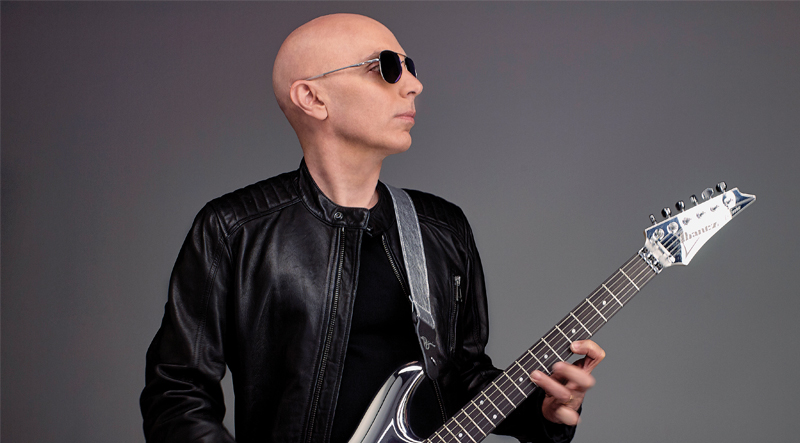
    Joe Satriani’s new album, What Happens Next, is a terrific back-to-basics effort with Satch in a trio format. Enlisting Red Hot Chili Peppers drummer Chad Smith and former Deep Purple singer/bassist Glenn Hughes, he employs soaring melodies elevated by the strong musical personalities and chemistry. He has also released a tour documentary directed by his son, ZZ, oversees his G4 Experience guitar camp, and another G3 tour is in the works featuring Def Leppard’s Phil Collen.

    How did you find time to write songs for a new album?

    I wake up slightly nervous every day when I’m going to write a song; that’s where the energy usually comes from. I’m sitting with an instrument, thinking, ‘What do I feel strongly about, and what would it sound like if I had to communicate it to somebody through music?’

    Did you change anything in your approach to making the album?

    I wanted to use fewer moving parts, and arrangements focused on the energy between Chad, Glenn, and me, and our performance in the studio, rather than getting super clever with production. That helped me focus on the writing.

    Halfway through my last tour were two Chickenfoot gigs (with Sammy Hagar, bassist Michael Anthony, and Smith on drums), and I was reminded of what a crazy and fun band that is. I kept thinking, “Wow, that’s what happens when a drummer and guitarist are looking at each other, trying to figure out where everybody’s going.” It makes a great show and there’s so much that gets created. It popped into my head that it could be a foundation, and Glenn’s name came up right away because he’s such a great rock-soul singer. And his playing is like his voice – there’s no separation between the singer, the performer, and the bass player. He’s just so musical. Once I happened on that, I sent a message to Chad: “You, me, and Glenn. All I need is 10 days in the studio.” Glenn thought it was the craziest thing ever because no one had ever asked him to play bass on a record and not sing.

    People forget what a great bass player he is.

    Exactly. In every take there was so much wonderful stuff – even the scat singing. I got some of those scat melodies down because I reminded him that he was singing between my guitar notes. I asked him to play it and of course he could play it on bass right away.

    What sort of gear did you use on this record?

    Part of the charm was to say, “I’m going to play what’s making me expressive and hand over the really hard work to [producer] Mike Fraser.” I wanted to use guitars that were friendly to my hands. We had 15 Marshall heads – some vintage, some brand new like my signature heads. We had some new heads like my Mezzabarba and a couple of my old Fenders. I think I used five guitars and maybe 10 amps, tops. One thing that makes a session drag on is when you’re searching and searching for a sound, then before you know it, you’ve lost the idea or your enthusiasm.

    You’re in the prototype stage on a couple new Ibanez guitars, right?

    Yes. One is an alder body we’ll finish in a new Muscle Car Red. It also has a new Satriani pickup from DiMarzio and comes stock with a Sustainiac in the neck position. I wound up using my orange and purple versions of the same guitar. Also, my black 2014 guitar outfitted with the same pickups.

    Phil Collen is going to be part of the next G3 Tour.

    Phil is a real virtuoso player and most people are unaware of the depth of his ability. He’s an exciting performer. To do what he does takes a high degree of musicianship and a love of professionalism. G3 is a tour, so we have to show up every night and give 100 percent. You can’t have people who don’t embrace that. What I didn’t know was that he was going to play faster than me (laughs). People will be pleasantly surprised. They’ll be overwhelmed with how good he is, and he’s a great singer, as well. It’s going to make the whole evening very special.


    This article originally appeared in VG March 2018 issue. All copyrights are by the author and Vintage Guitar magazine. Unauthorized replication or use is strictly prohibited.

  • Have Guitar Will Travel – 011 Featuring Shannon and the Clams

    Have Guitar Will Travel – 011 Featuring Shannon and the Clams

    In episode 11 James speaks with Cody Blanchard (guitar and vocals), Nate Mahan (drummer and aspiring luthier) of Shannon and the Clams.
    Over the last decade, Shannon and her chief collaborator guitarist Cody Blanchard have released four albums of 60s-inspired pop on indie labels, toured tirelessly and have gradually solidified a lineup of devoted Bay Area musicians. In this current iteration, Shannon and the Clams, consisting of Shannon Shaw on bass and vocals, Cody Blanchard on guitar and vocals, Nate Mahan on drums, and Will Sprott on keyboards, have developed notoriety for lively and genuine stage performances and a zealous following that craves their particular authenticity and innovation on classic sounds.

    Their latest album Onion, produced by The Black Keys’ Dan Auerbach at his Nashville studio, finds a finely tuned and tour-tested band stretching out from the 60s-inspired, surf inflected rock that has defined their previous releases, and delves into genres including soul and psychedelic pop. http://shannonandtheclams.com

    I also have a rare treat to speak with their tour manager Mary Claire Ginn who apart from tour manager duties also was the talent coordinator for the Hangout fest in Alabama. She has a lot of insight into the rigors of road and how the talent selection process works for the festival community.

    Please like, comment and most of all share this podcast with your friends. And send me any comments or show ideas to the Have Guitar Will Travel podcast page at Facebook Instagram and Twitter.

    Each episode is available on Apple Podcast, Stitcher, iheartradioTune In, Google Play Music, and Spotify!


    Have Guitar Will Travel, hosted by James Patrick Regan, otherwise known as Jimmy from the Deadlies, is presented by Vintage Guitar magazine, the destination for guitar enthusiasts. Podcast episodes feature guitar players, builders, dealers and more – all with great experiences to share! Find all podcasts at www.vintageguitar.com/category/podcasts.

  • Strymon Zuma

    Strymon Zuma

    Price: $249
    Info: www.strymon.net

    Are you tripping over a spiderweb of effects power cords? Have a pedalboard that requires an advanced degree in electrical engineering to operate? Or are you just confounded by your home setup of a few pedals patched together with a mish-mash of cords that mysteriously become a rat’s nest when you’re not looking?

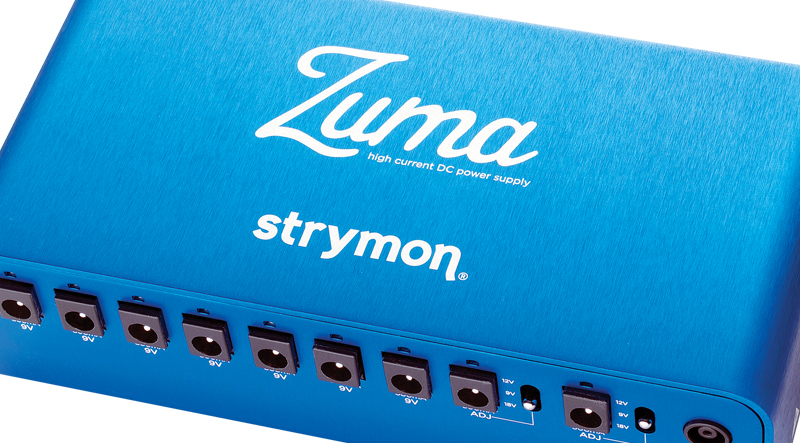
    Strymon’s Zuma power supply might be your answer. This beautiful blue box is the highest horsepower, most tech-savvy supply of its kind – and at a reasonable price.

    The Zuma provides nine high-current, isolated circuits, each with its own custom transformer and dedicated regulator. The nine channels all deliver 9 volts via the provided short or long cords.

    Two channels are switchable between 9-, 12-, or 18-volt output. This is ideal for most regular or even higher-power effects – and if you have a 9-volt stompbox that provides more headroom or output at higher voltages, you’ve got options. Each output delivers a whopping 500 milliamps of juice. If you don’t speak fluent electronics, all you need to know is that the Zuma is never going to let your stompboxes down. Each output is also topped by a small operating light to let you know when your connection is made.

    Zuma engineers were also thinking ahead to your future world tour, even if you weren’t: the power-in options include any variation from 100 to 240 volts with the IEC cable supplied.

    The Zuma is also amazingly quiet. Some pedals designed to work with batteries can churn out background static, but the Zuma’s dual isolation stages eliminate ground-loop and AC-line noises. So you really only hear your pedals working, not complaining.

    If the Zuma’s more juice than you need, Strymon also offers scaled-down Ojai models. The basic Ojai has five 9-volt outputs, whereas the Ojai R30 offers two selectable outputs for 12- or 18-volt units. And they can be daisy-chained together to expand your system.

    The Zuma and its little siblings are lightweight, rock-solid, simple to operate (even for guitarists), and downright cool looking.


    This article originally appeared in VG February 2018 issue. All copyrights are by the author and Vintage Guitar magazine. Unauthorized replication or use is strictly prohibited.