An itinerant Western-music guitarist who befriended Leo Fender and other employees at his up-and-coming company in the early ’50s, Bill Carson was the “test pilot” for the Fender Stratocaster prototype, and his input regarding body contours, pickups, and control placement differentiated it from the slab-bodied Telecaster.
Prior to the company being bought by CBS in 1965, Carson was appointed Supervisor for Guitar Production, and later spent several decades working for Fender Sales before retiring in the first years of the 21st century. Throughout his time, Carson stayed in touch, monitoring innovations on the Strat and continuing to lend ideas.
One day in 1977, Carson got a call from Charlie Davis, a longtime associate at Fender who told him about a figured one-piece maple Strat neck that for nearly a decade had been stashed in the company’s Service Center (a precursor to the Custom Shop), which set aside certain parts for special projects and artist-relations instruments. It had the larger/CBS-era headstock and four-bolt attachment, both of which Carson preferred. So he bought it with the intent of using it on a personal guitar he was building with a prototype ash body that had been carved for upcoming models like the Elite Stratocaster and The Strat.
Tommy Allsup, Craig Chambers, and Bobby Koefer. In front is producer Tommy Morrell.
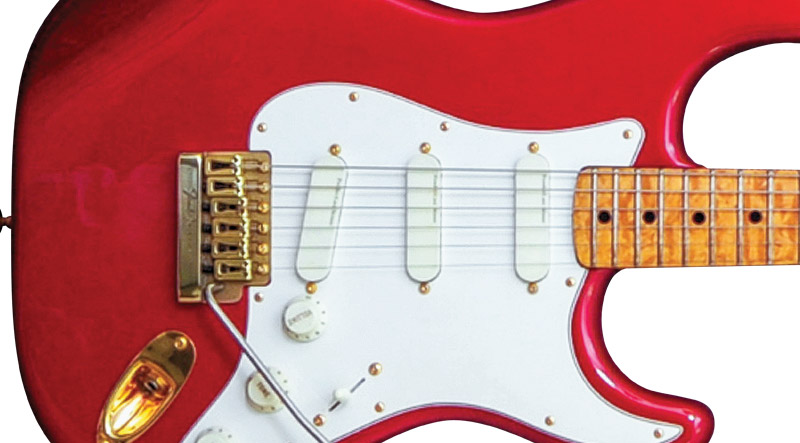
One of Carson’s co-marketing efforts at the time was gold-plated aftermarket brass partsfor Fender’s frontline models. One kit for Strats included a vibrato bridge, nut, knobs, strap buttons, and a tip for the vibrato handle. The bridge, made by Gary Kahler, was Carson’s design (he held the patent). Fender offered brass parts for about three years, and they were used on a handful of Strat variants, and Carson used most of them on the personal guitar he was creating, along with some new-old-stock gold tuners stamped with the Fender F logo. A 1969 neck plate was gold-plated for the effort. Davis supplied older pickups, potentiometers, and a wiring harness.
Bill Carson’s Strat with one of his Fender #351 picks. The neck has gorgeous flame.
Carson originally used a three-ply (white/black/white) pickguard on his guitar, and standard knobs rather than the gold-plated aftermarket type.
“He wanted to keep the weight down, and keep the look simple, but elegant, without being too heavily laden with gold,” said Carson’s wife, Susan.
Finished in Candy Apple Red, the instrument was “…more admired than played, because it was such a beauty,” she recalled.
In 1987, Fender introduced Lace Sensors, and Carson was smitten.
“Bill was crazy about them,” Susan recounted. “He wanted them in a guitar, and in 1988, he sent the red guitar to John English at Fender’s Custom Shop. The neck had always been a bit chunky for his liking, so he had John re-shape it, give it a lacquer finish, and install larger frets, and Lace Sensors, the first of which had Lace’s Gold tonality, which came to be Bill’s favorite; he really liked the smooth, quiet tone.”
After English’s touch-up, the neck had a B width with what Susan describes as “a very comfortable, classic oval contour.” English signed and dated it on July 17, 1988. The instrument weighs 8.75 pounds, and Susan recalled Bill saying, “I’ve never heard a Fender guitar ring, sustain, and resonate like this one does.”
Carson put his signature on the back of the headstock and on masking tape in the body cavity. He made additional notes on the inside of the back plate (over the vibrato springs): “Customized by me, for me – ’69 Strat, Bill Carson” and used the guitar exclusively until ’93, when the Custom Shop built a run of limited-edition Carson signature Strats. From that run of 101 instruments, number 77 became one of his favorites.
Carson was living in Nashville at the time of his passing in February of 2007, at age 80.
This article originally appeared in VG’s September 2022 issue. All copyrights are by the author and Vintage Guitar magazine. Unauthorized replication or use is strictly prohibited.
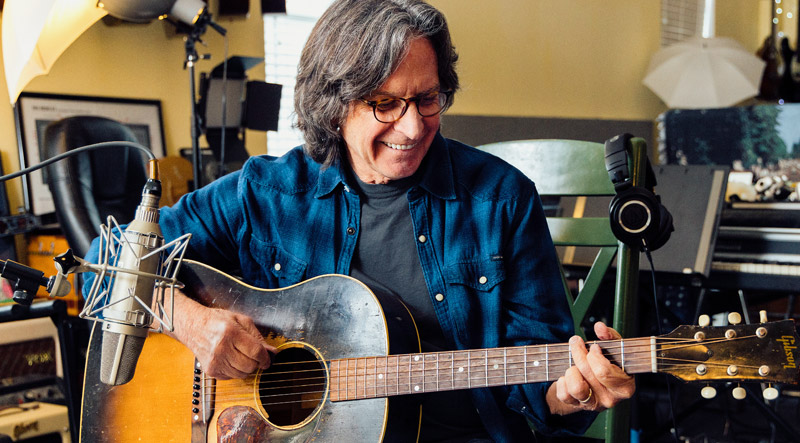
Jeff Hanna with Ray Kennedy’s 1950 Gibson J-45. Jeff Hanna 1971: Bob McEuen.
One’s taste in music usually starts in the home, where immersion can fuel the subconscious. Jeff Hanna’s parents loved Ella Fitzgerald and Louis Armstrong, which helped embed great music deep in the brains of their three sons.
By age 10, the middle child, Jeff, was hearing rock-and-roll on 45s and the radio in his big brother’s Ford hot rod – Chuck Berry, Little Richard, Fats Domino, Duane Eddy, and Buddy Holly.
“I loved that music – it changed my life,” he says. “Duane, Eddy, Eddie Cochran, and the Everly Brothers became part of my musical DNA.”
At 15, Hanna was given “…a funky Harmony Monterey that hurt my fingers,” at first reading sheet music for tunes like “Twinkle, Twinkle Little Star.” Shortly after, his family moved from Colorado to Long Beach, California, when his dad was hired to work on the Apollo program for North American Aircraft.
“I was a little bummed at the idea of moving away from the mountains, trees, and blue skies,” Hanna chuckled. “Our new house was inland, and I remember waking up the first day and seeing a layer of fog and all the concrete. Once I saw the beach, though, my attitude changed (laughs).”
Ray Kennedy’s 1935 Gibson L-00. Jeff Hanna’s high-mileage ’51 Gibson Southern Jumbo (right) known as “Scrappy” is heard on much of Dirt Does Dylan. Jaime Hanna played his ’73 Telecaster Custom on the majority of his electric tracks for Dirt Does Dylan. “It’s a great instrument,” says Jeff Hanna. “When I was a kid, I turned up my nose at any Fender that wasn’t pre-CBS, but now we know there’s a lot of good guitars from that time.”
A sophomore at the time, on the first day of school he met Bruce Kunkel and they bonded quickly over music and guitars; both burgeoning players, Kunkel showed Hanna how chord melodies came together in folk songs.
The two formed what would eventually become Nitty Gritty Dirt Band and go on to record 22 albums that produced 15 Top 10 hits including four number ones accompanied by three Grammy awards, including Best Country Instrumental (2004), a Country Music Association Award award for Album of the Year (1989) and a 2003 International Bluegrass Music Association award for Recorded Event of the Year. As a songwriter, Hanna won a 2005 Grammy as co-writer (with Marcus Hummon and Bobby Boyd) for Best Country Song for “Bless the Broken Road,” recorded by Rascal Flatts.
In May, NGDB released Dirt Does Dylan, which falls in line with a long-standing tradition of paying homage to its musical heroes (see sidebar). Now 75, Hanna sat to discuss events leading up to it, revealing untold tidbits along the way.
What type of music pushed you to pick up an instrument?
My brother, Mike, got into the folk boom with “Hootenanny” and the Kingston Trio. I hadn’t heard those big acoustic-guitar sounds on the rock-and-roll records I was first drawn to – Chuck Berry doing the duck walk with his ES-345 was very different from the Everly Brothers and Peter, Paul and Mary. Then, Mike brought home Joan Baez, Vol. 2, and that was my gateway to bluegrass thanks to the Greenbriar Boys backing her.
You started on guitar like most kids at the time, taking lessons, but quickly moved to other methods.
Yes, Bruce Kunkel showing me G, C, D, and E minor chords was an epiphany. I bailed on lessons and within a year, we’d both bought Goya nylon-strings and became a duo doing folks tunes at church dances.
Was the Goya a good instrument?
It was, and it wasn’t a cheap beginner guitar. Within a year, though, we both traded the Goyas for old Martin 00 and 000-18s.
This ’62-reissue Strat is Hanna’s primary road guitar; it has a neck from 1989 and body from the mid ’90s. Ray Kennedy’s ’58 Gretsch Duo Jet got the call whenever Jaime Hanna’s Tele wasn’t right for a track. Ray Kennedy’s ’59 Fender Jazz was used by Jim Photoglo to record every song on Dirt Does Dylan. Believed to be a prototype, lore says it was given to Don Everly by Leo Fender. Originally sunburst, Everly had a friend who painted cars give it a gloss-black finish.
Had your musical tastes evolved beyond what the nylon-strings could do well?
Yeah, by the beginning of senior year, we were deep into Bob Dylan’s early music, along with Doc Watson, Mississippi John Hurt, Sonny Terry and Brownie McGee, and The Jim Kweskin Jug Band, which was a huge influence. As a lark, we started a band to play that stuff. We recruited Jimmie Fadden, who played harmonica but was also willing to take up washtub bass.
After graduating in ’65, I enrolled at a community college and I’d hang out at McCabe’s Guitar Shop, in Long Beach. I could grab a guitar from the wall and go to a separate room to pick on it. One day in there, I met a mandolin player named Les Thompson and a fingerstyle guitarist named Ralph Barr. I told them about our jug band, and they were quickly onboard.
Me and Jimmie decided we’d be the rhythm section – me on a washboard, Fadden playing washtub bass – and the five of us started hanging around at a coffee house called the Paradox, where there was a community of players who were generous with their time. No attitudes or egos, just kids who loved folk music. Tim Buckley played there, and so did Jennifer Warnes and Mary McCaslin.
You also met Jackson Browne at the time…
Steve Noonan introduced us to Jackson when we went to see him play a solo set at a different coffee house. He played a couple original songs; imagine Jackson Browne being the first person you ever heard who wrote their own tunes (laughs), but he wanted to be in our band, and we said, “Sure!” So it became me, Jimmie, Les, Ralph, Bruce, and Jackson, and for four weeks in a row we won the Paradox’s talent contest. The prize was a couple pizzas and a headlining spot the next week. Word got out that we were pretty good.
Our first paying gig as the Nitty Gritty Dirt Band was at the Paradox the weekend of May 13, 1966. Then, we played a couple more weekends, then got a gig at the legendary Golden Bear, which was part of the professional folk circuit. It was mostly folk music, but also rock and roll. They had the Paul Butterfield Blues Band, and we opened for Sir Douglas Quintet, Doug Sahm’s band. We also opened for one of our favorite bands, the Lovin’ Spoonful, which did incredible electric jug band music.
Ray Kennedy’s 1950 Gibson J-45 known as “Thumpy.” This ’64 Martin D-28 appeared in the hands of Jeff Hanna on the cover of Nitty Gritty Dirt Band’s 1967 debut album. It now belongs to Jaime Hanna. Jeff Hanna played Ray Kennedy’s ’29 National Triolian on “It Takes a Lot to Laugh, It Takes A Train to Cry.”
How long did the band’s original lineup last?
That August, Jackson decided to pursue his singer/songwriter thing, and went off to New York to play behind the singer Nico. We decided to contact John McEuen, who was a phenomenal banjo player and guitarist. John had entered the Topanga Canyon Banjo Contest, which was a really big deal in L.A. folk circles, so we backed him, and he won (laughs)!
The gig solidified the Dirt Band lineup. We had so much fun onstage; we were teenagers – John was 20 – playing that quirky music, and people really dug it. We somehow cracked a market that had been exclusive to rock and roll in Southern California. Then we got a record deal and we were off and running.
Your first four albums were jug-band music.
Yeah, but our first single, “Buy for Me the Rain,” co-written by Steve Noonan and Greg Copeland, had nothing to do with jug music and became a Top 10 single in Southern California. So we thought, “Well, that was easy.” But, our producer and the record company didn’t get the jug-band thing, and when we walked into the first session, guys from the Wrecking Crew were there. We thought, “We’re not even gonna get to play on our own record.” But they told us, “You’re gonna play, but we’re gonna play along.” Jerry Scheff was on bass, so the washtub bass didn’t show up much. I played some washboard, we all played acoustic guitars, John played banjo, and Les played mando. Drums were done by guys like Jimmy Gordon, while Mike Melvoin and Don Randi played keyboards.
Jeff Hanna’s 1960 Les Paul Standard has been part of his studio arsenal for almost 50 years. Gibson Collector’s Choice #33 is a re-creation of this guitar.
We did the album, but afterward grew frustrated. Bruce left after the second album because he wanted to go electric, so we added local legend Chris Darrow to replace him. By the end of ’68, though, we were burned out; radio wasn’t playing our music, Sweetheart of the Rodeo had come out, and Chris and I started talking about how to incorporate that vibe into the Dirt Band. We worked up a few things that were country-rock-ish; hanging out at the Troubador, we were seeing Buffalo Springfield and The Byrds. But there was in-fighting over direction, and we all retreated to our corners, then shut it down after we released Alive. I like that album for its goofy humor and comedy bits. Some of the music is really good, and there are elements we used when and Chris and I started our own band with John London and John Ware. We called ourselves the Corvettes – the most-ironic name we could come up with for a country rock band (laughs). We got a deal with producer Michael Nesmith, from the Monkees, who was an amazing writer and singer, and we cut sides with Dot Records. But, the radio wasn’t really playing them and we were starving when we got a timely phone call from our friend, Linda Ronstadt, who was looking for a band. We backed her for several months, which was incredible training for guys who wanted to have a presence in the country-rock world. She was the queen of that.
Suffice it to say that was key to reinvigorating Nitty Gritty?
Yeah, I ran into John McEuen at the Golden Bear, watching Poco, and we talked about doing Nitty Gritty again. We added Jimmy Ibbotson on drums and did Uncle Charlie, which is one of my favorite albums we’ve done. The big difference was John’s brother, Bill McEuen, started producing us. We had 100 percent creative control and brought our own sensibilities to the table.
What differentiated you from bands like Poco or the Burrito Brothers?
Well, it wasn’t steel-guitar driven. Les Thompson was playing mandolin and John McEuen was on banjo and some mandolin. Me and Jimmy played a lot of guitar, and we had a cast of drummers – me, Jimmie Fadden, and Ibby (laughs). Les Thompson played bass, as well. So, we brought the mountainy bluegrass/cajun music thing that was vocally similar to Poco and the Burrito Brothers, with two-part harmony based on the Louvin Brothers and Everly Brothers. That was the Dirt Band when “Mr. Bojangles” became a huge hit in ’71.
Through the years, the band varied in number of members. Did that affect the music it was making?
When Ibby left the first time, in ’76, we weren’t sure what to do. The music had shifted completely away from jug-band, but there was still a country-rock element. We shortened the name to The Dirt Band for a few years, which, in terms of marketing, was a dumb idea. But we had two hits, “American Dream” with Linda Ronstadt and “Make a Little Magic” with Nicolette Larson, and both charted.
Crossover hits before there was such a term.
Yeah, they made the country charts and pop radio.
The drum spot has undergone the most change.
Beginning in late ’76, there was this period where me, Fadden, and John – the old-timers in the band – talked about bringing Jimmie out from behind the drums, because he’s a really good guitar player, a really good singer, and a great harp player. Then, several great drummers came through; Merle Bregante, who was an old friend from the jug-band days and played in Loggins & Messina, joined us for a couple records. Then we had Michael Buono on tour for a few months, followed by Michael Gardner, a Memphis guy who had played in Jimmy Buffet’s Coral Reefer Band. And finally, we had Vic Mastrianni, a rock drummer from Michigan who had played for Ted Nugent. Those guys were each with us for no more than a year or two, then one day Jimmie said, “I really wanna play drums again,” so we finished the last Dirt Band album and asked Ibby to come back in. He tells us about how he was painting houses on the Jersey Shore and kept hearing “American Dream” on the radio, thinking, “Damn…” So he was happy to take the call (laughs).
By then, all the silly ego crap we’d dealt with in our 20s had gone by the wayside. Ibby and I did some afternoon gigs in Aspen, where we both lived at the time. We’d sing Everly Brothers tunes, old Dirt Band songs, original stuff, some of which ended up on records, like Ibby’s “Dance, Little Jean” and a cover of “Cadillac Ranch” that’s still a staple in our set. We were both huge Springsteen fans. “Dance, Little Jean” was one of the hits on Let’s Go, the first album from what I call our “country era,” produced by Norbert Putnam before we signed with Warner Brothers in ’84.
Two of producer Ray Kennedy’s favorite studio amps are his Gibson Ranger and ’63 Fender Princeton.
You had a string of Top 10 singles beginning then.
It was quite a run, and the music we were making was really similar to what we were doing in the ’70s in L.A. Once in Nashville, we got serious about songwriting and recording our own tunes, and they were landing on radio.
At Warners, we were produced by Paul Worley and Marshall Morgan for the first two albums, then in the middle of Hold On, we changed gears and our friend, Josh Leo, came in to help produce. Josh was a California guy who’d played in J.D. Souther’s band and Jimmy Buffet’s band, and he brought a different production style that resulted in “Baby’s Got a Hold on Me” and “Fishin’ in the Dark,” which was a game-changing #1 record that you still hear once an hour on country radio (laughs). The lasting effect of that tune is remarkable. But what we really noticed was how our fan base instantly got 20 years younger. We still had fans who’d been around since the ’70s, but Josh brought this big-guitar/big-drums sound; he had me, Ibby, and himself stacking acoustic-guitar tracks like Jeff Lynne (laughs). It was massive, with a Telecaster, a little mandolin in the mix, and Fadden playing harmonica. Everybody who worked with Josh after that wanted to re-make “Fishin’ in the Dark” (laughs) because that sonic thing he created was so great.
The popularity of “Fishin’ in the Dark” keeps spanning generations.
It hangs in there, man (laughs). The three songs we can’t leave the building without playing are “Mr. Bojangles,” “Fishin’,” and “Will the Circle Be Unbroken.”
Speaking of “Circle,” the new album isn’t the first time you’ve covered Bob Dylan.
Yeah, we did “You Ain’t Going Nowhere” on Will the Circle Be Unbroken, II, with Chris Hillman and Roger McGuinn from The Byrds singing a duet. They’d put that out with The Byrds in ’68, and country radio wouldn’t play it – didn’t wanna play “those hippies.” It was a shame because that’s a beautiful track from a beautiful album (Sweetheart of the Rodeo).
Twenty years later, we released our version with Chris and Roger, and it became a Top 10 country single. Talk about redemption, you know? We were really proud. We’d been playing that song in our sound checks way before we cut it with them. It’s a staple; if you’re a band of a certain era, you know “You Ain’t Going Nowhere.” We love it.
What motivated you to do an entire Dylan album?
Once we started talking about doing a record, one suggestion was to honor a single songwriter. Dylan was the first idea; we talked about others but kept coming back to Bob, and the number one reason for me and Fadden was that we played those songs as teenagers – we’re lifetime members of the Bob Dylan fan club (laughs). But the main thing was his music. If you’re a fan of the Dirt Band, you know we’ve been eclectic from the jump – jug-band music, old-timey, bluegrass, ragtime, blues all over the map, rock and roll – you name it. Well, Dylan did all that, too. So we thought, “Here’s a songbook that’s hundreds of tunes deep, all great.” We started sending choices to each other and got to about 80 tunes, which we cut down to about 50. By the time we got in the studio, it was 30 or 40.
We booked studio time for early March of 2020 with producer Ray Kennedy, who’s been one of my favorites since we met in the ’80s – he’s a killer guitar player and big collector, as well. As a producer, he’s old-school, loves his analog gear, and has done a great job creating music with equal parts big acoustic guitar, killer electric guitars, and big bass and drums for artists like Steve Earle and Lucinda Williams, two of my favorite singer/songwriters.
Jeff Hanna in the early ’70s with a ’56 Les Paul Custom that he refinished in dark walnut. In ’72, he traded it for his 1960 ’Burst.
These days, the band is a mix of familiar faces, new blood, and family.
A big part of that was our friend, Jim Photoglo (who co-wrote “Fishin’ in the Dark”) joining for the band’s 50th anniversary in 2016. And when John McEuen left at the end of ’17, the fiddle slot became open and we had six months of dates booked, so we had to hustle to find somebody. My son, Jaime, suggested we call his neighbor, Ross Holmes, a great mandolin and fiddle player who grew up in bluegrass. He was in Bruce Hornsby’s band, and before that was with Mumford and Sons and Warren Haynes. He plays all kinds of stuff – writes concertos. And if you like, he’ll play some Doug Kershaw-style cajun fiddle.
Ross came out for a weekend of shows and never left – Jimmie Fadden and Bob Carpenter told me, “We can’t let him leave!” And I completely agreed.
You also added Jaime on guitar and vocals. What does he bring to the mix?
I might be a little biased when I say he’s a great singer/songwriter (laughs), but he was in Gary Allen’s band for 12 years, and before that played with the Mavericks and backed Raul Malo on his Today album, which is fantastic. He not only sang and played guitar, but co-wrote most of that material with Raul. He came to us fully formed as a musician, and he and I have that blood harmony thing going on, which I’m really fond of.
What influences do you see in his playing?
Well, it’s interesting because when Jaime was a kid, he played drums first, and in school played in jazz band and marching band. But when he was little, he had this plastic toy guitar he carried around and “played” left-handed. When he started playing guitar for real, I told him he really should learn right-handed. I said, “If you walk into a house with a guitar hanging on the wall and you wanna play it, it won’t be ready for a lefty.” My wife, Matraca Berg, is also a lefty who plays righty. Glen Campbell, same thing. There’s a bunch of ’em.
When he was learning to play, I didn’t know much about the guys he was into – Yngwie, Steve Vai, Metallica, Randy Rhoads, Van Halen – but I bought him a pointy-headstock Ibanez rock guitar. He lived with us when he was going to college, and from his room upstairs I’d hear him doing this shredding stuff all the time. I’d tell him, “You gotta check out Clapton, you gotta check out Mark Knopfler.” But he lived to shred, and he was good at it.
He also didn’t want to sing at first, but, living in Nashville, the concept of singer/songwriter was creeping in along with Tele and Strat sensibilities, to some degree because of Stevie Ray Vaughan. He was working his way back through those guys, and developed this really great style also rooted in Knopfler’s approach, favoring a volume pedal. He played some stuff on our new record that sounds to me a bit like Pete Anderson and even George Harrison’s country-ish licks on Beatles records.
Overall, how did he do on the album?
Well, I have limitations as a guitarist, Jaime, not so much. I might be a good acoustic-rhythm player – I’ve got my pocket of licks that are about tone, taste, and economy – not speed. Jaime’s really tasteful, brings great tone and chops, and we’re both geeky about pedals, amps and guitars. I’m dealing with some arthritis in my left hand, but Jaime’s fit as a fiddle, so I was passing along a lot of the solos. On the outro to “Forever Young,” Ray asked him, “Hey, can you play like Jeff Hanna on that?” Jaime laughed, and he did, but he took it to another level (laughs). He had a big grin on his face, like “Yeah, I’ve got a little dad influence in there.” (laughs)
Did you give a lot of thought to his joining the band?
Very much. We had a family meeting with our wives, and Jaime ultimately decided that if he was ever going to play alongside his dad, this is the time. And I’m so glad he did. His former boss, Gary Allen, was really supportive. For a couple months he played in both bands, earning a lot of frequent-flier miles. But, by May of ’18, the lineup you hear on the album was solid.
Dirt Tracks
Jaime Hanna with his ’73 Telecaster Custom
Beyond “Mr. Bojangles” and two fistfuls of radio hits in the ’80s, many know Nitty Gritty Dirt Band for honoring generations of bluegrass, folk, and country performers with its three Will The Circle Be Unbroken albums.
For its latest tribute, Dirt Does Dylan, NGDB touches on Bob Dylan’s country, singer/songwriter, blues, and rock artistry from the mid ’60s to the mid ’70s. Co-produced by Jeff Hanna and Ray Kennedy at the latter’s Room & Board Studio, it marks the addition of singer/bassist Jim Photoglo and other new members Ross Holmes (fiddle, mandolin, vocals) and guitarist/singer Jaime Hanna. Heavy-hitter guests included Roseanne Cash and Steve Earle, blues-rockers Larkin Poe, as well as Americana stars Jason Isbell and The War & Treaty.
The album was conceived in 2019, when with the band started sharing song ideas. Starting with 80, the list was pared until it landed at 12, 10 of which made in the final cut, and eight of which were recorded mere days before the pandemic shutdown.
“Four of the guys live in Nashville, but the other two are on opposite coasts – Bob lives in California, Jimmie in Florida, so after those initial sessions we didn’t see either of them until 2021. There were times when we thought, ‘Are we gonna ever finish this album?,” Hanna said with a chuckle.
“There wasn’t a conscious effort to cover this period or that, or a certain type of song,” he added. “I think it worked out great, mostly because it sounds like us, which was the key element.”
He touched on a few memories from the sessions.
“Tonight I’ll Be Staying Here With You”
“Ray likes to use live lead vocals whenever possible, and that’s what you hear on that track, which was the first song recorded for the project. The fiddle and guitar solos are also from the floor.”
“Girl from the North Country”
“Another live track, including live vocals. Jaime played fingerstyle electric while he sang it. The only overdubs are my harmonies, the fiddle, and Jamie added the outro guitar solo.”
“I Shall Be Released” (featuring Larkin Poe)
“We wanted Larkin Poe for that track because Rebecca Lovell is a ridiculously talented lead singer and they’re a great blood-harmony package. They came in so well-prepared! In the control room one day, I asked Ray to solo Megan Lovell’s vocal, because I noticed she’d sometimes go to the melody, and Rebecca would jump above her (laughs). They were trading back and forth, and it was seamless because Megan’s also a great singer. Her lap-steel parts very much remind me of David Lindley, with that beautiful, melodic sound like a human voice or a sax player. She totally gets that. I traded riffs with her on the outro – the only time my ’Burst is heard on the album, running through my Paul Cochrane Tim boost and plugged into the Princeton.”
“She Belongs to Me”
“Ross played a cool Cajun-vibe fiddle for the track. I wanted to honor Dylan’s version, with that suspended-chord bit. I used the J-45, then the SJ on the double/overdub. Jaime’s rockin’ the ’73 Tele.”
“The Times They are a-Changin”’ (featuring Rosanne Cash, Steve Earle, Jason Isbell, and The War & Treaty)
“As soon as we decided to record it, right from the get-go we wanted guest artists, and Jason and the War & Treaty were my first calls. They cut vocals here in Nashville; because of lockdown, Rosanne and Steve recorded their vocals in New York. All of them did a tremendous job. Jason played a great slide part using Ray’s ’69 Tele straight into the Gibson Ranger.”
“Don’t Think Twice, It’s All Right”
“I played my ’51 Southern Jumbo, ‘Scrappy,’ and Jamie played the D-28 for rhythm. Fadden played some great harp, and Bob and Jaime sang great harmonies.”
“Quinn the Eskimo (The Mighty Quinn)”
“We’ve never before had six guys who sing so well, and this was the one song everybody sang on. The harmonies were a blast! I love that big chorus. It was a great way to close the album.”
This article originally appeared in VG’s September 2022 issue. All copyrights are by the author and Vintage Guitar magazine. Unauthorized replication or use is strictly prohibited.
Glenn Holley was just five years old when he became infatuated with the sound of rockabilly music thanks to Elvis Presley.
“By 10, I had more than 30 of his albums – my room was Elvis posters, magazines, belt buckles, playing cards, coffee mugs, and other stuff,” he said. “I had a heavy old oak-cabinet record player from the ’60s that my mom bought at a flea market for $5. Every night, I’d stack five albums and play air guitar to Scotty Moore riffs before going to bed.”
That zeal never faded, and as an adult, Holley became a connoisseur of hotshot guitar music and the playing guys like Big Al Anderson, Ronnie Earl, Jimmy Bryant, and Grant Green. Of course, anyone of that ilk eventually discovers Danny Gatton.
“I got into Danny’s music when I first heard 88 Elmira St and saw him live in 1991,” Holley said. “I couldn’t believe what I was hearing. Danny tore it up on his Tele for most of the set, then pulled out an ES-295 to play a medley of Sun Records songs. He talked about how he believed it was the guitar Scotty used on the original Sun sessions. Being such a huge Elvis fan, that got my attention (laughs)! Beyond the fact that show was by far the greatest guitar performance I’d ever seen among several hundred concerts, I walked out wondering if I’d actually just seen the guitar I heard so much as a kid.”
Shortly after that concert, Holley wrote “a fanboy letter” to Gatton.
Danny Gatton with the ES-295 onstage in Berkeley, California, 1981.
“I had never written to a musician before – and haven’t since – but I was compelled. I started searching for all of his music – cassettes, bootlegs, and CDs – much of which at the time was sold by his mother, Norma. You’d send her a check and she’d fill your order after it cleared (laughs).”
The two became friends, speaking frequently for years; Holley arranged for Norma to get 1-888-4GATTON to sell Danny merch and helped her set up a system to accept credit card payments. The relationship led to Holley producing an official version of the Humbler bootleg in 1996, two years after Gatton’s tragic passing. It became Norma’s bestselling item, moving all 25,000 copies that were manufactured.
While he never took to playing guitar (as a kid he was demoralized by an elderly teacher who insisted he learn the nursery rhyme “Mary Had a Little Lamb” instead of “Mystery Train” or “Milkcow Blues Boogie”), in June of 2018 he bought Gatton’s 295 from a collector in Nashville (who’d bought it from the Gatton estate).
“Owning a Gatton guitar had always been in the back of my mind,” Holley said. “Owning one that might also have been owned by Scotty Moore was an opportunity I couldn’t pass up.”
Players who appreciate such tried-and-true classic guitars groan whenever a great one ends up in the hands of someone who puts it in a display case or vault, where it essentially goes unplayed. But such was not the fate of this one.
High mileage. Note the very well-worn neck.
“I have no interest in letting it hang on a wall, so I frequently loan it out to be played at gigs,” said Holley. “I’ve driven from my home in Connecticut to The Birchmere (in Virginia) twice in recent years for Danny Gatton birthday celebrations, where Dave Chappell has played it. In July, I took it to New Haven, where Redd Volkaert played it at a gig.”
Several others in the New England area have also taken a turn on the 295, and on September 2, 3, and 4, Holley is promoting performances by Welsh guitarist James Oliver, a Gatton devotee whose eclectic style fits the mold. He’ll use the 295 exclusively at Strings Bar & Grill, Johnston, Rhode Island, Tree House Brewing, Charlton, Massachusetts, and on Gatton’s birthday (September 4) at Carter Farm, Marlborough, Connecticut.
“Letting others perform on the 295 is my way of helping keep Danny’s memory alive and share the sound of a remarkable instrument,” Holley said. “Being able to introduce James to American audiences and see him play Danny’s iconic ES-295 is an incredible honor.
For information on tickets to James Oliver’s September 4 performance, search his name at Eventbrite.com.
Do you have a classic/collectible/vintage guitar with an interesting personal story that might be a good fit for “Classics?” If so, send an e-mail to ward@vintageguitar.com for details on how it could be featured.
This article originally appeared in VG’s September 2022 issue. All copyrights are by the author and Vintage Guitar magazine. Unauthorized replication or use is strictly prohibited.
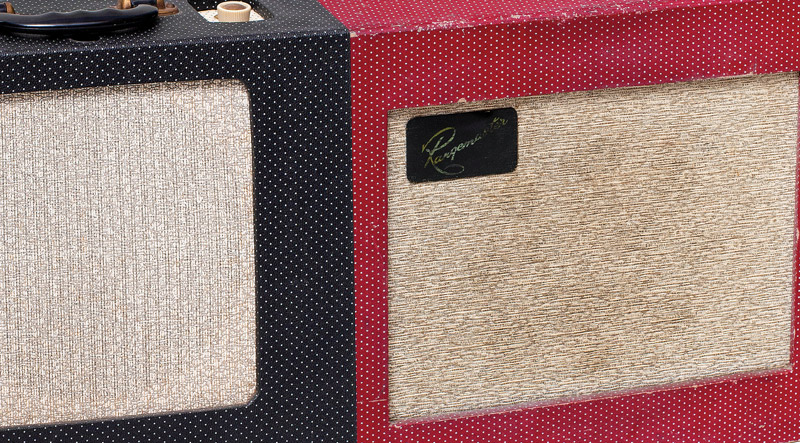
1960-’61 Dallas Rangemaster • Preamp tubes: three EF86, one ECC83/12AX7 • Output tubes: two ECL82 • Rectifier: solid-state • Controls: Volume 1, Volume 2, Treble, Bass, Tremolo (speed only) • Speaker: one 12″ Goodmans • Output: approximately 10 to 12 watts RMS Amp courtesy of TR Crandell Guitars, photos by Drew Gansz.
Fascinating also-rans, C-list classics, or both, the amps manufactured by London-based Dallas Music Ltd beginning in 1959 tie directly to legendary British gear. All but unheard of stateside, they were also a springboard to bigger things.
As the ’50s skiffle craze in Britain segued into rock and roll, a handful of instrument manufacturers were jockeying for position, and it became clear that amplified instruments were the way forward. Several brands were well-established at the time – Selmer, Watkins, Bird, Grampian, Elpico. But some of the more-interesting guitar amps were coming from a company that had almost a century under its belt, and which would evolve into one of the major players of the rock era.
The Rangemaster’s upper preamp chassis is oddly configured, with individual segments for each of four preamp tubes and the circuit strung point-to-point between them. A Goodmans speaker is squeezed between the upper and lower chassis. Note the ECL82 tubes atop the latter, which constitute the phase inverter and output stages. The control panel (left) sits at the back edge of the amp’s tiered top and boasts two channels along with separate Treble and Bass controls, and a Tremolo knob for adjusting speed.
The company called John E. Dallas and Son was formed in 1875 and enjoyed decades drums, and other instruments before the electric-guitar craze threw it sideways into a heady new market. Some of the drum and banjo lines of the early/mid 20th century carried the Jedson brand (a contraction of the full company name) used later on imported guitars, but by the mid ’50s, the company was known simply as Dallas Music Ltd. – the name that appeared on its first guitar amplifiers circa 1959. Models like the Scala, Shaftsbury, and Rangemaster carried basic textbook circuits, but looked nifty and have attained a certain desirability. Which is not to say these “basic” circuits couldn’t sound great when played with some attitude, and many latter-day guitarists have discovered that charm.
The Rangemaster, seen here in its earlier cosmetic incarnation, was the flagship and attracts the most attention today. It’s hard to beat the design in the looks department – if retro and rather twee are your thing, at least – given its white and pinkish-red covering with tiny polka dots, stair-stepped upper deck, and fawn grillecloth. It can also deliver plenty of classically Brit-voiced chime when played clean, and crispy, harmonically saturated overdrive when pushed into distortion.
The Rangemasters in this cabinet used a dual-chassis layout, with the preamp circuit coupled to the controls in the upper section and the output stage with transformers in the lower. The very first renditions, featured in magazine ads of the time, had a dual-6V6 output stage, unusual among British amps of the day, along with a tube rectifier. Despite appearing exactly the same externally, the version featured here is the more common, with an output stage using two ECL82 tubes and a solid-state rectifier. Known in the U.S. as the 6BM8, this tube (which outwardly looks much like an EL84) carries a triode and a pentode in the same glass envelope. In the Rangemaster, the two tubes’ two triodes are used for the phase inverter, and the pentodes provide the push/pull output power.
The upper chassis in both renditions carries three EF86s and one ECC83/12AX7. These are sufficient to provide a gain stage for each of the two channels, gain make-up for the shared Treble and Bass controls, and a Tremolo effect (with speed control only). There’s plenty of front-end girth to be had from the EF86 pentode preamp tubes, which were also a feature of the Vox AC15 of the time and some of the very first AC30s, along with several Selmer amps, but they’re limited by the constrained output of the ECL82s. And if you’re looking for toothsome tones at lower volumes, this can be a good thing. These tubes have a balanced, musical tonality, but are limited to 10 or 12 watts maximum per pair, and can be easily pushed into overdrive as a result. These were also used in some Watkins/WEM amps (notably the Westminster), the single-ended Gibson GA-8T, and others. Contemporary builder Steve Carr uses them in his Super Bee model specifically for their ability to emulate a bigger push/pull amp.
1960-’61 Dallas Scala • Preamp tubes: two ECC83/12AX7 • Output tubes: one EL84 • Rectifier: EZ80 • Controls: Volume for each of two channels, Tremolo (speed only) • Speaker: one 10″ Elac • Output: approximately 4 watts RMS
The Scala is far more a student amp, with a single-ended output stage in the mold of the Fender Champ or Vox AC4. Available with or without tremolo (the latter a la carte), this early example shows the effect added-on using a separate circuit with its own preamp tube and speed knob, all mounted in a hole cut in the side of the cab (not dissimilar to how JMI began adding Top Boost to the Vox AC30). Otherwise, it’s a simple circuit using one ECC83/12AX7, one EL84 preamp tube, and an EZ80 rectifier tube.
If it reads as “just another beginner’s amp,” though, the Scala exudes a major quirk factor; there’s no “control panel” as such, and the Volume controls for each of its two channels are placed at inset cut-outs at opposite sides of the handle, their recesses inlaid with a square of the dotted white covering that forms the two-tone aesthetic alongside the dotted black that wraps the top, bottom, and front. Inside, a 10″ Elac Alnico speaker does the honors. Tone-wise, it excels at the edge of breakup, where it’s still clean through most playing, but tips into overdrive when you hit the guitar hard to generate more output from the pickup. Pushed further, it can get raw and raspy, but its chime and articulation are surprisingly appealing when reined in.
The Scala’s two Volume controls are recessed in the top panel.
A year or two after this lineup ruled the roost, the Scala gained a proper control panel (mounted on the side), which also included a Tone control, though it lost the two-tone cabinet. The Rangemaster became the Rangemaster Popular, with a simplified circuit and two elliptical speakers in a more-traditional rectangular cab (still with a striking two-tone covering in blue and white). From there, it briefly evolved into a black rectangular 2×10″ combo with a PCB rendition of much the same circuit. After this amp’s brief reign in early ’66, amps under the Dallas umbrella were shaken up in a big way.
Circa 1965, Dallas Music Ltd. bought out Arbiter Electronics and gradually expanded and updated its lineup as a result. If you’ve been hearing bells ringing since the Rangemaster amp was first mentioned here, it’s because the company conscripted the model name in ’66 for its Dallas Rangemaster Treble Booster. Soon after, the merger was recognized on the Dallas-Arbiter Fuzz Face, reflecting the official name around the time of the pedal’s release. Meanwhile, our quaint Dallas-branded combos faded from the scene after ’66, thanks to the company’s absorption of Sound City and the more rock-worthy amps that came with it.
A glance inside the Scala reveals the unusual add-on tremolo circuit, mounted to the left side of the cabinet.
Arbiter was further desirable thanks to founder Ivor Arbitor’s acquisition of the Fender distributorship for the U.K. in the mid ’60s, though this progressed to CBS’ majority share ownership in Dallas-Arbiter by around ’69. The Dallas side of the effort waned through the early ’70s, and Dallas-Arbiter closed shop in ’75. For fans of the pre-Marshall age of British amplification, though, these primitive combos are among the most-appealing creations of the Dallas company’s relatively brief foray into the electric guitar revolution, if not the most famous.
This article originally appeared in VG’s September 2022 issue. All copyrights are by the author and Vintage Guitar magazine. Unauthorized replication or use is strictly prohibited.
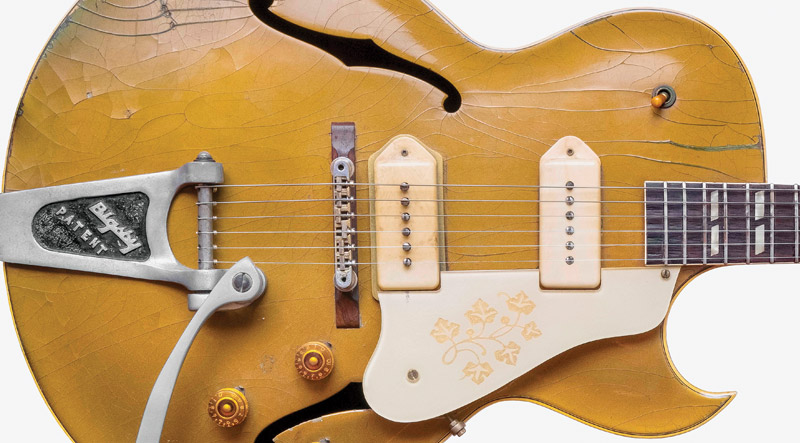
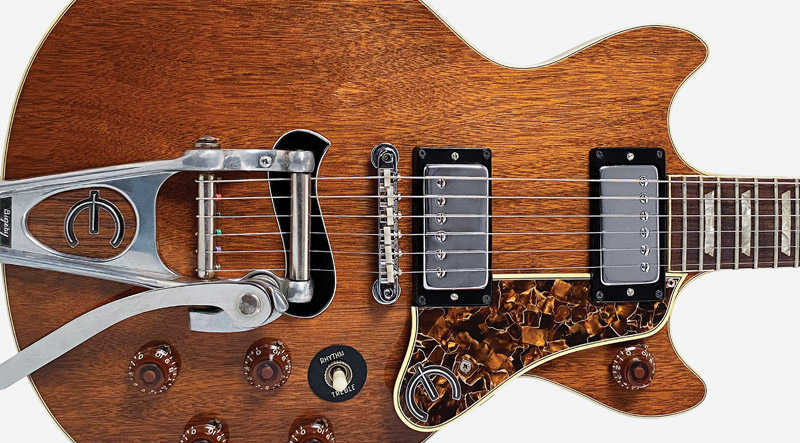
Modified nearly beyond recognition by its first owner, Robert Johnson had the guitar restored by Gibson in 1991. Fortunately, the original Epiphone stain was still available. The control knobs are a rare Brown Royalite style and the Bigsby was made specifically for the instrument. Its underside is stamped “Patent Applied For.”
Ted McCarty’s leadership at Gibson was highlighted by the introduction of top-shelf instruments created by knowledgable, intuitive designers and builders. Another brilliant move was his guiding the purchase of foundering Epiphone, which expanded Gibson’s retail reach.
Robert Johnson (right) with the guitar and ZZ Top’s Billy Gibbons (who’s holding a ’56 Junior) in 1971.
In 1969, Mike Ladd, who had just purchased a music store in Memphis, traveled to Kalamazoo for a tour of the Gibson factory. While there, he bought several instruments including this prototype Epiphone. Memphis native musician/collector Robert Johnson has owned the guitar since 1971, and recalled how it sat in the store for about a year before Ladd (1944-2021) gave it a complete re-work that included replacing its unique pickguard, black pickup surrounds, and black toggle-switch ring with common cream-colored pieces. He also replaced its Patent Number pickups with older PAFs and ditched its unhip Bigsby vibrato in favor of a hardtail setup. After putting wood filler in the Bigsby holes, he oversprayed the top in clear lacquer that Johnson says, “Did not look like Kalamazoo work.” Fortunately, though, Ladd boxed up all of the original parts.
“He then put it up for sale in his store, Mike Ladd’s Guitar & Drum City, for $599.99,” Johnson said. “I’d wanted it since I first saw it in 1969; I was playing guitar for Isaac Hayes at the time, and the band would often hang out at Mike’s.”
At 11/2″ deep, the body is thinner than the Les Paul, and there’s a belly cut on the back of the lower-bass bout.
Years after it joined his collection, Johnson began periodic visits to Kalamazoo with the guitar. His research, which included perusing blueprints and talking to employees, revealed that an Epiphone Les Paul variant was first envisioned in 1966.
Completed in early ’68, the body and three-piece neck of Johnson’s guitar are mahogany, and the fretboard was originally ebony with oval inlays, though Ladd had Gibson replace it with a piece of rosewood with trapezoid inlays.
In addition to Gibson’s standard two Volume/two Tone controls, there’s a master Volume on the treble cutaway. The potentiometers date from the 26th week of 1966 except for the master Volume, which is from ’62.
The laminate-mahogany headstock carries serial number 521446, along with factory-original Grover tuners.
“The headstock inlay is uncommon, but did appear on some Epiphone archtops, and several employees told me the wiring harness is from the Tal Farlow prototype,” said Johnson. “The Bigsby has Brazilian rosewood in its oval hole, and the early Epiphone ‘E’ logo. There have been a couple made like this since ’68, but this was the first. It originally had an ebony piece, but Mike had it changed when the fretboard was replaced.”
When the guitar was restored in ’91, a mustache-shaped plate was installed to cover the holes drilled for the stop tailpiece.
Epiphone’s Les Paul was to be introduced in July of ’68, along with the revamped single-cut Gibson Les Paul. However, changes were in the works.
“Talks had begun with (guitar manufacturer) Matsumoku, in Japan, to license the Epiphone brand, and a number of employees were laid off at Epiphone,” Johnson said. “With their departure, the Epiphone Les Paul was scrapped.”
Imported Epiphones first hit U.S. stores in 1970.
This article originally appeared in VG’s September 2022 issue. All copyrights are by the author and Vintage Guitar magazine. Unauthorized replication or use is strictly prohibited.
Arv Garrison with Vivien Garry at the Susie Q, Hollywood, 1946. Arv Garrison/Vivien Garrry: Robert Dietsche Collection/Los Angeles Jazz Institute.
American music history is fraught with tales of forgotten heroes. In the ’40s, jazz guitarists like Tiny Grimes, George Barnes, Chuck Wayne, and Arv Garrison occupied the space between Charlie Christian and Barney Kessel.
Garrison’s star shone briefly at a crucial point. A pioneer of electric-jazz guitar, he was a favorite of Django Reinhardt, admired by giants like Charlie “Bird” Parker, praised by critics Leonard Feather (Encyclopedia of Jazz) and Matt Ulanov (Metronome magazine).
Arvin Charles Garrison was born August 17, 1922, in Toledo – home to Art Tatum, Teddy Wilson, and Jimmy Harrison. Intuitive and single-minded, Arv taught himself to play ukulele at age nine, then switched to guitar and was accomplished enough to play dances and local events by 12, even as his first guitar teacher advised him to give up. The rejection prompted diligent self-study, playing along with Django records from morning to night. His mother taught him to read music and let him drop out of high school to pursue guitar.
In 1938, Garrison was “discovered” by pianist Bill Cummerow, and a move to Albany, New York, led to guiding his own bands by ’41. Quiet and unassuming, he experienced little success before forming a relationship with Vivien Garry, a singer who helped push him into the limelight. Arv taught her to play upright bass, and she soon became the first notable female jazz bassist. They married and worked together as the Vivien Garry Trio in Chicago and New York. By ’45, the trio was a fixture on NYC’s 52nd Street, the jazz mecca frequented by Duke Ellington, Billie Holiday, Thelonious Monk, and countless luminaries. They secured a residency at Kelly’s Stable and appeared on Art Ford’s prestigious “Saturday Night Swing Session” radio show. Their first single was cut for Guild in June ’45 with Teddy Kaye on piano, flaunting an approach and sound based on the Nat Cole Trio.
Arv Garrison’s playing on “Yardbird Suite” represents an important moment in jazz guitar, as his playing assumes a horn-like role emblematic of bebop guitar. This excerpt from the bridge finds him improvising in two minor modes. Check the blend of emphasized chord tones and arpeggios, as well as mixed modes – Melodic, Harmonic and diatonic minor scale sounds are crafted into coherent bebop phrases. His trademark chromaticism is found in the slurred triplet line of measure 5. Also familiar is the raked (sweep-picked) articulation of arpeggio figures in 2, 4, 5, and 6. He exploits emphasizes altered chords with imitated bebop cells in the closing measures, using a G# augmented arpeggio over D7 (D9#11) and G augmented over G7 (Db9#11) very much in the manner favored by Bird.
The couple moved to Los Angeles to join the burgeoning West Coast jazz scene and, in December ’45, recorded for the Sarco label, producing six tracks as a quartet with George Handy (piano/arranger) and Roy Hall (drums), a unit that looked to the future of small jazz combos. These sessions are distinguished by Arv’s impressive playing on “Tonsilectomy,” “Hopscotch” and “These Foolish Things,” which led to Handy’s recommendation for Charlie Parker and Dizzy Gillespie’s first dates on Dial. Bird knew him as a regular at the Finale Club and welcomed his participation, having played with him on 52nd Street and in Hollywood, at Billy Berg’s. Meanwhile, the trio was reconstituted with pianist Wini Beatty then worked on Central Avenue (L.A.’s equivalent of 52nd Street) bringing the cachet of a young jazz trio with two females.
1946 was a particularly productive and important year for Garrison, whose Dial sessions with Bird and Diz set new standards for jazz guitar via his featured turns on the bebop classics “Diggin’ Diz,” “Night in Tunisia,” “Yardbird Suite” and “Ornithology.” He made several successful jazz and pop records in the Garry Trio that included collaborations with diverse guests like Frankie Laine, Leonard Feather, Leo Watson, Vic Dickenson, and Rickey Jordan, as well as bebop dates with Howard McGhee and high-profile radio shows.
Also that year, he appeared on the cover of Downbeat (July) with Garry and Beatty, played the finest venues opposite titans like Errol Garner and Ray Bauduc and was hailed as a promising new voice. An Armed Forces Radio concert (Jubilee) showcased him in a medley playing his signature take on “How High the Moon” alongside Kessel, Irving Ashby, and Les Paul, and revealed his skills contrasting with the leading newcomers on electric jazz guitar. His crowning achievement came that October with “Five Guitars in Flight,” an innovative arrangement for the Earle Spencer Orchestra in which his five-part guitar ensemble (with, Kessel, Ashby, Tony Rizzi, and Gene Sargent) was featured within a big band. Rizzi maintains the historic session inspired his Five Guitars sessions.
Just 25 years old at the time, Garrison began to suffer seizures thought to be stress-induced epilepsy related to a childhood head injury. The episodes affected performances, foreshadowing a rapid decline. When Beatty left the trio, the couple reunited with Kaye and returned to New York in ’47, where they played radio shows, appeared at Royal Roost’s Bop Concert, participated in an All Star Jam that included Lionel Hampton and Gonzales. Arv also recorded as a leader with Garry and pianist El Myers in ’48, producing six songs that would be his last official studio dates. Garrison’s five to six daily blackouts prompted Myers to leave in the fall of ’48. Garry abandoned him shortly afterward to tend to her sick father, and never returned. Arv eventually returned to Toledo to be cared for by his mother, and played until ’57.
Garrison’s soloing over major-mode changes in “Yardbird Suite” (above) reveals another side of his artistry. Here, he references swing-blues; the unison juggling in measures 1-2 is a favored tactic of myriad blues guitarists. His arpeggio triad and minor/major duality in 3-4 are also familiar ingredients. However, the chromatic line in 5 is pure bop, delivered with tremolo-picked articulation. Compare this approach with a similar triplet line in the bridge. Also noteworthy is the chromatically shifting theme, with its angular wide-interval leaps, in 6-7 played over D7 and G7 chords. He creates a tritone substitution (Db over G7) by moving the simple figure down one half step during the II-V-I changes. The closing includes further allusions to swing blues, with pentatonic melody and minor/major polarity mixed with bop embellishment and a final idiomatic G7#5 gesture.
His ailment forced him to venture outside the music business to work at the railroad and odd jobs including vacuum-cleaner sales. Mixing medications to counteract the headaches led to dependency, and in a tragic twist, he died July 30, 1960, after diving into Centennial Quarry. An ace swimmer, he drowned, possibly due to epileptic convulsion. He was just 37.
Robbed of the recognition he deserved, the local obit failed to mention his pioneering work as guitar innovator, cohort to Bird, Diz, and Miles.
STYLE
A transitional player, Garrison combined elements of the past and present with glimpses of the future, and personified an evolutionary stage for electric guitarists between ’30s swing (Charlie Christian and Django) and ’50s bebop (Barney Kessel, Tal Farlow, Kenny Burrell and Jimmy Raney). His pioneering mid-’40s work exemplified by “Where You At,” “Baby, I’m Gone,” and “How High the Moon” acknowledges concessions of the swing era and classic jazz as well as chromatic chord progressions, melodic angularity, dissonance, faster tempos, rhythmic jaggedness, and the increasing complexity of bebop.
Acknowledged as one of finest technicians of the period, Garrison was admired for fast, fluid tremolo-picked lines – vestiges of Django’s influence exemplified by the theme in “Tonsilectomy” and passages with abundant legato embellishments throughout his repertoire, often played as slurred trills that hint at wind-instrument phrasing. The latter was also part of Les Paul’s playing in the ’40s, however, his advanced arpeggio-based chord outlining and horn-like execution, outgrowths of Christian’s approach, revealed a new streak of harmonic modernism, particularly in the altered-chord tensions, side-slipping, and intervallic bebop sounds that were uncommon in the period. The combination is brought to an apogee in “These Foolish Things,” where Arv takes center stage as the soloist. Also noteworthy is his prescient use of octaves (1:50) on “Where You At” (a Garry Trio radio date from March ’46) phrased as parallel melody lines foreshadowing Wes Montgomery’s signature use a decade later and sufficiently different from the purely rhythmic approach to octaves as fanfare or punctuation favored by Django and Christian.
A formidable soloist at the brisk tempos in “Indiana,” “Mop Mop,” “Dialated Pupils” and “High Wind in Hollywood,” Garrison supplied complex double-timed lines – a distinguishing aspect of bop improvisation – to “These Foolish Things,” “Baby, I’m Gone,” “You Can Do It” and “Lover Man.” Though capable of modern comping (“Where You At”), freer atmospheric textural backing (“Lover Man”), and block chording (“Just You, Just Me”), he functioned as accompanist in the traditional rhythm guitarist/timekeeper role where he lowered volume and strummed four-to-the-bar patterns, a holdover from swing and dance music in combos without drums. He also contributed muted-string strums to “A.B.C. Blues” and “Night and Day” and sometimes added percussive tapped and muted bongo-like effects to rhythm parts. A versatile ensemble member, he played main riffs (“Night in Tunisia” and “Drop Dead”), shared melodic fills (“Ornithology”) and supplied tight unison lines (“High Wind in Hollywood” and the coda of “Up in Dodo’s Room”).
Garrison’s command of the blues was highlighted in sessions with Rickey Jordan and Babs Gonzales. Jump blues, with its heavy swing emphasis, informed his work as he expanded single-note pentatonic and blues-scale phrases with chord figures and triad fills in “Blues in the Storm” and “Walk It Off,” milked double-stop riffs in “Three Bears,” and doled out a Charlie Christian-inspired solo laced with Django ornaments, double-stops, and proto-bop lines in “Rickey’s Blues.” On standards like “Stormy Weather,” he blended swing, pop, and blues. With Babs, he matched the singer’s scatting in “Blues in B Flat” with a mix of classic swing-blues, bebop chromaticism, and altered-chord sounds. His blues inclinations in the form of bent notes and swing-blues melody also graced tunes like “Where You At.”
Garrison’s blues-based style is exemplified by this grooving phrase in “Where You At” (from a Garry Trio radio date in March ’46) where he builds a powerful statement over the tune’s Db7-C7-F verse progression. He plays a rhythmically driven double-stop riff phrase in 1-2 not unlike Chuck Berry, Hand Garland, and others in the ’50s. His swing-blues single-note lines dominate the transition from Db7 to C7 in 3-5. In 6, he addresses bebop with a trademark chromatic lick in the blues box. The move to F reverts back to basic major-blues with triadic sounds and an operative D note in the melody that suggest Charlie Christian’s influence. This kind of swing/blues amalgam affected the next generation of bop guitarists but also inspired many upcoming Western-swing and rockabilly players.
ESSENTIAL LISTENING
Garrison’s recordings of the mid ’40s are documented on Wizard of the Six String: Classic and Rare Recordings 1945-’48 (Fresh Sound Records).
SOUND
His main guitar was a Gibson L-5 Premier with a DeArmond Rhythm Chief 1000 pickup that he positioned between fretboard and bridge due to the shallow space under the strings. The pickup moved along a shaft, its tone variable depending on location. He most likely used a small Gibson amp such as the EH-150 or EH-185.
Wolf Marshall is the founder and original editor-in-chief of GuitarOne magazine. A respected author and columnist, he has been influential in contemporary music education since the early 1980s. His books include 101 Must-Know Rock Licks, B.B. King: the Definitive Collection, and Best of Jazz Guitar, and a list credits can be found at wolfmarshall.com.
This article originally appeared in VG’s September 2022 issue. All copyrights are by the author and Vintage Guitar magazine. Unauthorized replication or use is strictly prohibited.
Paul Rodgers, Mick Ralphs, and Boz Burrell onstage in ’75.
Bad Company’s self-titled 1974 debut album defines “classic rock” – no frills, just superb songs and performances from four gifted musicians.
The British quartet was one of the first rock “supergroups.” Vocalist/guitarist/pianist Paul Rodgers and drummer Simon Kirke had been members of blues-rock powerhouse Free, which despite being blessed with brilliant-but-troubled guitarist Paul Kossoff and recording the megahit “All Right Now,” never reached its deserved level of commercial success, especially in America. Lead guitarist Mick Ralphs had co-founded glam rockers Mott the Hoople, which was saved from its initial implosion by the David Bowie song/gift “All the Young Dudes” but also struggled to gain substantial U.S. following.
Bad Company’s beginnings connected to the initial breakup of Free in 1971. Late that year, Rodgers’ band, Peace, was opening for Mott; he and Ralphs met backstage and shared musical ideas, Rodgers singing and playing bits of “Rock Steady” while Ralphs played a song he’d suggested to Mott (vocalist Ian Hunter didn’t feel he could sing it properly) called “Can’t Get Enough.” Rodgers immediately recognized the rousing stomper as a hit.
Though Free re-formed in early ’72 and had a hit the following year with “Wishing Well,” the band was in disarray, and the disillusioned Rodgers walked away. Meanwhile, Ralphs grew dissatisfied with Mott’s creative direction, and Kirke had started calling Rodgers, asking about musical possibilities. After Ralphs finished a Mott tour in the summer of ’73, the three of them started jamming while putting out feelers for a bassist.
Borrowing a name from a 1972 Western film and wanting to avoid the typical music-business pitfalls, they sought strong, artist-friendly management. Who better than the rough-and-tumble Peter Grant, manager of Led Zeppelin? After agreeing to meet them, Grant had a clandestine listen to a rehearsal before signing them to Zeppelin’s new label, the Atlantic Records subsidiary, Swan Song. They soon after recruited Boz Burrell (1946-2006), who’d been with the twice-dissolved King Crimson and did a stint with blues guitarist Alexis Korner. His jazz background and fretless bass brought verve to their sound.
“It felt great to be part of such a creative unit with a powerful management and record company behind us,” Rodgers said. “Atlantic co-founder Ahmet Ertegun was the towering mogul behind the whole thing, and such a gentleman.”
Recording started in November ’73 at Headley Grange, a rundown old workhouse in Hampshire, England, using a mobile studio borrowed from the Faces’ Ronnie Lane. Zeppelin had been working there, preparing Physical Graffiti, but took a short break when John Paul Jones contracted the flu.
“They were amazingly supportive when we moved in,” Rodgers said. “A lot of Jimmy’s guitars were there and, I admit, I picked some up and played them!”
The band self-produced the album with engineering by Ron Nevison.
“That meant we played the way we planned to play onstage, and Ron was understanding,” said Rodgers.
Swan Song’s first release, Bad Company was recorded in just 10 days, even though not all of the songs were fully arranged or well-rehearsed.
“I taught the band ‘Rock Steady’ during recording,” Rodgers recalled. “The backup vocals were Boz’s idea. There’s a story behind each song, and everybody contributed. We were a committed music unit going into the studio. It was a good feeling.”
Ralphs and Rodgers both played guitar on “Can’t Get Enough,” the former tuned to Open C.
“Mick taught me the harmony-guitar solo part,” said Rodgers. “The guitars gelled beautifully.”
There’s a famous story of Rodgers recording the vocal for “Bad Company” outdoors, under a full moon – in November.
“We recorded a pilot vocal, but there was spillage into the piano mics, so it was necessary to do them again,” said Rodgers. “Actually, it gave me more freedom just to sing without thinking about playing piano. I could ad-lib more, hence the line after I felt a gust, “Oh there’s a cold wind blowing.’”
The album reached #1 on Billboard and to date has sold more than five million copies in the U.S. The first single, “Can’t Get Enough,” reached #5, while “Movin’ On” (#19), “Rock Steady,” “Ready for Love,” and the moody, menacing “Bad Company” all received plenty of radio attention.
“We toured with the album in America and around the world extensively, connecting with people, and success followed,” Rodgers said. “Free didn’t do that, so the results were different. Free did tour Britain and Japan extensively and had great success in those territories. It’s interesting that Free influenced many, many musicians. Brian May told me Fire and Water was one of Queen’s bibles – they wore out their first LP and had to buy a second. Sting, Lynyrd Skynyrd, and Sammy Hagar have all told me how they were influenced by Free. As a musician, that speaks volumes.”
Does Rodgers think Bad Company would have turned out the same had it been recorded in a proper studio?
“Well, who can say? We had everything we needed, technically, but we had the extra dimension of the atmosphere in that big old mansion. It wasn’t sterile and soundproof. We had to adapt, and that did add to the vibe.”
Forty-eight years after its release, Bad Company reinforces its importance with songs that live on, inspiring new generations of players and fans.
This article originally appeared in VG’s September 2022 issue. All copyrights are by the author and Vintage Guitar magazine. Unauthorized replication or use is strictly prohibited.
In the world of archtop guitars, the Stromberg name represents the ultimate instrument – in size, at least – in the big-band era of the late 1930s and ’40s. The huge 19″ Master 400 and Master 300 models are worthy of their flagship status as the best-known and most revered Strombergs. However, this smaller, short-scale G-5 cutaway from the ’50s may be equally important, not only in the context of Stromberg history, but in the overall history of the guitar.
No major manufacturer offered a short-scale archtop guitar when this one was made, but the Stromberg family shop in Boston was open to new ideas. In fact, they’d been changing and adapting the focus of their instrument-making, weathering shifts in American musical tastes for almost 50 years.
Charles Stromberg, a native of Sweden, established the shop in 1906 and quickly built a reputation as a top-level maker and repairman for a variety of instruments. He made banjos, mandolins, guitars and drums, and he was also a highly skilled engraver and a nationally known harp repairman.
Charles’ oldest son, Harry, worked in the shop until 1927. His younger son, Elmer, began in 1910. Though Elmer would remain in the family business for the rest of his life (except for a stint in France during World War I), virtually all instrument labels or business cards said “Charles A. Stromberg and Son.”
Through the ’20s, East Coast tenor-banjo players knew the Stromberg shop as the place to go for a fine custom-made instrument. As the guitar began to supplant the banjo in popular music in the late ’20s, the Strombergs continued to cater to the preferences of musicians, and as early as 1927 they began taking orders for carved-top guitars, which were built primarily by Elmer. Based on Strombergs that survive today, serial numbering on guitars started at 300.
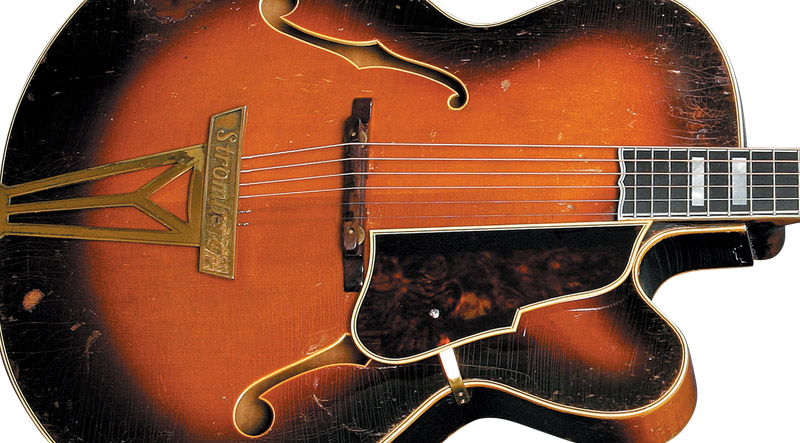
1952 Stromberg G-5 cutaway. Photo: Kelsey Vaughn.
Early Stromberg archtops, like those of Gibson and Epiphone from the same period, were a far cry from the behemoths that would provide the rhythm for the swing bands of the ’30s. They were only 16″ wide, and the back and sides and tops were of laminated wood. The tops, too, were laminated, and he earliest had segmented f-holes.
Following the examples of Gibson and Epiphone, who widened the body width on existing models in the mid 1930s and created even larger new models measuring 18″ and 183/8 ” (the Super 400 and Emperor, respectively), Stromberg widened his original G-series and Deluxe models to match the Epiphone Deluxe at 173/8″. Then in 1937 or 1938, Stromberg topped all other archtop makers with the 19″ Master 400 and the less-ornamented but no-less-wide Master 300. With these guitars, Stromberg introduced a new bracing design – a single diagonal bar that distinguished his guitars from the double “tone bar” or X-pattern bracing that virtually all other archtop makers used. These guitars pushed acoustic guitar volume – not to mention the size of the guitar – to its practical limit, as demonstrated most famously by Freddie Green’s rhythm guitar work with the Count Basie band.
By 1952, Elmer had come up with a new model designed to increase sales. It was a 17″ cutaway that was essentially a Deluxe but with less binding and a shorter, 231/2″ scale. Priced at $315, it was about 25 percent less than the cutaway Deluxe, which sold for $404. Consequently, the G-5 became one of Stromberg’s most popular models. Of course, “popular” is a relative term when it comes to a shop that only produced about 340 guitars in a little over 25 years. Total production of the G-5 is estimated at no more than a dozen, all of which are cutaways and probably all short-scale.
Barry Galbraith, who was influential in the careers of such jazz greats as Tal Farlow, Sal Salvador, Jimmy Raney and Joe Puma, was the most prominent guitarist to buy the G-5, and he owned two. Jazz player Tony Rizzi got one, and actor/singer John Payne, best known for his role as the attorney who defended Santa Claus in the 1947 film Miracle on 34th Street, also bought a G-5.
One who ordered a G-5 failed to come through with his payment when the instrument was finished, so Stromberg put the guitar up for sale in his shop. A local guitarist named Murray Nichols bought it. Bearing serial number 620, Nichols owned it until 2008.
Through the years, its nitrocellulose headstock overlay began to deteriorate. A replica overlay was made by Pete Kyvelos, of Unique Strings. Known in the world of Greek instrument as “the Stradivarius of oud makers,” Kyvelos used a non-disintegrating material and followed Stromberg’s tedious process of hand-engraving and using a camel brush to hand-paint the logo.
Stromberg’s reputation as a maker of short-scale jazz guitars spread quickly, thanks in part to Barry Galbraith. On his recommendation, Nashville jazz player and session guitarist Hank Garland ordered a cutaway Deluxe model with the short scale. Garland’s guitar was numbered 626, just six guitars later than the featured instrument. It may or may not have been Garland’s first short-scale guitar, but he obviously liked it enough to include the short-scale specification on his Byrdland signature model (named for him and his fellow Nashville guitarist Billy Byrd) Gibson introduced in 1955.
Stromberg made only 17 more guitars after this G-5. The elder Stromberg died in ’55 at age 89. Elmer, who was 60 at the time, died by the end of the year, leaving one G-5 cutaway unfinished. Hank Garland gained greater fame for himself and more exposure for short-scale guitars through the ’50s, but an auto wreck in 1961 ended his career.
Though Stromberg’s short-scale cutaway G-5 was arguably as important and as influential as the Master 400, its moment in the sun was just that – a moment – while the Master 400 endured and eventually emerged as the standard bearer of the Stromberg reputation.
Special thanks to Jim Speros.
This article originally appeared in VG‘s October 2009 issue. All copyrights are by the author and Vintage Guitar magazine. Unauthorized replication or use is strictly prohibited.
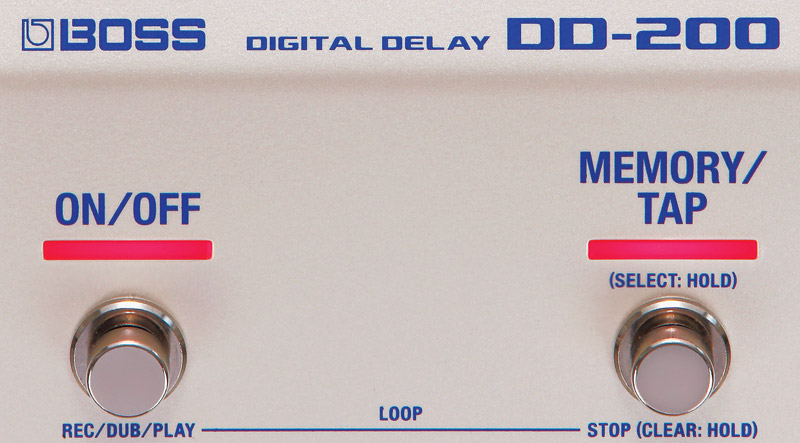
Delay pedals are essential, but there are so many different types – tape, reverse, tap, cascade, shimmer, analog and more. What if you could get all of them in one box, without breaking the bank? That’s the gist of the Boss DD-200, a delay that’s both simple to use and as sophisticated as the heaviest pro gear.
This Boss has 12 presets, all controlled by the knob on the left, as well as controls for Param, Tone, and Mod Depth. There’s two-band EQ and Effects Level to determine the mix with your dry guitar. Delay types include Tape, Analog, Drum (like a vintage Binson Echorec), Tera Echo (with reverb), Pad (slow attack), and Shimmer (long, ethereal tail).
There are also four memory locations and a basic looper for laying rhythms. A huge bonus is the display screen showing delay time and tempo, which is a must if you’re recording and syncing your delay with a song’s BPM or a keyboard arpeggiator. Now your delay repeats will be in rhythm with the other instruments. Certainly, you’ll find all the classic David Gilmour, Albert Lee, and The Edge delays in here, using a Tap Division button that offers half-, quarter-, and eighth-note modes, and dotted and triplet settings. These are indispensable tone tools.
Again, the Boss DD-200 Digital Delay threads the needle between super ease-of-use with sophisticated delay types and audio. This could be the last echo pedal you ever need.
This article originally appeared in VG’s September 2022 issue. All copyrights are by the author and Vintage Guitar magazine. Unauthorized replication or use is strictly prohibited.
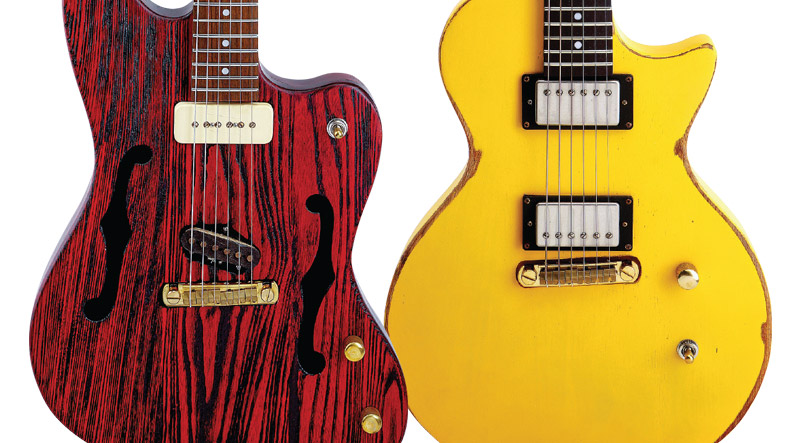
Since 2004, Guitarfetish has been selling instruments, parts, pedals, and accessories online. Their Slick guitar line – designed and built with input from guitarist Earl Slick – includes the offset SL-56 and single-cut SL-52.
The guitars have similar construction – ash bodies, bolt-on maple necks with walnut fretboards, 24.75″ scale, medium jumbo frets, proprietary brass-keyed tuners, along with brass bridges and knobs. Our SL-56 tester carried the company’s distinctive finish achieved by applying black pigment to the bodies without pore filler, which is then sanded, treated with automotive paint, and lightly clear-coated. The result is a guitar that looks and feels like a well-used vintage survivor. It’s not a relic finish, but cool for those who like an instrument that feels well-played.
The offset SL-56 sports large f-shaped sound holes, a Slick signature Fullerton pickup in the bridge position, and a Slick Junior at the neck, which gives the guitar characteristic Tele spank, coupled with the midrange snarl of a classic P-90. Impressive, and very suited to rock, blues, country, and almost anything else.
The LP-style SL-52 has twin PAF-style Slick Alnico V pickups for classic twin-humbucker tone. All Slick pickups are hand-weathered and slightly “demagnetized,” and the tester took overdrive and high gain particularly well, making it a great platform for heavier styles. Both guitars balanced well, sitting, or standing.
The Slick SL-52 and SL-56 are worthy choices for those on a budget, or a seasoned player looking for something different.
This article originally appeared in VG’s September 2022 issue. All copyrights are by the author and Vintage Guitar magazine. Unauthorized replication or use is strictly prohibited.