
The Alex Skolnick Trio will be on the road this December in support of its fourth album, Veritas. The Trio includes Matt Zebroski (drums) and Nathan Peck (bass). Veritas reached the Top 10 of the iTunes Jazz chart, nestled between Miles Davis and Esperanza Spalding. To check the tour dates, go to alexskolnick.com.
Month: November 2011
-
Electro-Harmonix Offers Switchblade+, Analogizer

E-H Switchblade+ Electro-Harmonix is offering two new pedals. The Switchblade+ allows a guitarist to switch signal between two amps, two effects chains, or two speaker cabinets. It can also send signal to both destinations at once. It has active LED indication and a dedicated output jack that can be used for a tuner or other pedals. Its audio path is fully passive.

E-H Analogizer The Analogizer is designed to warm the signal of a digitally processed guitar or thicken an already warm sound. It has controls for Gain, Spread, Blend, and Volume. The Gain allows a user to boost input gain up to +26dB. Spread controls the delay time, from 3.5 mS to 65 mS. Blend can mix direct and effected signals. Volume controls the pedal’s output level. Learn more at ehx.com.
-
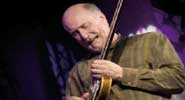
John Scofield and Eddie Henderson
 These two new releases showcase guitarist John Scofield in far different ways. The DVD finds Scofield in a quartet setting and is the perfect vehicle for his skills, displaying chops on cuts like “Ten Taken,” where he navigates changes at a breakneck pace, and the organ-based “Slinky,” a soul tune that shows how funk often intersects with his jazz side through the use of octaves and chords. His first solo sets the table, and as the band swings back to him, he plays in that weird-but beautiful-intersection where the blues meets jazz meets rock and roll.
His band is perfect for this setting, especially drummer Bill Stewart, who’s at the top of the jazz field at this point. Not only does the DVD show the great playing, but a short feature and interview with Scofield is a bonus.
 On the Henderson disc, Scofield’s role is different. His atmospheric chording and beautiful laid-back soloing are the perfect foil for Henderson’s trumpet. His sense of harmony structure on the title cut finds Henderson soloing over Sco’s beautiful chordal work.
These two releases perfectly showcase the difference between being a sideman and a leader.
This article originally appeared in VG‘s Mar. ’11 issue. All copyrights are by the author and Vintage Guitar magazine. Unauthorized replication or use is strictly prohibited.
-
Paul Yandell Passes
 Guitarist Paul Yandell passed away this morning. He was 76 and had been battling cancer.
Yandell grew up in Western Kentucky and was an accomplished guitarist while still in high school. In 1955, he moved to Nashville, where he played for the Louvin Brothers, including on many of their hits. In ’59, he entered the U.S. Army. After serving, he joined the Kitty Wells show from 1961 to 1970, then became a member of Jerry Reed’s band. In ’75, he began the affiliation with Atkins, which lasted until the a latter’s passing in 2001.
Other artists with whom Yandell worked included Dolly Parton, Steve Wariner, Hank Thompson, Perry Como, Roger Whitaker, Les Paul, Woody Herman, The Everly Brothers, and Mary Chapin Carpenter. He also appeared on TV shows such as “The Dinah Shore Show,” “The Tonight Show,” “The Today Show,” “The Merv Griffin Show” and others.
After Atkins died, Yandell recorded a solo album titled Forever Chet, which included many songs Atkins had performed throughout his career.
In August, Atkins’ family bestowed on Yandell the last official granting of the title “Certified Guitar Player,” which Atkins had used to describe an artist who personified performance skill and musical quality. In all, the honor was awarded to only five players – Yandell, Reed, Wariner, Tommy Emmanuel, and John Knowles.
Yandell’s final album, Drive On, was released in 2006. He is survived by his wife, Marie, a son, and a daughter-in-law.
-
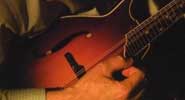
Don Stiernberg with Rusty Holloway and Jeff Jenkins
 Many musicians play swing, but few swing with the authenticity of Don Stiernberg, with whom the expression “Dig your well deep” comes to mind.
On Swing 220, Stiernberg is joined by Jeff Jenkins on guitar and Rusty Holloway on upright bass.
For this session, Jenkins uses a 1949 Epiphone Emperor while Stiernberg plays his ’96 two-point Nugget, and Holloway plays a 19th-century Collin Mettzin double bass.
The songs come from the great American songbook – standards including “Night and Day,” “All of Me,” “Pennies From Heaven,” “Lady Be Good,” “Stardust,” “Honeysuckle Rose,” “How High the Moon,” and “Limehouse Blues.” The arrangements aren’t flashy – they begin with a statement of the melody then the trio races off with solos for all. As the leader, Stiernberg takes the first improv solo pass, followed by Jenkins’ guitar. Both have the swing sensibility so thoroughly ingrained that while they go out on improvisational limbs, they never step outside the melodic and harmonic conventions of traditional swing music. This is a lovely album of beautifully played traditional American music.
This article originally appeared in VG‘s Mar. ’11 issue. All copyrights are by the author and Vintage Guitar magazine. Unauthorized replication or use is strictly prohibited.
-
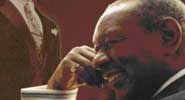
Freddy Cole
 Asked what younger jazz guitarists stood out to him, in his March ’10 VG interview, George Benson listed Norman Brown, Mark Whitfield, Russell Malone, and “the guitar player who’s playing with Freddy Cole.” He may not have remembered Randy Napoleon’s name, but he called him “spectacular.”
 The 33-year-old previously played on Cole’s live Dreamer In Me CD, backed vocalists Michael Buble and Melissa Morgan, collaborated with organist Jared Gold, and was a member of the Clayton-Hamilton Jazz Orchestra. In addition, Napoleon’s 2006 solo album, Between Friends (featuring another former leader, pianist Benny Green), showcased what Benson called his “allfingers
approach.”Napoleon arranged 10 of the album’s 12 songs – handling the doubly daunting task of doing justice to Cole’s voice (very similar to his legendary brother, the late Nat “King” Cole) as well as songs associated with Cole’s friend and mentor, Billy Eckstein. The Brooklyn native approaches these chores with the same sensitivity and insight he brings to his guitar playing – from the solo arpeggios that support Cole’s honey-toned vocal on “Tender Is The Night” to the octave runs that follow, as the ensemble joins in to establish a relaxed, swinging groove, before he trades a tasty single-note solo with special guest Houston Person’s tenor sax. For “Cottage For Sale,” the sad tale of a dream cottage now abandoned, Cole asked for a George Shearing feel, and Napoleon cleverly references the optimistic “Folks Who Live On the Hill” in the intro.
Throughout, he coaxes a warm but round tone from his Stadler archtop (a 17” Free Verse with floating humbucker) and reveals his biggest influences, Wes Montgomery and Joe Pass. Others “who swing and have a deep blues feeling” – including Benson, Barney Kessel, Grant Green, and Charlie Christian – are evident on “Jelly, Jelly.” A fitting tribute to them and, of course, to Mr. B.
This article originally appeared in VG‘s Mar. ’11 issue. All copyrights are by the author and Vintage Guitar magazine. Unauthorized replication or use is strictly prohibited.
-
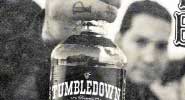
Tumbledown
 From punk to rockabilly – it feels like a perfectly natural progression for Mike Herrera. Part of the 1990s punk trio MxPx, Herrera has stepped back in, with his group Tumbledown.
Tumbledown marked its debut with the band’s 2009 disc. Led by Herrera on vocals, guitar, and songwriting duties, the group includes lead guitarist Jack Parker, standup bassist Marshall Trotland, and drummer Harley Trotland.
Empty Bottle is rockabilly for a new era. While the band may tip its hat to the Sun sound, its music is current, with closer ties to punk and the alt country of Lucero, Old 97s, and Hank Williams III’s alter-ego Assjack band.
They kick off with “Places In This Town,” which is high-energy vintage country/rock and roll – but with a sheen that takes the music far from Memphis. “Dead Man Walking” is wrapped in glorious reverb and echoing guitar work, while “Drink To Forget” is no-apologies modern honky-tonk with a fine punk twang.
This article originally appeared in VG‘s Mar. ’11 issue. All copyrights are by the author and Vintage Guitar magazine. Unauthorized replication or use is strictly prohibited.
-
DigiTech Intros DG15R/DG15/DB15

DigiTech DB15 DigiTech’s DG15R and DG15 15-watt combo amps have two channels, controls for Gain, Volume, Treble, Middle and Bass, and a Clean/Overdrive switch. Both have an open-back cabinet. The DB15 15-watt bass amp has controls for Volume, Treble, Middle and Bass, making it easy for players to create their favorite sounds. All use a single 8″ speaker and have a 1/4” headphone-out. Learn more at harman.com.
-
Duncan Releases Gus G. Fire Blackout Pickups
 The Seymour Duncan Gus G. Fire Blackouts pickup system is a matched set of passive humbuckers with a preamp that replaces one of the guitar’s Volume pots, The pickups are hand-made by Seymour Duncan in California, have individual pole pieces, Alnico V magnets, a high-output/low-noise dual preamp, bare-wire lockdown connectors, and 25k potentiometers. Learn more at seymourduncan.com.
 -
Doyle Bramhall, Sr. Passes
 Doyle Bramhall, the acclaimed drummer/singer/songwriter who wrote or co-wrote some of the most recognizable songs for the late Stevie Ray Vaughan, died November 13 at his home in Alpine, Texas. He was 62 and cause of death was not immediately known.A native of Dallas, while in high school, Bramhall formed the Chessmen, which gained a large local following and later added a 14-year-old Jimmie Vaughan on guitar. The band served as an opening act for Jimi Hendrix when the emerging star played the Dallas area. By the ’70s, Bramhall was drumming in a band called Texas Storm, which later changed its name to Storm and also featured Jimmie Vaughan on guitar and, for a short time, Stevie Ray Vaughan on bass. The band earned a strong following, especially in Austin, and was credited by its members for starting the sound that helped make Stevie Ray a star in the ’80s. After Storm, Jimmie Vaughan formed The Fabulous Thunderbirds while Bramhall teamed with Stevie Ray to form The Nightcrawlers.For Stevie Ray, Bramhall wrote “House is Rockin’,” “Dirty Pool,” “Tightrope,” “Wall of Denial,” “Change It,” and “Life By the Drop.” He also drummed on the Vaughan brothers’ Family Style album.Bramhall’s most recent solo album was 2007’s Grammy-nominated Is It News.He is survived by his wife, Barbara Logan, his daughter, Georgia, and his son, renowned guitarist Doyle Bramhall II.


