
Month: December 2009

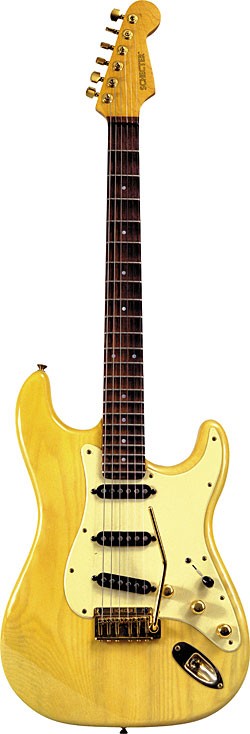
  • Schecter Yngwie Malmsteen

    1986 Schecter Yngwie Malmsteen

    1986 Schecter Yngwie Malmsteen

    For most of the 1970s I didn’t listen to or play electric guitar music of any kind, only acoustic music. I did, on occasion, read about it. Then, in 1981, I decided I needed to ride a stationary bicycle. The only way I could do it was to listen to music for distraction. I’d read about a young hotshot guitar player named Randy Rhoads, so I bought Ozzy Osbourne’s Blizzard of Ozz on cassette to audition during my ride. Talk about aerobic exercise! That kid could play! This ignited an ironic interest in the then nascent heavy metal revival. Inevitably, this led to hearing the young Swedish phenom Yngwie Malmsteen.

    Malmsteen was born in Stockholm and reportedly became obsessed with the guitar after seeing a news report of the death of Jimi Hendrix. Besides the usual rock heroes, Malmsteen also fell under the spell of the 19th century Italian virtuoso violinist and guitarist Niccolo Paganini, which had a major effect on his style. Much of Malmsteen’s playing consists of extended scalar excursions at an unrelenting velocity. There was no denying he was good, too. Rhoads and Malmsteen are often thought to be among the founders of the “neo-classical heavy metal” school. After playing one session with a band called Steeler, Malmsteen joined, Alcatrazz, then went solo in 1984. By ’88 he was popular enough to warrant his own signature model Fender Stratocaster. But it wasn’t his first namesake guitar; perhaps far more interesting was this 1986 Schecter YM-1 Yngwie Malmsteen.

    Schecter Guitar Research was founded in 1976 by David Schecter in Van Nuys, California. The company began as a repair shop and graduated to making replacement necks, bodies, pickup assemblies, bridges, and other parts, basically everything needed to build a custom guitar, which was a popular concept in the mid ’70s.

    Schecter offered things the big manufacturers just didn’t offer at the time, like fancy woods and nifty electronics. For a brief while, Schecter was also affiliated with Wayne Charvel and provided parts to other manufacturers.

    Circa 1979, Schecter began producing finished guitars under its own brand name. Despite having very limited distribution, they met with some success thanks in part to having Pete Townshend play one of their single-cut guitars, followed by Mark Knopfler.

    As a result, the company faced either becoming a full production manufacturer or selling to someone with more resources. In ’83, it was sold to investors in Dallas who turned Schecter into a full-scale production house, sans most of its California employees. Production guitars are never as good as customs, so the brand suffered, at least in the eyes of hardcore enthusiasts. Still, it managed to make interesting guitars during the sojourn. In ’86, Schecter scored its first big-name endorser in the person of Yngwie Malmsteen! It built a couple of custom guitars for him with contoured offset-double-cut bodies, scalloped fingerboards, and reverse headstocks (a similar model without the scalloping was promoted at the time as a Jimi Hendrix model).

    The YM-1 Yngwie Malmsteen may or may not have been a limited production model, but it certainly wasn’t mass-produced! The one shown here originally went to Troubadour Music, then of King of Prussia, Pennsylvania, where it was bought as new old stock after years sitting in the back room.

    It has a figured ash body with a translucent butterscotch finish. The bolt-on neck is maple, with a regular (tuners on top) headstock instead of the reverse models made for Yngwie. It has gold Schaller tuners and a Schecter/Wilkerson knife-edge floating non-locking vibrato system. If you like feather touch in your vibrato, you’ll like this. If you play with a really light touch, the scallops aren’t too bad, but if you’re accustomed to touching a meaty fingerboard, you wouldn’t like this. It’s very easy to screw up the intonation by pressing too hard.

    Even though this is not a California Schecter, it has an unbelievable powertrain; the pickups are three high-output Schecter single-coils with a “Phantom” system. Yngwie usually played a Stratocaster with the middle single-coil and tone control disconnected. With the Phantom arrangement, the middle pickup serves as the silent second coil in a humbucking arrangement. The front and back pickups are controlled by a three-way select. But what’s really cool is that all three tones are distinctive and feature that funky out-of-phase sound of the in-between positions on a Strat. Unlike Malmsteen’s preference for no Tone control, this guitar has a Volume and individual Bass and Treble controls, which give considerable flexibility in sound.

    While some tend to disparage production Schecters of this period, there’s nothing not to like about this guitar!

    Schecter actually introduced a few other interesting models during this period, including the Illusion, with see-through cutouts based on a design by Bill Reed.

    In ’87, Schecter Guitar Research was purchased by Hisatake Shibuya, owner of ESP Guitars and the Musicians Institute in Hollywood. Schecter moved back to California and for a decade once again became primarily a custom operation. In ’98, Schecter introduced what would become its main offering – a line of guitars made in South Korea. The company, which for many years was known mainly for Fender-style guitars, increasingly shifted to exotic shapes in a BC Rich mode, for which it is primarily known today.

    Whether this Schecter Yngwie Malmsteen is a rare bird or not is unknown. But it is far off the radar. One thing for sure is that it’s a really fine guitar, whether you want to shred like Yngwie or lay out one note like B.B… as long as you can deal with the scalloped fingerboard, that is.


    This article originally appeared in VG‘s March 2008 issue. All copyrights are by the author and Vintage Guitar magazine. Unauthorized replication or use is strictly prohibited.
  • Jerry Douglas – Glide

    Fans may argue whether Jerry Douglas is the greatest dobro player of all time, but few will dispute that he’s the finest player of his generation. Pioneers such as Bashful Brother Oswald and Mike Auldridge could swing, but Douglas is the first who can shred, slide, and shimmy.

    Douglas’ nickname, “Flux,” stems from his ability to play anything, anytime, with anyone. His career began in 1975 with J.D. Crowe and the New South, with like-minded young pickers including flatpicking phenom Tony Rice and Ricky Skaggs. In 1977, Douglas joined Skaggs in the band Boone Creek and within a year they released two stellar albums. Douglas then joined legendary mandolinist Buck White for three albums, and by the early ’80s was a first-call session player in Nashville while continuing to tour and record with The Bluegrass Album Band, which included his old boss J.D. Crowe and Rice. The Bluegrass Album Band released six CDs, the last one in ’96. Before that, Douglas was stretching out in the late ’80s from bluegrass and country sessions into an entirely new musical genre that has come to be known as “new acoustic music.” His Under the Wire album included other young innovators such as bassist Edgar Meyer, banjo whiz Bela Fleck, and guitarist Russ Barenberg. The live Telluride Sessions featured the same musicians in a live, improvisational setting. His 1993 trio collaboration with Barenberg and Meyer, Hop, Skip & Wobble was among the most influential acoustic albums of that decade.

    In the last 30 years, Douglas has also had time to release 11 albums where he continued to stretch the definitions and limits of acoustic music. Bluegrass purists may not have embraced all these CDs, but almost everyone has at least one Alison Krauss and Union Station CD that featured Douglas’ scintillating dobro solos.

    Which brings us to Glide, the 12th solo release in Douglas’ musical portfolio. Labeling his latest album as merely more of the same already places it in elite musical company. But Glide demonstrates the full expanse of Douglas’ musical breadth. Of course, longtime collaborators Rice, Edgar Meyer, and Sam Bush contribute, but the album also includes five-string banjo pioneer Earl Scruggs, singer/songwriter Rodney Crowell, and country vocalist Travis Tritt. Some tunes, such as the title cut, are almost new-age, with gentle rhythms and pellucid melody lines. Others, like “Sway,” are reminiscent of Celtic-influenced material of Hop, Skip & Wobble. The Scruggs cut reminds one of Douglas’ bluegrass roots. But whether it’s Tritt’s take on “A Marriage Made in Hollywood” or the Douglas’ original “Trouble on Alum,” where Douglas plays every instrument, his penchant for euphonic melodic invention shines through. After 30-plus years of musical exploration, Douglas maintains his reverence for melody. Even at his most experimental, he never falls into the “chops and changes” trap that ensnares many jazz players.

    Longtime fans don’t need a positive review to get them to add Glide to their collection. But for anyone new to Douglas’ music, it makes a fine spot to dip their toes into his rich musical stream. Start here, then work your way back. You won’t find a single clinker in Douglas’ whole discography.


    This article originally appeared in VG‘s Dec. ’08 issue. All copyrights are by the author and Vintage Guitar magazine. Unauthorized replication or use is strictly prohibited.


  • Doitsch Hawaiian Guitar

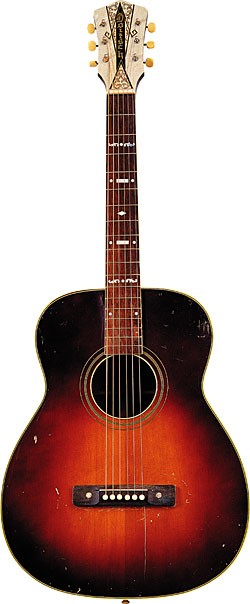
    1939 Doitsch Hawaiian Guitar

    1939 Doitsch Hawaiian Guitar. Photo: Michael Wright.

    If there’s a foundation for the enthusiasm for vintage guitars, it’s based on a somewhat arbitrary hierarchy of brand identity.

    That is to say, a Gibson or a Fender is by common understanding superior to, say, a Harmony guitar, and therefore more desirable. Some of this is simply a logical outgrowth of the truth, though it has led to the overlooking of many fine guitars that don’t have the right “pedigree”! Comparing a Fender to a Harmony or, more to the point, an Ibanez or Aria is one thing, but we get on much more shaky ground when the guitar says something like Doitsch!

    Say what?

    Who made Doitsch? Who sold it? How do we judge it? Well, we can help with two out of three!

    Who made it is pretty easy; the guitar was manufactured by the Harmony company in Chicago. We know that because the general shape is Harmony, as are the headstock shape and the basic feel of the construction. Furthermore, we have pictures of an almost identical guitar, minus the fancy trim, that was made by Harmony for Gretsch in 1939, a time when Gretsch was sourcing a number of its acoustics, as well as its budget Rex line, from Harmony. Therefore, this is a Harmony guitar.

    Who sold it is a horse of a different color. The annoying underside of the guitar game for some people (for those of us with more of a scholarly bent its like a good puzzle!) is the fact that many companies, including even the estimable Gibson and Martin, occasionally made guitars to be sold by someone else and put their customer’s logo on them, making them harder to identify. This guitar is no Martin, but it’s pretty darned good, and, as we’ve said, a high-end Harmony from just before World War II at the end of the Depression.

    However, don’t expect to find out much about who Doitsch was. All we have is clues; first, this guitar was purchased in Medford Lakes, New Jersey, a bedroom suburb outside of Philadelphia. Guitars certainly can and do travel long distances in this modern world, but this was owned by an older gentlemen who’d had it many years, so in all likelihood, it was not far from its point of origin.

    Then there’s the name itself; “Doitsch” is an anglicization of the German word “Deutsch,” which means German. Germany is the Deutschland. The first Germans came to Philadelphia in 1683 and settled the section of the city now known as (duh!) Germantown. Before long, they had spread north into the Lehigh Valley and west to Lancaster County, where they became known as the Pennsylvania Dutch. “Dutch” in this case is a corruption of Deutsch, not a reference to people from the Netherlands. Indeed, Pennsylvania Dutch culture is still riddled with words that have been corrupted – anglicized – from their original German. Hence, the proximity of this guitar’s purchase to Southeastern Pennsylvania and the heavy presence of German “Dutch” culture in the area strongly suggest that it was probably made for a distributor in that vicinity.

    In fact, it was quite common for manufacturers such as Harmony to build batches of guitars for individual distributors or retailers, and apply their names to the instruments. Teaching studios were often among these customers, especially during the slow days of the Depression. For example, Ed Sale, a teacher in New Jersey, dressed in cowboy gear and billed himself as “Radio’s Wizard of the Strings.” Sale had a regular radio broadcast (where is unknown), published methods, and sold Sale guitars, probably made for him at the old Oscar Schmidt plant in Jersey City. Many associations of Hawaiian guitar teachers developed during the 1930s and many of those, including groups such as the American Hawaiian Teachers in L.A., marketed guitars bearing their logos. Thus, in all probability, Doitsch was a music retailer or studio located in or near southeastern Pennsylvania during the Depression.

    Then again, of course, this guitar may have traveled east with some bloke from Wausau, Wisconsin, trying to be another Les Paul or Ed Sale… If you’ve ever heard of a Doitsch company selling guitars, please let us know.

    Judging this guitar is a snap, since it’s a pretty interesting piece of guitar art typical of many Depression-era guitars, a time when few people had lots of money to spend on instruments. The top is made of laminated spruce, whereas the sides and back are curly maple. The dark sunburst is fairly common on Depression guitars. The hardwood neck is square and set up for Hawaiian playing. The engraved plastic head face was a common way to dress up guitars and make them look fancy without adding lots of cost. The tuners are original crummy Harmony strip tuners, the kind many players eventually change out. This guitar probably didn’t see lots of action. Like many Harmony guitars, the bridge is both glued on and bolted on to make sure it wasn’t going to budge! This one came with an original hardshell case.

    The most notable features, however, are the fancy inlays, which consist of genuine pearl scrolls and rectangles. The inlay workmanship is not the finest, but it may simply not have survived as well over time. This guitar must have been custom-ordered, because the inlays are not similar to any of Harmony’s regular offerings. In any case, from the audience’s point of view, this is quite elegant!

    As far as sound goes, this one is quite respectable for a wooden guitar meant to be played lap-style with a slide. The dreadnought size gives a very nice bass response, very funky for slide, and much louder than more common small-bodied Hawaiians. However, playing a dreadnought on your lap may sound better, but it’s a little harder than playing guitars with smaller bodies. This is probably better for skinny players!

    It’s probable that this guitar would be worth more if it bore the Gretsch – or even the Harmony – brand, since no one knows boo about Doitsch, but it’s a cool Harmony by any other name, and a nifty example of better Depression-era guitarmaking.


    This article originally appeared in VG‘s February 2007 issue. All copyrights are by the author and Vintage Guitar magazine. Unauthorized replication or use is strictly prohibited.
  • Rusty Truck

    Jakob Dylan, Gillian Welch, Lenny Kravitz, T-Bone Burnett, Willie Nelson, and even Matchbox 20’s Rob Thomas all have a hand in producing, singing, and playing on this expanded edition of Rusty Truck’s debut.

    The band is helmed by Mark Seliger, former photographer for Rolling Stone. With that kind of gig it can’t be hard to accumulate favors. Still, getting in the door is one thing, making the party worth joining is another. Seliger, who wrote and sang all the songs on the disc, doesn’t do a bad job of making it so.

    Despite being a Texas boy, Seliger’s music is straightforward California country of the lighter late-period Poco type with a little Gram Parsons (“So Long Farewell”) for ballast. One standout is a duet with Nelson titled “1000 Kisses,” with a typical but well-fitted guitar break from Willie. Another is the title song, an especially pretty ballad with Welch. Maybe it was coincidence or maybe he got first pick, but the brightest moments on “Luck’s Changing Lanes” are the cuts produced by Kravitz. Whatever intangibles he brought to the studio were just what Seliger needed to operate at his best. Playing guitar, bass, and various percussion, Lenny makes a strong case for himself as a country player, producer, and the person to whom Rusty Truck should turn for what would likely be an even stronger next effort.


    This article originally appeared in VG‘s Nov. ’08 issue. All copyrights are by the author and Vintage Guitar magazine. Unauthorized replication or use is strictly prohibited.


  • Gibson Style U

    Gibson Style U

    Gibson Style U. Courtesy Gruhn Guitars.

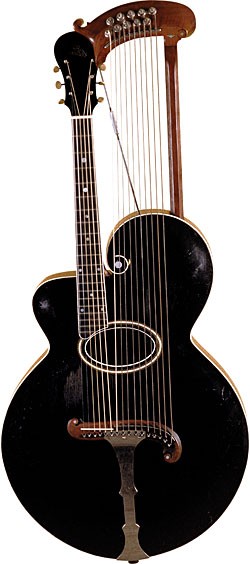
    This Gibson Style U harp guitar, made in 1906 or ’07, represents the top level of the Gibson lineup in the company’s first quarter-century, as well as the highest level of expectations for a new and innovative instrument.

    Although the design of the harp guitar seems unique among popular stringed instruments today, it was not a new concept in Orville Gibson’s day, at the turn of the 20th century. The concept of extra bass strings is rooted as far back as the theorbo and other archlutes of the 1500s – preceding the six-string guitar by well over two centuries. In the 1800s, German guitarmakers produced harp guitars, and in America, the Martin company made a handful.

    Orville Gibson made at least one harp guitar – a highly ornate model that’s pictured on the cover of the Gibson Guitars: 100 Years Of An American Icon – but it wasn’t until the Gibson company was formed in 1902 that Gibson “ran with” the idea. The first Gibson catalog featured four different harp models: the R and R-1 with 177/8″ body width and six sub-bass strings, and the U and U-1, with 21″ body and 12 sub-bass strings.

    The harp guitars shared a number of features with other Gibson models, starting with carved spruce tops and walnut back and sides, even though catalogs always specified maple back and sides. The scroll-shaped upper bass-side body bout, although it wasn’t invented by Orville Gibson, was a familiar feature of Orville’s F-style mandolins. (The Style U pictured in the first Gibson catalog had a scroll peghead as well.) The oval soundhole was Orville’s preference; it is found on F-style and A-style mandolins, as well as the early O-series guitars. The half-herringbone soundhole purfling is also shared by other Gibson models, including the F-2, F-4, and L-4.

    The Style U listed for $265.96 in 1902, compared to $221.63 for the F-4 mandolin. The Style U would remain Gibson’s most expensive model – even through the introduction of the F-5 Master Model mandolin and L-5 guitar – until 1934, when it was surpassed in price by the Super 400.

    After the introduction of the four harp guitar models, the line was immediately whittled down to just one – the Style U. Like Gibson mandolins and guitars, harp guitar designs evolved quickly through the company’s first decade. The most visible changes on the Style U by circa 1906, as exemplified by this instrument, are the 10 sub-bass strings, the standard peghead shape and the addition of “The Gibson” on the peghead in mother of pearl.

    More changes were immediately ahead for the Style U. In 1907, the S-shaped, glued-down bridge and metal-strap tailpiece were replaced by a one-piece, moveable maple bridge and a double-trapeze tailpiece featuring string-termination pins mounted in crosspieces of tortoiseshell-grain celluloid. At the same time, the body size was reduced from 21″ to 181/4″, and the back and sides were changed from walnut to birch (though still cataloged as maple).

    Although expensive and large to the point of being unwieldy, the harp guitar promised to open up a new world of music to guitarists. Keep in mind, this was a time when the guitar was not the dominant fretted instrument but rather (from Gibson’s perspective) an accompanying instrument for mandolin ensembles. The typical repertoire of these groups was semi-classical or light classical, and as such could not be counted on to be in guitar-friendly keys such as E, A or G. Bass notes were critical for full accompaniment, and as every guitar player today knows, the guitar does not have a rich, low Eb or C#. That’s what the harp guitar offered – a much-needed, extended range of bass notes.

    Gibson offered a free 12-page harp guitar “treatise” that illustrated the concept by showing the harp guitar’s “chords of completeness and fingering versus the incomplete chords generally used on the six string guitar.” But that was just the beginning of Gibson’s pitch for the instrument. It also predicted that the harp guitar was about to do to the conventional six-string guitar what the piano had done to the harpsichord 200 years earlier – send it into obscurity.

    In Gibson catalogs, Lewis Williams, the company’s evangelistic sales manager and founding partner, expressed Gibson’s high hopes for the harp guitar in flowery prose under the headline, “When Gray Hairs Applaid, Progress May Well Ask: What Have I Done Amiss.” He drew the historic parallel: “Then it was harpsichord versus piano; now it is Guitar versus Harp-guitar.” He then cited J.S. Bach as an example of an old-school musician who failed to see the light of innovation. “The mighty Bach and his contemporaries could not be persuaded to leave the harpsichord with its inferior capacity and power of expression for the piano,” Williams wrote. “Yet where is the harpsichord today? Death alone saved Bach from the ridicule of the then rising generation…”

    Interspersed among the gray-haired characterizations of the six-string guitar, Williams went into detail on the construction advantages – specifically the carved top – of all Gibson guitars. “This is why the ‘Gibson’ Guitar (Harp or six string) is so rapidly supplanting every other make,” he wrote.

    The Style U commanded the centerfold of Gibson catalogs for over two decades, but never fulfilled its potential. In the ’20s, the guitar began to rise in popularity, but the Style U was not carried along on the wave. Gibson cataloged it through 1937, by which time it was relegated to the end, sharing a page with the equally archaic Style J mando-bass. Demand for the instrument was even less than the catalog treatment would suggest, judging by the fact that we have never seen a Gibson harp guitar with a serial number later than 1925.

    Although Gibson sold a fair number of harp guitars prior to the 1920s, most musicians who play harp guitars today prefer the flat-top style of the Dyer instruments to the carved-top Gibsons. Still, the Gibson Style U is a wonderful conversation piece for its design and the high expectations that it carried, and it is a must-have for a complete collection of early Gibson instruments.


    This article originally appeared in VG‘s Oct. ’05 issue. All copyrights are by the author and Vintage Guitar magazine. Unauthorized replication or use is strictly prohibited.
  • Bill Monroe – Father of Bluegrass

    First released on VHS in the mid ’90s, this documentary deifies Bill
    Monroe as the founder of bluegrass music and as an all-around swell
    guy. Whether the film crosses the line between documentary and
    puff piece depends on how you view Monroe’s legacy and personality.
    Not even the most hardcore bluegrass crank would argue against
    Monroe’s status as progenitor of the music that has become known
    as bluegrass. In all ways he was a towering figure, from his physical
    presence to his influence on the American musical scene during the past 50 years.

    This film does an excellent job detailing Monroe’s importance. In this regard it’s essential viewing for anybody who loves folk, rock, or bluegrass. Where the movie falls flat is its desire to portray Monroe
    as a friendly, emotionally accessible father figure. By all accounts he was
    stern, stubborn, cheap with band pay, and prone to taking credit for
    compositions written by musicians under his employ. It also glosses
    over Monroe’s personal and professional foibles. Interviewees, who
    include many past band members, have nary a discouraging word to
    say, perhaps because he was still alive when the film was made.
    Still, the film is well-paced and logical ly structured. And the DVD’s technical quality is certainly better than the original videotape version. The overall sound and picture quality are good enough so viewers can enjoy the film without distraction. By way of bonus features, it includes a live performance from late in Monroe’s career, and even then, Monroe could still “whip that mandolin like a mule” when the spirit moved him.

    Anyone who loves bluegrass should have this. And for the sake of having a more balanced picture of a complex man, they should also have a copy of Richard D. Smith’s book Can’t You Hear Me Callin’.

    This article originally appeared in VG‘s Aug. ’08 issue. All copyrights are by the author and Vintage Guitar magazine. Unauthorized replication or use is strictly prohibited.
  • Trikuti – Trikuti

    Trikuti is a unique band that goes from jazz to metal and back, not in a song-to-song pattern, but in the space of a few bars. The opener here, “2012,” is a perfect example, starting as a progressive-rock piece with hints of metal. By the time guitarist Scott Seader gets to solo, the song has turned to funk. And just to make sure we don’t get complacent, things end up with a jazz feel. That’s how this whole record moves.

    Seader proves a fine soloist and supplies lead vocals, which work well though sometimes stretch him a little too far. That said, the music and songs are so cleverly assembled it’s hard to fault over-singing. Cuts like “The New Jam” let everyone spread out with its funky feel, dazzling bass and guitar solos, and even a guest sax solo that leads into metal-esque guitar. That odd mixture of styles could work against many bands, but the writing here (credited to the entire band) is so tight and natural, though with elements of surprise. While Seader is the main soloist, the entire band gets to shine on most of the cuts. “Running Circles” lets the rhythm section really lay down a bed for Seader. And that’s not always easy given the schizophrenia (the good kind) of many of the songs. The production, by veteran Chris Conway, gives the band the perfect environment to develop the songs with a clean, focused sound.

    This article originally appeared in VG‘s Jun. ’08 issue. All copyrights are by the author and Vintage Guitar magazine. Unauthorized replication or use is strictly prohibited.
  • Matt Rae – High Strung

    Matt Rae’s new record stretches beyond the Telecaster playing for which he is so well-known to include old-fashioned music a la Jimmy Bryant and Speedy West. In fact, the jazzy swing of “Happy Ending” is a very fun slab of music. But the record also goes in many other directions.

    Rae wrote or co-wrote all but one cut. “Bad Truck!” is a rocker with big power chords and funky/chunky rock guitar. “Peanut Butter and Tele” is a country stomper full of banjo rolls and Tele mojo. “Tube Job” is a dreamy blues with a wild solo in the middle where notes blend wonderfully. The notes of “Weedwhacker” bounce around your listening room. “Lizzie Strut” is an airy jazz piece with a solo that mixes jazz and rock played with tone as sweet as it gets. The one cover is “I Only Have Eyes For You,” and Rae has no problem breathing new life into the old warhorse with great chordal and melody work. The solo is gorgeous with incredible bends and tons of lovely multiple note licks that highlight the song’s natural melody and more.

    Some may know Rae from his gig with Arlen Roth, and it’s easy to see that lessons from Arlen have paid off. And while it might be easy for some to merely take in those lessons and move forward, Rae is his own guitarist and continues to grow with each album.


    This article originally appeared in VG‘s Jun. ’08 issue. All copyrights are by the author and Vintage Guitar magazine. Unauthorized replication or use is strictly prohibited.
  • Van Morrison – Under Review

    A documentary on Van Morrison’s most fruitful years including live concert footage would be welcomed by fans everywhere. Yet the academic subtitle here says all too much about this British film on Van the Man. And the back-cover promotional text seals the deal, promising “Rare and classic Van Morrison performances, re-assessed by a panel of esteemed experts.”

    Morrison is notoriously crabby and uncooperative: He refuses to lend his hand to biographers or filmmakers interested in his story. So what’s left is to gather together stray footage, found photos, scrape up the odd old interview, and weave it all together with commentary by those esteemed experts.

    The result here is mixed. Just when vintage ’60s and ’70s footage of Van in concert starts rolling, a talking head interrupts the action to explain what an artist Van is. Back to the concert shot – only to be broken off once again by another commentator emphasizing the first expert’s sage words.

    And all too often Van himself appears bored, as during the shots of him playing “Wild Night” and other tunes. Or perhaps he was too stoned to care. In the end, the classic recordings from Them as well as Morrison’s solo outings His Band And The Street Choir, Astral Weeks, Moondance, St. Dominic’s Preview, Tupelo Honey, Veedon Fleece, and It’s Too Late To Stop Now are all best heard by themselves.

    But if you’re a Morrison fan, you’ll definitely want to at least check out this film. There are jewels hidden between the “critical analysis.”


    This article originally appeared in VG‘s Jun. ’08 issue. All copyrights are by the author and Vintage Guitar magazine. Unauthorized replication or use is strictly prohibited.

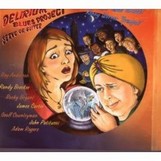
  • Delirium Blues Project – Server or Suffer

    This live CD begins by asking the musical question, “What Is Hip?” Singer Roseanna Vitro and her octet transform Tower Of Power’s dexterous funk anthem into a cool, would-be jazz standard – thus, answering the question: That, ladies and gentlemen, is hip.

    Vitro’s voice and delivery are reminiscent of Dan Hicks’ former Hot Lick, Maryann Price, while Adam Rogers’ guitar solo owes a debt to Robben Ford. Introducing “Goodnight Nelda Grebe, The Telephone Company Has Cut Us Off,” Vitro acknowledges the influence of its composer, Tracy Nelson, and leans (perhaps unconsciously) on her mentor’s style a bit too much.

    As you might have gathered, the m.o. here is taking songs from outside the typical jazz repertoire and jazzing and/or bluesing them up. In lesser hands the concept might have been a novelty at best, but, thanks to pianist Kenny Werner’s arrangements (and the considerable musicianship of players like trumpeter Randy Brecker and saxophonist James Carter), the result succeeds on its own terms. (Anyone who just had an acid flashback to Mel Torme’s cover of “Secret Agent Man,” fear not; this is nothing like that.)

    Rogers solos soulfully on Joni Mitchell’s “Be Cool,” again melding blues and jazz elements a la her former sideman, and varies speed and deliberation nicely on John “Orleans” Hall’s “Half Moon.”

    Other sources range from Mose Allison to Lil Green (a tasty vocal/bass duet with John Patitucci’s upright) to Dan Penn and Spooner Oldham. There’s a lot of untapped potential in this vein – which will hopefully be revealed in future sequels.

    This article originally appeared in VG‘s Jul. ’08 issue. All copyrights are by the author and Vintage Guitar magazine. Unauthorized replication or use is strictly prohibited.