Since forming in 2007, Blackstar has been building user-friendly amplifiers and attracting high-profile artists like Leslie West, Neal Schon, and Gus G. The company’s ID series would seem to represent the next logical step: Blackstar’s first digital non-tube amp line.
The 30-watt entry in the ID series has many of the same features and functions as the larger ID models in a smaller package, making it a great practice amp or recording tool. Its functionality allows guitarists to create and store a variety of guitar tones with effects, connect to a computer, and establish a quick setup for gigs.
The ID:30TVP’s trump card is its variety of preamp and power-amp tube emulations delivered through a 12″ speaker. Six preamp voicings (Clean Warm, Clean Bright, Crunch, Super Crunch, OD1, and OD2) are controlled by a Voice knob and give the guitarist everything from crystal clean to dangerously distorted. The TVP (True Valve Power) knob and accompanying On/Off button allow players to select emulations of six different power tubes: the EL84, 6V6, EL34, KT66, 6L6, and KT88.
Other controls include Gain, Volume, and three EQ knobs: Bass, Treble, and Infinite Shape Feature (ISF), which is a contour control that can be adjusted to the left for more American-voiced sounds, or to the right for more British ones. The amp’s built-in effects section features Reverb, Delay, and Modulation buttons, along with a Type knob that attempts to provide further versatility via four settings for each effect (more on that below). A second knob to control the level has a Tap Tempo button beneath it.
The ID:30TVP also has a Master Volume; an emulated output for connecting to a mixer, recording device, or headphones; and a line-in for an MP3 or CD player. There’s also a USB connection, a Bank button, and a row of Channel buttons that allow the user to manually save settings. The optional FS-10 multifunction foot controller comes in handy for scrolling through the amp’s 128 presets, tuning up, or switching effects on the fly.
Blackstar’s insider software can be downloaded from their website for both Mac and PC platforms. This includes a workspace to create a personal library of patches, deep editing options, a cassette library of audio tracks, and re-amping capabilities. It also allows the user to meet other Blackstar ID users in the company’s online community. Setup was a breeze.
The Blackstar ID:30TVP was put to the test with a range of Les Paul- and Strat-style guitars. Setting the preamp to OD2 and the TVP for 6L6 while maxing the Gain and Volume unleashed shred metal fury – i.e., smooth sustain, singing single notes, boosted mids, and plenty of crunch in ample supply. It never got out of control but rather elicited awesome room-temperature heavy rock tones. OD1 is similar but with fewer mids. The ISF knob comes in handy, allowing a tighter midrange sound when turned to the left, or a woolly Vox-ish sound dialed to the right. Chords were full, clear, and defined. Backing off the gain produced entertaining Cheap Trick and early Rush power chords with fantastic articulation.
Using the Clean Bright setting, the ISF knob, and the TVP tube selections was an enjoyable experience. The ID:30TVP’s replications of tighter Class A American sounds and Class A/B British sounds, along with the option of mixing and matching tubes provided a ton of options. Same with the Crunch and Super Crunch settings. The TVP settings displayed varying degrees of compression, headroom, and familiar tonal characteristics.
As alluded to earlier, the ID:30TVP’s effects section features a Type knob that bestows four settings upon each of the three effects: Reverb (Room, Hall, Spring, Plate); Delay (Linear, Analogue, Tape, Multi); and Modulation (Phaser, Flanger, Chorus, Tremolo). The quality of these sounds, though, was adequate at best.
Sitting in front of the ID:30TVP and auditioning sounds is one thing; playing it onstage at the local blues-rock jam with a full band and alongside two popular tube amps is something else altogether. Using factory presets and one customized bank of clean, dirty, and effected sounds at stage volume, the Blackstar ID:30TVP sounded glassy and dark, and lacked warmth and complexity. Despite this dearth of humanity on stage, however, it shines as a practice amp and as a computer-ready recording amp. In fact, it would be hard to top its number of features for the price.
This article originally appeared in VG December 2013 issue. All copyrights are by the author and Vintage Guitar magazine. Unauthorized replication or use is strictly prohibited.
It has been 40 years since the passing of Jimi Hendrix. In his honor, this month we will look at two unexplored aspects of his life and work, including the largely untapped oeuvre of Jimi’s later studio work – the period after 1968’s Electric Ladyland, when he was touring heavily but still recording countless hours of material. We’ll illuminate how this music dramatically differed from his more famous earlier work and, more importantly, how it could have paved way for his career in the ’70s.
But first, we will leap into the unknown and make a serious attempt to glean the musical styles and ideas Hendrix might have tried. Would his career have flourished? Would he have turned to jazz, as some speculate? And who would he have played with? In reality, Hendrix left lots of clues where his music was heading, and in this piece we’ll begin piecing them together to give a fuller picture of his staggering potential.
It’s a common enough question; “Had he lived, what kind of music would Jimi Hendrix have played?” Certainly, the studio album Hendrix would have released in late 1970/early ’71 – the assortment of tracks that fans variously call First Rays of the New Rising Sun or The Cry of Love – would have been a rock-solid recording and likely re-lit his career as a top recording artist. The other oft-mentioned project was a collaboration with jazzmen Miles Davis and Gil Evans. Add the coming tsunami of hard rock, reggae, and funk, we can speculate about various musical directions Hendrix might have explored in the ’70s and beyond.
One scenario is that Jimi would have continued in his bread-and-butter profession, releasing funky hard-rock LPs in the rising world of “arena rock,” but also investigating other veins of music in a variety of smaller, collaborative projects. Surely, he would have continued playing 10,000-seat hockey and basketball arenas for the growing masses of white, suburban teenagers, refining a touring business he pioneered with manager Mike Jefferies. This would have put him alongside Led Zeppelin, the Rolling Stones, Yes, Pink Floyd, and the Who, all of whom benefited from the proliferation of FM radio, hit albums, and the kind of relentless touring that would make them icons of the “classic rock” era. Suddenly, rock and roll had turned into big business and, with his and Jefferies’ business acumen, Hendrix would have been a part of it.
Back to Jimi, Davis, and Evans. On that matter, speculators often fail to address the fact Hendrix was not a jazz-trained guitarist – he could not sight-read music nor indulge in the kind of complex modal improvs that John McLaughlin, Bill Connors, and Larry Coryell would perfect in the coming years. Instead, any fusion collaboration between Hendrix, Davis, and Evans would have been crafted to fit the guitarist’s ability, just as George Martin would later bend jazz arrangements around the rock style of Jeff Beck on Blow By Blow and Wired. As Davis’ ’70s work bore out, the influence of Carlos Santana and his band was pervasive in early fusion – the Santana model of a grooving, rhythm-based band with instrumental solos on top would provide one standard for jazz-fusion jamming. In that light, a potential Hendrix/Davis/Evans album might be framed against LPs we know, such as the McLaughlin/Santana set Love, Devotion, Surrender, or the 1974 Santana/Alice Coltrane set, Illuminations. Like Jimi, Carlos wasn’t a jazz player, but that never stopped him from jamming with serious jazzers like Wayne Shorter and Herbie Hancock. This is a reasonable bet for how a rocker like Hendrix might have explored the jazz universe.
One also has to think about reggae. As a musician based as much in London as in New York, Jimi would have been right at ground zero for the U.K. reggae boom of the ’70s, when white British musicians picked up on the hip, groove-based sounds of Bob Marley and Peter Tosh. It would be hard not to see Jimi trying out a few reggae moves, as many rock musicians experimented with the fresh island sounds, from Eric Clapton (“I Shot the Sheriff”) to Jeff Beck (“She’s a Woman”) to Led Zeppelin (“D’yer Maker”).
It’s harder to gauge the impact Jimi Hendrix would have had on the funk universe. Considering that he, along with James Brown and Sly & the Family Stone, helped invent the genre, it’s difficult to see whether the guitarist would have continued to be a guiding force or merely relegated to being one of its forefathers. Judging by “Ezy Rider” and “Freedom,” Jimi’s own material was certainly headed in a funkier direction (see “Bringing the Funk”), so he might have been a big star of that genre. Or perhaps he would have collaborated with Parliament/Funkadelic, the Ohio Players, or Tower of Power on some bootylicious recordings. One could even speculate on a partnership with War, the California-based funk band fronted by ex-Animals singer Eric Burdon; you may recall it was Animals’ bassist Chas Chandler who “discovered” Jimi in ’66. It’s an interesting exercise that brings the Jimi/Chas connection full circle. Lending further credence to this idea is the fact Hendrix did sit in with War on September 16, 1970, two days before his death. It would be his last performance ever.
Like many rock giants of the late ’60s/early ’70s explosion, however, Jimi may well have hit the wall by the end of the decade. With the rise of punk, disco, and the arena crunch of Aerosmith, Kiss, and Van Halen, Hendrix may have retreated from the spotlight, as his brand of blues-fueled guitar may have sounded anachronistic by the early ’80s. But there was hope…
In the ’80s, Hendrix’s career may very well have re-blossomed, thanks to Stevie Ray Vaughan, Robin Trower, and Frank Marino (much the way Clapton and the late Mike Bloomfield helped revive the careers of B.B. King, Muddy Waters, and other electric blues icons 15 years earlier). Even if Jimi’s career didn’t hit high gear in the ’80s, one could see him on the ubiquitous Alligator Records label, cranking out fresh electric blues alongside Roy Buchanan, Johnny Winter, and Albert Collins. Think about it.
Into the ’90s (and assuming he was still musically active), Hendrix would have been perfectly positioned to ride the wave that saw the Fender Stratocaster and Gibson Les Paul return to their rightful places as definitive rock instruments. Furthermore, with Stevie Ray Vaughan’s passing in 1990, he would have been the world’s preeminent living Strat player, especially as retro rock continued to rise in popularity. Around the millennium, anything would have been possible – a Hendrix/Clapton CD of their favorite Chicago blues tunes, or a Hendrix/Beck jam of electro-fusion, pushing the Strat deeper into outer space. The sky’s the limit…
Today he would a be 68 years old – a rock-and-roll elder statesmen, either winding down a long, fascinating career or, like Paul McCartney and Bob Dylan, touring as much for personal pleasure as anything else. And while all of the thoughts and ideas here are pure speculation, Hendrix left a number of musical clues as to where he was headed toward the end of 1970. Whatever would have happened, good or bad, his later career would undoubtedly have been colorful and exciting. Then again, the man left us four years of brilliant, earth-changing rock and roll. In that light, perhaps it’s greedy to wish for more.
Bringing The Funk Hendix’s Late Studio Recordings
In a span of only four years, Jimi Hendrix carved out a career that still reverberates and entrances music fans and historians alike. However, his legacy is rife with questions and conundrums – from those trying to decipher veiled meanings in his music to others wondering why he died so carelessly.
One simple-but-perplexing question asks why Hendrix didn’t release more studio albums. This is all the more bewildering when you consider he had more than ample time to do so – in fact, there were two full years between the fall ’68 release of Electric Ladyland and his accidental death in September, 1970. This was an era when rock bands routinely put out one album per year and sometimes more – Led Zeppelin released its first two albums in 1969 and Black Sabbath put out its first two classics the next year. So, was Hendrix on permanent vacation during this span? Hardly. In addition to building his own studio (New York City’s Electric Lady) and touring incessantly to help pay the construction bills, Hendrix was laying down tracks – lots of them. The good news is that, despite the absence of a final studio album, enough material had been released to make a serious study of the guitarist’s late recordings. With that in mind, let’s take a look at what is essentially the second half of Jimi Hendrix’s recording career.
The recently released Valleys of Neptune is good jumping-off point for a primer on the guitarist’s late style, as it captures a number of studio recordings from 1969 and ’70. Despite the high audio quality and production values on Neptune, it’s still a posthumous Jimi album and, as such, only a glimpse of how he might have tweaked these tracks for release. As one hears regularly in material cut during the last two years of his life, its focus is on a stripped-down trio format and a brutish blend of hard rock, blues, soul and, most of all, funk. For example, you’ll hear “Valleys of Neptune,” a mid-tempo, soulful rocker, and the explosive “Bleeding Heart,” both of which sit comfortably next to later tracks like “Freedom” and “Roomful of Mirrors” as evidence of the increasingly urban late-Hendrix style. The Experience’s concert favorite, a cover of Cream’s “Sunshine of Your Love,” is equally powerful. What you won’t find from the early Hendrix days are any nods to pop hit-making – you won’t hear the sweet psychedelic trippiness of “Burning of the Midnight Lamp” in later recordings. This is lean, mean Jimi.
Another glimpse of later Hendrix in the studio is The Baggy’s Rehearsal Sessions, a Dagger Records CD of live-in-the-studio recordings from December, 1969, featuring bassist Billy Cox and drummer/vocalist Buddy Miles. These jams were recorded shortly before the fabled Band of Gypsys concert at New York’s Fillmore East, ostensibly to tighten up the set for the upcoming show. Just cue up this version of “Ezy Rider,” which packs a veritable right-cross to the jaw, while “Burning Desire” and the studio version of “Power of Love” get that deep-funk/Band of Gypsys treatment. There are no frills and no Sgt. Pepper-inspired fashion puffery – just a tight trio at the peak of its game. And while you can argue that Baggy’s was never intended as an official studio album, the recordings do capture Hendrix’s musical mindset at the end of ’69. In that light, it’s a useful – and quite enjoyable – studio document.
Released in ’97, First Rays of the New Rising Sun is the definitive posthumous Hendrix album. Made up of remastered and retooled tracks from such ’70s LPs as The Cry of Love, Rainbow Bridge, and War Heroes, it’s the closest thing we have to Jimi’s last studio album. Compared to Are You Experienced? and Axis: Bold as Love, these recordings crisply reveal his leaner approach to arranging and instrumentation. Again, gone are the psychedelic pastiches of the early Chas-Chandler-produced albums; they’re now replaced by an earthier vibe – just guitars, bass, and drums, without many of the backwards-tracked guitars and wild echo and flanging sounds (though “Drifting” does showcase some of those effects). Of course, we don’t know how Jimi might have adjusted the tracks during final mixdown, but quite a few of them are extremely close to being final mixes, according to John McDermott’s typically illuminating track annotations.
“Roomful of Mirrors” is a great example of Hendrix’s growing hard funk/rock hybrid, featuring fiesty Latin percussion and Billy Cox’s propulsive bassline, along with stereo-panned slide guitar. “Dolly Dagger” remains a stunning fusion of rock and soul, embellished with rhythm guitar licks that harkened Jimi’s days on the R&B circuit – in retrospect, there’s no way contemporaries like Clapton, Beck, or Page could have pulled off masterful chord work like that. Perhaps the coup de grâce is “Ezy Rider,” a remarkable blending of what we might now call “FM hard rock” over a funky groove with more Latin influences. Like Santana, Traffic, and Chicago, Hendrix was now emphasizing the rhythm section in much of his later work. It was a brand-new decade and Jimi was clearly getting his groove on.
The broader lesson one gets from listening to Jimi’s post-1968 recordings is that there are two distinct eras of Hendrix’s studio legacy. One is the earlier pop-fueled, psychedelic work guided by Chas Chandler and the other is the later, self-produced work that came from a thousand studio jams and sessions for his never-completed last album. And in the middle is Electric Ladyland, arguably the transition between Jimi’s distinct eras of polychromatic acid rock and the dangerous, politically-charged funk of his final months. Neither is superior to the other, but 40 years on, we can now see them as separate entities of unsurpassed beauty and power.
This article originally appeared in VG December 2010 issue. All copyrights are by the author and Vintage Guitar magazine. Unauthorized replication or use is strictly prohibited.
Though Elliot Easton enjoys his loaded full-size Pedaltrain board, his new band, The Empty Hearts (with Clem Burke, Wally Palmar, and Andy Babiuk), does a lot of fly-in concerts, so… “Since I have to schlep my stuff to the airport, it’s gotta be lightweight!” he said. “My pedal boards are built by Nick Conti at Tonetronix, and they’re neat as a pin and wired for the best possible signal chain regardless of the physical order of the pedals. Nick has turned me on to quite a few great pedals. This board is a Pedaltrain Jr. and includes 1) a Line 6 Verbzilla reverb, 2) MXR Carbon Copy analog delay, 3) ISP Decimator II noise reduction, and 4) a JangleBox compressor. Along the bottom are 5) a Tech 21 RotoChoir, 6) Hermida Audio Zen Drive, 7) MI Audio Crunch Box, and 8) a TC Electronic Polytune. They’re powered by a Voodoo Labs Pedal Power 2 mounted on the underside of the board. “Each is there because I think it’s great; the Verbzilla offers pretty much every type of reverb – in stereo – while the Carbon Copy is a fantastic-sounding delay – very tape-like and with a modulation effect that can be applied to the echo. The Decimator II keeps everything quiet without cutting off note decay or tone. I use a LOT of gain sometimes! The JangleBox is a compressor/treble boost designed to give a 12-string/Byrds-like jangle, but in this band I use it on a six-string when I play my sort-of-pedal-steel-like country licks. The RotoChoir is a simulator that has that Leslie grind, if you want, and sounds much cooler and organic than a regular chorus pedal. The Zen Drive has been called a ‘Dumble in a box.’ I don’t know about that, but it’s a wonderful overdrive. The Crunch Box is my ‘Marshall in a box!’ It’s the greatest distortion pedal I’ve ever played. Last is the Polytune, a polyphonic tuner. You just hit the switch, which mutes your signal, then strum all six strings at once. It instantly shows which strings are out of tune, cutting tune-up time to a minimum.
“I’ve been playing through a Marshall JCM 800 half-stack, plugged into the low-sensitivity input and with the tone set up to be big, fat, clean and twangy – kind of like a giant Deluxe Reverb! I use the pedals for distortion and overdrive, so I can always get back to a clean tone for the country-flavored stuff and more-poppy sounds. It’s a great rig, very flexible.”
Hear Elliot’s pedalboard on the road along with the rest of The Empty Hearts, he says they are “playing lots of shows and hope to get to your city soon!”
This article is from VG Signal Chain issue #17. All copyrights are by Vintage Guitar magazine. Unauthorized replication or use is strictly prohibited.
If they gave out Academy Awards for the best guitar instructional film, Tom Feldmann’s latest on Robert Johnson would be a shoe-in.
We rarely review instructional videos, but this one is something special. And it’s more than just a how-to guide: it’s an in-depth, note-for-note documentary look at the playing style of one of the most influential bluesmen of all time. And for that reason alone – whether you’re willing to sell your soul to the devil to learn to play like Mr. Johnson or not – you owe it to yourself to check out Mr. Feldmann’s study.
Johnson of course needs no introduction, but Feldmann may to those not up on the blues. Based from a small town in Minnesota, he has immersed himself in traditional country blues stylings, releasing several CDs of his own recordings, plus a series of stellar how-to DVDs on Charlie Patton, Son House, Bukka White, and more. Few pickers today play these old-time blues so naturally and intuitively.
Feldmann’s long-antipicated Johnson set has been well worth the wait. First, the technical details. The package includes three DVDs with a total running time of 352 minutes – that’s almost six hours. And the songs are available in both tab and musical notation in pdf form on the DVDs as well.
Feldmann covers most all of the 29 songs that Johnson cut in 1936-’37. He organizes his lessons by guitar tunings – standard, drop D, cross-note, Spanish, and Vestapol.
He then makes sense of the song similarities by organizing them into variations on themes. For instance, he goes through “Kind Hearted Woman” in patient detail, then explains how Johnson used that song form to create variations, seguing into explanations of “Phonograph Blues,” “32-20 Blues,” and several others. He also explains the efficacy of fingerings and the why behind the how. This logical approach makes understanding and playing the songs dramatically clearer.
As a teacher, Feldmann is ideal; as a blues historian, he’s downright heroic. His understanding and explanation of Johnson’s playing – as well as the other country blues greats – is masterful.
It’s also insightful, and this will be a reason that Feldmann’s films endure. No need to traipse to a crossroads at midnight and strike a bargain; just pop Feldmann’s DVDs into your player. Maybe this takes away some of that romance, but fear not – there’s still hours and hours of good old woodshedding left.
This article originally appeared in VG November 2014 issue. All copyrights are by the author and Vintage Guitar magazine. Unauthorized replication or use is strictly prohibited.
From 1954 through ’59, the Fender Electric Instrument Mfg. Co. built guitar amplifiers with controls mounted atop using “chickenhead” knobs that go to 12, and covered with “the finest airplane luggage linen.” This line represents the company’s classic “tweed era,” and from the diminutive Champ to the mighty Twin, it remained virtually unchanged throughout the period.
The ’56 Princeton is a small “everyman” amp. Its tubes are a 5Y3GT, a 6V6GT, and a 12AX7. Producing 4.5 watts of “excellent quality distortionless power” through a heavy-duty 8″ Jensen speaker, it has two inputs, controls for Volume and a Tone, and had an original list price of $79.50. Offered in Fender catalogs as part of the Studio Deluxe Set (with the Studio model lap-steel guitar and matching tweed case), the Princeton was touted as radically new and able to “stand a terrific amount of abuse.”
The Fender Deluxe is arguably one of the best-sounding, most versatile small combos ever made. “As modern as tomorrow,” the Deluxe set a standard for tone, volume, and durability that endures to this day. It has a 5Y3GT, two 6V6GTs, a 12AX7, and a 12AY7. With three inputs, two Volume controls, a Tone control, and a ground switch, in addition to a built-in extension speaker jack, it’s rated at 15 watts (RMS) through a 12″ Jensen. Life wasn’t as loud back in the ’50s, and this ’56 Deluxe might have powered an entire band’s electric complement – vocal mic, electric guitar, steel guitar, or maybe accordion. As a solo-guitar amp for recording or small club dates, the Deluxe can sing loud and sweet, and at $129.50, offered outstanding value in its day.
Introduced in ’55, the Tremolux is essentially a Deluxe with tremolo (Tremolo + Deluxe = Tremolux!). This ’58 model had a list price of $199.50, the cool effect of tremolo adding 70 bucks to the tab. The Tremolux has a 5U4GT, two 6V6GTs, a 12AY7, and two 12AX7 tubes, four inputs, two Volume controls, and a Tone control, as well as tremolo Depth and Speed controls and a tremolo footswitch. Fender literature proclaimed its tremolo circuit provided greater ranges of speed and depth than any previous type. Often pictured in catalogs with the Telecaster, the Tremolux was the period’s most modern and innovative portable guitar amp. Rarer than the Deluxe, some current tweed aficionados prefer the Tremolux, saying it seems louder and “just sings better.”
This article originally appeared in Vintage Guitar Classics No. 3 issue. All copyrights are by the author and Vintage Guitar magazine. Unauthorized replication or use is strictly prohibited.
When pop-music fans in the U.K. talk about guitar heroes, they tend to put more stake in the way a player’s work fits, contextually, into that of his band. To wit, in a 2006 poll, BBC listeners were asked to choose the best guitarist to emerge since 1980, and many of the 30,000 who responded picked Johnny Marr.
Co-founder of and co-songwriter in ’80s alt-rock legends the Smiths, Marr became a guitar hero in the U.K. thanks to his jangly style and the fact he and vocalist/frontman Morrisey rendered some of the most critically acclaimed music of its time. Post-Smiths, Marr stayed busy in groups like Electronic, The The, and helped create music with Bryan Ferry, Talking Heads, Crowded House, and many others. More recently, he emerged as a cohort to Isaac Brock and helped write songs for the 2007 Modest Mouse album We Were Dead Before the Ship Sank. His work in that band and the Cribs was laden with Jaguar-through-a-Super-Reverb tones, so it was only natural that he teamed with Fender to create a version of that guitar with his name on the headstock. VG recently sat with Marr to talk about it.
Did you play a Jag prior to getting into Modest Mouse?
I had a green one in the early ’90s, and I don’t really get rid of a lot of guitars, but I got rid of that and wish I hadn’t. I wasn’t really aware of how great they sounded until I started playing with Modest Mouse, and that was just a complete fluke because at three o’clock in the morning on the first night I was playing with them, my Telecaster just wasn’t cuttin’ it, and this beat up, old dusty, black Jag of Isaac’s caught my eye. As soon as I picked it up, it was like, “Where have you been all my life?”
We wrote quite a lot of good songs from then on. I just got this good connection with it, and it seems to do exactly what I need and sounds the way most people think I sound. I’ve not looked back, really; that was in 2005, and it set off this series of events that brought out the obsessive-compulsive in me.
Which guitars did you favor prior to that night?
Most of my work has been with Telecasters, Rickenbackers, and Gretsches, and my tech thinks my rig with the new Jaguar sounds exactly like a cross between a Rick and a Gretsch. I’d say that was pretty accurate.
I went through a period in the early 2000s using an SG exclusively, and I really enjoyed it; I still think SGs are very, very good guitars. But what I’ve done with the signature Jag is try to make it all things to all men and really put it through its paces. Luckily for me, there have been a lot of scenarios where I’ve been able to try it out, like with Modest Mouse and the Cribs in the U.K. and on the Inception soundtrack, so this Jaguar’s been where no Jaguar’s got any business being (laughs)!
Was Isaac’s guitar mostly stock?
No, entirely stock. It’s a ’63, but it needed some love – he hadn’t got along with it! But I just got this great feeling from it. Most players know how if you pick up an instrument, even if it’s in bad condition but it feels good in your hands, you fall in love with it.
What did you change on the signature model?
Essentially, I made it with Bill Puplett, whose been fixing my guitars in the U.K. since 1988. Billy’s a Jedi. I’ve been very lucky to have him as a resource, sounding board, and expert to work with. By now he’s used to my sort of obsessive whims and ambition.
There are so many things I love about the original Jaguar, aesthetically and sonically, but there are what I’d call “unwanted conditions.” The first – and most important – was that the bridge on my favorite old one kept dropping down. With the Cribs, I was playing a lot of fast rhythm parts. Several shows would go by, and I’d start hearing this horrible sort of clicking kind of distortion that sounded like digital distortion to my ears. So I’d pull my pedals apart and go through my cords and get grumpy with my tech… Eventually, I was coming around to the same thing each time – the bridge had gone down. So I got crazy and put Loc-Tite on it, or super glue, or nail polish because of all these old wives’ tales about how to fix it.
Essentially, the problem was one of the things that was so great about the guitar – the transients and the vibrations that traveled through the bridge into the trem beneath it was the cause of the problem. That is, the vibration would turn the screws, no matter how much super glue I put in there, or lock-tight.
I remember being with the Cribs in Australia, and during shows I would take a little screwdriver and, between songs, I would raise the bridge or drop the bridge… that was partly because I decided I was making very good, accurate decisions in front of an audience! It’s true. If you put on a prototype guitar and you’re not quite sure about the neck or the sound, you can make a decision in 45 seconds. At soundcheck or rehearsal, it would take you an hour and a half of headscratching. Nothing focuses you quite like standing in front of 5,000 people!
Fortunately for me, I was trying out all these different Jaguars – mostly ’63s – with bigger necks, smaller necks, darker pickups, brighter pickups, all of these idiosyncrasies I’d be trying in the middle of the set with Modest Mouse or the Cribs, making these very, very quick decisions.
So we ended up trying lots of ways to stop that bridge going down, and ended up with was a very elegant, simple solution – I put screws in it that set inside little nylon “feet” if you will, inside the poles. But leading up to that, we had all kinds of contraptions.
Then, we dealt with the trem system, because the arm on my ’60s ones would just swing around. An engineer friend of mine who is a Hank Marvin freak and always fancied doing something on a guitar, set his mind to doing something about it. Much like with the bridge, we tried all different kinds of systems over a two- or three-year period – locking devices, extra screws again, blah, blah, blah – and we ended up with a very simple solution of putting a bushing inside the tremolo unit that keeps it sturdy. More importantly, it means there’s no play in the trem, because I use the trem a hell of a lot as an expressive thing.
Also very important was addressing the pickup switching, which, to my way of thinking, was problematic because it could be switched off, which was fine in 1962 on a radio date. But in this day and age of jumping around and having band members dive on top of you, it was a real problem! Like a lot of players, I’d find myself hitting those switches and creating silence; you see so many Jag players with duct tape over those switches!
So therein lay one of the biggest problems for me, because I love the look of the tone wheels on the original, and I love those three switches. But when you’re trying to devise the most perfect guitar, technically, and thought about putting the blade switch from a Telecaster to stop from switching the guitar off, but also to enable a real quick maneuver from one pickup position to the next – and I change pickup positions a lot – that was a big jump because it changes the aesthetic. But after 10 minutes – maybe less – of seeing it, I thought, “This is great. It keeps it in the Fender/early-’60s design aesthetic, but technically got rid of the problems.” After putting in the blade switch, I preferred my signature guitar to a vintage Jag, which was really interesting for me because that was when I broke away from the original aesthetic.
Once I had done that, the enthusiasm grew to take on the original tone circuit. I knew that 19 out of 20 Jaguar players just didn’t bother with that system. I fretted over it for a long time and, technically speaking, because I had switched out the pickup system, I needed to find some place to put the high-pass filter switch and where I was gonna put the switch used to change to the rhythm circuit. So that decision was made, and it was to my advantage because you need it up close to you, anyway if you’re like me and use the high-pass filter switch quite a lot. I find that high-pass filter a really useful and very musical design. So it was great having it up closer to me, but the tone wheels drove me mad for 18 months. I’d be talking to other Jag players and wondering what I was gonna do; maybe I’d put a compressor in there, like the Rickenbackers, but then I didn’t want a battery in the guitar, of course, because that’s a sin! Then, through messing around on a Mustang, it struck me that I could use a sideways switch. So, the Telecaster switching system gave me opportunity to put the pickups in series and create a big, thick humbucker sound, and therefore shut up the naysayers who think a Jaguar is just a one-way ride to Treblesville, you know?
So I did that in-series thing and, to my surprise, it was too dark-sounding. Presto! That gave me a reason to put the sideways switch in, instead of the wheel.
I had a hard time letting go of all the original elements, because it was so beautiful. I wanted to keep the chrome and keep it looking like a Jaguar, but it had to have function. After a lot of thinking and OCD, it worked itself out.
Do you have a project in the works that will give us a chance to hear the guitar?
Well, I used it quite a lot on the Inception soundtrack, and we played a concert at the premier that people can see on Youtube. There’s a very Spaghetti-western feature to certain parts of that soundtrack where the Jaguar really came into its own. And I’m recording an album with my band, The Healers, using the Jag quite a lot. I just did a couple more tracks with Brian Ferry, which is nice because we haven’t worked with each other for a long time. I also did an album with Collin Newman, from Wire.
I’m always collaborating; that’s something I’ve done since 1983, when I first started out.
Plans for a tour?
Yeah, I’ll be playing the U.S. in the fall, actually. I was hoping to be playing in the U.S. by now, to try some of the material, but I’d forgotten that when you’re producing a record as well as writing it and singing it, it’s a lot of work. I ain’t complaining – I love it, but I’ve got to get the record finished and recorded.
This article originally appeared in VG June 2012 issue. All copyrights are by the author and Vintage Guitar magazine. Unauthorized replication or use is strictly prohibited.
Guitarist Jorma Kaukonen and bassist Jack Casady have been playing music together for 53 years – 40 of them as Hot Tuna. What started as an acoustic splinter group from their gig with Jefferson Airplane morphed into both acoustic and electric variations and myriad combinations.Released on the heels of Tuna’s successful “blues tour” with Charlie Musselwhite, Jim Lauderdale, and G.E. Smith, Tuna’s first studio album in 20 years, Steady As She Goes (Red House), is an artistic triumph – its six originals alongside material associated with Kaukonen’s longtime muse, Rev. Gary Davis, proving Hot Tuna is stronger than ever.
Why is this Hot Tuna’s first studio album in 20 years?
It’s a valid question, and it presupposes that we try to order our lives in a predictable way. I guess we just weren’t ready yet. But I did two CDs with Red House and said, “What about a Hot Tuna project?” They jumped at it. I got to use Larry Campbell again as a producer and as a co-player and co-writer, and we got to do it at Levon Helm’s place. So in a way, it was a perfect storm of creativity.
There are a lot of talented people in this business, but to say Larry is a multi-instrumentalist doesn’t begin to tell you what this man brings to the table. Yes, he plays each instrument as if it were his only instrument, but as a producer, he puts himself into your band, and I don’t think it’s something he has to make himself do. In the studio, his musical sensibilities are so unbelievable, you just trust him.
What was your electric setup on the CD?
I have a Gibson LP-295 I used on the electric stuff where I was fingerpicking, I used a Gibson Chet Atkins SST I’ve had a long time. I have a ’67 Fender Deluxe – which is not vintage to me, because I bought it new; it’s just old. I also used a Louis Electric 2×12, which is what I use onstage. On “Angel Of Darkness” I used a ’50s Bogan PA amp that’s been made into a guitar amp, and on “Children Of Zion” I used my SST through a ’30s Oahu steel-guitar amp.
Recently, Gibson used an Airplane song, “Volunteers,” for its new Firebird X, so I thought, “I’ve got to have one of those.” Well, they’re real expensive, and I’m not interested in a modeling guitar. But Gibson gave me a new Les Paul Standard, and I love it so much I would have paid for it.
Which acoustics did you use on the CD?
I used the Jorma M-30 that Martin makes. But since this is Vintage Guitar, I have to add that I still have my ’59 Gibson J-50 I bought new for a hundred bucks at Pop’s Music Store in Dayton, Ohio – which sort of defined my guitar playing life for so many years. I don’t have any of the old electric guitars – they’re long gone – but I’ve got that J-50. It’s sort of fragile in its old age, but it’s still a great-sounding guitar.
What do you think constitutes a “psychedelic” guitar player?
When I came into playing with the Airplane, I’d played in a band with Jack in high school and stuff, but I thought of my guitar as an amplified guitar, not an electric guitar. We didn’t use any of the tricks we’ve all come to take for granted. So it was kind of like on-the-job learning. I’d really never played with a band and came in knowing almost nothing. Then we just sort of listened to what was going on and kind of followed the music. I can’t say that I “architected” anything, but I think if you’re given a great song to play with, and everybody else is playing the song, you’re totally free to go a lot of different places. For a guy like me, whose style is uncluttered by knowing Albert King or B.B. King licks or any of that stuff, I honestly just played what I felt and got lucky. If you listen to the solos on “Somebody To Love” and “White Rabbit,” I mean, I’d never played in F# before in my life! Surrealistic Pillow was recorded on four-track, no noise reduction. So you couldn’t keep doing overdubs because the tape sound would degrade.
When I got into electric guitar, Mike Bloomfield was a gatekeeper for me in the beginning. I’d never seen anybody play the guitar like that. He sort of showed me how to do stuff and demystified that overdriven sound. And there was an Ike & Tina Turner song called “If You Can Hully Gully (I Can Hully Gully Too),” with a guitar solo that’s insane. Then there was Eric Clapton – the John Mayall stuff and the Cream stuff. He opened so many doors, too. When I got to know him a little, I thought it was funny that the Cream stuff wasn’t his favorite music. I thought they were brilliant. I had never heard an electric band so righteously take these acoustic blues things and turn them into electric stuff without being stupid or silly – just taking them to that level. In my opinion, nobody else has done it as well. I’d heard all the originals of those songs, and they captured the essence of what they needed to capture and turned it into their thing.
What’s it like playing with Jack Casady?
Jack is my oldest buddy, obviously. We’ve been playing together since ’58. We’ve always respected each other as artists and as men, and we read each other really well. He just listens to what’s going on and knows what is needed. When I do solo stuff, I have a collection of building blocks, and I move around this way and that way. It’s kind of like a Rubik’s cube until you get what you want. But Jack’s solos every night are so different. It’s like, “Where is this stuff coming from?” It’s a really deep well.
Anybody playing in a band will appreciate this: Jack Casady and Jorma Kaukonen and Hot Tuna have never had a band meeting. I think that has a lot to do with why we’re still buddies. We just listen to each other.
This article originally appeared in VG August 2011 issue. All copyrights are by the author and Vintage Guitar magazine. Unauthorized replication or use is strictly prohibited.
All Photos by John Peden.
Eric Clapton’s The Fool. A name immediately recognizable to guitarists, yet baffling to others. What is Clapton’s Fool? Very simply, it is one of the most important and famous electric guitars in the history of the instrument.
In the hierarchy of guitars, the bottom of the pyramid’s capstone is made up of guitars that are “merely” highly collectible, the best example being the 1959 Gibson Les Paul Standard, of which there are hundreds. Next up the pyramid are stage-played instruments belonging to well-known artists, often accompanied by pictures to ensure there is no doubt, such as one of Jimi Hendrix’s Stratocasters. At the pyramid’s apex are the rarest of rare – the unique instrument that is not only a visual and sonic signature in itself, but is readily identified with an artist of the very first rank, over a period of time, in many songs – a guitar that made anthemic songs played every day and has attained status as a cultural icon – in other words, a guitar that actually made history.
Clapton’s 1964 Gibson SG, commonly known as “the Fool,” is iconic in many ways:
• Visually: The first picture-painted guitar in rock and roll, it radically changed the concept of guitar from instrument to art object – the first “art guitar” created by artists.
• Culturally: It’s one of the leading cultural icons of an age, one of the first embodiments of psychedelia, and one of its most striking realizations ever. It evokes the most magical years of the mid/late ’60s, with its innocent love-and-drugs culture and the first supergroup, Cream.
• Sonically: It’s ground zero for a sound that did not previously exist, epicenter of one of the most soughtafter guitar sounds ever – its signature “woman tone.”
What Is It?
Clapton’s Fool started life as an SG. For many years, some speculated it was a ’61 SG/Les Paul, but the proper view came to be that it is a ’64. A primary bit of evidence is the pickguard, which has six screws as the later years’ pickguards do, rather than the earlier five screws, as was standard on the ’61 SG/Les Paul. In addition, it has patent-number pickups, not the earlier “Patent Applied For” pickups Gibson ceased using circa 1962. The guitar was purportedly originally owned by Beatle George Harrison, who gave it to Clapton circa ’65, after Clapton’s ’59 Standard that he had been using in Cream was stolen. Clapton had just left John Mayall’s Bluesbreakers to form Cream with Jack Bruce and Ginger Baker, having so stunned his audiences with his performances that the graffiti “Clapton is God” became visible throughout London. The band’s first album, Fresh Cream (1966), lived up to its name – it was a three-man group composed of players already individually recognized as members of other bands, and it played a repertoire that bore more in common with blues roots figures such as Robert Johnson, Muddy Waters, and Albert and Freddie King than with the then-typical “British Invasion” music. During its brief existence, Cream stood for continued innovation – one only had to observe Clapton’s hair evolve from his early “Brutus cut” on the cover of Fresh Cream to “Afro-man” perm to “college hippie” over a two-year period, with wardrobe changes to boot!
In ’66, Cream was making plans to go to the United States the following year – 1967 – the year of “the Summer of Love.” Murray the K, the WOR-FM disk jockey in New York, was organizing a week-long, never-to-be-seen-again, all-stars/all-hits revue. Cream knew its debut had to have maximum impact on their new American audiences, so they enlisted the help of a pair of then-obscure Dutch designers who later became an art group known as The Fool, who were to play an important role, in rock and roll, and more broadly, in the psychedelic culture of the late ’60s.
Who Was The Fool?
The Fool began with two members, but eventually grew into a collective; its core members were Simon (a.k.a. Seemon) Posthuma, Marijke Koger, and eventually, Josje Leeger, Koger’s art-school friend. Others, particularly photographer Karl Ferris and Barry Finch, were also associated with the group. Posthuma and Koger, who met circa 1961 and a few years later began participating an “alternative” Amsterdam boutique called Trend, were living on the island of Ibiza (off the coast of Spain) before relocating to London in early ’66 with a grant from the Von Pallandt Foundation. There, they sold posters to the galleries and boutiques around London. They also began to design clothing and other things for leading rock bands such as The Beatles, The Hollies, Procol Harum, The Incredible String Band, The Move, and others. One weekend, they painted the three-story mural on the side of The Beatles’ Apple store in London that delighted their fans – and so outraged local merchants that only three months later, the Westminster city council issued an edict that it must be painted over. They designed many other famous items, including George Harrison’s fireplace, the original album liner for Beatles’ Sgt. Pepper album, and others. It’s often thought that The Fool painted John Lennon’s famous Rolls-Royce, though in fact it was painted by the same gypsy painters who painted a gypsy wagon Lennon kept in his garden, after Koger spied it and gave Lennon the idea.
The origin of The Fool’s name was from the Tarot card Arcana Zero, which shares a name with a wild trump card. The Fool card, Posthuma said, “represents Truth, spiritual meaning, and the circle which expresses the universal circumference in which gravitate all things.” The Fool were not merely artists – they designed their own costumes, and made quite an entrance wherever they went, with their splashy, hippie-gypsy style. Eventually, The Fool even formed a band and released a few singles, along with at least one eponymously titled ’68 album on Mercury Records (produced by Graham Nash). Ginger Baker once remarked that Koger was the best tambourine player he had ever heard. They also were the driving force behind the ’60s psychedelic classic movie Wonderwall, in which they act and which was named after a Fool-painted armoire and bust in their apartment that served as Lennon’s inspiration to hire them in the first place.
Before ever meeting the Beatles, however, Koger and Posthuma were commissioned by Robert Stigwood, Cream’s manager, to work their artistic magic on Cream’s instruments and costumes. Simon Hayes, then-owner of Mayfair Public Relations agency, was a friend of Koger and Posthuma. Mayfair (where Finch also worked) represented the Saville Theatre, owned by Brian Epstein, the Beatles’ manager. It was Koger’s commission to create a poster for the Saville Theatre’s Sunday night rock concerts that indirectly led to the Cream commission. Stigwood, often broke but never poor, needed to promote the band’s upcoming American tour in a bold and different way. Having seen the poster for the Saville Theatre, Stigwood was very intrigued, and through Finch set a meeting with Koger. He gave her a commission to create costumes, graphic promotional material, and when she suggested that she paint the instruments, those, as well. The Fool disbanded as a group in about 1970, leaving Posthuma and Koger, who were married for a time, to continue as a duo.
After leaving London, Posthuma and Koger relocated to Hollywood, where they painted the exterior of the Aquarius Theater on Sunset Boulevard for the 1968 production of Hair. Today, Posthuma is based in Amsterdam and Koger is based near Los Angeles. Finch and Leeger married on the day Americans landed on the moon, had six children (each named for a color) and remained together until her death by stroke in 1991.
Clapton’s Fool is Born
Koger was the lead designer of Clapton’s Fool, in close collaboration with Posthuma. According to Posthuma, “Usually, Marijke created the figures and the landscape, and I did the colors and the color strips. People often refer to Eric’s guitar as The Fool SG. This is not correct. The Fool was not formed by that time. This job was done by Simon and Marijke. The Fool started when we were setting up the Apple Shop.”
Koger and Posthuma took Clapton’s SG, and after having it sanded and primed, applied their design by hand, using oil-based, brush-applied enamel paints. The theme of the guitar’s design is, broadly, good versus evil, heaven versus hell, and the power of music in the universe to rise above it all as a force of good. A clue to this is found in a quote from Koger’s web page (maryke.com/fine.html) explaining her fascination with themes she has used throughout her artistic career.
“The single thread running through all of my paintings is nostalgia for paradise (the Illud Tempus). In more or less complex forms, the paradisiac myth occurs all over the world, in all religions. It always includes a certain number of characteristic features: Immortality, Beauty, Freedom, the possibility of ascension into Heaven and meeting God (the Gods, Goddesses), friendship with the animals and knowledge of their languages. It expresses the urge to restore communication between Earth and Heaven; to abolish the changes made by the primordial disruption of ‘the fall.’ It embodies Hope for a better world with more Joy, Beauty and Peace, whether it be in the mundane or on the Other Side.”
On the face of Clapton’s Fool, a cherubic angel holds a triangle in one hand and the triangle beater in the other, sitting high in a celestial sphere. Yellow hexagonal stars (signifying the cosmic spirit, according to Posthuma) against a blue celestial sky (a Fool hallmark, still in evidence on Koger’s website) form part of the background. Below, flames lick upward from the lower treble bout toward the Volume and Tone controls and beyond. The angel looks back toward the lower bass bout and a rainbow-painted set of arcs – the Fool’s trademark, according to Posthuma. The inspiration for the angel was in no small way influenced by Clapton’s permed hair at the time, according to both Koger and Posthuma.
The back of the guitar is a set of concentric, rainbow-gradated circles that start in the center with yellow, and end with deep red on the outside. Outside the circles are waves of brightly-hued, contrasting colors. According to Koger, Posthuma was responsible for this part, as well as the corresponding “circle of light” on the back and front of Jack Bruce’s Fender Bass VI painted at the same time by The Fool.
“The pickguard was painted by me,” said Koger. “I principally painted the body, as well. Simon painted the circle of light on the back, and the circle on the front of Bruce’s bass.”
The neck and headstock are painted in psychedelic rows of bright-colored, wavy stripes. The truss-rod cover is a white plastic laminate.
Though many have speculated otherwise, the entire fretboard was never painted – a fact confirmed by Koger – and pictures of the guitar in this state have not been found. Clapton may have removed some of the paint on the back of the neck, which was flaking due to the fact it wasn’t clear-coated or sealed, and the high wear he was giving it. When, and by whom, the back of the neck might have been repainted are still a mystery.
The pickguard has an entirely separate scene – a picture within a picture, almost a Dutch miniature. Though it, too, was painted by Koger, it has a different style – a pastoral landscape with a path in the foreground leading into the distant hills, with a red sun overhead and plants and scenery all around. According to Koger and Posthuma, it represents Paradise. “The pickguard was painted by me. I was, and still am, intrigued by the idea of paradise which the landscape on the pickguard represents,” said Koger.
The guitar – along with Bruce’s bass and Ginger Baker’s bass-drum head, both of which were also largely designed by Koger – was painted over a span of two weeks. The Fool also produced costumes, graphic designs, a booklet illustrated with Koger’s art, photographs of Cream, and poems by Finch.
The Debut
Murray the K served as promoter on revues with some of the leading acts of the day, with shows lasting about 90 minutes, and repeated (in principle) five times a day. Each act initially was allowed to play two to three songs. At the spring, 1967 “Music in the Fifth Dimension” revue, two new acts – The Who and Cream – were to be introduced to the American public. It was slated for Saturday, March 25, through Sunday, April 2, at the RKO 58th Street theatre in Manhattan. Due to the lack of familiarity of American audiences, neither Cream nor The Who were headliners. Rather, Mitch Ryder headlined, with Wilson Pickett and Smokey Robinson (who never actually appeared) seconding. Cream (billed as The Cream) and The Who came next in the billing, “Direct from England.” Cream was initially scheduled to perform two songs in each show, “I Feel Free” and either “I’m So Glad” or “Spoonful.” However, the logistics of cramming 10 acts into each 90-minute show soon took over, and they were “encouraged” to perform only one song, “I Feel Free,” and even then were told to cut its length so the next act could take the stage on time.
Cream’s U.S. debut was also the debut of Clapton’s Fool and the rest of the Fool-painted gear, and it’s said the paint was not fully cured by the time of the concert! Several commentators have written about how the audience was taken aback by the band’s appearance, including their instruments and costumes, as well as their stunning new music.
Hearing The Fool
Clapton’s Fool was his principal guitar for most of the work that followed Fresh Cream. The ensuing albums, including Cream’s Disraeli Gears, the world’s-first platinum double album, Wheels of Fire, and Goodbye, are infused with the sounds of The Fool. Disraeli Gears was largely recorded at Atlantic Records studio in New York City in early May of ’67, produced by Felix Pappalardi and engineered by Tom Dowd. It includes the defining Cream song, “Sunshine of Your Love,” and other signature songs such as “Tales of Brave Ulysses,” and “Strange Brew.” Wheels of Fire contained a broader, more adventurous set of songs, but included “White Room,” “Politician,” and perhaps the most-copied song in any blues band’s repertoire, “Crossroads.” He used The Fool regularly, though less exclusively, until the end of Cream in November ’68.
These albums and recordings are remarkable for many reasons, but one of the most notable is Clapton’s introduction of “woman tone” – one of the most soughtafter sounds ever made by an electric guitar. Clapton began developing and refining this sound initially on his Les Paul, but it did not reach full flower until he switched to The Fool.
What is “woman tone?” Though subjective, it could well be defined as a guitarist’s version of “vox humana,” a tone that sounds like a woman singing “ooooh” softly and with a healthy dose of vibrato. In an interview in the August ’67 issue of Beat Instrumental, Clapton described his style and tone, saying “I am playing more smoothly now. I’m developing what I call my ‘woman tone.’ It’s a sweet sound, something like the solo on ‘I Feel Free.’ It is more like the human voice than the guitar. You wouldn’t think it was a guitar for the first few passages. It calls for the correct use of distortion.” Clapton illustrates the technique using The Fool in a 1968 interview that can be seen at vintageguitar.com/special-features.
In the interview, he illustrates the various tonal possibilities, and demonstrates the wah, all the while using his customary Marshall stack while Jack Bruce looks on approvingly.
“The woman tone is produced by using either the bass pickup, or the lead pickup, but with all the bass off.” Clapton says in the interview. “In fact, if you use both pickups, you should take all the bass off on the Tone control. That is, turn it down to 1 or 0 on the Tone control, and then turn the Volume full up.”
The opening riff and solo of “Sunshine of Your Love” are arguably the best illustrations of full-blown woman tone.
(LEFT) The handbill for Murray the K’s “Music in the Fifth Dimension” revue. (RIGHT) Murray the K ran this ad for his “Music in the Fifth Dimension” revue in the March 24, 1967, edition The New York Daily News.
The Fool’s Fate
There are several stories about what happened to the Fool after he stopped using it in Cream. All we know for certain is that the guitar left Clapton’s hands, passed through the hands of Jackie Lomax into the hands of Todd Rundgren for nearly 30 years, who then sold it at auction in 2000.
In one version, in early 1968, Clapton left the guitar with George Harrison, and never returned for it. Then, around the middle of ’68, Harrison “loaned” the guitar to his friend, Jackie Lomax, a “Merseybeat British Invasion” guitarist and singer/songwriter who bounced around in early-’60s bands in the U.K.
In ’71, Lomax moved to Woodstock, New York, to try to crack the American market yet again, this time under a Warner Brothers contract. He met Rundgren at a recording session, and let it be known that he possessed Clapton’s Fool (see sidebar on Rundgren).
When Rundgren received the guitar from Lomax, the wood of the upper neck and headstock had deteriorated because of playing wear, sweat, or through simple neglect. Wanting a playable instrument, Rundgren had a portion of the neck and headstock replaced. Today, the exact spot of the repair is only slightly visible, and it was repainted to a near-exact copy of the original. In addition, Rundgren had the body coated with a sealant that better protected the oil-based enamel paints, and retouched some of the missing paint.
Today, The Fool is in the same condition as when Rundgren last had it. Its tuners are Grovers, replacing the original double-ring/single-line Klusons. The nut is brass, not the original white celluloid. The neck, from the nut down to about the third fret, and the headstock, are new, having been repainted to look like the original. No serial number is evident. The instrument appears to have a clear coat except on the headstock, which has a noticeably duller sheen. The bridge is a Gibson Nashville-style Tune-O-Matic, with a stopbar tailpiece. There are many pictures of Clapton playing the guitar with a trapeze tailpiece, and with a Gibson Maestro vibrola tailpiece that was the standard for the time. The pickup switch and pots appear to be original, while the control knobs have likely been replaced.
Playing The Fool engages all the senses. It’s difficult to approach playing the guitar objectively, given its iconic status. First, it is so clearly different in appearance from any other guitar that one must be prepared for a new level of physical instrumentality. It smells old – not bad – just old. To the touch, the rippled effect of the hand-applied paint gives it a more-organic, less-manufactured feel. The neck has extremely low action and the frets are low and wide. On the spectrum of Gibson necks, from 1961 wide-flat to 1965 “baseball bat,” The Fool is somewhere in-between, but closer to wide-flat. This may have been original, but could also have resulted from repeated neck sandings or treatments over the years. The knobs turn with ease – not surprising, given the usage.
Plugged in, the guitar plays like any other, at least at low volume with its controls turned fully up. Naturally, the temptation to crank the amp and dial back the Tone controls takes over, and one begins to hear the difference. When one turns up the amp to at least 7, things begin to happen that take it out of the realm of the ordinary; the tone begins to thicken, compress, and sustain.
It’s often said that a guitarist’s tone is in their fingers, not the equipment. But here, it’s clear the equipment helps, to put it mildly. A few riffs are in order, starting of course with “Sunshine,” the classic tone of the axe is obvious. The temptation to finish with “Crossroads” is irresistible.
Today, The Fool is in good condition and in a very safe place in the possession of its online buyer.
Todd’s Tale of The FooL
For a portion of its life, The Fool, Eric Clapton’s famed Gibson SG, was in the possession of renowned guitarist/songwriter/producer Todd Rundgren (VG, August ’11). There has been much speculation about how Rundgren came to acquire the guitar from Jackie Lomax, its condition at the time and in subsequent years, what he did to restore it, and even the number of replicas that were commissioned by him. We posed the key questions to the man himself.
Do you remember approximately when you met Jackie Lomax?
I think it was in Woodstock, while [producing] The Band’s Stage Fright record. I really didn’t know Jackie that well, but he was living in Woodstock and someone said, “You want to go over and meet Jackie?” And, I’m not sure, but I think he was already looking for someone to buy the guitar, because I only really met him that one time and the first thing he did was get out The Fool. It had been horribly abused by that point, it was in terrible shape. He had been using it as a lap guitar. Original hardware down to the bridge was gone – he had a wooden bridge on it. The action was a mile high.
Was the neck bent then, too?
The neck was all beat up, especially near the headstock. Eric had played the guitar so much that he had worn the finish off the neck, so it was just bare wood and was rotting, essentially, because so much sweat had gone into the wood. It was like balsa wood at that point.
I played the guitar for a while and eventually, the headstock just snapped off, so I had to have that reattached. That eventually was replaced, but if the guitar was going to be played, I had to repair it. And the original paint had never been sealed – they used, like, acrylic paint, but never put sealer over it, so bits of paint had been falling off over the years.
Was that touched up at some point?
I got an artist friend to restore the paint job and seal it so that it wouldn’t fall apart anymore. Plus, I had to repaint the back of the neck since it had been replaced. I did a little work just to keep the guitar from turning into a pile of lumber.
What do you remember about acquiring it from Jackie Lomax?
Well, Jackie was not known as a great guitar player, so it seemed to me the instrument had been completely orphaned by everyone who owned it. He was desperate for money or something and said, “Give me $500 for the guitar and maybe someday I’ll buy it back from you.” I didn’t hear from him again until sometime in the ’80s, when he showed up at a gig we were at in L.A. and wanted to buy it back. Of course, by that time I had invested thousands in restoring the instrument.
In any case, I hung on to it until the auction Eric had – the first one to benefit his Crossroads clinic. And he asked if I would contribute the guitar to the auction. Unfortunately, I was in trouble with the I.R.S. at the time, so if anything I had that was valuable, I had to sell it – I couldn’t give it away. So I wasn’t able to simply donate the guitar. But I hung on to it, and a year later, after Brownie had sold for $550,000, I started to think “I have no business owning an instrument this expensive. What if somebody stole it?”
At the time, Sothebys was just getting into online auctions and wanted to include the guitar as part of one. It got two bids over the minimum asking price, which was way below what Brownie sold for, and we’d expected it to go for at least as much. But I’d told Eric that if I ever did sell the guitar, I would contribute 10 percent of the proceeds to his clinic, which we did. So I gave him 10 percent and gave the rest to the I.R.S. (laughs)!
And you had a replica made, right?
Actually, someone made it and gave it to me without solicitation. It was a Japanese guy, back in the mid or late ’80s, when I was touring Japan twice a year. One gig, this guy showed up with this guitar he had reproduced using the same model, same year, using photographs in magazines. He handed me the guitar and asked nothing in return. And as a matter of fact, the replica was a bit better-sounding than the original. Apparently, someone, Eric or somebody had [modified] the pickups in the original, and when you A/B’d the two, the original sounded thinner. I preferred to play the replica because it had a more robust sound. – Michael Dregni
Text and photographs all rights reserved, 2011.
You can receive more great articles like this in our twice-monthly e-mail newsletter, Vintage Guitar Overdrive, FREE from your friends at Vintage Guitar magazine. VG Overdrive also keeps you up-to-date on VG’s exclusive product giveaways! CLICK HERE to receive the FREE Vintage Guitar Overdrive.
This article originally appeared in VG December 2011 issue. All copyrights are by the author and Vintage Guitar magazine. Unauthorized replication or use is strictly prohibited.
The J-185’s figured-maple sides. Photos: William Ritter. Instrument courtesy of George Gruhn.
The J-185 is regarded by many players and collectors as the finest-sounding Gibson flat-top made after World War II. The only flat-top of its size and shape made by Gibson in the 1950s, the company offered nothing comparable even in its pre-war catalogs, and though it is in many ways similar to the J-200, it’s a very different instrument.
The J-185 was introduced in 1951 with a Sitka spruce top, curly maple back and sides, mahogany neck, and a Brazilian rosewood fingerboard with double-parallelogram inlays. By comparison, the J-200 had a two-piece maple neck with a dark center lamination and crown-shaped fingerboard inlays. Both had a Brazilian rosewood bridge, but with a moustache shape on the J-200 and a reverse-belly shape on the J-185. The pickguard shape is also the same, but the J-200’s guard is thicker, with decorative floral engraving. Initially, the 185’s body was 51/4″ deep, but by ’55, it was reduced to 415/16″, and at 16″ wide, it was smaller than the 200’s 17″ body. The 185’s lighter-weight construction utilized thinner wood than the 200, which makes the 185 very responsive. In addition, its 243/4″ scale (versus the 251/2″ of the 200) alters the sound and feel of the instrument compared to the 200.
The size and shape of the Gibson Jumbo body harks back to Orville Gibson, though the archtop instruments he famously designed were very different in construction. With the exception of the cutaway, the shape is the the same as that of the ES-175. Another interesting feature was its cross-shaped bridge inlays, their likely origin appeared on the GS-85, a rare classical (27 were shipped) made from 1939 to ’42.
It’s interesting that this body size was virtually unavailable on flat-top guitars prior to World War II, and was all but ignored even into the ’50s. Today, though, the shape and size are widely employed among big-name guitar builders including Taylor, Collings, Santa Cruz, and Guild. And while the Martin J model has a different shape, it is essentially the same size, and is functionally similar. Even Gibson currently makes several models of this size and shape, including a J-185 reissue that has sold well. Going back, Gibson’s Everly Brothers model of the ’60s differs radically in ornamentation, but is the same size and shape, and the late-run Guild F-40 was very close in size.
Any vintage instrument that is truly rare today was not a great commercial success when new. Many prized vintage models struggled, sales-wise, because their design was ahead of its time or because they appeared at the end of a wave of popularity for a particular musical style. Loar-era Gibson F-5 mandolins of the 1920s and five-string flathead Mastertone banjos of the ’30s were made after a surge in the popularity of mandolin music and prior to the advent of bluegrass music. These instruments were not highly prized until they were later popularized by Bill Monroe, Earl Scruggs, and other players of such stature who reintroduced them to the world as bluegrass instruments. When introduced in the late ’50s, Gibson’s Flying V and Explorer models were commercially unsuccessful and generally considered a joke. In time, they became hugely influential, and even popular among rock-and-roll players.
Conversely, other rare vintage instrument models are virtually unknown today because customers of the time quickly recognized an inferior or impractical product when the model was introduced. Though the rarity caused by small production numbers may be good if you are a coin, stamp, or fine-instrument collector, it is not the goal a manufacturer seeks when introducing and trying to sell a new model.
This article originally appeared in VG‘s November 2014 issue. All copyrights are by the author and Vintage Guitar magazine. Unauthorized replication or use is strictly prohibited.
“A lot of criticsperceived us as being pretentious,” says Rush guitarist Alex Lifeson of his band’s early years. “We were not representative of where they thought rock was heading.” • Responding after being asked about a comment he made in the award-winning 2010 documentary Beyond The Lighted Stage(“We always felt it was us against the establishment.”), Lifeson elaborates. “We only cared about playing and performing best we could. If people hated us for whatever reason, that was fine. Everybody’s got the right to like and dislike something, but it was painful, at times, to read stuff that was just plain nasty.”
Lifeson with a PRS in 2004.
Lifeson was born Aleksander Zivojinovie to Serbian parents in British Columbia on August 27, 1953. At age 11, he was given a Japanese-made Kent acoustic guitar as a Christmas present from his father, but his first formal musical lessons were on the viola, which he laughingly acknowledges, “…wasn’t the coolest thing you could do back then!”
In the summer of ’68, Lifeson joined friends Jeff Jones on bass and John Rutsey on drums to form a band they called The Projection. Jones left after one gig and was replaced by a schoolmate named Geddy Lee as the band evolved to become Rush. Six years later, as they prepared for their first American tour, management decided that Rutsey, whose diabetes was exacerbated by what they saw as excessive use of alcohol, couldn’t handle the stress of touring. So, Neil Peart took over on drums, and would subsequently become the band’s primary lyricist. In the decades that followed, Rush amassed more than 24 gold and 14 platinum albums, placing them in the company of the Beatles and Rolling Stones in terms of sales.
Their eponymous 1974 debut reflected the influences of Led Zeppelin, Cream, Deep Purple, and The Who. But by the next album, 1975’s Fly By Night, they began relying on their own musical instincts and Peart’s more-literary lyrics. With the 1976 release of 2112, the band was hitting its stride and released a string of impressive efforts leading up to 1981’s Moving Pictures, which includes its best-known song (“Tom Sawyer”) and remains its biggest seller.
Through the group’s many musical changes, Lifeson has provided unique guitar work on electric and acoustic guitar, as well as on mandolin, bouzouki, mandola, and keyboards. In concert, he incorporates a multitude of electronic effects, including bass pedal synthesizers.
Rush uses a MIDI controller in concert, which allows them to re-create the intricacies of their album sounds without having to add musicians or employ backing tracks.
On the band’s just-completed tour, Lifeson used several Gibson guitars, including his trademark ES-355, a ’58 reissue Les Paul sunburst, ’59 reissue Les Paul with tobacco-sunburst finish, and a Howard Roberts Fusion, along with two Martin acoustics (D-10 and D-12) and a Garrison OM-20 octave mandolin.
The Rock and Roll Hall of Fame has just completed this year’s inductions, and Rush has once again been bypassed. What are you feelings on that?
It’s not a big concern. It’s a business that makes a lot of money and I have no problem with that, but it’s not a real representation of what rock music is about. There are certainly a lot bands in there that I admire, like Zeppelin and U2. But if we’re not wanted there, I really don’t care. Being inducted is not going to change my life at all.
As an aspiring guitarist, were you more impressed with Jimi Hendrix, or Eric Clapton with Cream?
Oh, from the very beginning, Hendrix blew my mind. He was just amazing. There was no thinking about ever reaching his level. Everything he did seemed so nuanced and out of this world, especially at that time. You could never replicate that tone, or how he played those things. I certainly didn’t have the dexterity to do it. As a kid, Clapton’s solos seemed a little easier and more approachable. I remember sitting at my record player and moving the needle back and forth to get the solo in “Spoonful.” But there was nothing I could do with Hendrix.
What about Jimmy Page as an influence?
Jimmy Page has always been my absolute guitar hero. From the first time I heard Zeppelin’s first album, I wanted to play just like him. I wanted to dress just like him. When I finally got to meet him in ’98, I was so nervous, like a little kid. My hand was shaking when I handed him a copy of my solo album, Victor, on which I had written something saying how much he meant to me.
Any other major influences outside of the usual suspects?
I loved Steve Hackett’s playing with Genesis in the early ’70s; the way he worked melodies into the context of the music. He would stay in the background for the rhythmic stuff, but when needed, add a line that echoed or complemented a keyboard. It was always tasteful and sounded great.
You saw The Who play live in ’67, when you were 14 years old. What do you remember most about the show?
They were opening for Herman’s Hermits, and were simply amazing. I remember watching Townshend, noticing his strumming, and how the voicing in his chords was unique and covered a lot of territory. It was incredible.
You started taking classical guitar lessons when you were 17…
Yes, and I was very serious. I enjoyed the discipline, but the following year, 1971, the drinking age in Ontario was lowered from 21 to 18, and we went from playing two or three gigs a month to playing six days a week in clubs, and sometimes Saturday afternoon. Everything became full-time, so I had to give up the lessons.
Was it a matter of ego that you decided Rush didn’t need a second guitar player?
Actually, I was very self-conscious about my playing in those days. And we did have a couple of other guitar players; Geddy’s brother-in-law played rhythm guitar and keyboards the first year. Then we had Mitch Bossie for awhile, but he was more about image than playing, so it didn’t work out.
There are still times when I’d like to have another guitar player in the band… most times (laughs)!
In Beyond The Lighted Stage, you say 2112 was a do-or-die album because the record company was considering dropping the band.
Well, there was definitely pressure to do something similar to our first album, which really reflected our roots and was very Zeppelinesque. Before we released 2112, we did Caress Of Steel, which was much more experimental than our early ones and an important part of our growth. But because it was a commercial failure, there was a lot of pressure to make something Mercury considered more palatable to a rock audience, not so esoteric.
That idea probably didn’t fly well with the band.
Definitely not. Even though all of us were very broke at the time, we weren’t going to buckle and remake our first album. We figured, “At the end of the day, Rush is about who we are and what we are. If we can’t do the album on our own terms, what’s the point? We may as well go back to working straight jobs instead of becoming a bar band for a few years then ending everything.”
So we went into the album with the passion of having to fight the establishment again. And the music resonated with fans and became very successful. It really bought us our independence and freedom from ever having anyone at a record company influence or control how we do our music. A lot of musicians from other bands look up to us for that, because that’s the ideal for any musician.
To what do you attribute the enduring popularity of “Tom Sawyer?”
There’s the spirit of the lyrics – that swagger. There’s that keyboard opening, that bass sound… that’s a real signature. Neil’s drumming is spectacular on it. Every time we play the song live, it’s a challenge for him to reproduce it. I guess, structurally, the song is very sound. It’s not particularly repetitive, and has some interesting dynamics. I could never have never imagined that 30 years later, it’s still very active in terms of requests that it gets for television and film usage, and, of course, radio airplay.
You reportedly only did five takes on it. Is that typical of the way you work?
Yes, most of my solos are like that. I prefer doing very few takes. Over the years, I’ve found that when I’m soloing, I get stale very quickly. I’m too self-aware of my playing. Everything works best for me when I’m impulsive.
Which three of or four Rush tracks do you think best display your virtuosity?
Boy, that’s a tough question. “Limelight” definitely has one of my favorite solos. “Kid Gloves” is probably my second favorite; really off-the-cuff. Listening to it always makes me smile. “Natural Science” is always a challenge to execute in concert.
What were the first guitars you used after the band became popular?
I bought a Gibson ES-335 on our first tour, then got a Les Paul in ’76. Those were my main guitars until the late ’70s. I also had a Strat as a backup and for a different sound. I dropped a Bill Lawrence humbucker in it, and a Floyd Rose vibrato. In ’76, I got another 335 – my white one – which became my main guitar. I love that guitar and still use it on tour and in the studio. It’s a perfect weight, and has real creamy tone.
In recent years, Lifeson has relied predominantly on ’50s reissue Gibson Les Pauls like this one for his live sound.
What were your next ones?
I started using a Howard Roberts Fusion as my main guitar for a few years, then a Signature, which was a Canadian-built copy guitar that was awful to play – very uncomfortable – but had a particular sound I liked. The last few years, I’ve used Gibsons almost exclusively. There’s nothing like having a low-slung Les Paul over my shoulder! The tonality and playing is so great, so traditional.
You’ve also used PRS guitars. Would you agree that Les Pauls typically have a heavier sound than a PRS?
Most of my experience has been with the PRS CE, which has a smaller body, which gives it a smaller presence and tighter midrange. The vibrato is fantastic; you don’t need a locking nut and I never had any tuning issues with them. The Les Paul seems more expressive to me. Their sustain is different, and the guitar resonates in a different way.
1) Lifeson has used a Gibson EDS-1275 in concert since the mid ’70s. Currently, he uses this 2002 model. 2) Lifeson’ trademark ’70s Gibson ES-355 has been heavily modified through the years. 3) Lifeson used this Gibson B-45-12 on several early tracks, including “Closer to the Heart,” which remains one of the band’s most popular songs.
How is work on the new album coming along?
Well, our intent was to have it out this year, but after we started it, we thought, “Let’s go on a short tour, get in shape, then finish it.” Then the tour did so well that there was pressure on us to do another run, then we decided to do another leg. We’ll take a few months off after it’s finished, and complete songwriting. Geddy and I are working on several new songs to balance out the six we’ve already written.
As a band that has been recording for nearly 40 years, it must be a real challenge to come up with new ideas and avoid becoming a caricature of yourself.
That’s always our ultimate worry. We’re always concerned about repeating ourselves, always looking to go in different directions. But it’s difficult. You don’t want to go toofar outside what you’re known for just because you think you have to. Lately, I’ve been trying to challenge myself with different tunings, particularly in the context of songwriting, because the guitar becomes totally different, and having Geddy play off what I’m doing with the tunings sometimes takes us in new directions. I think we have a pretty good understanding of what our older fans want. I don’t think they want us to keep doing the same old thing.
From the early ’80s through mid decade, Lifeson (here with bandmate Geddy Lee) played modified Fender Stratocasters with Bill Lawrence humbucking pickups in the bridge position.Lifeson in ’79 with his trademark Gibson ES-355.
Is there such a thing a typical Rush fan?
I don’t know. Since the documentary, we have a new level of popularity and a broader fan base. There are a lot more females at shows than in the past because there are things in the documentary that women relate to – the connections we have with our families, and the women we married when we were young and have been with ever since.
The typical Rush fan? Hard to say. Probably fairly intelligent; very interested in music and information. Knowledgeable.
Do you think rock music is healthy in 2011, or are its best days in the past?
Well, a lot of the music on classic-rock radio has great staying power. When that music was made, times were very different – the listening experience, the presentation. Now, communication is instantaneous and broad. Yeah, there’s a lot of lousy music around, but there are also a lot of different kinds. You have to look hard to find a niche you’re interested in.
I have to admit, music doesn’t connect with me the way it did when I was younger; when I really enjoyed the experience of spending the time exploring the talents of a particular artist. Also, having a nice big album cover to look at while I was listening to the music was a much richer experience than downloading and having an iPod with 1,000 songs.
It’s been a very long time since rock dominated the music charts.
Yeah! What happened? Is it because of the quality of music? This generation has grown up on different influences. Rap and hip-hop isn’t my cup of tea. I try to be open-minded about it, but honestly I don’t see any real quality there. I recently had to bring my TV into a place to get repaired, and while I was standing in the queue, I was watching a huge TV on the wall. The sound was turned off, and there was some concert footage of Ricky Martin with all this dancing. It looked so ridiculous. Music is all about dancing now. To me, it has lost the plot. Is all that dancing really more important to people than real music?
What’s the secret for keeping a band together as long as Rush?
Well, I think mainly it’s that we’ve always gotten along. We keep things light and fun, and have always been a great challenge and inspiration to each other. Geddy and I will get together to talk about what we’re going to do next, and we’ll sit around, drink coffee, laugh, and fart. He’s still my best friend in the world. We just happen to be in a band together. Me, Geddy, and Neil are like a brotherhood. We’re family, and we work hard at staying as one.
This article originally appeared in VG September 2011 issue. All copyrights are by the author and Vintage Guitar magazine. Unauthorized replication or use is strictly prohibited.

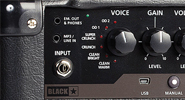

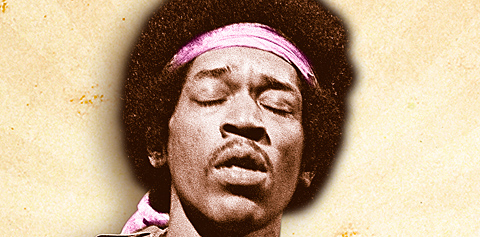


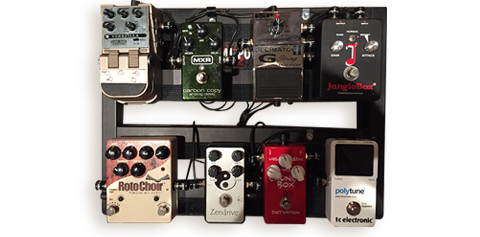
 Elliot Easton’s “Pedalboard”



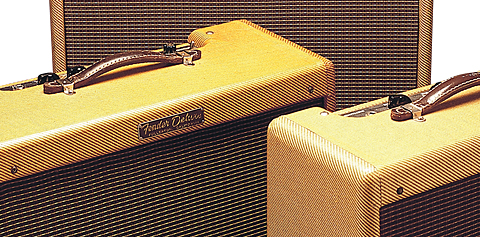


 Fortunately for me, I was trying out all these different Jaguars – mostly ’63s – with bigger necks, smaller necks, darker pickups, brighter pickups, all of these idiosyncrasies I’d be trying in the middle of the set with Modest Mouse or the Cribs, making these very, very quick decisions.


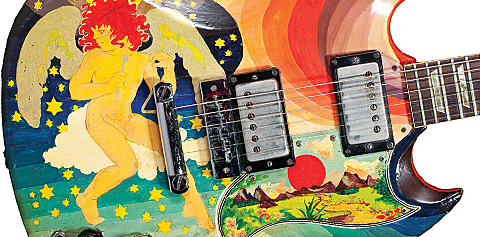


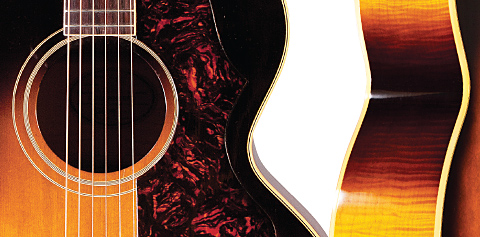

 It’s interesting that this body size was virtually unavailable on flat-top guitars prior to World War II, and was all but ignored even into the ’50s. Today, though, the shape and size are widely employed among big-name guitar builders including Taylor, Collings, Santa Cruz, and Guild. And while the Martin J model has a different shape, it is essentially the same size, and is functionally similar. Even Gibson currently makes several models of this size and shape, including a J-185 reissue that has sold well. Going back, Gibson’s Everly Brothers model of the ’60s differs radically in ornamentation, but is the same size and shape, and the late-run Guild F-40 was very close in size.