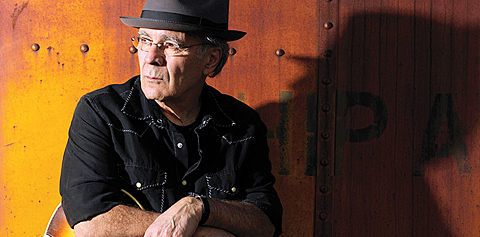
Ray Bonneville: Rodney Burseil.Ray Bonneville’s latest album, Easy Gone, glides on a steady groove.
“I really like the way it sounds with these guys,” he said of drummer Geoff Arsenault and bassist Gurf Morlix. “Their groove is in the same family as my groove.”
It took Bonneville years to feel where that groove should come from, but, he says, “I’ve learned to just trust my instinct. In New Orleans, I learned that I needed to trust the inner thing that drives the groove. I learned not to manipulate it, emotionally – just let it be. And that’s what we did. One, two, three, four, and here’s the groove. No discussion. If everyone’s listening, you’ll get that feeling; like ingredients in a soup – that really good taste.”
Bonneville grew up in Quebec, speaking only French, then his family moved to Boston when he was 12. “There was a little language barrier, so the school put me with some less-interested kids. So, I was a little less interested and became a juvenile delinquent.”
Then, he started to play guitar after listening to rock pioneers like Ricky Nelson, Roy Orbison, and Elvis Presley. He didn’t grasp their influence, though, until he returned from serving in the Vietnam War.
“When I came home, I heard the Delta and Chicago guys. I really started listening to Howlin’ Wolf, Muddy Waters, John Hurt, Lightnin’ Hopkins. I’d always liked Hank Williams, Etta James – anything with a deep groove – but for the first 20 years of my career, I’d never do songs the way they were on the record. I’d get the guitar and try to make them mine. When I started writing in my 40s, though, I discovered a vehicle.”
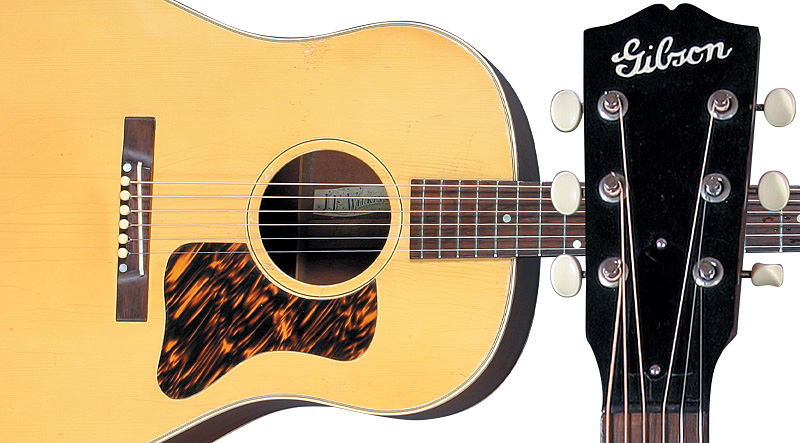
His writing guitars are two vintage Gibson acoustics – a ’43 J-45 and a ’48 LG-2 – but he uses electrics onstage and in the studio. “I use two or three amps and different microphones, and we blend sounds into something smokey and gritty. I’m into a slightly dirty tone, so I’m really happy with the guitar sound on the new record.”
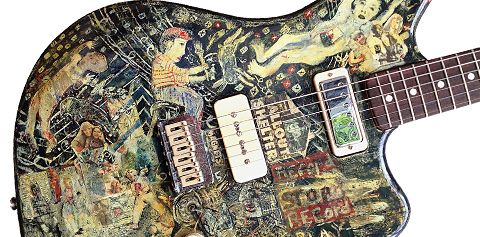
A fan of P-90 pickups, his first electrics were hollow/semi-hollow Gibsons. But, wanting to tour with something smaller, he found a Melody Maker and installed P-90s. “I love how deep the tone is, but it also has that shimmer on top.”
His amps are always Fenders. “My favorite combination is a Princeton and a Champ. One is dirty and the other is dirtier (laughs)!” For smaller venues, he’ll use a Princeton. On a bigger stage, it’s a VibroVerb modded to carry a single 12″ speaker.
Each song on Easy Gone has a groove that comes with a great story. “I have yet to figure out what my writing process is. In general, I overwrite; I write a story and I look to unlock it. If I can get a handle on who it’s about, I’ll take everything that is not that. I let the listener imagine as many things as possible; I supply the outline and let them add details.”
This article originally appeared in VG‘s October 2014 issue. All copyrights are by the author and Vintage Guitar magazine. Unauthorized replication or use is strictly prohibited.
In the world of vintage guitars, people tend to use the words “blond” and “natural” interchangeably to describe a finish with no stain or pigment. However, in some cases, blond is a distinct color, different from natural. The standard for blond finish is, of course, “Tele blond,” the yellowish finish that Fender applied in a sort of whitewash style to Telecasters and Esquires, allowing the grain of the ash body to show through. That may be quintessential blond, but as this Gibson J-35 from 1942 shows, the Tele was not the original blond guitar.
While this finish is extremely rare on a Gibson, the conservative company actually had quite a colorful history when it came to finishes. From the beginning, Orville Gibson’s mandolins typically avoided the natural top finish of virtually every other mandolin and guitar made in the 1890s in favor of a rich brown stain that matched the walnut back and sides of his instruments.
After the Gibson company was organized in 1902, its higher-priced instruments sported a black top that made the ornamentation “pop.” The low end of the line featured tops that enhanced the wood grain with a stain its catalogs described as “golden orange,” better known today as “pumpkin top.” As the models began to change from walnut back and sides to birch or maple (they were always specified as maple), they gained a rich red mahogany-stain finish. In the basic light-and-dark world of natural-finished spruce tops and rosewood or mahogany bodies, these instruments with black, orange, and red hues were as distinctly Gibson as the company’s logo.
In 1914, on its higher models, Gibson extended the red mahogany stain completely around the instrument, giving it a slightly shaded effect on the top. Four years later, the shading was accentuated into a more modern “sunburst” finish. Also in 1918, the Style 3 instruments introduced a striking, opaque white top finish (standard on the A-3 mandolin, optional on the L-3 guitar) that simply could not go unnoticed in any aggregation of instruments.
Gibson’s next finish color is viewed today as the epitome of a traditional guitar finish, but in 1922 it was as fresh and new as Gibson’s white and red tops had been in the 1910s. It had a deep amber shade in the middle of the top that seemed almost to be peeking through a deep and wide dark-brown border. The finish debuted on Gibson’s new family of Style 5 Master Models with a name – Cremona brown sunburst – that suggested a connection with Amati, Stradivarius, Guarnerius and all the fine violin makers from the Italian town of Cremona.
Through the 1920s, Gibson and other makers responded to the opulence of the Jazz age by creating ever-more-lavish finishes and ornamentation schemes for banjos, but the look of Gibson guitars remained virtually unchanged, with Cremona sunburst reserved for the L-5 and other Style 5 mandolin family instruments, while the red mahogany continued on older high-end models such as the L-4.
In 1931, Epiphone launched its line of Masterbilt archtops. Not coincidentally, all eight Masterbilt models featured a Gibson-like sunburst finish. Whether it was the prestige of Gibson’s L-5 or the pure aesthetic appeal of the light-to-dark brown shading, the sunburst finish quickly became the industry standard for archtop guitars. With a few exceptions at the low end, which had black- or natural-finished mahogany tops, Gibsons were all sunburst through the mid 1930s.
In an era of fierce competition, a small difference can turn into a big advantage, and Gibson came up with a new finish color that made its archtops stand out from those of Epiphone, Gretsch, or any other leading maker. This time, it was no color at all. Beginning in 1937 (though not officially offered until ’39), Gibson’s high-end archtops were offered with a clear finish that showed off the natural color and grain of the wood. Epiphone wasted no time, introducing natural finishes in 1939. Two years later, Epi began using the term “blonde” in some cases and featured three natural-finish models on a catalog page “for those who prefer blondes.”
Although archtop guitars were the foundation of the Gibson company and Gibson’s specialty in the 1930s, Gibson had started making flat-tops in the 1920s. In 1934 the company launched its first “jumbo” model to compete with Martin’s new dreadnoughts (which had been introduced in 1931). In 1936 Gibson replaced the original Jumbo with two dreadnought models: the rosewood-body Advanced Jumbo and the mahogany J-35, which were designed to go toe-to-toe with Martin’s D-28 and D-18, respectively.
As in the archtop market, the influence of Gibson’s sunburst could be seen in the flat-top market. Martin, which had made natural-top guitars exclusively for almost a century, began offering “shaded top” finishes – their version of sunburst – by 1931. Like virtually every other model in the Gibson line, the AJ and J-35 were offered with sunburst finish only.
Throughout Gibson history, cheaper models have typically outsold “marquee” models, and in the flat-top line of the late 1930s, the small-bodied L-0 and L-00 far outsold the Advanced Jumbo and SJ-200. The J-35, though a dreadnought, had a price of $37.50 that was much closer to the small-body models ($25 for the L-0, $30 for the L-00) than the $80 tag on the Advanced Jumbo. And the J-35 sold accordingly, averaging over 400 instruments a year from 1937 to ’40. In 1940, the natural finish option that had become increasingly popular on archtops was extended to the J-35 (although none may have shipped until 1941). The power of the J-35’s sound was apparently recognized by the buying public in ’41, when J-35 shipments surged to 846 units (including 49 with natural tops), surpassing all other Gibson models – flat-tops, archtops, electrics, banjos, mandolins, lap steels – except, surprisingly, Gibson’s V-25 violin.
Despite growing sales of the J-35 (and the smaller-bodied flat-tops as well), and despite America’s abrupt entry into World War II after the bombing of Pearl Harbor in December 1941, Gibson began overhauling the flat-top line in ’42. By August, Gibson had introduced a new dreadnought, the J-45, that would replace the J-35 (plus the LG-2 to replace the L-0 and L-00).
Sometime in 1942, someone at Gibson decided to paint a few J-35s with a near-opaque blond top finish. The serial number of this guitar includes the letter H, which would indicate 1942 production, but Gibson shipping records stopped listing serial numbers at that time, so its place in the J-35/J-45 timeline is unknown. Why this finish was chosen is also unknown. A few Epiphone Triumph archtops from the same period have shown up with a similar finish, but again, it’s impossible to determine which came first.
Also unknown is why the blond finish was dropped. Perhaps Gibson and Epiphone determined that it was more trouble and in less demand than natural. What is known is that the concept appealed to Leo Fender, who in 1950 abandoned the black finish he used on his earliest Esquire model and adopted the “see-through blond” that is still a standard today on Telecasters and Esquires.
Thanks to Lynn Wheelwright for his help researching this piece.
This article originally appeared in VG‘s December ’08 issue. All copyrights are by the author and Vintage Guitar magazine. Unauthorized replication or use is strictly prohibited.
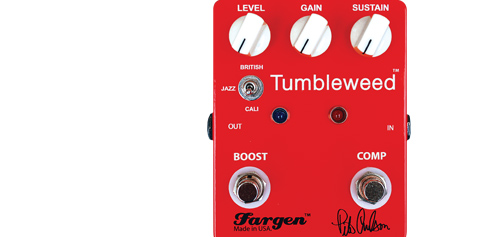
Fargen Pete Anderson Tumbleweed
Price: $299 (list)
Info: www.fargenamps.com.
Pete Anderson is a touring roots and country guitarist probably best known for his work with Dwight Yoakam during the latter’s tenure atop the country charts in the ’80s and ’90s. His deft Telecaster playing and conservative production techniques turned Nashville on its ear and helped launch the modern Americana movement. Ben Fargen is the up-and-coming amp and pedal designer who is helping to redefine what is eminently gig-worthy yet stylish. Recently, Anderson and Fargen collaborated on the Fargen Pete Anderson Tumbleweed, which they envisioned as the ultimate roots-rock pedal.
The Tumbleweed is actually two effects in one box: a finely crafted three-flavored clean boost along with a compressor that does more to “master” one’s sound than to simply squash it into dynamic-less submission. It has standard input and output jacks on the sides, and each effect has its own stomp switch and LED indicator. Additionally, the Boost has a Level knob, along with a British/Jazz/Cali character switch, while the Compressor has Gain and Sustain controls. The Tumbleweed is made in the United States and can be powered either by battery or a standard 9-volt DC power supply.
The Tumbleweed was tested with a 1967 Telecaster and ’82 Gibson ES-335 into a trusty ’65 Fender Deluxe Reverb. The compression is of the Ross/Dyna flavor, but unlike other varieties, it has a greater range of less compressed tones. While the Tumbleweed could certainly get squishy at the top of the dial, we were thankful for those less compressed tones when using the higher output of the 335.
Unlike many boost units that are simply repurposed overdrives, the Tumbleweed really does act as a clean boost – the only drive tones come from the amp’s input being hit hard, not from the unit itself. The Boost’s three voicings offer midrange and treble emphasis on the British setting, a much darker tone on Jazz, and the unit’s most transparent response and highest output when set to Cali. The British and Jazz modes are great for giving an amp a different tonal flavor; the Cali is the best mode for straight-ahead boosting.
The Tumbleweed is a fantastic pairing of effects for the roots-oriented player who appreciates fine, clean, and pushed amp tones. The boost is a fantastic tool for changing level and/or tailoring EQ for guitar changes, or for simply adding tonal versatility. The compressor is thankfully quiet and capable of everything from subtle smoothing to aggressive squash.
This article originally appeared in VG September 2014 issue. All copyrights are by the author and Vintage Guitar magazine. Unauthorized replication or use is strictly prohibited.
Billy Duffy has long been a different sort of bloke. As his peers in rock bands of the mid ’80s mostly fell in line to play modified “superstrats,” Duffy stuck with his trusty Gretsch White Falcon as The Cult scored its first international hit, “She Sells Sanctuary.”
Growing up, Duffy was like any of a million other kids who listened to rock-and-roll music. As punk become popular in England in the mid ’70s, he was all over it, and both styles influenced his playing – as well as his taste in tone. The White Falcon became a trademark, as Duffy used it to record The Cult’s early albums and tour the world. Ironically, though, it was at first more a solution than a choice…
“I wanted to get my own guitar sounds,” he said of his early work. “I was very conscious of not wanting to be a bad version of Steve Jones – I wanted to be a good version of Billy Duffy! The Gretsch represented an opportunity for a different sonic approach. That’s how it all started; I was aware of the guitar’s visual appeal, then started looking at its possibilities and limitations, like its incredibly long fretboard and how it’s difficult, on the single-cuts, to get much higher than the 12th fret unless you wear the guitar up around your neck, ya’ know (laughs)?”
Once he plugged in, the White Falcon’s sound helped him quickly acclimate. “For me, it was a perfect storm of experimentation,” he chuckled. “And I like to think I’m a guy who pushed the boundaries of what you could do with a Gretsch in the early ’80s. I don’t know too many guys who put them through a wah and phasers and flangers and that stuff!”
The Cult’s new album, Choice of Weapon, is aimed at anyone who jumped aboard their fanwagon early or with the 1989 classic, Sonic Temple. With its mix of layered guitar sounds a la the band’s first hit album, Love, and the straight-up bashing rock brought about by Rick Rubin’s production on 1987’s Electric, Choice of Weapon is set to draw fans back to the fold.
We recently spoke with Duffy to learn about his approach to guitar in various eras of The Cult.
Do you remember the first Gretsch you tried?
Yeah, it was a double-cut stereo ’70s White Falcon, which would have greatly been improved had they made it mono. And, like all Gretsches of the ’70s, it would have benefitted greatly from much-higher-output pickups! What I did like was that the thing stayed in tune well, it pretty much took a thrashing.
Do you still have it?
No, I had to sell that one to get what I really wanted, which was the single-cutaway Falcon with the curved palm bar, which has a very different feel than a short-armed Bigsby. I like the way they look on Les Pauls; I think it makes a Les Paul look interesting, but it just adds weight.
But I really fell in love with ’70s Gretsches, especially the neck. That was kinda how it started; we were trying to do something along the lines if Jimi Hendrix was trying to play an Ennio Marconi soundtrack on a Gretsch with very limited ability (laughs)! And writing at the same time. That was kind of like what I was trying to do as a young man… which in retrospect, is kind of amusing.
Did you go through a lot of guitars in the ’80s, or were you pretty loyal to just one or two?
I was a Les Paul guy, initially. I had a Les Paul Custom, and thought they were the Les Paul for me, probably through seeing Thin Lizzy in the ’70s, and then Steve Jones, who made the white Les Paul Custom kind of iconic. Which is a kind of a funny aside, because Steve’s a mate of mine and has been for like 20 years now. And he told me the story of he got that white Les Paul via Syl Sylvain of the New York Dolls, and there was a Gretsch White Falcon that Syl brought over, as well, in the early punk era, that Joe Stummer played – a double-cutaway ’60s Falcon that Jonesy had got his hands on. And, there’s all these stories of how they fell into the hands of different musicians. So, Steve kind of made that white Les Paul iconic – one of the punk rock images.
So that was the guitar. But I always loved Gretsches, pre-punk. I was in a high school band that played a lot of Neil Young and Crazy Horse stuff – “Ohio,” “Cinnamon Girl,” all that. I was into this slightly barnyard, cavalier approach to guitar playing, and the Gretsch helped! So there was all these elements, but I only had enough money to buy one guitar.
The irony was, when I got my first real job in a band, I went from a ’58 double-cutaway Les Paul Junior in Cherry Red to a double-cutaway White Falcon. I got into the Gretsches in ’81, when I was in a band called Theater of Hate. It has always been a big part of that, particularly on The Cult’s Love album, and from what I can remember, I played the White Falcon on pretty much all that album. Ian had a Vox [Mark III] teardrop; if you look at videos from ’85, you see a bunch of [British] bands using them because somebody found all these parts for Voxes. We brought in a red 12-string teardrop that appears in the video for “Revolution.” We used it either for the intro or the middle section of the song. The rest of it was either a Gretsch or a Telecaster [frontman Ian Astbury] owned.
Have you been a Marshall guy?
Well, I’ve always had Marshalls, but since the beginning of the Cult in ’83, I used a Roland JC 120 combo, as well. I tried to experiment with just the JC 120 heads, but there’s nothing like a 2×12 combo for getting that glassy, clear sound. I used to mix that with whatever valve amp I could get my hands on. At one time, I had a Ampeg VT22. But I’ve always had Marshalls, and that’s generally the valve sound I go for. I don’t have anything against Fenders, but living in England at the time, I could never find enough good ones – they were very hit-and-miss. I don’t think they like the British voltage, so basically, one Fender in 20 would be killer, and the rest would be horrible, and that’s just not a percentage game I could play. Marshalls gave me that kind of ballsy thing; I went for a slightly overdriven sound, then lay on overdrive pedals and different front-end stuff, because with a Gretsch, you can’t crank the amp because the guitar would be uncontrollable. Then figure into that how the pickups on the Gretsches I had were horrible. By ’86, right after the Love album and right before Electric, Seymour Duncan was gracious enough to make me a couple sets of pickups, which I put in both Gretsches – by that time, I had a the White Falcon and a ’70s Country Club as a second guitar which I had re-sprayed – my idea was a Black Falcon.
Duffy has owned this Gretsch Country Club (left) since 1984 and had it sprayed black by Roger Giffin so it could serve as the “evil twin” to his white guitar. Duffy’s “She Sells Sanctuary” White Falcon has been a mainstay in his stable for more than 30 years. His signature model is based on it.
You were 20 years ahead of Gretsch with that idea!
Well, the video’s there to prove it! I just thought it’d be cool – the evil twin to my White Falcon. It was originally a natural-finish, and there was a lot of them in the ’70s and ’80s. They looked like a piece of Danish furniture, really! I had Roger Giffin spray it in London, in his shop in the arches under the Kew Bridge, and I think something happened when he sprayed it because it got slightly cloudy and has a slight green tint to it, which is actually quite attractive. I remember, we were on tour in Saskatoon or somewhere in Canada, in winter, when it was minus 20 [degrees], and the lacquer cracked a little bit on both guitars; gave them that real vintage-looking finish checking.
I never really played the black one a lot. It looked great, but it didn’t have the same neck and didn’t have a vibrato arm until maybe 10 years ago.
How much of your tone relies on your touch?
I hit ’em pretty hard. I know different guys have a different physicality on guitars, and I’m definitely on the more-aggressive side. I apply a bit of weight when I play.
I think what I do comes from a combination of being the only guitar player in The Cult for a long time, and needing to make the guitar sound as big as possible, and the JC120 created that glassy, ethereal chime, which a Gretsch has anyway; one of the qualities of a good Gretsch guitar is this sing-song, chimey, almost cathedral-like quality to the sound. If you can harness that, but give it some chug at the bottom end, that’s what I tried to do after Seymour Duncan made those pickups.
When people see a guy with a Gretsch, they tend to think “rockabilly influence.” Is that true of you?
Well, yeah, because when I was living in London – I moved there in ’79 and early in ’80, into ’81, that was a huge psychobilly scene, which was punk mixed with rockabilly sound. There’s a hardcore following of that in the States, in Orange County, and Texas. But I saw the Stray Cats in London, and they were one of the best bands. I saw the Pistols before Sid was in the band, saw the Who on Keith Moon’s last tour, Queen on the Sheer Heart Attack tour in a 2,000-seat venue. I remember those moments and to me, those are pivotal live bands. I couldn’t work out how a band could be as good as the Stray Cats! What they did… it was hot-roddy rockabilly, the guitar player was shredding. It wasn’t just ’50s-sounding – it had punk-rock energy, and that was a big influence, as well. It all fit into a picture.
We always talk about how we were fans of punk rock who were looking to express ourselves with our own music and tools of our trade. We were trying to be more expansive, and we’d use pedals and any new technology. It wasn’t good enough for me just to sound like somebody who’d already done something, I wanted to make my own sound.
“She Sells Sanctuary” was the Cult’s first big exposure to an international audience..
It was a game-changer, yeah.
Do you consider your guitar tone on that song to be one of your trademarks?
That album was very experimental, and “She Sells Sanctuary” was recorded before the album, as a single. It was an experiment with the producer, recorded with a couple of other tracks that were kind of just throwaway B-sides – a song called “The Snake” and a song called “Number 13” – I can’t even remember how they went. But we did those songs as a little taster before we committed to an album, and a bunch of different s**t just worked out. There’s a funny story. We were trying to get in touch with Steve Lillywhite, who was producing U2 and Simple Minds and such at the time. We approached his management and sent a video of us playing. Well, they accidentally gave it to a another Steve at the company – Steve Brown – who was friends with Steve Lillywhite, but had not really produced any rock stuff. I believe he was involved in Wham’s first album, and was more of a funk/pop guy. So we took the meeting anyway, me and Ian, because Steve Lillywhite didn’t want anything to do with us because we had blue hair and I looked like some kind of Germanic-Nordic Hells Angels cowboy! We weren’t guaranteed success at that point, ya know? So we ended up with Steve, and he was brilliant – such a crazy guy. He said, “Look, I grew up mixing, being an engineer at Polydor… I’ve done Thin Lizzy, The Sensational Alex Harvey Band…” and he listed off a load of bands that I loved. He said, “When I became a producer, I became known for this funk stuff, and pop.” So what we got was a guy who knew about rock, but his expertise was more in pop. That combination mixed us with him, and we told him, “We want to record in Olympic because Led Zeppelin did the first two albums there, and Free recorded there.” He said, “Well, that studio’s really out of date. Orchestras record there. It’s really expensive, and it’s really old-fashioned.” And we went, “Yes! We want to record there…” (laughs)!
’Cuz think about it… It was 1985, right? Everybody wanted the most modern, technologically advanced gear. And we’re going “Led Zeppelin!” and we’re talking to the house engineer – “Tell us about Jimmy Page! What did he use?” And he’d tell us about the amps and we’d be like, “Awww, f**k!”
So, the combination of people, along with our stupid, naive insistence, tapped into this mojo where real records were made. We weren’t caught up in that punk attitude where they thought every record made before 1976 was horrible. We were like, “There was some cool music there…” That was the thing about The Cult – we were open to saying, “You know what? Jimi Hendrix wasn’t all that bad!” Well, wearing a cape and having a stage set that’s castle, singing about demons and dragons… We can’t really relate to that. But that doesn’t mean Led Zeppelin or Free or blah, blah, blah is all horrible. Punk rock tried to throw the baby out with the bath water.
Anyway, on “She Sells Sanctuary” – on the whole Love album – I couldn’t get one amp to get me the sound I wanted. So, we miked up every amp I could get my hands on, and that included Ian’s Yamaha combo, there was definitely a Marshall or two, and possibly that Ampeg VT22. We just miked them all up and blended them to find a sound. On “Sanctuary,” the guitar’s pretty thin, but if you listen to “The Phoenix,” “Love,” and “Rain,” the guitars are slightly thicker. “Sanctuary” was really the first effort.
These ’70s Les Paul Customs were originally black, but Duffy had them refinished in natural as a tribute to his hero, Mick Ronson. Both were used extensively on tour and in recording sessions between 1989 and 2000.
How did the band’s approach to songwriting and your approach to guitar change from Love to Electric?
Well, it was quite cathartic. We did Love, toured the world, had quite a lot of success, and changed our complete frame of reference. So, being sensible, we went, “Let’s go and do another album with the same producer.” So me and Ian tried to do the follow-up, and didn’t really have a firm title. We recorded it, and it just wasn’t there… we didn’t have the songs down, hadn’t honed them. We’d been on the road, then rushed to the studio and spent a lot of time messing around.
We ended up with this overblown album that didn’t capture what we wanted. It was all the songs from Electric, with maybe one exception. But we’d lost the grace of the Love album; we had a different drummer, got a bit more self-indulgent, and grew very much into the whole rock-and-roll lifestyle. We’d lost the lightness we had with Love, and we knew something was wrong. So, we started talking to Rick Rubin, who said, “I’ll re-mix the whole thing, but you have to cut one track with me, from the ground up.”
Well, we had hung out with Rick in New York – talked to him about music and all that. And he asked us, “Do you like AC/DC?” We went, “Yes.” “Do you like early Aerosmith?” And we went, “Yes.” And he’s like, “Do you want to be a rock-and-roll band?” And we were like, “Yes.” So we went about it.
Which track was cut just for him?
Well, we didn’t actually do one. That was his way of luring us into a studio – his bait-and-switch! We talked about doing another cut of “Love Removal Machine,” which was going to be the first single. After the demo sessions – which weren’t all rubbish but overall were overblown and indulgent – Rick came in and asked, “Which songs on the record do you hate the most?” I think I said, “Peace Dog,” because it was nothing like we’d meant for it to sound. He said, “We have to work on that one.” And Rick, with George Drakoulias, who was his partner in crime on that record, and Andy Wallace, the engineer, set about and basically cut everything to pieces – disassembled it. Rick’s quote about it is the best; “I didn’t produce The Cult so much as I reduced The Cult.” And that really sums it up. We stripped it down to the bones, re-jigged the fundamentals a bit, changed the foundations and the beats, then just played the s**t out of the songs. And that whole album was done on rented gear because we thought we were only going to cut one song. It was the best two Marshall heads we could find, the best cab, a couple of Les Pauls – one Standard and one Custom – and a wah. That was it.
At the time – New York in 1986 – Anthrax and the Beastie Boys were hanging out around there, and Public Enemy was on Rick’s Def Jam label. That’s what was going on. But in essence, the whole album was just Les Paul through a Marshall, pure and simple.
And no White Falcon, right?
No, not at all. It was in England. I didn’t play a lick on the White Falcon for Electric. It was on all of the Love album, but none on the Electric album. It was quite a transition, to be honest, from all those echoey wah sounds. Rick stripped all that away; I wasn’t allowed any delay. Rick was all about the space, he was into Dantzig and Slayer… he was about leaving holes. Like analyzing why there’s a hole on “Highway to Hell” where Angus does the pick slide, or the importance of the length of time of that hole in the song. Rick was about the spaces between the notes.
Where does Electric rate for you personally?
Oh, I don’t know, I would say it was an important record. I don’t know if it’s great compared to other stuff.
When you hear a critic or writer talk about Electric as one of the top albums of the ’80s, what do you think?
That’s not really for me to say. I think it influenced a lot of people. I’m not saying it’s in any way original, but it was heartfelt and real for that moment in time.
Love and Electric have a pretty obvious influence on the new album, Choice Of Weapon.
Yeah, I think so. It’s all in the DNA, you know? And it could be a bit of a kindred spirit to Sonic Temple in that it has a certain brashness and feel.
How did the songs come together?
These days – being adults, as opposed to adolescents – Ian and I don’t spend our off time in each other’s pockets! Everybody has wives and children and stuff. So, on our own, we compile stuff, then, when we feel it’s right, get together and go through it. The Cult has always been primarily him singing to my music, and together we listen to the riffs and categorize songs. He has taken a very active role the last two albums, listening closely for riffs that really speak to him and suggest what type of lyric to go for. It’s nothing too mystical.
This time, we decided to record “capsules” prior to doing a full album. Ian was adamant about that, and we released some about a year and a half ago – songs from the writing sessions for Choice of Weapons.
And you worked with two producers, right?
We did the capsules with Chris Goss, then did some gigs, then got back to writing more stuff, this time with Chris. We got most of the way through the project, and then just ran out of steam. We needed to bring in a new coach, as it were, to finish. We didn’t have the luxury of sitting around, so we brought Bob Rock in to close the album.
Which guitars and amps do we hear on it?
I used a couple of White Falcons – a new single-cut with TV Jones pickups, and a ’60s double-cut that sat well; I had about 10 guitars lined up and just grabbed it to put a different bit of paint on the canvas. I also used a Bill Nash E model he made for me, and a Nash S a little bit. The majority was a ’57 goldtop reissue from the Custom Shop that records nicely. I used a fair bit with the two Gretsches, a bit of a single-cutaway Les Paul TV Junior made for me by the Custom Shop, and the Nashes with Seymour Duncan pickups. It was those three food groups.
The Cult’sChoice of Weapon offers plenty of fan-favorite flavor.
How about amplifiers?
It was my Bad Cat 2×12 combo and a Matchless 2×12 DC30. I used one of my venerable Marshall heads and one of my 4×12 cabs. I’ve had four of my Marshall since the ’80s, two were used by the Sex Pistols when they reformed in ’96 and in 2002; they’re JCM 800s that were modified by Harry Kolbe in ’88, and those are what I’ve always used live and in the studio ever since.
There’s nothing too clever or slick. Chris Goss has a fantastic collection of amps, and I used a couple of his little Supros. He’s into those pawn shop amps, and I used one with a 12″ speaker, and that JC 120 a bit, for the same reason I’ve used one since 1981 – for that glassy tone. That was about it. There was nothing too exotic, really.
What did Kolbe do to your Marshalls back in the day?
He ups the quality of the power supplies, so when you hit the bottom-end, it’s loud and doesn’t make the amp sound thin. In my experience, certain Marshall preamps used to sound sizzly. So he added some kind of black box.
Do you still use mostly Marshalls live?
Live, it’s a three-amp setup – Marshalls, Matchless DC30s, and a JC 120. Even when you see just Marshall cabinets onstage, there are a couple of combos hiding in back.
Basically, from the Marshall, I try for an Angus Young tone, from the Matchless I get Malcolm Young, and from the JC 120 a bit of my own personality. Onstage, I switch between all three in various combinations.
Which effects do you use?
I have a couple of overdrives, a couple of wahs that Jim Dunlop makes specially for me, and a few different delays.
Are you using digital rackmount stuff, or old-school stompboxes?
I use stompboxes, mostly Boss because they’re readily available and give me the sound I’m familiar with. I only use one analog delay for the “She Sells Sanctuary” and “Fire Woman” intro sounds in combinations with one of the digital delay pedals. I’m like, “If it ain’t broke don’t fix it.” I’m not a guy who wants to be twiddling; a gig is about performance, excitement, aggression, not about twiddling knobs on pedals! That’s not the time or place for that. I just want to stomp on boxes.
I’m not a great gearhead. I stick with what works. I still wear Levis. You try other brands, but you go back. That’s me with equipment.
And you’re working with Gretsch on a signature White Falcon?
Yes! They forensically analyzed my guitar – the ’70s Falcon I used on “She Sells Sanctuary,” with all its battle scars, and we’re going to make something based on it. Most of the Falcons they do at Gretsch are from ’50s or ’60s designs, and the ’70s ones are very different – they have a different construction – smaller f holes, different headstock. It’s a lot of detail stuff, minutiae, like a zero fret. But we’ve got some great allies at Gretsch – Joe, Michael, a bunch of friends who have greenlighted it.
What’s your favorite pick?
I use Herco Flex 50s, and I grip them sideways.
…ahhh, like Stevie Ray!
Now there’s a guitar player! I could go on for weeks talking about guitar players. But I dig in quite hard, and use them that way so I have more to hold on to between my thumb and forefinger. And a lot of my tone has to do with where I pick. If you listen closely, you can hear I’m doing a lot of the picking right on the bridge, and I’m doing a bit of palm-muting. Somebody once said it’s a lot to do with the right hand. A lot of guitar players who are very gifted do great stuff with the left hand, but there’s quite a lot of technique on the right that plays into the sound. Where I choose to play some of the Cult riffs could be done more efficiently on different parts of the neck, but they wouldn’t get the feeling and intervals and you wouldn’t get the repeats off the delays that create that locomotive thing you hear on “Sanctuary.” I’ve heard guys play it, but they don’t have the locomotion. It’s not too hard – any 14-year-old can do it. It was pretty powerful and kind of a shock to hear that song on a Budweiser commercial during a Super Bowl, though I knew it was going to happen. Still, to actually hear it, you’re like a bit “Whoa!” you know?
This article originally appeared in VG July 2012 issue. All copyrights are by the author and Vintage Guitar magazine. Unauthorized replication or use is strictly prohibited.
When Jimi Hendrix released his first album, 1967’s Are You Experienced, he launched a new level of guitar heroics as well as a sartorial fad for ruffled shirts and band jackets. He also fed a fashion for fuzz.
One of Jimi’s main weapons was the Arbiter Fuzz Face, a cheap, crude fuzz box that would become famous – and infamous – forever more.
Fuzz was nothing new. In fact, the search for good fuzz was long and proud. Early electric guitarists may have been inspired by saxophonists who created “fuzz” by honking their instruments to make them quaver and spit. Ike Turner got a righteous fuzz tone from his combo amp after it fell off his car roof en route to a session; that fuzzed-out sound graced arguably the first rock and roll record – 1951’s “Rocket 88.” Grady Martin lucked on a malfunctioning channel in a mixing board to produce his rough-hewn Nashville sound. Paul Burlison of the Rock and Roll Trio claimed he found his fuzz when a tube was knocked loose in his Fender Deluxe. But these were crude solutions, not always repeatable on demand or controllable under fire.
Electronics manufacturer Maestro understood, and in 1962 launched what was possibly the first fuzz effect, the Fuzz-Tone, which was soon heard on the Ventures’ “The 2,000 Pound Bee.” The most famous application was the Rolling Stones’ “(I Can’t Get No) Satisfaction.” And a young Jimi is believed to have sported a Maestro during his journeyman days with Curtis Knight.
When he relocated to London in 1966, the Maestro was an expensive rarity. But there was a new, low-budget, homegrown option – the Fuzz Face. Jimi plugged in, twisted on the fuzz, and recorded his second single, “Purple Haze.”
The Fuzz Face debuted in 1966, made by sax repairman and amateur drummer Ivor Arbiter, who ran the Drum City shop on Shaftesbury Avenue in London’s West End. Arbiter was famous for selling Ringo Starr a Black Oyster Pearl Ludwig kit in ’62, which he hastily inscribed with “The Beatles” across the front to make the sale, complete with the dropped “T” logo that became part of rock history.
Arbiter’s Fuzz Face mimicked the Maestro Fuzz-Tone, but in a simple – even simplistic – design aimed at the low-budget market. Based on a Schmitt Trigger squaring circuit, it used as few parts as possible; just two transistors, three capacitors, two potentiometers, and a double-pole/double-throw true-bypass switch.
Arbiter claimed he was inspired in creating the Fuzz Face’s sand-cast casing by the round microphone-stand base. With its two knobs – Volume and Fuzz – its DPDT switch, and semi-circular “Arbiter England” or later “Dallas-Arbiter England” logo, the effect looked like a face smiling up at you.
But the friendly Fuzz Face had several problems. First, as Roger Mayer, a 21-year-old electronics wiz who soon became Jimi’s mad-scientist effects man, explained, “It was such a basic circuit that most people in electronics would never have used it because it was fraught with many, many problems. By making the circuit with a minimal number of parts, it made the circuit virtually unrepeatable.”
The Fuzz Face circuit used as few parts as possible; just two transistors, three capacitors, two potentiometers, and a double-pole/double-throw true-bypass switch.
Second, the germanium transistors of the day had such broad permissible manufacturing tolerances that getting a matched pair in one Fuzz Face was pure serendipity. “The circuit was so crude and so interdependent that if one transistor was a bit higher-gain than the next stage, you couldn’t use it,” Mayer said. “You had to get a balanced pair for the thing to sound right.” And because the Fuzz Face was built cheap, Arbiter wasn’t testing components to match them up.
Finally, the design of the circuit was temperature-sensitive. “It varied from day to day because the biasing of the circuit was rarely stabilized,” Mayer recalled. “It was crudely biased. It would work, but it rarely worked the same way twice.”
Jimi used the Fuzz Face for gigs because it was the cheapest available. While a Maestro cost £30, Arbiter’s was just £6. And that was a good thing. “The down side was that you needed a lot of them,” Mayer pointed out. “The problem Jimi and I had with the Arbiter was that you had to buy 20 to find a decent one. So I told him, ‘Let me take one Fuzz Face that works back to the lab and we’ll measure each component to see what’s doing what.’”
Mayer’s secret modification was simply to “blueprint” them – mix the components until he had matched sets.
Those first Fuzz Faces used PNP germanium NKT275, or sometimes AC128, transistors, which many players came to love for their fat, full sound. But when less-expensive silicon transistors became available, Arbiter quickly switched over. Some players found these too harsh and hairy, but others embraced the early effects using BC108C or BC183L transistors – and their increased reliability.
Jimi, too, used these silicon-transistor Fuzz Faces, but they brought a new issue. “Arbiter had taken no precautions at all in the design against radio,” said Mayer. “The silicon had much higher gain and frequencies than the germanium ones. This caused the actual device to become a radio receiver. When you connected the Fuzz Face to a guitar cable, the cable acted like a bloody antenna!”
Jimi toured the United States in ’68 and brought along Mayer simply to keep his gear alive. He remembers concerts where he had to run onstage to yank the Fuzz Face out because it was picking up (and re-broadcasting) AM radio pop songs through Jimi’s amps. “It was a nightmare,” he laughs. “The Fuzz Faces were very noisy, very temperamental. Many times in the States, we’d be swapping them out as he was playing. We’d have six of them onstage. It was frustrating for Jimi and totally out of control most of the time. Playing live, we were unsure of what was going to happen!”
Arbiter halted production of the original Fuzz Face in 1975. The design was reissued by Crest Audio, of New Jersey, in the late ’70s, then with a second version in the late ’80s. In ’93, Dunlop bought the name and today offers several versions with modern reliability.
Plugging a ’64 Rickenbacker 360 into a ’70s Dallas-Arbiter Fuzz Face with BC109C silicon transistors and then into a ’64 Vox AC30, you realize just how peaky the effect’s Fuzz control can be. You need to carefully balance the Volume with the Fuzz to get a warm sound. Otherwise, the fuzz can be all-consuming – unless, of course that’s the tone you want. But when you get it right with a good unit, the fuzz is glorious.
Mayer says Hendrix rarely used a Fuzz Face by itself.
“In the studio, we’d have some other circuits to put in front of the Fuzz Face to drive the unit differently. Of course, in the studio you can vary the voltage you’re running the Fuzz Face on, so we had much more control. I’d put different buffers with different equalization in front of them to drive the actual Fuzz Face from a low-impedance source rather than the high impedance of the guitar. Then we’d add the distortion after that with pre-EQ. Then we could also fuzz the device with post-EQ.
“You’re not going to get the tone that Jimi Hendrix got on a record with one simple device – that’s not going to happen, mate!”
This article originally appeared in VG August 2012 issue. All copyrights are by the author and Vintage Guitar magazine. Unauthorized replication or use is strictly prohibited.
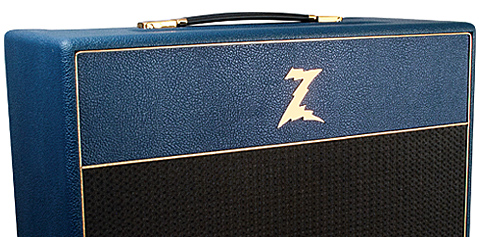
Originally designed as a head with a matching 2×12 cabinet, the Z Wreck came about at the request of country super-picker Brad Paisley and was a collaborative effort between Mike Zaite (Dr. Z Amplification) and Ken Fischer (Trainwreck Circuits). Recently, Dr. Z released the Z Wreck in a 1×12 combo format.
Like the original head/cab platform, the new combo uses three 12AX7 preamp tubes, a single input jack, and delightfully scant controls consisting of Volume, Bass, Treble, and Cut knobs. The output section incorporates four EL-84 output tubes (cathode-biased) to produce 30 watts, and a 5AR4 rectifier tube. The output transformer is a Ken Fischer design, while the power transformer is tapped to provide two plate-voltage (voicing) settings.
The Z Wreck Combo’s impeccable build quality is immediately noticeable; cabinetry, covering, piping, venting, and hardware are all first-rate. Dressed in blue tolex with gold trim and hardware accents, it is solid, tidy, and well-finished, inside and out. Its cab is designed with a first for Dr. Z; striving to maintain a grab-and-go ethos, builder Mike Zaite opted for 1/2″ baltic birch instead of the more-standard 3/4″. The design, he says, mimics classic Marshall Bluesbreakers combos, and he further cites drum makers who commonly use 1/2″ wood for its resonant qualities. Also, it has a 1/2″ floating baffle he says allows for better projection. These elements keep the Combo’s weight to 47 pounds with its Celestion Gold speaker (which by itself weighs just over nine pounds).
The top-mounted knobs are also a first for Z, as is the vent across the amp’s top, which Zaite says projects a bit of sound and helps avoid the boxy sound typical of a 12″ combo. The amp ships with a fitted cover with high-denier exterior and padded interior.
Plugging straight into the Z Wreck Combo with a Fender American Deluxe Telecaster, and starting with the Tone controls set to 12 o’clock, Volume at half past 9, and voicing at “Comfort” (the lower plate-voltage setting), the amp came to life with a full, well-rounded clean tone that was bright but not harsh, and rich with body – that “new-string sound” of the (almost) fresh strings on the Tele was immediately distinguishable. Adjusting the Bass and Treble slightly to the room, and setting the Cut knob between 10 and 11 rendered clean-tone heaven – articulate and meaty, with absolutely no thinness on the high strings and a fantastic smooth response to the touch. Both the neck and bridge pickup positions blossomed with tone.
Without changing any other settings, and simply switching the voicing to “Speed,” the attack and urgency of each note’s articulation intensified. Speed is less-forgiving and forces the player to concentrate not only on what they’re playing, but (perhaps even more) on how they’re playing. The amp is loud (no surprise for an amp in this class), but the tone is so good that one doesn’t give a second thought to the volume.
Adjusting the Volume to noon and switching back to Comfort voicing pushes the Z Wreck beyond squeaky, into total touch-and-crunch bliss. A simple roll-back of the Tele’s volume achieved whatever degree of clean was desired – from clean to an ever-so-slight bit of stubble on the note, to full beard. And when it’s time to solo, roll the guitar’s Volume back up and the Combo serves up snarly but well-defined notes smothered in a creamy overdrive with tasty harmonics on top.
Setting aside the Tele for a Les Paul Standard and turning the amp’s Volume up to just shy of 3 o’clock, the Z Wreck unquestionably rocks – hard. With superior midrange articulation, it handily delivers full-out high-gain tone useful for almost any “heavy” genre or high-gain situation. Perhaps the real beauty of the Z Wreck is that, even when cranked, simply rolling back the guitar’s Volume takes you right back to nearly clean or anywhere in-between, while the tone remains true to intention.
Dr. Z Amplification promotes this amp as something of a Swiss army knife – a plug-and-play amp no matter what you want to do, that will give you back what your hands and guitar give it. Believe it. The Z Wreck Combo delivers superior tone useable over a spectrum of styles, in a simple and efficient platform.
This article originally appeared in VG September 2014 issue. All copyrights are by the author and Vintage Guitar magazine. Unauthorized replication or use is strictly prohibited.
For the December ’14 issue of Vintage Guitar magazine, Dan Forte interviewed Bill Frisell. Here’s a look at the many guitars used by the ultra-versatile superpicker. The issue is available at www.store.vintageguitar.com.
1) The body of this Rick Kelly guitar is made of old pine taken from a beam from Jim Jarmuch’s loft in the Bowery. Its neck is padauk taken from an old barn, pickups are Lollar Charlie Christians. 2) This J.W. Black creation has a Bigsby vibrato with a Mastery Bridge and is the only guitar used by Frisall on Guitar in the Space Age.3) Another guitar assembled by J.W. Black, this has a Lollar mini-humbucker in neck position and Lollar P-90 in the bridge. It was painted by Terry Turrell.4) “This Mustang is exactly like my first guitar, which I got in the summer of ’65,” said Frisell. “I saw it at Bernunzio’s Uptown Music and couldn’t resist.” 5) This guitar was put together by J.W. Black, using a 243/4″-scale neck and Fender-made DeArmond Dynasonic-type pickups. 6) This Collings I-35 LC is a recent acquistion.7) Frisell calls this his first “real” acoustic. Built by Steve Andersen, it was a gift from Gary Larson during the soundtrack recording of his “Tales From The Far Side” TV special. 8) Frisell sold this ’68 Gibson ES-175 after using it for years while playing with Jim Hall, Johnny Smith, and others. He sold it and quickly regretted having done so, then 37 years later, reaquired it. 9) Frisell bought this Gibson SG for $200 in the mid ’70s. Painted with white house paint at the time, he stripped it, changed many of its parts, and has since made heavy use of it.
This article originally appeared in VG‘s December 2014 issue. All copyrights are by the author and Vintage Guitar magazine. Unauthorized replication or use is strictly prohibited.
Breedlove FF and KO Mandolins1
Price: FF $2,265 (list), $1,699 (street); KO $1,999 (list), $1,499 (street)
Info: www.breedlovemusic.com.
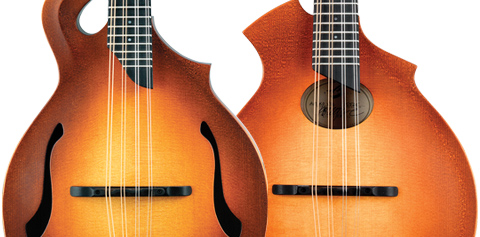
Unlike luthiers who re-create classic designs, Kim Breedlove prefers new ideas and cutting-edge aesthetics. Breedlove’s FF and KO mandolins combine unique visual style with superb build quality. For mandolin players looking for nontraditional instruments, the Breedlove FF and KO offer welcome alternatives.
The models share several specs and features, including a big leaf maple neck, ebony fretboard, TUSQ nut, adjustable ebony bridge saddle, solid Sitka spruce top, western maple back and sides, 14″ scale-length, vintage stain, and a bolt-on neck joint. The primary differences are their body and soundhole shapes. While the FF has f-holes and a horn on the upper bout, the KO has an oval hole and lacks the FF’s horn.
Both mandolins have similarly high levels of fit and finish. They lack the multi-ply bindings and fancy scroll carving found on some traditional pro-level f-style mandolins, but make up for this with their elegant craftsmanship. The FF and KO feature solid wooden edge joints where the tops and backs meet the sides. Breedlove refers to their wood finish semi-gloss, but it’s more of a satin – thick enough to protect the wood, but much thinner than traditional gloss. Satin finishes are typically unforgiving – any and every touch up or imperfection shows – so the lack of any signs of putty or filler on the edges or seams of either of the mandolins reviewed is a tribute to the level of woodworking skill that went into the instruments. The only complaint is the lack of a pickguard on both, which would be a nice option for protecting the front lower bout and giving the player a “depth gauge” while playing.
The neck shapes of the FF and KO are similar; a moderately deep U shape rather than a V or “canoe.” Both have a satin finish with a smooth, nonstick surface that offers no resistance when sliding into upper positions. Published nut width on both instruments is 1.1875″, relatively average-sized compared to other necks. The frets are beefier than traditional mandolin frets, which gives a beefier feel and should result in longer fret life.
Intonation on both instruments as delivered from the factory was good. Both actions were somewhat on the high side, but Breedlove’s adjustable saddle, which can be altered while the instrument is fully tuned, made it easy to lower the actions. This did have some effect on overall maximum volume: as with traditional instruments, the lower action didn’t drive the Breedlove’s top quite as hard.
Traditionally, oval-hole mandolins are bassier and mellower than f-hole designs, and the KO follows suit. This extra bass, combined with sustain, produces a loud instrument that doesn’t get muddy when driven hard. Chop chords on the KO don’t have as much pop and snap as with an f-style, which is why bluegrass players usually prefer f-holes.
The FF has more midrange power and a drier, less bassy harmonic balance than the KO. Typical of an f-style, the FF also has a much more pronounced chop and a slightly nasal midrange. From a player’s position the FF doesn’t seem quite as loud as the KO. However when compared from five feet away, the sound pressure levels of the two instruments were virtually identical. This is common – a sound hole doesn’t seem as loud from the player’s perspective because more of the sound is projected away from the player.
Neither the Breedlove KO nor FF is a “traditional” mandolin design, yet both capture the archetypal sound of their body styles. If you want a U.S.-made all-solid-wood mandolin with a nontraditional shape and style, the Breedlove KO or FF could be ideal.
This article originally appeared in VG September 2014 issue. All copyrights are by the author and Vintage Guitar magazine. Unauthorized replication or use is strictly prohibited.
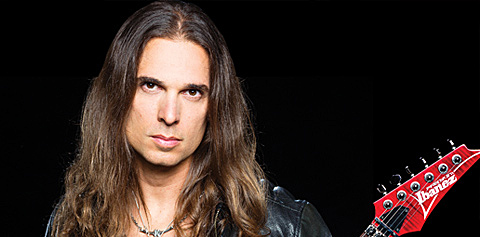
Photo by Alex Solca.“When I would play with musicians from the neighborhood, I noticed that my passion for Brazilian music was making me different from other guys,” explains guitarist Kiko Loureiro, a player who found his niche by combining his Brazilian heritage with his love of metal, shred, and fusion. His current album, Sounds Of Innocence, seamlessly blends these influences making for a unique listening experience. VG caught up with him after a recent sound check to get the lowdown.
What did you want to express on Sounds Of Innocence?
I’m finding myself as a composer with a concept. I love Carlos Santana representing Latin music. Al DiMeola could be a reference. Latin music with fast runs… but I don’t think I sound like DiMeola. It’s a Santana thing with Latin percussion, but I don’t sound like Santana. I’m transmitting the Latin culture into rock; I’m not afraid to put a conga in some songs. I was raised listening to Led Zeppelin, and, being a teenager in the ’80s, I was listening to all the Shrapnel Records guys and Steve Vai, but I was also playing acoustic guitar. I was listening to bossa nova and music in the Brazilian tradition, and I tried to mix it.
The first track, “Awakening Prelude” has some beautiful acoustic playing.
One of my dreams is to do an acoustic album. I’ve done a tour of acoustic playing, but I really have to focus on the instrument more. I already have the compositions ready for an album – real Brazilian stuff, a little bit like the intro of the album. More calm, not very technical. The harmonies of Brazilian music are rich and deep and sophisticated when it comes from Jobim or Villa-Lobos.
The Brazilian elements give your prog-metal compositions much more depth.
I was listening a lot and studying Brazilian music. The concerts I was going to had Brazilian music. The big metal bands weren’t coming to Brazil so I wasn’t seeing them live. I was seeing big bands like AC/DC or The Scorpions on TV. I was going to see people play Brazilian music live. I tried to accept this culture and blend it. I don’t deny it.
A lot of rock guys from Brazil deny their culture. They decide what tribe they want to be in; if they’re rock guys, they don’t want to listen to traditional music. I was always accepting of that. I was trying to play like Hendrix or Clapton at home and my mother said, “The genius of music are the Brazilian composers.” If I tried to play a rock song, it wasn’t as difficult as the sophisticated harmonies of Brazil. I got passionate about it and tried to mix it, keeping the rock and not going to straight fusion or straight Brazilian music.
Will you continue playing metal with the band Angra?
For 20 years, I’ve played with Angra – two guitar players and a vocalist. We did a lot of great stuff and still do a lot of great stuff. We’re going to do a festival in Mexico. It’s a very important part of myself, and it’s why I feel very comfortable doing fusion or solo acoustic. I like to do everything.
When I was a teenager, I practiced guitar a lot. I was obsessive. Then, when I would play with friends from the neighborhood, they were playing amazing pentatonic scales like Satriani or Jeff Beck. I could play that, too, but I could play Brazilian songs that they had no idea how to improvise over or groove with. I thought that was something I had to work on. It could be something that makes me different. There were all these guys trying to be the new Vinnie Moore. With Sounds Of Innocence, I tried to position myself as a composer more so than a guitar player who can play fancy licks. That’s why I don’t pose with the guitar on the cover.
It’s a good way to position myself. I don’t want to copy anybody. I really try to use what I have that’s different from other people. When I play at clinics and I ask if anybody wants to know about Brazilian music, everybody says, “Yes!’
What is your main guitar.
It’s my Ibanez signature model. I tried to combine the modern Ibanez models with a classic touch. The neck and body are thicker and it has an alder body. I can play heavier, but I can also do fusion. The pickups are based on DiMarzio PAF Pro pickups but made specifically for the guitar. They have a bit more gain.
Does your family appreciate your metal leanings?
If I want to have my mother come to a show, I’m playing acoustic guitar (laughs).
This article originally appeared in VG June 2014 issue. All copyrights are by the author and Vintage Guitar magazine. Unauthorized replication or use is strictly prohibited.
Joe Bonamassa onstage with the Blackburst, which he says weighs just 8 pounds, 13 ounces. Photos by Rick Gould.
Among experienced (and often jaded) veteran guitar collectors, precious few things create an adrenaline rush – strange one-offs, oddball brands that never quite blossomed, guitars with non-standard parts/materials from the factory, or those once owned by an icon. Even better, those personally built by an icon. And every so often, there emerges a guitar like this – a true classic that simply deviates from the norm.
Though Gibson produced more than 1,700 Les Paul Standards from 1959 through ’61, the model is far from pedestrian. Hailed as the foremost collectible solidbody ever mass-produced, it is lauded for its sound, feel, playability, workmanship, and the fact it represents the pinnacle of the form thanks in part to Gibson’s then-new humbucking pickups and Tune-O-Matic bridge. Most importantly from the standpoint of a collector, it was dressed up with a figured-maple top finished in gorgeous sunburst. Add the fact that Michael Bloomfield, Eric Clapton, and a host of other superstars played them while creating some of their most-revered music, and today it means adding one to a collection typically requires a six-figure deduction from one’s bank account.
Guitarheads appreciate a clean, crisp set of vintage hang-tags.
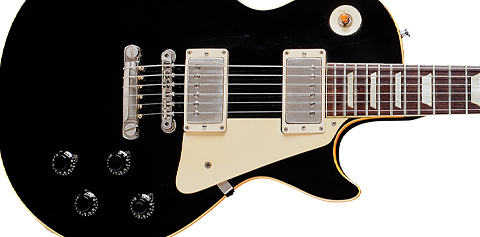
This guitar, bearing serial number 0 0162, exists because in January of 1960, Kenneth Waters, a young Floridian just learning to play, walked into Ralph’s Luggage and Jewelry, in Homestead, determined to buy a Les Paul. Having none in inventory, the proprietor – who was indeed a Gibson dealer – offered to place an order on Waters’ behalf. Wanting a black guitar, but seeing the high-end/three-pickup Custom version was beyond his budget (it listed for $375 versus the Standard’s $280), Waters had Ralph’s order a Standard finished in “ebony” along with a budget case and a GA-6 amplifier. Grand total? $345.05.
It took Gibson nearly three months to fulfill the order; at one point Waters grew sick of waiting and came close to cancelling. Ultimately, though, he took delivery and for the next few years occasionally played the guitar in his home. After ’65, he lost interest and the guitar spent the next three decades in its case, tucked in a closet – untouched, unaltered. When he retired in 1994, Waters sold the guitar to a local collector named Jim Dulfer.
(1 & 2) The underside of Blackburst’s pickups, showing their PAF stickers; on an ohmmeter, they show 8.49K (neck) and 8.47K (bridge). The bridge pickup has two black bobbins, while the neck unit is a “zebra,” with one black bobbin, one white. While helping his friend with the purchase, Hickey verified their originality. “I’m pretty sure I was the first person to turn a screw on the guitar,” he said. (3 & 4) The Blackburst’s pickup and potentiometer cavities shows signs of a complete, if quick, overspray. Pickups and cavities: Mike Hickey.
Enter Mike Hickey, who today serves as a guitar tech/all-around-guitar-guy to Joe Bonamassa and other touring professionals. He recalls a 2002 run-in with the guitar when he was advising a collector/friend.
“My friend had talked to a fellow in Florida who said he had a 1960 Les Paul Standard that was factory-finished in black… but he wasn’t interested in selling it. He did, however, have other guitars for sale, so we booked a flight to meet him, on the premise of viewing a dot-neck [Gibson ES-] 335. But, of course, our real mission was to obtain that black Les Paul!
(TOP) Though not visible here, with the guitar in hand, the impression of a 1959 serial number is visible under the black and near where the 1960 serial number was applied. “The original Cherry Red is seeping through the number, which we think was yellow-inked, like you usually see on a dark-back goldtop. Or, it may even have been inked in white,” said Mike Hickey. (BOTTOM) The guitar’s original “five-latch” case.The receipt given to Ken Waters on the day he purchased the Blackburst from Ralph’s Luggage and Jewelry.
“So, we hit the bank, filled my backpack with cash, and headed to Florida.”
Arriving at Dulfer’s home, the two checked out several old guitars, passed on the 335, agreed to buy a ’60s Fender Jazzmaster in Lake Placid Blue, then broached the subject of the Les Paul.
“We laid out all of our cash on his living-room table,” said Hickey. “Like I said, the guy had no intention of selling, but when that cash was out… He called his wife, who obviously told him, ‘Sell!’ So, we started counting the money.
“In the process, we missed our scheduled flight home, and the only other flight to New York was to the wrong airport. When we landed, I called my friend, Lou Gatanas, to ask for a ride. He said something to the effect of, ‘What am I, a f***in’ taxi?’ When I told him, ‘Hey, I’m holding a five-latch [Gibson case],’ after which he was more willing to give us a lift!”
Though other black-finished Les Paul Standards from the era do exist – Hickey is personally aware of two of them – he cites this one as being different for one key reason.
“The others I’ve seen are simply black, but with this guitar, Gibson took a fully finished Les Paul and oversprayed it,” he said. So, under the black are hints of the customary Cherry Red of the back and sides, including along the edges of the binding. Even better… “Through the black, you can see that the top is highly flamed. Hence, its title – Blackburst!”
In time, Hickey helped work a deal for the guitar between his friend and another collector, and it changed owners a few times before late 2013, when it landed in the very capable (and appreciative) hands of Joe Bonamassa (VG, June ’14).
“The guitar came with a set of white gloves,” Bonamassa said, semi-jokingly. “My friend and [the guitar’s]co-owner, who graciously invited me to the party, has always encouraged me to play it onstage, which I do.”
The thrill of staging it aside, Bonamassa says the guitar holds a special place in his collection, which includes many pieces that’ll put a flutter in the hearts of guitarheads – including other classic-era Les Paul Standards.
“It sounds and plays fantastic; it has a typical late-’59 neck profile, and I rate it up there with the top five PAF Les Paul guitars I ever had the honor of playing,” he said. “With classic instruments, the rule is, ‘If it’s mint and sounds average, leave it mint and enjoy it.’ With the Blackburst, the lesson is, ‘Let it rip!’
“It’s a fantastic instrument, no matter the color.”
This article originally appeared in VG‘s December 2014 issue. All copyrights are by the author and Vintage Guitar magazine. Unauthorized replication or use is strictly prohibited.










 Plugging straight into the Z Wreck Combo with a Fender American Deluxe Telecaster, and starting with the Tone controls set to 12 o’clock, Volume at half past 9, and voicing at “Comfort” (the lower plate-voltage setting), the amp came to life with a full, well-rounded clean tone that was bright but not harsh, and rich with body – that “new-string sound” of the (almost) fresh strings on the Tele was immediately distinguishable. Adjusting the Bass and Treble slightly to the room, and setting the Cut knob between 10 and 11 rendered clean-tone heaven – articulate and meaty, with absolutely no thinness on the high strings and a fantastic smooth response to the touch. Both the neck and bridge pickup positions blossomed with tone.