Tag: features

  • Beat Portraits: Burns Volume 2

    Beat Portraits: Burns Volume 2

    In early 2009, VG columnist Peter Stuart Kohman turned his focus on Burns, the pioneering British guitar builder. We’ve compiled the first three installments for a special edition of VG Overdrive. Watch for the complete history in the upcoming weeks.


    Faron’s Flamingos do the Bison Stomp!

    James Ormston Burns’ solo foray into the electric-guitar market began at the start of 1960; he had briefly partnered with builders Henry Weil and Alan Wooten beforehand, but from this point on, the instruments would bear only his name.

    Sales of the early Artist and Sonic models enabled the small company to move out of the basement of a Victorian house into something resembling a factory, listed in 1961 as 300 Mace Street, Hackney, London E8. Many entrepreneurs would have been content with this level of success, but Burns had just begun, and his next project would be a milestone in the history of British guitars.

    Behold the Black Bison (click to enlarge)!

    By the middle of 1961, the line had proved commercially viable and Jim Burns, no stranger to gambling, must have felt ready to up the ante. The models in production were good instruments with many innovative, if quirky, design features, but not really in league with the Fender and Gibson guitars being imported at the time. The next Burns guitar would be a major creative departure, intended as the equal of these American imports – at least! Alongside the original Vox Phantom, it would rank as one of the most visually striking electrics of the ’60s, but unlike JMI’s trapezoidal favorite, which was little beyond a hacked-up Stratocaster, the Burns would have a wealth of original concepts.

    The anecdotal story has Jim’s old cohort, Ike Isaacs, naming the new model when, upon seeing the swooping cutaway curves of the prototype, remarked “Looks like a bloody bison,” Burns must have been taken by the idea… the finished guitar carried not only the name Black Bison, but a tiny cartoon bison head on the vibrato handle and cover plate! Later Bison models still sported this enigmatic if amusing decoration, even when all else changed beyond recognition.

    The Bison’s hard-wired heart.

    The guitar appears to have been developed in 1961 by Jim and several collaborators who helped with the technical aspects. The U.K. patent filing for the ornamental design of the body was made in August; from the look of it, the instrument’s layout was pretty well formalized by then. The neck was seamlessly fitted into the body like the earlier Artist model, but the body styling was far more dramatic. The trademark cutaway horns curve not only inward toward the neck, but outward from the face of the guitar – an elegant touch that must have made sculpting the body not only more work, but required a larger block of wood, as well. Interestingly, this is a roughly contemporary design to the Gibson SG, following the first SG/Les Paul guitars into production by less than a year. Few of those actually made it to England, so whether Burns himself was aware of the new Gibson design or was simply following a similar thought process is likely unknowable. The Bison’s headstock was not Gibson-influenced, but quite Fender-like, albeit more sculpted, an elaboration on the Artist model’s quasi-Telecaster shape. The Bison was also the first Burns guitar with a full-scale neck (well, Gibson scale anyway – 24 3/4") giving it a more professional feel than the short-scale Artist.

    Rose Morris Flyer from 1963.
    The Bison bass, late 1963.

    These first Black Bisons were laden with innovations; nearly every part of the guitar was a new design, and different from any existing instrument. Burns publicity materials were often overrun with hyperbolic prose, but this actually merited much of the self-praise seen in the sales sheet, which appears to date from soon after distribution commenced, around December of ’61. This trade advert is a masterpiece of semi-scientific ad prose: “…the distortion free ‘cushioned impact’ of the unique Burns circuitry in which the initial signal from the string is controlled and subsequently fed through a powerful boosting network” is just the beginning. Also touted is “The Miracle of Split Sound” and the “Tremolo arm, which is hyper-sensitive – The ball-bearing spindle, working in sweet harmony with the floating cradle… really backs you up on spontaneous expression… brings a new relaxed feeling to your work.” You get the idea.

    The Black Bison’s elegantly carved body was made of English Sycamore; Jim always wanted to use native materials if possible. Obviously, the bound ebony fingerboard had to be imported timber, however! All metal hardware, including a decorative inset pickguard section, was gold-plated, which contrasted nicely with the ebony finish. One neat feature was a gold-plated machine head cover, concealing those nasty string ends! The machines were Dutch-made Van Ghents, probably the best in Europe. The headstock was adorned with a snazzy “OB” (Ormston Burns) lightning bolt logo… the Burns name was not large on these instruments, as it would soon be on following designs. Another eccentric feature was the oversize multilayered pickguard (“scratchplate” in U.K. terminology) that covered most of the face of the guitar – even the upper horn, where little “scratching” could be expected. This abundance of plastic would become a Burns trademark. One hidden but well engineered feature was the Burns geared truss rod, which was first used on this model. The patent filing date for “final specification” version of this was September 25, 1962 so it may have been reworked more than once, as by then it had been in use for some time. Earlier models had employed a simple and rather generic truss rod adjusting at the headstock, but this hidden (under a backplate) rod was a real practical advance and actually quite efficient in use, though so discreetly hidden, some Burns users are unaware of its existence!

    The heart of the Black Bison is the four (yes, four) Burns Ultrasonic low-impedence pickups coupled to internal transformer coils in one of the most complicated wiring setups the guitar world has ever seen! Two selector knobs allowed eight pickup combinations including “Split Sound,” essentially a mono adaptation of Gretch’s Project-O-Sonic stereo using different half-pickups to mix bass and treble string tonalities. This would become another Burns trademark, used on several subsequent models. The pre-set sound designations were numeric on this first model, but would soon gain names; the very thin out-of-phase rear-pickup selection would become infamous when labeled “Wild Dog” sound on the next generation of guitars! This system was developed by Jim with Gordon Chandler, and would be the subject of one of the densest guitar patents (filed October 20, 1961) ever issued.

    The actual pickups, Burns’ first with adjustable pole pieces, are most striking looking with the “Ormston Burns Ultra-Sonic” logo etched in silver on the underside of their clear plastic covers. They are less powerful than the earlier Tri-Sonics, even with that “powerful boosting network,” but with a higher-fidelity response. They are also quite oddly made, with no coil, as such, but an internal donut of wire wrapped around the magnet structure. Burns was well ahead of the game with this low-impedance experiment. The Ultra-Sonics’ tone is generally clean and hi-fi in most settings, though like anything else cranked through an AC15 they can really sing! Still, the guitar’s basic sound leans toward clear and distinct – perfect for the clean instrumental styles of 1962-’64, but not particularly well-suited to the raunchier sounds popular from ’65 onward. By the late ’60s, when overdrive crunch and distortion ruled the roost the elaborately wired Bison would seem far too clever for its own good!

    One of the most interesting features of all Bisons was their elaborate vibrato tailpieces. The first model Black Bison marked the appearance of the perfected “floating cradle” bridge/vibrato system, the bridge had appeared on the last Vibra Artist Deluxe. It would be progressively developed over the next several years, as the simplified Series 1 and 2 vibratos used on many Burns models. The long, integral tailpiece/bridge structure occupies a lot of real estate on the face of the guitar. This would be another Burns trademark. The patent filing for this unit was December 6, 1961, by which time the guitar was just being introduced into production. Actually, “production” may be a misleading term, as according to some recollections of folks involved, the Burns shop was essentially a cottage industry at the time, and the original Black Bisons were each handbuilt under arduous circumstances! These carry the earliest Burns serial numbers – many have only two digits. Burns’ master woodworker/right hand man Jack Golder recalls that only 49 original four-pickup Black Bisons were built. These retailed at £157, an unheard-of sum for a solidbody English guitar. A real American could be had for that, including the Hank-Marvin-approved Fiesta Red Stratocaster, a scant £3 more from Selmer in 1962… or an ES-335 – for two quid less! Still, they seem to have sold out soon enough. Of the 50 or so built, a small number survive in Burns collections, while several more are known to have been destroyed or modified beyond retrieval. One of the very few in the U.S. is in the collection of the Hard Rock Cafe in New York, coming from dedicated Burns fan Chris Stein, of Blondie.

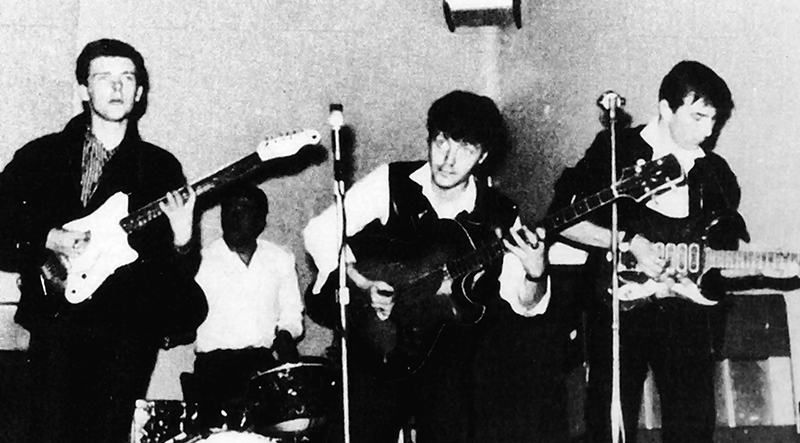
    Few successful period players appear to have used an original Black Bison professionally. One was Nicky Crouch, a fixture on the pre-Beatle Merseybeat scene with both Faron’s Falmingos and The Mojos, briefly a top 10 act in the spring of ’64. Crouch is pictured with his guitar in both bands before apparently switching to an ES-330 by ’65. It seems likely that Faron’s Flamingos raucous ’63 Oriole recordings including “Do You Love Me” and “Shake Sherry” and “Let’s Stomp” as well as the Mojos U.K. hit “Everything’s Alright” feature this guitar; perhaps not the way Jim Burns would have preferred his masterpiece to be heard for posterity, but still great listening for Merseybeat fans! More recently, renowned English avant-gardist Fred Frith still often uses a highly modified four-pickup Black Bison, but it is so little original it may not exactly count! Still, it’s a testament to the adaptability of the design.

    Wout Steenhuis, Bison Twanger.

    The elaborately handmade four-pickup Black Bison proved simply too fussy to mass-produce, so success spurred its own innovation. Taking a leaf from the Fender book Burns’ upper end guitars shifted to a bolt-on neck, three-pickup configuration. The Black Bison thus mutated into a more practical, if subtly less elegant, creation. One far easier to build in quantity. This second version of the Bison appears to have been phased in circa mid/late 1962, as the earlier Artist series was replaced by a less-elaborate set of guitars – the Vista-Sonic, Split-Sonic, and Jazz – that share hardware and construction features with the new Bisons. Apparently, even maverick Jim Burns was beginning to appreciate the production benefits of standardization!

    At this time, a new branch of the Bison family was introduced. Burns seems to have been sensitive to the needs of bass guitarists, and most Burns guitars had a “big brother.” Thus the second generation Bison guitar was paired with the new Bison Bass, easily the most versatile and impressive bass guitar yet built in Europe in 1962! The bass, which is gigantic and striking in terms of looks and sound, went on to be arguably more successful than the guitar – certainly a milestone in electric bass history, with a long-scale (331/2") neck and low-impedence Ultra-Sonic circuitry, though without Split Sound settings. A Rose-Morris catalog sheet showing the 1962-’63 guitar and bass, has the latter strangely illustrated in sunburst instead of the usual black! Both were, in fact, available in a range of colors, but black appears to have been the overwhelming favorite – a Bison in any other color is a serious rarity! White examples exist with a matching white pickguard, and are called “albino” among collectors. A ca. ’63 Burns flyer shows the second version of the bass, this time in the expected ebony finish!

    These second-generation Bisons – both bass and guitar – went through some evolutionary changes during a production run of approximately two and a half years. With their solid sycamore bodies, they tend to be quite heavy, and feel far more solid than many later Burns and Baldwin guitars. The thick black polyester finish bonds to this wood fairly well, and they usually have less finish issues than ’65 and later models. Most Bisons feature a bound ebony fingerboard with a zero-fret and plastic dot inlay. The notable differences in these models come down to the control layout on both and the vibrato tailpiece on the guitar. Earlier examples show four plain alloy knobs, with the control indications engraved on the scratchplate (in squint-worthy small print!). This changes to more elegant “clear skirt” knobs, also used on the “Orbit” series amplifiers. These are a minor work of art in themselves, with a transparent outer section carrying a painted dot attached to the small center knob and travels over a separate little number plate affixed to the pickguard… surely the most elaborate knob ever conceived! The Series 2 vibrato introduced by ’64 features a more massive bridge section than the Series 1, with more elegant saddles and strings fed through the block, along with a different internal spring layout. It is also more reliable in operation… some consider it one of the best whammys ever designed.

    On a Roll with Zoot Money.

    This timeline, as dedicated Burns followers will have already noted, contradicts most previously published information… it’s based on detailed observation and a photo/serial number database built over 20-plus years. Still, I’m sure there’s some lively discussion ahead. There is absolutely an overlap of the evolving features; the earliest guitars with serial numbers under 3,000 generally feature the Series 1 bridge and solid alloy knobs, with the control markings on the pickguard. The “skirt” knobs appear by the 3,000s and finally, the most commonly seen version of the guitar appears in the higher 3,000s range with the new Series 2 bridge mated to the two-stage knobs. This version is built up through the summer of ’64 in the largest numbers. It must also be noted that, like Fenders, most Burns guitars carry their serial numbers (a single series for all models) on a neckplate that is easily lost, changed, and certainly never originally installed in proper sequence, so, all number and dating information must be seen as approximate. Still, like Fender instruments, the patterns tend to be fairly consistent. Burns numbers usually run in batches with the occasional “ringer’ that just doesn’t want to fit in!

    This new Black Bison guitar was priced 140 to 150 Guineas, the bass slightly less. While it seems to have sold fairly well, the second-generation Black Bison saw relatively few top professional users. For the most part, English guitarists who had reached that level still wanted a “real American” guitar, not an English one; no matter how distinctive it might be! Burns instruments seemingly ended up being endorsed by pop groups, not “musicians’ bands,” and the influential players of the day rarely were seen with them – until Hank Marvin, of course. One slight exception was Wout Steenhuis, a studio player who had a specialty in re-recording instrumental versions of hits of the day, much as the Ventures and others did in the U.S. While not a “rock” player per se, he was well regarded as a musician, but wasn’t showing off his Black Bison on “Top Of The Pops” regularly! A player who did was Allan Ward of the Honeycombs, who usually played an early three-pickup Bison. Perhaps because of this, the band emerged as a fully-equipped Burns showcase (we’ll meet them in a future installment). Whether their lively Joe-Meek-produced records were actually cut with Burns gear is hard to say, but their bright twangy sound on discs suggests it. Billy Thorpe and the Aztecs were a well-known Australian band that similarly featured the striking Black Bison guitars to good effect. Indeed, older Burns guitars were sent to the antipodes in fairly large numbers, and can still sometimes be found there more easily than in the rest of the world.

    The later Bison Bass would score some high-profile U.K. endorsements, but the 1962-’64 model was often seen in the London clubs in the hands of Paul Williams of Zoot Money’s Big Roll Band, a jazzy, hard-swinging outfit much loved by hip music fans and trendy mods in 1964-’65. Williams may well have been the most respected musician to have played any Bison!

    There is no evidence that early Bisons were ever distributed in the U.S., despite efforts on Burns’ part to tap into the American market. With freight and duties, the already-expensive Bisons would have been astronomically priced by the time they reached the U.S. On this side of the Atlantic, they remain an extremely rare sight. Most American players have never seen an original! Ironically, they are often thought of as a cheap or cheesy guitar here. Still, to this day, any Burns Bison will help you stand out from the crowd! One place the Bison was definitely noticed was Japan… quite a few mid-’60s Japanese guitars carry a strong whiff of this Burns design. The inward-curving horns and general layout of the ’62-’64 Black Bisons proved to be a very influential stylistic starting point for a number of Japanese instruments – at least until the Ventures arrived with their Mosrites and started a new design trend!

    Despite their relative success, the second-generation models were fairly short-lived, with a production span of probably just over two years. In the wake of the introduction of the Burns “Hank Marvin” signature model in mid 1964, the Bison series would mutate yet again, becoming essentially a curvier Marvin and shedding most of its original character. Burns U.K. recently offered several versions of Bison reissues, including an especially nice limited-edition scroll-head 1965 version. But the original four-pickup model has never been revived in any form. Still, it remains an unmistakable guitar, and a testament to the vision of its brilliantly eccentric designer.


    This article originally appeared in VG March 2009 issue. All copyrights are by the author and Vintage Guitar magazine. Unauthorized replication or use is strictly prohibited.


    Dig into VG’s vast article archive!

    Be notified when the next “Overdrive” and other great offers from VG become available! Simply submit this form.
  • Beat Portraits: Burns Volume 1

    Beat Portraits: Burns Volume 1

    In early 2009, VG columnist Peter Stuart Kohman turned his focus on Burns, the pioneering British guitar builder. We’ve compiled the first three installments for a special edition of VG Overdrive. Watch for the complete history in the upcoming weeks.


    A Rose-Morris catalog from 1961, showing what appears to be a prototype Artist Bass (click to enlarge).

    Before American guitars became obtainable, most guitars supplied to the ’60s “Beat” era players in the U.K. were brought in from Europe or Japan. Seeing a void, a few venturesome spirits pursued the goal of creating original English-made guitars.

    There was a small but solid tradition of lutherie in the British Isles; high-quality banjos had been built in the U.K. from the 19th century and a few makers like Grimshaw and Clifford Essex/Paragon had produced professional-grade instruments – including guitars – in limited numbers. Still, compared to the U.S. or Germany, Great Britain had no fretted-instrument industry to speak of, and apparently few ready to take up the challenge.

    One who did became an enigmatic electric guitar legend – James Ormston Burns – often described as “The English Leo Fender.” While both men’s lives and the product lines they created do lend some creedence to this comparison, Burns instruments remain an obscurantist’s delight instead of a world standard. Still, buoyed by renewed collector interest and the efforts of a U.K.-based company carrying on his heritage, the Burns name is perhaps more familiar today in the U.S. than ever before – even during his mid-’60s heyday. Ironically, this is the one “Burns” company that has had long-lasting success – the one Burns himself (who died in 1998) had the least involvement with. Burns U.K., run by longtime enthusiast Barry Gibson (we’ll ignore the irony there!) created a variety of instruments ranging from carefully crafted reproductions of ’60s classics to a selection of Asian-made guitars that draw inspiration from the original line.

    Fenton-Weill’s second-generation Martian cricket bat.

    Still, it is the original ’60s Burns creations we’ll be looking at here. From 1960 to ’65, James Ormston Burns’ relatively small company produced an astounding array of distinctive, original designs. Even those obviously derivative of existing guitars always had an original look and distinctive design twist. Everything for these instruments except the tuners (Dutch-made Van Ghents) was designed and produced either in-house or by dedicated contractors; pickups, electronics, hardware, vibratos, etc. were always unique, and the sheer volume of original ideas they encompass is most impressive. If you watch the evolution of Burns’ designs, you can follow the trains of thought that must have occupied his restless mind. Nearest competitor JMI/Vox was supported by the stream of revenue from a highly successful amplifier line, but the Ormston-Burns company was dependent on the success of each new generation of guitars to survive… and in this period the generations came at blinding speed! Despite this, the one thing Jim Burns never had was an English equivalent to Fender Sales maestro Don Randall, the man who could consistently sell his ideas. He did have an ever-growing dedicated staff of specialists, and many little-known employees were major contributors to the company, but unfortunately business acumen was never his (or the organization’s) strong suit.

    Bell sells Burns, 1962.

    There are two print references on Burns history. Paul Day’s The Burns Book, first published in the U.K. in ’79 and reprinted by The Bold Strummer in the U.S. in 1990, remains one of the earliest and most comprehensive surveys of any guitar maker. The trim paperback, written with love, also sports a spiffy green sunburst cover! The second is Pearls and Crazy Diamonds, published in 2001 in Sweden by Burns collector Per Gjorde. Gjorde’s book is more a visual feast, with lush color photographs of many Burns models… though quite a few are unfortunately only shown at smaller squint-worthy size. The book also details Burns instruments until recent times, including a wealth of visual material on all eras. Despite much new research and very illuminating interviews with many of the personalities involved much of the actual guitar descriptions are little changed from Day’s work… in some cases reappearing virtually verbatim. Still, both volumes are essential for the budding Burns fan, and they complement each other well. There are also several collectors websites of note, which are invaluable in documenting some of the more perfect – and unusual – extant examples of the company’s 1960s output.

    A good deal of the following information is deeply indebted to these sources, especially Day, though in examining hundreds of instruments over the past 30 years I can “agree to disagree” with previously published information on certain points! Also, in this series I’ll attempt to cover details and raise questions little discussed in these two tomes, and leave it to the interested reader to seek out the above mentioned reference works for more detail on the basics of Burns history. This is more a personal stroll through the Burns saga, and as those who love them know, it’s an often quizzical world, filled with split sounds, Ultra Sonics, Rezo Tubes, and Martian sunbursts!

    Burns guitars are for the most part little-known to American enthusiasts, and often dismissed as cheap, shoddy, or just plain strange. While some halting attempts were made in the 1960s at American distribution, cost and tariff issues made it uneconomical to market high-grade British-made instruments to the US. Vox faced the same sort of challenges, and the result was the Thomas Organ licensing deal that eventually subsumed that company. As we shall see, Ormston Burns Ltd. would meet a somewhat similar fate at the hands of American piano/organ giant Baldwin after 1965… but that’s getting ahead of ourselves. The few Burns-made guitars most American players ever see are almost always labeled as Ampeg and Baldwin, and often are not the best examples of the U.K. company’s offerings.

    Like Leo Fender, Jim Burns was by all accounts something of an eccentric, and there are many stories from the people who knew and worked with him. He was generally reticent about his personal history. In a Beat Instrumental profile in 1964, he is described as “wanting to work in peace, he is generally known to dislike publicity – personal publicity, that is – he’ll tell you all you want to know about his staff and equipment but won’t talk about himself.” This dislike of celebrity was one trait shared with Fender. Unlike Leo however, Burns was actually a guitar player, primarily Hawaiian-style, and built his first instrument for himself in 1944 while a fitter for the RAF stationed in Africa. In the profile, he was noted as having “his own private collection of Hawaiian makes, the pride of which is a fine koa model.” Burns was originally from the Newcastle area in the northeast, but settled in London fairly soon on after his airforce stint. He worked variously as a professional Hawaiian guitarist, guitar teacher, cabinet maker, joiner and paint sprayer… developing a “perfect storm” of skills for a budding guitar maker!

    Jim Burns in 1964.

    Burns seems to have been determined to establish himself as a builder, and made gradual progress getting into the guitar business. He built a few electric Spanish and Hawaiian guitars and amps by hand starting around 1952, eventually interesting highly regarded U.K. jazz guitarist Ike Isaacs in an amplifier. By ’58, Isaacs was testing Jim’s creations and advising on the design, and the result was the “Ike Isaacs Shortcale Model,” a vaguely Les-Paul-esque creation built (by hand!) and sold one at a time. The electric pickup rig was supplied by Alan Wooton, and the “Supersound” brand name Wooten was to subsequently continue using was applied to this instrument. With perhaps 20 or so built, these guitars had little commercial impact and are so rare few collectors have ever seen one.

    In 1959, Burns’ next project in the guitar-making business was a short-lived in partnership with Henry Weill, who was an electronics “boffin” in British parlance. With his pickups married to Jim’s design sensibilities and woodworking skills, the Burns-Weill line was born. These were also hand-made instruments, but produced in somewhat greater numbers. Still, the surviving examples are very rare and show quirky individual differences. At the lower end of the line were the fairly conventional “Fenton” Guitar and Bass models, which owed something to the popular Guyatone branded Japanese made electrics, with small single-cutaway bodies, two pickups and an elongated headstock. Of considerably more interest – at least aesthetically – were the RP2G guitar and RP2B Bass, a rather bizarrely styled set affectionately known as the “Martian Cricket Bat.” These were designed with input from Roy Plummer, a well-known British jazz guitarist responsible for the asymmetrical neck design inspired by the 1930s Gretsch Synchromatic. Just who designed the slightly demented-looking sloping boxy body is unrecorded, but it certainly is original! The “RP” series were different and distinctive, love it or hate it, and must have helped draw attention to the Burns-Weill brand. Despite some success the partners split around the turn of 1960, and Henry Weill continued with the re-named “Fenton-Weill” range, in fact the first instruments sold after the split simply had the “Burns” part of the nameplate cut away! Weill continued to produce the RP-2 line in a somewhat smoothed-out version with the cutaways given a subtle curve, renamed for some reason the “American Range.” It’s hard to imagine a less “American” looking guitar! The early-’60s catalog page shown here gives an idea of their appearance. While little-associated with Jim Burns, these guitars remained essentially his earliest successful design.

    Mike Pender’s “taped together” Burns.

    After splitting from Weill, Burns established his own factory located at 131 Queens Road, Buckhurst Hill. This was actually the private residence of a Mrs. Farrell, who was Burns first major investor, so the term “factory” is perhaps optimistic! Jim’s few workers toiled in the large basement, filling it with sawdust while building the instruments that would set the Burns brand on a successful track. Jim Burns individual ideas about electric guitars were fully encapsulated for the first time in the “Artist” and “Sonic” instruments created there. Interestingly, Burns seems to have always been concerned with the needs of bass guitarists, and most Burns guitars from the beginning had a “big brother” four-string issued alongside. These models – the Sonic, Artist, and Vibra Artists – were basically the same design from a construction standpoint, and are a more original creation than often credited.

    The first of these, the Artist, was built in very small numbers. This was a three-pickup/double-cutaway guitar with fairly advanced controls including individual volumes and tones for each pickup. The most radical feature is an elegant and comfortable heel-less dovetail neck joint which made the guitar look as if it was fashioned from a single piece of wood. The Artist was fitted with a truss rod adjusted at the headstock and a 24-fret double-octave fingerboard, quite unusual at the time. With a fairly short scale of 233/8", this led to some cramped fingering up the neck!

    The Artist was quickly succeeded by the Vibra Artist – the same guitar with (surprise!) a vibrato added. This first unit was called the Vibra (Burns product naming would soon get much more creative!) and the simple flat-plate mounting would be developed into the Mark IX vibrato unit, the subject of several distinct patent applications in 1961. This particular hump-backed piece of hardware is a bit more advanced with a tension adjustment built into the housing, and will be familiar to many Gretsch fans as it somehow found its way onto that company’s Jet guitars in ’62. How this initial Burns-Gretsch connection was made remains a mystery. It’s tempting to speculate that Jim Burns and Gretsch promoter Jimmy Webster might have met at a trade show somewhere… certainly both men were brimming with creative, if sometimes impractical, ideas for the development of the electric guitar! The Vibra Artist bridge used with this tailpiece was an elaborately engineered if somewhat Heath-Robinson-looking concoction of stamped metal saddles and protruding screws; the final patent application for this engineering marvel was filed in March, 1961.

    The cheaper companion to the Artist was the Sonic Model, a simpler guitar with two pickups, a solid floating bridge, and a smaller, slightly squashed-looking body. The Sonic guitar and bass were good-quality instruments offered at a reasonable price and respected for their surprisingly gutsy sound. Sonic bodies were mostly built by an outside contractor, helping keep the small company from getting overwhelmed.

    One of the major factors in the success of all these instruments were their distinctive pickups, which were much more powerful and better-sounding than the typical European units of the day. Burns (learning the value of a catchy moniker) called them “Tri-Sonic.” These little wonders look fairly unassuming, housed in a round-edged chrome metal cover with six polepiece holes punched in the top and a donut of wire wrapped around the magnets without a coil form. All early Burns guitars mount their Tri-Sonics above the pickguard’s surface, supported by little springs with the wires meandering down into the body, giving a slightly precarious appearance!

    The success of this line led to a more upscale model being introduced – the Vibra Artist DeLuxe. A flashier version of the Artist with more flexible controls (including an on/off switch for each pickup), its hardware was gold plated, fingerboard was bound, and the guitar had a classier appearance. The Deluxe bore a small “OB” (Ormston Burns) logo plate with a lightning bolt on the headstock in place of a prosaic “Burns London” engraved plastic piece. By this time, the Burns company had moved out of Mrs. Farrell’s Victorian house to an actual factory at 300 Mace Street, Hackney, London, E.8. But it quickly outgrew this location, as well. While these guitars were not cheap, they were still priced below the American instruments lately available. Catalog pages shown here from Rose-Morris (Burns’ first major distributor) and Bell’s of Surbiton show the Sonics offered at around 50 Guineas and the Vibra-Artist closer to 80 in 1961-’62. The Vibra Artist Deluxe was priced at over one hundred pounds… quite a lofty sum for a homemade guitar in ’61! These prices are on par with the best continental imports, but Burns line were arguably the best solidbodies being built in Europe in 1960-’61.

    These early Burns instruments did attract numerous professional users, albeit mostly those just able to afford them. “Before Fenders or Gibsons, we had something called a Burns,” noted Ron Wood once in an interview. The Searchers’ Mike Pender (still being noted as “Pendergast” at the time of this picture!) was a long-time user of an early Vibra-Artist model when his group shot to fame in late ’63. “We’re still using our original battered guitars stuck together with tape” noted bassist Tony Jackson in the notes to their first LP; if anyone thinks this was a hyperbolic comment, look very closely – you may note clear tape on the upper pickup selector! The Searchers would go on to be one of the most visible Burns endorsers of the company’s “golden” year 1964-’65. Many up-and-coming U.K. bands had at least one Sonic or Vibra Artist in the lineup.

    None of the Artist or Sonic models bore serial numbers, so surviving examples can only be roughly dated by features. The Vibra Artist was already phased out by late 1962, succeeded by the next generation of bolt-neck solidbodies, but the lowly Sonic – the longest-running of these primal designs was still being offered in the summer of ’64. The construction and hardware on earlier models are a bit cruder and they feature a lacquered maple fingerboard; later ones sport a rosewood board and Mk IX vibrato in place of the flat-plate “Vibra” unit.

    Vibra-Artist Deluxe in detail.

    Surviving Sonic models outnumber Vibra Artists by a wide margin, and not only due to the lower cost and longer production run. Since the mid ’70s, old Burns Artists have suffered greatly under the predations very dangerous guitar carnivore – the dedicated Brian May fanatic! The Queen guitarist’s original Red Special, hand-built with his father, used three Burns Tri-Sonic pickups and for many years, the only way to obtain a set was to sacrifice a guitar! Although in the early ’60s, Burns freely sold the pickups separately, by the time May rose to fame they were long out of production. An unsuspecting Artist – or one and a half Sonics – were often stripped of their rig to provide the raw material to re-create this one-off guitar, or at least its sound. The cheaper Sonic pickups, built without individual polepieces, will work, but are technically wrong for accurate “May-Hem!” Happily, the modern Burns organization offer both the pickups and a full re-creation of May’s guitar, so the original Artists are less at risk today!

    By the middle of 1961, with the Burns line proving seriously viable, economically, Jim Burns was ready to up the ante and create an instrument priced to compete with American solidbodies. The guitar, dubbed the Black Bison, was a major stylistic and creative departure, and, along with the contemporary Vox Phantom, would rank as one of the most visually striking electrics of the 1960s. It was the ultimate expression of the early Burns aesthetic, and will serve as the next chapter in “As the Burns Turns!” here at “The Way Back Beat!”


    This article originally appeared in VG February 2009 issue. All copyrights are by the author and Vintage Guitar magazine. Unauthorized replication or use is strictly prohibited.


    Dig into VG’s vast article archive!

    Be notified when the next “Overdrive” and other great offers from VG become available! Simply submit this form.

  • The Ibanez Black Eagle

    The Ibanez Black Eagle

    Shop Sale ›› Vintage Guitar Overdrive sponsored by Reverb.
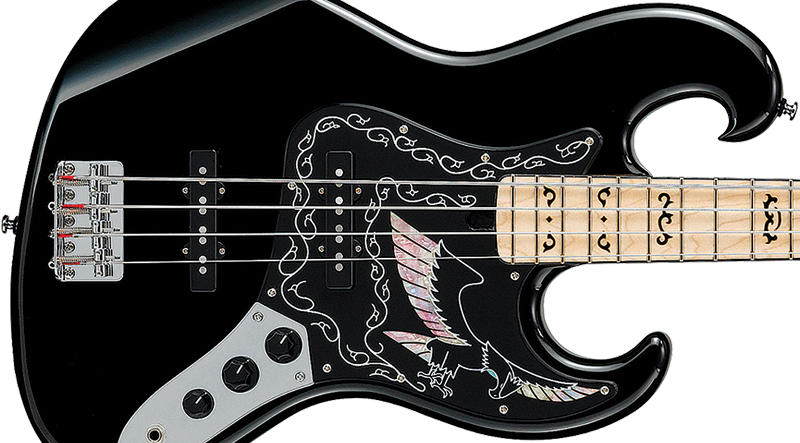
    The Black Eagle was conceived in ’75; this one (K 770658) dates to November of ’77. To mark the model’s 40th anniversary, Ibanez offered a faithful reissue. Photo: VG Archive.

    Sometimes, even overtly elaborate instruments are about more than aesthetic appeal. Take the Ibanez Black Eagle bass. No question it oozes coolness, but it also represents a turning point in the history of Japanese guitars – especially those made by Ibanez.

    In the mid ’70s, Japanese electric guitars and basses were primarily “copies” of popular American models, generally viewed as cheap commodities. And while most were indeed relatively inexpensive, they were hardly mere commodities.

    In those days, import guitars and basses were mainly handled by regional distributors such as Grossman, CMI, C. Bruno, Continental, Buegeleisen & Jacobson, Coast, St. Louis Music, L.D. Heater, and others that carried a range of instruments and accessories and employed an army of sales reps who called on music stores – typically the shop on the corner owned by a well-known local, not Big Box Guitars at the mall. Distributors assembled packages of instruments along with picks, strings, and winders. Each tried to monopolize floor space.

    Hoshino Gakki Ten, the company that owned the Ibanez brand, conceived of a different strategy. It purchased Elger Guitars, a small manufacturer affiliated with a local music store in Ardmore, Pennsylvania, outside of Philadelphia. Jeff Hasselberger, a Philly-area musician who was helping to guide the company’s marketing at the time, explains that Elger wasn’t a full-fledged distributor, so it tried an approach intended to pull customers into stores rather than push products at them, as big distributors could. With a chuckle, Hasselberger recalls how he would pose as a customer, calling stores several times over the course of a few months and ask if they had “…one of those Ibanez guitars.” They’d usually tell him they did not, but when the company’s rep finally walked in, the shop owner would say, “Ibanez? Yeah, I’ve heard of those…”

    “We were trying an end run around distributors, who were our main competition and had all the power,” he added. Ibanez guitars, being mostly copies, lacked an edge. But Hasselberger felt they could distinguish themselves by tweaking their offerings with some originality. He discussed the idea with a visiting member of the Hoshino family, who agreed.

    Enter the Model 2409B Black Eagle.

    “It and the Custom Agent were ideas swirling around in my head,” said Hasselberger. “I loved the look of a black bass with a maple fingerboard. I’d seen a guitar with fancy inlays and suggested we do that. I think they had some banjo inlays at the factory, and I knew they did great inlay work, so that’s where the inlaid pickguard came from; we kicked around ideas and landed on the eagle. I liked hot rods, so taking a familiar shape – in this case the Fender Jazz – and giving it the custom treatment appealed to me. That’s how the cutaway and headstock mods came to be.”

    Pinning exact dates on its launch can be problematic, but it appears at least one prototype was made in mid 1975 and photographed for a brochure for the German market. While Hoshino tended to print its own brochures, it’s not clear where that particular brochure was printed; those sent to the U.S. at the time are attributed to Japanese printers and did not include the Black Eagle. Meanwhile, logs at FujiGen Gakki kept by Fritz Katoh, who was in charge of production and maintained detailed records for a decade beginning in the mid ’70s, show an order for Black Eagle prototypes placed May 10, 1976, with two shipped on August 5. An educated guess is these were a second round, and the first production Black Eagles don’t appear in records until ’77.

    The Black Eagle had a mahogany body, laminated maple neck, and maple fretboard. Its pickups were two Super Bass single-coils, with two Volume controls and a master Tone. The strategy to make it so eye-catching was moderately successful. Whether for its visual impact or because the instrument was so well-made, played well, and sounded good, Ron LaPread briefly used one with the Commodores and was pictured with it in a late-’76 brochure and that year’s catalog. Perhaps contributing to its collectibility today, Nirvana’s Krist Novoselic played one. Speaking of collectibility, those who seek an original know the challenge in finding one with the delicate headstock that has survived intact or without needing repair. A fragile design element, even one tip-over posed great peril.

    Black Eagles aren’t the rarest Ibanez instruments, but neither are they especially plentiful. Records are not complete, but it’s safe to assume perhaps 30 to 40 were made in later ’76, 200 or so in ’77, 207 in ’78, and 52 in ’79, for a total of about 500. Curiously, in ’78 there were four White Eagle Basses made, one of which appeared on an internet blog with the Antoria brand.

    The Black Eagle’s page in the 1976 catalog, with Ron LaPread endorsement. It bore a certain similarity to the ’60s U.K.-made Burns Bison (right). Burns Bison: VG Archive.

    The Black Eagle hit the market just as popular tastes began to favor more-austere natural finishes and newfangled active electronics/pickups. While its impact on Ibanez was slight compared to the Artist and Iceman already in the works, it sent a message the company was moving in the right direction.

    “Its popularity pushed us toward further original ideas and the realization that new designs were going to be our lifeblood,” said Hasselberger. And the much-discussed lawsuit filed by Norlin (parent of Gibson) in the summer of ’77 lent additional “encouragement” for Ibanez to fly like an eagle – on its own wings.

    The Black Eagle premiered in Ibanez’s 1975 Custom Series brochure.

    Special thanks to Orval Engling at mr-ibanez.com. VG Editor Ward Meeker also contributed to this feature.


    This article originally appeared in VG April 2017 issue. All copyrights are by the author and Vintage Guitar magazine. Unauthorized replication or use is strictly prohibited.


    Dig into VG’s vast article archive!

    Be notified when the next “Overdrive” and other great offers from VG become available! Simply submit this form.

  • 5 Basses That Shook the World

    5 Basses That Shook the World

    Leo Fender didn’t invent the electric bass. Rather, its origins trace to the early 20th century, when Gibson put frets on a bass mandolin. Two decades later, Audiovox’s Paul Tutmarc built a fretted solidbody electric bass. However, when it comes to the electric bass as it is commonly perceived and played today, Leo deserves all the credit.

    Much as guitarists in the 1930s were reticent to plug their instruments into an amplifier, few bassists felt the need to extract more volume from their uprights. Then, of course, came rockabilly, followed closely by rock and roll – two forms in which the stationary, non-amplified “doghouse” didn’t fit the dynamic, in-your-face delivery that would become so vital.

    “The electric bass changed the way music was played – and even more how it was heard,” said VG contributor (and vintage-bass authority) Peter Stuart Kohman. “Its power and volume helped the music of the era expand in myriad directions. By the mid-’60s, a trio on guitar, bass, and drums could be louder than a ’50s big band, and recorded music gained a new low-end element to its sound.”

    “The saga of Leo Fender and George Fullerton’s efforts designing the bass that replaced the doghouse is a classic tale of American innovation,” added VG contributor/bass profiler Willlie Moseley. “Its runaway success validated its existence.”

    Here, we offer a look at electric basses that not only changed the sound of popular music, but also evolved along with it.

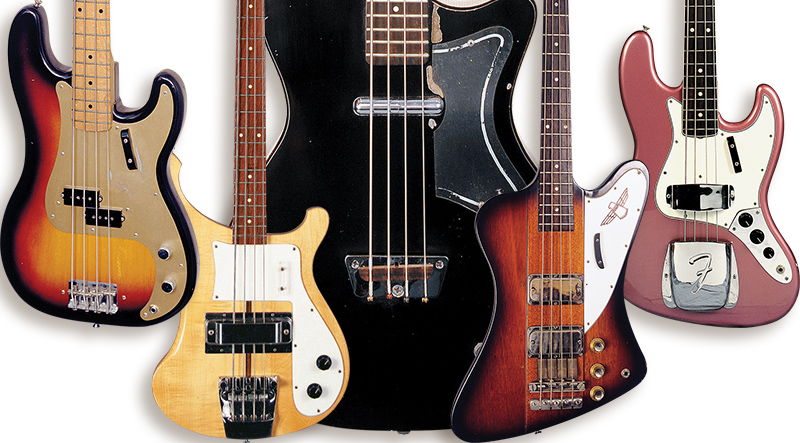
    1958 Fender Precision
    1958 Fender Precision

    Fender Precision

    When it debuted in November of 1951, Fender’s Precision was truly revolutionary – not in terms of design, fit, or finish; its square-edged ash body, one-piece maple neck, and blond finish made it essentially a slightly larger Telecaster. Rather, the Precision’s importance revolves around how it allowed bassists the same physical freedom, playing technique, and onstage posture employed by guitarists.

    Hoping to maximize its appeal and realizing the challenge it might face in gaining acceptance, Leo designed the Precision as something of a compromise. He believed its players would include two primary groups – those who played upright and those who played a regular/six-string electric guitar. Hoping to make it playable in the eyes (and hands) of each, he gave it a 34″ scale, which landed between the 42″ scale of the popular ¾-size Kay upright and the Tele’s 25½”. His thought was that any guitarist could grab a Precision and easily transition to playing bass, which in turn meant bands no longer had to find/enlist a trained upright player. Tremendously practical, it opened a broad market.

    Per Leo’s tendencies, the Precision changed with player input; in ’54, it was given beveled edges that would also be used on the Stratocaster. In ’57, it was given a new pickup with a split coil. Still, even as other companies began to offer solidbody electric basses and Fender itself launched new models, the Precision remained a standard-bearer.

    “The truly amazing thing about the Precision is how much Leo got right the first time around,” noted Kohman. “You can still walk onstage with a 1951/’52 Precision and it will perform as well or better than any bass offered since.”

    1972 Rickenbacker 4000
    1972 Rickenbacker 4000

    Rickenbacker Model 4000

    While innovative and successful, within a few years of its introduction, the Precision Bass was seen by some as “improvable.”

    One person who thought he could do better was F.C. Hall, who established Radio-Tel in the 1920s as an electronics repair shop and builder/installer of public address systems. Just after World War II, Hall established a dealer network for Leo Fender’s steel guitars and amplifiers. After watching Leo’s solidbody guitar gain quick popularity, in 1953, Hall jumped at the chance to buy the Electro String company from Adolph Rickenbacker and used it to establish an all-in-one manufacturing/distribution business focused on electric-Spanish guitars.

    In 1954, Hall hired German-born luthier Roger Rossmeisl, intent on building guitars and basses that would one-up what he saw as the blasé aesthetic of Fender’s instrument. Rossmeisl’s vision for a bass manifested in the 4000, introduced in mid 1957 with a dramatically different look and sound rendered through its now-famous “cresting wave” maple body and headstock silhouettes as well as neck-through construction, which put its “horseshoe” pickup (borrowed from Adolph Rickenbacker’s ’30s lap steels), tailpiece, and bridge on a solid center block – elements that gave it a decidedly different tone – brighter and more piano-like than the Precision. Refinements followed beginning in ’61 with the two-pickup 4001, which Moseley refers to as “the elegant antithesis” to the Precision.

    In a 1993 interview with VG, Rickenbacker CEO John Hall (son of F.C.), remarked on the 4000/4001’s departure from the “thumping, thudding” tone of the P-Bass, saying, “You’d have to call it a high-fidelity bass in that it produces a more-defined, sharper sound than almost any other on the market.”

    “The 4000 was stylish and its pickup gave it a unique sound, but it was expensive, so it sold in very small numbers,” noted Kohman. “But, the 4001 became one of rock’s signature basses, thanks to Paul McCartney, Roger Waters, and Chris Squire, whose playing led to the Rick’s mass acceptance in the ’70s.”

    Silvertone 1444L
    Silvertone 1444L

    Silvertone 1444L

    If you started playing bass as a kid – especially if you were a kid in the late 1950s or early ’60s, there are strong odds you played one of these.

    Introduced in 1959 at the (very) budget-friendly price of $79.95 (or $8 down/$8 per month!), the Sears Silvertone 1444L was immediately popular and, after the Beatles ignited the famed ’60s “guitar boom,” sold in droves.

    Made by Danelectro in Neptune, New Jersey, the 1444L was bare-bones and all-business; its black lacquer finish covered a body made of a processed-wood product called Masonite combined with pine, as well as its poplar neck. Its 29 ¾” scale made it friendlier to the shorter arms of youth and it had (in fitting with the theme) budget-minded “skate key” tuners, an aluminum nut, and a pickup developed by Danelectro founder Nat Daniel, who put its magnets and wire in actual lipstick tubes he’d bought from a cosmetics supplier. Its small, wooden bridge was moveable for the sake of intonation and was mounted on a plate with mere slots to anchor the string ends. Its headstock profile is now known to collectors as the “dolphin nose.”

    The 1444L stands as the final Silvertone-branded instrument to get the body shape that had first been used on the Dano U-1 guitar, and was also the longest-offered Silvertone bass, replaced by the all-wood 1442 and 1443 in the spring of 1966. Today, for reasons nostalgic and sonic, it (and other Dano/Sears basses) enjoy a certain status amongst collectors; not necessarily coveted, but certainly appreciated. And yes, purists will point out that Danelectro actually made far more 1444Ls with the Silvertone brand than its own.

    “Light, and easy to play, the 1444L was an obvious potential first stop for budding basses,” said Moseley. “Its wood frame and Masonite body, combined with the lipstick-tube pickups, offered a unique sound that exhibited great staying power in later decades.”

    “The 1444L equipped countless garage bands and helped put an electric bass in the hands of thousands of young players in the early ’60s, and is still a popular, practical choice today,” Kohman added.

    1964 Gibson Thunderbird IV
    1964 Gibson Thunderbird IV

    Gibson Thunderbird

    Looking to change public perception of Gibson’s instruments as boring and staid (and also to better compete with Fender), Ted McCarty enlisted automotive designer Ray Dietrich to come up with a bonafide “rock guitar” that was stylistically removed from anything else offered by the company.

    Dietrich delivered; his concept for the Firebird guitar and correspondent Thunderbird bass made a bold statement when they debuted at the 1963 NAMM show with sleek lines, neck-through construction, a unique body shape, new humbucker pickups, and 10 available custom colors: they virtually called out Fender’s Jaguar and Jazzmaster, looking for a fight.

    Offered in two forms of dress numbered in even Roman numerals (the Firebird got the odd numbers), the single-pickup/basic trim model was called the II, while the two-pickup/fancier version was the IV, and was even-morso aimed at anyone considering a Fender bass; its 34 3/8” scale, pickup placement, control layout (individual Volumes with a master Tone), and 1 ½” nut were lifted directly from the Jazz, as were the similarly-placed pickups and the rest on the pickguard.

    Though the ’Birds were well-received and sold in healthy numbers, feedback from players (and threats from Fender) forced Gibson to tweak their design after just two years; in the summer of ’65, their bodies were given a more-traditional form (now called “non-reverse”), and necks transitioned to set/glued in, and tuners were changed to the same as on other Gibsons. Collectors strongly favor the original style.

    “Gibson’s first long-scale competitor to Fender, the Thunderbird is the company’s greatest bass,” said Kohman. “Visually stunning, it combined style and function like few others, and today remains a statement for the boldest of bassists.”

    1966 Fender Jazz
    1966 Fender Jazz

    Fender Jazz

    Leo Fender being a perfectionist and Don Randall a conscientious salesman, the two were responsive to feedback from players. The Jazz Bass stands in testament. Introduced in 1960 to provide a feel and sound significantly different from the Precision, the Jazz was more curvaceous, had a slimmer, narrower neck, brighter-sounding pickups, and a dressier appearance.

    Even further evidence of Leo’s desire to please players manifests in details like the control knobs; by early ’62, the Jazz’s “stack knob” setup was replaced by the simpler three-knob (Volume/Volume/high-cut) arrangement. Other changes through the years were largely cosmetic, like pickguard materials.

    The subsequent years have seen Fender add many variants of the Jazz that offered players everything from the basic, as-it-was-in-the-beginning model to signature models, year-specific reissues, the latest active electronics, souped-up pickup switching/tone systems, five-string variations, and a host of wood and finish options. In the ’90s, the Jazz arguably overtook (or at least equaled) the Precision Bass in terms of popularity amongst players of all statures.

    Today, the mid-/late-’60s Jazz Bass is, like its brethren across the Fender line from that era, seeing a noted appreciation amongst collectors.

    “Considering how the Precision evolved, the Jazz was a logical progression that underlined how Fender wasn’t resting on its laurels,” said Moseley. “Its features were logical, so it’s easy to see why it was an immediate success – and why, like the P-Bass, it has never been discontinued.”

    “If the Precision bass was a workingman’s tool, the Jazz was the hot rod Cadillac of electric basses,” added Kohman. “By the mid ’60s it was nearly as popular as the Precision, and as bass playing evolved in the ’70s, it emerged as the choice of many of the most-influential players.”


    This article originally appeared in VG April 2016 issue. All copyrights are by the author and Vintage Guitar magazine. Unauthorized replication or use is strictly prohibited.


    Dig into VG’s vast article archive!

    Be notified when the next “Overdrive” and other great offers from VG become available! Simply submit this form.

  • The Beatles’ Casinos

    The Beatles’ Casinos

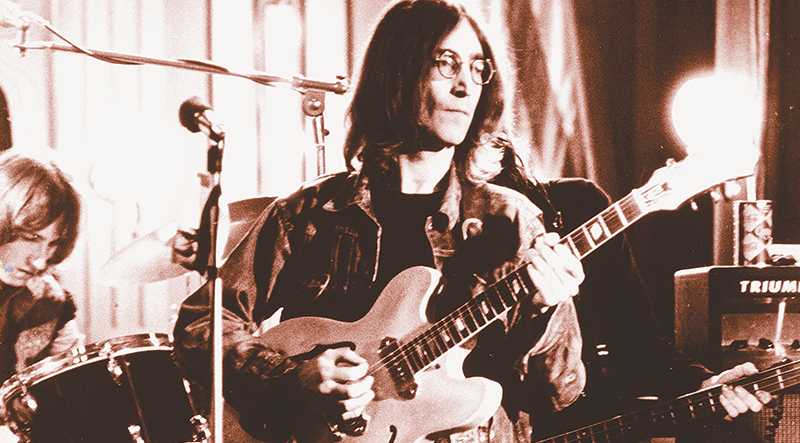
    John Lennon with his Epiphone Casino in December, 1968, on the set of “Rock ‘n’ Roll Circus.” Lennon photo: Andrew Maclear/Redferns.

    Of all the guitars the Beatles made famous, the only one that John, Paul and George had in common was the Epiphone Casino. Each owned a Casino and used it for countless recordings and performances.

    Paul McCartney’s Epiphone Casino courtesy of and copyright OutLine Press UK.

    Paul McCartney was the first Beatle to acquire a Casino. Influenced to purchase it by his friend, blues musician John Mayall, McCartney said, “You’d go back to his place and he’d sit you down, give you a drink, and say, ‘Just check this out.’ He’d go over to his [tape] deck, and for hours blast you with B.B. King, Eric Clapton… he was sort of showing me where all of Eric’s stuff was from. He gave me a little evening’s education. I was turned on after that, and [bought] an Epiphone.” Mayall recalls the late-night record sessions. “I showed him my hollowbody guitar that I’d bought when I was in the army in Japan in 1955. When people get together and listen to records, they talk about all kinds of things related to the music, so obviously we must have touched upon the instruments and it struck home. He got a hollowbody after to get that tone.”

    The Epiphone Casino ES-230TD that McCartney purchased at the end of ’64 has an early-style Gibson-design headstock rather than Epiphone’s later hourglass-shaped headstock. Photographs taken in December of ’64, during rehearsals for the Beatles’ Christmas performances at London’s Hammersmith Odeon, show Paul playing a new Epiphone Casino still strung right-handed. Another picture shows McCartney and Harrison examining the right-handed Casino, evidently discussing how they would alter the guitar so the left-handed McCartney could use it.

    McCartney’s sunburst Casino has serial number 84075, and according to Gibson’s records shipped November 1, 1962. McCartney altered it for playing left-handed, turning the guitar upside down, re-stringing it, and modifying the bridge for correct intonation. A strap button was added to now-inverted upper treble bout. McCartney used his Casino extensively in the studio with The Beatles, including the memorable lead-guitar break on “Ticket To Ride.” He also used it throughout his solo career, and still owns the guitar.

    In the spring of ’66, during recording sessions for Revolver, John Lennon and George Harrison decided to join the Casino club. The most obvious difference between these two virtually identical guitars was Harrison’s had a Bigsby vibrato, while Lennon’s had the standard Epiphone “trapeze” tail. Lennon’s was unusual in that it had a small black ring mounted around its pickup selector switch. Both had the more common Epiphone-style headstock and were fitted with gold-colored Volume and Tone knobs.

    The first time Lennon and Harrison performed with their almost-matching Casinos was when The Beatles made an appearance on the popular British TV show “Top Of The Pops.” On June 16, 1966, they entered BBC’s London studios to mime both sides of their new single, “Rain” and “Paperback Writer.”

    As the group started its ’66 tour of Germany, Japan, and the U.S., Lennon and Harrison chose the Casinos as their main instruments for the tour.

    By ’67, The Beatles embarked on the sessions that would produce their masterpiece album, Sgt Pepper’s Lonely Hearts Club Band. Present and used throughout were all three Casinos. And it was during these sessions that Lennon painted his by spraying a white or grey outline on back of the body and neck.

    John Lennon’s Epiphone Casino courtesy of and copyright OutLine Press UK.

    In early ’68, The Beatles headed to Rishikesh, India, to study transcendental meditation with The Maharishi and friends, including Donovan Leitch. There, Donovan convinced the trio to sand the finish off their instruments, telling them how a guitar sounds better without a heavy finish. After returning to London, during sessions for the self-titled “white album,” Lennon and Harrison sanded their Casinos. Lennon primarily played his newly stripped Casino for the sessions. Harrison said that once they’d removed the finish, they became much better guitars. “I think that works on a lot of guitars,” he explained. “If you take the paint and varnish off and get the bare wood, it seems to sort of breathe.” With the completion of the white album, promo clips were filmed for the single “Revolution”/“Hey Jude.” The clips showed Lennon using his natural Casino.

    On December 11, 1968, Lennon appeared as a special guest for the filming of The Rolling Stones’ television special, “Rock ’n’ Roll Circus,” which included a memorable performance by the supergroup Dirty Mac, whose members included Eric Clapton on guitar, Keith Richards on bass, Mitch Mitchell on drums, and Lennon playing his Casino. Dirty Mac’s legendary performance of “Yer Blues” was one of the show’s highlights.

    Lennon continued to use his Casino during the Beatles’ “Get Back”/“Let It Be” filming and recording sessions. On January 30, 1969, filming climaxed with The Beatles’ celebrated performance on the rooftop of their Apple Corps office building, in London. It was the last public performance given by The Beatles as a band and was documented by a slew of film cameras and still photographers – and an 8-track tape recorder rolling in the Apple basement studio. Lennon played his Casino.

    The last studio effort found the Beatles back at EMI’s Abbey Road Studios, where they recorded their swan song, Abbey Road. “The End” was intended to be the last song on Abbey Road, and gives the listener an all-too-brief glimpse of a great three-way guitar duel. McCartney, Harrison, and Lennon, in that order, each take a two-bar solo, cycling around three times. McCartney used his Casino, Harrison’s work is pure wailing Gibson Les Paul, and Lennon makes an aggressive, distorted howl with his Casino.

    John, Paul, and George would continue to use their Casinos on numerous solo projects and recordings. McCartney still uses his, even referring to it as his favorite electric. “If I had to choose one electric guitar, it would be this,” he said.


    Andy Babiuk is the author of Beatles Gear, which was recently released in a newly revised edition. He is also author of The Story of Paul Bigsby: Father of the Modern Electric Solidbody Guitar and with Greg Prevost is preparing Stones Gear, a history of the equipment used by the Rolling Stones. He can be reached at andy@tonebendermusic.com.


    This article originally appeared in VG May 2010 issue. All copyrights are by the author and Vintage Guitar magazine. Unauthorized replication or use is strictly prohibited.


    Dig into VG’s vast article archive!

    Be notified when the next “Overdrive” and other great offers from VG become available! Simply submit this form.

  • D’Angelico New Yorker

    D’Angelico New Yorker

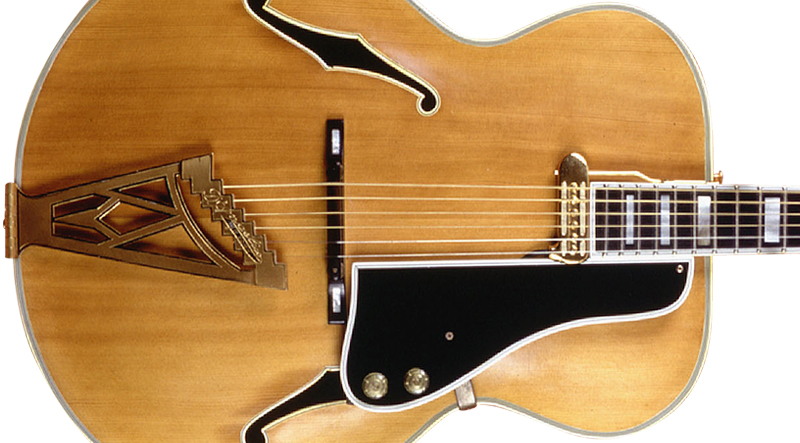
    1944 non-cutaway, blond. Photo: VG Archive.

    The D’Angelico New Yorker has rightfully earned its place in the Vintage Guitar Hall of Fame as one of the finest guitars in the history of the instrument. While models such as the Gibson ES-150 Charlie Christian, Fender Broadcaster, and Gibson ES-335 have achieved recognition and are worthy of Hall of Fame status based on their innovative qualities and superb quality, the D’Angelico New Yorker is significant primarily due to its superb quality and aesthetic artistic appeal, rather than being an innovative instrument.

    John D’Angelico’s reputation was based on producing superb-quality handmade instruments, rather than competing head-on with companies such as Gibson or Epiphone, which had factories capable of producing large quantities of guitars. While the Gibson company introduced many innovative new designs as well as very high-quality production-grade instruments, D’Angelico took the leading popular designs of his time and refined them into the most sophisticated handmade instruments available in his era. While D’Angelico’s instruments may not have been at the leading edge of design or technology, there’s no doubt his superb craftsmanship and fine sense of aesthetics raised his instruments to a level not obtainable in factory-made guitars.

    D’Angelico was born in New York City in 1905. When he was nine years old, he was apprenticed to a granduncle who made violins, mandolins, and flat-top guitars. From early childhood, D’Angelico learned how to run an instrument building and repair shop from the ground up, and he opened his own shop in 1932 to make violins, mandolins, and archtop guitars. His earliest guitars were very closely modeled after the Gibson L-5; the peghead shape was virtually identical. Although the bodies were typically ½" wider than the 16″ Gibson L-5 (measured across the lower bout at its widest point) of the time, D’Angelico’s early instruments were virtually identical in appearance to the L-5, with the exception of the peghead inlay. What set his instruments apart from his competitors was their superb quality, rather than radical new design.

    When Gibson introduced the 18″ Super 400 and the 17″ Advanced L-5, L-7, L-10, and L-12 in late ’34, D’Angelico followed Gibson’s lead. His 17″ Excel was closely modeled after Gibson’s L-5 in size and shape, although it differed in ornamentation, and his 18″ New Yorker was very strongly influenced by the Super 400. The 18″ body, split-block fingerboard inlays, X-pattern bracing, and the art deco ornamentation of the New Yorker were not introduced until after Gibson had introduced these concepts with the Super 400. But D’Angelico clearly took the concept to a new plateau with his superb craftsmanship and fine sense of aesthetics.

    Pre-order before 9 a.m. February 4, shirts mail week of February 14!!
    Available for a limited time, VG’s Fab Fours shirt recalls the pop-art movement while honoring four classic basses.

    In ’39, Gibson introduced an optional natural blond finish, and cutaway models. D’Angelico followed soon afterward, offering blond finishes as an option. Although there are very few cutaway D’Angelicos until the ’50s, from the mid ’50s until his death on September 1, 1964, the bulk of his production was cutaway models.

    Although D’Angelico had a standard line consisting of his top model, the New Yorker, as well as the 17″ Excel, the 17″ style B (roughly equivalent to Gibson’s L-10 or L-12), and the 17″ style A (roughly equivalent to Gibson’s L-7), his instruments were usually built on custom order. While the vast majority of D’Angelico guitars conform to the normal ornamental specifications of his primary four models, neck sizes differ considerably according to individual musician’s requests and the maker varied top thickness and other specifications in his efforts to produce the tone requested by individual musicians. Late in his life, he concentrated primarily on the 18″ New Yorker cutaway, a similarly ornamented 17″ New Yorker Special, and the cutaway 17″ Excel.

    D’Angelico left a legacy of over 1,100 guitars and an estimated mandolin production of 300 to 350 instruments. In addition, he did a considerable volume of repair and custom work on such a variety of brand-name instruments that there are now Gibson and Epiphone guitars with D’Angelico necks. He even built one of the first extended-length five-string banjo necks for Pete Seeger.

    While collectors today view D’Angelico instruments with awe and pay premium prices for them, in his lifetime, D’Angelico charged little more than the retail list price for an equivalent Gibson instrument. To bolster his income, he did repairs and even orders as oddball as a gun-shaped solidbody eight-string tenor electric. At the time of his death, archtop acoustic guitars were not nearly as popular as they had been when he first went into business. Unlike his apprentice, James D’Aquisto, D’Angelico did not live to see the reemergence of the archtop jazz guitar as an icon of American culture and a highly prized, expensive collectible.


    This article originally appeared in VG March 2000 issue. All copyrights are by the author and Vintage Guitar magazine. Unauthorized replication or use is strictly prohibited.


    Dig into VG’s vast article archive!

    Be notified when the next “Overdrive” and other great offers from VG become available! Simply submit this form.

  • National Dueco

    National Dueco

    Price: $4,200 (list)
    Info: nationalguitars.com

    Blues man Charlie Parr recently philosophized in VG that National resonator guitars are as much mechanical creation as musical instrument, which is why maintaining the function of vintage Nationals comes with a special set of worries and woes.

    Since its founding in 1989, National Reso-Phonic Guitar has re-created many great vintage models – and remedied their shortcomings along the way.

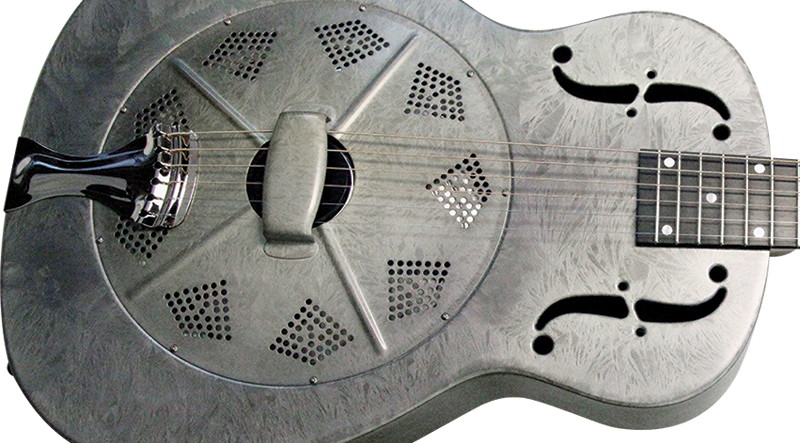
    The Dueco is a prime example. Duolians of the early 1930s were National’s budget guitars, and, as such, often the model of choice for blues men wanting to be heard above the sound and fury of a juke joint. The guitars – like the players – led hard lives, and most that survive today need a repair regimen, if not a complete resurrection.

    The Dueco is the remedy. While it retails for about the price of a prime vintage Duolian, it comes with something the old guitars don’t – rock-solid reliability. The new Dueco boasts a truss-rod-supported neck that won’t bow like your favorite archery equipment. And if it does get out of true – say you’re consistently using an A or E open tuning – you can simply realign it with an Allen wrench rather than going through the expense and agony of removing the neck and resetting it in a heat press. And then doing it again next year.

    The Dueco comes in both the early 12-fret, large-body and the later 14-fret, small-body versions of the originals. That steel body houses National’s 9.5″ hand-spun resonator – a new resonator that sounds so lovely many players insist on swapping them into their old guitars (and keeping the vintage piece in their case for originality).

    The Dueco is available in the traditional gray-green crystalline frosted Duco and the rare golden finish, which is stunning.

    The neck is made of mahogany and topped by an ebony fretboard. The slotted headstock follows the traditional early style (versus the last 14-fret guitars with their solid heads) and is identified by a stamped-in headstock logo. All told, the guitar weighs a sturdy seven pounds.

    Playing the Dueco is like playing the best vintage Duolian, except there are no rough edges, no roadblocks, no excuses. It’s kind of like stepping back in time and finding a brand-new National. Instead of compensating for 80-year-old foibles, you can focus on making music.

    Whether you’re sliding or fretting, the neck is sweetly finished. There’s no bow to hamper chording or rough fret edges to catch on a bottleneck.

    And the sound is pure Duolian – loud, but minus errant resonator buzz. Play it soft and you get that sweet, metallic tone for which single-cone/steel-bodied Nationals are renowned. Play it with a wide-open throttle and it’ll rock the house.

    Thanks to that hand-spun cone, the tone is everything you could want. Yes, it might mellow a bit with time, but you won’t be telling yourself that the guitar needs eight decades of picking to sound “right.” The Dueco has vintage soul right out of the box.

    Because the guitar’s voice is so clear and bright, we dressed it with a set of flatwounds. The Dueco loved them, enhancing the vintage vibe and doing away with excess bottleneck rattle and hum.

    Options abound with the Dueco. Both bodies are available in left-handed configuration, the 12-fret body is available as a square-neck, and there’s even a 12-string.

    It might sound like a sappy song or a greeting card, but if you love Nationals, you’ll fall in love all over again with the Dueco.


    This article originally appeared in VG November 2016 issue. All copyrights are by the author and Vintage Guitar magazine. Unauthorized replication or use is strictly prohibited.


  • Soul Tramp Tweed 12

    Soul Tramp Tweed 12

    Price: $2,375 (list)
    Info: soultrampamps.com

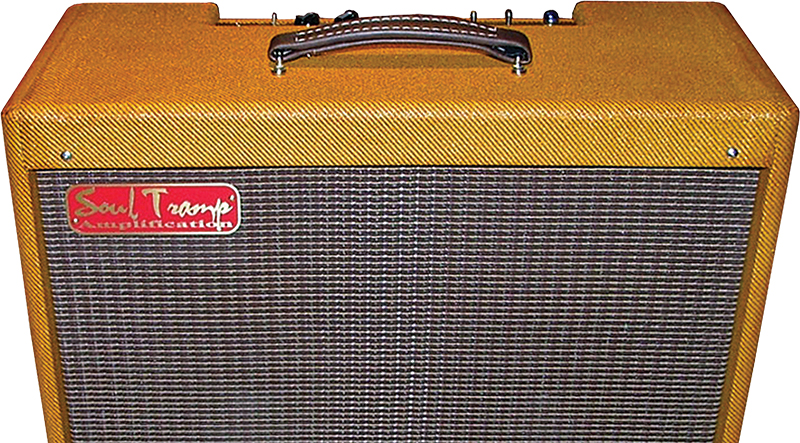
    Soul Tramp Amps are builder Don Hill’s take on classic amp circuit designs… for instance, his Tweed 12 offers a spin on Fender’s Deluxe at the height of its form.

    The Tweed 12’s cab is made with dovetail-jointed pine and has a hardwood-ply soundboard with a pair of 10″ Weber speakers (British Alnico and Ferromax Vintage, wired parallel) that combine to create nice, smooth low-end with a very clear overall projection. 

    Though fans of the tweed Deluxe will certainly appreciate the sound of the Tweed 12, this is no 5E3 clone. Rather, Hill’s proprietary circuit pushes the concept in new directions. The basic layout is comprehensive, with knobs for Volume, Tone, Soul, and Master volume, while the Boost and Bite switches extend its palette.

    Through the clean channel (labeled Volume), highs were clear and articulated, lows strong and balanced. Engaging the Bite switch produced a hump in the upper mids that didn’t shadow or detract, but added significant gain (by engaging a cathode-bypass cap).

    Pushing it further with the Boost switch – which engages a second gain stage – created natural breakup at higher volumes with slightly more clear harmonics with a smooth roll-off – classic characteristics of 6V6 tubes. Dialing the channel all the way up compressed the tone slightly. Experimenting with humbuckers and a Strat’s neck pickup, the amp had a warm crunch and hints of fuzz, but never got woolly. And with both, it offered striking touch-sensitivity and responsiveness.

    The amp’s Soul switch is voiced to add grind and snarl; it splits signal to run through both “channels” and the shared tone stack. A little tweaking in the balance unlocked harmonics and sweet spots where notes really bloomed.

    Like the Deluxe, the Tweed 12 is a cathode-biased amp, which means there’s no need to adjust bias when changing tubes. Hill experimented by swapping 6V6s for 6L6s and described the result as like going from an 18-watt to a 20-watt amp. While the Soul Tramp’s Mercury Magnetics transformers can handle such a swap, it is not recommended for vintage Fenders.

    The Soul Tramp Tweed 12 is an impressive work of art in terms of build and sound. Hill has elevated the concept, and his construction and appearance are top-notch. This is what a boutique amp is supposed to smell, feel, and sound like.


    This article originally appeared in VG November 2016 issue. All copyrights are by the author and Vintage Guitar magazine. Unauthorized replication or use is strictly prohibited.


  • Magnatone Panoramic Stereo

    Magnatone Panoramic Stereo

    Price: $2,999 (list)
    Info: magnatoneusa.com

    Magnatone amplifiers date back to the 1940s and ’50s – the era of Hawaiian-steel guitar – and boasted pearloid-covered casework befitting the silky, exotic post-war slide-vibrato sounds of the South Pacific. But they were truly set apart from the Fender-led pack with the introduction of their “true vibrato” circuitry (and proprietary “Varistor” control).

    Unlike tremolo circuits, which electronically vary the signal’s amplitude (volume) to create rhythmic staccato, the vibrato preamp stack in late-’50s/early-’60s Magnatones played on the frequency (pitch) to emulate the pitch-bending effects of fingers on frets and slide bar over steel strings. The resulting tone is unlike any other amp – a clean, psychedelic warble that, when combined with reverb, has been known to induce fits of seasickness. By the late ’60s, Magnatone had faded into oblivion thanks to a series of failed acquisitions and a shift to solidstate circuitry. Those seeking the unique “Maggie” sound had to hunt gig-worn dinosaurs to refurbish.

    It’s natural to be skeptical that the new Magnatone Panoramic Stereo could live up to the expectations created by the original 260s and 280s. Thankfully, though, the reincarnation brings back not only the late-’50s styling but, more importantly, a faithful reproduction of the circuitry. In fact, everything about the Panoramic Stereo is impressive.

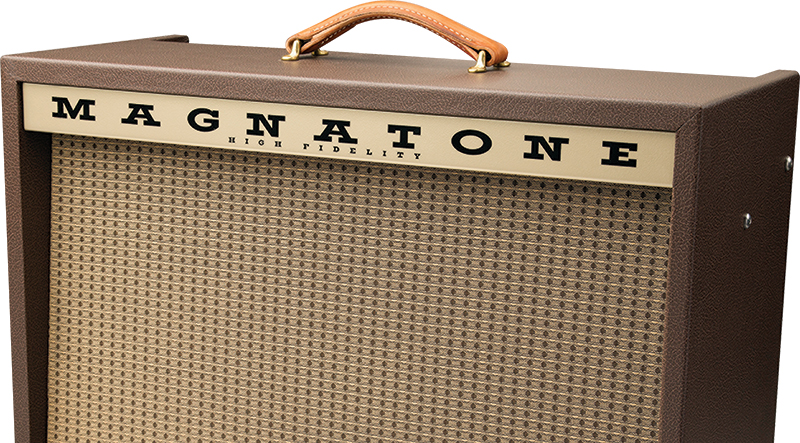
    Visually, it’s a more-compact but true rendition of the 1959 280 we used in our A/B test – right down to the brown tolex, contoured leather handle, gold grillecloth, and brass name plate. The slanted control panel on the back has Magnatone’s distinctive white chickenhead knobs as well as controls for vibrato speed and intensity. And, unlike original Maggies, the chassis doesn’t threaten to come sliding out in mid transport.

    Sonically, the Panoramic Stereo is a dead ringer for the 280, but with nice additions. It’s loud, with plenty of headroom, but there’s also an underlying hint of grit that pairs well with single-coil guitars. And unlike the originals, the Panoramic Stereo has onboard spring reverb that negates the need to haul another pedal. The combo ships with 10″ ceramic speakers (similar to the Oxfords in the 280) and has a two-switch foot controller with LEDs to engage reverb and vibrato.

    High-headroom amps should sound dead quiet, and the Panoramic certainly is. When cranked, there is plenty of volume. It was difficult to hear significant difference in tone between the new Panoramic and the ’59 280. That’s no mean accomplishment.

    Another modern twist on the original is the ability to switch between true vibrato (FM) and tremolo (AM), making the Panoramic Stereo that much more versatile. The original vibrato circuit on Maggies could dial the vibrato to a queasily slow oscillation and the Panoramic Stereo can do likewise for both vibrato and tremolo.

    For snicks, we hooked up a modified Fender Deluxe (5E3) to the Panoramic and plugged in a replica of Neil Young’s Les Paul, “Old Black” (Young being one of the more-notable Magnatone devotees; his late-’50s 280s were fed a padded-down signal from the extension speaker jack of his Fender Deluxe and were integral to his about-to-explode sound). The complexity of tone generated with this combination defies description. All we could say was, “Wow!”


    This article originally appeared in VG November 2016 issue. All copyrights are by the author and Vintage Guitar magazine. Unauthorized replication or use is strictly prohibited.


  • David Allen Fat ’59 Tele Pickups

    David Allen Fat ’59 Tele Pickups

    Price: $185 set (list)
    Info: dallenpickups.com

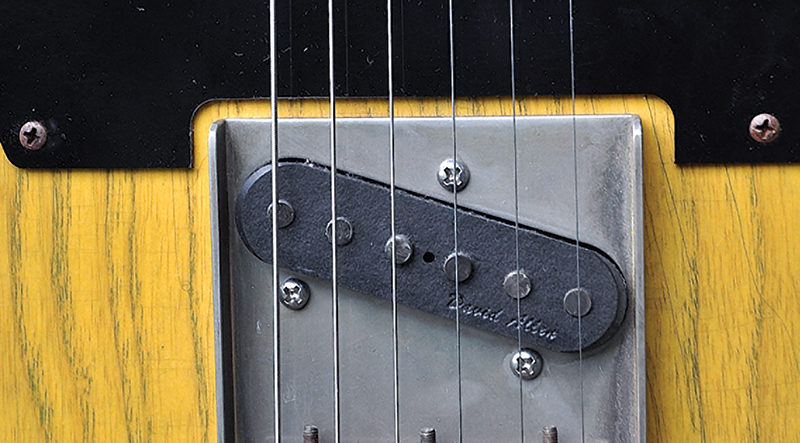
    At their best, Tele pickups deliver unparalleled twang – versatile and fat. Conversely, poor T-style pickups are flat and screechy or thin and brittle. Understanding these variables and knowing the bar is high for Tele users, California pickup/pedal maker David Allen set about making the Fat ’59 Tele set.

    For those into the science of magnets and wire, Allen used three Alnico magnets in each unit, the neck having an output of 7.2k with 43-gauge wire and the bridge sporting 7.6k of output. For the average player, that means they achieve seriously fat tones without breaking a sweat. Adjectives like “beefy,” “warm,” “organic,” and “articulate” came to mind as we tested a Tele fitted with a set.

    The neck pickup was chunky and funky, but not dull or bassy. The nuances and sonic girth of each note were obvious. The bridge position offered that spank and twang without that screechy high-end that can be distracting (unless your name is Albert Collins or Robbie Robertson). There were lots of other cool T-tones, too, from Danny Gatton to Jim Messina to Roy Buchanan.

    Take note; plugging your plank into a good tube combo will make these pickups really shine. With the right amp, they’re rounder and fuller, delivering that authentic twang so many players crave. You can even use the neck pickup with the Tone knob dialed down to get some sweet jazz flavors.

    Rock to blues, jazz to country, alternative to shoegazer, the Fat ’59 set brings sparkle to whichever gig you drag your Telecaster. It’s an impressive set.


    This article originally appeared in VG November 2016 issue. All copyrights are by the author and Vintage Guitar magazine. Unauthorized replication or use is strictly prohibited.