After five records with his glam-rock-inspired band Crash Street Kids, guitarist Ryan McKay has settled in with Louis Prima, Jr. and the Witnesses. Fronted by the son of a jazz legend, the band has a third album on the way – and McKay continually sharpening his jazz chops.
He landed the spot after an audition in Las Vegas.
“Louis wanted people who were comfortable jumping around onstage, but adept at jazz,” he said.
Accustomed to Les Pauls and Marshalls, the job also required new tools.
“I owned a Fender Twin, but needed a hollowbody, so I bought an Ibanez Artcore. After a while, Louis got a deal with Gretsch, so I now play a White Falcon. It’s gorgeous, and the pickups are perfect for the music. Out of the box, it was, ‘Oh, yeah. That tone!’ I got a Vox AC30 to accompany it.”
With effects, he believes less is more.
“I keep it simple – a Fulltone OCD and a Boss Tuner. With the AC30, I turn it up until it breaks up a bit, and that’s my rhythm tone. I use the OCD to boost solos and add a touch more gain for leads.”
Establishing a balance with the other players in the band is also essential to the sound.
“It’s a 10-piece, so we can get into serious traffic jams if we all try to fill the sonic space. So it’s okay to lay out on certain parts for the sake of dynamics.”
Of course, McKay’s parts are all about the swing.
“You have to really get that; I try to be dynamic with my right hand because Louis’ dad’s guitar players were real technicians when it comes to swinging. It’s that eighth-note rhythm where you push the offbeat as far to the right as you can – almost on top of the next downbeat – and swing as hard as you can.
“The first record, Return of the Wildest, is Louis’ dad’s material, and I was still using the Ibanez. After touring, the label asked if we could write, so a few of us wrote what would become the second record, Blow. By the time we got to the studio, I had my Gretsch and the AC30. I also used a Glasswerks Overdrive Deluxe amp and I kept a Les Paul around. There was one track, ‘Fame and Glory,’ that was perfect for a big Gibson rock solo.
“It wasn’t lost on us that we were recording at Capital Records, where Louis’ dad recorded a lot of his famous material. His picture hangs in the hallway and we put it in Studio B with us, where he recorded “Jump, Jive and Wail” and “Just a Gigolo.” There was some magic in that studio.”
McKay hasn’t forsaken his rock repertoire.
“Greg Chaisson and I have a project with Michael Beck, called Kings of Dust. We recorded an album’s worth of material but went on break because Greg was battling cancer. Everyone kept writing and now that Greg’s got a clean bill of health, we’re hoping for a fall ’17 release. The music is heavy rock like Deep Purple and Black Sabbath, and it’s a chance for me to stretch as a player.”
This article originally appeared in VG January 2017 issue. All copyrights are by the author and Vintage Guitar magazine. Unauthorized replication or use is strictly prohibited.
Equal parts anniversary party, all-star jam, and “you really needed to be there” celebration, a September ’15 performance by the Nitty Gritty Dirt Band at the Ryman Auditorium kicked off the group’s 50th year of existence and featured reworked arrangements of its classic songs abetted by special guests including Vince Gill and Alison Krauss along with songwriters who had long been the band’s own heroes.
Assisting were steel/dobro icon Jerry Douglas, multi-instrumentalist Sam Bush, and bassist Byron House. “They’ve been an extended part of our band whenever we could get ’em,” Hanna said. “They have great careers in their own right, but they’re also great friends.”
Tunesmiths who joined included John Prine (Hanna’s favorite moment was singing “Paradise” with him), Rodney Crowell, and original member Jackson Browne. Jerry Jeff Walker helped on “Mr. Bojangles,” and former member Jimmy Ibbotson played on two songs.
Hanna has an impressive vintage guitar collection, but tends to use reissues onstage.
“As much as I dearly love my old guitars, subjecting them to the rigors of the road is not a very good idea,” he said. His primary electric at the Ryman was a reissue Gretsch Duo-Jet with hump-block fret markers and a Gretsch Bigsby. The guitar has a reissue DeArmond pickup in the neck position and a TV Jones pickup at the bridge.
“I love the Bigsby,” he enthused. “I use it every chance I get. I love that sound; it’s like nothing else.”
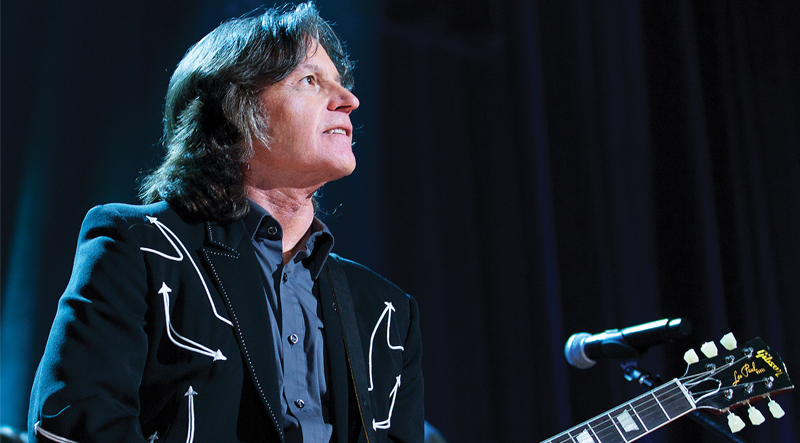
His acoustic was a limited-edition Gibson Advance Jumbo Concert.
“It has pre-war appointments and a thinner body,” he detailed. “It’s a great guitar and my favorite stage Gibson. I’ve been playing modern Gibsons on the road for a long time.”
Late in the concert, Hanna played a figured-top Gibson Les Paul Standard Collector’s Choice Series #33 Jeff Hanna model from the Custom Shop. “They cloned my ’60 sunburst, and it looks like the real thing and plays great,” he said. “I think the level of instrument building, right now, is at an all-time high among the American builders, and the Japanese,” he said. “Fender, Gibson, and Gretsch are making fantastic instruments.”
Hanna also used a Strat at the Ryman.
“That one’s kind of odd,” he chuckled. “It’s a ’62 reissue in Olympic White with a ’89 neck from my first ’62 reissue. It has Samarium Cobalt pickups and a Hip Shot drop-D tuner. It sounds like an early-’60s model.”
Ever the enthusiast, Hanna spent a good bit of time checking out the instruments played by others during the performance, including House’s Epiphone Jack Casady bass, a five-string Fender Jazz, and an old Czech upright. Vince Gill used a Martin 0000-28, and Rodney Crowell played a ’30s Gibson L-00. Nitty Gritty multi-instrumentalist John McEuen played a ’27 Gibson Florentine banjo, a Givens mandolin, a ’55 Fender Champion lap steel, and a Mervyn Douglas Smooth Talker six-string instrument made in South Africa. Jimmy Ibbotson played an’80s Gibson J-100, Jerry Douglas went horizontal on a Paul Beard resonator and Lap King steel, and Sam Bush played his iconic ’37 Gibson F-5.
“John Prine was playing a new Martin D-41, and Jerry Jeff was playing my Gibson Woody Guthrie model,” he noted.
A consummate musician, Hanna is rightly proud of the concert.
“Everybody brought something great. We’d worked so hard that we were somewhat tired when we hit the stage, but the energy from that crowd had us levitating!”
This article originally appeared in VG January 2017 issue. All copyrights are by the author and Vintage Guitar magazine. Unauthorized replication or use is strictly prohibited.
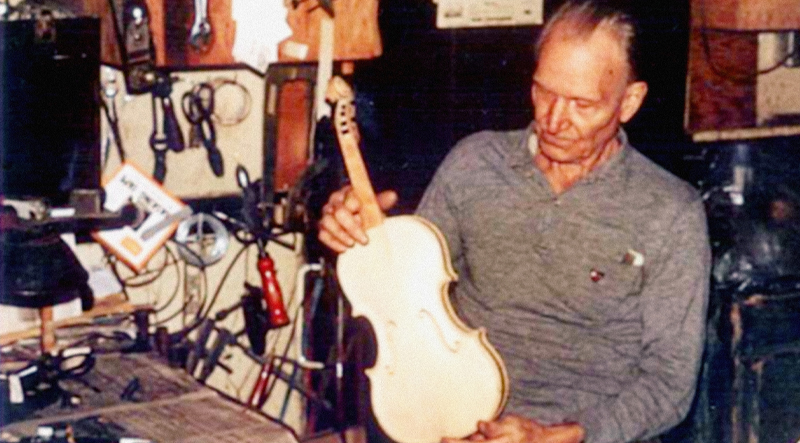
Carl Johnson examines a violin in his workshop. Carl Johnson photo courtesy of Wade Thames.
“Art for art’s sake.” The expression is common. But how often is it practiced?
In a basement studio on Chicago’s North Side, Carl Johnson epitomized the maxim while building archtop guitars bearing the Albanus brand from the 1950s until the ’70s. Rather than seek fame or fortune, Johnson was content to live modestly and draw pleasure watching people play his instruments, including professionals Fred Rundquist, Johnny Gray, Pat Ferreri, Ron Steele, Jack Cecchini, Bobby Roberts, Earl Backus, and Dick Curtis.
Today, many compare the sound and quality of Johnson’s guitars to those of D’Angelico, yet little is known of his life or craftsmanship.
Born Carl Albanus Johannson on December 18, 1892, his family lived in Fjallbacka, a fishing village in Sweden. Known for its herring industry, a periodic shortage may have caused the family to move inland to Barfendal by the time Carl’s last sibling was born in 1900.
Between 1910 and 1922, Johnson immigrated to the United States and settled in Akron, Ohio. On October 2, 1923, he married Maria Therese Kjellson. Their marriage license says Carl was employed by Mason Tire and Rubber.
The ensuing six years included a move to Chicago and the birth of a son, Werner. As a sideline, Johnson played violin at Swedish dinner dances, which is how he met a young Fred Rundquist. Life was uneventful for the young family until Maria contracted tuberculosis and had to be committed to the Chicago Municipal Tuberculosis Sanitarium. After several years of confinement, she passed away March 30, 1932.
With the advent of the Great Depression, Johnson struggled to maintain steady employment. With little work available, he sent his young son to Sweden, where he then lived with Johnson’s sister. Carl did not see the boy again until he traveled to Sweden in 1969.
(LEFT) The headstock on this circa-’69 Albanus has Johnson’s script logo and fleur de lis headstock inlay. (RIGHT) The headstock on this circa-’73 Albanus has the broken scroll pediment and inlaid stars. ’69 Albanus courtesy of Skinner, Inc. 1973 Albanus courtesy of Gary Dick.
As the country entered a new decade, Johnson continued to struggle to make a living. The 1940 census lists him as a lodger in a house on Beacon Street, in Chicago, his occupation, “Machinist.” He was employed for just 21 weeks in ’39.
A draft-registration card issued in ’42 indicates Johnson resided on Malden Street and was once again unemployed. Most interesting, though, is that in the field labeled “Name and Address of a Person Who Will Always Know Your Address,” Johnson wrote, “Mr. C. Rundquist, 2031 Wilson,” indicative of the bond between Johnson and the family of Fred Rundquist.
It’s not clear what Johnson did for a living from the mid 1940s until the mid ’50s, though a clue may be found in a March ’88 interview in Archtop magazine by Martin Taylor with Carl’s friend, professional guitarist/luthier Bill Barker (1924-1991). In the feature, Barker said Johnson “…never did luthiery on a full-time basis – he was actually a maintenance machinist with one of the railroads.” Prior to 1950, though, Johnson began constructing violins, violas, and cellos – primarily student-grade instruments sold directly or through local shops. One person who purchased several for students was Karl Fruh, a cellist and teacher.
Around this time, Johnson moved to 1909 Wilson Avenue, the address that would serve as his home and workplace for the rest of his life. A basement apartment, it consisted of a bathroom and one other room that served as workshop, kitchen, and bedroom.
By the early ’50s, Rundquist, then an NBC staff musician and member of the Art Van Damme quintet, was bringing his guitars for Johnson to repair; through the years, Rundquist owned multiple Gibson, D’Angelico, and Stromberg archtops, which gave Johnson the opportunity to observe differences in design and construction.
Albanus 10-string mandolin made for Earl Backus. Albanus mandolin courtesy of Ron Steele.
One enduring myth is that Johnson learned archtop guitar construction from Charles and Elmer Stromberg at their shop in Boston. This has been commonly surmised in part because all three were of Swedish descent and because Johnson used a single diagonal brace to support the top plate in some of his guitars. To date, though, no evidence suggests there was anyone other than Elmer and Charles working at the Stromberg shop in the ’50s. This was confirmed by the late guitarist Chet Krolewicz, a close friend of Elmer who recalled Johnson’s name coming up in e-mail correspondence with Stromberg expert Jim Speros.
Prior to his death in 2009, Rundquist corresponded with Speros about a Stromberg Deluxe he purchased from Hank Garland in 1953/’54. It had a short scale, and Rundquist asked Elmer to build a long-scale neck and send it to Johnson. Elmer communicated with him about its installation (Stromberg did not use glue to attach necks, preferring instead a very tight joint). One can speculate this work would have provided Johnson the opportunity to study Stromberg’s work in-depth (bracing, carving, etc.) and ask sufficient questions.
Though it’s not known exactly when Johnson began to build archtops, it happened prior to mid 1955 thanks to encouragement from Rundquist and guitar teacher George Allen, who pointed out a need for such professional-grade instruments in Chicago. Guitarist Art Ormaniec ordered one at that time, likely having heard about Johnson from Ron Steele, one of Allen’s students. Ormaniec received the guitar in early ’56, shortly before joining Tommy Alexander’s big band for a tour of the South and Midwest. On the evening of May 20, Ormaniec was a passenger in a car (driven by Alexander) that was in an accident outside of Berlin Heights, Ohio. Seriously injured, Ormaniec was confined to Sandusky Memorial Hospital for several days; the accident and his discharge were reported in the Sandusky Register Star-News on May 21 and 25, respectively. Ormaniec’s guitar sustained a split in the top and was repaired by Johnson.
In 1957, guitarist Pat Ferreri took a job as staff musician for the ABC television affiliate in Chicago and needed a top-quality archtop. As luck would have it, Ferreri was also a student of Allen, who had recently taken delivery of an Albanus cutaway archtop and offered his non-cutaway Albanus to Ferreri. According to Allen, the non-cut was the second archtop made by Johnson and originally shared the deep-red finish on Ormaniec’s guitar (and no other Albanus uncovered to date); Johnson disliked the color and asked Ferreri to let him refinish the instrument in sunburst.
Pat Ferreri performing with Bobby Christian’s band.
Ormaniec’s awareness of Albanus guitars meant at least one was already in circulation. Considering the time it takes to construct an archtop, Johnson probably started building Allen’s first one prior to ’55. Therefore, a best guess is that Johnson completed his first guitar in ’54.
Thanks to the quality of workmanship, materials, and the style, by the late ’50s, word-of-mouth demand for Albanus archtops had increased to an extent that Johnson had more than enough work to occupy his time. He used solid-wood bodies and hand-carved tops and backs (typically, cello sets). Though he offered a floating pickup, his guitars were primarily built to be played without amplification.
Despite having little spare time, Johnson imparted his knowledge to several people, the most well-known being Barker, who was looking for an alternative to life on the road. Barker lived in Toledo and began making weekly visits to Johnson’s shop, where he would take pictures, make drawings, copy tools, and use certain pieces of Johnson’s equipment. The only restriction was that Barker could not look over Johnson’s shoulder while he was working. After months of “bugging him out of his mind,” Barker learned enough to begin making jigs and templates of his own designs. Circa ’61, he built his first guitar.
Johnson continued to make guitars into the ’70s. In ’74, he was diagnosed with chronic pancreatitis which over the next two years evolved into cancer. By September of ’76, the cancer had spread to other parts of his body. It’s not known when Johnson’s final build was completed, but he was still taking in work as late as October, when he returned a questionnaire to Susan Caust Farrell for her book, Directory of Contemporary American Musical Instrument Makers.
On June 9, 1977, Johnson passed away after a short stay at St. Francis Hospital, in Evanston. Barker estimated Johnson built approximately 75 guitars during his lifetime.
Characteristics and Innovations
Pat Ferreri in the late ’50s, playing the second Albanus at ABC Television studios in Chicago.
Albanus guitars are many things. One they are not is cookie-cutter.
Billy Cook, who apprenticed with Barker and now operates Cook Guitars, has seen a lot of Albanus guitars and speculates Johnson used few templates. In fact, based on instruments tracked down to date, it appears Johnson was highly experimental. His top-bracing patterns include parallel, X, and a single diagonal brace similar to later Strombergs. Scale lengths range from 24″ to a 26½”, lower bouts from 17″ to 18″, and body depth from 31⁄8” to 33⁄8“.
LEFT) The second Albanus guitar, made circa 1955, has a cutaway and tailpiece added later. (RIGHT) 1957 Albanus made for Johnny Gray with hand-made violin-style tailpiece. Johnny Gray guitar courtesy of Michael Gaughan.
Some guitars were designed to accommodate the playing style of the owner. When he visited the shop, Ferreri would often play for Johnson. Johnson was impressed by how Ferreri used the full range of the instrument, and wanted to build one pitch-tuned to fit him. If a player focused on chord voicings using the lower strings (a la Freddie Green), Johnson would build the guitar to resonate at the note G. If the person played in a more-modern style focused on higher chord voicings, it would resonate at the note A. In Ferreri’s case, Johnson adjusted the pitch midway between, and the resultant guitar served as his primary instrument until it was stolen several years later.
Johnson’s experimentation was not limited to body design. His earliest employed a standard Kluson trapeze-style tailpiece, but by ’56 he’d designed a one-piece unit with four cutouts and an X-shaped center. In ’57, he introduced a violin-style tailpiece consisting of an ebony or rosewood façade with a brass inset. The inset extended beyond the façade and attached to the body. Each string passed through an opening in the wood, but the ball-end secured against the metal portion. In addition to aesthetic appeal, the wood eliminated sympathetic vibration of the strings.
On some guitars, Johnson installed hand-made tuning machines. Employing his machinist skills, he used a friend’s shop to construct brass tuners he installed in place of the Kluson Sealfasts on some models. His have an engraved A on the back of the gear box and buttons with curved edges. Their ratio is equal to or higher than the Klusons.
In addition to violin-family instruments and archtop guitars, Johnson made at least two mandolins, for guitarists Earl Backus and Jack Cecchini. The instruments have 10 strings tuned like the first five of the guitar, making for an easy transition.
Dating Albanus Guitars
(LEFT) Art Ormaniec with his early-’56 Albanus, with red finish and brass tailpiece. ( RIGHT) Ron Steele in 1958, holding his circa-’56 Albanus with original sunburst finish and hand-made brass tailpiece.
Dating an Albanus guitar is not simple because chronological markings are almost nonexistent. At least one has a label with the Albanus name. Written in ink is the year (1957), the original owner’s name (Johnny Gray), and a serial number (111) that does not appear to have chronological significance. It may have been included strictly to identify the instrument in case it was stolen. The only way to date most Albanus guitars is by finish, hardware, and headstock design. The earliest were Cherry Red and used a Kluson tailpiece and tuners. Also, the top of the headstock was contoured similar to a pre-1940 Gibson archtop. By ’56, Johnson’s guitars retained the red finish, but had his first hand-made (all-metal) tailpiece and the headstock top was shaped in a descending curve bisected with a single cusp (this pattern was used at least through the ’60s, perhaps later).
Carl Johnson’s hand-made tuning machines on a late-’50s Albanus.
In ’56, Johnson began applying a sunburst finish and in ’57 he began using the violin-style tailpiece. For at least the next five years, he made no significant changes to his instruments; Pat Ferreri’s guitar from ’62 stands in testament. However, by ’65, the original Albanus logo in block print and five-point star on the headstock had been replaced by a cursive version of the logo and a diamond inlay. By ’69, the diamond inlay had been replaced with a fleur-de-lis, and by ’73 the headstock had a broken scroll pediment with two inlaid stars.
Conclusion
Jack Cecchini recalls that Johnson particularly enjoyed hearing him play Bach’s solo violin works on Albanus guitars. Johnson loved music and strived to create instruments people loved to play. He received neither fame nor fortune, but left a legacy of noteworthy instruments.
James Leckinger is a guitarist and bassist from Lebanon, New Jersey, who is especially interested in jazz of the 1940s and ’50s.
He can reached at jwl5710@gmail.com. This feature is dedicated to the memory of Dick Curtis.
This article originally appeared in VG February 2017 issue. All copyrights are by the author and Vintage Guitar magazine. Unauthorized replication or use is strictly prohibited.
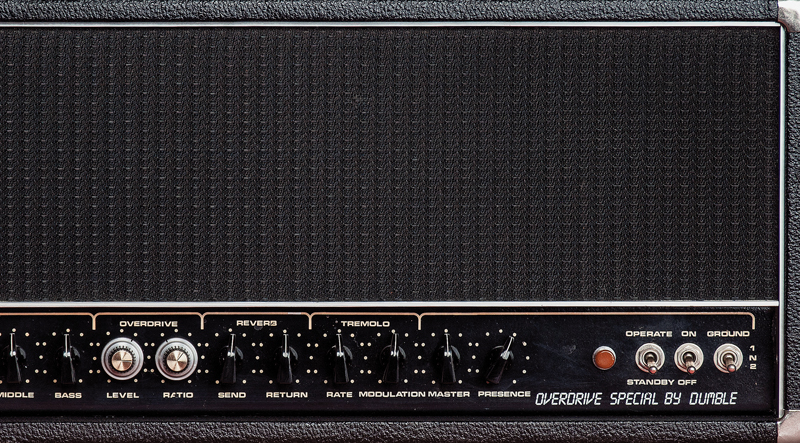
1983 Dumble Overdrive Special OD150 WR • Preamp tubes: six 7025, one 7247 (12DW7), one 5751 • Output tubes: four 6550 or KT88 • Rectifier: solidstate • Controls: Volume; switches for Bright, Deep and Rock/Jazz; Treble, Middle, Bass; Overdrive controls (on dual concentric knobs) for Trigger, Level, Ratio, and Taper; Reverb Send and Return; Tremolo Rate and Modulation; Master Volume, Presence • Output: 150 watts RMS 1983 Dumble Overdrive Special: Dean Gurr.
Alexander Dumble’s creations were already established as legendary when we probed our first example in this space back in May of 2011. Since that time, however, Dumbles have become the hot ticket for cloners on the boutique scene, and originals are perhaps the hottest amps on the vintage market. The difference in price between used Dumbles and vintage Fenders, Voxes, and Marshalls? Oh, about 10x… or more.
While all Dumbles are prized, the real peaches are those with solid provenance and an intriguing back story – and few are more enticing than this ’80s Overdrive Special.
Dubbed by its creator as the Overdrive Special OD150 WR, it was one of a pair (yea, two identical Dumble heads) built along with four 2×12″ cabinets with ElectroVoice EVM12L speakers ordered by ace studio and touring guitarist Todd Sharp.
Now a respected Nashville amp tech and builder/marketer of hand-wired amps (see his “Builder Profile” in the November ’16 issue), back in the ’70s and early ’80s he was a hard-working road warrior backing Hall & Oates, Christine McVie and Mick Fleetwood, Rod Stewart, and Delbert McClinton, among many others. Flush with gig money, he set out to assemble an amazing tone rig.
After playing the amp onstage and in the studio, including notable tours with Rod Stewart from 1989 through ’91, Sharp decided he didn’t need two massive Dumbles after all, and sold this one. In a cruel twist, soon after, its partner was stolen.
In addition to its four big 6550 output tubes, the OD150 WR’s rear panel has two unusual features for a Dumble – a half-power switch (immediately right of the BNC connector inputs) and bias-test points.
Any Dumble amp is a formidable beast, but this is a particularly complex creation. The amp generates 150 watts from a quartet of 6550 (or KT88) output tubes and a set of massive transformers. Along with a rendition of the maker’s classic input and EQ stages, there’s a tweaked version of his overdrive circuit, reverb with controls for Send and Return, and onboard tremolo (a Dumble rarity). Its clean tones have been described as a combination of Steel String Singer and Dumbleland, and its sophisticated overdrive employs a 12DW7/7247 dual-triode. The stage includes two dual-concentric pots (modified by Dumble from a four-knob OD that had two pots on the front panel and two on the back), including a Trigger control to adjust how much signal is fed to one side of the triode, a Level control to adjust how much is sent to the other triode, a Taper control to adjust the scale of the high frequencies, and a Ratio knob to determine how much overdrive is blended back in from previous preamp stages.
The amp’s tremolo (another unusual feature for Dumble) has a broad range that works with the reverb – the same two-knob circuit often used on Steel String Singer models to add lush, hypnotic effects to an already harmonically rich tone. On the back panel is a 150W/75W (i.e. half-power) switch along with more rare touches like bias-test and adjustment points for the output tubes. The four-knob footswitch selects on/off for each of the effects, plus Overdrive and Preamp Boost.
“I first played a Dumble at The Alley rehearsal studio in North Hollywood while rehearsing with Mick Fleetwood in 1981 or ’82,” Sharp recalled. “Alexander had left the amp there for me to try, and it blew me away at first touch – never heard anything like it; the overdrive was thick, rich, and delicious. Aside from Mesa, no one at that time was paying a great amount of attention to building an amplifier with onboard tube overdrive. But above all, that was what Dumble did better than anyone. Fair to say, its [clean] channel was also quite good – very clean, tight, bedrock-solid, and fairly Fenderish in character, but much bigger.
The original four-knob footswitch selects on/off for each effect, plus Overdrive and Preamp Boost.
“I offered to buy the amp, but it was spoken for by David Lindley, I think. So, I put down a deposit and ordered two very much the same except I wanted reverb, tremolo, and the bias test points at the rear panel.”
Sharp used his Dumbles in the studio with a handful of artists, as well as on his own self-titled 1986 album for MCA, but recalls there was only one setting in which he really got to wind them up.
This amp’s Overdrive stage is governed by four functions on two dual-concentric pots (toward the right side).
“I joined Rod Stewart’s band in 1989 and I remember the first day of rehearsal – Tony Brock hit his snare drum once and it nearly blew me over a few feet coming out of the side-fill monitor. I looked at Davey Bryson, the monitor mixer, and he just grinned back, then, in his thick Glaswegian drawl, said something like, ‘Welcome to the loudest f’ing band in the world, mate.’ I’d brought my Fender Dual Professional and Vox AC30 thinking they’d do the trick. Second rehearsal, though, I had both Dumbles and plugged them into some white-painted Marshall 4×12″ cabs – everything on Rod’s stage had to be white – and in short order took care of the volume disparity. That was really the only band I ever played with where my Dumbles fit, power-wise,” Sharp said.
However formidable the amp’s power, its current owner (who prefers to remain anonymous) finds pleasure in its exalted tone.
“I’ve owned the amp for two years and play it almost every day. My routine is to play for an hour before work, always through this amp; the connection puts me in a great place to experience the day. I consider it a piece of art that I can interact with, explore, and enjoy. I’m grateful to own it.”
This article originally appeared in VG February 2017 issue. All copyrights are by the author and Vintage Guitar magazine. Unauthorized replication or use is strictly prohibited.
Twelve years ago, Janglebox founder Steve Lasko set out to create effects pedals that capture the sparkling clean chime made famous by bands like The Beatles and The Byrds. Since then, his company has evolved to offer more ways to enhance the electric guitar’s sonic capabilities.
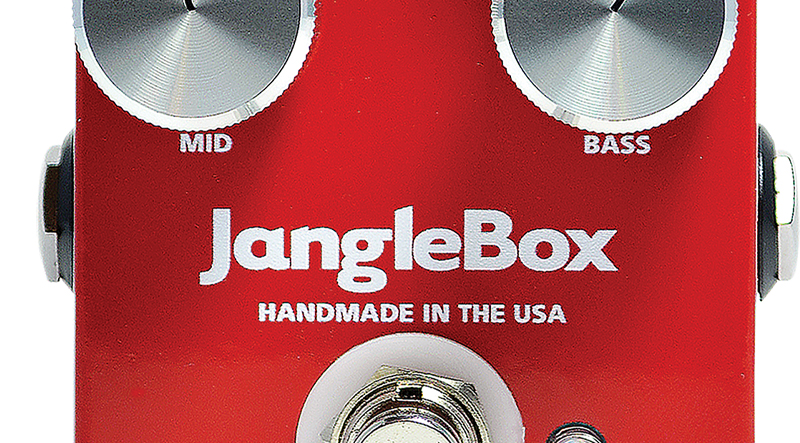
The J-Boost Non-Compression Clean Boost is the perfect companion to the JangleBox compressor line (or any compressor pedal). Designed to offset the lack of output when dialing in low-level compression settings, the J-Boost allows the player to maintain a desired flavor of compression without sacrificing volume. The J-Boost also lets the user lower their compressor’s attack to a lighter setting. Once engaged, the J-Boost serves opulent output with all the squish intact.
Made in the U.S., the true-bypass J-Boost has four knobs offering simplicity and flexibility; its Master, Treble, Mid, and Bass controls are accompanied by an input for a 9-volt adapter, all in a small enclosure.
The J-Boost is an EQ boost as well as a volume boost, providing lots of shaping and control. The output is immaculate and can be used as a treble booster, a mid boost, or for cranking up the bass. In testing, it added vitality to flabby lows and warmed up screechy highs. It’ll push an amp to slight breakup with a sharp richness and clarity and add a new dimension to distortion pedals.
With a compressor’s settings fine-tuned at a gig, the J-Boost goosed the compressor’s personality, making it much more prominent. Once thought too subtle to make an audible difference amid the wash of frequencies and chaos of club noise, the compressor’s unique qualities came to life, with the J-Boost pushing it to shine in all its taut, strangled glory.
Indeed, the JangleBox J-Boost is a fine pedal that provides a seamless volume increase and sheen to any rig.
This article originally appeared in VG February 2017 issue. All copyrights are by the author and Vintage Guitar magazine. Unauthorized replication or use is strictly prohibited.
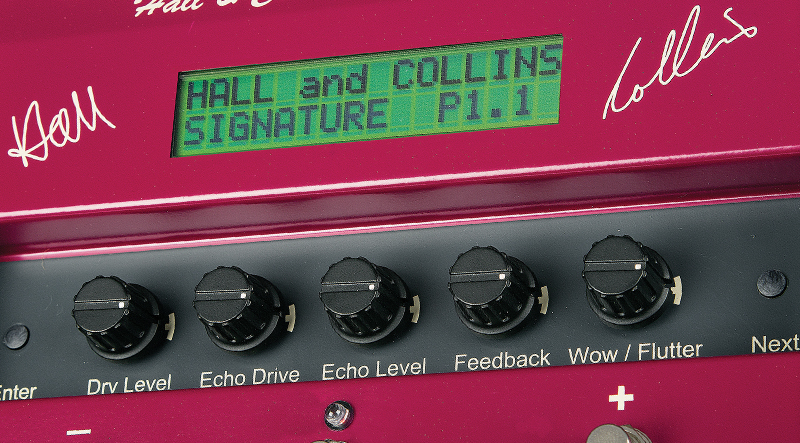
For guitarists whose lives are dedicated to replicating the echo effects heard on songs like Hank Marvin’s “Apache,” Hall & Collins Signature Echo is at their service.
Combining analog and digital technologies, it re-creates multihead echoes emulating a range of vintage sounds that would leave one broke and alone if they had to find and buy the real thing. The Signature has 64 preset patches and 64 editable user patches along with Dry Level, Echo Drive, Echo Level, Feedback, and Wow/Flutter controls. It’s a big, rock-solid mono effects pedal that’ll take a lickin’ and is powered by a 12-volt adapter. It also allows the owner to scroll through preset patches using the Patch Down and Patch Up buttons and the LCD display (these also double as Minus and Plus buttons in Edit Mode).
This U.K.-constructed analog-digital hybrid was engineered to summon the soughtafter old-school sounds heard from the fingertips of Marvin and others, and the unit’s preset titles are aptly named to prove it. The controls are easy to suss, but editing requires less-than-intuitive combinations of switch pushing; once they hear the results, though, players won’t mind the required extra effort.
The Signature Echo colors an amp’s tone even when bypassed, but that’s a good thing. Its preamp emulates the editable sounds of the Meazzi Echomatic (1, 2, and Model J), the Binson Echorec 2, Meazzi’s Factotum Special, the Vox Long Tom, Roland’s RE-301, the Pearl Echo Orbit EO-301, and Klemt’s NG51 tape-echo machines.
Yes, the Hall & Collins Signature Echo is pricey, and it might be too big or clunky for a lot of pedalboards, but it’a a no-brainer addition to the rig of any fan of beautifully lush vintage echo sounds.
This article originally appeared in VG February 2017 issue. All copyrights are by the author and Vintage Guitar magazine. Unauthorized replication or use is strictly prohibited.
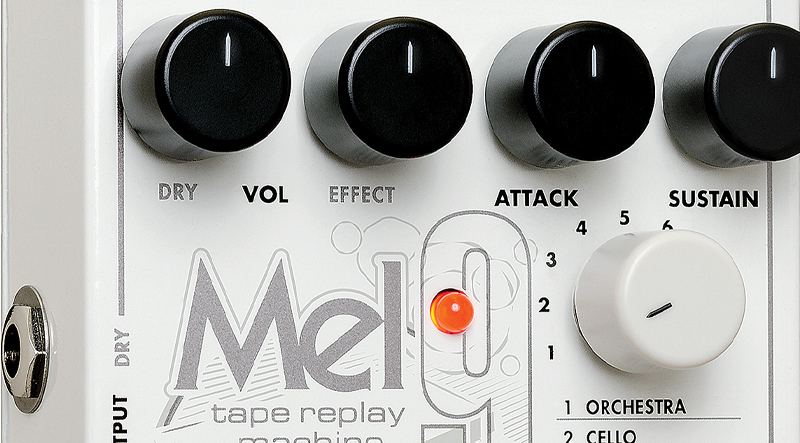
Producer George Martin was so fond of John Lennon’s tape-relay keyboard that he described it “as if a Neanderthal piano had impregnated a primitive electronic keyboard, and they’d named their deformed, dwarfish offspring ‘Mellotron.’” Finicky, phased, and frequently out of tune, the Mellotron really is something of a problem child – but a well-loved one. Electro-Harmonix has put its sounds (and some of its finickiness) within reach of guitarists by way of the Mel9.
Imagine a keyboard made up of Play buttons froxm 35 cassette answering machines and you’ll have an idea of how a Mellotron works. Depressed, a key produces a short and wonderfully imperfect tape recording of an instrument (or section of instruments). Nine of the most widely used Mellotron sounds – Orchestra, Cello, Strings, Flute, Clarinet, Saxophone, Brass, Low Choir, and High Choir – are re-created in the Mel9. Best known is the Flute as heard on “Strawberry Fields Forever.” The Cello sound, too, with its yawning bottom and fixed vibrato, is spot-on Mellotron as heard on Radiohead’s “Airbag” and Oasis’ “Wonderwall.”
Also true to the original, the Mel9 can be temperamental. Attack and Sustain dials control how rapidly the wet signal enters and decays, but notes can still swell unexpectedly or drop off in steps, and nuanced playing (e.g., a light trill or fingerpicked pattern) can go unregistered. Keeping an audible amount of dry signal in the mix helps, and EHX acknowledges the need to “pay attention to performance gestures.” EHX also recommends putting the Mel9 first in an effects chain, as it’s sensitive to incoming levels, though a compressor stabilizes its response.
The Mel9 requires some coddling but the genuine Mellotron tones it produces can be worth the work. “That is you can’t you know tune in. But it’s all right.”
This article originally appeared in VG February 2017 issue. All copyrights are by the author and Vintage Guitar magazine. Unauthorized replication or use is strictly prohibited.
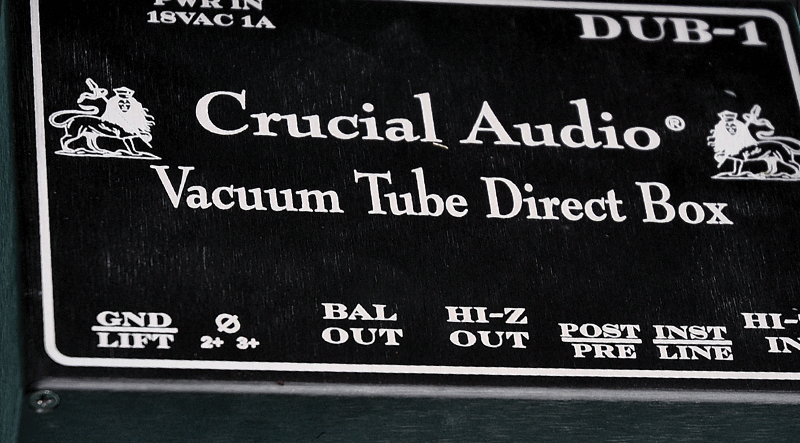
It’s not uncommon for novice guitarists to seek out stompboxes with zillions of features. As guitarists mature, however, they learn to chase something more important – sounding good. Crucial Audio’s DUB-1 is a direct box that does just that, with minimal controls, high-grade components, and a Ruby 12AU7 preamp tube.
Better still, the DUB-1 can be used in several ways. Guitarists might put it on their pedalboard to warm and fatten their guitar’s output signal, especially if they’re using a solidstate modeling amp or a straight-to-PA setup. For that, simply plug into the Hi-Z jacks (with the Pre/Post switch acting as a bypass or on) or run the XLR balanced output to the mixer. The Hi-Z input also has a 15dB pad and there’s a Ground/Lift switch to control extraneous noise. Hit the mini switch to choose Instrument (guitar or bass) or Line inputs (like a keyboard). Funkadelic four-string hero Bootsy Collins uses a DUB-1 to make his bass sound huge and clean, while an acoustic-electric guitarist might deploy it to smooth out the harsh treble that can plague piezo-pickup systems.
The unit’s wide frequency response (30Hz to 110KHz) contributes to the sonic accuracy of a picked note, and military-grade construction is ideal for live work.
The DUB-1 was tested with a Tele-style guitar and electric bass, both through a generic solidstate modeling amp. The results were dramatic. Thanks to the 12AU7 and circuits, all the harsh, trebly transients were smoothed out, giving warm, silkier sounds. For those wanting an amp or PA to sound more tube-like, this is an excellent tool. The DUB-1 doesn’t have a lot of “features,” but it does the single most important job any gizmo can – make a rig sound better. That’s why pro players are all over this box.
This article originally appeared in VG February 2017 issue. All copyrights are by the author and Vintage Guitar magazine. Unauthorized replication or use is strictly prohibited.
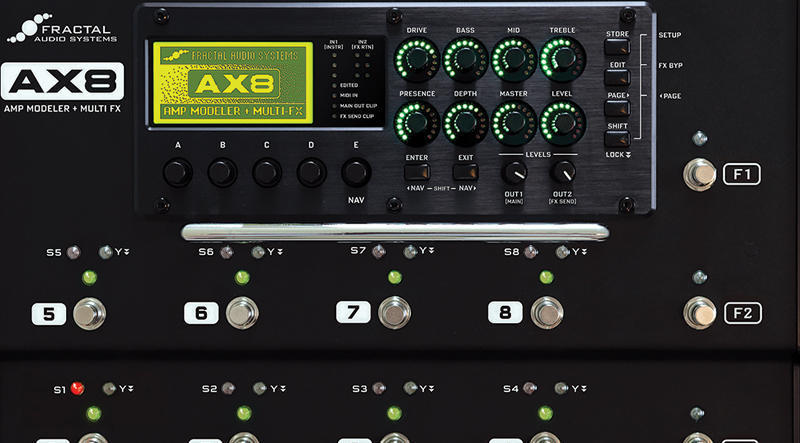
Thanks to the digital revolution, guitarists can plug into a small box and access a world of sounds unimaginable a generation ago. And the digital bar keeps rising, with outfits like Fractal Audio pushing the pace with serious sonic tools. Evidence their powerful AX8 amp modeler and multi-effects floor unit.
Unlike consumer-grade boxes that cost a few hundred bucks and contain a good variety of sounds, the AX8 purports to offer pro-grade audio and flexibility, which accounts for its price tag (it’s also built like a tank).
The AX8 offers 512 presets, each an entire virtual guitar rig – amp, speaker cab, and effects. Fractal Audio particularly prides itself on its Quantum amp models and Ultra-Res speaker cab sims, and for good reason; many of these presets sound great out of the box with no tweaking.
The sounds are accessed with eight footswitches and three Function switches. Each amp, cab, and effect can be edited within any preset, so if a Recto-type amp yields the monster crunch desired but not quite the right delay, dive into the menu via the screen and buttons. There’s also an onscreen editor – plug the AX8 into a computer via USB and edit to the heart’s content. Ultimately, the AX8 can be as simple or as complex as desired.
Once a certain preset is loaded, the eight main footswitches turn into individual effect on/offs, controlling goodies like overdrive, chorus, reverb, delay, compression, rotary, tremolo, flanger, phaser, gate, EQ, looper, scenes, and more. The sounds can be put in the desired order for gigs and many of the sounds can be manipulated with an external expression pedal. Other units have similar effects and features, but again, the name of the game is the supreme richness of these sounds. This is not a unit with thin digital models, frying-bacon distortion, or cheap housing and hardware.
The AX8 impressed with its beefy sounds, including super-fat simulations of vintage Fender and Vox, numerous Marshall amps, and saturated Mesa/Boogie and Friedman crunch. Specifically, Fractal Audio’s presets have that big low-end and midrange response, which are the X factors in any great tube amp. Most players want to feel that chunk, that speaker moving air, which can be achieved by plugging the AX8 into a PA system or an acoustic-guitar amplifier. Sure, it can be used for effects only through a traditional guitar amplifier, but half the fun is hearing the AX8’s killer amp and cab sims through full-range speakers and making the room shake like a big tube stack. Better yet, hook up both systems simultaneously – a PA for full-range roar and an amp for kickass stage volume.
Some users will point out that the AX8 doesn’t have as many digital ins/outs as other units (is an AES/EBU jack really necessary on a floor unit?). Others might fret that the AX8 isn’t a full-on digital interface for recording, but again, that’s not the endgame (the company positions the AX8 below its flagship Axe-Fx).
This floor unit contains some fantastic sounds. It’s not inexpensive, but boxes at more than half the price aren’t anywhere close to this good. No doubt someone could play a stadium gig with only a six-string and the AX8, plugging straight into the PA and blowing fans away with great sound. With that kind of firepower under the hood, think what it could deliver at your next gig.
This article originally appeared in VG February 2017 issue. All copyrights are by the author and Vintage Guitar magazine. Unauthorized replication or use is strictly prohibited.
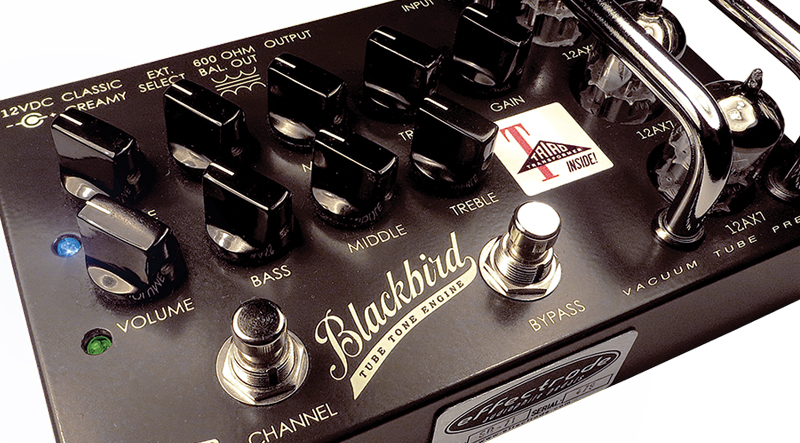
In a nutshell, the Effectrode Blackbird is a tube amp’s entire preamp section in a floor unit. And just why the heck would someone want that?
The Blackbird is housed in a heavy metal chassis with a Daka-ware knobs and high-grade components. It’s no accident that the box’s tubes are accessible on top, allowing the user to easily switch valves to fit their tonal needs, even on the fly. An external switch on the rear allows rebiasing for 12AX7, 12AU7, and 12AY7 preamp tubes, while an internal trim will accommodate other tube types such as dual-stage miniature B9A tubes like 12AV7s and 12AT7s.
Arriving outfitted with three 12AX7 tubes, the Blackbird has two channels with a three-band EQ on each. The first channel is a replica of a vintage Fender blackface circuit, covering sonic territory from clean to nicely overdriven with warm textures galore. The second channel picks up from there with an additional Gain control, going from mid-gain Marshall plexi to Dumble-style heavy saturation. Using the tube-buffered output, the Blackbird was tested with a small tube combo, resulting in serious “stack tone.” The transformation was shocking and delightful – with the Effectrode smacking its front end, the 15-watt 1×10 sounded more like a 50-watt 2×12.
In addition, the Blackbird can be sent into a mixer, PA, power amp, or digital interface for gigs or recording, using the Transformer Balanced Out function. The Blackbird was also tested into a Line 6 home-studio interface and cut cool, usable tracks in GarageBand via the buffered output. Even on tracks using Apple’s software amp simulations, the Blackbird yielded a huge difference – these sounded much more organic, convincing, and indeed tube-like than typical.
In all, the tones here won’t disappoint. Big, glassy cleans and naturally compressed crunch are but a few of the highlights and, again, the Blackbird made that small tube combo rage against the machine. There’s also a voicing switch on the back that goes from Classic to Creamy for even more high-gain textures.
This is the entire front end of a seriously good tube amp, but in a floor unit that can be tossed into a gig bag.
This article originally appeared in VG February 2017 issue. All copyrights are by the author and Vintage Guitar magazine. Unauthorized replication or use is strictly prohibited.




 His acoustic was a limited-edition Gibson Advance Jumbo Concert.