Tag: features

  • Watkins Joker

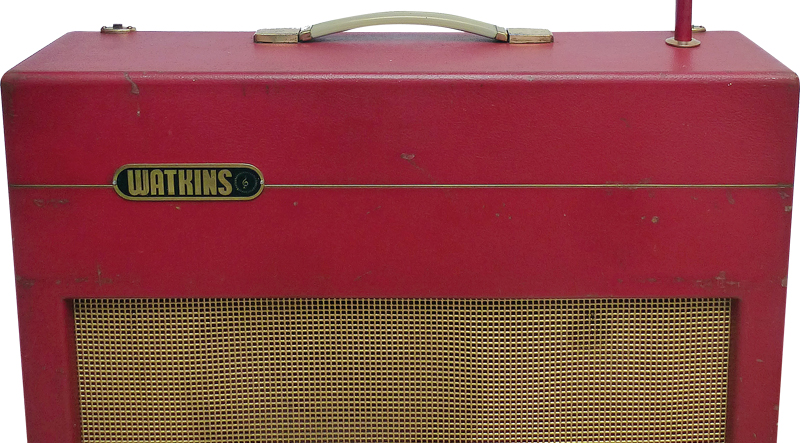
    Watkins Joker

    Amp and photos courtesy of Julian Marsh.
    1962 Watkins Joker
    • 
Preamp tubes: six ECC83 (12AX7), one 6BR8, one EM87
    • Output tube: four EL84
    • Rectifier: EZ81
    • 
Controls: Gain and Tone for each of three channels; tremolo Speed on Channel 1; shared Reverb and Echo Swell; Master volume
    • 
Speaker: 12″ Goodmans Axiom 301 plus Goodmans Trebax tweeter
    • Output: approximately 25 watts RMS

    This could be just what every well-heeled young “Beat” guitarist and singer in Britain needed in the early 1960s – a guitar amp/PA with reverb, tremolo, mic stand, and tape echo all in one! We’re joking, right? Not in the least – although Joker-ing, we are indeed. Put your hands together for the Watkins Joker, funkiest rock machine we’ve ever seen.

    Years before more-enduring British brands were establishing names for themselves, Charlie Watkins – following a wartime stint in the Merchant Marines and a shot at playing the accordion professionally – was catering to the needs of the burgeoning London skiffle/rock-and-roll scene. By the time this fanciful model came about in 1962, he had been marketing a little of everything the aspiring guitar star might require: guitars, amps, and tape-echo – the only effect that really mattered.

    At the time, the British guitar scene was on a quest for volume that would soon be achieved with bigger, more-powerful amplifiers, and Watkins would prove the most significant pioneer of festival-sized PA systems in the U.K. – he was even summoned to court for disturbing the peace after putting together a 1,000-watt system (largest of its day) for the ’67 Windsor Jazz and Blues Festival, which featured the Small Faces, Cream, Fleetwood Mac, and others. But in ’62, your local dance-hall outfit generally still achieved vocal amplification by plugging into the combos that were also running guitars. In the mind of inveterate tinkerer Watkins, why not give kids everything in a one-handed package?

    In addition to protecting the control panel while in transit, the hinged rear panel has storage for the amp’s footswitch and spare tape loops.

    Even so, this ’62 Joker is more than just a Dominator and a Copicat tape-echo crammed into one box, and does appear to have been tackled as a ground-up design even if it borrowed from elements of those products. For one thing, where the Dominator – Watkins’ flagship amp at that time, featured here in March ’17– used a pair of EL84s to generate about 17 watts, the Joker pushed 25 or so (nominally rated at 30) from a quad of these thin British tubes. Vox had already upped the ante in the volume stakes by introducing the AC30 in ’59, and Selmer’s Selector-Tone Automatic of the same year was capable of 25 watts. It’s often said Watkins released its first 30-watt amps, the Control ER30 and Control HR30, in ’64, after a change to the snappier WEM logo. Here, though, we have an output stage in the Joker’s Power 30 Drive Unit that was already capable of keeping up with the Joneses.

    Access to the Copicat’s tape loop lies behind the Joker’s main control panel.

    Into this chassis the Joker blends three independent channels plus effects, each with its own Tone and Gain controls, with a button to send each via the echo effect, and tremolo on Channel One, all of which were housed in an upper chassis. And what’s this at the end of the control panel, beneath the tape loop? That’s right, a Master Control, (a.k.a. Master Volume). Next time that old chestnut comes up at your local tavern or some chat site and the wiseacres chime in to give “first master volume” credit to Dave Reeves’ mid-’60s Sound City/Hiwatt designs or Randall Smith’s late-’60s Boogies, you can trump the lot of ’em with your Joker.

    As much as all of this already makes the Joker probe-worthy, the real novelty and “What the hell?” factor lies in its built-in Copicat. This sound had entered, even established, the pantheon of rock-and-roll tone as a built-in on Ray Butts’ Echosonic amp of the mid ’50s, so it’s entirely fitting that a British maker continued the trend; viewed from our 21st-century perspective, however, the notion of bundling such a cumbersome effect right into the amp seems wacky and utterly endearing. But it’s worth noting that, for all else he’d done to this point, the Copicat was by far Watkins’s greatest success of the early ’60s (and entire career, really).

    Inside the cab is clean. Note the 12″ Goodmans speaker and tweeter, along with the tubes atop the Power 30 Drive Unit.

    As he told David Petersen for The Guitar magazine in 2000, Watkins experienced what might have been his most profitable brainstorm after a pair of customers returning from a visit to Italy in 1958 dropped into his shop and raved of an echo unit they’d seen being used by singer Marino Marini. Figuring Marini’s system produced its echo from a continuous tape loop, with the help of engineer Bill Purkis, he compacted it into a 12″ x 8″ box using a Gerrard gramophone motor for transport, adding a selector switch to tap its three replay heads, and devising a feedback loop that allowed a variable echo-repeat effect.

    “I had a sample unit in the shop to see what the demand might be like, and in the meantime we built 100 units,” Watkins told Petersen. “The day I planned to put them on sale… I went to open up and the door burst open with the press of customers. I remember selling the very first one to Johnny Kidd (of Johnny Kidd & the Pirates, who had a #1 hit with “Shakin’ All Over” in 1960, replete with Copicat echo). Those first 100 sold that day.” To put an even more impressive number on the Copicat’s success, in the early 2000s, Watkins related how he sold “about 1,000 Copicats a month” in the first few years of the ’60s.

    Inside the power-amp chassis, a character-filled circuit.

    The Copicat’s functions were simplified for the Joker, but its inherently rich sound is all there, along with buttons to tap different play heads to achieve slapback and longer delays. This Joker’s former owner, British enthusiast/collector Julian Marsh, says it’s “a very tight and responsive amp – very positive to the pick. It’s a clearer sound than you get from a Westminster or a Dominator, probably because it’s built more like a hi-fi amp, with some versions having a tweeter and crossover. Apparently, Charlie thought it his best amp, but it’s a complicated circuit and was expensive to produce – hence the rarity – and it was also heavy and potentially fragile.”

    Quirky as all get out, then, the Joker might have been the future of rock and roll. If not, well, it sure wasn’t for a lack of trying.


    This article originally appeared in VG September 2017 issue. All copyrights are by the author and Vintage Guitar magazine. Unauthorized replication or use is strictly prohibited.

  • Vic Juris

    Vic Juris

    Vic Juris: Roger Sadowsky.

    Every noted jazz artist in the world is familiar with Vic Juris. His body of work commands serious respect and admiration from today’s music cognoscenti.

    A child of the ’60s, he grew up bombarded with great music – the Beatles, Hendrix, Coltrane, Wes Montgomery, Chuck Berry’s records on Chess. He recalls its tremendous appeal and how it spurred him to pick up the guitar.

    “My first guitar was a Harmony Monterey,” he said. “Then I graduated to a National electric and a Magnatone amp. At age 11, I began studying with Ed Berg, who hipped me to Barney Kessel, Jimmy Raney, Django Reinhardt, Jim Hall, and especially Johnny Smith. Ed had gotten one of the last guitars made by John D’Angelico. I’ve never heard a guitar sound like that.

    “My teachers were among the best anywhere,” he added. “In addition to Ed, I was lucky to have greats like Lou Mecca, Joe Cinderella, and Pat Martino mentoring me. Even Tony Mottola lived just two blocks away.”

    During a succession of garage bands and local rock gigs as a teen, a friend turned Juris onto Howard Roberts’ early Capitol albums, H.R. is a Dirty Guitar Player and Color Him Funky. 

    “I bought all his records, even later stuff with his more-progressive things like Antelope Freeway and Equinox Express Elevator. And I found Hank Garland’s Jazz Winds from a New Direction, with Joe Morello and Gary Burton. I think Gary was only 16 at the time. That was a real landmark record for any aspiring jazz guitarist.”

    Juris further cites Larry Coryell’s early recordings, the Beatles’ Rubber Soul, Jimi Hendrix’s Are You Experienced?, and Dynamic Duo by Wes Montgomery and Jimmy Smith as having profound impact on him. 

    Juris has always made his living as a guitar player. 

    “In the ’70s I learned so much from working my way up through organ trios, like Pat Martino did. In fact, Pat recommended me to Don Patterson and I played an ongoing gig with Jimmy Smith, and also worked with Wild Bill Davis.” 

    In addition, he helped perpetuate the prestigious line of guitarists who worked with drummer Chico Hamilton, whose bands always featured a hot young guitarist; Howard Roberts, John Pisano, Jim Hall, Gabor Szabo, Dennis Budimir, and Larry Coryell all got their starts with Hamilton, and Juris later taught alongside him at The New School for Jazz and Contemporary Music. Today, students can avail themselves of Juris’ teaching expertise at The New School as well as at Rutgers University and CUNY Purchase. 

    The Juris discography as soloist and sideman includes more than 200 recordings including sessions with Nancy Wilson, Sarah Vaughan, Mel Torme, two duet albums with Phil Woods, regular appearances with Larry Coryell, albums with James Moody and a live Carnegie Hall recording with Biréli Lagrène among many others.

    “I even got to work with Dizzy Gillespie in a couple of All-Star configurations,” Juris said. “He was so wonderful to play with and a great teacher. I’m so happy I got to ask him some technical questions about his tunes.”

    In addition, the guitarist routinely mines our greatest composers for his recordings. He admires compositions from everyone from the Beatles to Marvin Gaye and many more, but strongly favors the Great American Songbook old guard like Victor Young and the iconoclastic and enigmatic Alec Wilder.

    “The first Alec Wilder song I remember hearing was ‘Moon and Sand’ recorded by Kenny Burrell in the ’60s on Guitar Forms. The arrangement was by Gil Evans and I thought it was the most beautiful song ever. Then I heard ‘I’ll be Around’ and later the waltz that Wes Montgomery recorded, ‘While We’re Young.’ When I record a tune, I do my homework and always think of the lyric and try to listen to several versions.”

    Today, Juris is using a Roger Sadowsky semi-hollow and a Fuchs Jazz Classic amp with 12″ speaker. There’s an Earthquaker Dispatch Master for reverb and delay as well as a few Boss pedals like the Super Overdrive, Terra Echo, and DG-3 delay. Also in the arsenal is a Godin nylon-string Grand Concert and a Martin OM steel-string.

    Juris works with drummer Adam Nussbaum and bassist Jay Anderson in his trio, which plays the first Sunday of each month at The 55 Bar in New York City. His solo concerts include master classes that encourage and inspire young players. He’s proof that dedication and talent can realize an extraordinary career payoff.


    This article originally appeared in VG September 2017 issue. All copyrights are by the author and Vintage Guitar magazine. Unauthorized replication or use is strictly prohibited.

  • Luis Carlos Maldonado

    Luis Carlos Maldonado

    Luis Maldonado: Michael Corrado.

    Train guitarist Luis Carlos Maldonado’s musical upbringing and skill on the fretboard has earned him cherry gigs with artists like John Waite, UFO, and Glenn Hughes. He hails from the SG school of melodic-rock swagger, yet it’s his way around a melody that made him invaluable in great bands. He’s a prolific solo artist and professional songsmith. Train’s current album, A Girl, a Bottle, a Boat, is full of memorable pop and his clever guitar hooks.

    How did you develop such a wicked legato technique?

    My entire family is made up of musicians; three of my four brothers studied classical guitar. We were raised in orchestra from a very early age, studying classical guitar. So, most of it came from there. You have to build these techniques so you can play Villa-Lobos and all that stuff. When you’re doing flamenco, you’re always barring the frets and always moving up and down the fretboard. The muscle memory just stayed there when I started playing pop music. Somehow, when I managed to play rock, it stayed, and I developed my own thing. As much as I wanted to sound like Paul Kossoff, I never did (laughs).

    One of the main reasons I play an SG is because of Pete Townshend. I watched him on the Woodstock video, playing with the Hiwatt amps and that crazy fuzz he had going. That was a big influence – like, “Oh my God!” I’ve always loved Angus Young and Tony Iommi, too. My main guitar is a Gibson Custom Shop VOS ’64 reissue with a Vibrola and the stock Burstbucker pickups. I pair them with Hiwatts and Marshalls. They’re pretty awesome.

    What was going on in your life before you joined Train?
    About 11 years ago I was working with a pop artist on Columbia Records who was opening for Train. She never did sound checks, so I would sing, play Led Zeppelin, and all kinds of oddball stuff. Pat Monahan, the singer from Train came up and said, “Dude! Where did you come from!?” I told him about working with Glenn Hughes, UFO, and John Waite. He said, “Would you like to write?”

    We wrote some songs and ended up recording his solo record. Over the years, I stayed with the guys even though I made an album with my band, Into The Presence. If fact, I kept playing with a lot of people including Lisa Marie Presley and Bigelf, which was a big deal. One day, Pat called and asked me to join full-time. I was like, “Cool. Let’s do it.” We stayed friends professionally and personally. Everyone in the group is like a big family. My brother, Hector, plays in the group, so it was a logical step. Pat is really into letting everybody shine. Train is full of great music and inspiration.

    How did you graduate from Madison Square Bedroom to becoming a professional guitarist?
    I use to do sessions for Mike Varney, at Shrapnel Records. Mike loves discovering new talent – he paved the way for Yngwie Malmsteen, Paul Gilbert, and all those guys. I moved to the Bay Area and my mother said, “Some guy named Mike is looking for you.” I wound up playing guitar for him, doing back-up vocals, and engineering. That’s how I ended up working with UFO and doing a Michael Schenker record. Mike isn’t just a great friend; he’s a mentor in many ways.

    I ended up playing keyboard and guitar on a UFO tour with Uli Roth. John Waite was on that tour, and I ended up with him. Everything was very natural and organic when I met Glenn Hughes a few years later. Mike got me to that point with UFO and it just kept going. I wrote with John for eight years and wound up doing an album with Glenn and a bunch of other people. I don’t have many nightmare stories (laughs); 98 percent of my career has been very blessed and I’m glad to be doing it.

    Outside of Train, what’s going on with you?
    I still write with a lot of people. For me, writing is one of the things I’m blessed to do. When I first got signed, it opened a lot of doors to write with a lot of different artists. I’ll never ignore that. I want to make something that will last regardless of whom I’m working with. I’m in an awesome band with some awesome people, and I get to write with all kinds of people.


    This article originally appeared in VG September 2017 issue. All copyrights are by the author and Vintage Guitar magazine. Unauthorized replication or use is strictly prohibited.

  • Bettie Serveert

    Bettie Serveert

    Bettie Serveert: Sjors Schuitemaker.

    Bettie Serveert is still going strong, 25 years after bursting on the scene in Amsterdam at the height of alternative rock.

    Palomine, its acclaimed debut, mixed fuzzy riffs and folky jangle with engaging vocals by singer/guitarist Carol van Dyk. And while most contemporaries have long since hung it up, the Betties – van Dyk, guitarist Peter Visser, bassist Herman Bunskoeke, and drummer Joppe Molenaar – continue to release well-crafted albums of melodic, punchy guitar rock. Its latest is called Damaged Good.

    Did you do anything differently for Damaged Good, in terms of writing or recording?

    van Dyk: Every album is new adventure, and our daily life has an impact on our songs. We don’t sit down and say, “Let’s write a song.” Sometimes, a song will write itself and all you have to do is let it happen. Peter and I had done a project with [producer] Jesse Beuker in Australia in 2009 (Me & Stupid), so when we heard he built a studio in Amsterdam, we went to visit. Shortly after, we started recording.

    Which guitars did you use?

    Visser: A Gibson SG 1968 with a 490 in the neck and 498 in the bridge, both now with Alnico II magnets, a Frankenstrat with great-sounding ’70s Strat-style pickups, and a pimped-out ’75 Ibanez Les Paul copy with Gibson ’57 Classic pickups, Grover tuners, and cavities filled with mahogany.

    van Dyk: I played my ’99 Rickenbacker Jetglo 360, my mid-’70s Fender Starcaster, and Peter’s Dixon acoustic. For “B-Cuz,” I borrowed Peter’s SG.

    Bunskoeke: My workhorse, a ’69 Fender Precision I found on a wall in a little studio. I was lucky.

    What about amps?

    Visser: I used a Marshall JCM 900 Dual Reverb Top with a Framus 2×12″ FR cab and a Vox AC30 reissue.

    van Dyk: Mostly a Marshall JCM 900 4×12, but I also used Jesse’s Twin-Reverb.

    Bunskoeke: In the studio, I plug straight into the mixing board, and live I use a Fender Bassman with an Ampeg 4×10.

    And effects?

    Visser: My pedalboard has a Boss Tremolo, an ’80s Ibanez Tube Screamer and Yamaha DI-01, a Zvex Fuzz Probe, DigiTech Whammy 5, Ernie Ball Volume Pedal, Boss Tuner, Boss RE-20 echo, Boss Digital Delay, and a Line 6 Verbzilla.

    van Dyk: I don’t use much… mostly the Marshall’s distortion channel and a couple pedals Jesse had lying around. Live, I never use effects because as a rhythm player, I don’t really need them. Maybe that’s why I’ve always been a big fan of Mick Ronson.

    Bunskoeke: I use a Tech 21 SansAmp, an Electro-Harmonix Bass Preacher compressor, and a tube radio for rough edges.

    One of the highlights is your duet with singer Peter te Bos on “Lovesick.” How’d that come about?

    van Dyk: We’ve known Peter since the late ’80s, and in the early ’90s we shared practice space with his band. While recording “Love Sick,” we lowered the pitch of one of my backing-vocal tracks, and we said, “It sounds like Peter te Bos!” So, we called him, and we’re very honored he did the duet.

    “Digital Sin (Nr 7)” is another highlight, but it’s a bit out-there.

    Peter: Joppe and I were jamming a lot, and we recorded all of that. It sounded like an abstract piece of prog-rock until Carol added vocals and shaped the chord structure.

    van Dyk: I totally didn’t get Peter and Joppe’s idea. I’ve never been good at jamming, but I like writing songs. So I listened, then asked, “What’s the beginning, what’s the middle?” At home, I’d recorded a rough demo of “Love Sick” and there’s a specific melody I play in the bridges that’s basically the same as when the first verse starts in “Digital Sin.” Peter and Joppe mainly wrote the first half, and I added the last half!

    What’s the vintage-guitar scene like in Amsterdam?

    Visser: There are, relatively, a lot of vintage shops in Holland. In Amsterdam, there are three used-gear shops I visit on a regular basis – but not too often because the urge to buy might get the better of me!

    Are you planning to tour the U.S.?

    van Dyk: We’d love to, but we have day jobs and pay for everything ourselves, so won’t be able. Never say never, but any foreign artist/band needs a work permit, which is expensive and takes about five months to get. And if you get denied, you don’t get your money back.

    Twenty-five years together is a huge deal for a band. How does it feel?

    van Dyk: We’re really grateful there’s still an audience that wants to hear us play, because at the end of the day, they decide whether we can tour! The fact that Peter, Herman, and I have been close friends for more that 30 years is probably the main reason we’re still together, because we’re family. A dysfunctional family, but still, a family.


    This article originally appeared in VG September 2017 issue. All copyrights are by the author and Vintage Guitar magazine. Unauthorized replication or use is strictly prohibited.

  • Rodney Crowell

    Rodney Crowell

    Rodney Crowell arrived in Nashville in 1972, bent on finding a niche for himself in the country music he’d loved since his childhood in Houston. He wrote songs for Jerry Reed’s publishing company and, in 1975, Emmylou Harris added him to her Hot Band as rhythm guitarist. He wrote hits including “’Til I Gain Control Again” for Crystal Gayle, and his greatest success came during country’s New Traditionalist movement, with five #1 singles to his credit in 1988 and ’89.

    Life is critical to Crowell’s music; personal experiences inspired his 2011 album, The Houston Kid, and autobiography, Chinaberry Sidewalks. He views his latest, Close Ties, as a continuation filled with similar rootsy, hard-edged compositions. The songs, performances, and production are simple and hard-hitting; among the powerful are “Life Without Susanna,” an homage to longtime friend Susanna Clark, who died in 2012. Her husband – singer/songwriter Guy Clark, who died in 2016 – was another Crowell friend and mentor.

    “‘Life Without Susanna,’ is a recent memory,” he said. “So is ‘It Ain’t Over Yet.’ I was writing that while I was close to Guy.”

    He calls “Nashville 1972” “…a basic memoir,” adding, “Maybe I’ve gotten this out of my system now. Who knows?”

    Crowell played on almost all of the songs and had masterful helpers like Tommy Emmanuel, whom he invited to join for “East Houston Blues.”

    “He’s so dynamic, and such a charismatic player,” Crowell said. Longtime Crowell guitarist Steuart Smith appears in various places, while co-producer Jordan Lehning added guitar on “Life Without Susanna.” Chris Leuzinger and his resonator appear on “Nashville 1972,” with Richard Bennett on “Forty Miles From Nowhere.” Crowell and Jim Oblon created the ominous guitar framework for “Storm Warning,” while Lehning, Oblon, and Smith generate the full-bodied backing that frames “I Don’t Care Anymore.”

    Crowell used four guitars, two being his main acoustics.

    “My number one is a ’32 12-fret/white-pickguard Gibson L-00,” he said. “I also have a ’37 14-fret L-00 that Vince Gill gave me. I played that on ‘Life Without Susanna’ and ‘East Houston Blues.’ It has a pickup, and I also played it on ‘I Don’t Care Anymore.’ I also have a wartime banner J-45 – the Sherman tank of wartime Gibsons – with a baseball-bat neck. It’s a thumper and has that real midrangey Hank Williams sound. On ‘Storm Warning’ I was playing a ’57 Southern Jumbo. Live, I use the 12-fret L-00.”

    Crowell worked more extensively with vintage gear while supervising music for the Hank Williams biopic I Saw The Light. He also helped star Tom Hiddleston find a voice, and supervised musicians Chris Scruggs, Richard Bennett, fiddler Stuart Duncan, and guitarist Wes Langlois, who used vintage gear to accurately re-create Hank’s late-’40s/early-’50s sound. Recording on period equipment at Ray Kennedy’s Room & Board studio further enhanced the retro feel.

    Blues, not country, was Crowell’s major inspiration for Close Ties.

    “The album was informed by recordings by Big Joe Williams and Blind Blake,” he said. “I started digging into the blues the way I didn’t in my teens and early 20s; Hank Williams was my touchstone for blues. The last five years, though, I’ve been listening a lot to Delta and country blues. I’ve always listened to Lightnin’ Hopkins, but I’m smart enough to know that’s not what’s inside me. Still, if you understand it and love it for its purity, it starts to inform your work.”

    He views Close Ties as part of a trilogy.

    “The tonality is akin to what I did on Houston Kid and Chinaberry. Those are three of my better works as a writer, and that may be the thing that ties them together.”


    This article originally appeared in VG September 2017 issue. All copyrights are by the author and Vintage Guitar magazine. Unauthorized replication or use is strictly prohibited.

  • Steve Stevens

    Steve Stevens

    Steve Stevens: Patrick Shipstad.

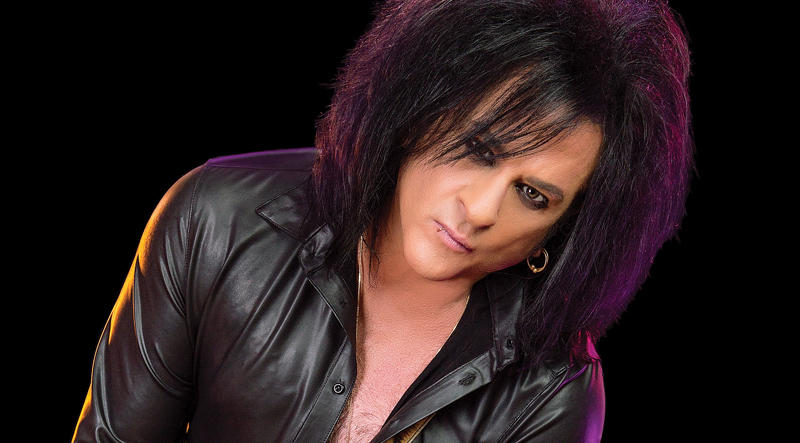
    As Billy Idol’s longtime guitarist and songwriting partner, Steve Stevens’ unique approach – flamenco stylings and the occasional ray gun – have rocked stages worldwide for four decades. Throughout his career, he has also recorded and performed with Michael Jackson, Vince Neil, Robert Palmer, and as a solo artist, having just wrapped a successful European tour.

    “Flamenco guitarist Ben Woods and I decided to go through my catalog and do the stuff people don’t get to hear,” he said. “Songs like ‘Top Gun,’ Michael Jackson’s ‘Dirty Diana,’ and tracks from my Flamenco A Go-Go record. About halfway through the show, we break it down and do a bunch of flamenco. It’s great for me because it’s a whole other side of what I do.”

    Stevens developed a passion for flamenco at a young age.

    “I started playing guitar when I was seven, and one of the first teachers that really made an impression on me was a flamenco guitarist. It’s another way for me to express myself and it’s something I do that’s different from other guitarists.”

    In Europe, Stevens simplified his approach.

    “It’s entirely different than the Billy Idol shows. I have a signature amp with Friedman; that was the only piece of gear I brought, apart from some pedals. So it was really stripped down and kind of liberating. With Idol, I have to re-create tones from a 30-year career, and songs like ‘Flesh for Fantasy’ requires a lot of processing and totally different guitar sound than ‘Rebel Yell.’

    “I have a signature version of the Rockaway Archer overdrive pedal made by J. Rockett. Before, I’d find a boost that I liked, but I’d have to put a six-band EQ after it to carve out a curve that worked for me. So I asked J. Rockett if they could combine the two pedals, and that’s my overdrive. I also had a Digitech Whammy and a TC Electronic Alter Ego Vintage, one amp head and one cabinet.”

    For his solo shows and the Idol gigs, the guitars remain the same.

    “I use a Knaggs Severn, which has their proprietary vibrato system, and we’re on the third generation of my signature Knaggs, the Steve Stevens Classic. I’ve got a signature pickup with Bare Knuckle called the Rebel Yell, so my guitars are loaded with that. I also use my Les Paul Silverburst, which has late-’70s Gibson humbuckers.”

    In 2010, the Idol band added second guitarist Billy Morrison.

    “Bringing him in allowed me to play songs or parts that I hadn’t played for the last 35 years,” said Stevens. “Now, I can replicate some of the overdubs and things live, which helps us sound much closer to the original recordings. I love having him in the band; it really frees me up.”

    Idol is currently holding court with a residency at the House of Blues in Las Vegas. “It’s great because we play three shows a week and we’ve dug into the catalog to play some more obscure tunes and things we haven’t played in a long time. We’re doing ‘Daytime Drama’ from Rebel Yell, for example, which we were never able to replicate live. When we originally toured on that album, that song fell by the wayside because of all the guitar overdubs; once again, having Billy meant we can play some of these other tunes. We also do ‘Don’t Need A Gun’ from Whiplash Smile, but we’re doing kind of a flamenco version of it with nylon-string guitar.”

    The set also includes a flamenco solo.

    “When I was in the Vince Neil Band, we did six weeks with Van Halen, and Vince said ‘You have to do a guitar solo.’ I’m thinking, ‘In an hour, Eddie Van Halen’s going to get up there and do “Eruption.” I can’t compete with that.’ So I figured I’d do a nylon-string solo, and I’ve been doing it ever since. To Idol’s credit, he’s willing to let the band shine; he’s proud of all of us.”

    This summer marks the re-release of the early Billy Idol records.

    “We’ve remastered the first three albums with (original producer) Keith Forsey for vinyl, and I have to say, when I A/B’d the test pressings, it wasn’t even close. They sound the way these records were meant to sound.”

    Stevens also frequently plays with Kings of Chaos, an all-star band built around drummer Matt Sorum, guitarist Gilby Clarke and bassist Duff McKagan, with rotating frontmen and additional players.

    “I love doing those gigs. Sometimes we wind up with Billy Gibbons and Robin Zander in the band. It’s a guitar-player’s dream, playing with Billy Gibbons, I’ll tell you that.”


    This article originally appeared in VG September 2017 issue. All copyrights are by the author and Vintage Guitar magazine. Unauthorized replication or use is strictly prohibited.
  • Danelectro ’66

    Danelectro ’66

    Price: $699 (list)
    Info: www.danelectro.com

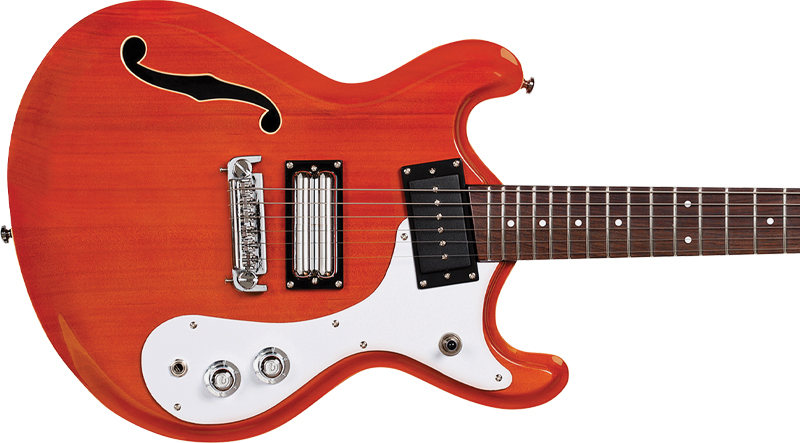
    The new Danelectro ’66 brings together several threads of retro-dom in one hip package. Visually, this Danny brings to mind the Mosrite Ventures models, with its reverse offset, double-cutaway design and wildly slanted neck pickup. But the Korean-made ’66 has a few wrinkles of its own to set it apart from the pack.

    The ’66 pumps up that vintage-offset look with an f-hole and internal chambering to cut weight and promote an airier semi-hollow tone. Its German-cut body style (that curved top edging) and crème binding are attractive, adding extra movement to the alder body, like waves on the ocean. With a 24.5″ scale and bolt-on maple, the Danelectro also sports a rosewood fingerboard with 22 frets and a zero-fret at the nut. Hardware includes a combination stop-bridge and tailpiece, master Tone and Volume knobs, three-way pickup switch, and chrome tuners.

    The Tone knob is a push/pull coil tap for the bridge humbucker, which is stylishly designed as two lipsticks side-by-side in a ’bucker-sized pickup ring. The neck slot sports a large-housing pickup wickedly slanted for tone and appearance; also look for an unbeveled pickguard. Overall construction is good, though the knobs didn’t feel too gig-worthy. And it has a nice weight – neither too heavy nor too light – which is good news for live performers.

    On the job, the ’66 was fun to play. Its neck is quick and has a modern D profile, like many bolt-ons in the middle price range. It has a plenty of personality for clean work, from country to jazz and even shoe-gazer. Crank the gain to let the lipstick humbucker go to work, creating snarly tones for all sorts of high-volume applications. In all, the Danelectro ’66 is a decent stage guitar, its vintage shape guaranteed to evoke all kinds of twangy, reverb-inspired dreams.


    This article originally appeared in VG August 2017 issue. All copyrights are by the author and Vintage Guitar magazine. Unauthorized replication or use is strictly prohibited.

  • Ball Amps 1950s GE TV

    Ball Amps 1950s GE TV

    Price: $2,199
    Info: www.ballamps.com

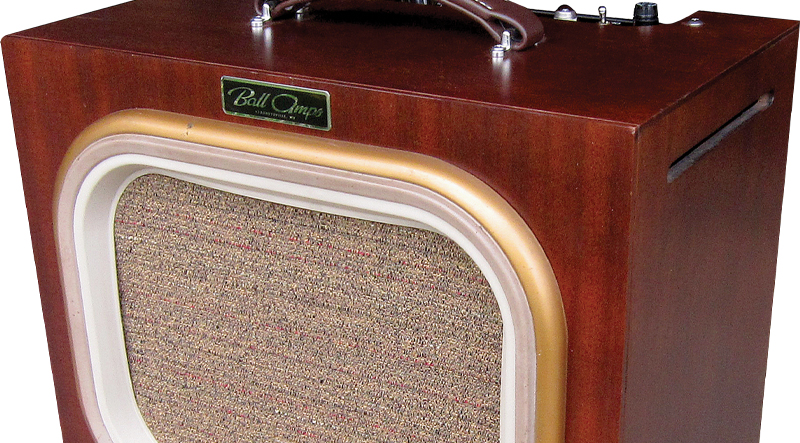
    Randall Ball crafts vintage amps like no others. At his workshop in Kearneysville, West Virginia, he translates tried-and-true schematics into new builds, then houses them in old cabinets adapted from radios, TVs, and suitcases. It’s a gimmick, sure, but it’s a darn cool one.

    And it’s not just about the looks; it’s all about the tone. Ball constructs amps based on Fender’s famed tweed Harvard 5F10 and Valco’s 510 Supro Supreme, among others. And the all-around aura of the finished creation is oh-so-cool.

    Ball’s GE TV amp, for example, is one of a kind. He used the schematics from a 5F2A Princeton, then housed it in a suitably sized 1950s television console. But rarely has a ’58 Princeton sounded so good – and this is where Ball proves it’s all more than a gimmick.

    In the re-created tube circuitry, he used Mercury Magnetics transformers, and the amp kicks out approximately 7 watts of power through an 8″ Warehouse Guitar Speakers G8C 20-watter.

    Plugging in a ’56 Strat, the tone is downright luscious – warm and woolly. You could almost wrap yourself up in it and keep cozy through the winter.

    But more than that, the amp sustains for a crazy-long time. Hit a note or chord, and it just rides on and on into the sunset. Lovely.

    The amp boasts two input channels with just two top-mounted controls: Volume and Tone. Overall, its voicing is on that warm side: more rich and resonant than hard-edged and trebly. It’ll overdrive and rock out, no doubt, but it doesn’t get in-your-face aggressive.

    And then there’s that cabinet. The GE TV is pure ’50s chic, from the styling to the original knobs (just for looks, although they do turn!) to Ball’s period-perfect grill cloth. It only accentuates the amp’s wonderful sound, making it a classy choice for jazz, country, and blues.


    This article originally appeared in VG August 2017 issue. All copyrights are by the author and Vintage Guitar magazine. Unauthorized replication or use is strictly prohibited.

  • Zerberus Nemesis Stone-Top

    Zerberus Nemesis Stone-Top

    When German luthier Frank Scheucher was first approached about building a guitar from stone, he had the same reaction you’re probably having right now: Say what? It’ll weigh a ton. And even if a player could lift it, does stone resonate – at all?
    Price: $4,200 (as tested)
    Info: www.zerberus-guitars.de

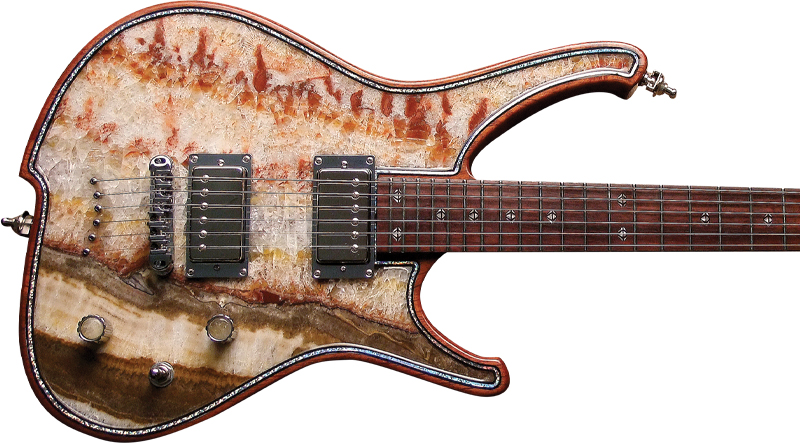
    However, experimentation led to a line of models like this Nemesis. With a stone top just 0.20″ thick and a chambered body of light mahogany, these “Gorgonized” (look it up) guitars from Zerberus weigh seven or eight pounds – no more than your average Strat or Les Paul. The stone is surprisingly resonant, too, allowing vibration in all directions rather than along a wood grain.

    Every stone top guitar is unique as a fingerprint, and the test model was cut from a stone found in Mexico and Brazil called Onyx Fantastico Red Light. Yeah. The top is slightly inset in the body and framed by a flecked strip that loves to catch the light. The front edges are heavily shellacked, though the stone itself is less prone than wood to scratching or damage. Overall, the Nemesis has a striking, ornate design, completed by an especially long top horn and Scheucher’s signature wave above the lower strap button (making strap locks a must).

    The bolt-on neck is a five-ply construction of maple and purple heart, with a beautiful rosewood plank inset with diamond-shaped markers. The dual strips of purple heart are visible right up through the headstock, with its unusual drill hole at the peak. The scale length is 25.5″, though from playing position it almost looks like a short-scale guitar – probably an illusion resulting from the long horn. It aligns at about the 11th fret, so the neck’s entire second octave is north of that upper bout.

    With a flat 14″ radius and D-shaped curvature, the neck feels substantial but not bat-like or bulky; more like a Les Paul neck sanded flat. It’s a finely crafted neck, and plays comfortably and consistently in every position. Also, the sustain on this guitar is exceptional, with credit due in part to the stone and the string-through design. The Wilkinson hardware (locking tuners, roller nut, and roller bridge) deserves a nod as well.

    With amp EQ set flat to limit variables, the tone of the Nemesis fell generally in the upper midrange, with less mid-low resonance. Even so, there was a softness on high notes, a welcome attenuation or curbing of those high frequencies that can be wince-worthy on, say, a Tele in bridge position. More range on the Tone knob would have addressed EQ; the pot is nearly indistinguishable between 10 and 2, and then drops sharply between 2 and 0. The master volume, similarly, was off in 0 position and then stepped on around 1, making it tough to get a smooth swell.

    Zerberus will load any pickups a customer orders, and this Nemesis came with alnico pickups by the German builder Harry Häussel. Push/pull features on the master Volume and Tone pots enable a lot of versatility with few controls. Pull the volume, and the neck humbucker splits to a single coil; pull the tone, and the bridge humbucker does the same. A favorite setting for us while playing rhythm was middle position with the neck pickup as a humbucker and the bridge as a single-coil, which allowed chords to sound both full and bright. The opposite setting (single-coil neck, humbucker bridge) lent well to a cutting lead tone, good for bold blues lines.

    Zerberus makes guitars out of Tiger’s Eye, Smoky Quartz, Aventurine, and other awesomely named gemstones. Each guitar comes with a hard case – and a wow factor you won’t get from a conventional wood top.


    This article originally appeared in VG August 2017 issue. All copyrights are by the author and Vintage Guitar magazine. Unauthorized replication or use is strictly prohibited.

  • B&G Little Sister Private Build

    B&G Little Sister Private Build

    B&G Guitars just about do it all – from mixing their own nitro finishes to winding pickups and even casting their own brass hardware. Their goal? To re-create the feeling of playing an old guitar, while at the same time updating those old magic formulas.

    Prices: $3,950 (as tested); $1,450 (Crossroads model)
    Info: www.bngguitars.com

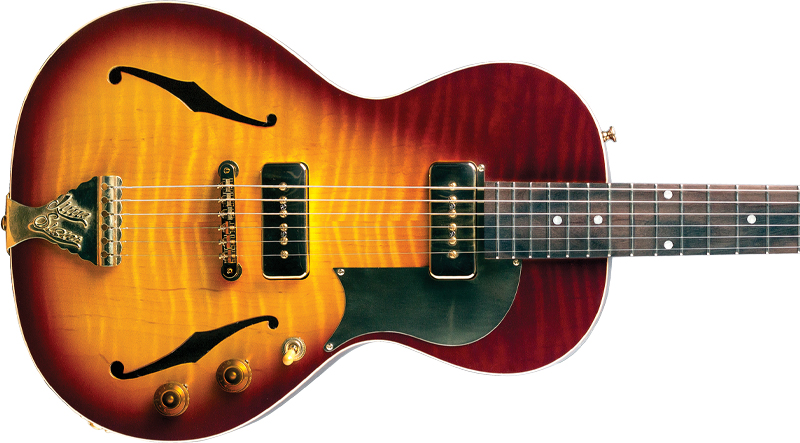
    Inspired by vintage parlor and early Les Pauls, B&G’s Little Sister is indeed a tribute to guitars of yore, in both fit and form.

    Available in single- and non-cutaway versions, the Little Sister comes in an array of velvety ’bursts (Tobacco, Brown, Lemon, Cherry, Honey, and Black), as well as Black Widow and Natural.

    Letting loose with those first few strums on the P-90-equipped test model, it was immediately obvious how wonderfully the mahogany neck’s soft V profile fits in the hand, its 12″ radius great for easier bends and a Les Paul-like action. The fretwork on the rosewood fingerboard was immaculate and vintage skinny.

    For electronics and hardware, the Little Sister features B&G’s pickups, Waverly tuners, and a bevy of brass: pickup covers, ABR bridge, a handsome tailpiece, even the pickguard.

    Unplugged, the Little Sister exhibits the sound and feel of a vintage parlor or a skinnier version of Gibson’s prewar ES-150, with great sustain and overtones that ring out in the mids with a warm and woody sound.

    Plugged into a Hi-Tone DR-30 head and a Hi-Tone 2×12 DR-F cabinet, the bridge pickup sounded like a P-90 through gritted teeth – it really barked when the guitar was dug into. With overdriven tones, the bridge pickup growled, crooned, and sang with a deep and gutty tone. The neck pickup was warm and round, though it perhaps lacked some top-end detail. That said, it did mimic that sort of aged, high-impedance sound.

    But true to B&G’s intent, the Little Sister does well to emulate the feel of classic prewar electrics – and looks great doing it.


    This article originally appeared in VG August 2017 issue. All copyrights are by the author and Vintage Guitar magazine. Unauthorized replication or use is strictly prohibited.