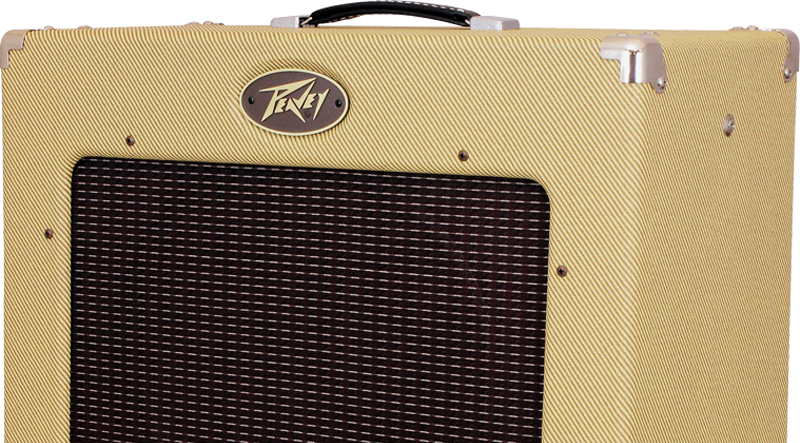
Most of us have been so conditioned to accept 12″ guitar speakers that we forget there are good options. While traditionally employed by bassists, 15″ speakers have also been used by the likes of Stevie Ray and Jimmie Vaughan, Dick Dale, Chris Duarte, and pedal-steel guitarists to get seriously fat tones. Peavey keeps the 1×15 tradition going with its Delta Blues 115 Tweed, a tube combo with a Celestion Fullback.
The Delta Blues is a loud 30-watter with a swank tweed skin, leather handle, and chrome top panel. Despite the old-school vibe, this is a two-channel amp with a footswitchable lead boost, effects loop, and external speaker jack, all speaking to the needs of modern guitarists. The amp sports four EL84 power tubes and a trio of 12AX7s in the preamp, and weighs about 50 pounds. It also has two rear jacks for Channel/Boost and Reverb/Tremolo footswitches (the amp comes with a single two-button footswitch, but you can buy another to manage all four on/off functions).
Controls include a Normal volume knob in Channel 1, and Pre and Post volume knobs in Channel 2 to conjure the proper degree of overdrive. There’s also a passive three-band EQ, reverb, and a tremolo circuit with Speed and Intensity knobs. Buttons include Channel Select and Boost, along with Power and Standby switches to the far right.
Tested with a Stratocaster, the Delta Blues sounded fabulous, with a huge sonic girth and sweet high-end – no harsh trebles here, especially with the spring reverb kicked on. The clean channel was fine for all manner of blues, country, rockabilly, and classic and modern rock – basically everything from Howlin’ Wolf to the Alabama Shakes. Jump to the overdrive channel and things get feistier, with big, bruising power chord crunch, thankfully without any glassy screech. The tremolo circuit only adds to the fun. Adjust the Treble knob, as well as your guitar’s volume and tone, to find the perfect sweet spot. You will be impressed by the heavenly tones.
The power amp’s 30 watts of output is plenty loud, but if you need more volume for gigs, consider an external cab or PA. The only debit is that the plastic Channel and Boost buttons are a bit flimsy for long-term gigging. Otherwise the Delta Blues 115 Tweed is strong contender for your tube-amp dollar. Peavey has a true winner here.
This article originally appeared in VG October 2017 issue. All copyrights are by the author and Vintage Guitar magazine. Unauthorized replication or use is strictly prohibited.
Gather ’round, children, for a scary bedtime story. Once upon a time, there was no such thing as a high-gain amp. So, wizards built treble boosters – like the Dallas Rangemaster – to add high-end response. Other sorcerers came up with a Top Boost modification, which they added to the Vox AC30. Then a mad scientist created a Frankenstein monster known as the Marshall, whose higher gain meant treble boosters would be largely lost to the mists of time.
Lost, that is, unless you have a vintage amp and you’re chasing those vintage tones. Which is where a magician named Dan Albrecht, founder of Area 51 Tube Audio Designs, steps in. His Alienist pedal breathes new life into the treble-booster concept – and in an interesting blend of old-fashioned and newfangled ways.
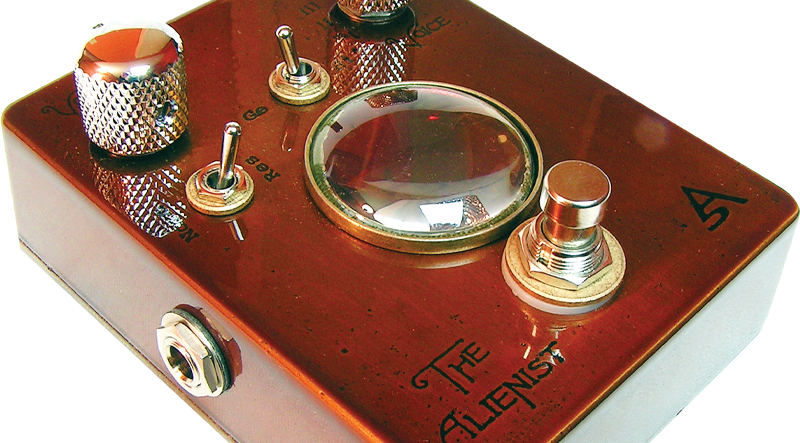
To start with, the Alienist looks suitably steampunk. It’s housed in an aged-copper-colored box with a portal lens in the center showing the eerie glow of the hard-working innards.
Those hand-wired guts include both old-school low-gain NOS germanium and new-tech higher-gain silicon transistors, switchable via a toggle that offers two sonic paths to mate to your guitar, amp, or the voice you hear in your head.
The Alienist was tested with a ’55 Fender Esquire and a tweed Deluxe. Now, few people have ever complained about the tone of a’59 Deluxe, but with the Alienist in the path, the array of tonal colorings was astounding, opening up the amp’s range in many ways.
To be sure, the Alienist is not simply your basic treble booster (Albrecht calls it a “Voicing Boost Pedal”); beyond the choice of the two driving transistors, the effect also has a six-position Voicing selector.
The effect helps to truly wake up a dark-sounding amp, enhancing its front end to balance out the shadowier shadings of tone. At the same time, the Alienist provides a wider variety of sounds under your fingertips as its boost broadens your amp’s range, which you can then control better than ever via the Volume and Tone knobs on your guitar. This greater touch sensitivity provides everything from shimmering cleans to dirty lowdown – all by way of those guitar tweaks.
Mixing and matching transistors with the Voicing options yields a pleasing range of sonic possibilities. Go for the high-gain silicon transistor with a low Voicing setting, and your tone is pure fat. Adjust the Voicing and you can dial in some overdrive (thanks to the boost) and some glorious second-order harmonics in those trebly upper registers. Talk about singing. Darken the amp, guitar, and the Alienist’s voice and you can mimic Clapton’s vaunted “woman tone” – and this from an Esquire.
The Alienist’s output is also especially responsive to pick attack and how hard you dig into the strings. Ease back and relax, and you get warmth and comfort. Dive in, and you’ll find new edges and angles to your sound. The pedal’s other toggle (Norm/Res) activates a filter stage that lends it some cocked wah character and harmonics – a unique facet of the circuit.
The Alienist’s build and componentry are also impressive: audiophile-grade resistors and capacitors for low hum and noise – as well as the best tone possible – plus Switchcraft #11 jacks as used on vintage Fender amps all ensure that this is an effect built to last.
Of course, a stompbox without tone isn’t worth stomping on. But the Alienist also wins points for being the coolest-looking pedal to come through this reviewer’s mailbox in a long time. From that copper steampunk styling to the etched-in gothic script to that menacing glowing eye – this is one manmade tone monster.
This article originally appeared in VG October 2017 issue. All copyrights are by the author and Vintage Guitar magazine. Unauthorized replication or use is strictly prohibited.
When Charles Thompson adopted the stage name Black Francis to play the Pixies’ first gig – at a bar in the suburbs on a Wednesday night in 1986 – guitarist Joey Santiago was right there, the two of them unfazed by the tiny crowd and chilly reception.
Santiago ’90s: Rick Gould. Pixies: Simon Foster. Santiago and Charles Thompson rehearsing in 1985, the former (LEFT) with his Ovation Viper. By the early ’90s, he was using a Les Paul Classic (RIGHT).
Former students at UMass Amherst, Thompson had convinced dorm mate Santiago to quit the books and get serious with his guitar. The two spent 1984 working warehouse jobs while Thompson wrote lyrics on his subway commute and at night grabbed a guitar to add backing chords. In late ’85, they placed an ad in a music newspaper seeking a bassist who was “…into Hüsker Dü and Peter, Paul and Mary.” The only response came from a folk-rocker named Kim Deal. Though she had never played bass or been in a band that made it out of the garage, she had a willing drummer friend named Dave Lovering. The four gathered and after just a few months of the bar grind scored an opening slot when Throwing Muses rolled through Boston. In the audience that night was producer Gary Smith, who in March of ’87 took the Pixies to his studio to cut a demo. Eight of the 18 songs became the band’s EP Come On Pilgrim.
Behind Thompson’s songwriting, the band developed a style that would prove supremely influential in the coming years, delivering lyrical messages that were harsh, humorous, or soul-searching paired with music that strayed from traditional pop structures via exaggerated dynamics – low-key verses mixed with screaming, go-for-the-throat choruses. Early albums like Surfer Rosa and Doolittle saw them develop into a college-radio stalwart in the U.S., while in the U.K. they were chart regulars and a huge concert draw.
Though their apex proved short, the Pixies created music with impact. Thom York of Radiohead and every member of Nirvana have referred to their own bands as Pixies rip-offs. David Bowie was a fan of Thompson’s odd art, and U2’s Bono has cited him as a great songwriter.
After a brief hiatus, the Pixies recorded Trompe le Monde in 1991 then toured the following spring before Thompson famously broke up the band via fax (except to Santiago, who got a phone call). They reunited to tour in 2004 and sporadically in the years after. In 2013, they released a compilation called Indie Cindy, followed by Head Carrier in ’16 with new bassist/vocalist Paz Lenchantin.
In a 2006 interview, Thompson cited Santiago as “the unsung hero of the Pixies,” for his ability to make simple guitar parts stand out, using a subtle touch in a rough setting. Quiet and soft-spoken, Santiago’s role behind the scenes has always been immense and his playing has tempered – or fostered – Thompson’s angsty lyrics. We recently spoke with Santiago to learn more about his background and the latest on the band.
Santiago/Francis photo courtesy of J. Santiago.
How did music first become part of your life?
The Beatles were big where I grew up in the Philippines, and I loved their sound instantly when I heard “Savoy Truffle.” Later, we listened a lot to the “King Biscuit Flower Hour” and watched “Don Kirshner’s Rock Concert.” I remember seeing so many bands on that show and thinking, “This is cool.” It looked like a good time, and on “King Biscuit,” especially, they played live. I thought, “I want to do that.” It was such a huge dream.
Did you ask your parents for a guitar?
Well, my brother’s guitar was right there hanging on the wall, so I got The Mel Bay Easy Way to Guitar and learned basic stuff like “Twinkle, Twinkle Little Star.” But I pretty much went straight to barre chords, then I was like, “That’s all I really need.” I learned other songs here and there – the basics of rock and roll.
Did you jam with friends?
Yes, but it was terrible.
After high school, you studied economics in college. How did that happen?
Well, I apparently had the brain for it. After I aced my mid-terms sophomore year, a professor said, “I see you’re undeclared. Would you be interested in economics?” I said, “Sure.”
And you met Charles because he lived in your dorm?
Yeah, he was two doors away.
What were your first impressions of him?
He was jolly. He was drinking milk from the little cartons you got at the cafeteria, and had his acoustic guitar. He was more into blues and stuff. My Ovation Viper was back home when I met him – I was focused on keeping up my GPA and didn’t want to be distracted. But I brought it from home and we started jamming in the common area.
Would people give you looks?
Yeah, and some would actually come over to watch. I don’t know that we worked on any songs that became anything, but we had some cool riffs… no lyrics.
Guitar and amp photos: Simon Foster. (LEFT) Santiago makes frequent use of the Bigsby on this ’65 Gibson ES-345. Its Varitone control rarely moves out of position 3. (RIGHT) This Les Paul Custom is Santiago’s primary stage instrument. Completely stock including the Bigsby, it’s as heavy as it looks.
Was there chemistry right away?
Yeah, we were having fun. I think he liked the weirdness in what I was playing. Years before, I’d found these albums in the public library. It’s a funny story… AC/DC was playing in town, and I rode my bike to the hall and cruised around back. When I spotted someone by their bus, I said, “Hey, I want to meet Angus,” and the guy said, “Beat it, kid!” So, I went to the library instead, got a card, and took home these albums by Joe Pass, Wes Montgomery, Les Paul. I thought, “That’s what I should learn if I want to play weird stuff in some kind of rock-and-roll thing.” I understood Jimi and Jimmy and Townshend and all that, but people had already done it. I was trying to find something else. That said, I did learn the opening chord to “Purple Haze” and used it a lot in the Pixies, but you never wig out on “Is She Weird” one note at a time.
And you weren’t into the shredder scene at the time – high-gain tones on superstrats?
Yeah, two things I wasn’t into (laughs) – the speed because everybody was doing it, you know? It sounded like “How fast can you type?” I was more into the Cars – Elliot Easton’s lyrical playing. And Queen. When I found out Roy Thomas Baker produced both bands, I made the connection. Back then, I would read about producers and recording engineers, and I noticed on a lot of jazz records how the sound was open and simple – I figured they probably used one microphone. When Charles and I met, I started listening to Iggy Pop.
(LEFT) This Les Paul ’60 Classic is a longtime road companion and was once his primary stage axe. (RIGHT) An ES-Les Paul Goldtop.
Which amp were you using when the Pixies started gigging?
A Peavey Special. It was cheap and had this awesome distortion I thought was great – super gainy even with the Volume turned really low.
And a clean channel that was unbelievably loud…
Yeah, I kinda ignored that (laughs). But that was it – I had the Viper, that amp, and a tuner. Nothing else.
When did you start using more effects?
When we started recording, and then all I bought was distortion pedals. Later, I fooled around with delay. To this day, I have at least eight delay pedals.
Feedback was a pretty important part of your sound.
Right. Playing live, I’d get that by turning up and facing the amp. The cool part was finding that spot where you could get it to really sing. It was like “Alright, where’s the feedback in this room?” I remember the stage floor at CBGBs had this loose plank I would jump on to rattle the spring reverb. It would make this sound people thought was magical. I’d jump, and kaboom!
What was the next guitar to come along?
I was always into Teles because of the cover of Bruce Springsteen’s Born to Run, but of course Charles had one. So, I bought a Fender Mustang when we started touring. There ended up being a lot of guitars around and Charles gave it away one day because he thought it was his (laughs)! That’s when we knew we had a lot of guitars – and s***ty memories! That’s when I got a Les Paul
What year was it?
It was Kim Deal’s – a ’70s, with soapbar pickups. And when I started [using] the vibrato, I’d get crazy and Kim quickly said, “Can I have my guitar back?” So I got my own, a goldtop Classic. I was the cheapest one I could find with the thin neck I loved. I still have it, but I broke it playing in Paris; I put it on a stand while doing a solo where I’d play with just the pedals, doing this thing with delay where I’d make it sound like the guitar would keep playing. I thought, “Man, this is f***ing cool!” But sometimes the guitar came out of the stand and went flat on its face.
Santiago rarely moves his 50-watt Marshall JCM 800 from the high-gain channel. For clean sounds, he relies on a mid-’60s Fender Vibrolux Reverb.
Did it suffer that famous neck-angle whiplash that has claimed so many Les Pauls?
Yeah, and it was probably the third time it had fallen like that. I picked it up and the strings were all loose. Then, I got the Les Paul Special.
As alt-rock became more popular, followed by grunge, did you see Pixies influence in other bands?
I did, and probably the first time was when I heard the opening to “Smells Like Teen Spirit,” by Nirvana. I saw an interview with Dave Grohl later, and he was talking about recording and telling his band, “This sounds like the Pixies, I don’t think we should be doing this.”
What was your reaction when Charles put the band on the backburner in ’93?
After I hung up the phone, my girlfriend – now my ex-wife – said, “What happened?” I said, “Um, the Pixies just broke up.” I didn’t make a big deal out of it – went back to cutting vegetables. It was a relief, really, because we were unhappy.
What was your plan from that point?
Well, after going into depression and staying in my room for three months, I discovered recording to a computer. So I made a bunch of demo tapes and thinking, “Why don’t I compose music?” Everyone always called the stuff I played “atmospheric,” anyway, so I got an agent and became serious about it. I also went back to college to finish my degree, but then one day my agent called and said, “This guy, Judd Apatow, wants to meet you.” He had heard my demos. So we met and he asked, “How long did take you to do this?” I told him, “Some of it was an hour, some was 20 minutes.” And he goes, “You’re not bulls****ing me, are you?” I told him, “No,” and he asked me to compose the score for his TV show, “Undeclared.” I also started doing films.
Head Carrier is the band’s first set of songs written to go together since Trompe le Monde. Was the process similar to those earlier albums?
No, we took about three weeks just sorting through songs, then figured out which would go to the wayside. Then, we went to Toronto to record proper demos and met with producer Tom Dalgety. Right away, we were bonding, and he thought we had enough songs, so we started recording. We did pre-production for a couple weeks, decided on arrangements, then pretty much nailed recording in three weeks; David did drum tracks in three days, then we recorded bass, then guitar, then vocals.
Santiago and Lanchantin: Simon Foster. Santiago and bassist Lenchantin during the recording of Head Carrier.
And Charles’ lyrics were worked out?
Kinda. There were a handful he wanted to tweak.
What amps did you use?
I had my Marshalls and my Vibrolux.
Did your parts come together pretty easily?
Yeah, we were writing guitar parts as we went, but I got them down pretty quickly.
The album has a strong modern-rock feel but still sounds like a Pixies record going back. It reinforces the thought that you guys were ahead of your time.
Well, we were drawing from the past – we embraced what it is, what we are, what comes naturally to us. And it might sound different because Kim left, but it’s different [because we were] experimenting.
How did you decide Paz was right for the band?
We knew it, really, on our second tour with her. And when we started recording the album, she had great suggestions, and she had chops, obviously.
What was the first connection with her?
She played with my ex-wife and I in the Martinis once, which I sometimes forget because it was years ago. But, I called my friend, Josh Freese, the drummer in Perfect Circle, and said, “Is there anyone you think would work?” We wanted to try out three people. Charles knew of one, and I also thought about Rachel Haden, of That Dog; she played with Todd Rundgren and was spectacular. Then Paz came in and was very much in our mood, had a good sense of humor. We enjoyed every moment with her.
How do you describe the nuance Paz brings vocally, compositionally, and in her bass parts?
Her vocals are right on, she’s a perfectionist, and her attitude in the studio was very light. We loved that she fit in – it’s hard to find people as weird as us. She’s positive; we call her “Pazative.”
So, if it wasn’t for rock and roll and the Pixies, what would your life have been like?
I don’t know… I would probably be trying to be in a band. It probably wouldn’t be as good as this.
Santiago: Simon Foster. Santiago in the studio, pedals galore.
Did you ever wonder if that knack you had for economics could have amounted to anything?
The only thing I knew about economics was that Mick Jagger was also an Econ major. So my economics background has nothing to do with the Pixies… other than me wanting to tour more because the fixed costs were already paid. I remember one professor asking a class, “Who wants to work for IBM?” A lot of people raised their hands, but I didn’t. I thought, “Hmm, I shouldn’t be here.”
How have fans reacted to Head Carrier?
All very positive. We made something fresh and smeared our fingerprints all over it! Seriously, though, it’s been great playing the new songs in the live show. They fit in really well.
Have there been notable tour highlights?
We had great shows in the U.K. and Ireland to start, and now mainland Europe. A personal highlight for me was when my kids came to Paris to see us at a Lollapalooza in July. It was interesting to experience through their eyes.
How does Europe compare with the U.S.?
I prefer to tour in Europe. It’s got a liberal vibe and the architecture is interesting.
Do you have any expectations for the fall tour in the U.S.?
I’m definitely looking forward to visiting cities we have not done with this album, including shows in Canada and the Midwest, particularly. I look forward to every tour.
What’s next for the band?
After this, we’ll take a break, but then we have two more U.S. tours. Next year, we’re planning to visit another continent – one we have not yet done on this album. And we’re thinking about recording a new album.
What do you think it is about Pixies music that draws a perpetually young audience?
I guess when a part of each generation reads that Kurt Cobain was into us, they take a listen. Plus, “Where Is My Mind” was on Fight Club.
This article originally appeared in VG October 2017 issue. All copyrights are by the author and Vintage Guitar magazine. Unauthorized replication or use is strictly prohibited.
In the 1970s, rockers were cranking out now-classic live sets with stunning regularity – Jimi Hendrix’s Band of Gypsys in 1970, the Allman Brothers’ At Fillmore East in ’71, Deep Purple’s Made in Japan in ’73, Kiss’ Alive! in ’75, Led Zeppelin’s The Song Remains the Same, Peter Frampton’s Frampton Comes Alive! and Bob Seger’s Live Bullet in ’76, Thin Lizzy’s Live and Dangerous in ’78, The Ramones’ It’s Alive, Cheap Trick’s At Budokan, and UFO’s Strangers in the Night in ’79.
The first prototype for the Sky Elite series, dubbed Sunrise Sky.
Worthy of inclusion is the Scorpions’ stellar 1978 offering, Tokyo Tapes, featuring Uli Jon Roth on guitar. With the Scorps embarking on a more commercial sound after Roth’s exit that year, the heavier/more psychedelic “Uli era” (which included shred-tastic tracks like “The Sails of Charon,” “Virgin Killer,” “Dark Lady,” “Fly to the Rainbow,” etc.) is often overlooked.
In an effort to raise its profile and remind fans of its place, Roth recently toured with a set list comprised solely of Scorpions classics from the ’70s. He then offered the 2015 album Scorpions Revisited and 2016 DVD Tokyo Tapes Revisited.
What inspired Tokyo Tapes Revisited?
The idea came up some time ago from friends who suggested a tour dedicated to early Scorpions material. Their idea was, “If you don’t do it, nobody will. People want to hear these songs, and the Scorpions concentrate on post-Uli stuff. But there’s a wealth of material that deserves to be heard live and in the right context, authentically.” That was the pitch, and I thought it was unusual because I see myself as a forward-looking artist, writing new music, though I’ve been known to indulge in stuff that is 300 years old (laughs). But I thought, “Why not? Maybe I should have a look at the material.” And I got a very good response from promoters; it was basically, “Let’s do it.”
So, we started touring a program I called Scorpions Revisited, with the idea of a live album and DVD. We started recording, and the first tour – we did America – was very good but I was wasn’t quite satisfied because the more we played this stuff, the better it got. We were interpreting it in a way that made sense, and with full inspiration, and we got an album out of it. But we didn’t have a DVD yet because I wasn’t perfectly happy with the footage. So I thought, “The idea is so strong and we have enough material… let’s split the project into halves – do the CD, then the DVD.” And that’s what happened. We played Sunplaza Hall in Tokyo, scene of the original Tokyo Tapes recordings in ’78, and recorded the whole thing. There’s a Blu-Ray version of the concert – two and a half hours – and there are more-extensive versions which include audio of the shows we did in Osaka and Nagoya. Both were great, and I’m happy we could include them. Where the main feature is the Tokyo Tapes show in full surround, a deluxe package has four vinyl versions of Scorpions Revisited, a book with photos, eight CDs and DVDs, a t-shirt, key chain, etcetera. It’s by far the most extensive release I’ve ever had.
Roth onstage in 2015 at the Sun Plaza Hall, Tokyo, with keyboardist Corvin Bahn and bassist Ule W. Ritgen.
You included “The Sails of Charon,” which was not on the original Tokyo Tapes. Why was it excluded the first time?
We weren’t really able to play it convincingly. We tried a few times in rehearsal, but it fell short of my expectations. It was one of those things I had recorded myself except for drums and vocals. When it came to the stage, we didn’t get it together, so I never thought it fit our live set. In the early 2000s, I did an orchestral version, then later I started integrating it in various guises. It went through some metamorphosis along the way, but the theme always remained even if the arrangement changed.
Sky Guitar prototypes built by Boris Dommenget. On the left is a doubleneck (Roth named it Mighty New Dawn) with seven nylon strings and seven standard electric strings. In the middle is Sunrise Sky, and on the right is Sunset Sky, a flamenco with eight nylon strings.
What was it about the ’70s and classic live albums?
I think it’s to do with what I call “The Law of the Octave.” At the beginning of any new development, a lot of the most important and interesting things happen in the first half of that octave, quickly and in abundance. The second part is like a journey through time, where the results become a bit more perfect, more smooth, but maybe not as exciting or novel. Usually, the invention takes place at the beginning. When you look at how rock and roll developed in the ’50s, you first had a mixture of blues and certain rhythms – Chuck Berry, you name it. Then, in the ’60s, you had that groundwork as other influences came into it. The ’60s were a very interesting time for music, with most of the important action happening with artists like the Beatles and several others. At the second half of the ’60s, you had Hendrix and Cream pushing into a new era, creating the groundwork for the rock bands that followed. Then, bands like Led Zeppelin and Deep Purple created a bridge while the bands that came later were basically spin-offs. I think the Scorpions were one of the groups in the early ’70s that were part of what helped create a genre – new sounds and new ways of looking at it all. The ’80s became more smooth, and recordings started to sound the same. In America, you had corporate rock where every band had to have this massive snare-drum sound they thought was emulating John Bonham, and then there were certain vocal sounds and harmonies. Heavy metal [was popular], but most of the influential stuff had already happened. It wasn’t as successful in terms of sales, but the influence came from the ’60s and ’70s.
Roth with his ’75 Strat circa 1979, just after he’d left the Scorpions and formed Electric Sun.The Strat now has a heavy-duty vibrato arm made by former Scorpions bassist Francis Buchholz.
What was the origin of your Sky guitars?
The idea came to me at the end of 1982 for the simple reason that I had played Strats for years – mainly the white one I still own that I used on four Scorpions albums and three Electric Sun albums. That guitar did it all for me, and I loved it; the Strat is a perfect instrument in its own way just like the Les Paul is perfect in its own way. But there were things I didn’t like, and in time I wanted to go places the Strat couldn’t. The first was I wanted to play higher in the range. Even in the early Scorpions, if you listen closely to In Trance you’ll hear a couple spots where I play the top Eb, which on the Strat was hard because it had 21 frets, so its highest note was technically a C#; for us, it was a C because we were tuned a semi-tone down. So I had to really bend the string to reach Eb.
So, I found Andreas Demetriou, a very good guitar builder in Brighton, England, and asked him to put two extra frets on the Strat. He said, “No problem” and I used those extra frets on the Electric Sun albums. Andreas did a brilliant job. But then he said, “Look, I can build you any guitar you like.” I’ll never forget that moment, because something happened in my mind. I suddenly started to question the whole thing. I thought, “Why shouldn’t I try to come up with something that enables me to do what I want?” And that’s how it started. I didn’t want to lose what the Strat had – the sound, the feel, the flair. I wanted to build on its strength, but in order to play extra notes, something had to give. I also wanted a guitar that was visually gratifying and nicely balanced – not symmetrically, but a different way.
So, I sat down and closed my eyes. Then I started drawing. I went to Andreas and said, “Can you build this?” And that’s how it started, and I never played another guitar. We built five prototypes throughout the ’80s, including a seven-string that preceded Steve Vai’s [Ibanez Universe]. I called mine Mighty Wing and it became my main guitar for 20 years until I was persuaded to market Sky guitars. That’s a story in itself because since the first Sky was built, a lot of manufacturers became aware of it and it was copied several times. In Japan, they produced a run without my knowledge, and a lot of players had Sky copies, but when I’ve played one, they were usually very bad.
Infinity Sky is a seven-string with mahogany body, maple top, and flame-maple neck with scalloped fretboard.
I didn’t like that copies were being made, but I couldn’t stop it. Then I met Elliott Rubinson, the late CEO of Dean Guitars, and he persuaded me to market a limited edition. He said, “We’ll do the guitar exactly to your specifications and you get a free hand in research and development. We’ll build prototypes until you’re satisfied.” That was all I needed to hear, and that’s exactly what we did – experimented and made the guitars better and better in small details.
I’ve recently designed a new Sky with an incredible active pickup system with a 100-dB output and a Gain control that enables me to control the clean channel of any amp without using any gadgets. It also has in-built delay and a looper. My current Sky is a dream machine. It can do anything I want.
In the ’70s, you and the white Strat were pretty influential during your stint in the Scorpions. What’s the story behind that guitar?
My dad bought my first Strat – a sunburst – in 1971, and I played it on Fly to the Rainbow in ’74. But the following year, we went to a music shop in Hamburg and I saw this white Strat for 900 Deutsche Marks. It was a ’75, stock, but had exceptionally high output on the rear pickup, so it sang like crazy. And because I had broken several vibrato bars on my sunburst Strat – maybe I was manhandling them in a vain attempt to emulate Jimi Hendrix, I don’t know – we built a new vibrato block for it and a massive vibrato arm. Our bass player, Francis Buchholz, had studied engineering and he said, “I can make a new block,” which he did using V2A steel.
Sunset Sky is a flamenco with eight nylon strings.
Which amplifiers do you use?
Currently, my main stage amp is a Blackstar Artisan 100. It doesn’t have a Master section; it’s really old-school, very similar in design to Marshall plexis that used to be my favorite lead amps. It’s based on that design, but infinitely more reliable. I have several and they’re virtually unbreakable – it’s amazing how long they run before you even need to have a look at the valves. Plus, they give the spectrum I like. The downside is they’re very, very loud. When you’re playing clubs, sometimes it creates casualties in the first row. But recently, we started turning away the amps from the audience. The downside then is that I only really hear the monitor sound, but I guess there’s a price for everything. These amps are built for bigger stages, but I can get a great sound out of them when I just turn up one on the main channels. And it has so much headroom, which I want so I can gradually bring in the power of the Sky’s preamp and get a very smooth, singing sustain with all the overtones I want. I set the guitar’s EQ differently every night depending on the stage; often, stages are made dead to give full control to the engineer in front. That’s the downside. But with my setup, I can get a decent sound, and in most locations it’s actually a great sound. I’ve worked hard to get to that point, and I’m very happy about it.
The first batch of Sky Guitars built by Boris Dommenget for Dean.
This article originally appeared in VG October 2017 issue. All copyrights are by the author and Vintage Guitar magazine. Unauthorized replication or use is strictly prohibited.
Photos courtesy of Bruce Sandler. Last ’Burst exhibits the flame and bookmatch that attracts collectors – and atmospheric prices.
Certain instruments are nearly as famous as the heroes who play them – we know them as Blackie, Lucille, Greeny, Number One. And don’t forget E.C.’s colorful Crash Strats. But not all guitars cool enough to get names are played in front of the teeming masses.
Last ’Burst on the back cover and inside The a ’Burst 1958, ’59, ’60 by Jay Scott and Vic DaPra.
Amongst the community of collectors who dwell in the domain of the sunburst ’50s Gibson Les Paul Standard – a.k.a. the ’Burst – names have for decades been assigned as certain guitars were passed from one collector to the next. One of them bears a name not usually associated with desirability, but nonetheless makes it special.
Amongst the community of collectors who dwell in the domain of the sunburst ’50s Gibson Les Paul Standard – a.k.a. the ’Burst – names have long been assigned as certain guitars were passed from one collector to the next. One of them bears a moniker not usually associated with desirability, but nonetheless makes it special.
Owned by instrument dealer Bruce Sandler, one known as the “Last ’Burst” in many ways embodies the things that make the original sunburst Les Paul the most valuable mass-produced guitar to ever leave a factory spray booth. In other ways, though, it’s an anomaly.
Familiar to the ’Burst community for 30 years, the guitar stands out because its serial number – 011495 –is from late in the final year Gibson produced the original single-cut Les Paul. It also nicely book-ends the ’Burst featured in the September ’16 issue of Vintage Guitar and believed to be the earliest.
Far more interesting, though, is how the number intersects with the then-new double-cut “SG style” Les Paul designed by Gibson in an effort to cure the model’s perpetually lagging sales (see George Gruhn’s feature on page 42 of this issue); though an exact quantity is not known, there are many SG Les Pauls with lower serial numbers than this single-cut, and Gibson’s shipping ledgers showed more than 300 units between it and the previous single-cut (with serial number 011167).
“She sounds and plays great, of course, but as Jay Scott and Vic DaPra pointed out in their book, The Gibson ’Burst, 1958, ’59, ’60, ‘It’s the wood that makes it good,’” said Sandler. “Or, as my old friend Stan Jay might have cleverly put it, ‘Imagine some of the most-diseased maple ever to grace the loading dock of Kalamazoo’s finest.’”
Sandler is referring to the guitar’s figured-maple top, a product of several factors that create a hologram-like appearance when viewed from changing angles. One of the most commonly applied terms is “flame” because the figure seems to move like the hues of orange and brown flickering in a campfire. The depth of flame and degree of “bookmatch” of a ’Burst’s top can push the value of one significantly above others. On the Last ’Burst, the flame is strong.
“Its medullary grain is striking, too, enhancing the flame’s depth and iridescence,” Sandler said. “From most angles, you see continuous waves of tight flame. But what sets the guitar apart from most 1960 ’Bursts is its unusually translucent finish and deep, rich color. Some 1960 ’Bursts are noticeably opaque – with an orangey-red tomato-soup look to them.”
Collectors sometimes call that soupy finish “clown burst,” but the deep red and orange on Sandler’s is gorgeously translucent.
The list of other qualities that determine any electric guitar’s collectibility – resonance, playability, the way it sounds through an amp, playability, and originality of its finish, parts, and hardware – are all magnified on a ’Burst. Any chips or breaks in the neck, headstock, or body, along with swapped parts or modifications – details apt to draw a groan from a collector/dealer in regard to most vintage instruments – bring a wince when done to a ’Burst.
Another factor that can push value is celebrity ownership. Sandler doesn’t know of any high-profile owners in the lineage of this one, but it does trace through a succession of “’Burst fanatics.”
“I believe the first collector to get it was Marc Quinton, on the West Coast, who sold it to Vic DaPra, who in turn sold it to Gil Southworth,” he said. “I got it at the Dallas Guitar Show in the early ’90s, where Gil had it in his booth on setup day. At that point, I had seen, played, and owned a lot of ’Bursts and was as obsessed as anyone – well, almost anyone – when it came to flame and color. I picked up the guitar and looked it over, and over… and over! It was one of the most beautiful and striking I’d ever seen. I wound up trading a couple dozen guitars for it – Gibsons, Fenders, Rickenbackers, Gretsches, etc. They were all great, but not like this. I just had to have it.”
Because the guitar’s serial number runs so late into the model year, and because its finish has less orange tint, Sandler believes it was likely a special order.
Beyond speculation, though, is how it delivers in terms of sound and play. Unplugged, he says its resonance is fantastic. Of course, to be truly great, an electric guitar has to deliver through an amp.
“When I first got it, I was using mostly tweed Supers and blackface Deluxe Reverbs – two of my favorites – with the occasional Marshall in the mix. Between them, I got most of what I was looking for. But then I bought a Dumble and with the resonant frequencies of the Les Paul combined with the harmonically rich Overdrive Special overdriven even moderately… I could get nearly every note to sustain and split, harmonically, without even picking the string. I could have pretty much left my picking hand at home.”
Sandler became enamored with vintage instruments in the early ’70s, beginning with a ’61 Les Paul SG Custom. In ’75, he bought a ’52 Tele, then a ’58 Strat, which redirected his interest to Fenders.
“I was hooked,” he recalled. “So, I started dealing to support my habit, as they say, and by early ’79 I was doing it full-time. Most popular forms of music at the time were guitar-based and had been for years, so interest in older guitars was really starting to grow.”
For five years he operated Guitar Exchange from his house, then in ’84 opened a retail shop just outside of Baltimore. As you’d expect, he has seen his share of fantastic examples – dot-neck Gibson ES-335s, herringbone Martin D-28s, D’Angelicos and Strombergs, custom-color Strats, Teles, and Jazz basses. And like anyone who’s been in the game so long, he has stories.
“The first really rare electric I bought was a Flying V,” he said. “I was on the phone with [PRS Guitars founder] Paul Smith one day, and as we were about to hang up, he remembered an old Flying V someone had told him was a few hours away. Within minutes, I was in my car with $3,500 cash in my hand – in those days, enough to buy almost any guitar – on my way to Ocean City, not knowing what I’d find, or if I’d see any guitar at all.”
But, Smith’s tip proved real.
“I found myself face-to-face with an extremely clean ’58 V with black parts and an immaculate original case,” he said. “But they wouldn’t sell it!”
Sandler left empty-handed and for the next year and a half, the owner shopped the V to every dealer in the region. Finally, he called Sandler, who made good on his offer to pay 10 percent above any other.
There are other stories…
“In ’81/’82, I had a ’58 goldtop with PAFs and a finish that was heavily checked and greened-out because it had been so heavily played – it was a beast,” he said. “I ended up using it as part of a deal to get a 1959 ’Burst played by a local guitarist named Jeff Adams, whose band had a big regional following. I pestered the hell out of him to sell it to me, and to close the deal I had to throw in a ’60s Strat, an early Marshall half-stack, and a few grand cash along with the ’58, which, by the way, sounded and played every bit as good as his ’Burst. In the end, though, Jeff was happy with the deal – and I was ecstatic.”
While heavily played, Sandler said Adams’ ’59 was “Magic… alive and responsive with that luck-of-the-draw combination of wood and wire. And its top was nothing short of amazing – even in a room full of ’Bursts, it’s a killer.” Among fellow dealers, it became known as the “Sandler ’Burst,” and now goes by “Sandy.”
Sandler sold the guitar to buy a house, and today expresses only a tinge of remorse.
“Ya’ know… the idea of holding on to a bunch of ’Bursts was not viewed favorably by a lot of players or dealers, even then,” he said. “So, more often than not, we sold or traded them, and held on to the ones we loved to play. And there were always lots of great guitars making the rounds or coming out of the woodwork.”
Sandy ’Burst courtesy of Tom Wittrock. The ’59 known as Sandy.
Around the same time, he also possessed a ’59 now known as the Texas ’Burst, named in part because he scored it during the Dallas Guitar Show in March of 1981.
“I flew to Dallas just to get the guitar,” he said. “It was listed in the local newspaper that weekend, when nearly every vintage dealer in the world was in town. Everyone at the show was jealous, especially the local dealers, who all knew about the guitar but weren’t aware it was in the paper. I believe it’s now back at home in Texas.”
Today, Sandy belongs to Tom Wittrock, proprietor of Third Eye Music, Springfield, Missouri. He has been dealing vintage instruments since 1976 and is the host of a online forum dedicated to ’50s Les Pauls. In the late ’80s, he counted 22 of them among his inventory and has sold them to Slash (who got his first one via Third Eye), some that ended up with the late Gary Moore (who bought one formerly owned by Ronnie Montrose), and Joe Bonamassa. His collection currently includes the Sandy ’Burst and another, serial number 9 1923, known as “Donna.” Both are considered exemplary, including by the specialists in the Gibson Custom Shop, who used Sandy as the model for its Collector’s Choice series #4 model, while Donna was used for CC#5.
Wittrock called Sandler’s Last ’Burst “a stunning beauty,” and says that until another surfaces with a later/higher number from 1960, Sandler’s deserves the name.
“Given what we know at this time, it is likely the last,” said Wittrock. “It has long been assumed that serial numbers were applied in numerical order and, unfortunately, Gibson’s records on these guitars are not available to the public. Unless they are finally made public, that assumption will remain and I have no problem calling Bruce’s guitar the Last ’Burst.”
This article originally appeared in VG October 2017 issue. All copyrights are by the author and Vintage Guitar magazine. Unauthorized replication or use is strictly prohibited.
In the late 1960s, Gibson reintroduced the single-cutaway Les Paul based on its classic ’50s model. But, a new version called the Deluxe proved the most popular Les Paul of its time.
While the new Les Paul used the same mahogany body and carved maple cap as ’50s Standards and Customs, the Deluxe was made with a laminate body that collectors have come to know as “pancake” construction – a thin sheet of maple between two pieces of mahogany – with a carved-maple cap that was three pieces instead of the two-piece commonly used in the ’50s. Production versions of late-’60s Les Pauls were given mini-humbucking pickups borrowed from Epiphone, while its hardware, controls, and “crown” fretboard inlays were similar to a late-’50s Standard. At first offered only in a goldtop finish, other colors followed including two in the mid ’70s – Red Sparkle and Blue Sparkle – that are particularly collectible. Through the decades, the Deluxe has been discontinued and reintroduced, including limited editions.
Bailey and Carlisi LP Deluxes: Willie G. Moseley. This ’69 Les Paul Deluxe, serial number 845552, was Barry Bailey’s primary guitar with the Atlanta Rhythm Section. (RIGHT) Jeff Carlisi’s go-to studio guitar with 38 Special was this ’69 Deluxe, serial number 894029.
Barry Bailey’s well-worn ’69 Deluxe was his primary instrument onstage and in the studio with Atlanta Rhythm Section. He acquired it from bandmate J.R. Cobb, who’d bought it new in an Atlanta music store.
“I wasn’t much of a gearhead then, and I’d never owned a Les Paul,” Cobb said. “But I played a bit on a goldtop that belonged to Joe South, and thought I might like to have one.”
When Bailey first saw Cobb using the guitar at Studio One, ARS’ home base in Doraville, Georgia, he was drawn to it.
“I’d been using my Tele in the studio along with a Les Paul Junior I used there and for live shows,” he recalled. “But the Junior [did not stay in tune], so I started borrowing the Deluxe from J.R., and it was like a magnet. So I bought it from him, and it was one of the better investments I ever made.”
Cobb never regretted parting with it.
“I was playing mostly rhythm along with some slide, looking for a sound that wasn’t real close to Barry’s,” he said. “I found that a Strat worked better for me. The goldtop was, and is, a great-sounding guitar; it just didn’t seem as versatile for what I was trying to do. And I still favor a Strat. I’m glad (the goldtop) ended up in the right hands.”
B. Buie and J.R. Cobb, 1970: C. Rogers, courtesy of Rodney Mills. Bailey late ’70s: George Steidel, courtesy of Barry Bailey. (LEFT) Producer Buddy Buie and J.R. Cobb with his Deluxe at Studio One in 1970. (RIGHT) Bailey and his Deluxe onstage in the late ’70s. Note the “witch hat” knobs and Harley-Davidson sticker that adorned the top until it began to crumble.
The guitar, nicknamed “Reb” by an ARS tech, deviates from the Deluxe norm in that is has a one-piece mahogany body – no “pancake” laminate. It does, however, have the three-piece maple cap; its seams have become more pronounced after nearly 50 years.
The guitar has seen its share of modification, including replacement tuners, a Gibson TP-6 tailpiece, and it has gone through a few sets of control knobs. Bailey always liked the sound of its mini-humbuckers and, like most Les Paul players, favored the bridge pickup.
“That was the setting for the most part, though I’d use the other pickup on ballads, like ‘Conversation,’” he said. “I liked the idea that it was available.” The wear around the bridge-pickup Volume knob offers proof.
Bailey used the guitar on one of the band’s biggest hits, “So Into You.”
“I played my Tele on the basic rhythm track, but all the lead overdubs were the Deluxe, including the instrumental passage after the first chorus. (Engineer) Rodney Mills, (drummer) Robert Nix, and I used eight tracks to accommodate all the harmony and octave parts I submitted. When Buddy Buie, the producer, listened to the finished playback, he thought it was all done electronically. We corrected him!”
“Reb” is depicted on the artwork on two later ARS album covers, Red Tape (1976) and Truth in a Structured Form (’89).
In the early ’70s, an architecture student named Jeff Carlisi was in the audience at Funochio’s, a renowned venue on Peachtree Street, when Bailey sat in with Lynyrd Skynyrd around the time that band was at Studio One recording songs for its 1973 debut album. Like Skynyrd, Carlisi was from Jacksonville, Florida, and played in bands there before moving to attend Georgia Tech.
“Barry walked in one night when Skynyrd was playing,” Carlisi said. “I already knew about Atlanta bands like Eric Quincy Tate and the Hampton Grease Band, as well as local guys like Barry, but this was the first time I’d heard him play. It was just a one-four-five blues jam, but Barry played great.”
Carlisi earned a degree but opted for a career in rock and roll as co-founder of 38 Special. That band made a lot of music at Studio One, and he recalled visiting the facility even before his band began recording.
“One day I went and there was Barry and (engineer) Rodney Mills, working on guitar parts,” he said. “I watched from the control room as they threw ideas back and forth; Rodney was actually producing Barry instead of just engineering. And Rodney was later the producer for 38 Special.
Jeff Carlisi in Studio One courtesy of J. Carlisi. Bailey and Stone: by Terry Spackman. (LEFT) Bailey and the Deluxe onstage in the late ’90s with fellow ARS guitarist Steve Stone (RIGHT), and Carlisi, circa 1980, with his Deluxe at Studio One. “It looks as though this was taken at about 3 a.m. and I was very tired,” he said.
“I didn’t stay long, but I really got a grasp on the discipline Barry had as a player, and how he played for the song. So that was an important educational event for me, and it’s fair to say his playing mentored me by osmosis.”
Carlisi later acquired his own Les Paul Deluxe, also a ’69.
“I got it at a pawn shop in the Buckhead area of Atlanta,” he said. “Three hundred bucks. That was about four years into 38 Special and it was first used on the third album, Rockin’ Into The Night, which was the first we recorded at Studio One.”
Carlisi was aware Bailey had a Deluxe, but that didn’t influence the purchase.
“It just had the tone I was looking for,” he said. “It wasn’t a matter of ‘I’ve got have one of those.’”
The body of Carlisi’s is the pancake laminate, and it’s unmodified except the strap-locks he added and replacement tuners that were on it when he bought it. Overall, it’s quite clean. “I never took it on the road because I had a Rhyne Explorer copy for my concert guitar,” he said.
Among the passages Carlisi recalled recording with the Deluxe were the solos for “Rockin’ Into The Night” and “Hold On Loosely,” as well as rhythm and leads for “Fantasy Girl,” “Caught Up In You,” and later hits like “Rough Housin.’”
“It was my go-to in the studio,” he said.
Asked about a favorite song, he said, “I’d have to pick ‘Fantasy Girl.’ It was a lot of work and caused a lot of frustration, but I’m very proud of that. I had started to be influenced by Brian May, not his playing style, but in the way he layered guitars. We were recording on a 24-track machine, and on that song Rodney gave me 12 of them!”
His favorite lick on the Deluxe was the triplet in the “Hold On Loosely” solo.
“I used to get asked about that a lot,” he chuckled. “I’d go into a music store and players would say, ‘How did you do that?’”
While he appreciates that he and Bailey own similar instruments, he’s quick to point out, “Whether it’s great players like Barry Bailey or Larry Carlton or anybody else, it’s about what the player does with his hands.”
This article originally appeared in VG October 2017 issue. All copyrights are by the author and Vintage Guitar magazine. Unauthorized replication or use is strictly prohibited.
Photos by William Ritter. Instrument courtesy of Gruhn Guitars.
It may be difficult to imagine now, but Gibson’s original Les Paul was only a modest success.
Introduced in 1952, the Gibson Les Paul Model (a.k.a. goldtop) reached peak production in ’53, when 2,245 were shipped before sales failed to meet expectations and subsequent production totals were adjusted downward. Gibson introduced the “black beauty” Les Paul Custom in late 1953, but the reception was similar and its sales peaked in ’55. The plainer/cheaper Les Paul Special did no better. In fact, the lone exception was the basic, stripped-down, one-pickup Junior, introduced in ’54 to relatively good sales likely because its price was much lower.
Gibson’s next move to breathe life into the Les Paul line came in ’57, when the Custom and the goldtop Les Paul Model were among the first guitars to get Seth Lover’s newly designed “humbucking” pickup, which offered low-noise output and the inherent quality of cancelling 60-cycle hum that plagued performers in many live settings. The pickup produced a strong midrange tone that, unfortunately, didn’t find a ready use at the time – blues-based rock was a decade in the future and among electric-blues players in south Chicago whose style and sound could’ve put them to good use, few could afford a Les Paul. In the broader market of the late ’50s, the rapidly growing surf music was based on bright, twangy single-coil pickups; Les Pauls were neither bright nor twangy.
In August of ’58, Gibson ditched the Les Paul Model’s gold top in favor of a “sunburst” finish intended to imply “upscale.” An internal memo from that December makes a telling statement: “In the future, all Les Paul guitars will be shipped in cherry sunburst finish – there will be no increase in price.” This was not followed by aggressive promotion, and sunburst was not mentioned in the company’s ’58 or ’59 catalogs.
By the late ’50s, the market for solidbody electrics had become crowded. Fender expanded beyond its Telecaster, Esquire, and Stratocaster with the Duo-Sonic in ’56 and the Jazzmaster in ’58. Gretsch premiered its Jet series in ’54, and while not true solidbodies, they were aimed at the same players.
The serial number on this 1960 model, 011485, is 10 units earlier than the single-cut “Last ’Burst” featured in this issue.
Aside from subjective preferences about how one guitar played or sounded compared to another, working guitarists talked about how Fenders and Gretsches were so much lighter than a Les Paul. While the difference was not extreme, it mattered to club musicians, who typically stood for hours on end. The folks in Kalamazoo, tired of sales reports reminding them how other makers were besting Gibson sales in guitar shops across the U.S.A., decided to make more-blatant changes to the Les Paul.
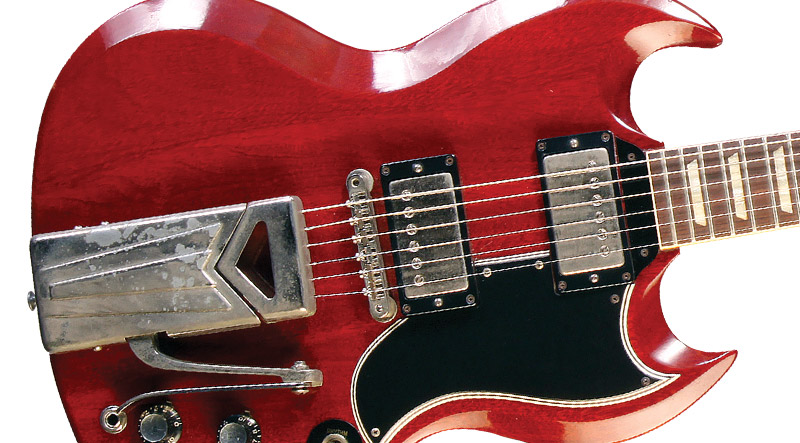
In mid 1958, their response arrived in the form of a new double-cutaway body of the same thickness as the previous single-cut Les Paul Junior and Special, but with rounded horns. The design, though, proved problematic on the Special, since the neck tenon was cut during the routing for the rhythm pickup, thereby weakening the neck joint. To strengthen it, Gibson moved the neck-position pickup slightly toward the bridge in ’59. But it was still far from ideal. The Special was renamed SG Special that year, retaining its “slab” body.
A second double-cut design, with pointed horns, was introduced gradually over the course of a year beginning in late 1960, and first used on the Les Paul Standard. Lighter and thinner, it was comparable in weight to any Fender or solid Gretsch, and boasted improved play up the neck thanks to a thinner profile and the fact it joined the body at the 21st fret. Like Fender’s Strat, its body edges were “relieved,” to allow greater comfort. The model name SG was used on the Special starting in ’59, but wasn’t used on the Junior, Standard, or Custom until early ’63.
Unfortunately, the modernization proved flawed. That thin, sleek neck joint on the thin beveled-edge body revealed itself as weaker than on the previous design. The long, thin neck was also less stable, which made it difficult to keep the guitar in-tune. And finally, the rout for the control pots made the body weak in that area, so if the guitar fell off of a player’s strap and hit the floor, the lower bout could break. Even more dramatic was the sad discovery by some players who broke the bout by stepping on their own cord, yanking it an unfortunate angle.
As it had done with the single-cut, Gibson took steps to improve the new guitar. Still, the transition did not equate to resounding commercial success. Production rose slightly in 1960 and ’61, then flat-lined. Plus, the burgeoning folk-music boom had shifted interest to acoustic instruments; sales of Gibson flat-tops almost tripled as mandolin and banjo sales rose, as well.
This guitar has suffered a break at neck-body joint, which was notoriously weak on early versions of the model. The new Les Paul boasted a slim, fast neck profile.
Interest in Gibson solidbodies wasn’t rekindled until well into the 1960s. Eric Clapton’s use of a ’59 Standard on the John Mayall’s Bluesbreakers’ “Beano” album in ’66 reinforced public interest in the original, but Clapton did not use his sunburst Les Paul very long and became better-known for playing his psychedelically painted “Fool” SG/Les Paul Standard. Blues guitarist Michael Bloomfield acquired a ’54 goldtop in 1965 and used it extensively until ’67, when he acquired a sunburst ’59 Les Paul Standard and used it with the Paul Butterfield Blues Band, influencing many musicians to seek out that specific model. By late in the decade, the popularity of surf music was on the wane and more players were discovering that the original Les Paul, especially with humbucking pickups, perfectly suited R&B and electric blues. Gibson responded in ’68 by reintroducing the single-cut Les Paul Standard in a goldtop version rather than the Cherry Sunburst players preferred (see “Southern Gold: Two Legendary Les Paul Deluxes” in this issue), though, in a move befitting Gibson and the model itself, it was hamstrung because instead of the humbuckers that helped reignite interest, Gibson equipped the goldtop Standard with two single-coil P-90 pickups; it did give the Custom version two humbuckers, but dressed that model with low “fretless wonder” frets, which were unpopular with R&B and blues players. But that’s another story.
This article originally appeared in VG October 2017 issue. All copyrights are by the author and Vintage Guitar magazine. Unauthorized replication or use is strictly prohibited.
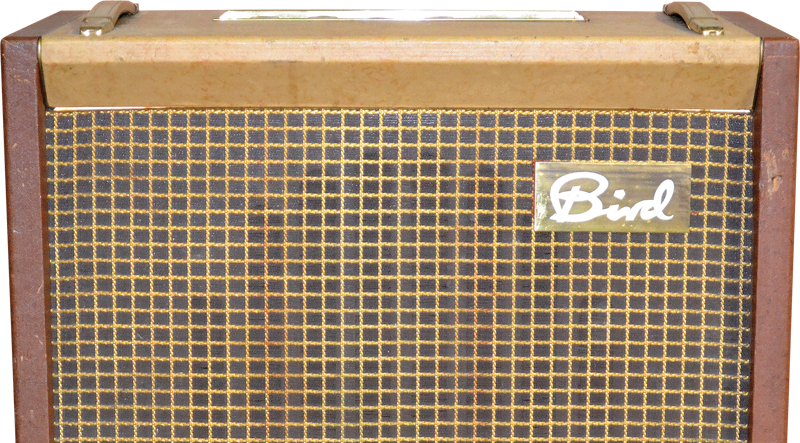
Amp and photos courtesy of Mike Tamposi. 1962 Bird Golden Eagle 4/25 • Preamp tubes: three EF86, six ECC83 (12AX7) • Output tubes: two EL34 • Rectifier: GZ34 • Controls: Volume and Tone for each of two channels; tremolo Depth and Speed; shared Reverb Level with Max/Min switches and channel-assign switch; and Repetitive Echo switch • Speaker: 15″ Wharfdale W15/EG • Output: around 25 watts RMS
Many of the oddballs, also-rans, and otherwise unusual creations we see in the amp world fall into the “B-list” category – the budget, student, and catalog amps that often display appealing ’50s and ’60s cosmetics but were never expected to lead the field. British maker Bird felt otherwise in creating the Golden Eagle 4/25.
Add up its features and the outrageous ambition of its design, and this amp clearly carried the full weight of its maker’s hopes and dreams as it headed out to conquer the world of Vox, Selmer, Watkins, and those pricey overseas imports from Fender and Gibson.
Did it succeed? Errr, no. But you know that already. If it had, Bird would be a household name… in guitarists’ households at least. Regardless, the Golden Eagle 4/25 was kitted like few other amps in the early ’60s – bigger Magnatones and Gibson’s GA-79RVT come to mind as competition in the “let’s see what we can pack in here” stakes, and it’s also likely Bird was taking a swipe at Watkins’ echo-equipped Joker featured here last month. The model name denotes number of inputs (four) and output rating (25 watts), respectively, and the amp packed two independent channels, reverb, tremolo, and a mystical effect dubbed “Repetitive Echo.” That alone should have won fans.
The Golden Eagle 4/25 is laid out across upper and lower preamp and output chassis, with its odd spring-reverb unit beneath the latter.
But, Bird wasn’t fated to crack the big-time. For the company’s lineup, as with so many interesting also-rans, that likely had to do with a lack of understanding of what made a tube-driven guitar amp sing – elements achieved in abundance in Fender’s tweed Deluxe or Bassman, Vox’s AC15 and AC30, and the yet-to-come Marshall JTM45 and JMP50.
Bird, it just so happens, was primarily a manufacturer of electronic organs, and it approached amplification more like a hi-fi manufacturer than a guitar-amp maker. With the goal of building clean-sounding amps, it rendered many rather anemic; the smaller Golden Eagle 2/15, for example, with a pair of EL84s, is severely constricted by its ultralinear output stage. This big one, then, might have been a happy accident; with a pair of cathode-biased EL34s and a big output transformer unfettered by ultralinear aspirations, the 4/25, says owner Mike Tamposi, absolutely roars while still providing plenty to ponder in a fussy and unusual circuit.
In addition to organs, Sydney S. Bird & Sons, of Poole, Dorset, did make several nifty guitar amps between around 1959 and ’65. Quality-wise, they were more on par with Watkins and Selmer than Vox and Marshall, but several carried interesting features. This Golden Eagle 4/25 seems to have been the flagship. And while the bones were more robust than some of the company’s other offerings, its bells and whistles were mostly sub-par. Tamposi said both of his 4/25s are finicky.
The bevy of onboard effects is impressive, though you’d be fortunate to find them functioning 55 years down the road.
“They remind me of my Selmers, but with printed circuit boards instead of standard point-to-point style wiring,” he said. “And while Bird used cheap caps and resistors, the transformers look like Drakes. It’s supposed to have an echo effect, but I can’t get it to work on either amp.”
His latter observation seems common, likely due to the fiddly nature of the “echo” circuit, which itself relies on the fiddly nature of the reverb circuit. The spring pan uses a crystal gramophone cartridge at each end to transmit and receive signal. These units sound interesting at best, though not as lush as the types used by Fender and Ampeg, and they’re prone to breakage. Bird’s Repetitive Echo effect used a tube-driven network to tap the spring at different points to produce a pre-set pseudo echo, with (it would seem) short-lived success.
Otherwise, from preamp to output stage, the Golden Eagle 4/25 follows familiar British circuit topology derived from Mullard’s applications manuals of the day, siblings of which are seen in some Vox and Selmer peers. Each channel has its own EF86 pentode preamp tube (a third drives the reverb), followed by a Volume potentiometer linked to a simple treble-bleed Tone pot. Skipping around the befuddling complement of effects – and making its way from the upper preamp chassis to the lower output-stage chassis via a cumbersome umbilical cord – the signal from each channel hits a sturdy long-tailed-pair phase inverter populated by an ECC83 (a.k.a. 12AX7). From there, it’s on to the EL34 output tubes which are independently cathode-biased with individual 470-ohm resistors and 50-microfarad bypass caps. All in all, the configuration makes Bird’s 25-watt rating fairly likely, even possibly conservative, though the same setup in a fixed-bias output stage fed with higher voltages might generate in excess of 50 watts. Rectification comes from another British standard, a GZ34 tube, and Bird included a hefty choke in the power-filtering line to help keep the tone punchy and the lows beefy.
This amp’s lower chassis has pencil-written legends for KT66 tubes in the output positions, though other Golden Eagle 4/25s carried the same EL34s; the schematic we’ve seen also calls for EL34s, and not only is Tamposi’s other example loaded with them, he’s fairly certain all of the tubes in this amp are the original Mullards. So, perhaps KT66s were a design whim that never got off the ground?
(Top) A trio of EF86 pentode preamp tubes (one for each channel, one for reverb) in the upper chassis gets things started in grand British style. (Bottom) The 4/25’s lower chassis houses its preamp’s EF86 and ECC83 tubes, two EL34 power tubes, transformer, and more.
All of this 25-plus watts is pumped into a hulking 15″ Wharfedale W15/EG speaker adorned with a spec label that cooperatively reads “10-15 ohms.” Relatively robust for its day, it might still have balked – or simply folded – at the full force of the cranked 4/25, but Tamposi doesn’t take any such chances when he wants to set loose the Golden Eagle.
“This sucker has a lot of gain,” he said. “So, I run it through a Marshall 4×12 and shake the farm!”
This article originally appeared in VG October 2017 issue. All copyrights are by the author and Vintage Guitar magazine. Unauthorized replication or use is strictly prohibited.
David Ryan Harris gets his greatest exposure singing and playing guitar around the world with John Mayer, but he’s been an accomplished songwriter for nearly 30 years. While he has a handful of solo albums and songwriting credits with Mayer, Dave Matthews, and Cassandra Wilson, he kept a handful of tunes for his new solo record ironically titled Songs For Other People.
Explain the title of the album.
I write songs to pitch to other people, and I had amassed a pile that nobody ended up loving. I thought I could put them together and make them hang as an album. Any other time I’m thinking I should write a specific body of work for a record. This wasn’t that. I usually aim for 15 songs and figure out which hold best to the mission statement.
Love is the central theme. There’s a certain amount of loss on a lot of them. “Darling” is about “Let’s burn this thing down that we had, and move to a new place.” “Coldplay” is a rumination about a relationship that fell apart. There are a few songs where you could do a narrative about the beginning of a relationship all the way to the end. “Red Balloons” is almost like a positive thing. This is the closest I will ever come to a disjointed pop record.
You began in the punk funk band Follow For Now in the late 1980s. How did you evolve from that to love songs?
It’s returning to what I came up with as a kid. There was tons of Stevie Wonder and ’70s AM radio. You have James Taylor, Earth, Wind & Fire, and Bill Withers. That’s what I grew up with during my formative years. I got a little older and more rebellious, as you do in your teen years, and punk really spoke to that. Bands like Bad Brains, Fishbone, Metallica, and the first Jane’s Addiction record. Those spoke to where I was at.
When that band broke up, it was difficult to play solo shows doing punk music, so I said “I’m going play music by myself with an acoustic guitar.” I returned to the stuff that I started with. There was a [NBC] show called “Michelob Presents Night Music.” They had a live performance with Pops Staples of The Staple Singers – just him playing a 335. I remember watching and thinking, “When I’m Pops Staples’ age, what kind of songs can I sing?” I don’t have any songs that I wouldn’t look ridiculous singing at that age. So I wanted to make music that could live with me forever.
I would love to put a band together. That’s my favorite state of being. Being in a band, rolling around with your buddies like a street gang. I love the musical camaraderie. I just haven’t been able to put one together. With this material, it’s not like I make acoustic records. These records are fully realized band records. It’s just expensive to tour with a band. That is why I tour acoustic – not because I have some mission statement about being an acoustic act.
Which guitars are you using?
I have a Gibson ES-330 that I love playing and writing with. It just sings. I also bought a Fender Jay Mascis signature Jazzmaster. It was super cheap and played great. I was never a Jazzmaster guy, but I love it. For acoustics, I have a ’66 Gibson Country & Western and a Martin OM-JM. There’s also a Gibson J-45 I’ve had for 14 years. I played that a bunch on this record and I play it on the road with John Mayer. I also have a pair of SG Melody Makers. I needed something that had single-coils, but didn’t want a Strat sound because John has that covered.
What’s you role in Mayer’s band?
I’m the glue. We have three guitar players, so it’s always an exercise in playing parts. I’m staying out of the way, but I’m being supportive and just being good. I have to have big ears on this gig so I can hear what John is doing and find my way without stepping on toes. I think this band requires that you have big ears and pay attention the whole time.
What’s on your docket looking ahead?
I’m going back on the road with John and then going out for three weeks supporting my record. Then there are more dates with John; I’m going to South America and then the West Coast. I’m excited about it.
This article originally appeared in VG October 2017 issue. All copyrights are by the author and Vintage Guitar magazine. Unauthorized replication or use is strictly prohibited.
Expatriate English guitarist James Elkington has long been based in Chicago, collaborating with other musicians including Janet Bean, Nathan Salsburg, and Steve Gunn. His first solo album is a mostly-acoustic effort called Wintres Woma, and it gives nod to his homeland in ways beyond its Old English title, which means “the sound of winter.”
“The way I write songs has a kind of ‘Englishness’ to it, though I haven’t really been able to put my finger on what that is,” he recently told VG. “It gets in your bones, and I’m more aware of it now that I don’t live there. I was also concentrating on trying to get the arrangement figured out in the guitar part in the way that a lot of British folk players used to do.”
Elkington played his parts in a DADGAD, a tuning he practiced during down time on tours.
“I wanted to tap into the way people like Pierre Bensusan and Martin Carthy arranged traditional songs, and apply it to my own,” he explained.
Wintres Woma was recorded at the studio of alt-rock band Wilco, where Elkington used guitars owned by Jeff Tweedy.
“Jeff’s collection is out of control, so I had to limit myself to the eight or nine guitars immediately around me, just to get any work done,” Elkington said. “The one that got the most use was Jeff’s Gibson L-00 from 1934, which sounded great in the room, but even better recorded. It was exactly the sound I was after, so I used it for almost everything. I recorded a couple songs with my Santa Cruz OM, which has been my main guitar for a while. I also used a ’50s Martin nylon-string, and one of Jeff’s Waterloo WL-14s. I was so impressed with his that I bought one to use on tour. It’s the closest thing I have to Jeff’s L-00.”
He also played banjo (“a crappy Washburn I’ve been dragging around for 25 years”) and a dobro.
The album’s leadoff track, “Make It Up,” is also the first single, propelled by a rolling, rapid-fire fingerpicked anchor lick and one of the few electric guitar passages on the album.
“It’s the most-accessible song on the record – kind of uptempo, but also a mission statement,” he detailed. “The electric is a parts Tele with an old Burns Tri-Sonic pickup, going through a ’60s Magnatone Twilighter.”
The only discernible percussion is a tabla sound on “Make It Up” and “Wading the Vapors.”
“Those are congas played with mallets by Tim Daisy, who’s a great drummer,” Elkington said. “Anything else in the way of percussion is probably me.”
“The Parting Glass” is a traditional instrumental.
“It’s an old Irish tune I found in a book,” said Elkington. “Again, I’m a fan of how people like Martin Carthy and Bert Jansch would arrange traditional music for other tunings, and that was my first attempt at taking a melody and putting a newly composed harmony to it.”
What sounds like an orchestral interlude on “Greatness Yet To Come” is “…actually just two very gifted musicians doubling themselves with different instruments and making it sound like an orchestra. Macie Stewart plays violin and viola, and Tomeka Reid plays cello. I wanted it to have a cinematic feel, and I think it came out really well considering it was just the two of them.”
The final track contains another bit of electric. “The solos on ‘Any Afternoon’ are a Les Paul,” he said. “It’s chambered and has Duncan Antiquities. I’m way into it.”
While Elkington had a concept for the disc and is proud of the results, he still appreciates playing with others.
“I think collaborations are my more-natural habitat,” he said. “As long as I get a balance, I’m happy.”
This article originally appeared in VG October 2017 issue. All copyrights are by the author and Vintage Guitar magazine. Unauthorized replication or use is strictly prohibited.







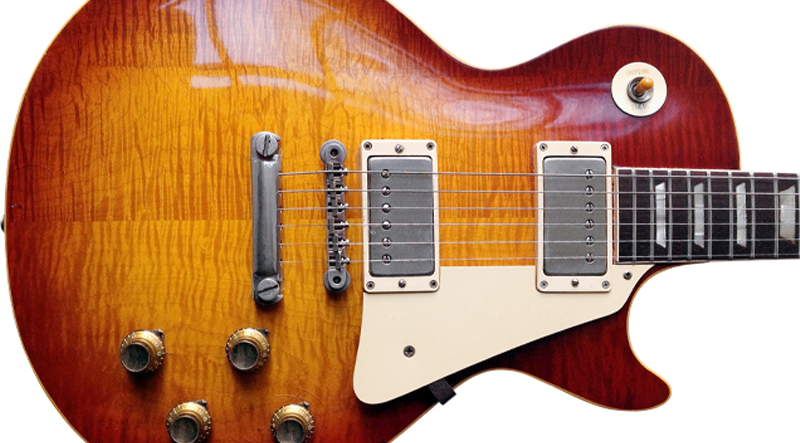


 “Its medullary grain is striking, too, enhancing the flame’s depth and iridescence,” Sandler said. “From most angles, you see continuous waves of tight flame. But what sets the guitar apart from most 1960 ’Bursts is its unusually translucent finish and deep, rich color. Some 1960 ’Bursts are noticeably opaque – with an orangey-red tomato-soup look to them.”
 Because the guitar’s serial number runs so late into the model year, and because its finish has less orange tint, Sandler believes it was likely a special order.
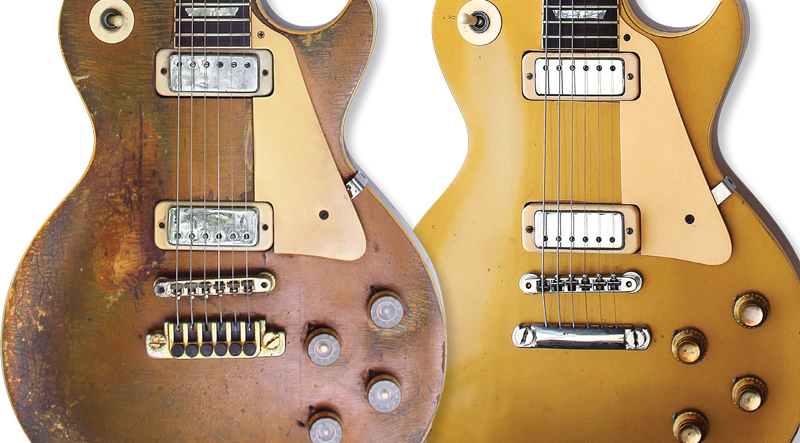



 Gibson’s next move to breathe life into the Les Paul line came in ’57, when the Custom and the goldtop Les Paul Model were among the first guitars to get Seth Lover’s newly designed “humbucking” pickup, which offered low-noise output and the inherent quality of cancelling 60-cycle hum that plagued performers in many live settings. The pickup produced a strong midrange tone that, unfortunately, didn’t find a ready use at the time – blues-based rock was a decade in the future and among electric-blues players in south Chicago whose style and sound could’ve put them to good use, few could afford a Les Paul. In the broader market of the late ’50s, the rapidly growing surf music was based on bright, twangy single-coil pickups; Les Pauls were neither bright nor twangy.