Tag: features

  • The Dr. Z CAZ-45

    The Dr. Z CAZ-45

    Price: $2,499
    www.drzamps.com

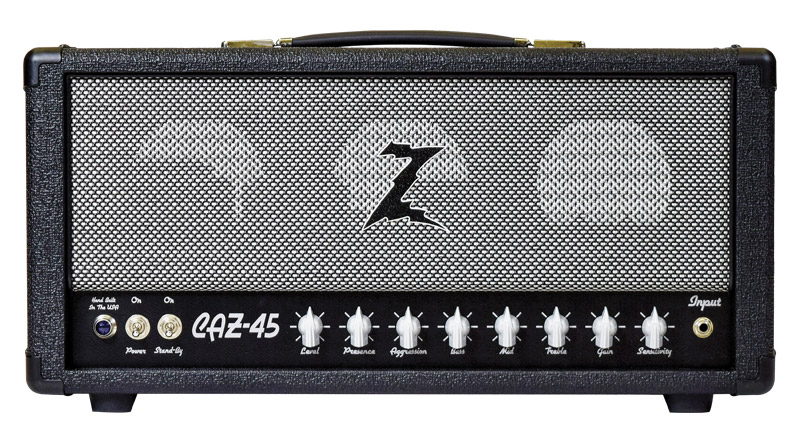
    When word got out in early 2020 that Mike Zaite and Alan Phillips (founder of Carol-Ann Amplifiers) were collaborating on a high-gain amp, the buzz was intense. After several prototypes and numerous design tweaks, the two masterminds came up with the Dr. Z CAZ-45.

    A hand-wired, 45-watt, single-channel head, the CAZ runs on two 6L6s, three 12AX7s, and one 12DW7. The control set includes the near-requisite Bass, Mid, Treble, Presence, Gain, and Level knobs, but there are also a couple never before seen on a Dr. Z amp – the Aggression and Sensitivity knobs add tremendous tone-shaping capabilities, controlling the amp’s tightness and overall responsiveness.

    With Aggression turned past 12 o’clock, low-end response is tight, pick attack sharp. Roll it back and you get a looser/smoother, less-aggressive sound. The Sensitivity knob is designed to tailor the amp’s responsiveness based on the player’s pickups. Turned up, it offers an extremely touch-sensitive and responsive feel under the fingers. Turn up the Gain along with the Sensitivity and pick harmonics fly off the fretboard. The ultra-smooth tube-driven effects loop is also impressive; time-based effects sound gorgeous.

    From the first notes played, one notices the CAZ-45’s 3D-like clarity and presence. But there’s also a top-end roundness that makes it particularly pleasant to the ears. Crank up Gain and Level (volume) and the CAZ-45 absolutely screams. Turn down your guitar’s Volume and enjoy beautiful cleans. With its thick, chewy feel, this amp is a lot of fun to play. Sweet, singing sustain with a great feel is effortless at any volume all the way down to a whisper, thanks to Dr. Z’s unique “master volume” design.

    Don’t be fooled into thinking the CAZ-45 is a high-gain one-trick pony. Yes, it’s capable of heavy tones, but it can do just about anything from clean to mean. Warm, musical sounds are a breeze with the Gain turned down, but if you want bright and articulate, the CAZ-45 has you covered – mid-gain classic rock and blues on through to fat, bouncy jazz tones. Regardless of how it’s dialed-in, the CAZ-45 may well make you a convert, with its otherworldly tones.


    This article originally appeared in VG’s August 2021 issue. All copyrights are by the author and Vintage Guitar magazine. Unauthorized replication or use is strictly prohibited.
  • The Epiphone Nancy Wilson Fanatic

    The Epiphone Nancy Wilson Fanatic

    Price: $529
    www.epiphone.com

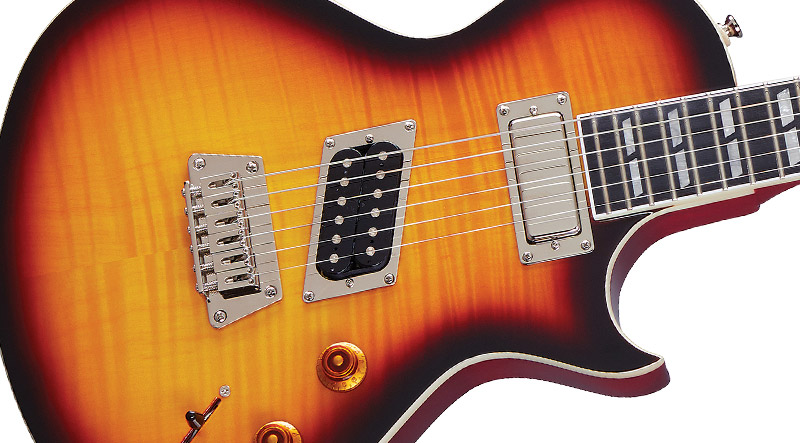
    Sometimes, it takes awhile to dial-in a good idea. The Epiphone Nancy Wilson Fanatic improves on Gibson’s Nighthawk design from the early ’90s, and now offers a versatile, player-friendly instrument.

    The big knocks on the Nighthawk were that it was headstock-heavy and had a useless middle-position single-coil. The Fanatic eliminates that pickup and uses two Probuckers with a five-way selector. The result offers a lighter alternative to a Les Paul that still delivers a meat-and-potatoes humbucker sound. A bonus is the selector’s fourth position, which offers extra output and drive unique to the Fanatic. The guitar also displayed excellent natural sustain when unamplified.

    As for ergonomic issues, the Fanatic is far better balanced than its predecessor, thanks in part to plastic-knob tulip-style tuners rather than all-metal kidney beans. The C-shaped neck wasn’t too slim or chunky, complementing the comfortably scooped and profiled body.

    The Fanatic is available in just one finish (Fireburst), and it along with overall build quality of our tester were first-class. Frets on the bound ebony ’board were neatly dressed, intonation was spot-on, plus it tuned easily and stayed that way extremely well.

    Playability and a double-take MSRP make the Nancy Wilson Fanatic not only an improvement on a ghost from Gibson’s past, but a serious guitar at a bargain price.


    This article originally appeared in VG’s August 2021 issue. All copyrights are by the author and Vintage Guitar magazine. Unauthorized replication or use is strictly prohibited.

  • Guild’s Starfire I DC GVT

    Guild’s Starfire I DC GVT

    Price: $835
    www.guildguitars.com

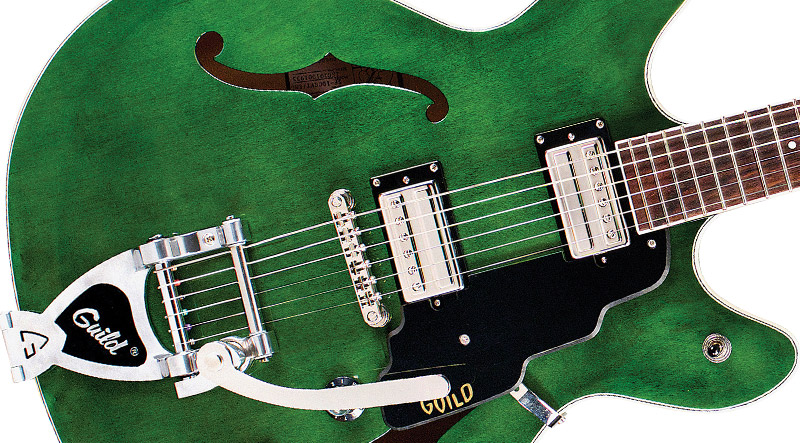
    Guild’s Newark Street guitars are a line of lower-priced instruments anchored by a reissue of the classic Starfire; the most distinctive is the I DC GVT.

    A handsome semi-hollow, it sports an arched top and back with a mahogany center block and is powered by Guild’s HB-2 Alnico II humbucking pickups with coil splitting for each (a handy feature).

    The Starfire is highly playable, with a thin U-shaped neck that meets the body at the 18th fret for easy access to the rosewood fretboard’s upper reaches. It balances well, too, and extreme string bends are effortless all along the 24.75″ scale.

    Plugged into a vintage Ampeg Reverberocket, the HB-2s sounded exemplary in both double- and single-coil mode, helping the Starfire to serve as six-string jack of all trades, capable of handling just about anything thrown its way – blues, various rock genres, Americana, country, R&B; even mellow jazzy chords were easy.

    With added overdrive or distortion, the guitar comes to life. The Bigsby (source of the “GVT” handle – Guild vibrato tailpiece) has a roller tension bar where a roller bridge would almost certainly make for better tuning stability. Still, attention to detail on this guitar is otherwise evident throughout. Fit, finish, and fretwork were impeccable, with no sharp fret ends or dead spots. Most impressive were the neatly finished sound holes, which too often are poorly executed.

    Offered in Emerald Green or Pelham Blue, the Guild Starfire I DC GVT arrives at an attractive price given its quality and performance. In a field crowded by semi-hollow choices, it stands apart.


    This article originally appeared in VG’s August 2021 issue. All copyrights are by the author and Vintage Guitar magazine. Unauthorized replication or use is strictly prohibited.

  • A Hero’s Gretsch 6117

    A Hero’s Gretsch 6117

    Scott Carpenter’s Gretsch #6117 Double Anniversary, SN 34374. Photo: Tim Tucker.

    In the 1960s, the astronauts were bigger cultural icons than the Beatles.

    And no, that’s not the Colorado-based surf band that hit with songs like “Baja.” We’re talking real astronauts, as in guys who climbed into tin cans perched atop 30,000 pounds of dynamite, lit the fuse, and broke the proverbial “Earthly bounds” of gravity.

    Mankind made its first voyage to outer space in April, 1961, and eight years later left footprints on the Moon. The efforts of the astronauts of the Mercury, Gemini, and Apollo space programs were, of course, documented by radio, newspapers, television, and textbooks as the United States and the Soviet Union duked it out in the “Space Race.” The astronauts of the original Mercury missions, in particular, enjoyed deity-like stature among the press and public, as chronicled in Tom Wolfe’s The Right Stuff and other tomes.

    In the Fall of 1960, this first-generation Gretsch 6117 Double Anniversary was purchased by U.S. Navy Commander Scott Carpenter, one of the original “Mercury Seven.” Its serial number is from late 1959 or early ’60, and Carpenter, now 80, recently told Vintage Guitar about his introduction to guitar and his affectation for folk and Calypso music in those days, citing tunes like “Yellow Bird” and “Day-O”.

    “I was attending the University of Colorado Engineering School,” Carpenter said. “And I went home with a classmate one afternoon; he had a guitar and knew how to make three chords, and I was hooked.

    “I ended up owning several guitars,” he added, “including a Martin, and a bunch of other stringed instruments – ukuleles and a tiple, which I loved.”

    Carpenter purchased the Gretsch in New York City in the Fall of 1960, when he and his wife, Rene, were in town to see a Broadway play accompanied by fellow Mercury astronaut John Glenn and his wife, Annie. After attending a matinee performance of The Miracle Worker at the Playhouse Theater, they made a quick jaunt up 48th Street to Manny’s Music just before it closed.

    “I don’t know why I decided on a Gretsch Anniversary,” he said. “I thought, at the time, that I was getting the top of the line. And it is a well-made instrument.” Even when it wasn’t plugged in, Carpenter liked the guitar’s sound.

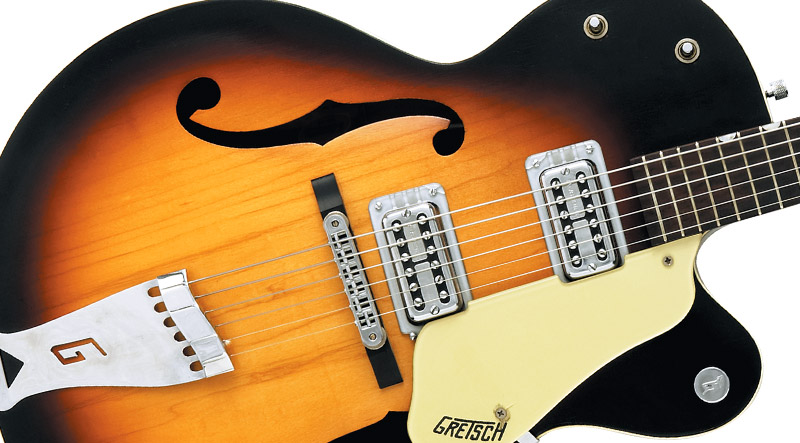
    Gretsch launched the Anniversary series in 1958, which was the company’s 75th year in business. The line was made up of the single-pickup 6124 and the two-pickup 6117 in sunburst finish, as well as both configurations in Smoke Green finish (called the 6125 and 6118, respectively). They had a 16″ single-cutaway maple body that was 21⁄2″ deep, and ebony fretboard with “thumbprint” fret markers. The headstock had a small “Anniversary” plaque with a diamond logo etched into it.

    Like many Gretsch instruments, the Anniversary series has undergone numerous changes in its history. The original 12-polepiece Filter’Tron pickups on first-configuration models were supplanted by less-potent Hi-Lo’Tron pickups, and the series ultimately underwent numerous alterations concerning electronics, hardware, and cosmetics.

    The control layout of first-edition Double Anniversary models is particularly intriguing. Note the pickup toggle switch and three-position tone switch on the upper bout, the master volume control on the cutaway, and the individual pickup volume controls on the lower bout. The bottom-line is that if this guitar was finished in orange and had a Gretsch-branded Bigsby vibrato instead of a “G” tailpiece, it would be a Chet Atkins model 6120 – Gretsch’s flagship model of the era.

    This example has a replacement tune-o-matic-style bridge that is more stable than the original, which had six threaded wheels that allowed alteration of string spacing, but no intonation capability.

    Scott Carpenter in the early ‘60s, the glory days of the Mercury space program. Photo courtesy of NASA.
    Carpenter was only the fourth American to venture into outer space, making his three-orbit journey in Aurora 7 on May 24, 1962. That’s almost 21 months before the Beatles appeared on “The Ed Sullivan Show.” Sadly, though, in 1964 he sustained an injury to his left arm that forced him to give up guitar.

    “I can’t supinate [it],” he said. “I can’t make barre chords. But I play four-string instruments on occasion, like a uke or a tiple, so I can still join in the fun.”

    Carpenter ultimately gave the 6117 to his daughter, Candace, who graduated from Berklee School of Music and counted the redoubtable Emily Remler among her instructors. She now teaches guitar and uses the 6117 in her jazz combo, the Jean Poole Trio, in the Boulder, Colorado, area, where she and her father reside. Since the guitar has been in her possession, the bridge has been replaced, a neck separation has been repaired, and the instrument has been re-fretted.

    Carpenter’s older daughter, Kris, also resides in Boulder, and collaborated with her father on his life story, For Spacious Skies, which was published in 2003.

    This Gretsch Double Anniversary model is cool and collectible in and of itself, but it’s even more interesting given its association with a real American hero.


    Special thanks to Kris Stoever and Candace Carpenter. This article originally appeared in VG’s March 2006 issue. All copyrights are by the author and Vintage Guitar magazine. Unauthorized replication or use is strictly prohibited.


  • Have Guitar Will Travel 071 – Adrian Belew & Turkuaz’s Dave Brandwein

    Have Guitar Will Travel 071 – Adrian Belew & Turkuaz’s Dave Brandwein

    In episode 71 of “Have Guitar Will Travel,” James Patrick Regan talks to guitarist/frontman Dave Brandwein of the band Turkuaz, and guest guitarist Adrian Belew, discussing its beginnings at Berklee School of Music, and the dynamics of being a group with nine members! The conversation turns to gear, including what Adrian has used going all the way back to 1980, as well as the original guitar synthesizers and touring with David Bowie. Listen Here!

    Each episode is available on Stitcher, iheartradioTune In, Apple Podcast, YouTube and Spotify!


    Have Guitar Will Travel, hosted by James Patrick Regan, otherwise known as Jimmy from the Deadlies, is presented by Vintage Guitar magazine, the destination for guitar enthusiasts. Podcast episodes feature guitar players, builders, dealers and more – all with great experiences to share! Find all podcasts at www.vintageguitar.com/category/podcasts.

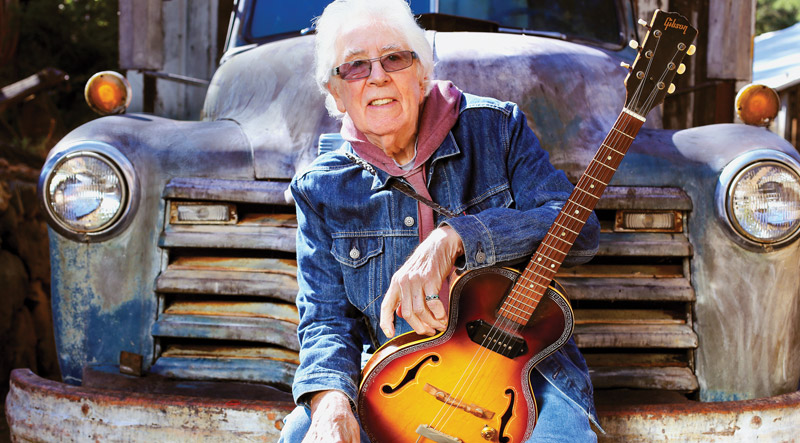
  • Blues Icon John Mayall

    Blues Icon John Mayall

    John Mayall: David Gomez.

    Few living blues artists could merit a package of 35 CDs. But what makes John Mayall: The First Generation most remarkable is that it only documents the British blues legend’s career up to 1974 – just 10 of his 55 years as a recording artist. It boasts official albums, a stash of bonus tracks, nine previously unreleased live discs, and a 132-page book.

    Not to “get ’em out of the way,” but the albums with Eric Clapton and Peter Green, and Mick Taylor’s first appearance with Mayall – Blues Breakers, A Hard Road, and Crusade, respectively – are so essential, dissected countless times over the years, we needn’t dwell on them. If you’re not familiar, you must’ve stumbled into the wrong bookstore. Regardless of your stylistic bent, these are seminal.

    Green also appears on the EP Mayall cut with harp legend Paul Butterfield, and each guitarist gets a turn on two CDs of BBC broadcasts. Mick Taylor had the longest stint with the bandleader before joining the Rolling Stones. Always his own man, he never played the speed game; live, he’d build solos gradually, weaving long phrases across several bars. With all the voodoo about Clapton and Green, make no mistake – Taylor was and is a force to be reckoned with. The ambitious Bare Wires includes an extended bonus live take on “Start Walkin’” – an example of Taylor at his best.

    Mayall’s drummerless period, documented with the well-known Turning Point and Empty Rooms, found saxophonist Johnny Almond and gut-string guitarist Jon Mark, subsequently to become Mark-Almond; USA Union featured guitar vet Harvey Mandel and violin wizard Sugarcane Harris; and the sorely overlooked Memories had Gerry McGee (the Ventures, Monkees, Delaney & Bonnie) on guitar and electric sitar.

    The years 1972 and ’73 were interesting, producing Jazz Blues Fusion, Moving On, and Ten Years Are Gone. Mayall mounted an ensemble of jazz stalwarts, including trumpeter Blue Mitchell, saxophonist Clifford Solomon, and guitarist Freddy Robinson, whose resumé embraces Howlin’ Wolf, Quincy Jones, and many more. His Gibson Barney Kessel model gets plenty of room to stretch out. These albums – with Sugarcane Harris returning to action on Ten Years – went a long way in exposing some jazz greats to blues and rock audiences.

    The hook that might get Mayall fans to drop 400 bucks for this is the live stuff, most of it previously unreleased. The first nine cuts of BBC broadcasts suffer with severely forgettable guitarists; when Clapton comes into the fold on “Little Girl,” the difference is profound, though his playing is busier than it would become. Interestingly, he takes liberties with “Hideaway,” but shadows Freddie King’s original on the head, not yet letting ’er rip as on Blues Breakers.

    The fidelity varies from show to show, with “All Your Love” and “Stepping Out” unfortunately muffled and distorted. Green’s first appearance, including his instrumental “Curly,” is likewise audibly challenged, but fortunately he reprises the tune on a subsequent show, displaying his trademark tone, sustain, and vibrato. Original instrumentals also showcase Taylor, with fine versions of “Snowy Wood” and “Knockers Step Forward.”

    Perhaps the jewels of the collection are two CDs’ worth of the lineup consisting of Green, Mick Fleetwood on drums, and longtime bassist John McVie – soon to splinter off into Fleetwood Mac. On the Mayall composition “Tears In My Eyes,” a slow blues that wouldn’t appear on record until Taylor replaced him, Green builds a solo from quiet to blazing as only he could. And he does the same on the Otis Rush minor-key “Double Trouble.” Add soaring lines on “Someday After Awhile (You’ll Be Sorry)” and “Looking Back,” and a price can’t be put on this college concert from ’67.

    It was somewhat of a tradition to feature Bluesbreakers guitarists on Freddie King instrumentals, and Green complies with killer takes on “San-Ho-Zay” and “The Stumble.” For his part, Taylor kicks off the first of four CDs he’s featured on with a great rendition of King’s “Driving Sideways.” The 18-year-old’s appearance at the National Jazz and Blues Festival in ’67 was indeed auspicious, particularly “I Can’t Quit You Baby,” but especially after Mayall pared the lineup down to a quartet, Taylor seemed to improve by leaps and bounds, gig to gig.

    So, what about Mayall himself? True, his talent-scout abilities often overshadow his own contributions. He accompanied his distinctive vocals on authoritative piano and organ, harmonica in the Sonny Boy Williamson tradition, and quirky guitar, typically slide. Most of all, his songwriting expanded the repertoire, and he championed the blues, for which he was awarded Officer of the Most Excellent Order of the British Empire in 2005.

    As I write this, with live music coming back not-quite-post-pandemic, the 87-year-old is set to play Arlington, Texas, in June. You bet I’ve already got my ticket.


    This article originally appeared in VG’s July 2021 issue. All copyrights are by the author and Vintage Guitar magazine. Unauthorized replication or use is strictly prohibited.

  • Dad’s Day 2021

    Dad’s Day 2021

    Marty Ashby’s very musical family has been playing together since he was a little kid. Here’s a shot of them in 1969; dad Jim (who operated Ashby Music in Baldwinsville, New York, and carried the Rickenbacker line) is playing a 1960 Fender Jazzmaster, Marty’s on a custom-order short-scale ’68 Rick, mom Henrietta is on bass, Dale’s on drums, and Jay’s playing trombone. “From 1969 until 1980, we were like the Partridge Family of central New York,” Marty said. Here’s Marty with his guitars today.

    Anthony Ragozino and his son, Zack, share a love for vintage Gibsons. Here’s Anthony with his early-’52 Les Paul and Zack with a ’54 ES-295 in front of a ’68 Marshall Super Lead 100-watt stack.

    Here are Preston Stedman and his daughter, Alana, in 1989. “Like her dad, she shares a love of music to this day,” he said. “She’s been a great concert buddy over the years.”

    Chris Gojdics and his kids, Nicholas and Sophia, love to make music in the house. Here, they have dad’s 1960, ’65, and Robert Cray Strats. “Playing together is a great way to spend Father’s Day,” said Chris.

    Here’s VG music editor Pete Prown with his newly acquired ’94 PRS McCarty (“…a bucket-list guitar,” he says), and his son, Rowan, picking an Eastman mandolin.

    Check out happy dad Michael Duncan with his clan! That’s Alexander (left) with a 1990 Rickenbacker 360/12, Mike with a PRS DGT, Abby on a Fender Custom Shop Dick Dale Strat, and Henry with a Stevie Ray Vaughan Strat. In back are a reissue Tele and a ’90s P-Bass.

    Times are good when Mark Clementi and his sons Cole (left) and William play together. Here, Mark is holding his ’65 Framus Atlantik 5/113 with his ’39 Gibson J-55 at the ready, while the boys have Fender Squire Mini Strats.

    Charlie Margeson and his daughter, Kaitlyn, like to spend time jamming in dad’s guitar room. Kaitlyn’s playing her ’86 Epiphone dreadnought while Charlie sticks with his ’58 Strat! “She got bit by the guitar bug early, like her dad, and plays great,” said Charlie. We”ve had alot of fun together.”

    In Dublin, Ireland, Peter Cheevers and his dad, Ben, are both longtime VG subscribers who propped all of their axes for thisø shot. The collection includes everything from a ’63 Höfner Senator bass to a 2007 PRS CE22. “It was a great day,” said Peter. “We jammed, ate cake, and drank tea.”

    Greg Roth, his son-in-law, Matthew, and son, Kelly, make music and memories on this array of Gibson, Fender, and Squire guitars.

    Just as he did with his son, Joshua, Edward Sparks made sure his grandson, James, had an instrument in his hands real early! Here’s Ed with a home-built eight-string and James with an F-style mando. At four, he’s the same age Josh was when he learned to love his dad’s Ovation Balladeer.

    Music keeps Anthony Guanci close to his kids, Toni (left) and Robin. Here, dad has his Taylor 514ce while Toni holds a custom Benford SC V3. “Happy Father’s Day to all those who have pretty cool kids like I do!” Anthony said.

    Here are Joe A. and his grandkids with grandpa’s ’82 “Dan Smith” Stratocaster, a Highway One Tele, a Les Paul Studio, and a ’94 SG.

    From Florida, here are Mike Jones, his dad, Doug (who’s 92), and son, Christian. Doug has his ’38 L-7 Mike his ’85 ES-175 , and Christian his Nash T-53.

    Jim MacArthur and his sons, Matt and Nick, love music and playing their instruments, which include everything from an Epiphone Mandobird to a 1970 Guild D-40 and a late-’50s Harmony “cowboy guitar.”

    Though they live far apart, VG subscribers Steve Vuich and his son, Brandon, take every opportunity to perform together like they were in this photo from a pre-Covid world. “We stay connected by talking about guitars and music,” said Steve.

    Eight-year-old Miles Blood and his dad, Jeff, enjoy jamming in their practice space. Miles is on an Ibanez Mikro, Jeff an ’88 Kramer Sambora. “Miles likes to listen to my old records and going down the Youtube rabbit hole to find music,” said Jeff. “His current favorites are Eddie Van Halen, Yngwie, Weezer, Gorillaz, and Weird Al Yankovic! The future of rock is secure.”

    Paul Swanson grabbed his ’67 lefty Guild Starfire V for this shot with his granddaughter Abbey, grandson Wilder, son-in-law Ken, and wife, Pam. Daughter/mom Jessie, who plays classical piano, served as photographer. “Where did I go wrong with her?” Paul asks, jokingly.

    Scoring high for family style, here are Stanley Johnson, his granddaughters Kylie and Eliana, son, Dustin, and their Beatles-inspired gear.


    This article originally appeared in VG’s July 2021 issue. All copyrights are by the author and Vintage Guitar magazine. Unauthorized replication or use is strictly prohibited.
  • The KW Cabs ST-220T SSB

    The KW Cabs ST-220T SSB

    Price: $1,419 base/$1,539 as tested www.kwcabs.com

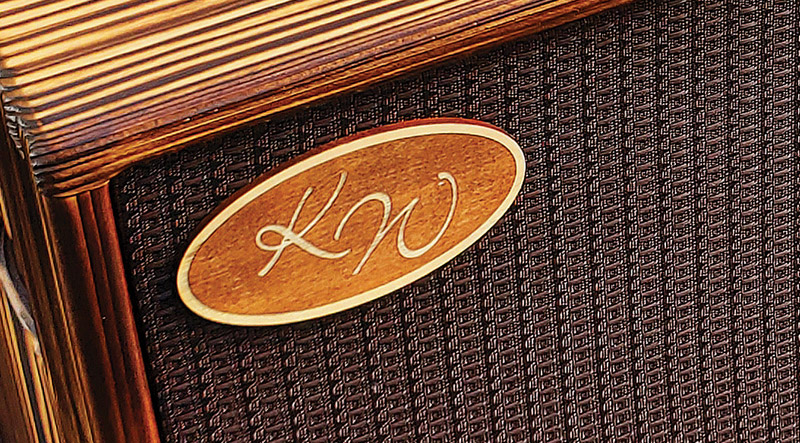
    Like you, Kurt Wyberanec knows that good extension cabinets, like acoustic guitars, serve their player as resonant sound chambers. Those he builds go the extra mile with artful design, sturdy construction, and unique functionality.

    Wyberanec’s company, KW Cabs, recently introduced the ST-220T SSB, an update of the cab that put the company on the map in 2003. A 2×12, it resembles fine furniture, and Wyberanec offers several wood and tolex finishes. Our tester, the SSB (an acronym for shou sugi ban), is named after an ancient Japanese form of woodworking in which the surface is burned and scraped back, leaving grain raised and black. It’s topped with a high-gloss/water-based lacquer.

    Equipped with a pair of Celestion Creamback 75 speakers (others are available), our tester ST-220T rendered huge sounds with help from three heads – a 1973 50-watt Marshall Model 1987, a vintage Vox AC30 TB, and a five-watt Marshall Class 5. Both high-wattage amps sounded as they should, with the Marshall producing signature crunch and the Vox retaining its trademark chime. The cabinet generated crisp highs and teeth-rattling lows while pushing a surprising amount of air. This level of volume especially benefited the Class 5, making it sound like a much more powerful amp when pushed.

    Functionality is boosted by the cabinet’s wiring system, offering 8- and 16-ohm options in mono and stereo. While the bottom-mounted jack plate is not ideal, it accommodates a partially removable back panel – small criticism and worth tolerating for the great tones this cab can bring to a stage or studio.


    This article originally appeared in VG’s July 2021 issue. All copyrights are by the author and Vintage Guitar magazine. Unauthorized replication or use is strictly prohibited.

  • The D’Angelico Excel 59

    The D’Angelico Excel 59

    Price: $1,999.99
    www.dangelicoguitars.com

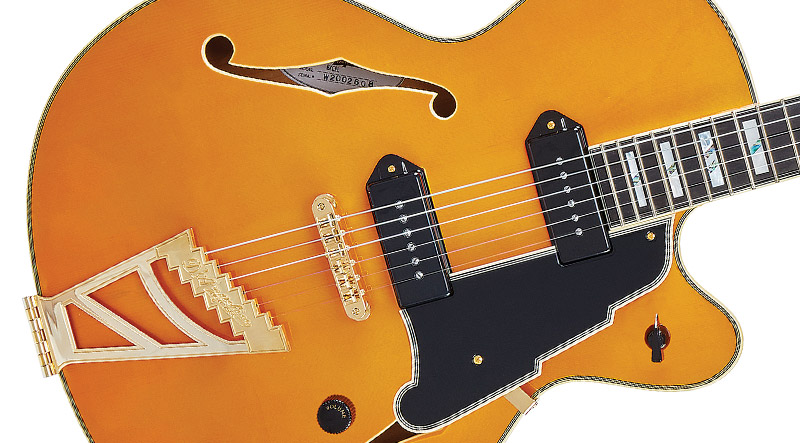
    Some might see it as a Frankenstein’s monster, while others will view it as the best of all worlds. The D’Angelico Excel 59 is a throwback to an original John D’Angelico design from 1959 – a 3″ archtop mounted with P-90s. However, this modern take puts the body on a diet and brings updated pickups.

    Like a D’Angelico Excel, the 59’s body is fully hollow – 16″ wide and a mere 1.75″ deep. That’s about the same depth as an ES-335, sans center block. The result is that it’s easy to wrap your arms around the girth and really dig in and play.

    The neck is smooth and sleek, topped by an ebony fretboard with a modern C-profile radius and medium jumbo fret wire, all accented by mother-of-pearl and abalone split-block fretboard inlays. It’s crowned by that most regal of guitar headstocks, complete with stepped gold Grover tuners. The body’s made of laminated flame-maple back and sides and capped by an arched laminated spruce top. And those flames burn brightly!

    But the pickups are the key. The Excel 59 uses custom Seymour Duncan Great Dane dog-ear P-90s exclusive to D’Angelico. Plugged into one of D’Angelico’s sibling amps – a period-perfect Supro Thunderbolt Plus – the Excel 59 sizzles. The combo of the hollow body and those P-90s creates a warm, woody tone with crisp, clear articulation. Click the vintage-inspired chickenhead pickup selector and cupcake Volume and Tone knobs, and you can dial in a hot, trebly, vivid rockabilly tone. Spin the knobs again and you go deep into heavy-duty rawk territory with a bold and brash sound with a thick, organic overdrive. That’s the glory of a hybrid model; the Excel 59 is a utility player with a wide range of tones and sonic options at your fingertips.

    Compare the D’Angelico to that classic hybrid – Gibson’s 1955 Byrdland, which was based on a L-5CES but with a thin body and a shortened scale. The Excel 59 shape is classic, but the feel – and that sound – is something novel.

    Finish options include Vintage Natural or deep red Viola, with the classic golden stairstep tailpiece. Or, go for the weathered Black Dog finish with a D’Angelico Shield Tremolo and white P-90s. Whichever you choose, it’s a whole lot of classy rock-and-roll tone.


    This article originally appeared in VG’s July 2021 issue. All copyrights are by the author and Vintage Guitar magazine. Unauthorized replication or use is strictly prohibited.

  • The Logan Telemaster

    The Logan Telemaster

    Price: $1,099
    www.logancustomguitars.com

    Though Bob Logan has been building guitars since 1972, he worked in construction for a few decades before fully dedicating himself to custom builds. Today, he specializes in models like his latest, the Telemaster.

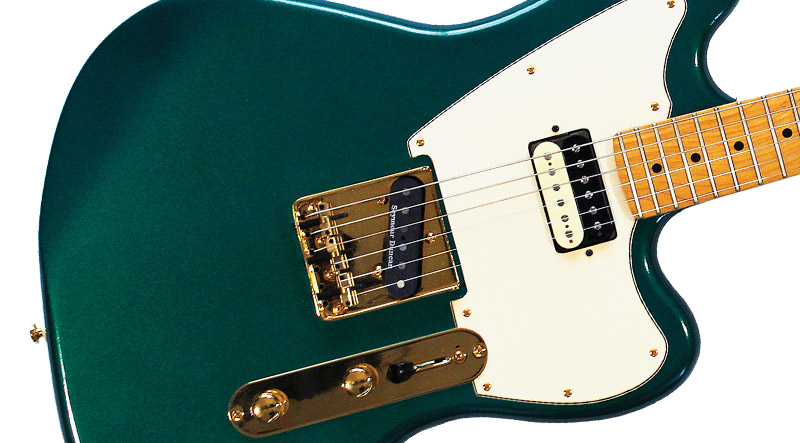
    With an alder body and maple neck, our tester Telemaster weighed in at a comfortable seven pounds, 12 ounces and balanced well while sitting and standing, exhibiting no neck dive. The neck has a modern C shape, while the maple fretboard (rosewood and ebony are options) has a 9.5″ radius and 22 medium jumbo frets. The nut is 111/16″ wide. It all contributes to an extremely stable instrument that held tuning through vigorous playing, slashing chord work, and torturous string bending. Other features include a custom-made bridge plate, Gotoh tuners, 250k CTS pots, orange-drop caps, D’Addario .010-.046 strings, and a Switchcraft jack. All hardware is gold-plated.

    Plugged in, the Telemaster proved its rock cred with the Seymour Duncan pickups – an APH-I Slash humbucker in the neck and an Little ’59 in the bridge; the neck pickup delivered exceptionally smooth-but-strident response, the bridge characteristic Tele bite without a hint of harshness.

    Logan normally uses clear nitrocellulose lacquer finishes, but the Telemaster is his first painted guitar – a striking Jade Green finish that’s extremely attractive. And the best part? The price. This is a custom-made guitar that looks great, plays superbly, and will hold up to the rigors of the road.


    This article originally appeared in VG’s July 2021 issue. All copyrights are by the author and Vintage Guitar magazine. Unauthorized replication or use is strictly prohibited.