
 The PRS Archon 25 offers 25 watts output switchable to 13 watts using a 6L6, EL34, or 5881 output tube. Each of its two channels has controls for Volume, Treble, Middle, and Bass, along with Master Volume control for each channel and global Depth and Presence. Visit www.prsguitars.com/archon25.
Year: 2014
-
PRS Offers Archon 25 in Combo Format
-
TC Electronic Offers Flashback Triple Delay
 TC Electronic’s Flashback Triple Delay has 12 different delay types and allows the player to use them in parallel or series, as well as three simultaneously. It has a tap-tempo switch, stereo in/out, MIDI connectivity, and an expression-pedal input. Learn more www.tcelectronic.com.
 -
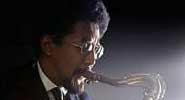
Charles Lloyd

In 1965, when these previously unreleased tracks were recorded at two New York venues, saxophonist/flautist Charles Lloyd and guitarist Gabor Szabo had recently left drummer Chico Hamilton’s group – an incubator for numerous jazz greats. Within a year, Lloyd got as close to being a rock star as any jazz artist of the period, with a quartet sporting Keith Jarrett, Cecil McBee, and Jack DeJohnette, and Szabo released Spellbinder, whose “Gypsy Queen” was later grafted onto Santana’s cover of Peter Green’s “Black Magic Woman.”
Both enjoyed crossover success, with Szabo unafraid of being labeled “commercial” – sort of the guitar’s equivalent of flautist Herbie Mann. But on the six cuts spread over this double-CD, clocking in at 80-plus minutes, they spearhead perhaps the most formidable super-group either would enjoy, with Ron Carter (at the time, Miles Davis’ bassist) and Pete LaRoca (who’d drummed with Bill Evans, Sonny Rollins, and John Coltrane).
In the liner notes, Lloyd accurately states, “This is a music of freedom and wonder – we were young and on the move.” He and Szabo were breaking down barriers, experimenting with Indian music – heightened by Szabo’s trademark use of a Martin dreadnought with a DeArmond soundhole pickup.
Like their previously unreleased performances by Coltrane, Evans, and Wes Montgomery, the nonprofit Resonance label’s package befits these jazz giants, with a 36-page booklet with insightful essays and photographs.
This article originally appeared in VG‘s December ’14 issue. All copyrights are by the author and Vintage Guitar magazine. Unauthorized replication or use is strictly prohibited.
-
Kirk Fletcher

Blues gets a bad rap because of a preponderance of mediocre imposters who lack the magic. The great stuff will stir you and mesmerize. Two-time WC Handy Award nominee Kirk Fletcher has the magic, and this album is Exhibit A.
Recorded on separate nights at the legendary Baked Potato in Studio City, California, Fletcher is joined by drummer Lemar Carter and bassist Travis Carlton on the first night. The second night consists of Carter, bassist Calvin Turner, and Jeff Babko on organ.
Supplementing fresh arrangements to crowd favorites “Funnybone,” “El Medio Stomp,” and “Congo Square,” Fletcher’s sultry vocabulary adds even more brilliance to Stevie Ray Vaughan’s “Lenny.” He swings hellaciously on “Blues For Kleopatra,” and explores lowdown love on Jimmy Reed’s “Found Love.”
Fletcher’s playing is a synthesis of the best qualities of contemporary electric blues, but he isn’t confined by it. On “Blues For Robben & Larry,” Fletcher displays a limitless flow of concepts in a slow-blues context.
His exceptional band swings hard on “Ain’t No Way” with Fletcher nodding to B.B. King and Robben Ford with juicy virtuosity and zeal.
This article originally appeared in VG‘s December ’14 issue. All copyrights are by the author and Vintage Guitar magazine. Unauthorized replication or use is strictly prohibited.
-
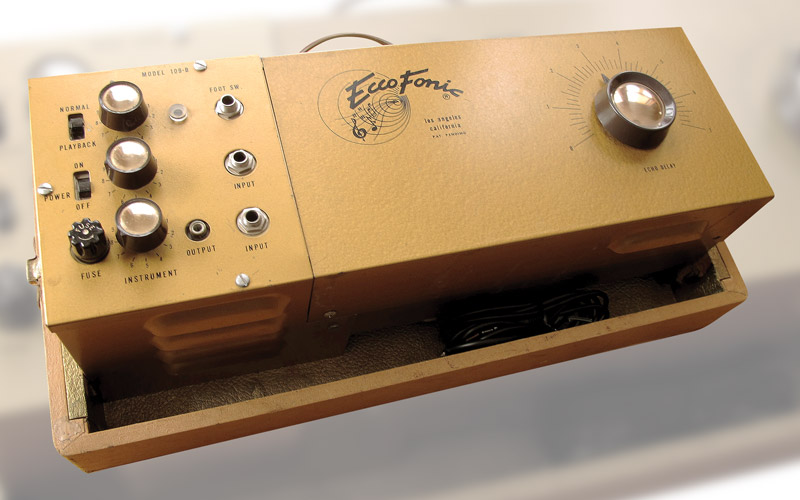
Ecco-Fonic

Four-knob Ecco-Fonic Model 109-B, circa 1960. John Adomono was an American guitar hero of the Cold War years. JFK named him his favorite guitarist, and Adomono played a command performance at the White House. He performed on “The Ed Sullivan Show,” jammed with the likes of Frank Sinatra, Duke Ellington, and Martin Denny. And at the dawn of the Space Race, he released several LPs of far-out tiki and spacey exotica music.
Adomono was a guitar hero in part because he had a secret weapon in his arsenal.
“John played alone, but most people thought there were five or six players on his records,” remembers Lu Woolley, his promoter and booking agent. “People were absolutely wowed by him. Nobody played like him.”
Adomono’s secret weapon was the Ecco-Fonic, a cutting-edge tape-echo machine. Alongside DeArmond’s Tremolo Control, it was one of the first stand-alone effects for the guitar. The Ecco-Fonic was also a testy, fidgety machine to use. It was never produced in great numbers, embraced by guitarists, nor widely distributed. Yet it remains a guitar milestone. And Adomono was one of the early testers, promoters, and endorsers.
Adomono was Romani. Born in the 1930s, he was playing guitar on the streets of New York City for spare change when he was five years old. He met fellow Roma Django Reinhardt during his sole U.S. visit in 1946, and was inspired to play jazz. But it was Adomono’s introduction to one of Ray Butts’ EchoSonic amps that spurred his fascination with echo and helped create the sound that made him famous.
In the late ’50s or early ’60s, Adomono was playing in Memphis when he met local guitarist John Arnold and borrowed his Gretsch 6120 and EchoSonic amp with built-in tape echo. “He would just play the crap out of it,” Arnold says. “He was amazing. He could get more out of a guitar than anyone that I had ever heard. This was his first time playing with a portable echo chamber. He was so enamored with the thing doing echo and making him sound like more guitars.”

CLOCKWISE) Ecco-Fonic logo from the tan 109-B case. Operating the tape loop on the Ecco-Fonic 109-B required constant head cleaning, motor oiling – and luck. The control panel of the Ecco-Fonic 109-B has the input – a standard 1/4″ plug; output was a RCA plug. Butts built the EchoSonic in small numbers and mostly sold them by word of mouth, primarily around Memphis. Adomono was on his way west (he would play for decades in Las Vegas at the Thunderbird Hotel, in Honolulu and L.A. at Donn Beach’s Don the Beachcomber lounges, and up and down the West Coast). While in Southern California, he discovered the Ecco-Fonic, which, like the EchoSonic, was largely a regional “secret” despite the builders’ best efforts.
The Ecco-Fonic was the creation of Ray Stolle, who ran a radio-and-TV repair shop on Sunset Boulevard in L.A. No one seems to remember his inspiration or motivation for the tape-echo machine. He built a prototype circa 1959 that differed from the EchoSonic in that the second playback head was adjustable, allowing musicians to fine-tune the time between the original note and echo. As an early flyer touted, “The Variable Delay Control permits the player to select any rate of straight echo playback desired. This can be from a microsecond to as much as a full half-second delay.”

Del Casher showed the potential of Ecco-Fonic on this demonstration EP. The first Ecco-Fonic had two control knobs: one for delay, the other for Reverberation, which was supposed to control volume decay on the echo. The machine also included an Echo Selector Switch that allowed players to record a short segment, then play along with the loop.
Stolle somehow hooked up with Fender, and the Ecco-Fonic was first promoted in a single-page Fender Sales flyer in summer ’59 as well as Fender’s ad insert in the annual Down Beat magazine guitar issue. But, as John Teagle reported in Vintage Guitar in 1998, Fender Sales chief Don Randall, “reportedly was not impressed with the reliability and test-user satisfaction” of the machine. Among other issues, the first Ecco-Fonic was mounted in a gold-painted metal box with a one-piece top that hampered easy servicing – and as Ecco-Fonic users quickly discovered, the unit needed constant oiling of the motor, head cleaning, and tape replacement.
Stolle lacked the finances to develop his design, so he sold out to E.S. “Eddie” Tubin, who started manufacture of the Ecco-Fonic at 905 S. Vermont Avenue, Los Angeles. Tubin refined the device with the aid of Adomono, guitarist Del Casher, and other early testers. A three-knob version appeared in late ’59, followed in 1960 with the four-knob Model 109, which added an Instrument volume pot blending wet and dry signals.
Tubin’s revised Ecco-Fonic sported a two-piece top, making service access simple. And the tape speed was revised from the 15-inches-per-second of the initial versions to 7.5 IPS, for better fidelity.
Tubin began promoting the 109 in music magazines with endorsements from Adomono, Casher, his accordionist bandmate Tony Lovello, mandolin maestro Dave Apollon, harmonica ace Leo Diamond, Joe Maphis, and Hank Thompson.
The 109 was superseded in autumn, 1960, by the 109-B with a rearranged four-knob control panel and the elimination of the Reverb switch. Thanks to the updates and advertising, the 109 was likely the first Ecco-Fonic to sell in significant numbers; as one ad shouted, “Stepped up production is our response to phenomenal acceptance.”
In 1961, the company was sold again, this time to industrialist Milton Brucker. Early 109-B models carried the legend “Los Angeles California” below the modernistic Ecco-Fonic logo; later versions sported a straighter logo and the address “Hollywood 28 California,” as production moved to Santa Monica Boulevard.
The 109-B was followed by a 109-C with multiple playback heads. This version came in a black-painted case and was likely built in small numbers. Brucker also announced plans for other Ecco-Fonics for churches, auditoriums, and radio stations with the model names Singalong, Vaudevillian, and Encore as well as the console Broadcaster model. It’s unknown how many – if any – of these others were ever made.

(RIGHT) Del Casher on the cover of an early Ecco-Fonic brochure. (LEFT) An early promotional photo of John Adomono. Teagle believes overall tube Ecco-Fonic production began with serial number 1001 (Casher’s Stolle/Tubin prototype is number 1012) and likely ran into the 3000s before switching to the solidstate version.
In the fall of ’62, Ecco-Fonic was bought out by electrical engineer Bob Marks, who moved shop to Pico Boulevard. With help from chief designer Russ Allee, Marks spearheaded the creation of a solidstate Ecco-Fonic to be distributed exclusively by Fender. Chicago Musical Instruments had taken over production of the Echoplex tape-echo machine under its Maestro line to accompany its Gibson guitars. So Fender rechristened the Ecco-Fonic as the Fender Echo.
The quirkiness of the Ecco-Fonic design always held it back, whereas the Echoplex, thanks in large part to its tape cassette, proved reliable and easy to operate. Fender offered its solidstate machine for several years starting in ’63, but it never sounded as good, and the Echoplex dominated the market. Orders dwindled, and the Fender tape machine was retired. The company soon switched to Tel-Ray’s simpler, but less-effective oil-can echo unit.
John Adomono never gave up on his Ecco-Fonic, however. As a solo guitarist, it was vital to his sound.
“He always used that echo,” promoter Woolley remembers. “He was just one person with one instrument, but the sound blew people away. Women from age 21 to 80 would go crazy for him, and send napkins with notes, trying to make contact.”
One of the most astounding examples of Adomono’s guitar work appears on his 1974 private-label LP Gypsy, which was funded by Woolley and others. Picking his archtop Guild through his tried-and-true Ecco-Fonic, he plays Rimsky-Korsakov’s virtuosic showpiece “Flight Of The Bumblebee,” his fleet picking resounding in multiple layers of warm echo, thanks to his old echo chamber in a box. It’s a masterpiece of guitar music.

This article originally appeared in VG June 2014 issue. All copyrights are by the author and Vintage Guitar magazine. Unauthorized replication or use is strictly prohibited.
Ecco Fonic
-
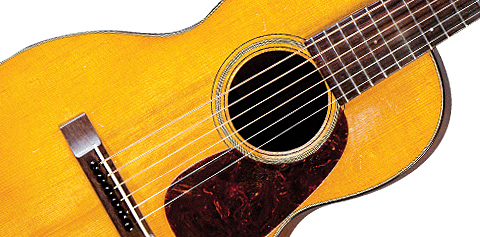
Martin 5-18

This Martin 5-18 was made in late 1935 and carries serial number 61745. The Martin style 5-18 is the smallest guitar in Martin catalogs; at the lower bout, it measures 11.25″, while at the upper bout it is 8.25″. And its body is just 16″ in length, with a scale of 21.4″. In 1930s catalogs, the style 5-18 and the less expensive matching size 5-17 were listed with the caption “Junior, or three-quarter, sizes fine for children; easy to hold and to play.”
Though most players viewed size 5 guitars as “junior” instruments, in the 1950s and ’60s, the style 5-18 was popularized by Marty Robbins, who used it extensively onstage.
Early in the history of the Martin company, guitars of this size were not viewed as a junior or three-quarter instruments, but were part of the Germanic tradition of “terz” guitars, designed to be tuned to a minor third – three frets higher than standard pitch and suitable for solo performances and harmony work. Terz guitars were produced by many 19th-century Germanic makers, and many European composers in the early/mid 19th century – most notably Giuliani and Sor – wrote solo and ensemble music that included parts for terz guitar. C.F. Martin, Sr. was deeply influenced by the designs of Johan Stauffer and was familiar with Stauffer’s terz guitars. Some surviving Martins of the 1830s and ’40s are terz guitars, and have a scale of 22″.
From the 1840s through the 1850s, Martin’s style designation system became increasingly standardized. Guitars were offered in sizes 1, 2, 3, 4, and 5, with the largest (size 1) measuring 12.75″ wide and the smallest being the size 5 terz. The very rare size 4 was also designated a terz. As larger guitars became popular during the 1800s, Martin introduced the size 0 measuring 13.5″ wide and later the size 00 measuring 14.125″ wide. It was not until after 1900 that the 15″-wide size 000 was introduced.
The 5-18 was listed as early as 1898 in Martin literature and last appeared in their catalog in 1989, though a Marty Robbins reissue 5-18 has been offered since 2006. With the exception of the slotted peghead, which was discontinued in the late 1940s in favor of a solid peghead, the 1935 5-18 shown here is virtually the same in appearance. This guitar has an Adirondack spruce top, whereas the post-war 5-18 has Sitka spruce. The ’35 has a Brazilian rosewood bridge, fingerboard, and peghead veneer, while those made from 1970 onward have Indian rosewood. The ’35 also has mahogany neck, back, and sides, as do the post-war models.
Though Martin offered size 5 models ranging from style 15 through the elaborately ornamented style 45, the only ones made in any significant quantity prior to World War II were the style 17, 18, and 21 in six-string guitars and styles 17, 18, and 21 tenors, as well as some style 15 post-war size 5 tenors. In recent years, Martin has offered highly ornamented size 5 models.
While terz guitars tuned a minor third above standard are a common instrument in the Germanic tradition, requinto guitars tuned a fourth higher (five frets above standard) are common part of Spanish and Latin American tradition. The requinto used in mariachi music is smaller than the standard-tuned guitars in the band, but has greater volume and projection and plays a significant role in the music. From the mid 1990s until recently, the Tacoma Papoose (tuned five frets above standard) was part of that company’s line, which ranged from the Papoose to standard-size instruments and a baritone guitar as well as acoustic four- and five-string basses.
Though size 5 terz guitars are smaller, they produce as much volume and have as much (if not more) projection than a full-sized/standard-tuned instrument. Many other small instruments have similar qualities; a fine violin can be used to play a solo heard above an entire symphony orchestra without amplification, a mandolin is fully as loud if not more so than any guitar, and the sound from the lone piccolo in a large symphony orchestra can carry throughout a concert hall. In spite of their size, small instruments designed with the proper ratio of air-chamber size to pitch are capable of tremendous volume and projection.
It’s ironic that although size 5 instruments were designed to be tuned three frets above standard pitch and have a scale length very similar to a standard guitar capoed at the third fret, pre-war Martin catalogs, as well as those of the 1950s through ’80s, referred to them as simply three-quarter-sized guitars. They are quite playable tuned to standard pitch, but tuned at least two frets above standard pitch, their sound comes alive. The short scale and smaller body results in a very different sound with excellent tone, volume, and projection. Though three of the four strings of the violin and viola are tuned the same, their tone remains quite different; the same applies to the terz, which has a voice all its own.
Martin’s description for the Marty Robbins 5-18 instructs players to tune the instrument three frets above standard pitch, finally acknowledging (and paying homage to) the fact these are descendents of early terz guitar designs from the homeland of C.F. Martin, Sr.
This article originally appeared in VG June 2014 issue. All copyrights are by the author and Vintage Guitar magazine. Unauthorized replication or use is strictly prohibited.
-

Greg Lake

Greg Lake: Lee Millward. Bassist/vocalist/songwriter Greg Lake came to notice in 1969 as member of King Crimson and his membership in Emerson, Lake and Palmer cemented his place in the pantheon of progressive-rock icons. He also recorded numerous solo albums; his most recent, Songs of a Lifetime, is a career retrospective.
“The idea came during the writing of my autobiography,” Lake said. “Every so often, a song would crop up that was in pivotal in the development of my career, [and] I realized they represented the journey the audience and I have shared over the past 40 years.”
There are plenty of classic King Crimson and ELP songs among the 20 tracks on Songs, along with tributes to Elvis and the Beatles. “Both changed the course of musical history, and played a role in my musical development.”

The between-song monologues are entertaining – sometimes extensive – and among them are memories of the art design of King Crimson’s first album as well as how one of ELP’s signature songs, “Lucky Man” evolved from its start with acoustic guitar and drums. Lake declined, however, to cite a particular performance as a favorite or “most interesting.”
“That’s rather like someone asking you to choose between your own children,” he said. “They are all dear to me in one way or another, otherwise they wouldn’t be in the show. Each time I perform a song or a piece of music, I give 100 percent of myself and to try and make it as good as it possibly can be.”
While the album isn’t “unplugged,” acoustic guitars figure prominently.
“I tend to play a lot of the songs on various Gibson J-200s,” Lake said. “I also use a John Lennon Epiphone to play ‘You’ve Got To Hide Your Love Away.’ On occasion, I also play a Taylor 12-string and sometimes take out one of my Martin acoustics, just for a change.”
Only one electric bass appears on the album – a gold sparkle, custom-made Sadowsky four-string he describes as “…absolutely superb. Roger Sadowsky is one of the great master guitar builders.”
One of the electric guitars Lake plays is a longtime favorite. “I have a great fondness for the Gretsch 6120,” he said. “Everything about the design and the way it’s finished and appointed makes it one of the best electric guitars. I own an original ’59 and a new one I use for touring. Both are really great guitars.”
The penultimate track on Songs is a plaintive cover of the Impressions’ “People Get Ready,” and not surprisingly, the album concludes with “Karn Evil 9 – 1st Impression, Part 2,” which is better-known to fans by its keystone lyric, “Welcome back my friends, to the show that never ends.”
While Emerson, Lake and Palmer have re-grouped more than once, Lake doesn’t anticipate further reunions, noting the band’s three erstwhile members are all following their muses in solo careers.
Likewise, Lake has further plans. “I’m going to perform in Japan soon, and then Italy,” he said. “And, discussions are taking place for future tours.”
This article originally appeared in VG November 2013 issue. All copyrights are by the author and Vintage Guitar magazine. Unauthorized replication or use is strictly prohibited.
Read Lake’s exclusive interviews with VG May and June 1994.
-
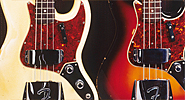
Fender Jazz Bass

“Stack-knob” is a catch phrase that for decades has perked the ears of collectors; these relatively rare examples of the earliest Fender Jazz Bass are among the first electric basses to be “collected” instead of just bought, sold, and played! Along with the ’50s Precision, they stand as the ultimate Fender bass – sought for their tone, feel, and aura of cool. Built during the transition between the ’50s and ’60s, they combine the craftsmanship of Fender’s pre-guitar boom period with the modern look.
Nobody knows how many Jazz basses were made before Fender switched to the three-knob configuration, but, as a new and more-expensive model in an era when the electric was considered an illegitimate upstart, the Jazz took time to establish itself as a popular alternative. The number of extant examples is small compared to the number of surviving early-’60s Precisions.
Fender took its time getting a second bass to market. The Precision had been an increasingly familiar sight for about eight years before the Jazz made its debut. Basses from Gibson (the Electric Bass, or EB-1, followed by the semi-hollow EB-2) Rickenbacker (Model 4000), and companies like Kay must have shown Leo and his crew how the market for electric basses was big enough to include a “deluxe” model. Instead of simply updating its one model, as Fender had done in ’54 and again in ’57, it decided to complement the Precision Bass with an upscale sister. Borrowing the new “Offset Contour” body from the Jazzmaster but keeping the long “horns” needed to balance a bass neck, Fender created a beautiful and harmonious design. The pickups were new, keeping the dual polepieces from the ’57 Precision, but with narrower, more-focused field. The stacked knobs gave individual Tone and Volume controls for each pickup – a novel feature for a bass at the time. The three-knob configuration was at the prototype stage, but got the commercial nod, only to be discontinued within two years. A 1960 Fender catalog bound into the July 21 issue of Down Beat shows on its cover what appears to be a three-knob Jazz with a ‘50s-style Fender logo. The bass in the catalog, and the ad in the January ’61 International Musician, is a stack-knob with no logo. Other distinctive “stack” features include the adjustable mute pads under the chrome tailpiece, prominently featured in promotional literature (but eventually removed by most players), the “patent pending” fine print on the headstock decal, and – on the earliest examples – the beloved “’50s bump” on tthe lower cutaway. Fender also promoted the new narrower neck as permitting “rapid technique” – one wonders if a young Jaco Pastorious took this to heart. The original catalog blurb for the Jazz says, “this… is the standard by which others will be compared” and for once a bit of ad copy has held true through the years! The early Jazz is still the standard by which any electric bass can be judged, and most are found wanting.
This article originally appeared in Vintage Guitar Classics No. 2 issue. All copyrights are by the author and Vintage Guitar magazine. Unauthorized replication or use is strictly prohibited.
-

Laurence Juber, Tommy Emmanuel, and various artists

With a catalog that boasts such top-drawer acoustic pickers as Laurence Juber, Tommy Emmanuel, Ed Gerhard, and Pat Donahue, Solid Air hit on a format of having a dozen or so guitarists contributing tracks to a central theme. These have included the music of Leiber and Stoller, Cole Porter, Elvis, and Henry Mancini, which won a Grammy. It might smack of gimmickry if the quality weren’t so high and the individuals’ arrangements so interesting.
Ripe for such treatment, of course, is the music of Burt Bacharach. Most are solo performances, although Wayne Johnson is double-tracked on the beautiful bossa nova “The Look Of Love,” and “Casino Royale” features a duet by Doug Smith and Mark Hanson that borders on Baroque. Hanson also explores the possibilities of “Walk On By”; Juber delivers stunning performances of “Alfie” and the title tune; and Emmanuel leaves pyrotechnics behind for a lovely reading of “Close To You.”
The only criticism is that Hal David’s name is nowhere to be found. Even though these are instrumental renditions, it’s his lyrics that you find yourself singing in your head as you listen to the inseparable melodies.
This article originally appeared in VG‘s December ’14 issue. All copyrights are by the author and Vintage Guitar magazine. Unauthorized replication or use is strictly prohibited.
-

John Scofield

John Scofield: Margaret Fox. Veteran jazz guitarist John Scofield has released a second album with Uberjam, which includes drummer Adam Detich, guitarist Avi Bortnick, and guest keyboardist John Medeski. It’s full of funk and soul, and we talked with Scofield shortly after the group started its current tour.
Why the second record?
We played a lot at the beginning of the millennium, then didn’t for awhile, and I thought it’d be fun to see how we could approach the music after a few years. Once you’ve grown as a group, it’s fun to reunite.Your career has taken so many roads a traditional jazz player may not. Any particular reason?
Part of me would like to have just one group all the time. The way the market works today, they want a different group every time, if you’re an old, established person like me. They’ve had you at their festival or concert series and they want to bring you back, but they want it to be something else. That’s a pain in the neck, on one hand. On the other hand, it fits with what I like to do; I can be restless. It helps the music in that you never have time to get bored, and one project will feed the other.Do you see yourself as a restless musician?
After doing it for a while, I think everybody realizes that things change. The best stuff you come up with is kind of spur-of-the-moment. We have to put ourselves in situations that make us come up with new stuff. We have to be restless. Part of me thinks if I could just practice “All the Things You Are” for my whole life and really get it down, that’s the way to go. Part of me feels like that, but I don’t do that.The record has a real soul vibe.
I realize now, looking back at it, that I grew up during the time when soul was really happening, with James Brown and Aretha in the ’60s. I was aware of the music then and loved it and was a huge fan. I played in bands since I was a kid that tried to play soul music. So, it just seems part of what I love.It seems like you’re always on tour, usually with someone.
I’m lucky I get to play a lot. This summer, it’s a lot of the jam-band festivals with my band. More in the U.S., and then we’ll hit Europe and Asia.Speaking of the jam-band thing, you’ve made friends in a lot of genres. People think you’re a jazz guitarist, but there you are hanging with folks like Warren Haynes.
Yeah, yeah, he’s not a jazz guitarist, but he likes jazz. I’m the “jazziest” guy Warren would play with, but when we play, it works. If he played with Tal Farlow, it wouldn’t work. I love blues and I love to play electric and loud. It’s fun for me to get to play with guys who are blues players or funk players and into a different thing.Speaking of, a year ago you did shows with Robben Ford.
I thought it was completely natural, and I think Robben did, too. We had a lot of fun playing and I hope we do some more. I’ve known Robben… well, I’ve known of him since I saw him at Hop Sing’s, a Chinese restaurant in L.A. that was also a club. He was playing with the group that later became the Yellowjackets. He knocked me out. And then when I [left Miles Davis’ band], he became the guitar player. I remember going to hear them and thinking “Oh s**t, this sounds really good. I wish I’d been able to play the gig like that.” I’m a big Robben Ford fan.What guitars are you playing these days?
I played my Ibanez AS200 on the record, but I also played a Fender Custom Shop Stratocaster on about half the tunes. My Ibanez is still my number one axe, but I got the Strat a few years ago. I was embarrassed to buy it; I went into Sam Ash in New York and tried a bunch of guitars, and this Strat was great. The thing is, it was all relic’ed up – had a fake cigarette burn on it. And it’s pink. But I got over the shock and got it. Now, I think whatever they do to make it look old actually makes it sound better. It’s a good one.What about amp on the record?
On this one I used the Vox AC30 that I’ve been playing since the late ’90s. It’s a reissue from then. I didn’t use a lot of effects. All the distortion is just the amp.
This month’s “Fretprints” column by Wolf Marshall focuses on Scofield’s work. See it on page 72.
This article originally appeared in VG November 2013 issue. All copyrights are by the author and Vintage Guitar magazine. Unauthorized replication or use is strictly prohibited.


