Month: December 2013

  • The Siegmund Doppler Vibe

    The Siegmund Doppler Vibe

    SiIEGMUND-DOPPLER-VIBE
    Siegmund Doppler Vibe

    Price: $495
    Info: www.siegmundguitars.com.

    It’s been said that Buddy Guy was the first guitarist to put his instrument through a Leslie rotating speaker. Supposedly, this was done in a pinch after his amp crapped out during a 1965 session for Junior Wells’ seminal Hoodoo Man Blues, but the result was a fresh new sound.
    Soon after, the Beatles started experimenting with rotating speakers, followed by Jimi Hendrix and Cream. As more guitarists picked up on the Leslie, they were faced with the problem of moving these behemoths that were often the size of a small refrigerator.

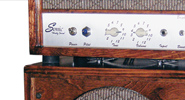
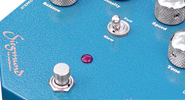
    As the ’60s progressed, the Uni-Vibe became what many believe to be the first pedal to simulate a Leslie. Since then, dozens of pedals have been devised to produce shimmering, liquid tones. The latest entry into the war of the vibes comes from Chris Siegmund, founder of Siegmund Guitars and Amplifiers. His hand-built, tube-driven Doppler Vibe, contained in a heavy-duty, blue octagonal case, provides a range of great Leslie-esque tones, from lush chorus to fast tremolo.

    The Doppler Vibe, which comes with its own power supply, is relatively simple to operate, having only five controls. The Intensity knob controls the level of effect, from subtle to pulsating. Speed regulates the rate of pulse, made visible by a blinking red LED in the center of the pedal. Additional range of speed up and down can be invoked through a Fast/Slow toggle (an optional foot controller – a wah-wah-style rocker pedal – does this manually by overriding the speed controls).

    The Doppler Vibe’s Balance and Tone controls are a little more involved and have a unique relationship. Balance combines both sides of the phase when in mono mode, while the Tone knob splits it into unique, out-of-phase signals. In stereo mode the two allow the player to emphasize different sides of phase through the two amps, creating an effect that can best be described as ranging from a rotating speaker effect to a pitch-shifting vibrato.

    When tested through a ’66 blackface Vibrolux Reverb, it becomes apparent in mono mode that the micro tubes within the Doppler Vibe provided a significant signal boost, warming up the front end of the amp – a nice touch, especially when using a bright guitar, in this case a 1970 maple-neck Strat. It didn’t, however, color the sound of the guitar. The optional foot controller allows the player to ramp up from slow to fast just like a real Leslie, a great feature as that speed variation becomes an effect onto itself. With the foot controller rocked all the way back, the Doppler Vibe provided a nice, slow chorusy sound, à la Hendrix’s “Angel.” With a push forward of the pedal, the speed escalated to a “Burning of the Midnight Lamp” fast tremolo.

    The real fun began when a ’69 smallbox Marshall 50 and 2×12 cab were plugged into the Doppler Vibe’s stereo input. Placing the amps about 20 feet apart transformed the room into a giant rotating speaker cabinet. This was truly a transcendent experience, with waves of sound coming through the two amps at slightly different times, phases, and pitches. A Tube Screamer placed in front of the Doppler Vibe increased the intensity until the pulsating was almost visible.

    When put through the tube-buffered effects loop of a Colby dtb50 (VG, Feb. 2013), the Doppler Vibe seemed to become one with the amp. Although the pedal increased the hotness of the signal, it didn’t bring a noticeable level of additional noise when using the effects loop.

    By placing waves of bass and treble around the room when in stereo mode, the Doppler Vibe closely mimics a rotating speaker, though this effect pedal goes way beyond simple Leslie clone. It is a very usable effect that should inspire many who want to add a little “spin” to their sound – and avoid a little pain in their backs!


    This article originally appeared in VG March 2013 issue. All copyrights are by the author and Vintage Guitar magazine. Unauthorized replication or use is strictly prohibited.
  • Joe Satriani

    Joe Satriani

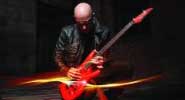
    Joe SatrianiAfter moonlighting with the super group Chickenfoot, Joe Satriani returns to his day job as solo artist extraordinaire with this new album, continuing his galactic reign as supreme commander of instrumental rock guitar.

    Unstoppable Momentum follows in the cosmic wake of Satch’s last album, 2010’s Black Swans and Wormhole Wizards. His band includes drummer Vinnie Colaiuta (Jeff Beck, Sting), bassist Chris Chaney (Alice In Chains), and Mike Keneally (Frank Zappa, Steve Vai) on keys. Throughout, flawless production is complemented by musicianship that is as good as it gets.

    Satriani’s technical mastery and fluid musicality is in full evidence throughout. The title track opens the album with what fan boys show up for – compositions that are familiar but different, complete with harmonized melodies, whammy pull-ups, and adroit Digitech Whammy Pedal usage.

    While the album works all the tried-and-true compositional tools, melodic signatures, and comfy rhythmic beds of Satriani’s past albums, the Beatlesque “Three Sheets To The Wind” is the departure. The song’s main theme features a happy-go-lucky (cheesy) melodic line using brass, piano, and dipping whammy bar. The composition thankfully goes to other places, but the song’s main motif is off-putting, and the most un-Satriani-like on the record.

    The commercial single “A Door Into Summer” harkens back to the 1992 radio hit “Summer Song.” It has all the signature bells and whistles you’ve come to expect, while the blazing guitar in “Lies And Truth” speaks to hardcore shred fans that simply want Satriani to “Go for it!”

    “Shine On American Dreamer” takes us back to Flying In A Blue Dream with its predictable rock drumming and pulsating bassline to match. Non-fans might hunger for any kind of rhythmic variety aside from the mind-numbingly consistent rock grooves associated with Satriani’s past work. But the choice of an understated rhythm section supports Satriani’s playing and compositional style. It simply works for his style of playing.

    The songs “Jumpin’ In” and “Jumpin’ Out” feature a back-porch boogie motif that Satriani visits from time to time à la “Satch Boogie” from Surfing With The Alien. Here, Satch journeys from earthbound bluesy concepts to skyward intergalactic note manipulation, magnificent astral textures, and the most lively and energetic drumming on the album. The two inspired tracks sound live in the studio and feature the band’s tight ensemble professionalism. The band kicks ass all over the place without ever stepping on Satch’s epic soloing. His guitar tones are silky, luxurious, and sheer perfection.

    “Can’t Go Back,” “The Weight Of The World,” “I’ll Put a Stone In Your Cairn,” and “A Celebration” are suggestive of work from past albums, but in the best possible way. His temporary obsessions and successful ideas from Crystal Planet onward all come to fruition here. Synthy atmospherics, solemn funeral dirges, techno beats, and metronomic rock drumming make way for major chord release and exaltation. Unstoppable Momentum rocks mightily with reminiscent grooves, familiar textures, and inspired band interaction. It’s a top-notch Satriani record with Satch and band playing at the top of their game.

    This article originally appeared in VG‘s September ’13 issue. All copyrights are by the author and Vintage Guitar magazine. Unauthorized replication or use is strictly prohibited.

  • PRS Introduces Archon High-Gain Amp

    PRS intros ArchonThe PRS Archon is two-channel, 100-/50-watt amp that uses four 6L6GC tubes and is designed for players demand aggressive overdriven tones and ample headroom with sparkling cleans. Its lead channel has five preamp gain stages, and controls include Volume and Tone for each channel, global Depth control, and Presence. A footswitch controls effects-loop bypass and channel selection. For more, visit www.prsguitars.com/archon.

  • Dumpstaphunk

    Dumpstaphunk

    DumpsterphunkThe New Orleans funk ensemble known as Dumpstaphunk has been at it for a decade now. Led by Ivan Neville on keys, the band consists of Nikki Glaspie on drums and vocals, guitarist Ian Neville, and not one, but two bass players – Tony Hall and Nick Daniels III. Their latest is stuffed with pulsating grooves and deep pockets.

    Dumpstaphunk traverses the funk through a New Orleans lens. It’s deepcut stuff mining Betty Davis, Mandrill, Funkadelic, Sly Stone, and of course, the Meters. “Dancin’ To The Truth” begins the journey with soulful call and response in the Sly Stone tradition with thick MuTron-laced guitar.

    The sick grooves continue but take a break on the soul-rock of “They Don’t Care.” Ani DiFranco guests on the riff heavy “Dirty Word,” and Flea of the Red Hot Chili Peppers makes an appearance on the Betty Davis cut “If I’m In Luck.”

    The Grooveline Horns appear on “Water” and “I Know You Know.” Ian Neville brings A-game effort throughout, with well-orchestrated rhythmic stabs, wah-wah, nasty-ass soloing, and a tasty use of effects.

    For serious funk fans, Dumpstaphunk’s Dirty Word is a must own.

    This article originally appeared in VG‘s October ’13 issue. All copyrights are by the author and Vintage Guitar magazine. Unauthorized replication or use is strictly prohibited.

  • Novax Preps 25th Anniversary Model

    Novax 25th anniversary modelNovax Guitas is introducing a limited-edition guitar to commemorate its 25th anniversary, available with a swamp ash body with maple neck or mahogany body and neck. The swamp ash version uses three single-coil pickups by Lollar or Bartolini, while the mahogany version will have three “soapbar” pickups by Bartolini with a a proprietary circuit. All models have ebony fretboards, Fanned Frets, Novax proprietary individual bridges, and will signed by builder Ralph Novak. Learn more at www.novaxguitars.com.

  • Iggy and the Stooges and Special Guests

    Iggy and the Stooges and Special Guests

    Iggy and the StoogesThe Stooges’ influence on ’80s and early ’90s indie scenesters is unimpeachable. For more than a quarter-century, cognoscenti have clamored to comprehend the quartet’s long shadow, more often than not dubbing frontman Iggy Pop with sobriquets like “The Godfather of Punk.” Understandable, given Pop’s performance chops, but such assessments overlook the cornerstone of the band’s sublime scuzz: founding guitarist Ron Asheton, who passed away in January 2009.

    Shot in the band’s hometown of Ann Arbor, Michigan, in April 2011, Tribute attempts to rectify this by presenting a set of Stooges classics with mixed results. Indeed, Pop proves he can still induce mayhem, and classic Stooges riffs as laid down by Raw Power guitarist James Williamson and Radio Birdman’s Deniz Tek still manage to sound timeless, primitive as they may be. Unfortunately bassist extraordinaire Mike Watt, with the Stooges since they re-formed in 2003, is virtually buried in the mix – doubly shameful considering MC Henry Rollins’ preshow spiel on the importance of the band’s rhythm section. Also puzzling is the extraneous string and horn sections that manage to sully a trio of primo Funhouse cuts.

    Depending on how seriously you take your Stooges, Tribute could be a real cool time or no fun at all.

    This article originally appeared in VG‘s November. ’13 issue. All copyrights are by the author and Vintage Guitar magazine. Unauthorized replication or use is strictly prohibited.

  • Effectrode Tube-Vibe and Goran Fat Boy

    Effectrode Tube-Vibe and Goran Fat Boy

    EFFECTRODE-01

    Effectrode Tube-Vibe
    Price: $429 (Tube-Vibe)
    Contact: www.effectrode.com

    Goran Fat Boy
    Price: $429
    Contact: www.goranguitars.com

    In the annals of guitar stompboxes, there are no tones more elusive than the mystical swirls of a modulation pedal and the warm roar of an overdrive box. Builders big and small put their stamp on these two classic designs, tweaking circuits and then some. As evidence, we offer two new boutique pedals – the Effectrode Tube-Vibe and Goran Fat Boy overdrive.

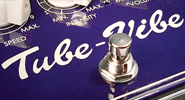
    The Effectrode Tube-Vibe is an inventive redesign of the (in)famous Uni-Vibe. As the name suggests, the most noticeable innovation is its use of tubes as a central component of the circuit, providing low noise and tons of headroom. The tubes are protected by two metal bars so that they can’t be smashed by an errant footstomp, and are interchangeable with other 9-pin tubes. The design was further revamped with Effectrode’s true-bypass switching system and a 1-meg input, which ensures a clear signal path and that pickups won’t overload.

    Other cool features include a Chorus/Vibrato switch and a Classic/Smooth switch that alternates between a more-classic Uni-Vibe tone and a more spacey/surreal sound. Additionally, the two low-frequency oscillators (LFOs) can be frozen at specific frequency notches to work as a filter. The Tube-Vibe also has an LED that flashes at the same tempo of the LFOs, so guitarists can match the Tube-Vibe to the tempo they’re playing.

    The Tube-Vibe has three knobs – Speed (to control the rate of the LFOs), Intensity (depth of the LFOs), and Volume. Along the back are the input for the power supply, a jack for an expression pedal, the input and output jacks, as well the Chorus/Vibrato and Classic/Smooth switches.

    We tested the Tube-Vibe with a humbucker-equipped guitar through a tube amp and a modeling amp. With the Chorus and Classic positions selected (to establish a baseline to the original UniVibe), we experienced a terrifically warm, lush vibe perfectly suited to knocking out Robin Trower’s “Bridge of Sighs” or Hendrix’s “Machine Gun.” The Speed and Intensity controls have enough range for everything from subtly nuanced modulation for clean arpeggios to psychedelic freakouts. Flipping on the Vibrato mode reveals cool pitch-bending warbles that make any lick unique and refreshing. The Smooth mode is a nice complement to the Classic mode’s thick, marshy vibe, bringing a lighter, dreamier modulation to the table that is excellent for odd, dissonant chording. We also had fun using an expression pedal to vary the speed and add further dynamics to our riffs.

    The Tube-Vibe is a cool tweak on the original UniVibe, bringing both innovation and improved tone to a revered design. It brings a multitude of options to the table and the runs the spectrum of the phase based modulation, it’s definitely a must have for those in the know about vibe pedals.

    GORAN-01

    The Fat Boy, from Goran Custom Guitars, is a dual-mode overdrive designed to drive clean amps into heavier territory. Its pressed-steel construction hints at durability, while the control layout is smart and professional. Internal components are equally impressive, including Black Gate electrolytic capacitors, new-old stock Allen Bradley composite resistors, and a military-grade op-amp.

    Atop the Fat Boy are the controls for the two channels. For the Drive Channel, they are Gain, Tone, and Volume. The Solo Channel has knobs Gain and Volume. Between the two sets, a switch selects Fat or Vintage modes; Fat is reminiscent of JCM-series Marshall amps, while Vintage recalls the classic overdrive of early Marshalls and Fender tweed amps.

    The Fat Boy has two stompswitches; one activates the Drive channel, the other Solo mode. These are not separate entities, but rather, interactive modes. Drive serves as the base tone, while Solo acts as a boost, giving the Drive more gain, more volume, or both.

    We started testing the Fat Boy using a humbucker-equipped guitar plugged into an amp set clean. The Vintage mode did a very good job emulating the sound of early Marshalls and Fenders while not sacrificing depth, as many such pedals do. From its lowest gain setting to the highest, it was just tight enough for rhythm work without losing the sonic fluidity characterized by the vintage amps. The higher gain stages seemed more British in character, while lower gain settings had Fender grit and rumble. One of the great things about the two-mode system is that one can have a very low gain setting on the Drive channel, then kick on the Solo mode and add an extraordinary amount of gain and sustain for lead playing without sacrificing tone.

    The Fat mode delivers on its promise of JCM-era overdrive, and there’s more than a modest difference between it and the Vintage mode. Where Vintage is loose and more present in the midrange, Fat is super-tight, with a classic scooped sound. Fat definitely takes you back to the ’80s (but without glitter and hairspray!) with a sound that’s pure testosterone. It’ll definitely put some hair on your chest when you kick in the solo mode, which heaps on even more gain for explosive rhythm riffs and molten solos.


    This article originally appeared in VG December 2012 issue. All copyrights are by the author and Vintage Guitar magazine. Unauthorized replication or use is strictly prohibited.


  • Greg Koch Band

    Greg Koch Band

    Greg KochDue to his longtime residency in Milwaukee, Greg Koch may have not been discovered by the world at large. But that’s certainly not true among his fellow guitarists.

    On his latest, Koch is joined by various musicians, including guitarists Robben Ford, Paul Barrère, and Joe Bonamassa, among others. The nice thing about the gathering is that it’s not a chopfest with everyone showing off. Instead, this is a collection of truly good songs.

    That’s not to say there isn’t some fine playing here, though. The slinky blues of “Walk Before You Crawl,” the sophisticated shuffle of “Sho Nuff,” and the rolling pop/ blues feel of “What You Got To Lose” all give Koch and Ford ample time to trade licks and play off each other. The songs also provide a partial reunion of the Blue Line as Roscoe Beck fills the bass chair.

    Bonamassa and Koch honk and squeal their way through a rollicking “Simone.” And Barrère’s slide mixes perfectly with Koch on four cuts, including the gorgeously relaxed soul of “This Whole Town Has A Broken Heart.”

    John Sieger sings and co-wrote the songs with Koch. Greg’s son Dylan handles drums on seven of the cuts.

    Unlike some other Koch records, this is not so much a showcase of his guitar abilities, but a display of his ample all-around talents.

    This article originally appeared in VG‘s November. ’13 issue. All copyrights are by the author and Vintage Guitar magazine. Unauthorized replication or use is strictly prohibited.

  • DoleSonic Half Back Stack

    DoleSonic Half Back Stack

    DOLESONIC-01

    Shaw Audio Bass 130
    Price: $1,350
    Contact: www.tremcaster.com, phone: (330) 608-2043

    In a day where gear companies often focus on utilitarian products, it’s nice when high-end craftsmanship rears its head. Ken Doles and the crew at DoleSonic Amplifiers are a good example with their latest offering, the Half Back Stack.

    A Class-A/10-watt offering, the amp sports an interesting tube combination – a single KT66, 12AX7, and a 5Y3 NOS rectifier. The KT66 gives the Half Back a unique voice, yet it’s not too broad a departure for traditionalists who may be more accustomed to the softer output of tubes like a 6V6; the Half Back can also be ordered with a 6V6, 6L6 or EL34.

    The Half Back’s controls are elegant and simple – single Volume and Tone with three-way Voicing switch that allows the user to toggle between Bright, Normal, and Boost settings. An impedance switch on the back panel allows for 4- to 8-ohm loads. Equally appealing is the amp’s speaker cabinet. Made of pine with a 3/4″ birch plywood baffle that gives it a high level of structural integrity while optimizing sound dispersion. The piggyback format exudes cool, especially with custom touches like a vintage-style custom grillecloth and leather strap handles. Head and cab are hand-stained in a finish that accentuates the design and wood grain.

    Plugging in a solidbody with dual humbuckers, the first word that comes to mind is “warmth.” Notes all over the neck translate clearly, with a pronounced roundness – not overbearing. The Class A circuitry provides nice top-end presence without being overly chimey. Single-coil solidbodies render plenty of snap and bite – again, with that warmth. The DoleSonic excels as a jazz amp; hollowbodies blossom through the stack, and it loves flatwound strings.

    Don’t for a second think the Half Back is simply a clean-sounding low-watt amp. On the contrary, DoleSonic’s design provides really nice overdrive; virtually all distortion settings proved usable and musical. When pushed, the roundness of the amp’s tone helps retain the same warmth. From subtle breakup to full steam ahead, the amp begs to be pushed, and you quickly forget you’re working with just 10 watts.

    In all, the DoleSonic Half Back Stack is an impressive package. In the studio or on stage, its looks are timeless, its tone much the same.


    This article originally appeared in VG December 2012 issue. All copyrights are by the author and Vintage Guitar magazine. Unauthorized replication or use is strictly prohibited.


  • Trampled Under Foot

    Trampled Under Foot

    Trampled Under FootEvery now and then a band comes along that after one listen you realize they really get it. This is the case with Trampled Under Foot, made up of the Schnebelen siblings: Danielle on vocals and bass, Nick on guitar and vocals, and drummer Kris.

    Danielle’s vocals are among the most soulful and electric you’ll run across this year. She infuses the soul tune “Bad Bad Feeling” with a sense that doesn’t allow you to miss the meaning of the lyrics about cheating. She gives “You Never Really Loved Me” a Gospel glint, even if the lyrics are decidedly not of a religious nature. She brings a magical feel to all eight of the songs she sings. And by the time they wrap things up with a cover of James Brown’s “It’s A Man’s Man’s Man’s World,” you’re convinced she’s on the short list of singers vying for the title of tops in the R&B world.

    All the aforementioned songs are full of blistering guitar work from brother Nick. His biting soul work on “Bad Bad Feeling” is the perfect match for his sister’s muscular vocals. He adds double-stop bends and a bluesy feel to “Don’t Want No Woman.” His work on “Pain In My Mind” is swampy with big bends that match the funk of the song.

    The band is no one-trick pony. While they work more than comfortably in the world of R&B and hard soul music, they’re not afraid to mix in a country-rock stomp like “Down To The River” that features a heavy dose of Nick on dobro.

    The Schnebelens get some high-powered help on the record, starting with producer Tony Braunagel, who has been known to put together some fine blues bands himself in his other life as a drummer. Veteran Mike Finnigan adds the keyboards while Johnny Lee Schell adds acoustic guitar to one tune while serving as the record’s engineer. Those names are recognizable to anyone familiar with American roots music, and while it’s obvious from the band’s performance they were already headed in that direction, having veteran input didn’t hurt.

    It may sound like hyperbole, but Trampled Under Foot has put their stake down as a big part of the future of rock and roll and R&B with one of the best records of 2013.

    This article originally appeared in VG‘s December. ’13 issue. All copyrights are by the author and Vintage Guitar magazine. Unauthorized replication or use is strictly prohibited.