Month: May 2010

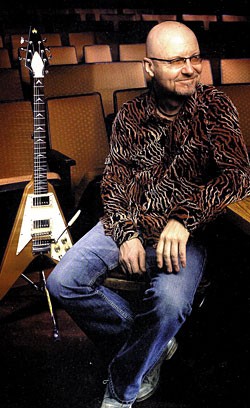
  • Andy Powell

    Andy Powell in 2006

    Andy Powell in 2006. Photo: Jeff Sacks.

    The early 21st century is a unique era for rock music, as many veteran bands are now plying their trade on the nostalgia and/or casino circuits, playing their decades-old hit(s) for people about their own age.

    Wishbone Ash, now in its 37th year of existence, never had a huge hit in the U.S., and like many combos has one original member in Andy Powell. But the English-born guitarist, known among players for his legendary 1967 Gibson Flying V, has for a long time continued to direct “the Ash” in a defined musical direction, forging ahead with tours and albums, the most recent of which is Clan Destiny, released in May. Since our last conversation with Powell four years ago, the band has actively toured Europe on a regular basis, but the Ash has also been performing more gigs recently in the States.

    Another turnover in personnel in the band has occurred since we last spoke with Powell. The longtime rhythm section of Bob Skeat (bass) and Ray Weston (drums) remains intact, but Finnish guitarist Ben Granfelt has returned to his solo career, and another Finn, Muddy Manninen, was recruited for the slot.

    “Ben served in what were four really good years for the band,” Powell explained. “He left for personal reasons, and he’d also put his own band on hold. It was amicable, and he was a gentleman, giving me plenty of notice. He even got involved in finding his replacement, and he’d played in a band with Muddy years ago.”

    Manninen brings a somewhat different approach to the band, favoring the P-90 sound of instruments such as Les Paul TVs. He also plays slide and lap steel.

    Before the band recorded a new studio album, however, the new incarnation appeared live on XM Satellite Radio. It was Manninen’s fourth gig with the Ash, and while Powell described the event as “pretty hair-raising,” it went over so well that a limited-edition CD of the concert was marketed.

    These days, Powell performs with a signature-model guitar with the classic, arrow-shaped silhouette of his Gibson Flying V. But it was made by veteran English luthier Kevin Chilcott. Numerous fans petitioned Gibson to make an Andy Powell signature model V, to no avail. Ultimately, Chilcott, who hadn’t created a guitar in about 12 years, offered to make a V-shaped instrument for Powell.

    “I love to be able to mix acoustic guitar and electric,” Powell detailed. “We designed an instrument with a custom neck profile, a one-piece Brazilian mahogany body – which to my mind adds to the vibrancy of the sound of the guitar – and an L.L. Baggs system on the bridge saddles. I’ve ended up with a very multi-purpose guitar.

    “He made two instruments,” Powell added. “I use one in the U.K. and Europe, and the other in the U.S. The first one was a prototype we called ‘Problem Child’, or ‘P.C.’ for short. The second one we called ‘Chamille,’ and he also refurbished my ’67 V – brought it back to life.

    “Kevin is a phenomenal luthier; his attention to detail is incredible. But I did have some bad luck on the last song of the last gig of our last tour in the States. Chamille got dislodged from its stand, fell over, and cracked. It’s been sent back. The break is along the grain, so I think it can be fixed.”

    In 2005, the band celebrated its 35th anniversary at the Moonshine Theatre in Scranton, Pennsylvania.

    “We spent the week at the theatre and worked on a lot of material for Clan Destiny, so it was really a two-fold situation, and it worked out really well,” said Powell. “We did an acoustic show and invited a fiddle player and an accordion player to join us onstage. There was an electric show the next night, and for my money the acoustic show, strangely enough, was the better of the two; there was an amazing atmosphere that night.”

    Foremost in Powell’s mind in mid 2006, however, was the new release of Clan Destiny. The new songs sound as if they were written to work better with Powell’s singing voice, as he now handles all lead vocals.

    “Obviously, I’m going to pick keys and styles that suit my voice,” he said. “But Muddy’s more of a bluesy guitar player than Ben, which also helps. I feel more comfortable with material that is a little bluesier. I enjoyed singing on the album, and I got some of the vocals in one take!”

    Manninen’s aforementioned slide and lap steel capabilities are on prominent display on the new album, and Powell recalled that the Ash’s other original guitarist, Ted Turner, had also played those instruments. Unusual guitar tones on Clan Destiny include a harp-like passage (a la Andreas Vollenweider, not Paul Butterfield) on “Healing Ground,” which Powell noted was played using a Washburn acoustic with a capo high on the neck. “Loose Change” features an intriguing warbling twin-lead guitar riff. “It’s simply Muddy’s Les Paul and my ’52 Tele, played very cleanly… which is unusual for guitar players these days!”

    Another clean guitar sound is heard on “Surfing a Slow Wave,” an instrumental that sounds like the Shadows playing a samba, and Powell agreed with a laugh that while such an analysis is valid, there’s an additional Shadows connection, noting “The guitar that was used on that one was actually a Korean-made Burns Hank Marvin reissue.”

    Interesting time signatures can also be sussed out on the new effort, as exemplified by “Capture the Moment,” which Powell opined is reminiscent of “Pilgrimage,” the title track from the band’s second album, released in 1971.

    Overall, Clan Destiny is a noteworthy effort from a veteran aggregation that isn’t caught in a time warp, and Wishbone Ash’s live shows are still sonic spectaculars for guitar lovers. Powell noted that tracks from the new album are going over very well in concert. And the definitive journeyman and dedicated musical craftsman, probably wouldn’t have it any other way.


    This article originally appeared in VG‘s October 2006 issue. All copyrights are by the author and Vintage Guitar magazine. Unauthorized replication or use is strictly prohibited.


    Wishbone Ash Live in London, Throw Down The Sword – 2003
  • Black John – The Soul of John Black

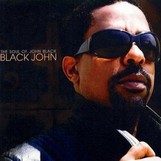
    Black John is actually John Bigham, who some music listeners may know from his days with Fishbone or as a percussionist with Miles Davis. Bigham’s latest effort is a powerful mix of soul, R&B, and gospel that shows he knows his way around a groove as a guitarist and singer. Cuts like “Black John” contain a powerful story and a mix of gospel, funk, and soul powered by Bigham’s slinky guitar grooves, while the chorus from “Betty Jean” is burned deep in your body, mind, and soul.

    While most of the tones are electric Fender sounds that weave in and out of songs, a couple cuts rely on nasty acoustic. Like the soulful, “Last Forever,” where a sly dobro gives way to electric guitar cranked through a wah pedal. Same goes for “I Knew a Lady,” with nasty funk set up by electric guitar, with a fine, melodic acoustic solo. As it fades, a chorused electric solo lets Bigham show off his rock-and-roll chops.

    Bigham shows pop music leanings, too, on cuts like “Better Babe” and “Push Into the Night,” the latter being a melodic minor-chord song that emphasizes radio leanings. And “Thinking About You” is a lovely acoustic folk tune that serves as the perfect capper.


    This article originally appeared in VG‘s May. ’09 issue. All copyrights are by the author and Vintage Guitar magazine. Unauthorized replication or use is strictly prohibited.


  • RS Guitarworks Rock Master

    RS Guitarworks Rock Master

    RS Guitarworks Rock Master

    In 1994, RS Guitarworks was just another guitar repair joint that every so often did some refinishing work. But it has since grown to become a full-on custom builder that also offers parts-upgrade kits, as well as finish and hardware aging.

    The “R” and the “S” in RS Guitarworks are Roy Bowen and Scott Leedy, and their shop produces about 50 custom axes each year. RS recently offered the Rock Master guitar for us to play and peruse, and though it may lack the vintage vibe (unless, in your eyes, ’80s guitars have indeed achieved vintage status) we favor in the pieces we review, any guitar that’s crafted entirely by hand piques our interest.

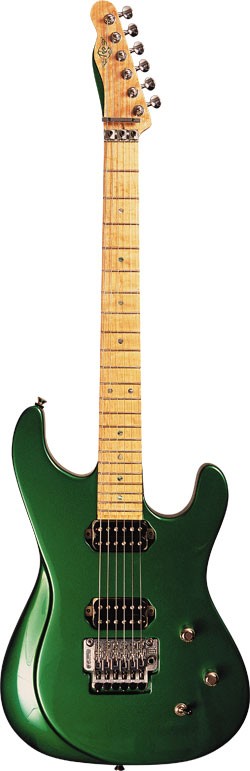
    The Rock Master is part of RS’s Step Side series, which feature a distinct “step” contour along the front of the lower bass bout. This contour is repeated on the headstock and combined with a touch of body-matched color to give the instrument a uniform, well-conceived aesthetic. The lightweight Swamp Ash body on our tester guitar (a prototype, by the way) was finished in cool metallic Indy Green that, along with the Schaller/Floyd Rose locking vibrato and reverse headstock, simply screamed “big-hair shredder axe.” The finish was well-executed, with a deep lustre and metalflake that accentuated the body’s contours. Another shredder-like feature is the Rock Master’s pair of WCR Shredder humbuckers, exclusive to RS instruments, mounted directly to the body. This not only contributes to low-end response, but means a player can do what they do without fear of feedback, even in the most gain-laden of situations.

    The Rock Master features RS’s own electronics, including their close-tolerance Super Pots (with push/pull coil splitter on the master tone), a Switchcraft three-way toggle, a Hovland capacitor, and an aluminum Electro output socket that’d fit nicely on a Telecaster. A more rounded, shallow neck heel with four ferrules in lieu of a neckplate, makes for a less bulky neck-to-body joint and allows great access to upper-register frets. The Schaller-manufactured Floyd Rose licensed locking tremolo is machined with tight tolerances that allow for repeated dive bombing without having to touch up the tuning – very stable and smooth feeling. The vibrato tailpiece is set into the body deep enough so its baseplate is flush, which means the player can rest their palm on the bridge without worrying about knocking it out of tune. Most vibrato baseplates sit above the body, which means the player must be conscious of where they rest their hand. Extra kudos on this to RS – it’s a very nice concept.

    RS doesn’t skimp on any of the other hardware, either, using high-quality chrome Gotoh tuners, chrome strap buttons and heavy chrome dome-style knobs. The birdseye maple neck has a U-shaped profile RS calls a “San Dimas soft U.” On the prototype, it was unfinished except on back of the headstock, which had a gloss lacquer. This is the only point of the guitar that created a nit for us to pick because there no transition area between the unfinished neck and where the headstock lacquer begins. Instead, it’s an abrupt, thick, and immediately noticeable line where the finish begins. Granted, this likely wouldn’t affect the Rock Master’s playability, but it looks like it could be susceptible to chipping, and at the very least, doesn’t look as smooth as it could.

    The neck and headstock feature abalone dot inlays and an inlaid mother-of-pearl logo, all slightly tinted green to nicely match the body. The neck shape is very comfortable, somewhat reminiscent of a Peavey Wolfgang, but with the more substantial U shape not typically found on an axe of this style.

    The neck is capped with a compound-radius (10″ to 16″) birdseye maple fretboard with jumbo fret wire that is tight and flush to the fretboard with smooth-polished crowns and rounded fret ends, further contributing to the guitar’s already fast feel. The compound radius allows for very low action that stays playable regardless of how aggressively one bends. Also adding to the slinky feel is a 25″ scale length, slightly shorter than the 251/2″ normally found on shredder guitars, which makes for easier bending and allows for a softer, more fluid feel.

    We listened to the tones created by the Rock Master using an all-tube Crate head with a Celestion-loaded 4×12″ cabinet, and Randall’s MTS100M with interchangeable modules, and its accompanying 4×12″ cab. The guitar responded well to the high gain of the Crate and the Randall’s Modern module, emitting a solid low-end, crunchy, present highs, and no squeal whatsoever, even at high volume. The WCR pickups had plenty of attack in the upper midrange, and plenty of cut in the highs, all without getting harsh or brittle. The neck pickup, especially, proffered a singing, silky sound, very nice sustain, and note separation. And the shorter scale seemed to soften and warm the overall tone, giving the guitar a different flavor than other 251/2″-scale shredder guitars, with punchier midrange response and less twang on the lower strings. Using the guitar’s volume control and coil splitter, we could clean up its sound without switching channels on the amps, from total overdrive to crunchy rhythm to sparkling clean, all at our fingertips.

    While the Rock Master truly shines as a high-end shredder with a killer set of humbuckers, super-fast neck, and high-quality locking vibrato, its short scale length, coil splitters, and swamp ash body make it an extremely solid all-around rock/blues guitar.


    RS Guitarworks Rock Master
    Price: $2,495 (retail).
    Contact: RS Guitarworks, 30 Taylor Avenue, Suite E, Winchester, KY 40391; phone (877) 777-3542; rsguitarworks.com.


    This article originally appeared in VG‘s May 2006 issue. All copyrights are by the author and Vintage Guitar magazine. Unauthorized replication or use is strictly prohibited.

  • Damon Johnson

    Damon Johnson

    Photo: Stephen Jensen.

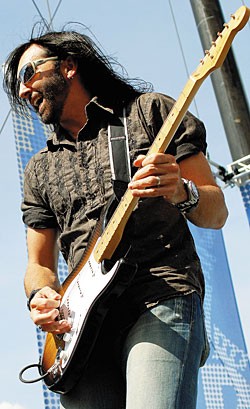
    Damon Johnson is a working man’s player, honed on the chops of Skynyrd and Zeppelin. His technique and influence spawned the early-’90s rock band Brother Cane, which released three albums, toured with Van Halen, and scored a handful of radio hits. Following its demise in 2000, Johnson played as a sideman, band member, and even “unplugged” in coffee shops.

    Four years ago he auditioned for Alice Cooper and then enjoyed a three-year run with the singer. In ’07 he found his dream job – playing lead guitar and singing with Whiskey Falls, a band that blends vocal textures with rich guitar musicianship.

    When you hired on with Alice Cooper, what did you bring to the table, guitar-wise?
    I tried to simplify it a little bit. Alice has gone through phases of guitar players who were either really heavy or the speedy technical guys. That’s not my style. He also had guys who were into glam – also not my style. Those songs were way more about great guitar tones and great parts. I had a lot of fun taking it back to that classic tradition that those songs have. I had the liberty to approach those songs any way that I wanted. He never told any of his guitarists to play something a certain way. He always wanted your own style on it.

    What was the high point for you in the band?
    When I moved to stage left by myself. I got to open the show with the classic riff of “No More Mr. Nice Guy” or “Eighteen.” That’s every schoolboy’s dream. I grew up on Love it to Death and Killer, so those were pretty awesome moments.

    Alice has always leaned towards L.A. players.
    To be honest, when I auditioned I even told my wife, “I don’t know if they’re going to pick me because I’m not that at all.” My influences are much more classic rock – Paul Kossoff and Pete Townshend, Jimmy Page and the guys in Skynyrd. My favorite is Thin Lizzy. Alice took us to Dublin, so I got to visit Phil Lynott’s gravesite. The following week, I met Scott Gorham. If there’s one guy who I’ve tried to rip off, it’s Scott. He has that perfect blend of blues-influenced rock fire, and he’s incredibly melodic.

    Stylistically, how did you shift from classic rock to the country of Whiskey Falls?
    My parents always told me to be as diverse as possible in my playing and my listening tastes. They brought me up on country music. When I first started playing the bars, I had to play as much Merle Haggard and Hank, Jr. as I did Van Halen and Aerosmith. It’s always been a part of my vocabulary. Whiskey Falls may be the most natural place I’ve ever found myself as an artist and a guitarist.

    Are you still playing Les Pauls?
    I’m eternally a Gibson man, but the truth is ESP has been very good to me. I’ve got 10 ESPs, and I play all of them. The Eclipse is my favorite because it’s more of a classic-style guitar. Matt (Masciandaro) and Allen (Steelgrave) were excited to work with me cause I wanted body styles and wood grains, things that were more classic and almost vintage looking. They made me a Pearl White Eclipse and an amazing white three-pickup Viper with the SG body style.

    You also play a Burns.
    Burns is a British company that goes back to George Harrison and David Gilmour. They make a guitar called the Sonic. It has two single-coil pickups, the Tri-Sonics. They’re the exact pickup Brian May put in the guitar he made with his dad. It’s a very different sound – unique to anything I’ve ever heard. It’s a great guitar to play slide on.

    How about acoustics?
    I use Crafter Acoustics. I started playing them in Alice’s band when they were good, but not great. Now I’m playing a DV250/VTG and it’s incredibly resonant, like a Gibson Hummingbird. There a lot of body and warmth so when I play impromptu acoustic shows I can go higher on the neck with single notes. I have a lot of guys tell me they heard every note I played even though I’m playing over the whole band.

    With Alice, you play Wizard amps.
    After my first year with him, I got a chance to work with my friend Rick St. Pierrre, who makes those amps in Canada. They’re incredibly loud – too intense for clubs. For Alice’s style and those classic songs, they were perfect. They were the style and the sound I wanted to bring back to Alice’s live show.

    What are you playing with Whiskey Falls?
    I use a Samamp VAC25 Combo, the 1×12 version. You can change the wattage from three to five to 11, 18, and 25 watts. It’s a class A amplifier, and it’s awesome to be able to control the volume. One day, we were playing small clubs to 150 people, and the next day opening for Montgomery Gentry to 12,000 fans. The amp kicks ass in any setting and gives me the sounds I need for country.

    How else do you keep it country?
    I use a lot of single-coil guitars. I’ve got an incredible ’54 reissue Fender Strat, and the ESP Vintage. Between the Fender, the ESP, and the Burns, I’m able to play a lot of different parts because there’s a need to come up with a lot of different sounds all of the time.

    Why should guitar players care about Damon Johnson?
    Truthfully, I’ve got a lot more in common with the average guitar player then the superstars who sell out arenas. I’m just a blue-collar player no different then a guy who loads his amp in his car every weekend. I’ve never had a gold record, I’ve never had a million dollars, but I’ve been lucky to raise a family and put food on the table by making music for more than 20 years.


    This article originally appeared in VG‘s
    February 2008 issue. All copyrights are by the author and
    Vintage Guitar magazine. Unauthorized replication or use is strictly prohibited.


    Whiskey Falls – Last Train Running

  • Sharon Isbin

    Sharon Isbin

    Photo: Takehiko Tokiwa.

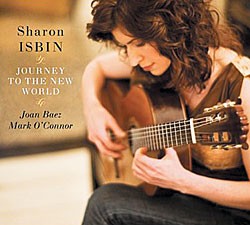
    Sharon Isbin is regarded as one of the premier classical guitarists of her generation, playing 60 to 100 concerts per season and earning a Grammy early this decade. Among her teachers was the venerable Andrés Segovia, and she has collaborated with rock and jazz aces like Steve Vai and Larry Coryell. Isbin’s latest CD, Journey to the New World, is a colorful crossover set featuring diverse artists such as singer Joan Baez and violinist Mark O’Connor.

    What prompted you to make an album that brings together folk melodies of the British Isles with the sounds of Colonial America?
    It all started with the “Joan Baez Suite,” written for me by John Duarte and based on songs like “House of the Rising Sun,” “Lily of the West,” and others. After hearing the suite, Baez offered to sing on the recording. Her voice and musical integrity has moved me to tears for as long as I can remember. She’s also a wonderfully warm, generous person, and working together was amazing. I then invited Mark O’Connor to join. His “Strings & Threads Suite” for violin and guitar is full of reels, jigs, waltzes, blues, rags and swing, which fit the theme perfectly.

    Playing with Mark must be exhilarating.
    His background as a guitarist enabled him to write a rich and dynamic guitar part for me in “Strings & Threads.” He is an impeccable musician whose mastery of various folk styles of violin playing and genius at improvisation are such a joy. We spent several days editing the score and rehearsing before premiering the work at Orchestra Hall in Minneapolis. A month later we recorded it, playing onstage as if in concert.

    Where does the folk/classical connection come from?
    The journey of American folk music begins in the British Isles, so I open the CD with Renaissance duets in which I play both parts, bridging American and British styles from the 17th and 18th centuries, then follow with Edward Flower’s brilliant settings of “Wild Mountain Thyme” and “Drunken Sailor,” and Andrew York’s haunting “Andecy.”

    There are lute melodies on the CD, too. What do you like about that style?
    I find Elizabethan music – notably that of John Dowland (1563-1626) and his peers – utterly enchanting. Maybe I was a court musician in a past life (laughs)! Hearing lute music from the Renaissance also takes me to a magical realm, one of unicorns on tapestries, suitors of romance, and joyous dances. The spirit, harmonies, and rhythms of the lute really resonate with me.

    You’ve had a range of collaborators over the years, such as Steve Vai. Where did you find the musical bridge between his electric guitar and your nylon-string?
    Steve and I first played together at events for the Recording Academy and I was drawn to his creativity, musical expertise, and delightful personality. When the Theatre du Chatelet in Paris asked me to give a series of concerts in 2005 and offered to commission a composer of my choice, I asked Steve to write a duet. His wonderful “Blossom Suite” was the result. Ever since my work in the ’80s with Larry Coryell and Laurindo Almeida, I’ve loved the combined sonorities of electric and classical guitar.

    Sharon Isbin's latest CD is Journey to the New World.

    Sharon Isbin’s latest CD is Journey to the New World.

    Tell us about your early guitar studies.
    I started playing at age nine, when my family lived in Italy for a year. My older brother asked for guitar lessons and my parents found a teacher who had studied with Andrés Segovia. But my brother’s fantasy was to be the next Elvis Presley, so he bowed out, and I volunteered to take his place. After taking lessons in Italy and Minneapolis, I later studied classical with Oscar Ghiglia, Latin-American music with Alirio Diaz, and had private lessons with Segovia and [classical guitarist and lutist] Julian Bream.

    Segovia had a reputation as a formidable teacher. Can you describe your experiences?
    I was 14 when I first played for Segovia and my heart was beating so hard it made the guitar bounce back and forth against my chest. But he was very kind and I felt much more relaxed in subsequent lessons. The most memorable part was hearing his gem-like tone when he demonstrated passages. That was inspiring.

    Who built your main nylon-string guitar?
    I recorded Journey to the New World using a guitar built by the late Thomas Humphrey in 2007. It has a cedar top, Brazilian rosewood back and sides, and two beautiful muses painted on the back with flowing hair elegantly styled by the grain of the wood. It has a warm, chocolate sound, and trebles that ring like bells. I’m also now playing a cedar guitar by the Irish maker Michael O’Leary – it’s a wonderful instrument that projects with clarity, warmth, and resonance, and has excellent contrasts in sonority.

    Do you have any older guitars?
    I still have the guitar built for me in Italy when I began playing, as well as the pint-size guitar my parents brought back from Mexico when I was three! I have several other Humphrey guitars, and a guitar Japanese maker Kohno gave me in 1975, when I won the Toronto competition.

    What other pieces of “gear” does a classical guitarist have, aside from the guitar itself?
    I always carry a footstool, metronome, a Korg AW1 tuner, and fleece handwarmers with Hothands inserts. I also have whiteout for fret dots, a nail-repair kit, nail file, 2,000-grade sandpaper, a capo, pick, and strings.

    In your opinion, what is the state of classical guitar in the 21st century?
    It’s an ideal instrument to explore contemporary classical and other styles, especially since jazz, bluegrass, folk, country, rock, pop, and Latin American music have long figured prominently in the world of guitar. Audiences also welcome diversity, so artists who discover new modes of expression and fresh collaborations have the opportunity to create something exciting no one has ever heard before. I think it’s a great time to play classical guitar.


    This article originally appeared in VG‘s August 2009 issue. All copyrights are by the author and Vintage Guitar magazine. Unauthorized replication or use is strictly prohibited.


    Sharon Isbin Performs at the White House: 1 of 8

  • G&L SC/SB Series

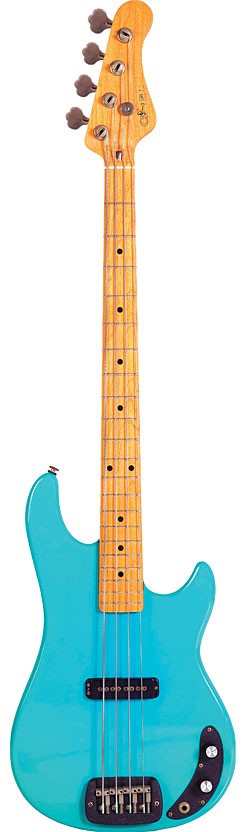
    Early-'80s G&L SC-3

    Early-’80s G&L SC-3. Bill Ingalls, Jr.

    Early-'80s G&L SB-1.

    Early-’80s G&L SB-1.

    During the “guitar boom” of the 1960s, one method of getting a band noticed was to equip it with matching instruments and maybe matching amplifiers. Better still, add matching stage clothes!

    Many instrumental surf bands followed such a notion. The Astronauts, for example, were notable for their use of white Fender instruments and matching suits. Likewise, the Ventures performed and posed for photos with three sunburst Fenders and, later, white Mosrites.

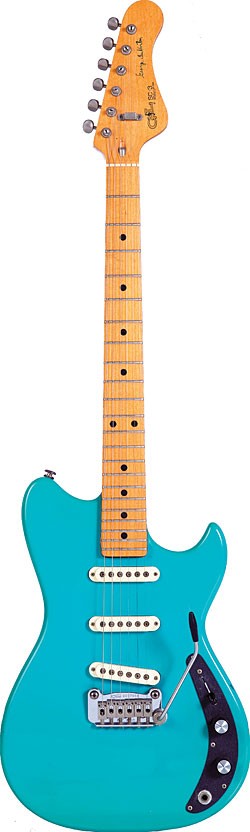
    Matching guitars and basses always have an extra “cool” factor, but the early-’80s G&L SB-1 bass and SC-3 guitar shown here have interesting similarities beyond their looks. Part of the S series introduced in late 1982, other models included the one-pickup SC-1 and the two-pickup SC-2; the latter essentially paved the way for G&L’s Telecaster-shaped Broadcaster and ASAT models a few years later. The two-pickup SB-2 bass was also a part of this series. All pickups in SC/SB instruments were variants of G&L’s Magnetic Field Design pickup, which have adjustable polepieces.

    Some might surmise the S designation implies student, but these are professional-grade instruments with fewer frills. The bodies and necks were made from maple, and the necks had full scales of 251/2″ (with 22 frets) on the guitars, 34″ (with 21 frets) on basses. They also sported the original six-on-a-side “non-barb” G&L headstock profile, as well as slightly enlarged fretboard dots.

    The low-frills elements of the series included the lack of bevel on their bodies, and basic control knobs (one Volume and one Tone, regardless of the number of pickups) mounted in a banana-shaped plate that had a powder-coated crinkle finish that was also found on the bridge plates of basses and non-vibrato guitars.

    When introduced in 1982, the SC/SB series was available in plain Red, White or Blue finishes. The SC-3 and SB-1 seen here are blue, but with age their finishes have yellowed slightly, giving them a teal-like color.

    The SB-1 exemplifies simplicity and playability, coupled with a potent sound. When strapped on, its traditionally-shaped double-cutaway maple body (measuring 15/8″ deep, and 121/2″ at its widest point) gives the neck an upward tilt in terms of ergonomics/balance. And though not beveled, the rounded edges are comfortable.

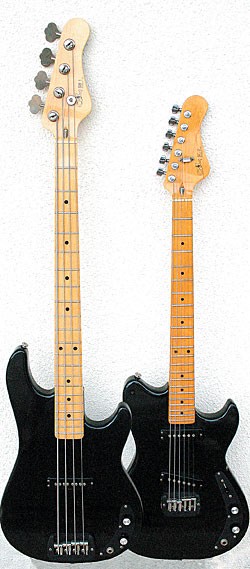
    1984 G&L SB-1 and SC-2

    1984 G&L SB-1 and SC-2. Photo: Willie G. Moseley.

    This SC-3 has several other unique aspects. Its body silhouette is a cross between a traditional single-cutaway Fender Telecaster shape and a double-cut such as a Fender Stratocaster. Moreover, it may appear slightly small – or perhaps the headstock appears too big. Still, it’s very balanced.

    Electronics include three pickups laid out in a traditional Stratocaster configuration. They’re controlled by a five-way toggle switch and master volume and tone knobs. What’s unusual is that these are rarer white pickup covers (most were black). Accounts vary as to how many early Leo-era G&L instruments were given white pickups, but Paul Bechtoldt, author of G&L: Leo’s Legacy, claims to have a hand-written note from G&L co-founder Dale Hyatt saying only a few dozen guitars or basses had such covers.

    Another curiosity is the guitar’s serial number. According to Bechtoldt, the first SC was completed on August 31, 1982, but a serial-number list in his book indicates the number embossed on the bridge plate is from 1981. Thus it seems early on, at least, G&L didn’t use sequential serial number bridges (much like Fender in the early ’50s).

    The SC/SB series lasted less than two years, but the SC-3, SB-1, and SB-2 continued longer, undergoing numerous changes in cosmetics and electronics. The 1984 examples shown here are in Black, a finish option added later.

    Whether or not the owners of these color-coordinated instruments ever feel compelled to dress up in matching suits and crank out “Pipeline,” their early-’80s G&Ls are interesting beyond the fact they’re cosmetic siblings.


    This article originally appeared in VG‘s October 2009 issue. All copyrights are by the author and Vintage Guitar magazine. Unauthorized replication or use is strictly prohibited.

  • SuperVee, Stetsbar T-Style, and StepMax Tremolo

    SuperVee

    Three new aftermarket vibrato systems for common double- and single-cutaway solidbody guitars offer the convenience of “drop in” installation. Each system boasts unique features and improved performance.

    SuperVee Tremolo System
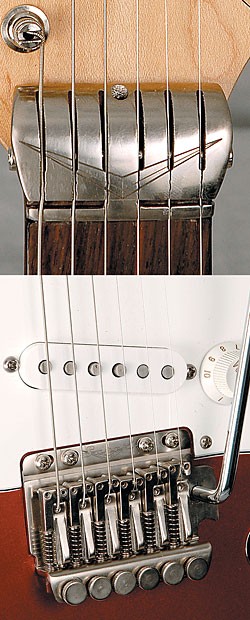
    Brainchild of designers Jeff Athrop and Marc Caldwell, the SuperVee is a direct-replacement (a.k.a. “drop in”) unit requiring no modifications, no drilling, and no routing. We tested a prototype unit installed by SuperVee on a Fender Strat.

    The system consists of a locking nut unit and a replacement bridge, and the first couple of things we noticed were 1) the high-quality, well-machined look and feel of its parts, and 2) the visually unusual locking nut assembly. Unlike most locking nuts, this one requires no modification or routing. Simply pop out the stock nut and install the new nut/clamp assembly, using a drop of glue to hold it in place. The nut/clamp assembly uses a stainless steel pre-slotted 9.5″ (or 7.25″)-radius nut with an attached clamping unit that pinches each string in a zigzag-shaped channel via two Allen-head screws (one for the E, A, and D strings, one for G, B, and E).

    The SuperVee’s bridge isn’t significantly larger, bulkier, or taller than a stock Strat bridge, and sports a couple of innovative features like its six-piece bridge-end string clamp/fine tuner assemblies and six separate saddles instead of the standard all-in-one piece. This allows the saddles to be individually adjusted for height and intonation, like standard Strat saddles, with no saddle shims or time-consuming intonation/setup.

    The other innovative feature is the bridge pivot point, or in the case of the SuperVee, the lack of one. Instead of a bridge that pivots on two screws or a “knife-edge,” the SuperVee uses a piece of industrial spring steel that bends to connect the bridge plate and mounting plate. This essentially eliminates any metal-on-metal wear and tear, and ensures the tailpiece returns to the same position after each use.

    The SuperVee uses the guitar’s stock springs and spring claw to compensate for string tension, and can be set up for floating operation with limited pull-up capability, or with the bridge flat against the guitar’s body.

    The SuperVee performs very well, staying in tune even with repeated heavy use, including dive-bombing. Its feel is slightly stiffer than a standard vibrato, but very smooth, and the fine-tuners at the bridge offer enough travel to allow for drop-D tuning without having to loosen the locking nut.

    As with most locking vibratos, changing a broken string (especially if you’re in a hurry) can be a bit of an ordeal. It requires two Allen wrenches (one for the nut and one for the string clamp) and also requires cutting the ball off of the string. Being able to simply lay the string into the open zigzag channels in the locking nut (instead of feeding it under a locked-down clamp) does speed things up a bit.

    Overall, the SuperVee vibrato is a well-crafted, well-conceived unit that offers solid performance without having to modify your guitar (save for perhaps shimming the neck).

    Stetsbar T-Style

    Stetsbar T-Style
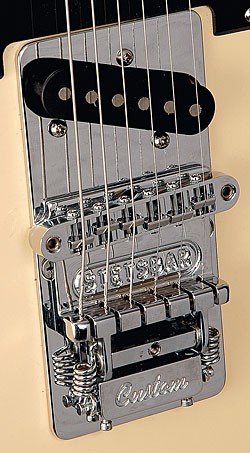
    This is our second go-round with a replacement vibrato from Eric Stets’ Stetsbar company. The first happened in September ’02, when we tested their Stop Tail for Gibson-style single-cutaway guitars. The latest addition to their line is the T-Style, for (as you’d guess) single-cut Fender-style guitars.

    Stets shipped the T-Style mounted on a Fender Standard Tele. Like the SuperVee (and Stetsbar’s Stop Tail), the T-Style requires no modifications to the guitar beyond a tapered shim in the neck pocket to allow for the added height of the replacement bridge assembly. Also like the Stop Tail, the T-Style uses a true linear-motion floating tune-o-matic-style bridge with micro roller bearings that allow the bridge and strings to move together.

    The T-Style has as very smooth, liquid, Bigsby-like feel, and stays perfectly in tune even with heavy use. Its nicely chromed parts fit the look of the Tele and, some would argue, look like something Leo himself might have devised.

    StepMax Tremolo

    StepMax
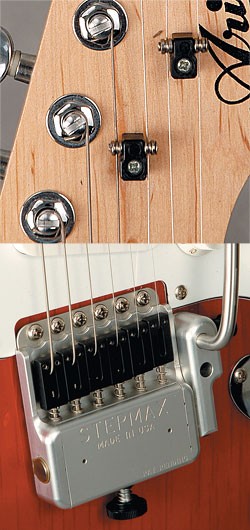
    Keith Pate’s StepMax dual-action tremolo follows in lock step with the others here in that it does not require modification to the guitar, save for a neck shim.

    The StepMax is set apart from other “dual-action”/floating vibratos (which allow the player to pull the unit’s arm up as well as push it down) is that it’s not really floating, which means the bridge can be mounted directly on the guitar’s body, which equates to better sustain. This is accomplished with a dual-action bridge that operates like a standard Fender-type system when the user pushes the arm down, moving the entire bridgeplate and block. But when the arm is pulled up, it activates a separate system that pulls all six saddles back. Step Max also incorporates an adjustable stop for the pull-up feature, which allows the user to set it at any half-step or full-step intervals.

    The StepMax is constructed of high-quality milled (not cast) aircraft-grade aluminum except for the steel block, Graph Tech saddles, and stainless-steel arm. It has two arm sockets with a tension adjustment screw for positioning the arm so it feels just right.

    Tuning stability is very good with the StepMax, due to the combined efforts of its high-quality parts and the fit of the bridge mechanism.

    All three of these vibratos delivered on their promises, and did it well. None require modification to the instrument, though all require neck shims. After a few strums, most players will have no problem adjusting to the slightly altered playing geometry, and then set out to get their groove on, worry-free.


    SuperVee, Stetsbar T-Style, StepMax Tremolo
    Price $199 (SuperVee), $349 (Stetsbar), $399 (StepMax).
    Contacts
    SuperVee, 963 Elkton Drive, Colorado Springs, C0 80907; phone (815)227-4400; www.super-vee.com.
    Stets Machine Company, 50 East and West Road, West Seneca, NY 14224; phone (866) 496-1194; www.stetsbar.com.
    StepMax Tremolo, PO Box 952, Lockport NY 14094; phone (716) 439-0244; www.stepmaxtrem.com.


    This article originally appeared in VG‘s March 2007 issue. All copyrights are by the author and Vintage Guitar magazine. Unauthorized replication or use is strictly prohibited.


    Super Vee Vibrato Demo – Hercules Castro


    Stetsbar


    Stepmax Demo

  • The Beatles – Rare and Unseen

    Most unauthorized retrospectives of pop music are overly academic and usually a bit cynical – consisting of revisionist perspectives from people who weren’t there “at the time.” With the exception of a couple of music professors and “social historians,” what sets this 90-minute DVD apart is that nearly all of the interviewees were fans or part of the inner circle when the Beatles hit the scene.

    With the exception of a 1975 interview that John Lennon did for French television (the only Beatle who speaks here), all of the interviews were conducted specifically for this project – from their early publicist, Tony Barrow, to Gerry Marsden of Gerry & The Pacemakers to boyhood friend and crew member Tony Bramwell.

    Some interviews are enlightening, such as Colin Hanton, drummer in the Quarrymen, Lennon’s pre-Beatles skiffle group; the band’s first manager in Liverpool, Allan Williams, who booked them to play Hamburg, Germany (what he calls “their school”); and Norman Smith, who engineered their first LP, Please, Please Me, whose 13 songs were cut in one all-day session. As he says, “To be absolutely honest, the Beatles didn’t really need any producing; they knew exactly what they were going to do.”

    Other interviewees merit inclusion for their sheer enthusiasm. Len Goodman (best known as a judge on TV’s “Dancing With The Stars”) gushes about hearing the single of “Please, Please Me” for the first time. Early promoter Sam Leach declares of their pre-mania days, “They were the best rock band on the planet at that very time.”

    Still photographs, the band’s own home movies, and other film (including the earliest-known footage of the group, in Liverpool, February ’62) illuminate the story to the point that you hardly notice that none of their actual songs are included – it’s instead Beatles-like backing music.

    There’s color footage of the band’s January ’64 Paris concerts (just prior to invading America), taken by Mickey Jones, drummer with Trini Lopez, on the same bill.

    Another drummer, Phil Collins, was a fan and subsequent extra in A Hard Day’s Night. “It’s hard to explain to people that didn’t grow up in the ’60s what it was like. But when you were there, it was quite extraordinary,” he states, before adding, “I judge every band and every song by that standard.”

    As Smith, who later produced Pink Floyd, correctly reminds, “Suddenly, England had become the number-one producer of hit records… due solely to the Beatles.”

    And there’s more accuracy than arrogance in Lennon’s comment that songs like “Hey Jude” and “Eleanor Rigby” aren’t “of an era” and will sound current 100 years from now.


    This article originally appeared in VG‘s Dec. ’09 issue. All copyrights are by the author and Vintage Guitar magazine. Unauthorized replication or use is strictly prohibited.


  • Bob Brozman

    Brozman 01

    Photo courtesy Bob Brozman.

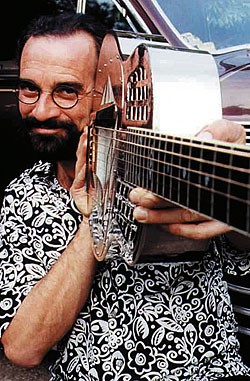
    To many, the terms “musician,” “artist,” and “entertainer” are rarely applicable to one person en masse, but Bob Brozman fits the category. What’s more, the term “musicologist” would also be an appropriate designation – to say that the veteran player is a musical ambassador is an understatement, as he has traveled the world for years, purveying his unique music.

    Brozman has recorded more than 30 solo albums or collaborations, many of the latter interesting efforts with musicians from other nations. His resume also includes authorship, as he wrote a definitive work titled The History & Artistry of National Resonator Instruments (Centerstream), published in 1993.

    While Brozman is indeed best known for his work with resonator acoustic guitars, he is capable of displaying dazzling abilities on dozens of stringed instruments from around the globe. Lumiere, one of two albums Brozman released in 2007, was a multitracked, nearly-solo “Mike Oldfield uplugged”-type of effort that drips with diversity (instruments and musical stylings), and the cover shows Brozman’s “orchestra” (27 images of him brandishing 27 different instruments).

    As for defining “world music” and his use of “world instruments,” Brozman recently told Vintage Guitar, “I think a distinction needs to be made between indigenous music, which is original music from cultures all around the world – I’ve been in over 60 countries – and world music, which is when we get mixing of cultures. And that included guys from Africa coming to America, picking up a guitar and starting something called blues – that’s a kind of world music that came about because of slavery, people being brought from one part of the world to another.

    “What I think is most interesting about the musical history of the blues is that the 12-bar blues with three chords was not invented overnight. Africans coming from a modal culture were trying to figure out these crazy diatonic Western instruments, like the guitar. So for me, Delta blues is a kind of world music.”

    Brozman described his interest in seeking out and learning to play other unique stringed instruments as “…pretty much a straight line. I was introduced to the resonator guitar as a child, and the possibilities of sound from a resonator are much more than with an electric guitar or a flat-top. Its dynamic range and tones set me on a path; my ears are always hungry for sound.”

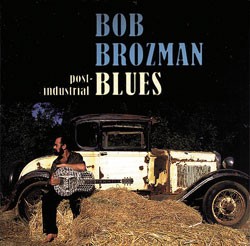
    Much of Brozman’s music has a foundation in rural Delta blues, a genre with which the resonator has been historically associated. His other 2007 album, Post-Industrial Blues, does lean towards Delta blues, but he managed to incorporate other “world instruments” onto that album as well, including two Hindustani slide guitars, a Bolivian charango, a Greek baglama (described by Brozman as a small bouzouki), a resonator ukulele, an 1860s Temletts seven-string banjo, and an Okinawan sanshin (a three-string fretless banjo), among others.

    While Brozman uses vintage resonators in his recordings, he also uses modern-day resonator instruments, and has had a longtime working relationship with the National Reso-Phonic Guitar company of San Luis Obispo, California, since the early ’90s. The cover of Post-Industrial Blues shows him with a one-of-a-kind 1992 tri-cone prototype that has a circular brushed-metal pattern on its top.

    “I’ve played old ones that were [unplayed], old ones that had been played a lot, and I’ve played lots of new ones,” he explained. “I started using new ones every day onstage in 2002, when I retired my last old one. The straight dope is that the new tricones sound as good out of the box as an old one, except for the first string. If you play it for six months, it sounds better than an old one – the bass is better, and from day one, the intonation is better, but I’ve played old ones in new condition, and they also took a few months to open up.”

    Brozman 02

    Some might pigeonhole the songs on Post-Industrial Blues as protest songs or sociopolitical commentary, but Brozman begs to differ, particularly since as a world-traveling American musician he could be perceived as an ambassador, by default.

    “I wanted to say something, without being preachy, that people in America would understand,” the guitarist clarified. “I’m not comin’ from left or right. Like ‘Look at New Orleans.’ I was being honest. I’ve got a young daughter, and I’m worried about what’s going to happen to this country 20 years down the road. That’s not a protest song; that’s a man wondering about his family. I think democracy is based on discourse; you should be able to exchange ideas. I’m saying this as a patriot who loves his country but asks questions about the people who are running it. I’ve traveled all over the world, and people desperately want to like us, but they’re having a hard time.”

    Oddball-but-listenable instrument combinations abound on Post-Industrial Blues. For example, “Old Man Blues” pairs the seven-string banjo and the sanshin.
    “It’s an obscure old thing with a giant skin head,” Brozman said of the Temletts seven-string. “It’s got six strings like a guitar, but a shorter extra string like a five-string banjo. It’s spooky; it has the most unhappy banjo sound you’ve ever heard! The sanshin is fretless, and the head is made of python skin. I just want weird sounds; I never use pedals or effects.”

    Post-Industrial Blues also reunites Brozman with upright bassist Stan Poplin and drummer Jim Norris, with whom the guitarist had gigged in the ’80s.

    “I love interacting with other musicians,” Brozman said. “And something like ‘Strange Ukulele Blues’ was something we weren’t even planning to do; it popped up in between takes. It was just a resonator ukulele, a banjo, and drums.”

    Underscoring his role as a world traveler, Brozman headed to Australia last Christmas to do a brief tour. He’s worked with Aborigine musicians there, and is an adjunct professor at an Australian university. He was also planning early-’08 gigs with the Cheap Suit Serenaders and David Lindley.

    Bob Brozman’s unique music, played on unique instruments, is always fascinating to anyone who hears it on his albums or in concert.

    For more information, go to www.bobbrozman.com.


    This article originally appeared in VG‘s April 2008 issue. All copyrights are by the author and Vintage Guitar magazine. Unauthorized replication or use is strictly prohibited.


    Bob Brozman – Look At New Orleans

  • Retroman effects

    Retroman

    Retroman proprietor Joe Wolf is a dedicated one-man-shop that designs, builds, and finishes effects pedals all by hisself.

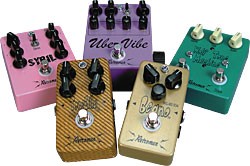
    Wolf, a guitarist and electronics engineer, began building pedals for his own use, and some for friends. Not long after, and with the encouragement of his wife, Amy, he started Retroman in 2002. As the name implies, Wolf builds pedals intended to replicate classic pedal tones. He recently offered to send us five: the Beano, Sybil, Wolf Tone Machine, and his latest creations, the Uber Vibe and Tonezilla.

    The Beano was Wolf’s first production unit, and he picked a good place to start – with a replica of the renowned Dallas Rangemaster used to great effect on the classic 1966 album John Mayall’s Bluesbreakers with Eric Clapton. The pedal employs a four-position Tone switch, Drive control, and a Hissbuster knob (labeled HB) that does an effective job, but also affects the pedal’s high-end shimmer. The Beano also has a true-bypass on/off switch with indicator, input/output jacks, and a power supply jack. The heart of the Beano’s tone lies in its new-old-stock (NOS) Mullard OC44 transistor.

    We plugged in the Beano between a solidbody guitar with Duncan pickups and an all-tube amp and it added a nice, boosted distortion. The tone switch produced a wide range of tones, from fat to trebly. Each increment produced a change in balance between bass and treble, with the full-on position sounding like a wah pedal with the treadle set halfway. Harmonics were incredible, and the gain didn’t get mushy, no matter how far we pushed it. This pedal certainly adds life and natural drive to the signal.

    We next plugged in the Sybil, which is essentially two fuzz pedals in one sweet pink box, one (labeled “Germanium”) employing an NOS AC188 transistor, the other (labeled “Silicon”) using low-gain transistors. Both have their own set of controls for Volume, Fuzz, and Tone. They share a true-bypass on/off stompswitch and a Series/Parallel toggleswitch, in/out jacks, and power supply jack.

    We found the Sybil to be quite capable of covering a wide range of fuzz tones. The design allows you to blend the circuits to create fuzzes ranging from thick and full to shrill and trebly, and all points in between. The tone controls help the Sybil produce a near-limitless number of sweet spots and fuzz variations. If you’re into the vintage fuzz thang, this pedal should be all you’ll ever need.

    For further fuzz, behold ToneZilla! Designed to replicate the Sola Colorsound MkIII Tonebender, the ToneZilla uses NOS AC188 and Philips NOS OC76 germanium transistors. Equipped with controls for volume, tone, pre-gain, and fuzz, an on/off switch with LED indicator, in/out jacks, and power supply jack.

    The ToneZilla does a fine job of making vintage fuzz tones that, as you play faster, sport the characteristic note decay. Using the tone, pre-gain, and fuzz knobs, we readily dialed in fuzz to our liking. And whether we asked for a little or a lot, the ToneZilla always stayed controllable.

    The Wolf Tone Machine is a fuzz/drive pedal available with an optional octave divider, similar to a vintage Roger Mayer Octavia. It has controls for Volume, Tone, and Sustain, along with true-bypass stompswitches for turning the effect on/off, and for engaging its Octave circuit. Both employ LED indicators. The Wolf Tone Machine produces retro-style fuzz, with the Sustain control helping the pedal produce varied amounts of fuzz.

    Kicking on the Octave switch is akin to having Hendrix walk through the door. If you’re trying to replicate his old solos or any late-’60s/early-’70s sounds, or if you simply feel your sound is missing something, this pedal may well be just what you seek.

    Last in our Retroman buffet was the Uber Vibe, which replicates the original Univibe, the first commercially available chorus/vibrato pedal. Think Hendrix. Think Trower.

    Though it produced fantastic tones, the Univibe also had a reputation for being inconsistent. Some sound notably better than others. Joe uses matched “light-dependent” resistors in the Uber Vibe to ensure each will sound its best. And Wolf takes the concept a step further, making it stereo and giving it a JFET buffer to add sparkle to its clean sounds. The unit also uses four filter controls that shape each stage, letting the user adjust fluidity and wow. The Uber Vibe also has two Volume controls, as well as controls for Depth and Speed, true-bypass on/off switch with indicator, Vibe/Chorus toggle, input/output, jacks that lets the Uber Vibe interface with other aftermarket devices, and a power supply jack.

    With our ’70s Fender Strat, we again flashed back to Hendrixland, with its swirling, liquid tone. This pedal nails it perfectly, and by using its filters we could practically perfect every nuance. Simply beautiful. We ran the unit in stereo; we’re pretty sure Jimi would’ve loved the expanded, lush tone. Flipping to the Vibe setting, we were greeted with a smooth, even vibrato reminiscent of the classic Univibe. The buffer produced a bit more sparkle on clean settings. With its improvements, the Uber Vibe just may be the best reproduction of the original Univibe.

    Wolf has done an outstanding job with these designs. His pedals boast solid all-around workmanship, and fantastic bang for the buck.


    Retroman effects
    Price: $150 to $270.
    Contact: www.retroman-music.com.


    This article originally appeared in VG‘s February 2006 issue. All copyrights are by the author and Vintage Guitar magazine. Unauthorized replication or use is strictly prohibited.