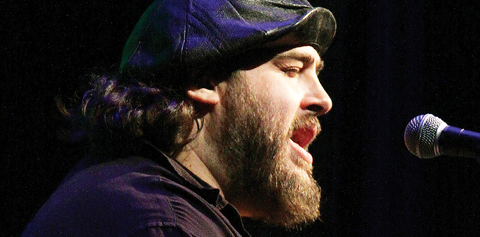
Since 2007, guitarist/vocalist Nick Moss has released five albums on his Blue Bella label, including two live discs. And while Moss still loves his Chicago-style blues, his most recent effort, Here I Am, is an adventurous album. Though it begins with a raucous Windy City-type rave-up called “Why You So Mean,” by the third/title track, it’s obvious Moss is up to something, as “Here I Am” is nothing less than a Led-Zeppelin-style stomp.
“That song was born out of frustration with people writing and talking about what I’m supposed to be,” he explained. “So, it’s a blatant statement from me directly, if they really want to know about me.”
Another song makes a similarly assertive statement. “‘Long Haul Jockey’ is about ****ing, not making love… getting down late at night and ‘driving,’ so to speak!”
He noted the album’s funk-type tunes such as “Candy Nation” and “Caught By Surprise” as being “…just fun grooves to play. I am big fan of all things funk. ‘Candy Nation’ is about America’s fascination with medication and pharmaceutical infomercials; ‘Caught By Surprise’ is about a woman turning the tables on a man and using him for her ill-gotten pleasures!”
A perusal of the track list might lead one to believe there are religious connotations to Moss’ songs, as with titles like “Here Comes Moses” and “Sunday Get Together,” but Moss says he was trying to stay in secular mode.
“‘Here Comes Moses’ is my way of relating that there are a lot of good common-sense lessons in the Bible – I’m no religious zealot – and I even say in the song that ‘I’m not without sin’ – and it seems like there are an awful lot of people these days lacking some damn common sense!”
On the other hand, he noted the no-frills recording style of the instrumental “Sunday Get Together,” detailing how it’s “…my Les Paul Standard with ThroBak PG 102 MXV pickups, going through my Orange Dual Terror, recorded live in-studio with very ambient mic placement. The background chatter was added later; I wanted it to sound like a family get-together with kids running around and laughing, and people eating and drinking and having a good time.”
“Katie Ann (Slight Return)” is a paean to Moss’ spouse and business partner, and it originally appeared on an album a decade ago; he recorded an update, which, as he sees it, validated the addition of “(Slight Return)” to its title.
“I wrote the song in 2001 for Got A New Plan,” he averred. “It originally had a Louisiana swamp blues feel. I decided to re-do it for my 10-year anniversary with Kate. I gave it a Hendrix feel, and just went over the top with guitar layers and feedback swells and the whole nine yards – and it was a blast! Just as Jimi did ‘Voodoo Chile’ and ‘Voodoo Chile (Slight Return)’ I called my new version ‘Katie Ann (Slight Return)’ as an homage to Hendrix.”
After the road van, which contained his guitars and gear, was stolen in Montreal in 2008 (where he had played the International Jazz Festival), Moss was forced to “update” his guitar and amplifier collection.
“I lost some really nice guitars, including a beautiful custom guitar made by Steven White, and some nice amps like my ’66 Fender Super Reverb and a very nice ’68 Pro Reverb.”
After the theft, he scored a ’67 Guild Starfire and now also owns several guitars he built himself, along with, “…a couple lawsuit-era Tokais and a great Fernandez Revival given to me by Craig Ruskey, who did the liner notes for Live At Chan’s: Combo Platter No. 2. I’m also awaiting guitars by Kurt Wilson and some amps from Don Ritter at Category 5. I’ve been using them for more than two years.”
Guitars used on Here I Am included an ’81 Burny with ThroBak’s SLE 101 MXV pickups, a custom-built Don Mare with Zepotone pickups, a custom-built guitar with Mare’s Josie pickups, and a Les Paul Standard with ThroBak PG 102 MXV pickups. A Takamine 12-string acoustic is also heard on “It’ll Turn Around.” The slide guitars that are heard were tuned to Open G, and Moss uses a Coricidin bottle for slide. He used a Category 5 Tempest and the aforementioned Orange Dual Terror on most tracks, as well as a Marshall JCM 800.
Here I Am is an ambitious effort that shows just how Nick Moss’ career has evolved.
This article originally appeared in VG September 2012 issue. All copyrights are by the author and Vintage Guitar magazine. Unauthorized replication or use is strictly prohibited.
– – – – – – – – – – – – –
Nick Moss photo: Jim McKinley.
.
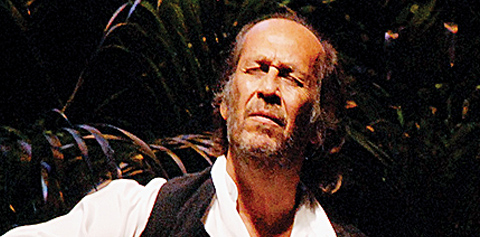
Spanish flamenco guitarist Paco de Lucia died February 26 after suffering a heart attack in Cancun, Mexico. He was 66.
In the U.S., de Lucia was best known for his collaborations with jazz-rockers like John McLaughlin, Chick Corea, Larry Coryell, and Al Di Meola, with whom he recorded “Mediterranean Sundance” in 1977. This seminal recording featured intense flamenco improvisations from both players, exposing this Latin guitar style to a new generation of young rock and fusion fans. In the ensuing decades, de Lucia would become regarded as the world’s leading flamenco guitarist and, in some players’ minds, the world’s greatest living guitarist. When he played, there were no effects, no electricity, and no tricks or mirrors – not even a pick. A melding of man, wood, and strings, de Lucia displayed pure, raw ability and a peerless musical sensibility when he held the nylon-string guitar.
Flamenco is an art form of the Roma – the Spanish gypsies who live in the Andalusia region – and involves dance, singing, clapping, playing guitar, and using hand percussion. Though not a Roma himself, de Lucia was exposed to it via his father and brothers, who were flamenco musicians, and he began playing guitar at age seven. Born as Francisco Sanchez Gomez in 1947, he started performing at 11, cutting his first album at 15. In the late ’60s, he began a partnership with flamenco singer El Camarón de la Isla and the two invented an electrifying new style of flamenco that catapulted them to national fame.
Paco’s break in Amercia came via “Mediterranean Sundance” and two years later, he began working with John McLaughlin and Larry Coryell in what later became known as the Guitar Trio, fusing jazz, flamenco, World, and more than a little rock attitude, but entirely on acoustic guitars (McLaughlin and Coryell flatpicking on roundback Ovation acoustic-electrics, while de Lucia picked with fingers and nails on a traditional nylon-string). As Paco de Lucia once told NPR about his style, “My flamenco is not a fusion. I have always been careful that it doesn’t lose the essence, roots and tradition of what is flamenco. I have incorporated other things, but things that have not altered the philosophy of the music. I have, as my only interest in all this, to grow as a musician who plays flamenco and not to bring things that some way or another changes the identity of this music.”
In 1981, Al Di Meola replaced Coryell in the Trio, and the three recorded Friday Night in San Francisco. Surprising everyone, the LP hit the pop charts and eventually sold seven million copies. de Lucia, McLaughlin, and Di Meloa followed up with a studio album – the excellent, but lamentably overlooked Passion, Grace & Fire – and toured for the next few years.
The three performed to sold-out audiences of screaming fans and received glowing reviews from the most jaded critics. Even with McLaughlin and Di Meola’s prodigious skills, de Lucia always stole the show with his high-speed (“picado”) picking chops, and those jaw-dropping strumming and string-raking techniques (“rasgueado”). The Trio’s 1983 tour further featured Dixie Dregs leader Steve Morse on solo acoustic guitar and, each night, he joined them for an explosive four-way guitar finale. In the mainstream pop world, de Lucia also played on singer Bryan Adams’ 1995 hit, “Have You Ever Really Loved a Woman.”
Upon hearing of his friend’s death, McLaughlin was quick to note, “Paco was passionate, but had true compassion and a deep understanding of the human condition. All this was revealed in his music and marvelous guitar playing. To have worked and played music with him is one the greatest blessings in my life. In the place where he lived in my heart, there is now an emptiness that will stay with me ’til I join him.”
“I was part of Chick Corea’s Return to Forever when I was 19 and we toured Spain,” added fellow six-string master Al Di Meola. “It was there that I heard the buzz about Paco and saw the potential of our collaborating one day. His technique far surpassed any other flamenco-type players and I envisioned an amazing collaboration between us. That day happened in 1977. We made history when I invited him to New York and we recorded ‘Mediterranean Sundance’ at Jimi Hendrix’s Electric Lady Studio. Surprisingly, it became the equivalent of a major pop hit around the world and was played on the radio everywhere, something unheard of in non-vocal music up until them.
“Right now, I am so sad at his passing and will forever miss Paco. But, I will remember our thousands of great memories and musical camaraderie. RIP, my dear friend!”
This article originally appeared in VG June 2014 issue. All copyrights are by the author and Vintage Guitar magazine. Unauthorized replication or use is strictly prohibited.
In his prime, Howard Roberts played more than 900 studio dates annually and recorded the hippest guitar records of the era. His legion of fans still revere his incalculable influence and musical legacy.
Vesta Roberts, who grew up in a family of lumberjacks, gave birth to Howard just three weeks before the Wall Street Crash in October of 1929. Howard’s dad, a cowboy, wasn’t happy about the boy’s affinity for music. But his mother prayed for her baby to be a musician, and Howard often told the story about, “When I was about eight years old, I fell asleep in the back seat of my parents’ car one very hot summer afternoon. When I woke up I just blurted out, ‘I have to play the guitar!’” So when his dad saw the youngster’s attempt to build one from a board and bailing wire, he acquiesced. For Christmas, he bought young Howard an $18 Kalamazoo student-model acoustic manufactured by Gibson.
By age 15, Roberts’ guitar teacher, Horace Hatchett, told the boy’s dad, “Howard has his own style of playing and there’s nothing else I can show him. He plays better than I do.” Howard was already playing club dates in their hometown Phoenix area – usually blues and jazz gigs on which he would gain playing experience and develop his improvising skills. He was receiving an extensive education in the blues from a number of black musicians, one of whom was the brilliant trumpeter Art Farmer. Journalist Steve Voce, in his 1992 article in The Independent Newsletter, quoted Roberts on those nightclub gigs, “I came out of the blues. I started in that scene when I was 15 and it was the most valuable experience in the world for me.”
Roberts had created an heroic practice regimen with his roommate, guitarist Howard Heitmeyer. The two would practice three or four hours in the morning, catch an afternoon movie, then return to practice until it was time to hit the clubs, gig or not. Heitmeyer would remain Roberts’ lifelong friend, and someone with a comprehensive talent Roberts found staggering.
At age 17, Roberts was drawn to a class created by composer/theorist Joseph Schillinger, whose students included George Gershwin, Tommy Dorsey, Benny Goodman, and Oscar Levant. Noted musician Fabian Andre was commissioned to teach
Schillinger’s system of applying mathematical principles to art piqued Roberts’ curiosity, so he arranged a deal with Andre; he’d sweep the floors after class to defray his tuition. That attitude was indicative of the teenager’s precocious intellect and passion for music and science.
By the late ’40s, many of the better players in Phoenix had split for the more rewarding jazz scenes in Chicago and New York. Roberts was gigging with his boyhood friend, Pete Jolly, who’s now a name jazz pianist. In fact, Roberts’ birth of fire on the road as a pro musician was with Jolly. The two toured Washington and Idaho in early 1950.
A group of Roberts’ regularly-used guitars in 1982 (from left); a Gibson ES-175 with a 22 fret dot fingerboard, the Gibson ES-150 “Black Guitar” (see sidebar), Epiphone HR Custom, a Gibson HR Artist in natural finish, Gibson HR Fusion. Photo: Andrea Augé.
In late 1950 – 20 and driven by ambition – Roberts headed for Los Angeles. He arrived with no place to live and carried only his guitar and amp. He was attired in a shiny blue suit that he would wear daily for the next year. Sometimes he’d have to staple its split seams.
For a year or so, he paid his blues dues and lived a spartan existence by choice. He didn’t want possessions, save his guitar and amp. He said he didn’t want a car or even a wristwatch. He’d sleep on friends’ sofas or in their cars and would avail himself of whatever largesse was offered. And he nurtured himself with music, haunting the after-hours scene and jamming with jazz luminaries like Dexter Gordon, Sonny Stitt, and Buddy DeFranco. That focus and dedication was a harbinger of the attitude and aura he exuded, especially after he became well-known.
Roberts met jazz great Barney Kessel after hearing him play one night. That meeting developed into an important and lasting friendship; Kessel introduced Roberts to guitarist Jack Marshall, who was becoming a heavy hitter in the Hollywood music scene. Marshall became a close friend, employer, and mentor to the young guitarist, and would eventually sign him to Capitol Records. But Roberts’ first L.A. gig was working on “The Al Pierce Show,” a radio broadcast that a prescient 10-year-old Howard had told his mom he’d be on someday. It was the first folding money he was to make in L.A.; he was paid $550 per week. He also landed a gig teaching guitar at the vocational Westlake College.
In ’52, Roberts scored his first record date, the obscure “Jam Session No. 10” with reed man Gerry Mulligan and pianist Jimmy Rowles. Later that year, he recorded Live at the Haig with the Wardell Grey Quintet, then a Bobby Troup album for Capitol in ’53.
By ’55, he was working with drummer Chico Hamilton and bassist George Duvivier. They recorded an album for the Pacific Jazz label entitled The Chico Hamilton Trio, a recording that netted Roberts the Downbeat New Star Award.
In ’56, Bobby Troup signed Roberts to Verve, a label where Kessel had an artist-and-repertoire position. Kessel produced Mr. Roberts Plays Guitar featuring arrangements by three of Hollywood’s best – Jack Marshall, Marty Paich, and Bill Holman. Another album for Verve, Good Pickin’s, followed in ’59. Roberts was becoming a success.
One of his session dates became a legendary Hollywood studio story. In May of ’58, he was hired for a Peggy Lee record date. When it was time to lay down the track for what would become Lee’s huge hit, “Fever,” producer Jack Marshall decided to lose the guitar part. Consequently, that’s Howard snapping his fingers along with Max Bennett’s bass line and Lee’s vocals. Some still wonder if he got paid what session players call a “double”; he made the date with his guitar, but ended up appearing with another “instrument” – snapping his fingers.
In ’59, Marshall was composing hip background scores for a western TV series entitled “The Deputy,” which starred Henry Fonda. Marshall wanted to feature jazz guitar on the scores, and hired Howard to improvise over many of the action sequences. Having a jazz guitar line complement a scene with cowboys riding at full gallop was a fresh and distinctive approach.
“Jack Marshall let Howard just blow as much as he wanted to,” studio vet Bill Pitman said of the sessions.
Photo: Rick Gould.
Howard Roberts’ “Black Guitar”
The “Black Guitar” was Howard Roberts’ trademark guitar of the 1960s-’70s. “H.R.” preferred this highly modified instrument during his most active years, playing it on countless studio dates. It can be heard on many of his recordings, including Color Him Funky, H.R. Is A Dirty Guitar Player, and The Magic Band Live At Donte’s.The Black Guitar began life as a Gibson ES-150 “Charlie Christian model.”Roberts acquired it from Herb Ellis, who remembers buying it new and keeping it as a spare. Roberts made numerous changes reflecting his tastes and preferences, the most dramatic being the slimmer body, the shape of the cutaway, an extended/repositioned neck, fingerboard replacement, and upgraded electronics.The original ES-150 was 33/8″ deep with a carved spruce top, maple sides and back, and a non-cutaway shape. H.R. had it thinned to a 23/4″ profile. The ES-150 had a flat back, while the Black Guitar has a laminated-maple arched back and possibly a reworked arched top. Nick Esposito did the labor.The Black Guitar sports an asymmetric double-cutaway shape, a notch in its upper bass bout, and a deeper Venetian cutaway going to its 17th-fret joint. The modified junction block has a larger maple piece to stabilize the deeper cutaway and joint. The fingerboard was replaced with a longer ebony board with dot inlays and 20 frets. Roberts recontoured the neck in stages, applying autobody filler that could be easily shaped and sanded. Its scale length is 251/4″, its fingerboard is fairly flat with a slight radius. Its width is 111/16″ at the nut and 23/8″ at the 12th fret – slightly wider than normal. The fret wire is .093 (a wider modern style) and the frets were milled down. Fingerboard and fretwork was performed by Jack Willock, an original artisan at Gibson’s Kalamazoo factory.The headstock retains a Gibson silhouette and is fitted with Grover Imperial tuners – five chrome-plated and one nickel-plated. It has a simple truss rod cover and no ornamentation or script. The headstock shows wear at the top edge, owing to H.R.’s habit of leaning his guitar against a wall.The guitar received a black nitrocellulose-lacquer finish, applied by H.R. himself. Cosmetic appointments include single binding on the headstock, fingerboard, body edges, and f-holes. Replacements include barrel knobs, Brazilian rosewood bridge, and tortoiseshell pickguard. The trapeze tailpiece is likely its only original ES-150 part.H.R. replaced the bar pickup with a P-90 single-coil unit. He modified its cover, enlarging the polepiece holes so the coil was closer to the fingerboard. Its resistance measures 8.67k ohms, slightly greater than a Gibson P-90 reissue. The output jack was relocated to the side rim.The guitar has unique tonal qualities – a woody, live acoustic sound that sings and is filled with harmonics. – Wolf Marshall
The Capitol Albums
Jack Marshall again played a pivotal role in Howard’s career. As house producer for Capitol Records, Marshall signed the guitarist to a record deal in February of 1963. Capitol wanted to create a stable of instrumentalists to record MOR versions of current pop songs and show tunes. The Capitol execs were simply looking for airplay that would translate into sales. That record contract ultimately led to 11 Roberts releases for the label. The first, in early ’63, Color Him Funky, followed by H.R. is a Dirty Guitar Player six months later, created a fan base unequaled by any jazz guitarist of the decade. He was forever after referred to by his initials, H.R., and his subsequent albums for Capitol, released twice a year through ’68, were the most eagerly awaited records of any jazz guitarist.
“Howard really blurred the lines among guitar players, and reached so many of them,” Ted Greene said in 2003. “Jazz guys, country players, and rockers all loved him because he played with such feeling and authenticity. Those first two Capitol albums were no doubt an introduction to jazz guitar for hundreds – maybe thousands – of young players. He didn’t water anything down, but it was all still accessible. And he had a recognizable sound. You immediately knew it was Howard.”
Mitch Holder (VG, January ’96/April ’97), a veteran of thousands of sessions, was Roberts’ most notable protege. In fact, he literally wrote the book on Roberts, The Jazz Guitar Stylings of Howard Roberts.
“The record company chose the tunes from the pop charts and Broadway,” said Holder. “I know when he got ‘Winchester Cathedral.’ He was thinking, ‘What am I gonna do with this piece of crap?’ But he worked it up to have an old-timey banjo sound, and it became a masterpiece.” It, and several other meticulous H.R. transcriptions, are included in Holder’s book.
Hollywood studio guitar doyen Bob Bain laughed, “Howard would pull all-nighters before those sessions. He’d stay up arranging, then go straight to the studio to record. Jack [Marshall] and Howard would come to my place and stay up writing charts and arrangements for the next day’s session. Even if I wasn’t there, my wife, Judy, would give them the run of the place. Sometimes, I’d be on the date with them the next day… though I had enough sense to get some sleep!”
The Capitol albums brought Roberts major visibility among guitarists and jazz fans. He was, however, paid only scale for the dates, and never got a dime on the back end.
The Studio Years
Holder recalls Roberts’ reaction to much of L.A.’s jazz scene moving to New York in the early ’60s. “Many of the L.A. jazz musicians consequently turned to the film and TV studios for their livelihoods,” he said. That’s when Roberts quickly became a first-call session player who would eventually, and later routinely, log more than 900 sessions per year. That includes playing on nearly 400 film scores. Howard said between 1966 and ’76, he played on more than 2,000 record albums.
In addition to “The Deputy,” Roberts’ TV work included playing the eerie theme for “The Twilight Zone,” working on the scores for “The Munsters,” “The Flintstones,” “The Addams Family,” “Gilligan’s Island” and hundreds more. He even played scene-transition cues on the plectrum banjo for “The Beverly Hillbillies.” On his record dates, he lent his talent to such artists as Peggy Lee, Dean Martin, Elvis Presley, Ray Charles, Bobby Darin, Duane Eddy, The Monkees, Jimmy Smith, The Beach Boys, Rick Nelson, Johnny “Guitar” Watson, The Electric Prunes, and even Chet Atkins.
One story commonly passed along illuminates Roberts’ iconoclastic and colorful nature. Chronicled in Don Menn’s 1979 interview with Roberts for Guitar Player, it recounts H.R. emerging heroic from an embarrassing predicament on a recording date for the ’65 film The Sandpiper.
The session was at MGM, where studio parking was unavailable to musicians. Roberts was 30 minutes late and had to park three blocks away, then run through a downpour. The part called for his nylon-string guitar, for which he had no case. So he carried it in a paper bag, and when he arrived, the impatient conductor, Robert Armbruster, glowered at Roberts, who was emptying water from his guitar on to the studio floor. Once the little Martin was wiped off, Armbruster told him, “Well, you have to play this solo and I have to get the timing right.”
“It had to be on the money, something like 51.2 seconds long,”Roberts recalled. “And I was shocked when I saw the music. I’d never played those chords in my life. But by golly, I got it right the very first time. And the conductor got it right. It was so amazing that everyone applauded.”
The famous song from that film, “The Shadow of Your Smile” was a catalyst in connecting a teenaged Holder to Roberts. Holder was studying the tune with his teacher when he heard Roberts’ recording of “Shadow” on his Capitol album, Whatever’s Fair.
“The treatment was so different that it blew me away,” Holder recalls. “Everybody played it as a slow ballad, but here’s Howard playing it as a medium-tempo swing, and just making it cook! Well my dad, who was a doctor, had a patient who knew Howard, and arranged for me to take lessons from him. So, H.R. started taking me to sessions right away.
“The first time I met him, he wanted me to wait right outside of Universal. This was in 1966. I didn’t know what to expect, but here comes this red Porsche. The door flies open, and Howard says, ‘Hop in.’ I thought, ‘This guy is way cool. Here’s a jazz guitar player, driving a red Porsche and taking me to Universal, where he’s doing a session with my other hero, Barney Kessel.’ I was mesmerized.”
Speaking of Kessel, Roberts once asked the jazz great for a guitar lesson. Kessel responded, “The only thing I can teach you is that there’s nothing I can teach you.”
Photo: Tim May.
Howard Roberts’ ’37 Epiphone Broadway
This is a1937 Epiphone Broadway, but it has a Deluxe-style neck and fingerboard. I bought it about five years ago from a guitar player named John Hannam, who lives in Oregon and hung out with Howard when he lived there. John acquired the guitar from Howard’s widow, Patty, and my understanding is that Howard got the guitar from George Van Eps. I recently showed the guitar to Bob Bain, who played a lot with George Van Eps, and Bob instantly remembered George playing this guitar before George went to the seven-string.As far as I know, the guitar was built by Epiphone with this neck, and blond finish. John had it refinished by a luthier named Saul Koll, who did a beautiful job. John Carruthers built and installed the floating pickup for me. The guitar sounds incredible, and plays great!There’s an old Epiphone ad that shows Howard Roberts playing what looks like this guitar. – Tim May
Spector and H.R. – Oil and Water
Holder also recalls how Roberts told him about one day becoming so aggravated after a studio date that he smashed his Martin nylon-string in the fireplace. “It was because of a Phil Spector session,” Holder said.
H.R.’s relationship with the producer was indeed strained. Often, Spector’s sessions called for Roberts to play a barre chord on a 12-string for hours at a time. It was typical of Spector to slavishly rehearse his musicians for hours. Consequently, Howard developed hand problems. “I had to get a specialist from Canada to come down and straighten me out,” he said.
Holder related another dissonant episode between Roberts and Spector, when the producer had a penchant for packing heat at his sessions. Roberts, an avid outdoorsman with a fervent respect for firearms, recoiled on a date when Spector’s pistol fired into the ceiling. H.R. left the session, telling Spector, “I just can’t do this. I can’t stay here. Don’t call me again.” In Denny Tedesco’s documentary, The Wrecking Crew, noted session drummer Hal Blaine said, “Howard Roberts was the only person I’ve ever seen walk out on a date.” Holder added, “It wasn’t really like Howard to get mad, but he had such respect for firearms.”
Benson Amps
In 1968, Roberts was working virtually non-stop in the studios and gigging at night with such jazz greats as Buddy DeFranco and Jack Sheldon. Because he was playing both jazz and rock dates, he needed an amplifier that would produce a variety of sounds. At the time, no commercial amp offered tremolo, reverb and the various sonics he needed on a daily basis. Ron Benson, Roberts’ former student, wanted to build something that replicated the jazz sound of their favorite amp, Gibson’s GA-50.
“The GA-50 had a gorgeous jazz sound, but wasn’t suitable for the studio,” Benson said. “And it wasn’t very powerful. So if Howard played a club with even a trio, it would get buried. Also, he’d been using a very low-power Gibson Falcon in the studios. It was small with a 12″ speaker and a tiny magnet, but it got the rock sound he needed. So I told Howard I was going to build an amp that sounded like the GA-50 but with more power. He told me he’d give me the funds to build one for each of us. I took a year, but after he’d played it on several dates other players became interested. So we’d build amps in my garage. Then, one night, Howard went outside and dropped all the beer bottles in a metal trash can and woke the neighbors up. They figured out we had a business going and the city made us move.” After a few years and a couple of unfortunate investor snafus, the Benson company eventually folded, but still produced about 2,000 amps.
Today, a few lucky players own one. Studio ace Tim May has one, along with a box full of the sound-processor modules that plug in the amp’s rear. “I use an old Benson 300 with a 15″ Altec,” May said. “It gets a real presence and a rich sound. It’s a great amp and weighs 300 pounds (laughs)! But it’s the best jazz amp around. I recorded an album in ’99 and did an A/B comparison with several amps, and the Benson was the cleanest and the richest. You could play really thick-voiced chords and hear every note with no intermodulation.”
Seminars, Columns, Books, and GIT
After years of the studio grind, Roberts felt the need to fulfill his passion for teaching. He created a guitar curriculum that included much of what he’d learned throughout his career. He covered such subjects as learning techniques, coping with difficult charts, sonic shapes, and even a tongue-in-cheek icebreaker – finding a place to park. He was soon traveling the country, presenting seminars.
“I drove from Seattle to San Francisco in 1972 to a Howard Roberts Seminar at the American Music Hall,” recalls Roberts associate Don Mock. Like everybody else, I saw the ad in Guitar Player, paid my $100, and was among about 30 students. When it was time for someone to get up and play a song with Howard, I got volunteered, as I was one of the better players there.
“Later, I mentioned to him that I had a ton of students in Seattle and that he should present a seminar there. He said, ‘Okay, I’ll come. You put it on.’ And he did, and I had about 60 people show up. Then he started coming regularly in ’74.”
Not long after, having spent years on the road and having moved his family to Oregon, Mock recalls how Roberts struck on an idea.
“One day, probably in 1975, we were eating breakfast and he said, ‘What do think about a school for guitar players? I know a guy in L.A., Pat Hicks, who wants to open a vocational school for guitarists.’” said Mock. In subsequent months, Roberts’ brainchild, Guitar Institute of Technology (now the Musician’s Institute of Technology) was realized.
In addition, Howard formed Playback Publishing with the agenda of upgrading guitar education and controlling the quality of materials. Playback published The Howard Roberts Guitar Book, Howard Roberts Chord Melody, Sightreading by Howard Roberts, Super Chops, and his educational masterpiece, Praxis.
H.R. also began writing a popular monthly column for Guitar Player magazine in which he covered many of the topics from his seminars. The column lasted 15 years.
Holder reiterates Roberts’ important teaching caveat: Through thematic development, anything will work over anything. Through voice leading, any chord will go to any chord.
“That sums up the basis for his playing – thematic development was first and foremost, and you can hear that principle on anything he ever recorded,” Holder added. “I’ve got it framed in my home studio as a reminder for when I get out of line. H.R. is watching… and listening!”
Photo: Mitch Holder.
The Gibson Howard Roberts Prototype
Howard Roberts played this first prototype of his signature-model Gibson after he retired his famed “Black Guitar” in 1973 until his passing in 1992. It can be heard on numerous albums, including Sounds, Equinox Express Elevator, and The Real Howard Roberts. It’s also pictured in the book American Guitars by Tom Wheeler, and The Jazz Guitar, by Maurice Summerfield. He also used it for his own clinics as well as those he conducted for Gibson, played it on the road, and at G.I.T.Bruce Bolen, who was the head of R&D at Gibson in the ’70s and ’80s, recalled how Howard wanted a couple of changes over the Epi models, mainly a laminated top rather than spruce, and the addition of two frets, giving it 22. At the time, Gibson was working with Bill Lawrence, who designed a full-sized humbucker for the guitar, using a combination of Alnico and ceramic magnets.According to Bruce, building this guitar proved a challenge, as shop personnel were reluctant to take it on because it would require a lot of handwork. But it happened, and the guitar was then sent to Howard for final approval.While playing in Seattle in 2000, I visited Patty, and asked if any of Howard’s guitars were still around. She said this one was being cared for by a friend. She had it sent to me, and I was surprised at its condition, as Howard was noted for being hard on instruments. He did make some changes, including removing the outer mid-range control, replacing it with Volume and Tone controls. He also changed the original Epiphone pickguard for a bound Gibson-type typically used on an L-5, Super 4, Byrdland, etc. – Mitch Holder
H.R.’s Guitars
Roberts was frequently pictured with a modified ’30s Gibson ES-150 known among aficionados and collectors as a “Charlie Christian model.” It was his main jazz axe from the early ’60s until 1973. Holder’s book documents how it was altered so much it’s almost unidentifiable as an ES-150.
Originally belonging to Herb Ellis (it was his first guitar, in fact), Roberts purchased it from him in the ’50s. Ellis had a repairman replace the neck to allow access to the upper fretboard, and created a notch/cutaway on the upper bass bout. Roberts had his repairman, Jack Willock, make an ebony fingerboard for it. He also had Willock use Bondo autobody filler to beef up the neck, and changed the original bar pickup to a P-90.
On Mike Evans’ website dedicated to Roberts, guitar aficionado Larry Grinnell recounts the story behind the first Epiphone Howard Roberts model. “Chicago Musical Instruments, Gibson’s parent company, called on product designer and clinician Andy Nelson to head the Epiphone line. In 1962, Nelson contacted a very receptive Howard about endorsing an Epi. The two traded ideas and sketched a concept Nelson sent to the suits at C.M.I., who in turn passed it along to the Gibson factory in Kalamazoo, where Epiphones were being built.”
“Many months later, I saw a memo from C.M.I., announcing a new Epiphone Howard Roberts model,” Nelson added. “It was nothing like our drawings; it was more like a Gibson L-4 (16″ wide, sharp cutaway, carved spruce top) body with an oval soundhole and a Gibson humbucking pickup mounted on the end of the fingerboard. The neck had a notched block inlay on the rosewood fingerboard and Epiphone’s ‘tree of life’ inlay on the peghead. It was a beautiful instrument, no matter who designed it. I later heard through the grapevine that Ted McCarty, Gibson’s president, contacted Howard and got him to agree to the changes that became the Epiphone (and later Gibson) Howard Roberts model. The Kalamazoo factory was busy building a variety of models, and a unique new one would have created an additional burden. So they used the slow-selling L-4 as a base. It was easier to modify and they could use existing tooling rather than create a new guitar.”
Tim May’s Benson 300 amp, designed and built by Ron Benson and Howard Roberts. photo courtesy of Tim May.
After taking delivery, Roberts called it, “The best guitar I’ve ever owned.” Unfortunately, it and his Benson amp were stolen just three months after it was delivered.
In ’64, the Howard Roberts Standard was introduced, and shortly after, the Custom. Both had an L-4 body but differed in neck configuration, hardware, and cosmetics. The headstock of the Custom sported Epiphone’s traditional vine inlay and an ebony fretboard, while the Standard had an unbound headstock with a different inlay and a rosewood fingerboard. Gibson used its new Johnny Smith floating humbucker attached with a bracket at the end of the neck.
“The first version wound up in the price list in ’69 and early ’70, as Gibsons,” said Holder, who owns a Gibson H.R. prototype. “The main differences are the laminated maple top and rosewood fingerboard.”
The H.R. Fusion was another, less-fancy model, with 22 frets and a stop tailpiece. It had little in the way of cosmetics, but Roberts used it while conducting seminars and on a few club dates.
Magnanimous, Mystical, and Anything But “Misty”
Session ace Mike Anthony considered Roberts his avuncular mentor. “The first time I took a lesson from Howard, just being in his presence changed my life and attitude,” he said. “He put me on a new path and kicked my ass into a studio career. He told me I was ready. And with confirmation from someone like Howard, it really meant something.”
Bassist Chuck Berghofer echoed Anthony’s sentiments. Best known for his bass line on the theme for TV’s “Barney Miller” and his upright playing on “These Boots Are Made For Walking,” Berghofer said, “Howard called me for his Capitol sessions, helping me get a foothold in the studios. And he showed me how to use the power of positive thinking. I’m still playing regular studio dates 40 years later.”
Guitarist Howard Alden studied at G.I.T. and remained there as an instructor before splitting for New York and a major jazz career. Among his many other film gigs, that’s Alden playing guitar for Sean Penn in Woody Allen’s Sweet and Lowdown.
A 19-year-old Howard Roberts and Pete Jolly (age 16) playing at the Mecca Lounge, in Phoenix. Roberts is playing his Epiphone Deluxe with a DeArmond pickup. Photo courtesy of Mike Evans
“Howard encouraged me to hang with good players, because they won’t be competitive,” Alden said. “And if you have to find a substitute for yourself on a gig, find the best player you can. Your employer will appreciate it. The first two or three afternoons we spent together, he made so many things understandable and clear, and introduced me to his ideas of learning efficiently and intelligently. At that time, he was showing me what eventually became his book, Super Chops.”
Roberts son, Jay, whose album, Son of a Dirty Guitar Player, showcases his own monster chops and progressive playing, gave a glimpse of his dad’s teaching technique. “When I moved out at age 18, I’d return every night to hang and play. Sometimes, when I’d ask, ‘What song?’ he would say, ‘No song and no key.’ And he’d turn off the lights so we’d be in the dark. He’d accompany me with these lush chords and provide a real foundation. And he’d always save me just before I’d crash. Sometimes, he would limit me to one string and tape off the other five. He’s say, ‘It takes 21 days to “own” something you’re learning.’ That’s how long it takes the brain and your muscle memory to retain what you’re working on. He also taught me to put down my guitar after I’d played something correctly so my subsconscious mind could process it. You don’t want to clutter things and undermine your progress.”
And May, who played the outrageous version of “Johnny B. Goode” for Michael J. Fox’s character in Back to the Future, adds, “When Howard was very sick I’d call to ask him how he was doing. He’d say, ‘I’m dying, and there’s nothing anyone can do about that. But how are you doing? Are you getting to play?’”
Mock, who today works with Jay Roberts at the Roberts Institute of Music, in Seattle, added, “I’ve never met anybody even remotely similar to Howard. He was so intense and inspiring.”
Pitman, who was usually in the rhythm section of H.R.’s Capitol recordings said, “Howard was always learning and striving for new things and wanted everything to sound hipper. He had so much energy and wouldn’t settle for his own brilliance. He had to keep moving and finding something new. He was insatiable that way.”
Roberts’ daughter, Madelyn, relates a story of her dad being called for a San Francisco rock session he didn’t want to play. He knew there was capable talent there to cover it, so he priced himself out of the date by asking an ridiculous amount, “Something like three grand,” she recalled. “But the producer still wanted him. When he got there, he looked at the chart and saw it was a mess. That’s when he knew why he’d been called. The producer knew Dad was a professional and wouldn’t embarrass him in front of his artist. So he laid down tracks he thought would enhance the session, like nothing was wrong. He told me, ‘I got the call because I was an old pro.’”
H.R.’s Philosophy
In Menn’s 1979 feature in GP, Roberts said, “I don’t like to play in public, especially when the name of the game is ‘Play “Misty” the way we heard you do it 20 years ago.’ Every kind of music you’re forced to play and can’t get out of drives me crazy. Whether it’s rock, jazz, or even classical, after its identity is established, it comes clichéd. So the player has to act out the cliché or he’s not believable. And jazz doesn’t mean a doggone thing. Does anything fall shorter of the mark than to describe a form of music as jazz? You ask people on the street, and one might say Stan Kenton and another might say John Coltrane. But their music is vastly different. So for me, if all things were wonderful, I’d be an explorer, an astronomer looking for a new star. Or a hobbyist putting combinations of pitches and notes together. The guitar to me is like what a typewriter is to a novelist – a tool for expression. And I truly believe that a good musician can do more to change the temperament and attitude of society than 30 of your average city mayors.”
Roberts died in June, 1992, after being diagnosed with prostate cancer a year earlier. His wife, Patty, perhaps best reveals his philosophy and attitude. “Howard was very sick, and I had asked him if he was worried about crossing over. He said, ‘I’m only worried about one thing. What am I going to say to Bach?’”
Special thanks to professor Mike Evans of the University of Toronto, Don Menn, Mitch Holder, and Larry Grinnell.
This article originally appeared in VG September 2011 issue. All copyrights are by the author and Vintage Guitar magazine. Unauthorized replication or use is strictly prohibited.
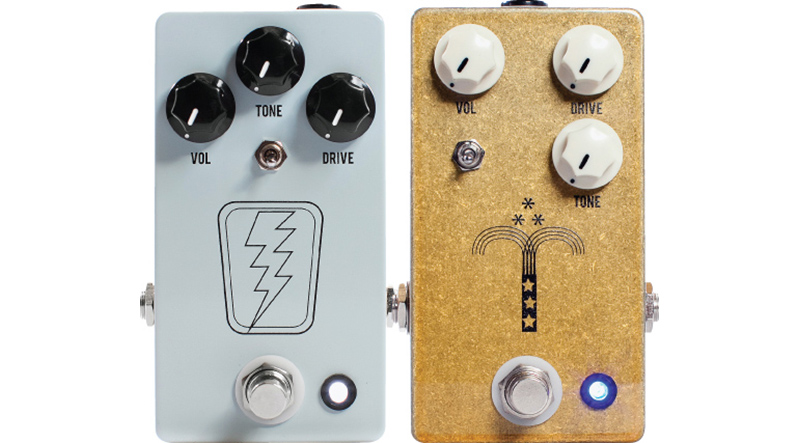
Started with a quick repair to a Boss pedal in Josh Scott’s Mississippi apartment, JHS has evolved into a well-regarded and growing boutique pedal company thanks to offerings like their SuperBolt and Morning Glory.
The SuperBolt is one of those pedals that tube hounds crave, one that reacts with a good amp rather than smothering it with gain. The goal of this box is to re-create the sound of ’60s Supro (and Valco) amps, which appeared in countless Led Zeppelin tracks and on early Stray Cats cuts, as well as other legendary recordings. The original was a 1×12 tube combo with a unique overdrive sound, dirty, but warm with lots of personality. Its tone was certainly not a one-trick-pony overdrive (Jimmy Page’s epic guitar solo in “Stairway to Heaven” was cut through a Supro), and that’s precisely what JHS is after with the SuperBolt: variety with classic soul and dimension.
The pedal is classic and simple: there are just three knobs (Tone, Vol, and Drive), and a Hi/Low toggle switch, as well as an AC adapter jack and guitar in/out. Internally, the circuit converts the 9-volt juice to 18 volts for more punch and headroom. As befitting such a simple pedal, just plug in a guitar and a decent amp, preferably tube, to find flavors aplenty. Dial in fatter, thicker tones that Page would have used on “Communication Breakdown,” “Whole Lotta Love,” or “Heartbreaker” – beefy tube tones that provide ample sustain without overblown distortion. Think of the SuperBolt as a musical overdrive solution, providing plenty of dynamics, even though the sound is still smokin’ in that great ’70s way (think Zep, Aerosmith, ZZ Top, or Rick Derringer).
Conversely, dial back the heavy artillery and go for cleaner sounds, as Page frequently did in the mid-Zeppelin era; think “The Song Remains the Same,” “The Ocean,” or Songs from Physical Graffiti like “The Rover” or “Custard Pie.” Here, Page developed tones that rocked but provided clear note definition, and the SuperBolt emulates that nicely. Play around, too, with the Hi/Low toggle. Hi provides more headroom and upper mids, while Low goes to a darker, mellow tone; roll back the Drive for some interesting jazzy textures. No matter where one goes on the SuperBolt, it seems, there are cool sounds, from sultry to blistering, to be discovered.
The Morning Glory takes a similar track, but it dials back the gain even more. This pedal is for the cat who really wants transparency – i.e., guitar and amp shining through, with a pedal to accentuate every note. Think about what the right bit of salt and pepper can do to food, bringing out interesting flavors without burying them. Scott’s idea behind the Morning Glory was to tweak the original English-made “black box” Marshall Blues Breaker overdrive that he’d been using for a decade.
Like the SuperBolt, the Morning Glory just has three knobs (Vol, Drive, and Tone), plus a Bright Cut switch to match the EQ to your rig. In testing, the pedal added just the right dimension to almost anything played on the cleaner side of the gain spectrum, putting in a little tube “sag” for taste. Strats and P90-fitted axes really loved the Morning Glory, which brought out all sorts of chewy, funky single-coil tones. Again, a nice little bit of grit, but with much of the test guitars’ personalities coming through. Also admirable is the lack of hype here – the Morning Glory is an honest tone tool that works to improve tone, headroom, and dynamics. Add in true-bypass switching and road-ready construction on both the SuperBolt and the Morning Glory, and you have a pair of winners from JHS. The hard part is deciding which one you want.
This article originally appeared in VG November 2013 issue. All copyrights are by the author and Vintage Guitar magazine. Unauthorized replication or use is strictly prohibited.
Thirty-Five years ago, Ibanez was a scrappy upstart guitar company that dared to challenge the big boys at Gibson and Fender. Today, is a dominant force in the guitar universe. • Ibanez was – and still is – a brand of Hoshino, a Japanese company with a U.S. headquarters in Philadelphia. In the mid ’70s, it was building affordable, high-quality clones of Strats, Les Pauls, Jazz basses, and Johnny Smith archtops, enough to earn the company a loyal following of guitar fans – and the wrath of Gibson’s lawyers. After the dust settled on the legal side, Ibanez quickly hatched a gaggle of amazing guitar designs: the Iceman, Artist, and Professional models among them. Even more exciting, artists such as Steve Miller, Bob Weir, Paul Stanley, and the venerable George Benson jumped onboard, adding even more credence to the Ibanez phenomenon.
A live shot of Steve Miller playing an Artist, from the ‘77 catalog. Known informally as the Bob Weir model
Behind much of this success was Jeff Hasselberger, whose designs and marketing prowess helped propel the perception of the Ibanez brand from “cheap Asian knockoff” to “cutting edge, yet affordable guitar maker” in just a few short years. Today, Jeff runs a marketing firm that caters to the MI industry, but here, he reminisces about these wild-and-wooly early days of Ibanez.
Jeff Hasselberger with the Hasselcaster, a parts guitar made by his sons (from left) Alex, Ian, and Mark for his 60th birthday.
You worked for Hoshino from 1973 to ’82. What was your title and role back then?
I was the second American employee at the Elger Company, which was the original name of Hoshino U.S.A., so an appropriate title would be “Number 2.” We had a small staff and just a bunch of desks in a room, plus a warehouse, so everybody pitched in on everything. I didn’t have an official title, initially, but it became director of marketing. My role grew into creating the ads, designing guitars, doing artist relations, visiting dealers, doing all the copywriting, and running R&D. In my later days, I also got involved in the international marketing.
For many, their first experience with Ibanez was playing the “lawsuit” guitars that cloned Gibsons and Fenders. Tell us about that era.
When I joined the company, the copies they made at the time were “Close, but no cigar,” as they say. I could see, however, that the copy business was very viable, and if Hoshino could make Ibanez the best of the copies, they’d have a good launching pad for the brand. But, for example, the Les Paul copies had bolt-on necks and the neck wasn’t sunk deep enough into the body. Also the fingerboard had a rounded edge – it was a little goofy-looking. I suggested they set the neck in properly and tend to some of the details of construction that would make the guitar more faithful to the original. I think that was one of the reasons Ibanez developed a following among players who could tell the difference.
Didn’t Gibson and Fender get ticked off?
I’d have to say that most of the industry didn’t consider us much of a threat. In fact, they pretty much ignored us, and that really worked in our favor. Gibson was part of Norlin and Fender was still with CBS. They are very sharp companies these days, but in the ’70s, they were asleep at the wheel. We operated very successfully below their radar until ’77.
Can you briefly sum up the lawsuit itself?
Imports of all sorts were beginning to be a thorn in the side of the big U.S. companies in the late ’70s. The boys in the tassel loafers at Norlin decided to do something about it, and of all the copy guitars, we were the juiciest target. Plus, we were the most flagrant violators. Rather than sue all the copy companies, they just sued us and figured they could take the judgment, wave it in front of every other copy company, and get them to capitulate.
We had seen the end of the direct-copy business coming. I can remember sitting around one day in the mid ’70s, wondering what we would do if we were Gibson. I think the consensus was that we’d sue our friggin’ asses. At the time, we understood copyright to cover the peghead and little else. So our first move was to come up with original peghead designs for the copy guitars that would be our interim step. The ironic part was that all the guitars we brought to the 1977 NAMM show had new peghead designs. The lawsuit was dropped on us while we were at the show, so we thought we had lucked out. Long story short, we agreed not to copy Gibson and they agreed not to copy us. Before the next show rolled around, we had a completely new line of guitars.
Tell us about the new Ibanez designs.
By that time, we had a lot of ideas for original designs, but it was more a matter of finding the right opportunity to spring them on the unsuspecting public. The lawsuit gave us that opportunity, and I don’t think Ibanez has ever looked back. Since we had just been sued by a big company, there was more than a little vengeance on our minds. We had something to prove and we now had somebody we could really hate. We took advantage of our upstart reputation and committed ourselves to making guitars that were inspired by whatever the current musical trend was at the time. I think that attitude still exists at Ibanez and I think that’s one of the big reasons for their continued success. And I have to admit, I still feel ill will towards Gibson. I don’t think I’ll ever own a Gibson guitar.
(LEFT TO RIGHT) Spec sheets for the ‘78 Iceman models. In 1978, Ibanez offered several Iceman models, including the upscale IC400, the korina-body IC300, and the IC210
One of the transitional guitars was the 2405, which had a quasi-Les Paul shape and mandolin headstock. Another of your designs?
I think the 2405 Custom Agent was one of the first designs I did for Ibanez. It was around ’73 and it’s one of my many embarrassments. It was inspired by a ratty Les Paul with a mandolin-style headstock repair that came into the retail store where I worked in the late ’60s. I thought it looked interesting and it stuck in my head. When it came time to start thinking about originals, we started with our frame of reference – Les Pauls and Strats. I went a little overboard with it, using banjo inlays in the fingerboard, a tailpiece-looking inlay in the body, and the curlicue pickguard. It was eventually more successful than I thought it would ever be.
1979 Ibanez catalog.
The Professional and Cowboy Fancy models were played by Bob Weir of the Grateful Dead. Tell us about that guitar’s development.
When I first went to see the Dead in ’74 or so, I didn’t really know what guitar or guitars to take to show them. The copy we did of the Rex Bogue doubleneck was about the snazziest thing we had, so I brought it. I can’t recall what else we took down there. I brought my partner in crime, Roy Miyahara, with me to the show, which was at the old Philadelphia Civic Center – one of those massive airplane-hangar-style joints.
I kind of paired off with Weir, and Roy hung with Jerry Garcia. Bobby was full of ideas, many of which I’d never heard before… or since, for that matter. He and I hit it off personally and his ideas got my juices flowing, so we started working together. Bob played the double neck through his rig after the show, liked the feel of the neck, and was pretty impressed by the workmanship. I offered to make him whatever he wanted. He didn’t need a doubleneck, but suggested we make a single-neck version for him. I went back, sketched it, and we started talking about pickups and controls. Bob liked the idea of a sliding pickup that could be moved to get different tones, but he also liked the idea of a couple of humbuckers. I suggested that we put a sliding single-coil between the ’buckers and he could play around and see if anything interesting happened.
That was kind of easier said than done, but I finally got it to work with some hardware-store parts and a drill press. It was easy to slide – stayed put where you left it and was height-adjustable. It was a favorite of Keith Olsen, who produced Bob’s Heaven Help the Fool album and the Dead’s Terrapin Station. Bobby played it like that for a year or so until he stopped moving the pickup around. He could get what he wanted out of it with the single-coil pickup snugged up against the bridge humbucker. So we made another guitar with the pickups fixed in position.
Bob was also interested in having a guitar with a large headstock, so that produced the designs for the Cowboy Fancy guitars that we started producing in ’76.
Where did the German-cut edge come from on the Professional and 2617?
That was pretty much taken from Rex Bogue’s McLaughlin doubleneck. I remember going to see Rex at his place, I think in Glendale, California. He was a terrific guy and a real guitar nut. I actually didn’t feel worthy to even talk to a guy who did such unbelievable work, but he was very down-to-earth and very generous. He was flattered that a “real” guitar company was interested in copying his work and gave us the go-ahead to do what whatever we wanted.
1977 Ibanez Artist Professional Model 2671 “Randy Scruggs”
What was George Benson looking for in an archtop, which later became the GB10?
George told me he always liked the shape of the Les Paul. He said, “The guitar I have in my mind is sort of halfway between the Johnny Smith and a Les Paul.” So I went back to the shop and drew a centerline on a large sheet of paper; laid a Johnny Smith down on it and traced the body shape; and did the same with a Les Paul. Then I free-handed a shape that was kind of in-between, and finished it with French curves. It looked pretty handsome in two dimensions. I took it George, and he agreed. He said, “Let’s start building on that!” I think it was the only guitar I ever designed where the first prototype was pretty on the money.
Who came up with the design of the Iceman?
Fritz Katoh was Hoshino’s guitar designer in Japan, while Roy and I came up with designs in the U.S. I’m almost 100 percent sure the Iceman was Fritz’s work. The only thing I added to the party was the name.
(LEFT TO RIGHT) A late-’70s Ibanez Destroyer. 1978 Ibanez Iceman Artist IC300. ’76 Ibanez Firebrand.
The ensuing Paul Stanley Iceman model got Ibanez a lot of press. Was it a big seller?
The actual Paul Stanley Model was fairly expensive, so its sales were limited by that fact. We sold a pile of black Iceman guitars, though. Paul was great to work with, as was Bill Aucoin, his manager. Paul was the creative force behind the whole Kiss zeitgeist – he had a smart business head and was always a gentleman, but he could also listen to the 15-year-old boy inside of him.
His Mirror Ball Iceman was a big hit, and it still seems to inspire people. I recently got a call from the Fender Custom Shop because Keith Urban wanted a Tele with a cracked mirror job just like Paul’s. He apparently said, “Find the guy who did Paul Stanley’s guitar and ask him how he did it.” So I took them through the process and I understand that it came out great. Probably a much better job than I did on the original.
Tell us about the thoughts behind the IC210’s triple-coil pickup and the earlier “sliding” pickup on the Iceman.
Those were from Fritz’s fertile mind. He was very good at thinking outside of the box about 25 years before anybody thought of using that phrase. The Tri-Sound switch of the later ’70s was a direct descendant of those early forays with the Iceman. In fact, the triple-coil is what drew Steve Miller to the Iceman.
Miller used Ibanez axes on Book of Dreams. What was he looking for in a guitar that Gibson and Fender couldn’t fulfill?
Steve was another guy who I hit it off with from the get-go. When you first meet him, his personality seems somewhere between cocky and mischievous. Steve also has the sixth sense of a pop artist – he knows when the tide is about to change. In the ’70s, he’d heard about enough of the Les Paul/Marshall sound that was becoming ubiquitous to the point of cliché. He started looking for something different. He told me later that he was inspired by the guitar sound of “Sweet Home Alabama” and was looking for an instrument that would take him in that direction. The triple-coil Iceman had a lot of the same sort of tones in it, and fortune smiled on us when Steve found one in a guitar shop and took it home.
Artist, from the ‘77 catalog. Known informally as the Bob Weir model, the 2681 later became known as the Ibanez Professional. The ornate 2681 endorsed by country artist Randy Scruggs. Note the arched top with “German Cut” edges.
If there’s any rap on vintage Ibanez solidbodies, it’s that the Super 70 and Super 80 humbuckers weren’t very good. They tended to be thin, which is why so many vintage models now have replacement pickups on them.
Early on, in the ’70s, we were focused on making pickups as hot as we possibly could. Of course, we overshot and made some pickups that were too powerful for their own good. As the decade came to a close, old PAFs and lower-output pickups became trendy. Naturally, we overshot in that direction, as well (laughs)!
Were all Ibanez guitars built back then in the FujiGen Gakki factory in Japan?
A lot of them were. All of the set-neck guitars were from Fuji, and many of the bolt-ons. Fuji was less price-competitive on the bolt-on guitars and many of those models were sourced from other factories. In my opinion, Fuji did the best work in Japan at the time.
One key thing about Ibanez guitars back then is that they beat Gibson and Fender, not only in quality, but in price… often substantially.
Japan had a distinct cost advantage on a number of fronts. Labor cost was lower, factories were more efficient than here, profit margins were less – those advantages added up to a big gap in retail pricing.
Is it gratifying to know that vintage Ibanezes from your era are now sought-after by collectors?
I’m amused as well as gratified. I was happy enough that people bought our guitars each month, much less considered them having collector potential. I was given a terrific opportunity by the Ibanez folks at a time when the solidbody electric guitar had just been defined as a musical instrument.
Do you have a favorite Ibanez guitar from back then?
Oddly enough, I have only one Ibanez from back then – a basic dot-neck 24-fret Artist. It was damaged in shipping and has a big gash in the back, but still plays great. My son has it now. I helped put the deal together for the reissue of the Bob Weir Cowboy Fancy Limited Edition and I managed to keep the prototype for myself. I regret that I don’t have a George Benson model. Maybe your readers could take up a collection and buy me one (laughs)!
You can receive more great articles like this in our twice-monthly e-mail newsletter, Vintage Guitar Overdrive, FREE from your friends at Vintage Guitar magazine. VG Overdrive also keeps you up-to-date on VG’s exclusive product giveaways! CLICK HERE to receive the FREE Vintage Guitar Overdrive.
This article originally appeared in VG July 2011 issue. All copyrights are by the author and Vintage Guitar magazine. Unauthorized replication or use is strictly prohibited.
Electro-Harmonix Germanium 4 Big Muff Pi
Price: $133 (list)/$99.75 (street).
Contact: ehx.com.
The Big Muff Pi overdrive is the effect stompbox that put Electro-Harmonix on the map, and in the decades since its introduction, it has undergone changes both subtle and substantial. Today, the company’s lineup includes no fewer than 10 versions including the newest, the Germanium 4 Big Muff Pi.
Each of the latest box’s two channels – labeled Overdrive and Distortion – has an on/off true-bypass stompswitch with LED indicator. The Overdrive channel has controls for Gain, Bias, Tone, and Volume, while the Distortion channel has controls for Gain, Bias, Volts, and Volume.
To test its sounds, we plugged it in between a ’50s reissue Fender Telecaster and a mid-’60s Fender Bandmaster head running through a vintage Fender 2×12″ cabinet. The Germanium 4 Big Muff’s Overdrive side offered a light overdrive/boost with that familiar ’60s Big Muff fuzz tone dressing up its high-end response. While the Gain, Tone, and Volume controls reacted as one would expect on an OD, the Bias control gave it real character. Altering the signal before it’s distorted, the Bias acts a lot like a tone control, but with more attitude – mellow, with less gain when turned fully counter-clockwise, transparent when straight up, and when fully clockwise, bright and snappy, with more gain.
The Distortion side offered substantially more gain, its Bias control dialing in sounds ranging from smooth and lush to bright and aggressive, and the lack of a Tone control doesn’t hinder the variety of distorted tones one can extract from it. The most interesting feature on the G4 Big Muff is its Volt control, which affects the amount of voltage supplied to the transistors, which simulates a low or dying battery. With the control turned completely clockwise (sending full voltage) the tone is full and uncompressed, and as it’s dialed back, the tone becomes more compressed, with a low-fi grit, until it sounds almost gated, with a sputtering effect – cool, and very creative. Since each side has its own footswitch and the Distortion side cascades to Overdrive, you can use the Overdrive side to boost output volume and use for the Distortion side for soloing or to add gain for a super-saturated sound.
The G4 Big Muff Pi is the most versatile version in the pedal’s lineage, and does its predecessors proud.
This article originally appeared in VG February 2011 issue. All copyrights are by the author and Vintage Guitar magazine. Unauthorized replication or use is strictly prohibited.
R.C. Allen, a noted luthier who built archtops for local and regional players of note and was a fixture at vintage-guitar shows in Southern California, died March 2.
Allen was renowned for sharing his secrets of guitar building and was the last of the original electric-guitar builders in Southern California. Known for his archtops, he made guitars for Merle Travis, Del Casher, and many more.
As a teen, Allen developed his technique with guitars that had chambers, which he learned from John Dopyera (Dobro) and Paul Bigsby, whose solidbody electric guitar bearing serial number 2 became Allen’s; he displayed it at guitar-show booths that he often shared with Guy Devillez and his brother, John Anderson, often allowing passersby to play it while telling them about its historical significance. Displaying his much-appreciated sense of humor, he made a copy of the guitar for Four Amigos guitar-show producer Larry Briggs with a logo that read “Brigsby.” When show attendees would ask for a picture with him, he would slyly turn half around, reach in his pocket, `pull out a set of crooked/stained fake teeth, and turn around with a big smile on his face.
Another of his customers, Rebecca Apodaca, recalled how when he presented her with a guitar he’d built for her, he was beaming from ear to ear. “I was admiring the wood he chose for its top – burled maple, stained brown. It was the color of my skin tone,” she said. “As I admired the inlays, he flipped the guitar around, and on the back of the headstock was a sticker that said ‘Made in Japan.’ We laughed! Then he pointed to the center of the back, and along the seam, the wood was figured in the shape of a heart. He smiled and said, ‘Look, I’m giving you my heart.’ I am lucky to say I will always have the heart of R.C. Allen.”
Apodaca also recalls a story Allen enjoyed telling about delivering a guitar to Glen Campbell. Campbell was working a studio session with a sax player and Allen recalled how, “They were playing the stupidest song I’d ever heard. It only had one word. How can you think anyone would buy a song with one word? It had a nice beat to it, but then they would stop, and Glen would yell, ‘Tequila!’ I don’t think it sold too well,” he would laugh.
Friends and acquaintances had planned a party/jam to celebrate his 80th birthday, with several music-industry luminaries set to attend.
“I just sent him a card two days [before he passed] to tell him how much his friendship meant to me,” said pickup maker Seymour Duncan.
“R.C. was always kind to me, and I tried to return his kindness, but I’m certain that I fell far short of what he gave me,” added guitar “Buffalo Bob” Page, former owner of Buffalo Brothers Guitars.
This article originally appeared in VG June 2014 issue. All copyrights are by the author and Vintage Guitar magazine. Unauthorized replication or use is strictly prohibited.
Railhammer Hyper Vintage Humbucker
Price: $139 list / $89 direct
Contact: railhammer.com
Developed by Joe Naylor of Reverend Guitars, Railhammers are passive humbuckers that use a combination of pole pieces on the treble side and rails on the bass side. It’s an interesting motif with an effective purpose.
The Railhammers’s six oversize poles under the treble strings cover a wider area than standard poles, so they capture the full range of each string as it vibrates. This, Naylor says, helps increase sustain and keeps the strings from sounding thin. The rails below the bass strings sense only a narrow section of each thicker/wound string, which increase clarity and definition. To maintain consistent volume on the bass strings, the rails are height-tapered.
Another useful feature is the Railhammers’ universal string spacing, which means they’ll fit most guitars.
We tested Railhammer’s Hyper Vintage neck and bridge models, which use Alnico V magnets and are voiced to emulate a pair of vintage PAFs. Mounted in a Squier Strat with a three-way pickup selector and controls for Volume and Tone, we plugged it into a 100-watt Marshall with an added master volume.
With the amp set for cleaner sounds, each string rang clearly – distinct and even. Chords were lucid and chimey. At dirtier and crunchier settings with more gain, notes sang with sustain and produced rich harmonics. Full chords and single bass notes sounded tight, while treble notes were smooth, with just enough bite and attack for playing lead and rhythm; this symmetry of tones would work very well for any genre or playing style. With the pickup selector set in the middle position and both pickups in full humbucking mode, the sound of all four coils was quite nice, particularly for cleaner chordal parts and picking. Often, when two humbuckers are used together, single notes become lost among the mids. But the Hyper Vintage pickups are a perfect match – well-balanced, articulate, and complementary of each other through the range of the guitar’s tones. And, they’re very quiet. Even when the amp was cranked, they produced no noise.
When a guitar sounds good, it can inspire a player to be better, play longer, and be more creative. And who doesn’t want to be enthused by their guitar’s tone? Railhammers’ Hyper Vintage neck and bridge pickups deliver the goods.
This article originally appeared in VG August 2012 issue. All copyrights are by the author and Vintage Guitar magazine. Unauthorized replication or use is strictly prohibited.
Ibanez has always had two distinct personalities – first as a purveyor of shreddy solidbodies for the hard rock/metal crowd, but also as a maker of fine archtops, thanks to famous users like George Benson, Pat Metheny, and John Scofield.
In the ’90s, the company started to brand many of its low-/mid-priced hollowbodies as the Artcore line, imbuing the guitars with a fresh, funky image for alt-rockers, blues players, and jazzers. Depending on how a particular Artcore guitar is appointed, it might veer to one genre or another; the fancy AF105NT is on the high-brow side and will likely turn on jazz and blues players.
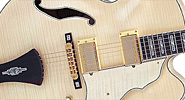
When you hold the AF105NT, your eyes will bug out and you’ll start droolin’ over its flamey natural top. Not to put too fine a point on it, this guitar is drop-dead gorgeous. The maple veneer on the top, back, sides, and even pickguard (likely a photo-flame decal) is stunning. To top it off, the Ibanez folks created dark, wooden control knobs and tailpieces that are downright sexy.
The guitar’s rosewood fingerboard – which has a 12″ radius – has a custom inlay of an abalone/mother-of-pearl composite and they distantly echo the “slashed diamond” inlay of classic Gibson Super 400 archtops. The AF105NT also has a bubinga/maple neck sandwiched in three sections – a move both cost-saving and attractive. Other details on this jazzbox are a pair of Custom 58 humbuckers with ceramic magnets, two volume and tone controls apiece, gold hardware, 22 medium frets (with nicely rounded edges), and a 243/4″ scale, akin to a Les Paul. The only design faux-pas is a small knot in the grain on the back of the headstock. It’s not a big deal, but it caught my eye – it seems out of step on a guitar that is otherwise so flawlessly constructed.
Plugged into amps by Ultrasound and Line 6, the AF105NT performed admirably. Ibanez is marketing these guitars to a range of players, so they’re set up with light-gauge strings and low action, to broaden their appeal. This is clever, ensuring the guitar will immediately feel good to solidbody/rock pickers. Once they catch the jazz bug, they can upgrade to heavier, round-wound strings (trust me, you’ll eventually want heavier G, B, and E strings for a fatter tone – it’s simply jazz-guitar physics). Overall, the guitar sounds very good clean and with moderate amounts of overdrive, if you start leaning towards the Steve Howe/Alex Lifeson side of things. And in typical Ibanez fashion, the neck is fast, another facet that will appeal to players of all stripes.
What really sets the AF105NT apart from the archtop pack is that it fills a gap in the hollowbody market. Companies like Ibanez and Epiphone have been offering affordable hollowbodies for years, but there has always been a weird hole in the mid-price area; either you get a killer axe for under $600 or over $1,000, but not many in the middle (this one streets at under $900). Feel free to scratch your head. But with this hollowbody, Ibanez is offering a sumptuous, deluxe guitar for a price most players can afford. Granted, they do substitute affordable materials and building techniques here and there to keep the price in check, but most guitarists will never notice.
In all, the AF105NT is a fine guitar that will be prized by rising jazz/blues players or used as a killer gigging guitar for those who keep their $10,000 vintage archtops at home. Either way, Ibanez does it again, offering impressive quality and value for tasty guitarists everywhere.
This article originally appeared in VG December 2010 issue. All copyrights are by the author and Vintage Guitar magazine. Unauthorized replication or use is strictly prohibited.
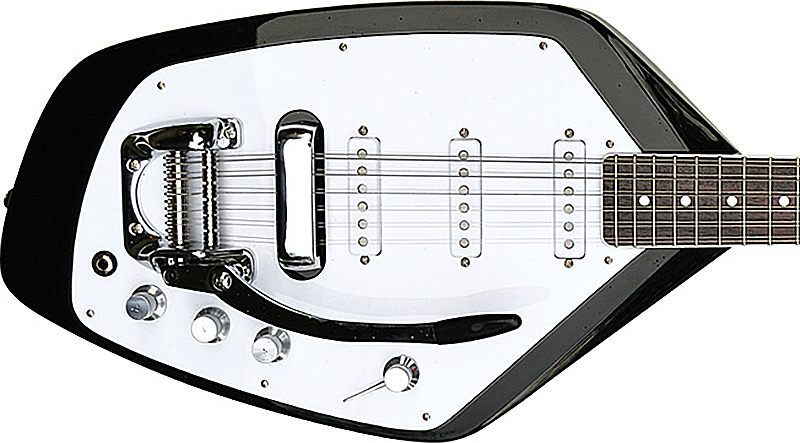
From the Hollies to the Mahavishnu Orchestra, from Robert Junior Lockwood to the Stones, the electric 12-string has a prominent place in modern music. And arguably, the most iconic of all electric 12-strings were those Vox guitars manufactured under the auspices of the Jennings Musical Instruments. Phantom Guitarworks is reissuing models inspired by the Jennings instruments, including the Phantom Reissue 1964 PH12 that conjures visions of ’60s rock iconography.
Our test model arrived finished in a flawless glossy black polyester, with chrome and nickel hardware and a white four-layer pickguard. The five-sided mahogany body, like that originally used from 1964 to ’69, features comfortably rounded edges, a rear belly cut, and two beveled upper bout edges to enhance comfort and playability and reduce weight. Three single-coil alnico pickups, measuring 5.9k to 6k, are humbucking in combination and free of the microphonic characteristics of many of the old imports, a definite Phantom Guitarworks improvement over the Vox original. They are wired through 250k solid-shaft pots (one volume and two tones) with specially machined aluminum knobs and a six-position rotary switch complete with a “handle” threaded into place. Virtually all the parts are custom-built for Phantom Guitarworks, including the bridge and its cover. The proprietary tremolo is fastened to the pickguard with four screws; it features six rollers and a spring especially tensioned for 12 strings.
The rock-maple neck, also in black finish, sports a 25.5″ scale and a single-bound rosewood fingerboard with white markers and small frets. The neck is mounted using four screws through a rear neckplate (truss-rod adjustments are made at the base of the neck, necessitating neck removal), and the aluminum nut has a tight 45mm width. The Phantom logo appears in script on the top of a simple but shapely headstock that complements the body lines; there are Kluson-style nickel tuners and two string trees.
Build quality and playability is a priority for Phantom Guitarworks (many vintage examples suffering to the degree of being barely playable). In the lap, the PH12 sits comfortably, though it feels best hung from a strap. Plugged in, it offers a broad palette of sonic colors, from fat to bright to brighter. As mentioned, pickup combinations are humbucking due to a reverse-wound/reverse-polarity strategy, a feature unavailable on the Vox original. And the handle on the switch knob makes accurate pickup selections easy to both see and feel.
The PH12’s relatively narrow neck makes the fretting hand’s transition from a six-string feel easy. Yet there’s enough room to accommodate fingerpicks, and with a flexible plectrum the Phantom 12 achieves a zither-like response that brings out one’s inner inclinations for world music. The setup facilitates a stress-free playing experience (though with the vibrato arm in combat position, the master volume can be a bit difficult to access). The tone controls are effective, but the PH12 sounds best full out.
Just the thought of a 12-string with a tremolo unit requires a leap of faith, but Phantom Guitarworks’ unit works well for subtle modulations. The guitar comes back to pitch dependably, and the trem action is purposely set up stiffly to discourage ill-advised dive-bombs. Though single-note lines are solid and balanced, the PH12 proves to be a rhythm guitar par excellence.
The Phantom Reissue 1964 PH12 is modeled after the U.K. instrument, not those lesser-quality Italian-made guitars, with all the modern conveniences and enough vintage British Invasion weirdness for any guitar geek to appreciate.
This article originally appeared in VG February 2014 issue. All copyrights are by the author and Vintage Guitar magazine. Unauthorized replication or use is strictly prohibited.



 Spanish flamenco guitarist Paco de Lucia died February 26 after suffering a heart attack in Cancun, Mexico. He was 66.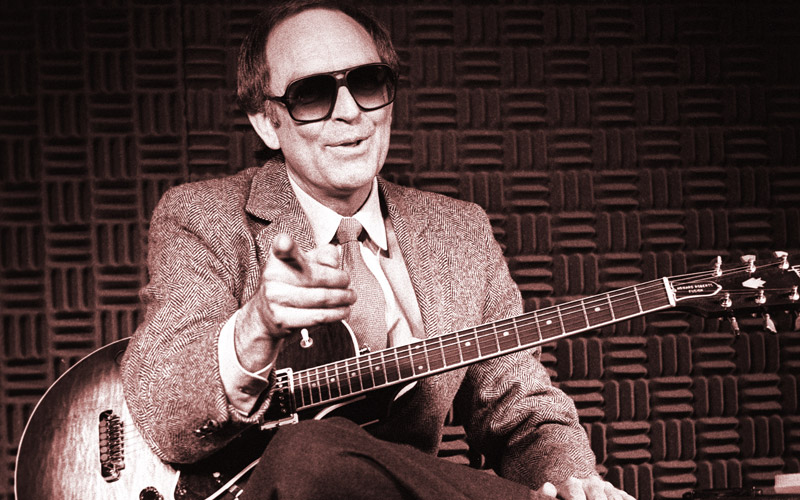

 By age 15, Roberts’ guitar teacher, Horace Hatchett, told the boy’s dad, “Howard has his own style of playing and there’s nothing else I can show him. He plays better than I do.” Howard was already playing club dates in their hometown Phoenix area – usually blues and jazz gigs on which he would gain playing experience and develop his improvising skills. He was receiving an extensive education in the blues from a number of black musicians, one of whom was the brilliant trumpeter Art Farmer. Journalist Steve Voce, in his 1992 article in The Independent Newsletter, quoted Roberts on those nightclub gigs, “I came out of the blues. I started in that scene when I was 15 and it was the most valuable experience in the world for me.”










 Ibanez has always had two distinct personalities – first as a purveyor of shreddy solidbodies for the hard rock/metal crowd, but also as a maker of fine archtops, thanks to famous users like George Benson, Pat Metheny, and John Scofield.