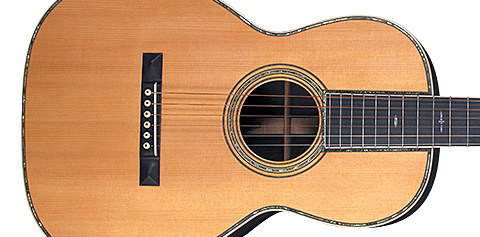
Photos: William Ritter. Instrument courtesy of George Gruhn. ’62 Gibson Les Paul Custom with serial number 95709.In its early years, the Gibson Les Paul Custom evolved through several body-style and spec changes and was the earliest Gibson solidbody to have a Tune-O-Matic bridge and stop tailpiece; the Les Paul model (a.k.a. “goldtop”) did not have them until late ’55.
First appearing in Gibson catalogs in 1954, the company actually made a few Customs in late ’53, the first version being a two-pickup guitar with an Alnico V “soapbar” in the neck position, with its distinct rectangular/height-adjustable magnets, and P-90 in the bridge; both had black-plastic covers. It was made with a mahogany neck and body with no maple cap, and dressed up (to stand apart from the “regular” Les Paul) with a bound ebony fingerboard with pearl block inlays, multi-ply binding along with Gibson logo and split-diamond inlays on its peghead, “Les Paul Custom” engraved on the truss rod cover, waffle-back Klusons and gold-colored hardware (until chrome was offered as an option in the ’70s).
The two-pickup Custom remained through mid ’57, when it was given three of Gibson’s new humbucking pickups. The two-pickup version had a standard three-position toggle switch, while the three-pickup’s middle position engaged the middle and bridge pickup out of phase with each other, giving a twangy sound. Many players consider this less-versatile, not only in terms of sound, but because the there was little room for a player’s pick to move across the strings without coming into contact with the pickup covers. The metal-capped “bonnet” Tone and Volume knobs first appeared – on all Gibsons – in 1960.
The guitar shown here was built in ’62, when Gibson was transitioning from “patent applied for” (PAF) pickups to patent-numbered pickups, and guitars from that year were given PAFs, patent-numbered, or a combination.
The previous-version/single-cut Les Paul Custom was available with an optional Bigsby tailpiece for $75 more – at that time, significant money (Paul Bigsby was a small-scale manufacturer, so production costs were high).
The single-cutaway/triple-pickup version of the Les Paul Custom was made until very early in 1961, when it was moved to the SG body shape. Neck ornamentation remained the same, but the body was given beveled edges with no binding. The three pickups and Tune-O-Matic bridge remained, but the new body was given a white-plastic plate (engraved with “Les Paul Custom”) between the end of the fingerboard and the neck-position pickup, a beveled plastic pickguard screwed into the top, and a vibrola tailpiece; the earliest had Gibson’s new “sideways” Vibrato, which truly did not work as well, as it tended to throw the instrument severely out of tune. Most SG-shaped Les Paul Standards and Customs were given this vibrato, though some were given a Bigsby. As seen on this guitar, however, some ’62 Les Paul Customs and Standards were given a next-generation vibrato and an ebony block with mother-of-pearl inlays to cover the screw holes drilled for the standard Tune-O-Matic/stop tailpiece. This was the precursor to the lyre-engraved tailpiece cover, and this version of the vibrato stayed in tune far better than the sideways unit and, in the opinion of most collectors and musicians, was more attractive. The Les Paul designation stayed on these SG shaped models through early 1963.
The single-cut Custom was offered only in black, and the SG-shaped Custom was offered in Gibson literature only with opaque white finish, but this guitar has the translucent Cherry Red lacquer normally associated with the double-cutaway Les Paul Junior, SG Junior, EB-0 and EB-3, and the SG-shaped Les Paul Standard and later SG Standard. While red finish was a color Gibson was tooled to do, it was not standard for this model at the time. With the exception of the unusual cherry red finish, this guitar conforms to normal ’62 specifications of the model with the beveled edge laminated white plastic pickguard and white control plate on the back of the body.
During the “good old days,” Gibson, Fender, and other manufacturers offered little variety of color. Gretsch was the first to get heavily into options, and even they primarily offered specific colors on models such as the Country Club, which was available with natural finish, sunburst, or Cadillac Green. The Jet Firebird was available with a red top and black back, the 6120 available only with orange, and the White Falcon and White Penguin were available only in white. The Fender Telecaster was blond and the Stratocaster was sunburst – any other color on them cost more in the early days. With Gibson, the early Les Paul Junior was available only in sunburst, the TV model in “limed mahogany,” the Les Paul Standard was originally called Les Paul Model and had a gold top (with all-gold as an option). Gibson didn’t offer sunburst on a Les Paul until mid 1958, at which time it became standard for the model.
Though we are now accustomed to seeing Cherry Red SG-shaped models, it’s interesting that instruments today are offered with so many more options as an essential part of their marketing; it’s almost unthinkable to imagine a high-end model being available today in one or two colors.
The number of custom-color/non-white SG Les Paul Customs that have surfaced over the past 50 years could be counted on the fingers of one hand, which makes this guitar an interesting historical oddball and a great conversation piece. Gibson’s 1962 catalog showed the Les Paul Custom with the new “side-pull” Gibson Vibrato, which “…operates in direction of pick stroke; swings out of way for rhythm playing.” It was shown in standard white finish and the text made no mention of color options.
This article originally appeared in VG August 2014 issue. All copyrights are by the author and Vintage Guitar magazine. Unauthorized replication or use is strictly prohibited.
Joe Moss is the archetypical blues “road dog,” regularly rolling out of his home base of Chicago to wail for crowds in venues ranging from clubs to festivals around the world.
His live sound is created with a mix of custom guitars made by Kurt Wilson, along with a Gibson ’58 reissue Les Paul, a Tele-style parts guitar, and a handful of others. His Category 5 Tempest is a Marshall-inspired 2×12″ combo with two channels. “I use the plexi side,” he said with a grin. At festivals, he goes a bit bigger, employing a Bedrock 1400 half-stack.
His pedalboard is wonderfully meat-and-potatoes, with (from left) a Danelectro Reel Echo, GTS overdrive prototype, a Klon-inspired OD, and a Budda wah. “I’m basically looking for a good clean sound, a dirty one, and an overdriven sound. The GTS prototype is built by Joe Campagna, and its the most transparent overdrive I’ve ever used. It gives the sound of the guitar and amp without much alteration, except more. It’s a very cool pedal. The Klon clone is made by Jacek Soltysiak, here in Chicago, and I use it for my overdriven and distorted tones.”
This article originally appeared is from VG Signal Chain issue #14. All copyrights are by the author and Vintage Guitar magazine. Unauthorized replication or use is strictly prohibited.
One of the most-enigmatic brands in the history of American guitars was a line of funky solidbody electrics created by Kurt Hendrick.
The son of an aerospace engineer, Hendrick grew up in Houston in the ’60s (near NASA’s Space Center) and studied at the Roberto-Venn School of Luthiery. Halfway through the course, though, he quit to work at the Apprentice Shop, in Tennessee, before returning home to be a repairman with instrument retailer Rockin’ Robin in the early ’80s. Inspired at the time by (and with input from) ZZ Top co-founder Billy F Gibbons, he created Hendrick Guitars, with body shapes that stood obviously apart from the crowd.
“I drew from a lot of influences, including NASA, ‘I Dream of Jeannie,’ and Vegas shapes…
but Billy took me over the edge,” Hendrick told VG in 2007. “It wasn’t really his sense of design – he could take any shape, put double binding on it, have it hand-made, and it would look cool. But he opened my eyes to the fact that anything was possible and that I had the ability to design guitars.”
Shown in his one and only catalog (top), Hendrick’s line included (clockwise from bottom) the Transformer Standard, Generator Standard, Catalyst Standard, Transformer Curved, Generator Curved, and Catalyst Curved. The design of Epiphone’s planned E-Series guitars (above left) was overtly Hendrick, while his Schecter “serape” guitar had a piece of striped cloth under its bound top.
The first Hendrick went to Gibbons in the summer of ’82, the second to Willie Nelson.
He designed three body silhouettes – the Generator, the more-traditional Transformer, and the tailfinned Catalyst.
“My first were one-offs made in my garage while I was working at Rockin’ Robin,” he said. “I had enough business from Texas guys to keep me alive – one or two guitars a month – but I was making pretty good money.”
Things quickly picked up.
“The Generator is the one I was really proud of,” said Kurt Hendrick of his first design (left). “A lot of it came back to my experience at Rockin’ Robin – seeing an old-school guitar and trying to revitalize it.” Hendrick’s Comet prototype, made of maranti, was designed in 1998 and built in Malaysia in 2003.
“All of a sudden, I was selling guitars to famous people,” he added. “I was in my early 20s, building guitars in my garage, and while it was nice to spend the day working at my own pace, I started missing the interaction with people. I just wasn’t ready to settle down and be a little old guitar maker. Plus, I liked the idea and dynamics of production – big or small. So, that seemed like the logical progression.”
In ’83, his girlfriend was transferred to Ohio and Hendrick followed. There, he made an attempt at mass production.
“I was working at a music store when I met some people, and one thing led to another. But I was young and didn’t know how to mass-produce; the budget wasn’t there, and it was an expensive proposition. So it fizzled.”
Hendrick then sent his tools to Kalamazoo, Michigan, where he had a number of instruments made by the folks who were starting what would become Heritage Guitars.
In the ’80s, Stevie Ray Vaughan (left, with Double Trouble bassist Tommy Shannon), Aerosmith’s Joe Perry and Brad Whitford, and the Scorpions’ Rudolf Schenker (below) all spent time with a Hendrick.
“They needed something to cut their teeth on. They were good guys, and could probably see my inexperience – I was 24 years old. They got their wheels going while there I was hanging on by a shoestring, without enough to continue by myself.”
All Hendricks made in Kalamazoo were Generator models, set apart thanks to their Schaller hardware. Some had maple or mahogany necks made by ESP, and were unusual in that they were bolt-on.
“You can tell those because they were laminated a hundred different ways,” Hendrick said. “It looked like they were making an acoustic neck, then turned it into an Explorer neck – they had an original Explorer tooling kit – and slapped a Fender-scale fretboard on it.”
Hendrick in the ’80s with two guitars made for Billy Gibbons.
Asked about their striking visual presence, he recalled, “It wasn’t really cowboy, it wasn’t rock and roll,” he said. “It was definitely its own flavor, but I think you could see maturity in those later guitars.”
Two-pickup Hendricks usually had a single-coil near the neck and a humbucker at the bridge because, “…it just looked cool.”
Though he never made a production bass, he did build a custom Generator for Dusty Hill, and in addition to the exposure created by ZZ Top, his instruments showed up in the hands of Stevie Ray Vaughan, Ted Nugent, Aerosmith’s Brad Whitford and Joe Perry, the Scorpions’ Rudolph Schenker, and Dez Dickerson, with Prince’s band.
He acknowledged that his inexperience led to the flash-in-the-pan status of his guitars – fewer than 100 were built, and while he also planned “Curved” versions of each model, the only three made were those shown in his one and only catalog.
Following the demise of his brand, in ’85, Hendrick went to work with Schecter, and from August of ’87 until January ’91, he worked in Madras, India, overseeing production for Greeta Musical Instruments.
“What was exciting about the Indian factory – and different from anything in the U.S. – was that it was so far away from anything that they had to do stuff we take for granted. For example, they had to cut logs and kiln-dry the timber. And there wasn’t much room for error, especially when we were shipping 6,000 guitars every month.”
His next stop was the Fender factory in Ensenada, from March of ’91 to July of ’93.
“Fender Mexico is where I learned a lot about production,” he recalled. “It was different from Corona, and I liked [the Ensenada factory] a lot better.”
The world traveler then moved across the Pacific once again, spending almost seven years with Jackson Guitars.
“Jackson had previously been made only in the U.S. and by [Japanese manufacturer] Chushin. I was sent to find a factory in Korea. It turned out that we built one from scratch, with a guy who’d made acoustic guitars for Epiphone.”
He then moved to India, and in 2000 was hired by Epiphone to develop a series of solidbody electrics to be made in Malaysia.
“I went to Epiphone with the intention of working in Nashville,” he said. “They were in a real hurt for new designs. After looking over my portfolio, they signed me to a design contract. After a month in Tennessee, everyone realized I would be overly influenced by what was going on in that plant, so they allowed me to go back to Malaysia, where there was no interference.”
Four of his instruments appeared in an Epiphone catalog. Two – the Moderne and Futura – were based on their ’50s Gibson forebears but had Hendrick-designed pickguards. The Apollo had offset-V shape with rounded silhouette, while the Comet was an original design with three pickups and vibrato. All had bound bodies and 251/2″ scales, except the Apollo, which was 243/4″.” One of each was made in Malaysia as samples for a NAMM Show. The Comet was shown on the cover of Guitar Player in May of ’01.
“Shortly after, there was the 9/11 tragedy, then Gibson restructured the Epiphone team and canceled [several] projects,” Hendrick noted. “Prior to that, we had only sent the samples for production clearance. So, basically, there were no production models.”
In ’04, he returned to the U.S. and worked with RKS Guitars, in California, before briefly going back to Houston to work with Alamo Music Products.
As for the interest in those rare ’80s guitars that bear his surname, Hendrick said, “I’m pretty amazed. Three years after the company closed, they were already getting into the ‘rare’ category at guitar shows.”
Today, he builds a, “…much more mature” version of the Generator. Watch for an update in a future issue.
VG Editor-in-Chief Ward Meeker contributed to this story. The original version appeared in the February ’07 issue.
You can receive more great articles like this in our twice-monthly e-mail newsletter, Vintage Guitar Overdrive, FREE from your friends at Vintage Guitar magazine. VG Overdrive also keeps you up-to-date on VG’s exclusive product giveaways! CLICK HERE to receive the FREE Vintage Guitar Overdrive.
This article originally appeared in VG’s January 2023 issue. All copyrights are by the author and Vintage Guitar magazine. Unauthorized replication or use is strictly prohibited.
Louis Electric Buster
Price: $1,595.
Info: louisamps.com
Lou Rosano has been building amps in the Fender vein for more than 17 years. His first build wound up in the hands of the late Danny Gatton, and other greats who have played through his Louis Electric amps include Keith Richards, John Fogerty, Jorma Kaukonen, and Hubert Sumlin.
Wanting to offer a basic, gig-friendly amp, Rosano recently designed the Buster. Based on hot-rodded 5E3 circuits used by Neil Young and Joe Walsh, but with a more-robust speaker, 6L6 tubes, and a heavier/upgraded transformer, the Buster was designed to be tweed-Deluxe-like while also being a more-versatile, stage-ready amp.
A 1×12″ combo with two 6L6 tubes biased in class AB1 fashion, the Buster also uses a custom-wound transformer and a Celestion G12H30 speaker. It has two channels with four inputs, all bridgeable (like tweed and early Marshall designs). The preamp section is powered by two 12AX7s, while a single 5AR4 handles rectification duties. Top-mounted controls are for Volume 1, Volume 2, and a single Tone knob.
The interior of the amp has a phenolic board and hand-wired construction with cloth-insulated wires. Jacks and are by Switchcraft or Carling. The Buster is covered in brown Tolex and has classic oxblood grillecloth. Finally, the amp is very load-in friendly at 25 pounds and measuring a compact 16″ x 20″ x 8.5″.
For our test, we used a ’59 reissue Gibson Les Paul and stock ’67 Fender Telecaster. With the Tele plugged into the bright channel, we were met with clear, balanced tones. The G12H hefted its share of the load by softening the bite. Both channels offered beefy clean tones as their Volume controls were tunred up to 5, while rolling up to 6 produced a great tonal platform with the Tele. Clean and overdrive were equally approachable by adjusting playing touch and/or the Volume knob on the guitar. The Tone control had a friendly range of treble roll-off that worked well. The low-end response produced by the heavier transformer and 6L6 tubes, along with the midrange of the Celestion speaker, made for a happy marriage with the simple tone stack. No matter the setting, the Tele sounded round, clear, and full. The Volume knob let us add overdrive, while the Tone let us tailor treble cut that fit the room or situation.
The Les Paul, as one might assume, became dirty quite quickly. The upper range of the Tone circuit definitely helped the guitar achieve usable high-end response, with rich overdrive and no sputtering when hit hard – no stock tweed Deluxe could do this. The upgrades showed their charms by keeping distortion tight while helping open-E chords keep from farting out.
Driven hard, the Buster delivered smooth highs, a nice midrange focus, and enough lows to make power chords sound muscular. Bridging the channels allowed us to gain the amp to an even greater degree, or blend the two channels.
The Buster takes a classic circuit and addresses the complaints tweed lovers have had with the stock 5E3. With its great low-end response, midrange, and power, it’s a strong club amp.
This article originally appeared in VG January 2012 issue. All copyrights are by the author and Vintage Guitar magazine. Unauthorized replication or use is strictly prohibited.
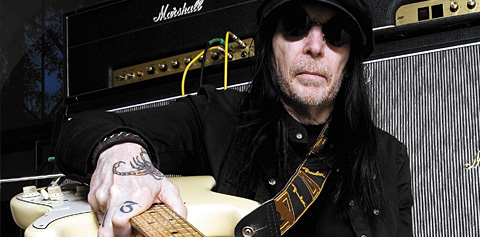
Since emerging from Hollywood’s Sunset Strip in the early 1980s, Mötley Crue has defined the Los Angeles metal scene. Fueled by the catchy powerhouse riffage of guitarist Mick Mars, the group dominated the rock charts throughout the ’80s, producing a stream of anthemic albums and hits that have echoed through the decades. Crüe soldiered through the grunge era, and during that time, frontman Vince Neil and drummer Tommy Lee left for personal reasons before finding their way back to re-join Mars and bassist Nikki Sixx.
While on a recent tour break, Mars invited Vintage Guitar to check out some of the cool instruments that share his abode. An astute fan and collector of vintage guitars – particularly ’60s Fender Stratocasters – he offered a look at an alluring dose of eye candy that stands as testament to his appreciation for the guitar.
Are the guitars we see the top choice instruments from your collection?
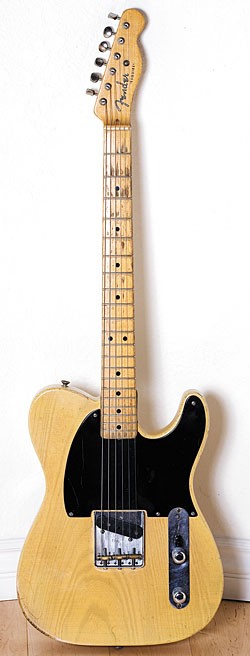
Not all of them. These are the ones I have at home to beat around on, with the exception of the ’51 Esquire.
What characteristics do you look for when buying guitars?
When I buy a guitar, I look for something I can play. I don’t buy pristine guitars, because I like to play them. If I drop them, I don’t care. So I’m a collector of “player” guitars – those I’m not afraid to pick up and bang on. I typically don’t buy guitars for looks; I buy them for tone – the sound, the output, and that kind of thing is most important. I’m a tone freak.
So you really don’t gravitate to collector pieces?
No. They seem to have no soul. I prefer guitars that have life to them.
Have you owned most of your guitars for a long time?
I’ve had quite a few of them for a while. I recently picked up a few ’66 Stratocasters, including a Dakota Red one and a green one. My Fiesta Red Strat is a ’62 with a small headstock and spaghetti logo; ’64 was the transition, when Fender went to the bigger logo, and ’66 was the first year of the bigger headstocks. I picked up a couple of those. They sound good, too!
Is there anything you’re still on the hunt for?
Well, if the price is right. I always enjoy looking around, but there really isn’t anything in particular. But for every collector… I hate to say it, but I think everybody should have a really cool Les Paul, and I actually do have one. What I mean is an older one – a ’57, ’58, ’59 or ’60, just to have it. I used to have a tobaccoburst ’60, but it didn’t sound very good. It had a broken headstock, so it didn’t cost me very much. And then I had a ’59 for about 10 minutes, and I got rid of it because it didn’t sound very good, either. But the last time I looked at them, they were over $250,000. It’s crazy! I had a Zemaitis I bought for $4,500 and then sold it for what I paid. It’s now worth $98,000. That broke my heart because it wasn’t very fun to let that one go. That was six to eight years ago.
The guitar market is always fluctuating, but prices did jump up quickly on certain guitars over a short time. It was typically affected by supply and demand and trends, but is now affected by the economy, which is good for buyers with money, but bad for sellers. In many ways, it’s just like real estate.
Exactly.
Some of your Strats have one string tree, while some have two. Do you usually take off the second one?
No, that’s the way I got them. Some people just take off string trees for some reason. I don’t know why they would, because it creates a weird upper-tone thing.
I’m figuring the bigger-headstock Fenders from ’66 to the early ’70s are going to be the next to skyrocket in price.
Does it seem strange that late-’70s guitars are now considered vintage?
It does sound weird. I suppose I’m vintage!
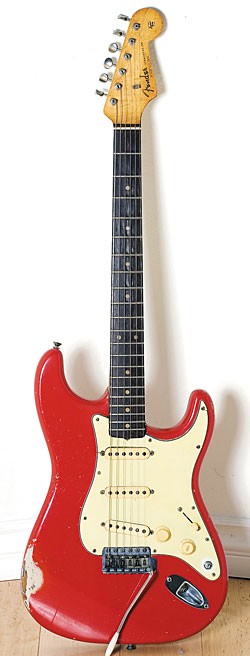
1962 Fender Stratocaster in Fiesta Red.
Late-’64/mid-’65 Fender Stratocaster in black.
Mid-’70s Fender Stratocaster in Candy Apple Red.
Mid 1970/’71 Fender Stratocaster in Olympic White.
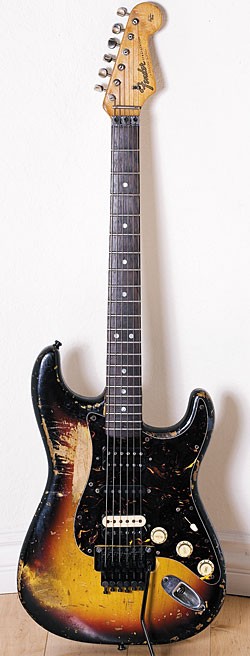
Your main stage guitar is a white Strat with a big headstock, maple fingerboard, two humbuckers, a single-coil in the middle, and a Floyd Rose. What year was that one made?
That one was built for me by Fender in ’96. I like to beat them up, so it looks older than it is. My three main guitars are that one, a beat up black one Fender also built for me, and a ’65 sunburst that was pieced together for me from ’63, ’64, and ’65 parts. I put humbuckers and a Floyd on it and started playing that one. Mötley Crüe with John Corabi was the first album I played it on, and I used it in the videos, too. For what I do, I need to have bridge and neck humbuckers and a single-coil in the center. The pickups are high-output, but not high-distortion. I think normal output is 7.5k to 8k, and mine are around 16k. It’s not for the purpose of increasing distortion, it’s part of my tone; it resonates better. I don’t know exactly how to explain it, but if I put a different pickup in it, it’s like night and day. It’s not so much distortion as it is a higher-output guitar.
What type of pickups do you use in your stage guitars?
They are by a guy that my guitar tech found. His name is J.M. Rolph. He’s from Melbourne, Kentucky. My guitar tech got in touch with him because my pickups were putting out 14k, and he told us he winds them to 16k. So I got a couple of them, and they screamed! So then I got a couple dozen of them. But my favorite pickups of all are the Gibson “T-top” humbuckers that were just after they got their patent. I can’t get enough of them.
Tell us about the other guitars.
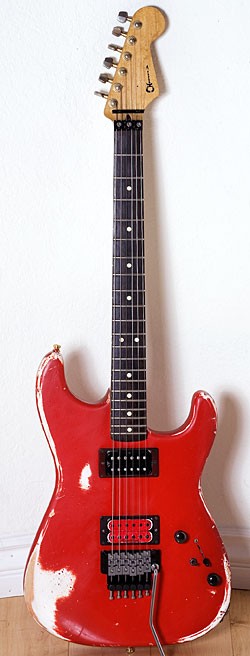
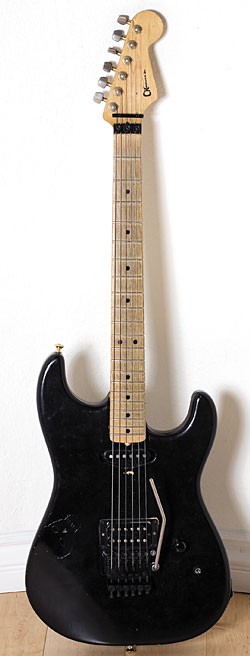
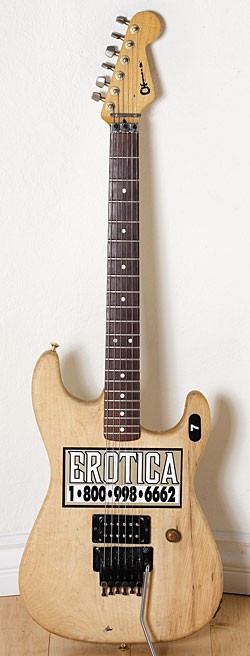
The old Charvels are definitely players. The one with the erotica sticker used to belong to Bootsy Collins’ guitar player. It was originally yellow-and-black-striped. But its sound was being choked off because the paint was too think, so I had it taken off.
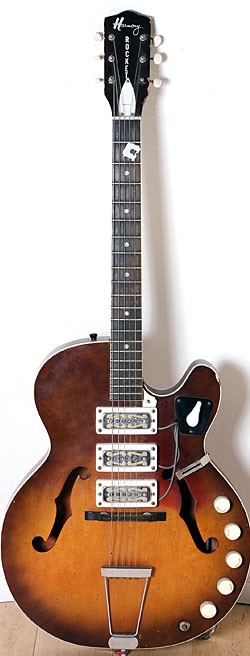
What’s the story behind the Harmony Rocket?
I got that for $500 or $600; it’s a 1960. Of course, I loved it because one knob was gone and one string was broken. And I left it exactly how it is. I haven’t changed the strings, I haven’t found a knob for it, or done anything. I play it, but I only play it with the plastic tab that comes on a bread wrapper. That’s what I use for a pick on that one. It’s the real blues to me, and that’s like the real thing. It’s just got some soul to it and I think it’s pretty cool.
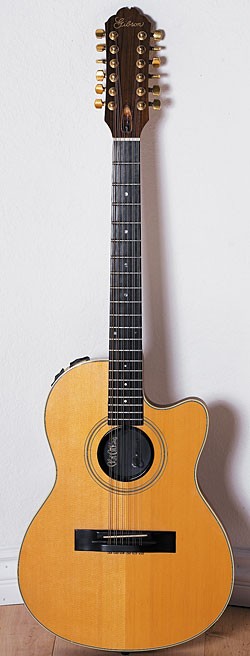
When did you get the Gibson Chet Atkins 12-string acoustic? You don’t see many of those. Have you played it much?
Actually, I got that guitar when they were first coming out. Jerry Garcia wanted it, but I had asked Gibson first! I used it to record “Without You” and some of the other stuff on the Dr. Feelgood album.
Do you use many of your vintage guitars for recording or tend to rely on the stage guitars for a more consistent sound between the studio and stage?
I use my white stage Strat quite a bit, but sometimes I switch up and use a stock Stratocaster with the pickup output around 5.5k or so.
Are there any go-to guitars you use for specific sounds?
Yes, but I guess it really depends on what I’m looking for. If I want a brighter clean sound, like Mark Knopfler, I’d use a stock Strat or even the Esquire. Usually, I have the heavy over-the-top guitar sound, so I need the humbucker. I have an Olympic White ’70 Strat I use a lot. I have a bunch of black ones, too, and they all sound different. When I put them through a clean amp, you can tell which one has the tone that you want. So that’s how I choose them.
Which guitar in your collection has the most sentimental value?
I have a ’63 Strat that truly introduced me to what a Stratocaster is really capable of. I kind of stumbled onto it in ’89, while we were on the Feelgood tour. The Les Pauls and that kind of stuff were getting to be a little much, so I went looking and found that. I bought it for about $1,300; picked it up and plugged it into my rig at rehearsal. It was like, “Wow! This is really cool!” The only trouble I have is keeping it in tune the way I want. It’s a sunburst with the A-profile neck. It’s hard to play chords on, but it’s still one of my favorites.
Mid-’60s pre-CBS Fender Stratocaster in sunburst.
Currently one of Mars’ main stage guitars, this Fender Stratocaster is pieced together with parts from ’63, ’64, and ’65 Strats with J.M. Rolph pickups and a Floyd Rose vibrato.
Mars beat Jerry Garcia to the punch to get this Gibson Chet Atkins SST 12-string steel, which he used to record the band’s hit ballad “Without you” from the Dr. Feelgood album.
1951 Fender Esquire.
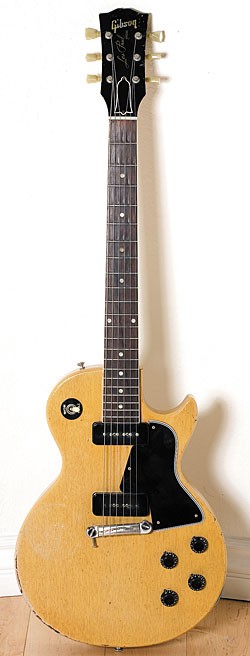
Of the Les Pauls, the only one we photographed is a TV Special.
That’s a ’56. I have a few other Les Pauls at the house. Here’s an interesting story… Back in ’89, on the Feelgood tour, a guy brought a black Les Paul from the Gibson Custom Shop to a meet-and-greet backstage. He said his mom got him the guitar but he didn’t like it, and wanted a guitar with a whammy on it. So I traded him a black Kramer for this black Custom Shop Les Paul. It has dot inlays and it’s made of alder. I took the paint off, like a bonehead, because I wasn’t using my head, and I put a Floyd on it and an EMG in it. It’s a beautiful-sounding guitar. I don’t think that one was photographed either.
I also have an early-’70s curly-maple-top Les Paul Standard. It looks really good. That’s about it for Les Pauls. I only have a few, but I don’t play them much, anyway.
Which of the other guitars do you play now?
Mostly play Strats and sometimes a Paul Reed Smith, not live, but in the studio if I want certain sounds. A good example is the slide parts on “Primal Scream,” which were are all recorded with a Paul Reed Smith. The rest of it is a Charvel and Kramer mix. That’s what I used in there. Paul actually made me quite a few guitars. I got one of the McCartys, but I wanted one that was more faded, and not the more popular colors. I also had him use dot inlays instead of birds. He thought it wasn’t right, but it was right for me, and I now have a couple of those. I have another one he made out of korina. It’s blood red with P-90s. It’s a pretty guitar.
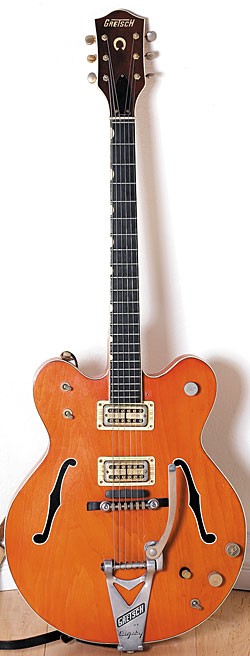
Tell us about the orange Gretsch Chet Atkins. Have you played that one live or used it for recording?
That’s a ’64. I never use that one, but I have used Gretsch White Falcons before. I used a White Falcon on the Dr. Feelgood album. It was Bob Rock’s, but it used to belong to Billy Duffy from the Cult.
This year on Crüe Fest, we’re going to play the whole Dr. Feelgood album live. There were, like, 79 guitar tracks on one song and I was doing a lot of guitar work on that entire album. It’s going to be really hard for me to pull that off so nothing is missed. I don’t want to cheat any of the people who come to hear us, whether they’re fans or skeptics or press – especially not the fans. But I’ll work things out so it all sounds right.
It’s difficult to cover all that ground when you’re the only guitar player in the band, if you recorded a variety of parts in the studio.
Yes, you have to pick the dominant parts and use the others when you can, even if you have another guitar on a stand. It’s obvious when you play an electric guitar part but there’s an acoustic guitar part going on in the background.
What type of amps are you using in your stage rig?
I use a lot of stuff – everything from Marshall to Soldano to Rivera to Crest and VHT. I use my stuff like a lot of people who bi-amp and slave out to this, that, and the other. I do mine in fives; I use Rivera, Marshall, and Soldano amplifiers, all going to different power amps to boost the signal. When I’m standing in front of my amp onstage, it’s putting out 124 dB, but it doesn’t hurt. It’s just a really fat, warm tone.
The Marshalls are 50- and 100-watt JCM 800s with mods in the preamp so they’re a three-stage instead of two-stage, with the master Volume and the Volume [on each channel], but there’s an extra knob on preamp stages, for Gain.
The Soldanos are SLO-100 Super Lead Overdrives. And I use the Rivera Bonehead to bring out low-end. I use the heads with VHT and Crest power amps. My cabinets are Marshalls with Celestion Vintage 30s. To my ear, I put them against the greenbacks, and the old greenbacks are cool for what they are, but for what I’m doing with my rig, these sound better.
So, you’re building tone from different components instead of relying on one amp to provide different elements and different tones…
That’s exactly right. It’s different elements of tone, and the combination makes this big tone. I’ve been doing the same thing in the studio for quite a while. I use a Vox AC30, a Hiwatt, a Marshall, and hook them all together. This is old-school, using all the tones from each different amp and using them with different combinations. Pro Tools plug-ins don’t sound the same.
’56 Gibson Les Paul Special.
’64 Gretsch Chet Atkins.
1960 Harmony Rocket.
Which effects are included in your live rig?
I use a Bradshaw rack with a lot of things in it. I have one of the very first Eventide H3000s, which probably sounds ancient now, but it has a lot to do with my sound. And I use a Yamaha SPX1000, an Alesis Quadraverb for some dry slapback echo, and for Leslie effect. There’s a certain sound in there I really like; it sounds like a half-mic’ed Leslie, which is a pretty cool effect.
I use the H3000 for my main sound and effects like the octave divider, chorus, and that’s about it. I use the Yamaha SPX1000 to make the sound a little wetter. I’m not much of an effects guy.
How do you have your guitars set up?
I set my action really low. When I’m recording in the studio, I can set it up exactly how I want it. On tour, it’s a bit different. I have the strings rattling against the fretboard because they’re so low. When we go through different climates and temperature changes, the neck goes back and forth. Sometimes the action has to stay set up a bit higher, which I don’t like too much. I’ve used Ernie Ball strings for as long as I can remember; .011, .014, .018, .030, .040, .050. I tune down to D and loosen the springs and tension to make it easier to play. I’m thinking about going up to .012-.052, but I’m afraid to see what it does to the neck when you go from hot to cold to cold to hot.
How many springs do you use on the vibrato blocks in your Strats?
I use three.
Describe some of the highlights from the last leg of the tour, when you were mostly playing arenas?
It was pretty cool. One of the highlights was when Rick Nielsen from Cheap Trick came out to a show in Illinois. He jammed with Last Vegas (one of the opening bands), then came up and jammed with us on “Jailhouse Rock.” That was really fun. Afterward, he invited me to see his guitar collection. I was really too tired to go, but I was also jealous because he has more than 4,000 guitars! He’s got everything from what Jimi Hendrix played to all sorts of unusual stuff. That five-neck Hamer is pretty cool, but it weighs 80 pounds! The doubleneck shaped like him is pretty cool. For me, personally, doublenecks are weird to play. I’ve had a few, and I guess I’d rather have one guitar on the stand and one in my hands. To me, it sounds better to use two guitars, and doublenecks are just too heavy.
The summer tour starts overseas, right?
Yes. We’ll play Moscow, Bulgaria, Greece, and a bunch of places we never played before. Then, Crüe Fest II starts July 11. We bring out Godsmack, Drowning Pool, Theory of a Deadman, and a newer band called Charm City Devils. That’s going to be a good gig – a lot of fun.
Are you working on other projects outside of Mötley Crüe?
Yes. I’ve got to do a solo thing – it’s time for me to do something of my own. I don’t have to tour it, I just need to put it out just to say, “This is Mick. This is what I’m really about.” I am definitely going to do it. I don’t know when, but before I die, to leave my legacy!
Have you been writing material for a solo album?
I’ve been writing a lot for it, but I’m not happy with any of it so far, and I’m not going to put a record out just to have a solo album. It has to be completely right and every song has to make you go, “Wow!” – like a Beck album.
On tours supporting Motley Crue’s most popular albums, Mars made extensive use of these ’80s Charvels.
I’m trying to develop stuff I want to do. You know how Cajun music came about from mixing jazz and these other elements so it came to be Cajun and zydeco? I’m going to do something – not zydeco – but taking different elements of things and mish-mash them so people go, “That’s cool! That’s different!” I just don’t want to sound like everyone else. So I’ve got this thing and I’ve been developing it. But so far, I haven’t been satisfied with what I’ve done. So I’m experimenting with things to try to make it different from every other band. I don’t even know how to describe it, but I just know what I’m hearing and I can’t get it yet. I will get it! I’ve got many songs I’ve done in my studio; I have stacks of half-inch and two-inch tapes, and I’m looking for this thing. Eventually, I’ll get it.
Sometimes, ideas flow much better when you’re bouncing ideas off of other musicians who inspire you.
That’s exactly right. I’m probably going to have to have somebody come in, because I want a great rhythm section – a good bass player and a drummer like Josh Freese or Steve Perkins – a drummer who thinks outside the box and has a different approach to playing drums. I need to lay down a really good rhythm section so I can do what I need to do or hear what I need to hear, and experiment with it.
I guess in many ways we’re never really satisfied with what we do. I think that if you are, then you’ve reached your plateau and it’s time to hang it up. Never think that you’re the best you can ever be. It’s also not about how many notes you play, but the soul you put into your playing. Lots of people are more concerned by how fast they can play. They like sweeps and playing faster and faster, but there’s no time for the note to develop any soul. It sounds like an old machine gun.
It would be interesting if more players worked on developing unique styles instead of trying to be clones or just the fastest players around.
Yes! Like so many of those ’80s guitar players. There are a few who are really good, like Nuno Bettencourt. I really admire people like that. When I hear Randy Rhoads, I think, “That is a guitar player!” Then I hear some of the other guys who just play fast, do a lot of sweep picking, and sound like they must have gone to G.I.T. for a week. I’m not trying to be mean, because I don’t know how to do any of that stuff and my fingers don’t move that fast. But a lot of players came out of there sounding very much the same. It just isn’t my style of playing I never got into it.
They call Clapton “Slowhand” for a reason.
I’ll be “Slowhand Mars!” I definitely don’t mind being lumped in with guys like that! I think sometimes you lose sight of what you do because you are the guy. Even Hendrix. When he was on the “Dick Cavett Show,” Cavett asked how it felt to be the best guitar player in the world and Hendrix said something about how he wasn’t the best. He always seemed insecure and humble about his playing, which I thought was cool.
Slash is another guy who doesn’t do all of that speed playing. He plays from his heart, and he’s very humble. I think what really screws guitar players up is not being themselves. When players ask, I tell them, “Be true to yourself. Play what comes from inside of you, and keep working on being the best you can possibly be at what you do.”
This article originally appeared in VG‘s September 2009 issue. All copyrights are by the author and Vintage Guitar magazine. Unauthorized replication or use is strictly prohibited.
Mötley Crüe – “Saints of Los Angeles” Eleven Seven Music
As any fan of Drivin ’N Cryin can attest, Kevn Kinney at his creative best surrenders little to the greatest singer/songwriters in pop – his message is delivered in succinct, pointed turns of phrase transmitted by a voice like no other and accompanied by riffs that sink deeper than a treble hook.
Drivin ’N Cryin was formed by Kinney and bassist Tim Nielsen in 1985, several years after Kinney had moved to Atlanta from Milwaukee. With the help of a few rotating drummers, they gained quick popularity and within a year of their first gig, recorded Scarred But Smarter for the indie 688 Records label. The following year, they signed with Island and recorded Whisper Tames the Lion, followed in ’89 by Mystery Road. Though each disc nudged the band further up the fame ladder, the label began pressuring it to step away from its inherent sound. Kinney at first resisted, then worked a compromise that saw him record a solo folk album (MacDougal Blues) while agreeing to move the sound of DnC toward mainstream rock.
The band spent the summer of 1990 in a Memphis studio with producer Geoff Workman and emerged with Fly Me Courageous. Released in early January of ’91, it offered a sound that, perhaps by its sheer simplicity, was distinctly separate in the atmosphere of the day – it wasn’t trendy, kitschy pop, didn’t emulate their friends in R.E.M. (who were huge at the time), and wasn’t as noisy as the grunge that had begun its plunge into overexposure. And it stood out thanks to Kinney’s songwriting.
The masses got their first taste thanks to the MTV videos for “Fly Me Courageous” and “Build a Fire,” and the resultant surge pushed DnC up the cliff that is rock stardom.
The ensuing years saw the band record a few more times and remain active into the 21st century, its sound always pulled together by Kinney’s distinguishable voice, a guitar tone birthed from Mosrite guitars, and Nielsen’s pocket-favoring style.
In 2012, DnC released the first in a series of themed EPs aimed at keeping fresh music bouncing off fans’ eardrums. The first three carried a theme that addressed the band’s musical influences. The initial release, Songs from the Laundromat, revisited its Southern-fried jangle-rock roots and was followed by Songs About Cars, Space and The Ramones, Songs From the Psychedelic Time Clock, and, finally, Songs For the Turntable.
The concept came to Kinney during a conversation with his wife. “I was writing [songs] one morning while she was listening to music. As a particular song was playing, she said, ‘You should record that.’ I said ‘I did…’ She was listening to the last song on my most-recent album!
“It dawned on me that people don’t usually listen past five or six songs,” he added. “So, I thought, ‘I’ll make a record with five or six songs. In fact, I’ll do four or five – or maybe the rest of my records that way!”
Kinney with his Mosrite Celebrity.
The scheme, he said, addressed several issues for Drivin ’N Cryin.
“We have never shied away [from our] influences, but sometimes, combining them on one record can be disconcerting,” he said. Beyond that, he was attracted to the idea of offering contrasting sounds by different producers, and concedes to a lack patience for drawn-out recording projects, which he equates to “a big buildup, as if you’re J.D. Salinger!” followed by the obligatory tour and the subsequent return to reality.
“I don’t like hype,” he said. “I just want to offer my art to fans.”
As with nearly all DnC music, the four EPs were well-received by critics and fans – including some artists who themselves have enjoyed the view from the precipice.
“Kevn most often reminded me of Neil Young in his commitment to a personal honesty that carry forth into every set,” said Dan Baird, whose Georgia Satellites led a guitar-rock resurgence of their own in the early ’80s. “That’s what was appealing about him – and remains so. His set of personal values is reflected consistently. It’s always good to watch and listen to someone playing with their own money on the table.”
Baird isn’t the only rock star who considers Kinney a rock star.
“He’s a great guy and a great artist,” added guitarist Audley Freed, himself a musical icon for his work with Cry of Love. “He’s a real treasure.”
Seeking to dig deeper, we talked with Kinney.
When were you first impacted by music?
There was a band from Milwaukee called Michael and the Messengers – psychedelic band kind of like Paul Revere and the Raiders or The Shadows Of Knight – and they got to be kind of big. They played in the parking lot of the Dineen Park pool one day, and I could hear the drums from my house. I was, like, “What is going on? That sounds like a rock and roll band.” So, we jumped on our bikes to check it out, and that was the first time I saw a band up close, not at a state fair or something! They were right there, on this little stage. It blew my mind, and I remember thinking, “I wanna do that.”
The second one was in the summer of ’77, when I saw the Ramones play at Summer Fest, in Milwaukee. I had been thinking I could actually become a musician and play the guitar, but when I listened to Zeppelin and the Stones, I thought, “I can’t make music like that…” But when I saw The Ramones, I thought, “Wow! That’s amazing. Music can be energy and intention, as well as craft,” you know? Still, it took me years. I became a roadie for a while, and finally formed a band in 1980.
Does the Ramones influence explain why you’ve played Mosrite guitars since the early days of Drivin ’N Cryin?
Well, there’s three bands – The Ventures, MC5, and the Ramones – that all played Mosrites, along with other guys. Maybe “In-A-Gadda-Da-Vida,” and Glen Campbell. My goal in life is to have Glen Campbell autograph one of my Mosrites – maybe my [Celebrity]. That would be the holy grail for me.
Listening to the Ramones and the MC5, were you drawn specifically to the guitar sounds?
They were everything, yeah. Bands like the Human Beins, Davie Allan and the Arrows… The way Johnny Ramone made it sound – to this day, I think Johnny Ramone, Jimmy Page, and Keith Richards are the three best lick players ever.
What was your first guitar-and-amp setup?
Well, I had a Teisco Del Ray, but I didn’t really learn to play it because I didn’t know anything about adjusting the action. But, I bought my first Mosrite for $75 at a pawn shop in Milwaukee – an Avenger that Semie Moseley later told me was a copy. I had a Vibrolux with it, then a Bassman stack, then used Vibrolux stack with the Bassman stack; I had amps and guitars on both sides of the stage when we were a three-piece. That was my thing!
When you first started bashing it out with a band, were you doing cover songs or did you work originals into the mix?
We did a lot of covers. I had my punk-rock songs – seven or eight of those – and then we did some covers like “Last Train to Clarksville,” “Do You Want to Be In My Gang” by Cub Koda, “It’s My Life” by the Animals – Nuggets-era stuff. I did The Who’s “Legal Matter” because my band at the time was called The Prosecutors.
Why did you move from Milwaukee to Atlanta?
Well, it’s warmer (laughs)! But, the story is my brother lived in Atlanta, working at a backpacking store. He told me, “Maybe you could come down and be a laborer at a construction site, it’s like $5.50 an hour.” I was making two bucks an hour at a record store in Milwaukee, so $5.50 an hour was a lot of money! I didn’t know how hard the work would be, especially in the summer.
I just needed something different, musically; in Milwaukee, I didn’t see that anybody would ever care about my music, so I went south, did a couple gigs, and people went, “That’s interesting.” So, Tim Nielsen and I started a band. We took it seriously and saw it as a great opportunity; in the ’80s, a lot of college fraternities down South hired rock bands, and we’d make $1,000 a night. In Milwaukee, we’d split 30 bucks, go to a restaurant, get our coffee and a burger. And we were good with that, you know? But this was people paying us real money. I don’t remember that sort of community in the Midwest. [Crowds] liked to hear original bands. You didn’t have to learn covers, they were just happy you were there and rockin’ out.
The Atlanta music scene, when I got there, was just starting to cross over to national – the B-52s, Georgia Satellites, R.E.M. After we recorded our first album, Scarred But Smarter, we were always on the radio – every station in town. But, of course, when “Fly Me Courageous ” became a hit, college radio didn’t play us anymore (laughs)! We weren’t cool anymore.
That song helped push the album to gold status at the time. Were you cool with becoming a rock star?
You know, at that moment, yeah, I was. The thing was, when Fly Me Courageous came out, it defined us. That was an era where it usually took three or four records to become somebody, and that was our last try. If it didn’t do well, the label was going to drop us.
I don’t really love that record; it’s not what I would’ve liked it to be. I sold out a bit, you know? I did the video with the funny hats because I was like, “Yeah, whatever.” Pop art, pop life, integrity… I don’t know what the balance of it was, but it was fun. I got everything I ever asked for; I was on MTV, we toured the world, and then, when it was over, I made a couple more albums for a major label.
“I’ve since made a dozen more albums, and I’m more proud of the fact that I’ve never chased that again. I had my share. A lot of my fans are taken aback by that. They ask, “Don’t you want to be huge again?” And I’m like, “Why?” I don’t know… That’s about reliving the past, and I’m really happy now.
Does that reluctance have anything to do with the fact you’re really a folk singer at heart?
Maybe part of it is the folk singer in me, but part of it is also about the legacy, especially now that it doesn’t matter if we’re huge. I think if you just keep making stuff you believe in, like these five-song EPs, maybe my granddaughter and her friends, when they’re 25, will find Drivin’ ’N Cryin somewhere and be like, “That was a good band.” And that will be fine with me. So I have to keep producing records, especially in the digital age, where you’re in the system – you’re never going to disappear. I remember when Whisper Tames the Lion was cut from the label’s catalog, I thought, “No one’s ever gonna hear this record… ever!” That was the truth back then. Mystery Road, Scarred But Smarter, Fly Me Courageous… they were all cut.
But they’re are all available now, digitally…
They are, but there was a moment where I thought they were going to be available only as “collectibles.” Which, for seven people, that’s cool! There’s seven collectors in every city – seven guys who have everything (laughs)!
Were the four EPs inspired by the current state of the music business, or are they more about your personal attention span?
Well, [R.E.M. guitarist] Peter Buck and I re-did some songs from [Kinney’s 1990 folk album] MacDougal Blues, so it’s actually five. But, I wanted to explore… wanted to explain myself. I wanted to do a Drivin’ ’N Cryin’ roots record, so the first one [Songs from the Laundromat] is our Southern-rock roots, the second [Songs About Cars, Space and the Ramones] is our punk-rock roots, the third [Psychedelic Garage] is our psychedelic roots, and the fourth [Songs For the Turntable] is Drivin’ ’N Cryin’ as we are today.
The second part of the equation is, I think, 12 songs on a record is too much. I do listen to records that have 10 songs on them, but I don’t know if people have time to hear 12 songs. Every day, I get CDs from various bands, and I’ll listen to the first two or three songs; I don’t have time to listen to the 15th song!
Part three is I love the 45. When I was a kid, I would buy a 45 and listen to it over and over and over again. The EPs kind of let you do that. You’re not exhausted from the journey; it’s a neat way to spend 25 minutes.
Kevn Kinney’s primary guitars are this Epiphone ES-339, his Mosrites Ventures model, and a Univox copy of a Mosrite.
So, does Songs For the Turntable most closely compare to Fly Me Courageous?
Well, it’s very commercial, like when Drivin’ ’N Cryin’ was goin’ for it.
Would you describe Laundromat as a series of homages? Songs From The Laundromat is kind of the country-circuit record – it’s a little bit of the rock and roll that Drivin’ ’N Cryin’ had, Georgia Satellites, the hard rock, and things like that. There’s an obvious homage to R.E.M., which goes back again to something you would hear on Nuggets – like a B-side where a band sings about another band (laughs). I just think it’s funny.
It sounds very much like them…
Yeah, well, I’ve spent a lot of time inside the R.E.M. world, so I understand it. What we did for that, specifically, was a week before we recorded the song I told everybody, “Don’t listen to anything but the first two R.E.M. records, Murmur and Reckoning.” Sadler Vaden (the band’s second guitarist for the sessions) and [drummer] Dave Johnson had heard their music, but weren’t fans like me and Tim are. “Just listen to these records over and over and just see what they’re doing,” I told them. “Then we’ll come in and record this.” We kind of pretended it was the only world that existed. If we’d had a little more time, I would have added some more-subtle tie-ins and maybe some harpsichord falling on the floor and other weird things, you know?
Did you use a 12-string on the track?
Definitely. And, I told Tim, “Man, play the bass like Mike; play a lot of notes and (mimics a bass-line octave jump).”
Who did the high vocal harmonies?
That’s Sadler. And before that, he was only familiar with “The One I Love.” I don’t think his generation knows about Murmur… but he does now because I made him listen to it for a week (laughs).
Songs About Cars includes instrumentals that sound Ventures-ish or like space rock. Did you play your Mosrite on those?
Absolutely. That’s my black ’60s Mosrite; it might be a ’65, probably what the Ventures were playing before they put their names on the brand. It’s a really good guitar, made before they became inconsistent. I have some Mosrites that sound really rockin’ – really dirty – and then some that are really thin. The pickups are never the same.
How many do you have?
I have two Ventures Mark I models, the black pre-Ventures one, and the fake Avenger, which has the best-sounding pickup, actually. I have two semi-hollowbodies, a red one and a sunburst combo that’s like a 335. I have a small acoustic that looks like something the Beatles would’ve played, and I have a red Ventures bass. I also have an acoustic resonator Mosrite, which is beautiful but just doesn’t work for a dobro sound (laughs); it’s, like, really poorly made. But it looks cool as s**t!
Do you still take any Mosrites on the road?
No, because about three years ago, we had a trailer stolen. Luckily, my guitar tech had taken the Mosrites out of trailer that night. When I called to tell him the trailer had been stolen, he said, “I’ve got your Mosrites at my house. I was going have them set up.” So now, I buy Epiphones [for touring]. The Mosrites are too valuable and I love them so much.
Kinney with his Mosrite Balladeer.
Which amps did you use on the EPs?
I used my Fender Bassmans and my Marshall.
How about effects?
I have a Big Muff and a DOD Overdrive.
Are you cool with the end result of the EP concept, or do you think you’ll more likely go back to making full-length albums?
If I have a theme where I think I can do 10 songs that make sense, I’ll do that. I don’t know… I’m not stuck on the five-song thing, but I do like to give fans something they can enjoy for the price of a beer or a shot; some people don’t have $12 after a concert to buy a full record.
I’m definitely going to make another record. It might be themed, like [DnC’s 2009 album] The Great American Bubble Factory. I love that record because it’s about what happened to America’s working class. Every song on there has to do with fighting or working your way through things.
You recently contributed music to the FX television series “Archer”…
Yes, I did all the music for Cherlene, one of the characters who is trying to become a country star. I wrote seven songs and produced a cover of “Baby Please Don’t Go” for the show. [“Archer” creator] Adam Reed is an old friend who lives in Atlanta. He told me, “I need someone to do some country songs for a character.” So, we took some of my songs and re-wrote the lyrics to fit the series.
Were you familiar with the storyline of the show before he hit you up?
No, I was not aware of his amazing show. When we met to talk about doing the music, he said, “Here’s some DVDs,” and I watched them non-stop. The stuff is smart! And hilarious. The music is me and our new guitar player, Aaron Lee Tasjan, who also wrote one of the songs. I’m very excited about it.
Speaking of Aaron, you have always treated the co-guitarist slot as something of a revolving door. Why?
The thing about us is we started off as a trio, but when we play live, we need another guitar. The first thing I told Sadler, was, “This is a stop-off. Play here as long as you can, but there’s much bigger bands out there, and there’s your own career and your own songwriting.” Same thing I told Aaron; “When you need to go, go. I don’t want you feeling like you have to stay.” I’m not that guy. I always thought what they did in the jazz era was cool, where guys would play a couple tunes with Miles [Davis], then not play with Miles, then play with Miles again. Most of the musicians that play with me are welcome to come back to do a show or two, or a tour if they want. It’s an open thing.
You encourage them to keep their options open…
Oh, absolutely. My options are open; today, I have a rock band. Tomorrow, I might play solo. Why shouldn’t their options be open?
When and how did it occur to you that you had a natural ability to write songs?
Well… I don’t know that. But, when I first started practicing with the band, I came up with what I thought were some pretty good things. It wasn’t until the early ’80s that I put together music and words that made sense. I think I wrote my first good song in probably 1982. I incorporated what I was feeling and who I was into “Scarred But Smarter,” and it actually made a lot of sense, and I could play it every night. I still do.
When I tried to become a folk singer, I realized, “Wow, I’m not really saying anything.” And I still write songs that don’t make sense but have great riffs – I like a great riff even if I don’t have a heavy lyric. Sometimes, I just let the riffs be the riffs (laughs), and there’s nothing wrong with that!
Is there a method to the way you write melodies and lyrics?
I think everybody in this world comes up with songs in their heads. The only difference is that when it happens to me, I stop what I’m doing and I write it down or record it on my phone. Three of the songs on the last EP are from soundchecks where I was just waiting around. I’d come up with a riff and think, “Ooo, that’s good,” hit the voice memo on my phone, record it, then listen to it when I got home. Sometimes it’s like, “I’ve got to make something out of that.” I think the only skill I have that some people don’t is it dawns on me, “That could be a good song.”
Do you understand the reverence that other musicians have for you and Drivin’ ’N Cryin’ music?
I don’t know… Not really. I think a lot of people see me as a musician who’s totally unaffected. People who respect me respect me because I’ve taken an approach to music that’s like, “Hey, man, it’s all good. I’m happy to be here. I’m happy to be making music and playing with my friends and I’m really blessed to have this opportunity. Let’s all create some stuff together and maybe it’ll be a good thing.” If people are inspired by me, I think they’re more inspired by my attitude than anything.
This article originally appeared in VG August 2014 issue. All copyrights are by the author and Vintage Guitar magazine. Unauthorized replication or use is strictly prohibited.
An early-’70s Thomas Organ Cry Baby, built in Italy.
Beyond being crowned “Album of the Century” by Time magazine, Marley and the Wailers’ 1977 LP Exodus is a wah-wah masterpiece thanks to Junior Marvin and his Thomas Organ Cry Baby. Others – from Earl Hooker to Jimi Hendrix, Frank Zappa to Sly Stone – made their mark with the pedal, but never has so much wah been played on one album, from multi-tracked rhythm riffs to spaced-out lead solos.
For the sessions, Marvin plugged his Fender Stratocaster into a Roger-Mayer-tweaked Cry Baby and an Electro-Harmonix Dr. Q envelope filter, then into two Fender Twin-Reverb amps. He layered up to six tracks of wah on top of each other to cut the distinctive rhythms for classics like “Exodus” and “Jamming.” The sound was part funk, part Jimi, pure reggae. “I was inspired by Jimi Hendrix on ‘Message To Love,’ and ‘Superfly’ by Curtis Mayfield, which had a wicked wah,” he remembers.
Electric guitarists first fiddled with their tone controls to mimic the wah-wah sound of trumpeters such as Clyde McCoy, who waved a mute over his bellhorn to create a human voice on his 1931 hit “Sugar Blues.” In the 1930s and ’40s, Alvino Rey twirled the Tone knob to modulate his guitar’s timbre. Chet Atkins did the same on the 1960 cut “Hot Toddy.”
Brilliant in it its simplicity; the foot pedal drives the rotary control on the potentiometer. This early Cry Baby features the round, brown Halo inductor, believed by many guitarists to be the best-sounding unit.
The wah pedal itself, however, was developed almost by accident.
In 1966, junior engineer Brad Plunkett was working at Thomas Organ Company in Sepulveda, California. The firm had a license with musical distributor Jennings, of England, to build and sell Vox gear in the United States. As part of this, Thomas Organ was developing a solidstate version of the Super Beatle amp; Plunkett was assigned to find an inexpensive replacement for the amp’s $4 Mid Range Boost transistorized switch. He played with a 30¢ potentiometer, using it to adjust the tone instead.
In the documentary film Cry Baby: The Pedal that Rocks the World, Plunkett recalls, “So I went next door and asked a friend of mine, John Glenum, if he would plug his guitar into the pile of wires and resistors and capacitors I had on the bench. He strummed a couple of chords and I turned the knob on the potentiometer and it went wack, wack, wack, and we looked at each other and – I won’t tell you exactly the words we said – we said, ‘Wow, this is really great!’
“We started thinking about, ‘Well, how’s the guitarist going be able to operate this thing? His hands are already busy.’ There was a Vox Jaguar organ sitting in front of one of the other engineer’s benches, so I said, ‘Hey John, go steal that volume pedal from Frank’s organ! Let’s put the pot in there.’ And pretty soon, we were drawing a modest crowd and everybody said it sounded pretty good. But we didn’t really know how good it was going to be.”
The up-and-down action of the foot pedal rotated the pot control, allowing the guitarist to color the tone from treble to bass. It was a brilliantly simple circuit, a showcase for the potential of a simple potentiometer. And Plunkett built it into an effect that was as easy and intuitive to operate as a car’s gas pedal.
The use of a pedal was not intuitive to Thomas Organ, however. President Joe Benaron was certain it would sell to horn players, and called Clyde McCoy to license it as the Vox Clyde McCoy Wah-Wah Pedal. The earliest versions boasted McCoy’s likeness on the baseplate; later ones had just his signature.
Thomas Organ demonstrator/multi-instrumentalist Del Casher knew they had it wrong. “This is really a guitar thing,” he told Benaron. In March of 1967, he cut a demo 45 titled “Crybaby…” showing off the range of the wah from blues to jazz, sitar to a tiger’s growl.
The Cry Baby moniker was used on the first Thomas Organ wahs. Listening to the pedal scream, someone at Thomas said it sounded like a baby crying. The name became famous.
Both the Cry Baby and Clyde McCoy – followed by Vox’s V846 successor – went into production in early ’67, first in Sepulveda, then at Eko, in Italy. When Eko balked at building the pedal, Benaron and Italian foreman Ennio Uncini launched Jen (borrowing the first letters of their names) to make them. The pedals were the same inside.
Thomas applied for a patent claiming first use of the “wow-wow sound” on June 27, 1967, and the patent was granted in 1970.
(LEFT) Thomas Organ originally believed horn players would be the market for the wah pedal, so licensed trumpeter Clyde McCoy’s endorsement on the early Vox models. (RIGHT) The first Vox versions featured Clyde McCoy’s likeness. Later ones had just his signature on the bottom plate.
In between, the wah was copied far and wide. There was the Targ & Dinner Cry-Baby Waa-Waa Pedal, UMI Electronics Wa Pedal, Jordan Gig Pedal, Dallas Arbiter’s Sound City Wah Face, Color Sound Wah-Wah, Rosac Nu-Wa Fuzz, Foxx Fuzz Wah, Maestro Boomerang, Electro-Harmonix Big Muff Crying Tone, and more, all of which signaled that the wah was an instant hit. Eric Clapton used it on Cream’s “Tales Of Brave Ulysses,” Hendrix on “Voodoo Child (Slight Return),” Jimmy Page on Led Zeppelin’s “Dazed And Confused.” By the late ’70s, wah was everywhere; it wailed through Isaac Hayes’ “Theme From Shaft.” Miles Davis played his trumpet through a Cry Baby on Bitches Brew. It was even on Bee Gees tunes, the theme for TV’s “Three’s Company,” and porn soundtracks. Use of the wah hit the saturation point, and it fell out of fashion along with bell bottoms. But as with most cool guitar sounds, it would come back.
The sound of the Cry Baby changed over time, due largely to different inductors used in its construction. The first models had a round, brown Halo inductor, often hailed as the best-sounding. That was followed by a bare-metal “film canister,” then plastic-covered Fasel in various colors, the square TDK, and a black-finished “stack of dimes” unit.
In the late ’70s, Vox and Thomas parted ways; in ’82, Thomas went under. Jim Dunlop astutely bought rights to the pedal and began offering his GCB-95 Original Cry Baby, soon followed by upgraded, hot-rodded versions and signature models. As of today, the Cry Baby just may be the best-selling pedal of all time.
Junior Marvin’s use of the wah was literally part of the effect’s exodus. Marvin and Bob Marley met effects wizard Roger Mayer at a New York gig, and Mayer became their tech. Marvin remembers, “He tweaked out the wah-wah pedals, and they sounded better. He gave them more high and lows, so the wah wasn’t so short. He really made them talk. He wouldn’t tell anyone his secrets, and I don’t blame him!”
Marley and the Wailers were booked into London’s Island Studios for a three-month session, 24 hours a day, seven days a week. The result of the marathon was Exodus and its follow-up, Kaya.
Jamaican reggae producers had a long history of studio experimentation, playing with echo and reverb, sometimes assembling two or three tapes to create delay. “European engineers would freak and go, ‘What are you doing? You’re not supposed to do that!’” Marvin laughs. “And they’d go, ‘Really? No one told us?’ They would do things by accident, things that were totally unheard of anywhere else in the world. They did things they thought sounded really cool. No one told them ‘Don’t do that!’ So they did it.”
While working on Exodus, Marvin felt more freedom in experimenting with the wah, given that reggae history. He recorded multiple tracks of wah guitar that were laid on top and woven in and out of each other.
“To play the rhythm on ‘Exodus,’ I muted the guitar strings, and with the wah, it would go wak-a, wah, wak-a, wah, wah, wah and they wouldn’t ring… When you wanted that bright, rhythm reggae sound, you’d turn on the wah-wah and put it on the treble, all the way down, and get that reggae chop sound. It’d really cut.”
Marvin played the rhythm riff on just four strings, and Mayer taped down those not being used, “So it was really clean, with just the harmonics of those strings. It was one of our little secrets.
“Sometimes, when I’d use the wah for the leads, I wouldn’t use the actual wah-wah itself: I’d pick a tone in that spectrum and use that tone along with a little distortion so you’d get that edge to it. Some people don’t realize that you can use a wah as a boost as well; it will boost your signal and also boost your tone.”
This article originally appeared in VG November 2012 issue. All copyrights are by the author and Vintage Guitar magazine. Unauthorized replication or use is strictly prohibited.
Fuzz. It’s the sound of fury, aggravation, indignation, and – considering the history of the most famous fuzzbox of all time, Maestro’s Fuzz-Tone – dissatisfaction. It’s also fitting as some of the first recorded electric fuzz guitar was heard via Howlin’ Wolf guitarist Willie Lee Johnson, who cut tracks like 1951’s “How Many More Years” using a tone distorted by simply turning the Volume knob on his low-fidelity amp.
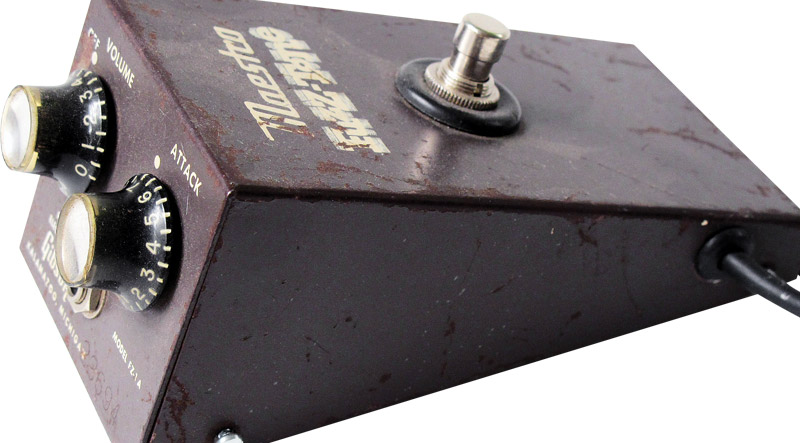
An early, Kalamazzo-built FZ-1A Fuzz-Tone. Later FZ-1A pedals were built in Lincolnwood, Illinois.
Like a dirty-toned saxophone or muted trumpet, it was a sound others sought to emulate.
Paul Burlison, who would go on to play in the iconic Rock and Roll Trio, traded slots with Wolf on radio KWEM in West Memphis, Arkansas, and picked up that tone; he later claimed he dropped his amp, causing a tube to spring loose and start that buzz. On the 1951 Jackie Brenston/Ike Turner proto-rock-and-roll hit “Rocket 88,” guitarist Willie Kizart reportedly poked a hole in his amp speaker to make it fuzz out. The trick, though, was to get that sound reliably.
Enter the 1962 Maestro Fuzz-Tone, godfather of all fuzzboxes. And it, too, was created almost by accident.
In the summer of 1960, country troubadour Marty Robbins was in Bradley Film & Recording Studios, in Nashville – the peerless Quonset Hut – recording a ballad for Decca called “Don’t Worry.” Backing him was the A-Team including session ace Grady Martin.
Martin, of course, knew a thing or two about guitar distortion. Along with backing Red Foley and leading his own solo career, Martin’s numerous credits included playing on Johnny Horton’s 1956 hit “Honky Tonk Man” and other country and rockabilly tracks. He also picked guitar on the Rock and Roll Trio’s classic 1956 sessions that included “Train Kept A-Rollin’,” where he may have used Burlison’s amp with that loosened tube. For the Robbins session, Martin was playing a muted “tic-tac” bass line on a ’56 six-string Danelectro bass.
The Quonset Hut had just received a custom-built console with Langevin 116 tube amplifiers, recalls engineer Glenn Snoddy, now 91. “When the console was built, the Langevin company had moved to California and farmed out 50 sets of output transformers to another company. In the console bought for Bradley, I believe we got 35 of these transformers, and they started to go bad when Grady was playing.
The FZ-1 and FZ-1A controls for Volume and Attack.
“Apparently, the transformer developed an open primary. Since approximately 250 volts DC was going through this winding, one would assume a tiny arc developed that caused this peculiar sound.”
Martin’s fuzzed-out bass, including a solo and outro, was kept on the single released in February, 1961. It was about the last thing you expected to hear in a soft, heartfelt, piano-led ballad. But Robbins’ fans loved it, and the song went to No. 3 on Billboard’s Hot Country & Western chart and No. 1 on Billboard’s Hot 100.
Snoddy and Martin must have known they had a hot thing going as soon as they heard that fuzz. Snoddy didn’t junk the “bad” transformer. Instead, he saved it, and Martin quickly cut an odd, noir-tinged single with his Slew Foot Five called “The Fuzz,” which actually beat “Don’t Worry” to market by a month or so.
A 1962 ad for the Fuzz-Tone.
“No one else used [the fuzz-toned transformer] to my knowledge,” Snoddy says; he saved it for Martin. But then, it died. “Nancy Sinatra came to town and wanted to use that sound, and I had to tell her people that we didn’t have it anymore because the amplifier completely quit. So I had to get busy and conjure some other way to make it happen.”
Snoddy enlisted the aid of Revis Hobbs, a fellow engineer at WSM radio and TV, where Snoddy worked prior to the Quonset Hut. “I invited him to come by the studio and bring some special transistors that I did not have, and together we worked out the details of the Fuzz-Tone.” While the Langevin amp had been tube-driven, Snoddy and Hobbs tried to re-create that fuzz with transistors.
Snoddy and Hobbs’ circuit worked by clipping the signal’s sine wave to a square wave. They added an on/off switch to the top of the pedal so musicians could change the tone from clean to dirty. Snoddy then toted the newborn effect to Gibson, and president Maurice H. Berlin. The man who had earlier turned down Les Paul’s solidbody guitar was by then more open to the brave new world of instruments.
“I don’t play guitar, but they had a fellow there who did,” Snoddy remembers. “I took the box, plugged it in, and Mr. Berlin said, ‘Hey, we want that.’”
Gibson developed the effect into a prototype. Snoddy says no photos remain of his original. He kept the Gibson prototype and later donated it to guitarist Harold Bradley.
Beginning in ’62, Gibson launched the Fuzz-Tone FZ-1 pedal under its Maestro brand name with a retail price of $40. The company also used the circuit in several basses including the EB-0F, EB-SF 1250 and Epiphone Newport EB-SF – the F suffix indicating “fuzz.”
It’s even possible Gibson saw this effect as primarily for bass use. Either way, the company soon released a 7″ 33-r.p.m. demonstration record in ’62, promoting the FZ-1 for guitarists. Still, Gibson didn’t quite know what they’d use it for. As noted in the May 3, 1962 patent application, the Fuzz-Tone was designed “to provide a tone modifying attachment and circuit for electrically produced signals which will permit stringed musical instruments such as guitars, banjos and string basses to produce electrically amplified and reproduced tones simulating other instruments such as trumpets, trombones and tubas.”
Gibson expected huge sales from guitarists who wanted to sound like sousaphonists, and dealers responded by snapping up all 5,000 units produced in 1962. But players didn’t buy. The story goes that Gibson shipped only three more Fuzz-Tones in ’63 and none in ’64.
That all changed come ’65, when Keith Richards used an FZ-1 on the Rolling Stones’ “(I Can’t Get No) Satisfaction,” and the Fuzz-Tone instantly became the “it” pedal. Ironically – or maybe not – Richards says he indeed used the Fuzz-Tone to emulate a horn.
As he wrote in his 2010 autobiography, Life, “It was down to one little foot pedal, the Gibson fuzz tone [sic]… I’ve only ever used foot pedals twice [the other being an XR delay on Some Girls]… effects are not my thing. I just go for quality of sound…
Inside the FZ-1A are the three Germanium transistors and 1.5-volt battery; the FZ-1 relied on two of these, while the FZ-1B used a 9-volt.
“I was imagining horns, trying to imitate their sound to put on the track later when we recorded. I’d already heard the riff in my head, the way Otis Redding did it later, thinking this is gonna be the horn line. But we didn’t have any horns, and I was only going to lay down a dub. The fuzz tone came in handy so I could give a shape to what the horns were supposed to do. But the fuzz tone had never been heard before anywhere, and that’s the sound that caught everybody’s imagination.”
The first time Richards heard the finished song, played over a radio station in Minnesota, he himself was shocked by the fuzz. “At first I was mortified,” Richards says, “We didn’t even know Andrew [Loog Oldham, the Stones’ manager] had put the f**king thing out! [But it was] the record of the summer of ’65, so I’m not arguing.”
Gibson responded in late ’65 by releasing the FZ-1A, and promptly sold some 40,000 pedals. The FZ-1 and FZ-1A used largely the same circuitry with three Germanium transistors, though the FZ-1 was powered by two 1.5-volt batteries whereas the FZ-1A relied on just one. The FZ-1 bore the manufacturing location of Kalamazoo, Michigan; the FZ-1A was built in Kalamazoo, then later in Lincolnwood, Illinois.
The Lincolnwood-built/9-volt/two-transistor FZ-1B followed with revised graphics. It’s sound was more trebly, but with less gain. The FZ-1S Super-Fuzz arrived with the ’70s offering more control and an even harsher attack. FZ-1A reissues bear the “Nashville, Tennessee” legend.
As a reprise to “Satisfaction,” most every instrument maker – legit and otherwise – offered their own fuzz pedals. The effect was cloned, copied, or imitated by Macaris’ 1965 Tone Bender, Burns’ Buzz-Around, the Italian Fuzzy, Roger Mayer’s custom Fuzz-Tones built for Jimi Hendrix and others, Mosrite’s ’66 FUZZrite, WEM’s Rush, and many more.
This article originally appeared in VG December 2013 issue. All copyrights are by the author and Vintage Guitar magazine. Unauthorized replication or use is strictly prohibited.
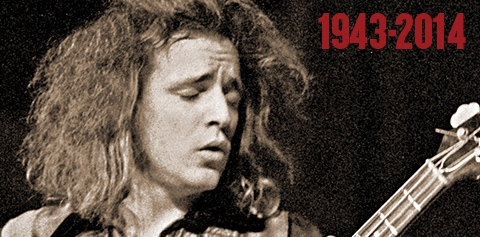
Bruce onstage in 1972. Johnny A.:Paul Lyden. Jack Bruce, 1972: Heinrich Klaffs.Jack Bruce, an icon of electric bass, died October 25 in Suffolk, England.
Best known for his work with Cream in the 1960s, he was born to musician parents in 1943. As a youngster, he underwent formal music training on cello, then shifted to upright bass, and though he fancied jazz and also played guitar and piano, low-end instruments (usually played loud) were his calling card.
In the early ’60s, he began playing in Alexis Korner’s Blues Inc. with drummer Ginger Baker. The association fostered a love/hate relationship in which they experienced a musical synchronicity even if as it proved turbulent on a personal level. It also endured for decades.
Later, in the Graham Bond Organisation (which also included Baker), he first played an inexpensive Japanese bass. “A Top Ten – Japanese copy of a Fender, and a very poor instrument,” he told VG in 2002. After the departure of guitarist John McLaughlin, Bruce switched to a Fender Bass VI. “With no guitar [in the band], I was occasionally able to play little guitar-like solos.”
Bruce also worked briefly with John Mayall’s Bluesbreakers and Manfred Mann, among others. Bluesbreakers guitarist Eric Clapton, already an important figure in the British music scene, recognized his own compatibility with Bruce, and the seeds of Cream were sown; the trio formed in mid ’66, adding improvisational techniques to traditional blues songs. In concert, it stretched music in a decibel-drenched three-way sonic war, as the three provoked each other in a musical sojourn to where no band had ever been.
At the outset of Cream, Bruce used his Bass VI, and, like Clapton’s Gibson SG, it was given a psychedelic paint job by a Dutch art collective known as the Fool. “The neck was so sticky I couldn’t play it, he said of the finish. “[So] I borrowed instruments and started looking for something new. That’s when I found the Gibson EB-3, which was very important because I wanted to develop a style that was very guitar-like, instead of playing root notes. I used La Bella light-gauge strings, which I could bend.”
He is today most remembered for playing the EB-3, though he also used a modified Danelectro Long Horn with Cream
After the band split in late 1968, Bruce began a solo career with ’69’s Songs for a Tailor and soon afterward played with the Tony Williams Lifetime.
In the mid ’70s, he returned to playing rock, with guitarist Leslie West and drummer Corky Laing; the three recorded two studio albums and a live album before splitting. Bruce’s collaborations with jazz artists such as Carla Bley also garnered notice. He later teamed with guitarist Robin Trower, then played again with Baker and guitarist Gary Moore in BBM.
Bruce onstage in 2006. Jack Bruce, 2006: Christian Sahm. Througout his career, Bruce battled addiction and, like Clapton, lost a son to an accidental death. In 2003, he barely survived a liver transplant.
In later years, he concentrated on fretless electric bass, and became a Warwick endorser. The company marketed a signature model, and later, the Jack Bruce Survivor model, which resembled his EB-3.
When Cream was inducted to the Rock & Roll Hall of Fame in 1993, the three reunited to perform. They reunited again for a series of concerts in 2005.
Bruce remained musically adventurous, and in more recent years began exploring Afro-Caribbean music. Recent efforts included a band called Spectrum Road, with guitarist Vernon Reid.
Bruce’s final solo album, Silver Rails, was released in March of 2014. Interviewed for VG’s August ’14 issue, he sloughed off the notion of retiring.
“It would be nice to slow down a bit and enjoy the house I just bought on Majorca,” he said. “But, who knows what’s around the corner? That’s what makes life exciting!”
This article originally appeared in VG February 2015 issue. All copyrights are by the author and Vintage Guitar magazine. Unauthorized replication or use is strictly prohibited.
1920 Martin 0-42Through the years, Martin’s dreadnought, OM, and 000 guitars may have gained the most notoriety. But for the sweetest and best-quality sound, Martin itself recommends the size 0, exemplified by this 0-42.
There’s obviously a catch to that statement, since only two of Martin’s current offering of over 200 models are size-0 guitars. The recommendation appeared in Martin catalogs around the time this guitar was made – 1920 – when a 131/2″ guitar was still considered a full-size instrument. If a sweet sound was not enough, Martin recommended the larger (though still small by modern standards) 141/8″-wide 00-size for clients wanting the greatest possible power in a concert setting (the even-larger, 15″-wide 000 was a more powerful guitar than the 00, but with sporadic production averaging less than five guitars per year from 1902 to 1920, its staying power was still unproven).
At the time this guitar was made, the vast majority of Martin guitars were designed to be played with gut strings. Although these guitars are braced with an X pattern, which is typically associated with steel-string instruments, it should be noted that Martin was using X bracing by the early 1850s, long before the company ever had any thought of putting steel strings on any of their guitars. It’s also of interest to note that while the bracing in 1920 was still very light, the actual dimension of the bracing was not radically different from the late ’20s onward, when Martin’s smaller guitars were intended to be used with steel strings. It was not until the mid 1940s that Martin dramatically beefed up the size of the braces on the small-body instruments.
This 1920 guitar features French polish finish rather than lacquer. Martin started using nitrocellulose lacquer in 1926. Prior to that, their guitars had a hand-rubbed shellac-based finish (“French polish” is the technique). Sprayed lacquer is much easier to apply and more resistant to scratches, but tends to dry out and crack over a long period of time, whereas French polish finishes look good even when over a century old.
This guitar features a one-piece, 12-fret, slot-head mahogany neck, whereas prior to 1918 the necks were Spanish cedar and their pegheads were grafted on. After the grafted style was replaced by a one-piece neck and peghead, Martin left a volute on the back of the peghead on styles 28 and higher that preserves the artistic appearance of the original German-style graft.
This guitar has bindings of white “ivoroid” (celluloid with an ivory grain pattern) on the fingerboard and body edges, whereas Martin guitars with white-colored binding made prior to 1918 had genuine ivory. The pearl-trimmed models also had violin-style wood purfling up until 1943 (when they were all discontinued). Martin continued to use ivoroid bindings until the late ’60s, after which they switched to white plastic. Today, Martin uses ivoroid bindings (but with plastic purfling lines rather than real wood) on many Custom Shop and limited-edition guitars as well as the Vintage Series, Golden Era series, Marquis series instruments and the D-28 Authentic model.
As is typical of Martin guitars of Style 21 and higher made prior to World War II, this guitar features an Adirondack spruce top; Brazilian rosewood back, sides and peghead veneer; and ebony fingerboard and bridge. The pyramid-end ebony bridge is typical of higher-grade Martins made prior to mid 1930, before the introduction of the modern “belly” bridge. The ornamentation of this guitar, with snowflake fingerboard inlays, white binding on the fingerboard and body edges, and abalone top trim, is typical of Style 42.
Style 42 dates back to the 1850s, when Martin began standardizing ornamentation schemes. Then, as now, it used abalone trim around the soundhole, top border, and around the fingerboard extension. Style 40 was almost the same model, but it lacked the abalone border around the fingerboard. Model numbers were originally the wholesale price of the guitar, so the wholesale value of the extra abalone trim was $2. Style 42 remained Martin’s top model for almost 50 years, until the introduction of Style 45 in the early 1900s. At the time this 0-42 was made, Martin guitars were offered in style 17, 18, 21, 28, 42, and 45 with the style 17 being the least ornamented and the 45 being the most ornate.
The 0-42 sold in small numbers from 1898 (the first year that production figures are available) through 1920, peaking at 20 per year but with single-digit production in many of those years. In the ’20s, production jumped considerably to a high of 52 in 1927. While the ostentatious trends of the Jazz Age may been a factor in the increased demand for the pearl-trimmed 0-42, Martin experienced a surge in production across the entire line in the ’20s – from the small, plain 0-18 to the large, fancy 000-45.
When the stock market crashed in 1929 and the Depression arrived, it hit across the entire line, too, prompting Martin to introduce the cheaper all-mahogany Style 17 models and abandon most of the rosewood-body 0-size models. Only the 0-28 was produced in any significant numbers. The economy recovered in the mid ’30s, and Martin did, too, thanks to a combination of strong sales of low-end models and increasing demand for its larger 000 and dreadnought-size models. The 0-42, with high-end ornamentation and what was now considered a small body, never recovered. It had been in regular production from the 1850s through 1930, but after 1930, Martin made only one 0-42 in 1934, one in ’38 and one in ’42. The larger 00-42 and 000-42 did not fare much better, lasting only into ’43, after which Style 42 was discontinued.
This 1920 0-42 is a superbly crafted guitar that represents the end of the era of small-bodied guitars – an era when many players valued tone above power. In that context, it still lives up to its billing as the Martin with the sweetest and best-quality sound.
This article originally appeared in VG‘s April 2010 issue. All copyrights are by the author and Vintage Guitar magazine. Unauthorized replication or use is strictly prohibited.

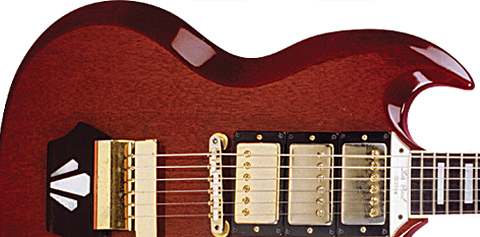


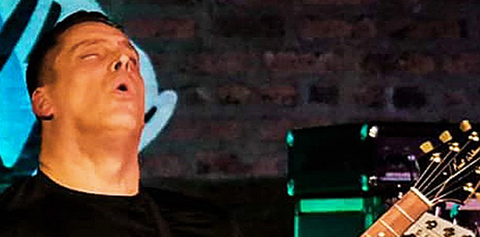


 His live sound is created with a mix of custom guitars made by Kurt Wilson, along with a Gibson ’58 reissue Les Paul, a Tele-style parts guitar, and a handful of others. His Category 5 Tempest is a Marshall-inspired 2×12″ combo with two channels. “I use the plexi side,” he said with a grin. At festivals, he goes a bit bigger, employing a Bedrock 1400 half-stack.
  His pedalboard is wonderfully meat-and-potatoes, with (from left) a Danelectro Reel Echo, GTS overdrive prototype, a Klon-inspired OD, and a Budda wah. “I’m basically looking for a good clean sound, a dirty one, and an overdriven sound. The GTS prototype is built by Joe Campagna, and its the most transparent overdrive I’ve ever used. It gives the sound of the guitar and amp without much alteration, except more. It’s a very cool pedal. The Klon clone is made by Jacek Soltysiak, here in Chicago, and I use it for my overdriven and distorted tones.”