Tag: features

  • Vega Director Model A-60

    Vega Director Model A-60

    Amp courtesy of Brian Centofanti, photos by Steve Donnachie.
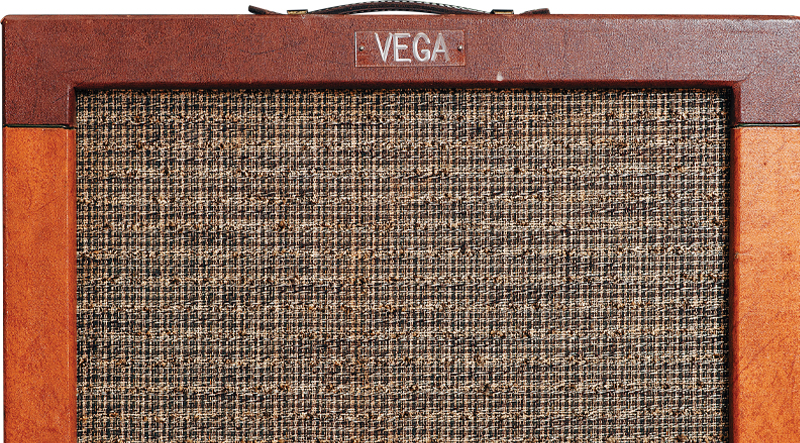
    1959 Vega Director Model A-60
    • Preamp tubes: 7025, 12AX7
    • Output tubes: two 6V6GT
    • Rectifier: 5Y3GT
    • 
Controls: Volume, Volume, Tone (doubles as power switch)
    • Speaker: 12″ Jensen P12R and 8″ Quam
    • Output: approximately 15 watts

    A worthy vintage combo in all regards, there’s sad irony in the fact the Director Model A-60 is representative of the downward trajectory of Vega, the company founded in 1881 by Swedish-born brothers Julius and Carl Nelson.

    Established as a mandolin and guitar maker, Vega became one of the biggest names in banjos in the early 20th century and for a time was poised to be a major player in the first guitar boom just before and after World War II. In 1959, there was no reason an aspiring electric guitarist wouldn’t purchase a Vega amp and believe he or she was tapping into one of the great names in American instrument manufacture.

    Given its configuration of two Volume controls, one Tone, a pair of nine-pin preamp tubes, a pair of 6V6GTs, and a 5Y3 rectifier, it’s easy to assume the Director A-60, like so many mid-sized amps of the era, was just another Fender 5E3 Deluxe knock-off. Such an assumption would be way off base. Careful tracing of the circuit by this amp’s owner, VG reader Brian Centofanti, reveals the signal follows a rather convoluted path and that – while still not particularly complex – is quirkier than the straightforward 5E3.

    The inputs share the first Volume control, which goes through first a 33k resistor then a .005µF capacitor before entering the first gain stage, half of a 7025 (a rugged 12AX7 equivalent). This tube appears to be grid-leak biased, a technique most guitar-amp makers had abandoned in the early ’50s in favor of cathode biasing. High-voltage DC reaches the tube via a 250k resistor connected to the plate. The signal exits the 7025’s plate on the way to the Volume control via an odd dual-.004µF cap, with two leads tied together in parallel to render it .008µF total. The third input, labeled “Inst 3 or Micro,” is odder still; it runs through .001µF and .005µF caps in series on the way to its own half of that first 7025 dual-triode.

    The 8″ Quam speaker is connected to the Jensen via a crossover capacitor to eliminate some low frequencies from its output.

    The second preamp tube, a 12AX7, appears to be used in standard configuration with the first triode acting as a second gain (a.k.a. “driver”) stage prior to the split-load phase inverter provided by the second triode, which splits the signal into opposite phases and feeds them from the plate and cathode to the 6V6s. Like most of its type, the output stage is cathode-biased and the Tone control is a simple treble-bleed network tied to the Volume controls. With 363 volts DC on the plates of the 6V6s, 289 volts on the screens, and given the size of the modest output transformer, the amp is likely putting out about 15 watts. All of this is rendered in the strangely appealing agricultural-grade “rat’s nest” point-to-point wiring often used by second- and third-tier amp makers of the day, with a preponderance of ceramic-disc signal caps, which can often lend a little extra grit and texture to the tone. 

    By all accounts, Vega wasn’t manufacturing its own amps at this time, but the origins of this one are not easy to discern. For assistance, we turned to Terry Dobbs – a.k.a. “Mr. Valco” – who’s an authority on sundry “catalog-grade” amps. According to Dobbs, the Director A-60 has a lot in common with the Harmony H204 and the R500 from Lectrolab of Cicero, Illinois (just outside Chicago), which jobbed many amps for other brands; the schematics he showed us do bear many similarities in the preamp stages, in particular, though it isn’t identical to either. So… who knows?

    Unmentioned among the specs so far is that enticing extra speaker in the cab alongside the toothsome, teal-framed 12″ Jensen Alnico P12R. An 8″ unit made by Quam, it’s wired in parallel with the Jensen, with a crossover capacitor (a 2µF electrolytic cap) in series with the positive connection to dump low frequencies and prevent “flubbing out,” essentially rendering it a tweeter.

    The Art Deco control panel makes the amp look older than its 1959 vintage and boasts the company’s home in Boston. Note the “Fidelity Amplifier” boast.

    On top of all that’s going on under the hood, how extremely cool does this thing look? The brown-and-orange cabinet is stylishly partnered to a tweed grillecloth with a far more luxuriant look than Fender twill and the Vega name declared by a reverse-etched plexiglas plate; it’s surprising no retro-minded boutique builder has borrowed the aesthetic. The chassis and control panel follow through with similar elegance courtesy of a hammered-gold finish with maroon key lines around the inputs and controls, reminiscent of trends from two decades earlier than its manufacture. Particularly appealing is the legend “Fidelity Amplifier” on the control panel beneath the model name; given the circuit beneath the hood, it was a bold claim even in 1959, but makes for a nifty marketing slogan (you may recall the ’39 Vega Model 120 we featured last year similarly billed itself as a “High Fidelity Amplifier”).

    The Director A-60’s build quality, however, is less-robust than its styling. Beneath the sartorial splendor is a pressboard cabinet (with wood reinforcement in some places), and an open L-shaped chassis made from thin steel. Nonetheless, it has held together well enough these 58 years. Partial thanks for that are likely to go to the amp’s original owner, from whom Centofanti purchased it 10 years ago. Since then, he has only done necessary maintenance to keep the amp functional – replacing some electrolytic capacitors and adding a grounded three-prong plug.

    “The amp sounds great with a Tele – clean, punchy, and bright with Tone at max, and it starts to get gritty at about three on the Volume control,” Centofanti said.

    All in all, the Vega Director A-60 is an alternative means of acquiring appealing vintage tone, and one that won’t likely break the bank – if you can find one.

    The chassis exhibits point-to-point wiring of the style often used in the day.

    This article originally appeared in VG July 2017 issue. All copyrights are by the author and Vintage Guitar magazine. Unauthorized replication or use is strictly prohibited.
  • Lonnie Brooks

    Lonnie Brooks

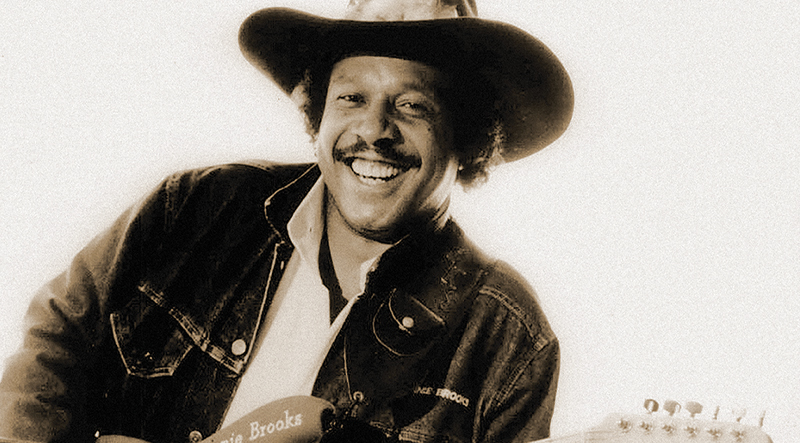
    Blues guitarist/singer Lonnie Brooks died April 1 in Chicago. He was 83.
    Born Lee Baker, Jr., he was one of 12 children and left school after the seventh grade to work in sugar cane and cotton fields near their home in Dubuisson, Louisiana. He learned about music from his grandfather, who played banjo, and in the early ’50s moved to Port Arthur, Texas, where he saw live performances by Clarence “Gatemouth” Brown, T-Bone Walker, B.B. King, Long John Hunter, and others, all of whom inspired him to forge a career making music. In the mid ’50s, he recorded several singles under the name Guitar Junior, scoring a string of regional hits including “Family Rules” and “The Crawl” using a sound that combined Chicago blues, rock and roll, Memphis soul, and country twang into a style that became known as “voodoo blues.” The songs’ popularity led to tours playing dance halls, juke joints, and roadhouses across Texas and Louisiana.

    In 1959, Brooks befriended R&B singer Sam Cooke, who suggested that Baker move to Chicago. There, he changed his name to Lonnie Brooks (because Muddy Waters’ guitarist was going by “Guitar Junior”) and became infatuated with the sound of the city’s deep blues. He backed singer Jimmy Reed, then cut a handful of singles throughout the ’60s while also playing sessions for blues and R&B artists and gigging each night in bars throughout the city and suburbs. In ’69, Capitol Records released Brooks’ first album (still using the name Guitar Junior), Broke an’ Hungry.

    In 1978, Brooks recorded four songs for Alligator Records’ Living Chicago Blues anthology, which led to a contract with the label and the 1979 album Bayou Lightning. It, along with Brooks’ performances, brought him national media attention and the Grand Prix du Disque Award at the 1980 Montreux Jazz Festival. While appearing in Montreux, Brooks befriended country star Roy Clark, who was so impressed he arranged an appearance on “Hee Haw,” the popular television show co-hosted by Clark.

    His 1980 live performance of “Sweet Home Chicago” on the Blues Deluxe album earned a second Grammy nomination, then a 1982 trip to Germany resulted in an hour-long special broadcast on German television, and in ’87, BBC radio broadcast an hour-long live performance.

    Brooks spent the summer of ’93 on a tour with B.B. King, Buddy Guy, Koko Taylor, Junior Wells, and Eric Johnson. In ’95, Eric Clapton invited him onstage for a jam at Buddy Guy’s Legends club in Chicago. In ’98, he appeared in the film Blues Brothers 2000, performed on “The Late Show With David Letterman” and co-authored (along with his son, Wayne Baker Brooks, and guitarist/music scribe Cub Koda) the book Blues For Dummies.

    His final two albums were released in the ’90s – Roadhouse Rules and Lone Star Shootout proved he was still an electrifying guitarist and vocalist who could compose clever songs.

    Brooks encouraged and mentored his guitar-playing sons, Wayne and Ronnie Baker Brooks (VG, June ’17). When Ronnie was a teenager, he toured with his dad, and both sons today lead their own bands. In 2011 and ’12, they toured as The Brooks Family Dynasty. Lonnie’s final recording appearance was as a guest on Ronnie’s latest album, Times Have Changed.

    In 2001, Brooks was inducted to the Port Arthur Historical Society Hall Of Fame, and entered the Blues Hall Of Fame in 2010. He is survived by four sisters, two brothers, four sons, three daughters, and extended family.


    This article originally appeared in VG July 2017 issue. All copyrights are by the author and Vintage Guitar magazine. Unauthorized replication or use is strictly prohibited.

  • Jeff Pilson

    Jeff Pilson

    Jeff Pilson: Willie G. Moseley

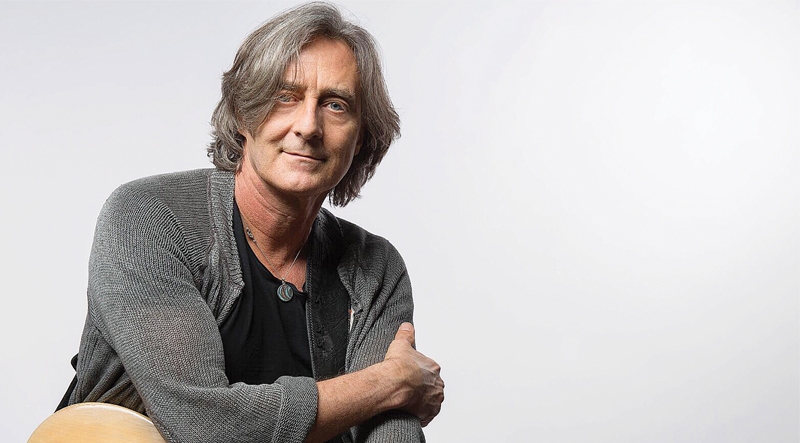
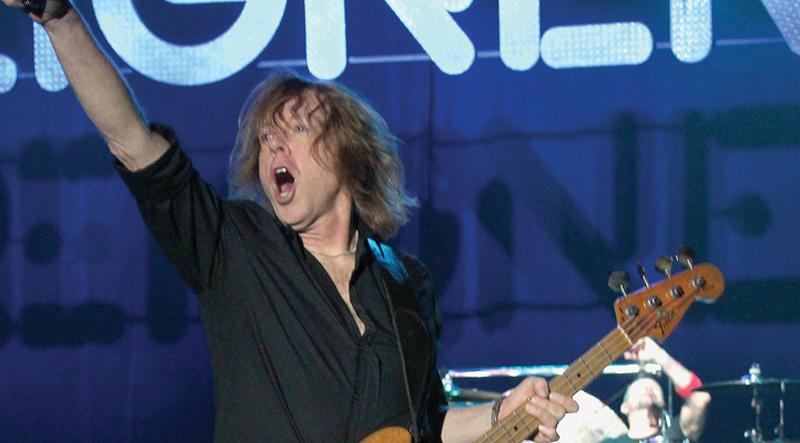
    Jeff Pilson’s career has included many notable facets. He rose to acclaim in the classic lineup of the hair-metal band Dokken, and since 2004 he has the bassist for classic-rockers Foreigner.

    Different genres don’t necessarily make for radically different approaches, and Pilson brought a high-energy approach to Foreigner, in the studio or onstage. Prior to a recent concert during the band’s 40th anniversary tour, he conversed with VG about his experiences and instruments.

    Pilson began playing as a youngster in Milwaukee, and later moved to Washington state, where he immersed himself in music.

    “I actually started on cello, and I got a bass when I was 12, before I got a guitar,” he said. “It was a Teisco Del Rey with a really tiny neck, and I loved it. I paid $35 for it, and I got a Gibson Skylark amp, also for 35 bucks.”

    Asked about early influences, he recalled, “The first guys I listened to were Jack Bruce and a little bit of (John) Entwistle, though that was beyond me at first. So there was a lot of listening to Cream. The first thing I ever learned to play and sing at the same time was ‘Born To Be Wild’ by Steppenwolf. When I was 15, I discovered Chris Squire, and I went over the top – started using a pick instead of my fingers, and learned every note on every Yes album, all the way through Going For The One.”

    While playing in Dokken in the early ’80s, Pilson’s primary bass was a Jackson heard on Tooth and Nail, then he gravitated to Fender Precisions by the recording of Under Lock and Key.

    “I used to rent a ’61 P-Bass from the Eddie Brauer rental company in L.A., and I bought a ’58 in ’86,” he said. “I also used Ripley basses.”

    His current P-Bass is a ’73 with ’66 pickups.

    “I found it when I first joined Foreigner. I had my ’58 but didn’t want to take it on the road, and I’d used some reissue ’50s P-Basses. I found this one at a store in L.A.; it felt right and the neck was really solid. I’d tried some ’64 pickups in it that sounded amazing, but they suddenly lost signal, so I replaced them with the ’66 pickups.”

    The bass also has a Badass bridge that Pilson installed, and a chrome strip on the forearm bevel was there when he bought the instrument; it’s actually a nameplate that said “Chuck Brown,” though the name has been worn away.

    Pilson has a ’71 P-bass for backup in concert, and it, too, has ’66 pickups. He also owns a Candy Apple Red ’64 P-Bass, but rarely gigs with it.

    Foreigner has been known to do acoustic/“unplugged” material in concert, and Pilson uses two Breedlove basses for those segments – one fretted, one fretless. He described them as “…amazing and gorgeous. I love the way they feel and play. The company has a love of instruments, which I think is pretty awesome.”

    The classic lineup of Dokken reunited in 2016 for a quick one-off tour of Japan.

    “That went a lot better than I was expecting,” Pilson recounted. “We had a lot of fun and got along great. It was a very positive experience, and everybody bonded.”

    A DVD/CD set from the Japan reunion tour is slated for release this year.

    “We also wrote a new song,” he added. “It came out amazing, and we were really pleased. We also did some acoustic versions of some old Dokken tracks.”

    Asked about any perceived contradictions in having played in a hard-rock/heavy metal band and the transition to an iconic “arena rock” aggregation, he said, “People will ask, ‘How different is it?’, and I say ‘It’s not as different as you think because Dokken was influenced by Foreigner.’ I was already a Foreigner fan.”

    Regarding the evolution of Foreigner over four decades, Pilson said of the current lineup, “We may bring a little more energy or may be a little heavier than the original band, but the principle is the same – heaviness and melody with great hooks.”

    Foreigner will be releasing an album in May titled 40 Hits From 40 Years, which will include some newly-record “unplugged” versions of its hits. Pilson predicted more acoustic concerts in Foreigner’s future, as well, and was looking forward to an upcoming performance with an orchestra in Switzerland.


    This article originally appeared in VG July 2017 issue. All copyrights are by the author and Vintage Guitar magazine. Unauthorized replication or use is strictly prohibited.

  • Michael Schenker

    Michael Schenker

    Michael Schenker: Emili Muraki

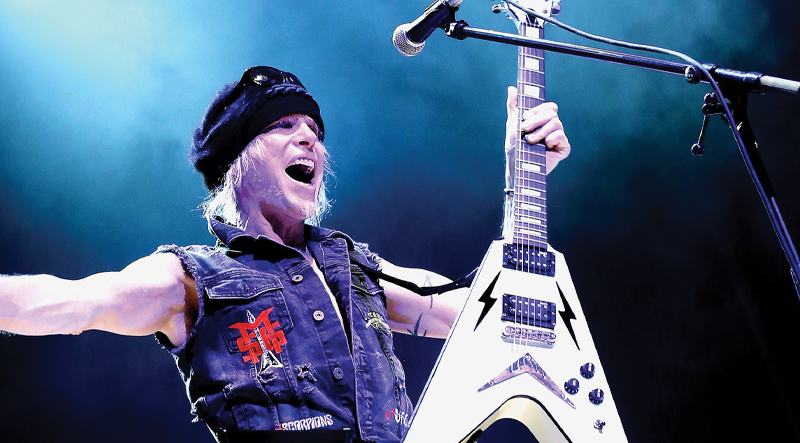
    Michael Schenker has been part of many live releases over the years, and one of the most intriguing is his latest, Michael Schenker Fest Tokyo, which sees the man known for wielding two-tone Flying Vs reunited with singers Gary Barden, Graham Bonnet, and Robin McAuley, along with ’80s cohorts Steve Mann on keys, Chris Glen on bass, and Ted McKenna on drums. We spoke with him to learn more about the reunion.

    What was the impetus for the new release?

    In 2015, Michael Schnenker Group had an offer to play in Japan, and the promoter thought of Graham Bonnet’s band opening, then having him sing a couple songs. I went, “Wait a minute… I’ve been performing my most popular music from the past, but not with the original singers. It would be a great idea if I could have all three from the ’80s on one stage.” So, we asked Robin, Gary, and Graham, and they were excited about it. Then I was thinking about putting a band together, and came up with a line-up with Steve, Chris, and Ted – the original rhythm section of Assault Attack with Graham Bonnet.

    It was a unique combination, and our first concert was headlining at Sweden Rock, then we went around the world, just from word of mouth via YouTube. After that, we started getting phone calls, including one from Japan to headline Loud Park on closing night. I asked, “Who is doing the first night?” They told me it was the Scorpions, and I said, “Sorry. I can’t. They’re too tricky – always cheeky and weird. I’m going to stay as far away from my brother [Scorpions’ guitarist Rudolf Schenker] as possible.” But immediately, my other promoter in Japan found out about it and made an offer to go to Osaka, Tokyo, and Sapporo. Tokyo immediately sold out. It was an unbelievable venue [Tokyo International Forum] – clean, big, fantastic sound, and great stage. I thought, “I have to capture this on DVD. I cannot just let that go.”

    You play an interesting hollowbody Dean V in the DVD.

    That’s one of my favorite guitars. It’s really nice and I actually ordered it with a specific idea in mind. I got it around the time of the second Temple of Rock album, Spirit on a Mission, but it didn’t make it in time, so I wasn’t able to use it. But I love that guitar, and decided I’d use it in Graham’s parts [live]. So, it changes things around and marks his part, and Robin gets the black-and-red V, and the black-and-white is for Gary. They’re all great guitars.

    I used to have a chrome one and the Michael Schenker Kaleidoscope, which were fantastic, too, but they were stolen. All the guitars that I get from Dean are fantastic. In 2008, I did a promotion tour with Bose speakers, where I played to a backing tape. At each of the 10 appearances, we had a giveaway guitar from Dean, and fresh out of the box, they played fantastically, without any problems. It’s a good thing when you can get a guitar out of a case, with all the plastic on it, pick it up, and it plays. That’s the way they are. I’m so sad about [Dean owner] Elliott Rubinson passing away. He was such a great guy. It’s just… annoying that all these people are dying. And it doesn’t get slower – just goes one after the other.

    One of your trademarks is that you don’t use your pinky on your fretting hand.

    That happened naturally. People go to school and learn playing guitar – all the technical aspects. But they don’t necessarily do the other part, the feeling part and the stuff that comes from the heart. So, you can learn in school how to play correctly and set your fingers correctly in such a way that makes it possible to play faster. But those things are not important in the world of “handmade rock,” I call it. Handmade rock is basically where you actually play and discover – it’s not practicing scales and using all the fingers, it’s about, “How do you get to the next tone? Where should it come from? What should it sound like? What kind of emotions do you want to put in there? Do you want to make the next tone sing, sustain, break up, hit it more than once with the vibrato?” All these different combinations – you make those choices in the moment when you improvise. So, by not having any rules in my head, I don’t really repeat myself. It’s just what you hear is “the Michael Schenker style.”


    This article originally appeared in VG July 2017 issue. All copyrights are by the author and Vintage Guitar magazine. Unauthorized replication or use is strictly prohibited.

  • George Lynch

    George Lynch

    George Lynch: Sebastien Paquet

    Musical chemistry is a rare thing. It’s not easily attainable, but when you have it, the fruits are magical. If you haven’t heard the project featuring George Lynch, drummer Ray Luzier of Korn, and bassist/vocalist Dug Pinnick of King’s X, you’re missing out. This is what chemistry sounds like. KXM’s second album, Scatterbrain, is one of the most edgy rock albums to marry chilling guitar, tribal-prog drumming, and gospel-tinged vocals. Lynch brings his A-game throughout, as he’s pushed outside his comfort zone for startling results.

    The chemistry you guys have together is undeniable.

    It’s a little gift to ourselves when we get together. It’s kind of a vacation from our regular music lives. We go in and pretend we’re in our garage-band days and do whatever the hell we want.

    It must feel refreshing to make an album so quickly without beating it to death.

    KXM is all about the process. That’s what really defines us. We’re not a real band in the sense that we’re not premeditated, made a career out of making the band successful, the tour, management, and all that stuff. We’re about improvising and seeing what happens. It’s liberating to be able to do that. It’s a rare thing to be able to come from different places in the universe, triangulate, and not have any preconceived ideas and notions about what we’re going to do. We set up in a room and say, “The clock is ticking! You have 12 days! Go! Make an album!”

    We work well under pressure. If we hadn’t had a deadline imposed, we wouldn’t have the spontaneous results. We’re not over-thinking stuff. That’s not to say we couldn’t do a great record we’re all happy with if we spent a lot more time working on it, but I think it captures something when you’re forced to not over-think. Not that there’s no thought put into the record – it’s very complex. But it’s different than the normal records that I do; we’re using odd time signatures and a variety of influences that I’m really not known for. I had to stretch a little bit, which is a great challenge and interesting for me as a player.

    How much does your rig inspire what happens?

    I brought a huge pallet of options – seven or eight heads I kept swapping out until I found the right combination. One of my anchors was my old 1988 Soldano that I used on the first Lynch Mob album, Wicked Sensation. I think it has the Jackson transformer, and that thing has always sounded fantastic. It’s got a big low-end and it’s very girthy. It’s a great amp, especially for rhythms.

    I like mating it with something else – sometimes a Trainwreck, or my old Marshalls that date back to my Dokken days. I have a very interesting JCM800 that was modified by Bogner. It’s very unique and very aggressive. I like mixing very aggressive amps with something a little more toned down – maybe an AC30 with EL34s. But the trick is to find two amps that work well together. The Soldano was a large part of that record.

    What kind of guitars were you using?

    I usually start with something substantial – my ESP Tiger, my Custom Shop Les Paul, or my ESP Super V, which is all mahogany. It’s pretty dark and Les-Paul-Junior-sounding. It has a lot of grunt to it. I’d use something like that on my initial tracks, then a lot of times I’d overdub it with something that’s got more spank. One of the guitars I use for that is my Linhof Super Telecaster. I put those together with those mix of amps and get an interesting combo.

    You recently did a Dokken tour that went better than expected.

    Getting back together after 25 years… people don’t really change that much. We had a blast. We were all kidding around like the old days. Obviously, we’re all older, but time hadn’t really passed at all. The band played well and we recorded a live DVD and a live album. It’ll contain semi-acoustic versions of three older Dokken songs. There’s also a new track, which is really cool.

    What’s next?

    I’m doing a project with Corey Glover, of Living Colour. He’s no joke! He will f**k you up! It’s similar to the project I did with Angelo Moore of Fishbone, but it’s a little more rock. It’ll be less weird (laughs)… Weird is not bad. I love weird (laughs)! I also have a Lynch Mob album in the wings, another Sweet & Lynch record, and an album with Jack Russell, of Great White.


    This article originally appeared in VG July 2017 issue. All copyrights are by the author and Vintage Guitar magazine. Unauthorized replication or use is strictly prohibited.

  • Max Cavalera

    Max Cavalera

    Max Cavalera: Nick Steever

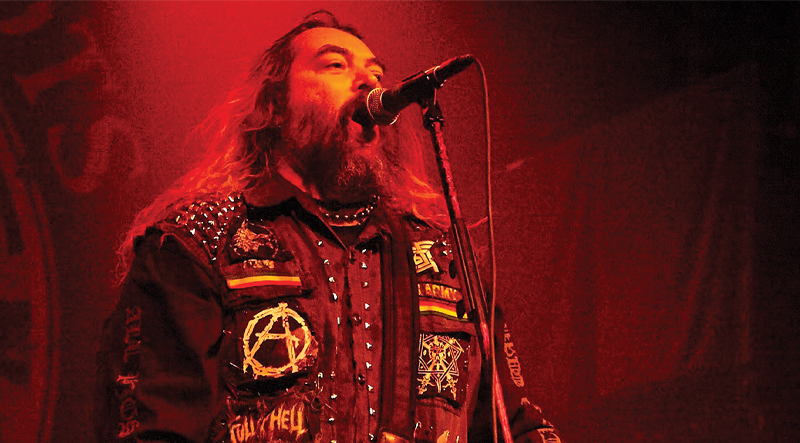
    To the casual fan, heavy metal can get a bit “same sounding” after a while. But then there are those rare albums that are undeniably unique. Case in point is Sepultura’s 1996 classic, Roots, which combined de-tuned riffing with Brazilian percussion, exotic instrumentation, and chanting. Two decades since its release, Max Cavalera looks back on what made Roots so special.

    It’s hard to believe it has been 21 years…

    After the Chaos AD tour, the band took a break and the guys went to the beach in Brazil. I didn’t want to take a break, so I started writing and making four-track demos. When the guys came back, we started putting them into songs and the first we worked on was “Straighthate.” It was a really exciting time and we were very inspired. I was listening to a lot of different stuff – metal, Brazilian music. And that’s why Roots was this return to Brazilian roots of great sounds, mixing Brazilian instruments like berimbau and percussion. When we started thinking about what we were going to do with the record, Monte Conner at Roadrunner suggested we use Ross [Robinson], who had just done the Korn album and a Fear Factory demo I really liked. There was a really cool studio in Malibu, called Indigo Ranch, where he recorded a lot of the stuff. We banged out a bunch of songs and it was a great time.

    Was there a sense that it would turn out sounding so unique?

    We felt it was different, but we didn’t know it was going to be so successful and influential. But yeah, we felt it had something special about it. A lot of it was the way we were writing songs at that time – a bit more simple, more focused on the energy level and the impact. A song like “Roots Bloody Roots” is really simple – one riff almost the whole time, just going all the way. I sing on top of it, and it has a really catchy chorus that helped the song, then we gave it a really brutal, slow ending.

    But when we started putting stuff on tape and listened back in the studio, I felt we were sitting on something quite special. I didn’t know it was going to be that big, but I felt it was different from we’d done before.

    Which guitars and amps did you use for the album?

    I was using Gibson at that time. I was on the verge of switching to ESP and had a contract with Gibson-Brazil, so I was with them for a couple of years. Before that, I was playing a lot of BC Rich stuff. But on the album, I used a lot of Gibson SGs.

    Amps… it would be a lot of old stuff because the owner of the studio, Richard Kaplan, had a massive collection of amplifiers and pedals. I think we recorded with a combination of Marshall and Vox, and it was an orgy of pedals and amplifiers – it was insane! We should have taken a picture and put it on the album, because there must have been 150 pedals on the floor at one point, and we were trying all kinds of different stuff because Ross was really into pedals and the crazy sounds you can get.

    Which guitars and amps do you currently use?

    I am using ESP. I have my own line of guitars, the RPR, which I designed myself. It’s a mix between a Warlock and an Explorer, and I love it. The connection I make is if the Explorer and the Warlock had a kid, that’s what my guitar looks like… it’s the bastard son of those two. And I’m using a lot of Peavey – all different kinds of amplification. They have these little amplifiers that you can put in a backpack, so we can take it to South America and Europe. They sound just as great as the big amplifiers.

    Which guitarists were your biggest influences?

    I always loved Brian May. Queen was the first band I actually listened to, and I was a big fan. And of course, Tony Iommi is the godfather of metal riffs. Anybody that wants to learn to play metal, you cannot go wrong with Iommi’s riffs. Later, I started liking Tom Warrior, from Celtic Frost. I loved his writing, mixing a bit of hardcore in it. And Piggy, from Voivod. I liked all the crazy, wild stuff that he did, and weird chords. I always loved Eddie Van Halen, especially liked his sound and ideas.


    This article originally appeared in VG July 2017 issue. All copyrights are by the author and Vintage Guitar magazine. Unauthorized replication or use is strictly prohibited.

  • Allen Hinds

    Allen Hinds

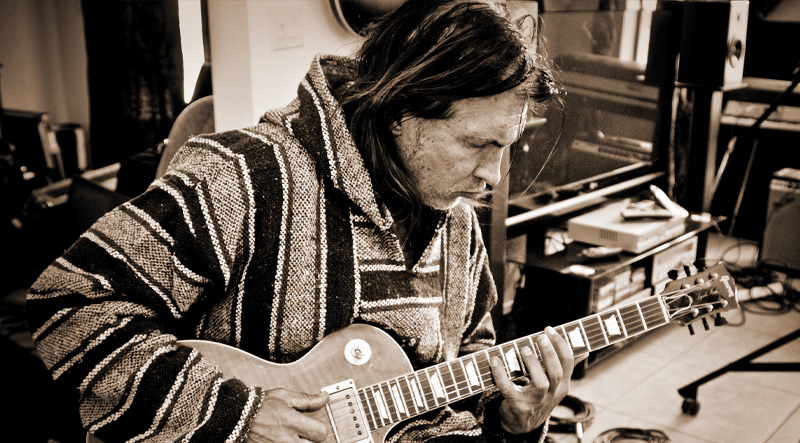
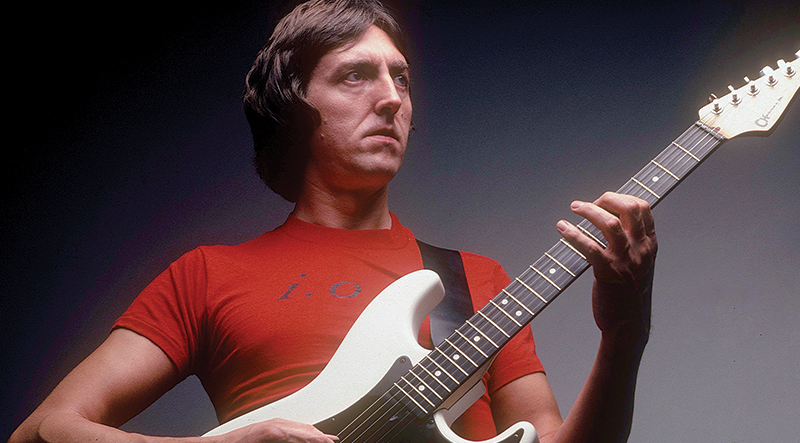
    Allen Hinds has spent a considerable amount of his 60 years playing guitar, and has kept busy lately with two new releases while also teaching at Musicians Institute, doing session work, and touring Japan and/or Europe a time or two each year. All this came after years of gigging with various acts and a late-blooming solo career that started circa 2005.
    One of two recent releases, Fly South, was written on acoustic.

    “I used an early-’60s Martin 000-28 I have at my house,” he said. “I had about 10 songs that were nice and vibey and I started adding electric to them.” Then, the album morphed after the unexpected death of his daughter. “A few songs – the slower ballads – were emotional,” he said.

    Making the record, he got help from heavy-hitters he counts as close friends, including bassist Abe Laboriel, guitarists Jimmy Johnson (“He’s always been like my big brother”) and Jimmy Haslip, along with others.

    “And I got lucky getting Vinnie Colaiuta between his incredibly busy touring. It was great. I had working tapes of the tunes; Vinnie listened to them once and said, ‘I got it. Let’s Go.’ He was great! He’s a very intuitive drummer.”

    Hinds’ musical journey started in the south. He grew up in Georgia and Alabama when the area was fertile for a young guitarist.

    “The Allman Brothers were about 50 miles away, so I got to hear the original band. I also heard a lot of great country music and great country players; I knew what a Tele could do through the right amp. I also fell in love with slide-guitar and pedal steel. That’s always been a thing that turned me on.”

    He started on guitar at age 16 and became of fan of Steely Dan and Joni Mitchell. “I’d look at the album covers and see Larry Carlton and Robben Ford listed, so I gravitated toward anything they played.” He then attended Berklee College of Music for a year before returning to Alabama, where he played with a band that mixed pop, rock, and fusion, but… “I wanted to learn more. At the time, the Guitar Institute of Technology was happening. You’d walk the hallways and there’d be Scott Henderson, Robben Ford, Jeff Berlin, Joe Diorio, all these great players. I’d skip classes to pester Robben.”

    After G.I.T., he jumped into the fertile L.A. scene, playing gigs with Hiroshima, Bobby Caldwell, Gino Vanelli, the Crusaders, and others. In 2005, he turned his focus to solo work and has steadily built a respectable following. A Tele guy, he relies mostly on ’52 Esquire with replaced pick-up and bridge plate from another ’52. “It’s a great-sounding guitar,” he said. “I believe tone comes from where your hand meets the neck and from the pickups.”

    He also uses a guitar made for him by Xotic, and two guitars for slide – a LSL and a ’59 Gibson Melody Maker with a humbucker and palm pedal. Always a fan of his old Fender Deluxe Reverb, he recently discovered Red Plates Amps’ BlackLine. “Its overdrive is incredible,” he raves.


    This article originally appeared in VG July 2017 issue. All copyrights are by the author and Vintage Guitar magazine. Unauthorized replication or use is strictly prohibited.

  • Allan Holdsworth

    Allan Holdsworth

    Allan Holdsworth: Neil Zlozower/Atlasicons.com

    Music fans were relaxing on Easter Sunday when word of Allan Holdsworth’s death began filtering about, bringing shock to the guitar community. For 45 years, Holdsworth had been one of the greatest improvisers in jazz-rock and the personification of the word “innovator.” In fact, earlier in the month his label released a 12-CD retrospective, aptly titled The Man Who Changed Guitar Forever.

    After arriving on the ’70s fusion scene in the group Tempest, Holdsworth dazzled fans through fast legato lines in various lineups of Soft Machine, Gong, the New Tony Williams’ Lifetime, Jean-Luc Ponty, and his 1976 solo album, Velvet Darkness, displaying his rarely-heard acoustic chops. Between 1977 and ’79, he broke to a wider audience with the fusion quartet Bruford and prog-rockers UK, the latter featuring bassist John Wetton, who died in January. Holdsworth’s liquid hammer-on phrasing and delicate vibrato-bar chops on UK’s “In the Dead of Night” remains his most famous solo, and had a seismic impact on players from Eddie Van Halen to Alex Lifeson and beyond. For incontrovertible proof, listen to Van Halen’s “And the Cradle Will Rock” or Rush’s “Limelight.”

    Notoriously particular about his music, Holdsworth escaped the sideman role in launching a solo career while showing off wild post-bop leads and gossamer chord arpeggios on 1982’s I.O.U., featuring longtime collaborator, keyboardist and drummer Gary Husband. A year later, he was back with Road Games, reuniting with virtuoso bassist Jeff Berlin and sporting Cream’s Jack Bruce on vocals, while 1985’s brilliant Metal Fatigue all but cemented Holdsworth’s place at the forefront of jazz-rock. At the time, Holdsworth’s chordal work on “Tokyo Dream” and “Devil Take the Hindmost” was almost wholly unprecedented – he was playing soft-but-complex clusters like a keyboardist, but on a standard six-string guitar.

    For gear, Allan used a white Gibson SG early on, but later deployed a Fender Stratocaster with two DiMarzio PAF humbuckers. After exploring Charvel, Ibanez, Steinberger, and Bill DeLap guitars (as well as amps made by Hartley Thompson, Sundown, Yamaha, and Mesa/Boogie), Holdsworth began a long association with Carvin and Keisel guitars, Hughes & Kettner amps, LaBella strings, and Dunlop picks. By the ’90s, he’d created an ethereal, chorus-like clean tone by layering eight delay units from different manufacturers. In a 1994 interview, Holdsworth told me, “I feed my amp’s output into little load boxes and then to a power amp and speakers. That way, I can play really soft and still get a sound I like. I don’t want to have to play loud to get a good tone. Actually, at the volume I use, I could easily play electric guitar with an acoustic band.”

    Albums like Atavachron (1986) and Sand (1987), however, raised eyebrows as he began exploring guitar synthesis via the Synthaxe, a radical MIDI-controller instrument. Despite the obvious beauty of “Distance vs. Desire,” some fans rejected his keyboard-like tones.

    Music journalist Tom Mulhern was one of Holdsworth’s earliest supporters in the U.S. press.

    “You can’t distill Allan Holdsworth into a simple sentence – he was his own branch of the musical tree, almost a new species of guitar,” he said. “In the 1980s, Allan not only got into guitar synthesis; he pioneered the SynthAxe. It produced no sound of its own, but provided the player with tools that no guitar could offer, including breath control for expression, keys for holding notes, and a reassignable electronic whammy bar that could be used for far more than bending notes. Allan utilized every aspect of the SynthAxe with the expertise of a skilled surgeon.”

    On the day of his death, a family friend created a GoFundMe page, noting the 70-year-old’s financial difficulties. Within 24 hours, fans had more than paid for his funeral, indicative of the level of reverence they held for the man.

    Thoughts of many notable players began circulating via social media. “Rest In Peace to a giant of Electric Guitar. Hero to generations,” said Vernon Reid, of Living Colour, while Joe Satriani tweeted, “Allan, you remain an enormous inspiration to me. Your beautiful music will live on forever.”

    Bill Bruford played with Holdsworth at his creative peak, and offered his own perspective.

    “Through my own band and U.K., I listened to Allan nightly, launching sheets of sound on an unsuspecting audience, changing perceptions about what guitars and guitarists should, or could, be doing,” he said. “I would have paid to be at my own gig. Allan wasn’t easy, but if it was easy, it wouldn’t have been Allan. Like all creative musicians, he was restless and relentless in pursuit of ‘the perfect sound,’ the one that he couldn’t get out of his head, the one that would never leave him alone. Now, he will be at peace. Still, my guitar gently weeps.”


    This article originally appeared in VG July 2017 issue. All copyrights are by the author and Vintage Guitar magazine. Unauthorized replication or use is strictly prohibited.

  • William Peale, Jr. Gibson Super 400

    William Peale, Jr. Gibson Super 400

    The iconic “singing cowboy” was created by Hollywood actors like Gene Autry, Roy Rogers, Tex Ritter, and others. Many used fancy, customized guitars, often with their name emblazoned on the fingerboard, and the majority were high-end flat-tops including Martin D-45s and Gibson J-200s.

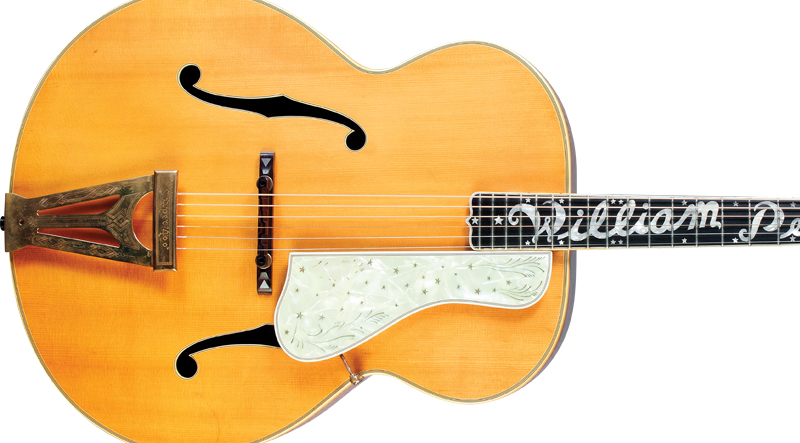
    This 1940 Gibson Super 400N was made for a genuine Texas cowboy and larger-than-life character named William Fulton Peale, Jr.

    Born in San Antonio on January 5, 1922, he was first cousin to Norman Vincent Peale, author of The Power of Positive Thinking. His father was successful in the oil business in Texas and left his son financially secure.

    As a young man, Peale was a competitive pistol shooter, and at age 40 transitioned to skeet shooting. He adopted an unorthodox stance, holding both elbows straight out from his sides, but still managed to qualify for several Sports Afield All-America teams in the late ’60s. He went on to an effective career in skeet shooting and in ’91 was inducted to the National Skeet Shooting Association Hall of Fame. Contemporaries remembered him as a great storyteller, especially when he reminisced about his early years in competitive shooting.

    Peale also enjoyed playing guitar. In early 1940, he ordered a blond Gibson Super 400N from the factory, and serial number 96242 was shipped to him from Kalamazoo on August 20. While the guitar is a beautiful example, Peale decided it needed something extra, so not long after purchasing the guitar, he returned it to Gibson, where it was customized with his name rendered in mother-of-pearl script inlay on the fingerboard, and small stars on the fretboard and its engraved white pickguard. Gibson returned it on February 17, 1941 – a quick turnaround (only six months) for such customization.

    In the years immediately before World War II, many instrument builders did not cut or inlay their own mother-of-pearl, even on production models. Instead, they depended on a network of companies that specialized in this work, most of which were in New York City.

    A Gibson MB-4 fretboard from the late ’20s shows how, instead of creating a pocket in the surface, the area to be inlaid was cut out completely. A mix of pearwood and sawdust was used to raise the inlay to level.

    From 1903 through 1929, Aumann Brothers, of Detroit, produced inlays for everything Gibson manufactured. Gibson would send blank (with fret slots) fretboards to Aumann. The brothers used manually powered stand-up jigsaws to cut intricate patterns from thin sheets of mother of pearl, typically creating seven or eight patterns simultaneously by stacking layers. The pearl was inlaid by tracing patterns on the fingerboard and drilling a small starter hole through the fingerboard, then cutting the rest using a jeweler’s saw. This method had the advantage of speed, but often resulted in a sloppy finished product that showed obvious filler around the edges of the inlay. Because wood had been removed, they had to support the pearl with filler underneath, as well.

    The fingerboards were returned to Gibson to be fretted, then stored as a sub-assembly.

    In 1930, Gibson began using Union Pearl Works, of Brooklyn, for primary production instruments, but until 1950 continued to use Aumann Brothers for custom orders. In a 2009 interview for Spann’s Guide to Gibson 1902-1941, Carl J. Stadler, nephew of Frank and Joe Aumann, recounted working in the shop during the late ’30s and early ’40s, including how it received a stream of special orders from Gibson.

    It’s also interesting that if a specific model was discontinued, Gibson did not discard the completed fingerboards (or other parts) intended for it. A good example is the L-Century flat-top produced from 1933 until ’39, which had a white-celluloid fingerboard with inlaid rosewood inserts which in turn had inlaid mother-of-pearl patterns. The rosewood inserts were produced by cutting up leftover tenor-banjo fingerboards, which in turn produced a variety of inlay pattern deviations from the L-Century’s catalog spec.
    Gibson found other uses for leftover fingerboards. When instruments requiring fret work were returned to the factory, it was easier to simply replace it using the discontinued stock; the replacement already had new frets, so it was a matter of dressing them and (if called for) re-binding. This practice resulted in bizarre combinations of inlay patterns.

    With the exception of the fingerboard and pickguard, the Peale Super 400 conforms to specs for the period, with an 18″ archtop body, carved Adirondack spruce top, f-shaped sound holes, figured-maple back and sides with natural finish, engraved Varitone tailpiece, three-piece figured-maple neck with center dark strip, “open-book” peghead with mother-of-pearl script logo and split-diamond inlays, sealed Kluson tuners with amber Catalin buttons, ebony fingerboard, heel cap with “Super 400” engraving, multi-ply binding on the top, f-holes, fretboard, and headstock, gold-plated metal hardware, and other typical appointments.

    Peale married late in life, never had children, and lived most of his life in Austin before dying there on January 15, 2008.


    This article originally appeared in VG March 2017 issue. All copyrights are by the author and Vintage Guitar magazine. Unauthorized replication or use is strictly prohibited.

  • First-Rate Second Fiddles

    First-Rate Second Fiddles

    No two ways about it, as his career hit stride, Jimi Hendrix was a Strat guy. Not famously loyal to any particular guitar going back to his days hustling chitlin-circuit gigs with Slim Harpo and Tommy Tucker, from the moment he could upgrade from the Supro Ozark and Danelectro of his youth to the Epiphone Wilshire he bought fresh out of the Army in 1962, the Fender Duo-Sonic used to back the Isley Brothers, to the Jazzmaster and Jaguar with Little Richard, Jimi always wanted the tool that best helped him channel the sounds in his head.

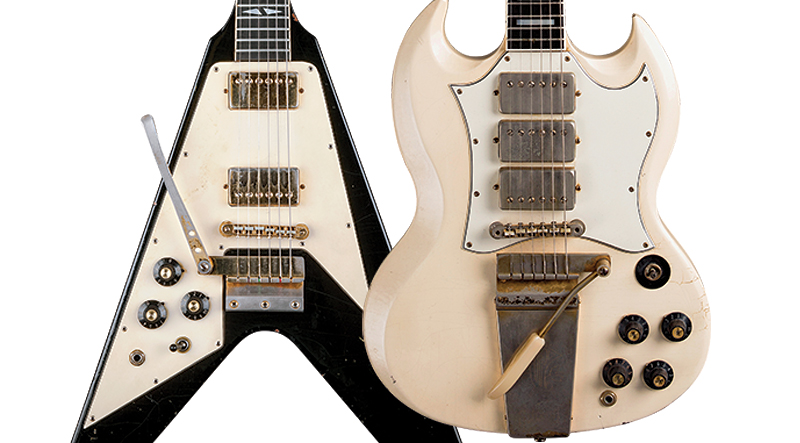
    ’67 Gibson SG Custom: Annie Darby, courtesy of Hard Rock Café. ’69 Gibson Flying V: Tina Craig, courtesy of Hard Rock Café.

    As he moved to center stage with his own Experience band in 1966, that tool was a Strat – and several that he used are now famous unto themselves, including the white one he played at Woodstock, the sunburst models he set aflame in the heat of performance, and the black ’68 with maple fretboard that was purportedly his favorite guitar and which he played the night of his death in September of 1970.

    Today, several of those Strats are in the noted collection of the Hard Rock Cafe – as are two Gibsons that are equally identifiable for their use at specific concerts.

    The Flying V bearing serial number 849476 was commissioned by Hendrix in 1969 and shipped from the Kalamazoo factory in 1970. He played it during his appearance at the Isle of Wight Festival in August of 1970, as well in the controversial 1971 film Rainbow Bridge, shot July 30 on Maui. The film includes 17 minutes of Hendrix with it, and while the footage is heavily edited it’s coveted by Jimi fans.

    Jeff Nolan, Hard Rock’s resident curator/historian, says most of this guitar’s cosmetic appointments were created per Hendrix specifications. It sports split-diamond inlays, a bound neck – both unusual for a Flying V from that period – a truss-rod cover from a Les Paul, and an ultra-thin three-ply pickguard. It also has a Maestro vibrato with a flat-mount base/string anchor bit, and lever with three holes that allowed for longitudinal adjustment. Word has it that it was on this instrument that the company first displayed a pearl-inlay Gibson logo on a V, was positioned unusually high on the headstock.

    Jimi owned three Flying Vs – a black ’67 he painted with “psychedelic” shapes and figures and used at the Paris concert during a 1967/’68 tour, as well as a ’69 in tobacco sunburst he played while awaiting delivery of this custom lefty.

    Jimi used this white ’67 SG Custom in 1968/’69, and is best known as the guitar he played for his appearance on the “The Dick Cavett Show” in September of ’69. After sitting for a bit of discussion with the host, Hendrix performed “Izabella” and debuted “Machine Gun.” 
The guitar has the Custom’s typical three humbucking pickups and was the instrument he frequently chose to perform “Red House,” including a 12-minute version in Stockholm on January 9, 1969. On the historic Isle of White version of the song from August of 1970, however, he played the custom Flying V. Many regard that ferocious performance as one of the finest examples of electric blues. Barely three weeks later, Jimi was gone.


    This article originally appeared in VG December 2016 issue. All copyrights are by the author and Vintage Guitar magazine. Unauthorized replication or use is strictly prohibited.