Tag: features

  • Reggie Young

    Reggie Young

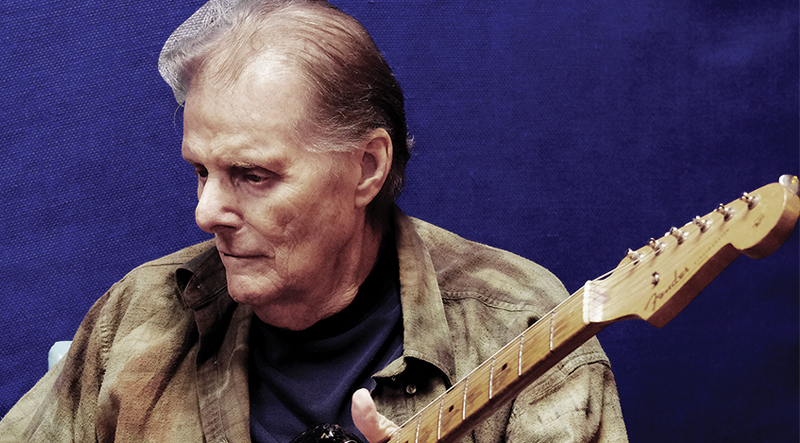
    After six decades as a session musician, guitarist Reggie Young has released his first solo album, Forever Young. A showcase of the soulful Memphis-style guitar playing, from its opening track, it offers the chord melodies, sliding sixths, bends, and amazing tone that made him one of the most revered and imitated guitarists in Memphis, Nashville, and Muscle Shoals.

    Though he began working on the album in his mid ’70s, it’s a showcase of his untarnished playing and taste that further cements his status as one of the most important guitarists of all time.

    What took this so long?

    People have been asking me for years to make an album, but I was too busy. I would be in the studio, and I started making up pieces of songs to use as warm-ups. Other players would ask me, “What is that?” and I’d respond that it was something I was messing around with. That really was where this all started. Then, I finally got all of the ideas together and decided to put them on tape.

    You spent the last four decades recording in Nashville. So why did you do the album at Muscle Shoals?

    I recorded down there quite a bit at Fame in the ’60s, and on other projects through the years. I also liked the LaLaLand studio down there because they have a Neve console. I also like the laid-back feel. Nobody is busy at their phone, wondering where they have to be next.

    Tell us about the players.

    Chad Cromwell played drums, David Hood played bass, and Clayton Ivey was on keyboards. They’re all guys I’ve played with for years, and we know each other real well. When we recorded the tracks, I was so busy producing the session that I was not happy with my guitar parts, so I ended up replacing them here at home with a recording engineer and my Deluxe Reverb in the next room. Then, I sent the tracks off to Jim Horn to add saxophone and flute.

    “Memphis Grease” features your bluesy playing in the A section and the Memphis-style double stops and then, in the B section, sliding sixths that you helped popularize. Did you intentionally quote part of your intro to “Son of a Preacher Man” at the end of the B-section?

    It wasn’t intentional; I guess it’s just part of my playing.

    Speaking of those flowery R&B double stops, where did that style originate? 

    I’m not sure. Not many people do that anymore. Even Steve Cropper doesn’t really do it anymore, and that’s why I wanted to do it. Years ago, I felt like I was copying Bobby Womack, but Don Was said I was doing that style before Womack was. Bobby was certainly a big influence on me, though. 

    Talk a bit about the gear you used on the album.

    My main guitars are a ’69 bound Tele and a ’57 Strat. The Tele has benders that Joe Glaser installed, a Bill Lawrence Strat pickup in the neck, Duncan Stack in the middle, and a Ron Ellis Tele in the rear. The Strat has Bill Lawrence noiseless pickups. My amp on the album was a ’65 Deluxe Reverb with a Celestion V30, or a Little Walter with an Ernie Ball volume pedal, a GE-7 to smooth things and add a bit of bass, and a Boss DD-6 for delay. I also used a TC Chorus and a Voodoo Lab tremolo and Sparkle Drive. 

    “Jennifer” features your work on volume pedal. When did you start using the volume pedal? 

    In the ’60s, I used to play instrumentals with steel guitarist John Hughey, in Memphis, and I liked the way he could drag notes out. None of the guitarist I knew of in Memphis or Nashville were using one at that time, so I decided to. “Jennifer” is dedicated to my wife, Jenny, who also played cello on the album.

    Are there personal favorites among the tracks you’ve played on?

    There are a handful, yes. Little Milton’s “Whenever You Come Around,” the Highwaymen’s “The Highwaymen,” Dobie Gray’s “Drift Away,” Merle Haggard’s “That’s the Way Love Goes” and “Think I’ll Just Stay Here and Drink,” and I especially liked my solo on “It Always Will Be” from Merle’s album, Chicago Wind. It was overdubbed with Merle, Lee Sklar, Mike Post, and Jimmy Bowen watching me. I told them, “I don’t have a clue what I am going to play,” and then I played the solo heard on the album.


    This article originally appeared in VG August 2017 issue. All copyrights are by the author and Vintage Guitar magazine. Unauthorized replication or use is strictly prohibited.
  • Glenn Phillips

    Glenn Phillips

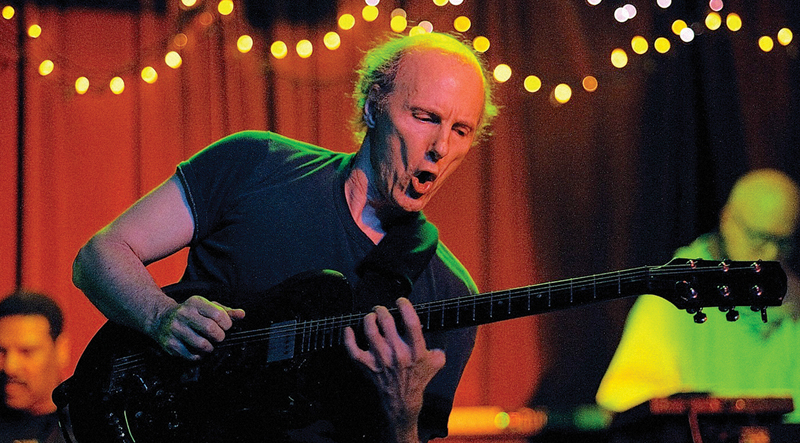
    Glenn onstage circa 2012.

    For more than 40 years, Glenn Phillips has been an underground hero of the guitar. His solo albums, unusual choices of gear, radical effects usage, and wild live shows broke the mold of guitar heroics. Phillips’ At the Rainbow, taped live in London in 1977, has just been released, and it’s a brilliant document of his instrumental acrobatics. We recently checked in with the Atlanta-based axe legend.

    What do you remember about the ’77 UK tour?

    I was a opening for Steve Hillage, and the Rainbow was the last date. The album was recorded on the Rolling Stones’s mobile studio, which was also used to cut Exile on Main Street and most of Led Zeppelin’s III, the fourth album, and Physical Graffiti. Before the tour, I did a couple of warm-up dates in London, one with the Troggs, who did “Wild Thing” and also an infamous bootleg tape of them bitching and moaning in the studio. That tape went on to inspire the movie Spinal Tap, and I got to hear some of their grousing in-person when we shared a dressing room.

    How did you find a following in the U.K.?

    When my first group, the Hampton Grease Band, broke up in ’73, I started working on solo material and sitting in with Little Feat when they played Atlanta. Lowell took a tape of my solo material to Warner Brothers and they decided to sign me. Unfortunately, I was still signed to Frank Zappa’s manager, Herb Cohen, who was suing Frank and the label. When Herb discovered Warner Brothers wanted to sign me, he demanded $100,000 for my contract and that was the end of my deal. Instead, I recorded Lost at Sea and somehow, DJ John Peel started playing it on BBC radio, and when Melody Maker held a reader’s poll, Lost at Sea finished second. This led Richard Branson to fly over from England and sign me to Virgin Records.

    Phillips in 1968, playing a Flying V with the Hampton Grease Band.

    Who’s your primary guitar influence?

    Although Mike Bloomfield isn’t as widely known as Hendrix today, in his heyday he was considered the most influential guitarist of his generation. Mike’s work on the first Paul Butterfield Blues Band album spurred white kids across the country to play the blues, and the improvisational 13-minute title cut on East West was the blueprint for the entire jam-rock movement. Go back and listen to the debut album of just about any California psychedelic band of the ’60s, and you’ll hear Bloomfield’s influence.

    Mike even drove the guitar market. When he played a Telecaster on the first Butterfield album, everyone wanted one, including me. When he played a goldtop with P-90s, it suddenly became the sought-after guitar. And when he switched to a sunburst ’59 Les Paul on the Electric Flag album, those values shot through the roof.

    Over the years, you’ve shared the stage with the Grateful Dead, Allman Brothers, and Zappa.

    I’ve had the good fortune to play with many iconic acts. One weekend, we played with Zappa and the Mothers at the Fillmore East, and John and Yoko sat in with them; I was in Frank’s dressing room, jamming with him, when they arrived. I did shows with Peter Green’s Fleetwood Mac, Pink Floyd, B.B. King, toured with Captain Beefheart and Roy Buchanan, and done a week’s worth of dates with Muddy Waters. I even got to back some of my early heroes like Bo Diddley and Albert King.

    Your choice of gear is pretty unusual.

    I was drawn to the Gibson L-6S because it felt good in my hands, though I ended up modding it extensively. As for the MXR Pitch Transposer, I got one when they first came out in the late ’70s and used it regularly through the ’90s. I’ve been told I’m the first guitarist to use a pitch shifter for up-and-down pitch jumps.

    How is the L-6S modded?

    I stripped it of every part then re-built it from the ground up. I had the fretboard flattened and re-fretted, replaced the tuners and pots, and put in an original Gibson PAF in the neck and a Fender Telecaster bridge pickup that I recently switched to a G&L pickup. I also installed a Jazzmaster vibrato, which required drilling a hole all the way through the body. But the first two guitars I ever owned were a ’50s Tele and a ’61 SG, and since then I’ve wanted a guitar that was a combination of my favorite aspects of the two. To me, that’s my L-6S.


    This article originally appeared in VG August 2017 issue. All copyrights are by the author and Vintage Guitar magazine. Unauthorized replication or use is strictly prohibited.

  • Gretchen Menn

    Gretchen Menn

    Gretchen Menn: Max Crace

    Every musician aspires to create music that will resonate through the ages and Abandon All Hope, by Zepparella guitarist Gretchen Menn, is an ambitious effort based on Dante’s Alighieri’s Inferno. Rich in melody and concept, the album weaves her melodic sensibilities amidst violin, cello, and viola via beautiful scores composed by Menn and joining nylon-string polyphony with soaring rock guitar.

    The disc tells the story of the journey through Dante’s underworld, led by Menn’s exceptional guitar playing.

    How did this come together?

    I’d been thinking about combining music and literature when Michael Molenda (editor of Guitar Player) pitched the concept to me. One of the challenges with instrumental music is that it’s so abstract it can be isolating. I’ve often thought that by giving people something more visual, directly or through concept, it ends up being less abstract.

    When I sat with Mike, I assumed he was going to say what everybody says, “Why don’t you sing and make a pop record?” But he laid this sheet in front of me: “Proposal Idea. Gretchen Menn – Dante’s Inferno: Journey in Eleven Different Musical Modes.” I was like, “I’m in (laughs)! You don’t have to tell me anything else!” It was coincidentally along the lines of what I’d been thinking. I was a music major, but literature goes just as far back for me. The idea of combining the two was obvious, but what Mike came up with was a slam-dunk. I looked at the concept and knew exactly what I was going to do. It was going to take a long time, and I had to get my orchestral and orchestration chops beyond what I had, even though I’ve been studying with a composition teacher. It took me about three years to compose everything between gigs and normal day-to-day stuff.

    How did producer/guitarist Daniele Gottardo come into the picture?

    I met him through a mutual friend. I’d heard his cover of the “Simpsons Theme” and stuff from his album, Non Temperato, and it blew my mind. It’s one of the best guitar records I’ve ever heard, especially for the sophistication and harmonic depth. It’s no wonder Steve Vai said he’s his favorite up-and-coming guitar player. We worked on my scores and producing a string quartet in Italy. Half the album was done in Italy.

    The relationship between violin and distorted electric guitar is beautiful.

    I have to credit Daniele for a lot of it. He was elevated from string co-producer to co-artistic producer because he was the only person I knew who had done an entire album blending electric guitar with classical instruments. There are tonal considerations, orchestration considerations… it’s a unique world. Having his experience was incredibly helpful.

    “Tombs” is a great example.

    I’d get tracks I was really happy with, and adjust guitar parts. I spent a lot of time trying to do complimentary vibrato, which is a great lesson. If you want to learn about vibrato, try to emulate classical string players.

    “Grace” has so much emotion.

    It was the last thing I wrote, so I got to do something different. It didn’t have to be infused with darkness; I wanted something with a different philosophical message. At that point, I was also four years more experienced as a composer. Some pieces have an easier flow, and that was one where I knew what I wanted.

    Which guitars did you use?

    My Ernie Ball Music Man Silhouette Special, a Les Paul on “Beast” and “Hounds Of Hades.” For the classical parts, a Kenny Hill Ruck guitar – it’s the one on “Lake Of Ice” and “Grace.” Except for “Limbo,” I tracked everything at my house and re-amped it. I used my Engl SE 670 with EL34s. It’s the best amp ever. 

    What’s next?

    I have a lot of ideas and it’s always a question of where to focus the energy. I’d love to play Abandon All Hope live, but I want to do it properly. Zepparella is booked until the end of the year, so I’ll be fighting for time to write.


    This article originally appeared in VG August 2017 issue. All copyrights are by the author and Vintage Guitar magazine. Unauthorized replication or use is strictly prohibited.

  • Punky Meadows

    Punky Meadows

    Punky Meadows: Danny Sanchez

    In the 1970s, glam-rockers Angel carved a niche with five albums of arena-rock anthems and an image that stood in antithesis to their Casablanca label mates, Kiss. After retiring from the music business in the ’80s, guitarist Punky Meadows returned last year with his first solo album, Fallen Angel.

    What have you been up to since Angel?

    After Angel, Gregg [Giuffria] and I put together variations of the band and shopped deals, but things didn’t pan out. So I went back East, opened some businesses that did really well, got into the stock market and had some properties. After selling them and my businesses, I went completely into the stock market, then retired from everything and lived in North Carolina. 

    Two years ago, I did an interview with Keith Roth’s “Electric Ballroom” show on WRAT radio, and it crashed their website! Keith said, “In 17 years interviewing everybody from Jimmy Page and Robert Plant to Keith Richards, I’ve never seen that happen.” I was dumbfounded – and I started getting record offers. I signed with Mainman and recorded Fallen Angel. Danny Farrow and I started writing, and we had great chemistry. I’m really a blues guitar player – I grew up on all the English blues players – Beck, Clapton, Page, Gary Moore, David Gilmour, and Hendrix, who of course wasn’t English but went to England to make it. But I love pop music, heavy rock, and country music, too. My tastes are pretty varied. 

    What gear do you use?

    I have a hybrid I put together. I love Carvin guitars, and I think they make the best single-coil pickups ever – really nice wet, Stevie Ray/Hendrix tone with the neck pickup. So, it has a Carvin neck and I carved the headstock like a Tele. It has a Strat body and Super-Vee vibrato, which is great, and a Mag-Lok that’s great because I’m into country, and love doing double-stop bends. When you bend strings, it holds the bar steady. But when you push it down, the magnets come apart and you can use the bar and it stays in tune. 

    I also have an actaul Carvin guitar that’s all over the record, and an old Yamaha DG100, which is a great-sounding amp that sounds like a tube amp. I used that in the studio for everything. 

    What are your thoughts on Frank Zappa’s song, “Punky’s Whips,” which was inspired by a publicity photo of you? 

    That was actually very cool. If people take it the wrong way and think it’s a put-down or an insult, well, Frank has always been a satirical writer. Growing up, I had a friend who was a big Zappa fan. We used to go to his house after I played a club, smoke a joint, listen to Zappa, and go, “Man, the dude is a genius. He’s amazing.” So, one day, we’re sitting in my manager’s office in L.A., and my manager goes, “Listen, Terry Bozzio – the drummer for Frank – wants to write a song about you.” I said, “Sure, man. I have friends who are crazy about Frank Zappa.” 

    So, they wrote the song and sent us a tape. We listen and I go, “Wow… That’s cool!” They said, “Frank is playing at Pauley Pavilion and would like you to come up onstage in full outfit and play the last song with him.” 

    That song was actually called “Punky’s Lips” because our first publicity photos for Casablanca showed me biting the inside of my lip, but it looked like I was puckering up. It started a little firestorm, and Zappa decided to write a song about that. So, Zappa wanted me to play, and I said, “Yeah. I’ll do it.” But the other guys in the band got jealous, so Zappa invited us to the show and put us in the front row. We’re watching, and there’s this big black scrim up behind the stage. Two flashpots go off, the scrim drops, and there’s that huge picture of me up there! We go backstage, and he says, “Hey, you’re a really good sport. You should come over to my house sometime, and we’ll write some songs.”


    This article originally appeared in VG August 2017 issue. All copyrights are by the author and Vintage Guitar magazine. Unauthorized replication or use is strictly prohibited.

  • Steve Hillage

    Steve Hillage

    Steve Hillage has followed his muse through 40 years making music as a member of the psychedelic band Gong, a solo career, and a partnership with Miquette Giraudy as the dance band System 7. 

    His style includes extensive use of echo, which he “stumbled across” while messing about with his home tape recorder.

    “My older cousin was an electronics freak and showed me a way to do tape echo,” he said. “I resolved to get an echo box; in 1968 there were just two on the market in London – the Watkins Copicat and the Binson Echorec. I opted for the Copicat and enjoyed setting it at the slowest settings and working out rhythmic riffs in time with the echo.” 

    Echo gave him “…instant sense of space and psychedelic dreamscape adventure,” he added. “It became an inseparable part of my own sound, and remains so. But my style is also about scales, modes, and phrasing.”

    Hillage hooked up with Gong in the early ’70s and the band recorded for Virgin. He also played on a 1973 live rendition of “Tubular Bells” by label mate Mike Oldfield. “I was his replacement in the Kevin Ayers band before I joined Gong. He’d left Kevin to work on the album that became Tubular Bells.”

    Hillage’s guitars at the time included a few Gibsons and a Stratocaster.

    “The first top electric guitar I owned was a Strat I acquired in ’67, when I was 15,” he said. “It was white, but I took the paint off and left it natural. 

    “In ’74, I got Les Paul and an SG. The Les Paul was black, but again I had the paint taken off. I got the Gibsons while preparing my Fish Rising album while I was in Gong. For the next few years, I switched guitars depending on the sound I was going for.”

    Hillage left Gong after the release of Fish Rising, which also resulted in his becoming a producer. 

    Since the early ’80s, he has relied on a Steinberger.

    “I was aware of Steinberger basses and eagerly anticipated their six-string. When I eventually picked one up and started playing, I bought it on the spot. At that time, I was concentrating on producing, and the Steinberger opened new vistas. I became so committed that I eventually sold my other solidbody electrics.”

    Hillage’s boxed set, Searching For The Spark, is a career-spanning collection. It includes 22 discs, a coffee table book with hundreds of photos, poster reproductions, and other memorabilia. Among the discs are recordings in early bands Uriel and Khan, all eight solo albums, recordings for other labels, four discs of live performances, and four of previously unreleased alternate takes, demos, etc.

    “I wanted to tell my whole story – how I developed from teenage psychedelic guitarist to record producer and eventually dance music in the late ’80s.

    “Whether this will lead to live Steve Hillage Band shows in 2018, I’m not sure yet,” he said. “My current plans involve System 7, which has a new album in the works, as well as remix projects and a stack of live shows this year, including many festivals.”


    This article originally appeared in VG August 2017 issue. All copyrights are by the author and Vintage Guitar magazine. Unauthorized replication or use is strictly prohibited.
  • Marty Stuart

    Marty Stuart

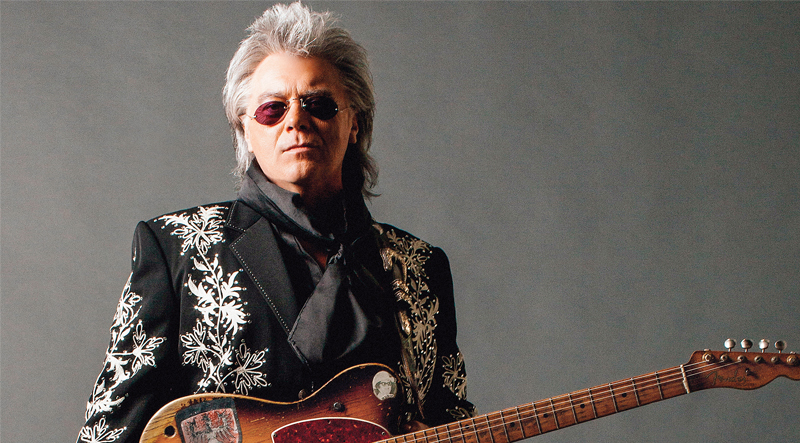
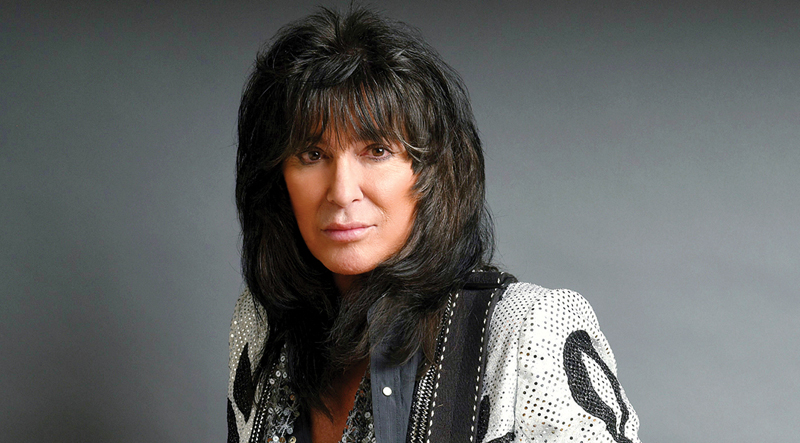
    For 30-plus years, Marty Stuart has blended traditional country, rockabilly, and honky-tonk into a potent mix. Following stints as a sideman with Lester Flatt, Vassar Clements, and Roland White, he was a breath of fresh air in Nashville in the late 1980s. 

    These days, Stuart is on a roll, fronting The Fabulous Superlatives, releasing well-received albums, touring, and hosting “The Marty Stuart Show” on RFD-TV. Stuart has also built a phenomenal collection of country music memorabilia, including Clarence White’s sunburst Telecaster, the first guitar equipped with a B Bender (VG, April ’04). Stuart’s latest album is Way Out West. 

    Beyond Clarence White’s Tele, you use other guitars formerly owned by well-known pickers.

    Yes, my go-tos are Johnny Cash’s ’39 Martin D-45 and Pops Staples’ rosewood Tele.

    You’ve also earned praise for your collection of country-music memorabilia.

    I started that from my bedroom at my parents’ home in Philadelphia, Mississippi. I’d buy records and get autographs, buy autographed 8x10s, and ask band members for guitar picks. Later, when I was in Lester Flatt’s band, they’d throw away set lists or neckties with too much makeup after too many TV shows, and I’d ask for them. In the ’80s, the treasures of old-time country music were being thrown away in thrift shops and yard sales around Nashville. To me, it was a sin, so I started buying, trading, and swapping. The Marty Stuart Center and Congress of Country Music Hall is now being designed, and funds are being raised for a permanent display there. We have over 20,000 items, including Johnny Cash’s first black performance suit and Hank Williams’ hand-written lyrics to “I Saw The Light.”

    What’s in your current rig – amp and pedals?

    I play a silverface Fender Deluxe I bought from Studio Instrument Rentals (SIR) in Los Angeles. It’s a dream amp – the finest I’ve ever owned. I have a power boost pedal, and that’s all I use. 

    What was the motivation for a concept album about the Mojave Desert?

    Way Out West is a cosmic journey through the Mojave, set to a “twangified” end of rock-and-roll and country music. It’s a very cinematic record, and the Mojave seemed like the perfect setting. The sky’s the limit out there. If you can think up a good song and story line, the Mojave is a great location to place it.

    The Fabulous Superlatives is full of great players. Obviously, you love working with them

    It’s a dream band, hands down. We’re 17 years old now, and it’s the most fun I’ve ever had playing music, period. I originally saw Kenny Vaughan playing with Lucinda Williams on “Austin City Limits” and loved his playing. I’d been working with Harry Stinson on drums, so we got him. I knew from the first rehearsal that this was a divinely ordained band. I’m not smart enough to have put this together!


    This article originally appeared in VG August 2017 issue. All copyrights are by the author and Vintage Guitar magazine. Unauthorized replication or use is strictly prohibited.

  • Fender PM-2

    Fender PM-2

    Price: $599.99 (list)
    Info: www.fender.com

    Once wildly popular among everyone from drawing-room dilettantes to road-hardened bluesmen shuffling the dusty byways, parlor-sized guitars fell out of favor mid-century when popular ensembles demanded the volume better provided by big-bodied dreadnoughts.

    The last several years, however, have seen a rebirth of the parlor segment – everything from well-built econo boxes that appear ripped from the pages of old Monkey Ward catalogs to luthier-crafted customs. While the Fender PM-2 Parlor’s price falls closer to the econo side, its materials and build might leave some silently wondering if the bean-counters in Corona forgot a digit.

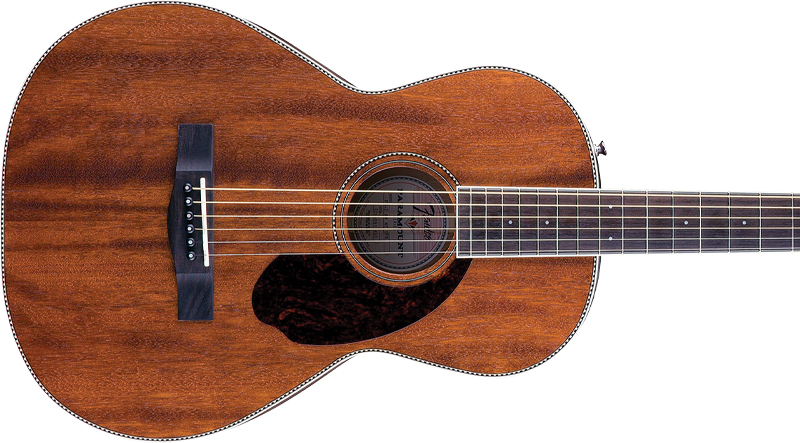
    Out of its included hardshell case, the all-mahogany PM-2’s most noticeable features are its satiny open-pore solid top and sides. The finish is billed as Natural, but owing to the mahogany, it’s a dark hue wonderfully accented by checkered purfling and rosette, and abundant aged white binding from body to headstock, the latter of which is tastefully tarted up with a mother-of-pearl “Fender” logo and decorative inlay and open-gear tuners.

    The PM-2’s playability lives up to all those good looks. The comfortable C-shape neck (also mahogany) boasts rolled edges, and its rosewood fingerboard is kitted with Fender’s skinny “vintage-style” frets.

    The PM-2 arrived with a light, buzz-free action all the way down its 24.75″ scale, from the bone nut to the neck’s junction with the box at the 12th fret. It also gave lie to the old saw that parlors are diminutive of voice; no doubt that light finish helps.

    Characteristic of many parlors, the PM-2 is midrange-forward, but fingerpickers and front-porch strummers alike will easily drive the top end and get plenty of volume out of those tasty low-string runs and hammer-ons. In all, an incredible value.


    This article originally appeared in VG July 2017 issue. All copyrights are by the author and Vintage Guitar magazine. Unauthorized replication or use is strictly prohibited.
  • Strymon’s Riverside Multistage Drive

    Strymon’s Riverside Multistage Drive

    Price: $299 (street)
    Info: www.strymon.net

    At first glance, the Strymon Riverside Multistage Drive doesn’t look much different from the rest of the herd. But dig deeper and you’ll find this is not just another overdrive pedal.

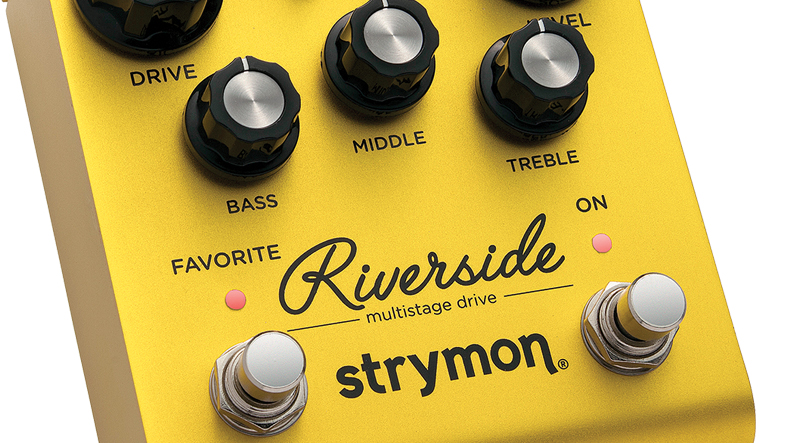
    For controls the Riverside features quite an array: multistage Drive knob with a Low/High Gain toggle; output Level knob; Normal/Mid Push switch; Bass, Middle, and Treble EQ; three-position Presence switch; true-bypass (via relay) On/Off footswitch; and Favorite footswitch.

    Connections are made via mono 1/4″ input and output jacks and TRS 1/4″ jacks for external Boost footswitch and expression pedal. Power is via a standard 9-volt DC input jack with either the included AC power supply or pedalboard power supply (no internal battery option). As with other Strymons, certain features – like Noise Reduction Threshold, Bypass Mode Selection, Boost Mode, and Expression Pedal Mode – are accessed by holding down multiple switches simultaneously and manipulating controls.

    The Riverside was tested with a couple of 1×12 tube combos and both single-coil- and humbucker-equipped guitars.

    The Riverside delivers a very musical overtone-saturated overdrive, thick with layers of complicated tube amp-like harmonics while remaining remarkably articulate even in the highest gain/drive settings. It responds nicely to pick attack and guitar volume changes, cleaning up easily with no loss to clarity or losing high-end sparkle.

    The Riverside’s EQ circuit is well-voiced, offering up optimal post-drive tone control without over-coloring its transparent characteristics. The pre-drive midrange boost Push switch is ideal for a smooth bump to the midrange and a bit more percussive overdrive. The Favorite switch is another great go-to – just hold it down for a few seconds and it saves all current settings, including the noise reduction.

    The Strymon Riverside is an easy-to-use high-quality overdrive with a useful set of controls. Best of all, it sports a very musical overdrive tone, rich with complex overtones.


    This article originally appeared in VG July 2017 issue. All copyrights are by the author and Vintage Guitar magazine. Unauthorized replication or use is strictly prohibited.

  • BC Audio Grand Prix 100

    BC Audio Grand Prix 100

    Price: $3,600 (list)
    Info: www.bcaudio.com

    For the past few years, builder Bruce Clement of BC Audio has been getting attention for his killer-sounding and meticulously wired tube heads and matching cabs. New for 2017 is his first two-channel head, the Grand Prix 100.

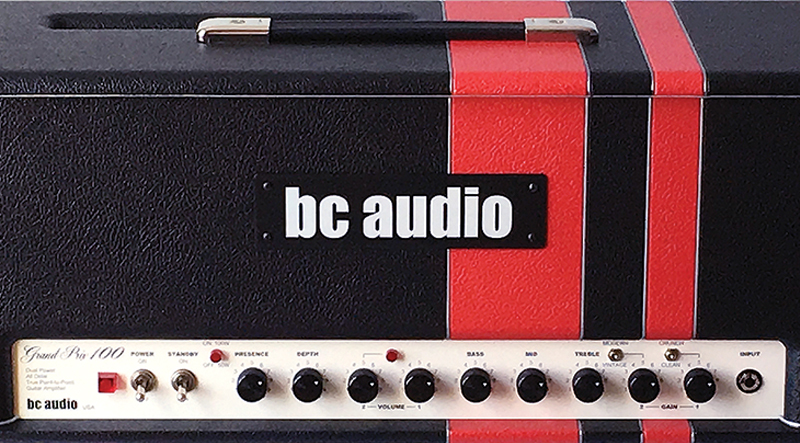
    The amp has an all-tube signal path and point-to-point wiring. Tube-o-philes will further dig the paper-bobbin transformers, zinc-coated steel chassis, and the overall heavy-duty construction, ready for the harshest gigs. There’s also a series effects loop for time-based and modulation stompboxes, including preset Send and Return levels for pedals – just plug ’em in and go. And not only does the Grand Prix 100 have two channels, it has a Dual Power feature that doubles the output from 50 to 100 watts at the tap of a footswitch. Those who play solos, will see the obvious allure.

    Inside there are three 6SL7 preamp tubes of an eight-pin “octal” design. Clement likes octals because they’re rugged and behave more like power tubes when they’re pushed. Rather than merely adding distortion, they transition from clean to dirty in a smoother, more organic way. 

    For output, there are four EL34 tubes, which are the crux of the Dual Power function. When the Grand Prix is in 50-watt mode, two of the EL34s are on. Kick it to 100 watts, and all four spring into action, delivering an extra three dB of output, which is substantial.

    On the front, look for tools to shape volume and tone, but perhaps not in a familiar sequence. From Power and Standby on the far left, you move into the power section. Use the Presence and Depth controls to jimmy the tone of the EL34s in the higher and lower frequencies (Depth, for example, can give a thin-sounding guitar more beef or make a smaller cab sound larger). Further right are each channel’s master volumes, followed by a three-band EQ. Finally, at far right, two Gain knobs deliver the preferred clean-to-crunch ratio. Above are two switches: Modern and Vintage for channel 2, and Crunch and Clean for channel 1. There’s also a simple, all-metal footswitch to jump between channels and – most crucially – to flip on those aforementioned EL34s.

    Plugged in, the Grand Prix 100 is a serious but absurdly fun amp. There are a lot of power-amp tones inside, specifically that stacked-flavored “thump” that can make the hair on your arms tingle. Better still, there’s everything from pure clean to California crunch in here, plus all the classic British amplification one could ask for. On the heavier side, channel 1 delivers authentic Angus and Keith overdrive, while channel 2 takes you well into Eddie and Kirk saturation – and then some.

    You can certainly introduce an overdrive pedal if you like, but really, the Grand Prix doesn’t require any external help in the gain department. It will cover any gig imaginable. And the 50/100-watt function works great at all volume levels. You can even use 100 watts at lower volumes for super-crunchy sounds that won’t wake the neighbors. (Keep in mind that the amp defaults to 100 watts when the footswitch is unplugged.)

    The Grand Prix 100 joins the rest of BC Audio’s line as a tour de force design. Sure, it’s priced on the higher end, but this is a hand-wired, premium tube head. Tone this sumptuous is worth every penny.


    This article originally appeared in VG July 2017 issue. All copyrights are by the author and Vintage Guitar magazine. Unauthorized replication or use is strictly prohibited.

  • Volt Electrics #004 Reverse

    Volt Electrics #004 Reverse

    Price: $3,711.34 (list)
    Info: www.voltguitars.com

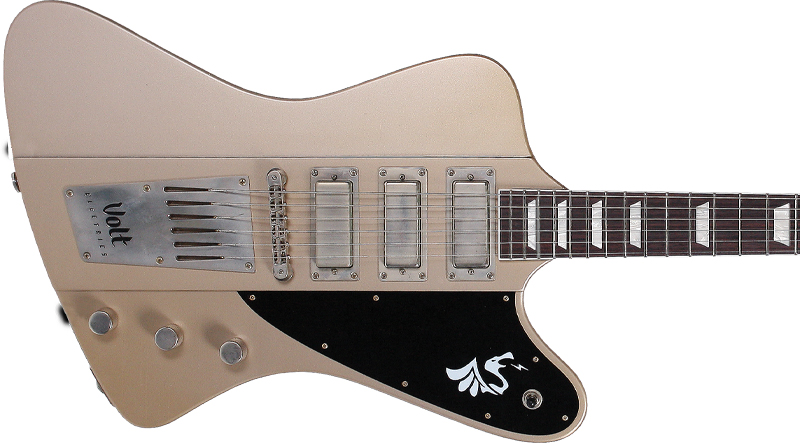
    From Johnny Winter and Stephen Stills to Scott Holiday, the Firebird has been turning heads since the early ’60s. Builders Sander de Gier and Ewout Nijman out of the Netherlands are two guitar freaks with a jones for old-school looks and modern appointments. They have a thing for Firebirds too.

    Their first series for Volt Electrics is a tribute to that venerable guitar. The #004 Reverse features the same cool backward Ray Dietrich design, but with some nifty modifications. The review model came in Shoreline Gold Metallic with light aging. Rock solid, its flawless nitrocellulose lacquer finish, retro styling, and workmanship, will encourage hours of boutique-level quality note density. The guitar’s light weathering and cracking is subtle. Tiny scratches and dings on its mahogany body and an aged matte patina on the nickel hardware give the #004 a mature appearance. 

    Its bolt-on one-piece maple neck comes equipped with a small wrench, and the rosewood fretboard, 22 Jescar 55090 frets, and Gotoh tuning pegs combine to make this a special instrument. With its clean block inlays, compound radius, medium C neck, 25.2″ scale length, and 1.67″ at the nut, the Reverse #004 is geared for players who like a handful. It sports a Master Volume knob, two Tone controls, three Lollar Firebird pickups, and an ABM tune-o-matic bridge. A black headstock gives the overall look a finished appearance.

    Running through a variety of rigs, the Reverse yields classic colors with a mix of nasal spankiness and bite. It runs the gamut from hard rock to jazz, and the upscale pickups have enough complexity to handle any measure of saturation. The three-pickup configuration offers a plethora of tonal variation, and the overall feel is solid, consistent, and inspiring. From ’60s rock to modern heavy rock, the Volt Reverse is a special guitar that improves upon an already great design.


    This article originally appeared in VG July 2017 issue. All copyrights are by the author and Vintage Guitar magazine. Unauthorized replication or use is strictly prohibited.