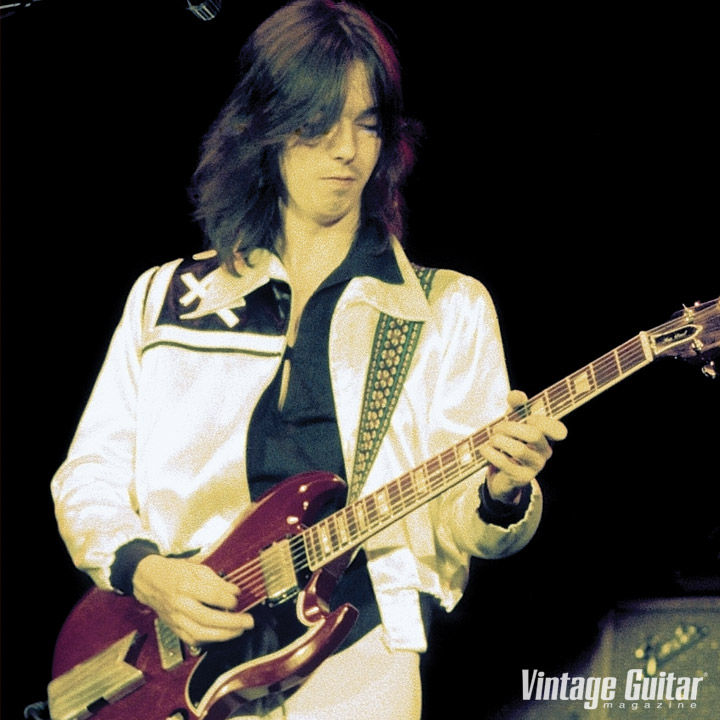
Jimmy McCulloch and his red SG onstage with Wings, September, 1976.
When a former Beatle name-checks you before a guitar solo on your very first recording with the band, you must be special. And Jimmy McCulloch was, as evidenced by Paul McCartney’s exuberant “Take me down, Jimmy!” on Wings’ 1974 single “Junior’s Farm.” The Scottish guitarist, who was 26 when he died in 1979, is the subject of this solid biography by Paul Salley.
McCulloch earned accolades as a teenager, playing with Thunderclap Newman on the 1969 hit “Something in the Air
.” He was a member of Paul McCartney & Wings from 1974 until ’77, playing on several hit albums and live smash Wings Over America. For trivia, McCulloch was invited to join David Bowie’s group the same day he got the Wings offer. He once left to join the James Gang, desiring a real touring band, but returned after Linda McCartney offered him a proper weekly wage. Post-Wings, Jimmy played with Steve Marriott in a reformed Small Faces.
McCulloch is described as a professional when sober, but possessing demons of drink and drugs; his death was listed as an accidental overdose. Fortunately, there’s ample info here about Jimmy’s gear, including his famed red Gibson SG. Best of all, his story is untold no longer.
This article originally appeared in VG’s January 2022 issue. All copyrights are by the author and Vintage Guitar magazine. Unauthorized replication or use is strictly prohibited.
Fifty years ago, singer/songwriters like James Taylor, Carole King, and Jackson Browne were busy conquering the rock charts; behind them, you could hear crack guitarists like Danny Kortchmar and Waddy Wachtel, along with bassist Lee Sklar and drummer Russ Kunkel. Today, these gents have formed a band called Immediate Family and released a self-titled album. VG checked in with Kootch about the get-together.
You’ve known each other for decades. Why form a band now?
I was offered a solo deal from a Japanese label, so I thought about who I’d want to play with on an album. I knew that Lee, Waddy, and Russ were some of the most in-demand musicians in the world, and amazed to find they were in town. Later, as we played more and more, I realized I wanted us to be in a band. So we toured Japan, which solidified the Immediate Family’s identity, plan, and future.
How do you and Waddy divvy guitar parts?
Waddy and I have very different sounds and approaches on guitar. We’ve played together so long that we don’t have long conversations about who’s going to play what; we listen to what the other is doing and it falls into place. Our interplay on “Divorced” is really cool – we put it together in a room and it’s all about complementing each other’s part. Our third guitarist, Steve Postell, fingerpicks beautifully and fills out the sound above what Waddy and I are doing.
What gear are you using?
The most-vintage guitar would be my thinline Telecaster from 1968. I was in a band with Carole King called the City, and my gear got stolen. Producer Lou Adler, being the generous guy he is, set me up with another couple of guitars, one of which was this Thinline. I played it on Tapestry and Sweet Baby James, and it was originally modified by Jeff “Skunk” Baxter when he was working as a guitar repairman back in the day.
I also have a G&L Doheny that I like very much, a newer Telecaster with Sheptone pickups, and a Demeter boost installed by Bill Asher.
I’m using a Fender Chris Stapleton Princeton amp – even though it only has one speaker and 15 watts, it makes a hell of a racket!
Speaking of Carole King, Tapestry was made half a century ago. What do you remember about the sessions?
Those sessions went very smoothly and quickly. We were at A&M Studio B, cutting two and three tunes a day. Everyone knows what a brilliant songwriter Carole is, but she’s also an articulate arranger and producer. Basically, what she wanted from me was what I already do on guitar. In the studio, Lou had us all set up close together to make it a more-intimate situation while the great recording engineer Hank Cicalo was in the control room; it was his idea to turn the lights off in the booth, so when we were recording, we weren’t distracted. It created a great atmosphere for us to get down and record those very intimate, wonderful songs.
Your playing on Sweet Baby James contains plenty of funk, blues, and R&B.
Producer Peter Asher, in his wisdom, knew he had to pare down the instrumentation, so James’ guitar and voice wouldn’t be overpowered. As for the blues and R&B fills, well, that’s me. We recorded at Sunset Sound and I used the Tele Thinline with an old Princeton amp.
Your great solos in Jackson Browne’s hit “Running On Empty” were chord figures, not single notes – the perfect foil for David Lindley’s lap-steel.
During the rehearsals, I was trying a lot of different things to find my place. I started playing the chord licks and Jackson said, “Oh, that’s great. You have to do that every time.” So in a lot of my solos, I used double-stops and triple-stops because it’s more powerful, obviously. Three notes are better than one!
You’re 75 and about to go out on tour with Immediate Family. Some people wonder what motivates a musician to keep touring.
Basically, that’s what we do. We play music and, for guys like us, this is our life. I don’t see music as a business or as a gig; I see it as a way of life, like a religion almost… a way of being. As a result, our lifeline is to play in a rock-and-roll band in front of an appreciative audience. There’s nothing like that in the world.
Do you envision a future where an 85-year-old Kootch might have a tour opportunity and totally go for it?
Well, I don’t know about a tour opportunity; I might be sitting down by then, but I’ll be playing. I’ll be playing and composing music if I can, doing whatever I can do at that juncture. Trust me – I’ll have a guitar in my hand.
This article originally appeared in VG’s January 2022 issue. All copyrights are by the author and Vintage Guitar magazine. Unauthorized replication or use is strictly prohibited.
Carlos Santana’s creative drive is obsessive, restless – and relentless. For his latest album, Blessings and Miracles, he pooled the cosmic energy of his wife (renowned drummer Cindy Blackman Santana), son and daughter, and a short list of superstar guest artists.
Blessings and Miracles is an extension of the 2019 album, Africa Speaks; in 10 hyper-creative days during those sessions, Santana recorded 49 songs with producer Rick Rubin and Guinean singer Buika. Obviously, good stuff had to be left on the table, so when the pandemic nixed a 2020 tour, his focus turned to the unused tracks.
“It all happened very organically,” Santana noted. “With Africa Speaks, there wasn’t a single within 500 miles, because that wasn’t the purpose. This time, I wanted to do the opposite – reach the four corners of the world and touch a lot of people’s hearts again, like [1999’s] Supernatural. So we ventured, with our intentionality, to create a radio-friendly, guided music purpose.”
Deciding who to invite was a combination of Santana’s personal wish list and advice from band members, family, and his record company.
“I wanted a think tank. I said, ‘I want to get back on the radio. Give me the names of those who have their finger on the pulse right now.’ Chris Stapleton was one of the main ones. I said, ‘Let’s call his manager and find out if Chris will have eyes to write a song with us or for us.’ He called, and asked, with specificity, ‘What kind of music do you want to do?’ I said, ‘I want to create music like Bob Marley – mystical medicine music to heal, and alleviate a twisted, crooked world infected with fear and darkness.’ He was like, ‘Oh, that way.’ I said, ‘Yeah.’ He said, ‘I’ll get back to you.’ After a long conversation, he took elements from that and sent a song, ‘Joy,’ which is the opposite of fear.”
Stapleton was later joined on the list by legendary vocalist Steve Winwood, Matchbox Twenty’s Rob Thomas (with whom Santana had crafted the 1999 mega-hit “Smooth”), jazz legend Chick Corea, Metallica guitarist Kirk Hammett, Living Colour singer Corey Glover, and others.
Santana: Roberto Finizio.
“I was in the studio with Narada Michael Walden, doing the basic tracks of (Procol Harum’s) ‘A Whiter Shade of Pale’ for Steve Winwood, and he says, ‘Hey, a good friend of mine, Diane Warren, is an incredible writer. She wrote a song and wants to know if you want to play on it.’ She sent it, and it was the Ally Brooke song, ‘Break.’ I added my guitar and she liked it so much she sent me another one, with G-Eazy, called ‘She’s Fire.’”
Three of the songs were recorded with Rubin before they’d welcomed Buika for the Africa Speaks sessions – “America for Sale” (with Hammett and Death Angel vocalist Mark Osegueda), “Peace Power” (with Glover), and “Mother Yes” (with Santana-band singer Tommy Anthony). And while Blessings features artists from across the musical world, Santana doesn’t assign definitions; Hammett comes from heavy metal, Stapleton from country. To Santana, it’s all just music.
“I don’t look at it like a genre. I look at it like a bed. We’re going to get in bed (musically), we’re going to make love, and we’re going to complement each other. Melody is the female. Male is the rhythm. The bed doesn’t matter. I never look at genres, whether it’s reggae or country or jazz or this or that. I look at it like a frequency being sent to me. I don’t look at it like genres – those are for music-business people. Duke Ellington just used to call it ‘good music and bad music.’ Now, they have all these denominations just for jazz alone.
“For example, Jimi Hendrix, Cream, Led Zeppelin, and Metallica is high-energy music they call heavy metal. Before that, it was (Fleetwood Mac’s) Peter Green doing ‘The Green Manalishi’ or ‘Oh Well,’ or Ritchie Valens. Again, I just look at the frequency energy. That way, I don’t have to think about it. You shouldn’t think about it. If you think about it, then it’s not music. I don’t think like that. In fact, I don’t think at all. I just feel.”
Family connections highlight the Latin-beat dance-floor sizzler “Rumbalero” and the ethereal “Breathing Underwater.”
“It’s funny. I was listening to a song that kept showing up [in my playlist] and I thought, ‘That is really haunting. I wonder who it is?’ I thought it was some group from Europe or something. When it showed up again, I Shazam’d it and my son’s face appeared! ‘Oh my God! This is Salvador!’ He wrote ‘Rumbalero’ with Asdru Sierra, from Ozomatli. So, I called and said, ‘Hey man, I can’t stop playing your song. Would you mind if I put my band in it and put it on my album?’ He goes, ‘Are you serious?!’ I said, ‘Of course!’
Santana’s new album, Blessings and Miracles, includes collaborations with his family as well as superstars like Steve Winwood, jazz legend Chick Corea, and Metallica guitarist Kirk Hammett.
“The same thing happened with Stella. She sent a song and I played it 20 times in a row; it sounded like a soundtrack for a (James Bond) movie or being in Switzerland at 5 o’clock in the morning. I said, ‘Sweetheart, I can’t stop playing your song. It’s incredible. Do you mind if I play guitar on it and put it on my album?’
“Stella and Salvador (contributing), and Cindy playing drums is very gratifying. I’m very grateful to God.”
Another high point was working with Corea on “All Together.” The iconic jazz pianist died in early ’21. Though they’d crossed paths, they had never recorded together.
“I jammed with him one time in Houston when he was with Return to Forever, with Lenny White and Al Di Meola. We talked about (recording) every year, believe it or not. Every year. As soon as he wrote the song and sent it, he left. He transcended. That’s his wife, Gail, at the beginning of ‘Angel Choir.’ I’m very, very blessed. The last song that my brother, Chick – supreme genius – wrote, he sent it to us, and we played on it. Somehow, it sounds like Mongo Santamaría and Cal Tjader and Willie Bobo – with Santana playing guitar.”
Fans of “classic rock” will love the very idea of Santana working with Winwood on “A Whiter Shade of Pale.” Santana believes no combination of musicians should be considered too strange or off limits, even if they outwardly seem mismatched.
“I’m planning an album with Andrea Bocelli,” he said. “The song I want to do with him is Otis Redding’s ‘Try a Little Tenderness.’ Nobody would think ‘Andrea Bocelli and Santana.’ But yeah! Who would have thought to do ‘A Whiter Shade of Pale’ with Steve Winwood and Santana and make it a sexy African/Cuban/Puerto Rican thing? To me, it’s just a matter of respecting and honoring your vision and going for it. Don’t let anybody tell you what you can and cannot do.
Santana: Marylene Eytier.
“The main thing for an artist is to not let your fans tell you what you should be. Some people want me to repeat Caravanserai or Welcome or Abraxas, and I’m like, ‘Dude, I’m not a Xerox machine. I have to do something different.’ Whether it’s a blessing or a curse, like Miles Davis. Some people got upset when I did ‘While My Guitar Gently Weeps’ with India Arie because they stamp their existence on a certain way they fell in love at that moment. I’m not one of them. I respect and honor it, but I’m into transcending and ascending and expanding. I don’t let nobody with a limited mind tell me how I should be. I wasn’t born to please you. I was born to please God and my spirit. They want to frame me. I’m not a picture to be framed. I’m too vast for somebody to define who I should be. I don’t do that to nobody, so don’t do it to me.”
Have past creative partnerships deepened his appreciation for certain music?
“You know how when you’re driving the car and you’ve got three mirrors – the rearview, the left, and the right? Sometimes I look at music like that, whether it’s heavy metal or country or jazz or whatever. But it’s the same road! The destination is the same.
“It’s funny, because I know this (interview) is about guitars, but I love injecting in conversations that heaven and happiness is a choice, not a condition or a destination. The greatest solo from Paco de Lucía or anybody is when that solo is not with time and gravity anymore. It’s outside of time. Like Jimi Hendrix on ‘All Along the Watchtower.’ That solo is outside of time. Same thing for Bob Marley or Bob Dylan. When an artist knows how to intuitively go there, to actually induce, activate, and ignite that frequency where you’re outside of time and outside of gravity, you’re a bad mother-you-know-what.”
For the entirety of Blessings, Santana played the gold-leaf-covered PRS he has used for nearly 10 years, plugged into amps by Dumble and Bludotone, along with an Allston (Neuro, a four-6L6/100-watt head with reverb and Master Volume running through a Tyrant Dictator 4×12 with Weber Gray Wolf speakers).
Circling back to the guitar, Santana extends encouragement to its human element.
“It’s important for guitar players out there to understand – my brothers and sisters – that if you submit your intentionality, some people call it a prayer to God, sweet baby Jesus, the universe, or divine intelligence – whatever you want to call it, it doesn’t matter. Submit your request then rest assured an avalanche of abundance of blessings and miracles in synchronicity is going to happen. Just like it happened to me with Bill Graham and Clive Davis, on Supernatural, and now with Blessings and Miracles.”
Special thanks to Santana guitar tech Tim Mech.
This article originally appeared in VG’s January 2022 issue. All copyrights are by the author and Vintage Guitar magazine. Unauthorized replication or use is strictly prohibited.
Host James Patrick Regan welcomes singer, rapper, and musician G. Love to episode 82 of “Have Guitar Will Travel.” They discuss his new solo album, “Philadelphia Mississippi,” recorded with a list of all-star guitarists including Luther Dickinson, Alvin Youngblood Hart, Christone “Kingfish” Ingram, and others. G. Love discovered the blues through John Hammond and his mother’s record collection, and in high school began performing as a folk artist before forming his band, Special Sauce. They dig into his ’39 Dobro and talk about his collection of Martins, Gibsons and Gretsches, as well as his signature guitars from Eastwood and Gretsch. Please like, comment, and share this podcast! Listen Here!
Have Guitar Will Travel, hosted by James Patrick Regan, otherwise known as Jimmy from the Deadlies, is presented by Vintage Guitar magazine, the destination for guitar enthusiasts. Podcast episodes feature guitar players, builders, dealers and more – all with great experiences to share! Find all podcasts at www.vintageguitar.com/category/podcasts.
This month we feature Nitty Gritty Dirt Band, Danny Gatton, Neal Schon, DaShawn Hickman, Bad Company, Arv Garrison, Taj Mahal and Ry Cooder, Tedeschi-Trucks Band, Walter Trout, Skunk Baxter, Eric Clapton, Montrose, Barney Kessel, and more!
Spotify is free, or available without ads via paid subscription. Go to www.spotify.com and search “Vintage Guitar magazine,”or if you already have an account Listen to the complete list HERE.
Don’t miss Vintage Guitar magazine’s monthly playlist on the music-streaming service Spotify. Each month, Karl Markgraf curates a playlist featuring artists and songs mentioned in the pages of VG, arranged in order to play along as you read the issue, or just enjoy on its own! Karl holds bachelor’s degree in Jazz Guitar from the University of Northern Colorado, and works as a performing and recording artist, producer, and educator in New York.
Also New On Spotify
Also on Spotify is VG’s “Have Guitar Will Travel” podcast, hosted by James Patrick Regan. The twice-monthly episodes feature guitar players, builders, dealers, and more, all sharing their personal stories, tales from the road, studio, or shop, and their love of great guitars and amps. CLICK HERE to listen.
G. Love
Host James Patrick Regan welcomes singer, rapper, and musician G. Love to episode 82 of “Have Guitar Will Travel.” They discuss his new solo album, “Philadelphia Mississippi,” recorded with a list of all-star guitarists including Luther Dickinson, Alvin Youngblood Hart, Christone “Kingfish” Ingram, and others. G. Love discovered the blues through John Hammond and his mother’s record collection, and in high school began performing as a folk artist before forming his band, Special Sauce. They dig into his ’39 Dobro and talk about his collection of Martins, Gibsons and Gretsches, as well as his signature guitars from Eastwood and Gretsch. Please like, comment, and share this podcast! Listen Here!
Have Guitar Will Travel, hosted by James Patrick Regan, otherwise known as Jimmy from the Deadlies, is presented by Vintage Guitar magazine, the destination for guitar enthusiasts. Podcast episodes feature guitar players, builders, dealers and more – all with great experiences to share! Find all podcasts at www.vintageguitar.com/category/podcasts.
Each episode is available on Stitcher, iheartradio, Tune In, Apple Podcast, and Spotify!
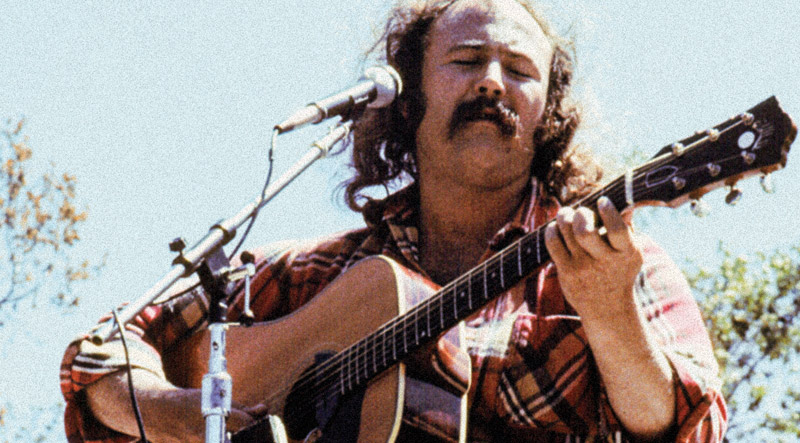
David Crosby in the mid ’70s, strumming a Guild D-50.David Crosby If I Could Only Remember My Name 50th Anniversary Edition
Upon its 1971 release, Crosby’s free-spirited debut was thoroughly bashed by critics – today, it’s a revered piece of Laurel Canyon post-psychedelia. Now on two CDs, it’s been expanded and sonically improved.
First, the original tapes have been restored with Plangent Processes, a digital/analog technology that corrects tape-speed flaws. The resulting tracks are warm and vivid, such as “Cowboy Movie,” with David’s vocal, Phil Lesh’s potent bass, and solos from Jerry Garcia, who brings a pervasive Grateful Dead influence. “Tamalpais High” sounds like a long-lost CSNY track, aided by Graham Nash’s harmonies and Jorma Kaukonen’s guitar.
In “What Are Their Names,” witness vocals from Crosby, Nash, Neil Young, Joni Mitchell, and Grace Slick, plus Garcia’s picking – a true supersession. The second CD of unreleased demos includes “Riff 1,” “Fugue,” and “Kids and Dogs,” capturing Crosby’s crisp, open-tuned acoustic – he’s a vastly underrated rhythm player – and mind-boggling vocals.
While other CSNY members had higher-charting solo releases, Remember My Name remains a stone-cold sleeper and precursor to the modern genre known as “freak folk.” Combined with a brilliant 2021 studio album (For Free) and documentary film, David Crosby is experiencing a surprise resurgence – at age 80.
This article originally appeared in VG’s January 2022 issue. All copyrights are by the author and Vintage Guitar magazine. Unauthorized replication or use is strictly prohibited.
(Clockwise from top left) The Japan-made guitar that Paul Smith “hates.” A prototype finished in Blue Pearl that served as a demo guitar at the Sam Ash Music store in White Plains, where employee Billy Fraioli was also gigging with it. PRS #5 0004 has a Vintage Yellow top and rare Brick Red finish (from a local Harley-Davidson shop) on the neck and back. It’s the first PRS with black tuning-peg collars, molded nut, production bird inlays, and production pickups. Smith personally stained the top, leveled the frets, and checked its neck shape. PRS Signature #2 (center), from 1986. Sammy Ash’s #6, made in ’85, is the only known PRS with its serial number stamped vertically.
Sammy Ash first laid eyes on a PRS guitar in the early ’80s, after catching a glimpse of one in Guitar Player magazine.
“I stopped at the newsstand to look at it because Jeff Beck was on the cover,” he said. “Paging through, I flipped past a column on ‘exciting new builders’ entering the mainstream guitar market. There was some guy named Seymour Duncan talking about pickups, and a wild-haired, wide-eyed kid named Paul Smith. Okay… next.”
Fast-forward to 1984: Ash is living in “exciting times” as the guitar/amp/effects buyer for his family’s six-store East Coast chain, Sam Ash Music.
“My job was to keep us stocked with all the latest and coolest gear from builders big and small, and we were very progressive with new lines,” he said, citing their early adoption of instruments from Alembic, Veleno, Ibanez, B.C. Rich, Jackson, Charvel, Hamer, Valley Arts/ESP, Orange, and Mesa Boogie. “I remember placing the 32nd order with John Page at the inception of the Fender Custom Shop.”
One day while he was at home, bedridden with double pneumonia, the phone rang…
“I get a call from Ralph Perucci, one of my guitar salesmen in the White Plains store, and he’s kinda excited,” Ash said. “He tells me, ‘I’ve got this guy here, Paul Smith, and he brought some guitars to show us. I really think you should see these.’ I thought, “I know that name, but from where?’ But it was a new builder, with new guitars, and if I’d had an ounce of breath to walk or drive a car, I would’ve been there in a heartbeat. But that wasn’t happening. So I told Ralphie, ‘Put him on.’
“Wheezing and with my raspy voice – picture a heavy New York accent and low, gravelly tone that made me sound like a mobster – I said, ‘Hi Paul. I hear you’re doin’ it right, but I can’t meet ya’. You need to see my brudda Richie, in the City. You go see Richie.’
“After hanging up the phone, I was deathly afraid he’d walk into Manny’s Music,” Ash said. “But it turns out he had already been there and had a not-so-good interaction with Henry [Goldrich, founder of Manny’s].”
The back of Ash’s Japan-made PRS is signed on the back by several of Smith’s early employees.
Instead, Smith did as his new guitar godfather asked, and went to see Richie.
Smith picks up the story from there.
“Richard loved the guitars, and told me, ‘I’ll buy 12,’ which immediately made me very happy. But then he added ‘…for all six stores, every two months.’ I was flabbergasted, and left with a 250-guitar purchase order worth $250,000, which was half of the POs I’d gathered on that trip.”
Smith happened to be looking for money to start a guitar company, and the order provided proof of market potential to show prospective investors.
“Until that point, my largest PO had been $6,500,” he added. He and Sammy met soon after, and became close friends.
The first PRS shipped to Sam Ash Music carried serial number 5 0006, and after it arrived, Smith called Ash, telling him to buy it for his personal collection because, “It’s a good one.”
“He was right – it is!” Ash said. Later, fortunate timing led him to acquire one with an even lower number.
“I called their shop to ask about getting a better case for number six, and the woman who answered (Ed. Note: Smith says it was likely Bonni “Pink” Lloyd) asked, ‘Are you interested in number four? Someone returned it, so it’s for sale.’ Again, I muttered ‘What?,’ then yelled ‘Sold!’”
Meanwhile, back at the White Plains store, a prototype that Smith had left was being used as a floor demo. One employee was even gigging with it.
Sammy Ash and Paul Smith in the early ’90s, with Smith’s first Dragon guitar.
“Once I learned that was happening, I took it home,” Ash chuckled. “It was still in pretty good shape.”
In 1988, Smith sent two Japanese-made prototypes to White Plains for his friend’s evaluation – one that looked like a PRS Standard and another more like a Stratocaster.
“He eventually asked me to send the Strat-shaped one back, but he forgot about the Standard, so I glommed it,” Ash said. “He really hates the fact that it exists, and rightfully so, as it’s not a great instrument. But it’s now the only one because Paul cut the necks off the others. For a fun surprise, I took it to his 40th-birthday party, where many of the early PRS crew signed the back.”
Another top piece from Ash’s collection is a 1986 Signature series guitar that was a gift from Smith, who signed the front of the headstock and wrote “Sam Ash #2” on the back.
“It’s the second one made,” Ash said. “Paul’s son, Sam, owns #1.”
Do you have a classic/collectible/vintage guitar with an interesting personal story that might be a good fit for “Classics?” If so, send an e-mail to ward@vintageguitar.com for details on how it could be featured.
This article originally appeared in VG’s January 2022 issue. All copyrights are by the author and Vintage Guitar magazine. Unauthorized replication or use is strictly prohibited.
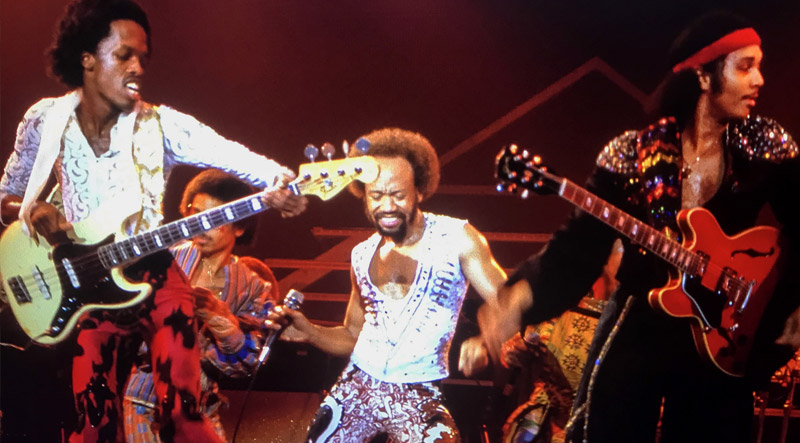
Brothers Verdine (left) and Maurice White onstage in 1978 with Al McKay, playing his ’72 ES-335.
Earth, Wind & Fire played “world music” before the phrase was coined. By 1974, bandleader Maurice White’s ensemble of talented musicians had five albums to its credit, two of which, Head To The Sky and Open Our Eyes, went platinum thanks to music lovers who were hip enough to appreciate an Afro-Cuban jam band with jazz, funk, R&B, gospel, and operatic falsettos. Still, the band faced an uncertain future. Translation: They needed a million-selling hit to broaden their audience and cross over to the international market.
In 1972, producer Sig Shore had a hit with the blaxploitation film Super Fly. The soundtrack by Curtis Mayfield was even more successful. So, when Shore invited White to do the soundtrack to his new movie about corruption in the music business, That’s the Way of the World, starring Harvey Keitel, it was an opportunity he couldn’t refuse. White was smart enough to not only bring in producer/arranger Charles Stepney, but write the album independent of the film so it would stand on its own if the film flopped (which it did). Going in, White made an especially keen play. Adamant about continuing EW&F’s lyrical themes of spirituality, love, and mysticism – creating music with meaning – he also brought in more horns and strings, all on Columbia Records’ tab.
Basic tracks were recorded at Caribou Ranch, in Colorado.
Johnny Graham and his Yamaha SG 2000 (left) with Maurice White in 1982.
The album’s rhythmic intensity was partially due to the work of guitarists Al McKay and Johnny Graham.
“Caribou Ranch was a beautiful place,” McKay recalls. “The studio was great. We churned up a lot of creative stuff there, and just by walking around the property.”
The title track was particularly challenging, and pushed the band to excellence.
“I had a Stratocaster that I’d just purchased in Denver,” Graham said. “Until that time, I’d only been playing my ES-345, and when Maurice called me in to cut a solo, the 345 was in Hollywood. The Strat’s action was stiffer, so here I am, cutting a solo with a brand-new guitar. I was struggling. Consequently, the solo was tamer than if I’d had the 345. But it turned out cool. Less is more.”
McKay played on the track, as well.
“‘Way of the World’ is a Charles Stepney tune, and he changed the direction of the band,” he said. “He’d change a simple C# chord to Oh my God! That song and ‘Yearnin’ Learnin’’ was his music; he did all our arrangements, and I especially remember those dates because I learned new chords. It was like school, and it was one of the best times of my life. I played a Gibson L-5 on ‘Yearnin’ Learnin’.’ It was a great day, a great song, and we loved it right away. Maurice wrote the lyrics, and it’s been Earth, Wind & Fire’s biggest anthem.”
“Shining Star” came from keyboardist Larry Dunn. White added vocal ideas and created the spiritual concept while on a walk in the woods one night.
“The song is about staying true to yourself,” said McKay. “It was a group effort and we tried it a couple ways before I added the #9 on the verses. I played all the guitars on that track – did the solo on my SG and the grooves on my Telecaster. Maurice played drums. Johnny Graham is a hell of a guitar player, but on the records, I did most of the parts.”
Additional tracks were recorded at Sunset Sound, in Hollywood. The fusion-inspired “See The Light” (written in 7/8) featured Graham on guitar, while “Africano” was McKay with a Les Paul Custom through a Twin Reverb.
“Happy Feeling” was an organized jam written by Maurice White, vocalist Philip Bailey, and bassist Verdine White. A live track, it was recorded specifically for the film at a roller rink in Camden, New Jersey, but turned out so well they put it on the album.
On a humorous note, despite being a popular ballad at weddings for its apparent expression of undying love and devotion, “Reasons” is, in reality, about the band’s infidelity on the road.
That’s the Way of the World was EW&F’s crowning achievement and breakthrough album, going to #1 on Billboard. “Shining Star” went to #1 on the Hot 100 and earned a Grammy for Best R&B Performance by a Duo or Group. In addition, the title track reached #5 on the R&B singles charts.
On May 24, 1975, EW&F became the first black band to simultaneously top the Billboard singles and albums charts. Their success gave the band a fresh start and initiated a series of changes that made it one of the most popular groups of all time. More importantly, Maurice White’s musical and philosophical vision infected the world with a positive consciousness, hope, and love.
This article originally appeared in VG’s January 2022 issue. All copyrights are by the author and Vintage Guitar magazine. Unauthorized replication or use is strictly prohibited.
Jazz guitarist Michael Gregory Jackson changes it up by using a classic (and seldom-seen) ’59 SG Special running through a Polytone Mini Brute with an Eminence Texas Heat speaker to show us this exclusive take on “Meditation in E (for Karen),” from his new album, “Electric Git Box.” Read our review in the August issue. Read Now!
It’s one of the most unlikely success stories in music. Armed with a four-string tenor ukulele, a young Hawaiian videos himself playing solo in Central Park. His dynamic instrumental arrangement of George Harrison’s “While My Guitar Gently Weeps” goes viral, viewed more than 17 million times. His command of the instrument and interpretations of material by Sting, Adele, and Queen turn perception on its head about the seemingly humble instrument. In short, Jake Shimabukuro becomes a rock star.
Twenty years and more than a dozen albums later, Shimabukuro has collaborated with Jimmy Buffett, Tommy Emmanuel, Jason Becker, Michael McDonald, Béla Fleck, Earl Klugh, Jack Johnson, Alan Parsons, Ziggy Marley, Yo-Yo Ma, and others. His latest effort, Jake & Friends, boasts perhaps the most star-studded roster yet, with artists ranging from Vince Gill to Bette Midler to Moon Taxi. Jon Anderson does the Beatles, Warren Haynes does Ten Years After, Ray Benson does Cream, and Jesse Colin Young revisits his classic “Get Together.”
Surprisingly, only three songs were recorded remotely; the other 13 were cut in person. As the 45-year-old says, “We sat down, played, and hit ‘Record’ – real takes, live in the studio.”
Jake phoned from the road to talk about his recording process, his equipment, and famous friends.
How did you pair the songs to the artists?
I asked everyone what song they wanted to do, and as long as I knew the key, I could prepare ahead of time. “Wrapping Paper” was one I suggested. I’ve always loved Cream, but that was one of their lesser-known songs. I knew that Ray Benson loved those kinds of chord changes. He’d never heard it, but it’s an Asleep At The Wheel song now (laughs).
What about the two instrumental numbers, with Billy Strings and Sonny Landreth?
They’re both such great improvisers, we just thought we’d see what would happen. I love the spontaneity of those cuts, how they happened organically. Sonny’s phrasing and tone – he’s just amazing, and “Smokin’ Strings,” with Billy, is a first take from beginning to end. Afterward, we did another few passes, charting things out, but they didn’t have the magic of the first one.
In Hawaii, we have a word, kanikapila, for a casual jam session, like at a party. I had an idea like, if we sat down in someone’s living room with a couple of instruments, what would it sound like? Natural, not forced or overproduced.
You do the standard “Stardust” with Willie Nelson, who is known for his unorthodox phrasing. And it’s just vocal and ukulele.
Ray Benson co-produced the album with me, and the first call he made was to Willie. A few months later we were in the studio, recording “Stardust.” I was so nervous! (laughs) I needed to be standing right next to him to follow him, because of the way he sings, and there was no one keeping time. So I couldn’t mess up, right? If I make a mistake, I can’t just punch in; we’ve got to do the whole thing over. But he always knows where he is, where the beat is, where the changes are. You just have to stay with him and let him lead you. That track is so honest.
Are you still using your signature model Kamaka uke?
Yes. I got a new one they made for me during the pandemic, which I just started using. It usually takes about a year of playing for one to really open up, where you get a sense of what it will be like going forward.
Walk us through your onstage signal chain.
I use a Saturnworks True Bypass Looper and an Orion Kafka Reverb with a germanium transistor that warms up the signal. That goes into the D.W. Fearn DI. For my overdrive stuff, I use the Jam Pedals Tubedreamer, which has a nice midrange sweep. Then I go into an Analog Alien Bass Station, which I use for the amp simulator. For delay, I use a Jam Pedals Delay Llama, and I have an Electro-Harmonix Pog for octave and freeze.
Not in the signal chain is a Boss RC-5 Loop Station, because I only use it for one or two songs. My favorite looper is a Boomerang, but it’s so big there’s not enough room on my pedalboard. I use it in the studio. My cables are all Analysis Plus, and my strings are D’Addario. My pickup system is Fishman.
A lot of these songs are iconic, but you’re famous for reinterpreting well-known songs.
That’s because I didn’t have confidence playing my own music in front of people. So I’d play songs I grew up listening to, like, “How would ‘Bohemian Rhapsody’ sound on ukulele?” I’m getting more ideas for original material, and I think that came from the process of arranging other songs. You develop different skills and get familiar with different chord progressions and voicings that speak to you. I try to come up with things you’ve never heard before.
This article originally appeared in VG’s January 2022 issue. All copyrights are by the author and Vintage Guitar magazine. Unauthorized replication or use is strictly prohibited.









 Don’t miss Vintage Guitar magazine’s monthly playlist on the music-streaming service Spotify. Each month,
 Have Guitar Will Travel, hosted by James Patrick Regan, otherwise known as Jimmy from the Deadlies, is presented by Vintage Guitar magazine, the destination for guitar enthusiasts. Podcast episodes feature guitar players, builders, dealers and more – all with great experiences to share! Find all podcasts at