Tag: features

  • Eric Johnson

    Eric Johnson

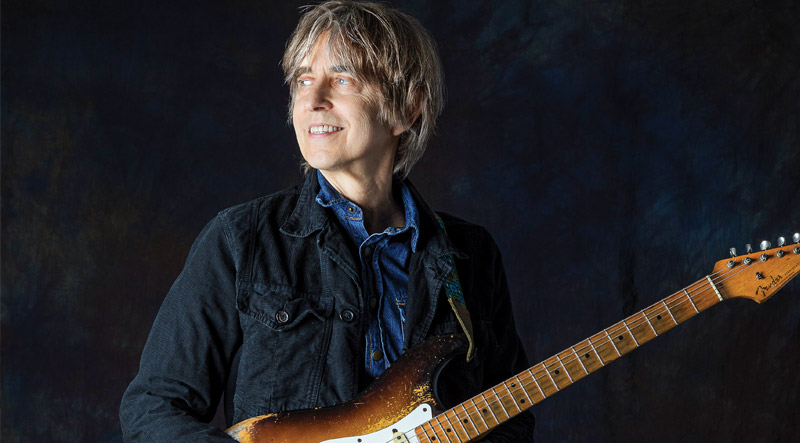
    Eric Johnson. Photo: Max Crace.

    For nearly 50 years, Eric Johnson has been a revered guitarist/multi-instrumentalist, songwriter, and vocalist whose music expands far beyond the ingrained blues roots of his Texas homeland. The multiple-Grammy nominee and winner (for the instrumental “Cliffs of Dover” from 1990’s Ah Via Musicom) is always pushing himself, and his combination of exquisite guitar tone, fleet fingers, and gift for melodic, memorable songs is fully displayed on two new albums, The Book of Making and Yesterday Meets Today.

    The songs are from 25 years’ worth of material Johnson had archived until 2020, when the pandemic lockdown allowed time to finish some of it. If their trove of 18 songs isn’t enough, seven more are on an EP dubbed Takeouts.

    Why two albums?
    I originally did it as a double album and had two names I liked. I couldn’t decide which to use, and thought, “Well, I’ll make it a double record.” [The label] Blue Élan decided to put it out as separate records.

    Maybe there was some thought about making it less expensive so fans can buy one at a time versus an expensive double album?
    I think that’s it. People can buy the one they want to, or maybe both.

    The guitar jumps out more on Yesterday Meets Today. Was that intentional?
    I think that’s probably true. There are a few guitar-oriented pieces on The Book of Making, which is a little more song-oriented.

    Did you put the songs together that way, to have one volume different from the other?
    I did. I tried to put the songs together the way I thought they flowed well. I think that leaned to the vocal songs going together.

    Without the time off the road due to Covid, would this music have been completed?
    I think some of it might not have because when I came home from the canceled tour, I started digging stuff out of the closet that was in bits and pieces. There are 18 songs, and seven were recorded new from scratch; 11 were started. I think it’s possible that I might not have ever gotten around to them or I would’ve redone them from the start rather than using what I already had recorded, and building on it.

    Did you remember specific pieces you wanted to find, or did you realize, “I forgot I did this…”?
    I knew where some of them were, and I revisited them. I thought they were cool and I could make them work. There were several I heard and thought, “I forgot all about this song!”

    How do you archive and organize ideas?
    It’s really just a mess. I’ve got this tape cabinet, and I just throw stuff in there. It’s labeled, I just have to remember what the name of the song was, then it sparks a memory or I’ll have to get it out and play it.

    Did you put the EP out because your diehard fans would want to hear the material?
    Yeah, it might be more of a fan thing. I’m not sure it’s something where the general public will go “This is really great!” There’s a song off (2005’s) Bloom called “Good to Me” that was all cut up and made digital and affected. I put the original version on this outtake record, which is more like the way I played it in (side-band project) Alien Love Child – a more rockin’, straight-ahead piece.

    Which guitars did you use?
    It was pretty much my Virginia Strat that came out a couple years ago, or a ’57 Strat. I did borrow a friend’s ES-345 Stereo for the rhythm part on “Bigger Than My Life” because I wanted that Varitone sound. I used a vintage Les Paul on some of the bluesy stuff, and an ES-335 on “Move on Over.” I think I used an SG on some of the overdubs on “To Be Alive” with (singer/guitarist) Arielle. I also used a National lap steel, a Fender six-string bass, and a Danelectro Coral sitar – mainly the Strats. On “Yesterday Meets Today” I used this prototype Strat that has a built-in overdrive circuit that Bill Webb (from Austin Vintage Guitars) and I came up with.


    This article originally appeared in VG’s August 2022 issue. All copyrights are by the author and Vintage Guitar magazine. Unauthorized replication or use is strictly prohibited.

  • Mike Campbell

    Mike Campbell

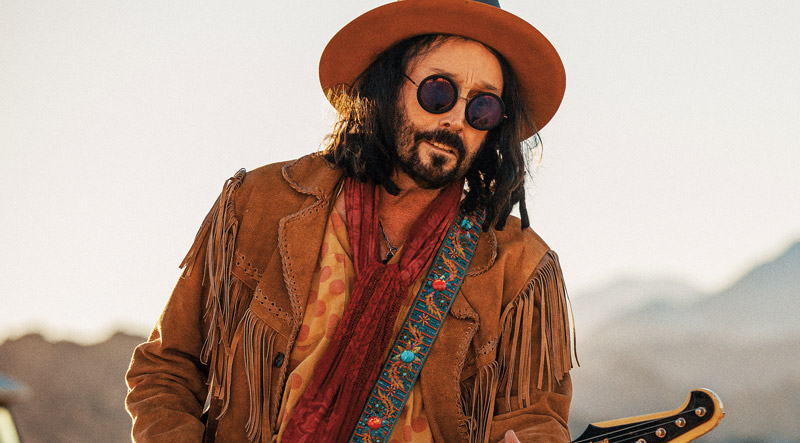
    On External Combustion, Mike Campbell pours on the boogie, pens spellbinding ditties, and leans into a live sound. With ancestral links to his former band, Tom Petty and the Heartbreakers, his quartet, The Dirty Knobs, spike L.A. rock and roll with psychedelia and rockabilly. The groove-laden swagger of this album should come as no surprise since Campbell’s discography looms large as a hit-making guitar craftsman.

    How do you do that thing you do?
    When you love something, it usually turns out pretty good (laughs). External Combustion is a continuation of Wreckless Abandon with some similarities. I wanted to keep the live kinetic approach in the studio, some of the solos, and the vocals live on each take. There’s some exploratory writing with the lyrics here and there, but The Dirty Knobs is a live band, and I wanted to keep that going.

    It seems to have come together because of musical chemistry rather than a master plan.
    A lot of that is because of our producer, George Drakoulias. He’s done both records and has a keen ear for picking songs that fit together. I write a lot of different types of songs – always have. The Dirty Knobs is a specific type of groove, so he was very helpful going through the songs and saying, “Forget these 20, but these other songs fit the band very well – we should focus on these songs.”

    Heartbreakers keyboardist Benmont Tench plays on “Lightning Boogie.”
    We call Benmont “The boy with the boogie-woogie brain (laughs).” He’s really got that down. There’s something about John Lee Hooker, who invented that feel. It’s an infectious feel and permeates a lot of our music, I hope. We cut the track while Benmont was out of town. He came back in at the end of the record and was gracious enough to come over one night and play on that song. He did a great job.

    Live, your guitar solos are very fat-free – no noodling.
    Thank you (laughs). Sometimes I do think we noodle, but we try to keep it to a minimum. I grew up in the ’60s with all those great bands with guitar parts. They weren’t noodling – they were playing parts within the song. I was always enamored with that, so that’s where I got it from. With The Heartbreakers, that’s the kind of band that we were.

    What went into recording slide for “Brigitte Bardot?”
    That was a Danelectro six-string bass tuned to a wacky low C. I only played on two strings, but it had a tone that was really cool – a lot thicker than a guitar. I thought it came out really good. I have an amp that Duesenberg Berlin Amplifiers made for me that’s modeled after a Fender Princeton, but a little beefier. It’s a one of a kind, with an extra gain circuit. I have it close-miked under the speaker with a condenser mic to pick up room ambiance. I don’t need much reverb because the room is doing it all.

    How about other guitars and effects?
    The guitars change depending on the mood or what the song calls for. I ended up using my ’59 Les Paul most of the time. I don’t take it on the road, so I use it as much as I can in the studio. I’m not really a pedal lover, but I have a few – a Way Huge Camel Toe and a Line 6 DL4 Delay I can pre-set for long delay or a rockabilly thing. It also has a reverse delay, which is a cool effect.

    Tom Petty fans will appreciate the band’s similarities to The Heartbreakers.
    I was a big part of the sound of that band. I made a conscious effort with The Dirty Knobs to filter out as much of that as possible. I’ve succeeded to an extent, but it’s just in me. It’s the way I play. I think the vocals at times are trying not to sound like Tom, but we have the same cadence and the same accent in places. I’m trying to find my own voice, and I think I am. I take it as a badge of honor because The Heartbreakers were a great band. But I don’t want to do a Junior Heartbreakers. The Dirty Knobs are a little edgier and more boogie rock and roll. The Heartbreakers had their sound, and some of it is always going to slip through because that’s who am and what I am.


    This article originally appeared in VG’s August 2022 issue. All copyrights are by the author and Vintage Guitar magazine. Unauthorized replication or use is strictly prohibited.;


  • Phil Collen

    Phil Collen

    Lemmy sculpture at Hellfest 2022: Clovis Christian/Caroline Brisset. Phil Collen: Kevin Nixon.

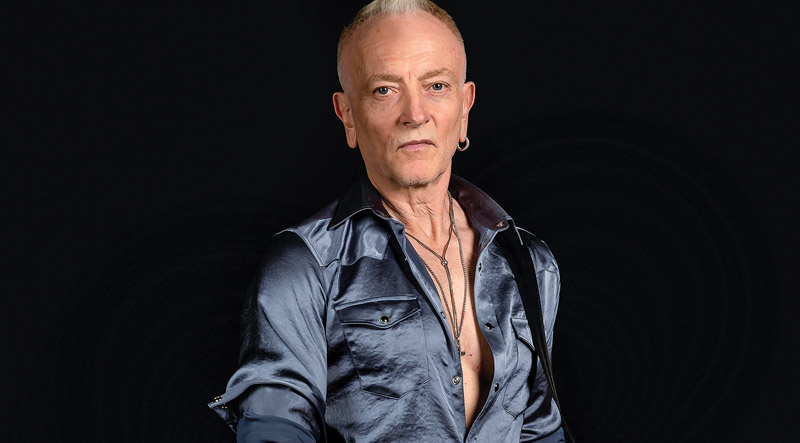
    Few groups radiate the sheer joy of being a famous, hard-working rock band than Def Leppard. The Rock and Roll Hall of Famers recently released their 12th full-length album, Diamond Star Halos, and finally embarked on The Stadium Tour with Mötley Crüe, Poison, and Joan Jett and the Blackhearts after a two-year Covid delay. The album is full of melodic hard-rock songs like those on 1983’s Pyromania and its 1987 follow-up, Hysteria, but also includes a few surprises. Bluegrass/country icon Alison Krauss – a huge fan – contributes vocals on two songs. Longtime guitarist/songwriter Phil Collen said some songs weren’t written with Def Leppard in mind at first, but it all came together.

    Was work on the album affected because The Stadium Tour might have been finally starting?
    Nope. Didn’t even think about it. This was pure artistic expression. All the reasons you get into becoming an artist or a musician, this was it. We didn’t have any restraints. There was no pressure by a label. There was no touring pressure. We just carried on writing songs because we love doing it.

    There are Def Leppard-style songs along with unexpected things. While writing, did you ever think “This isn’t Def Leppard”?
    Absolutely not. I think we used to. This album was about us, as was the last one (2015’s Def Leppard), but this one more so. This one, we were so excited about. I think as an artist you’ve got to stop worrying about what people are going to think – even fans. They liked you in the first place, so there’s no reason that shouldn’t happen again.

    A true fan is willing to grow with an artist.
    Absolutely. Otherwise, you’d just be stuck in this compromised hole. This album is not. This is growth. I love it.

    What was it like recording separately and remotely?
    You don’t have to wait for anybody. When you’re in a studio, even in the same country or the same building, you’re waiting for someone to do a vocal or a guitar part or a bass part or whatever. But doing it like this, we could each put in 100 percent. There was one part in particular – (bassist) Rick Savage on “This Guitar.” Sav is really good at playing jangles on guitar – very clear and clean and precise on acoustic or electric. I said, “Could you do an acoustic part on ‘This Guitar’?” He got his 12-string Martin. He wouldn’t have normally used that. He played that thing until his fingers were bleeding – literally – spent all day on it. I used a lot of my demo guitars that were first takes. They had a different sound, a different energy. The whole thing was really a different vibe.

    Plus, when you’re recording at home, you have everything at your disposal.
    More than ever. Like on the intro of “This Guitar.” I’ve got a Squier Starcaster I bought during lockdown for 300 bucks, just to goof around. But that’s what I played that song on. It actually turned up in a couple of tracks. I would have never used a semi-acoustic if we were in the studio. And it turned out great.

    In the studio, it’s bang-bang, a bit more intense, and gets a bit clinical, to be honest, and some of the inspiration suffers. And this is coming from someone who has spent sometimes three years on an album (laughs). A lot of stuff on this record, like guitar parts, were one take.

    Technology is such that something intended as a demo can be the master.
    That’s been the case for a while, but I don’t think we’ve ever really implemented it. We’ve talked about it a lot, but haven’t done it until this album. That’s why some of these songs have a rawer edge to them, especially “Kick.”

    You and Vivian Campbell play concise, punchy solos.
    Someone asked me the other day about guitar solos. Basically, I’m a songwriter, producer, and a band member. The guitar has to take a second seat to the song and to the narration of the vocal. The singer is narrating the story, so you’ve got to fit with that. That’s really important.

    What did you play on the album?
    Mainly a Jackson (signature) PC1. On “Kick” and “Fire it Up,” I used the natural PC1 I got in 2006 – my go-to guitar. On a couple of the solos, I used a walnut-top PC1 with a DiMarzio X2N. The solo on “This Guitar” was a Squier Telecaster, and I played a Ramírez acoustic on “Goodbye for Good This Time.”


    This article originally appeared in VG’s August 2022 issue. All copyrights are by the author and Vintage Guitar magazine. Unauthorized replication or use is strictly prohibited.

  • Fender’s Player Plus Meteora HH

    Fender’s Player Plus Meteora HH

    Price: $1,149.99
    www.fender.com

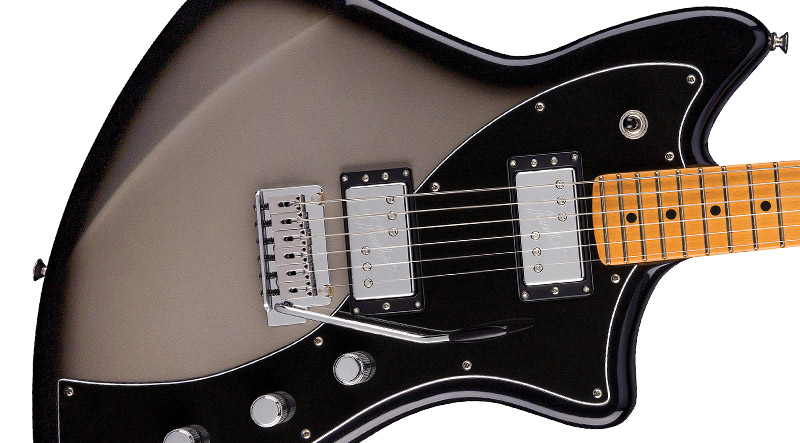
    Billed as “futuristic and familiar,” Fender’s Meteora design first arrived as part of the Parallel Universe line – mashups of Leo’s body types, hot-rod concepts, and blasts of pure guitar fantasy. The latest is the Player Plus Meteora, a made-in-Mexico solidbody with two humbuckers, whammy bar, and S-1 circuit to split the humbuckers for even more quackability.

    The Meteora sports an offset body vaguely resembling a Jazzmaster, but even more aerodynamic, hence its space-projectile name. The test model came in a swank silverburst with black pickguard, though there are three other finish options. The body is alder with a gloss poly finish, while the maple neck has a 25.5″ scale and 12″ radius on the 22-fret maple (or pau ferro, depending on finish) ’board. The neck has a standard Modern C shape, four-bolt heel, and vintage-styled headstock. Look for nickel/chrome hardware, vibrato bridge, a pair of covered Fireball humbuckers, and premium locking tuners.

    Plugged in, the Meteora delivers the impact you’d expect from an alder-body axe with humbuckers – bold, rockin’, and bright. Players can cover a tremendous amount of ground from completely clean textures to full-on scorch with heavy distortion. The alder and maple neck give the pickups quite a bit of snap, so players will have no problem cutting through a mix or jam session. For extra twang, push the S-1 button in the Volume pot to split the coils for more Fender funk.

    In hand, the Meteora’s neck is quick, its body comfortable if a bit hefty for the weight-sensitive. The vibrato performs seamlessly, adding to the rock attitude. All told, the Player Plus Meteora is a sweet addition to the family – Leo would surely approve.


    This article originally appeared in VG’s August 2022 issue. All copyrights are by the author and Vintage Guitar magazine. Unauthorized replication or use is strictly prohibited.

  • Sebastian Nagel’s Satisfying Funk

    Sebastian Nagel’s Satisfying Funk

    Winston Brothers groove it up on “Drift”

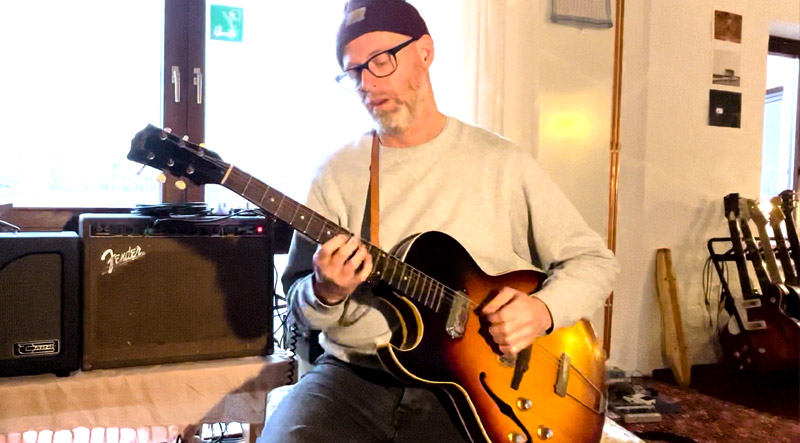
    Sebastian Nagel and his band, The Winston Brothers, balance groove, melody, and space in their super-satisfying instrumental funk. Here, Sebastian runs his ’56 Gibson ES-125 (converted to lefty and souped up with ’60s DeArmond pickups) through a ’70s Fender reverb tank and a ’63 Super to play “One Thing,” from the band’s new album, “Drift.” Read our review and exclusive interview with Sebastian in the March issue. Read Now!


  • The Gretsch 1955-’61 White Falcon

    The Gretsch 1955-’61 White Falcon

    Mike Campbell: Rick Gould.

    Photo: VG Archive.

    When it came to fancy electric guitars in the early/mid 1950s, Gibson’s Super 400 was ensconced as the undisputed King of the Hill.

    Through the years, though, other companies did pose occasional challenges. One prime example is the Gretsch Model 6136 White Falcon. One of the most renowned axes in guitardom, the 6136 was conceived in 1954 by Gretsch sales/demo man Jimmie Webster primarily as a promotional item complete with every bell, whistle, and accessory Gretsch offered at the time.

    A player of considerable ability and one of the first to employ two-handed tapping (which he taught in his 1952 book The Touch System for Electric and Amplified Spanish Guitar), Webster hired on at Gretsch after World War II. Part of his duties involved playing company instruments at trade shows and other presentations. And when it came time to truly demonstrate the full capabilities of Gretsch’s craftsmen, Webster went all-out, reportedly roaming the factory in a search for ideas about how to dress up a guitar; from the plant’s drum division, he grabbed gold-sparkle plastic laminate, and from the banjo side, rhinestones and other ornamental concepts. He then sat with designers and hammered out the basics, giving the guitar a hollow body measuring a substantial 17″ across its lower bouts and 2 7/8″ deep. Combined with the sensitivity of its DeArmond Dynasonic pickups, the resonance of the large body with it spruce top (a spec that may or may not have made it into production) aided his touch-style playing technique.

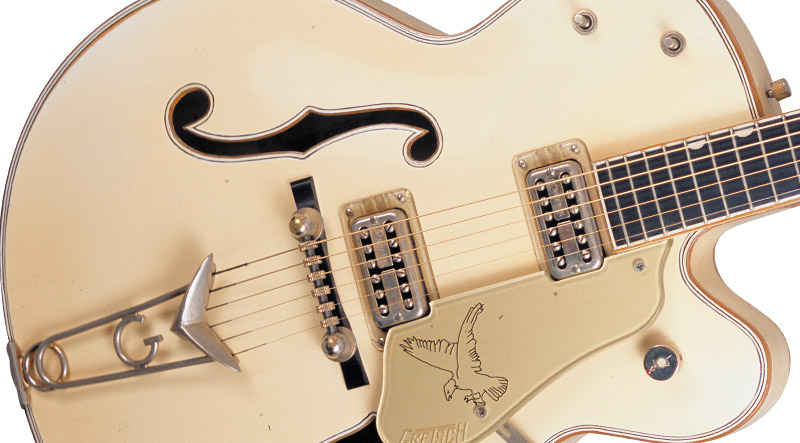
    Webster debuted the White Falcon at the NAMM show in July of ’54, replete with gleaming white paint, triple binding (black/white/gold-sparkle) on its body, neck, headstock, and f-holes, 24-karat gold-plated hardware, and an ebony fretboard with real mother-of-pearl block inlays. The array of special touches continued with its unique headstock shape and “Cadillac G” tailpiece, so named because the V-shaped piece that held its strings was reminiscent of a Cadillac logo. Its mechanical elements were also top-shelf, from the Grover Imperial tuners to its Melita bridge.


    The combination was intended to dazzle, and was very much a case of “mission accomplished.” Though never intended for production, response to Webster’s appearance was so overwhelming that the guitar was fast-tracked and began shipping to dealers the next year.

    Gretsch’s premier offering, the White Falcon sold new for $599 and continuously played host to innovations through the years, including stereo outputs and other trick circuits and hardware. Today, it is among the truly prized collectibles.

    Billy Duffy: Rick Gould.

    Played By:

    • Jimmie Webster
    • John Frusciante
    • Richard Fortus (Guns N’ Roses)
    • Mary Osborne
    • Joe Perry
    • Keith Scott (Bryan Adams)
    • Billy Duffy

    Further Facts:

    • Originally equipped with DeArmond Dynasonic single-coil pickups.
    • Neck made of three-piece laminate maple.
    • All metal parts were plated in 24-karat gold.
    • A stereo version (model 6137) included Project-O-Sonic wiring and pickups with three pole magnets and one bar magnet.
    • In ’59, Gretsch added its Action-Flo nut, a.k.a. the zero fret.
    • Body transitioned to 2” deep in 1960.
    • Bigsby vibrato tailpiece became standard in ’62.

    Details:

    • Tubular “Cadillac G” tail strung through V-shaped piece.
    • Original Melita bridge replaced with Space Control roller bridge in ’58.
    • These two knobs controlled volume for each pickup.
    • F-holes triple-bound in the black/white/gold-sparkle.
    • Pickguard is gold with clear acrylic and engraved falcon and logo.
    • Master Volume knob on upper treble bout.
    • Beginning in 1958, pickups switched to Gretsch Filter’Tron humbuckers.
    • Body measured 17” wide and likely started out 27/8” deep before becoming progressively thinner with the rest of the Gretsch line.
    • In ’58, the master Tone control became a switch on the upper treble bout, residing next to the pickup selector.
    • Neck joins body at the 14th fret.
    • Fretboard is Gaboon ebony with pearl inlay and gold sparkle-white/black/white bindings, with 22 frets, and 251/2” scale.
    • In 1957, mother-of-pearl “humptop block” fretboard inlays with bird engravings were r eplaced with Gretsch’s “Neo-Classic” half-moon inlays.
    • Truss-rod cover is cut from same gold-sparkle plastic used for the binding and headstock-logo inlay.
    • The headstock shape is unique to the model, and until ’58 had a white overlay of Nitron plastic drum material.
    • Grover Imperial tuners.
    • Vertical “winged” headstock logo replaced with horizontal “T-roof” logo in ’58.

    Special thanks to George Gruhn and Walter Carter.


    This article originally appeared in VG’s October 2009 issue. All copyrights are by the author and Vintage Guitar magazine. Unauthorized replication or use is strictly prohibited.


  • Manouche courtesy of La Pompe Attack

    Manouche courtesy of La Pompe Attack

    (Gypsy) Jazzin’ a James Taylor Tune

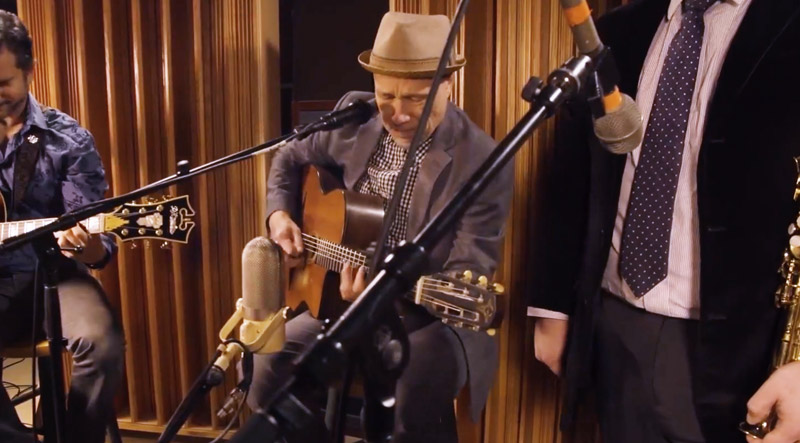
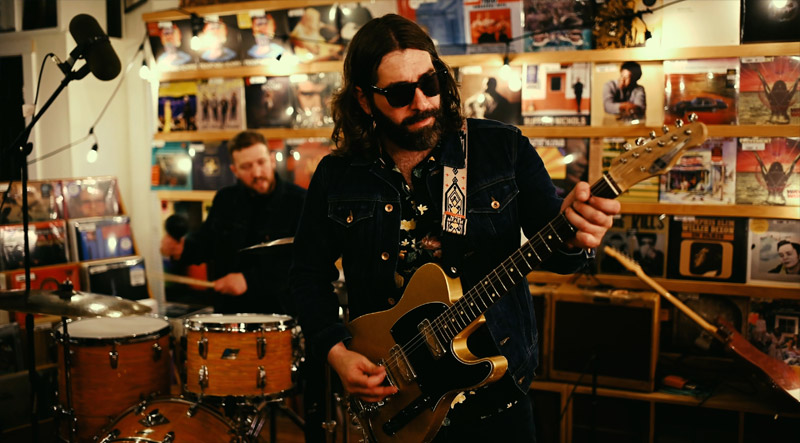
    La Pompe Attack shows us their take on James Taylor’s “Traffic Jam,” from their new album, “Putt Lake Toodleloo,” with Doug Munro on his Legend 503, custom-made by John Kinnaird for Delle Arte guitars. That’s Vinny Raniolo with his D’Angelico EXL-1, Albert Rivera on soprano sax, and Michael Goetz on upright. Our review of the album appears in the March issue. Read Now!


  • Lightnin’ Malcolm’s One-Man Wizardry

    Lightnin’ Malcolm’s One-Man Wizardry

    First-Rate Blues with Juke Joint Swagger

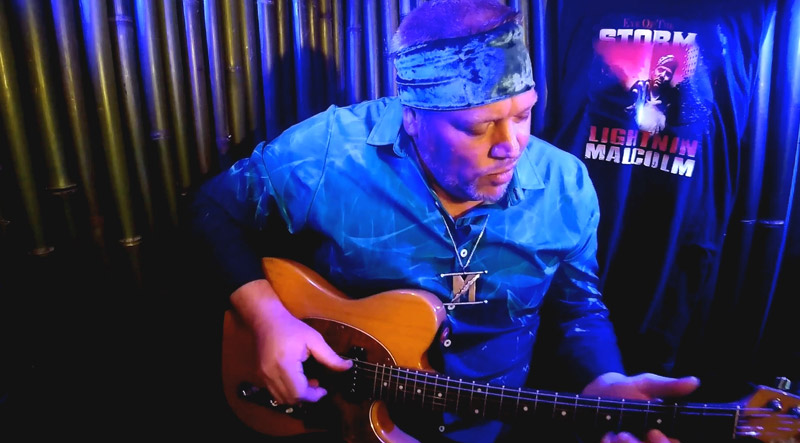
    Lightnin’ Malcolm learned blues first-hand from legends of the genre, and it shows! Here, he plays “Jungle” from his new album, “Eye Of The Storm,” using his G&L ASAT Special running through a Fender Hot Rod Deville. Our review of the album appears in the March issue. Read Now!


  • GA-20 – “Double Gettin”

    GA-20 – “Double Gettin”

    VINTAGE GUITAR EXCLUSIVE! GA-20 – “Double Gettin”

    GA-20’s Matt Stubbs tells it like this: “‘Double Gettin’’ originally appeared on our latest full-length release, ‘Crackdown.’ The story takes you from a hesitantly suspicious mind to the shock of finding your partner in bed with not one, but two, lovers.” Keep up with GA-20 at ga20band.com


  • Untitled post 41976

    Alex Aguilar’s Master-Volume Les Paul

    Some might think it sacrilege, but in his March “Guitar Rx” column, Dan Erlewine adds a Master Volume control to a Gibson Les Paul. Why? Because that’s what his friend Alex Aguilar wanted! “Gasp!” right? Relax – it’s a 2021 model, and as you see here, Alex does cool things with it. Read Dan’s detailed account of the process in the March issue. Read Now!