
Year: 2014

  • The Electro-Harmonix Germanium 4 Big Muff Pi

    The Electro-Harmonix Germanium 4 Big Muff Pi

    Electro-Harmonix Germanium 4 Big Muff PiElectro-Harmonix Germanium 4 Big Muff Pi
    Price: $133 (list)/$99.75 (street).
    Contact: ehx.com.

    The Big Muff Pi overdrive is the effect stompbox that put Electro-Harmonix on the map, and in the decades since its introduction, it has undergone changes both subtle and substantial. Today, the company’s lineup includes no fewer than 10 versions including the newest, the Germanium 4 Big Muff Pi.

    Each of the latest box’s two channels – labeled Overdrive and Distortion – has an on/off true-bypass stompswitch with LED indicator. The Overdrive channel has controls for Gain, Bias, Tone, and Volume, while the Distortion channel has controls for Gain, Bias, Volts, and Volume.

    To test its sounds, we plugged it in between a ’50s reissue Fender Telecaster and a mid-’60s Fender Bandmaster head running through a vintage Fender 2×12″ cabinet. The Germanium 4 Big Muff’s Overdrive side offered a light overdrive/boost with that familiar ’60s Big Muff fuzz tone dressing up its high-end response. While the Gain, Tone, and Volume controls reacted as one would expect on an OD, the Bias control gave it real character. Altering the signal before it’s distorted, the Bias acts a lot like a tone control, but with more attitude – mellow, with less gain when turned fully counter-clockwise, transparent when straight up, and when fully clockwise, bright and snappy, with more gain.

    The Distortion side offered substantially more gain, its Bias control dialing in sounds ranging from smooth and lush to bright and aggressive, and the lack of a Tone control doesn’t hinder the variety of distorted tones one can extract from it. The most interesting feature on the G4 Big Muff is its Volt control, which affects the amount of voltage supplied to the transistors, which simulates a low or dying battery. With the control turned completely clockwise (sending full voltage) the tone is full and uncompressed, and as it’s dialed back, the tone becomes more compressed, with a low-fi grit, until it sounds almost gated, with a sputtering effect – cool, and very creative. Since each side has its own footswitch and the Distortion side cascades to Overdrive, you can use the Overdrive side to boost output volume and use for the Distortion side for soloing or to add gain for a super-saturated sound.

    The G4 Big Muff Pi is the most versatile version in the pedal’s lineage, and does its predecessors proud.


    This article originally appeared in VG February 2011 issue. All copyrights are by the author and Vintage Guitar magazine. Unauthorized replication or use is strictly prohibited.


  • R.C. Allen

    R.C. Allen

    R. C. Allen
    R.C. Allen, a noted luthier who built archtops for local and regional players of note and was a fixture at vintage-guitar shows in Southern California, died March 2.

    Allen was renowned for sharing his secrets of guitar building and was the last of the original electric-guitar builders in Southern California. Known for his archtops, he made guitars for Merle Travis, Del Casher, and many more.

    As a teen, Allen developed his technique with guitars that had chambers, which he learned from John Dopyera (Dobro) and Paul Bigsby, whose solidbody electric guitar bearing serial number 2 became Allen’s; he displayed it at guitar-show booths that he often shared with Guy Devillez and his brother, John Anderson, often allowing passersby to play it while telling them about its historical significance. Displaying his much-appreciated sense of humor, he made a copy of the guitar for Four Amigos guitar-show producer Larry Briggs with a logo that read “Brigsby.” When show attendees would ask for a picture with him, he would slyly turn half around, reach in his pocket, `pull out a set of crooked/stained fake teeth, and turn around with a big smile on his face.

    Another of his customers, Rebecca Apodaca, recalled how when he presented her with a guitar he’d built for her, he was beaming from ear to ear. “I was admiring the wood he chose for its top – burled maple, stained brown. It was the color of my skin tone,” she said. “As I admired the inlays, he flipped the guitar around, and on the back of the headstock was a sticker that said ‘Made in Japan.’ We laughed! Then he pointed to the center of the back, and along the seam, the wood was figured in the shape of a heart. He smiled and said, ‘Look, I’m giving you my heart.’ I am lucky to say I will always have the heart of R.C. Allen.”

    Apodaca also recalls a story Allen enjoyed telling about delivering a guitar to Glen Campbell. Campbell was working a studio session with a sax player and Allen recalled how, “They were playing the stupidest song I’d ever heard. It only had one word. How can you think anyone would buy a song with one word? It had a nice beat to it, but then they would stop, and Glen would yell, ‘Tequila!’ I don’t think it sold too well,” he would laugh.

    Friends and acquaintances had planned a party/jam to celebrate his 80th birthday, with several music-industry luminaries set to attend.

    “I just sent him a card two days [before he passed] to tell him how much his friendship meant to me,” said pickup maker Seymour Duncan.

    “R.C. was always kind to me, and I tried to return his kindness, but I’m certain that I fell far short of what he gave me,” added guitar “Buffalo Bob” Page, former owner of Buffalo Brothers Guitars.


    This article originally appeared in VG June 2014 issue. All copyrights are by the author and Vintage Guitar magazine. Unauthorized replication or use is strictly prohibited.


  • Railhammer Hyper Vintage Humbucker

    Railhammer Hyper Vintage Humbucker

    NAYLOR-RAILHAMMER

    Railhammer Hyper Vintage Humbucker
    Price: $139 list / $89 direct
    Contact: railhammer.com

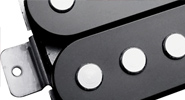
    Developed by Joe Naylor of Reverend Guitars, Railhammers are passive humbuckers that use a combination of pole pieces on the treble side and rails on the bass side. It’s an interesting motif with an effective purpose.

    The Railhammers’s six oversize poles under the treble strings cover a wider area than standard poles, so they capture the full range of each string as it vibrates. This, Naylor says, helps increase sustain and keeps the strings from sounding thin. The rails below the bass strings sense only a narrow section of each thicker/wound string, which increase clarity and definition. To maintain consistent volume on the bass strings, the rails are height-tapered.

    Another useful feature is the Railhammers’ universal string spacing, which means they’ll fit most guitars.

    We tested Railhammer’s Hyper Vintage neck and bridge models, which use Alnico V magnets and are voiced to emulate a pair of vintage PAFs. Mounted in a Squier Strat with a three-way pickup selector and controls for Volume and Tone, we plugged it into a 100-watt Marshall with an added master volume.

    With the amp set for cleaner sounds, each string rang clearly – distinct and even. Chords were lucid and chimey. At dirtier and crunchier settings with more gain, notes sang with sustain and produced rich harmonics. Full chords and single bass notes sounded tight, while treble notes were smooth, with just enough bite and attack for playing lead and rhythm; this symmetry of tones would work very well for any genre or playing style. With the pickup selector set in the middle position and both pickups in full humbucking mode, the sound of all four coils was quite nice, particularly for cleaner chordal parts and picking. Often, when two humbuckers are used together, single notes become lost among the mids. But the Hyper Vintage pickups are a perfect match – well-balanced, articulate, and complementary of each other through the range of the guitar’s tones. And, they’re very quiet. Even when the amp was cranked, they produced no noise.

    When a guitar sounds good, it can inspire a player to be better, play longer, and be more creative. And who doesn’t want to be enthused by their guitar’s tone? Railhammers’ Hyper Vintage neck and bridge pickups deliver the goods.


    This article originally appeared in VG August 2012 issue. All copyrights are by the author and Vintage Guitar magazine. Unauthorized replication or use is strictly prohibited.

  • Ibanez Artcore AF105NT

    Ibanez Artcore AF105NT

    Ibanez Artcore AF105NTIbanez has always had two distinct personalities – first as a purveyor of shreddy solidbodies for the hard rock/metal crowd, but also as a maker of fine archtops, thanks to famous users like George Benson, Pat Metheny, and John Scofield.

    In the ’90s, the company started to brand many of its low-/mid-priced hollowbodies as the Artcore line, imbuing the guitars with a fresh, funky image for alt-rockers, blues players, and jazzers. Depending on how a particular Artcore guitar is appointed, it might veer to one genre or another; the fancy AF105NT is on the high-brow side and will likely turn on jazz and blues players.

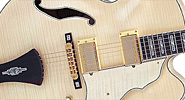
    When you hold the AF105NT, your eyes will bug out and you’ll start droolin’ over its flamey natural top. Not to put too fine a point on it, this guitar is drop-dead gorgeous. The maple veneer on the top, back, sides, and even pickguard (likely a photo-flame decal) is stunning. To top it off, the Ibanez folks created dark, wooden control knobs and tailpieces that are downright sexy.

    The guitar’s rosewood fingerboard – which has a 12″ radius – has a custom inlay of an abalone/mother-of-pearl composite and they distantly echo the “slashed diamond” inlay of classic Gibson Super 400 archtops. The AF105NT also has a bubinga/maple neck sandwiched in three sections – a move both cost-saving and attractive. Other details on this jazzbox are a pair of Custom 58 humbuckers with ceramic magnets, two volume and tone controls apiece, gold hardware, 22 medium frets (with nicely rounded edges), and a 243/4″ scale, akin to a Les Paul. The only design faux-pas is a small knot in the grain on the back of the headstock. It’s not a big deal, but it caught my eye – it seems out of step on a guitar that is otherwise so flawlessly constructed.

    Plugged into amps by Ultrasound and Line 6, the AF105NT performed admirably. Ibanez is marketing these guitars to a range of players, so they’re set up with light-gauge strings and low action, to broaden their appeal. This is clever, ensuring the guitar will immediately feel good to solidbody/rock pickers. Once they catch the jazz bug, they can upgrade to heavier, round-wound strings (trust me, you’ll eventually want heavier G, B, and E strings for a fatter tone – it’s simply jazz-guitar physics). Overall, the guitar sounds very good clean and with moderate amounts of overdrive, if you start leaning towards the Steve Howe/Alex Lifeson side of things. And in typical Ibanez fashion, the neck is fast, another facet that will appeal to players of all stripes.

    What really sets the AF105NT apart from the archtop pack is that it fills a gap in the hollowbody market. Companies like Ibanez and Epiphone have been offering affordable hollowbodies for years, but there has always been a weird hole in the mid-price area; either you get a killer axe for under $600 or over $1,000, but not many in the middle (this one streets at under $900). Feel free to scratch your head. But with this hollowbody, Ibanez is offering a sumptuous, deluxe guitar for a price most players can afford. Granted, they do substitute affordable materials and building techniques here and there to keep the price in check, but most guitarists will never notice.

    In all, the AF105NT is a fine guitar that will be prized by rising jazz/blues players or used as a killer gigging guitar for those who keep their $10,000 vintage archtops at home. Either way, Ibanez does it again, offering impressive quality and value for tasty guitarists everywhere.


    Ibanez Artcore AF105NT
    Price: $1,199.99 (list, with hardshell case)
    Contact: Ibanez.com.


    This article originally appeared in VG December 2010 issue. All copyrights are by the author and Vintage Guitar magazine. Unauthorized replication or use is strictly prohibited.


  • DOD Offers Compressor 280

    DOD Compressor 280The DOD Compressor 280 employs an electro-optical circuit that varies the pedal’s dynamic compression using a light-dependent resistor and internal LED. At lower settings, its Compression knob adds a subtle volume-leveling effect that adds a touch of evenness to the guitar’s signal, raising the level of low-volume playing and limiting the maximum volume of harder-hit single-note passages and chords. At higher settings, the Comp “squashes” the initial attack and raises the level of notes and chords as they decay. The Level knob controls overall volume of the signal and can act as a boost if desired. Its true-bypass wiring allows a guitar’s tone to remain pristine when the box is disengaged, and its modern power supply makes it more pedalboard-friendly. Visit www.dod.com.

  • Dean Zelinksy Teams with Guitars 4 Vets

    Guitars For Vets The non-profit Guitars for Vets (G4V) organization, which provides free guitars and lessons to veterans struggling with post-traumatic stress disorder (PTSD), has announced a “Buy One, Give One” partnership with Dean Zelinsky Private Label guitars. Zelinsky is producing an exclusive G4V-branded guitar. With every purchase of the guitar, an identical guitar will be donated to a veteran enrolled in G4V.

    Guitars For Vets G4V offers 10 weeks of free guitar lessons designed to engage veterans suffering from PTSD. Those who complete the lessons receive a free guitar. To date, it has completed more than 20,000 guitar lessons and distributed more than 2,000 guitars.
    The Dean G4V guitar is based on the company’s Tagliare model and carries a retail price of $369. It is available online at www.deanzelinsky.com or at Zelinsky’s Chicago-area showroom. To learn more, visit www.guitarsforvets.org.

  • Phantom Reissue 1964 PH12

    Phantom Reissue 1964 PH12

    Price: $1,168 (retail)
    Info: www.phantomguitars.com

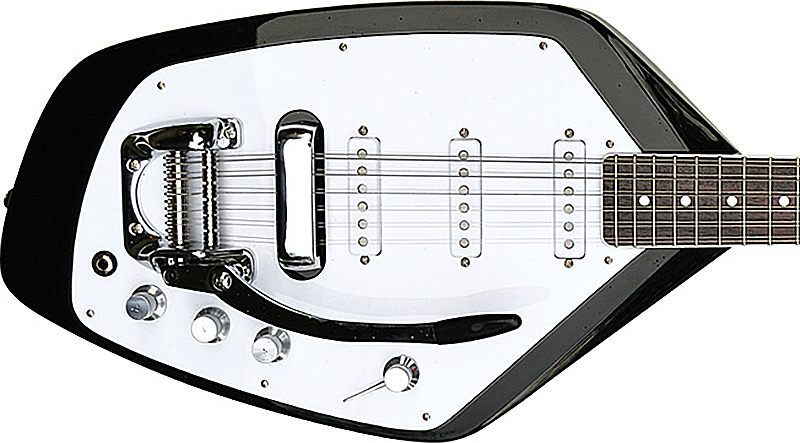
    From the Hollies to the Mahavishnu Orchestra, from Robert Junior Lockwood to the Stones, the electric 12-string has a prominent place in modern music. And arguably, the most iconic of all electric 12-strings were those Vox guitars manufactured under the auspices of the Jennings Musical Instruments. Phantom Guitarworks is reissuing models inspired by the Jennings instruments, including the Phantom Reissue 1964 PH12 that conjures visions of ’60s rock iconography.

    Our test model arrived finished in a flawless glossy black polyester, with chrome and nickel hardware and a white four-layer pickguard. The five-sided mahogany body, like that originally used from 1964 to ’69, features comfortably rounded edges, a rear belly cut, and two beveled upper bout edges to enhance comfort and playability and reduce weight. Three single-coil alnico pickups, measuring 5.9k to 6k, are humbucking in combination and free of the microphonic characteristics of many of the old imports, a definite Phantom Guitarworks improvement over the Vox original. They are wired through 250k solid-shaft pots (one volume and two tones) with specially machined aluminum knobs and a six-position rotary switch complete with a “handle” threaded into place. Virtually all the parts are custom-built for Phantom Guitarworks, including the bridge and its cover. The proprietary tremolo is fastened to the pickguard with four screws; it features six rollers and a spring especially tensioned for 12 strings.

    The rock-maple neck, also in black finish, sports a 25.5″ scale and a single-bound rosewood fingerboard with white markers and small frets. The neck is mounted using four screws through a rear neckplate (truss-rod adjustments are made at the base of the neck, necessitating neck removal), and the aluminum nut has a tight 45mm width. The Phantom logo appears in script on the top of a simple but shapely headstock that complements the body lines; there are Kluson-style nickel tuners and two string trees.

    Build quality and playability is a priority for Phantom Guitarworks (many vintage examples suffering to the degree of being barely playable). In the lap, the PH12 sits comfortably, though it feels best hung from a strap. Plugged in, it offers a broad palette of sonic colors, from fat to bright to brighter. As mentioned, pickup combinations are humbucking due to a reverse-wound/reverse-polarity strategy, a feature unavailable on the Vox original. And the handle on the switch knob makes accurate pickup selections easy to both see and feel.

    The PH12’s relatively narrow neck makes the fretting hand’s transition from a six-string feel easy. Yet there’s enough room to accommodate fingerpicks, and with a flexible plectrum the Phantom 12 achieves a zither-like response that brings out one’s inner inclinations for world music. The setup facilitates a stress-free playing experience (though with the vibrato arm in combat position, the master volume can be a bit difficult to access). The tone controls are effective, but the PH12 sounds best full out.

    Just the thought of a 12-string with a tremolo unit requires a leap of faith, but Phantom Guitarworks’ unit works well for subtle modulations. The guitar comes back to pitch dependably, and the trem action is purposely set up stiffly to discourage ill-advised dive-bombs. Though single-note lines are solid and balanced, the PH12 proves to be a rhythm guitar par excellence.

    The Phantom Reissue 1964 PH12 is modeled after the U.K. instrument, not those lesser-quality Italian-made guitars, with all the modern conveniences and enough vintage British Invasion weirdness for any guitar geek to appreciate.


    This article originally appeared in VG February 2014 issue. All copyrights are by the author and Vintage Guitar magazine. Unauthorized replication or use is strictly prohibited.


  • Dweezil Zappa Victim of Theft

    Dweezil Strat
    Zappa with the Stratocaster stolen during the current Zappa Plays Zappa tour.

    A Fender Custom Shop Stratocaster used by Dweezil Zappa on the Experience Hendrix tour earlier this year was recently stolen during the current tour with his band, Zappa Plays Zappa. A precise location of the incident is unknown, as the guitar wasn’t called on for use until a later tour stop, at which time it was determined to have been stolen. The Strat has several unique features, including a reverse headstock and a cutaway on the lower horn of its gold pickguard. Anyone with information should make contact via david@theguitarvaults.com.

  • Brad Paisley

    Brad Paisley

    Brad Paisley

    After a slew of excellent albums earlier in the decade, Brad Paisley’s work has taken a more uneven turn. His vocals and flair for guitar pyrotechnics remain flawless even if the material on recent albums has been less-consistent. Moonshine In The Trunk continues this trend.

    Several numbers here show him following other male Nashville stars of the moment, grinding out party-hearty anthems about booze, pickup trucks, hot girls in tight jeans, and the other usual suspects. The title song, along with “River Bank,” “Crushin’ It,” “Cover Girl,” “Limes,” and “49WP” all fit the formula.

    Three rise above the others: the love ballad “Shattered Glass,” “High Life” (spoofing a lawsuit-happy family), and “Gone Green,” a smart commentary on changing technologies.

    His Apollo 11 shout-out “American Flag On The Moon” is earnest, if a bit clichéd. The best instrumental moments come from Paisley, fiddler Justin Williamson, and Randle Currie’s pedal steel.

    As for arrangements, too many feel gimmicky – similar to those on other stars’ albums. Two exceptions are the churning rhythms of “River Bank” and stunning instrumental fireworks of “High Life.”

    Paisley’s strengths were always rooted in his willingness to stand out from the rest. Here, he’s opted to simply become one of the boys.


    This article originally appeared in VG‘s December ’14 issue. All copyrights are by the author and Vintage Guitar magazine. Unauthorized replication or use is strictly prohibited.


  • James Elkington

    James Elkington

    JAMES_ELKINGTON_01

    James Elkington tweaked the paradigm when he began working at a luthier shop before hitting his stride as a guitarist. Born and raised in a small English village northwest of London, his interest in the guitar blossomed relatively late.

    “It seemed the coolest instrument on offer and, as most of us guitar players have found out, it’s immediately kind of gratifying; compared to the violin, you can make quite musical sounds on the guitar without having any idea of what you’re doing.”

    The aesthetics of guitars were also appealing to the aspiring player.

    “Clarinets all look the same, but the fact that a Fender Jazzmaster can be as different to look at as a Gretsch White Falcon, and still operate the same way, was amazing to me,” Elkington said.  “I used to spend entire math classes drawing Vox Phantoms. When I was 13, the first Smiths album came out, and it struck me that I wanted to do exactly that.”

    Moving to London to purse his musical fortune, Elkington became frustrated when his ideas didn’t pan out, and a sour experience working at a music store added to his disenchantment. However, a move to the U.S. and employment at Specimen Products turned his quest in the appropriate direction.

    “When I moved to Chicago and met Ian Schneller at Specimen, I had to change my policy,” he said. “Working for him was so completely unlike working at a regular music store that you can’t even compare them. He’s an artist, and he works on guitars and amps as a means to fund his sonic experiments. Even though I’d been tooling around with guitars most of my life, I didn’t know much about the mechanics of them, and he taught me all about it.”

    Among the musical aggregations in which Elkington has gigged is the Horse’s Ha, and that group’s recently-released second album, Waterdrawn, is decidedly different.

    “Janet [Bean] and I had started out as a duo, but the band had expanded to a quintet by the time we put the first album together,” he recounted. “Everyone in that band is an in-demand musician in Chicago, and scheduling became difficult, plus the band really wasn’t making enough money to justify dragging everyone out of town, so instead of making the next album the same way, I shelved all the songs in favor of writing and recording a record that Janet and I could play and promote by ourselves.”

    Waterdrawn has a stripped-down sound that evokes comparisons to English folk artists like Pentangle, and, not surprisingly, Elkington is a fan of the late guitarist Bert Jansch.

    “That music is a big influence, for sure, though the content of the songs is quite personal to us – there aren’t any ‘Reynardine’ covers in there,” he said.  “Folk music was very derided in England when I was growing up in the ’80s, and as a result, I didn’t hear very much of it.  It was only when I moved to the U.S. and started writing songs that someone mentioned to me that they thought I must be into Bert Jansch – which I really wasn’t – and when I finally got hold of some, it was a revelation. Jansch continues to be an influence, and I’m glad to say that I got to meet him a couple of times before he died.”

    Elkington used a budget-model Martin 000-1 on the album, as well as a Yamaha 12-string tuned down, and a National lap steel. Bean played a Weber mandola, and both used alternate tunings and capos to evoke unique sounds on songs such as “A Stoney Valentine” and “Stick Figure Waltz.”

    With other bands, Elkington uses electric guitars, and espouses a utilitarian view of them.

    “I’ve seen so many collectible guitars that are absolutely no fun to play, and I really have no interest in that for myself, so almost every guitar I have has different pickups from stock and has been re-fretted. I play Telecasters, for the most part, and my main guitar is a red one with a pre-CBS neck and an ’80s body. I’ve also got a couple of parts Teles I take on the road, and they all have Lindy Fralin pickups, which are wired in series as well as parallel to make them a little thicker-sounding. I have a Danelectro and a Teisco from the ’60s that I like, a ’66 Fender Jaguar that I’ve had since I was 18, and a Sho-Bud pedal steel I haven’t been able to make any sense of yet.”

    An expectant parent when VG conversed with him, Elkington, stresses that family comes first. “I have so many unfinished projects at this point that I’ll be glad just to be in Chicago working on those between diaper changes,” he said.


    This article originally appeared in VG April 2014 issue. All copyrights are by the author and Vintage Guitar magazine. Unauthorized replication or use is strictly prohibited.