Year: 2014

  • Schroeder Radio Lane Edge

    Schroeder Radio Lane Edge

    SCHROEDER_RADIO

    Schroeder Radio Lane Edge
    Price: $11,500
    Info: www.schroederguitars.com

    Though Jason Schroeder began to follow his love of instrument-building in 1985, it wasn’t until 2005 that he made the jump to full-time guitar builder. His strong eye for detail and design gave him a leg up in producing instruments that are classic in spirit and feature accoutrements that take them to another plateau of craftsmanship. And though it is easy to see the influence of heroes like Benedetto and D’Aquisto, Schroeder focuses mainly on solid and semi-solid guitars.

    One of Schroeder’s top-of-the-line instruments is the Radio Lane Edge, with a flamed koa top over a limba body. Flamed koa is also used on the head plate, truss-rod cover, back plates, vibrato handle tip, and switch tip, while the artisan-grade Brazilian rosewood touches fall on the neck, fingerboard, handmade pickup rings, and the control knobs. Maple and Brazilian rosewood purfling is used throughout, and the fretboard is beset with striking rectangular gold mother-of-pearl inlays. Additionally, the Radio Lane Edge features a beautiful mother-of-pearl inlay on the face of the headstock and an even more beautiful hummingbird inlaid between the tuners on the rear of the headstock.

    The Radio Lane Edge’s scale length is 24.625″, and its nut is a hand-filling 1.7″ wide. The frets are of the medium jumbo variety, and the fretboard radius is a bend-friendly 12″. Hardware-wise, the instrument features a Callaham vibrato bridge along with Waverly tuners topped with classy ivoroid buttons. Not to be outdone, the electronics feature a primo set of nickel-covered MXV (“maximum vintage”) ThroBak PAF-style humbuckers which alone would set one back more than $500. The controls comprise Volume and Tone knobs, along with a standard three-way selector switch. A black Ameritage case with gold accents is included.

    The Radio Lane was tested with a vintage Deluxe Reverb and a recent Vox AC15. Before it’s even plugged in, the guitar in hand amazes with its level of detail work, especially Schroeder’s use of top-grade exotic woods. The top of the instrument’s contours, set off by maple purfling, put the Radio Lane in the “top shelf” category even before one is drawn to the flamed-koa cavity covers on the back, the sweet grained limba body, and the multiple levels of binding.

    With all of this breathtaking beauty to behold, it’s quite thrilling to finally plug a cable into the Radio Lane’s custom S-shaped side-mount jack and hear the guitar in action. Starting with the neck pickup, the Radio Lane reveals itself to be round and warm, yet with every note exhibiting a very strong fundamental that allows the plucked tones to sound fat, yet distinct. Skipping the middle position for now, the bridge also offers the strong fundamental tones found in the neck position, with plenty of cut and vibrancy that one would look for in this position. But the blended middle position is the real revelation here, striking a perfect balance of the two ThroBaks and giving a vibrant yet full sound. Owing to the Radio Lane’s strong tonal characteristics, it capably handled everything from fuzz to drive to delay and modulation without getting lost or overwhelmed.

    With such a finely crafted guitar – and one with such premium appointments, at that – it could have been easy for Schroeder to gild the lily, but thankfully this is not the case with Schroeder’s Radio Lane Edge. Not only is it an over-the-top beauty, the Radio Lane Edge is a great-playing instrument. Although the price certainly puts it in the high end of the market, the Radio Lane Edge’s craftsmanship, materials, and feel certainly justify the princely sum.


    This article originally appeared in VG March 2014 issue. All copyrights are by the author and Vintage Guitar magazine. Unauthorized replication or use is strictly prohibited.


  • David Michael Miller

    David Michael Miller

    David Michael Miller
    The latest record from David Michael Miller is a mixture of soul, gospel, blues, pop, funk, and everything in between.

    Sometimes multiple styles of music come together in the same song, as in the transcendent “Hope Finds A Way.” The song starts as though you’re going to be listening to a loud country blues, but turns into an amazing soul tune with brilliant chord changes, great vocals from Miller that stretch from an earthy growl to a heavenly falsetto, and then dips back into country blues land. In between, a blistering guitar solo from Miller adds to the fun.

    At least one song gives a hint as to some of his influences. “Diggin’ On Bill” is a funky tribute to Bill Withers with the kind of soulful vocals and tasty guitar that is everywhere here.

    With soul dominating the record, Miller’s guitar soloing is fine, but it’s his rhythm playing that really forms the backbone to each tune. Sacred steel guitarists Chuck and Darick Campbell guest on several cuts adding to the soul quotient.

    Miller’s a music veteran, but he never sounds old or bored.

    This article originally appeared in VG‘s October ’14 issue. All copyrights are by the author and Vintage Guitar magazine. Unauthorized replication or use is strictly prohibited.

  • Squier Intros Vintage Modified Baritone Jazzmaster

    Squier Vintage Modified Baritone JazzmasterSquier’s Vintage Modified Baritone Jazzmaster guitar is tuned A to A and has the 30″ scale. Sporting a modern take on Fender’s Antigua finish, with a matching pickguard, it has a bound fretboard with white pearloid block inlays, and two Duncan Design single-coil Jazzmaster pickups. Go to www.squierguitars.com.

  • Setzer Sends Gretsch to Smithsonian

    Setzer at SmithsonianBrian Setzer recently donated a replica of his 1959 Gretsch 6120 to the Smithsonian’s National Museum of American History. The renowned original was used during the ’80s heyday of the Stray Cats, when he personalized it by mounting dice (taken from his Monopoly board game) on two of its Tone pots and added stickers depicting a black cat, skull and crossbones, and a pin-up girl. Those touches were duplicated on the replica, which was built in 2006 by Stephen Stern, master builder at Gretsch. At the Smithsonian, it joined Edward Van Halen’s “Frank 2,” Prince’s Yellow Cloud, and non-stringed instruments such as John Coltrane’s saxophone and Dizzy Gillespie’s trumpet.
    “Brian Setzer is a prolific and distinctive contributor to American music,” said John Edward Hasse, curator of American music at the Smithsonian. “Proof of his legacy exists not only in the longevity of his career and in his lengthy discography, but also in his ability to cross musical boundaries.” To learn more, visit http://americanhistory.si.edu.

  • Stan Jay, Proprietor of Mandolin Brothers, Passes

    Vintage Guitar would like to extend condolences to the family and friends of Stan Jay, who passed away October 22. Founder of Mandolin Brothers, a forefather in the vintage-instrument trade, and cherished among his peers, Stan was one of the first (and longest-running) advertisers in VG.

    http://www.silive.com/entertainment/index.ssf/2014/10/stan_jay_owner_of_beloved_mand.html

  • Silvertone’s 1449 and 1423

    Silvertone’s 1449 and 1423

    SILVERTONE_01_1423

    Silvertone’s 1449 and 1423
    Price: $739 list/$479 street (1423); $629 list/$399 street (1449)
    Info: www.silvertoneclassic.com

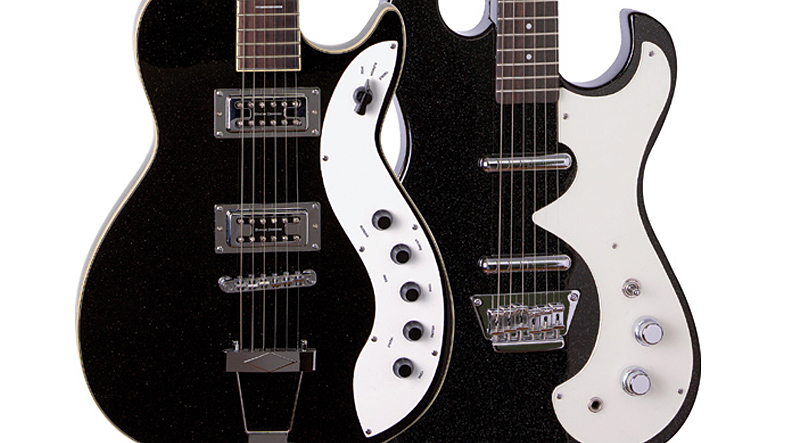
    With an up-swell of interest in vintage Silvertones, current parent company Samick has begun to reissue some of the most requested models. The first offering, the 1303/U2, with its famous “coke bottle” headstock and lipstick pickups, was followed by a Bigsby-equipped 1478, known for its Jaguar-influenced body shape. The latest offerings are the pivotal 1449 and 1423.

    Originally offered in 1963-’64, the 1449 is a two-pickup version of the most popular Silvertone, the “beginner” 1448. Vintage models, some will recall, included a tube amp built into the case. While the reissue 1449 does not include a case with integrated amp, when compared to a pristine original, the feel of the reissue is nearly dead-on. Likewise, the reissue’s lipstick pickups are true to the sound of a vintage original. However, it must be noted that the sound of the vintage lipsticks varied greatly from guitar to guitar. According to Tony De La Rosa of Silvertone, the Samick folks sift through as many originals as is necessary to find an exemplary guitar on which to base a reissue.

    The new 1449 has a full 24.75″ scale, and the pickups are controlled by the same stacked volume and tone controls as on the original. Perhaps the most obvious difference is that the reissue 1449 is made of solid mahogany rather than the original’s Masonite-covered pine frame. Plugged in, however, the difference is slim, with the vintage model having just a bit more woody lower midrange. Thanks to a modern dual-action truss rod, sealed tuners, and a through-body bridge with individual string saddles, the reissue can be made to tune, intonate, and play consistently. (The same can seldom be said of a vintage example.) Like the original, the fingerboard is rosewood, but the original’s aluminum nut is replaced with polymer.

    In use, the new 1449 produces nearly the same tones as the original – perfect for a working guitarist who desires the tone and aesthetic appeal of an original but requires consistency and the ability to fully tweak action and intonation.

    The Silvertone 1423 Jupiter adds ivory binding to the neck and body and sports a trapeze tailpiece and tune-o-matic-style bridge. Where the original (known as the Jupiter H49 in the Harmony line) featured DeArmond-made pickups, the new Jupiter has Seymour Duncan-designed Filter’Tron-style humbuckers. The control arrangement is exactly as the original’s, with individual Volume and Tone knobs for each pickup and a three-way chicken-head switch for the bridge and neck pickup positions (labeled “Bass” and “Treble,” respectively), and an unusual middle position labeled “Blender” that engages both pickups and a passive circuit that rolls off highs and boosts mids, the frequency of which is varied by the blender pot. The effect is similar to a wah pedal, and the position of the control facilitates pinky-finger manipulation.

    In use, the most notable difference between a vintage and reissue 1423 is the pickups. While DeArmonds were warm and woolly to an almost unusable degree, the reissue provides a wide range of contemporary and more usable tones. The feel of the reissue is also much more playable, with greatly improved action and intonation. The guitar covers diverse musical styles surprisingly well, and its retro looks definitely draw attention.

    The reissue Silvertones all retain the vibe of the originals, but include modern elements that make them fully functional. In other words, these reissues pay homage to the originals, but they are not slavish replicas.


    This article originally appeared in VG March 2014 issue. All copyrights are by the author and Vintage Guitar magazine. Unauthorized replication or use is strictly prohibited.


  • Peavey RJ-IV

    Peavey RJ-IV

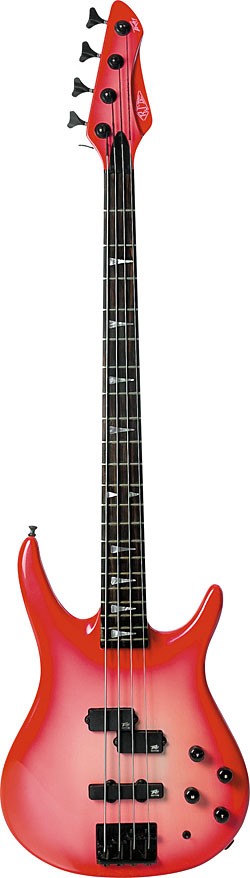
    Peavey RJ-IV bass

    Peavey RJ-IV bass, serial number 04938996. Photo: Bill Ingalls Jr. Instrument courtesy of Naffaz Skota.

    Americans by the millions “know” Randy Jackson. But not many realize that his gig as one of three judges on TV’s “American Idol” is just the tip of the iceberg in his long musical career.

    The veteran bassist has played alongside, recorded with, and/or produced musicians ranging from Jean Luc-Ponty to Bob Dylan to Jerry Garcia to Mariah Carey to Bruce Springsteen to Charlie Daniels (at the Grand Ole Opry, no less). He also played on Journey’s 1986 album Raised on Radio, and toured with the band. In fact, most Americans’ first Randy Jackson sighting was in a performance video for Journey’s hit single from that album, “Girl Can’t Help It,” where he played a green Jackson bass decorated with gambling-table graphics.

    A few years later, Jackson (the man) collaborated with Peavey to design and build the RJ-IV, one of several artist endorsement models marketed by Peavey in the late 1980s and early ’90s. It debuted in 1990, a year after the TL-5 (designed with the input of Tim Landers), and the Rudy Sarzo Signature Bass and a year before the Palaedium (inspired by Jeff Berlin’s “parts” bass).

    The RJ-IV has its share of interesting elements. For instance, Peavey spec sheets of the day referred to the model as the “RJ4,” while the headstock and owner’s manual actually say “RJ-IV.” And while company literature noted its neck-through configuration, touted its “select maple body” and “eastern maple bilaminated neck construction with graphite reinforcement,” its finish made it impossible to see and/or appreciate these qualities!

    The headstock profile was similar to other up-market Peaveys of the time, with a carved portion below the trendy black tuners.

    The RJ-IV was equipped with a Hipshot D-tuner on its E string and its 1.6″-wide nut is made of Peavey’s trademark Graphlon material. The scale is standard 34″ and the neck profile was described in literature as having a “…thin oval back profile.”

    Its fingerboard is macassar ebony, and has a 10″ radius and 21 frets. Its funky “icicle” mother-of-pearl fretboard inlays are unique among Peavey instruments. Company literature also hyped the “…reduced body size with four-way radial contour.” The body is 18″ long and 13″ wide.

    As for its electronics and controls, the RJ-IV came off as practical and simple-to-operate… on the surface. Its pickups are active, powered by a 9-volt battery that installs on the back of the body, in a small compartment separate from the rear control cavity. The control knobs are labeled “V” (volume), “B” (bass), “M” (midrange) and “T” (treble), and each of the three tone knobs has a center detent. Pickup selection is accomplished by a three-position mini-toggle. So far, so good…

    The Bass control is centered at 50 Hz and has a +8 dB boost and a -8 dB cut. The Treble control is centered at 2 kHz and has a +/-12 dB boost/cut. The Midrange knob is on the upper row, behind the Volume knob. The midrange tonal sweep of the RJ-IV can be pre-set for several frequency ranges with variable-notch centers. And for real fine-tuning of the tone, the rear cavity houses an eight-position dual in-line package (DIP) switch that the owner’s manual says adjusts thusly: “1 on – 6 dB pad on preamp input; 2 on – shift high from 2 kHz to 1 kHz; 3 and 6 on – shift mid from 1 kHz to 500 Hz; 3,4,6, and 7 on – shift mid to 250 Hz; 3, 4, 5, 6, 7, and 8 on – shift mid to 125 Hz.” Given its relative complexity, one wonders how many RJ-IV owners actually went to the trouble of changing the DIP switches.

    The Red Pearl Burst finish on the RJ-IV shown here might evoke comparison to Rickenbacker’s Fire-Glo finish, which is also pink-to-red, and its fret markers have a Ric vibe, as well, resembling the wedge shapes found on up-market Rics. The RJ-IV, however was available in three other Pearl Burst finishes (Black, Blue, and Purple) as well as solid Pearl Black, Pearl White, Pearl Blue, and Sunfire Red. There may even have been one in natural-finish koa. In 1992, Jackson filmed an instructional video called Mastering the Groove, where he appeared on the cover brandishing an RJ-IV in Red Pearl Burst.

    The RJ-IV lasted four years in Peavey’s lineup. While it’s debatable to what extent Jackson’s high profile today might bolster collector interest in this model, it, like most Peavey basses, is well-built and remains a practical value in the market.


    This article originally appeared in VG‘s October 2008 issue. All copyrights are by the author and Vintage Guitar magazine. Unauthorized replication or use is strictly prohibited.

  • Nils Lofgren

    Nils Lofgren

    Nils Lofgren

    Wags might be forgiven for calling Nils Lofgren the Forrest Gump of rock. The dude’s not only played with everyone, it seems, but he’s been a key guitar (and accordion) foil for some of the most critically acclaimed figures in rock.

    And that’s precisely where the wags would be way wide of the mark. Whereas ol’ Forrest landed alongside greatness entirely by dumb luck and failed to recognize the significance of those figures and events, Lofgren earned his place alongside greatness and, in his typically humble manner, understood the gravitas of those situations in which he found himself.

    What’s often overlooked, however, given his extraordinary career as a sideman, is Lofgren’s stellar solo output beginning with his early work as a teenaged guitarist/singer/songwriter with the criminally overlooked Grin.

    It’s that solo career which finally gets its due retrospective in this exhaustive 10-disc set (nine CDs and one DVD) curated by Lofgren himself, beginning with selections from Grin’s first album in 1970 and continuing through selections self-released on his own Cattle Track imprint beginning in 1993.

    Also included is a fantastic 132-page book lovingly prefaced by Dave Marsh and featuring rare photography alongside track-by-track commentary from Lofgren himself.


    This article originally appeared in VG‘s November ’14 issue. All copyrights are by the author and Vintage Guitar magazine. Unauthorized replication or use is strictly prohibited.


  • Laurence Juber with Marshall Terrill

    Laurence Juber with Marshall Terrill

    Laurence Juber

    This coffeetable book mixes Juber’s personal story with his time as Paul McCartney’s guitarist in the last version of Wings from 1978 to 1981. As he puts it in his foreword, Juber basically had photos in a box for three decades and had forgotten about them. It’s those photos that make this a treasure trove for fans of McCartney, Wings, or pop music in general.

    Juber’s studio shots from the time the band was working on Back To The Egg are gorgeous. They capture Macca and the band in a personal way, but are never intrusive. The same can be said for shots of the group at the beach and on the McCartney farm. The reader is also treated to some splendid guitar pics throughout the book.

    There is text, but not a lot. It tells the story of a humble guitarist who learned the biz from Paul and photography from Linda McCartney. Juber’s admiration for Linda is evident from front to back.

    A couple of spelling errors mar the book, but overall it’s just great pictures and text that comes across as a clever, animated conversation about Juber’s life.


    This article originally appeared in VG‘s December ’14 issue. All copyrights are by the author and Vintage Guitar magazine. Unauthorized replication or use is strictly prohibited.


  • Judas Priest

    Judas Priest

    Judas Priest

    After a supposed farewell tour a few years back, Judas Priest has replaced longtime guitarist K.K. Downing with young guitarman Richie Faulkner and developed a completely re-energized sound. As a result, Redeemer Of Souls might be one of the best Priest albums ever.

    First off, the studio engineering is remarkable. Priest’s guitars sound ferocious, like having a wall of Engl Powerball II and Marshall amps in your living room. You can really hear the detail in these super-saturated tube stacks. Veteran axeman Glenn Tipton is still co-leading the band, but he gives young Faulkner tons of room to strut: Richie takes the blazing first lead in “Dragonaut” while Tipton delivers a baroque-style figure run.

    Faulkner – who’s an admitted fan of Michael Schenker, Zakk Wylde, and Slash – cuts a bruising wah-wah solo in “March Of The Damned,” deftly balancing the blues and metal ideas. And “Down In Flames” delivers just about everything you’d want in a Judas Priest song: the riff, crunch, vocals, and a liquid-hot guitar solo to boot.

    Bottom line: If your enthusiasm in metal has waned over the years, check this out. It’s an amazing re-boot of Judas Priest that could make you believe again.


    This article originally appeared in VG‘s December ’14 issue. All copyrights are by the author and Vintage Guitar magazine. Unauthorized replication or use is strictly prohibited.