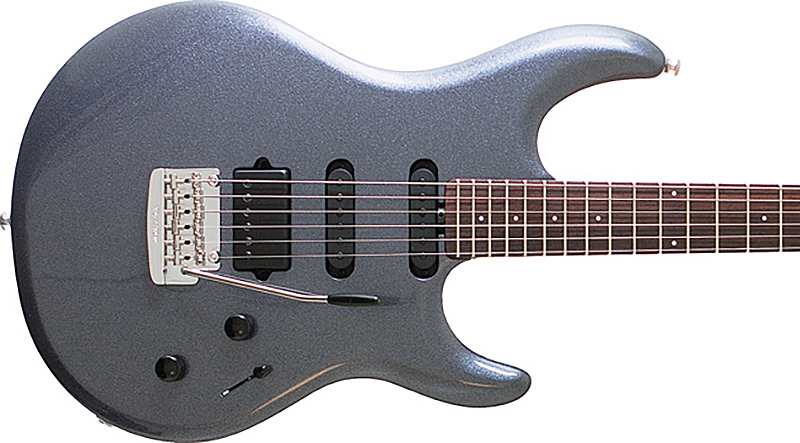
The latest model in Ernie Ball Music Man’s Steve Lukather signature series was designed to answer Lukather’s demand for an instrument that is simple yet versatile. The Luke3 (a.k.a. LIII), available in dual humbucker (HH) and humbucker-single-single (HSS) configurations, is a high-class workhorse that any serious player will appreciate for its playability and extensive tonal range.
Prior Luke, Luke2, and Luke BFR (Ball Family Reserve) models have avid fans, and Music Man knew better than to mess too much with basic specs and features. The LIII body is made of alder and maintains the original Luke’s shape with a deep cut on the lower bout for high-fret access, and a rear contour for comfort (though the LIII is slightly larger and weighs in at about 71/2 pounds). The “roasted” maple neck, finished with a gorgeous coffee-brown gun oil and mottled with birdseye, is hand-rubbed with a wax blend that walks the line between matte and glossy. The 22-fret fingerboard is rosewood with wide fretwire sunk low in the wood. The neck has a 12″ radius and Music Man’s soft V profile, which many players –especially those with smaller hands, like Lukather himself – find supremely comfortable. (Why more manufacturers can’t or won’t make a great slim neck like Music Man does is a head-scratcher.)
Schaller M6-IND locking tuners are split 4+2 in classic Music Man fashion. Just 57/8″ from nut to tip, the small headstock makes the neck appear shorter from playing position, but the scale length is a true 251/2″(same as a Fender Stratocaster). At the tail end is Music Man’s own floating tremolo in chrome.
But that’s where the LIII’s similarities to earlier Luke models end. Fundamental changes to the electronics set the LIII apart and above its older brothers.
While previous Luke guitars were outfitted with active EMG pickups, the LIII has passive DiMarzios and an active preamp. The HH model features DiMarzio’s custom Transition humbuckers (named for Lukather’s 2013 solo album). The HSS model features a Transition bridge pickup plus two custom single-coils. A five-way blade enables cuts on the HH (bridge/combo/neck in series in positions 1/3/5, and parallel outside/inside coils in positions 2/4) and Strat-style selections on the HSS.
Combining passive pickups with an active boost gives the LIII the best of both worlds. Played clean with no boost, the tones are natural and sweet. Up and down the neck, with a pick or snapping the strings with fingers, the sound is remarkably even. The low-end response on tightly voiced chords is never muddied, and strongly struck notes on unwound strings are clear but not cutting, as if the sharpest points are rounded off. Even bridge-only settings with the Tone knob full out are punchy without being abrasive.
The LIII’s preamp is activated by way of the push/push Volume pot and powered by a 9-volt battery that swings out from a small door in the back (the LIII was introduced with active boost on the tone pot rather than the Volume pot, not to mention an all-rosewood neck; Music Man made production changes in 2013 to reflect Lukather’s preferences). Kicking in the preamp boosts the output by up to 12 dB. However, it’s not the kind of abrupt, night-and-day surge that sends listeners to the back of the room. Rather, the change is to a bigger, broader sound rich in overtones. It’s dynamite for gain control, especially when paired with a low-watt amp on the cusp of being overdriven.
Should the preamp gain be too much or too little for the player’s tastes, its range can be adjusted with one of two trim pots accessed through a rear plate. The other trim adjusts the balance between single-coil and humbucker volumes so that there’s no disparity when pickup modes are switched.
One more noteworthy characteristic hidden in the Luke3’s wiring is the EQ on the volume pot. Normally, lowering a guitar’s volume has the secondary effect of rolling off highs and mids, but on the LIII, an active buffer maintains a constant high/low mix. That takes a little getting used to – we’re all accustomed to the imperfection on electrics – but it’s great to be able to adjust output without having to tweak the tone pot or use a volume pedal for consistent EQ.
The Luke3 comes in an excellent hardshell case and is currently available in Black or Bodhi Blue finish, both of which look sharp against the gun-oil neck.
This article originally appeared in VG September 2013 issue. All copyrights are by the author and Vintage Guitar magazine. Unauthorized replication or use is strictly prohibited.
Joe Knaggs has devised a method to stain different finishes on solidbody guitars. Called double purfling, the finish involves splitting the guitar’s top into sections by inserting channels. For more, go to www.knaggsguitars.com.
Dean Zelinsky, CEO of Dean Zelinsky Private Label Guitars, has been granted a patent for a new guitar neck design that textures the backside.
The design is marketed as the Z-Glide Reduced Friction Neck, which Zelinksy says improves playability and feel while addressing the undesirable tacky neck feel when a sweaty palm meets a conventional neck. The Z-Glide is currently available on Zelinsky’s Private Label guitars, but its availability will soon expand.
“We recently developed the technology to put the Z-Glide on our set-neck single-cut guitars.” Zelinsky said. “The response to the feel and improved playability is so good, I can see a day where we no longer build guitars with conventional necks.” Learn more at www.deanzelinsky.com.
Fender Musical Instruments Corporation (FMIC) has announced the upcoming retirement of CEO Larry Thomas.
Thomas was appointed to the FMIC Board of Directors in 2009 and became CEO on August 1, 2010. Interim COO Scott Gilbertson will assume the role of interim CEO until the company completes its search for a successor for Thomas, whose retirement takes effect May 31.
“I am extremely proud of the success we have achieved in my time at Fender,” said Thomas. “We did a lot in just a few years and I leave feeling like our table is set for the company’s future direction. This has truly been a wonderful life experience. FMIC is a wonderful company and Fender is a great brand, and I am very thankful to have played a part in the company’s history.”
In September, 2011, Thomas opened the doors to the 8,400-square-foot Fender Visitor Center, adjacent to the company’s factory in Corona, California. He played a key role in the management of the Fender Select series, the American Vintage series, the American Design Experience, and established FMIC’s first direct office in China.
Ana Popovic was but a toddler when she started to absorb major musical mojo through her father’s love of the blues, classic rock, and most importantly, thanks to the rec-room jams he would stage with buddies. By the time she was 14, the Serbia-born-and-raised Popovic was taking private lessons on classical guitar, but, “After a month I decided ‘This is not for me,’ and my parents realized I was going toward the blues – we listened to a lot of blues at home.”
So, she jumped ship, enrolling in lessons to learn rock guitar including the famous licks she’d heard around the house. “People in Serbia didn’t often get to hear that kind of music,” she said. “There’s a lot of Serbian music, so it was unusual for a kid to learn about Led Zeppelin, the Who, Deep Purple, or the blues – things every guitar player should know. So those were really good lessons.”
At 19, Popovic helped assemble a band that called itself Hush, which in short order transitioned from playing Friday nights only to weekends and, within a couple months, four nights per week. It was a great way to dip her toes in the water. “At first, I was singing mostly, and playing a couple of songs on guitar,” she said.
Hush released an album that mixed three original songs with blues covers, and while Popovic continually improved and even formally studied jazz guitar while the band maintained a heavy gig schedule, after a few years she was set to begin studying graphic design at a college in Holland. Though focused on classes, she formed another band that almost immediately scored a deal with the German label Ruf Records.
The path to fame has been a slow, steady climb for Popovic. In 2000, she contributed a rendition of “Belly Button Window” to the Jimi Hendrix tribute disc Blue Haze. The following year saw the release of her solo debut, Hush! (named in honor of her first band), which proved so successful it gave her the confidence to ditch those plans to become a graphic artist and try music as a career. From 2003 through 2011, she released four more albums, with two of them – 2007’s Still Making History and 2011’s Unconditional – reaching number one on Billboard’s Blues chart. Her latest, Can You Stand The Heat, was a rapid-riser on the charts from the day it was released in April, with a title track that went Top 5 among the Billboard Blues singles. Recorded with a new nine-piece band that includes John Williams on bass, Harold Smith on rhythm guitar, Frank Ray, Jr. on organ, Tony Coleman on drums, along with horn players and backing vocals, the disc was produced by Pete Matthews, and though it’s not the first album she recorded in Memphis, it is far and away the one most influenced by the city.
We caught up with Popovic during rehearsals with the new band as it readied for its inaugural gig, at the New Orleans Jazz Festival. After the event, the press positively glowed, with the local Times Picayune chiming in, “Almost every person in the tent was standing, applause… thundered for minutes after she left the stage.”
One would guess that your dad’s attitude toward you and your attraction to music had an effect on the way your two young children are being raised…
Oh, yes. I think parents should embrace and make it possible for their children to play an instrument, if that’s what the children want to do. I don’t think you should push a kid into it. My (five-year-old) son loves music and I think it should be around him, so I find a way to have him practice without him knowing he’s practicing! One day, I was jamming with my dad in the living room, and he dropped his computer and grabbed a guitar. That was a huge win (laughs)! But yeah, my dad never told me, ‘Go practice your guitar!’ He’d just take a guitar and start to play. Watching him, I was drawn to the instrument.
Your career began in earnest after you moved to Holland. What do you most recall about those early days touring with the Ana Popovic Band?
That was the first time I felt in charge of what the songs would sound like and how we’d approach the music. It was a fun, crazy time; I was a girl from Serbia playing guitar, leading a band, usually in a foreign country.
The first time I came to America, I couldn’t afford to travel with a four-piece band, so I was thrown into an extremely challenging situation being the only guitarist, but it was also very inspirational. I came out of that tour as a very good rhythm player because I worked on it so much as I sang and played. At first, I was like, “I can’t do this!” But American audiences are very supportive. They love to see you sweat, see you work hard, and when they notice you’re at the edge of your ability, they like you 10 times better! I really fell in love with them and that’s why I keep coming back. I loved performing in the trio, so I stayed in that format for quite some time. It gave me a lot of freedom – you can go in any direction.
Photo: Chuck Ryan.
Throughout your career, you’ve received recognition for your jazz playing as well as your blues efforts. The mix of styles seems innate in you…
I started listening to blues probably [at a younger age than] a lot of American kids did. I remember, clearly, singing along or dancing to old blues records that my dad would play, so I learned a lot about many musical styles. And I was always searching for the edges, so if you ask me to choose between Elmore James and Robben Ford, I couldn’t because though they’re completely different, I think they’re equally good. I like Chicago blues, I love Delta stuff… even when John Scofield makes a blues record, though it’s very jazzy and very fusion, I tend to hear the blue notes in what he plays. I’m not into cover bands, but if I would have to be in one, I’d do a Steely Dan band. I really hear blues in their music, and I did “Night By Night” on one of my records because I thought it was extremely bluesy.
So, beyond being comfortable in jazz or blues, do you consciously try to do some of both on every album?
Every record needs to be different – I’m not going do the same type of record just because the last one did well on the charts. Everybody keeps asking, “Are you going to do a follow up to Unconditonal because it did so well?” But I say, “No! I did Unconditional, now I’ve got to focus on another side of me and my music.”
There was a time when I was really touching the jazzy side, inspired by Ronnie Earl, who’s a great example of a blues man who was appreciated by jazz musicians, as well. He could go through the changes and do them in a bluesy way. I studied jazz because I thought everything Ronnie did was cool. T-Bone Walker was cool, Scofield was extremely cool – guys who know what’s going on in the changes, but who can also play really laid-back and simplify if they want their playing to go with a more-bluesy side.
I’ve tried to give all of my records some jazzy stuff – a jazzy standard or ballad.
How do you describe your new album, Can You Stand the Heat?
It’s real soul, with a real Stax sound – Isaac Hayes, Albert King and Albert Collins, War – those kind of acts. I’m loving it.
How did its sound and feel come about?
Tony Coleman – who’s the co-producer and was B.B. King’s drummer for decades – and I both felt what Albert King did back in the day could still be extremely hip. He had the blues going on – so groovy, but always with this funky rhythm section; you can’t help dancing when you listen to those records, like New Orleans Heat, which is wonderful and had some very funky, soulful stuff going on – the horns doing funk on the edge of blues and Albert playing straight blues, you know?
Tony and I thought, “Where is that nowadays on the blues scene?” The blues is African-American music that emerged in Chicago and Texas and on the West Coast, but all of it has that basic groove. These days, people mix it with a lot of styles, but fundamental blues, which is supposed to be really groovy, is all but gone. When Albert Collins was doing that back in the day, he’d tell a story and the band would lay way back but still groove so hard you couldn’t stop moving! Same with Albert King.
Memphis is a place where people still play like that. Step away from Beale Street and look for some juke joint where there’s local stuff happening, and you’ll find people who play so differently from anything else on the scene. They sound like War and other African-American bands back in the day. We wanted that sound, so we came to Memphis. It’s a groovy city, it’s got soul. It’s not particularly pretty, but it’s very inspirational (laughs) and I love it! Worst shopping on this side of the ocean, but good grooves!
Did you move there for the purpose of immersing yourself in the city’s musical culture?
Yeah, that’s one of the reasons, for sure. But I started making this record a year ago and I wanted to stretch it out. I’m a big fan of not simply running into the studio, recording, and getting out. I think it’s great to have the option to record some songs then come back a couple of months later and record a couple more. So I found it handy to live in Memphis versus staying in hotels and rushing through the process.
If a fan tells you they especially like your straight-forward blues, which songs on the album do you suggest they listen to first?
“Hot Southern Night” is a duet with Lucky Peterson, and “Blues For Mrs. Pauline” is one of my favorites – those are as deep as I got into blues this time – telling a story and playing slow, with a great groove. “Can’t You See What You’re Doing To Me” is an Albert King take – a straight-up shuffle, obviously, with plenty of guitar. And I tried another instrumental with slide and a War-type groove to it.
If a jazz-guitar fan asks, which tracks would you refer them to?
I would think “Mo’ Than Love” is the one. I didn’t have a whole lot of jazz on this album, but there are two versions; one is with Tommy Sims, which is more like Marvin Gaye kind of thing that closes the song, and one that’s more jazzy.
Photo: Cheryl Gorski.
But again, the emphasis is on funk…
Yes, and we wanted an old-school, back-in-the-day funk, because there are a whole lot of options for that. So “Can You Stand the Heat” and “Well Enough Alone” are extremely funky – “Cocaine”-like funk – and “Rain Fall Down” is a take on a tune the Stones did with a pop/rock approach, but I thought the funk was so groovy on its own that it can be so easily put in that Southern/Memphis kind of groove. It’s a wonderful version of the song, and completely different. “Object of Obsession” is very groovy. “Boys Night Out” is really fast – James -Brown-fast funk – that’s fun and a very popular message among males! We’ve been getting a lot of positive response on that.
“Can’t You See What You’re Doing To Me” is in the top 10 on Billboard’s Blues Charts.
Yes, which is great. USA Today chose that song for its “Pick of the Week,” and it landed on Billboard just a week after it was released.
Which guitars and amps are you playing these days?
I’ve got my ’64 reissue Strat and a ’57 reissue that’s on the cover of the album. I’ve had that guitar since my Belgrade days. I did a couple of takes with my old Marshall – the original 50-watt from back in the day. And I play a lot through my Mesa Boogie Mark IV. I did a couple of tracks with a blackface Super Reverb, and a Deluxe, which is a great overall amp for when you want a back-in-the-day sound.
How hard do you run it?
Oh, pretty hard. They’re tiny, so for stage, unfortunately, it’s impossible to use Deluxes. But they’re wonderful amps, and whenever I get a chance in the studio, I use one.
How about effects?
I still have my original Tube Screamer, which I love. I’ve got a Vox (847) wah with the Union Jack graphics. They’re the best – their sound is awesome. It’s very bluesy and doesn’t have the scream that the regular one has – it’s more subtle, has a bigger “loop” and a more-diverse sound. I have a Line 6 Delay and an old Boss Chorus – two knobs, the light-blue original – and a tuner.
Jim Hamilton, who builds Hamiltone guitars including one famously played by Stevie Ray Vaughan, recently made a prototype for you, right?
Yes, it has the classic double-cutaway body, their signature headstock shape but with a rosewood overlay and the mother-of-pearl Hamiltone logo, and a standard Strat (251/2″) scale, which is unusual for Jim – the guitar he made for Stevie Ray had a longer (26.188″) scale, which Strat players sometimes don’t like. It has a curly maple neck, a 3/8″ curly-maple top, their hand-wound pickups, a vintage tone capacitor, and we’re working on a custom color and neck shape.
I am also talking with a European guitar company called Fame, which makes affordable hand-made custom guitars. We’re working on a signature model that should be out late autumn this year.
Fender, Mesa Boogie, and DR Strings have all been supporting me for a very long time. I’m not big into endorsement, but get a lot of things sent to me. Usually, when I compare them to what I already play, I send them back! I just don’t stash equipment; I don’t like having guitar or amps sitting in my closet – they should be played.
Did Jim Hamilton do one of his trademark inlays of your name on the fretboard?
He is ready to do it and it’ll be a nice touch.
You once again have a rhythm guitarist onstage. Does it feel like you get to relax a little compared to all those years you performed as a trio?
Yes, and almost every second I have to remind myself to just cool it. I’m so used to playing rhythm guitar that I have to sing with my hands on the guitar – I need to have that touch with the neck. I’ve been doing it for so long that I’m not able to just hold the mic. So I’m going to keep doing my rhythm thing and then have the other guitarist do another type of rhythm. We’re doing old-school funk and blues, and there’s never enough rhythm in that, so that’s no problem with two guitar players.
But yes, with this band and what we play, I have to leave space for the horns and listen and watch for what other people are playing.
It’s a very exciting time. We’re bringing very high-end musicianship, and even though I’m leading the band, they’ll definitely get do their thing! It’s all very inspirational – a new approach to my songs. I’m really looking forward to it.
This article originally appeared in VG August 2013 issue. All copyrights are by the author and Vintage Guitar magazine. Unauthorized replication or use is strictly prohibited.
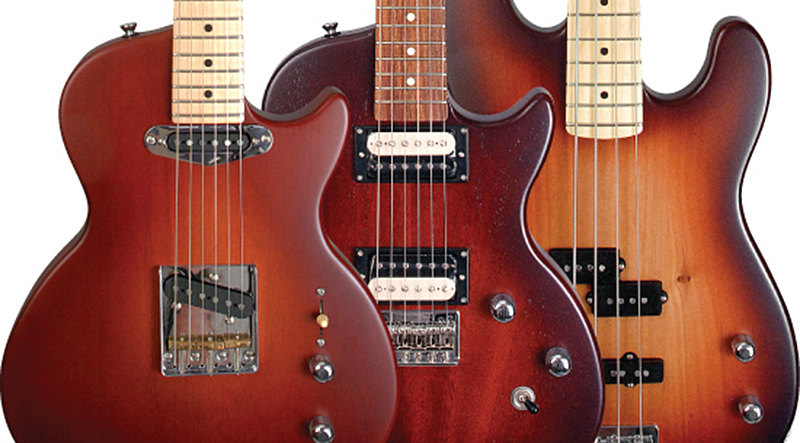
With the elimination of its Korean-made Pro Series and the introduction of the Juke Joint Series, Memphis-based St. Blues can boast an entire lineup made in the good ol’ U.S. of A. St. Blues’ initial offerings in the Juke Joint Series include the Bluesmaster and Mississippi Bluesmaster guitars, along with the Legendary Bass. With their stripped-down layouts – i.e., no pickguards, no bindings, ultra-thin satin finishes, earthy color palettes, and minimal chrome hardware – all three Juke Joint instruments exude a vibe that’s cool and natural while also being visually appealing and comfortable to play.
The Tele-inspired Bluesmaster features St. Blues’ proprietary bell-shaped alder body, a 251/2″-scale bolt-on maple neck with a classic C profile, Wilkinson vintage-style tuners, a Wilkinson box-style Tele bridge with compensated brass saddles, a rear-mounted three-way lever switch, rear-mounted push/pull Volume and Tone knobs, and a pair of individually tapped Ken Armstrong single-coil pickups.
The Bluesmaster was tested with a’65 reissue Fender Twin Reverb combo with an Ibanez TS9 overdrive pedal. Coming through the Twin, the Bluesmaster sports an old-school Tele sound with a nice and punchy bottom end, crisp snappy highs, and, with the pickups in tapped mode, pulled-back mids. The Bluesmaster’s untapped mode yields a hotter, rounded sound with thicker and more aggressive mids. The Kent Armstrong pickups are well-balanced, too. A throaty and relatively hot neck pickup keeps up with the bridge pickup, resulting in thicker sound in the middle position.
After many requests, St. Blues has returned to a more substantial tap percentage: about 40 percent, compared with the 30 percent found on their Pro Series and more in line with their 1980s models. The ability to individually tap the pickups allows the middle position to be tailored by tapping only one of the pickups or using them as a bit of a solo boost by going from the more laid-back tapped sound to the hotter untapped sound.
As versatile as the Bluesmaster is, the Juke Joint Series isn’t all about single-coils. At first glance, the Mississippi Bluesmaster looks like a humbucker version of the Bluesmaster, but closer inspection reveals a different creature more akin to a Les Paul Special. The Mississippi Bluesmaster features a mahogany body, a shorter 243/4″-scale mahogany neck with a Pau Ferro fretboard, dual Kent Armstrong humbuckers that can be individually split (P-90s that can be tapped are also available), a Wilkinson hardtail bridge, and Wilkinson vintage-style tuners. Played through the same setup as the Bluesmaster, the Kent Armstrong humbuckers produce a thick and crunchy overdrive with a moderately hot output and good note separation. The mahogany components, shorter scale length, and moderate-output humbuckers really focus the midrange for an articulate sound, whether played clean or dirty. The ability to split the pickups independently gives the guitar a wider tone range, adding a bit of bite in the bridge and neck positions and even some jangle in the middle position.
Far from jangly, the Juke Joint Series Legendary Bass features a P-style solid alder body, a 34″-scale bolt-on maple neck with maple fingerboard, open vintage-style tuners, body-mounted Kent Armstrong pickups, rear-mounted controls, and a nice and heavy cast tailpiece. The pickup layout is a standard PJ setup with a humbucking P-style unit toward the neck and a single-coil J-style pickup at the bridge. Each pickup has its own Volume control while sharing a passive master Tone control. The neck’s substantial U profile is comfortable and balanced with a vintage ’50s feel. Through an Ampeg B200R 1×15, the P-style pickup produces that classic round thumpy, throaty P-bass sound, while the J-style pickup can be dialed in for single-coil definition and attack.
The St. Blues Juke Joint Series’ super-thin satin finishes and super-tight “neck notch” neck joints produce a ton of natural resonance that is felt and heard in all three instruments. Although the series has a “back to the basics” feel, attention to detail is clearly not stripped down – all three instruments sport nicely finished, polished, and leveled frets, meticulous finishes, neatly cut and finished bone nuts, and pro setups. In short, the St. Blues Juke Joint Series offers American-made custom-shop quality; classy, no-frills design; excellent playability; and great versatility at reasonable prices.
This article originally appeared in VG September 2013 issue. All copyrights are by the author and Vintage Guitar magazine. Unauthorized replication or use is strictly prohibited.
Little Feat, barefooted with guitarists Lowell George (center) and Paul Barrère (right front). Little Feat: courtesy Warner Brothers Records.
Little Feat’s run of records for Warner Bros. from 1971 to 1990 was no little feat. The band suffered the effects of too many genius musicians, personnel changes, drugs, and alcohol. In effect, too much of the bad old ’70s in general.
The band’s music remains legendary, however. This 13-CD box set explains why.
The collection includes Little Feat’s 11 Warner Bros. studio albums, from the band’s eponymous 1971 debut through 1990’s Representing the Mambo. It also includes the stellar 1978 live album Waiting for Columbus in expanded form. Finally, there are selections from the 2000 box set, Hotcakes and Outtakes, including studio alternates, rarities, and previously unreleased tracks. The whole thing is packaged in a stylish clamshell case.
Little Feat was always first and foremost a band. While the members may not have been unified off stage, they came together in the studio and in concert to craft tight, virtuosic, and jubilant music. And they explored myriad styles – R&B, country, blues, and rock.
As this collection shows once again, the band featured an embarrassment of stellar guitarists. First and
foremost, of course, was founder, songwriter, and visionary Lowell George. An alumnus of Frank Zappa’s Mothers of Invention, George was a natural musician and multi-instrumentalist. As his playing with Little Feat developed, his slide work became perhaps his forte.
Ironically, though, on the band’s debut, George injured a hand while building a model airplane (another one of his several skills). Maestro-abouttown Ry Cooder stepped in to play acoustic slide on what became George’s best known song, “Willin’.” By the time of the second album, 1972’s Sailin’ Shoes, George’s hand was mended and he cut “Willin’” again, this time in a rollicking full-band version.
It was also in 1972 that guitarist Paul Barrère joined Little Feat, first appearing on Dixie Chicken, the 1973 album many consider its best all-around work.
Through all the ups and downs, Barrère remains a cornerstone of the band today, possibly the longest-term member. Through the remainder of the ’70s, Little Feat with George, Barrère, and new bassist Kenny Gradney recorded its most famous albums and songs. These included “Dixie Chicken,” “Oh Atlanta,” and “Down On The Farm.”
George died of a sudden heart attack in 1979, and the band pulled the plug for the next nine years. The group reunited in ’88 with guitarists Fred Tackett and Craig Lee Fuller, one of the founding members of Pure Prairie League. Together, they released two final Warner records, 1988’s Let It Roll and 1990’s Representing the Mambo.
What this box set does not include is George’s sole solo album, 1979’s Thanks, I’ll Eat It Here. The LP was much anticipated, but ultimately fell flat; released just before George’s death, the guitarist wasn’t able to promote or tour behind it.
If you’re a Feat fan, you undoubtedly have well-worn vinyl copies of these LPs. But this swank box set at a budget price requires no justification. It’s a worthy celebration of a great band.
This article originally appeared in VG‘s June ’14 issue. All copyrights are by the author and Vintage Guitar magazine. Unauthorized replication or use is strictly prohibited.
Guitar Legend Neal Schon Teams Up with Marco Mendoza and Deen Castronovo for Smoking New Fusion and Blues-Inspired Hard Rock Album
(New York, NY) – Guitar legend Neal Schön has joined forces with bassist Marco Mendoza (Black Star Riders, Ted Nugent, Whitesnake, Thin Lizzy) and drummer Deen Castronovo (Journey, Ozzy Osbourne, Steve Vai, Hardline) to create a unique body of work with jazz and blues-inspired virtuosic hard rock playing, entitled SO U. The new album featuresSchön, Mendoza and Castronovo splitting vocal and writing duties, with many of the tracks also co-written by Night Ranger/Damn Yankee’s songwriter, singer and bassist Jack Blades. Please see below for the track listing and click here to access the album cover for SO U. Of SO U, Neal Schön commented, “This is a great new record that features all three of us – Deen, Marco and myself – sharing lead vocals. Enjoy!”
Best known as founding member and lead guitarist of Journey, Neal Schön has enjoyed a remarkable career as one of rock n’ roll’s top virtuosos, with a hand in creating some of the most popular songs of all time. Beginning his career more than 35 years ago in the San Francisco Bay area, the 15-year-old guitar prodigy left home to join Santana. Schön moved on in 1973 to form Journey. With Journey and other projects, he has earned 19 Top 40 singles and 25 platinum and gold albums, was awarded the prestigious “Legend Of Live Award” at the 2011 Billboard Touring Awards, received a star on the Hollywood Walk of Fame in 2005 and was individually inducted into the Oklahoma Music Hall Of Fame in 2013. As the only member to record on all of Journey’s albums, Schön continues with the band today in its latest incarnation.
In addition to 6 solo albums and 14 studio albums with Journey, Neal Schön has also performed with Joe Cocker, Sammy Hagar, Paul Rodgers, Larry Graham, Betty Davis, Michael Bolton, fusion legend Jan Hammer, Hardline and supergroup Bad English, as well as a variety of side projects. His latest instrumental solo album, THE CALLING, released in 2012 via Frontiers Records, won rave reviews from fans and the media alike, with Vintage Guitar declaring “THE CALLING is a fine piece of work demonstrating that Schön still has it going on – and then some…The songs are strong and his guitar tones are absolutely luxurious.” In demand as one of the leading guitarists of his generation, Schön also worked with Gibson to manufacture his own limited edition “Neal Schön Signature Model Custom Les Paul” guitar, but now uses custom PRS Neal Schon LTD Private Stock guitars, made especially for Neal by Paul Reed Smith.
There’s never been a shortage of young guitar hotshots, but in recent years, particularly among blues players, these phenoms seem to be promoted more for their age than their playing. The early work of Robben Ford helps put all this hubbub in perspective.
In 1970, when the 18-year-old guitarist/saxophonist came out of Ukiah, in Northern California, he was quickly hired by harmonica great Charlie Musselwhite, along with older brother, Patrick, on drums.
The pair stayed with Musselwhite nine months and (with Robben now 19) then reformed their previous outfit, the Charles Ford Band, named for their father. There was never any hype surrounding Robben’s age, possibly because the group also featured the staggering harp playing of his younger brother, Mark, who was all of 17. Also, in spite of their popularity, there was no label or publicity machinery behind them.
The quartet’s ability to shift from lowdown Chicago blues to Coltrane-inspired jazz was as impressive and convincing as it was virtually unprecedented, and though it broke up in less than a year, the impact of the group, and of that chapter of Robben’s guitar playing, is still being felt.
But perhaps the biggest difference between Ford and later young guns was that, even though he was inspired by Mike Bloomfield’s work on the Paul Butterfield Blues Band album, he had a distinct, original voice on guitar, even at such as early stage – a voice that has become a major influence in blues, jazz, and rock guitar.
The fact that he was that good at 18 and 19 begs the question – what was he like at 17 or 16? According to Patrick, “By the time Robben was 16 years old, he was a serious contender, and I knew few guitar players who impressed as much as him. Though Robben always took from other guitar players, he was also always original. I think the saxophone kept channels open for him that others might not have experienced.”
Lest one views that as family pride more than objective analysis, consider ex-leader Musselwhite’s comments. “The chords and also the rhythms that Robben would feed me, providing a pad for me, would spark responses in me that I wouldn’t usually think of,” he said. “It would be as if he gave me the insight or the energy to soar, the freedom to fly. I would feel propelled and able to play my truest feelings. There are a lot of technically great musicians, but Robben is one of the rare ones who, with all that technique, still play straight from the heart. And that’s where I’m always coming from, so Robben somehow instinctively knows just what to provide to allow a guy like me to be set free and play what I feel with no distractions.”
Inevitably, Ford’s guitar took him around the world – literally, beginning shortly after the Ford Band’s breakup, with singer Jimmy Witherspoon, who was featured on the first blues album Robben ever owned (a Verve collection called Blues Box).
David Grissom, who later played guitar on Ford’s Mystic Mile CD, first heard him on a PBS special with “Spoon.”
“I’ve been a huge fan ever since,” Grissom says. “The way he was playing blues with an aggressive attitude and jazz phrasing knocked me out. I’ve had the pleasure of playing with him live and in the studio, and he is the epitome of taste and tone. He is such a strong player with a deep knowledge of music, and he loves to burn. With Robben, every note means something.”
The association with Spoon was a fruitful one for both parties, with the increased exposure bringing Ford to the attention of the L.A. Express, who were looking for a guitarist for an upcoming tour backing Joni Mitchell – someone to fill the shoes of Larry Carlton, who played on her then-current Court And Spark album.
Neither a fusion fan nor Mitchell devotee, Ford accepted the challenge, which yielded Mitchell’s live Miles Of Aisles album and more studio and touring work – with George Harrison. (At the time of the ex-Beatle’s 1974 tour, Ford was 22.)
Suddenly the “blues player” was in demand for sessions ranging from Barry Manilow to Kiss – in a resume that eventually encompassed Bob Dylan, Kenny Loggins, Little Feat, David Sanborn, Michael McDonald, Herbie Mann, Jennifer Warnes, Georgie Fame, Burt Bacharach, Dave Koz, Rickie Lee Jones, John Mayall, Tommy Emmanuel, Sadao Watanabe, Bob Malach, Boz Scaggs, Charlie Haden, Kenny Garret, Bonnie Raitt, and numerous others.
Sandwiched between solo albums was a six-month stint with jazz legend Miles Davis and several years with the Yellowjackets’ original incarnation, which began life as the rhythm section on Ford’s 1979 debut, Inside Story.
He formed the blues-rock trio the Blue Line with bassist Roscoe Beck and drummer Tom Brechtlein – yielding three fine albums – and reunited with former Yellowjackets bandmate, bassist Jimmy Haslip, for the fusiony Jing Chi, with Vinnie Colaiuta on drums.
His career path has had its share of left turns and even 180-degree about-faces. Split between New York and Los Angeles core groups (keyboardist Bernie Worrell, bassist Will Lee, and drummer Charlie Drayton on the former; keyboardist Larry Goldings, bassist Chris Cheney, and drummer Gary Novak on the latter), his brand-new CD (his third for Concord Records) is more song-oriented than most of the Blue Line’s output, but has a healthier guitar quotient than 1999’s Supernatural.
Ford penned most of the material, with “River Of Soul” and “How Deep In The Blues Do You Want To Go” co-written with Nashville tunesmiths Danny Flowers and Gary Nicholson, respectively, and Ke’b Mo’ assisting on Ford’s tribute to the king of the blues, “Riley B. King.”
“Too Much” was written by his nephew (Patrick’s son), Gabriel Ford, and “You’re Gonna Need A Friend” was co-written by his wife, Anne Kerry Ford, whose collection of Kurt Weill songs, Weill, Ford produced and played on (for the couple’s Illyria label).
Much like his peripatetic career, an interview with Ford can be self-deprecating one moment, outspoken the next; humorous, then provocative. But the 55-year-old is always interesting and, as the title of his CD implies, speaks the Truth.
1963 Gibson ES-355 and ’63 Epiphone Riviera.
Was there a specific concept or aim with the new CD?
I wanted it to be what I would call a blues record, but really of the times in its content. Contemporary themes, not a throwback. Obviously, my whole life I’ve worked to try to make blues music that I felt was relevant. But material is everything. How do you write a new blues? That’s a tough one (laughs), because the whole vernacular is of a time. So the language you use is important. And I always try to be honest in my delivery and who I am; I don’t want to pretend to be something that I’m not. But the political situation the way it is today, and the war in Iraq, the way money is, gas prices – that is the blues today. So I deliberately wanted to reflect that in this material. And I actually feel like I kind of pulled it off.
People like Stevie Ray Vaughan, Robert Cray, and Charlie Musselwhite have at times deviated from the 12-bar form but maintained a bluesy feel. To find a new version of the blues, do you need to go outside the structure?
I do. To me, a song like “Lateral Climb” succeeds in talking about things that people go through every day, and it’s a shuffle with blues guitar all over it, but it’s not a straight 12-bar format. It has the quality of being traditional, but the subject matter is so relevant, I think it succeeds in that way. You can’t do a whole bunch of those, or the whole thing starts to lose its power. As opposed to writing the blues, we’re writing songs now. But there is that central element of very basic, human, honest experience. That’s the thread, and that’s the blues part.
You seemed to step up the songwriting element on Supernatural.
What I literally said to myself was, “I want to write a record of songs where I can sit down with a guitar and play for somebody.” – where that in itself would be complete. Because for the most part, most of my music almost requires a band. I felt like I finally came into my own as a songwriter on Supernatural – like, I can hang with other songwriters, and I have something to bring. And two songs were co-written with Michael McDonald on that CD, which made me feel good – to hang out with him and write and not feel out of my depth.
Objective opinion was, “There’s not enough guitar on this record.” I didn’t feel that way about it, but everybody else did. And really there’s guitar all over it.
It does seem important for someone like me to keep that guitar way up front. And it’s what I do best, no matter what. No matter how hard I work at my singing or my songwriting, guitar playing is what I do best. So on Truth we made a real concerted effort to keep that guitar up there.
A lot of your reviews, by the press and also consumer reviews on websites like Amazon, refer to “the two Robben Fords” – meaning the blues singer/guitarist and then the fusion instrumentalist.
It’s not really like changing hats for me; I’m a musician, and I’m comfortable in a variety of situations mainly because I’m not changing hats. It’s the same guy who shows up, no matter what the gig. Whatever the music is, that allows that side of me as a musician to come out. But to me, it’s all one thing: I’m a musician. I don’t think of myself as this kind of a musician or that kind of a musician – although, ultimately, whenever I pick up a guitar and start to play, it sounds like blues. That’s the first thing that happens when I start playing the guitar; it’s the foundation, at the root of everything. I’ve had way too many people refer to me as “blues guitarist Robben Ford” to not start to believe it (laughs)!
When you get called to do a session, are they calling you to do your sort of signature style, or are there cases where they just want a good, all-around guitarist, like a session chameleon?
I haven’t done a session since I can remember, except for little things here and there. Back in those days, I think people expected guitar players who were associated with the L.A. scene to be eclectic. And there were people who thought, “Robben Ford’s a great guitar player. He can play anything, so we’ll just call him” – like the bag Larry Carlton was put in. And I did get called for a very broad gamut of things.
Were there sessions where you felt like a fish out of water?
Only when I had to read. I can look at a piece of paper and tell you what the notes are, and I can figure out the rhythms, but I can’t sight-read.
So what would happen if that was what they thought they were getting?
Well, I would be in trouble (laughs). I kind of figured out pretty quickly who to say yes to and who to say no to. And it got around. Eventually people knew, “Okay, you don’t call Robben for this or that.” Tommy Tedesco had this running joke of, like, “The guy who wrote the book on” this or that. I was “Sight-Reading By Robben Ford” (laughs) – which was pretty funny, man.
But no matter what the situation was, whether I loved their music or not, I went into all of those situations with a lot of respect for the artist, and I didn’t know what was going to happen. In other words, I always felt challenged.
Instead of being the guy who makes fusion records sometimes and blues records other times, have you thought about trying to combine it all into one thing, like a hybrid?
Well, that’s sort of been the idea all along. Certainly with Supernatural and again with the new album, I feel like it’s the closest I’ve gotten to that – although it’s a pretty ballsy, guitar-oriented record. There’s a certain amount of harmonic sophistication, like on “Peace On My Mind” and “River Of Soul” – some chords you don’t hear elsewhere. But, ultimately, people seem to need to have a handle, a label to put on you, or they just don’t know what to do with you. And I totally get it and understand that. For me, though, it’s been a difficult thing to grapple with, because you want to be free to make your music, and I am very eclectic, so it’s been tough.
You would seem to be a good argument for there being such a thing as natural talent, and your family would make a strong case for genetics.
Yeah, I think so. But, for me, I’m Buddhist, and I personally believe in reincarnation. So I think it’s all the same. It’s just like I’ve spent more lifetimes doing it than somebody else. I truly believe that people are no different, in a certain sense, and we all have the same capacities. But our karma is such that certain habits we’ve developed over, I would say, lifetimes lead to this manifestation.
Was playing sax before taking up guitar an advantage?
It’s hard to say if it’s a chicken-or-egg thing. That was the first instrument to really strike me – like, “Man, I want to do that!” So I liked saxophone players. But I didn’t hear that many. I heard a lot more guitar players and started playing guitar two or three years later. The only sax players I’d heard were on surf records and Paul Desmond on “Take Five.” So it wasn’t like I was being influenced, per se, on the saxophone; I was just blowing the thing. I think my saxophone playing probably sounded like my guitar playing when I was young. But as I grew older, the guitar playing started getting more influenced by saxophone players. The guitar was something that came a lot more naturally to me.
1960 Telecaster and Fender Duo-Sonic, ca. 1959-’60.
Who were your early guitar influences?
Mike Bloomfield was the first actual influence. I wanted to sound like him; I wanted to be him. By the time I saw him he was in the Electric Flag.
Then there was an avalanche after discovering that first Butterfield record – Eric Clapton with John Mayall’s Bluesbreakers, Jimi Hendrix. Through going down to the Fillmore and Winterland to see those guys, I was exposed to B.B. King and Albert King – those two in particular – and then a little bit later Albert Collins. B.B. was just a revelation. In fact, he was on the bill with the Electric Flag; I didn’t even know who B.B. King was. And it was the greatest night of my life! I swear to God, when I think about all of the shows I’ve ever seen, I think that was the greatest night of my life. Man!
I was at the show where John Mayall and Albert King opened for Jimi Hendrix [February, 1968]. Hendrix was so amazing. That was a moment for me, too, because when we arrived that night, Albert King was already onstage playing a slow blues. And he had the band down to a whisper. That was a big moment for me; that’s when I started playing really soft. It went into my body. The atmosphere in the room was so deep; it really impacted me.
But I was so disappointed in John Mayall’s Bluesbreakers. They were just sad. And Mick Taylor is probably my favorite of all those [English] guitar players. But they were just a bore.
The Charles Ford Band would do stone blues, and obviously had an affinity for that, and then shift gears to doing a John Coltrane song or something by Freddie Hubbard or Dave Brubeck. What other bands back then were doing that, if any?
Mmm… I think it was pretty unique. But certainly the Butterfield band and Charlie [Musselwhite] did. The Butterfield band doing “The Work Song” was a real parallel to what we were trying to do.
You guys took it further, though.
Well, we went further out, yeah. Whether or not we played any better is questionable, but we sure had our hearts in it.
After you and Patrick left Musselwhite’s band, that edition of the Charles Ford Band lasted less than a year – yet 36 years later, guitar players and bands exist that are still largely based on what the Ford Band was doing, especially in Northern California.
That’s great. It makes me feel good. It’s certainly something I’m proud of. But it was a very hard life. We were broke; we were not eating; it was rough. And Mark, even today, comes and goes – from playing music to not playing music. I mean, you can bet he hasn’t picked up a harp in a year. Whether or not he ever will again, no one ever knows.
For someone as young as you were, it’s pretty significant that you already had your own voice on the instrument, and it was strong enough that people are still copying the sound and style you established at 19 or 20.
I think the element that developed was confidence – and relaxation. That took a while for me – to have that sort of confidence outside a very small circle. Because there were musicians who were so much more advanced than I, and I knew it. Back then I had an almost bipolar relationship with my music and my instrument. One day I thought I was a badass, and the next day I thought I sucked – pretty intensely. It was a very powerful, passionate, emotional time, all of that. You can imagine – I was 19, Mark was 17, and it was a hard life. I mean, we did not have money. We were happy just to have someplace to play.
In terms of the badass side, you seem to rise to the challenge of jamming with other guitar players.
You know, I swear that competing is something I abhor. But there are occasional moments that I get scared, but I know that I scare them too, so it’s okay (laughs). When Larry Carlton and I go out there every night, you can bet he can throw down. Mike Landau, too. He’s a killer guitar player; he’s very creative; he can improvise for a long time. He scares me from time to time. It’s kind of exciting. Or Eric Johnson – to me, he’s just a ridiculously good guitar player.
It kind of comes back to what I was saying about confidence. More than anything, that’s really what I’ve built, which allowed me to just relax. And also feeling like I had something to offer – because I wasn’t competing with anyone else, nor was I competing with myself.
There was a period when you were writing and playing jazz that would not be classified as fusion.
Fusion was something that I got kind of roped into with the L.A. Express. That’s when fusion became something I learned to embrace.
I think the first fusion I heard was probably the Crusaders, because they had a hit with “Put It Where You Want It.” And I really thought that was just awful music. I thought it was like a commercialized version of jazz. I was such a hotheaded, hormonal punk; I was a purist, in my mind, where jazz and blues were concerned. I came to appreciate that stuff much later, after meeting those people and playing with them and realizing what it was they were doing. I saw the creativity and craftsmanship and all the things that make up what good music is.
What was fusion then – the commercial, mass-appeal version of jazz – is now so-called “smooth jazz.”
Yeah. There’s not a lot to say about that. It’s not very inspired, I would say. It’s serving a purpose that is other than musical, certainly other than artistic – in terms of stretching and growing as a musician.
Where did your chordal and harmonic vocabulary come from?
I learned all my chords out of the Mickey Baker book. So when I was with Charlie, in particular, I was playing the Mickey Baker book stuff, learning to incorporate that into a blues setting. I had a tape recorder, and I would tape myself playing these Mickey Baker chord progressions, and then I would try to improvise over them. And I tried to incorporate all of that into the gig with Charlie. And, of course, the Charles Ford Band followed that, and we started stretching that even further.
But I don’t feel that I really became a confident accompanist until my 30s – where I felt really good about what I was doing. I would say particularly after I played with Miles. That, for me, was a turning point, and I was 33. After that experience, I basically felt like, “Okay, if I can hang with this guy, and he likes me, I can play with anybody.” He would compliment me, and that made me really feel like I had something to offer pretty much in any situation. Truthfully, I’ll tell you, prior to that it wasn’t unusual for me to feel out of my depth in certain situations.
Most of the jazz influences you talk about are horn players. Did you ever get into many jazz guitarists?
I like Jim Hall a lot, and I listened to Wes Montgomery, Kenny Burrell a bit, and I had one Barney Kessel record I used to listen to. I’ve been told that I have a little bit of that Wes Montgomery phrasing in my jazz playing, and I could see how that would come about, having listened to him so much. Gary Peacock told me I sounded like Barney Kessel to him. So anything that happened in that way was just through osmosis, through listening; it wasn’t that I tried very directly to sound like any of those people, because, quite frankly, it was really all over my head.
A jazz guitar player I’ve recently become aware of and was knocked out by is Kurt Rosenwinkel. I heard a bit of a record, and I thought, “Wow, lotta chops.” I didn’t quite get it. Then I went to see him play, and it was some of the most impressive guitar playing, and so musical, so hip, I was blown away.
What sax players in particular influenced your guitar playing?
Certainly Coltrane, and I was very into Wayne Shorter, Roland Kirk, Cannonball Adderley, and I loved Yusef Lateef. Also, Archie Shepp looms large in my pantheon of icons. To call it an influence really had more to do with just the energy of it and the creative abandon I heard in people like that. I liked that these guys embodied both the tradition of jazz at its best, in that they were very sophisticated musicians who could improvise, and yet they wrote their own music. All those guys were composers. The music was relatively simple, and they had this wild, obviously blues-inflected music. It was just the perfect combination. It was something I could get close to. And they all sounded different from each other.
Larry Carlton’s ’57 Les Paul and Ford’s ’55.
The chord substitutions you use when you’re comping, even in a blues context, are much more sophisticated than typical blues players. Is that the jazz knowledge seeping in?
That’s probably from listening to jazz piano and also big bands. The way a big band would play behind a soloist definitely influenced me.
Do you remember a point where you felt like you were able to improvise and felt confident that you had something of your own?
I think the original Yellowjackets band and my first solo album, Inside Story. Before that, there were times when I thought I could play, but the next day I could totally hate my playing. It was sort of manic in that way. Around the time of my first solo album, before it was called the Yellowjackets, I was playing with a group of guys for the first time who were my contemporaries and were all great players and all really clicked. Prior to that, it was the L.A. Express, Joni Mitchell, and all that, and I always felt like I was out of my league with those people – even though it was great being with them. And, of course, with my brothers we had a ball. We had a lot of fun making music together, but it was still very formative; at the time, we were trying all kinds of different stuff.
How long were you in Miles Davis’ band?
I was with Miles for five and a half months. I left largely because it was no longer fun. His management didn’t treat the band well, and Miles really stayed out of that side of things. And the band itself was not like a close-knit group of people; everyone kind of went his own way. Miles started wanting the music to sound more and more like the Tutu record, and he started taking out more of the improvisation, so it wasn’t a place I wanted to be any longer. And my Talk To Your Daughter record was due to be made, and I was looking forward to getting out on my own. I would love to have played with him more, but it would have had to been a different time with a different group. That just wasn’t a great band.
You’ve said that of all the musical experiences you’ve had, the most fulfilling was playing with Joni Mitchell.
Yes. I was playing with musicians who were far more accomplished than I. People like Roger Kellaway, Tom Scott, and John Guerin were real musicians, in my mind, and I was still working at it. And I learned so much, and I was exposed to so much music that I perhaps would never have even gotten to. Also, I was accepted and befriended by these guys as though I belonged there. So that was confidence-building, to be accepted by these great musicians I admired so much. And, of course, Joan – who was really at the height of her career, with Court And Spark. That was the stellar moment. And she was beautiful, an incredible artist, and it was just the greatest learning experience. I learned more in that two-year period than at any other time in my life. It was the most fruitful, in terms of musical experience and broadening my world. It was a big jump from what I’d been doing prior to that – all due respect.
You called yourself a purist, referring to a period not long before that. Were you open-minded going into that gig?
Well, I wasn’t in any way hip to her music. I didn’t really listen to fusion music, but there were a few things that I liked. I was still listening to Miles Davis’ music and Weather Report and John McLaughlin. When I first heard the L.A. Express’ music, I didn’t like it. But after joining the band, these guys were just so good it transcended the context of their music. And that first L.A. Express record, which we were playing live, it’s not very good music. In truth, it was after I joined the band that it really started to open up. Then I was on the next one, Tom Cat, which is actually a lot more colorful. It’s funkier.
What was it like working with George Harrison?
He was always very kind to me. He even came to my wedding – actually uninvited (laughs)! He just showed up. And when they took a picture of the wedding cake, he stuck his finger in it – stuff like that. He was very playful.
One night while we were out on the road, he invited me to his hotel room, just to kind of hang out a little bit. It was just the two of us, and I played him a song that I’d written, and he played “Be Here Now.” It was when I was really first impressed by his guitar playing. There was really a strong feel. When he played it had command in it, which was not something that I ever really necessarily noticed. It was like, “Wow, this is a real guitar player here.” A lot of people might find that strange for me to say, but I was so into blues players and jazz, I kind of wasn’t aware of him as a guitar player. It gave me an even higher regard for him as a musician.
And his slide playing was really unique. He kind of developed his own thing completely. Very melodic.
Besides that natural talent we talked about, did you go through a period of working at it for hours a day?
Practicing I never did much, in a literal way; I never had a method of any kind. I just played the guitar. After the first L.A. Express tour, I set up shop in a little studio in my house and started practicing back-and-forth picking technique and learning new scales – like melodic minor, whole-tone, diminished, harmonic minor – and I had not done that prior to working with Joan and all that. I really worked at that for about six months, and I was also kind of always writing songs.
I’ve been writing songs since I was 17, in one form or another, and I always liked the idea of playing my own music. So I was always pushing myself somehow. I’d push myself into awkward situations – like write music that I couldn’t play, and just play it however best I could. For me, one of the things I like to say, which is completely true, is that I got my fingers going and just played and played as much as I could, then over the years took out all the wrong notes (laughs). My ear is what developed. That’s the real key. Music has to exist beyond your fingertips and beyond the fingerboard; it has to be a real internal experience. There’s that quality of just developing your musicality through a variety of experiences that you may or may not be prepared for. And I was willing to go ahead and step out on a limb.
Early-’80s Dumble Overdrive Special
Even though you’ve always been identifiable, there have been changes is your style and even technique. Early on, for instance, Albert Collins’ influence wasn’t very apparent in your playing.
Right. I didn’t hear him until I was out of high school, but his playing didn’t become an influence until later. With Spoon, for instance, I was still listening to saxophone players, trying to play like a tenor player.
But then he does enter your vocabulary. On “Mystic Mile” you’re obviously popping with your fingers, a la Albert Collins.
Sure. I remember seeking out a recording of “Frosty” in the early ’80s, and I got The Cool Sounds Of Albert Collins and just fell in love with it. That influence really kind of hit me then.
Why did you decide to form a trio with the Blue Line?
When I first toured behind Talk To Your Daughter, it was a quintet – drums, bass, keyboards, tenor saxophone, and me. Then I was offered a tour, but the money was so bad the only way we could afford to do it was as a trio. And I’d never done that in my life. I was truly nervous about it. We did almost two weeks like that, and the last show we played was at the Lone Star Saloon in New York City, and after the show I walked up to Tom and said, “Well, we got a band.” He laughed, and went, “Yeah, man” – because we loved it. Of course, it meant that we could make a little more money, too. But it wasn’t a drag; we felt like, “Wow, we can do this as a trio and have a ball!” That was the beginning of a very nice time. The Blue Line as a trio, the first couple of years, were really good times. Again, it was that feeling that you’re playing with a group of your peers; you enjoy each other; you’re all on the same track; and you go out and play your asses off. It’s hard to find that kind of synchronicity.
Eric Clapton was talking about the Cream reunion, and he said that trying to fill every space might be a false assumption, that there are people who can “leave air.”
That’s so true. I tried very hard to allow the space. I made a real effort at that. You can just have the drummer there – by himself – and people can have a satisfying musical experience, at least for a while. Of course, there were many times I felt that I had to play a lot or else it wasn’t going to be happening. But the times when it was best were when I practiced what I preached and actually relaxed into the space. The thing is, everybody has to do it, too. Even if you do it, if the other people don’t do it, then it doesn’t necessarily work.
Let’s run down the succession of guitars you’ve played.
My first real good electric was a Guild Starfire III with a single sharp cutaway. I bought the Gibson L-5 I used with Charlie and the Ford Band just because I wanted a jazz guitar. My mother co-signed a loan for me, and I got it at Sherman & Clay, in San Francisco.
It was brand-spanking new, and it was never a great guitar. Somehow while I was working with Spoon, I kind of figured that out, and I wanted something else. So I went into a shop on Sunset Boulevard and saw this Gibson Super 400 up on the wall. I played it and asked, “What will you give me in trade for this L-5?” He said, “I’ll take the L-5 and 200 bucks.” Okay.
That’s a steal!
I had paid $1,250 for the L-5 in 1970, which was a lot of money then. Of course, the Super 4 was a “used” instrument. There wasn’t really a vintage craze then.
Prior to Spoon, I had a blackface piggyback Fender Bassman with a 2×12 cabinet and no reverb – just the L-5 plugged straight into that amp. With Spoon, I bought a Super Reverb, and used that for at least the second half of the time I was with him, when I switched to the Super 400. I kind of associate the L-5 and the Bassman, and then the Super 400 and Super Reverb was a new combination. I kicked myself for years for selling that Super 400.
When you switched to the Gibson ES-335, was that dictated by…
The music. The Super 400 just made no sense in the context of the L.A. Express and Joni Mitchell’s music. It was Tom Scott who took me down to Guitar Center. He said, “I called Larry Carlton, and he said he uses a 335.” – he didn’t know the name of it. So we went looking for a 335 and bought four little stomp boxes, and went to rehearsal.
You and Larry Carlton have done some recent tours together.
I think we just have a tremendous amount of mutual admiration and respect. He’s a great spirit and a lot of fun. And it’s just great to get your ass kicked. It helps you grow, helps you move forward. We have different strengths, but the things that he’s really good at are awesome. There’s a thing or two that I’m good at that seem to maybe exceed his abilities here and there, but overall he’s got so much to offer as a guitar player it’s ridiculous.
Did the Fender that became the Robben Ford Signature Model come after the 335?
I fooled around with some Yamahas for a short period during the Yellowjackets. They gave me a 335-type guitar and a Twin-style 2×12 amp, but it was solidstate. Then Fender came up with the Esprit Ultra, I think it was called. It was Fender’s attempt at doing something Gibson-like. Dan Smith at Fender called me and said, “What would you like? What kind of guitar would you design, if you could?” I told him I wanted a smaller body, double-cutaway, and I also wanted to be able to get a thinner, brighter sound somehow, compared to what you got out of a 335, which started sounding too dark, to me, with the music of the times. Dan was really responsible for designing that guitar, along with John Carruthers, and my conversations with them.
1950s Fender Pro (left), ’66 Fender Super Reverb, and an early-’60s Super Reverb.
What did they do to make it brighter?
Brighter woods, with a spruce top and an ebony fretboard. I think it was Dan’s idea to have a little switch to split the pickups into single-coil. The guitar really made sense for me; it clicked. I only have one today – a much later model.
The guitar was a failure on the market and was discontinued after about six months. I continued to play it, and when Talk To Your Daughter came out, with me pictured on the cover playing it, Fender started getting calls. So Dan called me up and said, “What would think about having this guitar as a custom-shop Robben Ford Signature Model?” Great!
I continued to float back and forth between a Strat and the Robben Ford Model, and the Robben Ford Model evolved from a chambered body into a solidbody with a flame top and rosewood fretboard – basically a Les Paul with a double-cutaway. (Ed. Note: For more information of the evolution of the Robben Ford Signature Model, go to masterseriesguitars.com/timeline.html.)
What do you look for in a Strat?
Everybody was playing Strats in the ’80s, and it was a good recording guitar, a good rhythm guitar. That’s why I even started fooling around with one – more for accompaniment. But I finally sold my ’58 dot-neck 335, and bought a ’58 Strat, tobaccoburst. That’s what I played with Miles Davis and later David Sanborn and my own gigs to some extent.
Why do you prefer early-’60s 335s to dot-necks?
With dot-necks, sometimes when they feed back, they kind of choke, as opposed to ringing out. They kind of close down a little bit. The early-’60s models ring clear. I like a bigger neck, and those [early-’60s] guitars don’t necessarily have big necks. I like just a nice, round, medium-sized neck.
I actually just bought another 335. I was looking for an early-’60s model, but they’re just too damned expensive. I got a ’68, which is something I never would have even looked at in the past, but it’s got the old wood, and there’s enough neck there where I can set it up so it will be comfortable for me to play. The pickups are actually pretty decent, and it just might work. I’m hopeful.
But the Tele has also become very important. It’s a 1960. I’m not very familiar with the world of the Tele – this is the only one I’ve ever owned. I think I probably picked it up because it’s the same model that Bloomfield played on the first Butterfield Blues Band record. Once I checked it out, I had to buy it, and it’s become big for me. I got it when I was with the Blue Line and used it for the first time on the Mystic Mile record.
And you’ve got a couple of Les Pauls.
I have a ’55 that I’ve used a bit, like on “In The Beginning” and “I Can’t Stand The Rain” [Tiger Walk]. The variety of tones that come out of that guitar on that song is amazing. Really colorful instrument. I also have a ’57 goldtop that Larry Carlton gave me on long-term loan. It’s an amazing guitar.
Other than the Robben Ford model, everything you’re talking about is vintage. There are some great contemporary builders and great reissues. Have you tried many of them?
Not really. I sat in with Gov’t Mule in Santa Barbara about nine months ago, and for whatever reason I didn’t have a guitar (laughs). I think I popped a string or something, so I used one of Warren Haynes’ guitars – a blond, vintage-style 335. And I really liked it. But old wood just has something that I don’t think you’ll find elsewhere.
What’s the custom-made guitar shown on your website?
It’s a Sakashta. Taku Sakashta made some guitars for me that I fooled with, but they never quite clicked. But this particular guitar I’m playing all the time now. It has small chambers in the body. I basically used the Sakashta and Larry’s goldtop, and my Tele on the new CD.
I also have a ’63 355, but a 335 has a bigger tone. It’s a better-sounding guitar. A 355 is very specific and has that honky, midrangey thing. Because it’s got all that hardware and machinery in it, the guitar isn’t able to resonate like a 335 – at least that’s what I would say.
I fell in love with the 355 just visually, when I was 12 years old, and I always wanted one. I finally got one, but the only place I was ever able to use it was when I was out with Phil Lesh. To me, the 355 is the most beautiful-looking electric guitar ever made.
It seems odd that you’d own a Fender Duo-Sonic.
There were times when I felt like having something kind of small would make it easier to play in a certain way, particularly in a jazz context. Also, John McLaughlin used one of those guitars on [Miles Davis’] In A Silent Way and when he was with Tony Williams Lifetime. And they have wonderful pickups in them; they sound really good. But ultimately, the bridge leaves a lot to be desired, and makes the guitar pretty unplayable.
Why do you like Dumble amplifiers?
The tone curve is so perfect. The lows are low, but don’t get woofy and mushed out; midrange is punchy and very strong; and the high-end is clear and high but not ear-piercing. All the frequencies somehow are just so righteous and very even.
The first Overdrive Special I bought in about 1983, and the other one I had built around ’93 or ’94.
I’ve used Celestion 65s as my first choice for many years, but I’ve experimented with the 70s and 75s, and also Eminence was sending me speakers that I used off and on.
You prefer Super Reverbs to Twins?
Twins are too dark-sounding. The first Super Reverb I got a long time ago is an early-’60s. I got the second one pretty recently; it’s a ’66. The new one sounds great, and hasn’t been modified at all. The other one has been Dumble-ized a bit – not a lot. As Alexander [Dumble] said, he just kind of tightened up the low-end.
What does the rest of your rig consist of?
I have an Ernie Ball volume pedal, a Jim Dunlop wah-wah, and a TC Electronics 2290 delay – which has other effects, too, but I never use them. And the Dumble has an overdrive station in it, so that’s my overdrive. Then there’s the downsized rig, which for me would be the Super Reverb, a Zen drive pedal, wah, and volume pedal. I also use Planet Wave cable, but I reverse them. I plug them in the opposite way they say to use them. I like the way it sounds better. I use D’Addario strings, .010 through .046, and D’Addario heavy-gauge picks, like a standard Fender heavy.
Musicians talk about “The Zone” in the same way a basketball player will have a hot hand one night – where everything clicks. You must be familiar with that syndrome.
For me, if I’ve got my sound, I’m gonna be good. I’m going to be able to play; I’m going to feel comfortable; I’m going to be ready for anything and happy to be there. As long as I’ve got my sound, for me, it’s not a special space; it’s exactly the space where we should be. I’m shocked at a lot of people who say, “Oh, I just couldn’t play tonight.” I think, “Well, why not?” I actually don’t understand that kind of mentality. I don’t mean to blow my own horn here, but I’ve been playing for 40-some years; what’s going to stop me from being able to make some music? The only thing is the sound.
There’s something very earthy about the whole process of making music, to me, even though it has a strong spiritual element. It’s more of an emotional element – a very human realm that I appreciate so much. That’s one of the beautiful things about making music to me: I do have my feet on the ground, and I’m actually doing something with other people, and we’re sharing this thing. That’s what turns me on.
What about nights when you can’t get your sound? Can you put it out of your mind and still play well?
No, you’re just kind of screwed. You’re screwed for the night, man (laughs)!
This article originally appeared in VG October 2007 issue. All copyrights are by the author and Vintage Guitar magazine. Unauthorized replication or use is strictly prohibited.
The Allman Brothers jam, ’90s-style: From left, Dickey Betts, Warren Haynes, and Allen Woody.
With the news that the Allman Brothers are losing guitarmen Warren Haynes and Derek Trucks at year’s end, and the subsequent announcement by Gregg Allman that the band will call it quits, one of the greatest ensembles in the history of rock and roll will be no more. While it wasn’t planned that way, the release of an oral history of the band, live CD from 1992, and live DVD from 1991 still gives fans reasons to celebrate.
The book tells a story that even a great scriptwriter couldn’t make up. It’s by turns compelling, inspirational, depressing, and brutally honest. Author Alan Paul talked with all the principals in the band, including road crew, managers, and family members; he has edited those interviews into an oral history that will at times be familiar to fans and at others introduce new incidents.
What’s painfully obvious is that Duane Allman and Berry Oakley, both tragically lost to motorcycle accidents in the early ’70s, were the driving forces behind the band. Their deaths sucked the life and brotherhood out of a group of musicians who had become family. All those interviewed offer various reasons for the band growing apart, but the fact that it became ridiculous enough that members didn’t even see each other except on stage speaks volumes about why the music suffered after Dickey Betts pulled the band together for Brothers and Sisters.
The band’s numerous resurrections are well represented with kudos all around for folks like Betts, Chuck Leavell, Lamar Williams, Haynes, and Derek Trucks. The downside isn’t ignored by the principals, including the bad Arista albums they put out, the rampant drug use, and finally Betts being let go because, in part, the other members felt he was bullying them. The oral history format is the perfect way to understand how all the differing parties felt. Any fan of the Allmans will be fascinated by this book.
The Allman Brothers Band – Play All Night: Live at the Beacon Theatre 1992The CD, recorded at the Beacon in ’92, is a fine snapshot of a band that has regained its strength behind Betts and Haynes’ guitars and Gregg Allman’s rejuvenated voice.
Highlights include a blistering “Nobody Knows” and “Jessica,” with the impeccable jazz-influenced soloing you expect. Also of note is a three-song acoustic set. Allman’s classic “Midnight Rider” gets a brilliant vocal workout that makes the band sound like they’ve been listening to CSN. “Seven Turns”
is folk heaven, and a reworking of Robert Johnson’s “Come On In My Kitchen” shows how well this band knows the blues.
The Allman Brothers Band – Live at Great WoodsThe DVD features the same lineup and captures highlight after highlight, showing how much jazz and improvisation influenced this band. Both Haynes and Betts play brilliantly on “Whipping Post” and despite having played “In Memory Of Elizabeth Reed” hundreds of times, they continue to breathe new life into the classic.
While the Allmans’ place in rock history is secure, it’s good to get some reminders on how good they are and were.
This article originally appeared in VG‘s June ’14 issue. All copyrights are by the author and Vintage Guitar magazine. Unauthorized replication or use is strictly prohibited.


 Joe Knaggs has devised a method to stain different finishes on solidbody guitars. Called double purfling, the finish involves splitting the guitar’s top into sections by inserting channels. For more, go to www.knaggsguitars.com.
 Dean Zelinsky, CEO of Dean Zelinsky Private Label Guitars, has been granted a patent for a new guitar neck design that textures the backside.
 Fender Musical Instruments Corporation (FMIC) has announced the upcoming retirement of CEO Larry Thomas.