
 Mike Auldridge, widely acknowledged as one of the premier resophonic guitar players of his era, died December 29 after a lengthy battle with cancer. He was 73. Auldridge was a founding member of the Seldom Scene, which fused bluegrass with other forms of pop music, and more recently was a member of the touring bands of Lyle Lovett and Emmylou Harris; he recorded albums with the latter, as well as Linda Ronstadt, Patty Loveless, and others. He is also credited with expanding the vocabulary of his instrument and inspiring other modern players including Jerry Douglas and Rob Ickes. In 2012, Auldridge was awarded a National Endowment for the Arts Heritage Fellowship, in recognition of his contributions to musical culture.
Month: December 2012
-
Mike Auldridge, Noted Dobroist, Passes
-
Kay Vintage Reissue Offers K775/K5970
 Kay Vintage Reissue Guitar Company’s K775V Double Cutaway Electric is a reissue of the 1961 model. It has 15 1/4” body with a maple veneer, two Gold K pickups, Bigsby vibrato, adjustable set neck, nickel Grover tuning machines, Kay “Kelvinator” headstock chevron, rosewood fingerboard with sharkfin inlays, and a scalloped acrylic pickguard with the Kay logo.
The Kay K5970V bass has minor adaptations from the ’60s model, including a slightly smaller headstock and thinner, adjustable set neck. It has a chambered body with a maple veneer, one wound blade pickup, 31” scale, Wilkinson tuning machines, “Kelvinator” headstock, rosewood fingerboard with dot inlays, and a rosewood bridge. Check out both at KayVintageReissue.com.
-

Dwight Twilley
 Dwight Twilley writes perfect power pop songs with hints of the Beatles and other ’60s rock bands. He also has a knack for writing lyrical hooks – try to sing his ’70s hit “I’m On Fire” then get it out of your head…
Here, he casts more hooks on songs like the hard-driving power-chord rocker “Get Up,” with its slinky solo from guitarist Bill Pitcock, IV, that – like many on this disc – are short and to the point. The creepy lyric of “Doctor” refuses to leave one’s consciousness thanks to its pounding backbeat, simple but effective lead guitar, and ever-present hook. “You Were Always There” is power pop heaven, with jangling guitars, great changes, and a sound that enhances the simplicity of the lyric. “Stop” is a great garage-rock chestnut with stomping guitars and a punchy double-stop-based lead.
This is darn near a perfect album, save for the title cut, which whether in homage to “Yellow Submarine” or not contains so many elements of the original it comes off as way too cloying; though it’s guitar would make Harrison proud, there’s also background jabbering and weird strings (like the original). And, yes, it does have a great hook, but even that can’t get you past the feeling a little too much thought went into it.
Still, as a whole, this record is more proof of Twilley’s pop/rock genius.
This article originally appeared in VG‘s Feb. ’11 issue. All copyrights are by the author and Vintage Guitar magazine. Unauthorized replication or use is strictly prohibited.
-
Weber Speakers Moves to Bigger Space
Weber Speakers recently moved into a new building in its home town of Kokomo, Indiana. The building has 12,000 square feet dedicated to manufacturing, speakers, cabinets, and amps, and – for the first time – a place where customers can give a good listen to their product.
“This is really the first time we’ve had a showroom – a place where guys can try out gear,” said owner T.A. Weber. “We’ve been doing this 16 years, and in the beginning it was me and my father in a basement, then we moved up to a garage. Until now, we’ve never had a place where people can hang out and jam. It was all about building speakers and getting them out the door. This gives us a more-comfortable atmosphere. I feel good putting a sign out front.”
Weber Speakers are assembled by a staff of eight. “We build maybe 100 per day. It’s very custom work.” Learn more at tedweber.com.
-
T-Rex Upgrades Moller, Sweeper Effects
 The T-Rex Effects Møller 2 analog overdrive has a more-durable Voice toggle switch and easier-to-read control knob graphics. The Sweeper 2 chorus gives bassists easier-to-read control graphics and an upgraded algorithm. Visit t-rex-effects.com.
 -
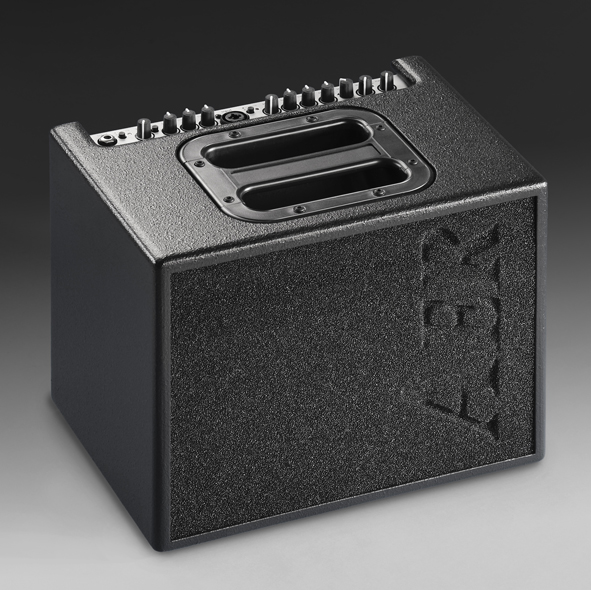
AER Updates Compact 60
 The Audio Electric Research (AER) Compact-60/3 has a cabinet made of 12-millimeter Finnish birch plywood and has slightly re-voiced overtones compared to earlier models. See more at musiquip.com.
 -
Jim Hall
There’s never been a time when Jim Hall wasn’t at the top of his game. From his days as a member of the Jimmy Giuffre 3 and Chico Hamilton Quintet, collaborations with Bill Evans, and sideman stints with Ella Fitzgerald, Hampton Hawes, Art Farmer, and Sonny Rollins in the ’50s and ’60s to 50-plus years of solo albums (including recent pairings with Pat Metheny and former student Bill Frissel), the 80-year-old has maintained a standard most jazz guitarists would be lucky to achieve once in a career.
The word “intelligent” is invariably used to describe Hall’s style, but that sounds a bit academic and sterile – which Hall’s innate swing and inventiveness definitely are not.
Hall’s one and only CTI session was recorded in April, 1975, when he was 44. As he had appeared (with special billing) on alto great Paul Desmond’s post-Brubeck RCA albums in the mid ’60s, it was only appropriate that Desmond return the favor here. Likewise, Hall and the bassist on that session, Ron Carter, had recorded a duo album a few years prior.
Adding trumpeter Chet Baker to the mix was a genius stroke on the part of producer Creed Taylor – his economical, egoless approach perfectly in line with those of Hall and Desmond. Pianist Roland Hanna is flawless, and it’s amazing to think that the Steve Gadd drumming tastefully here has also served time with Paul Simon, Stuff, and Eric Clapton.
The set’s centerpiece, Rodrigo’s “Concierto de Aranjuez,” crossed over from the classical repertoire to jazz via Miles Davis’ Sketches Of Spain as well as the Modern Jazz Quartet with guest guitarist Laurindo Almeida. According to CTI arranger Don Sebesky, the version here – 19 minutes of live, unedited interplay – was the first and only take Hall’s sextet attempted. They wisely saw no reason to re-do it.
This article originally appeared in VG‘s June ’11 issue. All copyrights are by the author and Vintage Guitar magazine. Unauthorized replication or use is strictly prohibited.
-
Gruhn Guitars Planning Move
Gruhn Guitars is preparing to move. In early 2013, the company will begin renovations on new space at 2120 8th Avenue South in Nashville, with plans to open in late spring. Until then, the store will remain open at 400 Broadway.
“We are looking forward to a larger building with a better layout and ample parking,” said proprietor George Gruhn. “This is an exciting time for us. We will miss being next door to the Ryman Auditorium and other landmarks, but our new location puts us within minutes of these attractions, and much closer to Music Row and other music-business enterprises.”
Gruhn opened his first downtown location in 1970 and moved to 410 Broadway six years later. The store has been at 400 Broadway since ’93. For more, visit guitars.com.
-
Esparza Joins Premier Builders Guild
 Premier Builders Guild (PBG) announced today that Art Esparza has joined the company and will work with Gene Baker and his team at its workshop in Arroyo Grande, California. He will focus on the USA Masterbuilt reissues PBG is producing for D’Angelico Guitars, the first of which will be introduced at next month’s NAMM Show.
Esparza worked at Fender for more than 18 years, where he was mentored by noted builders including John Page, J.W. Black, and Phil Kubicki. During that time, he designed and built instruments for Eric Clapton, Buddy Guy, John Mayer, Ernie Isley, and others. Since leaving Fender in 2006, Esparza has created custom instruments under his own name while designing, building, and repairing guitars as a consultant for a leading boutique brand. An accomplished sax player, he has also gigged regularly at several major casinos.
“PBG has taken an innovative approach to the production of U.S.-made masterbuilt guitars and I’m excited to be a part of it,” said Esparza. “The D’Angelico reissues are both challenging and satisfying, and I’m looking forward to their introduction.”
-

Grant Dermody
 Harmonica whiz Dermody is the honcho on this tribute to the real roots of modern blues and popular music, and he employs a host of fine guitarists to help.
Dermody is smart enough to make sure things work organically; no one crowds anyone else. The arrangements and instrumentation are sparse, and though the overall tone is low-key, it’s not without intensity. Some arrangements are very simple, as on “Twelve Gates To The City.” With Darick Campbell on lap steel and Orville Johnson on Dobro, he breathes new life into “Amazing Grace.” The matchup that works best is a teaming with John Cephas, whose voice sounds more and more like John Mayall’s.
There is plenty of good stuff here; Eric Bibb is splendid on Rev. Gary Davis’ “I’ll Be Alright,” and Frank Fotusky does a fine job with echoes of Brownie McGhee on “So Sweet.” Dermody even reaches all the way back to Stephen Foster’s “Hard Times Come Again No More,” with a saxophone ensemble for backup on one of the album’s best cuts. But the pairing with Cephas works so well that a long-term association, certainly a full album together, seems like a great idea.
This article originally appeared in VG‘s May ’11 issue. All copyrights are by the author and Vintage Guitar magazine. Unauthorized replication or use is strictly prohibited.

