Month: April 2010

  • Steve Earle

    Steve Earle

    Photos by John Peden.

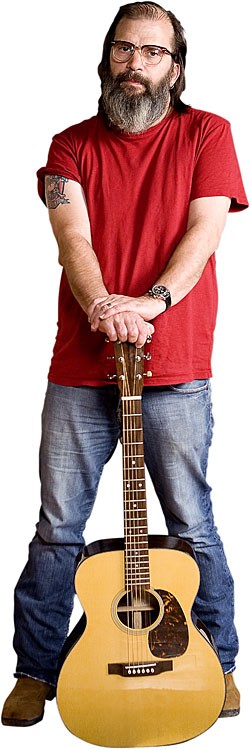
    Though bandied about haphazardly and almost always inappropriate, when applied to the life and times of Steve Earle, the adjective “extreme” is not hyperbole.

    The acclaimed singer/songwriter has survived 54 years of a life with peaks and valleys usually reserved for a soap opera. A high-school dropout, at age 14 he left his parents’ home near San Antonio and put food in his mouth as a working musician. Married (for the first of seven times) at the age of 18, he settled in Houston, worked odd jobs, and played music in clubs. Prior to celebrating his 20th birthday, he moved to Nashville, where, while still working day jobs, he’d write song, and play gigs at night backing Guy Clark.

    After a few years in Music City, he bounced back to Texas long enough to form his own band, the Dukes, then returned to Nashville hoping to strike it rich. Under contract for music publishers Roy Dea and Pat Clark, he co-wrote the 1982 country hit “When You Fall in Love” by Johnny Lee.

    With a hit on his resume, Earle decided to become to focus on his own material. From 1982 to ’85, he recorded a handful of rockabilly-styled singles, then in ’86 released Guitar Town, an outstanding effort that reached #1 on the country album charts. Strong releases followed in ’87 with Exit 0 and Copperhead Road in ’88.

    In 1990, Earle released The Hard Way, followed by the live Shut Up and Die Like an Aviator in ’91. The latter was his last album for Epic; the label opted not to renew his contract, saying drug use was hampering his creativity. For four years after, he did little during a period he famously referred to as his “vacation in the ghetto” and included a stint in prison for narcotics possession.

    In the years since, Earle his been prolific, and in May ’09 released his 14th album. Toss on the pile a book of short stories, an autobiographical book on his music, and two biographies by other authors, and it’s obvious Earle has not shied shying away from activity.

    In 2005, Earle marked his 50th birthday by moving from Nashville to New York City, a place that not only more greatly embodied his bohemian spirit, but put him closer to a variety of cultures – a move the overtly political Earle deemed necessary in the sociopolitical climate of the time. “I also tried to learn how to surf, but it didn’t work out as well as moving,” he recently said in an exclusive interview with Vintage Guitar. “We were in Australia, and I took a bunch of lessons, but just fell off the surf board a lot. But I tried! I’m still changing.”

    Since moving to New York, Earle has become close friends with Matt Umanov, a guitar maker, repair tech, expert on vintage guitars, and proprietor of the Greenwich Village guitar shop that bears his name. Whenever he’s in town, Earle hangs out at Umanov’s, buying “…more guitars than I probably should,” while in the second-floor the repair shop, Tom Crandall tries to keep up with the repair and setup needs of Earle’s 132 guitars.

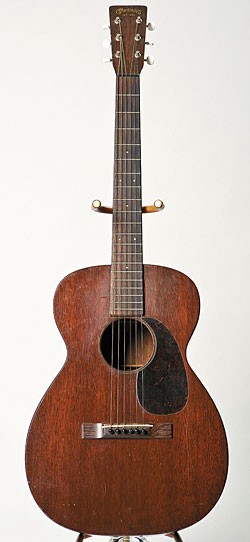
    During the interview, Umanov and Earle fondled an array of guitars from Earle’s collection, including one of his favorites – a late-’40s Martin 0-17. “I was looking for one of these, and Matt got two at a guitar show,” he said. “I think maybe it was Dallas. I bought both, and this one has extra sound that I’ve never heard in one. They all have that “bang” – the mahogany sound. But this one is a little clearer and a little more transparent. And players, when they get these, usually don’t let go of them.”

    Umanov shared a theory about vintage guitars and the socioeconomic status of their previous owners. “Even with the cheapest Martins, people tended to take better care of them. Why are so many more old Gibsons more f***d-up than old Martins? Two reasons: one, they weren’t built as well; and two, people who tended to buy Martins were people with more money, maybe a bit more education and/or manners. I firmly believe that. You’re more likely to see an old Gibson that got left in the back of a pickup for 43 years.”
    Our discussion begins there…

    Steve, what steered you to Gibson acoustics?
    Steve Earle: Well, I bought my first Martin, a pre-war D-18, for $150 from under a bed in San Antonio. Someone put a big, ugly hillbilly pickguard on it. Even though it sounded like a million bucks, the action had gotten really high because it hadn’t been taken care of. I tried and tried to keep it in tune once I got a capo on it, and I couldn’t do it. So in 1970, I traded it for an Alvarez Yairi – I made the trade because the Alvarez worked, and I had a gig. I made my living playing the guitar five or six nights a week, mostly in restaurants, and I had to have a guitar I could play.

    I played that Alvarez until I got to Nashville in 1974, when I saved up and bought a ’57 Gibson J-45 for $250 from George Gruhn. Though it seemed like an outrageous amount of money, Gibsons were the only thing cheap in George’s shop.
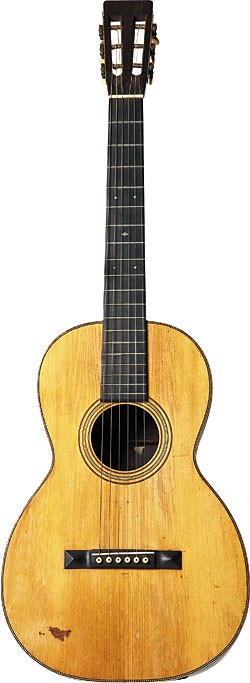
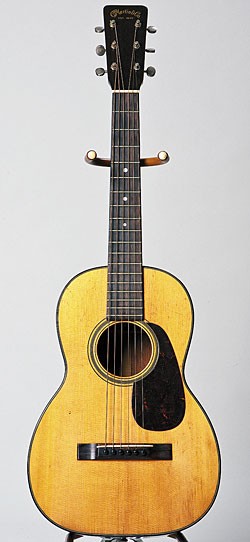
    1890s Martin 1-28

    From a collection of more than 130, this 1890s Martin 1-28 is Earle’s favorite instrument.

    Matt Umanov: I still have my ’43 D-28, which at the time I bought it had already been stripped, repaired, and refinished. I paid $155 for it in a pawn shop, and that was top dollar in 1963.

    SE: My deal was I hitchhiked everywhere, so I needed a guitar with an adjustable truss rod. That’s why I became a Gibson player – the adjustable truss rod, period. It wasn’t that I knew anything about them, it was just that people told me I could fix it if what had happened to the Martin happened to my Gibson, which isn’t true, necessarily.

    Today, I’ve adjusted the necks on my Martins a couple times, but I’m still nervous about it. I still get Tom [Crandall] to do it for me. But I’ve done it – I have a wrench!

    But the 0-17 has something in the top-end that mahogany Martins don’t normally have. They all have it down here (strums the bass strings), but most, starting with the B string, start to disappear a little compared to the other strings. They’re just a little more opaque-sounding, normally. This one has that extra treble that I normally associate with spruce tops. There were two [in Umanov’s store] a year apart – a ’48 and a ’49.

    MU: I know the 103 prefix is very late ’40s or early ’50s. Number 100,000 is very late ’40s, and this is 103, so…” (Umanov turns the guitar around and sees it has a thin brown stripe running cross-wise.)

    SE: That’s interesting… I never saw it before. It’s just a weird line in the wood – straight across.

    MU: It’s in the grain. It’s proximity to a branch. This back would not have made a grade-18 guitar. But for a 17 – no problem.

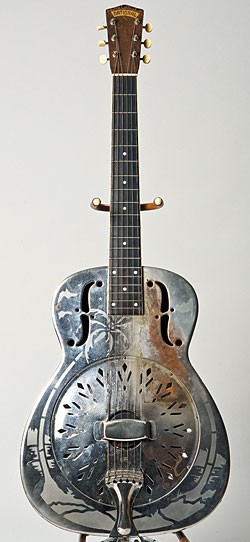
    SE: I bought [a 1929 National] Triolian from Matt on the condition that I’d never remove the cord – the rope strap – ever. I think I have a contract that says that (laughs)! I bought it same day as the 0-17.

    MU: You know what I love about these Triolians? The design. She’s got a ’20s flapper hair-do.

    Who used a cord strap like that? Was it Woody Guthrie?
    MU: Everybody used cords like that – it was the only guitar strap you could buy.

    SE: Most of the guitars associated with Woody never belonged to him. The Woody Guthrie Martin model [is based on an] 0-17 that belonged to Will Geer’s wife, and Woody used to borrow it and disappear and get drunk. He’d finally f**ked it up so bad that they just let him have it. His J-45 was borrowed from somebody. He was hard on guitars, and most of them he did not pay for. The famous Southern Jumbo, I don’t know about. I think the Southern Jumbo might actually be one he purchased, because it’s the guitar that he’s playing in the pictures and on his radio show. He was an organizer, but had a radio show in L.A., so he might have bought that one. I just know about that 000 because I tracked it down after reading the Joe Klein book Woody Guthrie: A Life – there’s a story in there about him borrowing that guitar that came from Will Geer. That’s one of the two “This machine kills Fascists” guitars. The original is a nylon-string, and I’ve never been able to figure out if he owned it.

    MU: I’ve always thought it looked like the typical Paracho guitar; Paracho, Mexico – the famed guitar-making town.

    SE: I’ve got a bajo sexto that came from there. I’ve had several guitars from there over the years – the generic gut-string guitar. There were those, and there were tons of those Goya gut-strings around, too. Joan Baez used to play one, and you know who had one? Bromberg. My dad wanted me to have one, but I wanted a Stratocaster.

    The shape of this neck [Triolian] is so cool – somebody played the heck out of it. I think the cone has been replaced, at least it looks kind of shiny. Tom would know, he worked on it. I think I only have one National with the original cone. I think my mandolin might, though.

    There’s a lot of Matt Umanov in that mandolin. I bought it from George Gruhn. Actually, a girlfriend bought this for me from George, for my birthday. It was always the best one I ever ran across. Then all the things that made all the other ones unplayable started happening to it. It’s one of the most ill-designed instruments in the history of mankind, and Matt has done a bunch of surgery. This tailpiece started to self-destruct, and it started to go out of tune; it was buckling under stress. A jeweler friend of Matt’s, Combat Shelley, fixed it.

    Also Matt, you did a modification on the neck-stick – I didn’t even understand it. You fabricated something out of plastic and metal parts into where the strap-pin (end-pin) holds the whole ****ing thing together…
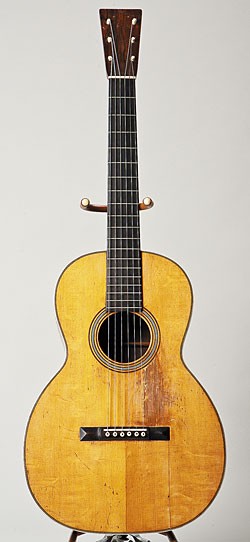
    1870 Martin 0-28.
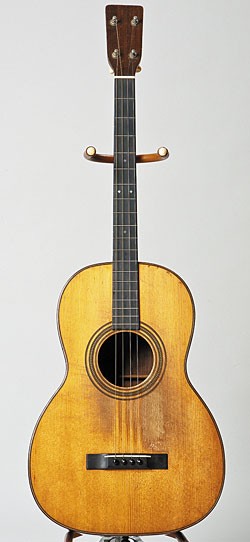
    1870 Martin 0-28.

    1927 Martin 5-21T

    1927 Martin 5-21T

    1931 Martin C-2 conversion
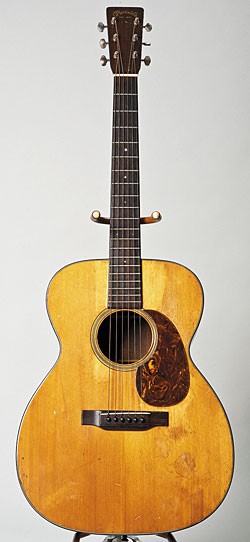
    1931 Martin C-2 conversion

    '37 Martin 000-18

    ’37 Martin 000-18

    MU: That’s one of the few times in years that I’ve hit the workbench myself. There was a lot of empty space in the end of the dowel-stick and the whole thing was loose, so I fabricated some wood, metal, and plastic.

    SE: Making a mandolin sound sort of in tune when you’re playing it is an illusion in the first place, you know? I mean, they can’t be in tune – guitars aren’t really in tune, either, but mandolins are notoriously out of tune. In Italian, mandolin means “out of tune,” right? However this one was always more in tune than they usually are, but then it went south on me.

    I used it on the Washington Square Serenade album, and wrote “Red Is the Color” on it – my Yank Rachel impression. I’ve had the mandolin since ’97, but didn’t get it on a record until last year. I sometimes feel guilty about owning as many instruments as I do.

    You shouldn’t feel guilty – you use a lot of guitars in your live shows.
    SE: Yeah, but I don’t take old stuff on the road. I like s**t that works on the road. I’ve fired several guitar players [who] got the “old Silvertone” bug or something. [Guitars like that are] not professional equipment. I like new guitars.

    What are some amps that you like?
    SE: I have some really cool vintage amps, but I won’t take them on the road, either. You know what I use onstage? Peavey Classic 50s with eight 10s. I’ve blown up one Classic 50 in the 15 years I’ve used them, and that was because I shoved it over. There’s something about them – they sound kind of real open and Class A-ish if you use them with eight 10s rather than four. That’s what they like. It’s stupid loud, but sounds better than four 10s.

    My main amp in the studio is a Vox AC50 amp, and I finally got one that belongs to me. Ray Kennedy had one I used on most of my records for the last 10 or 15 years. It’s not really a class A amplifier. The one I’ve got now is one that Charles Sexton found. I’ve known Charles since he was about nine, and he finally came in off the road and said he didn’t need two anymore. I run that through TKLs – that’s what they were designed for, and you shouldn’t run them through anything else.

    I like 10s, but ohmage is everything. Unless it’s a piece of s**t, whatever the guy built it to go with, he probably did it for a reason. The math is important when it comes to coupling a speaker – especially with really powerful amps.

    Which of your amps stay in the studio?
    SE: That AC50, a killer ’60s Fender blackface Super… I like 10s, period. I also have a small blackface Vibro-Champ and a Deluxe that’s killer. I also bought the first one of those ’56 Deluxe reissues. That’s my main New York City amp because it has a small speaker and it’s light enough to carry on the subway. So it’s practical, and won’t blow up; I own three Fender Pro Juniors, which are great, but I’ve blown up two while sitting in with somebody and thinking, ‘I’ll take a little amp,” then everybody else is louder than I am. So the Deluxe is just a little louder and has a killer tremolo. (Earle takes out a Martin Style 1-28 and starts to tune it.)

    This is my favorite guitar.

    MU: That was my absolute favorite guitar, and might still be. I’ve known that guitar for over 35 years. It belonged to my friend, Doris, who got it in the late ’60s. When I saw it, I knew about size 1 guitars, but this one stole my heart. She sold it to finance a piano.

    SE: She sold this and a C-2 conversion Matt built, and I bought both. Matt built David Bromberg’s F-7 conversion, too – that’s the guitar Martin patterned their M-style guitars after in the ’70s, right Matt?

    MU: Right. I made Bromberg’s F conversion. I made one or two others over the years, but I also made two C-2 conversions, one of which was for Doris. I built hers in ’71.

    SE: It’ll settle in a minute, hook up, and freak you out. It’s got some not-going-anywhere cracks in the side Matt says have been there for years, but they just always make me nervous. Is this one opening up?”

    MU: No, that’s been there for 35 years. This guitar is from the early/mid 1890s. It’s rock-solid, and it’s no featherweight, which is not what you expect from a Martin of that period. Well, from that period yes, but three or four years later? No way! They were made of tissue paper by the late 1890s and early 1900s. My guess is the bridge was replaced by Martin in the 1920s.

    SE: I have this theory that guitars need to warm up when you first play them, especially archtops. I was playing an L-5 in the store and Matt told me, “You need to play it, then wait. Because all those components are mechanical and they need to hook up.” Since then, I’ve noticed that’s also true of flat-tops to a certain extent. They loosen up or something. For lack of a better word, there’s like a harmonic convergence.
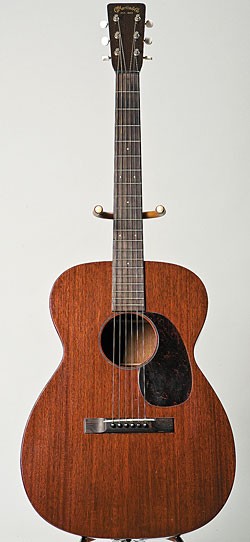
    '48 Martin 00-17

    ’48 Martin 00-17

    '48 Martin 0-17

    ’48 Martin 0-17

    '51 Martin 0-18

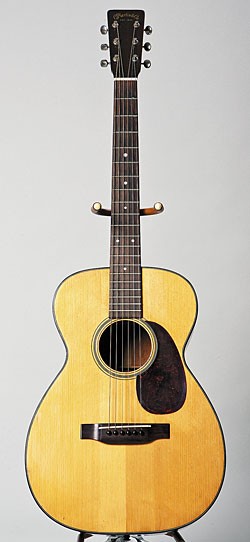
    ’51 Martin 0-18

    '53 Martin 5-18

    ’53 Martin 5-18

    I recently fell in love with guitars all over again. I thought I was through buying, but since I got out of jail, I started over. A lot of it has to do with that I put about a million dollars’ worth of guitars in my arm. And I tended to buy new guitars – I own two Epiphone Lennon Casino reissues which have been my main stage guitars because I don’t have to feel guilty about playing them. They’re still kind of an investment because they were a limited edition – and they’re well-made instruments. I concentrated on – and still buy – stuff like that. I’m bad about coming in and buying new Martins that there’s not going to be a ton of. They’re something you can get into that you’ve at least got a chance of being worth more money in the future, and you can play them. You don’t have to feel like you shouldn’t touch them.

    MU: It’s also true that just about everything that comes out of Martin is really good. And every so often you pick up one that’s like… it’s right there from the beginning and you know that over the years it’ll become greater than the sum of its parts.

    The Martin Authentic D-18 is built in the traditional style, with hot hide glue, a steel T-bar non-adjustable truss-rod, and other exact appointments. What do you think of those?
    MU: Those are great guitars, they’re wonderful.

    SE: I’ve been thinking about getting one of those hide-glue guitars because the only mahogany Martin I own is a 12-string. No, I take that back; I have a ’30s 000-18 – another guitar I got from Matt. And I have a ’69 D-18S – the “folk scare” guitar. So I have more than I thought. And I’ve been eyeballing a really nice ’64 D-18 in the store.

    The Martin Clarence White with the big soundhole is an especially good-sounding guitar.
    SE: You know why Clarence White played a guitar with an over-size soundhole? Because if you pick as hard as Clarence did, you wear right through the soundhole. They tend to come apart right where they put the trim in – and it did – and a guy just trimmed it out uniformly, making an over-size soundhole. It was the ’60s, and I’m sure somebody – probably Clarence – said “Oh, it sounds better” (laughs)!

    MU: Right. It’s like people think if they buy an Eric Clapton model Martin they’ll sound like Eric Clapton. What doesn’t come with the guitar is 10 of [Clapton’s] (wiggles his fingers).

    SE: Yeah, and people are afraid to buy my artist model, because they’re afraid they’ll become Communists!

    When I started buying these Martins, we were down in the shop and Matt gave me his “size 1 lecture,” which is, “This is where it all starts…”- the idea that this particular model is where the technology developed. So I decided I wanted one.

    MU: Size 1 is Standard, that’s the Martin name. An 0 is Concert, 00 is Grand Concert. Size 1 is called Standard because it is the standard from which all else was extrapolated. Steve’s a wonderful guitar – it’s my favorite Style 1. Doris bought it at a pawn shop called Unredeemed Pledge.

    SE: I’ve had it almost two years. I tune it to D or just above D because it’s so old and sometimes I’m gone a pretty long time. I was just on the road almost a year, and I left it in Nashville, tuned down, all that time. I just brought it up to the city.

    If you drop any guitar a whole tone, you’re releasing at least 20 percent of the string tension, maybe 25 – a huge amount, anyway. It’s almost the same as removing the strings.

    The funny thing is when I get it out after it’s been tuned down like that, it really sounds good. But when I tune it up to pitch, it’s like “Now I remember why I bought this guitar.” Because they want to be at concert pitch. That’s what they were designed for and that’s when they perform. It’s a ****in’ great guitar. I’ll use this guitar so much on the new record.

    MU: It only occurred to me recently, when this guitar came back, that this bridge is not original, and is in fact a 1920s Martin factory bridge. You look at enough Martin bridges and you see how they changed the contour, shape, and form over the years. Because different guys were making them; you know, one guy makes bridges for three years and 11 days, and then is put on something else and a new guy makes the bridges. Each man had a style.

    SE: Some people would call this a parlor guitar, but that term pisses me off because it makes no sense. I don’t understand what a parlor guitar is supposed to be, you know? I don’t think people bought guitars to have in their parlors. Pianos, yeah. One of the main reasons I’m not a piano player is you can’t hitchhike with them. That’s the cool thing about guitars – they’re portable. That was the whole deal at one time, and that’s why they didn’t go away. Chicks dig them, too. I’m from Texas and I didn’t play football, so it was football or this, and I wasn’t very athletic…
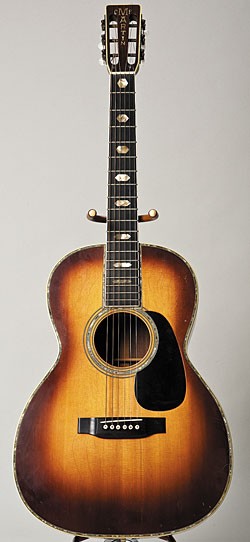
    '74 Martin 000-45

    ’74 Martin 000-45

    1937 National Model O.
    1937 National Model O.

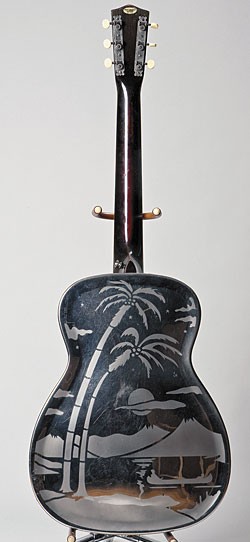
    Back of the National O.
    Back of the National O.

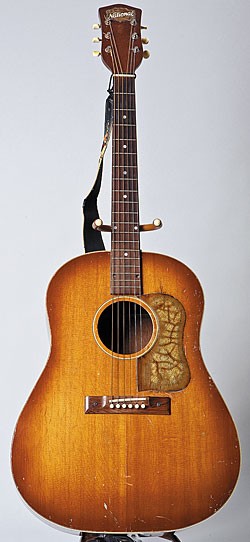
    1951 National 1155

    1951 National 1155

    What pickup system are you using?
    SE: Tom used to install the Fishman Matrix I in my guitars, but that system has been superceded by the Matrix Infinity. It comes with soundhole-mounted controls that are just bothersome to me and one more thing to break or come loose – I preferred the simplicity of the earlier Matrix I. As it turns out, Martin’s Thinline Gold Plus Natural 1, which is also made by Fishman, is the same as the old Matrix I, so that’s what Tom’s installing now. I run it through the Fishman Aura mixed 70 percent Aura and 30 percent Natural 1.

    I prefer the Aura to using a blended system – i.e. a microphone inside the guitar and a saddle pickup blended together by a stereo pre-amp. The blender system works, and it sounds much better than a pickup by itself, but the weakness of it still is that saddle pickups, and internal microphones, lack air. The attack is too “on top” – without the natural delay you get when you put a microphone in front of a guitar, and it takes a nanosecond for the sound to get there.

    The blended system acts like an electric guitar – like an electric guitar plugged right into a stereo – because there’s not that delay, and that totally changes the way you play. The Aura puts the air back into a live performance.

    The other cool thing is that even if you’re using floor wedges, you can put exactly what the audience is hearing back through the monitors, and you actually get to enjoy what your guitar sounds like. With the blender systems, you couldn’t put the microphone back through the monitors.

    Live, you play a Martin M-21 Steve Earle signature model. What makes the guitar different?
    SE: I am completely and totally queer for Style-21 guitars because I’ve always liked the “plainness” of them – like 18-style mahogany models are plain, but have rosewood back and sides. I own three M-size guitars that are fancier – a 42, a 36, and a 38. I also have a 000-45S. I’ve got the fancy guitars because they’re collectible, and they’re really good. But I really like plainer guitars, and I have this thing for the style 21.

    I’m the first to admit it may have absolutely f***in’ nothing to do with reality – and it’s totally one of those things a guitar player will say – especially those as bad as I am – but I’ve always felt more comfortable on rosewood fretboards.

    MU: It was Steve’s idea to go with the M-21. I gave him some technical details, but we wanted the best sound for the least cost possible, and that will be a Style 21 in the tradition of the 1940s, ’50s and ’60s. My own personal guitar, which I’ve had since the ’70s – is a 000-21 from the ’50s – I love it. It’s my guitar. So Steve and I agreed that the 21 was the way to go, with tortoise binding and some other things like peghead shape, for example.

    SE: The peghead shape was the only major variation from the period that the Style 21 appointments came from. Because in the ’50s and ’60s they were really round because the sanding or shaping jig had worn down over the years. Ours is a late-’40s shape.

    The main reason I went to this body shape was the depth. Hanging my arm over a f***in’ dreadnought was ergonomically kicking my old ass. It was hurting my shoulder, and the inside of my arm. I used to think it was silly when people thought there was one size of guitars for fingerpicking, and one size for flatpicking, because I fingerpicked on a dreadnought just fine, you know? But I also stood on the hoods of station wagons going down the interstate and did some other s**t that was bad for me!

    MU: It comes together visually. And we really hit it, even with the pickguard – it’s the best-looking pickguard they have. Little things, like the purfling around the top and the soundhole… I wanted certain stuff. When it came down to the internal stuff, I went with what Dick Boak suggested, coming from the sales realm.

    The guitar has forward-shifted bracing. What is that?
    MU: It refers to the original 1930s top-bracing pattern Martin devised for 14-fret dreadnoughts. The X is closer to the soundhole than it was after 1939 or so, when they figured out that moving the braces back some would be stronger structurally, so they abandoned the original forward pattern. It’s very soughtafter today in older guitars, and new custom Martins ordered by guys who are convinced that a guitar with forward-shifted bracing sounds better.

    So many times, I have laid a stack of $100 bills on a table and said to anyone who claims to know the difference, “I will now find you 10 guitars – half with and half without forward-shifted bracing. Match my money, and guess right more than half the time with a blindfold on.” They won’t do it. You know why? Because it’s a load!

    How receptive was Martin to these nuances?
    MU: Oh, totally! Dick is the best! He is more responsible for Martin’s public image having improved exponentially for the past 20 years. He’s a wonderful guy, and he’s smart.
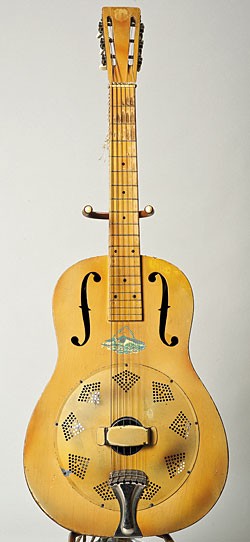
    Front of a 1928 National Triolian
    Front of a 1928 National Triolian

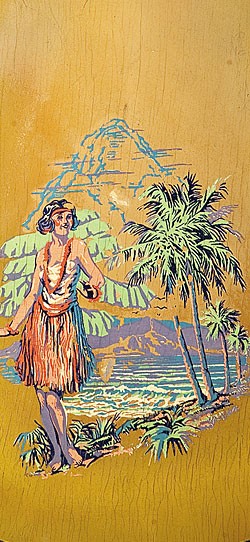
    Back of a 1928 National Triolian
    Back of a 1928 National Triolian

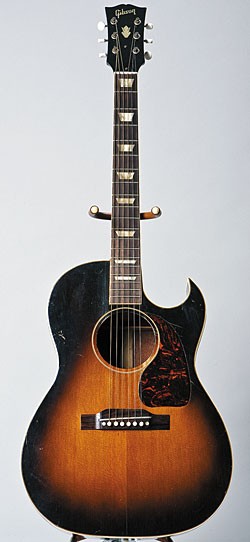
    '51 Gibson CF-100

    ’51 Gibson CF-100

    This '65 Gibson J-100 was ordered from the factory with two pickguards - one for a J-100 and a J-200.

    This ’65 Gibson J-100 was ordered from the factory with two pickguards – one for a J-100 and a J-200.

    The restraint with the M-21 is what’s so great, and that comes from the combination of what Steve wanted and my knowledge of what can be done, what can’t be done, and what should be done.

    SE: Yeah, I wanted to keep the price as low as we could on a solid-wood Martin. Matt sells them for the mid-$3,000s. Nowadays that’s not expensive for a solid-wood acoustic – especially a Martin.

    MU: Steve and I had a great time collaborating. I’m of the school that the right idea will come to me at the right time. Sometimes, I’d let the paperwork sit on my desk for two or three weeks. Then, I’d pick it up and say, “Oh, yeah… that part, it should be done that way.” So it was months before we had all the details down. It could have been done in an hour, perhaps, but for us it was months talking back and forth, and back and forth with Dick.

    When Steve and I signed off, we knew it was going to be a great guitar. But when the first ones came, we were so happy with them – and proud. And it really is more than the sum of its parts, I think. You pick it up, you say, “Wow! It looks like there’s not much here.” And there’s not. But it’s a lot of small nots that add up to something great, you know?

    What electronic tuners do you like or use?
    SE: You know, I finally figured that I needed to learn how to tune a ****ing guitar again, because I’ve toured so much at a level where I had a guitar tech handing me tuned guitars every night. It wasn’t until 10 years ago, when I made the bluegrass record, that I was back in the realm of people who played a lot better than I could. And one reason they did is their ears were really great. All of a sudden, I had to listen. And I’m into that vintage thing. My wife says I make records like a civil war re-enactor cause I use all this old gear, you know? But bluegrass, the way we do it, works better when you play it around one microphone.
    Yeah, the bluegrass thing – Norman Blake won’t use a tuner. That’s a little hardcore. The tuners I own clip directly to the guitar, and work pretty well.

    Do you tune to the rise or fall of the note?
    SE: Out of habit, I tune to the fall, because if you’re ham-handed, which I used to be, you have to wait to get a true reading. I mean, it’s maybe not sharp enough at first that you can hear it, but the tuner can definitely hear it.

    You keep them well tuned – sometimes without using a tuner.
    SE: Having a guitar tech is most of it. I mean, I do end up having to tune them myself sometimes. But 10 years ago, I couldn’t have done that. I’d sort of forgotten how to tune, from having a crew with roadies and guitar techs. But I find it necessary to re-learn as much as I can. Not just in case I have to, but because it’s good for me. It’s like remembering what I am and how I got to where I am – just going back and sort of remembering life for all it is.

    You know, when I’m coming out of the subway, I always give anybody sitting there buskin’ at least a dollar, because there, but for the grace of God… And I’ve busked. I can take one of these guitars and I busk. If I was going to take one, it’d probably be my M-21 sunburst, because I think it would hold up. Until recently, I would have been really embarrassed to talk to any magazine that was for and about guitar players. But you know what? I’ve decided recently I’m a pretty f**ing good guitar player! But how did I get that way? And how did I get to be a pretty good songwriter? Because I have a huge amount of respect for tradition, and a huge amount of respect for history. I’m very, very interested in where I came from and where all this came from. But I’m also not afraid to throw all that out the f***ing window every once in awhile, and I don’t let somebody tell me “Because that’s the way it is” and let that always stop me, you know? I accept some people’s authority that things are the way they are. I’m still here, I’m still alive – literally – because of the very act of unlearning behavior that was really, really, really ingrained. And now I’m re-learning a lot of stuff, going as far back to when I was 14 or 15 and almost had “C.F. Martin and Co., established in 1833” tattooed on my back after I bought my first Martin. My girlfriend talked me out of it, and then I became very anti-Martin for a long time. In fact, anybody would probably have assumed that if I ever had an artist guitar it would be a Gibson, because I’ve been associated with them for such a long time.

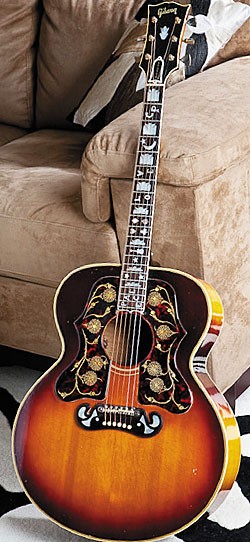
    Speaking of Gibsons, I have a ’65 J-100 that was ordered from the factory with two pickguards – one for a J-100 and a J-200. Matt bought it from the original owner at the Spartanburg (South Carolina) guitar show. I don’t know who owned it, but his initials, CP, are on the guitar. You know the spaces between every fret that are not filled with one of those crowns? He inlaid something in each one, and they’re all different. It looks like Leonardo da Vinci threw up on it. There are crescent moons, stars, his initials, and the words “peace and love” laid out in this f***in’ Masonic-looking [way] that’s unreadable, but it works. It’s like Donovan meets Eddy Arnold. When Matt saw it, he said, “Steve Earle!”

    There are only a few Gibsons I’m still in the market for. One is a J-35, and there’s a really good natural-top early-’40s one in the store I’ve looked at real hard. I haven’t jumped on it for some reason, but I want a ’30s version rather than an early-’40s. I guess I associate J-35s with the ’30s. I’m after the one where the top has three tone bars rather than two. And I’ve got a really good CF-100, but Matt’s got another one, and I may buy that. They’re really good guitars when they’re good.

    What do you think your future might hold, in terms of guitars?
    SE: Well, I haven’t been all that interested in electric guitars; hadn’t bought one in a couple years, and then I bought two lately. So I don’t know what’s gonna’ happen!
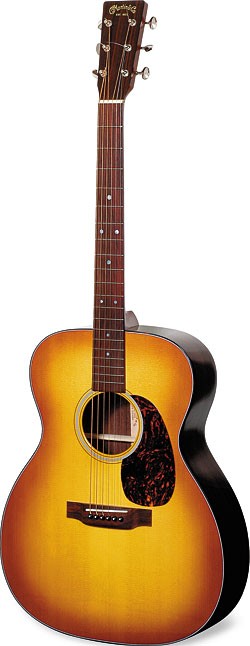

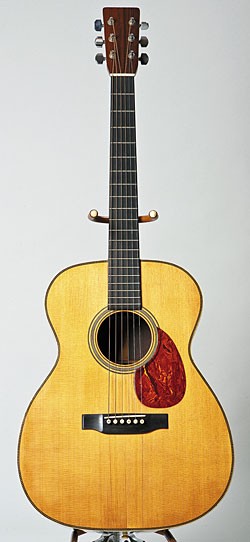
    Martin M-21

    Martin M-21

    Dan Digs In – The Martin M-21

    No guitar smells as good as a new Martin, in part because they use Spanish cedar kerfing to connect the sides of the guitar to the top and back.

    The M-21 Steve Earle signature model is a joint effort between the two-man team of Steve Earle and Matt Umanov, and of course, the famed manufacturer.

    The M-size came into being in the mid 1970s because Martin was aware of several vintage Martin F-size archtops (built from 1935 until ’42) that had been converted to flat-tops in the ’60s by luthiers including Umanov, John Lundberg, and Eugene Clark. The F was similar in shape to Martin’s 000 models of the same era, but larger and slightly thicker from top to back. They were even larger than a dreadnought (same length, but wider), and in the conversion created a new size – the 0000.

    Umanov’s conversion was of particular interest because he didn’t retain the F-model’s 24.9″ scale. Instead, he used Martin’s longer 25.4″ scale, and installed longer necks to accommodate it. He anticipated that it would have the power and tone of the Martin Orchestra model (OM), which it did. This conversion became famous in the hands of David Bromberg and is the guitar Martin patterned its M-style guitars after, beginning with the M-38 in 1977.

    The OM debuted in 1929 and was Martin’s first “modern” guitar – i.e., designed specifically for steel strings, with 14 frets clear of the body and using the 25.4″ scale that would also be used on the dreadnought models to follow a couple years later. By ’34, the OM was renamed 000, as the earlier 12-fret model was discontinued, and its scale length was shortened to 24.9″, leaving the dreadnought as Martin’s only long-scale guitar for years to come. Umanov points out, however, that 14-fret long-scale 000-18s have been seen as late as mid 1935.

    The OM body looks like an original 12-fret 000 that was held fast in the lower bout while being squashed 1″ shorter length-wise, thus bulging wider in the shoulders. The soundhole and bridge are moved forward to accommodate the longer neck and 14 frets clear of the body. For that to happen, the X-brace also was moved forward, and is known as “forward X,” “advanced,” or in Martin terminology, “High X” bracing. Martin uses this bracing on certain vintage reissues, including the M-21. By ’39, Martin moved it back from the soundhole toward the bridge, probably because the heavy-gauge strings used at the time wreaked havoc on the bridge area. Today, early advanced-braced guitars are highly collectible.

    The M-21’s braces – top and back – are thin (5/16″) and light, adding to the guitar’s sparkly tone and fast response. The top braces are scalloped

    The M-21’s shoulders and lower bout are the same width as a Gibson J-35 (115/8″ and 16″), but the waist is 1″ narrower (93/4″ vs. 103/4″). Of equal importance is the fact that the M is also considerably thinner from top to back (31/4″ tapering to 41/16″ vs. the 4″ to 5″ taper of the Gibson). For many players, the narrower waist lets the guitar nestle lower in the lap, and is easier to reach over with the picking arm. No other Martin is the same size. The closest is the Gibson J, which is the same shape, but as deep as a dreadnought.

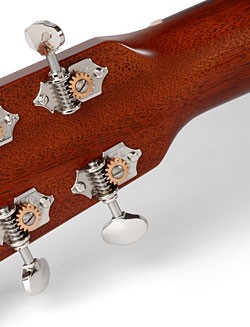
    It’s unusual for a guitar in the M-21’s price-range to come with Waverly tuners. It’s a classy touch. Its overall design is simple, elegant, and handsome, in the Style 21 mode preferred by Earle. And its loaded with little touches that only an expert like Umanov would be aware of, such as multi-layer tortoiseshell top binding (the outer color against the inner plys gives a “dark” look specific to Style 21. There’s also tortoise/single white back binding. Other Umanov design touches include;
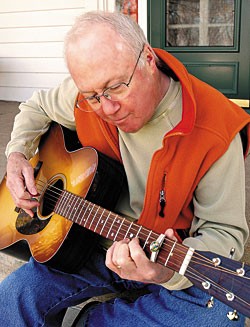
    Dan Erlewine strums the Martin M-21.
    Dan Erlewine strums the Martin M-21.

    The M-21 gets Martin's

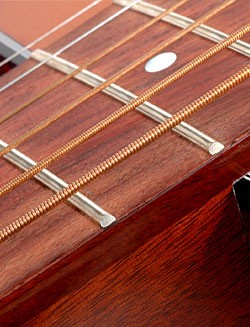
    The M-21 gets Martin’s “pocketed” frets, which mimic a bound fretboard.
    The M-21's old-style peghead decal.

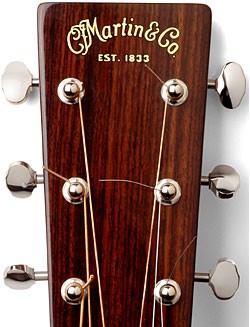
    The M-21’s old-style peghead decal.

    Back of the peghead, with no diamond volute.

    Back of the peghead, with no diamond volute.

    • The checkered back strip, like a D-28. It fits in with the binding, and looks great with rosewood.
    • Nitrate pickguard in the fine example of tortoise color and pattern.
    • The perfect vintage peghead shape, with sharply-defined corners.
    • Old-style peghead decal.
    • Soundhole rosette as used on all Style 18 and most Style 21 instruments after World War II.
    • Rosewood heel-cap.
    • Tortoise end piece.
    • Martin’s low-profile neck, which is sleeker and more modern than vintage Martins. Players who prefer the shape of the neck on most electric guitars will appreciate this. The neck also has a plainer look with no diamond volute, and a satin finish. In contrast, the peghead face has a high-gloss finish. The fret ends fooled me because they seemed to be overhanging “binding” that Style 21 fretboards don’t have (Martin overhangs the fret ends on their bound fingerboard models like Style 45, 35, and others with binding). Then I figured out that the fret slots were cut short of the fretboard edge, leaving untouched wood for the fret ends to overhang. Martin calls this “pocketed” frets – mimicking a bound fretboard and eliminating unsightly fret ends. It’s a very comfortable feel, and a super-classy look.
    • East Indian rosewood back and sides. Until now I’ve generally not been a big fan of guitars with rosewood backs and sides, preferring the sweeter, crisper, more punchy sound of mahogany. But the M-21 has a sound equal to – but different from – mahogany guitars. I think it’s because the rosewood is seasoned, carefully kiln-dried, and thin.
    • Alpine Spruce top. A number of builders love this spruce. Perhaps it lends to the overall sound and “tones up” what I thought I didn’t like about rosewood guitars. I’ve read that Alpine spruce is similar to the popular Adirondack or Red Spruce in that it has great stiffness and makes a good fingerpicking guitar. I fingerpick, flatpick, and often use both, and the M-21 responds to touch with as little effort as my much-played 70-year-old J-35.
      Speaking of the J-35; it’s the lightest guitar I’ve ever played, and I’ve always assumed that fact has something to do with its sweetness and response. But the M-21 feels equally light and has such a similar response that I had to weigh it on a postal scale. I also grabbed a new Gibson Advanced Jumbo (also with Indian Rosewood back and sides) for comparison. The J-35 weighed in at 3.85 pounds, while the M-21 was 4.20 pounds and the AJ was 4.85 pounds.
      Still curious, I used a Hacklinger Gauge to measure the thickness of the top, back, and sides of the three guitars. Here’s how they stacked up;
    Top Backs Sides
    M-21 3.1 3.1 2.1
    J-35 2.9 2.9 2.7
    AJ 3.6 3.7 2.7
    • East Indian rosewood fretboard and bridge, figured, and very nice quality.
    • Detail work in the bridge, bridge pad, and bridge pin. The first thing I inspect on a flat-top is the bridge pin holes in the pad (the reinforcing wood piece glued inside). It’s surprising how many new guitars have holes with jagged edges or other minor damage caused by a drill bit. I have never seen a Martin with anything but perfectly drilled holes, and the M-21 was no exception.
    • Except for the satin finish on the neck, the finish is gloss nitro-cellulose lacquer – very hard and thin. The top-grain has a vintage look.
    • Martin’s current neck adjustment system is the company’s first two-way adjustable; previous rods worked against string tension only.
    • Both the nut and saddle are made from bone. Plus, the saddle is not compensated, per Umanov, who insists a compensated saddle makes “…absolutely no difference in the intonation of the guitar, and I insisted on this feature. And Steve agrees with me!”– Dan Erlewine

    This article originally appeared in VG‘s July 2009 issue. All copyrights are by the author and Vintage Guitar magazine. Unauthorized replication or use is strictly prohibited.


    Steve Earle : Christmas Time In Washington
  • Guild Aristocrat M-75

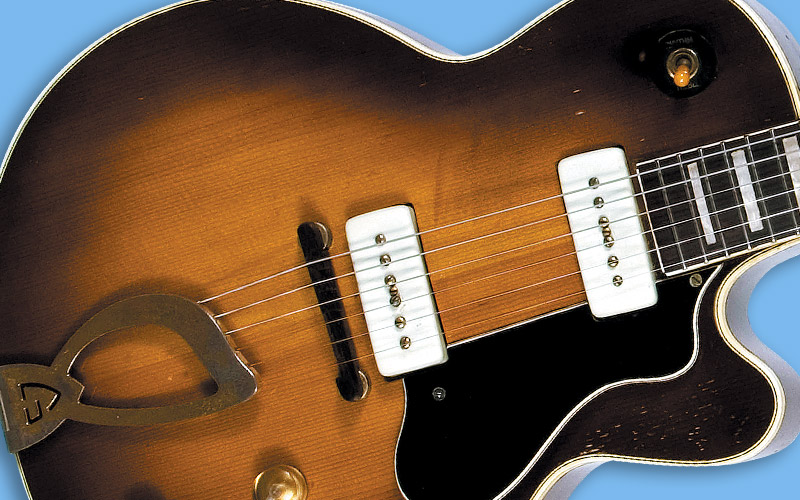
    Guild Aristocrat M-75

    Photo by Kelsey Vaughn.

    Guild didn’t intro-duce a true solidbody electric guitar until 1963, but the Aristocrat of 1954 gave the appearance that Guild was competing head-to-head with Gibson’s new Les Paul Model. However, with its hollowbody and spruce top, the Aristocrat was more than just an interesting variation – it was quite a different animal altogether.

    Despite its small, single-cutaway body, the Aristocrat was probably not created as a direct reaction to the Les Paul. For starters, the Guild company was just being formed in 1952, when Gibson introduced the Les Paul. With the solidbody electric guitar still in its infancy and Guild being based in New York City, it’s likely that Guild founder Alfred Dronge paid little attention to the new solidbodies made in the hinterlands of Kalamazoo, Michigan, much less the crude “plank” solidbodies coming from Leo Fender’s upstart operation in California. However, when the Brooklyn-based Gretsch answered the Les Paul Model with a similar-looking Duo-Jet in ’53 – just as Guild was bringing its first guitars to market – the move undoubtedly got Dronge’s attention. The evidence lies in the Aristocrat, which is more closely related to the Duo-Jet than to the Les Paul.

    Legendary Gibson president Ted McCarty stated that one of the reasons Gibson put a carved top on the Les Paul was that Fender didn’t have the experience or the tooling to copy it. Epiphone, Gibson’s arch rival in the archtop market of the pre-World War II era, obviously would have had the resources to copy the Les Paul, except for the fact that Epiphone had fallen on hard times, and production had been moved to a Conn facility in Philadelphia. When Epi’s key production employees refused to move, Albert Dronge seized the opportunity and staffed his new Guild company with experienced ex-Epiphone workers, so Guild was well-equipped to make a Les Paul-like guitar.

    Guild debuted in ’53 with a full line of traditional hollowbody models, electric and acoustic. That year, Gretsch introduced its Duo-Jet, which had a body shaped like the Les Paul but with the significant difference of a routed mahogany back, which made for lighter weight and a different sound. A year later, Guild’s Aristocrat refined the concept with a routed mahogany back and an arched top of laminated spruce, plus a cutaway shape that was not copied from the Les Paul.

    Guild’s pickups looked like the white “soapbar” single-coils of the Les Paul, but were made by the Franz company of Astoria, New York, and offered lower output than the Gibson P-90. The control configuration, with four knobs on the lower treble bout and the selector switch on the upper bass bout, was taken straight from the Les Paul. It would appear Guild was aiming at the same market as Gibson.

    However, the market for a solidbody electric guitar was anybody’s guess in ’54. Fender’s early client base was in Western swing music. Gibson had Les Paul setting the example, but many early goldtops found their way into the hands of blues players. Rock and roll players didn’t exist yet; the term “rock and roll” had been coined just three years earlier. Bill Haley and the Comets didn’t record “Rock Around the Clock” until ’54, the same year Elvis recorded “That’s Alright,” and the memorable solos on both were played on hollowbody Gibsons. 

    So what sort of guitar players did Dronge have in mind for the Aristocrat? Quite possibly jazz players. Dronge was a fan of jazz, and Guild had inherited some of Epiphone’s reputation for jazz guitars. Not only the Aristocrat’s spruce top, but its rosewood height-adjustable bridge and harp-shaped tailpiece were hollowbody archtop features – jazz-guitar features – that distanced it from the Les Paul, which by ’54 had a stud-mounted “wraparound” bridge/tailpiece. When it came to performance, the Aristocrat’s body construction and pickups produced a thicker, mellower, somewhat muted sound – Guild’s catalog called it “a magnificence of tone never before achieved in a guitar of this size.”

    Although its magnificence is arguable, it may well have been more appealing to jazz players than the sharper, more powerful sound of the Les Paul. Large block fingerboard inlays (pearloid, though, rather than mother-of-pearl) and gold-plated hardware had nothing to do with the Aristocrat’s sound, of course, but the ornamentation nevertheless gave it a classy look that would appeal to more sophisticated guitarists.

    Introduced as the Aristocrat M-75, the model changed little through the 1950s, although the diagonally oriented script logo on this ’57 example was used only for a brief time. An optional natural finish was added in ’59 and Cherry finish in ’61. Guild dropped the Aristocrat in ’63, but it returned in ’67 under a new name – the BluesBird – still with the routed mahogany body with spruce top. Humbucking pickups replaced the soapbar single-coils, but otherwise, changes were cosmetic.

    The BluesBird lasted only a year with the Aristocrat’s original construction. The ’68 version looked at first glance like the Aristocrat, but most examples from that year onward had a laminated maple body. Some tops were still spruce, while others were maple or mahogany. The hardware was downgraded to chrome-plated in 1970 and the model renamed M-75 Standard to delineate it from the new M-75 Deluxe, which had gold-plated hardware. At the same time, an M-75 Bluesbird with a fully solid body was added to the line. The hollow models only made it through 1971, while the solidbody continued to ’78.

    Although the original Aristocrat style ended in 1967, the concept kept coming back. The M-75 solidbody returned in name only, with a poplar body and features designed by Brian Setzer, from 1984 to ’88. A truer-to-original version with a maple top and a mahogany back routed with tone chambers reappeared as the Nightbird in 1985 and lasted until ’95, then came back again from ’97 to 2003 under the Bluesbird name. Through it all, the original Aristocrat design maintains its own unique appeal one of the earliest guitars to bridge hollow- and solidbody design.


    This article originally appeared in VG‘s August 2008 issue. All copyrights are by the author and Vintage Guitar magazine. Unauthorized replication or use is strictly prohibited.


  • Garcia Amplification 60-watt combo

    Garcia Amp

    Garcia Amplification’s 60-watt combo

    Matthew Garcia has been a guitarist for 27 years, many of them spent on the road six nights each week, 50 weeks each year.

    During his time in the trenches, Garcia started that search all too familiar to veteran players like him – he wanted his amplifier to reproduce the tone that resided in his head… the perfect tone. A longtime electronics repair technician for several school districts and a musical instrument retailer, Garcia was familiar with tube amplification. Today, he designs and builds amplifiers, tube-driven distortion pedals, and speaker cabs in his own shop.

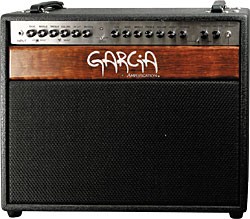
    Garcia’s 60-watt 2×12″ combo has independent channels, one clean and one distortion, that can be switched on the front panel or with the included footswitch. Each channel has controls for Bass, Middle Treble, Volume, High Cut, and Reverb, and the distortion channel also has a control for Gain. And the master section has a mini-toggle switch labeled “Vintage/Modern.”

    The amp produces tones using two new old stock (NOS) 12AX7 preamp tubes, four “select” new 12AX7s, an NOS 6201 in the effects loop circuit, and two Tungsol 6550s in the output section. Its chassis is made of 14-gauge stainless steel and is replete with fantastic point-to-point workmanship. Two 16-ohm 12″ Celestion Vintage 30s are wired in parallel, and the cabinet is covered in a scuff-resistant, polyurethane-based material. The engraved front panel is mahogany, finished in a high gloss. Other notable physical features include two heavy-duty handles positioned, Vox-like, at each end on top of the amp, perhaps because the Garcia may well be the heavyweight champion of combos, weighing in at 91 pounds. Such is the price for features like Hammond transformers and choke, and a 13-ply Baltic birch cabinet. Plus, the included removable casters make for easier toting.

    To exercise the beast, we used an Ibanez solidbody with humbuckers and a ’70s Fender Stratocaster. Plugging in the Artist first through the amp’s clean channel, we got classic Fender blackface Twin-like clean tones that really sparkled, especially in the neck position, with fantastic low-end punch that hit like a ton of bricks, all the while retaining incredible note separation and touch response. Regardless of how hard we pushed the Volume knob, the Garcia stayed extremely clean. Even almost all the way up, it only hinted at breakup.

    The Tone controls are smooth and responsive, and cover the frequencies very well, and the long three-spring reverb sounded great. The amp’s Vintage setting produced less low-end and punch, but still gave us a huge-sounding clean.

    Moving to the gain channel, we got tons of gain that was smooth and warm, with tons of harmonics. The tone in this channel more closely resembles a high-gain Marshall, with a hint of Fender clean mixed in for the sake of clarity.

    Again, this amp can get extremely loud, and in the distrotion channel, it’ll produce nearly enough gain and sustain to satiate the heavy-metal aficionado. We were able to push the amp’s gain until we lost control of it. Using the guitar’s volume control, we dialed in varying amounts of distortion without sacrificing tone.

    Pushing the output tubes produced a more natural, less gainy British-like tone. Players who appreciate flexibility will have fun tapping the various gain structures and sweet spots – and there are many to be had.

    As we dialed back the Gain, we got a fat blues breakup that hit like a fist. Insanely fat. Switching again to the Vintage setting, we got less low-end, making the amp sound like a not-as-modded high-gain Marshall; there are so many smooth, usable gain structures to be had, from crunch to insane, and all points in between.

    Next, we grabbed the Strat and plugged into the clean channel. Not surprisingly, we got the cleanest, biggest Strat sound we’ve heard in a long while, with no breakup in sight. Notes popped out all over the place, with a sparkly, bouncy punch. With the Garcia’s huge reverb tones, the surf was definitely up!

    Switched to the distortion channel, we were greeted again with that British-style tone with a touch of the U.S. West Coast (a.k.a. Fender) note separation. The harder we ran the Gain, the more it filled out, getting ever smoother to the point of sounding like we were playing through humbuckers.

    The Garcia produces some of the cleanest, fattest “American-style” tones around, as well as true British high-gain with a touch of American clean tone. If these are the things you’ve been seeking, the Garcia may just be the perfect amp for you.


    Garcia Amplification’s 60-watt combo
    Price $ 4,500 (retail).
    Contact Garcia Amplification, PO Box 30747, Myrtle Beach, SC 29588; phone (843) 340-1905; www.garciaamplification.com.


    This article originally appeared in VG‘s April 2006 issue. All copyrights are by the author and Vintage Guitar magazine. Unauthorized replication or use is strictly prohibited.

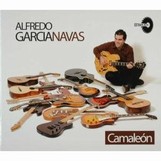
  • Alfredo Garcianavas – Cameleon

    Austrian by way of Venezuela, Alfredo Garcianavas appears intent on learning every style of music.

    Garcianavas is more than at home on fusion pieces like “Piazzo Tango” and “Pektopakt.” Growing up in Venezuela, the obvious influence of Latin music shows on “El Diablo Suelto,” which has a waltz feel juxtaposed with intense shredding. He also delves into instrumental rock on “Alf Layla Wa Layla,” tipping his the cap to Joe Satriani and Eric Johnson.

    Speaking of rock, behold the metal-esque, anthemic “I Don’t May Then,” (sic). There’s also proof that country has entered his radar screen on “Count Tree” and “Taqui Taqui,” both of which provide huge amounts of chicken pickin’ and wonderful chromatic licks.

    When he pulls out the nylon-stringed acoustic, Garcianavas’ music takes on a beautiful jazz feel. Cuts like “San Basilio,” with its gorgeous changes and nice soloing.

    Garcianavas has an obvious hunger for playing, and for learning. And it all comes out on this record.


    This article originally appeared in VG‘s Nov. ’09 issue. All copyrights are by the author and Vintage Guitar magazine. Unauthorized replication or use is strictly prohibited.

  • Mark Karan

    Karan Photo

    Photo: Alan Hess.

    Ten years, 800 shows, and countless solo flights into the journey, Mark Karan, lead guitarist of Bob Weir and RatDog, thinks he may have found his secret to great jamming.

    “When the notes are coming, I do my best to get out of the way,” he says.

    Sounds simple, but this mantra for transcendent improv comes from 40 years of passionate playing and diverse listening. Raised in San Francisco in the late ’60s, Karan witnessed the pantheon of rock’s great guitarists. Having begun his career in the Bay Area, by the early ’90s he had relocated to L.A., playing with the Rembrandts, Sophie B. Hawkins, Delaney Bramlett, and Dave Mason, doing studio work, and jamming incessantly.

    His career ignited when, after the passing of Jerry Garcia, the surviving members of the Grateful Dead tapped him to fill their lead slot. “For the first time, I was playing to 20,000 people,” he says. The Other Ones gig lead to Mark being chosen for RatDog, the touring group lead by Bob Weir.

    Working with RatDog’s huge catalog of songs, Mark further refined his approach to soloing.

    “Onstage, I do everything in my power not to think. I do my work ahead of time, listen to melodies… whatever. Then, when I get on the stage I try to go by intuition as much as humanly possible, so the melodic ideas come to me pure, not contrived.”

    Mark’s approach to gear is similarly pragmatic. Although his tour rig boasts an array of vintage and vintage-inspired gear that would wag the tail of any gear-hound, it’s all there to support his playing, not the other way around.

    The philosophy of function also applies to vintage guitars. “I want to use them, so I buy pieces with collector ‘issues’ like non-original hardware or refinishing. If the old wood is there, we’re fine. I bought my ’51 Nocaster from Emerald City Guitars in Seattle. As we were leaving the store, I strummed it, unplugged, and my wife whipped her head around from across the room! We knew we couldn’t leave without that guitar.”

    Partnering with Jay Monterose, owner of Vintique and longtime guitar tech to Danny Gatton, Mark has taken his “player” Nocaster that nobody wanted and turned it into one of his favorite touring instruments.

    Mark likes “straight” guitars, too. His main guitar is ’63 Gibson SG with side-to-side Vibrola. “The Vibrola does nothing good for the tone,” Mark jokes. “But the guitar sounds and plays great! In a perfect world I’d get an SG from two or three years later with the fatter neck profile, and put a stop-bar tailpiece on it. But this does just fine.” Where he doesn’t have the originals, Karan uses aftermarket pickups from Jason Lollar, Jerry Amalfitano, and Lindy Fralin.

    In the ’80s he used rack gear extensively, per the style of the time, and for better or worse witnessed first-hand the sea-change to vintage gear.

    “When I moved to L.A. in ’91 there was a huge return to vintage gear,” he said. “I would go to auditions and if I rolled in a rack, I didn’t get the gig. Influenced by that scene, he went on a major vintage kick for nearly 10 years.

    The current Karan setup reflects his gear history, incorporating elements from the rackmount days and the vintage era. “When I started playing with Bobby, I needed a little more of the flexibility I had with the rackmount setup, but I didn’t want to lose the tone and feel of the cool old stuff. What I’ve ended up with is extremely vintage-oriented tones and sonic approaches accessed with a fairly sophisticated switching and loop-based system.”

    His current amp setup uses a Two-Rock 100-watt Custom Reverb Signature head, a Fuchs ODS-100 head, and a Blankenship 100-watt Vari-Plex head. He switches between heads, sending the dry signal to a Mojo basketweave 4×12 cab with two Tone-Tubby alnico Hempcone, and two Two-Rock/Eminence ceramic speakers. A second signal path is used for a “wet mix.” This gets routed through a Fulltone TTE tube tape delay into a small line mixer with a Lexicon PCM-90 reverb in the send/return loop. It feeds a Mesa-Boogie 290 power amp into an A. Brown 2×12 cabinet with Tone-Tubby alnico Hempcones. He has a separate rig for acoustic guitar.

    In the effects department, Karan uses a serious selection of high-quality vintage-style analog pedals to achieve the array of sounds that come up during the typical RatDog gig. Some of the effects include the Fulltone TTE Tube Tape Echo, Teese RMC3 wah, Analogman-modded Electro-Harmonix Q-Tron, Maxon PT999 phaser, Retro-Sonic chorus, a Durham Sex Drive boost, an early hand-painted Fulltone “69” fuzz, Hughes & Kettner Rotosphere Leslie simulator, Keeley-modded Line 6 DL4 delay unit, and a Catalinbread Semaphore tremolo. The rig was put together by Dave Friedman in Los Angeles.

    Karan readily acknowledges that were he not on tour with an act as big as RatDog, he would not have the opportunity to haul around such an extensive rig. He considers himself very lucky to have that luxury. It’s not only in this sense that he considers himself lucky. After battling throat cancer last year and being recently pronounced “free and clear” he feels extremely fortunate just to be alive and out playing, more so than ever. “It’s amazing the amount of freedom I have on this gig, not to mention the amazing love and support that was shown to me while I was sick. It really is a great gig and a great musical family.”


    This article originally appeared in VG‘s November 2008 issue. All copyrights are by the author and Vintage Guitar magazine. Unauthorized replication or use is strictly prohibited.


    Gov’t Mule and Mark Karan – After Midnite

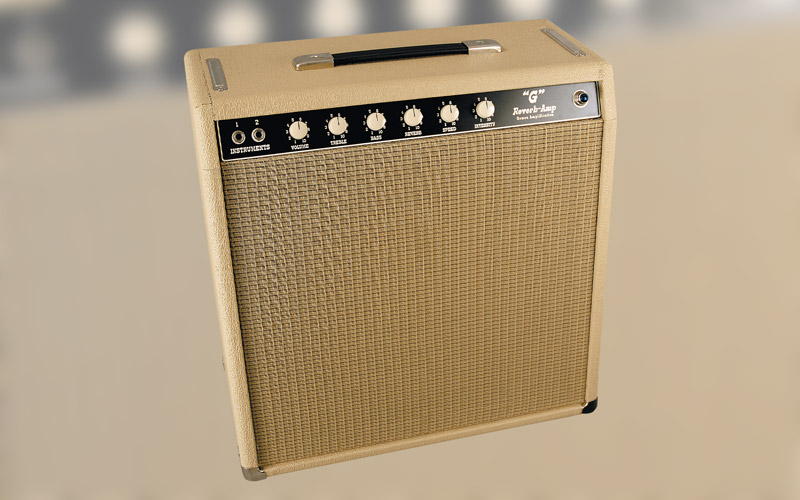
  • Gomez Amplification “G” Reverb

    Gomez Amplification “G” Reverb

    Gomez Amplification “G” Reverb
    Price: $1,399
    Contact: Gomez Amplification, Rancho Santa Margarita, CA 92688
    (949) 300-8573
    www.gomezamps.com

    As amp builders go, Dario G. Gomez is about as fresh as they come. Though he has been repairing tube amps for many years, he started offering his own amp designs only about a year ago. His is a modest one-man shop, and though he has yet to build amp #100, Gomez is wise enough to know that only top-shelf components make for a top-shelf amp. His sole product is the surf-inspired “G” Reverb combo, but an expansion of the line is in the works.

    The “G” Reverb is a 1×15″ combo with hand-wired tube circuitry, a Jensen Alnico-magnet speaker, tube-driven tremolo, sprin”G” Reverb, and a two-spring Accutronics reverb tank (a three-spring tank is a no-upcharge option) all connected with high-quality RCA cables.

    Aesthetically, the “G” carries a certifiably classic ’60s Fender style and vibe with its rough blond tolex, wheat grillecloth, chrome corners, simple strap handle, slanted black control panel with vintage-style cream knobs, blue jewel light, and very cool cream-colored Western-motif silkscreen. Under the tolex is a solid 3/4″ pine cabinet with dovetailed joints and a 1/2″ cabinet-grade birch plywood baffle.

    You know what they say about first impressions? Well, the Gomez makes a good one, especially if you’re a fan of compact, lightweight guitar amps. At 201/4″ (tall) x 201/4″ (wide) x 103/4″ (deep) and just 36 pounds, the “G” Reverb is small and easy to haul.

    The tube layout in the “G” Reverb consists of a matched pair of JJ/Tesla 6V6 power tubes that help it produce 12 watts of output, a new-old-stock (NOS) RCA 5U4GB rectifier tube, three Electro-Harmonix 12AX7EH preamp tubes, and a NOS JAN Philips 12AT7WC reverb-drive tube. The control panel layouts included two 1/4″ input jacks (high- and low-gain), as well as knobs for Volume, Bass, Treble, Reverb and Speed and Intensity for the tremolo circuit. The back panel hosts a power switch (the amp does not have a standby mode), ground switch, fuse holder, and speaker-out jacks. Fit and finish on the “G” Reverb are very nice, with clean wiring inside and well-executed tolex application.

    We sampled the “G” Reverb’s tones using several guitars including a stock ’66 Fender Jazzmaster, a Gretsch 6128 reissue with single-coil DynaSonics, a Gretsch 6119 reissue with Hilo-trons, stock ’59 Dano U-1, Gibson Custom Shop Johnny A, Fender Robert Cray Custom Shop Strat, and a Fender Custom Shop 1960 Relic Strat.

    Starting with the Strats, we set the “G” Reverb’s Volume at 9 o’clock and the tone controls at 1 o’clock.

    We weren’t surprised when the Gomez offered classic Fender sound, replete with sparkling clean highs, slightly scooped midrange response, and punchy low-end. The amp’s passive Bass and Treble controls are smooth and subtle, requiring only minor adjustments to compensate for the differences in tone between various guitars and their respective pickup configurations. As we drove the volume to 11 o’clock, the clean tone grew a bit of hair, with complex musical overtones and bit of overdrive, while low-end remained punchy. Highs never got harsh, and low-end never “farted out,” as 6V6-powered amps are often apt to do. With the volume at 2 o’clock, the overdrive and sustain became more abundant, but the amp stayed consistently open-sounding and we were able to clean up the tone quickly using just the volume control on the guitar, without losing spank or punch. This is a great attribute if you think solo boost at your fingertips is a cool thing. And Gomez’s choice of an Alnico-magnet speaker was indeed wise; the smaller voice coil in the Jensen allows highs and mids to be reproduced more naturally, like a 10″ speaker, while the added surface area of the 15″ rounds out and reinforces low-end.

    Plugging in the ’66 Jazzmaster, we dialed in reverb and caught a mouthful of lush tone with ’60s wet “surf” splash in the high-end response, without the unnatural, hollow sound that often muddies the tone of reverb amps. The placement of the reverb circuit in the amp’s gain structure, the vintage 12AT7WC drive tube, and the Accutronics tank all contribute to the amp’s outstandin”G” Reverb.

    Not set to take a back seat, the “G” Reverb’s tremolo circuit sounds equally as good, with a deep, silky-smooth vintage waveform that can go very deep and become quite intense without sounding choppy. Every guitar sounded excellent, with a full, natural tone.

    The Gomez “G” Reverb’s small size and light weight make for easy packing, but they sure don’t make a small sound. To the contrary, the amp has a big, lively tone with some of the most impressive reverb and tremolo we’ve heard from a new amp. It excels as a surf amp, but its ability to get a little dirty when driven to do so makes it a smokin’ blues amp, as well. – Phil Feser


    This article originally appeared in VG‘s Nov. ’06 issue. All copyrights are by the author and Vintage Guitar magazine. Unauthorized replication or use is strictly prohibited.

  • Gibson Style O

    Gibson Style O Artist

    Gibson Style O Artist

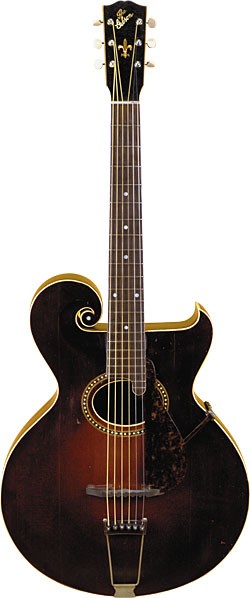
    The priority Gibson put on mandolins in its early years was reflected in the company’s original name – Gibson Mandolin-Guitar Mfg. Co., Ltd. And the fact Gibson strung its guitars with steel strings suggests it may have viewed them as an extension of the mandolin family rather than as an instrument with its own voice. In 1908, the “suggestion” of Gibson’s mandolin approach to guitar design became obvious fact with the introduction of a new Style O model with a scroll body shape.

    Style O models had been part of the Gibson line, along with L-series models, from the company’s beginnings in 1902, and although the body shapes were distinctly Gibson, with circular lower bouts, they were symmetrical in shape like any other guitars of the era. But the 1908 Style O was something altogether different.

    Although it was not simply a larger-scale version of Gibson’s F-style mandolins, which featured a scroll and three points on the body, plus a scroll cutout on the headstock, the Style O’s design was nevertheless clearly influenced by the F mandolins (one of Orville Gibson’s original designs dating back to the 1890s). The upper bass bout of the guitar extended into a scroll, as it did on the mandolin, but the design was refined from an artistic standpoint, such that the line from the scroll (where the neck meets the body on the bass side) continued on the opposite side of the fingerboard through the upper treble bout, which extended outward to a point. The lower bout retained the typical Gibson circular shape of earlier models..

    Gibson initially called the new Style O “Special Grand Concert,” but it was the only grand-concert-sized guitar (16″ wide) in the line. In 1911, when a more conventional 16″ guitar (the L-4) appeared, catalogs began referring to the Style O by the name most collectors call it today – the Style O Artist.

    The Style O had a radical appearance compared to guitars of 1908, and that would continue throughout the model’s production period from 1908 to 1925. Not only was it radical in appearance, it was functionally very modernistic and innovative. Whereas most guitars of the period had necks with 12 frets clear of the body, the design of the Style O’s upper treble bout provided 15 frets clear of the body. Although it did not have the circular or cupped shape of the cutaways we’re familiar with today, it functioned the same, allowing easy access into the higher register.

    In other respects, the Style O was a typical Gibson instrument. Like all Gibsons from the time of Orville until Gibson’s first flat-tops appeared in the mid ’20s, the Style O featured a carved spruce top. Although catalogs specified maple back and sides, the Style O, like all the other Gibsons of its period (except the F-4 mandolin), was actually made of birch. Like the L-4 and the earlier O-series guitars, the Style O had an oval soundhole (the smaller models in the L-series had a round soundhole). The O’s mahogany neck with dark center lamination, ebony fingerboard with white binding, and pearl dot inlays, were all standard Gibson fare for the period. The bound peghead initially sported only a pearl-inlaid fleur de lis; “The Gibson” in pearl was added circa 1915. The bridges were standard Gibson-style, starting with a non-height-adjustable ebony unit and switching to height-adjustable in 1921. The tailpieces, too, were standard Gibson for the period and changed with the bridge, from a trapeze-style with a crosspiece of tortoiseshell-grain celluloid and strings anchored in the crosspiece by pins (similar to bridge pins), to a more modern trapeze with a metal crosspiece. Early on, the finish was usually black on top with uniform red mahogany stain on the back and sides, becoming shaded mahogany finish in the late 1910s.

    From a manufacturing point of view, the Style O had a more complex design than that of a guitar with a symmetrical body shape, and the carved top and back further complicated production. In addition, the model was well-ornamented (compared to other Gibsons), which required more labor. Consequently, the Style O was the most expensive guitar in the Gibson catalog through most of its existence. Pricing fluctuated, starting with a list of $150. A price list for Catalog H (ca. 1911-’12) shows a dramatic drop in pricing to $77 list, although catalogs continued to list the model at $150. By comparison, when the Style O listed for $150, the next expensive model, the L-4, listed for $124. Prices did drop, then rose again, peaking in 1920 at $304 for the Style O and $230 for the L-4. Only a year later, as Gibson began to experience financial difficulties as a result of the rising popularity of the banjo, prices again plunged to $150 for the Style O and $120 for the L-4. The Style O was last listed in 1923 at $225. The L-5 had been introduced at $275, and on the price list of January 1, 1924, the Style O was gone, although examples exist with serial numbers from 1925.

    There is certainly no question that the Style O was – and still is – a striking guitar. The body shape, with its bold lines, makes the instrument stand out in any group, and they are seen often in group photographs from the mandolin orchestra era. Their visual appeal and rarity make them highly sought by collectors today. Unfortunately, their performance quality makes them considerably less appealing to musicians. The tops are relatively thick, resulting in limited volume, and the necks tend to be large, even after late 1921, when they were fitted with Gibson’s patented adjustable truss rod. Consequently, photos of Style O Artist models in the hands of professional guitarists are few and far between. The best known artist (if not the only artist) to be photographed with one is blues singer Big Bill Broonzy (1893-1958).

    While the Style O Artist model may be more appealing visually and as a collectors’ item than as a great-sounding utility guitar, its design continues to have merit. An instrument with similar specifications, but a lighter, more carefully graduated top and more modern neck dimensions, could be an exceedingly fine guitar.


    This article originally appeared in VG‘s March ’06 issue. All copyrights are by the author and Vintage Guitar magazine. Unauthorized replication or use is strictly prohibited.


    Vintage Gibson Style O 1917

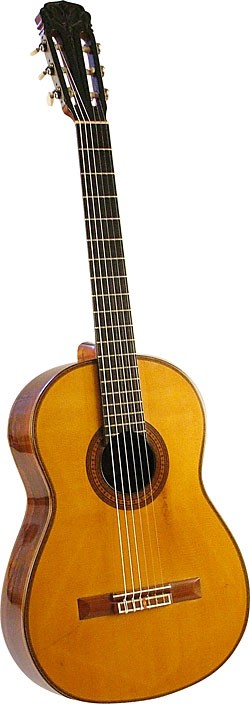
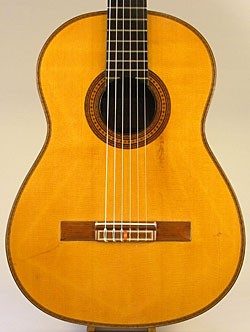
  • 1924 Francisco Simplicio

    1924 Francisco Simplicio

    1924 Francisco Simplicio

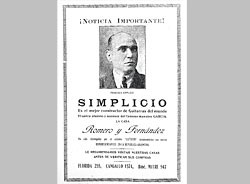
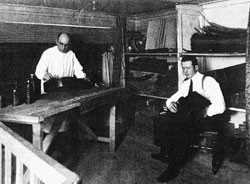
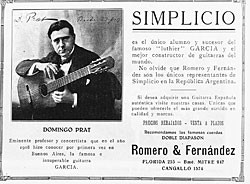
    Francisco Simplicio was one of the most highly regarded Spanish (to be precise, he was Catalan) makers of the first half of the 20th century, being the only student and successor to Enrique Garcia, who worked in both Madrid and later, Barcelona. Simplicio began his guitar making career in 1919 with Garcia after losing his position as an “ebeniste” (highest caliber of cabinet maker) with the firm of Masriera y Vidal of Barcelona, who were makers of deluxe luxury goods. Simplicio had worked for them for 18 years and was already highly skilled as a woodworker. For more on Simplicio’s history, see “Guitars With Guts” in the March ’99 issue

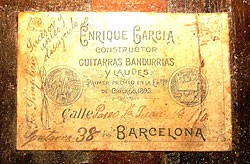
    As can be seen here, Simplicio continued using the label of Enrique Garcia, who died October 30, 1922, having completed only 272 guitars under his own name. While one might argue that Simplicio was merely being practical by using up remaining labels left over in the shop, I suspect several other factors influenced his decision. Garcia was the 500-pound gorilla in the guitar-making world when he died, lionized by wealthy players in South America and the rest of the world, and he was hailed as the “Stradivarius of the guitar” in the obituary notices of the era. Convincing players to accept an instrument with an unfamiliar name, no matter how much it looked and sounded like a Garcia would have been an uphill battle. Using the Garcia label, which Simplicio continued until around 1925, fully three years after the death of Garcia, permitted him to over sign them as the “only disciple and student of Enrique Garcia,” thus helping open the way for acceptance of instruments under his own name. It didn’t hurt that Simplicio also retained the original Garcia shop address at Paseo San Juan #110, an address which then and now is in a very expensive and exclusive area of Barcelona. Despite the very high prices their guitars commanded, neither maker felt secure enough to actually print the address on their labels, leaving this detail blank to be filled in by hand on each guitar. Such was the tenuous nature of lutherie in the early 20th century.

    In total, Simplicio made 336 guitars under his name between 1922 and his death on January 14, 1932, a pace that works out to being just about 34 guitars per year, a surprising rate of production even if one factors in help from his son Miguel and daughter Josefa. Even the plainest Simplicio guitars carried normal levels of decoration, and his deluxe models were paragons of time-consuming lavish ornamentation, all produced in the Simplicio shop.

    This particular example, No. 38 from 1924, harks closer to the original Garcia model, with a more delicate construction and slightly smaller body than Simplicio’s later instruments. It does not have the tornavoz, a brass (or sometimes wooden) inverted cone attached to the underneath side of the sound hole whose function was to deepen the tone of the guitar. The tornavoz was an “improvement” that the jury was still deliberating on in 1924, some players swore by them, others swore at them. Today they are as relevant as a buggy whip.

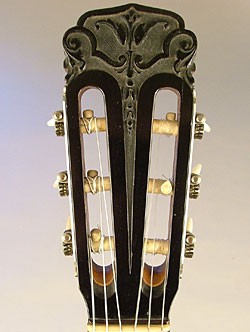
     Simplicio head relief carved in ebony

    Simplicio head relief carved in ebony.

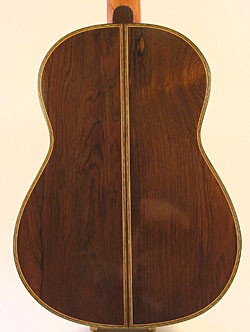
    Back of the guitar showing the two halves

    Back of the guitar showing the two halves, not matched.

    The faint pattern of the fan strutting

    The faint pattern of the fan strutting, where years of exposure to acidic atmosphere caused slightly different levels of oxidation.

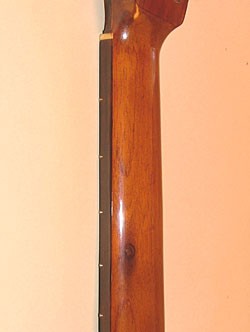
    Knot in the Spanish cedar neck

    Knot in the Spanish cedar neck, something not considered a fatal defect in those days. Apparently they knew what they were doing, the neck of this instrument is still perfect after more than 80 years under tension.

    Made of Brazilian rosewood, it’s curious that the two panels of the back do not match at all, not even close. While today this would be considered a huge defect in an upscale deluxe instrument, in those days players accepted this kind of thing as normal, if not even desirable, as it gives the guitar a very distinctive personality, something entirely lacking in today’s cloned CNC produced products. Like the Garcia models, this guitar is fitted with an asymmetrical fan strutting pattern on the top consisting of eight fans rather than the usual seven symmetrical fans as used by Torres et al. The arrangement of eight fans was a Garcia innovation, which greatly improved the treble response of the guitar. Long-term exposure to an acidic environment has oxidized the very thin (less than 2 mm) soundboard, and now the position of the fan struts is showing through where the top is slightly less oxidized. I have seen this effect in several older thin-topped Spanish instruments that spent many decades residing in cities which suffer from acidic atmosphere such as Buenos Aires, Montevideo, and Chicago. It has no structural consequence whatsoever.

    The scale of this guitar measures exactly 251/2″ (647 mm) the same as used by Antonio de Torres in the 19th century, who used tools and measuring devices that were probably English in origin. Later Simplicio guitars beginning around 1927 have slightly larger bodies and a scale measuring 650 mm, or 255/8″. Unfortunately, we don’t have any written correspondence from Simplicio that would shed light on his reasons for this change, but the desire for more volume (thanks to more tension on the longer scale) and greater depth (due to a larger internal air volume) would have been the factors Simplicio would have understood to control the sound.

    Simplicio used many different patterns for the head profile and carvings, as did Garcia before him. This was an area where they exerted their artistic creativity. When it came to the rosettes and purflings, it’s clear that while several distinctive patterns were used, these were items made in large quantities and stockpiled in the shop in the various individual components, which allowed not only mix and matching from instrument to instrument, but also some degree of consistency, without the boring perception that everything was assembled from one parts box.

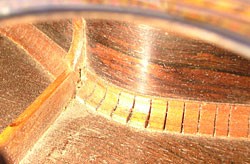
    Like Torres in the 19th century, Garcia and Simplicio both scraped the corners of their instruments thinner before cutting the purfling channels, which gives their instruments a soft roundness just like those of Torres. By 1927, when Simplicio was making his larger model, he discontinued this time-consuming practice, giving his later guitars a much more masculine appearance. Internally, Simplicio used molded kerfed linings of cedar and pine, which ingeniously provided adequate internal support for the wide, elaborate external inlays and purflings without making the instrument noticeably heavier. The only defect of Simplicio in my opinion was cutting entirely through the back and top surfaces to glue all this extensive inlay directly to the linings, instead of having them glued to a ledge cut halfway into the thickness of the back. The difference is apparent if one ever has to remove the highly decorated back from a Simplicio in order to do extensive internal repairs. This is an operation never to be done in the presence of dogs or small children!

    Garcia label showing Simplicio's over-written signatur

    Garcia label showing Simplicio’s over-written signature.

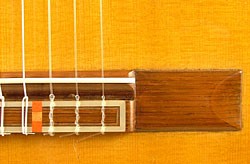
    The precise bridge work. Note the perfect miters of the mother of pearl

    The precise bridge work. Note the perfect miters of the mother of pearl, and the perfect facets on the ends of the thin arms.

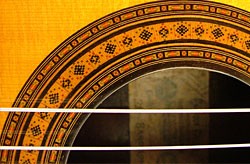
    Detail of the Simplicio rosette.

    Detail of the Simplicio rosette. The mosaic border is made to imitate the printed border of one of the segunda época labels used by Antonio de Torres. The same mosaic is used to border the entire sound board margin.

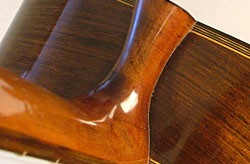
    The rounded Simplicio heel

    The rounded Simplicio heel. Garcia’s and Simplicio’s esteem in South America was so great that nearly all South American makers today favor the rounded heel in homage to these pioneers. Of course Garcia and Simplicio were only following the lead of Torres, who also used the rounded heel.

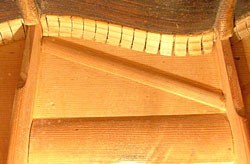
    The interior back linings, carefully molded and kerfed.

    The interior back linings, carefully molded and kerfed. Note the precise fit of the crass strut against the linings, and the support block on the end of the cross strut.

    Interior, showing top linings and soundhole braces.

    Interior, showing top linings and soundhole braces. Simplicio has also used heavy paper to partially reinforce around the soundhole, an ancient practice among Spanish makers.

    The Simplicio bridge is worthy of close attention, being both delicate and very precisely formed. The arms are very thin and flexible, delicate to an extreme, and the tie block is quite wide and large, inlaid very precisely with mother of pearl and very delicate purflings. As you may note, the tie block inlay is set within the width of the full tie block, which visually lightens the very wide central area of the bridge. The arms are so delicate that the valley is not undercut, despite the very low position of the string holes. The ends of the tie block and saddle area are precisely and gently rounded over to lighten the bridge and soften the corners. The bridges of Ignacio Fleta immediately come to mind when viewing Simplicio’s (and Garcia’s) bridges. Few makers used bridges of such consistent acoustical design as did Simplicio, who left nothing to chance with this detail. While I’ve heard it suggested that the central wood tripartite inlays found in some Simplicio tie blocks indicated export models, I have not found that to be consistently the case, there being several Simplicio guitars which would contradict this traditional legend.

    Like most guitars from the 19th and early 20th century, this guitar was originally intended to carry a very low action, but it has been fitted with a slightly higher saddle to bring the action more in line with modern classical guitar action, and it is a testimony to the genius of Simplicio’s art that the top shows no distortion nor problems despite the change of intended torque. For many older Spanish instruments this kind of action change can be very detrimental to the integrity of the top. Typical of Simplicio guitars, the fingerboard is much thicker at the nut end than other Spanish instruments of the era, part of Simplicio’s approach to achieve the correct action. The thicker fingerboard also helps give the instruments more sustain and “singing” quality.

    Like all unaltered Simplicio guitars, this one is finished in “goma laca,” as the Spanish call it, or “French polish” as we English speakers like to call it, a varnish consisting primarily of shellac dissolved in ethyl alcohol applied very thinly with a pad lubricated with olive oil. Whoa… I think I just gave away some important varnish secrets! Well, there is a small matter of experience in doing this, too. Simplicio did his own varnishing using various grades of shellacs, as shown in a photo of he and son Miguel working in the shop, something that was not universally done by Spanish makers. This being a highly skilled trade, often, makers would entrust their instruments to specialist polishers who would do the varnishing for them, a tradition that lives on today in Spanish instruments of various Madrid builders who send their guitars out to Earl Scheib to be sprayed with modern catalyzed urethane. Due to repairs over the years, like so many older Spanish instruments, this guitar has acquired newer paddings of french polish (goma laca, shellac) on top of the original varnish, something entirely acceptable provided the original is not scraped off and the instrument sanded to bare wood. Among luthiers, this radical stripping procedure is known as the Phyllis Diller facelift.

    Advertisement from the catalog of Romero y Fernández of Buenos Aires.

    Advertisement from the catalog of Romero y Fernández of Buenos Aires. It reads, “Important announcement! Simplicio is the best guitar maker in the world, the only student and successor of Garcia. The house of Romero y Fernández has been appointed by the celebrated luthier as the exclusive representative in the Argentinean Republic. We recommend that you visit our showrooms before making your purchase.”

    Francisco Simplicio (left) and son, Miguel, applying French polish in their shop.

    Francisco Simplicio (left) and son, Miguel, applying French polish in their shop. On the shelf between them one can see fret wire in coils on the top left shelf, with spruce soundboards leaning vertically next to them. On the shelf below are stacks of partially finished necks and heads with fingerboard blanks behind them. On the top shelf above Miguel are stacks of unbent sides topped with inlay materials and purflings, and on the middle shelf are sets of bent sides. On the bench are bottles of shellac, alcohol, and olive oil, and both are working with what the Spanish call the “muñeca” or doll, which is a wad of cheesecloth wrapped with pure linen used to apply the shellac in molecularly thin coats using thousands of passes over the surface. The wall behind Francisco is actually a roll down security gate which opens directly to the street in front of the shop. It is interesting that they have closed this gate for the varnishing process. Normally they would have been working in open air. The building still exists, though the roll-down gates have been replaced with windows.

    Josefa (left) and Francisco Simplicio working in their home.

    Josefa (left) and Francisco Simplicio working in their home. Though Francisco’s letters mention his daughter, Josefa, it is not clear what role she played in the operation. But she must have been very helpful, there is no way Francisco and Miguel could produce 34 guitars a year without help.

    Advertisement from the July, 1926, issue of the Revista Tárrega.

    Advertisement from the July, 1926, issue of the Revista Tárrega. It reads, “Simplicio is the only student and successor of the famous luthier Garcia and the best maker of guitars in the world. Don’t forget that Romero y Fern#225;ndez are the only representatives of Simplicio in the Argentinean Republic. If you would like to acquire an authentic Spanish guitar, visit our showrooms. We are the only ones who can offer you the largest selection of quality and brands.” Domingo Prat is featured prominently in the ad, with the legend, “Eminent professor and concert artist who in the year 1908 introduced for the first time in Buenos Aires the famous and incomparable GARCIA guitar.” Curiously, the photo shows Prat actually holding what looks to be either a Manuel Ramírez or Domingo Esteso guitar. Of course, those were incomparable, too.

    Simplicio liked to varnish the interior sides and back of his guitars, presumably to slow down the loss of moisture when they were taken to dryer climates where cracking was a distinct risk. In those days, makers had no practical way to control humidity in their shops short of closing the window when it was raining outside. Indeed, there are several repaired cracks in the back of this instrument which is quite thin (less than two millimeters). While internal varnishing might slow down the loss of humidity, it certainly does not prevent it, and further complicates the later repair of the instrument if cleat work is needed. Ignacio Fleta, who was just getting started as a luthier when Francisco Simplicio died also followed this concept of finishing the interior of the sides and back, and had no more success at preventing cracks than did Simplicio. Some makers today still follow this theory. Hope springs eternal.

    The machine heads of this Simplicio are the original German silver machines with mother-of-pearl buttons and the patented pips screwed to the rollers which were favored by Garcia and Simplicio. The difficulty of removing these machines has helped to preserve the instruments from casual and amateur refinishing, the leading cause of death for many other fine Spanish guitars. German-made, the quality engineering of these machines has kept them fully functional for nearly a century, and they show no signs of imminent demise. It was a hallmark of Simplicio to use nothing but the finest tuning mechanisms, which were German made, and must have been frightfully expensive in their day. Simplicio’s clientele did not care, they wanted the best, and Simplicio spent his entire lifetime making the best – “Ars longa vita brevis,” as they say.

    Acknowledgments: Sincere thanks to Randy Osborne of Fine Fretted Stringed Instruments, Campbell, California, for allowing me access to his historical archives of material from which I obtained the advertisements for Simplicio’s guitars and the photos of the Simplicios in their shop. This and much more material is set to appear in his soon to be published book, Annotations for the History of the Classical Guitar in Argentina.


    Richard Bruné began making guitars in 1966 and is a former professional flamenco guitarist. He has written for the Guild of American Luthiers and other organizations and lectured at guitar festivals and museums including the Metropolitan Museum of Art in New York City. He collects classical and flamenco guitars. He was recently featured on the PBS documentary, “Los Romeros: The Royal Family of the Guitar,” and his new book, The Guitar of Andrés Segovia: Hermann Hauser 1937, was recently published by Dynamic, of Italy. You can write to him at 800 Greenwood Street, Evanston IL 60201, or visit rebrune.com.


    This article originally appeared in VG‘s July 2009 issue. All copyrights are by the author and Vintage Guitar magazine. Unauthorized replication or use is strictly prohibited.

  • Rodrigo y Gabriela – Live in Japan

    The guitar duo of Rodrigo Sanchez and Gabriela Quintero created a huge sensation with its eponymous 2006 CD – the pair’s acoustic attack equal parts flamenco and metal.

    If there was any doubt that all-instrumental music could hold a rock audience’s attention, it was certainly dispelled last March, when Rod and Gab played their first show in Japan. Thankfully, it was recorded, and is available as a limited edition, containing a 14-track CD and five-song DVD. The DVD is, if nothing else, a great visual aid, because just listening to so much rhythm, lead, and percussion, it’s hard to believe it’s all coming from just two steel-string guitars played live. Some songs, in fact, contain sections that are entirely percussion – Quintero being particularly adept at beating and slapping her guitar’s body.

    Metallica’s “Orion” sits comfortably alongside energetic duo originals like “Foc” and the opening “OK Tokyo.” Each member takes a solo turn (Gabriela employing a wah, Rodrigo tossing in some jazzy octaves) before their signature take on “Stairway To Heaven.”

    While their fiery closer, “Diablo Rojo” (somewhat of a rock radio hit), is a real showstopper, their intense but sensitive arrangement of the Dave Brubeck jazz classic “Take Five” reveals potential for growth beyond mere chops. But either way, this is one of the most exciting guitar acts on the scene.


    This article originally appeared in VG‘s Mar. ’09 issue. All copyrights are by the author and Vintage Guitar magazine. Unauthorized replication or use is strictly prohibited.

  • Seymour Duncan P-Rails pickups

    P RAIL

    Seymour Duncan’s new P-Rails pickup is a P-90 with a slim rail-style coil tucked in next to it, designed to fit into a standard humbucker ring.

    Coupled with a standard three-way mini on/off toggle switch, the P-Rails are designed to produce tones including traditional P-90, rail, single-coil, or humbucker – all in a single pickup. Combine two P-Rails, each with a three-way mini toggle in a two-pickup guitar with a three-way pickup selector and you’ll have 15 pickup combinations! But do the P-Rails do justice to all three pickup types?

    The P-Rails are sold in bridge and neck versions, and the only significant difference between them is the pole spacing and their flipped coils.

    Mounted in a 24.5″-scale solidbody wired with a pair of three-way mini toggle switches, and running through a 20-watt EL84-equipped amp and 2×12″ cab, running both P-Rails at once produces a classic, midrange-packed humbucker tone with a fairly high output. Separately, the bridge unit offers thick, punchy tone with the amp turned all the way up, while the neck unit excels in making jazzier tones – round and dark, especially with the guitar’s Volume and Tone controls backed down.

    In straight P-90 mode, the P-Rails throw a punchy, classic Les Paul Special tone with plenty of gain (slightly less than in humbucker mode), clear mids, and sparkling highs.

    In single-coil/rail mode, both P-Rails produce a usable vintage Strat/Melody Maker tone with slightly less gain and midrange than the P-90 coil. Having the lower-output rail/single-coil on the inside and the hotter P-90 on the outside (mirror image) helps maintain balance between the coils. Having the bridge rail further from the bridge itself keeps it from sounding thin and weak, while pushing the P-90 closer to the bridge helps it produce that punchy low-end and midrange.

    The greatest benefit with the P-Rails versus a standard single-voiced set of pickups, or even a set of regular humbuckers with traditional coil splitters, becomes apparent in the middle position, where you can mix combinations (i.e. humbucker and P-90, humbucker and single-coil, P-90 and single-coil) to get just the right sparkle, cut, and fullness. With a total of nine combinations in the middle position, the variety of usable sounds is impressive; at times, the differences are subtle, but still very worthy of exploration.

    The P-Rails offer so many tonal possibilities; in a hum/single/hum guitar you’ll have nearly 30 combinations. In the neck position of a Fat Tele, they’ll push the combination from three to seven. And in a dual-humbucker guitar with individual volume and tone controls (our tester had just one of each), the possibilities would be greatly expanded. The Seymour Duncan P-Rails cover three pickup styles very well, don’t require major modification to your axe, and tremendously expand its tonal possibilities.


    Seymour Duncan Pickups P-Rails
    Price $129
    Contact Seymour Duncan, 5427 Hollister Ave., Santa Barbara CA 93111-2345; phone (805) 964-9610; www.seymourduncan.com.


    This article originally appeared in VG‘s October 2008 issue. All copyrights are by the author and Vintage Guitar magazine. Unauthorized replication or use is strictly prohibited.