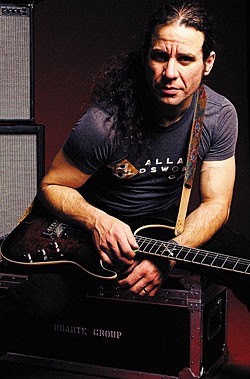
Chris Duarte photo courtesy Carol Howell/Loophole Entertainment.
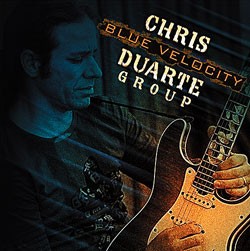
Blue Velocity, the latest record from the Chris Duarte Group, is a rarity in today’s music world – a knock-down, drag-out, “crank ‘er up and let ‘er rip” guitar album. And that’s how Duarte and producer Mike Varney wanted it.
“We weren’t striving for perfection, we were striving for emotion, you know?” Duarte said. “Part of it is guitar, that’s what Mike wanted. He realizes people love to come out and just hear me play. I really feel we accomplished that and made a really strong driving blues/rock album.”
One fact that might surprise Duarte fans and anyone who hears solo after blazing solo on the record is that his main love is playing rhythm guitar.
“I think it’s extremely important for people coming up in bands. You have to learn how to play with people and learn how to be in a support role. I always thought rhythm was way cooler than playing solos, although I love playing solos, too. I mean, you lay down a cool rhythm, and there’s nothing like it.”
Those unfamiliar with his background might also be surprised to learn that his first big gig after moving to Austin from San Antonio was in a jazz band. He was 17.
“I could read the chord charts in the Real Book,” he said. “Plus, I had a good memory. We would use charts, and the leader would call out the tunes. I’d be shuffling my papers and he’d give me that glare. I thought, ‘Hell with it!’ So I memorized all the songs. I could play whatever he decided to call out and not have to shuffle the charts.”
The move to the leader of a blues trio came later, while he was touring in a quartet. “The main guy was late for a gig and I had to cover. When I realized I was making the people happy and filling it up I thought maybe I could do this trio thing. I did it, even though I still held down some rhythm chairs in a couple of other bands.”
Duarte’s introduction to music came via television in the ’70s. “I saw Fiddler On the Roof, and one of the opening scenes is the fiddler silhouetted on the roof, playing that little riff. I thought that was so cool. So the next day, I went to school and said ‘I want to do violin.’ They said, ‘We don’t have violins, we have clarinets.’ I went home and told my mom, and she said, ‘Uh, no. We’re not gonna do that.’ But the seed had been planted, and later I got into the guitar and bands like the Beatles, Black Sabbath, the Stones, and AC/DC.”
As for guitars, most of Duarte’s followers associate him with the ’63 Fender Stratocaster he has been playing for many years, but won’t be for much longer. “It’s on its last tour,” he said. “Some things have come up where it just can’t do it anymore. It’s so beat up. I’ve had the frets redone, but there’s nothing but a thin veneer of rosewood left and I don’t want to change the fretboard.” He also has a Hamiltone from 1995, and he makes frequent use of an Epiphone Les Paul. Then, he’s working closely with Xotic Guitars on a custom replacement for his Strat.
“They’re gonna measure the Strat and try to make me one. I’m really excited to see how it turns out – I told them, ‘If this works out, I’ll be the biggest poster boy you’ve ever seen!’” And if you know of his past, you know he loves to collect jazz boxes.
“I’ve got a Gibson ES-175, an Epiphone Emperor, a Washburn Montgomery, and one of the Japanese versions of the D’Angelico New Yorker. Whenever guitar companies come to me, I tell them ‘You gotta give me one of your big jazz boxes.’”
Duarte’s amp and pedal setup is a complex rig. He has two Randall RM50s, one a combo with a 15″ EV speaker, the other a head with a 4×12″ cab. The Randalls use preamp modules and adjustable tube configurations. There’s also a Marshall JCM and a blackface Fender Twin – the latter sees most of the action. The left side has a vintage Fender Vibroking. “The serial number is 0068, and I’ve been informed number 60 was the first allowed to the public,” he says of it. His rig also contains a Marshall JCM 900 that, while it may not have the highest reputation among Marshalls, Duarte has “learned to work it.” In a bit of an understatement, he redirects attention to his pedalboard by saying, “I seem to have a lot; I use a Boss DS-1 pedal, made in Japan. I’ve got two of those. I have a Boss CE-5 Chorus, a Boss DD-3 Digital Delay, a Glo Vibe Monkey Dance, which is like a Univibe. I have a Mutron Octave Divider, and a Granville Procrastinator, which simulates an Echoplex. At the very front of everything, I have a Cesar Diaz Texas Ranger pedal. Cesar gave me that. It’s always on the mid setting. It really gives a good boost to a single-coil pickup.”
Duarte’s new record comes at a time of big change in his life. After years of doing drugs, including heroin on-and-off, he has undergone treatment. “I feel great. I’ve dealt with my drug problem in a professional way. I went down to the Crossroads Center and it was just a life-changing experience. It’s a great center. I feel rejuvenated and regalvanized in life.”
This article originally appeared in VG‘s December 2007 issue. All copyrights are by the author and Vintage Guitar magazine. Unauthorized replication or use is strictly prohibited.
Chris Dreja had a front-row seat to rock-and-roll history, playing rhythm guitar and bass in the Yardbirds behind Eric Clapton, Jeff Beck, and Jimmy Page. Today, Dreja still plays with the vaunted Brit-pop group, co-leading the band with original drummer Jim McCarty and cranking out ’60s anthems like “For Your Love” and “Heart Full of Soul.”
We caught up with Dreja as he toured the U.S. this year with the Zombies and Spencer Davis Group, asking him to reflect on the magical music he helped create some 45 years ago.
“Heart Full of Soul” was one of the first songs to bring an Indian influence to rock in 1965. How did that idea came about?
That was another tune written by Graham Gouldman, as we had already recorded his song “For Your Love.” He was later a member of 10CC, and his music had an eclectic, timeless quality that inspired our creative interpretations. We felt the riff in “Heart Full of Soul” needed that Indian sound, and we even tried recording it with Indian musicians on sitar and tablas. Unfortunately, their timing and sound was too thin, and did not sit well in the track, so Jeff Beck stepped in with his fuzz pedal and that was it – perfect.
Beyond the Beatles, what bands were the Yardbirds listening to in 1965-’66?
A lot of Chicago blues artists like Jimmy Reed, Muddy Waters, and Howlin’ Wolf. Also, we were into the Kinks, the Who, Animals, Bob Dylan, Beach Boys, Lovin’ Spoonful, and Peter Paul and Mary. All genres, really. But the Rolling Stones were the inspiration for us to form a band and start performing.
Who were your own guitar influences?
The players in Jimmy Reed’s band, plus Hubert Sumlin, Duane Eddy, Brian Jones, and of course, Chuck Berry.
Clapton, Beck, and Page tend to get much of the Yardbirds glory, but you, McCarty, Keith Relf, and Paul Samwell-Smith wrote a lot of the music. What was your role in the songwriting process?
Jim, Paul, and Keith were prolific writers, and I contributed where I could with lyrics, arrangements, and a lot of crazy ideas. The Yardbirds were a democratic band and if somebody came up with something interesting we would all work on it and see how it developed. Breaking the rules of accepted pop songcraft at the time was always good fun.
Did pot or LSD play a roll in the songwriting and/or recording?
Beer and Indian curries were the staples of the day. I personally didn’t drink alcohol until after the Yardbirds, but I made up for that in later years! Genuinely, it was the music that was the drug; only in the late stages of the band was I aware of any drugs. Some later material may have had its roots under the influence, but I do not recall any recording session where there were drugs.
How did the Gregorian-chant sound of “Still I’m Sad” enter the Yardbirds sound?
Giorgio Gomelsky, our manager at that time, was a big influence with the Gregorian chant. He was half Italian and had a big memory for the religious rites of the monks and church trappings. He sang the very bass part of the chant. We also admired and listened to the film composer Ennio Morricone’s music and his incredible use of sounds and especially the human voice.
What do you see as the Yardbirds’ impact on later rock-and-roll bands?
Back then there was no road map for the music, or even the business and touring side that came later. The Yardbirds had a tremendous energy and in the five years we were together (it felt more like 20), we embarked on a lot of experimentation and eclectic sounds; I’m glad we did. To be cited as influential on later rock artists is a great honor for us.
What guitars and basses did you use in the ’60s?
My guitars back then included a Watkins Rapier, a Harmony, a Gibson 335 and a Les Paul, and a Fender Jaguar. My bass was a Gibson Rivoli, and the amps were Vox 15-watt, Vox AC30 top boost, and Fender Showman. Today, I use Les Pauls and still the Vox AC30. Nothing has changed too much from then and now – pretty much a set up and go type rig.
Back to Clapton, Beck, and Page; which of the three was the most enjoyable to play with?
I had a close kinship with Eric during his time with the band, as our art-school background was pretty much the same and we had a similar sense of bizarre humor. He introduced me to plenty of blues, too, and taught me a lot. Jeff, on the other hand, was quite a moody guy, and really his main conversation was through his guitar. He could be up and down sometimes during a performance, but as a natural guitar genius, when he was on; it was a privilege to share the stage and jam behind him. And Jimmy was a real professional when he joined the band and never pulled a moody – you always knew where you were with him. I personally liked that period mainly because we became a four-piece and I got to play my bass really loud!
This article originally appeared in VG November 2009 issue. All copyrights are by the author and Vintage Guitar magazine. Unauthorized replication or use is strictly prohibited.
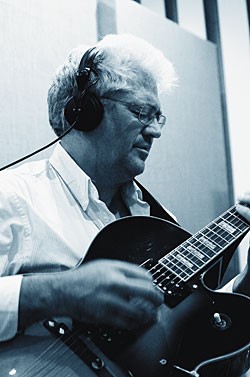
In the mid ’70s, the guitarist grabbed a Hagstrom Swede and formed the funky Eleventh House; later in the decade, Coryell could be heard playing lush artificial harmonics on Ovation roundbacks. But for the last 25 years, the guitarist largely returned to his straight-jazz roots, touring the globe, and recording steadily. A few years back, however, Larry Coryell revisited his fusion roots at a red-hot gig in LA. Today, that music is available as the CD Earthquake at the Avalon and it also features guitar work from his son, Julian, and, surprisingly, Los Lobos’ David Hidalgo.
Earthquake at the Avalon contains some pretty explosive guitar work.
The Earthquake gig was a retrospective of my early fusion work, which included vocals and strange originals. The gig was really a positive journey back into time to re-explore and recreate these early works. I knew David’s playing from Los Lobos, but I got the lowdown on how good he really was from my son Julian – they both live in LA. Julian told me David had some Hendrix in him, so that was more than good enough for me! The allotment of the guitar parts was organic; each guitarist quickly found where their role was located and everything flowed naturally from there.
What guitars did you use on the album?
I played a white Les Paul Standard that was originally mine, but had given to Julian. I also played Julian’s Hamer Daytona. But my favorite jazz guitar is still the Gibson Super 400.
Is your normal jazz rig different from the Earthquake setup?
My normal jazz rig is basically any decent tube or solidstate amp – the older the better – with little or no reverb. I used to use chorus and some digital delay, like when I played with [drummer] Lenny White and [bassist] Victor Bailey, but most recently I plug straight in and play with the most natural sound. I also like Henriksen Jazz Amps.
You were a big proponent of Hagstrom solidbodies and Ovation acoustics back in the ’70s.
You know, the Hagstrom came into my life around ’73 because my managers at that time made a deal with them. I kept the Swede for a long time, but about 12 years ago, I gave it to one of my students. I also liked Ovations back then, but now I’ve gone to all-wood acoustics. The Ovations were pretty durable, so they made good road guitars. I still have an Adamas in the back room, but I don’t play it. They make a great 12-string, but it’s really hard to play at my age.
Larry coryell – Earthquake at the Avalon
Do you have any vintage guitars?
If the Super 400 is a vintage guitar, then that’s it – I am not a collector. I always felt that the instrument itself is simply a piece of wood and metal. I do have a nice Rodriguez flamenco that was a gift from [jazz producer] Creed Taylor. It has a great sound, but it’s hard to keep in tune because of its wooden tuning pegs.
Looking back at the heady fusion days of the ’70s, what are your recollections?
The short answer is that fusion had a lot of good playing, some memorable compositions, and it helped the rock crowd come over to jazz. In my opinion, tunes that are original and somewhat complex, like Mike Mandel’s “Level One,” still hold up very well. If you want a complete answer about fusion, read my autobiography, Improvising: My Life in Music [published by Hal Leonard].
Who were your early guitar influences?
My early influences were Barney Kessel, Chuck Berry, Chet Atkins, Carlos Montoya, Johnny Smith, Chuck Wayne, Tal Farlow, and Wes Montgomery, as well as Charlie Byrd and Kenny Burrell. Later, there was B.B. King, Clapton, and Hendrix.
Who moves you now?
Anything that sounds good, and it can come from recognized players or newcomers – if the playing is good, I’m moved. I think John Scofield is a good player, as well as John Stowell, George Benson, and Bireli Lagrene.
In your opinion, where does classic “jazz guitar” stand in the 21st century?
Jazz guitar stands out in this century as an instrument that went from the background to the forefront. The evolution of the jazz guitar, beginning with Charlie Christian, transformed the humble Spanish instrument into a major force for connoisseurs of jazz. Much of the credit goes to disciples of Christian, like Barney Kessel, Herb Ellis, Jim Hall, Kenny Burrell, Wes and Tal – they’re the ones who got it going. Then Scofield, Metheny, and others came along and took it forward, keeping the jazz-guitar tradition intact, but attaching relevant new elements along the way. To me, you just can’t beat it.
This article originally appeared in VG‘s June 2009 issue. All copyrights are by the author and Vintage Guitar magazine. Unauthorized replication or use is strictly prohibited. Larry Coryell: A Retrospective [Slow Blues]
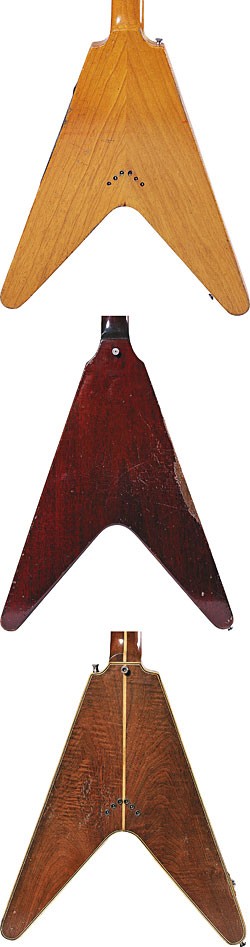
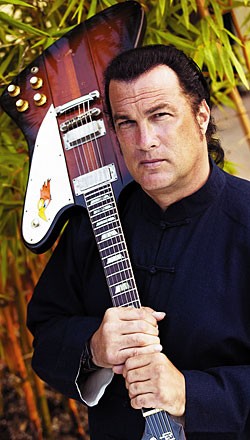
The ’59 Gibson Flying V made famous by Albert King (left), along with the “Lucy” guitar built by Dan Erlewine in the early 1970s, and the mid-’60s Flying V King played extensively after his ’59 V was lost. Photos by Rick Gould.
In a quiet, wooded canyon blissfully removed from the hustle and bustle of nearby Hollywood and the roar of Pacific Coast Highway, sits the very private retreat and Shangri-La of Steven Seagal, well-known movie actor, martial arts master, and dedicated blues-guitarist/fanatic. There, he recharges his creative and spiritual batteries between projects and career demands, surrounding himself with Asian and Eastern artifacts, in a tranquil setting that reflects his fusion of the Californian and Oriental.
There he also hosts cognoscenti on the occasional pilgrimage to what has grown into a veritable museum of blues guitar and arguably the finest collection of such instruments in the world. Alongside ornate inlaid Persian furniture, lustrous silk tapestries and serene wall hangings from the Far East are rows of vintage Marshall stacks and cases housing treasures of the Kings. No, not King Nebuchadnezzar nor kings of the Shang and Yin dynasties, these are guitar cases containing iconic instruments of the American blues Kings – Freddie, B.B., and Albert. Such is the eclectic and inclusive mosaic of Seagal’s multicultural world.
Seagal has attained admiration and notoriety among blues devotees for his custodianship of these classic American axes, previously owned by such legends as the Kings, Bo Diddley, Stevie Ray Vaughan, Buddy Guy, Howlin’ Wolf, Muddy Waters, and Jimi Hendrix. Unlike many of his self-absorbed film cohorts, he has put his money where his mouth is, taking the time, resources, and effort to rescue and restore countless gently weeping historic instruments.
On a recent visit by VG, Seagal, along with ZZ Top co-founder/guitarist and fellow blues-music historian/aficionado Billy F Gibbons, paid homage to three Flying Vs once played extensively by the great blues master Albert King. The two took turns strumming, inspecting, and discussing the guitars, which are now part of Seagal’s amazing collection.
Billy F Gibbons: These guitars are so important; they represent what came out of Albert with his hands. Look at the beauty of these keys; they have not deteriorated. I think anyone lucky enough to play the Gibson Flying V from the late 1950s would concur that it is not only one of the most exotic instruments, but came from the zenith of Gibson’s manufacturing expertise.
Steven Seagal: I hope seeing them will bring some joy to blues aficionados and people who revere these guitars like we do. These guitars tell a story. When you pick them up, they almost play themselves. They have so much spirit in them; the Gibson korina and the Erlewine particularly have a lot of mojo.
Check out the body, where Albert made an impression into the top with the pressure of his hand. BFG: My God!
SS: Yes, as you can see, Albert almost wore a hole in solid wood from playing it so much.
BFG: Out of curiosity, where did this one surface?
SS: There’s a rumor that Albert lost it in a craps game in the late ’60s. Whether at the game itself or as a debt he paid later, this guitar went for $2,500. The person who bought it was supposed to hang on to it – he promised never to sell it. So it disappeared for more than 20 years, hidden in Memphis. But I knew who had it, and found him. I’ve kept it quiet for many years; not many have seen it.
BFG: Languishing all these years in Memphis…
SS: Yeah. I think it is the most important blues guitar in the world, period, and it’s the best-sounding V around – a voice from another planet. It has the most amazing tone and it has all of Albert’s energy in it. It’s one of my greatest treasures. I have Stevie Ray Vaughan’s Firebird with the personally carved names of Stevie, Albert King, and Muddy Waters, but this one is much more important.
I’ve played it through a late-’60s plexi 100-watt with a 30-watt slant cab in bigger shows and through a 100-watt Fender tweed Twin, which is what I’m using now. When you take two or four of those Twins and play this through them… it screams, but it has beautiful harmonics and unbelievable tone.
What do you think Albert played it through when he recorded? SS: He used the crappiest amps, didn’t he? Solidstate Acoustic amps… and later, a Roland Jazz Chorus – another solidstate amp.
BFG: I couldn’t say what Albert used in the studio. Live, he used this tall Acoustic amp when I saw him, and later added a Maestro chorus pedal to it. I remember he had a proper flight case for his guitar and he would set the case in front of the amp on stage. When he wanted it louder he moved the case, like it was a baffle.
SS: I don’t know about what he used in the studio, either. But I do know with him it’s not about the amp – whether it was solidstate or tubes – it’s about the player; it’s the way he used his fingers and the way he squeezed the tone out of his guitars.
There’s a rumor Albert recorded with a small tweed amp, like Steve Cropper’s Fender Harvard. Any thoughts? BFG: Could be, I’ve got Steve’s Harvard amp and his old Tele. Cropper scratched his address into that guitar (laughs)!
One thing that stands out in my mind is not only was Albert a great soloist as a blues guitarist – he certainly did the statement – but his singing was so appealing.
SS: Friendly, warm.
BFG: The high point was when he got together with the Memphis Horns and… was it Booker T & the MGs in the rhythm section?
SS: Yeah, all Memphis cats.
Steve Cropper… SS: …Steve Cropper, David Porter, “Duck” Dunn, all of them…
BFG: “Born Under a Bad Sign” from 1967 – the sound was amazing. I was at Kiva, I think, when they were recording. We were talking during a break and I made a remark about how rich the Stax sound was. Over the years, many people have wondered about that sound because the records had such a cohesive quality. I asked them, “Was there some thought that went into designing that sound? Was it a planned thing?” Albert laughed and said, “Tell him, Steve.” Cropper asked if I’d ever been to the Stax studio in South Memphis. I told him, “Not if I could help it.” It was in an old movie theatre in the worst part of town – dangerous country, as bad it gets. It turns out they had so many break-ins that they finally bolted the amps to the concrete floor. They also bolted down the mic stands, the drums, anything else that could be stolen. As a result, nothing was ever moved and the sound didn’t change. They wouldn’t even let the cleaning people move anything around.
Here’s Albert’s 1966 Gibson Flying V. BFG: Another example of a fine-playing instrument; most Gibson guitars from this year are still excellent. They seem to have maintained a standard of quality longer down the line, compared to Fenders after the CBS takeover in 1965.
SS: I think Gibson gave this to him. He’d already lost his original korina V and he replaced her with this ’66. Albert wrote and recorded a bunch of famous songs – like “Born Under a Bad Sign” – with it in the late-’60s Stax period.
Do you think Albert was drawn to the Flying V for a reason? SS: He made it famous, I’ll tell you that.
But why not the conventional blues guitar route – an archtop like T-Bone, a semi-hollow like B.B., or a Strat? SS: He was an entertainer, man! There was the visual side.
BFG: It was about style, you know? The V was not a popular instrument at the time, but for so many players it’s something to stand behind because it was such an odd…
… Striking? BFG: …Yeah, a striking instrument. Mine is a ’58; was Albert’s earlier?
SS: Its [serial number is 1959] but some of the parts are from the early ’60s. I believe Gibson gave that guitar to Albert around 1962.
What guitar was Albert playing before the V? Anyone know? BFG: I don’t think he did play another. I think he went straight from the drum set to the V – just started twanging. The V might have stimulated his interested, got him curious. He probably said, “I’m going to stand behind this thing.” I don’t know a lot about his early work; I have some old singles like “Let’s Have a Natural Ball.” But he has been well-documented and only after he’s dead and gone does everyone make much of what he did.
SS: Speaking of dead and gone, toward the end, Albert wasn’t feeling well. The last time I saw him he didn’t look good at all; his eyes were swollen and his face was puffy. He had a heart attack and asked a girl to drive him to the hospital. So she drove him. Well, you know how Albert had all those nice rings and stuff. This girl was so concerned about his gold and jewelry that she drove him to the parking lot, stole his jewelry, and left him to die in the car. All she had to do was drive to the front door, to the emergency room, and he’d probably be here with us now.
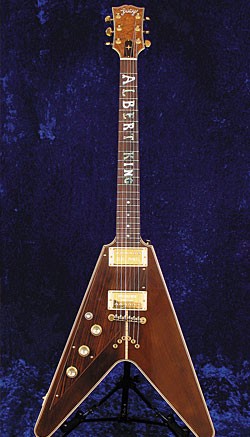
Talk about the Dan Erlewine-made V… SS: I’ve had it about eight years; I bought all three roughly within the same period of time. The Dan Erlewine V is made of black walnut, but it has [a maple strip down the middle]; it’s called Lucy. I think he called the earlier one “Lucy Blue.” Albert played shows all over the world with this guitar; he did interviews with it and about it. He claimed it was the guitar of his life, but I think that’s because the korina was gone.
There’s a spooky story attached to this guitar. I’ll let Peter (Seagal’s friend and guitar repairman) tell it. He worked on the guitar for a while.
Peter Skaltsis: This guitar was at my house for quite some time while I was working on it. I was downstairs in my shop when my younger son – he was seven at the time – came in crying; he was really scared. He said, “There’s a black man sitting on the sofa – a big black man.” I ran upstairs thinking someone had broken in, but when I got there no one was in the room. I still get goose bumps talking about this. I called Steven and he said…
SS: Show the boy a picture of Albert King and ask him if that was who he saw. He said, “Yes, that’s who I saw… God’s honest truth.”
BFG: Wow… When you’re seven you wouldn’t make up something like that. I don’t know, man… these instruments are imbued with the power of the player.
…Especially a power as strong as Albert’s. BFG: He was pounding it into the guitar.
SS: Albert loved this guitar.
BFG: He did; he played it religiously. This guitar is a little better known and is associated immediately with Albert.
Because of his later work with it? SS: Yeah, he just played it everywhere… to the end of his life. That’s the last guitar he played. I think the one you gave him, Billy, wasn’t played very much. BFG: Yeah, I don’t think so. I’ve only seen one or two photos of him with that V.
Albert wasn’t one to have spare guitars; he played one guitar the whole night. With all that string bending did you ever see him break a string? SS: I never did.
BFG: No, I didn’t either. And he did those two-string bends, man… (sings an imitation of Albert’s bends).
That technique was heavily imitated – especially by Stevie Ray Vaughan. SS: Stevie copied a lot of his stuff.
BFG: Albert was upside down on the guitar (strung like a right-handed guitar, played left-handed) and it’s not easy to do that and be technically correct.
And he was in an alternate tuning… BFG: Because of that unorthodox style, a lot of stuff came out of his hands that is otherwise not possible; Jimi Hendrix, same thing.
One show, in 1972, I think, had Albert and B.B. I was asked to stand in for the guitarist in the opening band, which I knew quite well. It was a chance to play with Albert and B.B. I was warming up backstage and Albert came up to me. I think I had a Fender Telecaster at the time. I had it strung with the heaviest strings, thinking a bluesman played the heaviest strings you could find. Albert asked to play my guitar. He had it upside-down and played a little bit. Then he asked, “Why are you using these strings?” I told him because I wanted to have that bluesy sound. He said, “Why are you working so hard? Get something light!” (laughs)
What the old blues guys did before light strings were available was buy a set of Gibson Mono-Steel or Black Diamond strings. They’d get rid of the sixth string, then move every string over one and use a banjo string on top.
At the end of his career Albert went pretty quickly; he was active until just a short time before he died.
SS: That’s right. He just started feeling bad and said, “I’m thinking about retiring.” Then he went.
BFG: He had a going-away party one Friday night in West Memphis at a little funky joint. He said, “Ladies and gentlemen, this is it – a going-away party for me, Albert King; I’m gonna pull it to the curb.” It was a warm moment. We were talking with him during a break and he told us, “Don’t miss tomorrow night, I’m gonna make a comeback.” Okay (laughs)! SS: That sounds like Albert.
BFG: He was loved by so many. There’s a little barbeque joint, the Rendezvous, in an alley off Union Street near the Peabody in Memphis; it’s run by Nick Vergos and his dad. The police and Albert King always ate there at no charge. But brother, he could pile on the ribs.
SS: He was a rib-eating mother…
BFG: You didn’t want to get in the way of his knife and fork. He didn’t like paparazzi, especially when he was eating. There was a photographer who traveled the nightclub circuit; made his living with Polaroid shots – souvenirs – selling them for five bucks. You’d find him on Beale Street; he’d pop up anywhere, everywhere. Anyway, he tried to take a shot of Albert one time without asking and Albert did not want to be bothered…
SS: I know, I saw Albert get in someone’s face about that. And he always carried a pistol; you might not have seen it but I’ve seen him take it out, a little black one that he wore on his right hip.
It seems everyone who knew him had a memorable Albert King story to share. BFG: On the way over it occurred to me… just a fond recollection of Albert: My girlfriend, Christine, organized a surprise birthday party for me… I was living in Memphis at the time. And the big surprise was when I came into the room, she had gathered our close friends and whatnot, and there was Albert sitting at the piano. She had rented this big room at the Peabody, and we just had a grand time.
You know, with everyone who has an Albert story, you can bet it’s a good one and generally uplifting, although they may have a different take on it. SS: We all loved Albert, but we knew him to be a fierce guy, a big guy with a bad temper; he could be very cantankerous. And he was also very charming; he had a lot of personality and a great sense of humor.
BFG:Talk about stories, until recently I didn’t realize that Albert King started as a drummer.
SS: That’s right.
BFG: What band was he in?
SS: I don’t know, but when I was playing with Elmore James’ cousin, Homesick James, he was telling me, “Yeah, Albert King used to play drums for me.”
He also played drums with Jimmy Reed and John Brim. BFG: Oh, yeah. And I think Albert either went by the name of T-99 or there was a nightclub called The T-99. He had, back in the ’50s, a brand new Buick. What was the fancy car of the line, the Buick Special, the Delta 88 or something? Albert had these air horns mounted to the front fender – giant, three-foot long trumpet air horns from a truck. Years later, our buddy who owned the Peabody – Gary Bells…
SS: …Right, Jack and Gary Bells.
BFG: …Gary bought the Bar Kays’ recording studio, revamped it and renamed it Kiva recording services. And as that was coming together, he became Albert’s manager. SS: …did for a while, yeah.
BFG: I remember when the studio was finally completed, Gary asked me to come over and check it out. And it was very impressive. They had taken what had crumbled into a ramshackle structure and really put it together nicely. Albert was sitting in the office and just prior to this, someone had shown me a picture of his Buick with the big trumpet air horns on it. I brought it up to him and he laughed. Well, two or three days went by and we were walking down Beale Street. About a block ahead of us was Albert, who stepped out of a building; he saw us coming up and motioned to us to come over. He said, “C’mon, I want to show you something.” He had just bought a brand new Chevy Suburban and it was parked in the back of the building. So we walked through and came out back. He said, “Yeah, I got me a new car. Beautiful, big, brand new Suburban.” And he had those same truck air horns on the front. Albert said, “I remember you telling me, and that reminded me.” He said, “I knew there was something missing!” (laughs)
Another friend of ours, Tony, his parents owned the distribution agency for Taylor frozen-drink machines; daiquiris, margaritas, frozen ice cream, if it was cold and slushy, this was the machine. Anyway, they had the distribution through Tennessee, Mississippi, Alabama, and later New Orleans, which was just amazing… can you sell a frozen drink in New Orleans?
SS: Daiquiris on every corner!
BFG: The Taylor company developed a frozen-drink machine and was forcing all their distributors to buy 50 of these machines. Well, it turns out they had a design flaw and the product kept freezing; you couldn’t get anything out of them. Tony found a guy – an old black gentleman – who had a way to fix the machines, bought all of them from his dad – who thought he was crazy – and managed to secure a storefront on Beale Street. That was right across from the old Daisy Theater – great location in the sweet part of the East Side just when it was first getting popular. Anyway, we were visiting him on the way to Vegas, walking up to the daiquiri shop when we saw Albert – he had just come out of Tony’s shop and was standing on the corner. He had a big cone of soft ice cream, wearing denim bib overalls with a black-and-white checkered sport coat, and brown patent leather shoes in like size 100 (laughs)! He was eating ice cream and smoking a pipe at the same time.
You know, there’s Freddie King, B.B. King and Albert King, with them you couldn’t go wrong. All of them are stunning players. Being a fan of the way Albert played, it was something to find he started on drums. He was left-handed, so everything was backward, but it didn’t stop him and he developed a style that was so personality perfect.
SS: The way he bent notes is something nobody else has done; he did it better than anybody.
Anyone who bends those wide intervals is alluding to Albert in one form or another. SS: Like bending those huge steps between notes.
BFG: And he was so entertaining. When you went to see him play, you’d always have a good time because he liked to have a good time. Albert turned every small juke joint appearance into an event.
Steven Seagal
Seagal’s New Blues
Steven Seagal has never been one to rest on his laurels. Deluged with demands to make action movies and personal appearances, Seagal invariably has a music project in the works.
His latest recording venture finds him reappraising the classic blues he holds dear to his heart. For those not familiar with his playing or previous releases, it’s well worth investigating Seagal’s spin on the form. Though in initial stages of production, the concept behind his current project is compelling, portending a record that could resonate with even the most implacable listeners.
Is there a theme to your new project?
It’s influenced by hill-country music. There was a time in the history of the blues, even in the Delta, when they had what was called “hill-country music.” It was black people who only knew the blues mingling with whites that only knew bluegrass. They listened to and were influenced by each other. I don’t know how much was recorded, but as a child growing up in Louisiana, I got to hear a lot of it; it was just something people played. I think R.L. Burnside was doing some.
In terms of instrumentation, I’m bringing in some real bad boys, as well as legends out of Nashville. I’m using fiddle, mandolin, and banjo mixed with traditional blues instruments. I’ve had the idea for a long time, marrying hill-country bluegrass with Delta and Louisiana blues; it’s very moving with great grooves, feel, and soul. It represents an overlooked piece of history.
Is the music electric-based?
Yes. We start as electric blues, then add the flavor of mountain instruments; it’s kind of a fusion of country and old blues with electric sounds.
What stage is the music in currently?
Right now I just have a trio. I wrote all the songs and laid the guitar down, as well as bass and drums. I recorded those in Memphis. I lived there and worked at Papa Mitchell’s studio; he’s a dear friend and helped me capture the real vibe. Then I came to L.A., where I brought in Vinnie Colaiuta and Abe Laboriel to do the drums and the bass. They played over my parts. And I brought David Lindley in to play some slide guitar. I had very specific ideas about what I wanted, and they gave it to me. And then I added some Nashville cats playing fiddle, mandolin, and banjo. The music is in its basic form – rough mixes of rhythm tracks without vocals and without solos. I plan to play a lot of solos, have some surprise guests, and get some church girls from Memphis to put a gospel feel in there.
I hope to have the album finished and out in time to be submitted to the Grammys in the Blues category. Like my last album, which had Robert Lockwood Jr., Koko Taylor, members of the Muddy Waters band, and others – these were legends and this was the last thing they played on – I’m doing this for them and the music, not myself.
What guitars are you playing on the tracks so far?
So far, I’ve used a Fender Broadcaster, an early-’50s Strat, and a Gibson Firebird, all vintage. – Wolf Marshall
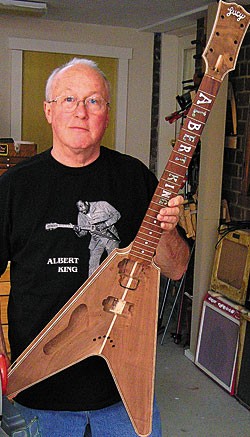
Dan Erlewine in his shop with an “under construction” Lucy.
A Lucy guitar built by Erlewine in 2006.
Dan E. And Lucy building a guitar fit for a king
In the fall of 1970, Albert King played the Ann Arbor Blues Festival in Michigan. Among the thousands of spectators at the event was Dan Erlewine, an Ann Arbor “townie,” guitar repairman, aspiring blues guitarist, and for that weekend, a stagehand.
“When Albert played, I was supposed to be his backup guitarist,” Erlewine recalled. “But I chickened out, big-time, and my friend, Pat O’Daugherty, took my place. Those familiar with King know he was at the height of his power and playing at that time, and it truly was like being in the presence of a king!”
The next fall, King returned to Ann Arbor to play the Canterbury Coffeehouse. There, Erlewine approached him about building a true left-handed V.
“I told him I had 125-year-old black walnut I bought in 1965,” he said. “In true hippie – and probably inappropriate – fashion, I described the wood as being ‘the same color as your skin.’ Of course, I meant that as a compliment, which Albert must have realized, because he came to my shop the next day to have me measure the original Lucy – his ’59 Gibson Flying V.”
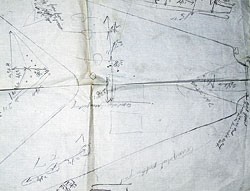
Looking at it now, Erlewine’s “blueprint” looks like little more than a tracing on graph paper with scribbled notes and measurements. But it was the seed that eventually spawned one of King’s most beloved guitars. We talked with him about the guitar and the experience.
What sort of notes did you make on the guitar?
Stuff like “flat-wound G string,” “Black-Diamond ‘Silver’ strings,” and “D, G, D, G, B, E tuning.” Unbeknownst to me until that time, Albert didn’t use standard tuning. He tuned a whole step low, plus he tuned the low E and A strings another whole step, producing C, F, C, F, A, D. However, either Albert was not tuned a whole step low that day or I was confused, because I notated his tuning as D, G, D, G, B, E which reflects a step higher.
Did Albert ask for any specific custom touches?
Oh, yes. He wanted his name inlaid in the fretboard, and wanted “Lucy” inlaid on the peghead. Sorting through my stash of pearl, he selected white pearl and abalone – abalone for position markers at the third, fifth, seventh, ninth, and 12th frets, so he could see them under stage lights.
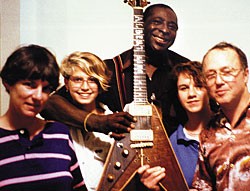
Joan Erlewine, Ellen Gagliano, Albert King (with Lucy), Meredith Erlewine, and Dan Erlewine in 1989.
Erlewine’s “blueprint” tracing and notes on Albert King’s ’59 V.
How long did the build take?
I delivered Lucy the following spring, in May, 1972. Other than on record album covers, I never saw the guitar (or Albert) again until 1989, when he sent her to me in Athens, Ohio – via Greyhound bus – for fret work and fine-tuning. When I picked her up at the bus station, she was in her case, but not packed in a box; the case was simply tied inside a jute onion bag that you could see right through – tags, venue-stickers, and even his name and address visible through the large mesh for any guitar-knowing thief to see.
What sort of condition was it in?
Well, it had been worked on at least twice. My cousin, Mark Erlewine, who lives in Texas, had re-fretted it in the late ’70s or very early ’80s. And in the mid/late ’80s, Albert’s equipment-trailer was tossed into a creek by a tornado and Lucy spent 24 hours underwater, where a lot of her joints came unglued. She was respectfully repaired by Rick Hancock in Memphis.
Anyway, I turned Lucy around that weekend and got her right back on the bus. About a year later, Albert played a blues club in Columbus, and I went to hear him with my wife, Joan, daughter, Meredith, and her girlfriend, Ellen. Albert was playing Lucy, and at show’s end he asked us to stand and take a bow, then invited us backstage.
And then you went another long stretch without seeing it, right?
Yes. In 2004 – 33 years after I built it – I was asked to make a replica for Teddy, a guitarist from Norway. He was pleasantly surprised to learn that I still had the black walnut, having hauled it from town to town, home to home, and shop to shop since 1965. I had built a few guitars from it, all at the same time as Albert’s, including a Les Paul-style for a friend, and two Strat copies – one for Jerry Garcia and one for Otis Rush. But by then I was so involved with repairing guitars that I didn’t have time to build, except for an occasional custom order. But I never built another V. And I didn’t use the walnut again because I planned on building furniture with it. Before I knew it, 30 years had passed!
So Teddy picked up the guitar in the spring of ’05. Then, later that year I was contacted by a left-handed player, a young woman named Alicia, who wanted a true-lefty, like Albert’s. About that time – just as unexpected as the calls from Teddy and Alicia – I got a call from Steven Seagal, who told me he’d acquired Lucy, and wanted me to give her a physical. I’d watched a number of his movies, but didn’t know he was a serious blues guitarist. His friend and guitar tech, Peter Skaltsis, delivered Lucy to me.
What was it like, having it back in the shop?
It was a cool vibe having it at the same time I was building the new left-handed one. It even inspired me to start making one for myself – another true lefty, even though I’m a righty and probably won’t be able to play it.
So, have you changed your mind about building Lucy copies with the rest of the black walnut?
Oddly enough, about four years ago I pulled it out and cut it into enough to make a run of 20 of them. But to date, I’ve only made three – two righties, one lefty. The one I’ve been working on for two years now is a lefty. – Ward Meeker
This article originally appeared in VG‘s June 2009 issue. All copyrights are by the author and Vintage Guitar magazine. Unauthorized replication or use is strictly prohibited.
Albert King – “As The Years Go Passing By” Live Sweden 19
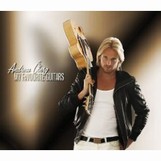
If you were to judge this disc by its cover, you might think something was fishy; a handsome Swedish guy with a leather jacket and t-shirt, guitar thrown over his shoulder… Yeah, right! But push “Play” and skepticism makes a quick exit.
Despite its title, öberg is actually paying tribute to his favorite guitarists. With covers of tunes by Django Reinhardt, Toninho Horta, Pat Martino, Wes Montgomery, George Benson, and Pat Metheny, there’s a lot of song titles familiar to anyone who knows the jazz library.
öberg plays with a fire that cannot be denied and chops beyond question. Pat Martino’s “Uptown Down” makes the point; just when you’ve been able to catch your breath after the incredible single-line work, he puts together truly amazing slurred and blurred chord runs, while retaining a soulful vibe. He proves up to the task on cuts like Montgomery’s “The Trick Bag” where he and the rhythm section glide through the classic. He shows a special affinity for Benson on “The Changing World,” a sparse jazz tune with great changes, and a cover of Benson’s cover of Donny Hathaway’s “Valdez in the Country.”
One notable downer here is the keyboards, used to simulate horn sections and in other ways that seem a bit forced. One can imagine öberg backed by a killer rhythm section. Hopefully that’s how we’ll find him next time.
This article originally appeared in VG‘s Nov. ’08 issue. All copyrights are by the author and Vintage Guitar magazine. Unauthorized replication or use is strictly prohibited.
The Massachusetts-based guitarfetish.com is an instrument/parts importer that carries a complete line of goods, from pickups and vibratos to knobs and pots.
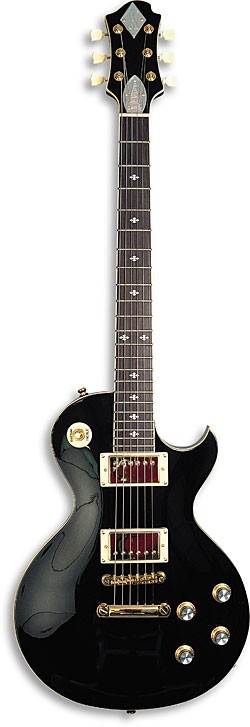
Its guitar line, dubbed “Xaviere,” consists of 11 single-cutaway solidbody guitars (the XV 500/700 line) and three thinline semi-hollowbodies. The solidbodies range in price from $300 to about $1,150, with the primary difference being the finish; at the entry level are opaque finishes with sparkle, while the upper crust gets you a pearl/abalone top. In-between are various sunbursts finishes on quilt- or flame-maple tops.
The XV solids have a distinct Gibson Les Paul/Zemaitis influence in terms of design and aesthetic, while the semi-hollows recall Gibson’s vaunted ES-335, with 11?2″-thick double-cut bodies.
One of the reasons we were motivated to order a Xaviere was the lofty verbage on the website that captured our technically-trained eye. “Each Xaviere guitar is meticulously set up by our pros…”it says, adding how the guitars have, “the kind of tone, sustain, and balls hard to obtain in a $2,000 instrument.”
After reading that, we just had to get our hands on one, and we opted for the entry-level XV 700.
Unwrapping the guitar, we were immediately struck with a couple of cosmetic elements, the first being the very funky metalflake finish. Not your run-of-the-mill metalflake with nearly-microscopic flakes in the finish, the Xaviere’s large copper-colored flakes give the finish remarkable depth. And as advertised, the guitar weighs in at just over seven pounds. The neck has a comfortable slim-taper profile, and the nicely polished/dressed frets make for a bump-free ride up and down the neck. The plastic nut is fitted nicely and cut with proper string radius – an oft-overlooked detail on import guitars, and one that can really affect feel and playability.
The 700 did indeed arrive set up well, with fairly low action and no fret buzz to speak of. The neck was straight and level, and the overall feel was fairly slinky and fast, due to its .010-.046-gauge strings and 241/2″ scale length. The body’s thin profile and set neck allow for excellent access all the way to the 22nd fret. Fit and finish are also good, with only a few minor issues, i.e. a bit of paint bleeding into the binding and the treble pickup ring didn’t sit flush on the body.
The guitar has gold-plated hardware, including the stop tailpiece, tune-o-matic-style bridge, strap buttons, Kluson-style tuners with plastic buttons, football-shaped jackplate, and pickup covers. The only hardware not finished in gold is the stamped aluminum truss rod cover and a stamped-aluminum badge on the headstock, which both tie in with the aluminum reflector caps on the knobs. The dual covered GFS alnico-magnet humbuckers have individual Volume and Tone controls with gold reflector-cap knobs, individual push/pull coil splitters, and a traditional three-way pickup selector toggle, all in a traditional layout.
We plugged the XV-700 into a tube-driven Crate head and Celestion-loaded 4×12″ cabinet. With the overdrive channel’s Gain control set just past halfway, we got a pretty respectable crunchy overdrive with tight low-end response and just enough bark in the midrange to make it interesting. It’s not quite as beefy as, say, a Les Paul or PRS, but it’s solid. The pickups have plenty of midrange definition and never got mushy, unless you really pile on the gain, and even then we experienced no uncontrollable squealing or feedback.
The coil splitters add a lot of versatility to the XV’s clean tone. If the humbuckers seem a bit dark-sounding, especially for your clean tone, you can simply yank one of the push/pull pots to add some single-coil sparkle.
Our experience with the Xaviere XV 700 was very pleasant. The guitar lived up to – and in some cases exceeded – our expectations, and the claims on the company’s website. It’s an instrument packed with features, it plays effortlessly, and is an outstanding value.
Xaviere XV 700 Thinline Features Mahogany body, carved top, set mahogany neck with bound rosewood fretboard, GFS Alnico-magnet humbuckers, push/pull coil tap on each pickup, gold-plated hardware, bound top, neck, and headstock. Price $299. Contact Guitarfetish, 2 Watson Place, Framingham MA 01701;
www.guitarfetish.com.
This article originally appeared in VG‘s Jan. ’06 issue. All copyrights are by the author and Vintage Guitar magazine. Unauthorized replication or use is strictly prohibited.
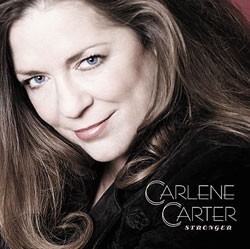
John McFee isn’t a household name in music, but he has been a major player for more than 35 years. But his attitude (“I never really wanted to be famous. I just wanted to make some good music.”) has guided him through career stops with several high-profile bands, as well as work as a producer, including on Carlene Carter’s new album, Stronger.
“I was in her band before I joined the Doobie Brothers,” McFee said. “I got a call, and she’d done an album in Nashville, but thought it needed work and asked if I’d be interested in helping fix it. I was flattered. And I started out trying to make things work to Carlene’s taste, but reached a point where I said, ‘You know, I think this would work better if I just started from scratch.’ It’s hard to come in on something somebody else has done.”
Scheduling conflicts forced McFee to play most of the instruments and record in hotel rooms and his own studio.
While most might think of McFee as a rock-and-roll guy, his main influence is country music. “California was a real hotbed of country music when I was growing up there,” he said. “My dad had a banjo, guitar, and ukulele, and I started playing so young I don’t really remember not playing!”
As a teen, he recorded instrumentation for commercials, and played in bands. Shortly after graduation he hooked up with a band that would become Clover. “We were the band always on the threshold of the verge of the start of the beginning of the inception of the happening,” he laughs. But the closest they came to “making it” was working behind Elvis Costello on his debut, My Aim Is True; that’s McFee’s lead on “Alison.”
The band had moved to England after hearing how English musicians liked their two records, which had stiffed in the U.S. They did two more in the U.K. before getting stuck in an acrimonious situation with two managers. “It was about that time my son was born,” he added. “So I also had that responsibility.”
Shortly after, he went to work for Carlene Carter and Norton Buffalo. Then, the Doobie Brothers gig surfaced; he was a personal friend of Doobies drummer Keith Knudsen. So McFee replaced Jeff Baxter, playing guitar, steel, and other instruments. Unfortunately, the band cut just one record, One Step Closer. “I think the guys were burnt out. They were always either on the road or in the studio, and needed a break. I remember reading articles about animosity and fighting, but it was nothing like that.”
John McFee served as producer on Carlene Carter’s new album, Stronger.
McFee soon scored another gig, anchoring the country band Southern Pacific. “It started as a group of us doing country sessions. The original lineup actually had James Burton on guitar, me on pedal steel and fiddle, Jerry Scheff on bass, Glen D. Hardin on keyboards, Tim Goodman on vocals, and Keith on drums.” After a label bidding war for some music they’d made, the makeup changed. “James left. I think he just felt more comfortable not starting a new group, but playing with established artists. Albert L ee stepped in briefly. That was cool, but by the time we got around to making the records, I was covering the guitar.
For McFee, Fender guitars offer the highest comfort level. “I’ve had a Tele since I was 12 or 13, and to me, Strats are really one of the best, if not the best electric guitar ever. That said, I love my Parker Fly Deluxe. And on the Carlene record I did all the electric guitar parts with a Line 6 Variax.” That embrace of technology may surprise some, as could McFee’s mode of amplification “I use the Variax through a Pod XT. I haven’t used amplifiers onstage for, I don’t know… about 15 years. I’m a traditionalist as a player, but in terms of equipment, I’ve never liked things loud, so it’s great for me to have an in-ear monitor. It works out well for the sound man and I honestly would love to challenge people to tell me if it’s what they call a ‘real’ amp or the other.”
These days, McFee does sessions and about 80 dates a year with the Doobie Brothers. Why hasn’t he done a solo record? “I’ve thought about it and been asked, but honestly I think I’m just kind of scared. Otherwise, I would have done it by now. I really do feel I have to do it at some point, probably sooner than later.”
This article originally appeared in VG‘s August 2009 issue. All copyrights are by the author and Vintage Guitar magazine. Unauthorized replication or use is strictly prohibited. Reno Bound – Southern Pacific
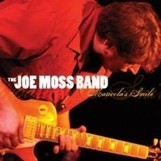
Joe Moss is a veteran bluesman who expands the palette a bit here. The 13 cuts are not standard three-chord fare, and various other forms of music are sprinkled into the mix.
“Suburban Glory” starts as a funk rocker but uses jazzy changes on the bridge before Moss wraps it up with a big wah solo. “Green Eyes” is a somewhat jazzy march and gives Moss a chance to show off his B.B. King-influenced solo chops. The title cut is a ballad with jazz changes that does the same. Soul music never seems far from the music either on cuts like “I Am Feeling You” with its after-hours feel and clever changes; Moss provides a soulful solo full of pinched notes that fit perfectly.
While most of this album leans toward jazz, soul, and blues, Moss covers an underrated rock classic in Free’s “Fire and Water.” And he more than does it justice, with a biting tone and fat solo. The record also features one live cut, and it’s a doozy. Clocking in at over 17 minutes, “Ain’t Got No Money” gives the band a chance to stretch. James Brown-style funk gives way to a jazzy feel before Moss brings it back together with several solos.
Moss may not be a great singer, but his affinity for this style of music is more than adequate. It’s good to hear him expand a bit.
This article originally appeared in VG‘s Jul. ’08 issue. All copyrights are by the author and Vintage Guitar magazine. Unauthorized replication or use is strictly prohibited.
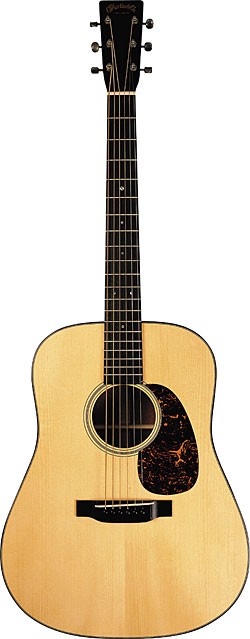
Martin D-18 1937 Authentic – Solid Adirondack red spruce top, solid mahogany back and sides, solid mahogany neck, ebony fretboard, ca. 1937 abalone fret markers, 5/16″ Adirondack spruce braces, period-correct bracing placement, hide-glue construction throughout, Gotoh SD-770 nickel-finished open-back tuners.
The first thing that catches your eye as you open the case of Martin’s D-18 1937 Authentic is the guitar’s unmistakable vintage vibe.
Whether you’re drawn to the nickel-finished open-back Gotoh tuners, the tinted Adirondack red spruce top, or the cellulose tortoiseshell pickguard, you kind of feel like you just discovered a guitar that had been hidden in a closet.
The key to the 1937 Authentic’s “authentic” pre-war vibe is in those details and others, like ebony bridge pins and the lack of an interior label. But it’s also in the more overt structural elements, like the neck shape, 5/16″ bracing, bracing patterns, nonadjustable T-bar truss rod, and the hide glue used to hold it all together.
The 1937 Authentic shares most other features with Martin’s D-18 Golden Era, including solid mahogany back and sides, fossilized ivory nut, vintage-style bridge (with long saddle) and 14 frets clear of the body.
In terms of playability and tone, it takes exactly one strum (we played an open E chord) on the D-18 to realize it’s a flatpicker’s dream, with big, clear, well-defined bass, snappy highs, and balanced mids. The entire guitar resonates noticeably; the low E and A strings have a clear punch, while the high E and B strings have a sizzling bite that really rings. Even when we upped our picking attack, note clarity never suffered, whether we were playing open or barred chords.
We invited a few accomplished local flatpickers to take the D-18 for a test run, and in the hands of one true bluegrass junkie, the tones never faltered. And even when we put some distance between ourselves and the guitar, it proffered excellent, balanced sound with clear bass and very good projection.
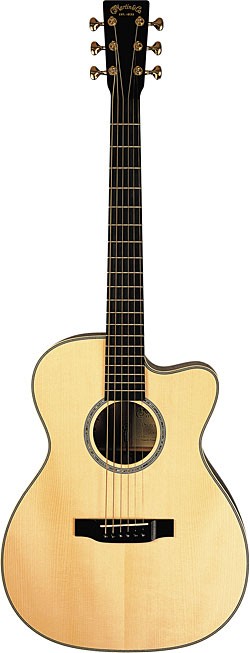
Martin OMC-1 Fingerstyle – Solid Adirondack red spruce top, solid Spanish cedar back and sides, solid Spanish cedar neck, ebony fretboard, 0000-style hybrid body with a Venetian cutaway, compensated Tusq saddle, ebony nut, herringbone inlay, Gotoh tuners, Fishman Ellipse electronics with condenser mic.
Also fresh from Martin is the OMC-1 Fingerstyle guitar, which features a 000-14 body with hybrid bracing, a Venetian cutaway, solid Adirondack red spruce top, solid Spanish cedar sides, back, and neck, as well as an ebony fretboard and nut.
The OMC also employs Martin’s new two-way adjustable truss rod, herringbone and pearl trim, gold Gotoh SGL510 tuners, 16″-radius compensated Tusq saddle, and Fishman’s Ellipse Blend electronics, which uses a combination of under-saddle transducer and internal condenser mic that’s controlled at the rim of the soundhole. The unit features Volume, Blend, and Phase controls, as well as a trim pot for the mic.
The design of the OMC-1 is aimed at the fingerstyle player, with an emphasis on clarity. The smaller body of the OMC aids in its being very lightweight and resonant, while the Spanish cedar back and sides, in combination with the 000 body and spruce top, create strong midrange tones and articulation without sacrificing low-end. We got flatpick-type clarity and definition using only our fingertips! And, as we’d previously experienced with the Fishman Ellipse, the one aboard the OMC-1 performed very nicely. With the mic blended about one-third and the transducer at two-thirds, we achieved accurate acoustic tones with good clarity and a round, full sound. The condenser mic really adds the roundness you typically lose with an under-saddle system alone. Feedback wasn’t a major problem, given the smaller body and quality of the condenser element, and the ability to trim back the mic and rely on the saddle pickup for the bulk of the output. Of course, the electronics can only reproduce what is produced, and Martins choice of Spanish cedar for the OMC provides the key to balancing the sound, especially for fingerstyle playing.
The Martin D-18 1937 Authentic and OMC-1 Fingerstyle boast flawless fit, finish, and craftsmanship, as well as excellent playability. Every detail is addressed in fabulous fashion, including inlay, seam and joint work, and the high-gloss finishes. To most players, either one represents a significant investment, but given their sound, playability, and all-around vibe, both rate very high in the “get what you pay for” category.
Martin D-18 1937 Authentic Price $7,999.
Martin OMC-1 Fingerstyle Price $3,799. Contact Martin & Company, 510 Sycamore St., Nazareth, PA 18064; phone (513) 451-1071; martinguitar.com.
This article originally appeared in VG‘s December 2005 issue. All copyrights are by the author and Vintage Guitar magazine. Unauthorized replication or use is strictly prohibited.
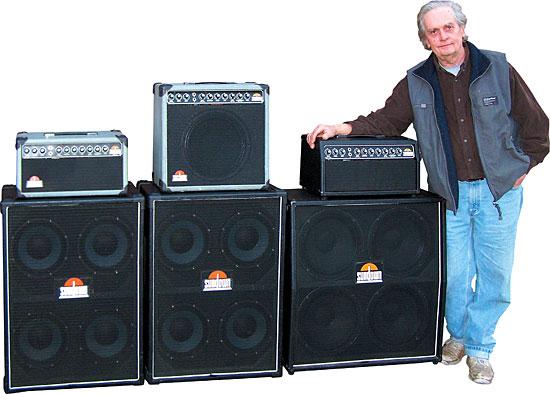
Kager with some Sundown amps. Photos courtesy of Dennis Kager.
Amplifiers became a passion for Dennis Kager 45 years ago. And through the years, he has witnessed the zeitgeist surrounding the combination of guitar and amp. A guitarist as a young man, Kager shifted to the “other side” of the amplifier early on, and the duality strengthened and shaped Kager’s concept of sound and how to achieve it. “Gene Autry brought the guitar into my life three or four years prior to Elvis,” he said. “I got my first guitar in 1949, started taking lessons when I was six, and was reading music before I was reading books.”
Kager’s first exposure to rock and roll happened via Bill Haley and the Comets, then Elvis. “I liked Scotty Moore and Bill Black,” he said. “When I was 15, I started playing in bands for $5 or $6 a night.”
Not long after came what Kager describes as the musical “big bang” of his generation – the Beatles. “From that point on, it seemed everybody grew their hair and learned to play an instrument.” He began working for Ampeg in April of ’64, just two months after the Beatles came to America. “I was getting married, and had to get a job,” Kager recalls. “So I filled out the application and was called into the office of founder and CEO Everett Hull. “I had to play a couple of songs with him (Hull played piano and bass). He asked me to play jazz, and when I got done, he said, ‘You don’t know a lot about jazz.’ To which I replied, ‘I never said I did, but I can play.’ But I was a musician who had an electronics background, and I was hired immediately.”
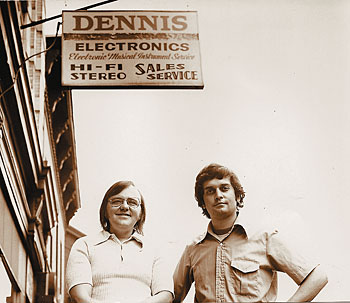
Dennis Kager and partner Dennis Bonk in May of 1973, outside of Dennis Electronics, Union City, New Jersey.
His electronics background came via the Middlesex County electronics school, which Kager attended in 1962 and ’63. The school focused on vacuum tubes as they applied to television, radio and hi-fi. But Kager, of course, “gravitated to amplifiers” because his time playing music served as catalyst for his interest in the technical aspects of sound equipment.
“When I went to Ampeg, I was playing in a band three nights a week, making $150. In ’64, that was a lot of money. My gross pay at Ampeg was $80! I was gigging through a Fender Concert 4×10, and the older guys at Ampeg would tell me, ‘We have amps that are better than that.’ But I thought otherwise! I felt Ampeg amps didn’t have the bite or the punch of Fenders. But then I saw how with a little alteration, they would take on new life – life it wasn’t necessarily meant to have – and I realized that by tweaking a few little things, the character of an amp could be changed.”
Ampeg had been making amplifiers in its famed blue-check vinyl primarily for jazz musicians, but they caught on with a broader group of players. “Eventually, it didn’t matter if you were at Rondo’s, or Lou Rose, or any other music store,” he said. “And as things began to sell, things began to break.”
Hired as a product tester, Kager soon found himself rising through the ranks. “They moved me to setting up and repairing guitars in the service department, then someone remembered that I’d gone to electronics school, so they started giving me amps to fix.” And soon after that Jess Oliver promoted him to service manager. “I really didn’t know if I could do it, and other employees – some of whom had been there 10 years – all had similar electronics backgrounds. But they weren’t musicians!”
In ’66, Kager designed Ampeg’s “horizontal” bass, earning his first patent. He stayed on at the company until 1970, and by late in his tenure was fixing amps on the side. When he told management what he was doing, he was given yet another job – quality control manager. “They said, ‘We know you’re a company man, and if you see something some other company is doing, you’ll bring it to us.’ Which I did.”
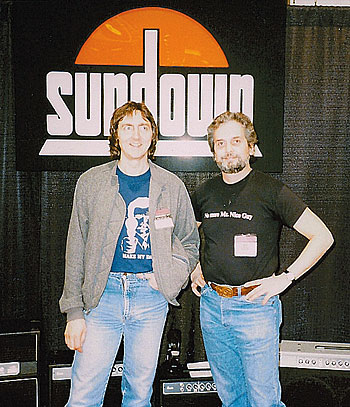
Kager with Allan Holdsworth in the Sundown Amplifiers booth at the ’86 NAMM show.
With the British Invasion inspiring hordes to buy guitars and amplifiers, Kager began fixing more equipment. His home became a veritable amp showroom, and his personal life took a back seat to his work. “I’d go to Ampeg, work all day, come home, eat, go to the basement to work on amps until 2 a.m., then go back to Ampeg at 6 a.m. That went on all the time. Meanwhile, I was still playing in my band and teaching guitar.”
When Robbie’s Music asked Ampeg to service Fender amps, Kager started Dennis Electronics. In no time, the new company was getting calls from Dorn and Kirschner, Muscara Music, City Music, Rondo’s, and other mom-and-pop music stores in New Jersey.
“I had artists coming to my house, like The Four Seasons,” Kager recalled. “People would drop by to have equipment looked at, and I wound up with amps all over the place. Eventually, I had to make a choice.”
That choice was to leave Ampeg. “I told my father I was going on my own. I was very tight with him, and needed his blessing. He said, ‘Fine. Don’t look back.’’
Not surprisingly, Ampeg fought to keep him. “They told me I could work half-days during the week. And I wanted to be good to them, so I did. But it went from five half-days to four, then three. But I was as much a part of the company as when I was there full-time.”
Even after Kager made a clean break from the company in 1970, he continued consulting for a time, and the two have maintained a relationship through the decades.
When he turned his focus to Dennis Electronics in ’67, several music-instrument dealers in New Jersey were so eager to have repair staff on hand, they offered Kager and partner Dennis Bonk free space to set up shop. They chose a site on Washington Avenue, in Belleville, and used it until ’73, when they moved to Union City, a mile and a half from Manhattan, where the shop became the New York service center for Fender and CMI, Gibson’s parent company.
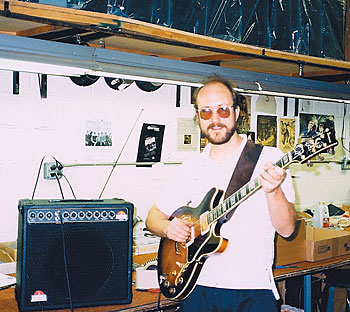
John Scofield in 1985 at the Sundown facility in Edison, New Jersey.
While focused on Dennis Electronics, Kager developed a knack for keyboard setup, which led to a fortuitous encounter. “I enjoyed working with Fender Rhodes pianos, and one day an older gentleman walked in and told me his name was Harold Rhodes. He said, ‘We’re starting to put pianos in classrooms, and we need somebody to maintain them.’ Fender wanted to have me open a school where people could learn to service the instruments.” To this day, Kager’s shop is one of two registered regional Fender service centers.
In addition to the major manufacturers relying on Kager’s services, major bands began sending equipment. “All the guys at Ampeg who had moved to other companies kept calling me to repair keyboards.”
In a few years, Dennis Electronics was a huge success. “When we moved to Union City, it really took off. All the big-name acts would go to Studio Instrument Rentals (S.I.R.) to rehearse and they’d send their equipment to us for repair. The roadies helped build our reputation. When a tour ends, roadies tour with other bands, and they’d bring that band’s stuff to us. So I always take care of roadies.
“We did work for people like The Police, Foreigner, Hall & Oates, Johnny Winter and Rick Derringer, Jan Hammer, post-Mahavishnu Orchestra but pre-“Miami Vice”… There were a lot of musicians in the Hudson/Essex County area, and the accessibility from Jersey and New York was great.”
The shop’s connection with S.I.R. Studios and Capricorn Records brought work with Southern rock bands, including the Allman Brothers. “We devised ways of making Marshall heads more reliable, and did little modifications like switching to more rugged tubes. We installed blow-out lights in the back of the heads so equipment managers could see from the back of the stage; if that red light came on, it meant the head had blown a fuse.
“And it wasn’t just guitar groups; our work was for whatever anyone played. Not all groups had their own tech who had the equipment for replacing tubes, speakers, cables, etc.”
Recently, Bruce Springsteen’s equipment manager brought in the Boss’ stuff for a tune-up.
People still contact Kager about certain sounds they’ve heard via his handiwork. “They’ll say, ‘That modification you did on the Allman Brothers’ amps… That amp sounds great! How’d you come up with it?’ And to me, it wasn’t a big deal – it was more common sense.”
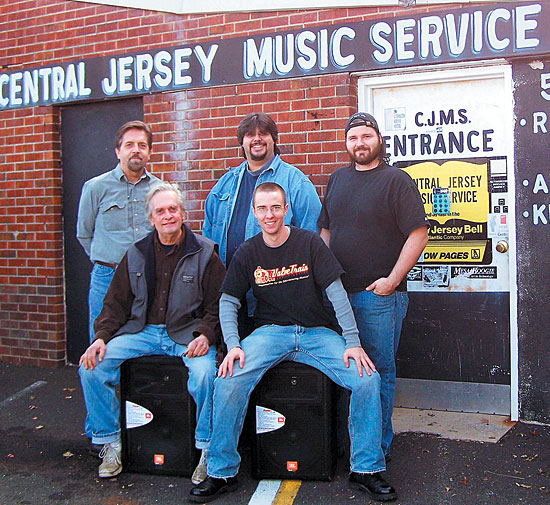
Kager (front left) with the staff of Central Jersey Music in October, 2008.
Eventually, Kager got the itch to create his own, and designed a “working man’s” amp, capable of producing a range of tube sounds. He called it the Sundown Amplifier.
“It was the first discreet channel-switching amplifier,” he said. “Any other amp that said it had channel switching really didn’t – it had layering. You hit a button and the amp layered an extra stage on top of a sound you already had. So my goal became to make an amp that had two true channels. I got a patent for a biasing circuit that allowed it to be manually adjusted from 100 watts down to 15, just by turning a dial. I also incorporated a governor circuit – a post-phase inverter compression circuit – as well as being a Master Volume so it could blend textures of overdrive.
A combo that used one 12” speaker, the Sundown was designed small enough to fit in a road case or put in a car and still, as Kager says, “…blow somebody’s face off.” In 1983, he built a prototype and had Peter Frampton and others lend feedback. In ’84, he got financial backing (and a distribution deal) with Hoshino U.S.A., who marketed Ibanez guitars. “I went with them because I felt they were honest, and people in the business recommended them. But it turned out they weren’t as keen on marketing amplifiers as they should have been.”
One missed opportunity for Sundown amps still haunts Kager. “My association with Dennis Berardi, the president of Kramer, goes back. And after he formed the Kramer Company, then got Eddie Van Halen to endorse the guitars, he wanted to do a deal with Sundown. Eddie even tried the amp. But by then, I’d decided to go with Hoshino.”
Nonetheless, the amp did see action with some heavy hitters.
“John Scofield used one. He was an Ibanez endorser, and he fell in love with it. Up to that point, he never carried an amp with him; he usually rented a Polytone. But when he got the Sundown, that’s what he wanted. In fact, he started running two in stereo.”
Eventually, Sundown developed other models. “As European distribution increased, we started making 50-watt amps, which Europeans preferred.
Through Sundown, Kager met another of his childhood heroes. “James Burton was my unofficial rock-and-roll guitar teacher,” he said. “Even though I prefer Strats, I owned Teles strictly because of James Burton; in my opinion, he wrote the book. I met him in 1987, when he became a Sundown artist, and that is still my biggest thrill.”
Sundown amps were well-received by the press and players, but Kager says by the late ’80s, the market for high-end equipment was shrinking. Eventually, he hit a wall. “I exhausted my funds – everything I’d gotten from the sale of Dennis Electronics, and then some,” he said. “Plus, I’d spent capital from friends who wanted to be a part of the company. Hoshino started selling the amps for below cost in the U.S. and the only thing keeping me in business was the foreign market… and a Sam Ash store in Paramus, New Jersey.
“A lot of the features on the amp were ahead of their time,” he added. “People would ask, ‘What’s a Governor’ or ‘What’s RMS.’ People just wanted to turn everything to 6 and have it work. They didn’t want to play around and figure it out. Guys like Allan Holdsworth or Jan Hammer or Scofield are fantastic musicians, and they’d take the time to learn how to work the amp. Unfortunately, their names don’t sell product like Ratt or Slayer or somebody like that. The bulk of the market at the time was driven by teenagers.”
Deciding it was time to walk away, Kager sold his share of Sundown and took time off to work around his house. Within a few months, though, boredom set in.
“I didn’t know what I wanted to do. I was too old to go to law school, which I’d always wanted to do. But one day, I talked to a friend, Tony Viel, at Lou Rose Music, and asked if they had space where I could set up shop. He said, ‘We’d love to have you!” And I’ve been there since September of ’88.”
Though he’d been temporarily out of circulation, his reputation wasn’t phased. “One day I got a call from a company that had a warehouse full of Holmes amps shipped from Korea – 5,000 of them – and all of them were humming. They sent two, I fixed them, and their rep said, ‘You just saved my year.’ I told him to make the check out to Dennis Kager Electronic Design, and that was the beginning of the next phase.”
He then began designing and building amps for companies including Gorilla U.S.A., and Yamaha. “They asked Michael Soldano to design an amp, but he couldn’t produce them in the numbers they needed. I made it work, price-wise, for them. I bought everything direct – chassis, transformers, etc. – and was able to cut the price by more than half. I also established vendor relations for Yamaha in America.”
He was also approached by Pignose, for whom he developed a line. “Before that, they had only the classic 7-100, and they wanted to expand.”
If one thing set Kager apart through his four-plus decades in the business, he credits being a musician for giving him insight, and an edge.
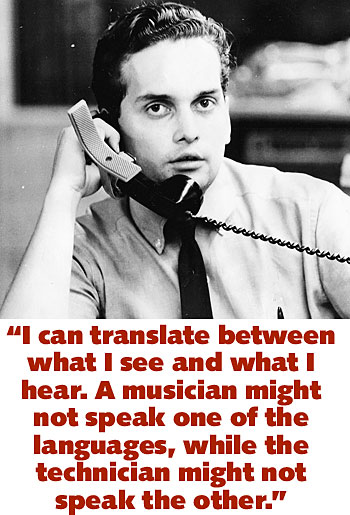
“A player can tell the difference between what’s good and what’s not. It’s like speaking two languages – I can translate between what I see and what I hear. A musician might not speak one of the languages while the technician might not speak the other.” He also recognizes the importance of balancing repair work with consulting and design. “When building amplifiers becomes your ‘nest,’ you’re usually blind to what’s happening in the rest of the industry. Ampeg made me their product researcher because they had no idea what others were doing. I see what the others are doing, and know what I feel they’re doing, right and wrong.”
For all of his achievements, Kager credits his success to the love, support, and help of his family. “I couldn’t have done it without my two wonderful sons, Denny and Tommy, and my brother, Johnny, who’s my right-hand man and has been with me from when I was playing in bands through Ampeg, Dennis Electronics, Sundown, now at Central Jersey Music.
“Most important is my wife, Joanie, who has been my partner and sweetheart for 50 years. She’s my heart and soul, and she’s as smart as they come!”
This article originally appeared in VG February 2010 issue. All copyrights are by the author and Vintage Guitar magazine. Unauthorized replication or use is strictly prohibited.