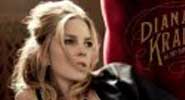
 Fans familiar with Krall’s records featuring swinging tunes and gentle ballads might be more than a little surprised when they hear Glad Rag Doll. It wouldn’t be fair to say she’s left the jazz world, because many of these 13 song are old jazz tunes that fit that bill. But they are done in such a rollicking fashion with – not to confuse things – such an “old-time modern” feel that they bear no resemblance to her previous work.
Let’s talk players for a moment. Your first hint should be the producer, T-Bone Burnett, who is on a hot streak of unrivaled proportions. He plays guitar along with the eclectic Marc Ribot, Bryan Sutton, and Colin Linden. We also get someone named Howard Coward, who is actually Krall’s husband Elvis Costello. Those players, with their very different résumés should give you an idea how different this music is.
There’s great playing on pretty much every cut. Lovely acoustic on “Prairie Lullaby;” big, loud repeating guitar figures on “I’m a Little Mixed Up;” jazzy lines on “I Used To Love You But It’s All Over Now;” and some nasty playing on a rendition of “Lonely Avenue” that can only be described as surprising and yet right on the money.
While the players are all great, Krall herself deserves a tip of the hat for stepping out of her comfort zone. Many of these songs could have gotten a clichéd vocal, but she meets the challenge of them all. Sighing, sexy, growling, or melancholy, she handles the assignment perfectly. While her piano isn’t featured as prominently as in some of her other records, when it makes an appearance she shines, as on the aforementioned “Lonely Avenue.”
Kudos to everyone involved for making a record that could have sounded like the relic of another period, but instead feels new and fresh.
This article originally appeared in VG‘s Feb. ’13 issue. All copyrights are by the author and Vintage Guitar magazine. Unauthorized replication or use is strictly prohibited.
 The DigiTech Element and Element XP multi-effects pedals have six overdrive and distortion stompboxes, compressor, three-band EQ, flanger, phaser, tremolo, vibrato, chorus, rotary simulator, envelope filter, step filter, spring reverb, room reverb, noise gate, an acoustic-guitar simulator and 12 amp/cab simulators in a pedalboard-style control layout. The XP adds four expression pedal-based effects including the Dunlop Cry Baby wah, Vox Clyde McCoy wah, a full-range wah, a volume pedal. Players can choose from 100 factory presets and create 100 more. Each also has 45 drum tracks and a built-in tuner. Learn more at www.harman.com.


 TWA’s Great Divide Mk.II is an all-analog octave divider with proprietary synth technology that offers five independent voices that can be blended to sound like a Bass, Arp, harp, Hammond, Moog, or synth guitar, as well as many combinations. Its lower voices are monophonic but can be co-axed into tracking double-stops, while its Upper Octave voice is a form of harmonic distortion that can track polyphonically. It uses TWA’s Shortest Send Switching (S3), a form of relay-based true-bypass. Learn more at
  Carlos Santana has announced that he and his band will perform in Guadalajara, Mexico, December 14 at the Vicente Fernandez Arena, with a star-studded cast of musicians, all celebrating their Latin music heritage. The concert is a homecoming for Carlos Santana and a kickoff event to mark his forthcoming album, Corazón. Confirmed performances include Chocquibtown, Gloria Estefan, Los Fabulosos Cadillacs, Juanes, Miguel, Niña Pastori, Samuel Rosa of Skank, Salvador Santana, Soledad, Diego Torres, with more to be announced. For more, visit