Month: January 2010

  • Epiphone Valve Junior and Valve Special amps

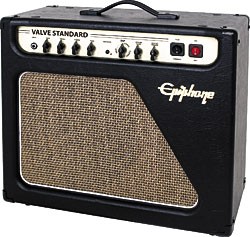
    Epiphone Valve Junior

    Epiphone Valve Junior

    Through the years, a number of amplifier manufacturers have tried their hands at producing budget tube amps. The problem with the vast majority of these items was that they were not primarily tube amps, they were primarily low-budget amps. Their main audio function was to give the listener the distinct feeling that a knitting needle was slowly being shoved through their eardrum.

    If any of these had survived – and very few did – they could have been used to great effect by military intelligence to elicit volumes of information from Al Qaeda detainees at little more than half volume. So when not one, but two inexpensively-priced amps recently showed up from Epiphone, the emergency jar of ear plugs was put on standby.

    The first indication that this reaction might have been uncalled for was the fact that, upon opening the carton with the Valve Junior, we found the amp was properly shipped – upside down – to keep the tubes from falling out. In its inverted state, the Junior’s chassis could be seen, finished in a thick, vintage cream enamel. Very nice. Also, the power transformer, mounted to the bottom of the chassis to assist cooling, looked large enough to power a 30-watt amp without working up a sweat.

    “Okay, let’s plug it in and get it over with,” I thought to myself. The nearest six-string victim, a recent Gibson Les Paul Junior with Rio Grande Bluesbar and Jazzbar pickups, could not escape before a George Ls cable linked it, with no mercy, to the Valve Junior. The red “On” switch was clicked and the volume knob was set at 12 o’clock.

    A slight hum from the amp indicated it was ready, and an A chord was struck.

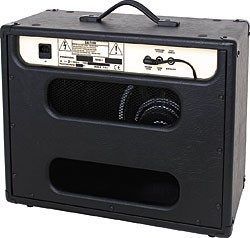
    Back of the Epiphone amps

    Back of the Epiphone amps.

    Wait a minute… What’s this? Smooth distortion… super-clear note definition? Let me try that again. E chord. Decent low-end response. This can’t be. A quick Freddie King solo. Nice sustain on the notes. Turn up the volume, more grind. Turn it down, nice warm jazzy sounds from the neck pickup. What’s the list price? $199? They sent the wrong amp!

    Next up was a newer Fender American hardtail Strat with DiMarzio Virtual Vintage pickups. The first test is the check for decent cluck in the notch 4 position. Dang! Robert Cray, get on out of town.

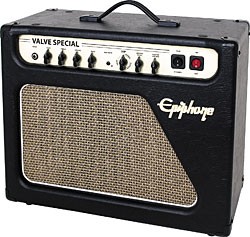
    Where’s that other box? This one held the Valve Special, which has a 10″ speaker instead of the Junior’s 8″, and has six more knobs and two more switches on front. While the Junior gets by with just the On switch and a Volume knob (like a Fender Champ), the Special has Gain, Treble, Middle, Bass, DSP Mute, DSP dial, Reverb, Master Volume, and Standby.

    The Standby is a nice touch that should increase power tube life, while the Master Volume and Gain controls allow a wider range of distortion at wider volume levels than the Junior. The three-band EQ is also useful for dealing with guitars of various tonal responses, while a separate Reverb knob allows for precise adjustment of this effect – most commonly used by vintage guitar players. Although this reverb does sound distinctly digital, it’s fairly warm and devoid of that annoying “plink” sound some have on the initial attack.

    Epiphone added three common DSP modes to this amp: Delay, Chorus, and Flanger. Mounted on the same dial, it’s only possible to use one effect at a time. Each effect has a setting that clicks in rather than being continuous. The Delay has eight settings that go from over a second down to a quick echo that could be described as “hyper reverb.” The attack and treble fade out on the Delay, so it’s more like a vintage echo unit than a strictly digital delay, and it sounds fairly warm.

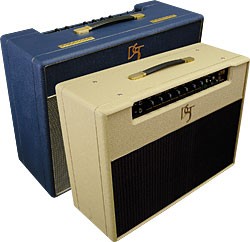
    Epiphone Valve Special

    Epiphone Valve Special

    The Chorus has four settings, going from Pretenders to rotating speaker. Again, the effect is fairly warm. The Flanger also has four settings for different speeds. While all three effects do introduce some noise into the mix, the Flanger introduces the most, and was my least favorite in terms of sound quality. However, it’s there if you need it, and clicking the DSP Mute button eliminates virtually all noise.

    Both amps exhibit a surprisingly good sound quality considering their prices, and the same would be true if they each cost twice as much. The Junior has about 85 percent of the sound quality of a good ’50s Champ, while the Special offers the same tones with more bass and presence, courtesy of its larger speaker and box. Compared to boutique and vintage amps, both do give up points in shimmer, bass depth, and definition, and just plain prettiness of the treble notes. But they don’t give up many points. Will these amps make you sell your point-to-point treasure? Very unlikely. But if you have a solidstate practice amp shoved under the desk in your home office, it’s time to call the recycler. Also, because of the variety of distortion levels available at low volume and their great note definition, these would both make great home recording amps. Buy one before someone in the accounting department at Epiphone comes to their senses.


    Epiphone Valve Junior
    Features Five-watt, Class A single-ended 12AX7 circuit design, 8″ speaker.
    Price $199.

    Epiphone Valve Special
    Features Five-watt, Class A single-ended (using two 12AX7s and one EL84) circuit design with master volume, three-band EQ, DSP effects plus separate digital reverb with level control, 10″ speaker.
    Price $219.
    Contact Epiphone Guitar Co., 645 Massman Dr., Nashville TN 37210; www.epiphone.com.


    This article originally appeared in VG‘s October 2005 issue. All copyrights are by the author and Vintage Guitar magazine. Unauthorized replication or use is strictly prohibited.

  • Mike Morgan & the Crawl – Stronger Every Day

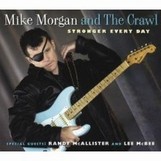
    Texas-born Mike Morgan returns with his 13th album of original songs, layering blues with a funky rhythm that captures the essence of Muscle Shoals and Beale Street all at once, and does a credible job. Morgan has a strong voice and develops rich melodies that stay true to blues structures and context, but also bring a slightly different sound and feel. Some of that may be the equipment, like his Epiphone Riviera with minihumbucking pickups and a penetrating tone used to good effect on “All Night Long” and “Sweet Angel.” A Strat can be heard on the title tune and “You’re The One,” though the best cut on the album may be the instrumental “Funky Thang,” which includes guest vocalists Randy McAllister and Lee McBee.

    Morgan and company have been active for 20 years and deserve a wider following. The guy looks cool with that eye patch, and packs a mean sting with the Epiphone.


    This article originally appeared in VG‘s Dec. ’09 issue. All copyrights are by the author and Vintage Guitar magazine. Unauthorized replication or use is strictly prohibited.

  • Dingwall Super J

    Dingwall Super J Price: $3,300 Contact Dingwall Designer Guitars, Box 9194 Saskatoon SK S7K 7E8 Canada; phone (250) 545-4423; www.dingwallguitars.com.

    While Dingwall Designer Guitars’ Super J bass is unquestionably inspired by the Fender Jazz, it’s separated from the typical clone by several things, including its use of the Novax Fanned Fret system and a list of high-end components and proprietary features.

    In the Super J, Dingwall starts with the basics – a resonant, lightweight alder body with a high-gloss finish (our tester sported the company’s Bronze Age color with optional matching headstock), and a three-piece U-shaped bolt-on maple neck with satin poly finish (available options include maple or rosewood fretboard, choice of nine finishes and four pickguard materials).

    Arguably the most notable feature of the Super J is the Fanned Fret system, in which the frets are installed at incremental angles across the fretboard, creating a progressively shorter scale for each string; the E is 34 1/4″, while the G is 32″. The system adds definition to the tone of the lower strings (due to additional tension) and adds roundness to the tone of the higher strings.

    The Super J uses a pair of custom Dingwall hum-canceling single-coil pickups mated to an 18-volt Aguilar OBP-1 active preamp with a mini toggle bypass, four-way rotary pickup selector, master volume, active bass control, and an active/passive treble tone control. The four-position pickup selector lets the Super J be heard through the bridge pickup by itself, the bridge and neck pickups in parallel (the way most Jazz-style basses are wired), the bridge and neck pickups in series (like a humbucker) and finally, the neck pickup by itself. The Bass Tone control adds low-end only when the Aguilar preamp is engaged, and remains non-functional in passive mode. But its center-detent Treble control works in both the passive and active treble modes. Turn it clockwise (active mode) and it adds treble, turn it counterclockwise (passive) and it acts like a traditional high-roll-off tone control.

    Further refinement is apparent in the sculpted headstock and countersunk Hipshot Ultralight tuners (with drop-tuning function on the low E), which not only lighten the headstock for better balance, but eliminate the need for a D/G string tree. The Super J also uses a proprietary Dingwall saddle-lock bridge made of aluminum, brass, and stainless steel. One of the coolest features is the innovative battery compartment, which uses a recessed aluminum oval-shaped cover with two finger holes, held firmly in place by two magnets recessed into the body. Getting to the two 9-volt batteries is as simple as lifting the cover – no hassling with screws that too often are lost or strip their holes.

    The Super J arrived with a pro setup, spot-on intonation, and low, buzz-free action. The feel of its neck lives up to the legacy of the original, with a very comfortable, narrow (1.5″ at the nut) U profile with a slightly rolled fretboard edge. And while one would think playing the Fanned Fret system would require acclimation, among the handful of bass players (along with a few guitarists) who handled our review unit, most were too impressed with its ease of play to notice any major change in the way they had to fret notes.

    In passive mode through the four pickup settings and plugged into an Ampeg SVT3 Pro Head (Mos-fet/12AX7/12AU7) mated to a 6×10″ cabinet, the Super J readily offered all of the standard classic Jazz Bass tones, along with a very nice high-output P-bass-style tone with the selector running both pickups in series. The Dingwall noiseless single-coils have plenty of warmth and body while still exhibiting the snappy highs for which single-coils are famous, with no buzz or RF noise.

    Engaging the Aguilar preamp noticeably increases output, as do the Bass Boost control and the “boost” half of the Treble control. The Bass Boost circuit adds a well-contoured low-end boost (up to 18 db at 40 hertz) without getting boomy – just enough to lend some drive and fullness. The Treble adds a fair amount of crispness to the highs (18 db at 4 kHZ), and while the Super J’s voiced pickups have an excellent natural clarity and don’t need much help in the upper registers, the active Treble can certainly be useful if the Super J is run through cabs that don’t have a tweeter. And the Aguilar preamp is very quiet, emitting minimal noise only when the active Treble control is dimed.

    The Super J is proof Dingwall has done its homework. Every component, from the pickups and electronics to the selection of tone woods, and the hardware, are all well-conceived and executed, and the craftsmanship is superb.


    This article originally appeared in VG‘s January 2008 issue. All copyrights are by the author and Vintage Guitar magazine. Unauthorized replication or use is strictly prohibited.


    Will Karling test a Dingwall Super J bass during a trip in Paris

  • Andy Fraser

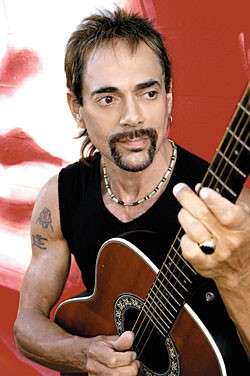
    Andy Frasier photo courtesy of Andy Fraser

    Andy Frasier

    In the late 1960s, Free emerged as a four-piece blues rock powerhouse – a bridge between Cream and Led Zeppelin. Fronted by the incredible voice of Paul Rodgers and the stinging guitar of Paul Kossoff, the group’s rhythm section consisted of Andy Fraser on bass and Simon Kirke on drums. Besides being a principal songwriter for the group, Fraser was renowned as a talented and innovative bassist who (despite being in his teens) had already passed through the ranks of John Mayall’s Bluesbreakers.

    In his time with Free, Fraser experienced the extreme ups and downs of being in a world-class rock and roll band; from the success of “All Right Now” to playing major events including the Isle of Wight Festival, to the heartbreak of the band’s demise.
    Following the breakup of Free, Fraser concentrated on his development as a singer and songwriter. During this time, his songs were performed by artists including Rod Stewart, Wilson Pickett, Chaka Khan, Bob Seger, Robert Palmer and others.

    In the early 1980s, Fraser emerged (sans bass!) on MTV with his “Fine, Fine Line” video, which was more akin to modern pop music. His musical metamorphosis may have seemed significant, but it was miniscule in comparison to the changes in his personal life. It was during this time that Fraser began to acknowledge the fact that he was gay – an issue he had suppressed his entire life.

    From the mid ’80s until this year, little was known of Fraser’s whereabouts. He was the only surviving member of Free who did not provide input or commentary on the 2001 David Clayton/Todd Smith biography of Free entitled Heavy Load, and many wondered what happened to him.

    In early ’05, Internet rumors said Fraser had died of complications due to AIDS. There were even reports communicating this as fact, coming from otherwise reputable music websites. Then, on April 25, he released a statement saying, in part, “While many have considered me dead long ago (artistically or otherwise) and I do confirm I am living with AIDS, I am still very much here, and wish to let my friends and supporters know that I intend to be for quite a while.”

    VG recently spoke with Fraser to separate truth from fiction, and to get details on his new release, Naked… and Finally Free, which he describes as his “coming out – 15 years of finding the nerve to say what I had hidden from myself.”

    Vintage Guitar: How are you feeling these days?
    Andy Fraser: I’m actually feeling very, very good. It’s a necessity for me to get my eight hours of sleep a day, four or five small meals, three hours of exercise… I have to keep it together, and I feel good.

    Most people know of you as a world-class bassist, but you had classical piano training, first, correct?
    That’s true, I had piano tuition from about the age of five until I was about 11. And I enjoyed having a piano, but hated the lessons. It was very helpful, and it taught me a lot about how music was put together; it definitely helped me connect the dots, and made me realize that all keys, notes, all majors and minors, were all related. And when you’ve got a lot of this technical stuff out of the way, you can just get on with expressing yourself. Sometimes, not having the technical stuff can prevent you from getting to the real stuff, which is expression. And of course, even at 11, the piano teacher’s not gonna give you much as far as expressing yourself, it was really like extra homework.

    Was this about the time you started playing the bass?
    Well, I went to guitar from there. I figured I was going to be a guitarist… and probably would have stayed with that, but all the other kids that I wanted to play with wanted to be the guitarist, so I tuned down an octave and made everybody happy.

    Do you remember your first real guitar?
    I had my Lucky Airstream III… did I feel chuffed (laughs)!

    So when did you actually move to bass?
    When I was 14 or so. At that point, I was playing across London with various West Indian bands, playing a lot of all-night soul clubs where black people would come out and dance all night to Sam and Dave songs. We used to play four hours of covers. To their amusement, here was this little white boy on bass, boppin’ along.

    Who were some of your early influences?
    I suppose it was Otis Redding, the Sam and Dave records. I could listen to just about all of that and play along. The Duck Dunn stuff… I was very influenced by that, as it was a matter of course for what I was playing.

    Did you get your first real bass around this point?
    Yeah, and I can’t remember what it was (laughs). But it did the job.

    So you played bass for a year or so, and through your connection with Alexis Korner, you were introduced to John Mayall.
    When I was 15, I was expelled from school for refusing to have my hair cut. I went to college for a few months, and became very close to Alexis’ daughter, Sappho, and spent a lot of time hanging around their house. Alexis would play records that turned my head quite a lot, and he didn’t mind me plunking around on his guitars. Mayall lived a few streets away, and one day he called and said, “Alexis, I need a bass player.” Alexis said, “There’s a kid who hangs around my house who says he’s a bass player. I’m tempted to think it’s true.” He sent me over and I sort of plunked along with John – and that was good enough for him. I auditioned on a Saturday, and on Sunday he had got me a new bass, and by Monday I’d quit school and got court permission to work abroad and promise that I’d be in bed by such and such time… Yeah, right (laughs)! I had already been playing clubs with the West Indian bands until 6 a.m. So I was like, “Right, whatever you say, judge!” And we were probably in Germany by the end of that week.

    How long did you stay with Mayall?
    Just a few months. I can’t read Mayall’s mind, but he was forever changing people, and I really don’t think me and Keef Hartley as a rhythm section ever really gelled. Mayall picked up on that. I was only 15, and the only person in the band I was sort of close to in age was Mick Taylor.

    And then you hooked up with Free?
    After that, Alexis knew I was looking for other people to play with, and he put me in touch with (producer) Mike Vernon, who knew of this guitarist named Kossoff who was looking for a bass player. Kossoff came to my mother’s house, and we donked around and it felt pretty good. He said, “Why don’t you come down to the Nag’s Head… we’ve got a singer and a drummer, and let’s see what it feels like.”
    We played a few half-formed ideas that turned into a couple of the songs on the first album (Tons of Sobs), but basically we played the standard type of blues like “Rock Me Baby.” Coincidentally, that night was Alexis’ birthday. He arrived as we were winding up, and heard a few tunes and said, “This is happening. Go with it.”

    What was it like to work with producer Guy Stevens?
    Guy was a complete nutter – functioned on 150-octane all the time, but a very nice guy – and very supportive of the band. I believe it was Guy who suggested we be called The Heavy Metal Kids, which we totally resisted. It got to the point where Chris Blackwell (head of Island Records, Free’s label) said that if we weren’t going to be called The Heavy Metal Kids, Island wasn’t interested. I said, “Okay” and slammed down the phone. He called right back and said “Okay, you win,” and we’ve had a great relationship ever since.

    You and Paul Rodgers were the principal songwriters in Free. Did you collaborate, or write independently?
    Initially it was a 50/50 situation… we needed each other to finish ideas. So it was very creative and very productive. By the end of the band, he was writing half the songs and I was writing half the songs, and maybe we’d co-write one, and either credit them to the two of us, or as in the case of “Free At Last,” credit them to the entire band.

    You were playing mostly Gibson EB-3s through 100-watt Marshalls. What drew you to that combination?
    Well, Jack Bruce was a big influence. But to tell the truth, ’cause I’m a little guy and was pretty young, a smaller bass is what I physically needed. And EB-3s allowed me to easily play a lot of high notes. When I tried playing a Fender Precision, I’d feel overwhelmed. As for the Marshalls, we used them in the studio too.

    You recorded the archetype rock and roll bass solo on “Mr. Big” (from Fire and Water). How did you develop the approach?
    First, I never really considered myself a bass player. My main function in any unit was to do whatever makes the thing work, whether it was piano, tambourine – whatever. So I never had any concept that a bass player has to stay low and play with the kick drum and all that, which probably made life hell for drummers.

    But you and Simon (Kirke) always seemed to be locked in…
    Well, he’s an incredibly good timekeeper, so that was no problem.

    In 1970, Free was playing to the largest audiences in the world, including at the Isle Of Wight Festival. That must have been a life changing experience…
    Isle of Wight was quite an experience. Imagine looking at 750,000 people – I’m told – and not being able to see the end of the sea of faces… the energy required to meet that is incredibly demanding. We were on for only 15 to 20 minutes, gave our all, and probably wouldn’t have lasted much longer.

    One memorable moment was Pete Townshend coming up and saying how much he liked the band, wishing us well, in such “the British gentleman’s accent,” I was taken aback because the image projected from the Who’s stage didn’t bring that to mind at all. I’ve always loved his performance, and acknowledge that the riff in “All Right Now” was an attempt to sound like him.

    Another strange experience was coming in close proximity to Tiny Tim. Before I actually saw him, I was aware of this strange otherworldly vibe. Truthfully, that guy was on his own planet!

    I didn’t get to see Jimi Hendrix, one of my all-time favorite guitarists, because we were helicoptered out shortly after our set.

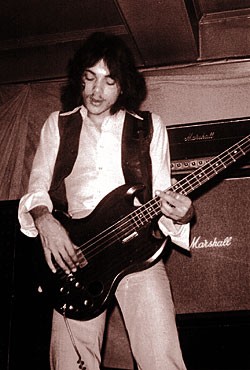
    Fraser with his Gibson EB-3.

    Fraser with his Gibson EB-3. Photo courtesy of Lucy Piller.

    Any thoughts on the initial Free breakup?
    I thought our earlier time together was really something else. And there was no other reason to leave except to face that in reality, the best we could do was play “All Right Now” every night.

    You got back together to record Free at Last. Did you know you were going to leave the group as you were writing the album?
    No, I don’t know if it was that conscious. I suppose that if you’re writing, and you just sort of let things come out, it sort of writes your story and maybe you’re more aware of it when you look back with the perspective of time.

    After you left Free, you worked with a variety of groups – Toby, The Andy Fraser Band, The Sharks. You also started writing for other people including Rod Stewart, Robert Palmer, and Bob Seger. Care to share anything about this time?
    By then, I felt pretty comfortable as a songwriter. What seemed more important to me was to develop my experience and confidence as a singer. That was my main function with these groups. With Toby and the beginning of Sharks, the idea was to develop vocally. Sharks may have worked if it hadn’t been intercepted by the arrival of Snips (singer Steve Parsons). It started off as just me, Chris Spedding, and (drummer) Marty Simon, but before I knew it, Snips was there, and I found myself not advancing vocally… And me and Snips could never really get on the same page. So I felt it better that I let them go in another direction. And I think we were both better for it.

    Free fans were probably surprised to see you on MTV in 1984 with the video for “Fine, Fine Line” where you didn’t even have a bass in your hand. Was it a conscious decision to get away from the “bass player” tag and position yourself as more of a Robert Palmer-type lead singer?
    I wasn’t sure how people would take that, but it was another step in developing my confidence as a singer. In terms of not having a bass, that decision really had been specific. I mean, one only has 100 percent to give, and if you sing and play bass, you have to divide your energies. I felt it was important to make the singing as good as possible, and I was quite happy to let someone else play bass.
    The video was kind of like a cold shower. A musician suddenly getting into the theatrical world is really a head turner, and one needs to wrap your head around that to get it down.

    Also at this time, you sunk into a deep depression.
    It was probably around that time that my marriage was sort of crumbling – though that was well on its way. Ri (Fraser’s ex-wife) had been taken with Eastern meditation, and I was just starting to quit denying that I was gay. I’d been compartmentalizing it in the back of my mind from way, way back, and just didn’t deal with it. So, these two things had us going in totally different directions. And it was about the time of “Fine, Fine Line” that it all came to a head, and I had to come to terms with it.

    In terms of being honest to yourself?
    Right. I’ve always been up front with people, which didn’t fit in the picture. Plus, when one stands onstage, one must be comfortable in one’s own skin. You can’t hide anything, or you’ll be found out. And when you see yourself through thousands of other peoples’ eyes, you’re made aware of many of your shortcomings and you either have to change them, accept them, or try to drown them. And that never worked for me. So I really could not see how I can be outwardly gay, and publicly gay… it was really quite a mountain.

    I remember at school, the way “faggots” were treated was not a good thing – and it was nothing that I wanted to be treated like. So that helped with the self-denial. I do believe things have gotten better for gays, but we still need to get to the point where it’s not even thought about, and part of my mission is to present a normalcy. Some people, I’ve sensed, have felt a need to maybe camp it up, and I definitely don’t want to be pressured to go there… just live as normal, so no one needs to think about it. So that’s part of my mission.

    Besides the new record and the revelations about your sexuality, you’ve also revealed that you are suffering from AIDS. What was the catalyst for this announcement?
    Well, I’ve been working toward announcing it… I guess that’s what these last 15 years or so I’ve been working towards (laughs)! A lot of the songs I’ve written were, in a sense, a way for myself to come to terms with everything – just get it out there. And the announcement came about very suddenly because there were rumors. We had to get the website up quickly. And there is no denying it. I was like, “Let’s put it all out there and get ahead of this.”

    Have you read David Clayton’s Free biography Heavy Load?
    I was aware that he was writing it, but haven’t read it. I was told, though, that it was one of the better rock books. I probably wouldn’t read it. I tend not to read stuff or take it too seriously. It’s just another perspective from a person who wasn’t there. The fact that it’s been so well received is very positive. But even if it wasn’t, I wouldn’t pay it any mind. But I’m still quite amazed when I see something on the web, for instance, that there is a long-lasting, deep-rooted affection for the band. And that’s great – I have it, too… believe me. If I hadn’t fully believed that our creative period was over, I’d still be there.

    Your new record doesn’t seem so concerned with sounding “pop,” per se, but its lyrics are deep and the music has great texture. It’s very accessible.
    Well, the songs are very personal. I try to be as honest as possible, and it helps you deliver them if you can get behind them. Overall, I’m very at home with the direction of the album. I don’t feel, for example, like I did even after “Fine, Fine Line,” which was I thought was my best thing of that period – that feeling of, “I’m on the wrong track.” I really believe I’m on the right track now. Even with “Fine, Fine Line,” I thought there were still things pulling me in different directions. I think my attitude toward myself, my AIDS status, everything, made me want to put it out there. Life is too hard, and hiding things makes it harder. So get in front of it and see where it goes.

    I’m feeling better than ever, and one of the things about a serious sickness, if you can get past the fact that it is very serious, is that there is no option when it comes to exercising and keeping it together, so I’m unbelievably disciplined about that, and am so fortunate that I can spend three to four hours a day exercising. Most people don’t have the will to exercise; they just don’t have time. So my diet, exercise, sleep regimen, and drug program is very, very disciplined. Some people complain about the taking the drugs – I think, “No big deal, only have to swallow.” The big problem is some of the side effects, and I need to take additional drugs to combat the FX, some of which have done permanent nerve damage. For example, peripheral neuropathy, which for a period had me thinking that playing an instrument was gonna be past tense. But thankfully, we’ve found a program that works like a charm.

    I am thrilled to have worked with my daughters, who directed the video and designed my website. They really know what they’re doing. If you can imagine telling your kids that you are gay and you have AIDS, and it only created a tighter bond. They both have inherited their mother’s sense of visual art. She could draw like Michelangelo… So visually, it’s allowing the world to see me through their eyes.

    Will you be touring to promote the record?
    I want to. We hope to make it available for purchase online in June and get it on the radio at the same time. We’ll then follow it up with the album, and then, depending on what type of noise we can make, follow that up live.

    Which instrument do you play the most these days, and how do you typically go about songwriting?
    Mostly, I’m singing. I either write with just bass or keyboards, and record everything in the computer. Sometimes, when you wake up and you’ve just dreamt up a whole song, turning on the bloody computer can take forever (laughs). And I don’t play much guitar. The other day, I was laying in the sun, and a song just came to me, so I just went to the computer and laid the lyrics down, then later put some bass to get the root notes against it so there’s a basic tune there, and then fill in the rest later.

    But I try and start with the lyrics or a concept, and a melody. It makes filling everything else later much easier.

    Do you still have any of your instruments from the Free days?
    (Sadly) They were all stolen… Currently, I have three basses – a Tobias, a Warwick five-string, and a Peavey Cyberbass, which I find very cool because, for a long time I’d dreamt about getting that electronic kind of Moog sound on bass, and now it’s possible.

    As for amps, I don’t bother much with them in the studio, and when we go out live, I’ll have someone else worry about it. I typically record the bass direct into an Avalon tube preamp, which I’ve been happy with. I don’t have any guitars… I let others play them ’cause they play much better (laughs)!


    This article originally appeared in VG‘s September 2005 issue. All copyrights are by the author and Vintage Guitar magazine. Unauthorized replication or use is strictly prohibited.

  • Ibanez Destroyer II

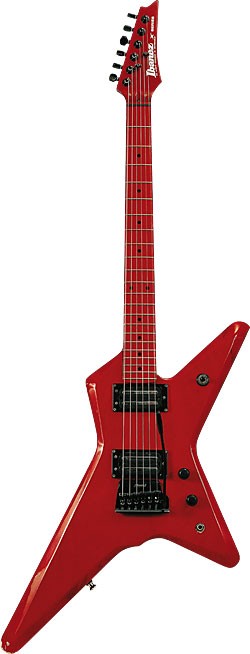
    1985 Ibanez Destroyer II DT-250

    1985 Ibanez Destroyer II DT-250. Photo: Michael Wright.

    Back in 1958, when Gibson unleashed its now legendary trio – the Explorer, Flying V, and Moderne – its designers probably had no idea how big the shapes would become.

    Certainly, the response to these innovative guitars at the time gave no indication. They tanked pretty quickly. No one has ever even seen a real Moderne, and players didn’t warm up to the Explorer and V until the 1970s. These models even inspired at least two new American brands – Hamer and Dean – both dedicated to making “improvements” on the Gibson originals. Japanese manufacturers also picked up on the appeal of these designs.

    One of Ibanez’s most successful early copies was its Destroyer, which debuted circa 1975. Indeed, some of the most desirable ’70s Ibanez guitars are the so-called “Korina” versions of the Explorer, Flying V, and Moderne introduced around the same time.
    Building the Destroyers/Explorers continued to be a successful strategy for Ibanez for at least another 10 years, culminating in guitars like this 1985 Ibanez Destroyer II DT-250.

    The first burst of interest in Explorer-style guitars in the 1970s, led by players such as Rick Derringer and Sammy Hagar, was followed by a hiatus at the end of the decade when guitarists followed an Alembic-style lead. However, natural-finished neck-through guitars with sophisticated electronics didn’t cut it with the heavy metal bands that became more popular in the early 1980s with the New Wave of British Heavy Metal and the subsequent American response, chiefly out of Los Angeles. Poofy hair and skin-tight spandex begged for guitars with in-your-face style. The radical Explorer shape was perfect for making the right kind of personal stage statement. Manufacturers jumped on the bandwagon. Baby Deans, Ibanez, Aria, Cort… Even Gibson offered Explorers in cool custom graphics.

    Slightly ahead of the curve, in 1980 Ibanez revived its Destroyer as the Destroyer II Series. Indeed, the Destroyer’s “goosebeak” headstock shape would soon become the company’s trademark head. These first Destroyer IIs came in a variety of options and included bolt- and set-neck models that evolved over the next four years. The set-neck models had bound flamed maple tops over mahogany bodies and are exceptionally fine guitars. In ’84, the series introduced the high-end set-neck DT-555 Phil Collen Model, named for the fiery Def Leppard lead guitarist and modeled a little more after the Dean ML that had debuted in ’78, a kind of hybrid of the Explorer and Flying V shapes – basically an Explorer with a V notch in the butt.

    In ’84, Ibanez revamped its Destroyer shape to become more like the Phil Collen. Ibanez rolled these new Destroyer IIs into its X Series, which featured several ultra-pointy guitars, some like the XV-500 in daring two-tone metallic finishes.

    Which brings us to this 1985 DT-250. While it sports the tail notch, the shape is a little more sleek and diminutive than the comparable Dean ML. The lower front bout is extended to be almost symmetrical with the diagonally opposite bass wing. The treble-side lower bout is shortened, giving the whole guitar a tasteful offset-X shape… X Series. To add dimension to the shape, Fuji Gen Gakki added “crystal cuts” to the edges, basically code for angled bevels.

    There were actually two bolt-neck DT-250s, both with basswood bodies and the very nice locking Powerocker vibratos. The regular model came in black or white and had a rosewood fingerboard. Well, a little boring. But the Transparent Red TRs came with a maple fingerboard stained red. Yes, that’s what we’re talking about! If you’re going to have a red guitar, you ought to have a matching red fingerboard. Hard maple, made slick with the red polyurethane.

    Actually, red fingerboards were all the rage among Japanese makers about this time. Several Matsumoku-made Westones sold by St. Louis Music also had the red maple ‘boards in ’85/’86.

    The Ibanez DT-250 is a perfect guitar for shredding. The basswood is light so you can run all over the stage, jump off your stack, and still have energy to dive-bomb. Even do the splits. Notice that was a “you can.” These were outfitted with a pair of blade-pole V5 humbuckers, produced toward the end of Japanese-made pickups, before Ibanez started working with DiMarzio. They are smokin’ hot! This guitar almost leaps out of your hand when you plug it in. The Japanese improvements on the locking vibrato were also impressive, and this combines the precision of a Floyd Rose with the feather touch of a Kahler.

    Along with the DT-250 was a DT-350, available in both a solid finish and, later, with a flame top.

    Alas, the DT-250 was more of a punctuation point than a sign of the times. Or maybe it was a sign of the times. The Phil Collen model (minus his name after ’85) and the flametop DT-350 made it through 1987, but this DT-250 lasted only from ’84 to ’85. Unfortunately for this heavy metal monster, pointy guitars were already on the way out when it appeared, about to be eclipsed by the Superstrat craze that would dominate the rest of the ’80s. While these redboards do not really qualify for rarebird status, they’re not all that common. Over the course of their production, only 1,432 were built for worldwide distribution.

    Explorer-style guitars dropped off the radar after the mid 1980s, but were revived again under the influence of late Pantera guitarist Dimebag Darrell Abbott toward the end of the ’90s. Weird shapes were back, if anything can ever be said to be “back.” What goes around comes around. There’s clearly an algorithm going on that originated back in 1958!

    Still, it’s unlikely that the DT-250 will ever come around again, despite its excellent quality. Especially with a groovy red maple fingerboard made by the great Fuji factory in Japan! Rock on!


    This article originally appeared in VG‘s June ’06 issue. All copyrights are by the author and Vintage Guitar magazine. Unauthorized replication or use is strictly prohibited.

  • DST MarWatt and UV6 amplifiers

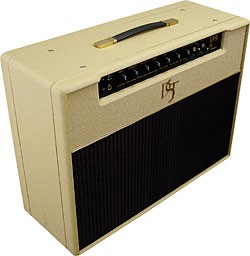
    DST MarWatt/UV6

    DST MarWatt/UV6

    Bob Dettorre and Jeff Swanson are longtime gearheads who played in bands starting when they were just kids. As adults, one went to college and worked a “real” job, while the other tackled life as a working musician. A couple years ago, they established Dettorre/Swanson Thermionics (DST) Engineering.

    Dettorre, the son of a TV/stereo repairman, built his first guitar amp from a kit, and through high school fixed gear for his friends. His interest carried over to college, where he earned degrees in electrical engineering before earning a living as an engineer.

    Swanson was a childhood tinkerer, as well, who built a cabinet for his bass rig (complete with a 15″ Radio Shack speaker) when he was just 12 years old. Later, he and his bandmates in the Buzz Brothers out of necessity became self-sufficient amp repairmen.

    DST UV6

    DST UV6

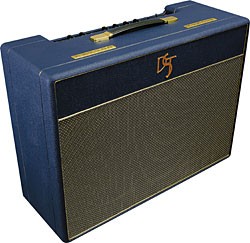
    Today, Dettorre and Swanson build amps that relay a vintage vibe with unique touches. They recently offered us a look at their MarWatt and UV6 models, both of which employ all-tube circuits, hand-wired construction, and solid-core Baltic birch plywood cabinets. Both of our test amps were in 2×12″ combo configurations, and both are also available in head/cab configurations.

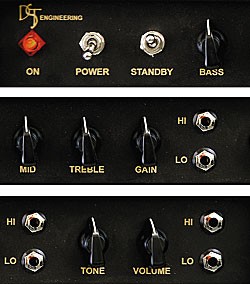
    The MarWatt produces 18 watts output using three 12AX7 preamp tubes, two EL84 output tubes, and a EZ81 rectifier. The amp has two channels, the first based on the legendary mid-’60s Marshall JTM circuit, including the JTM’s tremolo circuit. This channel has just two controls – Volume and Tone – with Hi and Low inputs. The second channel is based on the preamp in late-’60s Hiwatt amplifiers and has controls for Bass, Middle, Treble, and Gain.

    The UV6 produces 22 watts using 12AX7s in its preamp, two 6V6 output tubes, and a GZ34 rectifier. And in a twist that distinguishes it from most other amps of its ilk, it also can use 6L6GC or EL34 tubes without the need for re-biasing.

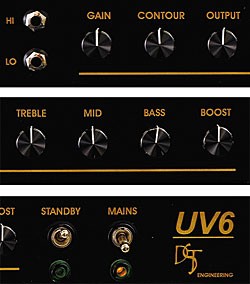
    DST UV6 Panel

    The UV6 is a single-channel amp with controls for Gain, Contour, Output, Treble, Mid, Bass, and Boost. It’s also impedence-variable using a toggle switch on the back panel.

    We tested the DSTs using an early-’70s Fender Stratocaster with stock pickups and a ’79 Ibanez Artist with aftermarket humbuckers.

    We got rolling by plugging the Ibanez into the MarWatt’s second channel, which with very little tweaking produced a gorgeous sound that was balanced across the range of frequencies, with fantastic note separation, meaty low-end, and nice high-end sparkle. As we pushed it to a bluesy-sounding breakup, it fattened up without losing any of its sparkle.

    We then pushed the high gain, which gave us that renowned EL84 crunch, but with noteably better low-end response than we’ve heard on similar vintage-inspired amps. We got a lot of smooth gain that remained tight and focused.

    DST MarWatt

    DST MarWatt

    Plugging into the first channel (the one with the Marshall-based preamp) set to clean, we got tones that as a whole were not quite as full or bright as the second channel, but were stronger in the midrange frequencies. High-end response was still very pleasing and smooth, and pushing the volume helped the amp produce plenty of British crunch. Overall, the sound from this channel was a well-balanced, very smooth rock tone. And again, the amp exhibited awesome touch response.

    Plugging the Strat into the second channel first set to clean produced a veritable encore – a host of low-end response with sparkly highs, again very full and pure, with laudable clarity and note separation. Tinkering with the Mid control showed us many sweet spots, and pushing to higher Gain levels increased the fullness but retained incredible clarity and sparkle, even with the Treble control nearly dialed out. In channel one set to clean, low-end response was reduced, but we got great, meaty mids, and smoother highs. Pushing the Gain even higher produced much fatter (but still Strat-like) tones.

    DST MarWatt Panel

    The MarWatt is an incredible-sounding amp all-around. Like a good book, it’s hard to put down… unplug… whatever.

    Next up, we ran the Ibanez into the UV6 set for clean tones. The UV6 differs from the MarWatt in several ways, both cosmetic and electronic. Its control panel is front-mounted, and includes a Contour knob that lets a player shape the amp’s tone to match a guitar’s pickup ouput. It works quite nicely; we tweaked it to match the Ibanez’s humbuckers, and were rewarded with a full, fat tone with exceedingly smooth highs. It’s also instantly apparent that this amp is designd to sound more “American” than the MarWatt. Rolling the Contour back revealed a warm jazz tone, while pushing the Gain higher produced a smooth, warm blues crunch with extremely smooth highs. As we pushed the Gain higher and rolled back the Volume, the crunch faded somewhat, but never completely went away. We then pushed the Volume again, this time with the Gain dimed, and got much more crunch and so much low-end we thought the UV6 might come right out of its cabinet!

    Next, we plugged in the Strat and set the amp back to clean. Tweaking the Contour quickly set the amp to help the Strat make warm, smooth, sweet highs with tight, full lows and (again) an all-around even frequency response. And it retained all of those characteristics as we drove the Gain to acceptable blues-lead levels. Manipulating the Contour let us dial in several distinct Strat voicings, and the footswitchable boost control lets a player bump the volume for solos, with a touch of extra gain and volume.

    DST’s MarWatt and UV6 both sound incredible, boast the expected boutique qualities, and offer fantastic bang-for-the-buck value. Eighteen (or 22) watts never sounded so good!


    DST MarWatt/UV6
    Price $1,999/$1,899
    Contact DST Engineering, 4 Clipper Way, Beverly, MA 11201; phone (978) 578-0532; www.dst-engineering.com.


    This article originally appeared in VG‘s February 2007 issue. All copyrights are by the author and Vintage Guitar magazine. Unauthorized replication or use is strictly prohibited.

  • Hanburt Electric Guitars

    Hanburt

    Hanburt “Style 1” in maple. Photo by Julie Woods.

    Black walnut

    Black walnut “Style 1”. Photo by Julie Woods.

    As a brand of American electric instruments, the name “Hanburt” is about the furthest thing from being a household term. Nevertheless, the recently documented saga behind this obscure line of electric guitars that originated just prior to World War II offers a rather interesting story.

    As a matter of fact, until recently, nobody – not guitar collectors, history buffs, or museum specialists – was even aware of their existence. Nobody, that is, except guitar historian Lynn Wheelwright, who is always finely tuned to mysterious rumblings in the realm of rare guitars.

    The mystery arose a few years ago, when Wheelwright acquired a Hanburt lap steel from Portland, and it bore striking similarities to 1930s Audiovox guitars, which were made in Seattle. Knowing that I have devoted a lot of effort to tracking down and documenting the story behind that overlooked line of pioneering electric guitars, he suggested I keep my eyes peeled for clues that might prove a connection between the two long-gone companies.

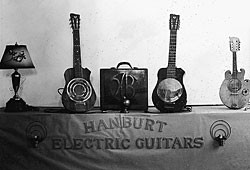
    While perfectly open to discovering any such evidence, I had no idea where it might ever surface. Such is the way these quests unfold that a crucial piece of the puzzle can arise most anywhere – and this time that occurred when my wife and I were out shopping at Hansen Lamp and Shade shop in Seattle’s Phinney Ridge neighborhood. While she looked over the offerings, I poked around listlessly until my gaze settled upon an old photograph on the wall – a torn, wrinkled, black-and-white image of a retail display of a few electric instruments highlighted by a cloth banner that read “Hanburt Electric Instruments.”

    I was stunned to learn that the shop’s long-deceased namesake founder, Harvey Hansen, had made and marketed his own line of instruments. Unfortunately, that’s about all the sales clerk knew and so I moved on, thinking I would revisit the matter when time permitted.

    Meanwhile, I continued my work as Senior Curator at Seattle’s Experience Music Project (EMP) developing, among other exhibits, their Quest for Volume: A History of the Electric Guitar display. In time, Wheelwright sent me images of his Hanburt and it finally sunk in that these instruments do indeed bear an uncanny resemblance to the Audiovox units. Now my interest in the mystery intensified and I set about tracking it down.

    By interviewing two of Harvey Hansen’s sons, Harold and Gail, and conducting additional research I’ve been able to piece the following Hanburt Guitar company history together – a history that proves Wheelwright’s hunch to have been dead-on correct.

    The Hansen Lamp and Shade shop was founded about six decades ago by a hard-working couple, Harvey and Emily Hansen. Harvey M. Hansen (1898 -1990) was born in South Dakota and by the 1920s had become a railroad fireman at Stevens Point, Wisconsin. In time he met and married Wisconsin native, Emily Mae Holburt (1901-1993). It was circa 1927 – and four years after the birth of their first son, Harold – that the young family jumped into their Model T and drove west to Seattle.

    Upon their arrival the young family discovered that economic times were just as tough there as back home. Still, by ’28 the Hansens had settled into a rental home in Columbia City – an old neighborhood in the Rainier Valley area – and Hansen found employment at the Columbia Lumber Company. He worked as a lumberyard truck-driver and by 1929 they moved to their first home at 4220 Lucille Street.

    Then, right around the time of the worst economic collapse in U. S. history – 1929’s Wall Street stock market crash (and subsequent Great Depression) – the Hansens were blessed with a second son, Forrest Henry (then a third in 1934, Gail), and the pressure to increase the household’s income mounted. Throughout those tough times, Hansen took on any temporary jobs he could find, including hustling to raise money by trying to sell items door-to-door.

    “My dad… if he got anything, he’d go knock on doors and try to sell it – all over Seattle,” recalled Harold, “He’d peddle.”

    The times were lean and he was handy – usually made whatever he needed: “He used to make everything,” concurred brother Gail. “He made everything by hand. He was a tinkerer. Anything he ever needed, he just made.” “He was handy,” said Harold, “he was uneducated, but very, very clever.”

    Natural walnut

    Natural walnut “Style 1”. Photo by Julie Woods.

    Hanburt

    Hanburt “Style 2” in walnut. Photo by Julie Woods.

    Among the things Hansen created for door-to-door sales were flower vases, figurines, electric lamps, and eventually, with the help of his wife, stenciled and/or painted parchment (and then silk) lampshades. Meanwhile, the general economy – and the Hansens’ lamp and lampshade sales – were improving and the family began dreaming about opening its own retail shop.

    That’s when “fate” intervened, as Harold recalled, in the form of a religious radio broadcast that featured the electric Hawaiian guitar playing of a local musician named Paul H. Tutmarc. By the mid ’30s Tutmarc was a prominent tutor whose school taught singing and guitar playing. He was also Seattle’s most prominent Hawaiian Steel guitarist. As early as 1930-’31, he had experimented with electrifying a hollowbody Spanish-style acoustic, and by ’35 he had (with the assistance of a couple other skilled craftsmen) launched Seattle’s Audiovox Manufacturing Company, which began marketing a line of electric guitars – including what was likely the world’s first electric bass guitar.

    Then, in November of ’35 Tutmarc, a businessman who rarely turned down offers to perform given that he would simultaneously be promoting his instruments and music school, accepted an invitation to perform at the Hollywood Temple. The congregation’s warmth and approval of hearing various sacred hymns played on his newfangled electric Hawaiian Steel guitar brought Tutmarc back for Sunday performances several weekends in a row. And if the music inspired the audience – both in the church’s pews and across the region as those Sunday services were broadcast on Seattle’s very powerful KJR – the influence was a two-way street; in early December, Tutmarc and his family joined the church (which later was reorganized as the Calvary Temple).

    But it was those KJR broadcasts that impacted the future of the Hansen family. Harvey and Emily were both absolutely taken by the sounds of Tutmarc’s guitar. It was the “siren song” that pulled them from their south-end home to visit the Hollywood Temple to see and hear for themselves. As a result, three things occurred: in 1937, the Hansen family moved north to the Green Lake neighborhood, became members of the Calvary Temple, and rented a commercially zoned shop with a residential apartment upstairs located at 6244 Woodlawn Avenue. By the following year, the Hansens had modified the building to include a workshop and the Hansen Lamp Shop store on the street level.

    By this time, they’d also expanded to sell lamps and lampshades, and being a can-do fellow who never shied away from borrowing ideas and plunging ahead on his own, Hansen, according to Gail, “made all his lamps. He’d turn the wood on a lathe. He made all the parts for everything.” He also repaired electrical appliances including record players and organs.

    And thus, Hansen, whose wife, Emily, had shown no musical inclinations but had became fond of the tones of Tutmarc’s instrument, committed to building her a guitar. And even though Hansen understood basic electrical wiring techniques from his lamp-making business, rigging an electromagnetic guitar pickup was somewhat trickier. According to Gail, once his father began trying to devise a workable pickup device, he realized he needed a bit of help. “Once in a while he’d get stuck on something, so he’d get a friend to help.”

    In this instance, Hansen recruited Barney E. Egerer, an electrician and mechanic who worked for Countner’s Record and Phonograph Co., which sold and serviced “automatic phonographs,” nickelodeons, pinball machines, and other items in its shop on Eastlake Avenue.

    Egerer was, Harold recalled, “a genius who could do anything and [Harvey] told him ‘I’d like to make a guitar. And I’d like to make it electric.’ So they got together and figured all this stuff out.” How much experimentation the duo conducted is unclear – Harold remembered an early pickup device that, “He finally got to make a sound, then got to making a guitar for it. [But] he had trouble when he tightened the wires too tight and bent the guitar! He worked and worked on that.”

    Whether or not that particular pickup was an all-new design or not remains unknown, but what is an apparent fact is that their quest was ultimately helped along when the ever-frugal Hansen finally bought an Audiovox guitar and amplifier in order to dissect their internal workings.

    “Oh, my dad would take any ideas. He’d steal them,” Harold admitted. “He got hold of one of [Tutmarc’s] guitars and took it apart.” From there, it seems that Hansen and Egerer simply disassembled the instrument and figured out its mysteries one component at a time; Egerer “helped teach him how to make the coils that make the sounds. I think dad cut the steel or iron T-shaped [pickup blade component] things. And the two of them worked to get the sounds right.”

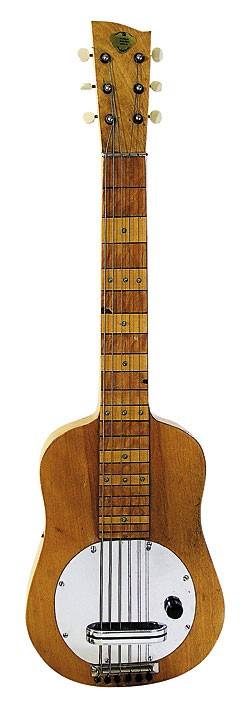
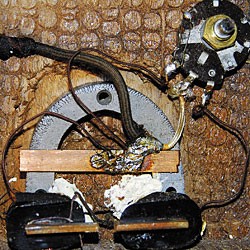
    The Hanburt pickup.

    The Hanburt pickup.

    Once they had the electrical components analyzed, the shape of the guitar was considered and Hansen moved forward with a body profile that is a near-identical knock-off of two Audiovox units: the Model #136 and the redesigned #436 Hawaiian Steel Guitars. Indeed, while Hansen did eventually add plenty of his own design flair to his guitars, the multiple similarities they share with Audiovox instruments are unavoidable. In fact, by the time he finished his first complete instrument (which still survives), it had taken on quite a few of the physical attributes of Audiovox instruments – which meant, of course, that his wife would love it!

    Emily took to the instrument with natural ease, learning to play it so fast that she was soon hosting jam sessions with other folks at their Woodlawn apartment. “They did a lotta stuff at that place,” Harold fondly recalled. “They had a lotta fun. They used to get big jamborees goin’ in that lower part of the building and they’d have people over. My grandmother [Iola Eupheney Holburt], she was a tiny little thing, she’d come in and play the piano, and she could outplay anybody! She would get these professional up-to-date people and they’d play something and she didn’t even need the music. She beat that big upright old piano ’til it wiggled! So they had big jam sessions down in the basement there. But they played their guitar – it was always there, making noise. My mother got pretty good at it.” Indeed, Emily apparently became adept enough that before long she began taking on students herself. And so they reorganized their storefront by dedicating a portion of it to a music studio where Emily began offering Hawaiian steel guitar lessons to the public.

    It was at this point that Hansen decided to establish his own commercial line of instruments under the brand name of Hanburt (which was simply a conflation of Hansen with Emily’s maiden name, Holburt) Electric Guitars. In addition, he also began building matching amplifiers (again based on Audiovox design specs) and hard-shell cases for the instruments. The intention, of course, was to produce guitars and amps they could sell to Emily’s students.

    The 1941 R.L. Polk Business Directory is the first that shows Emily with her own listing as a “Music Teacher (guitar).” The ongoing augmentation of their business activities is reflected in the 1942 edition which features a listing under the “Musical Instruments Manufacture and Repair” category for Hansen, and the couple amended their main business listing to reflect this new side business. Now instead of just advertising that they retailed lamps and lampshades, they boasted: “Hansen Lamps and Musical Instruments.” “He’d make ’em and sell them to her students, and she’d teach electric Hawaiian guitar,” recalled Gail. “She had a number of students. It wasn’t a big thing but it was steady income.”

    Indeed, the 1943 Polk directory amends Emily’s listing to “Music Teacher (Hawaiian guitar).”

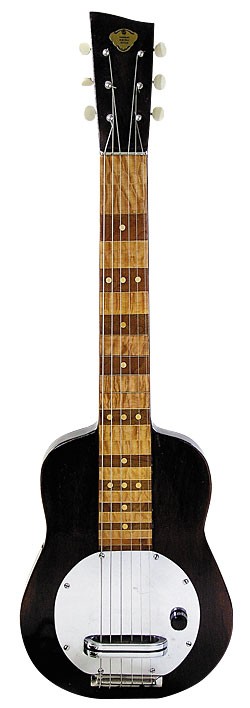
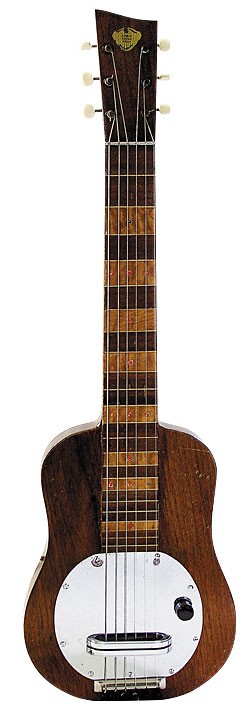
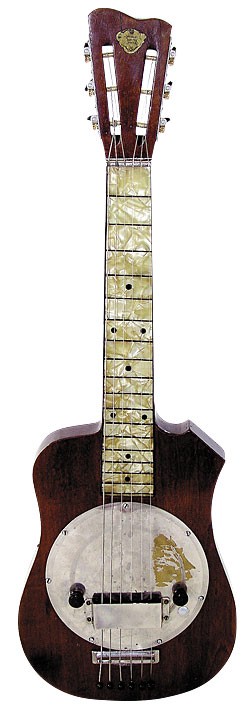
    Ultimately Hansen apparently marketed at least three different models of Hanburt electric Hawaiian lap steels. The first/earliest is like Emily’s – an essentially full-shouldered guitar-shaped body and 23-fret neck. The second (like those pictured in the photo of the vintage display) had a cutaway upper treble bout with a squared-off “horn” and 18-fret neck. The third had a stairstep body shaped much like a 1938 Art Deco-styled National New Yorker lap steel guitar.

    The design aspects and components on the surviving units include commonalities as well as the occasional variance. They usually have an eye-popping fretboard surface comprised of alternating light (maple) and dark (walnut) wood veneer strips (although at least one was given a white pearloid fretboard). Other typical features include a metallic-gold Hanburt logo decal (with a rose flower graphic motif) on the peghead, a freefloating and chromed cast-metal bridge, and bakelite or ebony end pins rather than the era’s more typical (and practical) stop or floating trapeze tailpiece. Some have smooth faceplates, others are etched. “Style 1” guitars have charming kitchen-drawer-pull palm rests and inset faux (pink, blue, golden) glass “jewels” for fretboard markers, while “Style 2” have sheet-steel rests and more typical inlaid markers.

    While some of these details are somewhat unique, Hanburt instruments evince considerable clues that Hansen had indeed borrowed a lot directly from the Audiovox guitars, including: a wooden body a parallel-to-the-bridge blade-style split-polepiece pickup with wired-in-series twin coils and a large below-the-strings horseshoe magnet; an asymmetrical wavy headstock; hardwired cloth-covered cord running out of the inside edge; “mirror-steel” faceplate; and metal nut and bridge.

    Considered in total, one might think a proud businessman like Tutmarc would have been furious about Hansen’s copycatting. And, sure enough, he was.

    The Hanburt Electric Guitars display

    The Hanburt Electric Guitars display photo that hangs today on the wall at Hansen Lamp and Shade shop in Seattle.

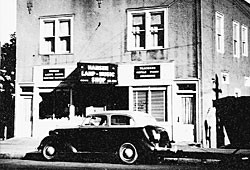
    The Hansen Lamp and Music Shop

    The Hansen Lamp and Music Shop. Lamp repair on one side, guitar instruction on the other.

    “Paul [Tutmarc] senior was pretty upset for a while that dad had come in there and done that,” Harold admitted. “There was some friction between him and Paul. Dad would put a little gold leaf label on his guitars and somebody from… Paul would get hold of it [and] take my Dad’s sticker off and put his on (laughter)! That was part of the game!”

    Even the good-natured namesake son of Tutmarc, the late Paul “Bud” Tutmarc, Jr., confirmed (when firmly prodded) that there indeed had been some tension between the two companies, but his father never bothered to pursue legal action against his fellow church member.

    Meanwhile, in or about 1944 the Hansen’s landlord raised the rent and by ’45 they’d relocated westward, beyond Green Lake a few blocks. Buying their own mixed commercial/residentially zoned building, they opened the Hansen Lamp and Music Shop and erected twin exterior signs that announced, “Repair: Lamps Radios Electric Guitars” and “Teachers: Guitars Piano Accordion.”

    “It was one of the oldest buildings on this avenue,” recalled Gail. “There was six units; one was a grocery store, one was somethin’ else. A couple of apartments up and a couple bachelor apartments in the basement. Our family lived where the store part is.” Gail also recalled that the main floor featured the lamp and shade retail area, and a separate music studio where Emily continued offering steel guitar lessons. “My mother used to teach Hawaiian electric guitar in the building. One side was the lamp store and the other side was the guitar studio.”

    “My mother played the guitar,” added Harold. “But dad couldn’t play – he made a couple little noises. He wasn’t a musician. He was a mechanic and could do anything with his hands. Couldn’t read a book – but he could make anything.” Perhaps it was in the years after Harold left home that his father gained a bit more musical skill, because Gail recalled, “My dad made an organ and played it for years. He made harps and guitars and organs.” And as one of the Hanburt retail display photos reveals, Hansen also made at least one Hanburt electric mandolin, as well.

    While the whereabouts of that mandolin remain unknown, in a similar fashion no one seems to have a clear grasp of the extent of Hansen’s guitar-building efforts. “He made guitars… and sold a lot of them,” said Harold. How many? Ten? A hundred?

    “Oh, probably more than that,” Harold recalled. “He had them stacked around – a lot of them. I remember that he ran around [Washington state] showin’ it to people, and sold a lot of them.”

    Perhaps so, but Gail (who lived at home long after Harold moved out), offers a quite different estimate – one that calculates that before Hansen stopped making them he’d produced a total of “Maybe 20 over the years. Then he got full-time into lampshades to make a livin’.” That estimate sounds about right to someone whose research has accounted for a total of 14 instruments (and three amps bearing the Hanburt brand).

    Interestingly, the Hansen family still owns Emily’s guitar, and it’s paired with a vintage Audiovox amp. For her part, Emily carried on playing and teaching until at least her 70s, but Gail thought that Harvey wound down his instrument-making around 1950. By ’51, the business had expanded, adding a second shop that was to be run by Harvey’s brother, Hadley Hansen. But they had a falling out and Hadley returned to California within the year. Soon after, his shop was closed and sold.

    Then, circa 1952, Harvey and Emily moved into a new home, where they spent their last years. Harvey took up still-life oil painting, and the two participated in lawn-bowling tournaments. In ’57, Harold opened his own business, Harold’s Lamps, in Seattle’s Wallingford neighborhood. Harvey retired in ’62, passing Hansen Lamp & Shade to Gail. In the mid ’80s Gail hired his own son, Jeff, to assist, and in ’95 he took over, just as Harold’s son, Kim, still carries the torch at their shop.

    Although Harvey, Emily, and Harold Hansen are no longer with us, the story of the family’s Hanburt Guitars enterprise – once seemingly fated to be relegated to the status of lost history – has been unearthed.


    Peter Blecha is the author of 1997’s Wired Wood: The Origins of the Electric Guitar, 1999’s Vintage Guitar feature, “Discovered: The World’s First Electric Bass!,” 2000’s Quest For Volume: Electric Guitars and the Auditory Arms Race, 2005’s Rock & Roll Archaeologist, and his latest, Music in Washington: Seattle & Beyond.


    This article originally appeared in VG‘s June 2008 issue. All copyrights are by the author and Vintage Guitar magazine. Unauthorized replication or use is strictly prohibited.

  • Jake Shimabukuro

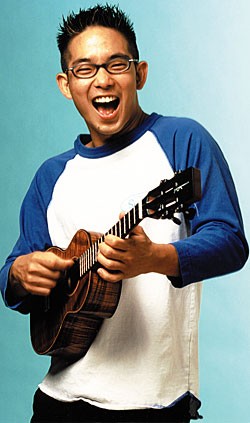
    Jake Shimabukuro

    Photos: Kaz Tanabe, courtesy Hitchhike Records.

    “Hey, have you seen that guy? You know… that guy! Have you seen him yet? He’s amazing!”

    That’s the question bouncing around the country ever since a video clip of “that guy” – Jake Shimabukuro – performing an impromptu solo version of “While My Guitar Gently Weeps” began showing up on the internet.

    Even though his name might not be that easy to remember (yet), he won’t remain “that guy” for long. The 27-year-old Hawaiian has been wowing audiences in Japan with his instrumental virtuosity for several years, and the spectacle of his stage shows has spawned two performance DVDs. That’s in addition to his three commercial CD releases. This Summer, he’s touring with Jimmy Buffett and Bela Fleck. But here’s the best part – Jake Shimabukuro plays the ukulele.

    “I know a few chords [on the guitar], but that’s about it. On [his new album, Dragon] there’s a track where I tried to play a guitar lead. It took me the whole day to get it. It’s a completely different instrument. I had never played electric guitar before, and never used a pick, so just trying to get the right tone took forever. And I’m still not happy with it! I just don’t feel that connected with the guitar, or any other instrument, really. I’m always so inspired to play ukulele.”

    And boy, can he play ukulele. His chords are as inventive as his solos are blazing, and he moves effortlessly between the two. So original is his style that he’s finding himself called the Jimi Hendrix of the uke, although the moniker makes the self-effacing Shimabukuro uncomfortable.

    “Jimi Hendrix is my hero, man, along with Eddie Van Halen and Yngwie Malmsteen. I used to listen to their music when I was growing up, and I still listen to their stuff. And every time I listen, I’m so in awe of what they did for their instrument.”

    The difference, of course, is that their instrument was six-string guitar, while his is the four-string tenor uke. And what Shimabukuro is doing for the instrument is garnering the attention of critics, concertgoers, and stars alike. Although the chance meeting with Jimmy Buffet that kickstarted his U.S. career this Summer almost didn’t happen.

    “It’s a funny story. I was doing a radio interview in a surf shop in Waikiki, and Jimmy Buffet had stopped into that same surf shop before I got there, and he noticed that they were playing my CD. He left a hand-written note to give him a call when I got in. Then he asked if I wanted to sit in on his concert and play a couple of songs with them. At first I thought someone was playing a joke on me or something, but it turned out to be the real deal. My life hasn’t been the same since.”

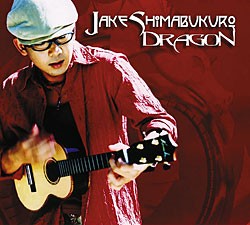
    Shimabukuro CD, Dragon

    Dragon

    Shimabukuro plays a Kamaka tenor in a standard C6 tuning, although his use of the familiar “my dog has fleas” tuning runs contrary to the way most tenor players tune. Shimabukuro prefers the high G on the top, like a soprano, “Because it keeps that traditional, unique sound. And because I have that high G, I’m able to create voicings you wouldn’t be able to get on other stringed instruments because you have that high string on top.”

    Shimabukuro’s custom-built pearl-trimmed uke is the perfect match to his style. Constructed of highly figured koa and inlaid with his initials, Shimabukuro is intensely loyal to the Kamaka organization.

    “The [Kamaka] family has really been supporting me for years,” he said. “My very first ukulele was a Kamaka; I was four years old! People always ask what kind of things I ask for, but I really know nothing about making ukuleles; I don’t tell them anything, I just let them do what they want to do. And I’m more than pleased with every ukulele they make. I’ve been playing [the same one] for about three years now. The last three albums were recorded with it.”

    Which is also happens to be the uke on which he played “While My Guitar Gently Weeps” in the video, another subject about which Shimabukuro is passionate.

    “I love the Beatles, and I really felt a connection to George because he was such a big ukulele fan, as well. I’m a huge fan of his music, and I believe to this day that a lot of the music he wrote was ukulele-inspired. Songs like ‘While My Guitar Gently Weeps’ or ‘Something’ Even ‘Here Comes The Sun.’ Because they are such ukulele-friendly pieces, they really are! The way the chord progressions work, it’s really coming from an ukulele player’s perspective. So I’ve always enjoyed arranging his songs.”

    While there aren’t any George Harrison covers on Dragon, it’s yet another ambitious undertaking for the young artist.

    “I produced it myself, and it was a lot of fun. It’s 11 original tunes and one cover. It’s very different from my other stuff, and there are a lot of different techniques. I feel very personal about this album, like it’s more of an expression of myself.”

    And expressing himself is just what he’s going to continue doing, right up until he’s a household name. But please, just don’t call him “that guy” anymore. Call him Jake.


    This article originally appeared in VG‘s November 2005 issue. All copyrights are by the author and Vintage Guitar magazine. Unauthorized replication or use is strictly prohibited.

  • Rick Derringer

    Rick Derringer

    Photos courtesy Rick Derringer.

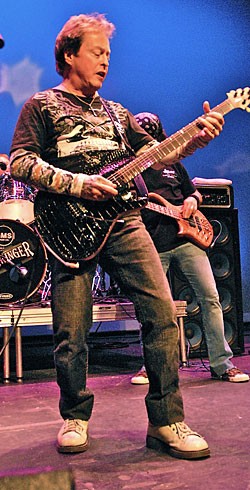
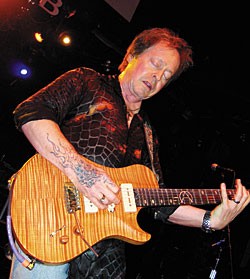
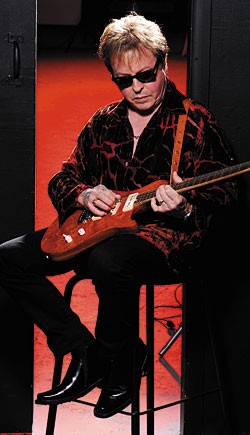
    Rick Derringer’s latest record, Knighted by the Blues, is an amazingly varied album from a guitarist who has been in the music industry for more than four decades. Highlighted by a player who’s still in top form, playing as well as ever, the disc reflects Derringer’s attitude and the fact he is both confident moving forward and comfortable reflecting on his remarkable career.

    How did the idea for Knighted By the Blues come about, and did everything come together as you were expecting?
    Well, it was made for Mike Varney’s label, and I’ve done others for Mike, and each time he gives me a little more freedom to do it the way I think it should be done. This was the first time he said, “You don’t have to come to California. You can do it in the studio where you usually work and use whatever musicians you want. I won’t even tell you what songs.” So it was the first time he completely gave me the reins. He does call them blues albums, but Mike Varney’s idea of the blues is not strict blues. He likes things a little over the edge and high-energy. So I was able to stretch a little bit. I don’t think he would have recommended a song like “Funny, I Still Love You,” and I know it’s problematic getting license for a Jimi Hendrix song, so I know that he wouldn’t have encouraged me to do “If 6 Was 9,” but since I had a little freedom, I did those songs, and he really liked it.

    I also had an opportunity to play with a couple of great players – they’re brothers – Dave Reinhardt plays the drums and Ron Reinhardt plays keyboards. They’re a couple of the best I’ve ever played with, on any album. They’re just a pleasure to work with, and it was a real privilege. Same goes for the engineer I work with in Florida, George Harris. He’s one of the best.

    One of the great things about the record is its mixed bag of music.
    It’s always been hard for me to focus and make things one slice. I like a whole big pie.

    Rick Derringer

    One of the beautiful things about your breakthrough 1974 solo album All-American Boy, was that it was so varied.
    The record companies always come back with, “Hey Rick, you could have had a lot more success if you would have just focused on that rock and roll.” So they weren’t always happy with what I did, but I think it helped me attain a longevity that some other bands didn’t have.

    Given your well-rounded approach one would assume that when you were learning, you listened to everything?
    I did. When I was a kid, my folks had a huge record collection – Les Paul and Mary Ford and a lot of country, Merle Travis, Chet Atkins. And then on the other side they had Wes Montgomery and stuff like that. So I really had a well-rounded start. But it wasn’t long before Elvis broke through and I was really struck with rock. And when you start playing, of course, you want your friends to be just as excited as you are, so one of the best things about playing guitar is winning friends and influencing people. So I really concentrated on a lot of rock.

    Speaking of friends, you’ve had plenty in the biz involving names we all know. Did your early start lead to those relationships?
    Yeah. That’s really it in a nutshell. We were told by our parents you wouldn’t have enough success as a musician to really make it, so you’d better have something to fall back on. I was going to be an artist – I was enrolled in the Dayton Art Institute. I was accepted and ready to go, but that summer we recorded “Hang On, Sloopy” and I ended up not going to art school. It was a surprise that we had that kind of success and did kind of just fall into it. I realized right away that it wasn’t something that necessarily happens to everybody. I was tenacious about hanging on to it. I like the music business. I love writing, producing, playing, concerts, the studio – I love it all.

    Must have been a real eye-opener for a teen to be opening for the Rolling Stones?
    We did everything. We went around the world. People inevitably ask about Johnny and Edgar, and I love them and they’re doing great, but what most of those people don’t know is that I’d already been touring around the world before I ever met them.

    Rick Derringer

    Edgar pops up now and then in situations you least expect him.
    Well, he lives in Hollywood and has access to those high-visibility situations. There’s no telling where he’ll turn up. Me, on the other hand, I live sometimes in Florida, sometimes in New Mexico, and sometimes in Tennessee. I kind of drift around. The closest to the music business is Franklin.

    How did you end up co-writing “Hold” with Patti Smith on All-American Boy?
    We were friends, and we’ve co-written several songs. Steve Paul, who was my manager at that time, had a very eclectic view of the world and sat in a kind of interesting place in New York City. He had a club where a lot of people came, and he was really into the art scene. Patti was, at that time, Robert Maplethorpe’s girlfriend. We were kind of immersed in that whole world of poetry and art, and Steve encouraged us to write together. He thought it would be a good combination, and I enjoyed it.

    How did you end up as one of the many wonderful guitarists who played on Steely Dan albums?
    While I was living in New York City, which I did for 26 years, I had the opportunity to meet and play with a lot of people. One day a guy named Gary Katz (longtime Steely Dan producer) called and said, “I’m going to produce some demos to try and get this guy a record deal.” I asked who it was and he told me the guy’s name was Donald Fagen. He asked if I’d play on the demos, and I said “Sure.” They called me after their first record was successful and asked me to do more work with them, which I did. I played on a lot of their records. I don’t even really know which songs because they didn’t always list credits. But I played a lot of rhythm for them, and ended up playing on Donald’s solo album, The Nightfly, too. I enjoy playing with those guys any time they call.

    Do you produce anyone else these days?
    I love to work on my own stuff now more than anything, but that doesn’t mean I wouldn’t do other projects for other people. I’m not as into speculating on artists who aren’t well-known and need record deals. That stuff’s getting harder and harder all the time. But if a record company calls and tells me they have a great artist and a budget, I’m certainly apt to say yes to that situation.

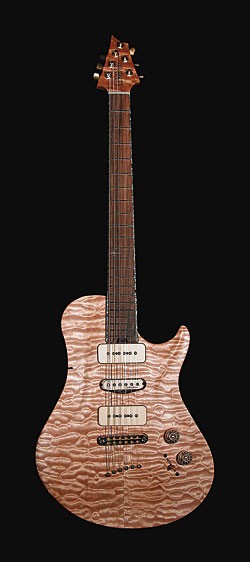
    Rick Derringer signature Warrior guitar

    Rick Derringer signature Warrior guitar

    Are you doing any studio work these days?
    Yeah, sure. One of my favorite solos I ever played was on the Air Supply song “Making Love Out of Nothing At All.” Whenever I hear that on the radio, I tell my friends the solo is coming up and it’s cool (laughs)! Russell Hitchcock, the main voice of Air Supply, has been working on a new CD and they asked me to play on a couple of songs. There was one I really liked that sounds like it should be one of those big pop/country crossover hits.

    Were you in a lot of studio situations during that time?
    Quite a bit. Bonnie Tyler’s “Total Eclipse of the Heart.” I played all guitar parts on that album (Faster Than the Speed of Night). I played on everything from Streisand to Kiss – all kinds of things.

    I’ve talked to a lot of players who played on Kiss records that you’d never expect.
    Well, they really wanted to make hits. And they reached out to a lot of good players to make those records.

    In the last several years you’ve worked with builders to design signature guitars and amps.
    I used one guitar on this whole record – the Rick Derringer signature model I worked with Warrior to design and create. We started working together six or seven years ago. What they allow for me is the hands-on ability to create a guitar; I think of changes that might improve it, and they try them. If we both like the results, they’re incorporated.

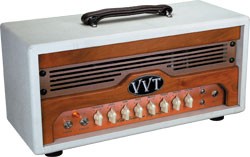
    For my amp, I wanted to create a Rick Derringer-style amplifier. Four or five years ago, I started working with some designers and made some great amps. One of them really stood out, made by VVT – the Hyperdrive. I used it on 90 percent of the record.

    The VVT Derringer signature Hyperdrive amp

    The VVT Derringer signature Hyperdrive amp

    Is there a guitar you’d compare your signature model to?
    It’s really hard. Over the years, I’ve played a ES-355, Les Pauls, a Strat, Steinbergers, B.C. Rich, and PRS guitars. Paul Smith made some beautiful guitars for me. So what we tried to do was take the best of all those instruments and create one that could compete with all of them.

    Did you keep any of your old guitars?
    Yeah, I still have the ’65 Strat I used on some records. And I have the world’s cleanest ’66 Strat. It’s sunburst, and most who see it think it’s a reissue. I also have a two-pickup wide-body Paul Reed Smith. It’s beautiful.

    Your music is living into the next generation thanks to a certain video game. Teenagers everywhere are huge fans of “Rock and Roll Hoochie Koo.”
    The younger crowd all knows it now from Guitar Hero. I was in an Indian restaurant the other night, and I told the waitress I’d eaten Indian food all over the world and told her theirs was really good. She asked me why I’d eaten it all over the world. I told her I traveled because of music. She went, “Oh, are you big?” I realized I was talking to a 17-year-old and told her I had a song on Guitar Hero. She was all freaked out when I told her it was “Rock and Roll Hootchie Koo,” and said she played that one all the time. So it’s cool that a whole new generation is getting into some of that music.


    This article originally appeared in VG‘s October 2009 issue. All copyrights are by the author and Vintage Guitar magazine. Unauthorized replication or use is strictly prohibited.


    Rick Derringer (Edgar Winter Band) – Rock’n Roll Hoochie Koo

  • Eric Clapton & J.J. Cale

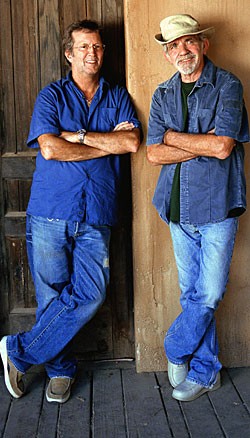
    Eric Clapton & JJ Cale

    It’s fitting that The Road To Escondido, the long-awaited collaboration between Eric Clapton and J.J. Cale – a concept that seems, on the surface, to be so obvious, at least to fans – took decades to materialize.

    Cale, in particular, never seems to be in a hurry. Since his debut album, Naturally, in 1971, he has released – at a suitably laid-back pace – 13 studio albums (often recorded at his home; in some cases literally on his back porch) and one live album.

    Clapton, on the other hand, in roughly the same span of time has released 16 studio albums, six live albums (including the Grammy-winning MTV session, Unplugged), and a collaborative effort with B.B. King, Ridin’ With The King. That’s in addition to the stints with the Yardbirds, John Mayall’s Bluesbreakers, Cream, Blind Faith, and Delaney & Bonnie & Friends that preceded his self-titled solo debut, and the releases by Derek And The Dominos that followed it (one live, the other the classic Layla And Other Assorted Love Songs) – not to mention virtually nonstop touring (something Cale does rarely).

    But despite only appearing onstage together twice (at shows 27 years apart), in a way they’ve been collaborating continuously since early 1970. That’s when, at the suggestion of producer Delaney Bramlett, Clapton covered “After Midnight,” an obscure single Cale had recorded for Liberty Records, and the pair’s lives became forever intertwined. A symbiotic relationship began, albeit long-distance.

    Cale became as big an influence on Clapton’s songs (whether penned by J.J. or Eric himself) and overall sound as the blues masters had been on his guitar playing (which often veers into snaky, Cale-tinged licks). The man who virtually created the blueprint for the Guitar Hero, a huge influence on countless guitarists from unknowns to stars, is also part chameleon, capable of getting inside any number of other guitarists’ styles – including Cale’s.

    And the Top 20 success of both the Eric Clapton album and the single of “After Midnight” provided Cale with enough income to launch a solo career and keep cranking out songs. Clapton subsequently cut “Cocaine” and “I’ll Make Love To You Anytime,” and other Cale tunes (like “Call Me The Breeze,” “Magnolia,” “Cajun Moon,” and his own hit single, “Crazy Mama”) were recorded by artists ranging from Chet Atkins to Deep Purple, from Waylon Jennings to one of Cale’s guitar heroes, Clarence “Gatemouth” Brown.

    Meanwhile, Clapton continued to assimilate and home in on the J.J. approach, with albums like 461 Ocean Boulevard and Slowhand (with the hit “Lay Down Sally,” penned by Clapton with bandmates Marcy Levy and George Terry) sounding like veritable homages to Cale.

    In 1981, after Clapton released Another Ticket, featuring his original “I Can’t Stand It,” Cale laughed, “Yeah, I don’t get any reward for that – but that’s okay. See, he’s getting to a point where he can write that way. …You finally get to a point where you can write the whole thing in any style you want to do it in. So he finally figured out how to write all that. Which might be bad for me. But it’s not in the song; it’s in the feel. And once you’ve figured that out – well, he’s figured that out, so he doesn’t need to use my words anymore.” (Clapton later covered Cale’s “Travelin’ Light,” on Reptile.)
    Although they’re obviously kindred spirits and, as Clapton says here, share the same philosophy, the two couldn’t have taken more different paths and led more different lives.

    John Cale, who just turned 68, grew up in Tulsa, Oklahoma. By his teens, he and his guitar were playing country gigs before making the transition to early rock and roll. Along with other Tulsa musicians, including Leon Russell and Clapton’s future bassist, the late Carl Radle, Cale moved to Los Angeles in the mid 1960s. When he was booked to play off nights during Johnny Rivers’ long-running stint at the Whiskey A Go-Go, the club owner suggested he change his name to J.J. Cale, because there was already a John Cale, in the Velvet Underground. To this day, friends call him John or Cale, and he sometimes refers to “this J.J. Cale deal” as if it were a different person.

    While Cale struggled as a session guitarist, engineer, and sometimes producer – or all three, as on an album by a nonexistent psychedelic band called the Leathercoated Minds – Eric Clapton was rising to heights no mere “guitar player” had ever scaled. The art-college student from the wrong side of the tracks first made his mark with the Yardbirds. He joined the band at age 18, and by the time he left a year and a half later his playing had reached a level of maturity well beyond his 19 years, soon revolutionizing blues and rock guitar.

    After a month of intense woodshedding, he joined John Mayall’s Bluesbreakers, where his massive tone, aggressive phrasing, and unheard of sustain on the instrument earned him a cult following eclipsing his bandleader. During the 15 months he was in the band, “Clapton Is God” graffiti began showing up at overpasses and tube stations.

    Within days of his last gig with Mayall, he played his first gig with bassist Jack Bruce and drummer Ginger Baker, under the name Cream. Although it boasted fine songwriting and singing, the trio of virtuoso soloists was the band’s main attraction – much like that of a modern jazz combo, perhaps for the first time in rock history.

    By the time Cream played its farewell gig in November of ’68, Eric Clapton had come to epitomize what every guitarslinger aspired to be: arguably the most famous guitarist in the world – at the ripe old age of 23.

    But every accolade seemed to be counterbalanced by tragedy – all of which was played out in the fishbowl of success. Ironically, although he was wary of fame and fortune and the intrusion that comes with being a public figure, he invariably laid himself bare, expressing even the most personal and tragic events in song. His affair and breakup with his friend George Harrison’s wife, Pattie Boyd, inspired “Layla.” The song succeeded in winning her back (eventually resulting in his first marriage years later), but not before he became addicted to heroin.

    Guitar-playing friends Jimi Hendrix and Duane Allman died young, and he later lost his close friend from The Band, Richard Manuel, and his longtime bassist, Carl Radle. And in August on 1990, after Clapton topped a bill that included fellow blues greats Robert Cray and Stevie Ray Vaughan & Double Trouble (with Buddy Guy and Jimmie Vaughan sitting in), the helicopter carrying Stevie Ray crashed, killing the guitarist, the chopper pilot, and Eric’s booking agent, bodyguard, and assistant tour manager.

    The following March, his son, Conor, fell from a New York apartment window and died at age four and a half. In his honor, Clapton wrote the Grammy-winning “Tears In Heaven” – its gut-string fingerpicking and soft melody in sharp contrast to the blazing blues of years before.

    Likewise, the pride and joy of The Road to Escondido’s (Reprise) “Three Little Girls” is a far cry from the desperation of “Layla” – mirroring happier times for the 61-year-old husband and father of three young daughters. And having long since kicked drugs and alcohol, he founded the Crossroads Centre rehab on the Caribbean island of Antigua, in 1998 – largely underwritten by auctioning off guitars from his personal collection, in 1999 and again in 2004, coinciding with the Crossroads Guitar Festival, a two-day event held in Dallas.

    If you want a barometer for Clapton’s enduring popularity, you need look no farther than the two most prized guitars that were auctioned that year. For a battered mongrel Fender Stratocaster (the famous “Blackie”) and E.C.’s red ’64 Gibson ES-335, Guitar Center paid nearly two million dollars – $959,500 for Blackie, $847,500 for the 335 (both since replicated in limited-edition reissues by Guitar Center in conjunction with Gibson and Fender).

    Along the way, Clapton joined Bruce and Baker for a 2005 reunion of Cream at Royal Albert Hall, the site of the magnificent Concert For George, which Eric directed in memory of “the quiet Beatle.”

    While Clapton’s every move was being scrutinized by both music and non-music press, J.J. Cale was opting for a comfortable life as a songwriter, even though he viewed himself as John Cale, guitar player. For years he referred to his albums as song demos, in which he experimented with various studio tricks and gadgets and tried his best to bury his vocals in often purposely murky mixes.
    But all the while he was carving out a niche as a singer and songwriter as distinctive as his guitar playing – and as influential, infiltrating not just Clapton but Dire Straits and others. The laid-back mix of blues, country, jazz, and rock that came to be known as “the Tulsa sound” was largely forged by Cale. And Clapton filled his band with Tulsa boys, getting a steady diet of “Cale stories” years before he met the man – or, as he points out here, even saw a picture of him (oddly similar to Clapton’s biggest hero, Robert Johnson).

    And the self-described “senior citizen” suddenly seemed more active than ever – releasing a live CD in 2001, playing the Crossroads Fest (with a certain Englishman on second guitar), and making his best album since Naturally and even submitting to on-camera interviews for an on-the-road DVD (both titled To Tulsa And Back).

    In one of the interview segments in the DVD, Clapton talks about asking Cale to produce his next CD, wanting to capture that Cale sound and vibe. That project evolved into a duo album, co-produced by the pair.

    With Cale writing 11 of the CD’s 14 cuts, and Cale’s Oklahoma “cronies” acting as the initial studio band, it’s not surprising that The Road To Escondido (on Reprise) sounds a lot more like a Cale record than a Clapton album – or more like the albums Clapton was making 25 to 30 years ago. Cale details, “Two of the songs were outtakes that didn’t make it onto earlier albums. I took the songs and rearranged them – said, ‘I think I’ll slow this one down,’ or, ‘Maybe I’ll use the words and the chord changes.’ ‘Who Am I Telling You’ was a boogie, and I turned it into a ballad. Seven songs I wrote for this CD, and ‘Don’t Cry Sister’ and ‘Any Way The Wind Blows’ I already did on older albums, but Eric wanted to do them. I sent him about nine of my songs and ten by other writers, and he didn’t record anything but my songs.”

    The album eases into a mid-tempo groove on the opening “Danger,” showcasing the late Billy Preston on organ. “Billy played organ on almost all the cuts,” John says, “and Walt Richmond played acoustic piano on almost everything.” Clapton takes the first and third solos, with Cale in between. Even though Cale has influenced Clapton greatly, it’s still easy to spot who’s playing guitar – their styles are plenty distinctive. (On “Any Way The Wind Blows,” it’s the reverse – with Cale’s two turns bookending Clapton, before both go at it as the song fades.)

    Cale employed three drummers – Jimmy Karstein, James Cruce, and David Teegarden – but, as he points out, “only one drummer would be playing a kit; the other two would be on percussion.”

    Another Tulsa vet, Gary Gilmore, played bass, but, John explains, “He works as a semi driver, and he could only get two weeks off, so he had to leave to go back to his regular job. So Willie Weeks came in and played bass for one day, and Steve Jordan played drums just that one day, too. They’re both in Eric’s band, and Nathan East, who used to be in his band, was there one day, too. Later, Pino Paladino and (drummer) Abraham Laboriel, Jr., were overdubbed.”

    “Missing Person” features a distorted solo by Eric, a slide solo by Derek Trucks, and some harmonized riffs by Cale. Trucks also supplied slide on “It’s Easy,” “When The War Is Over,” and “Who Am I Telling You?” For the bluegrassy speedster “Dead End Road,” there was only one man for the job: Clapton’s second guitarist in the ’80s, Albert Lee.

    The only non-original is Brownie McGhee’s “Sporting Life Blues,” which features Taj Mahal on harmonica and Clapton playing an old guitar but a new acquisition – a 1929 Gibson L-5 that Cale gifted him during the sessions.
    Acoustic rhythm was provided by Mrs. Cale, better known as Christine Lakeland, with Doyle Bramhall contributing rhythms and counter-melodies throughout, and John Mayer trading solos with Clapton on “Hard To Thrill,” which they co-wrote.

    “Don’t Cry Sister” has all of Cale’s trademark licks, including harmonized, overdubbed, multiple guitar lines – all supplied by Clapton, who uncannily dupes every nuance from J.J.’s original version of the song, on the 5 album. Conversely, Cale, who mixed the CD, added some effects to Clapton’s already-wah’ed licks on “Ride The River.”

    Before leaving for Japan, Clapton used his short break from the road to sit down for two days’ worth of interviews, and managed to get Cale to join him. Most of the time was devoted to TV and mainstream press, but the two guitarists generously set aside time for Vintage Guitar. They seemed relieved to not have to answer, “What’s the real meaning of the song ‘Cocaine’?” one more time, and talk music instead.

    An interview with either is a rare opportunity; having both legends in the same room together was a once-in-a-lifetime master class.

    Vintage Guitar: Why did it take so long for this to happen?
    Cale Eric came up with this idea, and it was time to do it. I think any other time before now, you know… making music is a creative process.

    Clapton It was so simple, it’s amazing.

    Cale It never dawned on me. People think that Eric and I are old cronies from way back, which we haven’t been. We’re kind of musical brothers – a long-distance kind of a thing. I don’t know how that would have happened any sooner; I guess I could have. It’s almost like asking, “Why weren’t you born in 1920? Why were you born in 1938?” I didn’t have anything to do with it. Eric came up with this idea, and I thought about it. I thought we’d probably play some gigs together.

    Clapton I wish we had sooner – for sure. I would hear those albums, in the ’70s and ’80s, and think, “Why didn’t he ask me to play on that?” [laughs] All these people he’s got. I’d think, “Maybe I’m too famous.” Because all the people who would be on John’s albums have been great players, but who are these people? Bill Boatman. Who’s Bill Boatman? All these great names; you’re just amazed.

    And I certainly had to grow up, and I had lots of other fish to fry, too. But I would look at those records, and I would have loved to have played on “Magnolia” and those songs. So I just had to bide my time.

    Do you think that because you just sort of organically let it happen when it was time, the age you guys are and this stage of your life, it made it a better record because of that?
    Cale I don’t think it made it any better… it’s what we did. Like I said, it just happened. We’re old enough to know as things happen in life, they just happen.

    Clapton I think it happened also because I didn’t want it not to. I mean, he might have asked me – who knows? But I asked him because I don’t want either one of us to drop off the planet without having this happen.

    You might not have tomorrow…
    Clapton Yeah.

    Cale Billy Preston was on this. I did an interview today, and the guy knew I mixed the album, so he said, “The song ‘Danger,’ did you mix Billy Preston up because he died?” I said, “No, I spent several months mixing that, and I mixed that song before he died.”

    Clapton He thought it was like in tribute to him?

    Cale When I played it for Eric the first time, he said, “Oh, I didn’t realize Billy played so well on that one.”

    Clapton Yeah! It became actually the tone of the track.

    Cale So I mixed him up when I heard what he was playing. But he asked me did I mix the damn thing up because Billy had died. I went, “No, man.”

    Clapton Silly thing to say. He’s lucky you didn’t bite his head off.

    When you got up and played the whole set with John at Crossroads, that was the second time you’d ever played together live. When was the previous time?
    Clapton Way back – in the ’70s, when we first met, and John came to play in London. I went to see him, and I can’t remember… I was with someone. Would I have been with Carl Dean (Radle)?

    Cale You might have been, because we came over to the studio after the gig.

    Clapton Olympic. Around Slowhand (recorded in May ’77). And Carl was in that band I had then, with Jamie (Oldaker).

    Cale He was way in the background; I didn’t even know he was back there. People told me, “Eric Clapton’s sitting in with you back there.” During his shy period.

    Clapton I thought it was the mode – that we had to work around him.

    Cale Eric was sitting back there, and some of the English people were mad at him because he didn’t stand up.

    Clapton That was the first time we met, and then a couple of times after that. Not many times.
    The nice thing about the Crossroads set was that you just became part of the band. It wasn’t, “And now for the encore…”
    Cale Yeah, he’s great at that.

    Clapton Just try to get on the merry-go-round and figure out what they’re doing. What else could you do? I don’t remember how we decided it. Did we talk about that and then do it?

    Cale It was just, “Come on out and play.” I said, “I’m probably gonna do ‘After Midnight’ and ‘Cocaine’ and ‘Call Me The Breeze,’ and I don’t know what key I’m gonna do them in. Just follow it.” In the DVD thing (To Tulsa And Back), he said the song was half over before he figured out I was doing “After Midnight.” I change it up every night. I’m sure you do that, too.

    Clapton With my outfit, I keep everything pretty much the same except what you play in the solos.

    Cale I don’t. I change it. Sometimes I do it slow, sometimes fast. I’ve done “After Midnight” as a waltz before. I just get bored of listening to the same old thing. But I didn’t call out the key or nothing; I just started playing. I used to have the drummer count things off, but I had just gone out solo, so, even after I added some band guys, I just kept doing the solo deal, and they would join in. When I start off, it can be any song.

    On that DVD, you’re talking about Cale, and you say, “If you played his music for a black person, they’d identify with it.” But the same thing could be said for your music.
    Clapton Yeah, hopefully. I don’t remember saying that, but I’m sure I did. I guess the point of it was that his thing seems to come from so many different influences. And I thank God that I got to know these guys, because I would hear stories about John – especially from Carl, because he was deep into all that. I went and stayed with Carl in his place out in Claremore, just outside of Tulsa, and we’d go into Tulsa almost every night and look at what was going on, and I was stunned by the amount of music that took place there, the amount of activity. I kind of got to see how this stuff came about.

    Because there’s a lot of mythology – “Shootout On The Plantation” by Leon Russell and all this stuff. Leon sings about it, and Taj, and Jimmy Markham – all these famous people, who are only famous in this kind of network. People like (drummer) Chuck Blackwell. I find it incredibly appealing. So what I may have been trying to say was that that seemed to be a melting pot. I went to see the Gap Band play there, and it was not like a black club; it was just Tulsa people. It wasn’t about black or white or anything. I hadn’t been exposed to a lot of country where I came from. I got it all then; got a taste for it then.

    Cale Austin’s kind of that way. There’s a music scene there in and of itself. Tulsa was like that. I thought every place was like that. I thought if you lived in Cleveland, there was a Cleveland sound – and there probably is. It just didn’t resonate into another thing. I mean, look at Memphis; there’s a history there. The Tulsa people didn’t really make it into the big time. Some, like Bob Wills, did. Then Leon, David Gates. Eric’s a leader with a sideman philosophy, so all those people he liked, like Carl Radle, were sidemen.
    Clapton Yeah.

    Cale It’s easy to fit in when there’s no leader. That’s kind of what Tulsa is like; there’s not a leader. Somebody’s got to call the tunes, and somebody’s got to warble it out, but there’s no, “I’m the boss, and you’ve got to play it this way.” I think Eric was looking for that, because he’s even that way now – not being the guy way out front. I like being the guy out front, but I want some other people out front, too. Because you can really separate yourself mentally from the sidemen – you’re so out front, and there’s no way you can get around that. Tulsa was the kind of place you could slide in, and, “You want to be the leader? You be the leader tonight, you be the leader tomorrow night.” [Clapton laughs.] That was the Tulsa sound, to me. It was an attitude more than it was in music. There’s good music everywhere.

    On the Tulsa DVD, you talk about playing more economically with Cale than you do in your own band. But then a year after Crossroads was the Cream reunion, where you had a lot on your shoulders – more so than even in your own band. Was that much of a hurdle?
    Clapton It’s very naked playing in a trio, but, then again, that might be a false assumption. It’s kind of like saying, “Well, there’s got to be something going on all the time.” There’s a level of anxiety in that. But maybe there doesn’t have to be. There are people who can put that kind of thing together and leave air. I just have that anxiety thing, where there’s got to be something going on. If there’s a space, fill it. It’s not right, but I’m compelled to do that.

    But it worked with Cream, then and now.
    Clapton Well, it does work – and, if I don’t do it, Jack will do it, or Ginger. The first thing we did in England was good, because we worked on it. We spent time and gave it respect, and we spent a month rehearsing the songs and getting ourselves back up to speed. Then when we went to America, we made some arrogant assumptions that we didn’t need to do that again, and I think it suffered. It kind of got back to where it used to be; there was a bit on infighting and stuff. We went for the money, is what happened. We got a big salary for coming to America, and I think that bent everyone out of shape to some extent. That’s my take on it anyway.

    The first time it was like a homecoming. It was a very emotional, genuine experience; it wasn’t for the money, and we all really got a lot out of it. Then someone started waving the dollar bills, and, “Ooh, yeah.” I could have said no, but I knew, for instance, Ginger has been struggling, you know, and he’s always been in trouble with the tax man and different things. He really needed that, so it was great to do it, in the end. He benefited greatly from that. And it was all right. But playing in a trio is hard work. If I were going to do it again, I’d learn how to play in a way that wasn’t so manic. There must be better ways to do the trio thing.
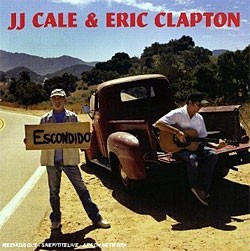
    Eric Clapton & JJ Cale Album

    It’s funny, though, because there are people who base the way they play guitar, or took up guitar, because of that.
    Clapton I know, I know. Well, a lot of people reckon that Led Zeppelin came out of that. I mean, I was never a fan of Led Zeppelin, but the void that Cream left was like, “Oh, we need a super-group, heavy band.” And apparently they didn’t even know one another. It was a masterminded thing.

    Did you use any guitars out of the ordinary for this CD?
    Clapton John gave me a guitar. He had some guitars in the garage, and we started going through the cases, and I saw this one…

    Cale …a 1929 Gibson L-5 with a DeArmond pickup.

    Clapton And it’s fantastic! I used it on the album, because it had the sound. Just a little bit distorted.

    Cale He played that on “Sporting Life.” I originally bought it from Norm Harris. I’ve had it a long time, and I don’t ever play it. Eric came to my house without a guitar, and it was all funky. I said, “I’ve never cleaned it.”

    Clapton I started playing it, and I thought, “That’s funny; the paint’s coming off.” And it was dirt [laughs]!

    Cale There was some grease on it. It was not me. When I bought it, it was like that. It was in the original case, and when you open it, here’s this smell. Only something from the ’20s has that smell. And you let it sit out for 10 days and put it back in there – when you open it up again, it still has that. You could smell the guitar.

    Clapton That came home with me. He let me have that.

    Cale He played a Stratocaster on a lot of the CD, his signature model Martin on a couple of things, like “Three Little Girls.” And I don’t know if we used it or not, but you played a 335 on one thing.

    Clapton Most of it, I played Strat and an L-5. (Ed. Note: Eric’s longtime guitar tech, Lee Dickson, reports that he mainly used his Fender Eric Clapton Signature Model Strats. Lee adds, “He also used a blond ’50s L-5 with alnicos. The 335 that was auctioned was a ’64; the one he’s playing at the moment is a dot-neck 1960. It’s one of the best 335s I’ve ever seen or played; it’s incredible.” In the studio, Clapton played through a ’57 reissue Twin with two 12s, “and we hired in a Champ and a Deluxe.” Dickson details: “Onstage, during this tour, he’s using the ’57 Twins, a Leslie, and he stopped using the Cry-Baby wah after the beginning of the tour.” Cale played a white Danelectro Convertible through a Fender Blues Junior as his main rig, and, he explains, “All the overdubs I did were mainly with my Casio Strat copy. The Dan-o has been modified; it has a piezo in it, and I play it in stereo – but for the record I just played it mono.”)

    After auctioning all those guitars, are you down to the bare essentials?
    Clapton In the auction there was an L-5, and I’ve got L-5s. I often have two of each. So I’ve still got some nice guitars that I can play. Not as many as I had.

    Cale One of the best things you’ve ever done in your whole career is that DVD – and the festival itself. I’m talking about guitar players – and there are a lot of them in the world. What you did with that is you got all these wonderful guitar players and put all that together. You’re the only person on the planet who could have pulled that off.

    I was there, and that was probably the best thing he’s ever done. And not only that, he played with everybody.
    Clapton You can’t make any money from doing events like that; the overheads are phenomenal. But the auction made $5 million, which goes straight into the rehab and sits there and gets drawn out when someone comes in who hasn’t got the money. So it will get used really well. What we’ll probably have to do is another mini auction, but I’m running out. Now I’m going to have to start to sell the stuff that I don’t want to sell.

    But you could still buy more guitars.
    Clapton Well, I did. Right after that auction, when I sold the red ES-335, I went and bought a sunburst one. It’s a great guitar. I mean, the Fenders are fine, because the brand-new Fenders they make are fine; I love them. But I played this 335 the other night, and it’s so loud. I’d forgotten how loud they were.

    Cale Christine ordered one of your signature Stratocasters. What it’s got is the tone-tweaker deal.

    Clapton Fattens it out.

    Cale Runs up the midrange (25 db).
    You’re an identifiable stylist, but sometimes you’ve been a bit of a chameleon.

    Clapton Yeah.

    But, even when you are a chameleon, you’re still identifiable as Eric Clapton.
    Clapton I like to think so, yeah.
    On the other hand, John, you’re more like, say, Lonnie Mack. Obviously, there was a lot of history that people didn’t know about, but the first record you ever made, it was as though your style sprang up full-blown, completely realized, and never really changed.

    Cale Yeah, I don’t know how to do it any other way. I tried. My critics go, “Well, everything you do sounds the same,” and I think, “Well, I need to invent something different from what I do.” So I tried, and it always sounded like crap. So I just keep doing the same thing.
    But it’s not all the same. You put yourself in different environments, but whatever you do to your guitar sound or style, the approach is still J.J. Cale. And sometimes Eric plays like J.J. Cale.
    Cale Mainly on the songs I wrote.
    You can spot who’s who on the CD…

    Clapton I think it’s fairly easy. I think we deliberately played our way. But I think maybe in the early years there was an over-riding mood to most of his records, but later things are really different.

    Cale Yeah, I don’t think I play like I used to. In fact, I’ve tried, and said, “I wish I could sound like that again.” But I can’t.

    Clapton For myself, if I can’t play the blues in something, I won’t go there. I’ll give you an example: I was approached to do a song on this Tony Bennett thing (Duets: An American Classic), and I said I’d love to. And they said, “Well, here’s what we suggest.” It was “Fly Me To the Moon” and “Just A Gigolo.” I can’t do that. I didn’t want to be rude, but I said, “Have you got anything else?” – and they came back with “Smile.” I said, “Oh, I can do that” – because I can hear a blues framework in “Smile,” and I used to do “Smile.” Because the O’Neil Twins, the guys from Tulsa, did a gospel version. But they came back and said, “Well, Barbra Streisand wants to sing that”; I said, “Well, bye all.” [laughs] Because that’s where I preserve my bit. You’re talking about it being identifiable. It’s a conscious thing; if I can play the blues or sing the blues in it, I’ll do it.

    Cale Eric was at the house the first week – we were sitting down trying to figure out what we were going to record – and he can sit down and play all kinds of amazing things. Before the band got there, he and I were sitting around noodling, and he played something, and I went, “Oh, I wish I had the tape recorder on, because that was just gorgeous.” And he said, “Oh, John, sometimes it needs to go into the air, and nobody hears it.” But what a loss to people. I had never heard that before. In other words, it’s totally against your ego.

    Clapton Nobody ever makes records like that. You get to the point where you think, “I’m going to make a record,” or, “I’m going to record it,” something changes. Something kicks in.

    Cale Yeah, you start over-thinking.

    Clapton If I sit and play like that at home, someone’s going to go, “Oh, I didn’t know you could play like that.”

    Cale And I heard that, because we were in my house and sitting around. It was totally different. I never ever heard those licks; probably will never hear them again; you’ll probably never play them again. It’s like he said about working with a trio; it’s hard to relax. I’m that way, too. Oh, there’s not many bodies; I need to fill this space. That really is hard to do – just being so relaxed you play something you never played.

    I spent some time with Rusty Kershaw one time, recording in Nashville, and he said, “You know what’s wrong with all these drummers – they all think too much.” That’s what he’s talking about. You get to thinking and pretty soon it almost comes out programmed. We’re all like that – even the greats, like Eric. I’ve tried to turn that off. And when I do, I wish I had the tape recorder on. I’ve seen him sit down, and that don’t sound like Eric Clapton; it don’t sound like anybody; that’s brand-new.

    So, with this collaboration seeming like such a logical thing, and you two having this mutual admiration, when you decided to make the CD and went into the studio, what was the experience like?
    Clapton Great fun. It was kind of very quick. It was clear, unless we were going to be real perfectionists, we could have gone on and recorded quite a lot of material, but we deliberately kind of took our time. “Let’s not do more than two or three songs a day.” But we could have done more.

    Cale We didn’t spend a lot of time on it. What we also did do was, there were a lot of people there. I mean, I had three drummers at all times – one playing traps and two playing percussion. Eric brought in Derek Trucks; Albert Lee came in; John Mayer came in; plus there was Doyle, Eric, me, and Christine playing rhythm. So at any time there could be six guitars going on. And we didn’t try to perfect any of that, nor did we go back and analyze it. We just kind of threw it at the wall, like, “I don’t know what this sounds like; we’ll figure it out later.”

    Clapton Exactly.

    Cale Mixing it, I could tell that. I don’t think we took anything over three takes.

    Was it just a simple matter of, “I’ll take the first solo, you take the second one”?
    Clapton It was just like that, yeah.

    What about when you brought in someone like Derek?
    Cale Same thing. “You take a solo, then Eric’s coming back in.” We just kind of arranged it. I know I wrote one verse back at the hotel and brought it in the next day, because Eric said, “This songs needs another verse.” When you listen to it, you can probably tell that it was not perfected at all; it’s kind of organic. Although that’s the wrong word; there’s nothing organic about it – it’s digital recording. I spend a lot more time tracking one song (on solo albums) than we did on four or five. We went through four or five of them, and we never went back.

    Clapton And just a scheduling thing. I don’t like to work more than four or five hours. I like to get there by 11:00, work ’til lunchtime, and work three or four hours after lunch. That’s it.

    Cale We only did two days when we stayed ’til about 8:00.

    Clapton And that was towards the end, when we were doing overdubs.

    Especially since you’re both guitar players yourselves, what’s it like producing another guitar player?
    Clapton I think the only time it happened really was John Mayer wanted to play a solo again, on “Hard To Thrill.” He just said, “I think I can do it better.” And he got stick (British for good-natured ribbing), actually; everyone went after him, like, “Ohhhh, well, we all did it on the first take.” Like he was rookie, you know.
    Cale Most of Eric’s stuff was done live. Probably the one who did the most overdubbing was me, because I took the tapes back home, and I had to mix it.
    Clapton Well, I did, too. In the aftermath, I was putting on guitars, too. But the bulk of the album was done on the floor live. It was to get that feeling of the song and play to the feeling of the song.

    On your CD, To Tulsa And Back, it was hard to tell the ensemble tracks from the ones you recorded at home using canned drums.
    Cale Well, you know, “Crazy Mama” and “Call Me The Breeze” (Naturally) were an electric drum machine. What I try to do is make electronics sound like real people. What it did back then was sound like a bad drummer. The reason was, I didn’t have any money to hire a drummer. This album is organic, but I put synthesizer in places to beef up the horns or whatever. The horn players are playing it, but I put it a little bit behind them, just to make it a little bit stronger.

    Those are mixing tricks. That all emanates from Les Paul. His original technique controls recording today, unless it is actually live. Everything I know comes from him.

    In the DVD John refers to himself as a “late bloomer” in terms of success. You’re as opposite from that as almost anyone you can cite. When Cream broke up you were –
    Clapton Twenty-three.

    You two are kindred spirits who have led radically different lives.
    Clapton Well, he was a physical recluse; I was a mental recluse [laughs]. I wouldn’t talk to anybody. I think the thing is, they are very different paths that we’ve taken, but we share the same philosophy. I was suspicious and wary of fame and fortune from the word “go.” I don’t know where I got it from, but I was very aware that that was a false god.

    Cale Yeah, watch out. I was, too.

    Clapton You know, I left the Yardbirds because they wanted to be on TV. I didn’t know what I wanted to do as much as what I didn’t want to do. But it just seemed you couldn’t get away from it, man. Even when we tried to do Blind Faith – which even by its name suggested a kind of shot in the dark – within months that was like, “Oh, the world’s first super-group!” I thought, “Why is it a super-group? Why are they doing this? Why can’t they leave us alone? We just want to play music in a cottage.” So it just seemed to be foisted on me a lot of the time – the super guitar thing and all. I never wanted it.

    So what John had in his lifestyle, I had in my head. I was just constantly trying to find the back door out of there.

    Now more than ever, with TV shows like “American Idol,” fame and fortune seem like all that matters. Having had that and being wary of it, are you envious of somebody being able to lead the kind of life John has?
    Clapton No, because I learned how to do that, too. I learned how to live on a normal kind of scale, so that I don’t have expectations or entitlement issues, where I come out of a restaurant and go, “Oh, where are all my fans?” [Cale laughs] But people think like that. That’s what happens if you get into that kind of trap; you just live waiting for people to come up and tell you how great you are. Well, I kind of got the other thing. I know my limits, and I’m happy to play inside them. I don’t have any kind of illusions about that. I did have. In the days of Cream, I caught that delusion of grandeur, but it didn’t work. It backfired.

    What’s surprising is that you’ve had to live out your life in the spotlight, in a fishbowl, and you’ve done it about as open-book as someone could. There doesn’t seem to be anything that’s off limits.
    Clapton No, I don’t think there is. I’m an open book. What is it – they say in recovery, “You’re only as sick as your secrets.”

    And you don’t have any secrets?
    Clapton I do, actually. Some things will never be talked about. But when they did some kind of 20-questions thing (in Vanity Fair) and asked, “Who do you most admire?” I could have said Leonardo da Vinci – but I said J.J. Cale.

    Cale Oh, thanks a lot [laughs]! What a comparison!

    Clapton It’s true. It’s only because I identify with the way he’s chosen to live his life and make music. Because you can make music without having to do all that. And I don’t need to see videos of John. I mean, it was interesting when I finally saw a picture of him – about 1975 or something – I thought, “Oh, he’s a nice-looking guy.” I had no idea what he looked like, but I didn’t need to. When the music is that good, you don’t need anything else. I really believe that.

    So when MTV came along, I thought, “This is going down the tubes. Everyone’s just going to want to be in the movies now.” And that’s the way it is.

    Cale Well, there’s quite a bit of difference in people who have aspirations to become “a rock and roll star” or people who play music. I mean, the biggest talent you need to have in order to get on MTV or “Today” or anything is how well you can dance. Well, if you have a guitar player and a dancer, that’s two different art forms, man. The art form that has come out of dancing, they’re calling those people musicians, and they’re not. They’re dancers or they’re actors.

    Eric and I tend to go more toward the musician. And there are some real showy musicians – whatever they can do to make a buck. But that’s the difference: When the TV thing came along, you had to have a cute little song with a nice hook, but it was based on dancing and looks. Musicians tend to kind of go the other way. That’s why there’s a whole bunch of people who like Eric Clapton, but there’s a whole bunch of people who like Britney Spears – and they don’t talk to each other.

    You’re one of the last people who just gets up onstage and plays guitar, but in big venues.
    Clapton It can be done

    Cale Thank God he’s still doing that.

    There’s talk of John showing up on some gigs when you play the States next year.
    Clapton It’s not a definite, but we’re going to try. We’re going to practice, and see if it can be done.

    Cale We’re thinking about it.

    Will it be done on a stealth basis, where nobody will know ahead of time?
    Clapton Absolutely, yeah.

    Cale Could be a surprise for him and me [laughs]!

    ©2006 Dan Forte; all rights reserved.


    This article originally appeared in VG‘s February 2007 issue. All copyrights are by the author and Vintage Guitar magazine. Unauthorized replication or use is strictly prohibited.