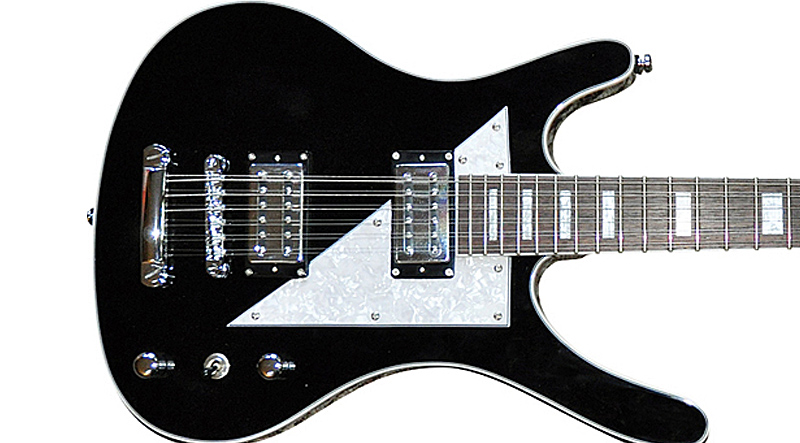
Since its appearances in the Austin Powers movies, Musicvox guitars have received a cachet for cool ’60s hipness and wicked space-age designs. Their latest axe, the MI-5 12-string, continues that tradition with a double-cutaway body shape that sports an extra-long bottom horn. Let’s explore this groove machine.
This Korean-made guitar has a solid mahogany body with a bolt-on maple neck and rosewood fingerboard. It weighs 7.4 pounds, and has a 243/4″ scale, 111/16″ nut width, one control each for Volume and Tone, plus a three-way pickup switch. Twangability comes courtesy of Musicvox Special Vintage humbuckers in Filtertron-style housings. There’s also a beveled three-ply pearloid pickguard, triple-bound body, tune-o-matic-style bridge and tailpiece, and a mondo open-face headstock with Kluson-style tuners. In old-school style, the paired tuners point outward and backward. Our test guitar was finished in black with pearloid block inlays akin to that on a Les Paul Custom. Color options include Seafoam Green, Candy Apple Red, Silver Sparkle, Gold Sparkle, White (with gold hardware), and Taxi Yellow.
When you pick up the MI-5, its shorter, Les-Paul-like scale might throw you for a second. The bridge is set back, creating a compact design, but give it a few strums and you’ll begin to dig its unique vibe – quite likeable – and the bolt-on neck is easy to grab and play.
Plugged into a modeling amp, the MI-5 covered a lot of ground. Flipping between pickups, the bridge delivered thinner/’60s jangle, with some icy highs for playing Byrds, Marshall Crenshaw, or The Police (use the Tone knob to temper that treble, if you like). The neck pickup, meanwhile, brought on fat, warm, and almost acoustic-like tones, more like classic George Harrison or Jimmy Page. The MI-5 sounded great with various effects ladled on, notably reverb, chorus, and generous dollops of tremolo. Crank up the overdrive and it moves nicely into Rush territory where you can conjure Alex-Lifeson-style chords using shimmering open strings – strong and authentic.
Musicvox has another winner on its hands. Aside from the shorter-feeling scale, most will have to get used to the tuners. But again, it’s a classic configuration that has worked for nearly 50 years. More importantly, the tuners hold tune, which is critical with a 12-string. Add their good tone, a nice design (dig that triangular pickguard!), and that all-important vintage jangle, and you have a fine electric 12-string on your hands. You may not put it down for awhile.
This article originally appeared in VG January 2013 issue. All copyrights are by the author and Vintage Guitar magazine. Unauthorized replication or use is strictly prohibited.
Because I don’t know what to call this Gibson guitar, I refer to it as a “Florentine,” for lack of a better name. Though the body decoration is unlike any cataloged Gibson guitar, the fingerboard and headstock ornamentation is almost identical to Gibson’s Florentine banjo (made between 1927 and ’37). In size, shape, construction and woods, it is identical to a late-’20s style L-1, but “L-1” seems inadequate to describe this instrument.
Perhaps we should call it a “Venetian.” It is a mystery why Gibson named its banjo after the Italian city of Florence and then ornamented it with scenes of Venice. Similarly, the companion banjo to the Florentine was described in the catalog as having “Spanish”-style ornamentation and yet it was called by an Italian name, “Bella Voce.”
In any case, the Italian nomenclature that began with these banjos has persistently recurred in association with the Florentine solidbody mandolin, for instance, or the “Florentine” and “Venetian” cutaway descriptions that today have achieved common usage even outside the Gibson line. I have no idea how or why the Italian names came about, but there is no doubt they have been effective.
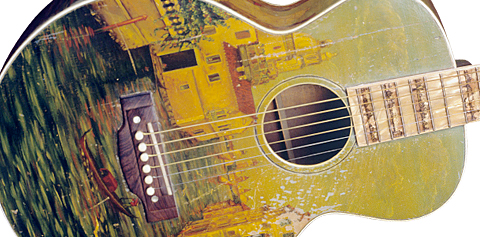
In the late ’20s and ’30s, Gibson and many other manufacturers decorated guitar bodies (usually only the tops) with stenciled scenes or patterns over a standard finish, but this is the first guitar I have ever seen – Gibson or otherwise – that is completely hand-painted. Except for the bridge and binding, the top, back and sides are totally covered. The back of the neck is also painted, except for the area behind the first 10 frets, where the player’s hand would have rubbed away any paint, had it been applied.
The Gibson company was founded for the purpose of building carved-body guitars and mandolin-family instruments. The first Gibson flat-tops had slightly arched tops and backs. The GY (Army-Navy) model was introduced in December 1918, then the flat-top L-1 and L-0 were introduced in 1926. During the first five or so years of flat-top production, Gibson offered only the “L” series guitars (initially the L-0 and L-1, and then the L-2) and the Nick Lucas Special, with tenor and plectrum versions available in 1928. Originally, the L-series guitars all had the same rounded body shape adopted from their predecessor, the archtop L-1. A variety of bracing patterns, beginning with a classical-type fan bracing, was used during this period, as were a variety of bridge styles. By about 1931, all of the L-series guitars had been changed to a more elongated body shape, similar to that of the then-popular Martin 00-size guitar, and “X” bracing was standard.
This Florentine guitar has the early, rounded, L body style and the bridge is one of several typical early variations. The bracing pattern, characterized by an inverted “V” below the soundhole, is the immediate predecessor of the “X” pattern. The guitar has no serial number by which to pinpoint the exact date of manufacture, but the structural features indicate it was made in the late 1920s. It has a spruce top, mahogany back, sides and neck, a bolted-on bridge, 19 frets, and a 24-inch scale. It measures 13 5/8 inches wide and 4 1/8 inches deep. These features are typical enough of an L-1, but that is where the similarity ends.
I have seen custom Gibson guitars with rhinestone-studded headstocks, and of course, pearloid fingerboards are not unknown, the Century model being an excellent example. Gibson banjo ornamentation has often crossed over into guitar decoration. We have seen the rhinestone pattern on this guitar’s headstock duplicated on Florentine banjos, but it is much less common than the standard Florentine peghead inlay which looks similar to a floral bouquet. The fingerboard, on the other hand, is all but identical to that of the banjo, allowing for the difference in size. Tiny scenes of Venice, each with water in the foreground and clouds in the sky, have been etched into the pearloid at marker positions. Each scene was tinted, and a thin layer of lacquer was applied overall. The engraved, gold-plated tuners have pearl buttons and though they do not function any better than the standard, they are a cosmetic upgrade from standard L-1 tuners.
The guitar’s wood body appears to have been left unfinished for the paint to be applied. The painting was done in oil colors, applied with minimal physical texture, then lacquered over. Again, scenes of Venice were depicted. As is typical, the lacquer has yellowed with age and dimmed the color. A combination of yellowed lacquer and the fading of the scenes’ tint has reduced the fingerboard etchings to a sepia tone. In spite of this, the guitar is still very colorful. The fingerboard has blues, reds and yellows against white pearloid. Judging from the small spots where the lacquer has chipped away, the body was brilliant. Under the lacquer the sky is a bright “robin’s egg” blue and the water is an intense, deeper shade. An eye-opener even today, this guitar must have been spectacular when new.
The guitar may well be one-of-a-kind. I obtained it from a trader in Grand Rapids, Michigan. It seems a disproportionate number of non-catalog models are from close proximity to the Gibson factory. Perhaps it belonged to an employee of the Gibson factory or being close to the factory made it easier for folks to make their spacal wants known.
Though not at all practical from a player’s point of view, this is certainly a beautiful instrument. Although pictured with strings, it is not playable. The top crack visible in the upper bout is unstable, but repair might damage the painting. Also, you can see that playing has already worn paint off the top, next to the soundhole. The guitar is such a work of art that being limited to display doesn’t seem much of a limit at all. Many hours of work went into the decoration of this instrument, and that certainly has not been wasted. The guitar can still command the eye, if not the ear.
This article originally appeared in Vintage Guitar magazine’s January 1997 issue. All copyrights are by the author and Vintage Guitar magazine. Unauthorized replication or use is strictly prohibited.
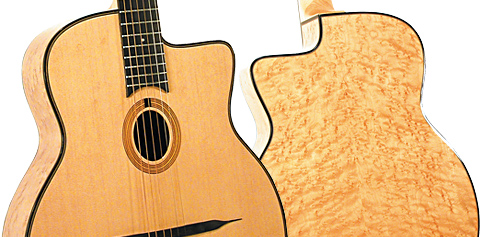
Saga Gitane DG-250M
Price: $949
Info: www.sagamusic.com
Features: Open-gear 14:1-ratio tuners, solid spruce top with “petite bouche” oval soundhole, birdseye maple back and sides, ebony fingerboard, maple neck, zero fret, bone nut, mustache bridge, Selmer-style tailpiece, wood binding.
Saga Instruments has established itself as a keeper of the vintage flame: the company, with its Chinese manufacturing plants, has evolved a series of historically-based instruments that are highly affordable, very modern, yet redolent of vintage vibe.
The Gitane DG-250M, based on a limited-edition Selmer from the 1940s, is another in this line of vintage inspirations from Saga, which includes other Gypsy jazz guitars in the Gitane line, resophonics from Regal, and well-received fingerpicker and flatpicker favorites from Blueridge.
The review DG-250M came out of the case in perfect tune with itself, although over a half-tone flat for shipping. I knocked out a couple of choruses of “Oh, Lady Be Good” without touching the tuners, then grudgingly took the time to tune up to pitch.
Until then, I didn’t know I preferred ’40s-style blonds!
This little blond has some interesting vital statistics. First, the 265/8″-scale neck is made of figured, flatsawn maple. The neck is a generous 13/4″ wide at the nut, carved very slim and comfortably rounded with shoulders. Unlike most Selmer-style guitars, this neck is topped by an unslotted headstock with a birdseye maple overlay and nickel-plated, open-gear tuners, but traditional Selmer details reappear with the zero fret, undersized nut, ebony fingerboard, and pearl dot inlays. The occasional players’ confusion raised by the presence of a 10th-fret inlay (in the European style) is counterbalanced by the faithfulness to the original details of ’40s Selmers. You’ll get used to it. A side dot at the 12th fret, though, would be helpful for up-the-neck runs.
The most unusual detail on the body of the Gitane DG-250M is the three-ply back and sides. During World War II, Selmer made a run of about 20 guitars with birdseye maple back and sides. Our review guitar, made to imitate these rare instruments, is generously covered with birdseyes, which wink up at you as you move the instrument to admire the undulating woodgrain as it refracts light. The plywood is not a cost-cutter; most original Selmer bodies featured plywood construction, except for the top (ironically, ’40s Selmer birdseye guitars were solid wood throughout, according to Francois Charle in The Story Of Maccaferri Selmer Guitars). Having owned a boutique Gypsy jazz guitar with solid wood back and sides, I think the triple-ply strategy works better. The extra resonance of solid-wood back and sides does not really serve the sprightly tone and aggressive cutting power of the Selmer-style instrument. Maple, hard as it is, provides an excellent body wood for the demands of Gypsy Jazz. Add the influence of the hard maple neck, and you have a lap-held weapon with the penetrating power of a laser.
As attractive as the maple body is, I was particularly impressed by the quality of the slightly arched spruce top. The straight, even grain and the “silk” effect that indicates perfect quartersawn stock are all indicative of the sophistication and power of Saga’s wood buyers. I have seen many Saga products, and have consistently noticed the tops are of a very high grade.
The guitar’s body made up of all this delicious-looking tonewood is 181/2″ long, 16″ wide at the lower bout and 111/4″ wide at the upper bout. The tapered body is 4″ deep at the tailblock. The classic compensated ebony mustache bridge features a two-footed center saddle that is moveable between the glued-on mustache ends. The “petite bouche” oval soundhole (23/4″ x 11/8″) is surrounded by an attractive wooden rosette, and the bindings and purflings are also made of a complimentary wood. The thin lacquer finish is clean and glossy, with a little evidence of sanding on the tapered heel.
A gold-plated Gypsy-approved tailpiece will accommodate both loop- and ball-end strings. Only the shiny plastic insert (Selmer used plastic, ebonite and rosewood) on the tailpiece detracts from the visual appeal of the guitar body from the front. If this guitar were mine to keep, I’d use a piece of 0000 steel wool to dull the gloss of the insert. This little effort makes it look like ebony from a few feet away.
When compared to a Gitane D hole DG-500, the DG-250M was considerably more aggressive in the high end. I also had an opportunity to play the guitar with New Orleans’ leading Gypsy Jazzer, Tony Green, alongside a 1990s Dupont “petite bouche,” an ’80s Saga “petite bouche,” and a pre-war Francesco Oliveri “grande bouche.” The new Gitane more than held its own volume-wise, with a head-register voice that nicely complimented the deeper chest-register sound of the solid wood Dupont. The restored Oliveri and the older Saga never had a chance.
Workmanship on this DG-250M is solid in most areas, though there’s a little woodfiller nestled into a few spots around the neck joint. The frets are highly polished, and play cleanly with a manouche-appropriate action of a strong 3/32″ at the 12th fret on the high E string.
Although a nice-quality Golden Gate CP 1510 case is supplied with the DG-250M, the guitar moved around a bit too much in it. Saga’s marketing department told me that a reissue Golden Gate Gypsy Jazz Guitar case has been approved for production.
The DG-250M was modeled from an original ’40s Selmer. At the Winter NAMM show, Djangophile John Jorgenson told us, “The Saga sounds remarkably better than the original.” Jorgenson liked the DG-250M so much, he asked Saga to build a signature model. I like this guitar enough to wish they’d name it after me. Unfortunately, it plays Gypsy jazz a lot better than I do!
This article originally appeared in VG May 2005 issue. All copyrights are by the author and Vintage Guitar magazine. Unauthorized replication or use is strictly prohibited.
Wood with his ’55 Fender Stratocaster in 2007. Photo: Neil Lupin/Getty Images.
“I’ve always wanted to rock,” gushes 63-year-old Ron Wood, whose journey from the shy 10-year-old washboard player in older brother Ted’s ’50s skiffle group to the renowned veteran guitarist in “The World’s Greatest Rock and Roll Band” has been one wild joyride.
Born Ronald David Wood on June 1, 1947, in London’s Hillingdon section to a family he describes as “water gypsies,” like most of his British contemporaries, Wood was also smitten by the first wave of American rockers. By ’64, the 17-year-old was proficient enough on guitar to join The Birds, an R&B-influenced outfit that was part of the first wave of English bands following the Beatles’ lead. After little commercial success, the group disbanded.
Wood’s first real break was joining the first edition of The Jeff Beck Group in 1968 as a bassist, along with a young gravely-voiced Rod Stewart on vocals. Following just two albums, Truth and Beck-Ola, Wood and Stewart left to join bassist Ronnie Lane, keyboardist Ian McLagen, and drummer Kenny Jones in The Faces. The band recorded hits like “Stay With Me,” albums like A Nod Is As Good As A Wink To A Blind Horse, and their shows provided heady competition for rivals like Led Zeppelin, The Who, and The Stones.
Soon however, Stewart’s career was sparked by solo smash singles like “Maggie May” and “I’m Losing You” and successful albums like Every Picture Tells A Story and Never A Dull Moment (featuring Wood’s very prominent input) before ego problems did in The Faces in ’75.
As fate would have it, Mick Taylor, the Stones’ talented lead guitarist, departed, leaving an opening for Wood. Names like Eric Clapton, Rory Gallagher, and even Jeff Beck were thrown about as Taylor replacements, and though like Taylor, all were more technically proficient guitarists, Wood, with his spiked hair, gaunt arms, and exuberant stage presence, was the perfect foil for the equally hard-living Keith Richards. Thirty-five years later, Woods has logged more time with the Stones than his two predecessors combined.
An accomplished painter as well as musician who has collaborated with such an array of legends ranging from B.B. King to David Bowie to Aretha Franklin, Wood has more than proved his worth with the Stones. The band’s most versatile onstage musician, fans are accustomed to seeing Wood switching from a seven-pedaled Emmons steel guitar (for songs like “Far Away Eyes” and “The Worst,”) to a baby sitar – either the Danelectro original or the Jerry Jones reissue for rainy outdoor shows on “Paint It Black” and “Jumpin’ Jack Flash.” For the slow acoustic numbers, Wood enjoys the slide effects he elicits from a hollowbody Weisenborn (“No Expectations”). His acoustics include a Gibson J-200 and a Zemaitis adorned with silver. Other favorites include a custom Zemaitis electric he uses for rockers like “Rough Justice,” “You Got Me Rockin’,” and the classic “Can’t You Hear Me Knockin’.” He also favors the unique “BBB” (black B-bender), a Ron Wood signature Fender Telecaster.
Wood’s most-used stage guitar is still his beloved ’55 Fender Stratocaster, while he’ll grab his prized original ’52 Telecaster for classics like “Honkey-Tonk Women.” And his readily identifiable slide sounds are partly the result of using slides fashioned by his guitar tech, Dave Rouze, using standard 3″ copper tubing.
While talk of a Stones tour in 2011 is being bandied about, Wood is focused on his new album, I Feel Like Playing (Eagle Records). His seventh solo effort, it’s his first in nine years. To get the raunchy no-frill rock-and-roll guitar sounds he is famous for, Wood used his trusty ’55 sunburst Strat, ’64 white Firebird reverse, red ’67 Strat, all cranked up through a ’50s Fender Tremolux, a ’56 Fender low-powered tweed Twin, a ’58 high-powered Twin, and a new Fender Vibro-King. To get an early Hank Marvin/Shadow’s sound when needed, Wood added a ’60 Watkins Dominator.
With an impressive cast of fellow rock-and-roll renegades including ZZ Top’s Billy Gibbons, former Guns ’N Roses axeman Slash, Red Hot Chili Peppers’ bassist Flea, and Pearl Jam’s Eddie Vedder, the album is exactly what one would expect from Ron Wood.
Why did you now decide to come out with another solo album?
(Record producer) Steve Bing actually started the project. I happened to be in L.A., and he said, “Hey, Ronnie. I would love to hear you play. I’ve booked The House Of Blues, and I’ve got (drummer Jim) Keltner, and Ivan Neville.” I said, “Okay… cool.” I hadn’t thought about making any new tracks. So I got hold of Flea and brought in (longtime Rolling Stones backup vocalist) Bernard Fowler. We cut “Spoonful,” and it all just snowballed from there.
Did you have a stockpile of tunes ready for the album?
I had some phrases that had been knockin’ around my head, for awhile, like “Why’d you wanna go and do a thing like that for,” and (sings) “Well, I don’t think so.” So, there were songs waiting to come out from phases. One day, I heard Bernard say, “Sweetness, my weakness.” I said, “That’s not a greetin.’ That’s a song.” So he said, “You write it,” and I did. We’d write songs in the morning, and cut them in the afternoon. Everything on the album came together very easily.
Some time ago, you said, “You don’t make solo albums to have hits.” Do you still feel that way?
Well, I’ve changed my way of thinking, because I hope to have one or two hits of this album. When the record company told me “Lucky Man” became the most requested song on Amazon, I went, “Wow! Fantastic! I’ve had a little flash of fame of my own.”
How did Slash come to play on the album?
He was working in the next studio, and I’d bring him over, and say, “Come on, Slash. You know exactly what I want. Go ahead and play.” Then Billy Gibbons would walk in saying, “Hey, man. I’ve got a great song for you called ‘Thing About You,’ and I’d say, “Come on then. Let’s play it.” We’d work a little on the arrangements, then just do it. I love that spontaneity.
People buying the album might expect to hear you doing all of the solo work. But you recruited other guitarists, like Slash and Gibbons…
Well, I’m doing solos, but sometimes I’d let Slash take half, then I’d do half, and then we’d both perform the last part together. I did that with Billy, too. But for most of the songs, I left room for me to solo.
It’s nice to have a rapport with those kinds of guitar players, because they don’t mind playing a rhythm or just a simple thing in the background. However, if I’d also tell them, “Let loose,” they’d go, “It’s your album. You do the flashy stuff.” So, it’s not like they were trying to steal the limelight, or that I’d be giving up my rightful place.
It’s hard to explain; it’s a give-and-take thing going on among musicians. For instance, I might like a little phrase Slash did, and later decide to keep it on the track.
You can tell where Gibbons comes in with his trademark crunchy guitar on “Thing About You.”
That’s really me being a Gemini (laughs)! You see, I’m very chameleon-like. It’s me sounding like Billy Gibbons, and him sounding like me. We’re weaving together in the solos, so that quite honestly I don’t know where I start and leave off, where Billy takes over, and visa versa. It’s nice to know it’s not cut-and-dried, like he’s doing this bit and I’m doing that bit. Weaving is something I’ve been doing with Keith Richards since we started playing together. It’s an ancient musical form where we just “talk” to each other through our guitars.
The Stones have incorporated reggae for years, especially on some of your songs with them. “Sweetness My Weakness” is almost a tribute to Bob Marley.
It’s actually an homage to Gregory Isaacs, and I’m really pleased with the way it came out. I didn’t want to over-sing it. When you analyze that track, none of us is really playing a reggae beat. It just came out sounding like a reggae song.
When you were growing up in England, who were the first performers who inspired you, musically or visually, to think, “Hey, I’d like to do something like that with my life…”?
Oh, definitely the first was Fats Domino, with his record, “I’m Walkin’,” and alongside him, Jerry Lee Lewis (W oods performs on Lewis’ new album, Mean Old Man). The early Jerry Lee stuff was very important to the changeover in British musical tastes, blended with the influence of Muddy Waters, Howlin’ Wolf, and Chuck Berry, and even earlier, Big Bill Broonzy and Leadbelly. It all crossed over from the music of Louie Armstrong and Bix Beiderbecke. I got all of the traditional jazz influences from (brothers) Ted and Art, who were eight and 10 years older than me, and turned me on to R&B. They had bands who backed up some of these blues guys when they came to England.
And you actually backed Memphis Slim when you were very young…
Yeah, that was my first gig away from my group, The Thunderbirds. We later found out that (singer) Chris Farlowe had a group with the same name, so we had to knock off the “Thunder” part and became The Birds. This old, black crooner came up and asked (whispers) “Hey, boys. Would you back me up?” We were teenagers who didn’t know him from Adam. But he seemed like a gentleman, so we backed him for a bottle of whiskey. It was a real turn-on for me, though. Shortly after that, I got friendly with Bo Diddley at The 100 club.
I also used to go see Muddy Waters when he came to town. He always thought I was in the Stones. It was really funny when I saw him years later. I said, “Muddy, I’m finally in the band you always thought I was in.” He said, “I knew you’d do it.” (laughs)!
When you first saw The Stones perform at The Richmond Jazz and Blues Festival in ’64, did you seriously think that one day, someone in the group would drop out, and you would be asked to join as a full-time member?
Ron Wood
You know, I was just so captured by their performance, I thought, “Someday, I’m gonna be in that band.” I was the last one out of this tent, and I banged my leg really hard on this huge tent peg. It really hurt, but I didn’t think about the pain. I was just thinking, “Yeah, that’s my band.” I got to meet them, and funny enough, after Brian Jones died, when they were initiating Mick Taylor, I was going around the outskirts of (London’s) Hyde Park, and right in front of me, Mick (Jagger) and Charlie got out of this car and called out, “How are you doing?” I said, “I’m fine,” and they shouted back, “Well, we’ll see you.”And I said, “Yeah, sooner than you think.” I was just in the right place at the right time when (five years later) Mick Taylor told Jagger he was leaving the band. Mick looked at me, and said, “What am I gonna do? Will you join?” It was so funny. It was like fate was playing the cards.
Of course, that must take you all of one second to consider…
Yeah, but Mick also said, “To be fair to The Faces, I don’t want to split them up.” I said, “Nor, do I.” So Mick said, “Well, if I get really desperate, could I ring you up?” I said, “Of course.” So about a year later, when I was in L.A., Mick rang me up.
This must have been in ’75, but didn’t Mick actually call you right after Brian left, and you didn’t learn about the call until around five years later?
Yeah, that’s right. He rang me up through Ian Stewart, the piano player/roadie we sadly lost around 20 years ago. Ronnie Lane told him, “No, Ronnie’s quite happy here.” When I found out, later, I said to him, “Why didn’t you tell me about the call?” He said, “Because you’re happier here, my boy!”
What do you remember about the first session you played with Keith Richards… as a bassist… on P.P. Arnold’s 1966 recording, “Come Home, Baby?”
We were doing the session for Andrew (Loog) Oldham. I remember people like Keith Emerson on the organ, Nicky Hopkins on piano, and Keith on guitar. We also did some other things with Rod, like “Little Miss Understood,” and P.P. Arnold’s cover of Cat Stevens’ “The First Cut Is The Deepest.” (Ed. note: Stewart’s version of “Cut” came many years later.)
It was really a great way of mixing and matching different genres of music together. Different bandmates from far afield all coming together. You’d get these random phone calls, “Can you be there at this studio?” You never knew who was gonna be there, or who’d walk in.” It was like, “Wow, there’s John Lennon over there,” or someone like him. Those were really fantastic days.
So you were all close in those days.
Yeah, it was a great, thriving time. Everything would come to a head at the record company Christmas parties. You’d jump from one company to another, and party with people like Viv Prince and The Pretty Things, then go to The Who’s office and party with Townshend and Keith Moon. All the members of The Small Faces would be up at Immediate Records. The Stones and Beatles would all be down the road. It was all mad. All everyone was thinking about was, “Wow, let’s party!”
What do you think has made that generation of British musicians endure, still active and creative more than 45 years after hitting the scene? Certainly, none of them could have foreseen being this popular in 2010.
Well, we were all born with that imbedded thing, almost like being born with a guitar in your hands (laughs)! I was like that. That’s what we all did. You wouldn’t give up, even if in the back of your mind you thought you really couldn’t play. You would just get up there and front it out, which is something I still do to this day. I’ve got a lot of front in me. I just jump in the deep end and play.
Your formative years in England must have been very exciting.
Back then, you’d bump into Jimmy Page, who was a top session guy at the time. Jeff Beck was a schoolmate of his, and he told me that Jimmy was the one who was playing the solos on all those hit records. Me and Jeff would be on a train, and we’d see Jimmy on the platform. It really was a small world. We’d go past Ealing Station coming home from school, and I’d see Keith Moon playing football. We were all just knocking around. But deep down, we had a dedication to playing music and sticking in there, never giving up.
If in 1964 some caricaturist had drawn a picture of what he imagined Mick Jagger would look like at 67, it would probably be of an old man with a cane. But of course, that’s not the case.
It’s like 65 has become the new 40. It’s all truly amazing, the music and continual creativity, the ambition, always wanting to get better and taking on new things.
It’s always that way for me in the art world with my paintings, going through phases. I’m always learning. It’s the same with music; always striving to find new ideas.
How did you feel about the recent Faces’ reunion shows?
They were both really good, actually. We did the O2 Festival in Goodwood, and another gig in Denmark with Mick Hucknall singing just like Rod did in the ’70s. Mick sang well, and shut up a lot of people who said, “What? He’ll never sound like Rod.” Well, he did!
Is there any chance Rod will be involved in future Faces’ reunions?
I just got an e-mail from Rod, and he’s open to ideas. He said, “Hey, let’s see about going out and playing again.” So we’ll see. We’re planning shows in January with Mick.
The Stones are rumored to have a new album and tour planned for 2011. What’s the latest on that?
We won’t know until we’ve had our winter meetings, but we’re all looking forward to them with itchy feet.
You’ve had an incredible 35-year run with The Stones so far. Can we assume you’ve forgiven Ronnie Lane for possibly preventing you from joining six years earlier?
To be truthful, if I had, I’d probably have become a junkie straight away, and would probably have OD’d… or I’d be dead now.
This article originally appeared in VG January 2011 issue. All copyrights are by the author and Vintage Guitar magazine. Unauthorized replication or use is strictly prohibited.
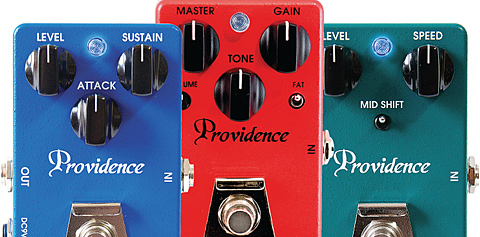
The Providence Velvet Comp, Red Rock OD, and Phase Force
Price: $199 (per piece, list)
Contact: www.providence.jp
Providence is a Japan-based manufacturer of effects, cables, guitars, pickups, and audio-switching devices. Though an established brand in its home country for almost two decades, its products only recently found their way to the United States, including a line of effects pedals.
Providence pedals are housed in industry-standard Hammond/MXR-sized enclosures, and use a unique metal harness around the footswitch that both protects it and gives the pedal a signature look. All units feature 1/4″ in and out jacks, along with a standard barrel DC receptacle. All three reviewed here – the Velvet Comp, Red Rock OF, and Phase Force – can be powered with either a 9-volt battery or a 9-volt DC center-pin negative power supply.
The effects were tested with a ’67 Telecaster and an ES-335, along with a reissue ’65 Deluxe Reverb. The Velvet Comp is in the Dyna/Ross family but has a very pleasant addition in the Attack knob. While it’s true other compressors have attack knobs, frankly, many do next to nothing or are very subtle at best. Here, the Attack knob allows standard smoothing. There’s an outright loss of initial attack at the fully counterclockwise setting. As it’s turned clockwise, pick attack actually returns. The compression/limiting is smooth and classic, and certainly a joy with the Telecaster/Deluxe combo.
With the Red Rock OD unit, the mini pot labeled “Volume” is a post-input buffer and a pre-gain knob that controls the amount of signal that hits the gain stage. With most guitars, a lower setting is more desirable, unless one wants to dial in a fizzier overdrive. The real strength of the feature is the ability to boost a weak signal so that the overdrive section can be used to its full extent. For Dano lipstick users or fans of low-output Guyatone pickups, the Volume mini pot can boost their weak output to be useable by the dirt stage. The Gain pot functions as a standard drive level, and the Master control is an output that is post-gain and tone stages, yet pre-output buffer, making it a true master volume control for the pedal. The Volume, Gain, and Master controls allow a wide variety of drive textures, with the Tone control and Fat boost aiding in smoothing things out. Twisting the Tone control adds both dirt and volume, along with treble as it is cranked up. Although the pedal has a certain midrange emphasis, one would never confuse it with a Tube Screamer circuit – this is much clearer sounding, and much more controllable due to the pre-gain Volume control, interactive Gain and Tone knobs, and the ability to gain back, via the Fat boost, the low end that is usually lost in Tube Screamer circuits.
The Phase Force is a classically styled phaser with some pleasant twists. The first is its Level control, which allows the user to match, boost, or cut the effected versus the dry signal level. The second is its Speed control that has a much wider variance of slow to insanely fast settings than run-of-the-mill phasers. Finally, the Mid Shift switch provides an enhanced midrange boost to help the guitar cut through.
The Providence Velvet Comp, Red Rock OD, and Phase Force are vintage-inspired effects with helpful tweaks that make them more controllable and stage- and studio-friendly. The Velvet Comp’s smooth compression and actually functional Attack knob make it a standout. The Red Rock’s input gain and Fat switch make it both versatile and complementary to just about any instrument. And the classic tone of the Phase Force cuts through better than the rest with its mid-boosting Mid Shift switch.
This article originally appeared in VG November 2014 issue. All copyrights are by the author and Vintage Guitar magazine. Unauthorized replication or use is strictly prohibited.
Anyone who has ever plugged an acoustic guitar into an amp or PA is well-acquainted with the bone-crushing howl of hollowbody feedback. It’s not a happy sound. And in a live setting, it can be almost impossible to dial in enough volume to sit in the mix without inducing that telltale low-frequency wail that precedes the inevitable chorus of “Turn that thing down!” Unfortunately, many acoustic players resort to electrics live, even if the resulting tone doesn’t suit the song.
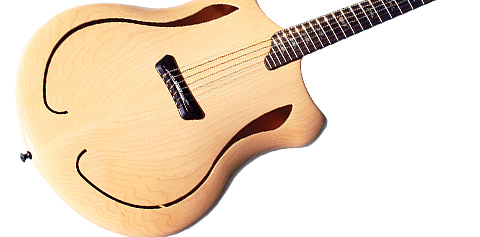
Methods used to combat hollowbody feedback are legendary: tape over sound holes, posts between top and back plates, all sorts of things stuffed into bodies. Inevitably, the resulting sound has little resemblance to the rich acoustic overtones the player was trying to preserve in the first place. Now, luthier Jon Kammerer has what may very well be the answer to acoustic guitar players’ prayers: a guitar that looks, plays, and sounds like an acoustic but does not feedback, even under the most unforgiving of circumstances.
Kammerer took a scientific approach to the problem by first identifying the frequencies most responsible for feedback and then devising a revolutionary design to keep them at bay. The result is the Pegasus, a hybrid acoustic guitar with a top plate that nearly “floats” above the body. Kammerer recognized that an acoustic guitar projects sounds because it acts like a blacksmith’s bellows, pumping air through the sound holes. The unplugged answer to more volume has always been to make a bigger bellows by building larger bodies – precisely the prescription for low-frequency feedback loops when the guitar’s sound is amplified back at it through a speaker. So, Kammerer extended the length of the sound holes as far as possible to limit the vibrating top plate from transferring energy to the sides and back, thereby preserving the mid- and high-frequency overtones but stopping the feedback-causing low frequencies from being acoustically amplified. The result is an identifiably acoustic-looking and -sounding guitar with very little tendency to feedback when amplified.
The Pegasus body is made from two pieces of solid maple, shaped to pleasing contours, hollowed out with CNC machinery, internally braced, and glued together as top and bottom to form a shell. The top is only about 0.125″ thick (it’s an incredibly light guitar), and the neck is made of figured maple with an inlaid ebony fretboard (rosewood, maple, and Pao Ferro are also options). Kammerer uses a 25″ scale with either a conventional or compound radius as options. The 24-fret neck is bolted on, but the plate and screws are hidden behind a walnut plate, and all frets are reachable and playable. The fretwork is impeccable, as you would expect from a maker who has taken such care in design and material selection.
The guitar sits in the lap like a well-balanced dreadnaught but is thinner and more comfortable to play than most acoustic guitars when standing up with a strap. And that is precisely the point – this guitar is made to be plugged in and played through the L. R. Baggs active-element pickup system beneath its saddle. Unamplified, it isn’t much louder than an unplugged Epiphone Casino, so if you’re looking for a guitar to do double-duty, the Pegasus probably isn’t the answer. Plugged into an amp or PA, however, it sounds more “acoustic” than any other acoustic/electric it was compared to, albeit a bit brighter due to the maple body (the Pegasus can also be ordered with a warmer-sounding walnut body). That brightness did translate into more fingers-on-the-strings sound than we normally would expect, but try as we might, we couldn’t get the Pegasus to feed back any more than a solidbody guitar, and certainly less than the Casino and a White Falcon we paired with it.
What a luxury to finally fingerpick and strum at performance-level volumes without fear of suddenly delivering a “howler.”
This article originally appeared in VG November 2014 issue. All copyrights are by the author and Vintage Guitar magazine. Unauthorized replication or use is strictly prohibited.
Heart guitarist Craig Bartock stopped by Vintage Guitar World Headquarters. He really liked our house ’52 Tele!
This month, we take a guided tour of the pedalboard belonging to Craig Bartock, guitarist with Heart.
Craig Bartock, a well-known (and busy) guitarist/composer, has been the touring lead guitarist for Heart since 2004. Those who’ve seen him play live know that his tone is amazing; he relies on two Vox AC30 amps, several classic guitars, and this nicely loaded pedalboard. Here’s his breakdown:
1. Line 6 DM4 Distortion Effects Modeler
The distortion I use comes primarily from the amps, I tend to use this to shape the overall sound for various solos and rhythm parts. For example, if I’m looking more for a ’60s fuzzbox sound, I’ll accentuate Vox distortion with this to “remodel” the sound going in. In essence, I use this pedal to vary the tonality of the guitar, which changes the way the amps react. It’s a useful tool, considering Heart’s legacy and the various styles of solos.
2. MXR M169 Carbon Copy Analog Delay
I use this to simulate reverb/filler rather than an actual delay. It’s on very softly during certain solos with a long delay time and just a bit of feedback. When we play in rooms that tend to be drier-sounding, I use it to fill the gaps between notes. The delay has a dull, echoey sort of sound that doesn’t get in the way of the initial notes, which I like and is great for “gluing” the sound together, especially in venues where the sound tends not to be as roomy.
3. MXR M104 Distortion+
This has been my go-to distortion for many years. I use it with a lot of Heart songs, including “Magic Man.” A Distortion+ with a Strat and an AC30 on about 7 is an unbeatable combination. I use my guitars’ Volume controls quite a bit to regulate the amount of distortion. I’m constantly adjusting it to find that right amount of sound depending on the part and what type of tone Nancy Wilson has dialed in. The Distortion+ adds this level of brightness and bite that I love and can’t get just from the amp alone, especially with a Strat. When the Volume knob on the guitar is about at a 1/3 and this pedal is on, it has that Hendrix “Manic Depression” sound I really love– serious attack, as well.
4. Red MXR M102 Dyna Comp
This is perfect for rock solos in ballads, where sustain is everything. It’s especially useful for solos in songs like “What About Love.” It’s great for studio work, as well. Years ago, I used only a direct box and this pedal, and got amazing results.
5. Line 6 DL4 Delay Pedal
The most functional delay on the market. I have three distinct sounds programmed into mine. The button on the left triggers a basic delay that’s around 150 milliseconds, with some feedback. I programmed this to work around the MXR Carbon Comp; delay times and return sounds are totally different, so they can be on at the same time and not fight each other. It’s great for solos where a long delay can accentuate the riffs. The second button triggers a very short, slap delay with no feedback – almost like a doubling effect. I’d guess it’s around 30 ms. I use it for songs like “Straight On” (which has a bit of a delay on the original guitar part) and a McCartney cover we did called “Let Me Roll It.” It fattens the overall sound. The third button is set for a crazy-heavy long delay with a lot of feedback and modulation. I use it in conjunction with volume swells. The setting is perfect for “Mistral Wind,” where the guitar has a cello-like sound in the softer parts. The last button sets the time of the delays. I can adjust accordingly for changes in tempo, etc.
6. MXR M152 Micro Flanger
Ann Wilson wanted to cover the Robin Trower song “Day Of The Eagle,” and I needed a flanger, quickly! This was Nancy’s, and her tech, Jeffo Ousley (an excellent tech and all-around good guy), was nice enough to pass it over to me. It’s only used on that one particular song.
7. A.J. Peat Rooster Booster Pedal
As A.J. says, this pedal “…boosts your signal, adds bloom, and opens your tonal spectrum.” I totally agree. It allows me to fine-tune how hard I want to hit the amps with guitar signal. I can then find that perfect balance between how much gain to add on the front end and how much distortion I need on the back end.
8. A/B splitter
The signal from my guitar goes into this and then to an A/B box behind my amp, where my tech, Edward Mendoza, can switch cables and always have a guitar ready without having to unplug. This is important because there are some songs in the set that are spaced very close, and with this, we can work a guitar change in a few seconds.
9. Voodoo Lab Pedal Power 2
Does exactly what it says –provides nice, clean 9-volt/regulated DC outputs for everything.
I rarely leave a pedal on for an entire song. For example, one of the settings on the Line 6 distortion modeler comes on only during the second verse and guitar solo in “Kick It Out.” As a rule, the guitar and amps do most of the heavy lifting. The pedals are there to accentuate the styles Heart has been known for over the years, and make up for sonic differences in venues.
This article is from VG Signal Chain issue #13. All copyrights are by Vintage Guitar magazine. Unauthorized replication or use is strictly prohibited.
Fullerton’s signature on the back of Jazzmaster’s headstock.
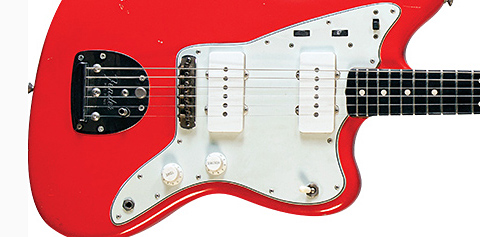
This Jazzmaster is an interesting example of what went on behind the scenes at the Fender factory with the research and development of body shapes and materials, and during the pre-production phase for new models in the late 1950s and early ’60s.
After having great success with the Esquire, Telecaster, and Stratocaster, in 1958, Fender introduced the Jazzmaster as its top model. Described in the catalog as incorporating “…remarkable new features which provide the ultimate in electric Spanish Guitar versatility and playing ease,” the Jazzmaster mostly missed its intended mark – jazz players – and found its niche after being popularized by surf rock bands in the ’60s.
Many of the Jazzmaster’s specifications built upon existing Fender designs, but were a noticeable departure from the Strat or Tele in an attempt to offer features that would appeal to a new segment of musicians. The Jazzmaster had a contoured body similar to a Strat, but stylized into what Fender literature called an “off-set waist” intended as an ergonomically friendly solution for seated players. While the Jazzmaster had a customary maple neck, it was the first model with a glued-on slab Brazilian rosewood fingerboard with clay dot inlays. In mid ’62, it was given a curved rosewood fingerboard. Those made beginning in late-’65 have a bound fingerboard, and, starting in late ’66, it had pearloid block inlays. The Jazzmaster also introduced “extended range” pickups with separate Rhythm Tone circuit, which enabled players to quickly switch to the neck pickup with a pre-set rhythm tone. The new pickups provided a warm, mellow sound compared to other Fender single-coils and, like early Gibson P-90s, were commonly referred to as “soapbar” pickups, due to the size and color of their covers. The Jazzmaster also offered a new vibrato system with a longer arm and a “floating” bridge, which, according to literature, would enable the guitar to “return to tuned pitch without variance.” The earliest examples of this model were available in two-tone sunburst finish (during the course of 1958, Fender switched to three-tone sunburst) and an anodized aluminum pickguard. Most custom-color examples have greenish-white pickguards, and the tortoiseshell pickguard became standard in late ’59.
(TOP) Fullerton with his cherished Jazzmaster. Instrument photo: William Ritter, courtesy of George Gruhn.
This particular example belonged to longtime Fender executive and G&L co-founder George Fullerton. One of the earliest Fender employees, Fullerton is credited with many design and engineering innovations, and played a critical role in the development of Fender’s first solidbody models.
In addition, he was responsible for the custom-color finish on this pre-production Jazzmaster. In 1957, Fullerton visited a local paint shop and selected red automotive paint which was sprayed on the body at the Fender factory. The color was originally referred to as Fullerton Red by fellow employees. Custom colors were first offered in the 1956 catalog “upon the player’s request,” but were not standardized until 1960, when this color was called Fiesta Red in marketing materials. According to Fullerton, his recommendation to offer guitars with a selection of custom colors was originally discredited and scoffed at by Fender Sales staff, but, after early examples were provided to music stores, demand proved very high.
While the size and shape of this pre-production body became standard specs for early Jazzmasters, and Fiesta Red became a standard option, the neck on this guitar is representative of Fender’s further experimentation. Though it is unclear if the body was originally fitted with a neck, Fullerton matched it with one dated 7-61 (July ’61)with a vulcanized fiberboard fingerboard. A material typically used for pickup bobbins, it has an appearance similar to ebony, and Fender tested it while seeking an economical fingerboard veneer that would increase neck stability (and thu, decrease the need for adjustment). There is only one other known Fender with this fingerboard material – a 1960 Jazz Bass originally owned by Fender employee Freddie Tavares.
The Jazzmaster was discontinued in 1980, then reintroduced in 2000 as part of Fender’s American Standard Series (made-in-Japan reissues were offered beginning in ’96). It has been introduced to new generations of players by musicians like Lee Ranaldo and Thurston Moore (Sonic Youth), Nels Cline (Wilco), and Troy Van Leeuwen (Queens of the Stone Age).
In addition to his years with Fender and G&L, Fullerton later worked as a consultant to the Fender Custom Shop, assisting with the production of the George Fullerton 50th Anniversary 1957 Stratocaster. He succumbed to heart failure on July 4, 2009.
This article originally appeared in VG‘s October 2014 issue. All copyrights are by the author and Vintage Guitar magazine. Unauthorized replication or use is strictly prohibited.
1896 Orville Gibson A model. Photo: Eric C. Newell.
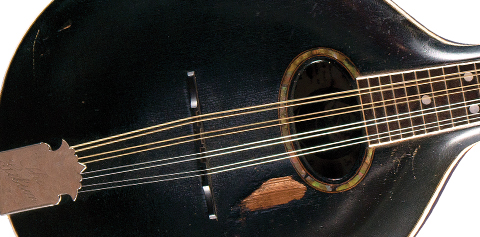
All carved-top guitars and mandolins trace their ancestry back to Orville Gibson of Kalamazoo, Michigan. However, as this A model mandolin illustrates, Orville’s designs went through considerable refinement through the early years of the Gibson company’s existence to reach the standard of design that we know today.
The highlights of Orville’s life are well-known:
Born in Chateaugay, New York, in 1856.
Moved to Kalamazoo and began making instruments by 1894 (the date on a small medallion in an instrument now owned by the Gibson company).
Obtained a patent in 1898. Though the patent illustrated a carved-top A-style mandolin, it focused on the principle of having the back and sides carved from a single piece of wood.
Applied his carved-top design to mandolins with a pear-shaped body (A-style) and a scrolled body (F-style), as well as to guitars.
In 1902, sold his patent and the rights to his name to five men who formed The Gibson Mandolin-Guitar Mfg. Co. Ltd.
Had an immediate falling out, after which he had virtually no involvement with the company. He was eventually granted a monthly pension.
Died in Ogdensburg, New York, in 1918.
It’s not possible to make many sweeping statements about Orville’s instruments, because so few of them have survived – probably around 25, and that includes A mandolins, F mandolins, lyre-mandolins, guitars, a harp guitar, a zither, and a 10-string lute-guitar.
In the case of this month’s featured mandolin, just trying to date it creates an enigma. The label features Orville’s head surrounded by the arms of a lyre mandolin – a familiar image from the labels used by the Gibson company until about 1908. The label includes the date of Orville’s patent (Feb. 1, 1898), so it would be reasonable to date it no earlier than 1898.
However, underneath the top is the penciled date Oct. 10, 1896, so the label had to have been applied later. Either the instrument lingered unfinished for two years in Orville’s shop or Orville kept track of the owner and put a label in it after his patent had been approved. Near the date is an impressed brand stamp we’ve never seen on any instrument; “The Gibson Mandoline, made by O.H. Gibson, Kalamazoo, Mich.”
The neck extends in a long volute about halfway up the back of the headstock – sign of a grafted-on headstock. However, playing wear around the nut area of the neck reveals wood grain going continuously from the neck into the headstock, so Orville’s volute appears to be no more than an aesthetic reference to an earlier construction technique – similar to the diamond-shaped volute still found on some of Martin’s high-end models.
The peghead shape is broad but doesn’t appear to be as broad as the “paddle heads” typically associated with Orville. And the top edge of the peghead is carved with curlicues and the slightest hint of the broken-scroll pediment that John D’Angelico would use 40 years later.
The tuners, with their front plates and concealed gears, are unusual for Orville, though they would not be unusual on bowl-back mandolins of the era. The prevailing thought among collectors is that Orville used right-angle tuners on his A models and banjo-style straight-through tuners (or friction pegs) on his F mandolins. These tuners do, in fact, have right-angle gears. The use of fancy tuners probably ties in with the peghead carving.
On the other hand, this is not a fancy mandolin by Orville standards. It lacks the star-and-crescent inlay on the headstock as well as the pearl-ornamented tortoiseshell pickguard inlaid into the top that some of his mandolins have. The only pearl on this instrument is an abalone soundhole rosette.
This mandolin has the hollow body extending halfway up the neck, which is a typical Orville feature, as is the conical bore into the neck block.
Other features of this model can be better illustrated by comparing them to an A model made by the Gibson company from the early 1910s; Orville’s mandolin measures 11″ across the top – an inch wider the than the Gibson.
Orville’s mandolin looks deeper, but the rims are actually narrower – 11/2″ compared to 13/4″ inches on the Gibson.
The depth of the carving on the top and back more than make up the difference in rim dimension. Orville’s top reaches a height of 10/16″ above the rims and his back is 12/16″ above the rim. The Gibson’s top and back both rise only to about 5/16″ above the rim.
The shape of the carve is noticeably different. Orville’s top and back rise steadily from the rim and then form a large flat area about 8″ across. The Gibson carve dips below the rim, then curves steadily with virtually no flat area in the center of the top.
The Orville’s elongated body does not leave much neck for the player to work with; the heel taper begins at the fifth fret and the body binding meets the fingerboard at the seventh fret. On the Gibson A, the heel taper begins at the seventh fret – it’s a much less obtrusive V-shaped heel – and the top binding joins the neck at the 12th fret. Surprisingly, in light of the differences, the scale length on the two is the same – 133/4″.
Though the Gibson-company mandolin of the 1910s, which is still a viable instrument, is clearly a direct descendant of Orville’s mandolin, it went through a remarkable number of design “generations” in less time than a single human generation.
This article originally appeared in Vintage Guitar magazine January 2013 issue. All copyrights are by the author and Vintage Guitar magazine. Unauthorized replication or use is strictly prohibited.
Led Zeppelin’s final studio album, 1979’s In Through The Out Door, opens with an eerie, otherworldly drone that weaves and winds its way before segueing into the searing Stratocaster riffs of “In The Evening.” In the past, Jimmy Page played his Les Paul with a violin bow and waved his hands like a wizard over a Theremin. This sound was something new, however – something even more extraordinary.
That drone-like voice came thanks to a Gizmotron, a bizarre and complex mechanical guitar add-on that would make Reuben Goldberg choke with envy. Page explained that it was a “hurdy gurdy-type of thing,” which was astute as the effect worked similarly to the ancient musical instrument that created a violin-like sound with a hand-cranked wheel serving as a mechanical bow.
The makers of the Gizmotron saw their creation as much more. As the advertising on the effect’s box declared, it was, “The most exciting musical development since the development of the electric guitar.”
“It promises to revolutionize the world of music,” an enthusiastic British television announcer decreed in a September ’77 broadcast heralding the Gizmotron prototype. The journalist, very sure of the brave new world he stood at the threshold of, forecast the wholesale demise of the string orchestra. Such established, age-old symphonic bands would soon be replaced by Gizmotron-wielding electric guitarists and bassists.
A rare, restored, and working Gizmotron.
And that was indeed the idea behind the device. At least, sort of.
The contraption was the brainchild of guitarist/keyboardist Lol Creme and drummer Kevin Godley, members of the British art-rock band of 10cc. Short on funds to hire an orchestra to add string backing for their music, the duo dreamed of a guitar that was able to synthesize violin sounds. They lacked the know-how to make it happen, so enlisted physicist John McConnell from the University of Manchester Institute of Science and Technology to craft a prototype.
“It was a bit of a patch up of glue, cardboard, bits of metal cut out with tin snips, but an excellent kind of model to work on,” McConnell modestly told that awestruck TV reporter. But it functioned. At least, sort of.
The concept wasn’t complex, but making it operate consistently and accurately was. The Gizmotron bolted or fastened with double-stick tape onto an electric guitar just in front of the bridge. Six small Delrin-plastic wheels, each with multiple miniscule plectrum-like edges, were driven by a small electric motor; the number of plectrum edges – up to 48 per wheel – varied depending on which string it was designed to “pluck.” As the newsman explained, “By simply depressing a lever, the guitarist lowers the wheel to pluck the string more than 100 times a second, in effect vibrating them just like a bow does.”
The agog newsmen filmed Creme and Godley as they cut their 1977 Consequences album at Strawberry Studios in Stockport, England. Creme played a Strat fitted with that odd-looking Gizmotron prototype, creating impressive string, organ, and brass sounds. The effect provided “ultimate sustain,” the guitarist explained. Creme and Godley believed fervently in their creation; they were quoted in an ad for the device, “Until now, all electric guitar inventions merely altered the sound of the guitar. The Gizmotron, however, enables the guitar to create the orchestral sounds of other string instruments. It’s a musical instrument in its own right.”
(LEFT) Lol Creme in 1977 with the prototype Gizmotron on a Strat. Lol Creme: courtesy of Mike Beigel.
The concept itself wasn’t really new. Automaton musicians had been built with similar clockwork features for more than a century to wow the unbelieving royalty and hoi polloi alike. And the Mills Automatic Virtuosa of 1905 was a sort of mechanical violin positioned inside a jukebox creation with robot-like moving fingers and music made by a similar disc drive. But the Gizmotron was electric and it was “now.”
Creme and Godley hooked up in 1976 with Musitronics Corporation in Rosemont, New Jersey, creators of the Mu-Tron III envelope filter and other effects. After three years of belabored and expensive development, in ’79, Musitronics released both six-wheel guitar and four-wheel versions for the bass.
The bass Gizmotron proved more popular and worked better than the guitar version. On a promotional flexi disc from the time extolling its virtues, Musitronics pointed out the most significant of all features: “The opportunity for the electric bass guitarist to now get the sound of a bowed upright bass from which his instrument originally evolved.”
As groovy as the Gizmotron’s sound was, mass-producing it proved daunting. Musitronics engineer Mike Beigel remembers “falling in love” with the prototype and its possibilities, “…thanks to Lol’s skillful knowledge of what notes to play, and how and what notes not to play.” But even with colors on the buttons to aid players, the Gizmotron was a difficult beast to master. And, Beigel states, the guitar Gizmotron “never worked right.” Many were returned, others recalled – all playing a role in the unit’s scarcity today. Beigel himself eventually resigned from Musitronics over the Gizmotron fiasco.
Creme and Godley wrote a letter to Gizmotron customers with advice on how to play their new “instrument”: Use a classical musician’s style of back-and-forth vibrato to sustain notes; the amount of pressure you put on a button changes the dynamics; and advised that you could both play sustained chords with the heel of your hand while also picking with your fingers. Sound difficult? They ended with that age-old mantra, “practice makes perfect.”
(LEFT) Patent drawing showing the Gizmotron’s parts. (RIGHT) The original Gizmotron prototype in 1976-’77. Gizmotron prototype: courtesy of Mike Beigel.
“The product, though desired by many musicians at the time, simply could not be reliably manufactured and further – even at best – only worked on some notes of the instrument, guitar or bass,” said Beigel.
Getting the Gizmotron aligned was a task. Keeping it working was even more difficult. The Gizmotron needed constant adjustment, was temperamental depending on how hard the keys were pushed, and was awkwardly fragile. Those Delrin-plastic wheels, in particular, wore out in the blink of an eye.
But that of course would never stop guitarists from trying to play the Gizmotron.
Creme and Godley first used it on 10cc’s “Gizmo My Way” instrumental. It then made multiple return appearances on the band’s subsequent albums. Post-10cc, the inventors featured the Gizmotron on their 1977 triple-record concept album, Consequences, which began as a promotional piece and demonstration record to market the effect.
By then, the Gizmotron was already playing its swan song.
Musitronics chief Aaron Newman believed in the Gizmotron as zealously as Creme and Godley. “Everybody thought we were going to make a fortune from the Gizmotron, so we decided to sell off Musitronics,” Newman remembered. The company sold in 1978 to the ARP synthesizer company, which was to pay royalties on each Mu-Tron product sold. But ARP soon went under, leaving Newman’s fledgling Gizmo, Inc. to flounder without the royalty income. Newman invested everything to make the renamed Gizmo Fingerthing, but was soon dragged into bankruptcy and suffered a heart attack. Beigel pronounces Musitronics’ dealings with the Gizmotron an “Epic Greek Tragedy.” “It really is a sad story,” he said. “It led Musitronics to its own destruction.”
And so, by 1981, the Gizmotron was no more.
In the realm of the guitar, that of course does not mean that interest – or fanaticism – for the Gizmotron died, as well. In October, 2013, Aaron Kipness began manufacturing replacement parts for the few original Gizmotrons that survive. He also plans to launch a new and improved Gizmotron 2.0. It will be made of modern, robust materials, with an improved mounting system, and be capable of running on rechargeable battery power.
The concept behind the Gizmotron – violin-like notes from an electric guitar – is also alive and well today. Guitar synths, active pickups, hexaphonic pickups, the EBow, and other creations live on. And playing an electric guitar with a violin bow will probably never go away.
This article originally appeared in VG March 2014 issue. All copyrights are by the author and Vintage Guitar magazine. Unauthorized replication or use is strictly prohibited.





 A gold-plated Gypsy-approved tailpiece will accommodate both loop- and ball-end strings. Only the shiny plastic insert (Selmer used plastic, ebonite and rosewood) on the tailpiece detracts from the visual appeal of the guitar body from the front. If this guitar were mine to keep, I’d use a piece of 0000 steel wool to dull the gloss of the insert. This little effort makes it look like ebony from a few feet away.






 4. Red MXR M102 Dyna Comp