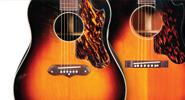
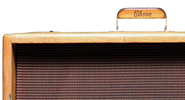
Photos: William Ritter. Instrument courtesy of George Gruhn.
Harp guitars with a standard six-string guitar neck and varying numbers of sub-bass harp-style strings have been made by a variety of American builders. Some of the best-known include Gibson, Joseph Bohmann (of Chicago), Knutson (Seattle), and the Larson brothers (Chicago), who made them primarily under the brand of Dyer (a distributor based in St. Paul, Minnesota). Even Martin experimented with a few harp guitars more than a century ago. Bohmann and Gibson produced harp guitars with carved tops, whereas others produced flat-tops with harp extensions.
The concept of producing fretted instruments with a standard neck and harp extension originated during the Renaissance, with lutes that were given harp extensions.
Gibson harp guitars originated with Orville Gibson himself, who produced harp guitars, six-string guitars, and mandolins from the 1890s until he sold his patent to a group of Kalamazoo businessmen which in 1902 incorporated the Gibson Mandolin-Guitar Company. The 1902 Gibson catalog featured four harp guitar models – the R, R-1 (with slightly more ornamentation), the U, and the U-1. The R was their least elaborate model at that time featuring a 17 7/8″ wide body and 25 1/2″ scale. The R-1 was same size and appeared only in the 1902 catalog, whereas the R was continued until circa 1907.
The most expensive instruments in Gibson’s catalog at the time, the earliest listing of the style R priced the instrument $195.03 while the R-1 listed at $221.63 and the earliest listing of the style U was $265.96 while the style U-1 was an astronomical $354.60.
The Gibson Style R you see here is typical of a circa-1906 model, with a carved mahogany bridge with scroll ends. Though the bridge is glued to the top in much the same manner as the bridge on a flat-top guitar, it is also held in place by a metal-strap tailpiece. By late 1907, the scroll shaped, fixed bridge was replaced by a moveable bridge and a double-trapeze special design tailpiece with string retaining pins mounted on a tortoiseshell grain celluloid crossbar. The reinforcement rod with turnbuckle adjuster running between the scroll and the six-string peghead is typical of 1906 onward. The star-and-crescent peghead inlay harkens to the days of Orville Gibson, who used this inlay pattern on many early Gibson models. The interior label in this instrument includes a photo of the face of Orville Gibson and one of Orville’s lyre-shaped mandolins which is typical of Gibson instruments made prior to 1909.
The language used to describe the harp guitars in early Gibson catalogs included a substantial dose of humor.
The carved top and carved back and scroll on the upper bass bout, as well as the oval sound hole, are similar in construction to Gibson artist-model mandolins. Though the earliest Gibson catalog specifies maple back and sides for harp guitars, virtually all which have surfaced made from introduction through 1907 have walnut back and sides. Later catalogs continued to specify maple back and sides, however the typical wood utilized was, in fact, birch, which is relatively similar in appearance to maple. Birch was the standard wood used by Gibson after 1907 for backs and sides on almost all of its guitars until 1925 and was used on A model mandolins as well as the F-2 mandolin prior to 1925, though the F-4 mandolin had figured-maple back and sides. From 1925 onward, Gibson phased out birch in favor of maple.
Though the Style R catalog specifications call for six harp extension strings, this instrument features seven harp extension strings. Gibson offered the option of varying numbers of strings. By 1906 10 sub-bass strings were standard on the style U and remained so from that time onward.
The original version of the style U in the 1902 catalog had a 21″-wide body and 27 1/4″ scale. The first version featured a six-string neck and 12 sub-bass strings. By 1906, the style U had a 25 1/2″ scale and by 1908, the scale had been reduced to 243/4″, the same as other Gibson standard single neck six-string guitars, and by 1913 the body width had been reduced to 18 3/4″ inches resulting in a much more comfortable instrument to play than the early style U. The Style U went through numerous evolutionary changes over the years, culminating in an instrument with an adjustable truss rod in the neck and a height adjustable standard archtop guitar bridge for the six string neck by late 1921.
Though style U remained in the catalog until 1939, there is little evidence any were made after the mandolin orchestra boom died in the early ’20s. Once demand for harp guitars ground to a halt, Gibson continued selling instruments from remaining stock and listed them in the catalog until supplies ran out.
Gibson harp guitars never sold in large quantities, likely due in large part to their high price and the fact they were unwieldy and uncomfortable to play. Gibson did, however, devote significant catalog space to harp guitars and even touted them as the ultimate evolution of the guitar. Early catalogs include impassioned promotions reminiscent of biblical passages.
Though Gibson’s statements that the harp guitar would render the standard six-string guitar obsolete proved to be untrue, there are still musicians composing and playing music on harp guitars today and a number of makers producing very fine new harp guitars. If anyone can be said to have been influential in this movement, it would be the late Michael Hedges, who played a Dyer harp guitar made by the Larson Brothers. Though Gibson harp guitars are among the most artistic and well-crafted, most modern harp-guitar players use vintage Knutson or Dyer/Larson models or modern instruments based upon Knutson/Larson design.
This article originally appeared in VG February 2014 issue. All copyrights are by the author and Vintage Guitar magazine. Unauthorized replication or use is strictly prohibited.
Morgan Monroe Blues 32, Morgan Monroe Creekside MV-01 and Loar LH-200
Picture the archetypal 1930s blues man, photographed with a studio backdrop, jaunty hat, knowing leer…. What else do you see? A guy with not too much money, that’s what! That’s why the guitar in his lap was usually something like a Gibson L model – small, shapely, and sunburst.
The iconic Robert Johnson L-1 was discontinued in 1937, when a Gibson L-0 sold for $25 and an L-00 cost $30. The 2007 equivalent sums are $350 to $420. So, where does that put your typical not-so-heavy-in-the-pocket blues player today?
Morgan Monroe provides a couple of answers in the form of their Creekside MV-01 and Blues 32, two guitars with different but equally pleasing voices.
The Blues 32 is finished in glossy tobacco sunburst, the top shading reminiscent of the later L-00s with a narrower dark outside edge, allowing for more of the tight sitka spruce grain to show. A bit more deluxe than its MV-01 sib, the appointments are still tastefully simple; Grover Sta-Tite tuners, three-layer white/black/white plastic top binding, inlaid maple logo banner, and bone nut and saddle.
Sonically, the Blues 32 is very reminiscent of its L-model inspiration, with a blues-approved sound strong in the mids, but with a full, textured bass and some treble snap.
This tight-sounding box, up to 43/8” deep, sounds equally good with plectrum or bare fingers: the steely, immediate response just invites a player to dig into classic blues licks and bass patterns and returns the favor by never sounding compressed, even under a heavy right hand. A slim V-neck with diamond volute, attached with an old-school dovetail joint, with 111/16” nut width and 14” radius, is perfectly comfortable. With a 5/16” nut string spacing and 251/4” scale, the Blues 32 is easy to play, with good volume and balance.
The Morgan Monroe duo share features other than the bone nuts and saddles: each fingerboard is graced with well-dressed, buzz-free frets.
Generally stellar construction values are visible throughout both guitars, though the MV-01 deviates from the Blues 32 with a slightly bigger body width, narrower body depth, subtle satin-sunburst finish on the top, stainless steel frets, and a tasteful maple binding. The triple-bound neck has a 243/4” scale length, maple dot inlays, and a contemporary D profile. The greatest difference is in the sound: considerably more body resonance with an airy presence.
Our archetypal blues man would do well with either Morgan Monroe; both offer excellent sound with fine playability, good intonation, solid-but-lightweight construction, and visual appeal. Although the Blues 32 comes out ahead in the 1930s bluesman appeal category for looks and quick-response sound, the MV-01 belies its lower price with its wooden appointments and more complex tonal palate.
The Loar LH-200 strikes immediately as a contender in the looks department “Vintage Vibe” division. The ivory-black-ivory binding, pearl logo and fret markers, abalone fern pattern (craftily overlaid, not inlaid, in an age-old technique utilizing microthin shell) and snakehead-with-vintage-style tuning machines has enough flash to complement any upright archetypal blues man’s better suits and dapper foot/headwear. The Loar flat-top boasts clean construction, good fretwork, modern rounded neck profile, and a classic sunburst finish over a bearclaw spruce top.
The LH-200’s long (201/4”) body and 251/2” scale length sound strong and play comfortably with its 111/16” width bone nut (which was cut very, very well). Though the saddle is plastic, intonation out of the box was quite good and all frequencies spoke with authority when played finger-style. With a thick Dunlop pick, the LH-200 summoned up a powerful growl in the bass, strong mids, and a good cut in the high-end frequencies. The LH-200 also featured a long, resonant decay, and fine slide-guitar sustain. We think any Bluesman would be tempted by this slightly pricier Korean-made guitar for all the right reasons; it plays well, sounds great, and leaves a striking visual impression with the generous shellwork on the headstock.
If vintage Kalamazoo and Gibson guitars have an advantage in solid wood and ’30s mojo, these newfangled contenders have more dependable intonation and neck adjustability. All three are good guitars, and represent exceptional values.
Morgan Monroe Blues 32/Creekside MV-01
Price: $499/ $479.95
Contact: Morgan Monroe, 1922 West Banta, Indianapolis, Indiana 46217; phone (800) 475-7686; www.morganmonroe.com.
The Loar LH-200
Price: $699.95
Contact: The Music Link, PO Box 162, Brisbane, CA 94005; phone (415) 570-0985; www.theloar.com.
This article originally appeared in VG July 2008 issue. All copyrights are by the author and Vintage Guitar magazine. Unauthorized replication or use is strictly prohibited.
At 1.5″ x 3.5″, the E.W.S. Little Fuzzy Drive looks fun and toy-like, but, when plugged in, thoughts of cuteness disappear.
Designed to use half the space on a pedalboard, the Little Fuzzy Drive (LFD) is sturdy despite is size, and is capable of a variety of tones, from slight overdrive to full-out retro fuzz. Instead of using a germanium transistor, E.W.S. incorporated an actual amplifying element, which the company says increases stability and makes the pedal less sensitive to temperature changes. A true-bypass pedal, the LFD can handle a 9-volt adapter.
Plugged in between a 1970 Stratocaster and a ’66 Vibrolux Reverb, its heavy fuzz setting sounded great for leads. Like the best fuzztones, LFD is sensitive to the instrument, giving the player the ability to dial back the level of fuzz by merely rolling back the guitar’s Volume control.
For overall tone shaping, it allows the player to toggle between normal- and fat-sounding fuzz tones via the microswitch on the top of the pedal. Fat Fuzzy mode engages a mid-boost that expands the gain and also seemingly increases the bass, giving even the thinnest-sounding guitar the creamy richness and sustain of the much sought-after “woman tone.”
Joe Bonamassa’s latest record, Driving Towards The Daylight, is a return to the blues. After two successful studio albums with the heavy-rock band Black Country Communion, Bonamassa’s latest solo effort explores some of his early influences. While covering Robert Johnson, Howlin’ Wolf, and Willie Dixon, he got help from heavyweight guitarists including Brad Whitford, Pat Thrall, and Blondie Chaplan. But Bonamassa couldn’t have recorded this album without the help of producer and label partner Kevin Shirley. Their unique relationship has produced a great body of work as well as some awesome guitar tones.
Driving Towards The Daylight sounds like you getting back to your thing.
It’s a little bit of a return to the blues, which is always fun. It was about time to stop messing around with the bouzoukis and world stuff, and do a blues record again.
Was that an actual conversation you had with Kevin Shirley?
That was the word. Every record has a word. Ballad of John Henry was “swampy.” Black Rock was the “world blues” thing. Dust Bowl was “Americana.” This one was “blues,” so we tried to make a blues record. It’s fun to play and the material is translating very well live.
When you and Kevin discuss concepts, does it flow naturally, or do you have goals in mind?
We always find ourselves on the same page. That’s why the way we work is so special. He’ll say, “I think we should make a blues record.” And I’ll say, “I was just thinking the same thing.” That’s the beauty of it. When you run your own record company, it’s like, “I’ll do whatever I want!” There’s no committee thinking. There’s no hits. We don’t play the radio game. In spite of it all without a radio hit, we’ll walk into venues with 2,000 to 5,000 each night, going, “This is better than having some kind of radio hit that you have to play every night.” There are a few songs they would be disappointed if I didn’t play, so I get to them, but there’s certainly no career-defining song.
What keeps you on course in terms of the records you choose to make?
I try to make records I know my fans would like. I think I know my fans pretty well at this point; they tolerate a lot of adventurism on my part, with trips to Greece and bouzoukis laid over I-IV-V changes. I think they know me as a person and they know whatever I want to do is something that’s uniquely authentic to myself. They have a good barometer when they smell “the machine” getting behind it, and so do I. When I see that coming down the lane, I pick up my guitar and run the other direction.
Was joining Black Country Communion an attempt at a crossover?
Essentially, what we tried to do was make modern classic rock. It sounds like it was recorded in 1972 with that kind of live-in-the-room feel, with everybody playing great on new songs. We saw there was definitely a niche for that – “new classic rock.” New songs, but they would sound relevant to 1972, as well.
For years, blues purists were saying, “Please stop trying to hi-jack the blues and go join a rock band, because your show is more rock than blues.” Some of the points they made are valid because it really isn’t “blues” by definition, yet it’s categorized as blues. So I gave them their wish, and honestly, it’s a lot of fun! They’re good cats to play with, and good people, and it’s exhilarating.
Staying away from rock, how did you choose the material on Driving Towards The Daylight?
One of the initial songs was Howlin’ Wolf’s “Who’s Been Talking?,” and we basically let Howlin’ Wolf dictate the tempo. At the beginning of the song is a sample from the ’60s, when he went to London and did those sessions; it’s him talking to Aynsley Dunbar. On Robert Johnson’s “Stones In My Passway,” we just wanted to do it like if Lead Belly was alive today, doing Robert Johnson on a 12-string. We’re messing with the traditional structure, but that’s the way I like it.
What’s the difference between the gear you use for Black Country Communion and the gear you use on solo tours?
I bring more stuff for the solo gigs. I have 13 albums to get to. For Black Country Communion, I bought seven guitars. Mostly, I played a couple of my signature-model Les Pauls and my first ’59 Les Paul Standard sunburst. Since then, I’ve purchased two more. On tour, we have two ’59 Les Pauls, a ’60 with a Bigsby, two dot-necks – a ’60 and a ’61 – a ’53 black-guard Tele, a ’54 Firebird, and a ’57 goldtop with P-90s. Amp wise, I’m using two Marshall Jubilees, a Trainwreck Liverpool from 1990, and a prototype from Jim Kelley, built by John Suhr. It sounds freakin’ wicked.
My whole thing is that I just want to be different from everybody else. I don’t want to be lumped in. What I do is different than Derek Trucks. Derek Trucks is different than me. Kenny Wayne Shepherd is different than both of us, and Jonny Lang is different from all three of us.
The people who do the lumping don’t have an ear for nuance…
“Oh you’re a blues guitar player, so you must like Stevie Ray Vaughan.” Well, I admire the man’s music, but let’s not go to the lowest common denominator here and take the Wikipedia definition. There are deeper things. I’m from America, but British blues is my thing.
This article originally appeared in VG August 2012 issue. All copyrights are by the author and Vintage Guitar magazine. Unauthorized replication or use is strictly prohibited.
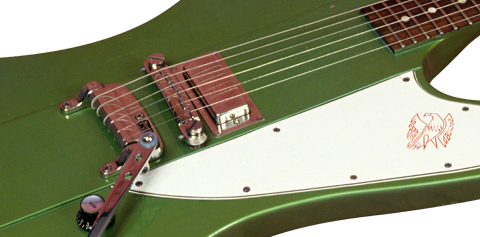
Mike Lipe has a wall of gold records. Why? Not because he’s a musical star, but because he’s a star to the stars. A former top builder at Ibanez, his creations have helped Steve Vai, Joe Satriani, Andy Timmons, and many others become luminaries on the instrument. Now on his own, Lipe is producing a line of hand-built instruments.
Lipe’s traditional-leaning Maestro is a solidbody guitar that incorporates bolt-neck construction and a Tele-meets-Jazzmaster design. Weighing in at an startlingly light five pounds, eight ounces, its body and neck are mahogany, its fretboard a dark, tightly grained rosewood with large 6155 Dunlop fretwire, a bend-friendly 12″ radius, along with a 25.5″ scale length, and a nut width of 1.70″. The neck is a handful, with a measurement of .90″ from front to back at the first fret, and .99″ at the 12th. The headstock has a 7-degree angle, which allows for elimination of string trees and promotes tone through greater downward pressure on the nut. Hardware consists of Hipshot locking tuners and a solid Strat-style bridge, with black knobs that go to 11. Electronics are two Amalfitano P-90 pickups, complemented with a three-way switch, master Volume, and master Tone controls. The body is stained deep red, while the neck is satin-finished, providing a friendly feel. Lipe does no CNC shaping of necks or bodies, and various neck shapes and fret sizes are available.
The neck of the Maestro has the size and feel of a vintage Precision Bass. Though large, it’s comfortable, and Lipe builds to suit the player’s taste. Finishes are beautifully applied and the woods are gorgeous. Playability is top-notch, facilitating clean bending, and intonation on our tester was spot-on, allowing chords to ring loud and true. The pickups are perfect for the instrument, bringing out the best of its Fender-meets-Gibson nature. The neck pickup offers a clean, articulate tone that’s warmer than most Fender styles, and less muddy than most Gibson-style instruments. The bridge pickup can get downright twangy, but never with harsh top-end. Run together, they produced a grand sound – clear, bell-like, and full. With either amp’s overdriven tones, as well as with dirty tones derived from a pedal, the Maestro worked equally well. No matter the level of drive or volume, the guitar never fed back or lost its character under the weight of heavy distortion.
The Maestro is beautiful, playable, and tonal. Its Fender-style neck and Kalamazoo-style tone woods, pickups, and headstock angle make for a pleasant mix.
This article originally appeared in VG February 2013 issue. All copyrights are by the author and Vintage Guitar magazine. Unauthorized replication or use is strictly prohibited.
LeVang in ’69 with with his ’64 Fender Telecaster.
Neil LeVang was about to get a lecture.
Days earlier, the A-list studio guitarist’s new boss, Lawrence Welk, had golfed with a couple well-known singers who mentioned that LeVang had played on their sessions.
“Neil,” Welk implored in his famous German accent, “If you thought as much about this (band) as recording with all these different people, you could be my right-hand man.”
LaVang, a master of the sarcastic retort, had an instant comeback.
“Should I have my cards printed now?”
His easy laugh bursts forth as he tells that story and others covering his half-century career. Like Welk, LeVang is a rural North Dakota native. But the similarities end there. ABC’s weekly “Lawrence Welk Show” gave him such high visibility that he was the first guitar hero to a number of babyboomers. As a kid, Seymour Duncan audiotaped LeVang’s solo spots from the show (see sidebar). Nonetheless, the former jazz violinist made his greatest mark as a guitarist in Hollywood’s recording studios from the late 1950s through the late ’80s, his staggeringly diverse workload spanning all genres, including TV and film.
Regardless of their home base, great studio players tend to be a breed unto themselves, with their own codes and an uncanny chemistry. LeVang joined that elite group when network TV was evolving and stereo was becoming mainstream. The digital era was dawning when he hung it up in the early ’90s. His strength – a knack for tasteful playing – remained a constant, as did his ability to give producers and arrangers precisely what they wanted. For him, it was art, but also business. He never took his eyes off quality, excellence, or the bottom line; understandable, given his humble origins.
“I came from a Swedish family,” he says. Born on a farm in 1932, Neil Kenneth LeVang says his home town of Adams was made up of “200 people, so, you know… not much talent around there! We didn’t have electricity or plumbing, so we were… in trouble!” he laughs. “My dad had a violin and a guitar hanging on the living room wall, but wouldn’t let me touch ’em. I was very young. Dad played old-style fiddle, and my older brother, Morris, played guitar. When I was three or four years old, I was totally interested in music. And I didn’t realize at the time, but I had (perfect) pitch. And as time went on, my mom would let me take the violin down, so I learned to play it a little.
“We didn’t have electricity, but my dad worked up a battery-operated radio, and at night I could get WLS in Chicago. I’d listen to jazz players like Rhubarb Red – Les Paul – and George Barnes, and saxophone players… the greats of the day. And that’s what I wanted to play. I hadn’t even started school yet, but I knew what I wanted to be!”
LeVang began working when he was young, “candling eggs at Johnson’s Mercantile for 25 cents a crate. I worked all evening.”
In 1940, the family moved to Bemidji, Minnesota, a town of 5,000 that LeVang recalls was “humongous to me. It was like New York!” He became interested in the guitar, and at age 10, met a kid from the local high school. “He got some kids together to form a band – horns and the whole shot. He asked me to play guitar with the band, and we practiced, then got a job at a place called Shore Crest, in nearby Walker. All of a sudden, I was making $5 a night! People loved it because we were kids.”
LeVang in 1980, with his ’74 Gianninni Craviola.By 1945, LeVang had decided to leave Bemidji for California, where a cousin worked at an aircraft plant in Riverside. After telling his family, they moved with him. Despite his guitar experience in Bemidji, jazz violin remained his main instrument, with Joe Venuti and Stuff Smith, two of the greatest, among his heroes. Like Smith, LeVang amplified his violin. Arriving for a Sunday jam at a Riverside bistro, he met Edgar Hayes and the Stardusters, a respected jazz combo led by pianist Hayes with bassist Curtis Counce, guitarist Teddy Bunn, and drummer Blinky Allen. Bunn, LeVang recalled, tuned his guitar to E-flat. His violin so impressed the band they took him to Los Angeles’ Central Avenue area, locus of a vibrant music scene. Jamming at Jack’s Basket Room, upcoming young blues singer Jimmy Witherspoon complimented his playing.
Eventually, someone directed him to a restaurant near CBS’ Hollywood radio studios, where a number of Western singers hung out, among them Jimmy Wakely and comic Smiley Burnette. LeVang assembled a combo to open Burnette’s stage shows. His guitarist was jazz virtuoso Bill Dillard, who later replaced Tal Farlow in the Red Norvo Trio before he died in a fire. “This guy was a beautiful jazz guitar player, 22 years old, and we went on the road and opened for Smiley. We had worked up some jazz tunes, some standards. I was playin’ electric fiddle and we… kicked butt!”
In Hollywood, he met singer Colleen Summers, part of the local Western duo the Sunshine Girls. She was a regular at Les Paul’s garage studio on North Carson Street even before Les renamed her Mary Ford. In 1948, LeVang joined the Western vocal group Foy Willing and the Riders of the Purple Sage as a singer. The stint lasted two years, after which he moved to Texas Jim Lewis’ band as a fiddler. During an engagement at Manhattan’s first important country music club, New York’s Village Barn, LeVang did his first recording sessions as a sideman, fiddling behind the country band the Pinetoppers, who recorded for the Coral label. His composition “Jelly Bean Rag” was later recorded by Leon McAuliffe and the Cimarron Boys.
Lewis was Seattle-bound in January of 1951, and when LeVang arrived, he took an office job at Seattle radio station KOL, working his way into a disc jockey job and later, becoming a local TV personality on KING. “I was dabbling with guitar on the side, but not as a profession,” he recalls. “I heard everything; I was a sponge.” From 1951 to ’53 he was enlisted in the U.S. Coast Guard, based in Seattle, and doing so well in a bureaucratic position at the port that his commanding officer urged him to stay. Attorney-politician Albert Rosselini, a future Washington Governor, helped him get into college and shoot for a law career, a notion he abandoned in 1956 by returning to Hollywood.
Switching to guitar, he wound up replacing Barney Kessel as guitarist on Jimmy Wakely’s weekly CBS radio show, playing a Gibson ES-175D. During two years attending the Westlake College of Music part-time, he learned the Schillinger System of composing and arranging. Acquiring a new Fender Pro amp launched his lifelong friendship with Leo Fender. “I loved the sound of it because it didn’t try to make sound – it [reproduced] sound. That was my thing with Leo. I was supplied with instruments, and he would come up with these country amps with a pitch only dogs could hear. The Pro was my favorite because it had a mellow sound.”
1) LeVang on the Welk show with the 1974 Gianninni Craviola and singer Ralna English. 2) LeVang with his 1930 B&D Silver Bell tenor banjo. 3) LeVang with his son, Mark, in 2008.LeVang found work doing demos, and by ’58 had graduated to country sessions with the Sons of the Pioneers and Freddie Hart. A soundtrack date with pop orchestra leader David Rose led to a lifelong friendship and association, including working on Rose’s own orchestral recordings (among them “The Stripper”) and briefly on Red Skelton’s weekly CBS TV show, where Rose ran the band. In the fall of 1959, after touring with Gail Davis, TV’s “Annie Oakley,” he got a phone call about a job. Buddy Merrill, Lawrence Welk’s wunderkind guitarist, was going into the Army, and the band needed a replacement.
Welk’s Saturday night TV show had immense appeal to older adults enamored by his bland but melodic “champagne music,” complete with a machine pumping out bubbles around the band. For average uncritical music fans, Welk was all they needed, and even hipper musicians who deplored that music couldn’t argue with Welk’s commercial and financial successes.
There was no favorite to fill Merrill’s chair, he remembers. “They had several different guitar players (try out). Tommy Tedesco was on the week before me, so when I called into the office they asked, ‘Can you do it this week?’ I went in the week after Tommy, and I played ‘Little Rock Getaway.’ I guess I did it good,” he laughs. “He called me on Monday (imitates Welk). ‘Hello! How would you like to join our show?’ I said, ‘Let me think about it.’” He was dubious, though his band encouraged him. Finally, he talked with George Cates, Welk’s musical director, telling him, “I’ve got a good studio business starting here, and as long as tjos doesn’t limit me from doing my studio work, I don’t mind.” Cates assured him that beyond the day the show was taped, he was free to work sessions.
LeVang officially joined the Welk Musical Family around Thanksgiving of 1959. He’d remain for the next 23 years, doing occasional tours but mostly working that day a week when the show was taped.
His rationale for taking the job was mainly pragmatic, explaining, “it paid my kids’ (health) insurance and my child support,” and firmly asserts Welk was “a quarter of my total work.” He had good reason to maintain his studio schedule. The other days of the week, he worked for top arrangers like Nelson Riddle, Don Costa and Billy May. Early on, he’d become a vital cog in the musical section of the Hanna-Barbera cartoon machine, working with arranger Hoyt Curtin, which led to 15 years of more or less steady soundtrack work.
Kicking around new ideas with Leo Fender, LeVang helped him create the Fender Bass VI. He explains one early prototype thusly. “I took a Telecaster and equipped it with bass strings. He built the other one (production model), which I used.” Youtube videos show him using the Bass VI on the Welk show. He also recalls using it years later on Glen Campbell’s hit “Wichita Lineman.” Campbell was an old friend; they worked many sessions side-by-side. “They’d write parts for him, but he didn’t read, so I’d sit there alongside him and I would pencil in his stuff and I’d play in thirds or whatever.”
The Bass VI was introduced in ’61, the same year Buddy Merrill, discharged from the Army, returned to the band. Around that time, Welk decided to make other changes, delegating Cates to call the unlucky musicians. LeVang received one of those calls. Unconcerned, he took David Rose up on his offer to fill the guitar chair with the orchestra for Red Skelton’s weekly TV comedy-variety show. Cates consulted with Welk, who within an hour reversed course on Neil. A tough negotiator, LeVang wanted double union scale and doubles for playing multiple instruments. When Welk balked, LeVang reduced the double scale, but shrewdly worked out a deal that, when the smoke cleared, netted him a total 2.25 times scale. Again, he asserts, practicality motivated his thinking. “I’ve been a businessman since I was a kid,” he explains. “Let’s face it. You either make this a business, or you make it a hobby. I just feel that you do it for one reason or another: you want to kick ass or work the country club and pick up chicks – your choice, not mine.
“I’m very proud of [being] self-taught. I learned to read from violin and clarinet books, and if you can get that down, you can read anything.” In the early ’60s, he recalls, “I did a lot of things with Herb Alpert. I did the original Tijuana Brass. We were tryin’ to get a sound, so I did those up to the time of ‘Whipped Cream’ – when he formed the (recording and touring) band.”
Sessions gave him the opportunity to rub shoulders with giants. “We were doing an album with Frank Sinatra, who never rehearsed – he ‘came in.’ The band rehearsed. And one time there was an empty chair in the rhythm section, and he came over and sat by me, listening to playback. He said, ‘Hey Neil. Don’t sound bad for an old drunk, does it?’ He loved musicians.”
Sessions paid well, but also had their frantic side. “My biggest problem was makin’ it from one studio to the other,” LeVang laughs. He worked with anyone popular at the time. “I did an album with Liberace, one with Roger Williams, Eddie Fisher – the worst singer I ever recorded with – and Carol Burnett before she started doin’ TV. At one session with singer Tony Martin, Martin asked the studio be set up like a stage so he could record in a concert setting, wearing a tux.”
LeVang did extensive work on TV soundtrack sessions and, in ’65 a “Beverly Hillbillies” cast album for Columbia. Other TV work in the ’60s included two classic themes – “Green Acres” (“that’s me on first guitar playing the theme”) and Neil Hefti’s theme for “Batman.” “I did a whole bunch of things with him. I played six-string bass and also regular guitar.” Playing alongside him on the “Batman” session were two other guitar giants – Howard Roberts and Al Hendrickson.
1) LeVang on the Lawrence Welk Show in ’67, with Lynn Anderson and Buddy Merrill. 2) Neil LeVang with his early-’60s Fender VI. 3) LeVang in 1980 with his ’63 Fender King Acoustic.He also worked extensively with other great orchestral arrangers including John Williams, Patrick Williams, Marty Paich, Artie Butler, and Henry Mancini among them, as well as his buddy Frank DeVol, known for portraying inept bandleader Happy Kyne on Martin Mull’s sitcom “Fernwood-2 Nite” (with Tommy Tedesco on guitar). “With Frank, I did ‘Brady Bunch,’ ‘Family Affair’ and several other things,” LeVang says. “He was a beautiful cat.” When the plot for “Family Affair” included a trip to Spain, he asked LeVang to record Spanish guitar solos for the soundtrack. His response was typically candid. “I said, ‘I don’t want to hold you up. But I’m not a legitimate gut-string guitar player.’” When DeVol insisted, LeVang offered to have a schooled gut-string player standing by in case he couldn’t cut it.
“I never looked at charts before the session because I didn’t want to freak myself out. I put the earphones on and opened it up. But he wrote so well for guitar, I just read the (solo) spots. Listening to the playback, I didn’t even recognize my own playing! DeVol came out and said, ‘Where did you learn to read like that?’ I said, ‘I don’t know.’ He asked, ‘What was your original instrument? I said, ‘Violin.’ He said, ‘That explains it!’”
The rock and roll of the ’60s expanded his range of sessions, though due to overdubbing, he often recorded backgrounds, unaware of the identity of the singer or band. “At one session, this guy comes out of the booth and says, ‘Neil, you did a hell of a job on the last album!’ I said, ‘Oh… Whose album was that? He said, ‘Dino, Desi and Billy.’ We were doing the Monkees stuff. Studio musicians did the work and (the rock bands would) sit down and copy the records.” That wasn’t the case, however, with one session. “I was called to TTG studios to do an album with Frank Zappa when he was just starting out. I was working with Welk at the time, and we got through the first session, when Zappa looks at me, his hands wheelin’, and says, ‘How do you play that way? You’re “Mr. Straight Life!” I thought he was out of his mind!”
A 1971 date brought an unexpected reunion. “When I got there, they said, ‘You’ll be playing funk fills. I got my Fender and put the headset on, doin’ the fills. And after I get through with the first tune, this fella puts his hands on my shoulder. He said, ‘Don’t you remember me, Neil? I’m Spoon!’ It was Jimmy Witherspoon, who he’d met 26 years earlier on Central Avenue. “It was a kick that he remembered me.”
Some in Welk’s musical family expected LeVang to be on the receiving end of a different kick. “Everybody thought I was gonna get fired all the time.” He witnessed Welk’s penchant for mangling the English language with his famous bloopers. Once, reading from cue cards, he announced the band would play “songs from World War Eye.” Another time, Welk requested a sideman accompany an auditioning female singer, innocently asking the accompanist to, “Give this girl a good feel.” But the money was good, and he got along well with Cates, who ran the band behind the scenes. “I was in charge of the rhythm section and (George) respected my ability. I’d come in one day a week, do my gig, and get the hell out. I didn’t want to be invited to Lawrence’s for dinner.”
Clearly, that was not going to happen, given incidents like one during the band’s Lake Tahoe engagement. Accompanying the Lennon Sisters, he suddenly found Welk standing in front of him exclaiming, “Too much! Too much!” “He’s wavin’ his arms. I’m hearing him over my earphones and said, ‘Shhhh!’ and keep playin’.” Called to Welk’s dressing room later for a chewing-out, LeVang struck first. “I said, ‘Lawrence, I could hear you over my earphones, and if my mic is picking you up, it’s going out to the audience, I didn’t want you to be embarrassed.’ He said, ‘Everybody’s telling me how to run my band!’ I said, ‘No, Lawrence.’ He said, ‘You were just playing too much.’ I said, ‘I may not be the best guitar player in the world, but I’m probably one of the tastiest!’ I had to fight that ego with ego.”
At its peak, LeVang’s armada of gear gave his cartage company a considerable workout. It included the Bass VI, a Fender Precision Bass, Dobro, Gibson L-5, Fender steel-string acoustics including a King, and “several gut-strings” including a Tarrega. He can’t recall the brand of one favorite guitar, but, “I called it the Thrifty Mart because it cost $39.95, but had a hell of a good recording sound.” A Fender Twin Reverb and a ’65 blackface Pro Reverb were his amps of choice.
1) A 1960 Fender promo photo. 2) LeVang in 1952 with his first Fender Telecaster.Along with guitars, he routinely kept four-string tenor and five-string banjos handy, tuning the tenor like a guitar because, as he says, “People didn’t know how to write for tenor banjo, so I tuned it like a guitar, so I could read (music while playing) on it, and I also played a Fender electric mandolin. I had a couple of ukuleles – tenor and a baritone. Hell, I had a little bit of everything. I played a Gibson (A-series) mandolin.”
On some early shows, he played a Fender Jazzmaster given to him by Leo, who liked LeVang’s directness. He recalls a time Fender was planning to make an electric banjo. “He had a prototype I happened to see one day, and he said, ‘What do ya think?’ Leo had a 42-foot boat, and I said, ‘If your rudder ever breaks, this would be a good replacement!’ He always wanted a straight answer.” LeVang particularly loved one axe Fender custom-made for him in the early ’60s – “a Stratocaster with curly maple. The I had them wrap the pickups so they didn’t have all those highs, and the neck was flat in the back like an old Gibson neck.”
In ’74, the Strat and some of his other instruments were stolen from Welk’s truck. “The guy transporting them from the studio went to his girlfriend’s for lunch and forgot to secure the truck. I had an L-5 stolen, along with the Stratocaster.” Also gone was tenor banjo given to him by Eddie Peabody when he appeared on Welk in ’63. “The Lennon Sisters had written him a solo, but he didn’t read.” After LeVang played the part for him, a grateful Peabody gave him the Vega he used on the show.
“When Leo sold the factory, I started playin’ other stuff,” LeVang noted. “I had an Epiphone Sheraton that I loved, and a Guild Starfire I played on the Welk show.” On occasion, he used a Music Man and a Fiesta Red Tele owned by his son, Mark, a composer and studio keyboard player in L.A. But when Fender founded Music Man, LeVang switched allegiances, playing the company’s electric guitar and HD 130 and a 115 RP amps.
His soundtrack work continued, encompassing dozens of major feature films including All the President’s Men, At Long Last Love, Valley Of The Dolls, Dick Tracy, Good Morning, Vietnam, the Disney Herbie The Love Bug series, Rosemary’s Baby and Smokey and the Bandit, to name a handful. He played his Gibson mandolin on the Godfather soundtrack. That led to his recording an album with singer Al Martino, whose bodyguard effusively praised LeVang’s mandolin playing, adding “And you’re not even Italian!” For a Judy Garland concert with the L.A. Philharmonic, he remembers, “I played gut-string, and knew how to accompany a vocalist. I played fills, and it was a very nice moment. She wanted me to do her TV show, but because of my other obligations and the Welk show, I couldn’t. Still, it was nice to be asked.”
He worked with pop and rock acts including Duane Eddy, the Fifth Dimension, the Jackson Five, Harry Nilsson, and Rosemary Clooney. He played on the Jackson Five’s “I’ll Be There” alongside ace session guitarist Don Peake, and did some of Michael’s and Janet’s solo material. On other sessions, he backed Barbra Streisand, Johnny Mathis, David Clayton Thomas, Dick Dale, Lou Rawls, Neil Diamond, Al Martino, Dean Martin and Sinatra. He played on the Carpenters’ Christmas album and Phil Everly’s acclaimed Star Spangled Springer album. “I did Bing Crosby’s last album (Crosby died in 1976),” he adds. “Beautiful. He was laid back.”
1) LeVang in a U.S. Coast Guard promo photo in 1950, playing fiddle. 2) A 1952 promo photo of Texas Jim Lewis (from left) Lewis, Frank Lawver, Tex Worrell, Neil LeVang, and Jack Rivers.He once recorded in Nashville with Brenda Lee, working alongside some of the celebrated A-Teamers with Lloyd Green on pedal steel.
LeVang’s work on the Welk show had its moments, both solo and when he teamed with Merrill, a featured and much-admired soloist on guitar and pedal steel until he departed in ’74. One youtube video shows the pair tearing up the “Green Hornet Theme” on matching Strats. LeVang also accompanied band member Peanuts Hucko (respected big-band clarinetist) on tenor banjo on the ancient jazz favorite “Hindustan.” Backing violinist Joe Livoti on the Joe Venuti-Eddie Lang instrumental “Wild Dog,” he made his Fender King sound like a jazz archtop. “I happened to be playing the bass line along with the chords,” he laughs. “I made it up as I was going along. What do I know?”
He was involved in another unusual Welk jazz project – a ’65 album with iconic Duke Ellington tenor saxophonist Johnny Hodges. Welk faced a changing world during that decade. Amid the turmoil of the civil rights movement, pressured to include black performers, he added tap dancer Arthur Duncan to the cast. When longtime drummer John Klein (who was Welk’s cousin) left the drum chair in ’76, at LeVang’s recommendation Welk hired a black drummer who worked with the band for a time. In the past, rock acts occasionally appeared with Welk (the Chantays played “Pipeline” on one broadcast), but by the ’60s the show included more rock, adapted (dumbed-down, some might say) for Welk’s aging audience.
LeVang’s cheekiness with the boss occasionally exacted a price, yet even then, he had a comeback – or two. He wrote all the charts for a (Welk) album, but then on the day of a show taping, he found a copy of the album on his music stand in the studio, and his name was conspicuously absent from the credits. Irritated, he hit the talkback button on his music stand and began reading the album credits to everyone in the control room. “I was naming all the people including (Welk’s) secretary, down the line to the guy who cleans up the stage. And Lawrence comes back just a couple minutes later and he says, ‘Neil, I notice the album doesn’t have your name on it.’ I said, ‘That’s alright. If the album’s a flop, your name is on it, mine isn’t.’ That was the relationship we had.”
Nonetheless, the show continued through the ’70s, and so did LeVang’s session work. He worked with David Rose on the soundtrack for the TV series “Highway To Heaven,” which ended in ’88. “When we did the last show, he called and said, ‘I didn’t have time to write a guitar part. Just look at the score and when you feel like it’s time to play, you play.’ It was a pleasure working with the man.” Rose died in 1990.
He even went the distance with Welk, remaining until ’82, when the 79-year-old leader, dealing with the realities of age, ended the show after a hugely popular farewell tour. Welk hosted a couple subsequent reunion shows before he died in 1992. Summarizing the relationship, LeVang reiterates that “Welk was not my career or my head or my heart. That was to pay my child support and the insurance for my kids. It was sensible to hang on to, and that was basically it. You see the (Welk) things of mine online and (think) ‘This is what the guy did.’ But that’s not what I did. I didn’t do all I could on that show, because we were limited.”
When his studio calls tapered off by the late ’80s, he was philosophical. “I had so many years, I really didn’t care,” he says. He found himself touring Japan with bandleader Billy Vaughan, who was “a sweetheart of a man” bigger overseas than in America. During those tours, LeVang did occasional solo shows. At one, he met a fan who bowed to him. “I said, ‘I’m just a guitar player. You don’t have to bow to me.’ He said, ‘No, I’m just a doctor. You are an artist.’”
What does LeVang consider himself today? “Retired, thank God! All I did was make a living. I never had to work a day in my life, and I’m proud that I had the chance to do the things I’ve done. Some were memorable.” He no longer plays, saying, “I have nothing to prove. It was a nice 40 or 50 years! It was great.”
Seymour Duncan: The LeVang Connection
“I bought my first Fender Stratocaster in 1963 because of Neil LeVang,” says Seymour Duncan, whose admiration for the L.A. studio great and Welk guitarist sparked his passion for the instrument. “I told the owner of Musicville, in Woodbury, New Jersey, that I wanted to get a Strat so I could sound like Neil LeVang.”
Duncan, a revered guitar tech even before he started his legendary pickup company in 1978, is an institution himself, his gear used and endorsed by everyone from David Gilmour and Slash to Robben Ford and Jimmy Bruno.
LeVang’s inspiration helped start it all.
Seymour’s uncle, Howard Duncan, actually pointed the way. Having hipped his nephew to Chet Atkins and Jimmy Bryant, he told him about the Welk guitar duo of LeVang and Merrill in the early ’60s. Duncan’s dad, who owned a reel-to-reel tape recorder, allowed him to record LeVang’s playing on Welk’s show every week. Duncan remembers how it affected him, particularly his performance of “Ghost Riders in the Sky.”
“He was the first professional musician I ever saw perform, and he was playing a sunburst Stratocaster with gold pickguard with white pickup covers (the guitar stolen from Welk’s truck in ’74). I watched the show every week, recording any solo Neil would take. He was my first guitar hero, along with Duane Eddy and The Ventures, who I only heard on record. It was so great to see Neil play, and watch his technique.
“I liked his playing because I could hear the melody. I basically get lessons while watching.”
Later, the two met at NAMM shows in Anaheim. “Meeting him was a great thrill. He can play so many styles of music.”
Also memorable for Duncan were the guitars LeVang played on the Welk show, including a white Jazzmaster he used when he performed “South,” with tortoiseshell pickguard and the “switch in the middle position.” He later used a sunburst Jazzmaster, again with the tortoiseshell guard. For “Green Hornet,” he and Buddy Merrill used white Strats. In ’77, he vividly recalls Neil using a three-tone sunburst Strat to perform “Wabash Cannonball.” On a performance of “Wheels” that same year, LeVang used the neck pickup on his famous Fiesta Red Tele.
Duncan and Fender’s Custom Shop have teamed to build a reproduction of the stolen Strat with the custom pickups Leo Fender wound especially for him to emphasize a more mellow tonality. Duncan has a clear strategy for recreating that sound. “I’ll make the pickups by hand, using a specific Formvar-insulated wire, and I’ll scatter-wind the coils using hand-controlled tension, magnetized and calibrated magnets, and it’ll be calibrated for the bridge, middle, and neck position. The tone will also be determined by the string gauge Neil uses.”
Other custom touches will include waxed pots and a custom wiring harness with a five-way pickup selector switch. The pickups will be calibrated for string balance and position, and the pickguard will be either anodized or single-layer white, depending on Neil’s preference. The pickguard will have a ’50s control plate.”
This article originally appeared in VG December 2009 issue. All copyrights are by the author and Vintage Guitar magazine. Unauthorized replication or use is strictly prohibited.
Country Gentleman “Special” prototype with serial number 23396 (left), and Country Gent number 26400. Photos courtesy of Naoaki Toyofuku.
The Gretsch Country Gentleman 6122 was the third of four Chet Atkins signature guitar models created for the legendary guitarist in the ’50s. The little-known truth is it was also a response to all the things Atkins did not like about the first model Gretsch conjured for him – the 6120 Hollowbody. The reality is Atkins didn’t have much input on the development of the 6120, and there is evidence it was conceptualized prior to Gretsch’s signing him on to endorse it in 1954.
The Country Gentleman however, was heavily influenced by Atkins, and was his opportunity to make right the 6120 features he dutifully endorsed in public, but with which he privately voiced dissatisfaction. Recently, an early example was discovered – the earliest, in fact – which reflects the radical direction Atkins took with the Country Gent and the bold departure from his original namesake model.
First and foremost on Atkins’ complaint list for the 6120 Hollowbody was the pickup technology. In the late ’40s, Gretsch began employing the DeArmond Dynasonic single-coil in its electric guitars. Atkins thought its magnets were too strong and negatively affected the tone of the guitar. With the advent of Ray Butts’ Filter’Tron humbucking pickup, Atkins was able to get a more desirable sonic response for his newest signature model.
Secondly, Atkins was a big believer in the benefits of a sealed top. He didn’t appreciate the over-sized f-shaped sound holes in the 6120, and the sentiment was illustrated in his well-known favor of a prototype 6120, which had a thick top that lacked sound holes. He used the guitar – made for him in 1955 – on many recordings, and it was no doubt a source of inspiration for the subsequent Country Gentleman format. Though the Atkins signature archtops all received internal “trestle” bracing for the 1958 model year, he could never persuade Gretsch to make a guitar with a solid block down the center, which Atkins believed would further enhance the tone of the instrument. Regardless, with its sealed top and internal bracing, the Country Gentleman in essence emulated a 17″ chambered solidbody, as much as anything else.
So it was that the inaugural batch of Country Gentleman model 6122 was produced in the fall of 1957, intended for the ’58 sales year. This initial group of 50 consisted of serial numbers 26400-26449, and was one of only two batches made with the ’58 model-year feature package, making them infrequently encountered guitars. Standard features on this single-cutaway, 17″ wide by 2.25″ deep, archtop included a tasteful walnut brown stain, elegant gold-colored hardware, and distinctive neoclassic markers on an ebony fretboard. It was the first to employ the Filter’Tron – the earliest examples having plain gold-colored cases surrounded by smooth plastic bezels. The top was adorned with thin plastic inserts that provided the illusion of traditional f-shaped sound holes. This lack of open holes created a challenge for the Gretsch factory in labeling these guitars; the solution to the lack of access to the body cavity was to apply a gold-plated plaque to the face of the headstock, which both announced its identity as “The Chet Atkins Country Gentleman” and displayed each guitar’s serial number. Consistent across Atkins signature models, the 6122 also employed an enamel-faced Bigbsy B6 vibrato tailpiece, and a metal nut.
The label of Country Gent number 26400 was applied to the backside of the pickguard (left). Prototype 23396 has “Special” written in the line for model designation.
It’s this feature package that adds so much intrigue to a newly discovered first-batch Country Gentleman specimen. Based on its serial number (26400) this specimen represents the very first guitar from the debut batch. It’s immediately apparent this all-original example strays from the standard feature package in several ways, the most glaring being the two-tone finish with ivory white top over black back and sides. Also, there are no simulated sound-hole inserts, making the body appear strangely barren. The scale length is 25.5″ while most subsequent examples are 24.5″. The ebony fretboard is unusually wide and flat, 1.75″ at the nut – a favored Atkins feature. Lastly, this example lacks the typical headstock plaque, which would typically provide model and serial number info. Instead, this Gent possesses a Gretsch paper label, displaying its serial number and a severely faded model stamp (6122) affixed to the underside of its pickguard.
Chet Atkins: The Guitar Genius, from 1963.
An explanation for these non-traditional features might be found with a guitar that has been widely accepted as the prototype Country Gent; that guitar (serial number 23396) is finished in the same two-tone treatment and also possesses a paper label under its pickguard with the word “Special” hand-written in the blank typically used for model identification. Variations between this prototype and the 26400 guitar include control knob and switch placement, pickguard material, and the fact the earlier guitar had the finish removed from its neck at some point. Otherwise, this earlier prototype and the 26400 guitar would appear to be sisters.
The prototype Gent’s serial number is chronologically associated with a batch of 17″ Convertible model 6199 guitars produced in the January ’57 time frame. It was one of the last labels used in the group, and has been assumed to be a one-off. The gap of 3,000 serial numbers between this guitar and the 26400 Gent equates to about nine months of production, which is corroborated by the factory invoice for a Country Gentleman with serial number 26439, published on page 184 of Jay Scott’s The Guitars of the Fred Gretsch Company, confirming a September 1, 1957, shipping date for the Gents of the debut batch.
Documented Country Gentleman specimens from as early as number 26405 of the debut batch display the standard feature package including the walnut stain finish, faux sound-hole inserts, and headstock plaque. Speculation exists suggesting this two-tone 26400 example, and perhaps others were manufactured at the same time, providing a small group of test-guitars with varying features, presumably for Atkins to evaluate. Once that process was completed, it appears that number 26400 was simply included in the first production batch of Country Gents shipped to retailers.
Initially popularized by Atkins’ passionate endorsement, the Country Gentleman, in its later ’60s double-cutaway incarnation, is also widely associated with George Harrison. Sales of the model soared following the Beatles’ famous performance on “The Ed Sullivan Show” in February of ’64. The Country Gent 6122 went on to become one of the most successful models in the Gretsch line, surviving until the brand went on sabbatical through much of the ’80s. Variations have been reissued in recent years in several popular model-year formats.
The rich history and resiliency of the Chet Atkins Country Gentleman makes this “first” Gent an important artifact in the history of American electric guitars.
Ed Ball is the author of Gretsch 6120, The History of a Legendary Guitar (Schiffer Publishing, 2010).
This article appeared in VG February 2014 issue. All copyrights are by the author and Vintage Guitar magazine. Unauthorized replication or use is strictly prohibited.
Dallas’ Rangemaster was bare-bones effect designed to set atop an amp, not as a floor pedal with a footswitch, it has just two controls – Boost Set and an on/off switch. Dallas Rangemaster: Wade Jones.Eric Clapton christened it “woman tone.” On the famed 1966 “Beano” album, John Mayall’s Blues Breakers With Eric Clapton, the guitarist ran his Les Paul Standard into a Marshall Model 1962 JTM45 2×12 combo. Legend has it he added a Dallas Rangemaster Treble Booster to his signal path on several tracks. With the amp controls dimed and the treble boosted, his sound was thick yet piercing, overdriven yet smooth, distorted yet creamy. That woman tone became famous.
The treble booster was a particularly English phenomenon, sort of like high tea and clotted cream with crumpets, but with a twist. As a stand-alone guitar effect, the treble boost was short-lived and primarily contained to the stompin’ style of British blues and rock and roll. And yet it would go on to have a far-reaching, long-lasting legacy.
Treble boost was a sign of the times. Many British guitarists were using homegrown Marshall or Vox AC30 amps, often in combination with that Cadillac of solidbodies, the Les Paul Standard and its plush PAF humbucker voice. Those darker-toned amps – along with the sonic limitation of early PA systems and the weighty sounds of the bands overall – meant that the high ends could be lost in the muddle. A treble-boosting preamp was needed.
Enter Dallas’ Rangemaster, circa 1966. It was the product of musical-instrument firm John E. Dallas & Sons, Ltd., of Clifton Street, London. Founded in 1875, by the 1960s, the company was offering Dallas and Shaftesbury guitars plus Dallas, Shaftesbury, and Rangemaster amps. In ’65, it bought Arbiter and soon launched the Sound City amp line.
The Rangemaster Treble Booster was simplicity in a box, a Zen-like circuit that created musical Nirvana. Dallas’ effect offered a lift to your guitar signal, sending an amp into lush distortion.
Nobody knows who engineered the Rangemaster for Dallas, but the design was brilliant in its less-is-more purity; one germanium transistor, three resistors, four capacitors, a Boost Set pot, an on/off switch, a battery, and you were set. There was an input jack in front, a hard-wired output cable in back.
(TOP) The face of the Treble Booster has an input jack. A hard-wired output jack routed out the back. (BOTTOM) Inside the Rangemaster is simplicity itself; one germanium transistor, three resistors, four capacitors, a Boost Set pot, an on-off switch, and a battery.It was all packed in a bare-bones, folded-metal box, painted a nondescript battleship gray. A half-hearted attempt to fancy-up the effect came thanks to the screen-printed graphics showing musical notes ascending into a trebly heaven. In a flip of the old adage, the Rangemaster was designed to be heard, not seen.
The glorious sound came thanks to that single germanium transistor. Most Rangemasters have a Mullard OC44 or an NTK275 (as used in the original Dallas Arbiter Fuzz Face), although some boast a Mullard OC71. Germanium transistors were less powerful than the silicon transistors that usurped the throne in the late ’60s, but their sound was more pleasing. The result? A luscious, glossy distortion.
The control potentiometer was usually a 10K, but some had 20Ks, which some players believe resulted in a hotter, gainier sound. The battery was a weird, round unit that was soon obsolete. Fortunately, converting the effect to a standard 9-volt was easy enough for even a guitarist to handle.
The Rangemaster was truly a box. Designed to perch atop an amp, it was not a floor pedal with an easy-to-stomp, top-mounted switch. That petite on-off switch on the face of the Rangemaster give it away; unless you had quick and nimble fingers to switch the unit on just before your solo, the boost was either in effect or not. You didn’t hear Clapton power into boost mode just before nailing his Les Paul.
It is, of course, ironic that Clapton’s Marshall amp was originally based on Leo Fender’s 5F6A Bassman and that the Rangemaster added a bit of a Strat-like sting to a Les Paul. But the sound was not pure Strat, and several players use one with a Fender. The Rangemaster could deliver a tone alive with harmonics, fat rather than thin, silky smooth rather than bristling.
The Treble Booster was at its best with an amp already slightly overdriven, ramping the sound to the verge of feedback. You could retain solid low-end, but also reliably push the high-end’s gain.
Les Paul-meets-Marshall was not the only combo where the Rangemaster excelled. Other customers used the effect with a range of guitars and amps; on the honor roll are Jimmy Page, Marc Bolan, Ritchie Blackmore, Rory Gallagher, Tony Iommi, Brian May, and their assorted setups including Strats, SGs, and May’s home-built Red Special, along with various AC30s, Oranges, and Hiwatts.
Following on the sound waves of the Dallas Rangemaster came a variety of copycats. Hornby Skewes offered its similarly basic Treble Booster with a germanium transistor (soon replaced by a silicon transistor) plus its Shatterbox, combing treble boost and its Zonk Machine fuzz. The firm also made a Bass Booster, plus the Selectatone TB2 treble and bass boost. Colorsound made both its Power Boost and later, Overdriver. Orange made a Treble Booster. Electro-Harmonix followed with its Screaming Bird and Screaming Tree.
Vox provided several options. To help its initial four-input AC30, the firm offered an add-on (later, built-in) Top Boost, and also sold its compact V806 Treble Booster, which plugged directly into an amp with no effect-to-amp cable. Others amp makers dealt with the issue in other ways, including a range of Treble, Brightness, and Presence controls.
Other inventors saw an opportunity, too. They built effects that provided instant overdrive without all of the particulars of Clapton’s woman tone. In particular, Ibanez’s Maxon-launched its Tube Screamer circa 1980, and suddenly you could approximate that tone with a range of guitars and amps. By the dawn of the ’80s, the Rangemaster and its brethren were suddenly obsolete.
Rangemasters were never common pedals. No one knows for sure how many were built, but finding them even back in the day could be a search.
Today, the whole concept of a treble boost seems downright silly. Many guitarists now wind down the Brightness and seek out the warmth inherent in tube amps.
As players seek to revive those vintage sounds, Rangemaster prices have skyrocketed while replicas and updated versions that work as true stompboxes are available. Clapton’s woman tone will never go out of style.
Dallas ad from the late ’60s showing the company’s range of amps.
This article originally appeared in VG September 2014 issue. All copyrights are by the author and Vintage Guitar magazine. Unauthorized replication or use is strictly prohibited.
Alvin Youngblood Hart surfs the musical landscape of blues-based music to make his own great art. His influences range from Howlin’ Wolf, Link Wray, Thin Lizzy, and Skip James, to Sly & The Family Stone. He has received five W.C. Handy Blues Award nominations and won Best New Artist. He’s also the recipient of two Living Blues Awards and received Downbeat magazine’s Critics’ Poll Award for Best Blues Album for Territory. He’s a multifaceted songwriter, master guitarist, and a nomadic road warrior always on the move. VG pulled him over to get an update.
You went electric on 2005’s Motivational Speaker. What happened after its release?
It got great reviews and I was pretty happy with the record. Unfortunately, it was one of those things where you get involved with a label, the parent went bankrupt, and so went the project. By the time the record actually came out, there was no real label support behind it. For the next couple of years, I spent all my resources touring it around. Now, I’ve just been writing songs and thinking about the next project, which will go into action this year.
You’re well-known for channeling older acoustic-blues styles, but you also like to rock the electric. You ever feel trapped by the genre that brought you acclaim?
Sometimes, I have a desire to play other things. I made my first record in 1995 and it was at the tail end of the “Unplugged” era. I was doing my version of “Unplugged” when, all of a sudden, the people out there running the show said this was going to be my musical identity, and I shouldn’t stray from it.
Jimmy Page is one of my biggest influences. When I was a teenager, we all knew Led Zeppelin for the bombast, but Jimmy Page had all these subtle, cool acoustic moments, as well. I wanted to do both. That’s what got me into it.
As far as all the bluesy things, my family comes from Mississippi, and my older brother turned me on to all that. I think I was around 13 when I first heard Charlie Patton and Robert Johnson. It’s always been a thing where I more or less played both electric and acoustic guitar.
There was a point around 1983 where I just couldn’t find people that I liked playing with in a rock-band context. At that time, almost everything was shred or sharkskin suits, pompadours, and fat hollowbody blues guitars. I wasn’t into any one of those. It was at that point that I started playing acoustic guitar by myself. That’s where it started.
You and Luther Dickinson worked together on the South Memphis String Band project, and you guys really nail that vintage southern authenticity. You’re not exactly old guys.
It wasn’t like the guys making records back in the old days were old when they were making those records. They were just old when everybody found out that they made the records. I had a friend in St. Louis named Henry Townsend who passed away back in 2006. He made his first record in 1929, when he was 19 years old.
How did Joe Louis Walker impact the early part of your career?
I was playing gigs in the Bay Area while I was still in the Coast Guard, when I met Joe Louis Walker. He’s pretty much a library of all styles of blues guitar. On a dime, he can go from Otis Rush to Memphis Minnie. We both saw that in each other and he was instrumental in getting me some high-profile gigs. I ended up playing the San Francisco Blues Festival before I even had a record out.
What’s on you pedalboard?
My favorite wah was built for me by Scotty Smith, at Pro Analog. He has built quite a few pedals for me, like the Pro Mk II Fuzz. I also use a Danelectro Chicken Salad Vibrato, and an old Boss delay. Most often than not, there’s a DOD 250 Overdrive that’s set clean to add juice on my solos. I bought my first one for 20 bucks at Guitar Center in Hollywood with my high-school graduation money in 1981. I’ve been using the DOD 250 ever since. It’s like either you’re either a Tube Screamer guy or a DOD 250 guy. I think there are more Tube Screamer guys out there. I didn’t know the DOD 250 was the Yngwie Malmsteen pedal. Apparently it is, and we have that in common (laughs).
This article originally appeared in VG September 2014 issue. All copyrights are by the author and Vintage Guitar magazine. Unauthorized replication or use is strictly prohibited.

Back home in Bali, Indonesia, guitarist Dewa Budjana is noted for his work with the pop band Gigi, but recently, he has also been collaborating with noted Western drummers and bassists on a series of instrumental jazz and fusion albums.
A fan of John McLaughlin’s work in Mahavishnu Orchestra, Budjana’s first electric guitar was an Aria Pro II, which he played in his high-school band in the early ’80s, and he has always shied away from traditional designs.
“Until 1996, I used a Steinberger,” he said. “I played a Klein guitar in ’97, and since ’98, my main guitars have been Parker Flys and PRS models. I love the modern approach to guitars – a Parker Fly is my favorite, because it’s very light and the tension is perfect for me. My favorite configuration is two humbuckers with a push/pull combination, piezo, and synth pickup. I recently used a Duesenberg for a session with Antonio Sanchez.”
Budjana has recorded several fusion albums, collaborating with players including drummer Peter Erskine, bassist Reggie Hamilton, and Janis Siegel, who contributed vocals to “As You Leave My Nest” on the 2013 album, Joged Kahyangan.
His most recent effort is Surya Namaskar, a tour-de-force featuring bassist Jimmy Johnson and drummer Vinnie Colaiuta. Drummer Gary Husband and guitarist Michael Landau appear on one track.
“I always start my album concept by choosing a drummer. The rhythm section changes and different players contribute different moods on compositions. The compositions on Surya Namaskar were inspired by my imagining playing with Vinnie and Jimmy, who are the greatest rhythm section I’m aware of.”
The new album employs unique time signatures and powerful riffs and licks.
“All my guitars have a synth pickup installed,” he said. “I don’t play synth guitars on the session – synths and clicks were prepared before the session and we played live in the studio with synth and sequencer in our headphones. On some parts, I did the overdub synth after the session.” There’s also Jerry Jones electric sitar on Surya Namaskar, and he played an old Taylor 712 for “Campuhan Hill.”
Budjana collects guitars painted and carved by Indonesian artists like Nyoman Masriadi, Srihadi Soedarsono, Putu Sutawijaya, Handiwirman, Agus Suwage, and Yunizar. Referring to them as “…a one of a kind art form,” his favorites include a Parker Nite Fly with the carved body representing Sarasvati.
“I am Balinese, and Balinese art is very important to me. Indonesia is a multicultural country of over 260 million people, of whom three million of us are Balinese, with our own culture and arts.”
He’s building the Museum Gitarku (Guitar Museum) in Bali, its purpose is to educate visitors about the history of the instrument in Indonesia. He has released a book highlighting his guitar collection, and is planning other fusion projects and tours. But, “This year, Gigi celebrates its 20th anniversary,” he said. “We recorded an album last year at Abbey Road studios in London, so, for now, that band is my main focus.”
This article originally appeared in VG September 2014 issue. All copyrights are by the author and Vintage Guitar magazine. Unauthorized replication or use is strictly prohibited.