Epiphone’s ES-339 PRO
Price: $400 street
Info: www.epiphone.com.
The Gibson ES-335 quickly revealed its versatility and tone following its introduction in 1958 – all warm ’n’ woody like a jazz archtop, or nasty and rude for blues and rock. The design got an added shot years later when Gibson scaled the 335 into a more manageable solidbody-sized axe. Now Epiphone has grabbed the scaled-down concept, offering the ES-339 PRO.
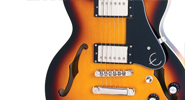
The China-made Epiphone ES-339 PRO features classic ES-335 body lines at about three-quarters the size. It has a laminated maple body and top, like most every other guitar in the 335 universe, and a mahogany SlimTaper D-profile neck with a 22-fret rosewood fingerboard. Hardware includes a LockTone Tune-O-Matic bridge and stop tailpiece, and Wilkinson TM 14:1 vintage-style tuners. Controls include the expected Tone and Volume for each humbucker, plus a three-way toggle. The addition of Alnico Classic PRO humbuckers with push/pull coil splitting for single-coil tones is a nice tweak (see below). The test guitar came in a sweet retro Vintage Sunburst, though it’s also available in Ebony, Natural, Cherry, and Black (the latter with a white pickguard).
In hand, the ES-339 PRO’s neck is slim, but substantial – not like those super-skinny vintage Gibson 335 necks. Though neither is it one of Epiphone’s occasionally chunkier necks. The guitar also has more heft than might be expected, but then again, the ES-339 PRO does have a solid center block to control feedback.
Plugged into a 1×12″ combo, this semi-hollowbody covered a lot of territory. Starting clean, it readily offered blues, country, and jazz. The push/pull knobs proved useful and fun. Use the bridge humbucker for clean blues or rock, then pull the volume knob for P-90 twang. Do the same on the neck pickup and go into single-coil mode. Now dial back the tone knob for pre-humbucker ’40s jazz and blues – wicked tones reminiscent of cats like Charlie Christian, T-Bone Walker, and Tal Farlow.
Of course, the amp’s overdrive can be ramped up to make the Epiphone work for a living – try some gritty blues soloing or British Invasion chime. Stoke it up even more – the 339 proved reasonably feedback-resistant and rolled into AC/DC and Bad Company territory with plenty of big, clean overdrive tones perfect for old-school hard rock. Add in the coil taps for favorite Southern rock licks.
The Epiphone ES-339 PRO is a mighty fine axe for only four bills. It’s classy, delivers sweet semi-hollowbody tones and good playability, and has the added benefit of split-coil pickups. That’s a great value.
This article originally appeared in VG December 2013 issue. All copyrights are by the author and Vintage Guitar magazine. Unauthorized replication or use is strictly prohibited.
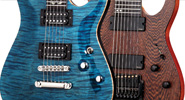
(LEFT) This Masterworks CS-1 is a prime example of the work being done by the Schecter Custom Shop. (RIGHT) Guitars like this wenge-bodied Banshee 8 helped resurrect Schecter in the late 1990s.
Riding high after 35 years with an array of original instruments, an impressive artist roster that started early with Pete Townshend and Mark Knopfler, and a line of high-gain amplifiers, Schecter Guitars has come full circle.
Established as Schecter Guitar Research by David Schecter in 1976, the company began repairing guitars and selling parts to fit the latest offerings from Gibson and Fender, which were largely failing to strike players’ fancies. An innovator in pickup winding and coil tapping, Schecter eventually began selling replacement bodies, necks, and all the parts a player needed to assemble their own guitar. The concept shifted the guitar zeitgeist and helped push customizing to the forefront – Eddie Van Halen used a couple of well-known “parts guitars” – and a few repair shops even became quasi builders, using parts from Schecter (or Warmoth, et al) to help those who didn’t have the time, tools, or inclination to assemble a guitar on their own.
By ’79, Schecter Guitar Research was building its own instruments, widely viewed as better variants of Strats and Teles. Production was initially limited, but demand pushed the company to establish more than a dozens retail stores in North America. That growth caught the attention of a group of investors from Dallas, and in 1983, production (sans most of the builders from California) moved south. Still offering Fender copies, the company shifted to all-out mass production, and its reputation suffered somewhat from the same ills of its big-brother predecessors – quality control being the primary knock. Sales lagged, and by ’87, the boys in Big D decided to bail, selling the brand to Hisatake Shibuya, owner of ESP Guitars. Grabbing the reigns, Shibuya did an immediate about-face, initially taking Schecter back to just a couple guys building high-end customs in L.A. One of the brand’s remaining few retail outlets was another Shibuya interest, Sunset Custom Guitars, which employed a guitarist named Michael Ciravolo.
“I had been working at Lab Sound, a music store on The Strip,” he recalled. “But, when it changed ownership, I was suddenly in need of a day job! I was hired to manage Sunset Custom, which was the sister to the famous store on 48th Street in New York City. We carried racks full of guitars with brands like Tom Anderson, Schecter, and Valley Arts. We were also Schecter’s U.S. headquarters at the time, so I split my time between the store and doing sales for Schecter International.”
Ciravolo was in the right place at the right time as the company began a return to significance. Its director resigned not long after his arrival, and Ciravolo was chosen as his successor. Though he had no formal business training, Ciravolo brought knowledge and ideas, and Shibuya let him run with it. Coincidentally, Ciravolo’s wife, Tish, was expecting a baby.
“Until then, my life had been about chasing the illustrious record deal,” he said. “But, it struck me that I had to take advantage of the opportunity, and I am eternally grateful to Mr. Shibuya for giving a longhaired guitarist from New Orleans the opportunity to reinvent a brand.”
(CLOCKWISE TOP LEFT) Michael Ciravolo has guided the Schecter ship since 1995. Harkening to the company’s earliest days, a worker winds pickups. Shigeki Aoshima in the spray booth.
In the years that followed, Schecter expanded its operations and staff, and introduced several original models beginning with the S series, then – with considerable input from Ciravolo – the Tempest, Avenger, Hellcat, and others. In the late ’90s, the brand experienced a resurgence thanks to its guitars finding favor with players in the heavy, post-punk music of the era, propelled by its seven-string models and others suited to the look – and especially the sound – of the genre’s alternate/lower tunings.
More recently, Schecter began elevating the profile of its Custom Shop. The renewed focus started with machinery and the hiring of John Gaudesi, who for a decade had been a key player in research and development of guitars at Yamaha. “I had known John for a long time, and he brought a wealth of knowledge,” said Ciravolo. “He started in the early ’80s at Charvel, and the moment John joined, we no longer simply dabbled in custom building – we had the basis to build a real, true guitar factory.”
“I had speculated on taking on a venture like this for many years,” Gaudesi said. “It’s exciting, being part of this team, especially under the leadership of someone who is not afraid to do things right the first time.”
In March of 2012, Schecter moved the Custom Shop to a dedicated 14,000-square-foot building in Sun Valley.
“It is really inspiring to walk through that shop now,” Ciravolo said. “It looks, smells, and feels like what I imagined the Schecter facility did in the early Van Nuys days – a cool combination of high-tech and low-tech, with all the work being done by guitar players.”
The Custom Shop is divided into two sections – one for the USA Production line, which includes several models that can be dressed with a handful of custom options, and the Masterworks division, where a Master Builder creates one-off, custom-order guitars from start to finish using more-traditional techniques and machinery. “Masterworks can provide the discerning player with their dream guitar – bolt-on, set-neck, neck-through, six, seven, eight or more strings, doublenecks, chambers – the options are truly endless,” said Ciravolo.
The USA Production side, meanwhile, employs craftsmen skilled in many aspects of the process along with specialists who focus on various phases. Gaudesi uses two computer numerical control (CNC) machines to rough-shape bodies, carve routes, and rough-in neck blanks, fingerboards, and inlays. Necks are sanded, and inlays and frets installed before the pieces move to Jose Rosas, who does final prep on bodies for finisher Rafael Barrajas, who applies paint and a thin polyester finish in the spray booth. Once dry, finishes are leveled and buffed before the bodies and necks move to Shigeki Aoshima, in assembly. “This is where the real magic happens,” said Ciravolo.
He also still points proudly to the company’s hand-wound pickups. “They were really the birth of Schecter Guitar Research,” he said. “Many features pioneered by David Schecter in the mid ’70s are standard on many of today’s popular pickups. It’s truly exciting to be able to reverse-engineer and re-create some of the classic pickups from our past – the SuperRock, MonsterTone, and Z-Plus – and design new and innovative models.”
(LEFT) John Gaudesi inspects the neck of a Masterworks guitar. (RIGHT) Schechter’s USA Production CET guitars offer a healthy dose of vintage appeal.
The staff includes about 40 guitar players that serve as an essential built-in focus group. “There really aren’t any models, pickups, and custom touches we have not tried ourselves,” Ciravolo said.
There was a time where Schecter was perceived as merely building “expensive Strats” (or Teles). How does Ciravolo react when someone tosses that generalization in the direction of his Custom Shop instruments today?
“In the genius of David Schecter, that wasn’t just perception, it was fact,” he said. “Schecter Guitar Research spearheaded the golden era of hot-rodding guitars – at the time, no self-respecting guitarist would play a stock, off-the-shelf instrument, and ’70s instruments were not looked at as collectors’ items, but as sub-par guitars in need of replacing everything.
“When I took over as President, I knew we had to shed the image of ‘kit’ guitars and ‘expensive Strats’ if we were going to compete. And we never stopped building U.S.-made instruments; for awhile it was essentially a two-person operation building two or three instruments per month, but the inception of our Diamond Series instruments in 1997 overshadowed those efforts while simultaneously changing the industry standard of what an ‘import guitar’ could be. We set the bar high with innovative designs and the addition of high-quality U.S.-made components like Seymour Duncan, EMG, and TonePros.”
“I am very honored to be a part of this new venture for Schecter Guitars,” added Gaudesi. “It’s a nice combination of the right team, state-of-the-art technology, and hand craftsmanship that truly brought high quality and an affordable custom instrument, made in the USA, back to the forefront.”
“To set our new path, I purposely distanced us from Schecter’s superstrat era. Now, with the rebirth of our Custom Shop, we are giving a nod to our early history and the guitars that have spawned a lot of other well-known brands.
“In my 20 years of knowing Mr. Shibuya, even with the success we have had in putting Schecter in the ranks of the world’s top electric-guitar companies, I have never seen him light up like he did when he first saw our new shop in Sun Valley. He said, ‘This is something I always wanted to see!’ For me, that was enough!”
This article originally appeared in VG March 2014 issue. All copyrights are by the author and Vintage Guitar magazine. Unauthorized replication or use is strictly prohibited.
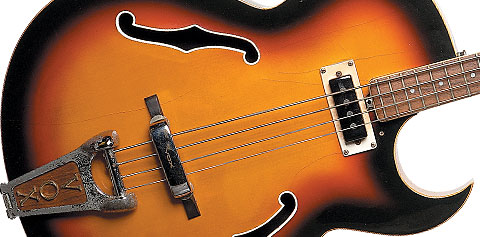
1968 Vox Saturn IV bass. Photo: Rick Malkin. Instrument courtesy of Sean Smith.
In the mid 1960s, England’s Vox company was in the right place at the right time. Buoyed by frontline British Invasion endorsers such as the Beatles and American bands such as Paul Revere & the Raiders, the instrument/amplifier maker signed deals with almost every popular band. Even one-hit-wonders such as Music Machine (“Talk Talk”) brandished Vox guitars.
Through most of the ’60s, Vox made instruments in the U.K. and in Italy; those made in the U.K. were mostly sold there, rarely crossing the Atlantic. Those made in Italy (first by Crucinelli, then beginning in ’66 by Eko) were mostly exported to the U.S. and included the Phantom, the famed “teardrop-shaped” instruments, and unusual items like the model V251 Guitar Organ and V257 Mando-Guitar. By 1968, Vox’s influence in the market was beginning to wane, and it responded by offering instruments with more traditional shapes.
Coincidentally, ’68 was the only year the V281 Saturn IV seen here appeared in a Vox catalog. A hollowbody short-scale bass with a bolt-on neck and a silhouette that referenced the Gibson ES-175 or ES-125C (with two f-holes and a Florentine cutaway), the Saturn IV had Vox’s paddle-shaped headstock atop a super-slim laminated bolt-on maple neck with binding and a 21-fret rosewood fingerboard (with zero fret) measuring 13/8” wide at the nut. The neck joined the body at the 15th fret on the bass side, 18th fret on the treble side. The body measured 20” long, 12” wide on the upper bout, 16” on the lower bout, and 111/16” deep; overall length of the instrument was 461/2” and it had single-ply binding front and back, as well as bound f-holes. The single-coil pickup had non-adjustable polepieces. And though this example is missing its three-ply (white/black/white) pickguard, its Tone knob, and the silver insert on its Volume knob, its bridge still has the snap-on cover. Underneath it are four multi-grooved/radiused bridge saddles, which could be individually intonated.
The pearl-dot markers on the fretboard are two sizes; on the third, fifth, seventh, and ninth frets they’re 5/16” in diameter, while beyond the 12th they’re 3/16”. Another curiosity is a snap-on vinyl pad measuring 111/2” diameter on the back of the body. Also on back is a neckplate that plays host to a serial number, Vox crest logo, and a sticker bearing the model name.
A diagram in the ’68 Vox catalog touted the brand’s Double T neck support. (BELOW) 1968 Vox Saturn IV bass.
Other single-pickup Voxes sported the same body style, including the Saturn guitar and the Apollo guitar and bass. All were available in sunburst or cherry finishes.
Even on short-scale basses, a hollow body can infer neck-heavy ergonomics. However, Vox enthusiast Jim Rhoads describes the balance of this particular bass as “…not too bad, since it has the smaller headstock and smaller tuners, which were also used on the (Bill) Wyman bass and some others. The Sidewinder IV, Constellation IV, Astro IV, and a few other basses used huge ‘elephant-button’ tuners on huge headstocks, which made them really neck-heavy.”
To say that the Vox instrument lineup in the ’60s was “diverse” is an understatement. This Saturn IV is just one of many examples of where the company was trying to be everything to every player.
Special thanks to Jim Rhoads.
This article originally appeared in VG May 2010 issue. All copyrights are by the author and Vintage Guitar magazine. Unauthorized replication or use is strictly prohibited.
In 1961, Gibson’s Johnny Smith model not only associated Gibson with one of the most popular guitar stylists of the day, it also brought high-quality amplification and high-quality acoustic sound together for the first time.
From Gibson’s first electric “Spanish” guitar, the ES-150 of 1936, Gibson had fashioned an electric guitar by cutting a hole in the top of an acoustic archtop guitar. The ES-150, with its 16″ body width and flat back, obviously wasn’t designed with acoustic sound in mind, and the heavy pickup, secured to the top with three screws, killed most of the instrument’s acoustic capabilities. Nevertheless, until the late 1940s, Gibson continued to go through the motions of making electric guitars as if they could be good acoustics, too, as evidenced by the carved spruce top.
The ES-5, introduced in 1949, indicated that players did want a classy-looking electric, but its laminated maple back and sides represented a farther departure from good acoustic quality. Gibson made another cosmetic concession in 1951 with electric versions of the L-5 and the ultra-deluxe, 18″-wide Super 400, but as usual, the holes for the pickups were cut through the top – even through top braces – which all but destroyed acoustic capabilities.
In the meantime, many players were amplifying their acoustic archtops with a non-invasive pickup. The most popular aftermarket pickup of the 1940s, the DeArmond Rhythm Chief, was mounted on an arm that attached by screws to the side of the fingerboard. A volume control attached to the strings (behind the bridge) or the tailpiece. When Ted McCarty came in as president of Gibson in 1948, one of his first moves was to design a pickup with the entire unit – pickup and controls – built into a pickguard. While it was moderately successful, it allowed too much pickup movement, and fell out of favor by the mid 1950s.
Through the ’50s, Gibson focused its attention on battling Fender in the new solidbody electric market. At the end of the decade, Ted McCarty sought to boost Gibson’s hollowbody electric with the help of influential guitarists, and he landed one of the most popular and respected guitarists of the 1950s – Johnny Smith.
Born in Birmingham, Alabama, in 1922, Smith came of age musically in Maine, where he played with a hillbilly band and then started a jazz trio. By the early ’50s, he had developed a “chord melody” style that featured the melody on the highest string and lush, jazzy chords on the lower strings. In ’52 – the same year Gibson introduced the Les Paul Model – Smith released what would become his best-known recording, “Moonlight in Vermont.”
Smith’s working guitar was a 17″ D’Angelico New Yorker Special with a DeArmond pickup. In ’55, the Guild company, which had been founded only four years earlier, engaged Smith to design a model, but Guild’s factory foreman refused to follow Smith’s instructions to carve the top before the cutaway area was removed. Guild introduced the Johnny Smith Award in ’56, but Smith never played it. Two years later, he went into semi-retirement, settling in Colorado and opening a music store. (After his contract expired in 1960, Guild continued the model as the Artist Award.)
Smith would gain considerable notoriety for his composition, “Walk Don’t Run,” after The Ventures turned it into a number two pop hit in 1960 (though it didn’t sound much like Smith’s 1955 version). It’s unknown whether anyone at Gibson was influenced by – or even aware of – the fact that Smith had written the hit, but Gibson president Ted McCarty visited Smith at his home in Colorado in ’61, where Smith drew up the plans for a new Gibson signature model.
The Gibson Johnny Smith had a 17″ body modeled after Smith’s D’Angelico, which was slightly – but significantly – different from Gibson’s L-5. With body depth of 31/8″, the Smith was a 1/4″ shallower than the L-5 and Super 400. The Smith was different under the top, too, with an X brace instead of the tone bars Gibson introduced along with f-holes in 1922. (The X brace was not exactly foreign to Gibson, as the L-5 had been X-braced from 1934-’38.) The neck of the Smith was also slightly wider than that of the L-5.
The neck ornamentation of the Johnny Smith clearly placed it in the upper echelon of Gibson’s line. Its slashed-diamond fingerboard inlays and peghead ornament, along with elongated peghead shape, were the same as Gibson’s top archtop, the Super 400. The tailpiece is the same design as that of the L-5CES, except that Smith’s has his name on it.
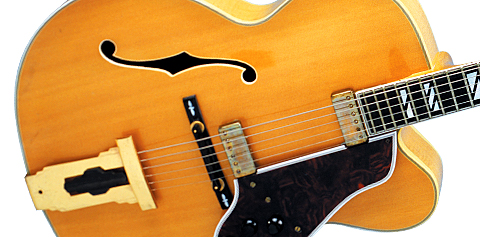
The Smith had a floating pickup that set it apart from all the DeArmond equipped guitars. Gibson had developed the double-coil humbucking pickup in ’57, and humbuckers were standard on high-end electrics. The Smith’s pickup was actually a mini-humbucker, which would soon find its way onto Gibson’s high-end Epiphones. The ’65 blond pictured here sports a two-pickup version of the floating mini-humbucker that Gibson began offering in ’63.
The Smith gave archtop players an instrument with the best-quality amplification without visibly altering its acoustic persona. The Smith’s Venetian (rounded) cutaway was an acoustic feature, as Gibson’s electric versions of the L-5 and Super 400 had a Florentine (pointed) cutaway during this period. And it sported an acoustic player’s traditional ebony, height-adjustable bridge rather than the Tune-O-Matic on the L-5CES and Super 400CES. But the top is slightly thicker than the standard Gibson archtop, so despite all appearances, the Smith really was designed for electric play.
Smith’s smiling face appeared with the guitar in Gibson’s ’62 catalog. The model was priced at $795 with sunburst finish and $810 for natural, including a deluxe case with a zippered cover. The only model above it was the Super 400CES at $825 and $850 for sunburst and natural, respectively. Curiously, the case and zipper cover were not included in the price of the Super 400 and L-5, and the extra $86 made the L-5 more expensive than the Smith by $6.
Through the Johnny Smith’s first decade, Gibson sold a total of 873 guitars, almost the same as the L-5CES’ total of 895 and significantly more than the Super 400CES’ total of 555. In its second decade (’71-’80), Smith sales fell only slightly, to a total of 771, while the L-5CES and Super 400CES fell more sharply to 468 and 260.
The Smith model endured Gibson’s move from Kalamazoo to Nashville in ’84 and the acquisition by its current owners in ’86. However, Smith’s loyalty stayed with the crew in Kalamazoo, and in ’89 he moved his endorsement to Heritage. In 2004, he returned to endorse the Guild Johnny Smith Award, by Benedetto (produced through ’06). Still, Smith’s legacy remains strong at Gibson, where the model that once bore his name is still offered, but as the LeGrand.
This article originally appeared in Vintage Guitar magazine’s January 2008 issue. All copyrights are by the author and Vintage Guitar magazine. Unauthorized replication or use is strictly prohibited.
You can receive more great articles like this in our twice-monthly e-mail newsletter, Vintage Guitar Overdrive, FREE from your friends at Vintage Guitar magazine. VG Overdrive also keeps you up-to-date on VG’s exclusive product giveaways! CLICK HERE to receive the FREE Vintage Guitar Overdrive.
Don Felder: Willie G. Moseley.Former Eagles guitarist Don Felder is spending the summer with a few friends. On an extended tour with Styx and Foreigner in a package billed as The Soundtrack of Summer, Felder is truly enjoying himself.
“Since I left the Eagles, I’ve been doing 50 to 60 shows a year,” he said. “Multi-headliners, summer festivals, casinos, private shows, corporate events. Pretty much Fridays and Saturdays, but this tour has been 42 shows in not quite three months. So it’s been a long haul even if we’ve had breaks.”
Felder’s second solo album, Road to Forever, was recently re-released with four songs added to the 12 on the 2012 release; the new tunes were recorded at the same time as the others, and appeared on alternate versions of the album.
“I wrote 27 songs and recorded what I thought were the best 16 for a well-rounded record,” he said. “After it had been recorded, my manager informed me that Amazon wanted an exclusive song, iTunes wanted an exclusive song, and so did Japan and Europe. I had to take four songs off for exclusives in certain markets, but that was only for a year. All that were intended to be on this record are now on the extended edition, but it actually should have been called the ‘original edition!’”
One of the additions, “Can’t Stop Now,” features a talk box.
“One of the colors in my songwriting palette,” he said. “I wrote ‘Those Shoes’ when Joe Walsh joined the band so he and I could play harmony talk boxes, like a couple of trumpet players. ‘Can’t Stop Now’ has four talk box parts. It has a special timbre and tone, and it’s a lot of fun to play.”
As for the details regarding the summer tour, Felder recalled, “I’ve known Styx’s individual members for a long time, and we first played together about 10 years ago at an Alice Cooper charity fundraiser. Tommy (Shaw) and I became fast friends, and he co-wrote a couple of songs on Road to Forever with me, and sang harmony vocals on them. We started doing more things together, and when this tour idea came around, I looked at the catalog of Foreigner, as well as Styx’s repertoire, and my history of the songs that I co-wrote and recorded with the Eagles, as well as solo stuff, including the Heavy Metal soundtrack; I knew it was going to be a really great show. One of the nicest things is that this feels like a bunch of friends and family – we play golf together, we go to dinner together, and of course, we jam on each other’s sound check! There’s no tension at all, and nobody has to prove anything.”
On the Soundtrack of Summer tour, Felder’s arsenal includes two Gibson signature models that bear his name – a Les Paul and an EDS-1275 – along with a Music Man Luke (the signature model of Steve Lukather, who played on the title track of Road to Forever), a “parts” Strat-style instrument, and Taylor acoustics.
The camaraderie between bands also manifests itself onstage, as well. As one might expect, Shaw comes out during Felder’s set to play harmony guitar and sing on “Hotel California,” and Felder has been known to reciprocate during the Styx set on “Blue Collar Man.” Other sit-in opportunities have occurred during the tour.
“The crowd really gets to see and hear something they would normally never experience in a show, and we’re having a ball doing it,” Felder enthused.
To mark the tour, a special CD featuring Styx and Foreigner material has been released. The album includes another newly recorded version of “Hotel California” by members of both bands; Felder rearranged the song and participated in the recording.
“I’d already done two versions,” he noted. “There was the original version in ’76, and the acoustic version, which starts with the flamenco guitar, on Hell Freezes Over. This time, I rearranged it with the idea that Styx and Foreigner members would be singing and playing. It’s a great exercise for any musician to take a song and try to do rearrange it creatively, yet again.”
Felder is proud that the new version of “Hotel California” has charted on classic-rock radio (as has “You Don’t Have Me” from Road to Forever), and looks forward to further songwriting and recording in the near future.
“I’m trying to find a comfortable balance between my personal and professional lives,” he said. “I’m much happier being able to play music as much as I want, and spending time with friends and family.”
This article originally appeared in VG‘s October 2014 issue. All copyrights are by the author and Vintage Guitar magazine. Unauthorized replication or use is strictly prohibited.
“My dad was my biggest influence, especially melodically. He loved dark melodies,” says Eliza Gilkyson of her father, the late Terry Gilkyson. As the title of her latest CD hints, The Nocturne Diaries mostly habitates the darker side.
Her dad sang with the Weavers in the Folk Boom and co-wrote the Dean Martin hit “Memories Are Made Of This.” He could write a happy-go-lucky ditty like The Jungle Book’s “Bear Necessities” or as sad a love song that ever was, like the Brothers Four’s classic “Greenfields.”
“He was a very disciplined songwriter; he’d go to his office every day, like nine to five, and write songs – as well as writing at home. And I saw the magic, the charisma when he performed. He loved writing a good bridge, and there was a lot of classic songwriting structure that stuck with me. In fact, that haunted me when I wanted to break out of my box.”
Considering that her brother Tony, a veteran of Lone Justice and X, is an accomplished guitarist whose credits range from Peter Rowan to Alice Cooper (in addition to several of Eliza’s albums), and Eliza’s son, percussionist Cisco Ryder, co-produced Diaries, the family makes a strong case for the role of genetics in one’s destiny, or at least talent.
“Something gets opened up early on that you start to depend on,” Gilkyson feels. “Whatever that is, you don’t want to shut that off. You’re hooked. And certain decisions in your life that would require you to shut off that tap – you just can’t do it. You feel like you’ll die.”
Surrounded by excellent guitarists in her home base of Austin, Texas, Gilkyson thinks hard about which guitarist to use for a project or song. Longtime collaborator Mike Hardwick appears on half of the CD’s dozen originals. “He brings a certain kind of flow and atmosphere, and the emotional way he plays is almost orchestral,” she says. “He can shred, but he’s more of a parts player and is really good at hook lines.”
Gilkyson’s own guitaring is nothing to sneeze at, nor is her collection. “It helps having different guitars, because different sounds bring different things out of you as a writer,” she explains. “That’s one of the reasons I started playing electric. The Gibson CF-100e has two pickups. A Highlander acoustic mic goes to its own preamp and pedals, and the P-90 goes to a SansAmp and other effects, so I can switch from acoustic to electric with one guitar.”
She and Tony share their dad’s ’53 D-21. “Tony has a real feel for obscure old guitars that are not overpriced – yet. He’s hipped me to lots of guitars, like the Regal Parlor with stenciled flower pattern and plastic fingerboard. I use it a lot for recording because of its sweet, rich tone. And My Kay Swingmaster was a gift from Tony. I’ve recorded all my electric guitar stuff on the last two records with it.”
Gilkyson got to pick her ’36 Gibson L-00 out of a collector’s stash of L-00’s and, she smiles, “this one was the bomb! It wasn’t ’til later I found out it had the floating bridge, which really does make a difference.”
She uses her Goya when nylon strings are called for. “My dad took me into Wallach’s Music City on Sunset and Vine, and let me pick it out in 1965,” she recounts.
Obviously a Gibson fan, she explains, “The B-25 has the wider nut, which gives it a great feeling for writing at home, but I love my ’65 J-45 for warm and dark rhythm playing. It’s my warhorse. People think I’m crazy, because I like the strings dead and thunky.”
Of folk’s current resurgence, she laughs, “We’ve been the shameful ones for years, the ones John Belushi made fun of in Animal House – sort of parodies of ourselves. When I teach songwriting classes, I say, ‘Don’t be a parody; get into what it means.’ Folk isn’t connected to the rest of the industry particularly, but it has its own system – press, radio, festivals, fan bases, venues. It’s a whole life that you can live, but don’t expect to hit it big out there. I didn’t buy my own home or have a decent car or health insurance until I was in my 50s. But if you love the community and the whole being greater than the sum of the parts, folk music can be a great outlet if it suits the life you want to lead. You have to be true to it and walk the talk. If it’s contrived, everybody knows. It means a lot to me to stay current. I’m not by any means a traditional folk singer, and I don’t ever want to be a parody of a folk singer.”
This article originally appeared in VG June 2014 issue. All copyrights are by the author and Vintage Guitar magazine. Unauthorized replication or use is strictly prohibited.
It’s been well-documented how car-crazy vets and teens in postwar America reimagined the American automobile. Some shaved, sprayed, and slammed contemporary two-door sedans, creating the custom car. Others invented the hot rod when they stripped prewar coupes and roadsters to their bare essentials, stroked and bored their Flathead mills, and headed out to the dry lakebeds to see how fast they could go. If Jim Worland were a car-crazy postwar teenager working out of his one-man shop in Rockford, Illinois, his Prairie model acoustic guitar would place him squarely in the hot rod camp.
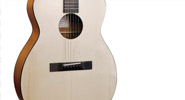
Upon removing the Prairie from its included TKL arched hardtop case, the instrument’s most noticeable quality is its simplicity – no fancy binding, no rosette, not even a headstock logo or fingerboard markers. Not unlike those dry lakes hot rods of yore, the OM Prairie places function ahead of form, and that function is to offer the serious player an affordable hand-built acoustic tuned for peak performance.
Which is not to say the Prairie isn’t a beautiful guitar. The satiny lacquer finish on the test instrument was flawless, allowing the grain of the Honduran mahogany back, sides, and neck, as well as that of the cedar top, to do their thing. Said woods were nicely complemented by a fingerboard and bridge of ink-black mahogany. Like a channeled ’32 Ford, the effect is subtle but pleasing – somehow more so on this small-bodied guitar.
Under the hood, Worland uses a traditional scalloped X-bracing. The Prairie’s speed equipment, if you will, includes a bone saddle and a hand-cut bone nut, sealed Gotoh tuners, and medium frets dressed to perfection. The 24.9″-scale neck joins the body at the 14th fret . . . which is where the Prairie gets really interesting.
Rather than a set neck, Worland opts for a bolt-on design. The arched-brow set might view this as a cost-cutting measure, but as Worland explains, “The main reason [for the bolt neck] is to get a stronger, straighter neck. The neck is one piece all the way to the soundhole, like an electric neck. That way there is no hump at the body joint and the action can be lower than a standard acoustic. Also, the heel-less design gives the player a little more access without your hand bumping into the heel.”
The Prairie’s neck design certainly does translate to a fast action, and one with no fret buzz. This ease of play is accentuated by the neck’s low-profile C shape; the comparison to the action of an electric guitar is no exaggeration. But the aforementioned heel-less design is a real eye-opener, too. Frankly, it’s a bit jarring at first to find no protuberance where you’ve been conditioned to expect one, but that surprise quickly transitions to pleasure. Some purists might have to come to terms with the two tiny holes on the back of the body through which the screws that attach the cedar top to the underside of the fingerboard are accessed. Otherwise, aesthetically and functionally, the neck joint is tighter than a miserly uncle during the holidays.
Sonically, Worland’s stated mission with the Prairie was to create a handcrafted guitar with the same tonal characteristics as his higher-end instruments. In fact, if Worland’s spendier units sound as good as this, he’s doing alright because the Prairie is fantastic, exhibiting great note separation, with the mids in particular coming through remarkably clear. Neither was the tone as punchy as one might expect from a smaller-bodied acoustic, but rather resonant and more characteristic of larger guitars. The Prairie’s ability to cut through when needed makes it well-suited for cowboy-chord front-porch hootenannies, coffee-shop gigs, and even recording situations. And if it’s more volume that you need, Worland’s got you covered: one of the few options he offers with the Prairie is a pickup (others are strap buttons, a Sitka spruce top, and a pickguard).
Clocking in at a shade under two-grand, the Worland Prairie is admittedly no impulse purchase. But when one considers that it’s a luthier-built guitar amid a slew of factory-built acoustics priced much higher, the Prairie is a bargain – one which Worland happens to keep in inventory for speedy delivery. The Prairie is a no-nonsense affair, to be sure, but anyone who climbs behind the wheel is sure to be smitten by its functional design, enjoyable playability, and dialed-in tone.
This article originally appeared in VG March 2014 issue. All copyrights are by the author and Vintage Guitar magazine. Unauthorized replication or use is strictly prohibited.
D’Angelico’s EX-DC and EX-SD
Price: $1,769 list/$1,259 street (EX-DC); $1,659 list/$1,185 street (EX-SD)
Info: www.dangelicoguitars.com
John D’Angelico produced just 1,164 guitars during his career on Kenmare Street in New York City, but each was a remarkable instrument created at the height of the jazz era. Today, the brand is in revival, and while new D’Angelico guitars are still sought after by jazz cats, the current designs are produced with modern features for modern music.
The EX-DC is a semi-hollow double-cutaway with laminated-maple body and a 22-fret neck set at fret 19 for good upper-fingerboard access. It has all the, er, D’Accoutrements, including D’Angelico’s famous key motif and logo in inlaid pearl, gold hardware, a beveled tortoise pickguard, and a multi-bound top, back, neck, and headstock. A tune-o-matic bridge and stop tailpiece, two Kent Armstrong humbuckers with individual tone and volume controls, and Grover Rotomatics with Imperial buttons comprise the EX-DC’s functional hardware. The maple/walnut C-shaped neck has slight shoulders, and the scale length is 24.75″.
The EX-SD has the same decorative styling and gold hardware as the EX-DC. It also offers a time-tested combination: flamed maple top and mahogany back (both carved), one-piece mahogany neck with a 24.75″-scale rosewood fingerboard, two humbuckers, tune-o-matic bridge, and stop tailpiece.
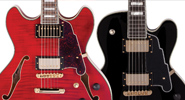
High build standards match the ambitious aesthetics of both guitars, which feature well-dressed frets, nicely slotted and shaped bone nuts, tight inlays, flawless bindings, and glossy poly finishes. The cherry finish on the test EX-DC was too dark to easily show off its fantastic flamed maple top and back, while the EX-SD had a black finish that really set off the gold hardware and headstock detail. Players who score either guitar in a ’burst finish will have a real showstopper in their hands.
None of this would be worth its weight in pearl if the guitars didn’t perform so beautifully. Both models exhibited easy, stay-in-tune playability, even with hefty string bends played with variable left- and right-hand techniques.
Plugged into a ’50s Ampeg Jet, the Armstrong pickups immediately showed who’s boss: powerful without being strident, and never muddy, even with the tone controls rolled off. Each guitar easily pushed the Jet into overdrive with a smooth, singing tone and the kind of bite from the bridge pickups that made digging in and popping out false harmonics a visceral pleasure.
The EX-DC, whose sound spectrum ranged from delicate timbres to full roar, showed the versatility that has made the semi-hollow double-cut design a favorite of B.B. King, Dave Grohl, Leo Nocentelli, and John Scofield. Middle-position tones were conducive to funky, skanky rhythm work, but with enough bite full out to solo effectively. The neck humbucker produced fat blues tones and, with tone-control manipulation, a rounder jazz voice. The bridge pickup was reasonably well-balanced with its partner.
The EX-SD immediately distinguished itself with extraordinary sustain at low volumes (remember, Les Paul’s initial solidbody concept evolved as a jazz design with sustain.) Fingerstyle chord melodies were a breeze thanks to the forgiving setup and the responsiveness of the pickups. Cranked up, the old Ampeg Jet practically walked across the studio floor as the EX-SD was put through the paces with crunchy power chords, wailing blues bends, and fusion-oriented single-note lines. The EX-SD has power and tone to spare, fully equal to its decorative design elements.
With the EX-DC and EX-SD, D’Angelico definitely offers big-bang-for-the-buck instruments. Their fantastic sounds, great playability, and high build standards, combined with irresistible visual presentation, should appeal to guitarists of all stripes – not just jazz cats.
This article originally appeared in VG March 2014 issue. All copyrights are by the author and Vintage Guitar magazine. Unauthorized replication or use is strictly prohibited.
In celebration of the 50th “birthday” of its famous Stratocaster model, Fender has taken the reissue concept to new heights.
And why not? Arguably the most popular guitar – electric, acoustic, you name it – ever built, the Stratocaster is the epitome of a pop music legend, and a huge part of Fender’s history and lore.
Fender’s latest ode to its own, the Custom Shop 50th Anniversary 1954 Stratocaster, made its debut at the January ’04 NAMM show, just four months after the idea was pitched by Mike Tonn, Marketing Manager for Electric Guitars and Basses at the company’s Arizona headquarters.
“People have asked us over the years to make a ’54 Strat,” said Tonn. “Although we have made ‘versions‘ of the ’54 in the past, they were never vintage-correct due to the fact that the knobs, pickup covers, pickguard material, and switch tip were very different back then, and tooling can be costly. Unless we were thinking of adding a ’54 Stratocaster to the American Vintage series, it just did not make sense. But, as we sat to discuss what we wanted to do to commemorate the 50th anniversary, we all knew it was time.”
And at first, the idea met with a little resistance…
“I didn’t really want to [have the Custom Shop take on the project], because we’d already done a ’54 reissue,” admits Mike Eldred, Custom Shop Marketing Manager. “But once Dan Smith told me they were having original parts duplicated, I thought ‘Okay, we could make it cool. Let’s see how far we can take it.’”
And take it they did. From a special form-fit case to larger-diameter pickup magnets, designers went to great lengths to ensure the kind of attention to detail that could be appreciated by even the most curmudgeonly of sticklers.
“We knew we could do it,” Eldred said. “But the problem with a Fender from 1954 is if you laid out four of them in front of you, no two would be alike. There would be small variations. So we took one apart and based the 50th Anniversary model on it.”
That one was #0100, belonging to Richard Smith, renowned Fender expert and author of Fender: The Sound Heard ’Round the World.
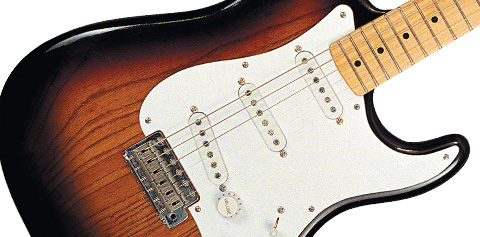
In sheer mechanical terms, the new reissue has a nitrocellulose-lacquered, two-piece ash body (in the Custom Shop’s “Closet Classic” style in two-tone sunburst) with offset glue seam, one-piece U-shaped maple neck with 25.5″ scale and 7.25” radius, synchronized tremolo with “ash tray” bridge cover, nickel/chrome hardware, bone nut, documentation, and the form-fit case. The degree of finish aging depends on the finisher, but it’ll typically have a few small dings, checked finish, oxidized hardware, and aged plastic parts.
“Mike [Tonn] even got his hands on an original strap and sent it to one of our suppliers to see if they could replicate it,” Eldred noted.
Because the guitar is a Master Built model, each carries subtle differences determined by the individual builder. This lends each a unique element that in a way harkens back to the variations in the originals – perhaps a slightly different body contour or different blend on the neck, etc. But other parts are just like they were in ’54.
“Jackplate holes, the tremolo cover plate with round holes, pickguard dies, and the fiber dies, all used the original templates,” said Eldred. “We even hand-stamped the serial number on the trem cover plate. Roger Centeno, who was hired at Fender in 1964, did the cover plates himself.”
They even made sure they had the correct typeface on the control knobs.
Dan Smith, V.P. of Fender’s guitar R&D, also notes they were particularly diligent in regard to the plastic parts.
(LEFT) The control knobs boast the correct type face – something not seen on any previous Fender reissue. (RIGHT) All Master Built guitars from Fender include the builder’s signature as part of the Custom Shop logo.
“One of the myths surrounding the first Stratocasters is that the plastic parts were made from Bakelite,” he said. “Bakelite is a trade name for a synthetic resin made from formaldehyde and phenol, the end result being Phenolic. In its raw state, it’s a translucent amber color and fillers like cotton linen and wood are added, along with coloring agents. Since it’s amber in color, it does not lend itself to being used for anything white; darker ivory is as close as it can get. Plus, it cannot be injection-molded; it can only be cast or compression molded.
“So we procured original ’54 Strat plastic parts and [had] them tested by the best laboratory in Southern California,” he said.
The Custom Shop “Closet Classic” finish is weather-checked, but not “beat up.” And The 50th Anniversary‘s trem cover plate has period-correct round holes.
That means the 50th Anniversary Strat‘s knobs, pickup covers, switch cap, and tremolo cap are made of high-styrene ABS, and the pickguard is .070” PVC.
“The end result is a tribute reissue in which the case, strap, collateral materials and guitar have all been faithfully replicated for the first time ever,” Tonn said.
Not surprisingly, the guitar has been quite popular. Though Fender won’t divulge numbers, Eldred says orders have exceeded their expectations.
This article originally appeared in VG November 2004 issue. All copyrights are by the author and Vintage Guitar magazine. Unauthorized replication or use is strictly prohibited.
Dan Fogelberg’s success as a singer and songwriter far overshadows his reputation as a musician, but the man whose tenor voice and sentimental songs ruled the Adult Contemporary charts in the early 1980s was actually quite an accomplished guitarist. Evidence is on The Innocent Age and Windows and Walls – the albums that yielded his biggest pop hits – where he was the only guitarist listed in the recording credits. One of his favorite electrics, which he owned from the beginning of his recording career, was also one of the rarest of collectibles – this ’58 stereo Gretsch White Penguin.
The White Penguin (Model 6134) was the solidbody version of Gretsch’s electric hollowbody White Falcon. Like all the other solidbody Gretsches of the ’50s, the Penguin originally had the single-cutaway body of the Duo-Jet, with routed mahogany back and a laminated-wood top pressed into an arched shape.
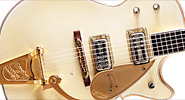
The trim distinguished the solidbody models from each other, and the Penguin had the Falcon’s white finish, gold-sparkle edge trim, gold-sparkle logo and truss rod cover, “Cadillac” tailpiece with the letter G in the center, single-coil DeArmond pickups, engraved “humptop” block fingerboard inlays, and vertically oriented peghead logo with the G flanked by wings. The Penguin and Falcon both had a V-top peghead that no other Gretsches had.
The inspiration for choosing a flightless bird for the model name has never been explained. The incongruity is underscored when the pickguards of the Falcon and Penguin are compared. The White Falcon’s guard depicts a falcon, ready to land, with wings spread and talons open, while the bird on the White Penguin’s guard is standing upright with its wings hanging down at its sides, looking very much like an old man in an overcoat.
This apparent disrespect for the Penguin carried over to Gretsch catalogs. In 1955, the company featured the White Falcon, along with a bevy of other colorful models, in a full-color catalog entitled Guitars for Moderns. The White Penguin was nowhere to be found – not in that catalog, not in any Gretsch catalog that followed. It was mentioned only in a 1958 flyer announcing the availability of stereo electronics and on a ’59 price list (at $490).
With that kind of support, it’s no wonder White Penguins are rare. Estimated production is no more than a few dozen. The examples that have shown up indicate that the Penguin followed the same changes as the Falcon, with pickups going from DeArmonds to Filter’Tron humbuckers in late 1957; inlays going from engraved humptops to the half-moon “thumbprints” in ’58; optional stereo electronics in ’58; Melita bridge to “space control” roller bridge in ’58; and vertical peghead logo to horizontal logo in ’59. When Gretsch’s other solidbodies went from single-cutaway to double-cut in ’61, so did the Penguin.
The Penguin went out of production some time in ’62, the year Fogelberg turned 11. The son of a band director and a pianist, Fogelberg started his musical career with a steel guitar and a Mel Bay instructional book, and quickly moved on to standard guitar and piano. As a student at the University of Illinois, playing at coffeehouses, he met manager Irving Azoff. Fogelberg and Azoff moved to California, but Azoff soon sent Fogelberg to Nashville to polish his songwriting ability. He made his recording debut in 1972 with Home Free, produced by Norbert Putnam and featuring Fogelberg on most of the guitar work. The album stalled at number 210 on Billboard’s album charts (though it would later go Platinum as a reissue).
Also in ’72, Fogelberg ventured to Nashville’s Lower Broadway district and bought this White Penguin from GTR (the original incarnation of Gruhn Guitars). Though sales records no longer exist, GTR inventory lists from 1973 show sunburst Les Pauls for $1,200 and a ’58 Explorer for $1,000, so Fogelberg would not have paid more than $1,000 for the Penguin.
Fogelberg’s guitar had a transitional set of specs (it’s often said that all Gretsch models are transitional). The Filter’Tron pickups are the second version, which appeared in 1958, with “PAT APPLIED FOR” stamped on the center tab (earlier units had no stamp; later ones had the patent number). The thumbprint fingerboard inlays also debuted in ’58, same year that the vertical logo last appeared.
The most interesting (and rarest) aspect of this guitar is the stereo wiring. Gretsch introduced Project-o-Sonic stereo in ’58, featuring Filter’Tron pickups with treble/bass split (rather than the one-pickup-per-channel design of Gibson’s stereo models). At first, the stereo setup was easy to spot; the neck pickup had three polepieces for the bass strings, and the bridge pickup had three polepieces for the treble strings. After a year or so, the pickups were changed to look like normal six-pole Filter’Trons (though a stereo Gretsch could still be identified by an excess of control knobs). Consequently, this is a relatively rare stereo setup on any Gretsch, and exceedingly rare on a Penguin.
Two years after acquiring this guitar, Fogelberg teamed with guitarist Joe Walsh as producer to record Souvenirs. Fogelberg contributed most of the guitar and keyboard parts, including an electric guitar solo on “As the Raven Flies” using the White Penguin. By that time he had modified the guitar, as he later explained in a note accompanying this guitar, “to make it more playable.” He added a Bigsby vibrato, Gibson-style tune-o-matic bridge and Yamaha Rotomatic-style tuners.
Souvenirs yielded Fogelberg’s first hit, “Part of the Plan,” but it wasn’t until his 1981 double album The Innocent Age, that he hit his stride with three pop hits (“Hard to Say,” “Same Auld Lang Syne,” and “Leader of the Band”). By the time of his next album, Windows and Walls, MTV had been launched, providing a 24-hour cable TV outlet for music videos. “The Language of Love,” Fogelberg’s first single from the disc, became his first video, and the featured guitar in the video was his White Penguin.
“The Language of Love” rocks harder than the quintessential Fogelberg tune, and the video opens with the body of the Penguin filling up the screen and Fogelberg playing a screaming lead line. The video is simple, with Fogelberg and his three-piece band performing in front of a white background. It’s the perfect setting for a White Penguin.
Fogelberg died of cancer in 2007. By then, his legacy had been established with acoustic-oriented music, and the guitar with which he was most often identified was a signature Martin D-41. This ultra-rare stereo White Penguin represents another side of Fogelberg’s artistry and also shows that he had an appreciation for vintage guitars throughout his entire recording career.
You can receive more great articles like this in our twice-monthly e-mail newsletter, Vintage Guitar Overdrive, FREE from your friends at Vintage Guitar magazine. VG Overdrive also keeps you up-to-date on VG’s exclusive product giveaways! CLICK HERE to receive the FREE Vintage Guitar Overdrive.
This article originally appeared in VG June 2012 issue. All copyrights are by the author and Vintage Guitar magazine. Unauthorized replication or use is strictly prohibited.






 In 1961, Gibson’s Johnny Smith model not only associated Gibson with one of the most popular guitar stylists of the day, it also brought high-quality amplification and high-quality acoustic sound together for the first time.