• Preamp tubes: two 12AY7, one 12AX7. • Output tubes: two 6V6, cathode-bias. • Rectifier: 5Y3 • Controls: volume for each channel, shared tone. • Speaker: Jensen Special Design P12R. • Output: approximately 16 watts RMS. Photos: Dave Ellis. Amp courtesy of Warren Hein
Behold, this specimen that checks off all the right boxes for fans of vintage amps; beautifully clean, it has a watertight provenance and emerges from a heart-warming backstory. If we love anything more than a musty old tube amp in outstanding condition, it’s a musty old tube amp with a stirring history – a tale that takes us rapid-rewind style from the present day back to a time in the mid ’50s, when this Gibson GA-20 was first bought, played, and loved.
Add the fact the 1954 Gibson ES-175 that was purchased right along with it by this amp’s original owner is featured in Dan Erlewine’s “Dan’s Guitar Rx” column this issue and, well, this is something to get excited about.
Warren Hein, 77, of Joppa, Maryland, purchased this GA-20 and the accompanying ES-175 at a store in Baltimore in 1954, and made good use of the pair until he was drafted into the Army in ’57, when he stored them in his bedroom closet and set off to serve his country. After his discharge in 1960, life “got real,” as they say, and his earlier adventures in music remained on the back burner. Work and family kept Hein busy, and the years rolled by until one day recently when he took a notion to drag his old pals out of storage. What he found were two vintage Gibson pieces in impressive condition, but in need of a little repair and freshening up after their long hibernation. Hein then had a fortuitous encounter with vintage amp enthusiast and repairman Dave Ellis of nearby Bel Air, Maryland.
“I stopped in at [a consignment shop owned by Warren and his daughter] to see if they might have any old amps, radios, or stereos I could buy to work on,” Ellis said. “Conversation led to music equipment, and Warren mentioned that he had a Gibson guitar and amp that were in disrepair. He was beginning to experience problems with arthritis in his hands, and I asked if I could get the guitar and amp repaired [so he could] use them to keep his fingers flexible.”
Ellis picked up the set, got a willing Dan Erlewine in on the guitar repair, and set about servicing the 59-year-old GA-20.
Gibson made the GA-20 in various configurations between 1950 and ’61, with this two-tone rendition in buffalo-grain with woven Saran grille appearing from ’54 to ’59 (the only real visual alterations in that span being the loss of the “20” from the front logo and changes in the input legends in the final two years). Generating approximately 16 watts from a pair of 6V6s in cathode bias sparked up by a 5Y3 rectifier with a 12AY7 in each of the two channels and a 12AX7 in the phase-inverter slot, this 1×12″ combo sat either at the lower end of Gibson’s professional-grade lineup or (depending on how you look at it) the upper end of its student range. Either way, it was a head-to-head rival for Fender’s similarly powered and proportioned Deluxe, and did pretty well at the effort, with 949 sold the year Hein bought his. If you keep a weather-eye on vintage amp listings, you get the impression that a fair number of them are still doing service in the field, too – no major surprise once you check out the quality workmanship and components found inside.
The Cornell-Dubilier “Grey Tiger” tone and coupling capacitors seen here would fade from use the following year.
Being sympathetic to non-invasive amp restoration, Ellis took great care in bringing the GA-20 back to life. Had it been played regularly throughout the intervening five and a half decades, there’s a chance it would have kept chugging along pretty well, but the repairman knew he’d need to be careful with the long-untested electrolytics, in particular. After trying (and failing) to bring them up to voltage with a Variac (because they were dried out), Ellis found it necessary to replace the filter caps – no surprise in an amp of this age. He did, however, manage to retain all the delectable Cornell-Dubilier “Grey Tiger” tone and coupling caps, which Gibson used in guitars and amps before switching to yellow Astrons in amps in ’56, and Bumblebees and Sprague Black Beauties later in the decade (the photos here were taken by Ellis prior to the restoration, and show the amp in its original state). Ellis also replaced a few resistors where necessary with new carbon-comp types, replaced the crumbling 200-ohm “dog bone” cathode-bias resistor with a new five-watt ceramic 220-ohm resistor (which would actually keep the amp operating more to spec with today’s higher-mains AC voltages), fabricated a new spacer for the pilot light, cleaned and re-tensioned the tube sockets and inputs, added a properly grounded three-prong cord, reconfigured the input grounding to take the guitarist out of any potential electrocution loop(!), replaced the deteriorating leather handle, and performed a few other items of routine old-amp upkeep. It all sounds like a lot, perhaps, but the work introduced nothing out of spec to alter the sonic character or original appearance of the amp, while keeping it playable – just as it should be.
All fired-up and running again, this little GA-20 has a rich, round tone when played clean, and one that’s perhaps a little warmer than its familiar Fender counterpart. Cranked into mild overdrive (a condition Gibson would have considered out of spec back in the day), it becomes reedy and meatily twangy with single-coils, creamy and thick with humbuckers. The original Jensen P12R speaker sounds great, Ellis reports (though the amp would gain headroom and girth with a replacement P12Q or P12N or any of a range of Celestion options, while also saving the vintage P12R from the grave).
Top to bottom, then, this a sweet and satisfying restoration, and a happy tale of the kindness and generosity of strangers… or, strangers who easily become friends. And we can’t wait to hear how the GA-20 greets the ES-175 when that connection is re-established.
This article originally appeared in VG July 2014 issue. All copyrights are by the author and Vintage Guitar magazine. Unauthorized replication or use is strictly prohibited.
Amp courtesy of Michael Stefanka, photo: Julie Doiron.
Park 75
Preamp tubes: three ECC83 (12AX7 equivalents)
Output tubes: two KT88
Rectifier: solidstate
Controls: Volume II, Volume I, Treble, Middle, Bass, Brightness
Output: approximately 75 watts RMS
We might not expect anyone to give much of a hoot for an amplifier with “Park” on its badge – a brand that has also graced budget-grade solidstate amps from Asia for the past couple of decades – except for the fact that any player or amp collector in the know is hip to the fact that a Park from around 1965 to around 1980 really is just a Marshall by another name, and often one with a nifty twist.
This situation has set up the unusual circumstance that the sub-brand Park amps from the golden years, the point-to-point amps made from the mid ’60s until around 1974, often fetch a little more on the vintage market than their Marshall counterparts. That probably fewer than 800 or so such Parks were ever built doesn’t hurt their desirability, and the pervasive rumor that Jim Marshall made many Park models “a little hotter” than similar Marshalls coming out of the factory alongside them adds further cache to the name.
The original Park amplifier line represents a clever and rather devious piece of marketing brinksmanship on the part of Jim Marshall. In the early years of Marshall, the Jones and Crossland music store in Birmingham served as a distributor of sorts for the north of England, but was cut out of directly handling Marshall business when the company penned a bigger and broader distribution deal with U.K. music-industry biggie Rose-Morris in 1965. Store owner Johnny Jones had long been a pal of Jim Marshall’s, however, and the amp maker seemed keen to accommodate his friend one way or the other. Meanwhile, Jones and Crossland was already handling a “house brand” line of guitars and other musical instruments, apparently dubbed in honor of Jones’ wife’s maiden name, Park. Marshall and Jones devised the ploy of giving a few minor twists to Marshall-built circuits to sidestep any exclusivity issues, along with some visual alterations and the rectangular Park logo… and Bob’s your uncle; Marshall keeps on supplying its sought-after tube amps to Jones and Crossland for Birmingham and Northern England.
For the first several years of production, most Park amps followed Marshall designs very closely, and the larger heads are therefore comparable to the evolution in Marshall JTM45, plexi, and metal-panel heads from the mid ’60s to the early ’70s. Often they had black or silver control panels rather than the Marshalls’ gold, some came in taller or differently shaped head boxes, and earlier examples displayed other cosmetic tweaks such as chickenhead knobs and different control layouts and labeling. By the mid/late ’70s, Park amps had even more of their own thing going on, such as the more “basic” looking front-mounted metal control panel of the Lead 50 combo, which was also quite different internally from any other amp wearing the Marshall name at the time. Like their more populous siblings, these Parks were built with printed circuit boards post-’74, but are still great amps with loads of sonic character.
This 1972 Park 75 is of an era when the northern alternative was looking rather more Marshallesque, though it is distinctive for its silver metal control panel. It also retains the split channel volumes different from the Marshall setup with the two channel input pairs side by side, and the Volume controls following. It’s purely an alteration of layout, which doesn’t change the way the channels function, but must have provided Jim Marshall yet another way of saying, “Why, no, Mr. Rose, Mr. Morris, this is not a Marshall amp at all – it’s a Park 75!”
One of the biggest technical differences between this Park 75 and a 50-watt Marshall Model 1987 of the same era was its use of KT88 output tubes rather than EL34s (note that this example, however, has been modded by a later owner to use EL34s). Marshall used four mammoth KT88s in the Major to pump out a whopping 200 watts, and a pair of them keeps the Park 75 pretty clean and bold up to a higher point on the dial; most owners report these amps don’t start to break up until the Volume control hits 7 or 8, by which time they are moving a lot of air through a 4×12. At the same time, there’s talk of Park amps having slightly lower-value resistors feeding the preamp tubes in the first gain stage than those used by Marshall in similar circuits, resulting in higher plate voltages and, in turn, more sizzle from the amp’s front end; this might be another distinction of sorts, but in truth, some Marshall amps of the era display similar variations. One further interesting difference here is the “lie down” power transformer configuration, something seen in earlier Marshall plexis, but changed to the stand-up transformer configuration in 50-watt Marshall heads of the early ’70s.
Beyond the input stage, the Park 75 is pretty much classic Marshall all the way out – which is to say, perhaps, that it still follows the basic circuit template laid out by Leo Fender in the 5F6-A Bassman of the late ’50s. A cathode-follower tone stack offers Treble, Middle, and Bass controls, and a long-tailed-pair phase inverter delivers its load to two KT88s in fixed bias, with a negative feedback loop that is tapped to yield a Presence control (called “Brightness” here) just to further differentiate things (and again, not by much). Otherwise, from the fat “mustard caps” to the British carbon-comp and carbon-film resistors and several other distinctive components, it really is solid Marshall stock through and through – and a great alternative means of getting your Brit-rock on.
The Back of the 1972 Park 75.
This article originally appeared in VG July 2013 issue. All copyrights are by the author and Vintage Guitar magazine. Unauthorized replication or use is strictly prohibited.
You can receive more great articles like this in our twice-monthly e-mail newsletter, Vintage Guitar Overdrive, FREE from your friends at Vintage Guitar magazine. VG Overdrive also keeps you up-to-date on VG’s exclusive product giveaways! CLICK HERE to receive the FREE Vintage Guitar Overdrive.
Anyone who’s ever caught Ted Nugent on tour has seen this instrument, and during the Summer of 2003 it was intended to be the only guitar used by the Motor City Madman during his one-hour slot.
“That was pretty much due to time restraints,” said Dean Mitchell, who has been Nugent’s guitar tech for a number of years. “He wanted to just keep going, and didn’t want to have to stop to change guitars.”
In addition to being unique as a rock guitarist’s main instrument, the Byrdland is unique among Gibson electric guitars. Designed with the input of guitarists Billy Byrd and Hank Garland (the name is derived from their surnames), it was introduced in the mid 1950s as one of the company’s first “thinline” hollowbody models. Its 23 1/2″ scale is also unusual, being more typical of a student guitar than a professional instrument.
Standard Byrdlands were originally available with P-90 pickups, and acquired humbuckers in the late ’50s. Stock finishes were sunburst and natural, and Gibson made the model with Venetian (rounded) and Florentine (pointed) cutaways, as well as spruce or maple tops.
Da Nuge’s preferred Byrdland configuration is a spruce-top model with a Florentine cutaway, and Mitchell said that the guitarist has had the instrument since his days with the Amboy Dukes. It’s known as “Number 4” – Nugent numbers his Byrdlands sequentially, and the first three were lost in a fire that destroyed an Amboy Dukes trailer. Number 4 has been broken on more than one occasion, but has always been restored to Nugent’s sonic satisfaction.
Photo: Rick Gould.
The guitarist’s no-holds-barred playing style has necessitated the removal of the pickguard on all of his Byrdlands. Note the wear – down to the bare wood of the top – not only where a pickguard would have protected it, but also around the volume knobs.
According to Mitchell, the wear is due to a combination of Nugent’s sweat and his constant manipulation of the controls.
“He’s the only guitar player I know who constantly works his volume knobs and pickups,” Mitchell said. “He’s always turning up, turning down, turning up halfway, back and forth between each pickup.”
Modifications include an old Gretsch threaded strap button knob that serves as the cap for the toggle switch, and Mitchell avers that “…it’s easier for him to get at, and it looks cooler! We put those on all of his guitars.”
In 2003, the original Patent Applied For (P.A.F.) pickups, which had begun to “squeal,” according to Mitchell, were replaced by Gibson Burstbucker 2 models.
Battered, worn, and reinforced, Nugent’s ’62 Byrdland is as outspoken and unique as its owner, and Nugent has relied on its sound for many years. Perhaps Nugent’s affection and reliance on this instrument are best summed up by an anecdote recounted by his guitar tech.
“I was looking at the wear on it…” Mitchell recalled with a chuckle. “And I asked Ted if he wanted me to sand it down and put a little lacquer on there. He told me if I touched it, he’d shoot me. He wants it to be like Willie Nelson’s acoustic!”
This article originally appeared in VG‘s April 2004 issue. All copyrights are by the author and Vintage Guitar magazine. Unauthorized replication or use is strictly prohibited.
From early models such as the Carr Slant 6V and the Rambler to more recent offerings such as the Artemus and Sportsman, North Carolina-based builder Steve Carr creates impressive tube designs that are never mere copies from the past. His latest circuit is the Bloke, which is his take on the high wattage tone offered by ’70s stacks, but with hints of bass gear like the Ampeg SVT thrown in. Furthermore, Carr has produced this class of tone in a gig-friendly 1×12 combo that’s rated at 48 watts.
The Bloke has controls for Drive, Levels for the Normal and Lead channels, Treble, Middle, and Bass. Top-mounted switches control medium/high gain, normal/lead (foot switchable), standby/play and on/off. The preamp circuit contains three 12AX7 tubes and a 12AT7 driver, while the power section can either use a pair of EL34 tubes for 48 watts, or two 6V6s for 23 watts (amp must be re-biased and impedance adjusted). Rectification is solid state, and there are dual speaker outputs, along with a 4/8/16 impedance selector switch.
The amp’s Elsinore speaker is made by Eminence to Carr’s specs, using a Brit-style cone, along with a US-style magnet and spider to give the unit more mids, tighter bass, and extended, yet controlled high-end. The Bloke’s cabinet features a dovetailed solid pine build with an integrated baffle. Because of the baffle design, the Bloke has an ingenious floating grill cloth, as it could not be attached in the traditional way. The control panel is top facing, while the pilot light is creatively placed on the front panel of the amp. Aesthetically, the Carr is one-of-a kind, and likewise there is little mistaking it for anything else on the market. At 47 lbs., the amp is still in the grab-and-go category, and will certainly fit in all but the tiniest of trunks. Like all Carr amps, the Bloke is constructed with classic point-to-point wiring, and is also available as either a head, or 2×12 combo. A variety of custom coverings are available for an up-charge, while additionally, the amp may also be ordered with an effects loop for an additional $400.
For testing the Bloke combo, we used a Les Paul and a Strat-style electric with Rocketfire single-coil pickups. Flipped on, the Bloke sucker-punched us with its brash, immediate tones. The amp had none of the softness or the delay associated with many of the Fender-based designs on the market. Tonally, the Bloke delivers fairly bright, tight-sounding, and punchy tones. If you have ever plugged into a ’70s Marshall, then you know of the tone we refer to. If you have not had the pleasure of plugging into one these gems, we suggest you listen to some Ziggy Stardust-era Mick Ronson or classic AC/DC to get an idea of the Bloke’s tonal pedigree.
Running the drive and level knobs at various levels, it became pretty clear that this amp is a medium- to high-gain creature. Although it can do a bit of clean, that is not the forte of this diminutive 1×12 beast and clean seekers should look elsewhere. We then hit the foot switch to shift the amp into “lead” mode. Here, the tones became more overdriven and thicker. As much as we liked the Normal channel, the Lead had us after the first note. Its tone was never compressed and notes could be easily pushed into feedback and long sustain. Switching out between the single-coil and humbucker-loaded test guitars, the amp did well with both, yet responded better with the higher output/fatter-sounding Les Paul. A boost pedal easily leveled the playing field on a single-coil guitar, however, with just a little EQ help from the stompbox. If there’s a star of the tone section, it would be the Bass control. Never boomy, the knob gave tight low-end that kept things full without flab.
While not a one-trick pony, this amp has a definite sonic signature that might not lend it to playing a Top 40 or old-timey country gig. Rahter, it’s a rock star, able to produce classic ’70s stack tones. Its tight punch and gainy tones make perfect for the player who wants to drop their ’70s Brit-style head and cab for a 1×12 combo.
This article originally appeared in VG September 2012 issue. All copyrights are by the author and Vintage Guitar magazine. Unauthorized replication or use is strictly prohibited.
For Americans, the legend of the Beatles has a very specific starting moment: 8 p.m., February 9, 1964. That Sunday evening 50 years ago, the group appeared for the first time in the U.S. on “The Ed Sullivan Show,” and spurred a phenomenon. The broadcast was watched by the largest television audience tallied up to that point – 73 million babyboom teenagers, baffled parents, the randomly curious – or 60 percent of the TV sets in use that night. Their second appearance, on February 16, was just as successful, and newly minted Beatlemania spread from the U.K. to the U.S. as the entire nation seemingly went mad over the Fab Four.
Fifty years on, the impact of that moment still reverberates, especially among musicians. Nearly any guitarist who watched that show will tell you that playing guitar in a band suddenly seemed like the only thing in the world that mattered. The exact “Why?” has been speculated endlessly; it has been suggested that for an America saddened by the Kennedy assassination a few months prior, the embrace of the Beatles signalled the end of a period of national mourning. Whether true or not, it led to an era of cultural change that remains ongoing.
Many critics slammed the group’s TV debut; the next week’s issue of Newsweek reported, “Visually, they are a nightmare.. Musically… a near-disaster. Their lyrics (punctuated by nutty shouts of ‘yeah, yeah, yeah!’) are a catastrophe, a preposterous farrago of Valentine-card sentiments… Odds are they will fade away, as most adults confidently predict.”
To most younger Americans, this was just the “squares” talking. The rock-and-roll music of the ’50s had created a teen culture centered on music, and the Beatles instantly established the new paradigm for young Americans in the ’60s to create a cultural voice for the next generation. If the camera-eye sight of the band itself was not enough, the shots of screaming teenage girls in the audience was further incentive to any teenage boy – “Get a guitar, now!”
Guitar had, for years, been on the rise as the popular instrument for young players, but this created demand that would never be matched. While any guitar associated with the group has attained “Beatles guitar” collector status, the three used on the Sullivan show occupy the peak of this elite family, and stand as the Beatles instruments even non-musicians associate with the group. The guitars – seen only in TV black-and-white – are John Lennon’s 1958 Rickenbacker Model 325, George Harrison’s ’63 Gretsch Chet Atkins Country Gentleman, and Paul McCartney’s ’63 Höfner 500/1 (forever after the “Beatle Bass”). Each instrument has is its own history apart from, and linked to, the Beatles phenomenon, but all three are forever wedded to this broadcast moment. In each case, the actual instrument used by a Beatle for that performance has specific features that have, ever since, proved frustratingly hard to replicate for fans and collectors. Manufacturers have long been known to change specifications without warning, but with these, minute differences mean a huge increase in a particular instrument’s collectible mojo.
(LEFT) Bob Adams (second from left) shows a Country Gent to the up-and coming Cherokees in the summer of ’63.
Rickenbacker debuted the 325 in early ’58 as part of its new Capri line, and Lennon’s was one of the first made. Bearing serial number V81, it was unusual in that had no sound hole and (at first) only two knobs. Rickenbacker displayed it at a mid-’58 trade show, re-wired it with a four-knob layout, then shipped it to Framus Werke, in Germany, that October. It found its way to a Hamburg music store to be purchased by Lennon in fall, 1960, during the group’s first stint there. Rickenbackers were at the time unobtainable in the UK; Lennon’s interest had been piqued by Toots Thielmans with George Shearing’s group, and finding one in Germany must have seemed like kismet! Interviewed in ’63, Lennon raved about the guitar’s playability, which was understandable given his previous instruments!
With the heavy strings common at the time, the slim short-scale neck was perfect for Lennon’s chord-bashing style. His chiming triplet rhythm on “All My Loving” (the opening song of their first Sullivan appearance) is a perfect example of how the little Rick worked for him. “Just feel the action… get a load of that sound,” and “It’s the most beautiful guitar… the action is really ridiculously low,” he enthused to Beat Instrumental.
(LEFT) Rose-Morris’ Beatles-backer 159 Guineas. (RIGHT) The Höfner from Selmer. Only 58 guineas?
The 325’s shorter scale was designed for ease of play before the advent of light strings, an idea kicked around by several manufacturers in the ’50s. It proved unpopular in practice (feeling cramped to most players) and limited the guitar’s long-term appeal (the other major 325 user in the ’60s was John Fogerty). Lennon’s 325 was extremely rare to begin with, and was soon unique, as he tinkered with it from the beginning. By the time of the Sullivan show, it had been extensively modified; were it not his, it would be “ruined” as a collector’s piece today! By February of ’64, it had been refinished to black, re-wired more than once, fitted with a Bigsby vibrato, seen several sets of knobs, and been bashed around by more than three years of non-stop gigging. The Sullivan show and ensuing Carnagie Hall and Washington gigs were its last stand, and by the group’s mid-February Miami shows (which were also broadcast on Sullivan), Lennon had received a replacement 325 from Rickenbacker (also black but with a white pickguard) that became his signature guitar for 1964-’65. Oddly enough, Lennon claimed in ’64 that he, “Didn’t like it half as much as the first one.” Still, Rickenbacker’s U.K. distributor, Rose-Morris, was quick to exploit the connection.
Lennon’s use of the 325, even modified, was an incalculable boost to Rickenbacker’s fortunes. At the time, the company was still low-profile enough that many fans assumed John’s guitar was of German or English manufacture, not sunny California. The ’64 Model 325 listed at $399.50, but despite the Beatles endorsement seems to have not sold well. Still, with the prototype 360/12 soon played by George Harrison, Rickenbacker became forever identified with the Beatles. The 325 has maintained its iconic “Beatles” status, but the other full-scale thin hollowbody guitars of the 300 series, especially the 12-strings, have been the practical choice of most players, then and now. A 325 identical to Lennon’s “Sullivan” guitar would be the ultimate Beatles collectible, but no such instrument exists unless it has been similarly modified. Few original ’58s come to market, but Rickenbacker has made excellent reissues in its original and Sullivan-show livery.
Unlike Lennon’s veteran, the guitar Harrison brought to New York was a recent acquisition – a ’63 Gretsch PX-6122 Chet Atkins Country Gentleman. By ’63, the “Gent” had been in production for six years, but recently modified (not to Chet’s liking) with a new double-cutaway body and adjustable string mutes. Atkins originally wanted a semi-solid guitar, like Gibson’s ES-335, but the 6122 had a closed thin body with heavy “trestle” bracing, but no center block. “The handsome showpiece of the fabulous Gretsch Chet Atkins line… with the styling and tone that have made it the most desired electric guitar in the world” was Gretsch’s blurb before Harrison appeared with the model! Listing at $595 in November ’of 63, the “Gent” topping the Atkins line was very expensive by any standard. Harrison had really stepped up with this instrument, replacing his veteran ’57 Gretsch Duo-Jet.
The Country Gent, ’63-’65
The “Sullivan” guitar was actually the second Country Gentleman he acquired in ’63; an earlier one made that same year had already seen heavy use and was replaced, possibly after damage to the mute system.
The Gretsch line was distributed in the U.K. by Arbiter, which listed the Gent at a whopping £330. Harrison got his at Arbiter’s Sound City shop in central London; an earlier version had the more-cumbersome dial-up mute, while a second, with the lighter “flip-up” mute, became Harrison’s favorite by ’64. It also had a very dark walnut-stain finish; on black-and-white TV it appeared nearly black. While a 1963-’64 Country Gentleman is not an exceptionally rare guitar, an exact Harrison-spec Gent has been a sought-after item virtually since ’64, and difficult to find, as Gretsch almost immediately (and inexplicably) began to alter the instrument’s features. By mid ’64, the company equipped the Gent with the then-new bar-polepiece Super’Tron pickup in the neck position. This was Atkins’ preference, but thousands of would-be buyers wanted a guitar like Harrison’s, irrespective of the namesake endorser’s wishes! Other changes included the pickguard markings, serial number on the headstock nameplate, and the deco-style buttons on the Grover Imperial tuners – all different by the end of ’65. It’s ironic that as Gretsch was desperately ramping up production of all guitars – especially the Country Gentleman featured on the ’65 catalog cover – they were altering the image that had sold it in the first place. Harrison’s original is sadly long lost, destroyed in a motorway accident in late ’65, but the bass played right alongside it is still very much in service.
Another recent arrival in early ’64 was Paul McCartney’s replacement for his long-serving Höfner 500/1, acquired in Hamburg in 1961. His first bass had been used non-stop, getting battered in the process; photos from late ’63 show the neck pickup taped in place. “I ordered another… it was the only left-handed bass available and I thought I’d better have a spare,” he said at the time. This spare almost immediately became his stage bass, used almost exclusively through ’66. The new left-handed 500/1 was acquired in October of ’63 through Selmer, which served as Höfner’s U.K. distributor. Selmer had held the Höfner franchise for years, but the violin-body bass was not offered until McCartney created a market. “Probably the best known instrument in the pop world today is Paul McCartney’s ‘Violin Bass guitar.’ It’s distinctive shape plus the fact that it is played the ‘Wrong way round’ by the Beatles quick-silver front man Paul has made it one of the most in-demand guitars in the country today,” said Beat Instrumental. Oddly, though Selmer began importing the 500/1 in ’63, it was not shown in their catalogs for some time. Eventually, McCartney’s smiling face was put on a tag reading “Wishing you every success” and the group’s management secured a royalty. Even so, it was not called the “Beatle Bass” – and was still relatively inexpensive at all of 58 guineas.
(LEFT) The 1965 Sorkin/Höfner catalog – $335 for us Yanks! (RIGHT) An extremely rare right-handed Höfner 500/1 with features identical to McCartney’s and likely made in the same period – mid/late ’63 – perhaps even the same batch. And a “Mac-spec” two-piece neck with strip tuners.
By ’64, the Violin Bass was widely available in the U.K., but Höfner, like Rickenbacker and Gretsch, routinely changed construction and fitting details, so earlier and later examples have small differences that now drive collectors crazy! McCartney’s mid-’63 500/1 has specific features – most unusually a two-piece maple laminated neck instead of the much more common three-piece construction. It was fitted with strip tuners instead of the individual units most often encountered – likely quirks of supply instead of design. In ’64, Höfner added white-celluloid binding to 500/1 fingerboards, and the pickup configuration – four-pole/four-screw with side-mount small, black plastic rings on Paul’s bass – differs year by year. McCartney’s was, of course, factory left-handed, but the headstock is still the regular right-handed configuration – a feature shared with his Rickenbacker! Compared with most electric instruments, it was easy to build a left-handed 500/1; its symmetrical design meant only the control rout and fittings like the pickguard needed to be altered.
By ’65, the entire Höfner line was distributed in the U.S. by Sorkin Music, based in New York. Far less expensive than the other Beatles instruments at $335, these sold well to many teenage bands. This makes ’65 and later 500/1 basses fairly common, but with their top-mount pickup rings, bound necks, and other later features, they are not “Sullivan Show” spec – though likely few users at the time noticed or cared! Now, however, original 1962-’63 models are much more desirable, and Höfner has offered very accurate reissues.
McCartney still uses his ’63 bass on just about every gig; it must be by this point the single most-filmed (and one of the most-heard) basses in history. Many other musicians have used a Beatle Bass (especially in the ’60s), but only ’70s reggae supersessioner Robbie Shakespeare made it his main squeeze. The quirks of the Höfner also make it alien to bassists accustomed to a Fender-style instrument; by comparison, the 500/1 is light and feels somewhat insubstantial. While the instrument’s Beatles legacy has ensured its survival, many players have also enjoyed its unique feel and sound. Lennon once commented that the many fans, players, and songwriters who have obsessively studied the Beatles’ sound over the years miss the point entirely; it was the band’s originality and seemingly endless creativity that ensured its legacy.
As testament to that continuing influence, each instrument of that February ’64 Sunday evening has been re-created with near-obsessive fidelity for modern fans and players to experience anew. Still, the thrill of playing an exact original version of the group’s chosen instruments remains one of those bucket list moments for guitar fans of a certain age. Yeah, yeah, yeah, yeah!
This article originally appeared in VG March 2014 issue. All copyrights are by the author and Vintage Guitar magazine. Unauthorized replication or use is strictly prohibited.
Remember the first time you encountered the Rick 331LS Light Show guitar? You thought, wow, that’s cool, but how does it sound? The Immix Eleven V-Series 30 is a head/speaker design with a little light show all its own, but with a sound that ought to fully satisfy vintage tone freaks.
Light show aside, the amp is 30 watts, Class A all the way: four EL84 power tubes, a special-label Mercury Magnetic hand-wound transformer, and two channels with a Master volume. Channel 1, with an EF86 pentode preamp tube, is distinguished by its nontraditional layout. There’s a Volume knob, but Channel 1 has its own unique deal: a six-position Tone switch augmented by a Cut knob that reduces brightness. The Tone knob’s six positions determine the amount of gain fed to the EF86, with the greatest gain at position 1, lending the amp the fullest possible low end. At 10, the Cut knob is at full treble; at 0 reduction is maxed. Channel 2 is more familiar, with its Volume-Treble-Middle-Bass layout and four triode 12AX7s.
The cabinet is loaded with Celestion Alnico Gold and G12H 70th Anniversary 12″ speakers; the Gold provides a hefty bass response, while the Anniversary’s back-to-vintage specs balance low end with good breakup.
Then there’s the design. A Colour knob (one of nine chickenheads) changes the color of the LED lighting the Immix logo (a $50 option). Both cab and head sport classic Brit looks replete with white piping. Twelve Tolex options range from British Black to Seafoam Green to Brown Croc.
We plugged a solidbody with two Armstrong stacked humbuckers into Channel 1. With the Master volume dimed, and playing Waters/Winter-inspired slide starting with the Tone switch’s fat “1” position, we slowly added treble with the Cut knob – the lead pickup cut through like it was mowing hay. Nashville cats might appreciate the sparkling spank with both knobs set to full treble. With treble reduced, the solidbody sounded like a fat semi-hollow.
Switching through humbucking and single-coil combinations on a PRS P22, we found a more familiar vintage tone zone on channel 2, with enough clean headroom for almost any style, but classic breakup with the Master cranked.
Of course, the average buyer won’t be after the V-Series 30 head and cab just for the “Colour” LED graphics (though they would look great onstage). No, the 30 earns its keep with kicking versatility that sounds great with humbuckers and single-coils.
This article originally appeared in VG February 2015 issue. All copyrights are by the author and Vintage Guitar magazine. Unauthorized replication or use is strictly prohibited.
Fender’s Classic Player Strat HH
Price: $949.99 (list)
Contact: www.fender.com
One of the great guitar myths is that pro Fender players always use single-coil pickups. Many do, of course, but many have replaced those singles with noise-free humbuckers, whether full-sized units or others shrunk to fit Strat or Tele routs. Next time you’re at a gig, get as close as you can to the guitar picker – you might be surprised how many times his or her Fender plank is sporting a set of ’buckers. This leads us to the new Classic Player Strat HH, a Fender that wears its humbuckers proudly. But can it still quack like a Strat?
The Classic Player Strat HH is Fender’s version of a custom-modded Stratocaster. It has a maple neck in Fender’s traditional 25.5″ scale, a rare bound rosewood fingerboard with a radius of 9.5″, 22 medium jumbo frets, and pearloid dot inlays. At the neck’s head end is a synthetic bone nut with a width of 1.65″ and an uncovered truss-rod access pocket. At the other end, the heel sports a four-bolt plate. Hardware is chrome with a standard vibrato bridge. The guitar is finished in Mercedes Blue with a matching face on its large/CBS-era headstock, and has a black three-ply pickguard. Look more closely and you’ll see the word “Stratocaster” silkscreened in black (for some mysterious reason) on the headstock’s dark-blue finish.
This Classic Player Strat’s body is alder and has quite a bit of heft – we compared it to an ash-bodied ’70s Classic Strat also made at Fender’s Mexico facility, and the HH’s alder checked in clearly heavier. Electronics include a pair of Wide Range Special Humbuckers, master Volume knob, two Tone knobs, and a five-way selector (position one: full bridge pickup; position two: inside coil of bridge pickup; three: both full pickups; four: inner coil of neck pickup; and five: full neck pickup). This array gives the player a bucketful of options and the ability to cover everything from jazz to country to heavy rock to blues. To our hands, the neck’s ’60s-C profile felt more like a larger, flatter D shape. Either way, it’s a substantial neck that’s good for players who like a beefier vintage profile or have larger hands. Nevertheless, it’s quite comfy and, furthermore, the guitar came with a super-low setup, which added to the bound-fingerboard perception of inherent speed and agility.
But what about the guitar’s tone and the paradox of putting humbuckers in a Strat? Unlike Fender’s original ’70s Wide Range humbuckers, which had a completely different construction, these Specials are actually Fender’s medium-output Twin Head Vintage humbuckers under reduced-size Wide Range covers. Still, they offer a demonstrably different sound than, say, humbuckers in a mahogany-body Les Paul or SG. Although they’re humbuckers and extra quiet, as we rolled the Strat through our tests, it was wonderful to hear that they do produce a remarkably Fenderesque tone thanks to the alder body and maple neck, among other factors. Sure, we got some blistering metal tones from them (think Yngwie Malmsteen or Dave Murray, Adrian Smith, and Janick Gers from Iron Maiden – all Strat guys known to use full- or mini-sized humbuckers in their axes). But we also dialed in great country, funk, blues, jazz, and vintage styles. This “humbucker in a Fender” idea shines through on the Classic Player and delivers big, clean articulation, no matter if you’re playing clean or crunchy. If you’ve never played an alder- or ash-bodied Strat or Tele with medium-output pickups, try the Classic Player Strat HH; you may become one of the converted.
As for the whole package, it’s hard not to like this mid-price Fender offering. The Classic Player Strat HH plays and sounds great, and looks sexy as hell. We’ll again raise a flag about its weight, but that’s the nature of some alder bodies. Otherwise, it’s a fine, nontraditional Strat – one that will handle anything you throw at it.
This article originally appeared in VG February 2015 issue. All copyrights are by the author and Vintage Guitar magazine. Unauthorized replication or use is strictly prohibited.
A young lady and her parlor guitar in Forest City, Iowa, circa 1890. Photo courtesy Frederick Crane.
Ed. Note: In this series, Tim Brookes attacks the common argument that the guitar in 19th-century America was small, quiet, and suitable only for young middle-class ladies playing in parlors. Part one explores what was arguably the most extensive and skillful guitar culture of the day – the generally forgotten guitar in non-English-speaking communities. The remainder of the series can be read at Part Two: Man and Machine and Part Three: Women.
“Over the last century,” began a recent guitar history, parroting conventional wisdom, “The guitar has evolved from a parlor instrument for young urban ladies.”
Of all the insults the guitar has had to put up with over the last 500 years, the most common and most infuriating is that during the 19th century, the guitar in America was nothing more than a parlor instrument for young urban ladies.
This is, as John Lydon might say, a load of bollocks. It wasn’t only a ladies’ instrument, it wasn’t only a parlor instrument, and even when it was a ladies’ parlor instrument, both the instrument and the parlor were much more complex and interesting than they’ve been made to appear.
The 19th century was, in fact, a fascinating time for the guitar in America, and while many a music writer has blandly described the 19th-century guitar as a small, quiet, dull instrument that didn’t find its voice or place in the global spotlight until the technical improvements that attended it in the 20th century, the opposite may be true – that in certain crucial respects, the 19th century was the guitar’s last hurrah.
Let’s start with one largely unacknowledged respect in which the “parlor instrument for young urban ladies” insult is completely out of whack: it’s an Anglocentric point of view. The colonists arriving from the British Isles weren’t the best guitarists in the New World. They also weren’t the most numerous, or even the first. The first identifiable guitarist in the New World was Spanish.
His name was Juan Garcia y Talvarea, and he was part of the garrison in St. Augustine, the oldest continuously occupied settlement on the land we now call the U.S., located on Florida’s northern coast. We don’t know anything about him except that he died circa 1576, and among the possessions he left behind was a guitar.
What did Juan Garcia y Talvarea’s guitar look like? It’s hard to know for sure, because not a single example of the 16th-century guitar has survived, and chances are that different makers made different variants: there has never been such a thing as a standard guitar. It was almost certainly a figure-eight-shaped instrument with four courses (pairs) of strings, and very small by today’s standards, perhaps 1/3 the size of a modern classical guitar, with as few as seven frets up the neck. And frets were not yet made of metal wire, but short pieces of gut string tied around the neck, like on a lute. The guitar might have been tuned in the old Spanish tuning of F below middle C, middle C, E and A or the newer tuning, with the F tuned up to a G, but any tuning would have been approximate, as there was no way of establishing perfect pitch, especially in a military encampment in the New World.
Y Talvarea probably played the same repertoire the folk guitar still plays – ballads, love songs, comic songs, complaints – though if he was among the musicians who played for Aviles on ceremonial occasions, he might have taken part in more complex instrumental works involving counterpoint. He probably also strummed dance music, perhaps playing with the harpist, for we hear elsewhere that the Spanish soldiers took guitars and harps with them as folk instruments. The garrison at St. Augustine must have needed all the social energizing it could get, being 3,000 miles from home.
Florida, after periods of belonging to the British and the French, remained Spanish until 1821, and it seems to have enjoyed the typically festive Spanish-style open-air use of the guitar. History describes the scene during a carnival early in the 19th century, “Masques, dominoes, harlequins, Punchinellos, and a great variety of grotesque disguises, on horseback, in cars, gigs and on foot, paraded the streets with guitars, violins and other instruments; and in the evenings, the houses were open to receive masks, and balls were given in every direction.” At the end of a day of festivities to celebrate the coronation of Charles IV as king of Spain, a formal minuet was held, “But as the evening grew cooler and spirits gayer, the violin was replaced by the guitar and livelier contredances occupied the floor…”
This guitar-driven dance is much more Spanish than British. In Anglophone America, the British colonists seem to have used the guitar in small domestic settings and in concert, rather than in larger social settings and in social rituals such as weddings and religious services. To overstate the case, to Anglo-Americans the guitar was an instrument rather than a way of life.
Florida, though, gives only a hint of the richness and breadth of the guitar’s flourishing in the Spanish New World. The Southwest was settled by Spanish moving up from Mexico, and the guitar was so much part of their lives that even before the Mayflower landed at Plymouth Rock, guitar strings could be bought on the Camino Real between Mexico City and Santa Fe.
During the 17th and 18th centuries, the guitar moved northward into the upper reaches of Mexico – in other words, into the land we now call New Mexico, Texas, Baja California, and Arizona. It was used for dances and social ceremonies; it was even used by priests in missions that were too remote to have an organ. Indians picked it up with notable speed and skill.
Mexico gained independence from Spain in 1821, and declared Alta (Upper) California a province of Mexico. Between then and 1848, Spanish Californian life flourished in what is often regarded as a Golden Age. Noted 19th-century California shipbuilder William Heath Davis wrote, “Many of the women played the guitar skillfully, and the young men the violin. In almost every family there were one or more musicians, and everywhere, music was a familiar sound.
“Throughout California, feast days, rodeos, weddings, funerals, and other special occasions were accented by music, and events were preceded or followed by a fandango or a baile.”
The guitar was, as in many Hispanic cultures, an indispensable feature of life for men and women of every class. In rural areas it might be a folk instrument, but elsewhere it might equally be played in the classical tradition to the highest levels of accomplishment.
Most of the printed music (and probably some of the instruments) used by the more trained musicians would have come up from Mexico City, but Mexico was by no means a cultural desert. The musicologist John Koegel writes that more than 1,000 symphonies, sextets, string quartets and trios, mixed quartets, duets, sonatas, concertos, serenades, individual pieces for different instruments (especially guitar, cello, piano, flute, and violin), and vocal music selections have been found in a Mexico City collection dating to 1801, including not only Spanish and Mexican works, but works by major European composers such as Haydn, Mozart, Stamitz, Gossec, Pleyel, Dittersdorf, Dussek, Hoffmeister, Abel, Johann Christian Bach, Pergolesi, Boccherini, Gretry, Devienne, Paisiello, Cimarosa, Clementi, and Lolli.
It wasn’t only music that was available. Booksellers, Koegel writes, sold all sorts of musical goods in colonial Mexico. One shop’s inventory consisted of 111 violins, six flutes, two oboes, four horns, one German clave horgano, one small organ, two barrel organs, two dulsainas biejas, and a number of stringed instruments, including all kinds of forgotten and surviving members of the guitar family. Mexico City was the music capital of the New World.
Spanish dancers in the early 1900s accompanied by guitar and violin. Photo courtesy California Historical Society and Doheny Memorial Library, USC.
Everything was changed by the 1848 Gold Rush and the influx of 100,000 Anglo-Americans that accompanied and followed it.
At first, many of the Anglo Easterners visiting California write about seeing Spanish culture for the first time, and their reactions are fascinating. There’s a marked difference between the rough-and-ready appearance and behavior of the miners, and the civilized demeanor of the Spanish:
“Among the fresh arrivals at the diggings the native Californians have begun to appear in tolerable numbers,” wrote Edwin Bryant. “Many of these people have brought their wives, who are attended usually by Indian girls. The graceful Spanish costume of the newcomers adds quite a feature to the busy scene around. There, working amidst the sallow Yankees, with their wide white trousers and straw hats, and the half-naked Indian, may be seen the native-born Californian, with his dusky visage and lustrous black eye, clad in the universal short tight jacket with its lace adornments, and velvet breeches, with a silk sash fastened round his waist, splashing away with his gay deerskin botas in the mudded water.
“Since these arrivals, almost every evening a fandango is got up on the green, before some of the tents… It is quite a treat, after a hard day’s work, to go at nightfall to one of these fandangos. The merry notes of the guitar and the violin announce them to all comers; and a motley enough looking crowd, every member of which is puffing away at a cigar, forms an applauding circle round the dancers, who smoke like the rest. One cannot help being struck by the picturesque costumes and graceful motions of the performers, who appear to dance not only with their legs, but with all their hearts and souls. Lacosse is a particular admirer of these fandangos, and he very frequently takes a part in them himself. During the interval between the dances, coffee is consumed by the senoras, and coffee with something stronger by the senors; so that, as the night advances, the merriment gets, if not ‘fast and furious,’ at least animated and imposing.”
Many of the new arrivals were struck by the democratic spirit of the dances. “It was not uncommon or surprising to see the most elaborately dressed and aristocratic woman at the ball dancing with a peon dressed only in his shirt and trousers open from the hip down, with wide and full drawers underneath, and frequently barefoot,” wrote trader Josiah Webb in 1844.
Above all, there are signs that this is a musically developed and sophisticated culture, with a wide range of music played well. This is San Francisco in 1850:
“[A] quintette of Mexican musicians… came here at night to perform. There were two harps, one large and the other very small, two guitars, and one flute. The musicians were dressed in the Mexican costume (which, however, was nothing very noticeable at that time, as many of their auditors were in the same style of dress), and were quiet, modest looking men, with contented, amiable faces. They used to walk in among the throng of people, along to the upper end of the room, take their seats, and with scarcely any preamble or discussion, commence their instrumentation. They had played so much together, and were so similar, seemingly, in disposition – calm, confident and happy – that their 10 hands moved as if guided by one mind; rising and falling in perfect unison – the harmony so sweet, and just strange enough in its tones, from the novelty in the selection of instruments, to give it a peculiar fascination for ears always accustomed to the orthodox and time-honored vehicles of music used in quintette instrumentation.”
The flood of Anglos and the steady change from a settled agraian society to a pell-mell frontier society threw off the established social and musical rhythms. The Californian Spanish were pushed into progressively poorer and more isolated areas. In town, these would become barrios; in the country, villages like Las Uvas, which turn-of-the-century writer Mary Austin, noted for her writings on the area, describes in The Land of Little Rain.
“At Las Uvas, they keep up all the good customs brought out of Old Mexico or bred in a lotus-eating land; drink, and are merry and look out for something to eat afterward; have children, nine or 10 to a family, have cockfights, keep the siesta, smoke cigarettes, and wait for the sun to go down. And always they dance; at dusk on the smooth adobe floors, afternoons under the trellises where the earth is damp and has a fruity smell. A betrothal, a wedding, or a christening, or the mere proximity of a guitar is sufficient occasion; and if the occasion lacks, send for the guitar and dance anyway.”
For every sympathetic Mary Austin, though, there’s a William Heath Davis, ready to look down his nose.
“The families of the wealthier classes had more or less education,” he wrote. “Their contact with the foreign population was an advantage to them in this respect. There were no established schools outside the Missions, and what little education the young people obtained, they picked up in the family, learning to read and write among themselves. They seemed to have a talent and taste for music. Many of the women played the guitar skillfully, and the young men the violin. Of course, they had no scientific and technical musical instruction.”
It’s that last sentence that reeks of the smug snobbery of the Victorian Easterner. It’s hardly surprising, then, to read that as soon as the newcomers reach a critical mass, the guitar is pushed aside by the instrument that best embodied “scientific and technical” music: “On our return, we stopped at Don José’s house in town to lunch, where we were most hospitably entertained,” wrote the Rev. William Ingraham Kip. “His daughter played some pieces on the piano for us, with great taste and skill. As American habits creep in, this instrument is, in many California houses, taking the place of the guitar, whose music they inherited from their Spanish ancestors.”
In Spanish-influenced areas of late-19th/early-20th-century America, the guitar was more likely to be played outdoors or have a ceremonial role, not only in dances, but in processions, funerals, and a range of celebrations including weddings, like this one in Cordova, New Mexico, in 1939, which looks very much like drawings and paintings of similar ceremonies a century or more earlier. Photo courtesy B. Brixmer, courtesy Museum of New Mexico.
What we’re seeing is a form of low-level cultural genocide, in which the guitar is a kind of metaphor: so many features of Spanish California life that delighted the new arrivals would be rudely elbowed aside, spoken of with disdain, and marginalized.
The remnants of Old Spanish culture became increasingly marginal, but not extinct, and they were “rediscovered” before the end of the century by Charles F. Lummis, a writer, folk song collector and guitarist, who crossed the country on foot from Massachusetts in the mid 1880s. He wrote that life in California “before the gringo” had been “the happiest, the humanest, the most beautiful life that Caucasians have ever lived anywhere under the sun.” He collected songs in the high desert of what is now New Mexico, “squatting with the quiet Mexican herders in the little semi-circular brush shelter by a crackling fire of juniper,” hearing “an invariable sense of time and rhythm which only our best musicians can match. And they were such human, friendly folk! Glad to sing a song over and over until I had it note-perfect, and then to repeat the words while I wrote them down… So we sang and talked and smoked cigarettes under the infinite stars of a New Mexican sky or the even more numerous flakes of a mountain snowstorm.”
The French had also brought guitars to the New World. The Rev. J.W. Adams of Syracuse references crossing the St. Lawrence River and moving down from present-day Canada with a guitar, bound for a Jesuit colony founded in 1655 at Onadaga. The colony prospered, the account says, for nearly two years until, “At length, a conspiracy which extended itself through the Iroquois cantons was formed against them.” Sieur Dupuys, an officer who had brought the mission from Quebec, decided to retreat to Canada, the Rev. Adams writes, but the settlers needed to build canoes and make their escape without arousing the suspicions of the Iroquois, “And this they accomplished by a stratagem singular enough.”
“Singular enough” sums the story up pretty well. In the midst of various flummery involving prophetic dreams, family obligations and whatnot, the French invite all the Indians to a feast, and while they’re eating, the settlers secretly load up their bateaux, ready for a swift departure. A young Frenchman then produces a guitar and begins playing to the Indians. It must have been an early New Age piece in DADGAD tuning, because “In less than quarter of an hour every Indian was laid soundly to sleep. The young Frenchman immediately sallied forth to join his companions, who were ready at the instant to push from the shore.”
As if this weren’t unlikely enough, the Indians wake up the following morning and spend all day wondering why all the French houses are shut and locked. Eventually, at eveningfall, they break in and “to their utter astonishment found every house empty.”
This story is preposterous in so many respects it’s hard to have much confidence in it – but for the fact that the guitar was all the rage in France at that time. Before his death in 1643, Louis XIII was such a keen player that the guitar was used in chamber recitals and ballets at court. One painting/engraving shows a procession of guitarists walking onstage, two abreast, to perform during a ballet – and one of the musicians is thought to be the King himself. The young Louis XIV was taught by the great Italian guitarist Francisco Corbetta, and became as avid a player as his father. In fact, Voltaire observed caustically that the only things Louis ever learned were to dance and play the guitar, and it has been suggested that Corbetta had been invited by Cardinal Mazarin so that young Louis would become so addicted to the guitar that he would never become interested in politics, and leave the running of the country to Mazarin.
The Guitar as Political Tool
In the New World, the French established a series of settlements from Detroit (1701) down river to New Orleans (1718) and Baton Rouge (1720), as well as Biloxi (1699) and Mobile (1711) on the Gulf of Mexico. Individual settlements in 19th-century America were often almost entirely inhabited by one nationality, so it’s not surprising that when G.W. Featherstonhaugh, exploring the upper Midwest before mid-century, should talk of visiting “French” villages. He wrote:
“It was 3 p.m. before I reached St. Geneviève, and upon returning to my old quarters, I found that both the master and mistress of the house had gone on a visit to Kaskaskias, an old French settlement in Illinois, but had left word that I was to consider myself at home… Having further refreshed myself with a comfortable cup of tea, I strolled out into the village.
“How different the tranquil existence of this primitive French village from the busy excitement of a populous city! At 9 p.m. there was not a soul to be met in the streets; here and there the chords of a guitar, accompanied by a French voice, agreeably interrupted the general silence, whilst the only tread that was audible was that of cows slowly moving up and down the streets…”
So this was the guitar in much of America in the first half of the 19th century: played by men and women, rich and poor, indoors and out, alone or in company.
And if someone were singing to the guitar, they might have been singing in English, French, German, Italian (though that would have been more likely after the great Italian immigrations of the 1880s and later), or Portuguese (though that would have been more likely in the whaling towns of New England and the cannery towns of California, as Portuguese from the Azores and the Cape Verde Islands were highly prized seamen). Most likely, though, it was Spanish, and it’s one of the great tragedies in the history of the guitar that the Spanish-American guitar tradition withered and died almost without trace.
Tim Brookes is a guitarist and the author of Guitar: An American Life, published by Grove Atlantic Press. The book tells two stories: the history of the guitar on the North American continent and the history of one custom guitar being built from scratch by master luthier Rick Davis in Vermont.
This article originally appeared in VG Jul. 2005 issue. All copyrights are by the author and Vintage Guitar magazine. Unauthorized replication or use is strictly prohibited.
Guitarists have an insatiable desire for overdrive and distortion pedals, and manufacturers seem to be responding with more models every day. Two of the latest to roll out are the Soul Food and Nano Big Muff stompboxes from Electro-Harmonix. Both units feature a small-footprint chassis, sized more like an MXR box than EHX’s traditionally larger designs. But both are packed with tone and available at affordable prices.
As Electro-Harmonix bluntly admits, the Soul Food is their version of the revered, almost mythical Klon Centaur. In the ’90s, that pedal defined the kind of high-end boutique overdrive that many guitarists would soon crave for their tube amps – a transparent overdrive that embellishes the natural flavors of the amp rather than covering them over with fuzz or distortion. In cooking, it would be the difference between adding just right amount of salt and pepper to liven up a dish and smothering it with a heavy sauce. For a certain type of tonehound, the original Klons were the ultimate salt ’n’ pepper flavoring, providing the spice needed to tweak EQ and gain until their ears were tickled pink.
The Soul Food offers the same approach: a simple, rugged, clearly voiced overdrive for substantially less money than a Klon Centaur (original Centaurs sell for at least $1,000). Like the Centaur, the Soul Food is not for over-the-top saturation junkies, but rather for old-school sounds like a Les Paul through a non-master volume Marshall 100-watt head, or a Strat through a Fender Bassman. There are plenty of boxes out there for the gain-loving rocker, but this isn’t one of them; the Soul Food is meant to create cool sounds by working between a tube amp and the guitarist’s playing dynamics. (And it should be emphasized that the unit isn’t really made for solid-state amps, per se. Yes, it will work, but the magic really happens with a good tube amp.)
The Soul Food has just Volume, Drive, and Treble controls. The Drive gives light-to-moderate dirty tones, while Treble controls the sheen over it. Look for warm, vintage tones that bring to mind the sounds of Mike Bloomfield, Bluesbreaker-era Clapton, Jimmy Page, Peter Green, and early Angus Young. Jamming for an hour or so with the Soul Food really lets you savor the subtlety of sweetly driven amps, evoking a period before Van Halen put high-saturation overdrive on the map. Some purists will argue that the Soul Food isn’t an exact replica of the Klon Centaur, but it’s a great deal at this price and a cool addition to any pedalboard. Indeed, every guitarist needs a pedal that brings out the flavors and lets some real tube tones and – key word – dynamics ring through.
On the flip side, the Nano Big Muff is anything but subtle. With Volume, Sustain, and Tone controls, this small pedal claims to shrink the circuitry of the legendary Big Muff into a smaller package. Indeed, the Nano Big Muff packs a ton of musclebound tone, bringing to mind Jimi Hendrix, the most famous user of its big brother. Much like that classic big-box NYC Big Muff from 40 years ago, the Nano Big Muff has wild distortion tones lurking within its hull, as well as the trademark “singing sustain” that made the original such a revered fuzzbox. It’s astounding how well the Nano conjures Hendrix tones on the neck humbucker of a Les Paul – quite an impressive feat considering Hendrix played a Strat. Somewhere in its circuitry, the Nano also has stack-like properties – not quite a 4×12 cabinet simulator, but enough low-end chunk to make one think it’s intentional. Another asset of the Nano Big Muff is that it’s housed in a bulletproof steel case, unlike the original Big Muffs of yore, which were not nearly as rugged. No question, this box sounds ferocious and is pedalboard-ready. In fact, it’s hard to unplug.
On the whole, with the Soul Food and the Nano Big Muff, Electro-Harmonix offers a nice pair of overdrive stompboxes. It just depends whether you want soulful and edgy or unbridled and wild. At these prices, why not both?
This article originally appeared in VG July 2014 issue. All copyrights are by the author and Vintage Guitar magazine. Unauthorized replication or use is strictly prohibited.
Emerging as grunge began casting a metaphorical pall over the pop music landscape of the early 1990s, the Georgia-based Black Crowes offered something decidedly different in its reverential mix of rock and roll that delivered an update on the promises made by the likes of the Rolling Stones, CSN, Jeff Beck, AC/DC, the Faces, and even R.E.M.
And it hit big right out of the chute, as its 1990 debut album, Shake Your Moneymaker, went platinum while simultaneously putting the band squarely atop not only the charts and MTV playlists, but firmly in the consciousness of music fans of the day.
The band, formed by brothers Chris and Rich Robinson, employed an always edgy live show with an ever-changing setlist that delivered a mix of raucous rock songs, extended jams, and some of the era’s best ballads. Fans who feasted on the band’s musical amalgamation – and connection with its audience – dubbed the Crowes’ musical style “freak and roll.”
The band saw continued critical and commercial success with its 1992 followup, Southern Harmony and Musical Companion, which, while it marked a progression in the band’s style and ability, staunchly maintained an independence and creative freedom that became the band’s trademark. Subsequent albums saw the band continue to evolve while remaining amazingly consistent in regard to the quality of its output; the band sold more than 19 million albums worldwide and along the way shared the stage with Jimmy Page, Bob Dylan, The Rolling Stones, Aerosmith, AC/DC, The Who, Neil Young, The Grateful Dead, and other legends.
But the path hasn’t been without pitfalls. Like any band that displays a degree of staying power, personnel have changed. For instance, guitarist Jeff Cease was dismissed after the band’s first album, replaced by Marc Ford, whose tenure was on-again/off-again, and shifted to off-again just two days before the band toured in the fall of 2006. Still, the outing proved successful, and the months following saw the Robinsons writing songs for a new CD and DVD, titled Brothers of a Feather, set for release later this year.
Rich Robinson has always been a fan of true vintage guitars and amps. Some of his first chords were strummed on his father’s 1953 Martin, and after wading through a few beginner instruments, 400 of his first hard-earned dollars were spent on a used Fender Telecaster Deluxe. And while he makes no claims about being a “great” guitarist, he knows full well how classic equipment and good tone can inspire a musician.
Do you remember when and why you first started paying attention to music?
Chris and I grew up listening to everything – Joe Cocker, Sly and the Family Stone, Bob Dylan, the Chieftans, to Aretha Franklin and everything in-between.
This was stuff on your parents’ record player?
Yeah. My dad was a musician, so he would play a lot of traditional folk and country songs. And mom was from Nashville, so she grew up listening to all that stuff. Dad was in a folk band trying to get on with CBS Paramount back in the day.
When you were young, did you pay much attention to his guitars?
Not really, but as we got older, he let us play them. He had this really cool one made by the Gauer brothers, in Tennessee. It’s a dreadnought-style, but a little thinner, with a really interesting sound and an Egyptian-style mandolin headstock with tons of mother-of-pearl inlay. It’s a really cool guitar.
Do you still have it?
I still have it, yeah. I also have his ’53 Martin D-28, which is beautiful. We used it for songs like “She Talks to Angels,” on the first record.
What first got you interested in playing guitar?
AC/DC. I loved Angus and Malcolm Young, and the way they played together. As a teenager, that was the first music that I got way into. I also loved Parliament Funkadelic and Prince at the time, and obviously Crosby, Stills, and Nash was a huge influence back in the day.
As I got older, Dad would let me play his guitars. I’d try to pick out things; the first song I learned to play was “Oxford Town,” the Dylan song from The Freewheelin’ Bob Dylan. Then I started getting into learning R.E.M. songs and things like that, because R.E.M. was huge in the South when I was 14 years old. I picked up the guitar for the first time when I was 15, and taught myself.
Were you a quick study?
I was a quick study in learning chords and writing songs. I was never the guitar player who sat in his room and learned scales. I was way – and still am to this day – more interested in songs than people. I love and respect people who can play well, but I think songs are truly a gift, you know? I think people who can write great songs… there’s just nothing better in the world, to me. So I immediately started writing songs that we started playing in clubs.
At first, we were a punk band. But there was this paisley underground scene going on in pop music at the time, and we used to love what bands like the Rain Parade, Dream Syndicate, and the Street Club were doing. And we sort of outgrew our little punk phase and started delving into different kinds of music like that.
Bigsby-equipped ’60s Gibson ES-335. All photos by Neil Zlozower.
’60s Gibson ES-335 in “tobaccoburst.”
Gibson Custom Shop ES-335 in Black.
Gibson Les Paul Special with the custom “Three Snakes” inlay.
A Tony Zemaitis disk-front with custom Black Crowes engraving.
How did AC/DC fit into the list?
I was nine or 10 years old when I started listening to them, and their music made me want to play the guitar. I remember If You Want Blood… You Got It, their live record. I loved “Riff Raff” – that was an amazing song to me at the time. I never tried to play AC/DC songs, I just so appreciated them. Being a kid, it was exciting, powerful rock and roll music. Everyone calls them a heavy metal band, but they’re just a f***in’ rock and roll band, all day.
And as I got older, got into more things, and started delving more into music, I started getting back into Crosby, Stills, and Nash, Sly Stone, The Byrds, The Beatles… all those bands.
Do you count Peter Buck, the guitarist in R.E.M., as an influence?
He’s not really a guitar influence, but R.E.M. songs of the day – Murmur had some great songs, Reckoning and Fables of the Reconstruction – those three records were the ones for me, as far as songwriting goes. I know these are really weird, sort of all-over-the-place influences.
Do you think any them have affected the way your guitars, amps, or playing style sound?
I don’t think so. I think tone is 90 percent about the way a person plays, not which instruments they play.
It’s in the hands…
Yeah. I play different amps and guitars, and it always sounds like me, though sometimes in a weird way.
Even back when you were playing your dad’s guitars, you had your hands on good stuff.
When we were kids, I had a new Tele; it might have been a Squire. The very first guitar I called my own was one my parents bought me… a crappy Lotus copy.
But what was the first guitar you bought for yourself?
I had a bunch of weird guitars when we first went out, because we couldn’t afford good guitars back then. The first decent guitar I bought was a new Rickenbacker in sunburst finish. Then I bought a Robin.
Made by Dave Wintz, in Houston.
Yeah, that was pretty cool. Then I had this weird Tele… I would always just buy these guitars, play them for six months, and then trade ’em for something else. I never had a multitude of guitars. I once had this huge hollowbody Gibson. I can’t remember what it was but, it fed back a lot, so I had to get rid of it.
The first really good Fender I bought was a black Custom Tele from the ’70s. And then I bought a ’68 blond Tele and that’s been my main guitar ever since. I paid 400 bucks for it.
It’s still out on the road with you?
Yeah, I still use it, and this weird goldtop Les Paul that I’ve had forever, that some dude tried to shave down – there’s an area where there’s no gold anymore. It used to have a Bigsby on it, but I took it off while we were recording Shake Your Money Maker. I’ve had those three guitars since I was a kid.
Is that the goldtop you take on the road?
Yeah. I don’t know what the hell it is – a ’50s reissue, maybe? Whoever had it before me had an ’80s Dimarzio heavy-metal pickup in the bridge, and in the neck position it had a P-90. Instead of just trying to fill in the P-90, I routed it out, because the whole thing was so f***ed up anyway. The headstock was cracked at some point, but we had it fixed.
When was the first time you bought a guitar that was collectible the instant you bought it?
In the middle of the tour for Shake Your Money Maker, I bought a ’58 sunburst Les Paul Junior in immaculate condition. I’ve since sold it, but I’ve had well over 100 guitars since then. Some I sell, some I keep.
So how many do you have right now?
I don’t know, really. I take, like, 36 guitars on tour, and I have another 20 or 30 in storage.
What sort of stuff is in storage?
I have a Charlie Christian from the ’40s, original, with a lap steel and a matching amp. And I have the Gauer in storage, another few Teles, this weird old Gretsch that has two f holes and one really cool old pickup. A bunch of basses – a cool Tele bass, a Jazz Bass, and a P-Bass. My dad’s Martin is there, and another D-18, it’s either a ’58 or ’61, along with a couple of Taylors and a couple more Trussarts. And there’s more.
Do you buy certain guitars because you want to try certain sounds, or are you buying them to have a collection?
I definitely buy things to get certain sounds. I don’t really care about collecting. It’s nice to have great guitars, you know? But to me it’s more about what sounds good. That’s always what it’s been. I have new guitars; I bought this Duesenberg, which is great, and I have the Trussarts. The new Zemaitises are really good. There’s this guy in Tokyo who makes these Freedom guitars that are great, really well-made. I have a couple of Fender Custom Shop Teles that sound f***in’ great.
There’s a lot of new stuff out there that’s really good. So it’s not about collectibles, it’s about what sounds good to me.
Have you ever had any ’50s Teles?
I have a ’54 Esquire – its either a ’54 or ’55, I can’t remember. I originally had a ’61 and it was stolen in either Chicago or Grand Rapids. So there was a guitar shop in Hoboken – and it might have been Hoboken Guitars – but they had this ’55. After I got mine stolen, I found this one and it was just f***in’ great, has a baseball bat for a neck, and sounds amazing.
Bill Asher lap steel. All photos by Neil Zlozower.
James Trussart Steelphonic with TV Jones Filter’Tron pickups and Bigsby tailpiece.
James Trussart Rust-o-Phonic.
9) Fender Mary Kay Stratocaster with Custom Shop parts.
Mid-’50s Fender Esquire.
And you’ve used many different amps through the years, right?
Yes. I’m into just trying different things, you know? When I started, I used Marshall Silver Jubilees. That was before there were any independent companies, really. You didn’t have the boutique amps; you had Fender, you had Marshall, you had Vox, you had Laney; it was pretty limited.
On our first tour, I used an old blackface Showman and the Marshall Jubilees, and my rig sounded really good. As we went to make Amorica, I started getting into vintage amps because I could finally afford them. I bought a bunch of tweed Fender Vibroluxes, I bought a really cool brownface blond Tremolux that sounded great, a ’71 50-watt Marshall that sounded really good – just random amps – a Gretsch, a couple of Supros, things like that.
By the time we recorded Amorica, our engineer had gotten to know Mark Sampson, when he was still building amps one by one, and I bought five or six from him… maybe more. We each bought two Clubman amps, and he made us each a Chieftan. They were really, really well-made, great-sounding amps, and we got into the different tones. I used them to record all of Three Snakes and One Charm, and Amorica. Then I got into the Harry Joyce stuff after someone told me Harry was making amps again. He made all of Pete Townshend and David Gilmour’s amps, and I always loved their tones. So I called HiWatt to check it out, and they sent me an amp, and it just sounded great. So I stuck with that for awhile.
But now, there’s all these really cool boutique-amp companies making great amps. Wayne Jones at Headstrong amps is really good. I use one of his 30-watt amps. And 65 Amps made me this cool 55-watt amp with one channel. It sounds really good. I use all of them to get my sound. It’s not always simple, but it needs to sound basic.
How many amps do you have at home, and how many do you take on tour?
Well, on tour I have the Headstrong, the 65, and my Marshall Silver Jubilee. At home, I have three different-sized Supros, some Wizard amps; one is a hybrid with two transformers and sounds like two amps in one. One of them sounds more like a Showman, and one sounds more like the Silver Jubilee. They’re great-sounding amps. Then I have some Orange amps, a new Fender tweed Twin that sounds really good, three tweed Tremoluxes, a couple of original tweed Bassmans, the Matchless stuff, that ’71 Marshall… there’s tons of stuff.
Two of my Matchless combos just got stolen, which really pisses me off.
Where were they when they disappeared?
In my storage space. Someone walked in and took them out of the cases and put the cases back. They’re custom-made, covered in tweed, and they sounded great.
There was other stuff there they could have stolen, but didn’t?
Yeah, it doesn’t make any sense. It was like someone knew what they were. Maybe they thought we wouldn’t miss them for awhile… I don’t know.
From day one, the Crowes have been compared to the Rolling Stones. But what are some other influences on the band’s sound?
Mick Jagger is a huge one; I love the way he plays guitar and writes songs. Sly and the Family Stone is another huge influence, and always has been. Then there’s The Faces, Crosby, Stills, and Nash… all the bands we grew up listening to – Parliament, Joe Cocker, The Jeff Beck Group, the Byrds, the Beatles… Gram Parsons, all of that is in there.
And then you’ve got the whole Led Zeppelin thing…
The minute we played with Jimmy [Page, to record 2000’s Live at the Greek, a mix of Led Zeppelin covers and other blues songs], people started comparing us to them. All of a sudden it was “They’ve always ripped off Zeppelin!”
Are there any comparisons you’ve heard through the years that didn’t make sense, in your opinion?
Well, I was 19 or 20 when we recorded Shake Your Money Maker, and I’d been playing guitar for only four or five years. When you’re young and don’t have a lot of experience, you wear your influences on your sleeve. So there we were, making our first album, and we wanted it to be our Beggar’s Banquet or Exile On Main Street! But with Southern Harmony, our sound became our own. After that, when people started comparing Amorica to the Stones, or even Three Snakes, the comparisons just started getting really silly. It’s like the dips***s had never really listened to these records; Amorica and Three Snakes had nothing to do with the Rolling Stones. If you listen to those albums, they’re completely different. Lions has nothing to do with the Stones; I mean, By Your Side was more of a straight-ahead rock and roll album.
If you look at our career, because our first two records were so successful, that’s what everyone reverts to. But we really took a left turn with our songs, and really pushed ourselves and tried to do different things. But because of the laziness or ignorance of some journalists, so many of our other the influences were never discussed. As we got away from the Stones thing, we really got away from it.
The big news these days is that you’re getting set to make a new album. Are you planning on playing all the guitars yourself?
Well, Paul (Stacy, the band’s producer and touring co-guitarist) is going to be there, so we’ll see what happens. It just depends on everyone’s schedule and what they want to do. Everything is up in the air right now.
Rich’s (main) Axes
Three guitars (LEFT) have been Rich Robinson’s go-to axes since the earliest days of the Black Crowes. His ’70s Fender Custom Telecaster was the first serious guitar he bought, followed by his longtime primary guitar, a ’68 Telecaster with a humbucker that had already been installed when he acquired it. He removed its Bigsby vibrato while the Crowes were recording their first album. The Les Paul was also “altered” by the time Robinson bought it.
This article originally appeared in VG‘s June 2007 issue. All copyrights are by the author and Vintage Guitar magazine. Unauthorized replication or use is strictly prohibited.

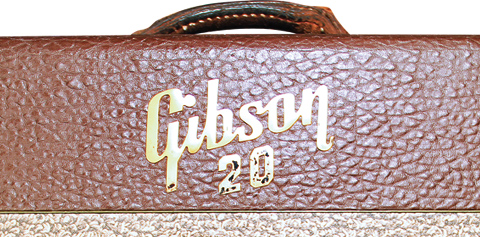

 “I stopped in at [a consignment shop owned by Warren and his daughter] to see if they might have any old amps, radios, or stereos I could buy to work on,” Ellis said. “Conversation led to music equipment, and Warren mentioned that he had a Gibson guitar and amp that were in disrepair. He was beginning to experience problems with arthritis in his hands, and I asked if I could get the guitar and amp repaired [so he could] use them to keep his fingers flexible.”


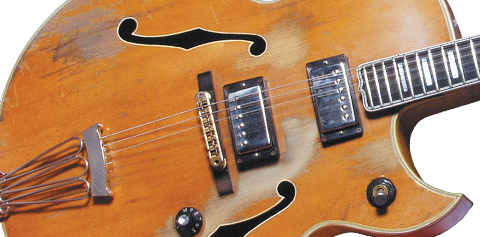


 This article originally appeared in VG‘s April 2004 issue. All copyrights are by the author and Vintage Guitar magazine. Unauthorized replication or use is strictly prohibited.
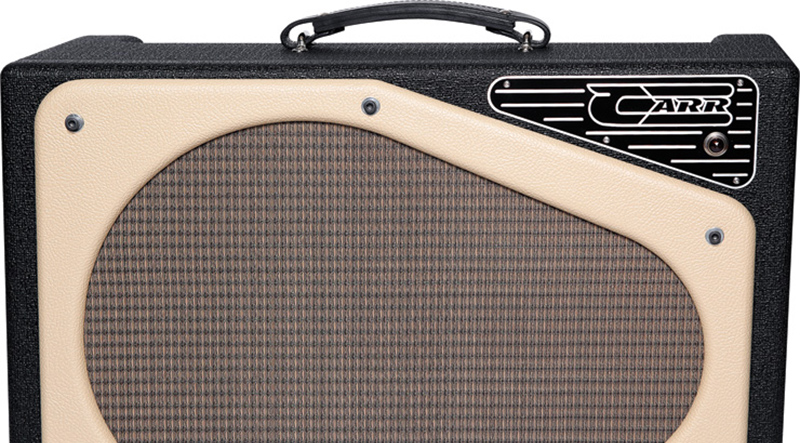


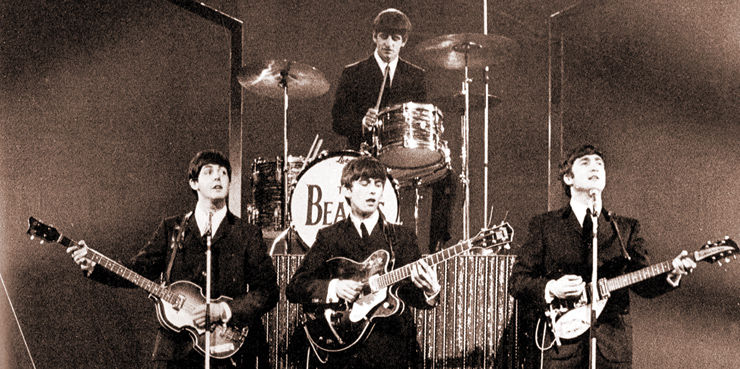


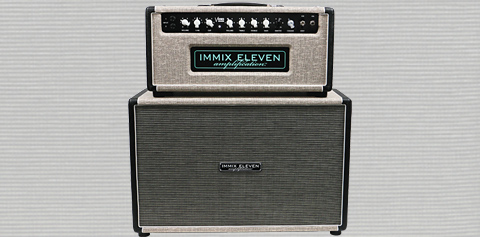

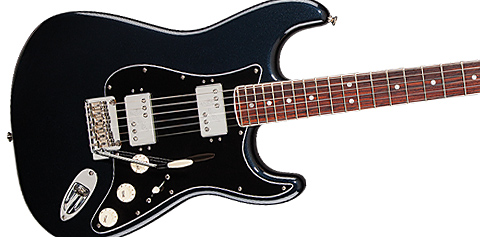

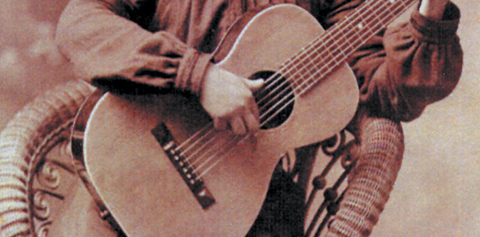


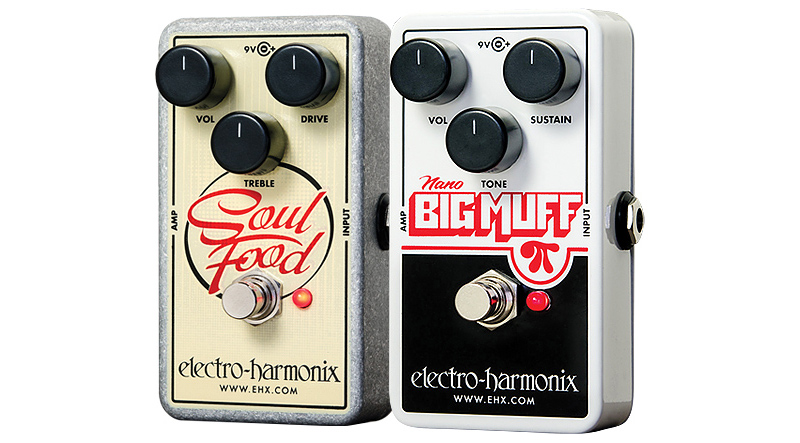

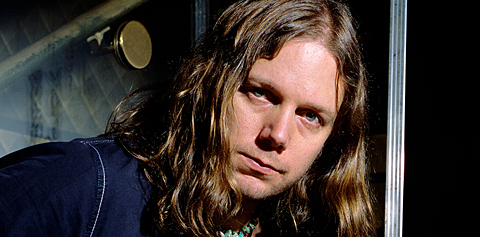
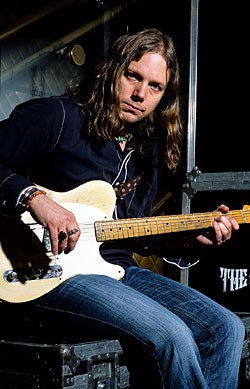
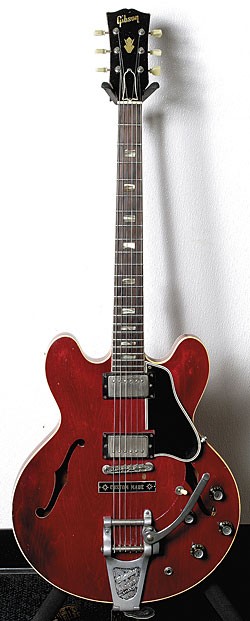
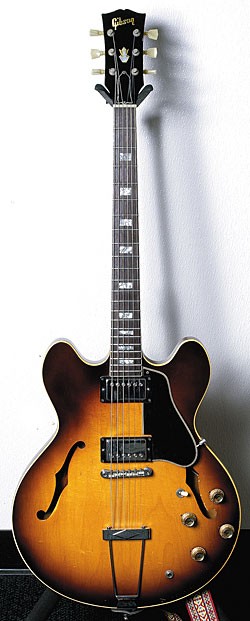
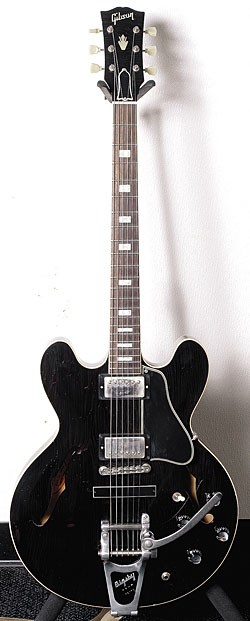
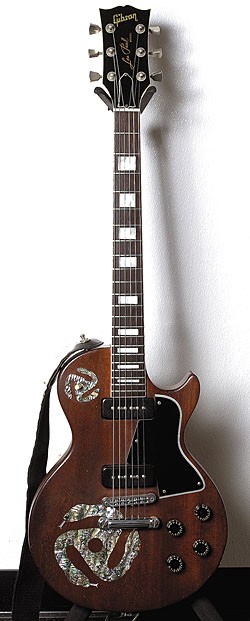
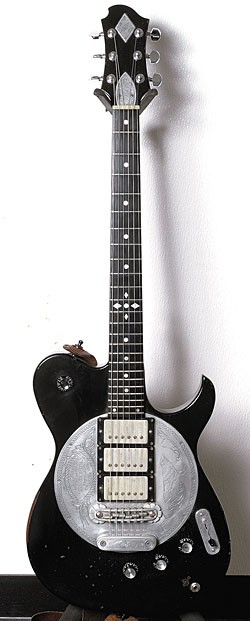
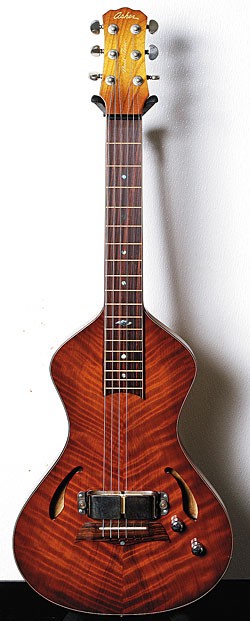
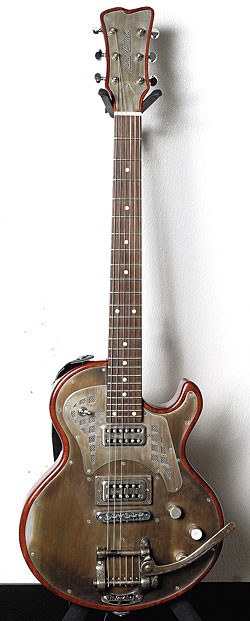
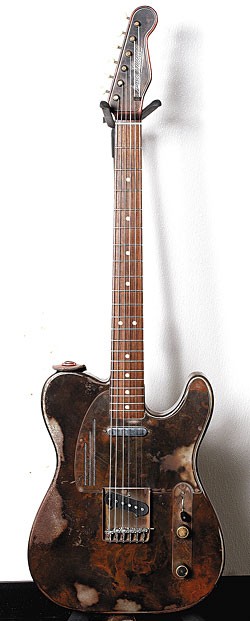
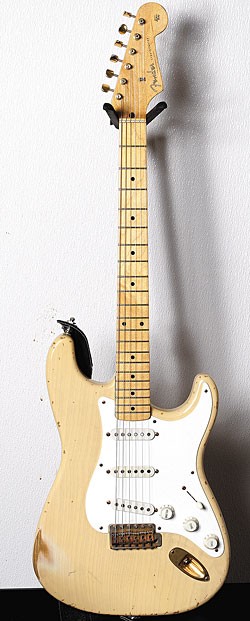
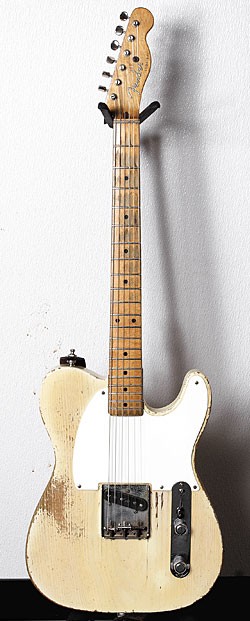

 This article originally appeared in VG‘s June 2007 issue. All copyrights are by the author and Vintage Guitar magazine. Unauthorized replication or use is strictly prohibited.