
Tag: features

  • Steve Cropper

    Steve Cropper

    Bowl for Ronnie: Craig Newman.

    The gloriously soulful music recorded by Stax Records is still entertaining listeners six decades after its release, and the label has been celebrating its 60th anniversary with a reissue campaign. The first offerings are 10 Stax Classics compilations from artists including Booker T. & The MG’s, Otis Redding, Sam & Dave, Albert King and others.

    Central to the story is guitarist/songwriter/producer Steve Cropper. “The Colonel” was a member of Booker T. & The MG’s, best known for the 1962 instrumental “Green Onions” and as the house band for most of the label’s music.

    “I have my theory on what made Stax and Memphis music great,” said Cropper. “Every time I look at my wife at a concert and we see people dancing, I’ll say, ‘You know why that was a hit, don’t you?’ and she’ll say, ‘Yeah, because you can dance to it,’ and I’ll say, ‘Exactly!’”

    Cropper is still a busy man at 76, though due to his success – he also co-wrote and/or produced/co-produced standards like Wilson Pickett’s “In the Midnight Hour,” Eddie Floyd’s “Knock on Wood” and Otis Redding’s “(Sittin’ On) The Dock of the Bay” – he can work when he wants. He’s been promoting Stax’s anniversary and the 50th anniversary of both the legendary Stax/Volt European tour and Redding’s scorching set (backed by The MG’s) at the Monterey Pop Festival.

    Since Booker T. & The MG’s backed Stax artists, a certain stylistic feel was inherent, but they strived to make the other artists’ music different so it didn’t just sound like a guest vocalist or instrumentalist.

    “The best example is Albert King, who became the most-famous blues guitar player of all time. Listen to any of his records then to the records we made with him. We took what he was doing and made it dance blues. We just brought it up a notch,” Cropper said. “That energy, I think, is what sold Stax music.”

    Though responsible for so much fantastic music, Cropper is still electrified when he hears it on the airwaves.

    “I think the most excitement and the biggest thrill you will ever get out of being a musician or a songwriter is hearing either something you’ve played on or wrote when it’s on the radio,” said Cropper. “That’s a thrill you just can’t explain to people. That is the ultimate.”

    Those heady early days at Stax directly led Cropper to this point in his life and career. Stax music mattered then and still does now.

    “You can’t hold that music down,” he said. “It’s too good.”

    These days, he tours regularly with The Original Blues Brothers Band and the group’s new album, The Last Shade of Blue Before Black, is set for a fall release. Cropper and saxophonist Lou Marini ground the band, which was conceived by “Saturday Night Live” comedians Dan Aykroyd and John Belushi. 1980’s musical comedy The Blues Brothers is a beloved cult classic.

    “A lot of people don’t know this, but the basics of the Blues Brothers band that played on the first record, Briefcase Full of Blues, and did the movies had done two albums and two world tours with Levon Helm & The RCO All-Stars,” said Cropper.

    Early in his career, he was known for playing a Fender Esquire and Telecaster. Cropper said the guitars didn’t distort, and engineers and producers preferred the way their clean tone cut through on songs’ backbeats.

    “I liked the Tele because it had two pickups. It was a little more versatile than an Esquire, which had one pickup,” said Cropper.

    His main guitar for the past nine years has been a Peavey custom.

    “It’s a one-of-a-kind Telecaster copy and it’s laminated so it’s very light. It’s a solidbody, but it’s all been hollowed out and laminated. It’s a great guitar. Great tone,” he said.

    Cropper also had a Peavey signature model, the Cropper Classic, created because he envisioned a quality, affordable Telecaster-like guitar for beginning guitarists.

    “I spoke with Hartley Peavey and said, ‘I need to put a Tele-style guitar on the market for under $1,000.’ He said, ‘I’ll build that guitar for you.’ It’s not a cheap guitar,” said Cropper. “I’ve got fan mail that said, ‘I bought it because it had your name on it, and now it’s my favorite guitar. I take it everywhere I go.’”

    Cropper isn’t much of a collector and he’s not much into acoustic guitars, but when the economy tanked nearly a decade ago, as an investment for his children he bought several Gibson J-200s that people were selling. He also has a Gretsch Chet Atkins model given to him by The Who drummer Keith Moon.


    This article originally appeared in VG January 2018 issue. All copyrights are by the author and Vintage Guitar magazine. Unauthorized replication or use is strictly prohibited.
  • Carl Martin’s Roadie Bandmate 15

    Carl Martin’s Roadie Bandmate 15

    Price: $1,200 (list)
    Info: www.carlmartin.com

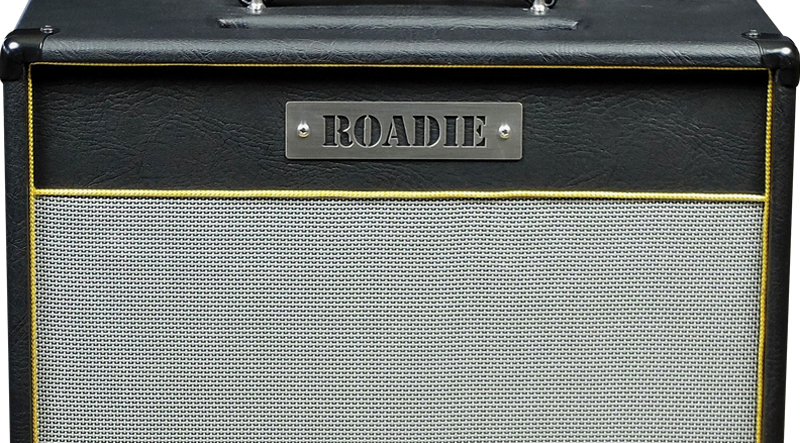
    Denmark’s Carl Martin has built a following with its PlexiTone series of overdrives and effects pedals used by stars the world over. The company recently introduced the Roadie Bandmate 15, a 15-watt Class A amp with matched EL84 power tubes, a Celestion Vintage 30 speaker, and built-in spring reverb. 

    At 41 pounds and boasting clean aesthetics, it offers rich top-end along with rugged tonal splendor. And while it breaks up mightily when pushed, at low volume it delivers an edgy rock cleans desired by guitarists with no use for jazz tones. 

    Using 12AX7s the Bandmate 15 provides masculine base tones for favorite pedals. It shines as a plug-in-and-go blues-rock machine for recording or for lower-volume gigs with a disciplined drummer. A straightforward amp, it has Volume, Bass, and Treble controls, a Bright switch, and Volume and Tone knobs for the reverb. A rear-panel input allows the player to turn off the reverb.

    With the EQ maxed, the Bandmate 15 gives a bright-but-scintillating sound with lively colors and sparkling harmonics. Using this as a starting point, dial the Bass and Treble knobs counterclockwise to warm the tones. Getting a good sound is quick and easy as long as you’re entrenched in the world of blues and rock; the Bandmate 15 has an earthy punch with lots of personality and sizzle, and emphasizes the attributes that make Stratocasters special, while humbucker guitars take on a gruff, ballsy power when the Volume knob is cranked.

    The amp is a dream come come true for guitarists who ride their guitar’s Volume control; vintage-style saturation for angry solos gives way to smoother grittiness for cleaner rhythms with snarl and teeth. An extremely loud 15 watts, the Carl Martin Roadie Bandmate 15 is the way to go if you need portable old-school tones. 


    This article originally appeared in VG December 2017 issue. All copyrights are by the author and Vintage Guitar magazine. Unauthorized replication or use is strictly prohibited.
  • Gretsch G2420T Streamliner

    Gretsch G2420T Streamliner

    Price: $549 (list)
    Info: www.gretschguitars.com

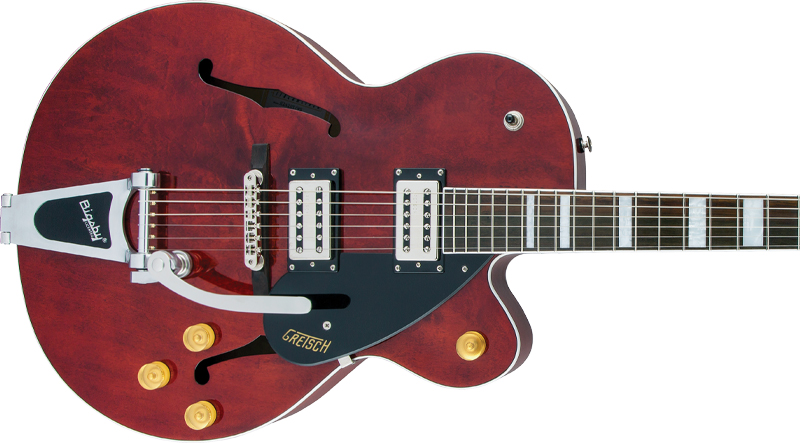
    Want to rock like they did back in the glory days, but don’t have pockets deep enough for a top-line Gretsch hollowbody? Strap on one of the new G2420T Streamliners and turn it up.

    Ideal entry-level Gretsches, the line offers Cadillac looks at a price a back-alley garage-rocker can afford. And the sonic capabilities are jacked up to match, with updated electronics and a more-modern sound.

    At the heart of the newly spec’d Streamliner Collection is the company’s new Broad’Tron humbucking pickup, designed to echo the vintage Filter’Tron that was one source of that famed Gretsch sound. And true to the legend, the Broad’Tron has a wonderfully chimey sound – clear and bright, but with bite to its growl.

    The Streamliner Collection includes the G2420 hollowbodies with a 2.75″-thick body and the choice of a Bigsby or Chromatic II tailpiece. The line also features two models with thin center blocks – the G2622 and G2655.

    Similar in shape and size to a 6120, the body of the G2420 is made of arched laminated maple supported by a sound post. The neck is built for speed, with a 12″ radius and thin-U design topped by a rosewood fretboard and 22 medium jumbo frets.

    The controls match an early 6120, with a three-way toggle for pickup selection and Volume knobs for each pickup as well as Master Tone and Volume knobs. Classic Gretsch.

    Plug it into a tweed Deluxe and you quickly hear that sound. The Broad’Trons boast a hefty bottom-end and pristine highs, but with a solid midrange. Make it purr with a warm tone from the neck pickup or switch to the bridge and really make it roar. Simply put, this is an incredible amount of guitar for the money.


    This article originally appeared in VG December 2017 issue. All copyrights are by the author and Vintage Guitar magazine. Unauthorized replication or use is strictly prohibited.

  • Boss Katana 100

    Boss Katana 100

    Price: $399 (list)
    Info: www.boss.info

    More and more, guitarists’ passion for tube amps is being balanced by the rise of quality digital, solidstate, and modeling amps, and for good reason – they’re often inexpensive while packing a huge range of features. The Boss Katana series is an interesting combination of price and tone in this category.

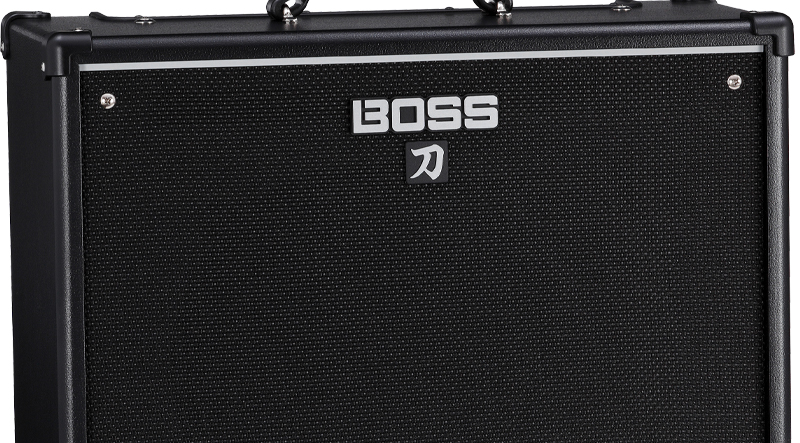
    The Katana 100 has a custom 12″ speaker and a control panel broken down into four sections. The first gives up the channel Gain and Volume, as well as a selection dial to find the general type of tone you want among five available “characters” – Clean, Crunch, Lead, Brown, and Acoustic (for acoustic/electric guitars). A three-band EQ section is essential for controlling the vagaries of solidstate amps, followed by an Effects section and the power section with Presence, Master Volume, and a Power control.

    The Katana 100 offers effects that can be used simultaneously. On the control panel you can access nine effects via three knobs and colored LED buttons labeled Boost/Mod, Delay/FX, and Reverb. It’s really easy to access the effects; 7 o’clock to noon accesses the first effect, and noon to 5 o’clock brings in the second. Boost provides distortion and overdrive (including Boss Blues Driver and OD-1), while Mod kicks in the chorus, flanger, and phaser. Delay covers three levels of echo simulations – digital, analog, and tape – while FX delivers Tremolo, T-Wah (for that Jerry Garcia tone!), and Octave. Reverb offers Plate, Spring, and Hall sims. Again, this is all from just three knobs and buttons.

    Katana amps also have USB outputs to access the Boss Tone Studio effects editor via computer. Hooking the amp to a PC or Mac also allows downloading new sounds from the Tone Central website and tweaking up to 55 customizable effects. There are 15 default effects and you can use three at once. The best part is that you can save the effects, tone, and EQ settings for instant recall using the Channel Preset buttons. Players can purchase a separate Boss GA-FC foot pedal to access sounds quickly at gigs.

    The Power Control adjusts output from 100 to .5 watts. There’s a tilt stand for monitor and sound projection (which should be offered on more amps), and the Katana 100 weighs under 33 pounds, making it supremely easy to carry.

    Plugged in, it’s a beast, offering everything from clean and twangy to full-on metallic glory. The critical piece of the sound puzzle is the 1×12 combo’s excellent bottom-end; in general, “fat” is always better. Even its mid-overdrive tones have a degree of power-amp interactivity and more “air” than most boxes in this category.

    The kicker, though, is that Acoustic setting, which makes the Katana 100 the perfect gig amp for both a rock set and the unplugged set right after. No more lugging two or having to plug the acoustic/electric separately into the PA.

    The Katana offering so much under one hood makes it hard to quibble. If anything, its tone is a bit bright, but keeping the Treble on the low side helps. And you can’t argue with its overall sound and good-to-excellent effects. It’s certainly a “leave your pedal board at home” amp with impressive amenities.


    This article originally appeared in VG December 2017 issue. All copyrights are by the author and Vintage Guitar magazine. Unauthorized replication or use is strictly prohibited.

  • GluBoost MasterGlu, Fill N’ Finish, MasterTint, and Gludry Accelerator

    GluBoost MasterGlu, Fill N’ Finish, MasterTint, and Gludry Accelerator

    Prices: $15 (Fill N’ Finish, MasterGlu), $44 (MasterTint).
    Info: www.gluboost.com

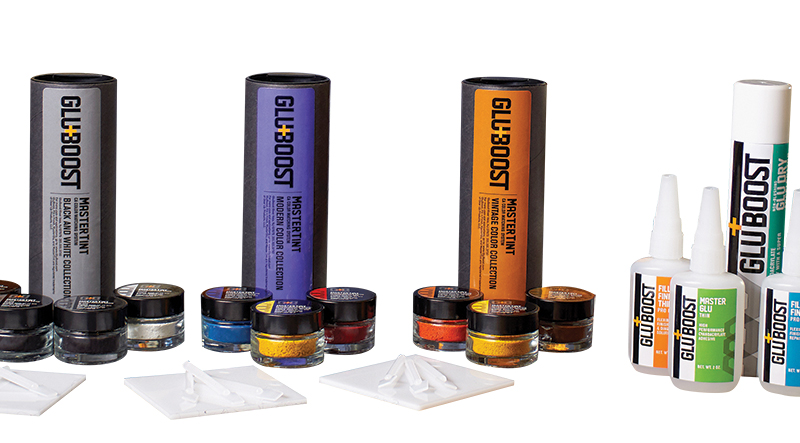
    There exists a subculture of guitarists who build, customize, or resurrect their own instruments, or help friends with theirs. GluBoost’s line of glues, dry accelerators, and wood finishing products allows even such novice luthiers or their techs the same quality of products used by their professional counterparts.

    GluBoost’s MasterGlu is offered in Thin as well as Ultra Thin formulas, providing transparent clarity for finely crafted fret repair and binding work. It goes on super clear and holds like granite. It’s also a rock-solid adhesive for inlay repair or new builds – and all GlueBoost products are carcinogen-free.

    Fill N’ Finish is ideal for a variety of wood builds, repairs, top coating, and inlay work. It works for any number of projects and provides resilience and flexibility with practically no witness lines – great for filling dings, dents, pores, gaps, and cracks for quick repairs or long-term projects. The Pro Formula is made for spruce, mahogany, rosewood, and cedar, while Thin works best for less-porous woods like ebony, maple, and koa. It provides top base and top-coating on fills and provides thinner finish.

    The MasterTint Color Matching System provides color additives for repairs or restorations; it’s available in seven colors that can be mixed to match any guitar and requires no solvent.

    Last, but not least, Gluboost’s non-blushing Gludry Accelerator is hard to beat for speeding up the set process. Two seconds is all it takes leaving a clear finish.


    This article originally appeared in VG December 2017 issue. All copyrights are by the author and Vintage Guitar magazine. Unauthorized replication or use is strictly prohibited.
  • Electro-Harmonix Synth9

    Electro-Harmonix Synth9

    Price: $295.10 (list)
    Info: www.ehx.com

    For 40 years, guitar synthesizers have come and gone, but the Electro-Harmonix Synth9 looks to be a game-changer for several reasons.

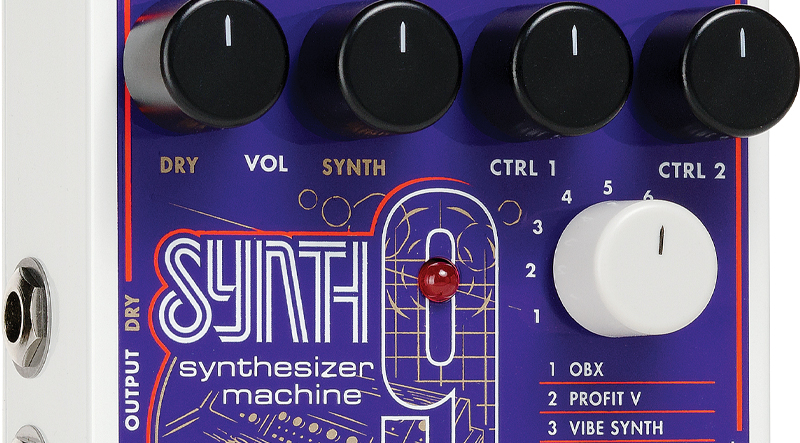
    First, you don’t need an external pickup to make it work. Rather, the Synth9 is a traditional guitar pedal – just plug it into your chain and get stomping. Second, the box is completely intuitive – no banks, MIDI controls, or menus. Again, it works like any other stompbox.

    The controls include two Volumes, one for pure guitar (Dry) and one for effect (Synth). These are key tools to achieve precise balance between the buffered, unaffected signal and the Synth9 tone. The CTRL 1 and CTRL 2 knobs offer different sonic functions depending on the position of the big white Presets knob.

    Now, the fun begins.

    Turn the Preset knob to any detent to find cool and useful analog synthesizer emulations; these are labeled to indicate classic keyboards from Moog, Oberheim, Sequential Circuits, Arp, and Korg. The Profit V has a gated effect bringing mind fusion-era Jan Hammer, while OBX is a massive polyphonic sound – think of Van Halen’s “Jump” or Rush’s “Subdivisions.” The Mini Mood and Mood Bass positions are high and low Moog sounds, while String Synth delivers Arp strings.

    For best results, use your bridge pickup with the Volume all the way up, and bring the Tone knob down, as the presets are bright and powerful. As for that all-important “tracking” (the traditional term for glitched notes on guitar-synths), balancing the “guitar” and “synth” voices will deliver the best results, but in general, the Synth9 will track fine for most players.

    Bottom line? Players who’ve been using guit-synth technology for years will marvel at the Synth9’s ease of use and powerful tones. Newer players will be happy they’re living in the 21st century!


    This article originally appeared in VG December 2017 issue. All copyrights are by the author and Vintage Guitar magazine. Unauthorized replication or use is strictly prohibited.

  • Fender’s Brad Paisley Road Worn Telecaster

    Fender’s Brad Paisley Road Worn Telecaster

    One of the newest models from Fender’s Artist series is designed to appeal to vintage Telecaster fanatics, country twangers, and even new converts taste-testing the Tele waters.

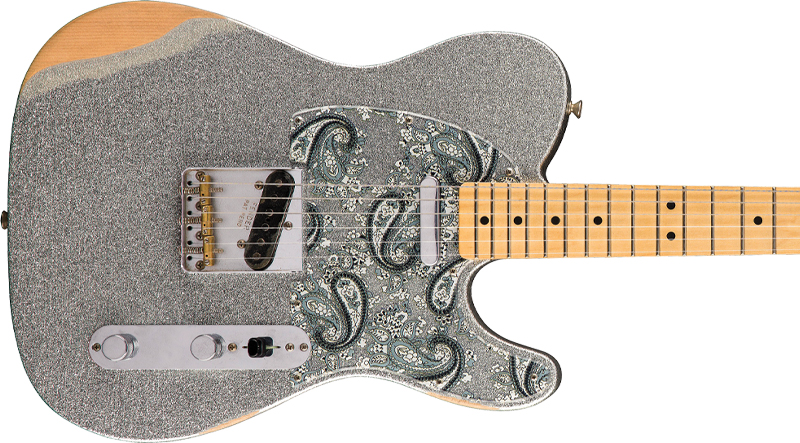
    The new Brad Paisley Road Worn Telecaster has a body made of paulownia, a fast-growing wood that has long been used in China, Korea, and Japan for the soundboards of traditional stringed instruments. It’s becoming popular in the building of electric guitars in the region due to its high availability/low cost, weight, and a fine grain that makes it strong and warp-resistant. On this instrument, it’s sandwiched between a spruce top and back.

    Price: $1,199
    Info: www.fender.com

    Modern touches include a 9.5″-radius fingerboard and medium-jumbo frets. Its personal aesthetic is derived from a silver-sparkle Road Worn lacquer finish, aged hardware, clear pickguard with black and silver paisleys, and a cowboy-hat insignia on the headstock.

    Its patina will find fans among those wanting the Relic look without having to pay prices typical for the segment. The dull chrome of the tuners and hardware looks tastefully weathered, as if exposed to skin oils, pick scratches, humidity, and general use for many years. Likewise, the aged-brass bridge saddles appear incredibly realistic, with the color and feel of old screws in your grandpa’s workbench bins. Even little details like the strap buttons and string ferrules are given the weathered treatment. Plus, the frets are masterfully flattened ever so slightly to match the feel of good used frets without affecting playability. There were no buzzing or intonation issues on the tester – quite an achievement considering the difficulties of creating an “old” guitar such as this.

    With its satin finish and no discernible Relic treatment, the neck has a modern feel. For some, this will be a plus. The new Enhanced V shape  – fatter near the headstock, flatter in the upper registers – may prove less than comfortable for smaller hands or those accustomed to a vintage profile, but those with typical or larger hands who feel lost on a vintage Tele neck will feel right at home here, with plenty of room to grab those harder-to-hit notes.

    Unplugged, the guitar was surprisingly resonant, which carried over to the sustain when plugged in. Double-stop bends on frets that might be a problem on other guitars have almost unnaturally long sustain. Fender says Paisley himself approved the pickup configuration, which includes the company’s ’64 Tele bridge and a Custom Shop Twisted Tele neck pickup. The latter has a clear sound that isn’t overly bright or piercing, with a tinge of warmth that works well when paired with brighter amps. The ’64 Tele pickup also has that classic Tele bite, with popping, bright dynamics and subtle warmth. Digging in, the sound jumps with more bite and grit, and powerful response. Those dynamics make the Road Worn Paisley work impressively at low- and high-gain settings – a quality not often seen with vintage-style pickups.

    Through a 30-watt 6V6 amp into a paired 2×12 cabinet, the guitar maintained a wonderful snap and low-end tightness. Into a 20-watt class D lunchbox amp, those driven dynamics remained obvious, with silky highs, biting mids, and taut lows.

    The Brad Paisley Road Worn Tele may not be a pure “Relic,” but its combination of vintage aesthetics and modern comfort is sure to make many players jaded by the sterility of modern guitars excited to make great music.


    This article originally appeared in VG December 2017 issue. All copyrights are by the author and Vintage Guitar magazine. Unauthorized replication or use is strictly prohibited.

  • Positive Grid’s Bias Head

    Positive Grid’s Bias Head

    Price: $1,299 (list)
    Info: www.positivegrid.com

    Designed to be a dream machine for players who just love to “experiment” with tone, the Positive Grid Bias Head is stand-alone that interfaces with software to create fresh presets that can be downloaded. But it’s actually more because it can record other amps, tweak them on a computer, and save them as presets.

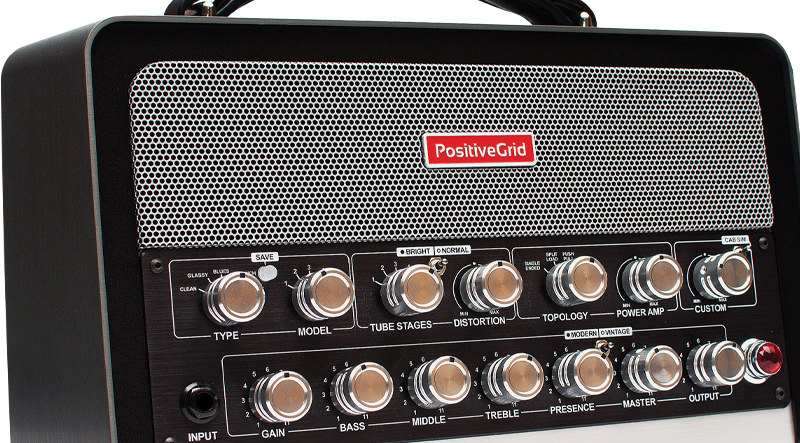
    With groovy ’60s-style knobs, the Bias Head offers two major sound controls – Type (Clean, Glassy, Blues, Crunch, Metal) and Model, which offers five choices. The next stage presents the tube simulations for tone and distortion, while the Topology and Power Amp knobs delivers sims of the power-amp stage. A cabinet-simulation control finishes the top row, useful for recording or going straight to PA. The bottom row of knobs works like a traditional amp, featuring Gain, Bass, Middle, Treble, Presence, Master, and Output. The overall output from the 600-watt solidstate power amp will depend on the cabinet it’s run through; there are also stereo balanced and unbalanced outs, as well as an effects loop.

    On the job, the Bias Head offers a vast assortment of tones even without loading software. Pull up fat cleans or hairy distortions with ease and, when you find a sound you like, save it with the blue LED button. The real magic is when you link it to your computer or compatible mobile device using the app and Bluetooth. Adjust parameters to your own taste, download other guitarists’ presets, or record other amps and adjust them with the ToneMatch software.
    While the amp works great as is, the person who grabs the Bias Head will most likely enjoy customizing every detail to taste – from its simulated preamp tubes and EQ to transformers, speaker cabs, and even virtual microphone positions.

    The Bias Head isn’t for everyone, but if you’re a player who feels constrained by the “closed universe” of an old-school head or combo, this 21-century amp will impress. It also has a small-box chassis, making it portable for desktop recording, rehearsals, and gigging. In fact, with the Bias Head, you won’t ever show up to a gig with one amp – you can conceivably show up with every amp.


    This article originally appeared in VG December 2017 issue. All copyrights are by the author and Vintage Guitar magazine. Unauthorized replication or use is strictly prohibited.

  • Magnatone Varsity Reverb

    Magnatone Varsity Reverb

    Price: $2,359 (street)
    Info: www.magnatoneusa.com

    Face it. They may look oh-so-cool, but rarely do you really, truly need that full amp stack. Most gigs for mere mortals these days are in smaller venues where smaller amps do the job just fine, or the amp is being miked through house PA. More than 35 watts is usually overkill, and small amps often sound killer.

    Enter the Magnatone Varsity Reverb, a small amp with a heaping spoonful of tone – and from a unique combo of componentry.

    The original ’50s and ’60s Magnatones were coveted tone monsters, as Buddy Holly and others attested. Today, the reborn company has proven itself over again, offering a range of amps and even fastidiously re-creating Magnatone’s revered true vibrato circuitry.

    The Varsity Reverb is an ideal entrée to Magnatone – and with all the power and tone you may ever need.

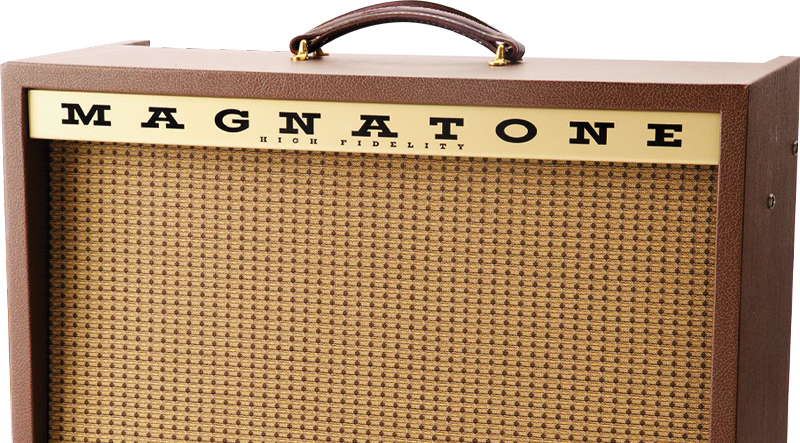
    First, the specs. The amp produces 15 watts of push/pull Class A power via two EL84 tubes with dual 12AX7s in the preamp, creating that classic American sound. The tube complement is rounded-out with a 12DW7 and GZ34. While many smaller amps send their signal through a 10″ speaker, the Varsity Reverb uses a custom Magnatone 12″ with a ceramic magnet, and the combo results in a unique sound providing headroom, depth, and complexity.

    The amp is housed in Magnatone’s classic rock-solid pine cabinet with looks that are tough to beat; think ’60s TV set, highlighted by a big, bold nameplate. Way back when, Magnatone was a style-setter, far ahead of the game.

    In honor of Mr. Holly, we plugged in a ’56 Strat and fired it up.

    The control plate is on the back of the top, though in keeping with ’50s styling, it’s tilted away from the player, which adds to the looks but not the ease of use. The controls, however, are simple and straightforward – just Volume, Treble, and Bass for the two guitar inputs.

    The key, though, is a negative-feedback (NFB) slider switch that offers an 8-dB boost/cut. When cut, the sound is less loud, but also warmer, more rounded. Dial in some treble and you’ve got a fine recipe for saucy blues.

    With the boost on, you get a more forceful, clearer, trebly tone. That NFB boost makes the whole amp sound more muscular, punchier, cleaner, and simply, bigger. The Treble and Bass knobs create a range of both dynamic mixes, and add edginess to that tonal coloring.

    The Varsity Reverb boasts a big, fat low-end thanks to that 12″ speaker as well as the oversized cabinet – larger than may be required, but allowing for richer bass.

    To complement that bass, the mids and top end are suitably vibrant. The amp has a glassy tone, but with a nice edge of compression. Played hard, it’s extremely responsive, overdriving just a bit while retaining distinction and clarity of note. An overdrive pedal would add lovely raunch to the proceedings.

    The reverb is a tube-driven, four-spring long pan nestled into the bottom of the cabinet and controlled by a single knob. Dialing it up, the reverb adds a lovely dimension to the sound, though not the wettest ever. 

    Back to that 15 watts… You might laugh at the power rating, but crank the Varsity Reverb up and that smirk will disappear. This is a loud, vocal 15 watts. And coupled with that cool 12-incher, the Varsity Reverb will rock most any gig or studio.


    This article originally appeared in VG December 2017 issue. All copyrights are by the author and Vintage Guitar magazine. Unauthorized replication or use is strictly prohibited.

  • The Daddy Mojo Ozark

    The Daddy Mojo Ozark

    Price: $2,650 (as tested)
    Info: www.dmelectrics.squarespace.com

    For a decade, Daddy Mojo has been making cigar-box guitars that refine the vibe of those rudimentary instruments. In 2016, the company debuted a line of traditional guitars under the banner of DM Electric Guitar Company.

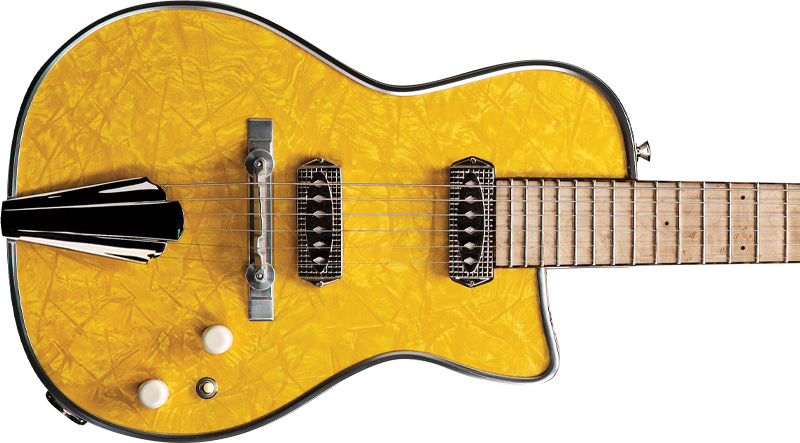
    One of its first was the Ozark – a modern take on ’50s budget electrics. Builder Lenny Piroth Robert was inspired after moving into an older home; during renovation, contractors removed 86-year-old pine that Robert salvaged for his own use. He also grabbed the ’60s yellow Formica counters and wall paneling.

    These reclaimed materials are put to use in the Ozark, a 23.5″-scale solidbody that resembles an early Harmony Stratotone. Spying a guitar with a Formica top is hardly an everyday occurrence, but it is extremely cool. The back of the neck and body are finished in a beautiful tobacco sunburst, and one of the most interesting features is the aluminum molding encircling the body just like on many a kitchen table in the ’50s.

    Other appointments include a chunky but extremely playable maple neck with 23 frets made of wood rescued from the bottom of a Quebec riverbed. It’s topped with a lovely birdseye-maple fretboard, and that Formica also serves as a fetching headstock overlay, while the neck binding and truss-rod cover are both an attractive imitation tortoiseshell. The tuners are vintage-style, with open backs. 

    The controls are of the basic ’50s and ’60s econo-box ilk – one Tone and one Volume alongside a three-way selector switch. The pickups are proprietary Daddy Mojo single-coils that sonically resemble old DeArmond gold-foils. Plugged into a Sommatone Slick 18 amp, they responded with plenty of clean sparkle and high-end cut. Even the neck pickup served up usable jangly tone. The middle position performed nicely for rhythm chores, and the bridge pickup gave Tele-style sounds. When plugged into a small Vox with the overdrive engaged and finally dimed, the Ozark turned into a snarling dog with plenty of sustain to spare. Most guitarists would be hard-pressed to ask for more. This is simply a fun instrument to play, certainly one to consider, particularly for those into blues and Americana playing.

    The Daddy Mojo Ozark breaks the mold of Strat and Tele clones, and is sure to draw the attention of anyone with a taste for funky retro chic and unusual styling.


    This article originally appeared in VG December 2017 issue. All copyrights are by the author and Vintage Guitar magazine. Unauthorized replication or use is strictly prohibited.