For players of a certain vintage, there’s something gratifying about an old-school compact Boss pedal at your feet. Even with the evolution of more-sophisticated pedals, those bright, uniform boxes reliably recall a formative time.
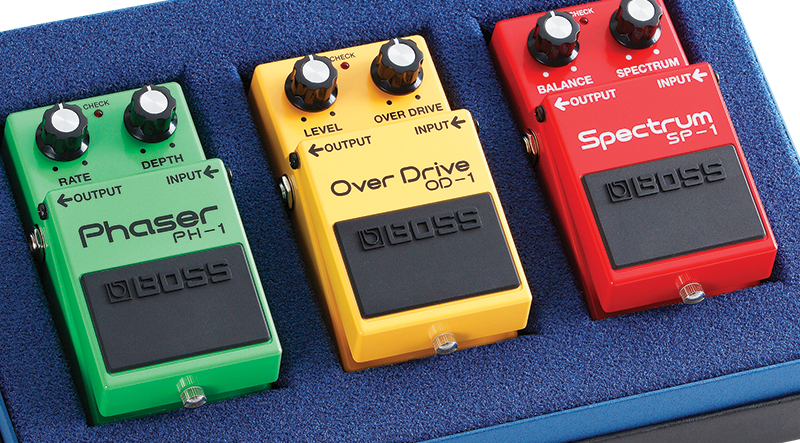
Boss is celebrating its compact pedal line with Box 40, a special-edition set containing reissues of the three that introduced the compact series in 1977 – the OD-1 Over Drive, PH-1 Phaser, and SP-1 Spectrum. Affectionately known as the “traffic light” set, this throwback three-fer is a chance to reclaim a piece of the past.
Like the originals, the reissues were manufactured in Japan, and Boss took pains to faithfully reproduce the early circuits in all their buffered-bypass glory. Design specs were followed closely and components tweaked by hand to match original response characteristics. Whether a player is nostalgic for a first-generation model or they rocked a later Boss with more bells and whistles, they’ll appreciate the classic tones and blissfully simple functionality – two knobs and the truth.
The OD-1 was a groundbreaker in ’77 and the first in the Boss compact line. At a time when the smooth-edged sound of an overdriven amp wasn’t yet available in a stompbox, the company secured a patent on asymmetrical clipping-emulating tube distortion. Producing a soft, compressed overdrive, the OD-1 fattens a lead line and enables a chewy distortion for rhythms. A nice range of warm saturation is available within the sweep of the Over Drive control. The drive is tight in the bottom, big in the middle, and versatile, while not especially transparent. Though there is no Tone control, you won’t miss it; instead, pick attack, guitar volume, and pickup selection can be used to draw out a biting crunch, subtle buzz, or soaring lead tone.
The PH-1 is dark and swarshy, with that rich sound characteristic of vintage phasers. Distinct effects are available by working its Rate and Depth knobs. The phasing gets thick as you twist Depth past 12 o’clock and transition to a subtler background wash by dialing Rate back toward 9 o’clock. The Rate slows all the way down to 16-second cycles and up to 100 ms, which yields a Leslie effect. There’s a Uni-Vibe sound hiding in here, too, not to mention a built-in dry/wet mix, with the dry signal out front and never at risk of being drowned.
Finally, the SP-1 Spectrum, with its circuit borrowed from early Roland amplifiers, is like a single-band parametric EQ. Frequency between 500 Hz and 5 kHz can be selected with the Spectrum knob and then emphasized or deemphasized using the Balance control. The SP-1 is a bit of an odd duck but Boss has always been good with usable guitar EQ. A fixed-wah effect is easily dialed in. Tee up a tone to cut through the band, such as a high-mid boost for a honky, twangy solo. It’s also great in conjunction with the OD-1 to hone in on feedback frequencies.
Boss indulged just a few modernizations for the reissues, including a PSA-compatible power supply with a protection circuit and noise filter; reinforced battery snaps; and an on/off LED indicator. It says these are one-time-only reissues and that a total of 1,500 boxed sets will be produced. Upping the ante for collectors, the pedals in each have matching serial numbers and the presentation includes a note from Boss’ president imprinted with the same number.
This article originally appeared in VG January 2018 issue. All copyrights are by the author and Vintage Guitar magazine. Unauthorized replication or use is strictly prohibited.
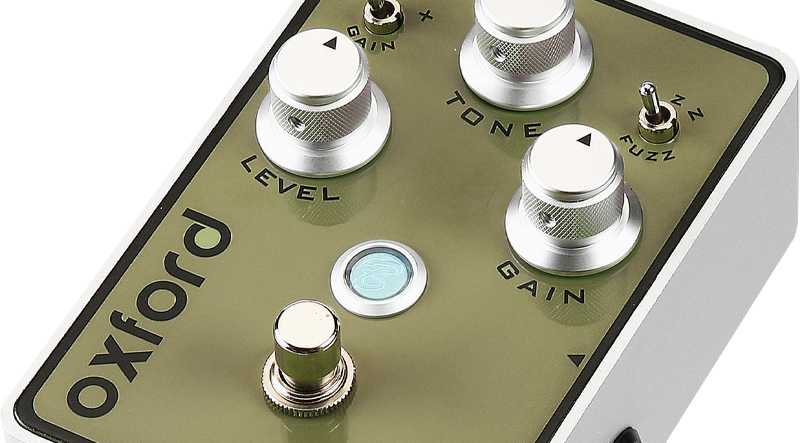
Teaming with Rupert Neve, Bogner Amplification has developed a line of pedals based on its renowned amp channels. One result, the Oxford Fuzz, is a smooth and highly refined fuzz with unmistakable tone and feel.
Housed in a sleek die-cast chassis with top hat-style knobs and chassis-mounted pots and switches, the Oxford’s insides are loaded – a Neve-designed transformer, double-sided (and gold-plated) printed circuit boards, German WIMA capacitors, Japanese Nichicon capacitors, gold-plated relays, and Carling switches. Controls include a true-bypass footswitch with large LED, three-position Fuzz Mode toggle, two-position Gain toggle, and knobs for master Volume, Tone, and Fuzz. Hookups include 1/4″ input and output jacks and a nine-volt power jack (internal battery option). Ferrosilicon transistors ensure consistent performance.
Clearly, Bogner invested a lot of thought in the details of the Oxford Fuzz. So how do they all come together? To find out, we unshelved a Fender Blues Junior 1×12 and a Les Paul Standard with Burstbucker pickups.
The Oxford produces a smooth fuzz with a thick and harmonically rich tone with a surprising amount of touch-sensitivity. Even with an over-the-top grainy fuzz dialed in, the pedal maintains a buttery tone – clear and complex, thanks no doubt to the Neve transformer. Between the three-way Fuzz Mode switch, two-way Gain, and Tone control, the user can access a huge variety of fuzz/overdrive tones, from organic and mild transistor ’60s overdrive to out-of-control sustaining fuzz.
With its quality build and thoughtful componentry, the Bogner Oxford Fuzz will raise the grade of most any guitar setup.
This article originally appeared in VG January 2018 issue. All copyrights are by the author and Vintage Guitar magazine. Unauthorized replication or use is strictly prohibited.
Fuzz wahs are nothing new, of course. Released under scores of badge-engineered monikers, they’ve promised aural overload ranging from sirens to tornadoes. Problem is, most have sounded like novelty toys – funky and great for party tricks, but that’s about it.
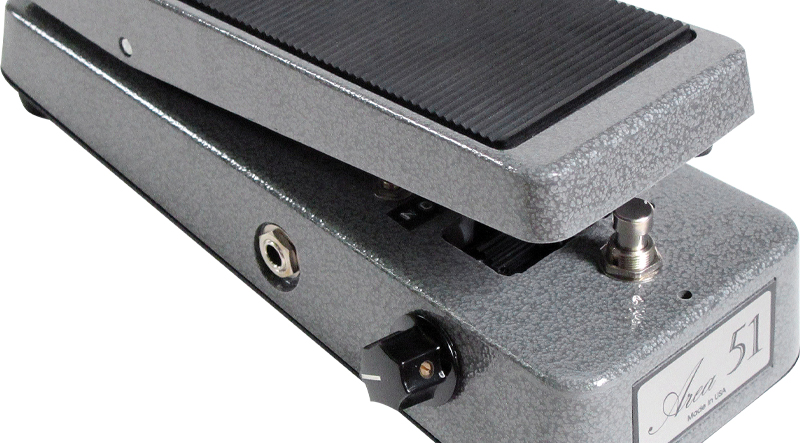
Area 51’s Fuzzwah changes that. This pedal can make the weird sounds, sure, but they’re glorious; far-out wah, buttery fuzz, and any combo of the two.
Dan Albrecht has been building “standard” wah pedals for a number of years – rocker pedals that have garnered rave reviews. He also makes a simple-but-killer fuzz box with many an acolyte. Why not meld the two into one?
Albrecht added extra boost to his standard wah circuitry, which in turn added character to the tone depending on where the foot treadle was set. That extra gain stage powers the amp’s preamp. The added gain smooths out the sweep of the wah, so depending on the rock of the foot, the Fuzzwah can produce incredibly subtle shifts or downright massive ones.
Further, this isn’t a frog covered in warts of dials, controls, and switches: it’s a simple, solid wah with a single dial. And, Area 51’s build quality is superlative – important with a pedal that gets a lot of footwork.
The ultimate glory here is you get three effects in one. Turn off the fuzz and use it as a regular wah; leave your foot off the go pedal and just let the fuzz work its magic; or combine the two for an infinite array of sounds that change as quickly as you pick and rock your hoof.
Morley built one of the most famous – and truly usable – fuzz wahs back in the day, beloved of players from Jerry Garcia to Metallica’s Cliff Burton. But no one has perfected the effects amalgamation like Area 51.
This article originally appeared in VG January 2018 issue. All copyrights are by the author and Vintage Guitar magazine. Unauthorized replication or use is strictly prohibited.
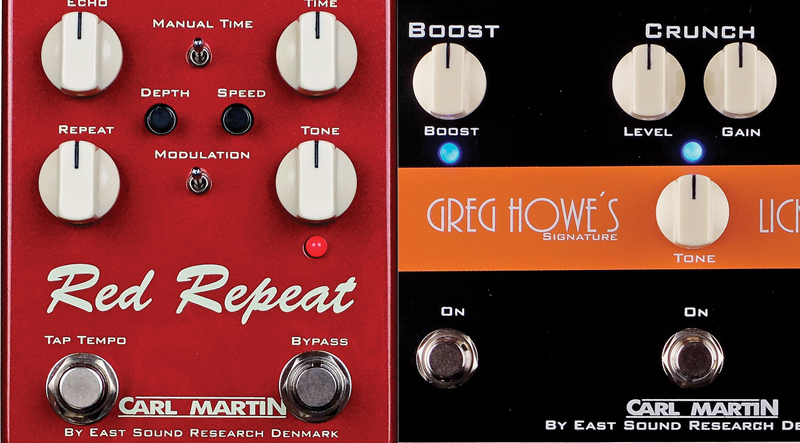
After hearing – and taking to heart – feedback from players, Carl Martin recently upgraded its Red Repeat Delay Echo by adding tap tempo and modulation functions. The former allows players to tap-in desired tempos for specific songs, while the latter, along with the use of the Depth and Speed mini-pots, allows players to control the quality of echoed notes to imitate the complexities of vintage tape echoes. The additions give the Red Repeat Delay Echo flexibility to create anything from contemporary repeats to old-timey slapback.
The Red Repeat has an Echo knob to control slap-back, a Time knob to control the distance between original note and the echoed note (0 to 600 milliseconds), and a Repeat knob to control the number of echoes. The Tone knob controls the EQ, and the Manual Time switch enables the Tap Tempo. It powers with a nine-volt adapter.
Settings are easy to dial and offer everything from simple repeats for thickening tone to super-delayed shenanigans that would leave Brian May scratching his head. It’s compact and solid, and the knob settings are easy to see on dim stages. The sounds are upscale and substantive, and the additional switches affect the quality of your signal trail to yield everything from pristine ’80s repeats a la Andy Summers to the cavernous slapback echoes of Brian Setzer.
Funk fusioneer Greg Howe travels the world to make a living playing agile licks and wide intervals. He needed a pedal small enough to fit in his carry-on bag but that retained his sonic persona when played through a different backline night after night.
Carl Martin rose to the challenge with the Greg Howe’s Lick Box, a pedal with three channels that offer Boost, Crunch, and High Gain. The channels work independently or in combination, and the Tone knobs – Crunch and High Gain – coerce even the most unpleasant amp to a player’s will. From 12 dB of sparkling boost to mid-focused saturated distortion, the Greg Howe’s Lick Box works a number of musical settings – from gritty Americana to heavy-duty rock.
Plugged into an old Pro Reverb, the Crunch channel was smoky with a beefy midrange and crispy bite. The Tone knobs offered a usable range of colors; sweet spots begin at around 1 o’clock and will indulge the Allman Brothers blues rocker within. The High Gain channel produces cranked-up Satriani-meets-Bonamassa with copious harmonics, sustain, and notes that truly sing. It’s still too smooth for contemporary metal, but engaging the Crunch and High Gain channels together allow for serious damage.
The channels can also be tweaked in tandem, balancing gain stages while adjusting levels of saturation and EQ to achieve a rich distortion that just might compel promoters to fly you around the world – just like Greg Howe.
This article originally appeared in VG January 2018 issue. All copyrights are by the author and Vintage Guitar magazine. Unauthorized replication or use is strictly prohibited.
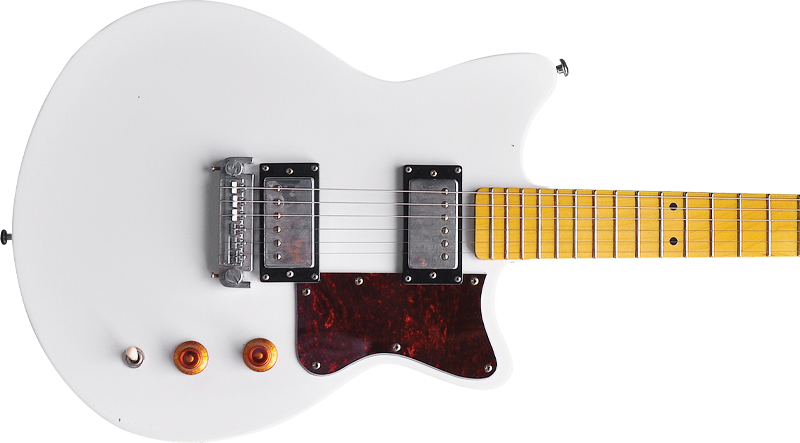
On the surface, the Scumbag is a simple rock beast. With a 25.5″-scale neck, maple fingerboard, and bolt-neck construction, it has the design and spunky nature of a Strat or Tele. Another nod to the past is the guitar’s “snake head” headstock, a throwback to Leo Fender’s 1949 Broadcaster/Telecaster prototype. With its squared-off three-and-three design, it’s a clever way to evoke Gibson and Fender.
The Scumbag has Kluson double-line tuners, a TonePros wraparound bridge, vintage cloth wire, Switchcraft jack and switch, CTS pots (there’s a push/pull option for coil tapping), and Sprague “orange drop” capacitors. The True PAF humbuckers are made by Bob Gabriel of Netherlands-based 4 Seasons Pickups. Additionally, the Scumbag comes with a choice of two neck profiles – Fat C or Modern C. Its 9.5″ fingerboard radius is presented cleanly, with just two dots at the 12th fret.
Part of the Scumbag’s appeal is its construction. Its two-piece, double-cut alder body has a thin nitrocellulose finish (the builders stress that there are no poly layers), which helps a solidbody make a chunkier tone like classic ’50s axes. To finish the look, the Scumbag is offered in black and white finishes with just the slightest bit of relic work – a few signs of distress in the finish along with aged pickup covers and bridge.
While solidbodies sometimes can sound flat and uninspiring, occasionally one shows up with a big, fat tone. This plank is a case in point. Plugged into a tube combo, the Scumbag is loud and resonant, displaying a big personality and plenty of tone. It all speaks to a combination of materials, notably that alder body and bolt-on maple neck that provide plenty of chime and sparkle, but given a twist with the Bob Gabriel humbuckers.
Ultimately, Relic the Hague’s Scumbag is the kind of rock and roll machine its Dutch builders intended, able to roar through anything from a small combo to a half-stack. Most pickers will find killer sounds here, and paired with the fine neck setup, there’s a lot to like about this solidbody. No question, the Scumbag is a rocker.
This article originally appeared in VG January 2018 issue. All copyrights are by the author and Vintage Guitar magazine. Unauthorized replication or use is strictly prohibited.
Though electric guitars have undergone radical change since the world first laid eyes on Rickenbacker’s “frying pan,” acoustics have rarely strayed from tradition. Andrew White is tweaking the system.
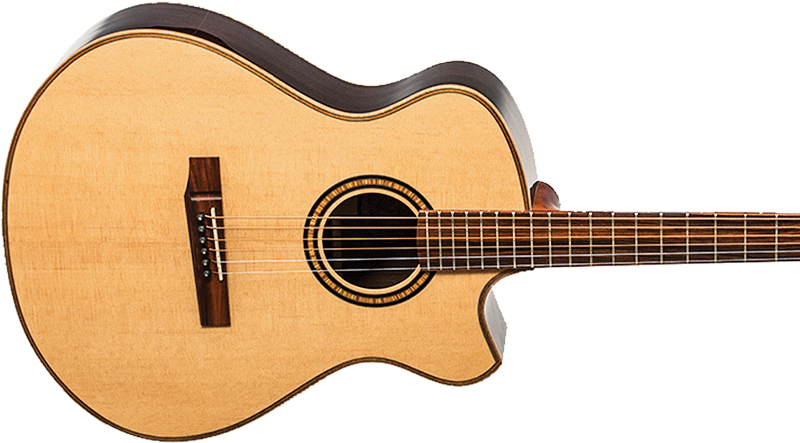
The West Virginian has reinterpreted the shape and dimensions of acoustic-guitar design, finding a median between jumbo and dreadnought with his Freja 1013W NAT. The Freja is comparatively short in body length – about a half inch longer than double-ought models – and its exaggerated soft shoulders and tight convex curves at the end of each bout bless the Freja with a distinctive look.
Its solid-rosewood back and sides are topped with Sitka spruce crisscrossed with flecks. A stylized logo is the only pearly bling in sight, yet the Freja seems decorative, warm, and inviting, with its curly maple binding, wooden purfling, and zebrawood rosette. The pau ferro bridge is discreetly shaped to optimize the gluing surface without being oversized or heavy. Players will appreciate the one-piece cedar neck with stacked heel overlaid with a pau ferro fingerboard and carved to a modern C shape. The headstock has an attractive rosewood cap. The neck joint is curved at the heel cap to match the body and headstock curves, while the finer details of the neck include a classic dovetail joint and two-way truss rod. The fretwork is clean, and the NuBone nut (in either 1.6875″ and 1.75″ widths) and saddle are functional tone enhancers.
The Freja has a distinctive look with a lofty level of craft. Its polyester finish and visible joinery (inside and out) are faultless.
Played with a thick pick, the Freja achieved a deep, bassy growl and plenty of rosewood presence, but less problematic woofiness – a characteristic that might sound good in the lap but has long been the bane of sound engineers. The upper register in the first positions showed the steely quality of a maple jumbo. The classic 25.5″ scale drew the best out of the Freja’s body, while the neck was substantial enough to enhance sustain, yet comfortably shaped for playability. Tightening the curves on an acoustic body generally results in a focused sound with fewer overtones than a dreadnought.
While not a bluegrass cannon, the Freja nonetheless delivered solid flatpicked single-note lines on fiddle tunes and modal noodling. The design, materials, and build permitted excellent string separation, giving strummed chords a texture that broke through the overtones produced by the Sitka/rosewood body.
Flatpickers can be stuck on the dread design much like gypsy jazzers want to park themselves behind something Maccaferri/Selmer-inpired, but open-minded fingerstyle players are going to find lots to like in the Freja, especially the W variant with its wide string spacing. It responded to bare fingers with a tuneful, even sound, while metal fingerpicks produced authoritative amplitude with cut and depth. Open tunings seem made for the Freja; the clarity of fretted notes contrasting with the ringing, open strings in octaves. The Freja produced a big sound, responsive to dynamic attack.
The Andrew White Freja 1013W is a high-value instrument with unique, pleasing aesthetics, first-class playability, and distinctive tone.
This article originally appeared in VG January 2018 issue. All copyrights are by the author and Vintage Guitar magazine. Unauthorized replication or use is strictly prohibited.
Among the arcana of tone, few things inspire as much devotion – even obsession – as echo. The Holy Grail is often considered the simple-but-lovely slapback heard on early Sun Records crafted by Sam Phillips. But delay, of course, can get far more far out.
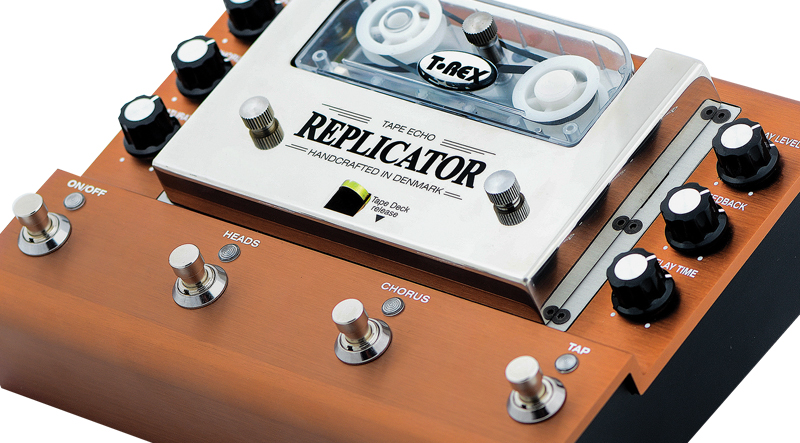
T-Rex’s Replicator bridges the gaps between tape’s unique tone and its complexity, price and availability, reliability and durability. The company’s goal was to build a tape-echo unit that nailed the sound quality of vintage units – think Echoplex or Roland Space Echo – while surpassing them in features. Basically, they sought to make tape echo usable on a daily basis.
The Replicator is, simply put, one gorgeous stompbox. Built in Denmark, it reflects that hallowed Scandinavian engineering and design.
The pedal is based on the replaceable tape cartridge that runs through two playback heads – one for short, 125- to 600-millisecond delays, the other for long, 250- to 1,200-millisecond repeats. Or, use both to compound and amplify the effect.
Controls include master Volume, Delay Time, Saturation, and Feedback, with two expression-pedal inputs to give your foot the say over time and feedback.
Original tape-echo units usually had some unpredictable variation in their output: The Replicator is much more controlled, yet offers that variability via its controls. The box includes a Chorus mode that enhances the inherent modulation of tape echo, giving that glorious pitch waver in the repeats; this too can be turned down or up via a dial. Added to the analog features are a digital tap tempo to regulate tap speed to your command.
The Saturation control is a unique and especially cool feature, enhancing the Replicator’s responsiveness to the player’s attack, almost overdriving the sound as the player picks harder. It’s key to the box’s very organic sound.
And, yes, you can thankfully make the echo go freaky. Dial in Pink Floyd-esque sound sculptures or even make it self-oscillate out of this known universe. It’s ready and willing.
The Replicator can be used like an everyday analog or digital stompbox, kept running full-time through practices and gigs. In our tests, the unit never faltered – it just faithfully churned out sweet-sounding echo.
The Replicator ain’t cheap, but it’s got the tone. And it’s sturdy and steadfast – all making it ultimately inexpensive when compared with the efforts involved in keeping an Echoplex among the living.
This article originally appeared in VG January 2018 issue. All copyrights are by the author and Vintage Guitar magazine. Unauthorized replication or use is strictly prohibited.
The Danelectro name first surfaced on amplifiers in the late 1940s, then later on guitars made with Masonite bodies and lipstick-tube pickups, along with electric sitars, baritone guitars, and “Longhorn” basses.
In 2006, the Evets Corporation bought the name and began to offer a fetching line of retro-styled guitars and basses. Its most-recent, the Danelectro ’84, alludes to the year when Stevie Ray Vaughan was ubiquitous on stages around the world and on MTV, his Southwestern grit, soul, and attitude sometimes relayed via guitars with lipstick-tube pickups.
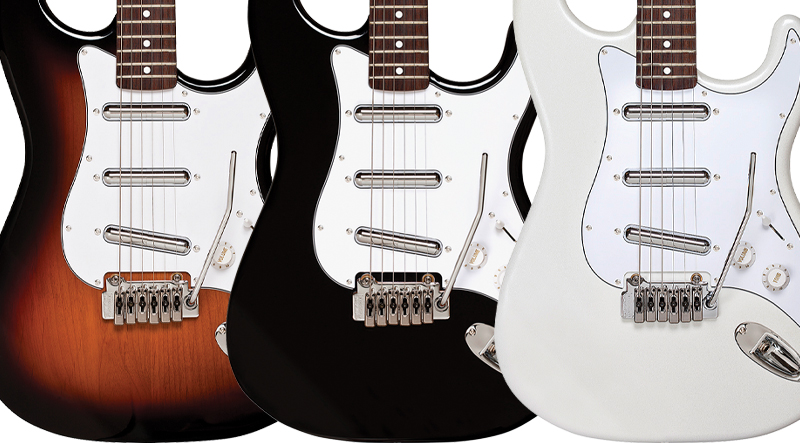
The ’84 has a contoured 22-fret neck, graphite nut, three lipstick-tube pickups manipulated by a five-way selector, and a floating Wilkinson vibrato bridge. It’s offered in three-tone sunburst, black, and white on an alder body with asymmetrical double cutaway, and employs a 25.5″ scale with a rosewood fretboard.
The ’84’s girthy C-shaped neck and flat 12″ fretboard radius address the concerns of modern guitarists who employ diverse playing techniques, and its Volume and Tone controls bypass electronic fuss. Frets have a clean finish, and while the Kluson-style tuners and selector switch aren’t high-end, they get the job done. The Wilkinson vibrato allows the player to fine-tune string height, and its bar pushes into the unit, allowing for tightening the bar with only a few turns.
But it’s the pickups that have brought us to this party, and they do not disappoint. Played through a bevy of blackface-style combos and a high-gain head, it sounded sweeter than a glass of Texas iced tea, pickups yielding that classic nasal quality with smooth, curvy bottom. The neck pickup leans toward the upper end of the EQ spectrum, doling out resonant chime, spank, and cluck while retaining plenty of warmth but still cutting through a mix. It’s the type of plucky ’tude usually found with instruments at twice the price. The two and four positions of the selector are spot-on, ushering all manner of chunky goodness, but the guitar also shines on Rickenbacker-style arpeggiated jangle. The bridge position is brighter and tougher, yet yearns for a Tube Screamer to fulfill its life’s work. The middle pickup has a subtle honk that seasons the other when positions two and four are engaged.
Player-friendly, comfortable, and offering a bevy of usable tones, you’d be hard-pressed to find a tastier guitar for the price.
This article originally appeared in VG January 2018 issue. All copyrights are by the author and Vintage Guitar magazine. Unauthorized replication or use is strictly prohibited.
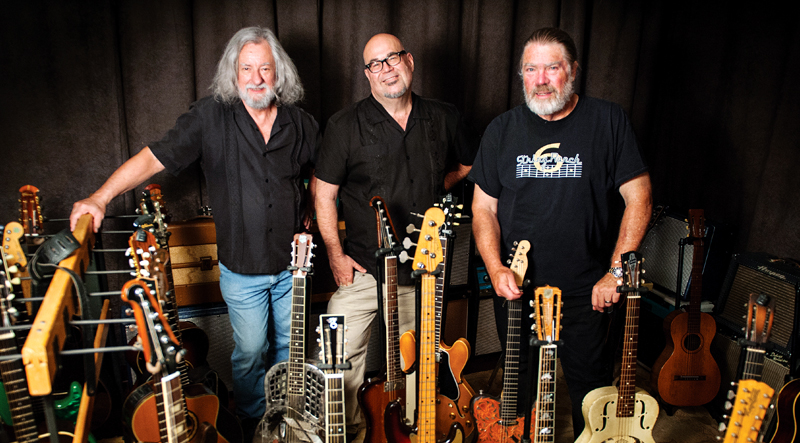
Jeff Hasselberger, Matt Smith, and Bill Kaman with some of the vintage instruments at 6 String Ranch.
The J&B Brothers make a sound equal parts Texas country, blues, folkie, rock, jazz, and soul – the spices that make music from the region so damn tasty. They’re also longtime vets of the gear biz.
Jeff Hasselberger was the visionary behind the rise of Ibanez in the ’70s, while Bill Kaman was a big wheel at Ovation, as well as the son of founder Charles Kaman. Their producer/bassist is Matt Smith and their album, Different Mothers, combines those influences into a sound that’s resoundingly Austin. Kaman and Smith also run a studio and jam space in Austin called 6 String Ranch – a place teeming with cool vintage gear.
Among the vintage gear available to clients of 6 String Ranch are this ’57 Strat, ’58 Precision Bass, ’59 Strat, and ’57 Princeton.
You two are expatriates living around Austin, but sound like you’ve been there forever. How does the culture, people, and landscape resonate with your music?
Jeff Hasselberger: Music in Texas – not just Austin – is woven into the culture, and it resonates with anyone with music in their blood. Texas is also a great historical melting pot of American music with influences from Mexico, the Caribbean, Germany, blues, country, jazz, folk, R&B, barbecue and cold beer. I’ve always been a Texan in that respect – I just happened to have been born in New Jersey.
Bill Kaman: I’ve been coming to this area of Texas since 1982. There’s a great feel to the countryside here, and to the music. Back in the ’70s, we all loved the Southern music. My college roommate was really into Asleep at the Wheel, Doug Sahm, and Commander Cody. I loved Bill Kirchen’s guitar playing back then although I didn’t know who he was or that these guys were from Texas. Now he hangs out at the studio with us! Funny how life runs in small circles.
How does your collaboration work? Each of you must have quirks that enhance the ultimate sound.
JH:Bill and I just started pickin’ together with no real plan. I really like his playing and especially love his songs. His background is mainly in Southern sounds and acoustic guitar, and mine is in urban electric rock and blues. A lot of quirks come out of that simple fact. It went from “Let’s start playing out” to “Let’s do a record” in pretty short order.
A 1934 Gibson Super 400.
Are there songs that best demonstrate your process?
JH: A good example of the acoustic/electric collaboration is “One Window Town.” It started out as acoustic tune and wandered in the desert for a while. I kept hearing it as a hard-driving electric tune, Bill added the electric 12-string idea, and Matt put a plan together to make it a rocker. It’s the same tempo as “Into the Great Wide Open,” and Bill and I tried to channel Mike Campbell in the solos, so it ended up as kind of a Tom Petty song.
BK: We each start with an idea and pull it together enough to make it presentable to the other. Then it’s, “Hey, what do you think of this?” and we work on it. Sometimes the suggestions are good, and sometimes tried and discarded; sometimes it takes a while for things to become obvious. On “Hill Country Home” we loved the song and played it for a while ’til it hit me that it needed something after the chorus, so I suggested the little walk-down turnaround. And of course, once we’re in the studio, we can count on Matt to throw several curves, some of which we seem to hit out of the park.
Matt Smith: I always think about what works best for the song – guitar voicings, single-coil or humbucker pickups, amp choice, or whether to add something twinkly, like high-stung guitar, or throaty like a baritone. We can also vary rhythm patterns and stay out of the way of the vocals and existing guitar parts. Every part has to be the best part of the song.
“Hill Country Home” feels like a love letter to Texas. Tonally, what’s the difference you’re looking for between your ’59 Strat and Bill’s Collings SoCo 16?
JH: Actually, it’s an ode to the travelin’ man who’s also trying to be a family man, in addition to being a Hill Country Valentine of sorts. It was written as a soul song from the start. The ’59 Strat has a particularly captivating middle/bridge tone, and was an early decision for the rhythm guitar. I think I used a Bruno amp. I was envisioning a big Billy-Preston-style organ intro, but Bill brought in a guitar solo that fit perfectly – the tone was his call. After Bill laid down that track, Matt said something like, “You know… this needs a dual guitar solo.” Bill played both parts, using the same tone, and I started to weep. My bass-playing son Alex made a visit from Philly and he’s a big James Jamerson fan, so I asked him to do the bass groove. The studio has a killer ’58 P-Bass and he had great fun playing it.
BK: I love the song, and I’ve always been partial to 335 sounds and the feel of the guitars. Collings makes the best, in my opinion, especially their I-35 and SoCo 16.
You can really hear Bill’s Ovation Deacon 12 on there, and then various other models throughout the album. Are Ovations coming around in the hip factor?
JH: I’ve always loved Ovation guitars and they have a loyal following around the world. And there are Ovations all over Different Mothers – the Deacon 12 on “One Window Town” sounds and plays great. Bill and I have large hands, so a Rickenbacker was out of the question. Bill’s slide on “40 Feet of Water” is an Ovation UKII and it has great balls for slide. We also used several Adamas guitars – they record nicely and can be strung with anything. There’s a Nashville-strung Adamas Q on “Dark and Stormy Night” and “Needles Highway.”
BK: Were they ever not hip? Or maybe that was just my point of view? Ovations are the guitars people love to hate because they were nontraditional. Now there are many makers using composite materials, so all of a sudden the 50-year-old original isn’t so bad anymore.
A ’53 Les Paul goldtop and ’51 GA-20.
What is the Hasselcaster?
JH: It’s a Tele-style electric that matches the paint job on my 2001 Harley Deuce. My sons, Ian, Mark and Alex built the Hasselcaster as a surprise for my 60th birthday. It sounds terrific and hey, my kids built it. Ian honchoed the project and got most of the parts from Ebay – the neck is a Mighty Mite, the body was made by a hobbyist in Florida. It’s chambered rock maple, but still quite heavy. The boys took it to the guy who painted my bike and he matched it perfectly. The bridge came from a guy in Texas. The neck plate and pickguard are solid brass and chrome-plated. Ian had a Russian machinist neighbor cut the opening for the pickup. The ashtray and neck plate are engraved with a “60th” diamond design. The pickups and controls are EMG.
As for the Harley, I had a big wreck in 2003 – the other driver swore he didn’t see me. The only thing that could be saved was the worked-over motor. It was a ground-up rebuild, so I took the opportunity to make it highly visible with a great paint job.
1890s Thompson & Odell Artist parlor guitar.
“Layin’ My Burdens Down” has that Bob-Dylan-plays-country vibe. The guitar part has a sweet tremolo sound.
JH: That’s a baritone Tele that Bill made, through a Supro Royal. The guitar has a definitive bari sound and the amp has great tremolo.
BK: The TeleBari is a fun guitar. I didn’t get to play it, as I was busy putting down the rhythm. I really like playing rhythm because it really defines the song. My late friend Steve Sutton used to say, “If you don’t have a solid rhythm, you haven’t really got a song.” I tried to learn well from him. I do like to play lead, too, and “Hill Country Home” gave me a chance for that.
What about “The Secret”?
JH: It’s the same guitar and amp, and that may have been the first track where we used it. It fits in well with our sound and shows up on several tracks. We intend to do for the baritone what Mumford & Son did for the banjo.
BK:Don’t you mean “Sanford & Son” (laughs)?
Matt is a well-known guitar ace from NAMM and other events. What was his role in the project?
JH: Matt deserves most of the credit for how the album sounds. He was a true producer in every way. I’d bring a song to him in a cardboard box and he’d guide the assembly process into a fully produced track. I love working with him.
BK: Yep. This is the third CD I’ve done with Matt. Each is a learning and growing experience – not just about the song and playing, but arranging, layering, and how to record. He’s a great coach – pumps you up off the floor and pulls you down just before you hit the ceiling.
What’s the story behind your Austin studio/rehearsal facility, 6 String Ranch?
MS: 6 String Ranch was conceived as a place of musical evolution. All of us dearly love to play, but we need a goal. Here, you can learn to play, write, and all aspects of how to record an album all in one laid-back, comfortable place. My mission is to help clients achieve their potential as musicians, since everyone is represented by their body of work. Writing and recording songs is the best way to funnel the desire and learning into one place – it’s a legacy that can be passed down to future generations of your family. That makes it a beautiful, important endeavor.
Collings 18″ Archtop with two ’66 Supro Big Star amps.
Who teaches here?
MS: We have master classes with players such as Bill Kirchen, Redd Volkaert, David Grissom, Ed Gerhard, John Knowles, Jody Fisher, myself, and many more. On our website, 6stringranch.com, we have a bunch of free instructional video and also offer full video, photography and services for copyright, publishing, licensing, and promotion of the music recorded here. It’s a one-stop shop!
BK: It’s where a musician can live out their dreams. Many of our clients are players in mid-life who used to do this or always wanted to, and now life lets them. Kids are off to school, or out of it, house is mostly paid off, they have spare time and the desire and some ability to do this again. So they do. Not only is Matt a great producer and musician, he is one hell of a teacher. I was a student of his for about 10 years after I moved to Texas. He helped in all aspects – playing, theory, singing, and songwriting.
1953 Telecaster and ’66 Fender Vibrolux.
Are the vintage guitars available to musical clients for their sessions?
MS: We have an extensive collection of rare vintage instruments and amplifiers, as well as the complete Supro line. All are available to clients.
BK: Some clients are more comfortable with their own instruments, often the ones they used to write the songs.
1929 National Tricone Style 3.
Which planks do they grab the most?
BK: Well, first they go to the espresso machine, then maybe an old Martin or Gibson. Often, it’s an old National they’ve only seen pictures of, or one of the unique pieces – baritones, acoustic and electric, mandocellos, five-string acoustic bass, tipples, high-strung guitars. The weird stuff they would never own but sound great on a recording.
How do you maintain all the vintage gear? That must take time.
MS: Just changing strings is a full-time job!
BK: Keep ’em covered with a tarp in the backyard to keep the rain off. Actually, having grown up in a guitar factory, I can do much of the smaller stuff myself. Coming from that side of the industry I know at least a half-dozen good repair guys here in town that I call on, depending what’s needed.
Is the band’s name derived from someone’s favorite beverage? And which of you has the better whiskey voice?
JH: The name has a much dumber origin – it’s our initials, and they just happen to be J&B. When we started playing together, folks would ask if we were brothers. And when they’d ask if we were really brothers, we’d just say, “Yes, but from different mothers.” Titling the album Different Mothers wasn’t much of a stretch.
BK: And, using our first initials in alphabetical order wasn’t going to work, either…
JH: In reality, we drink a lot more Shiner beer and William Chris wine, but “WC Brothers” was a non-starter. That said, Bill has the better whiskey voice.
BK: But I don’t drink that brand of whiskey. If I have a scotch, which isn’t often, it’s a single-malt. There are so many good local wineries and breweries here, and it all goes well with the local food. You can drink a bottle of wine with a meal, but if you drink a bottle of booze, you’re going to pay for it. I was done paying those dues long ago.
Two mid-’60s Airline 62-9013a amps frame a ’59 Danelectro Centurion (bottom) and a ’60s Ampeg made by either Noble or Oliver.
What’s it like to be guitar players in Austin, a town full of accomplished players?
JH:We try to make friends with local guitarists so we can steal from them (laughs). Seriously, the players around here are very accessible and generous with their knowledge. Besides Matt, who was a founding member of The Monstas, we’re pretty friendly with Bill Kirchen and Redd Volkaert. They’re a good reminder that lots of old guys still play killer guitar.
BK: It’s a thing you have to keep in mind; no matter what town you’re in, there are always a ton of players better than you. The ones who point that out, you can avoid. The rest are usually sweethearts like Redd and Bill. They become your friends.
This article originally appeared in VG January 2018 issue. All copyrights are by the author and Vintage Guitar magazine. Unauthorized replication or use is strictly prohibited.
Watching her baby boy become rapt whenever his grandma played country blues on her guitar, Ella May King had a notion… So, as soon as his tiny hands could fret a string, she found a Silvertone for little Frederick to start strumming along.
Freddie King courtesy of Bear Family Records/VG Archive. King with a stop-tail 345.
Her intuition set the course for Freddie King to reach far-ranging musical heights well beyond anything conceivable. From childhood into his teens, King developed a love for the music, keying on blue players Robert Johnson, T-Bone Walker, Lightnin’ Hopkins, John Lee Hooker, Muddy Waters, Sonny Boy Williamson, and others. Over and over, he’d play a record by jump-blues saxophonist Louis Jordan until he’d copped the solo note for note. The sum impact would help King become one of the most dynamic and influential blues guitarists of any generation.
In the fall of 1949, King’s mother and her husband moved from their home in Gilmer, Texas, to Chicago, where they went to work in steel mills. Having just finished high school and thrilled by the chance to become part of that city’s flourishing blues scene, Freddie accompanied them and immediately began to hit the clubs to watch Waters, Howlin’ Wolf, and Little Walter. He also befriended Otis Rush, “Magic Sam” Maghett, Buddy Guy, Robert Jr. Lockwood, and Hound Dog Taylor, all of whom helped pave his path.
Freddie worked in a mill, then played gigs at night, gravitating to the smaller clubs on the West Side, where he and a few friends could jam in basic combos instead of the horn-heavy bands favored on the South Side. In these settings, King began to develop his sound, turning up his amp and employing energetic interaction with the audience. In ’53, he recorded his first songs as a key performer and in the next several years went on to make some of the most influential blues music ever recorded, along the way helping to invent blues-rock.
While often cited as the Texas element of the “three kings” of the blues – B.B. bringing the Memphis sound, Albert a funkier Stax feel – Freddie’s music didn’t have a regional sound or feel. Rather, his style mixed country and city influences like Waters, Walker, and Hopkins, employing dramatic extended string bends, a vocalesque vibrato, and single-note passages that borrowed rhythmically from several styles including jump blues. While his wheelhouse was uptempo instrumental blues like “The Stumble,” “Remington Ride,” “Side Tracked,” and “San-Ho-Zay,” he was well-served by a strong, soulful voice as heard on “Have You Ever Loved A Woman,” “Someday After Awhile You’ll Be Sorry,” “Going Down,” and “I’m Tore Down.”
Chris Simmons uses aftermarket pickups and switches in the guitar, but keeps its original electronics stowed away.
King was the first guitarist to take the nascent blues-rock form born by T-Bone Walker and turn it into crossover hits. In 1961 alone, he placed six singles on Billboard’s R&B chart (four of which reached the Top 10) – “Hide Away,” “Lonesome Whistle Blues,” “San-Ho-Zay,” “See See Baby,” “I’m Tore Down,” and for the holidays, “Christmas Tears.”
King’s work was marked by superb musicianship. In a style taught to him by Jimmy Rogers, he played upstrokes using a steel fingerpick on his index finger, downstrokes with a plastic thumbpick. And while he never played slide, his work displayed hints of Elmore James and Earl Hooker.
Beyond Stevie Ray Vaughan and his older brother, Jimmie, he was hugely influential to blues-rockers like Lonnie Brooks, Billy Gibbons, Luther and Bernard Allison, and Johnny Winter.
Additionally, King’s style and songs heavily influenced the thriving blues scene in England in the early/mid 1960s; the most overt example may be Eric Clapton, who covered “Hide Away” on the legendary Blues Breakers album and cited King repeatedly through the years, saying the single “Have You Ever Loved A Woman” and its B-side “Hide Away,” made King his guitar hero. In fact, it spurred Clapton to track down his first Les Paul. Peter Green and Mick Taylor were also fans.
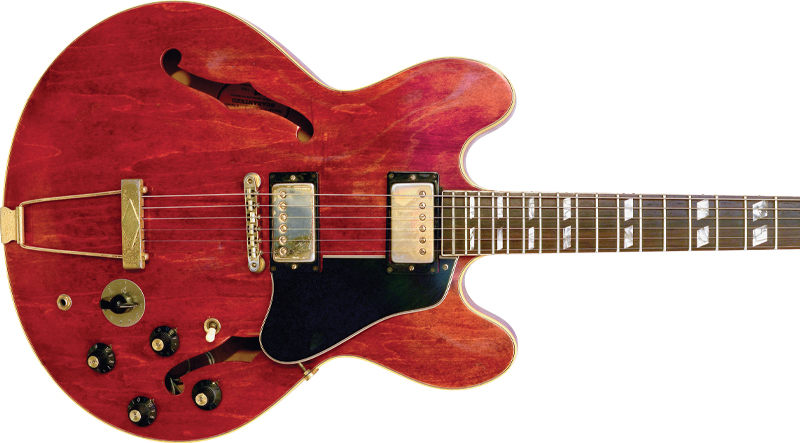
King’s choice of instruments is delineated between the early-’60s tracks for which he used a ’54 Gibson Les Paul Model (a.k.a. goldtop) and from the mid ’60s on, when he played a series of Gibson semi-hollowbodies including more than one with Vari-Tone circuitry. Some had stop tailpieces, others a trapeze or Vibrola. After his fame had waned, King sold some of his guitars to acquaintances including pianist/composer/songwriter/producer and Shelter Records co-founder Leon Russell. One was the ’68 ES-345 used on his first album for the label, 1971’s Getting Ready.
Later, on his own tours, Russell often passed time sharing stories as the busses rolled down the highway. From 2007 until 2012, Chris Simmons was his lead guitarist – a gig that not only broadened Simmons’ musical horizons, but landed the 345 in his care.
The story began one night a few months after Simmons had joined Russell’s band. His new boss was telling the story of how Freddie King called, saying, “Hey, Leon, I have a couple of guitars to sell. Would you like to buy them?”
Chris Simmons onstage with the 345. Photo by Leigh Ann Edmonds.
Familiar with King and his music, Simmons was fascinated by the narrative. Then, after the tour ended, Russell invited Simmons over for a visit and told him, “Why don’t you go to the warehouse and see if you can find that 345?”
Simmons entered to find the building chock full of pianos, artwork, and a lot of whatever else had captured Russell’s fancy through the years. Tucked away on a high shelf with other guitars, the 345 obviously hadn’t been touched in a long time.
“I took it into Leon’s house and opened the case,” said Simmons. “Right away, I noticed the strings were rusty and it needed a setup. I might’ve actually worked on it right there – it’s hard to remember because it was so surreal. I was touching Freddie King’s guitar!”
Simmons took the guitar home, whipped it into playing shape, then returned it to Russell’s house. He figured that would be the end of the story.
“But then maybe a month later, Leon brought it up again after a show. He said, ‘How would you like to have it?’ I said, ‘I’d love to, but I’d never expect you part with it.’ But he figured Freddie would have wanted it to be played instead of being stored away.”
When they returned to Russell’s home in Columbia, Tennessee, the two went back to the warehouse. Later that day, Simmons dwelled a bit on what had gone down. He stared at the guitar in disbelief and eventually picked it up, plugged in, and propped himself in front of a mirror “…pretending I was Freddie King.” He noodled some, and even played along to Freddie songs on his stereo, all the while hearing nuances of King’s tone. For a couple months, he kept the guitar at home – safe and sound.
“Every time we’d go on the road, I’d think up excuses to not take it out; ‘It’s too important… I’m not comfortable with it, it needs a re-fret, it might get knocked over, might get stolen…’ And I didn’t want to re-fret it because those were probably the frets Freddie played.”
But Russell called him out.
“He finally asked, ‘Where’s that guitar? I gave it to you because Freddie would want it to be played, so do whatever you gotta do. Its value is not in its history, it’s in what you do when you play it.’
“That is wisdom,” said Simmons.
He had the 345 re-fretted and removed the original pickups, pots, switches, and Vari-Tone. In their place, he installed four-lead Schaller Golden 50 pickups so he could wire the “spin-a-split” mod to produce single-coil tones. With the selector in the middle position, he says it gives a nice, biting out-of-phase sound, and there’s now a master Tone control where the Varitone’s chicken-head selector used to reside.
The guitar has since seen a lot of stage time. Midway through his set each night, Russell would spotlight Simmons playing it on a classic blues bit. In his own shows, Simmons plays it regularly, most nights jamming on “I’m Tore Down.”
Every so often, he gets to share his good fortune on a deeper level.
King with a 345 on the cover of his 1971 album, Getting Ready.
“When I talk to fans at a gig, if someone mentions Freddie or says they dig his music, I tell them, ‘I have something you might like to see!’ and I let them check out the 345 – hold it or play it if they want. The guitar has such great mojo, and I really like to let them catch a little of it.
“For me, the guitar is a symbol of Leon’s love. It was sometimes hard to tell with him, because he wouldn’t say much about how we all played together. But getting the guitar showed me something. It started to sink in that, ‘Hey, I’m playing with Leon Russell and I’m doing a good job.’”
Special thanks to Dave Cothran. Freddie King was profiled in the December ’01 installment of Wolf Marshall’s “Fretprints” column and Dan Forte’s “Check This Action” column in September, 2011.
This article originally appeared in VG January 2018 issue. All copyrights are by the author and Vintage Guitar magazine. Unauthorized replication or use is strictly prohibited.













 Is the band’s name derived from someone’s favorite beverage? And which of you has the better whiskey voice?
 Watching her baby boy become rapt whenever his grandma played country blues on her guitar, Ella May King had a notion… So, as soon as his tiny hands could fret a string, she found a Silvertone for little Frederick to start strumming along.

 Later, on his own tours, Russell often passed time sharing stories as the busses rolled down the highway. From 2007 until 2012, Chris Simmons was his lead guitarist – a gig that not only broadened Simmons’ musical horizons, but landed the 345 in his care.
