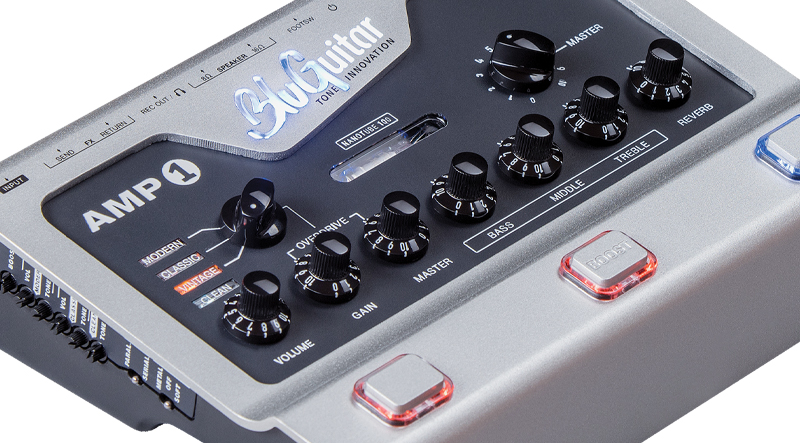
The trend toward the miniaturization of guitar gear shows no signs of slowing. Thanks to modern technology, guitarists are fitting more and more sorcery in their bags of tricks. BluGuitar’s Amp1 is a good example – a full 100-watt head that can fit on a pedalboard and sports a real tube.
First, let’s get past antiquated notions regarding tube, solidstate, and digital amplifiers. As the Amp1 proves, one box can accommodate all three technologies. It’s an analog preamp, a clean channel with three amp models, and a power section that combines a “nanotube” (long-lasting miniature tube) with a Class D transistor power amp. The tube creates the natural compression and chewy tones of a valve amplifier. There’s also reverb, boost, and a three-band EQ. A preset mode can store three favorite settings to the internal footswitches so that each recalls a channel, boost, and reverb. For more flexibility, opt for the Remote1, which adds floor control for channel switching, reverb, and an effects loop, plus a power soak down to 1.5 watts.
The Amp1’s four-position knob allows the user to dial between Clean, Vintage, Classic, and Modern, covering tones from clean to crispy-bacon distortion. Tiny knobs on the unit’s side fine-tune the tone and volume of each preset. A line-level output in the back allows direct recording.
Overall, the Amp1 evokes rich tube tones in a freakishly small unit – it would be difficult to imagine any guitarist not having a blast with it. Sure, you can probably get more-organic tube tones from dedicated valve amps, but having everything from vintage twang ’n raunch to modern crunch in one floor unit is remarkable. Downsides include a bevy of teensy knobs. Nor is the Amp1 cheap. But remember, that’s a real 100-watt head with killer tones.
This article originally appeared in VG March 2018 issue. All copyrights are by the author and Vintage Guitar magazine. Unauthorized replication or use is strictly prohibited.
Zakk Wylde emerged from New Jersey in the late ’80s to give Ozzy Osbourne’s music a style and attitude unlike that of any guitarist before him, using an approach spawned from the Allman Brothers, Black Sabbath, and Randy Rhoads.
His debut on No Rest For The Wicked introduced a dynamic chemistry between guitarist and singer that lasted through three decades. Today, Wylde’s picking propels heavy-metal churners Black Label Society and he guides Wylde Audio, designing gear that shares his aesthetic sensibilities.
The company’s Odin Grail Genesis Bullseye has a single-cut mahogany body with flame-maple cap, three-piece maple neck with a C shape, bound ebony fretboard with a 24.625″ scale, 14″ radius, and 22 extra-jumbo frets. The guitar is distinguished from other “Les Pauls” with a sharp, down-curved treble-bout point, curved tip near the strap button, and oversized mother-of-pearl block inlays.
A TonePros tune-o-matic bridge and Grover Rotomatic machine heads in gold work in conjunction with a GraphTech Tusq nut for tuning stability. A three-way toggle, two Volume knobs, and a master Tone control operate an EMG 85 pickup in the neck position and EMG 81 in the bridge; the 85 uses two Alnico-magnet coils with a wider aperture to give the upper and lower EQ spectrums a sweeter thickness while the 81 has a ceramic magnet and higher output. Both offer a range of sounds with no noise, yielding subtle midrange timbres, very usable compression, and a seamless transition when switching.
The Odin is ’70s-heavy, powerful, and yields hearty cluck in the middle position, angry bark in the bridge, and warm-but-brusque personality in the neck position. Clean tones are an excellent complement to fine-tune the sound of a high-gain amp.
The Grail Genesis Bullseye wasn’t sired for lounge jazz at wine-tasting socials. But it’s an outstanding no-frills rock machine.
This article originally appeared in VG March 2018 issue. All copyrights are by the author and Vintage Guitar magazine. Unauthorized replication or use is strictly prohibited.
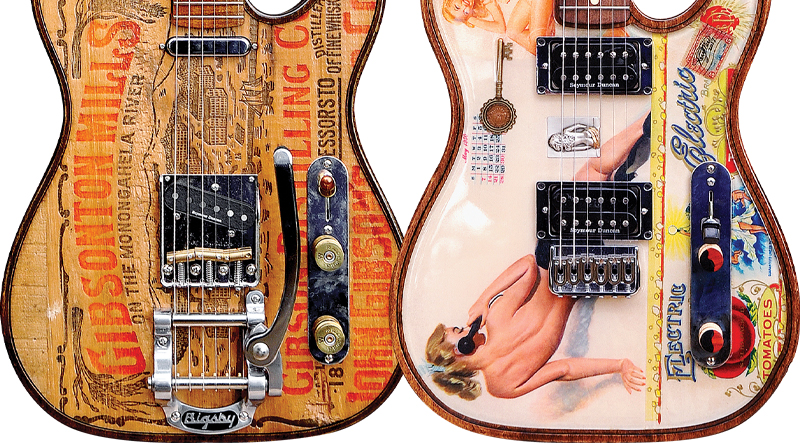
Walla Walla has carved a niche in the world of highly customized guitars and basses in the tradition of those time-honored Leo Fender archetypes. Their Maverick Pro Series offers up one model with classic single-coils and a tremolo bar, and another with humbuckers and a hardtail. You might want to strap a bib on before handling these beauties, though, as sudden drooling is possible.
First axe on the block is from Walla Walla’s Vintage Wood series – a Tele-shaped body with a piece of reclaimed wood as its top. This one uses the logo of Gibsonton Mills, an 1800s whiskey distillery once located south of Pittsburgh, Pennsylvania. The top gave the guitar an immediate vintage flavor and sense of the past. While every Walla Walla plank can be customized to the buyer’s tastes, this Maverick Pro sported a chambered poplar body, 22-fret bolt-on neck (25.5″ scale), deeply flamed maple fingerboard and neck with a soft-V profile, Seymour Duncan APT single-coil pickups, Sperzel tuners, and a Joe Barden bridge with Bigsby trem. Its unusual Volume and Tone knobs were made from the ends of shotgun shells, while a bullet casing formed the three-way pickup selector.
Another unique feature was the Sound Tunnel Port, located under a metal star on the north side of the upper bout. Occasionally these are seen on high-end acoustics, but it’s a novel idea for a chambered electric – indeed, the port delivered a nice acoustic resonance when playing unplugged. For pickups, Walla will install models from Seymour Duncan, Fralin, Barden, EMG, and TV Jones. Best of all, this Vintage Wood weighed under seven pounds.
The other Maverick Pro tested was from the T-Top Crystal series, which can have objects embedded in their resin tops – think coins, keys, badges, medallions, and other metal ornaments. This model has a 22-fret neck of flamed maple with a rosewood board, full-chambered poplar body. Hipshot non-trem bridge (Barden, Wilkinson, and others available), and Duncan Pearly Gates humbuckers. Also look for a NuBone 1.625″ nut and different fret-size options.
Plugged in, both guitars displayed fast playability thanks to those slim, speedy necks and compound radii (9″ to 12″). Fitted with its Tele-style pickups, the Vintage Wood was suitably twangy, while the humbucker-laden Crystal model rocked like a good Status Quo record. You can only imagine that each will sound better as you play them through the years – they play great now, but in a decade or two, they could sound even better as the wood opens up and the already-fine necks begin to play in to that exalted standard.
As every Walla Walla guitar is one-of-a-kind, both the Vintage Wood and Crystal models tested were original, fun, and exuded an old-school vibe. One key attraction is that you get that kind of “custom shop” attention and detail at a somewhat lower price. It’s still higher-end, but nothing like the astronomical numbers often seen these days. And they’re brimming with history and Americana.
This article originally appeared in VG March 2018 issue. All copyrights are by the author and Vintage Guitar magazine. Unauthorized replication or use is strictly prohibited.
Cigar-box guitars are a 19th-century creation that today are enjoying a trendy surge in popularity, and attracting the design expertise of some talented folks. Why? Well, because cigar box guitars are quirky and equally fun for musical neophytes and advanced players.
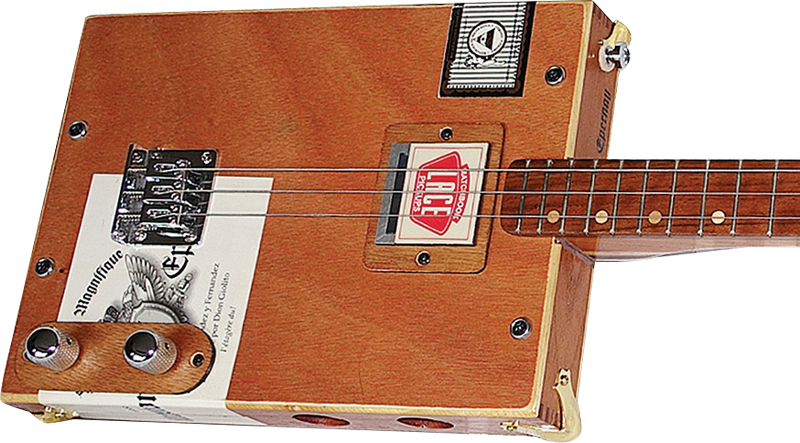
Take Rob Wrobel, who makes his three-string CBG Model with Lace Matchbook Sensor pickup in a state that would seem a likely source of cigar boxes. Wrobel mainly procures his boxes from a Destin cigar shop, and all of them are made of South American hardwoods.
Stamped with the legend “Hecho en Centro America” and a coat of arms with a two-headed eagle, the Wrobel Le Voyage Lace III tested was made from a carefully chosen box with brass hardware reinforcing its rear corners. The top had a beveled edge, while screws-through-eyelets held things together, a common joint system for the genre. Neck-through construction of primarily walnut laminated with domestic and tropical hardwoods comprised the fretted neck, and mesh-covered soundholes on the sides (dubbed “box breathers”) allow their sound to project. The Wrobel cigar box came tuned to G-D-G.
Plug into the 1/4″ jack and dial in the Lace Matchbox Sensor with the guitar’s Tone and Volume knobs. The Le Voyage allows one’s G-blues-boogie instincts to take over, even more with a slide. The Matchbox sensor has more than enough gain to overdrive a little tube amp, but at lower volumes produces a clarity that allows the characteristic cigar box tone to shine. Turkish saz hajiz scales with modulation effects, compression, and just a hint of overdrive also come alive. While a dedicated pickup might seem antithetical to the cigar-box DIY mentality, why not? Especially when it’s got a “found parts” kinda vibe, i.e., the north magnet resembles the striker on a matchbook and can even be decorated with a favorite matchbook cover.
There are cigar-box guitar clubs and conventions, and even a celebration in Clarksdale, Mississippi – heart of the Delta. Wrobel sees the revolution starting to impact guitarists on the lookout for another distinctive voice, and makes his guitars in five-string configurations, as well, for that Keef-inspired open-G tuning that rock guitarists have come to love. Hopefully, these musicians picking up cigar boxes don’t forget about the fun.
This article originally appeared in VG March 2018 issue. All copyrights are by the author and Vintage Guitar magazine. Unauthorized replication or use is strictly prohibited.
In guitardom, players far too often believe there is nothing more sonically pleasing than a tall stack. Yet, plenty of diminutive amps offer up massive tone; think Derek and the Dominos’ Layla and Other Assorted Love Songs.
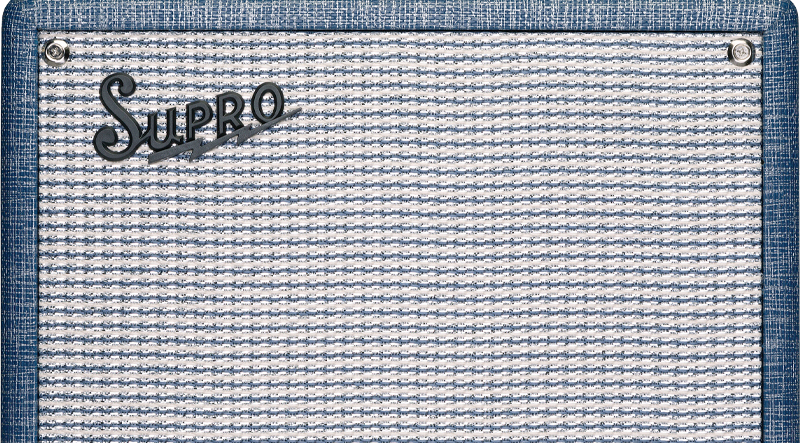
Supro is wise to this. After recently launching a lineup of full-sized Classic and 1964 Reissue amps dubbed Neptune, Coronado, Supreme, Statesman, etc., its designers turned to building a little amp that could. Now Supro’s vintage Super of the ’60s is back, better than ever.
The new Super was reverse-engineered using a vintage favorite from the collection of Aerosmith’s Joe Perry. The results are the Super and its buffed-up sibling, the Reverb, with tube-driven spring reverb. Both are five-watt/1×8 Class A combos. They’re small, they’re light, and they sound big.
The advantage of a small, low-powered amp is that you can crank it. Turn the Volume knob north and the amp is overdriven into a state of magical distortion while you can still hear yourself think. And you won’t have your neighbors calling the sound police.
The Super sports just one Volume knob, and it’s all you need. The absence of EQ controls is purposeful – the more pots and switches are in a circuit, the more that electrical signal (and thus, an amp’s tone) from the preamp is colored, altering he circuit’s essence. Instead, the Super gives no-frills, high-gain, raw tone from a 6V6-equipped, single-ended power amp.
The Reverb needs a couple more knobs, naturally, including Gain, Treble, Bass, and a Master volume (which is a welcome rarity in such a small package). Its preamp circuit includes two 12AX7s and a single 12AT7. Plus, there’s a Bypass plug-in to skirt the spring-reverb circuit when in search of bare-bones tones.
Both amps sing through custom-made speakers designed by Eminence and Supro with help from Iowa State University, which laser-scanned Perry’s vintage Jensen.
So, how do they sound? In honor of Derek, both the Super and Reverb were tested with a ’56 Strat, and both were hot to trot. Cool blues riffs, chunky rock shuffles, wailing solos – they’ve got the grit. Plus, they’re plenty loud for the studio, small gigs, or to scare your cat from the living room.
The Reverb has another set of tricks up its sleeve; the back panel sports a trio of tube-driven direct outputs – Wet (reverb output), Dry (preamp output), and Mix (wet and dry output with attenuator) – that allow the user to turn it into an outboard reverb unit or drive other amps in concert with the Reverb.
Copping the sounds of a Supro Reverb unit from the ’60s is possible using the dry output, which removes the dry signal from the output, leaving 100 percent-wet spring reverb from the 8″ speaker while sending as much preamp gain as desired on to another amp. Use the Mix output for direct recording or even configuring the unit to work as a “plug-in” insert if/when you use ProTools.
They may not have the headroom, articulation, or sophisticated overtones of big amps with big speakers, but that’s what those amps are for. And at just 23 pounds, these new Supros are eminently portable. And if you still have doubts, peek at the pic in the Rolling Stones’ Blue & Lonesome album – a vintage Super all miked up and ready for action.
This article originally appeared in VG March 2018 issue. All copyrights are by the author and Vintage Guitar magazine. Unauthorized replication or use is strictly prohibited.
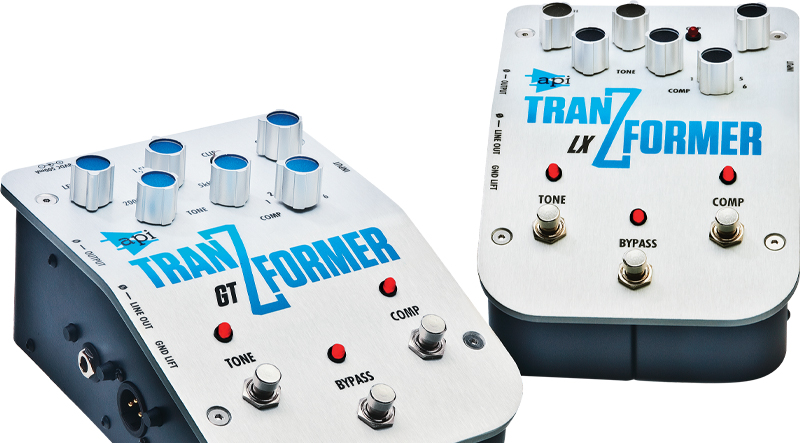
Automated Processing Inc. (API) is best-known for its high-end mixing consoles for broadcast and recording, along with the mic preamps, compressors, and EQs it has been making since the ’60s. The company’s discrete analog circuits are sought after for their uncolored sound. The legendary analog EQ and compression circuits in API channel strips recently became available in simplified, affordable pedals for guitar and bass players.
The TranZformer GT (guitar) and LX (bass) are housed in heavy-duty custom steel and aluminum 8″ x 5″ x 4″ chassis and weigh in at a stout four pounds. They share a layout including chassis-mounted 1/4″ input/output jacks with phase switches, balanced XLR output connectors with ground lifts, true-bypass footswitches for the EQ and compressor circuits, and external jacks for the included 18-volt power supply.
Controls consist of an output Level control, input Gain, a three-band Tone, and a six-position Compressor knob. The boxes’ tone circuits differ in frequency – 200Hz, 1.5KHz, and 5KHz center points for the GT; 100Hz, 400Hz, and 2KHz for the LX. The compressor circuit’s threshold is affected by the Gain control; the Compressor control changes threshold from -15db to -40db while adjusting makeup gain from 0db to +18db.
Tested with a Custom Shop reissue Strat, a Martin acoustic/electric dreadnought, and a G&L L2000 bass through a variety of amps and speaker combos, the pedals lived up to API’s reputation – silky smooth and thick with natural, sweet overtones while adding zero out-of-phase clutter. The quality of the Compressor circuit leaned toward that of a rack-mount unit, with a smoother, uncolored hi-fi sound that did a great job of leveling output without squashing the tone. The only significant tone change was to top-end under heavier compression, where it took a bit of the bite from the highs, reducing harshness but maintaining a nice amount of sparkle.
The API TranZformer GT and LX are true studio-quality preamp pedals with high-fidelity EQs and compressors that will benefit any instrument.
This article originally appeared in VG March 2018 issue. All copyrights are by the author and Vintage Guitar magazine. Unauthorized replication or use is strictly prohibited.
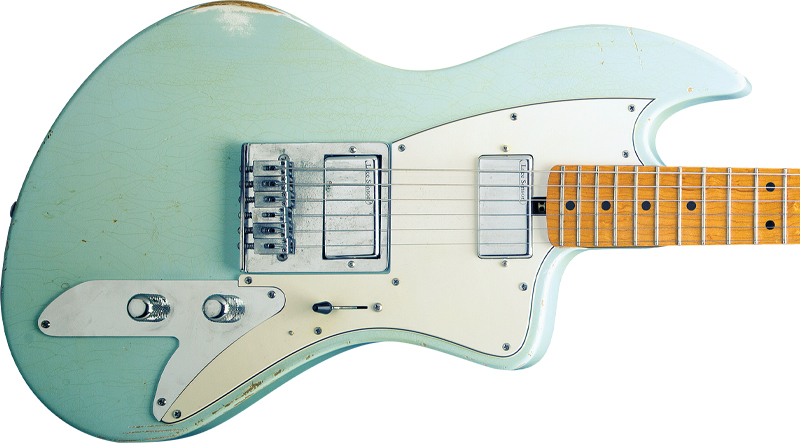
The mere name of Don Lace’s Cybercaster may set calloused fingertips to head-scratching. After all, “cyber” connotes cutting-edge, futuristic. How could that possibly jibe with “caster,” which implies beloved mid-century designs?
Truth be told, though, cutting-edge and retro go hand in hand on the sleek Cybercaster, which gives off a hint of Selmer on its treble side and a note of SG in the bass-side upper bouts. The entire lower bout is stretched into a distinctive ergonomic form with firmly rounded edges all around. A lightly relic’d nitrocellulose finish completes the effect, suggesting the Cybercaster is actually an early-’60s survivor.
The Cybercaster LS (Limited Series) is produced by Grover Jackson Guitars, Laguna Hills, California. Our Blue Relic tester was built with a two-piece swamp ash body; production models are korina, which the company says will produce a consistently lighter instrument. In addition, production models use a gold-foil logo on the maple headstock, as well as a push/pull potentiometer for splitting the humbucker coils.
The Cybercaster LS has a slab-sawn maple neck and birdseye-maple fingerboard topped with a distinctive headstock shape that’s somehow angular, but with curves. A 25.5″-scale neck includes large, well-dressed frets. Further, the neck and setup have been submitted to the Plek process to ensure a consistent setup.
Hardware is simple, combining Don Lace’s popular Hemi humbucker pickup with time-honored wiring – Volume knob, Tone knob with a simple capacitor, three-way selector switch, and a string-through adjustable bridge, all in chrome.
Hipshot locking tuners are mounted on the headstock, which does not require string trees, and experienced eyes will note the tightly fitted four-bolt neck joint – a crucial detail done right and indicative of the guitar’s build level. Equally distinctive are the design and fit of the chrome electronics plate and triple-layer aged-white pickguard.
The LS Blue Relic nitro finish is a popular ’60s color, lightly distressed, worn, and checked on the body, exhibiting “evidence” of playing time on the fingerboard and neck edges. It’s more than enough to vibe you back five or six decades to a time of classic guitar designs, that place from which the Cybercaster draws inspiration.
The Lace Sensor pickups are known for full-range response and quiet performance, and plugged into a small solidstate amp, they shimmered with an acoustic sound belied only by the lengthy sustain. With the Tone control dialed back, the neck pickup sounded round and fat. Hang a picture of an ES-175 in front of it, and go knock off some jazz gigs!
With effects pedals and a popular small tube combo with a single 12″ speaker, the Hemis and the Cybercaster worked together to achieve a clean, chiming chorus/delay sound. Pushing the gain envelope with a variety of OD boxes really brought out the sonic character of each pedal, as the pickups’ transparency let the pedal color the sound, with plenty of gain to enhance that overdrive. The Tone control, with an ideal, smooth taper, proved a handy tool in tone-shaping, making the most out of the familiar wiring. The addition of push/pull coil tapping on production models should add yet another dimension of possibilities.
The popularity of effects pedals and the need for a quiet, responsive sound should be enough to draw attention to Don Lace’s Cybercaster. The timeless appreciation guitar freaks have for a fine modern build which captures that old-school allure might be enough to make it an instant classic.
This article originally appeared in VG March 2018 issue. All copyrights are by the author and Vintage Guitar magazine. Unauthorized replication or use is strictly prohibited.
Metallica emerged as the antithesis to corporate rock and the “hair metal” that dominated L.A.’s Sunset Strip in the ’80s. Proudly separated from that scene, the band often famously ventured from its home base in the Bay Area to inject SoCal with doses of real metal.
By the ’90s, the band stood alone as the only metal (thrash, not heavy!) band too big to be quelled by the grunge steamroll that crushed the genre. As power-pop and proto-punk then turned the tables, Metallica remained a force by holding tight to a musical M.O. that simultaneously reinforced its standing amongst loyal fans and brought new ones to the fold. In November of 2016, the band released Hardwired… to Self-Destruct, it’s 10th studio effort, first in eight years, and first on its own label. In testament to its staying power, the double disc set became the band’s sixth consecutive studio album to debut at #1 on Billboard’s Top 200 in the U.S. (it also reached the top spot in 56 other countries) and to date has sold more than three million copies.
Lyrically, Hardwired… is a mix of old-school Metallica in the way it calls to task the music industry and addresses drug addiction. In other ways, it’s topical, as with “Dream No More,” an ode to original bassist Cliff Burton, and “Murder One,” written in honor of late Motorhead singer/bassist Lemmy Kilmister. For better or worse, the disc drew a lot of critical comparison to the band’s early work, a fact (sort of) bemoaned by guitarist Kirk Hammett.
“There was a lot of comparing Hardwired to Ride the Lightning and the ‘black album’,” he said. “But I realized long ago that people see and hear things the way they want. You make an album, put it out, and don’t try to predict what people are gonna say. Hope for the best, but brace yourself.”
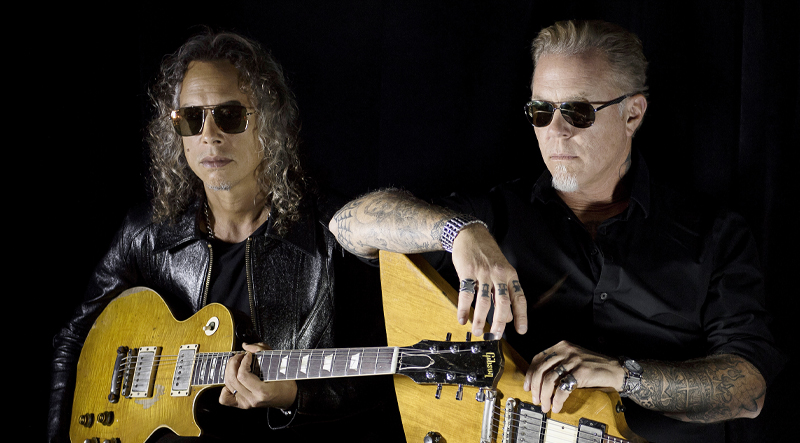
We spoke with Hammett and frontman James Hetfield during the first half of Metallica’s European tour, which will resume in February and where, night after night, they stage two of the most valuable guitars on planet Earth.
Hammett onstage with Greeny. Photo by Jeff Yeager.
Kirk Hammett
What first drew your attention to a guitar?
Seeing a documentary about Jimi Hendrix, where he sits on a stool, playing a Zemaitis 12-string, I decided, “That’s it. I’m getting a guitar.” (Ed. Note: the 1973 film was titled Jimi Hendrix and the guitar is now at the Rock and Roll Hall of Fame). I traded $10 and a Kiss album to a friend for a Montgomery Ward guitar with an amp that was the size of a jukebox. I was on my way (laughs).
What were your first licks?
I tried to pick out bits and pieces of solos by Hendrix, Jimmy Page, and Jeff Beck – the simpler, more melodic stuff. The very first song I learned was “Purple Haze.” I picked out parts of Page solos from The Song Remains the Same because I was listening to it day in and day out. I learned a lot of the simpler Zeppelin riffs, like “Dazed and Confused” and “Communication Breakdown.”But from the get-go I was able to improvise. I’d only been playing for about two weeks when I formed a band with friends; one decided to play bass, another decided to sing, and we knew a guy who’d been playing drums for three or four years. I was always the lead player, even when I could barely play a song. Within the first couple months, we did 20-minute versions of “Purple Haze” with me in the middle trying to come up with some sort of solo; I’m sure it sounded like garbage. Thankfully, no one recorded it!
Were there influences beyond Hendrix, Page, and Beck?
Yeah, my main influences are mostly British and German guys – Michael Schenker and Uli Roth – and American guys like Ronnie Montrose, Pat Travers, Eddie Van Halen, and the guys from Aerosmith. I gravitated to anything that had a lot of energy and aggression and heaviness. I remember listening to the radio one day and realizing I how much liked loud drums, heavy guitar, power chords, and riffs. And I didn’t like that Talking Heads s**t (laughs). Hard rock felt best deep inside my soul. It was fun, it was exciting, it kept my interest. I wanted to explore it, and I had something of a vision. Looking back, I’m surprised at how many decisions I made, as a 15-year-old kid, that ended up being right for me.
Were you into gear at the time?
Always – even when I couldn’t afford any. A friend and I would hang out at Guitar Center, pretending we were checking out guitars but really we were waiting for cool players to come in so we could watch ’em. I’d go to the counter and look at effects, thinking, “One of these days…” I remember having $50 to my name, and I used it to buy a wah pedal. That set me on a course. I discovered the Tube Screamer when I was 16, and I lusted after Marshall amps and Flying V guitars. When I began to buy better gear, the first thing I got was a Flying V and a Marshall half-stack, which I bought with money from washing dishes at a country club.
What year was the V?
’78 or ’79. I was aware of what was out there because I used to read guitar magazines cover to cover. That’s how I became aware of active pickups; I got a DiMarzio Super 2 and decided,“Wow, pickups are where it’s at, man. That’s where we can get a heavier, more aggressive sound.” I also saw an ad for EMG pickups, and as soon as I get enough money, in late 1984 I put them in my Flying V. It was like a new guitar. I couldn’t believe it.
When we got signed to Electra and they gave us a bit of an advance to buy better gear, the first thing James and I did was go to Mesa-Boogie. The newest amp they had was the Mark IIC. The combination of EMG pickups and Mesa amps solidified the Metallica guitar sound on albums from Master of Puppets on.
You eventually became one of the higher-profile “superstrat” players…
Being way into Beck and Hendrix, I first got a Japanese Strat, but I struggled with the single-coil sound. So, I put an EMG double-coil in it, and it was great. I entertained the idea of routing it for a humbucker in the neck position, but then a friend said, “Check out these guys at ESP, they’ll build whatever you want.”
So I went for a Strat shape, two humbuckers, and a neck-through because Les Claypool was always going on about how great his Warwick bass was because it was neck-through. I asked ESP, “Can I get a neck-through with two EMGs and a Floyd Rose?” They said, “Sure.” We did a few other changes like neck dimensions.
Greeny: Bill Glassner/VG Archive and Jeff Yeager (headstock). Greeny’s twice-repaired headstock.
How long after did your love of monster movies merge with a guitar?
When I asked ESP for a skull-and-crossbones fretboard inlay at a time hardly anyone was doing that. Later, when ESP added a custom shop in ’94or ’95, they asked if I wanted to do more crazy stuff. So I had them put different graphics on my guitars, and they built a few wacky ones like one with a Theremin in it, and the Wavecaster has a plexiglass body filled with blue oil to make it look like the ocean.
When did the first “monster” guitar happen?
I’d been into monster movies and horror since I was five or six years old, and while working with ESP, I acquired this incredible poster for the 1932 film The Mummy. So I took a bunch of pictures of it, cut them up, taped them to a blank guitar body, and sent a picture to ESP asking, “Can you do this?” It took them a year or so, but it was breathtaking. And it just so happened the elements came together in that guitar – the neck had the third set of dimensions I gave ESP for the KH neck, which is probably the best version. I loved the way it looked, and when I plugged it in, it sounded better than a lot of my other guitars. ESP hit it out of the park with The Mummy, which opened the gates for a bunch more. And we’re still making ’em, man.
Was there a point where you went from being a guy with a lot of guitars to having a collection?
I’ve been “collecting” guitars since ’88 or ’89, and it started with a trip to Pete’s Guitars, in Minneapolis. Pete Alenov was a good friend, and every time we were there, I’d leave with the greatest stuff. I love old Strats, old Teles, old Les Pauls, Flying Vs, Explorers, ES-335s, 295s, Super 400s and acoustics like J-45s and Martin D-18s and 28s.
You’ve been touring with a pretty special Les Paul…
Yeah, the Peter Green/Gary Moore guitar. Greeny found me… a dealer in England called and said, “Hey I got this guitar.” And I said, “Bring it over.” I plugged it in, and it sounded incredible. So we worked a deal. I’ve been collecting Les Paul Standards for a while and have five or six of ’em; I’ve been playing ’em in the studio since Load and Reload.
Word is you enjoy letting guitar players who know the story of the guitar sit and play it.
Yeah, anyone who knows what that guitar is can play it. If you’re a fan of Peter Green or Gary Moore, I’ll say, “Hey, check this out!” and let them sit with it for a half-hour. Play their guts out. It’s an amazingly cathartic instrument, almost like f***ing Excalibur, man. It brings out the best in anyone who plays it. I just crack a smile; I can’t help it because I know they’re experiencing something they’ll never forget.
Peter Green with the ’Burst in the late ’60s. Photo: Tony Gale/Pictorial Press.
What are some other highlights from the collection?
Uh, I have some really crazy Strats. One of my favorites is a ’64 in Sea Foam Green that I thought I might’ve lost in the Sonoma-Napa fires. But I was lucky enough to evacuate with it.
Did you lose any gear in those fires?
No, thankfully the fire stopped at my front gate – literally.
Whoa. Anyway, you were saying….
Yeah. I love L-series Strats with rosewood fretboards and maple necks. I also really dig ’56 Strats because of the neck – it has a V shape, but not exaggerated. I love transitional Strats from ’66/’67 because they had some crazy colors. I have a korina Strat.
There’s only a handful of those. What was the first piece you paid crazy collector prices for?
The Sea Foam Green Strat; I paid $3,000 for it in 1991, which was a f***in’lotof money, man (laughs)! But I’m never gonna sell that thing, and I’ve been offered six figures for it.
Have you ever used it to record?
Yeah, I used it on the riff and solo on “Fuel.”
Are there other Metallica tracks on which we hear your vintage instruments?
I used a korina V on the solo for “Fixxxer,” on Reload. Most of the lead stuff on the new album, Hardwired, was done with Greeny ’cause it’s such an amazing lead-sound guitar. I played Les Paul Standards all over Load, Reload, St. Anger, Death Magnetic. I have a blond front-loader Tele that sounds amazing – ’57 or ’58 – and it’s all over Death Magnetic. I think it’s on Reload, as well.
I have a prototype V – the second or third ever made. It has a black pickguard and a hand-routed body, which is an indication it was a prototype because they didn’t use the routing machine because it wasn’t calibrated.
Where’d you find it?
A dealer in L.A. had been sitting on it for years. It sounds f***ing great. It’s amazing. I also have an old Explorer… I just had to ’cause I’m a “collector.” (laughs)
Speaking of ’58 Explorers, did you help James get his?
Well, the guy I got my Explorer from had three or four of them. I said to James, “Hey, this is the guy.” And of course James knows a good opportunity when he sees it. So he left with it. We both have “the pair” of korinas – a korina Explorer and a V. That’s what we like to call them. He has a pair, I have a pair. I might have two Korina Vs, I’m not sure (laughs).
You know how ridiculous that sounds, right?
But check this out, though; I’d wanted a korina V back in 1978, when I’d only been playing for six months. That price tag of $2,500 was unreachable then. But now… oh, boy.
Has James always been into gear?
Yeah, he’s always had an interest in vintage guitars and recognized how cool they are. It’s hard not to be when you’re a dedicated player.
Were you with him when he got the ’58 Explorer?
Yeah, the guy brought it to a gig, and usually when people bring guitars to gigs, him and I go off in the corner and have a discussion to see what angles we can use to work a deal.
How does his collection compare to yours?
He collects different Fenders; I collect more Strats, he’s more into Teles and whatnot. But we both love Les Pauls, Flying Vs, Explorers. I love ’60s Explorers. I think they’re amazing-sounding instruments. I love the nickel parts on ’em; they remind me of my friends hot-rod toys growing up. When I look at that Flying V, it takes me back. I love Medallion Vs and I have a Medallion Firebird, which is pretty rare.
So, you’ve been taking Greeny out on the road, but how much do you use it?
Just for special songs.
It’s led an interesting life…
Yeah, its neck has been broken twice and the repair was brutal. I was looking at it one day and asked a friend, “Should I do anything about this?” They were like, “No, don’t touch it! It’s part of the allure, part of the legend.”
Where is the break?
Right at the head. It was broken first when Gary Moore’s car got rear-ended while it was in the trunk. The second time, it might’ve just fallen or whatever. But it stays in tune and sounds killer. And you know, so what if it was broken twice? It still is what it is.
J. Hetfield’s ’58 Explorer: Ray Masterson. Hetfield with the ’58.
James Hetfield
How did you get into the guitar?
My brothers. I have two older half-brothers and there were always instruments around the house. One was messing around with the guitar and the other was playing drums in a band. They were doing cover stuff from the early ’70s, late ’60s – Hendrix, Jefferson Airplane, “Born to Be Wild.” I’d hang out when they practiced in the garage, and just loved the sounds and the smell of amplifiers when they got hot. There was also the fact they were sneaking into the garage after our parents told them, “While we’re away, do not practice in the garage.” But of course they did. There was an attraction with the rebelliousness. It just felt cool.
Outside of the garage, what were you listening to?
I’d constantly raid my brother’s record collection. There was Beatles, Jethro Tull, Black Sabbath, Love, and things like that. But I gravitated to Sabbath. I’d sit and look at album covers, and the riffs would scare me a little. It was awesome… the sound. I liked the heavier, riff-based stuff.
Do you remember the first time you picked up a guitar and tried to play something?
I do. It was a terrible acoustic that sat around the house. I’d pluck on it even before I knew to press on the fretboard to make a note; “How do they do this?” But watching my brother’s band or seeing a picture of someone with a guitar, it was like, “Oh, he’s making shapes…”
Did you start learning riffs on it?
Yes. My buddy in junior high had an acoustic, too, and we started learning around the same time. We’d show up with new knowledge; “Hey look at this.” We were learning from and trying to be better than each other, which was a very good, healthy competition.
What was your first electric guitar?
I had a swap-meet special – five bucks for this off-brand with a log neck and action that was half an inch high. It was near impossible to play, and I painted it probably 10 times; at some point it even had Van Halen stripes. But the shape just wasn’t cool, so I convinced my mom to buy a ’68 SG being sold by a guy in the Downey High jazz band. I’d gotten into AC/DC by then, and thought the SG was what I needed – a real guitar. So, she fronted me the $200.
Were you playing in a band by then?
Yeah. I think it was my sophomore year of high school. We had a band called Obsession, and played probably 40 cover songs – Black Sabbath to Led Zeppelin to Deep Purple, Robin Trower, Cream, Thin Lizzy. We played three or four high school parties.
What amps did you use?
My brother had a Sears Silvertone that I “procured.” He and I built a speaker cab for it – I wanted something tall and big, and we recovered the Silvertone. Of course I wish I still had that amp and that we hadn’t re-covered it (laughs), but the first real amp I put money down on was a Peavey Deuce. It was cool – had a footswitch so I could pretend I was soloing. Really, it just made me louder than everyone else.
Was the SG still around when Metallica formed?
It was not. I wish it had been, but when I was 16, my mother passed away and I was uprooted. I had to move in with my brother, change schools, and be away from all my friends. It was brutal. But I thought, “I love music. Here’s a chance to meet new people and form a band. Everywhere I looked, everyone was looking for a singer, so I thought I had a better chance getting into a band if I was singing. So, I traded the SG for a giant P.A. and a Carvin mixer that I kept in my tiny, tiny bedroom. I flipped it back and forth between singing or playing guitar depending on who needed what in a band. No one was a good enough singer or no one was a rhythm-guitar player, so I ended up doing both anyway.
When Metallica formed, what were you playing?
An Electra Flying V – made in Asia and with a bolt-on neck. All I cared about was that Michael Schenker played a V, and I wanted to be Michael Schenker. I painted it white.
Were you playing a Marshall amp at the time?
Yeah, and I’m not sure where the head came from; I saved for it or had some inheritance. I bought a Marshall cabinet from George Lynch. I didn’t know who he was, but he was advertising it, so I picked it up at his studio in Hollywood. I had a half-stack and my Flying V, so I was pretty happy.
As Metallica gained momentum, superstrats were becoming popular, but you never got into them.
Strats were never my thing. They were more for lead players. Plus, Schenker didn’t have one! The whole Charvel thing was the big deal at the time, and all these L.A. bands were playing them. That was not my scene. Later, I ended up playing a Jackson V, which was one of my first backups. The V and the Explorer shapes interested me. The V was nice and punchy for fast songs and the harmony stuff we were doing. But the Strat, to me, wasn’t a cool-enough shape. Plus, everyone had one.
When did your first Explorer come along?
I saw a couple of bands in the Bay Area playing them. I loved the shape, and when I finally played one it fit my body really well. I could play it sitting down or standing up, and it balanced nicely. I also loved the hockey-stick headstock. The first was an ’80s model with a black headstock and white body.
Were you like Kirk, replacing pickups right away?
Yeah, and I tried many pickups up in that V – Bill Lawrence to DiMarzios. I think I ended up with Super Distortions. Then, we met Matt from ESP and told him I was interested in an Explorer with a bigger headstock. They were very open to making it, and I started getting more into all the things I could modify. EMG pickups were just coming out, and Mesa Boogie amps. All of this stuff started to come together in developing our sound.
The first guitar ESP made for me was the So What?. I loved it, and it went from my backup into the number one slot really quick.
Was this around the time of Ride The Lightning?
The end of Ride the Lightning toward Master of Puppets. So ’85/’86.
And you now have a handful of signature models.
Yeah. I’ve always loved the Les Paul shape, as well, so we did the Truckster and the Iron Cross. I’ve since done the V-shaped Snakebite and Vulture with them. Those are the three that feel best on me.
Hammett, Hetfield 1991: William Hames/Atlasicons.com. Hammett and Hetfield in 1991, surrounded by early additions to their collections, including a ’50s Les Paul and Les Paul Custom, a Tele, a Gibson ES-295, a Danelectro Longhorn bass and 3021, a Coral Sitar, and two Gretsches – a double-cut Sparkle Jet and a White Falcon.
When did collectible/vintage guitars ping your radar?
Once we started having some money, we’d stop in cities and towns on tour and go, “What can we do here? Oh, let’s go to a guitar shop.” Then it became, “Hey, these guys got this guitar. Somebody’s got this.” And, people with guitars started showing up at our shows. At that point, I suppose I was collecting. Kirk was a lot more into it than I was, and it was him and [producer] Bob Rock who said, “Hey, you should get one.” I remember looking at my first ’59 Les Paul Standard and the guy said, “The prices on these are going to go up.” He was right. I got one for $25,000 and now it’s a lot more than that, obviously.
Were you focused on a particular brand or model?
My first interest was eclectic and weird, out-there stuff that no one else wanted. I liked the unique sounds of Kay guitars and other off-brands. Also, designer brands. I dove in.
There’s something magical about getting a guitar that’s new to you, even though it’s vintage. There’s something in a guitar that speaks to you or still has riffs. I put human emotions into it and get human emotions out of it. When I see an old car sitting in a field, I think, “Yeah, maybe it served its purpose, but it still wants to run.” A guitar wants to play – there are riffs in it. The excitement of playing it… there’s an energy that riffs come out of. I love playing a vintage guitar through an amp for the first time. Something comes alive with it.
You mentioned designer brands. Do you remember the first time you saw an old Zemaitis?
I think it was Keith Richards playing one. I really love artistry – tattoos, scroll work, patterns, Western scrolling, When I saw on one of the Zemaitis V copies, I had to look into it. I eventually got an old one and a new [GZV 500 MF] that Danny O’Brien engraved for me with designs from my tattoos. It’s really, really cool.
How about other vintage models?
I have five ’59s and one ’60 Les Paul Standard, I’ve got a few ’57s. I’ve got a black three-pickup, a korina V from ’58 that matches the Explorer. I also have a Veleno and a few other unique guitars that I really love. I’ve got a really cool collection of Vs and recently found one in Silver Sky Metallic, which was pretty difficult.
How did you find the ’58 Explorer you have on tour?
I’d been looking for one for quite a while. A friend who sets up our guitars and finds stuff for us said, “Hey, there’s this pair available – ’58 V and Explorer. Are you interested?” I had my guy go look over them with a fine-toothed comb and flashlight. It was no-brainer. It was not the cheapest set I’ve ever bought, but it’s very worth it.
What made you decide it was okay to take it on tour?
Once Kirk started bringing Greeny out on the road, that inspired me to bring the Explorer. Also, going to see Queen; Brian May is a wonderful guy and we were talking backstage when his roadie walked past with a guitar on his back. I said, “Hey, what’s that?” He was like, “That’s the old boy.” It was the guitar that he and his dad built – out on tour. I thought, “Hell, if he can have that out, I can bring the Explorer.” Why not?
This article originally appeared in VG March 2018 issue. All copyrights are by the author and Vintage Guitar magazine. Unauthorized replication or use is strictly prohibited.
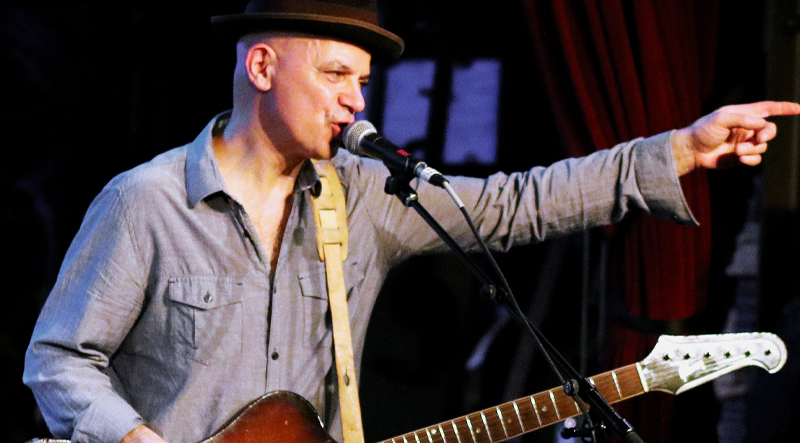
As one of the guitarists in Ian Hunter’s Rant Band for the past 17 years, James Mastro is responsible for providing some of the texture that gives the legendary singer’s songs depth and definition. • “James is a thinking guitarist,” says Hunter. “By that I mean he colors beautifully. Boschie (Mark Bosch, Vintage Guitar, October ’16) can do things Mastro can’t, but Boschie can’t do what James does. It’s an ideal combination. Mark is a great organizer and an ultra-decent chap with a great sense of humor.
Mastro ’78 courtesy of J. Mastro. Mastro in 1978.
He’s been with me for 17 years; can’t imagine life without him. Of course, I have to say all this or he’d fire me.”
VG caught up to the guitarist to discuss a career that began with Television’s Richard Lloyd in the ’70s through his time with The Bongos and includes the past 20 years as owner of The Guitar Bar, in Hoboken, New Jersey, which has helped him find very cool instruments.
With The Bongos, you released two major-label albums and toured constantly in the ’80s. What was it like in the days of MTV?
That was a great experience. Being in my early 20s, traveling the country with your best friends playing music every night… you couldn’t ask for better. Playing with Richard Lloyd prior to that set the groundwork. We didn’t tour as extensively, but we were playing all the time and that was an amazing education for a 17-/18-year-old. I was in high school at the time and lived about an hour west of New York City, so we’d play CBGBs or Max’s and I’d get out of there at 3 a.m. then get home just in time to go to class (laughs).
Instrument/amp photos by Dennis DiBrizzi. (LEFT) Mastro users this ‘60s Zim-Gar six-string bass for baritone parts. (RIGHT) This ’73 Strat has been Mastro’s constant companion for 40 years.
How do you and Mark decide who’s going to play what?
Mark is primarily the lead player, and he’s amazing. I consider myself part of the rhythm section, so I try to create backdrops that are hooks and fit the emotional and lyrical content of the song. It’s not quantity of notes, but quality. Creating parts is all about listening to what the other person’s doing and not treading on each other. If he’s going high, I’m going to stay low, and vice versa.
(LEFT) This mid-’70s Tele Custom makes appearances with The Rant Band. (RIGHT) Mastro’s ’65 Jaguar.
How do you add texture without clutter?
I approach parts in terms of what’s going to work best for the song. If that means playing one note for four minutes, I’m okay with that. Having five or six people in the band is like having five or six painters. If all are using the color green, it’s going to be a boring painting. I approach the song as I hear it produced in my head. Part of that comes from locking myself in my room as a kid and really listening to records, hearing all the little parts in the background that made that music special to me, reading the liner notes to see what instruments were played. What’s a Mellotron? What’s a Nashville-tuned guitar?
Mastro’s amp collection includes two favorites – a ’68 Princeton Reverb (TOP LEFT) and ’67 Ampeg Reverberocket (CENTER).
Who were some of your influences in those days?
Mott the Hoople was my favorite band as a kid… and Bowie; Mick Ronson and Mick Ralphs were all about tone and melody mixed with chaos. From a guitar-playing perspective, Television had a huge effect on me – two guitars playing totally different, angular parts like gears that mesh perfectly, very clear and audible. I loved Eno’s “Here Come the Warm Jets” because there are so many textures. To this day, I listen to it once or twice a week and I’ll hear something I’d never heard before. Phil Manzanera and Robert Fripp are also that great blend of melody and chaos.
Here are his ever-changing pedalboard for live work.’65 Gibson Firebird III – a rare example with reverse body and non-reverse headstock.
How do you use pedals?
I’m a pedal junkie, and I’m jealous of people who do not use pedals (laughs). Even in what someone considers the worst pedal, there’s something good. It goes back to what’s going to make a song different, and the proper effect to bring that out. Part of it is having that library of new and old records in my head, the sounds on them, and being able to pull that up and relate those sounds to a new song. It’s all about frequencies, too. If there’s a part that’s up high, I think “What’s going to put a nice bed underneath it?”
“Dandy,” off Ian’s new record, is an example of that. Everyone had great parts when we went to record and I was thinking, “I don’t need to do much here.” But then it hit me that there could be this weird little high thing going on. Most people think it’s a Theremin or keyboard, but it’s me on guitar with a Electro-Harmonix POG. As soon as Ian heard it, he said, “It’s perfect.” It’s subtle, but if it makes the song better I don’t care if people think “Oh, he’s not shredding.”
For recording, an old Foxx Tone Machine octave fuzz never ceases to be the right ingredient. Also, an original tube Echoplex and an Tel-Ray Variable Delay also get a lot of use. The Boss PS-2 Pitch Shifter/Delay is also a fave of mine – just so many crazy sounds in one pedal. For wah, I have an old Musonic that looks like Herman Munster’s shoe that has a unique sweep and is very expressive. Another cool old pedal is the original Ibanez Flying Pan, an incredibly versatile device I like to use to record effects in stereo. The Digitech Space Station is just too great to not carry around, as I always find something to use in the bank of sounds. Other cool effects are the Multivox Little David Leslie simulator, the Maestro Rhythm & Sound, which triggers brushes, claves, tambourine, and has some crazy tone filters. Also, a fuzz bass is always at hand!
Live, the Strymon El Capistan is exceptional, and I’ve started using the Supro Drive, which is killer. The pedal that I’m never without is the E-H POG 2, which I use more than I ever thought I would. From organ sounds to baritone, 12-string, Mellotron-type stuff, and more, and it is worth every penny.
Mastro’s favored acoustics are this (LEFT to RIGHT) ’65 Guild F-30, ’79 Guild F-50 and a mid-‘30s National Trojan Resonator.’67 Goya T-23
How did you build that sonic framework for Ian’s “Soap and Water?”
That was my ’73 Strat and my ’60 Gretsch Double Anniversary for the baritone-sounding part. Ian and (producer) Andy York sent me the track, and right away I started hearing a few parts; I had an idea of where it should go. I’m all about the hook, and want people to sing the guitar part as well as the lyric. You want everything to be memorable.
One of the rarest instruments you own is your vintage Gibson Firebird III.
Well, one of the advantages… or disadvantages (laughs) of owning a guitar shop is that I am my best customer. The Firebird came in as a single-owner ’65 and his family brought it in. It needed work, but as soon as I picked it up, the weight was right and it resonated beautifully. I love the way it sits. There’s something about mahogany-body Gibsons from that period that makes them incredible, and it’s one of the most special-sounding guitars I’ve ever played. Those mini-humbuckers are so unique – they cut through, but also sit well in a track. So, it’s incredibly versatile. Unique to this guitar is that the headstock is non-reverse. I researched it and found that Gibson didn’t make many.
Mastro in the early ’80s, rocking a blond ES-330 with The Bongos.
Another guitar you play with Ian has P-90s and a Bigsby.
That’s a Hanson Cigno, made in Chicago by the same guys who make Lakland basses. I stumbled on it while playing with Patti Smith; I’d taken my ’65 Jaguar for that show and the airline lost it! While waiting for it to show up, I called my friend Nick Tremulis and told him I had no guitar. He said, “I have a friend who owns a guitar company.” So, John Pirruccello, who owns Hanson and Lakland, came to the venue with one of his guitars, and I used it for the show. It was incredible – one of the most versatile guitars I ever played, and it had a fat neck like an old Gibson. I keep going back to it for Rant Band shows.
(LEFT to RIGHT) Mastro played this 1960 Gretsch Double Anniversary for the baritone part on Ian Hunter’s “Soap and Water.” This ’65 Harmony H-74 and Rickenbacker 370/12 help Mastro add rhythm textures.
Speaking of, how do you go about picking guitars for the stage?
It varies with the artist. The guitar I’ll use with Ian is not necessarily the one I’ll use with Garland Jeffreys, John Cale, or Ed Rogers. It goes back to what’s going to work for the song and voice well with other instruments. Even the venue; is the room boomy or bright. The Hanson has worked well with Ian, though I’ve started to use one of the new Supros, as well, which I love. They have a glassiness that cuts through a mix of the two keyboard players and Mark. For Megan Reilly or Karyn Kuhl, something more dreamy is required, so I might use the Jaguar or Gretsch. Plus, it helps me justify keeping all these guitars (laughs).
Do you use a similar variety of amps?
I’ve got a ton of vintage amps, but my go-to for smaller gigs around New York City is a ’68 Princeton Reverb, which is an all-around great amp. I’ve recently started using the Supro Black Magic with Ian and it has really impressed me. Those are the two for around town. For recording, my Magnatone M15 and ’67 Ampeg Reverberocket are pure tone. You can’t beat the Magnatone’s reverb and vibrato or the Ampeg’s tremolo.
Mastro’s primary stage guitars with the Rant Band are this Supro Coronado II and Hanson Cigno.
Do you consider yourself a collector?
My wife will tell you that I’m definitely a collector (laughs). But, if I’m not using something for awhile, I will get rid of it. I use most of the things I have now.
Take us through some of the unique guitars in your collection…
I stumbled across a Guitar Center limited edition Les Paul 1960 reissue, and as soon as picked it up the wood felt right. I don’t have huge finger vibrato, so I added a Bigsby. It’s just a great guitar – perfect for that classic-rock tone.
There’s also a ’60s Zim-Gar six-string bass I got from Tom Verlaine, which is strung as a baritone. It’s an incredible instrument and I’ve used it more than I ever imagined. It’s got that “handle” that would emerge later on the Ibanez Steve Vai guitars. Sonically, it’s in a frequency that sits well with the track.
Another cool Japanese guitar is a Norma I used on Ian’s latest record. It is a short-scale and you can’t get much past the 12th fret, so you can’t hot-dog on it, but it’s a fun guitar with a unique tone, and it makes you play different. Certain guitars just inspire you to play different things.
My ’65 Jag came into Guitar Bar about 10 years ago. It’s a single-owner and the guy played in a local funk band in the ’60s and ’70s. It had all the sweat and mojo already. Until then, I’d never found a Jaguar I liked, but this is probably the most-versatile guitar I have, and use most for sessions and local gigs.
I have a great ’73 Strat in original Candy Apple Red; I bought it when I worked at We Buy Guitars on 48th Street in ’79. I wanted it so bad, but couldn’t afford the $300. A customer even put a deposit on it after I showed him everythingelse and tried talking him out of it. Every week, he came in and put more money down – a dagger in my heart each time. He was one payment from taking it home, and came in and told the boss he couldn’t afford it. As soon as he walked out, I told my boss to keep my salary until it was paid off! It’s the guitar I used on all The Bongos’ records, and now I mostly use it for sessions where I am doing leads or slide.
Mastro used this ’60s Norma on Ian Hunter’s latest record, Fingers Crossed.
What’s next?
I’m be going out with a singer/songwriter from Norway named Numa Edema, and we’re doing six weeks opening for Stephen Stills and Judy Collins. I’m looking forward to it, as I’ll be the only guitar player, so I’ll be orchestrating parts and sounds for the two of us to fill big rooms. A challenge for sure, but that’s what keeps it exciting.
This article originally appeared in VG March 2018 issue. All copyrights are by the author and Vintage Guitar magazine. Unauthorized replication or use is strictly prohibited.
In the late 1970s, trends combined to spawn several new guitar companies in the Chicago area motivated by a desire to “build a better Gibson.” The list included Dean and Hamer, both of which impressed players with their high degree of hand-crafted detail. To that fraternity should be added Silver Street guitars.
Bruce Hardy today with one of the Taxi prototypes, and in the ’80s with an early production Taxi.
At the time, many guitarists perceived a degradation in the quality of Gibson instruments in the wake of a change of ownership from Chicago Musical Instruments (CMI) to the Panamanian conglomerate Norlin, Inc. Real or not, the attitudes created opportunities for ambitious young makers like Dean Zelinsky, Jol Dantzig, and Bruce and Craig Hardy, of Elkhart, Indiana.
The Elkhart Beat
Silver Street began life in ’79, when Bruce Hardy set out to build a better drum kit. Born in ’48, Hardy’s musical path began with piano lessons as a kid. The Beatles’ appearance on “The Ed Sullivan Show” changed him and, like millions of other Babyboomers, he grabbed a guitar and played in bands through high school, college, and into adulthood when he returned to Elkhart.
At the time, it was common among drummers to stuff things into their drums to “muffle” the tone to give a deeper, more controlled sound. Hardy’s drummer neighbor stuffed his with pieces of foam rubber. At the time, Hardy worked installing carpet at an RV factory, and had an idea to improve the setup; he brought foam rubber from work and – without permission and to his neighbor’s great astonishment – glued it underneath the heads of his drums. It worked well and the concept would evolve to become Silver Street’s first commercial product – the Deadringer drum muffler, for which Hardy received a patent.
Hardy had a fertile mind when it came to developing musical products; he was ultimately granted 10 patents for various guitar and drum-related pieces, but relied on business expertise provided by his brother, Craig, who operated several small businesses near their boyhood hometown of Shelby, Michigan. In June, 1981, Silver Street Incorporated (named for the street Bruce lived on in Elkhart) was formed to handle manufacturing and marketing of Bruce’s musical inventions, and before long, electric-guitar designs.
Other Silver Street products eventually included the Pick-Clip, Cable-Clip, the Headmaster (a plastic tray to safely hold snacks and drinks on an amp), and other, mostly drum-related accessories. Silver Street got a boost from pickup guru Larry DiMarzio, who gave them access to his independent sales reps and allowed them to put product sheets in their binders.
A Taxi prototype in suitable yellow, along with a Cobra and a Spitfire.
Hail a Cab
Silver Street’s move to guitar production was the result of a trip to the Musik Messe trade show in Germany, where in June of ’81 they displayed accessories. Among the products Bruce encountered were increasingly popular small guitars like the Steinberger and the Chiquita travel guitar. Bruce imagined a guitar that would make it easier for big-city musicians to carry in a taxicab. He conceived it having a full-scale neck on a compact body, and on the flight home sketched ideas that led to a model called the Taxi.
In 1981, Gibson was nearly finished relocating from its longtime home in Kalamazoo, Michigan, to Nashville. While Nashville was emerging as “Music City,” the move also reflected a broader move by manufacturers from unionized Northern states to “right to work” states where joining a union was not required and labor costs were substantially lower.
The Taxi’s gig bag – highly portable, by design.
On Your Mark
In ’81, Hardy drove to Kalamazoo, where he met with J.P. Moats and Marv Land, Gibson employees who later stayed in Kalamazoo to found Heritage Guitars. They introduced Hardy to Jim Deurloo, manager of Gibson’s wood shop who in turn put him in touch with Richard Schneider, a luthier who in the mid ’70s worked with Michael Kasha to produce Gibson’s radical Mark Series acoustics. Schneider agreed to build four prototype Taxi guitars along with one bass. They were completed in ’82 and had Gibson-style “sandwich” bodies with two pieces of wood pancaked over a thin, dark slice in the center. The necks were shaped like a Les Paul’s and had rosewood fingerboards; the earliest even had a volute. Headstocks were given a distinct, small shape. Bruce had a friend named Marty (who airbrushed conversion vans) finish the guitars in a bright yellow, the bass in red. Hardy wired the prototypes the night before the ’82 Summer NAMM show, in Chicago. Pickups were DiMarzio Super Distortion Dual Sounds. Tailpieces were Leo Quan BadAss units. The guitars were well-received, and after the show, Hardy ordered 50 Taxi necks and bodies from Gibson.
Silver Street built two Cobras for Quarterflash guitarist Jack Charles, one in Candy Apple Red, the other, White Pearl (below). The first was delivered just in time for the band’s appearance on “Solid Gold.” “It was set up great and was extremely comfortable to play, even though the design might suggest otherwise,” he said. “It had a lot of sustain, and was punchy!” He continued to use them in his solo project, Mien Street. Today, he heads Phantom Guitarworks.
Silver Street eventually employed as many as a dozen people at its Elkhart factory. Bruce continued to supervise manufacturing and design new models – Taxis with one or two pickups, the offset double-cut Spitfire, and the triangular Cobra. All were distinguished by near-complete treble access to the fingerboard and a 24.5″ scale. The majority of fingerboards had dot inlays offset to the bass edge like Gretsch thumbnails or Teisco’s bars, though they also offered other patterns. Bridges/tailpieces transitioned to Schaller assemblies. Early models had serial numbers stamped inside the neck pocket, and control cavities shielded with lead foil. Later models had a serial number on the back of the headstock and black shielding paint in the cavities. Single-pickup models had a coil tap, one Volume and one Tone. Where applicable, they were given three-position switch.
Rainbow Coalition
Silver Street offered a number of options and many players requested custom features, so there was very little consistency. Pickups could be DiMarzio Super II, P.A.F., or Super Distortion in any combination, with X2N units for an upcharge. The buyer could even select bobbin colors; Bruce and Marty did the painting. Standard controls were master Volume, master Tone, and three-way select, though electronics could also be customized. Standard colors included Roadster Red, White, Sky Blue, Rude Pink, Yellow, Turquoise, Porsche Red, and Black. For a little extra, you could get Champagne, Dark Blue, Mercedes Red, Silver, Dark Green, Steel Blue, Gold, Candy Apple Red, Candy Apple Blue, Rose Pearl, White Pearl, Blue Pearl, or natural. Flame-maple bodies were an option, as were custom finishes. In ’83, base prices for the Taxi were $549.95 (one-pickup) and $599.95 (two-pickup), $699.95 for the Spitfire and Cobra.
Things were going so well that Silver Street acquired equipment for making its own necks and fingerboards.
In ’83, Bruce began working on the MX, a hybrid V/Explorer that had more than a little similarity to Dean’s ML, and (with input from artist relations rep Ken Willard, who’d also spent time in the company workshop, and Styx guitarist Tommy Shaw) the Nightwing, an offset double-cut with asymmetrical “French curve” on the lower bout.
Bruce was putting in long hours and continued to devise ideas for new accessories. Silver Street, however, had its hands full and Craig chose not to expand its line. Tension over the situation came to a head in mid ’83, and Bruce promptly exited.
North to Shelby
In many circumstances, the loss of its main product designer might have meant the end for a guitar company. However, Craig Hardy was sitting on a stash of components, an investment in tooling, and business interests in Shelby, Michigan. One of his companies made artificial gemstones and another was a machine shop. So, in mid ’83, construction began on a new building while parts and equipment were shipped from Elkhart. Ads were placed in local newspapers seeking a spray painter. One person who saw the ad was the sister of former Shelby resident Dan Mustard, who in ’83 was working as a house painter in Kentucky. Mustard applied and one of his references was a friend who knew Craig. Mustard was offered a job before the new factory was finished.
Shipping of parts from Indiana was not the final association between Silver Street and Gibson. By ’83, Gibson’s move to Nashville was almost complete, and those who chose to remain in Kalamazoo became the core of Heritage. Some became consultants, including Charlie Garrison, head of Gibson’s finishing department for nearly 40 years. Garrison spent a month or two schooling Silver Street’s new finisher in the art of applying nitrocellulose lacquer.
“Those are fun guitars,” Tommy Shaw said of his signature model (above, left). “I still play the custom TS model shown on the back cover of my 1987 solo album, Ambition, and I used a red short-scale one when Styx headlined the Texas Jam in ’83. I later gave that one to Sammy Hagar, who was also on the bill on that day.” Bruce Hardy designed the Nightwing (middle) with input from Tommy Shaw and artist relations rep Ken Willard. A prototype Taxi bass (right).
The Les Paul Vibe
Mustard was in awe of his new mentor.
“There’s a very good reason why Silver Street guitars, especially the sunbursts, have lots of Les Paul vibe – Charlie Garrison,” said Mustard. “Charlie taught me it’s not just putting on the lacquer; wet-sanding and buffing are the hard parts. It only takes a second of too much pressure to ruin a finish! Nitrocellulose finishes helped put Silver Street on the map because so many companies were switching to polyurethane at that time.”
While many Gibson-made parts were used, the new factory was outfitted with state-of-the-art equipment including pin routers and cutting machines just before CNC.
Silver Street benefitted from having access to local hardwoods direct from mills, and their own kilns.
“We also had Craig’s machine shop,” Mustard added. “Whenever we needed patterns or fixtures, they’d make them. So, we could build to very tight tolerances.”
When Gibson finally shut down in Kalamazoo, a lot of the equipment and materials were auctioned. Silver Street purchased an overhead sander and pallets of wood including mahogany and figured maple. Later, Silver Street got a contract from Brunswick to make bases for bowling trophies.
“A lot of that old wood ended up sitting under a trophy, which is kind of a shame,” Mustard said with a wry chuckle.
The company’s NAMM display and a flier handed out at the event (right).
Jolt of Voltt
The reincarnated Silver Street was much leaner than it had been in Elkhart, running with only three or four employees. Mustard did the painting, final assembly, and setup, while sales and marketing was handled by another young musician, Steven Voltt. It was Voltt who recruited artists to play Silver Streets, including Shaw. A picture of Shaw playing a Spitfire surfaced around the time he was going solo in ’84, so Voltt approached him, and the association led to Mustard designing two new models, the Tommy Shaw and the Elite.
Shaw preferred Gibson’s scale, but also liked Strats even if they were too large for him to play comfortably. His signature Silver Street became the perfect blend – a Gibson-style neck mounted on a down-sized Strat-like body with a pair of humbuckers. By this time, Silver Street was offering an optional Kahler or Floyd Rose locking vibrato.
The final Silver Street designed by Mustard was the Elite, in ’85.
“That was our attempt to make a Gibson-style guitar,” he said. “You can see it was inspired by a Les Paul Junior, with a set neck, and they were made with wood from the Gibson auction.”
The Elite evolved from symmetrical cutaways to a slightly offset shape and was given Schaller pickups in the then-popular humbucker/single/single configuration, with the de rigueur locking vibrato.
Along the way, they made two promotional guitars with bodies shaped like the state of Michigan.
Craig Chaquico (here in the ’80s with a Cobra) still digs his Silver Streets. “I remember how cool those guys were and how refreshing it was to talk to people who understood the needs and aesthetics of guitar players, especially professionals who might play onstage in situations where sound and performance were very important,” he said. “The neck, frets, and the tuning pegs were all first-class and the humbucker in those mahogany bodies sounded so good whether I was playing a rock song like Jefferson Starship’s ‘Jane’ or a groovin’ blues tune when I played with Boz Scaggs.” Other notable artists who played Silver Streets included Chris Hayes (Huey Lewis and the News), Jonathan Cain (Journey), Michael Stanley, Don Barnes (.38 Special) and Rick Springfield, who bought three and used one in the video for “Rock of Life.”A one-sheet for the Taxi, and a Silver Street flier.
The End
Though it jumped into the boutique-guitar game early, Silver Street ultimately couldn’t compete. When Paul Reed Smith guitars emerged in 1985, it was also combining Gibson and Fender elements. And it wasn’t the only competition. Guitar players were increasingly warming to guitars made in Japan by Ibanez, Yamaha, ESP, or Charvel. By comparison, Silver Street guitars were expensive, the company’s margins slim.
By a point in ’86, Mustard was the only person working on guitars before the plug was pulled and the company’s equipment sold to a luthier in Detroit.
Rare Birds?
For better or worse, Silver Street guitars were made by enthusiastic men in their early 20s. They were completed in batches as orders came in, and no one thought to keep production records. Neither was there a meaningful serial-number system. Bruce Hardy guesses that approximately 500 were produced, but the total may be slightly higher. Mustard estimates that slightly more than 300 Taxis were made in Shelby, along with 50 Cobras, 50 Spitfires, 50 Nightwings, 25 MXs, 50 Tommy Shaw models, and 25 Elites. Suggested retail prices ranged from $449 for a single-pickup Taxi to $889 for a basic Elite.
In the ’80s, Dean and Hamer transitioned from merely building better Gibsons to become long-running, respected brands. Silver Street, on the other hand, was on its way to becoming a footnote to Gibson’s final days in Kalamazoo until its story was rescued through the efforts of advocates such as Mustard, Bruce Hardy, and Murray Jackson, a collector and de facto dean of the brand’s history who runs silverstreetguitars.com.
“Silver Street wasn’t a situation where someone had too much to drink and said, ‘I think I’ll make guitars and get rich,’” said Jackson. “They set out to make something innovative, with attention to quality and detail.”
This article originally appeared in VG March 2018 issue. All copyrights are by the author and Vintage Guitar magazine. Unauthorized replication or use is strictly prohibited.



 Zakk Wylde emerged from New Jersey in the late ’80s to give Ozzy Osbourne’s music a style and attitude unlike that of any guitarist before him, using an approach spawned from the Allman Brothers, Black Sabbath, and Randy Rhoads.




 Both amps sing through custom-made speakers designed by Eminence and Supro with help from Iowa State University, which laser-scanned Perry’s vintage Jensen.

 The mere name of Don Lace’s Cybercaster may set calloused fingertips to head-scratching. After all, “cyber” connotes cutting-edge, futuristic. How could that possibly jibe with “caster,” which implies beloved mid-century designs?


 Were there influences beyond Hendrix, Page, and Beck?


 Outside of the garage, what were you listening to?


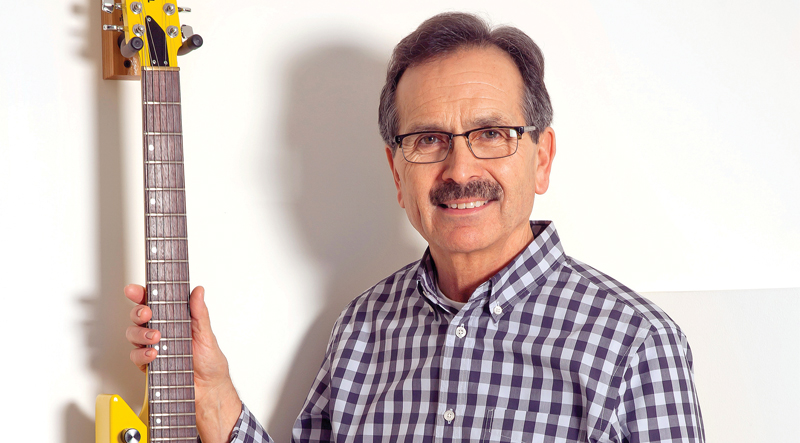
 In the late 1970s, trends combined to spawn several new guitar companies in the Chicago area motivated by a desire to “build a better Gibson.” The list included Dean and Hamer, both of which impressed players with their high degree of hand-crafted detail. To that fraternity should be added Silver Street guitars.


 In ’83, Bruce began working on the MX, a hybrid V/Explorer that had more than a little similarity to Dean’s ML, and (with input from artist relations rep Ken Willard, who’d also spent time in the company workshop, and Styx guitarist Tommy Shaw) the Nightwing, an offset double-cut with asymmetrical “French curve” on the lower bout.

 Jolt of Voltt

 Rare Birds?