Tag: features

  • Andy Bassford

    Andy Bassford

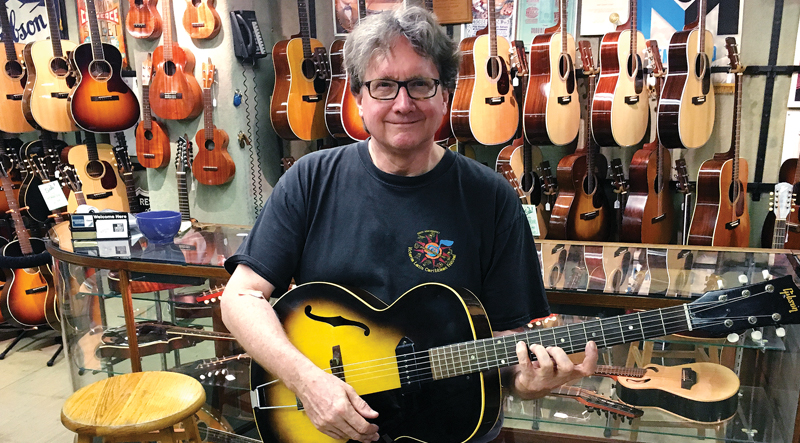
    Andy Bassford: Stephen Paul.

    Legendary fish-out-of-water reggae guitarist Andy Bassford has been a first-call sideman for decades. Now, he’s stepping out front with his first solo album – a remake of the soundtrack to the classic film The Harder They Come, which transported him from Hartford, Connecticut, to Kingston, Jamaica – and then, the world.

    How did a small-town boy become a sought-after reggae sideman?

    I’m not sure! I started on violin and viola. After I saw B.B. King, I had to learn guitar. I started in rock bands, then saw The Harder They Come; seeing Toots sing “Sweet and Dandy” changed my life. I discovered that Hartford’s Jamaican community had its own record shops. So, I studied the music and joined a reggae band. Then, Horace Andy hired me to play on “In The Light” in 1977. It sold well and we went to Jamaica in 1980 to record. That didn’t happen. But I got a couple of sessions, so I stayed.

    Word got around fast. My influences were different, but I knew the tradition. Then I joined Lloyd Parks and We The People. We backed 10 or 12 singers each night, played dances, and toured with Dennis Brown. Total immersion!

    I left Jamaica in 1985, continued with Dennis, then did 22 years with Toots. Currently, I freelance, and play with Monty Alexander.

    With reggae, the guitar is both the lead instrument and one of the main percussive points. How does reggae guitar differ from other styles?

    Playing rhythm is counterintuitive. You play up beats with down strokes! On lead, you decorate the bass line and complement the singer. The phrasing is very idiomatic. Sometimes, you’re way back on the beat. It requires much study.

    You’ve played with some heavy hitters…

    Skatalites, Peter Tosh, Gregory Isaacs, Luciano, Yellowman, Super Cat, Sly & Robbie, Burning Spear, Roots Radics, Marcia Griffiths, Chronixx, Ernest Ranglin, Aretha, Rihanna, Natalie Merchant, Bonnie Raitt, Percy Sledge, Willie Nelson…

    After 40 years as a sideman, what prompted you to re-record The Harder They Come?

    In 2013, I did a project called Island Head. It was guitar-heavy reggae/rock versions of Bob Marley songs. To promote it, we visited Cable Man Dan’s radio show on Sirius XM. “Rivers of Babylon” is Dan’s favorite song, so I recorded it for his ID, then released it on iTunes. Reaction was positive, so I decided to do an album.

    I’d always wanted to record “Many Rivers To Cross.” Then I thought, if I’m going to re-do two songs from the movie, why not the whole album? Nobody knows me, but everybody knows that record. It made sense.

    Jamaicans love familiarity, so the melodies stayed close to the script. I improvised only after completing the lyric. Almost everything, including vocals, was cut live in three-hour union sessions. There were very few fixes. I did re-amp some things.

    What were your go-to guitars and amps?

    Three tracks are my Epiphone Les Paul with Lollar Imperials. The others are my ’68 SG, ’66 Tele, ’64 Strat, a Squier chambered Tele, and my ’55 ES-125. Mikey Chung used my Hamer Special for rhythm.

    Amps were a Danelectro DS-100, a Gemini I, an AC-15, a Deluxe, a ’61 Bassman with KW cab, ’66 Twin, and an Excelsior.

    “Rivers of Babylon” has a nice 12-string sound. What is that instrument?

    An Ibanez AW-25 recorded in my living room.

    Halfway through “Many Rivers to Cross,” you transition from a clean-toned melody to a hotter solo sound.

    That’s the Les Paul through the AC-15 and Deluxe. I started with both pickups turned up to around 7. The solo is the bridge pickup plus a Soul Clone. You can hear me click it on! We left that in.

    At the extended end of the title track, two guitars trade solos. Are they both you?

    No. It’s me and George Naha playing live. George listens so well, I thought I had four hands.

    On “Johnny Too Bad,” is that a baritone guitar?

    It’s a six-string Squier bass. Jamaicans love spaghetti Westerns. Those soundtracks have lots of six-string bass. Johnny’s an outlaw, so it’s a sonic in-joke.

    Some Americans think that reggae was born and died with Bob Marley, yet it remains one of the most popular idioms worldwide. To what do you attribute its lasting appeal?

    Reggae contains spirituality, protest, romance, and rhythm. It’s the voice of the dispossessed. When you travel, you realize how universal it is.


    This article originally appeared in VG April 2018 issue. All copyrights are by the author and Vintage Guitar magazine. Unauthorized replication or use is strictly prohibited.
  • Jussi Jaakonaho

    Jussi Jaakonaho

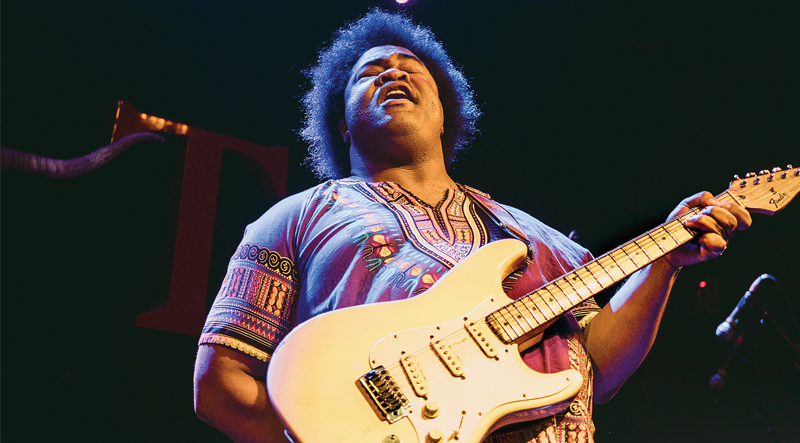
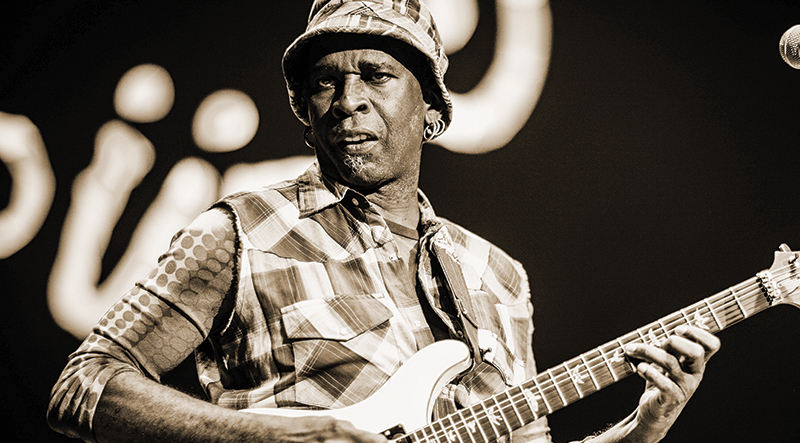
    There’s a vibrant instro-guitar scene in Finland and among its chief architects is Jussi Jaakonaho. Well known as a producer and engineer, his first solo album, Ghost Riot, is a gem of suspenseful twang and vintage tones. VG caught up with Jussi in his Helsinki studio to learn more.
    What made you cut a guitar-oriented solo album at this point in your career?

    I wanted to get back to the original spark, trying to understand the moods and colors that inspired me to make music. One of the first records that I remember from my childhood is a Shadows hit compilation my father owned. The sound of Hank Marvin’s guitar playing lead melodies just stuck with me. One of the most legendary guitarists in Finland is Esa Pulliainen, and he was also a very big influence when I started as a teenager.

    There’s a lot of “suspense” in your music, with flatted fifth notes and major sevenths over minor chords.

    I like suspension in music. Classically, it seems that ultimately it would be necessary to give the listener release after the suspense. I often prefer not to have the release – I like musical stories that don’t have a clear ending, when things just kind of dissolve.

    Is there a natural connection between surf, old Hollywood soundtracks, and the Finnish ’60s instro music called “rautalanka?”

    Yes, it’s the clear, simple lead melodies played on an instrument rather than sung. The electric guitar is a really expressive instrument for that, as it possesses range, power, dynamics and versatility. Rautalanka music was basically instrumental versions of classic folk songs or the hits of the day played on an electric guitar. It has a lot of similarities with surf music.

    Who were a few of your key guitar influences?

    Early Ritchie Blackmore, Mike Campbell, Neil Young, Zoot Horn Rollo, The Church, Peter Buck, Sonic Youth, J.J. Cale, Curtis Mayfield, Leo Nocentelli, Pops Staples, and Luther Perkins, among others.

    What is the stringed instrument at the beginning of “Zelig”? Sounds like a tiny 12-string acoustic.

    It’s a Brazilian cavaco, or cavaquinho, which is originally a Portuguese instrument about the size of an ukulele but with steel strings. It was used a lot in Brazil, Portugal, and Cape Verde. I also used a 2007 K. Yairi jumbo-baritone acoustic guitar in an open tuning – Db-Gb-Db-Gb-Db–Gb.

    “Secret Sauce” has a sick fuzz tone out front.

    Yes, the lead fuzz guitar melody has the sickest signal path I’ve ever used for a track. I just got carried away, but I love the result! It’s my ’76 Rickenbacker 481 guitar into UTA Vari-Cap cable, Mad Professor Red Cable, Xotic X-Blender with an Emma DiscumBOBulator and Snarling Dogs Very-Tone in the loop, a Lehle Volume Pedal, Nemesis Delay, Catalinbread Topanga, Binson Echorec, Hallmark Nu-Fuzz, and an Api A2D Mic Pre. There’s no amp!

    Is the Jazzmaster your main guitar?

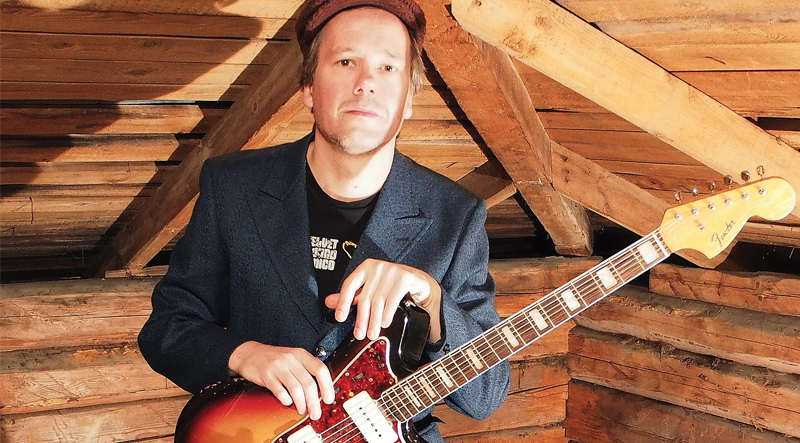
    Yes, it’s a ’66 sunburst and it was missing the vibrato bar when I got it. The lacquer from the back of the neck had been sanded off, and the neck also had a tendency to get too straight. During the years, I’ve tamed it – sometimes too strong-handed when I was young and hot-tempered, but it just gets better and better. The only modification I’ve done is the Mastery bridge, which makes the vibrato even better, and I replaced the volume pot to 250K. The original was too bright.

    Which vintage guitars, amps, and other gear did you use on the album?

    Beyond the Jazzmaster and Rickenbacker 481, I used a ’53 Gibson ES-175, a ’67 Gibson Firebird VII, a ’66 Epiphone Casino, and an ’83 Gibson Les Paul DeLuxe. The amps were a ’60 Gibson GA-8T, a ’58 Fender Tweed Deluxe and a ’66 Fender Showman Amp. Oh yes and a ’62 Martin 00-21NY acoustic guitar. These are all featured in my video on the Vintage Guitar YouTube channel.

    Do you play this music live?

    Yes, I’ve played it live and will continue doing so. My band is a trio, so it’s really interesting to get all the colors of the music realized, but I think we’re doing a pretty good job with it. All in all, the guitar scene in Helsinki and around Finland is insanely great. The level of musicianship here is just crazy, as the level of musical education in Finland is really high. World-class players in all genres. We Finns tend to be too modest and introverted with our achievements, and it’s not easy to get international attention from this corner of the planet. But our scene is great – come and see!


    This article originally appeared in VG April 2018 issue. All copyrights are by the author and Vintage Guitar magazine. Unauthorized replication or use is strictly prohibited.

  • Jabrille “Jimmy James” Williams

    Jabrille “Jimmy James” Williams

    Jimmy James: Ballard Vox.

    Seattle’s Jabrille “Jimmy James” Williams is a rare find in the guitar universe. At a time when music influences run the gamut producing a mishmash of styles, James keeps it real with a single-minded purity culled from the sounds of ’60s soul. His two bands, The True Loves and The Delvon Lamarr Organ Trio, unleash vintage funkiness in the Stax tradition. But James is no one trick pony. Armed with a Strat, a Silvertone, and an Arbiter Fuzz Face, he’s an R&B rhythm specialist schooled in the art of soul who turns people on to Curtis Mayfield, Al Green, and James Brown. The Delvon Lamarr Organ Trio’s latest record is called Memphis Concussion.

    What’s your home base for guitar?

    I come from blues more than anything. Blues and rock and roll has always been my big thing. Chuck Berry, Little Richard, and stuff like Bobby Blue Bland, B.B. King, or Freddie King – all the kings, basically, along with Bo Carter, Hubert Sumlin, and Howlin’ Wolf. The list is long. I was also into soul music at an early age and big into Curtis Mayfield and The Impressions. People my age never listened to that stuff, but I thought, “This is the greatest stuff ever!”

    Was it tough finding kids your age who played R&B?

    Yes. In high school, I was in a band that played James Brown and Kool & The Gang, but finding people who were into Wilson Pickett was very hard. People were into Earth, Wind & Fire, but I was more into Bobby Blue Bland and Wilson Pickett, so I was the odd man out. Contemporary music didn’t say much to me. Two songs that got me into guitar were “My Girl” and “I Second That Emotion.” Those songs spoke to me. I loved the lyricism; the lyrics and the music told a story. I didn’t fit in, but I wasn’t trying to.

    Kids were wearing Reeboks and I was wearing bell-bottoms. They thought I was weird because I was into Jimi Hendrix (laughs). My friends referred to me as the 80-year-old man because they would say, “You listen to stuff my grandparents listen to.” I couldn’t fall in line. Delvon Lamarr and I have known each other off and on for years, and the reason we get along is because he heard what I was hearing. When we first started hanging together, I would pick his brain. He asked me, “Do you know ‘Can I Change My Mind’ by Tyrone Davis?” I said, “Yeah, I know that!” I would play “It’s Your Thing” by The Isley Brothers and he would go, “Oh you know that one!” He would say, “Do you know ‘The Ghetto’ by Donny Hathaway?” “Of course!”

    It’s amazing you two had such similar tastes in music.

    There were songs that I loved to play, but I had nobody to play “We’re A Winner” by The Impressions. I was playing “Hollywood Swinging” when I was 15, in a high school band, so this stuff came back to me easy. We would play “Tighten Up” by Archie Bell & The Drells, and songs by Booker T. & the M.G.s. I also knew Sharon Jones’ entire catalogue.

    You have that early-’60s R&B rhythm guitar style really dialed in.

    I love rhythm guitar players more than anything. I love Jimmy Nolen and Teenie Hodges, who played with the Hi Rhythm Section. I love Steve Cropper, of course, and Robert White and Joe Messina of The Funk Brothers… also Catfish Collins and Curtis Mayfield.

    What’s the story with Memphis Concussion?

    I used to do these Tuesday-night jams and Delvon would come up with a bass line. I’d just jump in. I didn’t know what was happening. We added some stuff here and there and we came up with “Concussion.” It had a James Brown feel but with a different beat. Then he had another song called “Raymond Brings The Greens.” We’d try different things. We just let whatever happens happen. 

    We play the music the way we feel it, and make records that we would groove to ourselves. All the songs that happened from that session happened spontaneously. The song “Al Greenery” was just something we were messing with. I asked Delvon, “Do you know the song ‘Love And Happiness?’” He was able to get that organ sound which I love, so we called it “Al Greenery.” We never know what’s going to happen. Sometimes it’s just a happy accident.


    This article originally appeared in VG April 2018 issue. All copyrights are by the author and Vintage Guitar magazine. Unauthorized replication or use is strictly prohibited.

  • Vernon Reid

    Vernon Reid

    Vernon Reid: Zack Whitford.

    Vernon Reid went against the grain of rock guitarists in the 1980s, conjuring Parliament-Funkadelic, Ornette Coleman, Bad Brains, Carlos Santana, blues and hip-hop. His riffs and solos were a canvas to express the human condition.

    Since the release of Vivid in ’88, Living Colour (with singer Corey Glover, drummer Will Calhoun, and bassist Doug Wimbish), blurred boundaries while making enthralling music that woke consciousness. The band’s latest album, Shade, continues its visceral legacy. Intense and provocative, blues is its spiritual center – but it isn’t your grandfather’s blues.

    What took so long to make this record?

    We had initial tracks down, but realized there was a component we didn’t have. We had disagreements about the writing, so we wrote more until the balance was there. We also went through a couple incarnations about how things should be recorded and mixed. We needed to do a couple heavier things, and we didn’t have it. So, we checked out different approaches and eventually got there.

    There has to be unity in the conversation and, at the end of the process, you have to come out with something you can stand behind.

    At its core, Shade is a blues album using the band’s sound and social worldview.

    I wanted the vibe of the blues influence, but I didn’t want to make a self-pitying blues-rock record. We were asked to be a part of a celebration of Robert Johnson at the Apollo, which was a huge honor. We took on “Preachin’ Blues.” We listened to the original and the Derek Trucks version when Corey said, “Put those lyrics on top of that riff (laughs)!” That’s how we did it. There wasn’t even an amp in the dressing room. We were flying without a net and it turned out great. The fact that it was well-received and felt great was a huge inspiration. It was like, “Maybe this is the thing.” Corey and I were having lunch later and he said, “We should call the album Shade.” Later on I thought, “Maybe that shade is blue.”

    Which guitars did you use?

    I started on the record using my old Hamers and prototype Parker Vernon Reid model. By the end, I’d started working with PRS and was using a S2 Vela Custom. We’re coming out with a model called the Vernon Vela.

    You’ve heard all the jokes about your 40-acre pedalboard.

    Yeah. It’s a bit much  (laugh). I have this thing about using passive mixers, which are made by DOD. I plug my guitar into it and I can get four outputs and send the signal to various places. I can add my Roland VG-99, or my Kemper Profiling amp, which I used a lot on the album.

    Which amps do we hear?

    I was mainly going into a Randall amp or a Dual Rectifier, but I also used a Positive Grid; they do their own kind of modeling. At one point, I used my older Fractal Axe-Fx, a few old boutique amps, and Quilter amps, which are really cool. So, it was a lot of stuff going on.

    How do you feel about the LTD Cult ’86 reissue of your old ESP guitar?

    Matt Masciandaro made it, and it looks good. That old ESP was the first guitar given to me by a guitar company – my first endorsement instrument. The riff to “Cult Of Personality” was written on it. It’s part of history. Instruments like Van Halen’s Kramer, Santana’s Yamaha, or McLaughlin’s double-neck are powerful symbols, and the idea that one of my guitars enters that pantheon is flattering.

    What do you think about the fact that sociopolitical songs you wrote in the ’80s are still relevant?

    On one hand, I’m happy about that, but it’s also incredibly sad we’re having the same conversations about bias, race, and prejudice. “Time’s Up” is actually more relevant now as we deal with the effects of climate change. Even “Who Shot Ya?,” which is about Biggie Smalls getting shot.

    The relevance conundrum is something I sit with a lot. One of the lyrics on Shade says “Nostalgia for things that never happened,” and that’s where we are in the world today.

    What’s next?

    I did a project with Melvin Gibbs and Will Calhoun called the Zig Zag Power Trio. It’s an instrumental record where we play a little bit of Ornette Coleman, Shannon Jackson, and some improvised things. We did a thing up in Woodstock. It’s going to come out next year. I’m very excited about it. I’m also producing artists, and in particular a singer/songwriter named Shelley Nicole who I think is pretty brilliant.


    This article originally appeared in VG April 2018 issue. All copyrights are by the author and Vintage Guitar magazine. Unauthorized replication or use is strictly prohibited.

  • Bumblefoot

    Bumblefoot

    Ron Thal: Hristo Shindov.

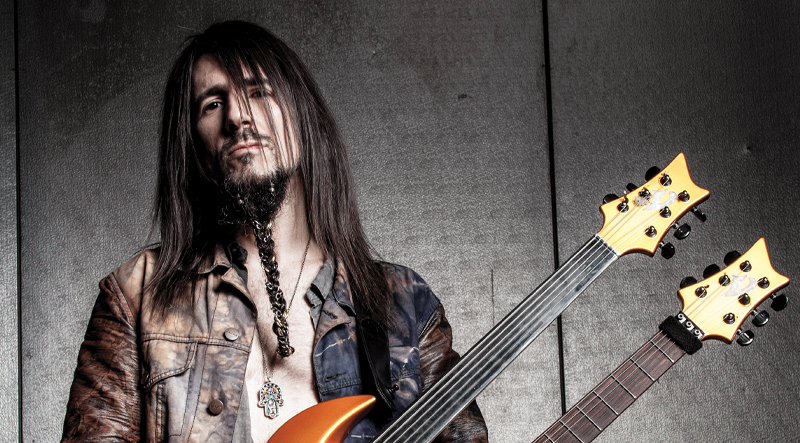
    After bursting onto the scene in 1995 with the screwball shred classic The Adventures of Bumblefoot, Ron Thal (a.k.a. Bumblefoot) has shape-shifted his playing, adapting to the hard rock of Guns N’ Roses for Chinese Democracy, the alt rock of Art of Anarchy, and he recently joined Jeff Scott Soto, Billy Sheehan, Derek Sherinian, and Mike Portnoy in the prog-metal Sons of Apollo. The man known for playing doubleneck guitars recently spoke about his latest collaboration.

    How does your guitar playing differ in Sons of Apollo compared to earlier projects?

    It’s a different beast. With Sons, I participated in the writing and we were together in the studio. Before that, Derek and I were throwing ideas back and forth in e-mails; we challenged each other. In the other bands, that didn’t happen. It’s not like anyone was saying, “I came up with this riff in 11/16 for three measures, then 11/9, then we switch to this.” With everything else, I was learning existing songs or writing with other people where it was more straight-up radio stuff. If it was Art of Anarchy, I had moments in solos where I could definitely do my thing, but the overall setting was definitely not as progressive. So getting back to progressive stuff was nice. I forgot how much I enjoyed it.

    You’ve played a variety of styles throughout your career.

    I can play a punk song – and do it right – because I was raised on that stuff. All the punk, classic rock, old-school metal, prog, all the stuff from the ’70s and ’80s, and even ’60s. That’s always there. But I studied jazz, classical, and if you listen to my first album, it’s more progressive, and as whacky as Sons of Apollo. I’ve always been able to do that kind of music, it just straightened out over time. And playing with different people where it wasn’t a progressive thing. Which is good – you get in touch with your primal side.

    When I go back to playing progressive stuff, I take it with me, and you can really put your heart into it with emotion and conviction. In my own stuff, anything goes, and in the past I would definitely go to strange places. Over the years, not quite as much… I’ve become a boring old dude (laughs).

    It’s good to be playing with guys who know who they are, musically, and can step up to the plate; you know what kind of swing you’re going to get, and they know what kind of swing they’re going to deliver, so nobody has to think about it or second guess. We can all just bust out music while trusting our instincts.

    And you’ve been lucky to play with talented singers – Axl Rose, Scott Weiland, Jeff Scott Soto, etc.

    Iconic people whose voices you’ve heard all your life! When I get to make music with them, it’s great. It’s wonderful when I get to write with one of them and do something fresh and new. That’s exciting – to hear a voice you love take the music in a direction you never would have thought about. That’s why they’re great.

    Which guitars, effects, and amplifiers did you use for Psychotic Symphony?

    I used an Engl Invader II, 100 watts going into a 4×12 Engl cabinet, and an SM57 and ribbon mic. I had a Dunlop 95Q wah – the one that activates as soon as your foot touches it; you don’t have to stomp on it like you’re trying to crush a roach. Then a bunch of TC Electronic pedals –  the Sub ’N Up, Flashback delay, Corona chorus, Shaker Vibrato, and the Vortex Flanger.

    Guitar-wise, I had my Vigier Signature Series DoubleBfoot doubleneck with the fretted neck on the bottom and the fretless on top. It has DiMarzio Tone Zone pickups by the bridge and DiMarzio Choppers by the neck. The selectors are one through five – the bridge pickup as a humbucker, bridge as single-coil, bridge and neck together normal, fourth position is bridge and neck together out of phase, and the fifth position is the neck pickup. It’s the same for both necks. And there are just Volume knobs – no Tone knobs.

    I use D’Addario NYXLs on them; I think it was .009 to .042 or .046 on the fretted, and .12 to .54 or .56 on the fretless. Tuned to 440 standard tuning, but on the fretted guitar, the sixth string is dropped to D, and on the fretless, the sixth string is dropped two and a half steps, to B. So, it’s almost like the seventh string of a seven-string guitar.


    This article originally appeared in VG April 2018 issue. All copyrights are by the author and Vintage Guitar magazine. Unauthorized replication or use is strictly prohibited.

  • Eli Cook

    Eli Cook

    Eli Cook: Jill Kettles.

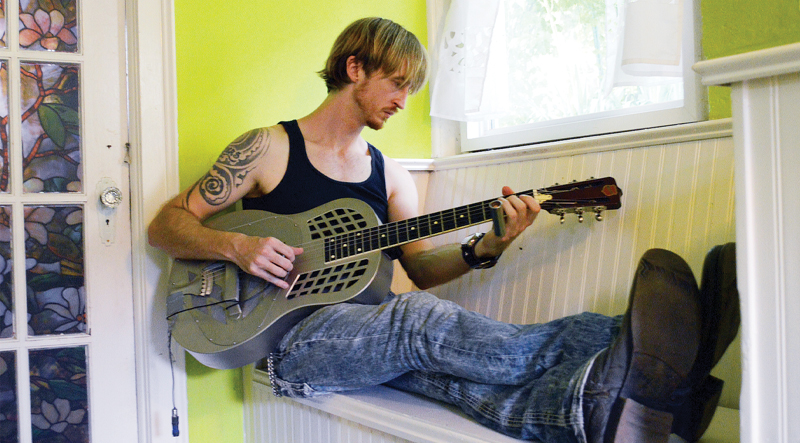
    Eli Cook’s seventh album, High-Dollar Gospel, is an Americana-style showcase of sounds, instrumentation, and varied tunings played on an interesting mix of guitars – a National tricone, a Rockbridge SJ 12-string, Washburn 12-string modified for slide, and a reissue Strat.

    The gravel-voiced Cook has been compared to singers like Leon Redbone, but more often to grungers Eddie Vedder and the late Chris Cornell. At 18, he opened for B.B. King and, before turning 30, had recorded six albums. A big fan of resonators in a band environment, his fingerpicking is influenced by Chet Atkins and Doc Watson.

    “It’s great for group arrangements,” he said. “It’s louder and more aggressive than a flat-top. It can take some getting used to, but it’s capable of great sustain and expressive harmonic content because it has that spike in the midrange.”

    Cook employed other instruments to create ethereal embellishment, including a Fender lap steel for tremolo sounds on “Mixing My Medicine” and a Les Paul Custom for the quasi-feedback volume swells in a cover of Muddy Waters’ “Can’t Lose What You Never Had.”

    “The most powerful music creates a sonic realm,” Cook said. “U2’s Joshua Tree, Waylon Jennings’ Dreaming My Dreams, and Robert Plant and Alison Krauss’ Raising Sand are all fine examples. That’s one of the privileges of studio production, and I like to use it to create a specific atmosphere and evoke a certain feeling through instrumentation, then capitalize with lyrics and vocals – set a scene or mood, then deliver the soliloquy. Sinatra had an orchestra to achieve that; I have Pro Tools and a pedalboard.”

    On the disc’s hardest-rocking song, “Pray for Rain,” Cook used only his Strat, which has Klein pickups and a few other tweaks, “…running through a reissue Super Reverb that’s also heavily modded,” he said. “A Déja-Vibe and a Tube Screamer are a [Robin] Trower fan’s best friend!”

    Conversely, “King of the Mountain” has a dense mix of instruments.

    “We doubled the 12-string, then layered in electric seven-string on the chorus, as well as a banjo on the solo, plus some ambient, Hendrix-inspired reverse-lead things. It was meant to be Son House meets Soundgarden in the desert, on mescaline… not that I’d know about that sort of thing.”

    In addition to “Can’t Lose What You Never Had,” Cook covered Roosevelt Sykes’ “.44 Blues” and Bob Dylan’s “I’ll Be Your Baby Tonight.”

    “I chose the Muddy Waters tune to show how classic blues can be presented in a different way,” he said. “I tuned down a step and a half, to C#, and made it more contemporary. The Dylan song was to show jazz influence, especially with the vocals. I did ‘.44 Blues’ live one day when I couldn’t think of anything else to record, and we ended up keeping it. It’s my own rendition, and the spontaneity pleased me.”

    Having just wrapped a fall tour through several states, Cook is making plans for the future.

    “I’m demoing the next album,” he enthused. “It will be more electric, for sure. I want to go heavier, and tour the world.”


    This article originally appeared in VG April 2018 issue. All copyrights are by the author and Vintage Guitar magazine. Unauthorized replication or use is strictly prohibited.

  • Adrian Vandenberg

    Adrian Vandenberg

    Adrian Vandenberg: Stefan Schipper.

    If you played rock guitar in the ’80s, you likely paid attention when Vandenberg videos/songs played on MTV or the radio. The Dutch band recorded three albums that put guitarist Adrian Vandenberg on the map with a mix of spine-tingling neoclassical chops and accessible ’80s hard rock. He later joined David Coverdale’s Whitesnake in time to record the lead on “Here I Go Again” (the only guitar part on the band’s self-titled fifth album not recorded by John Sykes) then co-wrote Slip of the Tongue while becoming half of a great guitar duo with Steve Vai.

    In 2013, Vandenberg formed Moonkings with vocalist Jan Hoving,  drummer Mart Nijen Es, and bassist Sem Christoffel. The band’s new album, MK II, continues its focus on blues-rock and the guitarist’s virtuosity.

    While making MK II, did you have particular expectations?

    It felt like the very first demo I recorded on a cassette, really. I pour my heart and soul into the music. You throw it out there and hope people like it as much as you do.

    Your guitar tone is right on with the musical style.

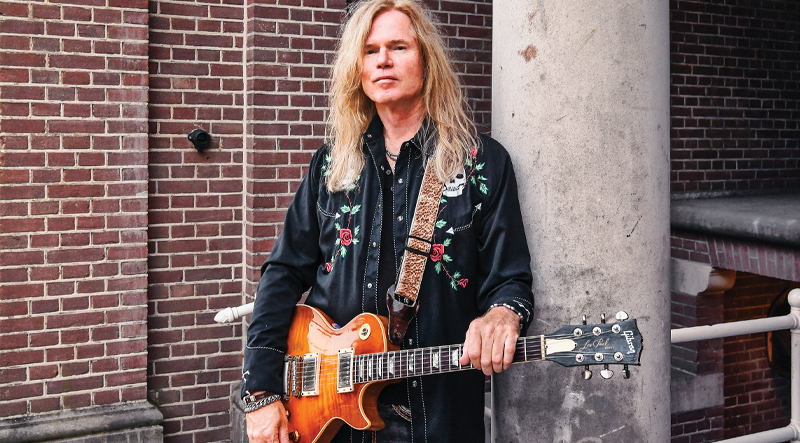
    I’m happy to get back to my organic sound with my Les Paul straight into a Marshall. I wanted the root to be firmly in the ’70s, but building a bridge between then and now. The first album was a statement to sound like it was in a small club, with the listener sitting right in front of the stage. On the second album, I wanted the sound of our live show.

    It must feel good to tour with a larger body of work.

    With the first album, we hadn’t done any gigs. Now we’ve done quite a number of them – played all over the place but, unfortunately, not in the States. I wanted the second album to sound like it would when you’re sitting in the middle of the band. No pedals or anything in-between – just my Les Paul with everything turned up. There’s a reason people keep going back to Led Zeppelin, Free, and early Cream records – spontaneity and dynamics in the studio were captured on tape. After that, rock music became formulated. I wanted to get away from that, and you can hear it on the tracks.

    The outro solo on “If You Can’t Handle The Heat” is absolutely killin’.

    Originally, I was going to let it fade, but it turned out so well that I left everything on there. I thought, “Man, this is the first time in my career that I jammed on my own record.” It was an interesting end to the record because I was fiddling with my toggle switch, like what Hendrix would have done.

    The band mixes your vast experience coupled with these young guys for inspiration.

    We have an incredible chemistry, which you can’t buy. I’ve always liked a “band” feeling. Sem and Mart are incredibly talented. Jan… in the U.S. he would have been kidnapped by a bigger band (laughs). I feel very fortunate that I ran into these guys.

    Which guitar are you using?

    It’s a Les Paul Heritage I bought new in 1980. I used to look through the window in guitar shops but they wouldn’t let me in because they knew I couldn’t afford it. I saved the money by working in factories and it’s been with me all over the world except when I was in Whitesnake.

    I took a train to Amsterdam to get that guitar and was extremely lucky because it’s unusual, with a very beautiful top. It has been relic’d by my own sweat and blood. I have other Les Pauls, but this one is my faithful mistress who gets better with age.

    Any plans to work David Coverdale again?

    We keep in touch and we’re very good friends. We have a plan to do something sooner or later – a blues album, something acoustic, or just writing.

    Will Moonkings play the U.S.?

    I really want to. The last time I toured the States was with Whitesnake in ’94. I get lots of mail from American friends asking, “When are you going to play here again?” It’s wonderful to hear from people who are touched by what you do.


    This article originally appeared in VG April 2018 issue. All copyrights are by the author and Vintage Guitar magazine. Unauthorized replication or use is strictly prohibited.

  • Billionaire by Danelectro Big Spender

    Billionaire by Danelectro Big Spender

    Price: $79
    Info: www.billionairetone.com

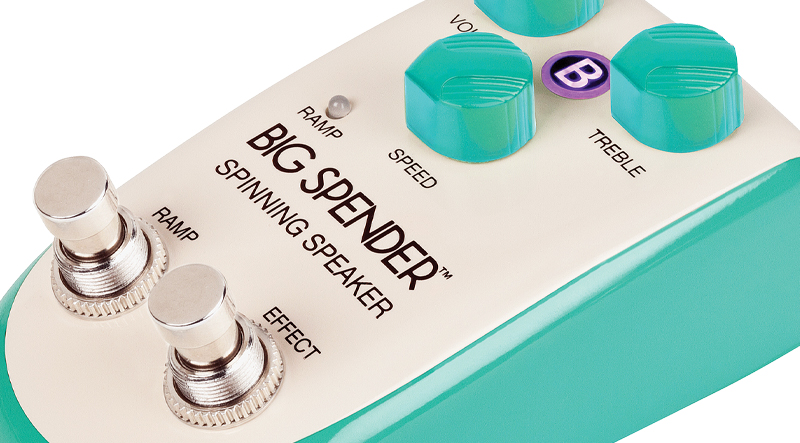
    In this day and age, there’s a lot of spin going down, but perhaps not enough of the right type. Enter the new Billionaire line of affordable effects from Danelectro, including the Big Spender spinning-speaker simulator. It’s spin control in all the best ways.

    Leslie speaker cabs are big and bulky, while Univox Uni-Vibes cost big bucks. The Big Spender counters all of that with its small size, simple controls, and alluring price point.

    The effect is housed in a sweet and stylish die-cast casing that’s light and solid. Its two-tone color scheme harkens to ’50s cars – and early rock and roll.

    At its simplest, you really only need to bother with the two footswitches. “Effect” turns the box on or offers full bypass; “Ramp” increases the “speed” of the spinning-speaker simulation. Click it once to light up the green LED and evoke luscious slow-speed revolutions; hit it again to accelerate to the red zone. The Speed dial offers further fine control over each range.

    Volume dials in output, while Treble boosts the top end for increasingly sparkling and chimey sounds. It’s all that simple.

    The slower, green-lit speeds gave enough spin simulation to make chords and double-stops sound lush and lustrous. Red tightened the sound nicely, offering Memphis R&B and Motown tones. But speed it up too much while also turning up the effect’s volume and you’ll get some background oscillation.

    You can dial in SRV Texas blues tones, Allman Brothers-like warmth and mesmerizing rhythm, or sweeping David Gilmour wet sounds that can send you to outer space. The Big Spender responds especially well to slower, more articulated playing of chords and double-stops, adding depth and richness. If you’re looking to join the rotary club on a budget, this is great place to start.


    This article originally appeared in VG March 2018 issue. All copyrights are by the author and Vintage Guitar magazine. Unauthorized replication or use is strictly prohibited.

  • Jam Pedals RetroVibe

    Jam Pedals RetroVibe

    Price: $329
    Info: www.jampedals.com

    In a civilized world, every guitarist would have a bit of Robin Trower, Pink Floyd, and Band Of Gypsys shimmer in their musical vocabulary. Fitting, then, that a company headquartered in Greece – cradle of Western civilization – has taken it upon itself to help guitarists reach such lofty heights.

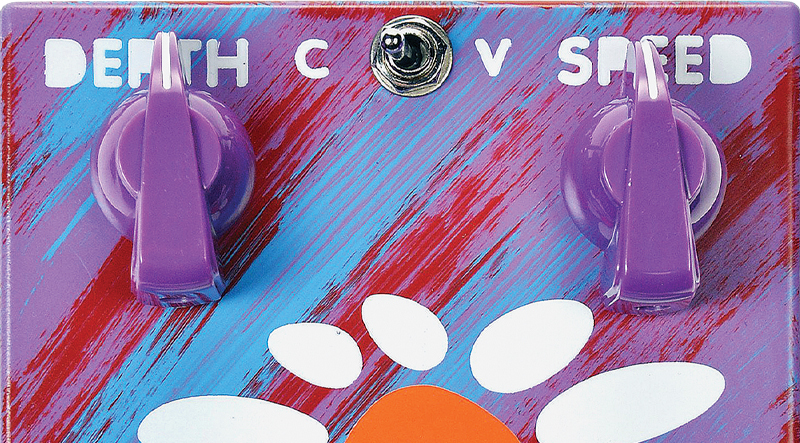
    Jam Pedals’ RetroVibe produces succulent old-school flavor thanks in part to its new-old-stock (NOS) 2SC828 transistors and carbon-comp resistors – the same used in the 1969 Uni-Vibe. Jam added an internal trim pot so the user can dial-in maximum intensity without sacrificing character.

    Inside, four photocells surrounding a pulsating light source offer cork-sniffing Uni-Vibe aficionados the experience of a thick chorus/vibrato effect in all its swirling oceanic beauty. Manipulating the Speed knob slows it down to deep-sea effects and speeds up to a rapid-fire warble as you progress to higher settings.

    The only other controls are a Depth knob to manipulate the pulsating intensity of the throb and a toggle that moves from Chorus to Vibrato. The RetroVibe also has an expression pedal input to allow for smoother on-the-fly tweaking of the speed.

    Running on a 9-volt adapter and wired true-bypass, the RetroVibe is sturdy, has a cool paint job, and doesn’t take up a lot of space. On the Chorus side, with the control knobs set at 12 o’clock, you’re immersed in watery realm with all the nuances of hallucinatory Trower and the Floyd’s “Breathe.” Judicious tweaking offers tone that can be fattened with smidgeons of warble on the Vibrato side, and fast Leslie-speaker impersonations.

    While it’ll recall some truly iconic rock sounds, the RetroVibe is more than a one-dimensional impersonator. Dig in and you’ll find a gateway to a diverse palette of chorusing and tremolo effects.


    This article originally appeared in VG March 2018 issue. All copyrights are by the author and Vintage Guitar magazine. Unauthorized replication or use is strictly prohibited.

  • Mu-FX Phasor 2X

    Mu-FX Phasor 2X

    Price: $339
    Info: www.mu-fx.com

    Mastermind effects mad scientist Mike Beigel is back with another re-creation of a classic Musitronics effect.

    The Mu-FX Phasor 2X is a time machine back to the bad old ’70s that includes several smart upgrades which make the future look a little bit brighter.

    In case you weren’t paying attention back in ’72, Beigel was one of the brains behind Musitronics Corporation, where he unveiled the beloved Mu-tron III that proved we all needed an envelope filter when we didn’t even know what one was. By ’78, Musitronics was history, but in 2012 Beigel sparked Mu-FX to build new and improved versions of his classics with the same DNA and musical mojo.

    Beigel was also the inventor of one of the first (and best) phasers. Mutron’s original Phasor arrived in ’74, followed by the humongous Bi-Phase and Phasor II. Today, they’re all cherished boxes – and all elegantly expensive.

    Beigel refers to his new Phasor 2X as a “modern vintage analog refinement” of the original. That’s a reasonable explanation, but there’s more to it than that.

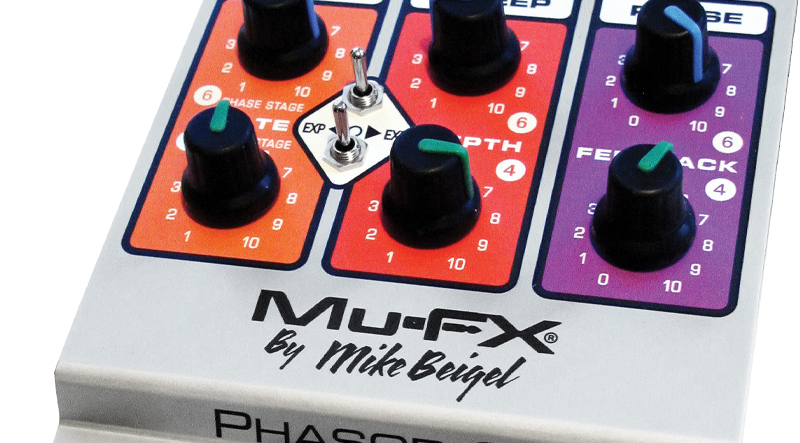
    The “2” in this box’s name tells us that this new version houses two Phasor IIs in one unit. It also adds savvy modern features such as four- and six-stage phasing, multiple independent controller modes, stereo output, and the possibility of real-time control by way of the optional Mission MU-XP2 expression pedal (other expression pedals work with the Phasor 2X but may not be as perfectly calibrated).

    The circuitry is all-analog optical and made in the U.S. on dual circuit boards. It’s rock-solid and beautifully crafted, inside and out.

    Plug in, and your instant reaction to that whoosh will be wow! The phaser sound is warm and full, sexy and rich.

    The dual phasers can’t be combined in series, but you’ll forget about wanting this feature when you understand what the pedal can do.

    You can dial in the separate four- and six-stage decks to create completely different wave patterns – then quickly switch between them with the tap of your toe. And for each deck there is a three-position toggle letting you switch between rate of phasing, sweep, and expression-pedal control. This versatility allows you to move from Waylon Jennings’ tough outlaw rhythm sound to Jimi’s sensuous “Little Wing” flights of fancy to Pink Floyd’s industrial-grade modulations and anything in-between.

    The Phasor 2X keeps alive Beigel’s Space Age love of dials and toggles, so much so that you sometimes feel like you’re piloting a rocket ship. Here, the wealth of independent controls allows you to shape those sounds to the edges of the phaser universe. And don’t forget the expression-pedal possibilities.

    With just a little bit of Sweep dialed in, you can get sweet, Uni-Vibe-like modulations – a sound simulating a spinning Leslie speaker. Or, opt for resonant waves that provide almost a flanging effect. Yes, it may be a cliché, but with the Phasor 2X, the limits are truly a function of your imagination.

    As with many of Beigel’s boxes, he chooses to run the Phasor 2X on higher voltages for a purer sound. It requires 200 milliamps of 12-volt power, and there’s no battery option. A 12-volt wall-wart adaptor is included.

    If you haven’t tried a Mutron or Mu-FX pedal, know that Beigel is one of the ultimate mad scientists when it comes to gear. There’s no true comparison in control, ability, and, ultimately, sonic tone. This is love at first swoosh.


    This article originally appeared in VG March 2018 issue. All copyrights are by the author and Vintage Guitar magazine. Unauthorized replication or use is strictly prohibited.