As gigs at coffeehouses, street festivals, and farmers’ markets become more common, a growing legion of performers is being supported by an increasing array of portable acoustic/electric gear. The Acoustic Array Pro from Genzler Amplification recently jumped into the mix.
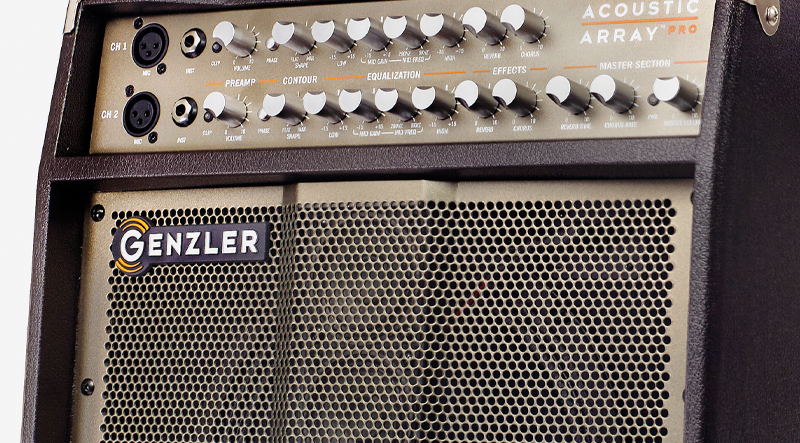
Assembled in the U.S., the Acoustic Array Pro’s name alone should pique interest; “Array” refers to the amp’s unique speaker setup. While the typical acoustic amp has a woofer and small tweeter/horn, the Genzler has a 10″ woofer in a ported chamber and four 2.5″ drivers mounted in front of the woofer, creating greater dispersal. Shine a flashlight in the grille and you’ll see the speakers mounted in the center bump-out with the woofer behind it. The idea is that this array of speakers produces better clarity, dynamics, and dispersion, as well as a more-natural acoustic/electric tone, since there isn’t a potentially harsh tweeter.
The Acoustic Array Pro offers two channels, each with a 1/4″ input and XLR jack. The inputs on each channel also mix together for simultaneous use, allowing a player to sing and play through the same channel. Each channel has a four-band EQ with Low, High, Mid Gain, and Mid Freq controls, and a Contour knob creates the gentle EQ curve of boosted lows and highs with reduced mids – handy for quick mid-gig tone adjustments. The Contour is also useful for shaping tone – it sounds great for fingerstyle as you turn it up; turn it down for some meaty midrange for acoustic solos. If you sense a feedback howl developing, push the Phase Reverse button to flip the signal and get out of trouble.
Sweeteners include digital reverb and chorus for both channels. You can adjust the reverb tail and chorus rate in the master output section next to the Master Volume. The back has a headphone jack, effects loop, line-level aux input (for keyboard, phone/tablet, or MP3/CD player), and an effects on/off jack.
Other practical features are a slanted cabinet for better projection, especially in small spaces, and a bottom-mounted stand adapter to raise the Acoustic Array Pro off the ground. The amp sports 150 watts of output, though you could add another cabinet and ratchet that up to 300. If you need more output, three XLR outputs facilitate connection to P.A., recording desk, or a power amp. You can even set the outputs for pre- or post-EQ, which can be useful for managing live sound.
Plugged in, the Acoustic Array Pro provides extensive tone-sculpting tools to deal with the ups and downs of amplified acoustic audio. It has a big, airy tone – much larger than you’d expect from a small combo – yet delivers extensive bass frequencies with detailed top and middle control. You might wish for a compressor (as found on some acoustic amps), but it’s unnecessary. With a Yamaha Transacoustic dreadnought, the Genzler provided a big, crystal-clear sound and a well-controlled dynamic range. The reverb was warm and deep, giving the dreadnought lots of personality and impact.
Given all of its features, you might expect the amp to weigh a ton, but it’s a perfectly manageable 27 pounds, to make your load-out easy. Add the middle-range price and attractive looks, and the Genzler Acoustic Array Pro becomes a serious contender for your acoustic-amp buck.
This article originally appeared in VG April 2018 issue. All copyrights are by the author and Vintage Guitar magazine. Unauthorized replication or use is strictly prohibited.
Railhammer’s Nuevo 90 Humcutter Set Price: $99 each Info: www.Railhammer.com
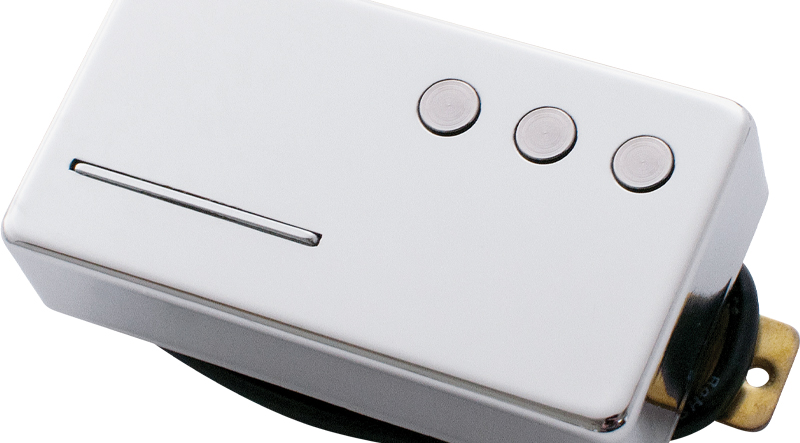
Joe Naylor has a long history of designing and marketing everything in the music business from high-end amps, guitars, basses, speakers, and effects pedals to his latest Railhammer pickups. His pickups all utilize a unique mix of blades and round polepieces to produce a more balanced tone than what is available by using one format or the other. Naylor’s latest is the Nuevo 90, part of the Humcutter series – P-90-styled hum-canceling pickups.
The Humcutter Nuevo 90 is a humbucker-sized pickup that, like all Railhammer designs, features their patented mix of blades and round polepieces. The blades are used under the wound strings to create a tighter low-end by sensing a smaller area of the strings’ vibrations; the large round poles sense a wider area of the string, and are used under the plain strings to give them as much fatness as possible. The neck measures out at 7.8k, and the bridge at 9k, and both utilize ceramic magnets. They are available with either chrome or black covers.
Mounted in a slab-bodied, bolt-on neck guitar and played through a reissue Deluxe Reverb, the pair of Nuevo 90s delivered stout, wiry tones that definitely mirror those of P-90s. The neck pickup was full-bodied and punchy with every note putting out a very commanding girth. The bridge Nuevo had the all the added midrange grind that one could would want, while both pickups together produced that slightly hollow tone that P-90 fans know and love.
The Nuevo 90 has the tonal vibe of a hot P-90 with the bonus of being in a much more standardized shape for the pickup swapper. To boot, it is dead quiet and its patented half-rail/half-polepiece design gives it the upper hand with better string-to-string tonal balance.
This article originally appeared in VG April 2018 issue. All copyrights are by the author and Vintage Guitar magazine. Unauthorized replication or use is strictly prohibited.
Jason Lollar has been in business winding pickups for more than 20 years. While he’s most famous for his take on the P-90, he makes pickups of all kinds, including 16 different humbuckers.
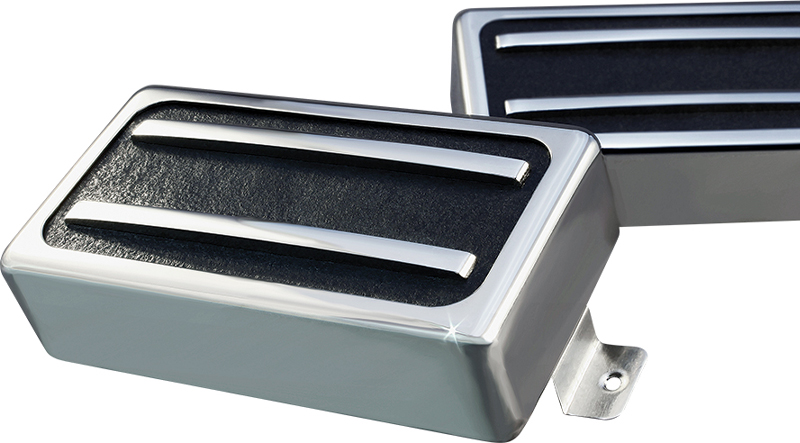
One of them, the dB Humbucker, is not your run-of-the-mill double-coil, but a high-output, double-bladed, black-and-chrome beauty that looks like something off a late-’50s Chevy.
The pickups were tested with a Hamer Artist HB (chambered upper bout, Korina wood) modified with the recommended 1M ohm pots. At full (guitar) volume through a 50-watt 6L6-based clean channel (tone stack set flat at 5), the signal was overdriven nicely, with the higher output of the pickups completely obvious and reacting aggressively. Chords were thick but not mushy, like having a good overdrive pedal up halfway. Rolling down the Volume to roughly 8, the signal cleaned up without sacrificing much volume. Even at this level, notes were sustained, clear, and woody. With just the clean channel and the Volume knob, the dBs provided great tone capable of covering many styles.
Switching to the lead channel (EL84s) was comparable to stomping on the gas of a well-tuned muscle car. Sustain was incredible and single notes blossomed. Fast runs were clear enough to distinguish picked and hammered-on notes. The overall sound was rich in harmonics with a slight dip in the upper midrange. The lows were tight without being farty, and bent notes retained full volume.
For those keeping track, these clock in at 11.2k Ohms for the neck and 12.77k Ohms for the bridge. They are a bit heavy (seven ounces) and loud! And, while louder isn’t always better, more energy at the beginning of the signal chain gives a player more control over the sound farther down the line.
High-output pickups may not be for everyone, but the Lollar dB is anything but a one-trick pony.
This article originally appeared in VG April 2018 issue. All copyrights are by the author and Vintage Guitar magazine. Unauthorized replication or use is strictly prohibited.
Gibson and Fender have a long history of influencing each other’s designs. When hard rock and warm, jazzier textures were on the rise in the early ’70s, Fender wanted some of that double-coil action, so they hired PAF inventor Seth Lover to come up with something new. The result was the Wide-Range humbucker that turned up in a variety of period Telecasters. Now Lindy Fralin has their own take on this vintage design.
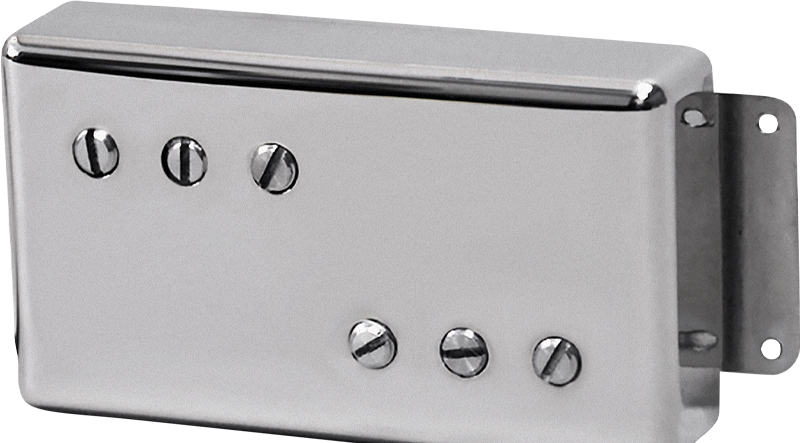
The Fralin model is the exact drop-in size for current Wide-Range slots, allowing an easy upgrade for Teles, Strats, and Starcasters, among others. The units aim to find that sweet spot between humbuckers and single-coils – keep in mind that Fralins will give different tones with alder or ash solidbodies, or with a Tele Thinline. Each pickup is fitted with threaded Alnico pole pieces and wound with 42-gauge wire. The pickups deliver 8.2k neck and a 9k bridge output, but Fralin can custom-wind them to taste.
In a tone test, the Fralin Wide-Ranges evoked that patented tone, beefy enough for hard rock and jazz, but with a bit of a midrange scoop for Fender twangin’. This was particularly evident with both humbuckers on. If you’re at a gig and need some ’bucker colors on one song and single-coils on the next, these pickups give you that option, depending on your amp and amount of gain. The neck unit is fat and bassy, while the middle brings in the midrange flavors. The bridge is full of midrange bite, perfect for cutting through a mix.
If you’re looking for pickups that can give you degrees of both humbucker crunch and single-coil quack, you’re in the right place. That’s the magic of the Wide-Range humbucker, ably captured by the craftsmen at Lindy Fralin.
This article originally appeared in VG April 2018 issue. All copyrights are by the author and Vintage Guitar magazine. Unauthorized replication or use is strictly prohibited.
EMG pickups have been around since 1976, offering a diverse line of active pickups used in just about every genre of music and matched with top guitar manufacturers. EMGs have been heard in everything from blunt-force metal to trailer park country – all with absolutely no 60-cycle hum.
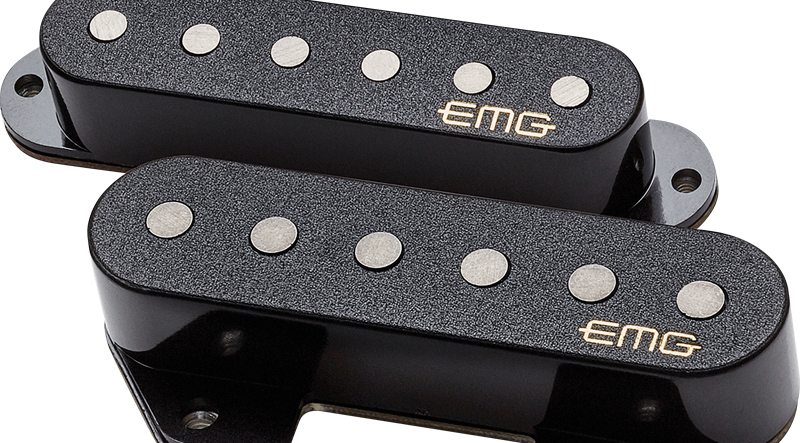
EMG has continued to evolve its Retro Active Series with the T-52 set for Telecasters. This is EMG’s take on a ’50s sound with a blend of magnets that offer vintage flavors with edginess, warmth, and musicality. It comes with their custom Retro Active preamp yielding sublime goo-gobs of crisp cluck and bite without the annoying hum. Easily installed in most Telecaster-style guitars and completely solderless, the T-52 requires a 9-volt battery. If your guitar lacks sufficient cavity space, a battery holder is recommended in the back of the guitar.
Plugged into a variety of clean combo amps and high-gain heads, the T-52 Set offers a smooth clarity useful for a plethora of genres that require lustrous punch. Its exposed polepieces and Alnico V magnets will give your bridge Telecaster position smooth warmth with definition, while the neck position uses Alnico II magnets for diaphanous midrange, less treble, and a classic utilitarian identity. Gig-friendly clean funk tones along with volume manipulation yield flexible output levels without the muddiness associated with passive single-coils. The bridge pickup screams with mellifluous proclivities while the neck indulges blues phrases with rich harmonics.
EMG’s T-52 is a great set of pickups with a range of sounds. Best of all, you can install them yourself.
This article originally appeared in VG April 2018 issue. All copyrights are by the author and Vintage Guitar magazine. Unauthorized replication or use is strictly prohibited.
The creation of great music is almost always a collaborative effort. From session players to engineers, producers, arrangers, and marketing teams, many talents meld in the fulfillment of a performer’s vision. The music world lost a great member of the team with the passing of guitarist Marlo Henderson, who was 67 when he died of cancer in October of 2015.
Though his death barely made the music press, Henderson had a 50-year career playing behind some of the most talented singers and songwriters in the industry while garnering credits on everything from obscure recordings to mega-selling albums. In the late ’60s, he rubbed elbows with Buddy Miles, Jimi Hendrix, and Miles Davis, then later worked with contemporary blues and hip-hop artists as well as with Paul McCartney, Stevie Wonder, Prince, Quincy Jones, Maurice White, and Michael Jackson.
Photos courtesy of Sherry Pruitt and the estate of Marlo Henderson. Henderson (right) with Maurice White in 1980.
Born on May 31, 1948 in Alamogordo, New Mexico, Henderson was one of 10 children in the family, and his father was a sax player who taught him the rudiments of that instrument before guitar became Marlo’s obsession and he began taking lessons at the age of seven. His first professional gig came in 1961 and earned him $15 per night. He went on to receive a Bachelor of Arts degree from the University of New Mexico, earned a Master of Fine Arts degree from the Berkley College of Music, and attended the University of Southern California. His “street education” came when he started playing for Buddy Miles, whose bassist, Billy Rich, introduced Henderson to Jimi Hendrix. When Hendrix’s Experience band played Red Rocks, Henderson and Jimi would jam together; a friendship developed that would last the remainder of Hendrix’s life.
Henderson’s idiosyncratic feel on the guitar became an integral part of Miles’ albums We Got To Live Together and the iconic Them Changes, recorded in 1970. The latter rose to #8 on the jazz charts and its title track is Miles’ most popular song – Henderson’s funky guitar lines can be heard throughout (and in performances in video posted online). Tours with Miles opening for the Experience kept Hendrix and Henderson close jamming buddies.
In every career context, Henderson was influential both as a player and a person. Sound Barrier guitarist Tracey “Spacey T.” Singleton was inspired to develop his skills when he saw Henderson on television.
“Living in New Jersey during the ’70s, I saw Buddy Miles’ band on a TV show called ‘Soul!’” said Singleton. “I started following [Henderson’s] music and noticed that he recorded with so many different artists – he could play anything with anyone. I wanted to be just like him. He has a special spot in music.”
Henderson was featured in a mid-’70s ad for the Ibanez 2670 Artwood Twin.
Henderson later joined the bands High Voltage, Maxayn, and backed vocalist Minnie Riperton on her Perfect Angel album, then co-wrote some of the music on Love Lives Forever and Petals: The Minnie Riperton Collection. His funky vibe and unique musical voice brought him to the attention of Stevie Wonder. Henderson had played on Jackson 5 tracks that Wonder produced for Motown but were never released. This led to other collaborations, including 1974’s Stevie Wonder Presents: Syreeta, featuring Wonder’s soul-singing protégé, Syreeta Wright. Henderson and fellow guitarist Michael Sembello joined Wonder on tour in ’74 to support Innervisions, and they can be seen in videos tearing it up on funk-fusion workouts like “Contusion.”
“I got more from Stevie Wonder than from any learning institution,” Henderson said in a 2010 interview for New Day Talk Radio. “It was an advanced degree in music because he was so diverse. It was great to be in his band, and you had to be on-point. It was hands on and it wasn’t music theory. We’d rehearse songs a certain way and when we got onstage, he’d change it. You had to be awake in his band.”
At that point in his career, Henderson was getting a lot of calls for session work, so he recommended Bob Marley guitarist Junior Marvin to replace him in the touring Wonderlove Band. Henderson and Marvin became friends when the Wailers toured with Wonder, and the two often jammed onstage during Wonder’s set.
With a much sought-after style that leaned to the soulful side of rock, funk, pop, and R&B, Henderson worked with Lester Chambers, Van Morrison, Deniece Williams, The Emotions, Gil Scott-Heron, and Patrice Rushen. He finished the ’70s collaborating with Jones and Jackson on Off The Wall. Henderson’s guitar is heard on “Don’t Stop ’Til You Get Enough,” “Rock With You,” “Off The Wall,” “It’s The Falling In Love,” and “Burn This Disco Out.” Check out his interlocking guitar lines with Wah Wah Watson on “Girlfriend,” written by Paul McCartney, where Henderson employs his patented “less is more” approach to groove, syncopation, and use of space. His finesse was the connective tissue that gave sizzle to such rhythm tracks.
In the ’80s, Henderson lent his talents to projects by the Pointer Sisters, Patti LaBelle, Janet Jackson, Booker T. Jones, Nancy Wilson, The Gap Band, Teena Marie, and Smokey Robinson. He made significant contributions to Earth, Wind & Fire’s I Am album, including “After The Love Has Gone.” On the band’s follow-up album, Faces, he developed an even stronger creative bond with producer Maurice White and bassist Verdine White.
“Maurice thought Marlo would be a great guitarist to work with Al McKay,” said Verdine White. “He was a great player. We used to joke and call him Howdy Doody because he had freckles. He had great guitar lines and was a super-beautiful person to work with – one of the unsung heroes in our business. He always knew just what to do. He was part of our life and he’ll live on forever. I was honored to play with him.”
Henderson’s musicality drew from blues and soul, which became embedded in the catalogs of an array of artists. From sessions with Dusty Springfield, Lamont Dozier, Bette Midler, and Dr. John to Seals & Crofts, Diana Ross, Ray Charles, and Marvin Gaye, his essence permeated whatever he recorded. He also had a love of jazz and the permutations that evolved from it, as one can hear in his sessions with Ahmad Jamal, Lenny White, Ramsey Lewis, Eddie Henderson, Gato Barbieri, Joe Sample, and Norman Connors. His only solo disc, Reflections, was a smooth-jazz album.
In the ’90s, he recorded with rap and hip-hop artists such as KRS-One, Snoop Dogg, and Tupac Shakur, then later helped score the audio book The Pursuit Of Happyness by Chris Gardner. In 2013, he produced I’m The One You Need for blues singer Sherry Pruitt, and, in the years preceding his death, composed more music for audio books, blues projects, and collaborations within the hip-hop community, where he went by the name M5. His final project was serving as musical director for East Meets West, a play about the merger of Chinese and American musical cultures in the 19th and 20th centuries. It was to be performed in five Chinese cities.
Palo Henderson (left) in the studio with his dad in 2006.
In a 2013 interview with Michael Limnios, Henderson was asked how he translated blues and soul for new generations of listeners.
“My music philosophy is simple,” he said “One is the sum total of one’s experiences, and most of what I live is, at some point in my life, translated into the music I write or play. I am a simple guitarist who doesn’t really excel.”
Guitarist Gregg Wright met Henderson when they worked the studio circuit in the late ’70s.
“Marlo was a first-rate musician who could also produce, arrange, and direct,” he said. “His track record speaks for itself. He’s one of my all-time favorite cats.”
Allen Hinds, a noted studio guitarist who backs Gino Vannelli in the studio and onstage, played gigs with Henderson during the last years of his life and has never forgotten his intuitive musicality.
“There was never a bit of competition with him,” said Hinds. “I never got that vibe. He was always a supporter. We’d talk about life as much as anything. A week before he died, he told me, ‘Keep that pop in your collar.’ He wanted me to keep positive and keep going. He was one of the best people I’ve ever known. I’ll miss him a lot.”
Henderson’s son, Palo, keeps his father’s legacy alive by working as a composer and guitarist.
“It’s hard to pinpoint his contributions in a clear way,” he said. “The hits speak for themselves, but he was so much more. He sang, engineered, and worked with vocalists; he stayed in the background, never wanting to be up front. When I asked why he preferred to stay behind the scenes, he said, ‘Son, I’m a musician, not an entertainer.’
“My brother, producer Chuck Heat, also does his part, and his daughter, Patience, sings and plays guitar. And then there’s me – the unruly vagrant (laughs). I started working with ZT Amplifiers because they endorsed my father; Michael Kirschmann and my father had a great relationship.
“Your father is supposed to be your hero,” Palo added. “He was a god to me, and I was his Thor. Everything he taught me has become part of my routine. More than his talent, I received his ability to keep getting up even in the face of danger. That has kept my career going, far more than talent.”
Special thanks to Palo Henderson, Teira Doom, and Sherry Pruitt.
This article originally appeared in VG April 2018 issue. All copyrights are by the author and Vintage Guitar magazine. Unauthorized replication or use is strictly prohibited.
When it comes to identifying guitars, basses, amps, and effects, nobody knows it all. Anyone save for the true specialist, whose interest is focused on a particular model, make, or era, knows there’s an impossible mountain of detail concerning materials, specs, and luthiery techniques for the thousands of vintage models.
By itself, the heralded triad of Martin, Gibson, and Fender presents a mind-numbing list of models and variants; add smaller manufacturers and solo builders (D’Angelico, anyone?) and the idea of any single person knowing everything becomes downright laughable.
By itself, the heralded triad of Martin, Gibson, and Fender presents a mind-numbing list of models and variants; add smaller manufacturers and solo builders (D’Angelico, anyone?) and the idea of any single person knowing everything becomes downright laughable.
There are many good reference books on vintage instruments, of course, but even the best has limitations; covering the subject in general leaves innumerable details unexplored, as does diving deep into a certain brand, era, or model. Databases for vintage-gear info began cropping up shortly after consumers got their hands on computers, but they depend on one person or a small network willing to spend countless (unpaid) hours documenting whatever they find.
Glaser and Rawlings: Rusty Russell. Joe Glaser (with a ’39 Gibson L-5C Premier) and Joshua Rawlings.
But, what if someone created an online repository that accepted contributions from everyone? A crowd-sourced reference that even the smallest mom-and-pop music store or repair shop could, when that ’66 Dano Convertible came in for a new nut, use to document and share with the world, even as they zoomed in on the aluminum nut of another Dano to guide their work? And what if it was curated by a team of recognized experts, so the facts were checked before the info was published?
Say this database made it easy to upload detailed photos, even showed contributors exactly which angles, views, and details to shoot? And what if there was ample space for a description, including details like dates of manufacture, design changes over time, specific or unique features, variants, construction techniques, and similar factual info about the specific model? What if somebody put all that together?
Well, somebody has.
GitWik.com is the brainchild of Joe Glaser, noted Nashville repairman, builder, and co-developer of the Plek treatment for guitar necks. As the go-to for many well-heeled collectors, superstar guitarists, and working players, he sees drool-worthy instruments on a daily basis.
“I’ve seen a lot of guitars,” Glaser says. “Not the tens of thousands that George Gruhn or Matt Umanov or Walter Carter have seen, but a lot. And still, quite often, something comes in that we all gather around and look at for the first time; ya’ know – ‘Wow! I didn’t know Fender ever did that.’ There’s just no end to what’s out there, even after all this time. We constantly find ourselves trying to research some detail, going through all the books, hundreds of Google images, and still coming up with nothing. I’ve always thought there must be a lot of people who run across stuff and have no way to document – or at least no way to share – what they’ve seen. So, the GitWik is based, as the name implies, on the Wiki model. One big difference is that it’s curated. Before it’s published on the site, what you post is checked out by a team we’ve recruited, so no one can just post opinion or junk info. And if your entry on the ’64 White Falcon shows a variant, it doesn’t bump the last guy’s entry on his ’64 White Falcon – it’s just another probable version. Of course, at a shop like mine, we see things the typical collector or player doesn’t, like inside the neck pocket of a ’58 Flying V, for example. And now we can share photos, and it’s information everyone can check out for their curiosity, or for restoration.”
Glaser’s in-house IT manager, Joshua Rawlings, did much of the coding and design and maintains the site, and notes that while there’s a lot to check out on GitWik, there’s no “checkout.”
“The site wasn’t imagined or built as a for-profit endeavor,” he said. “Contributing and viewing is free. Contributors are the ones who drive it from the supply side, and users offer the demand element. The synergy is that people can be both users and contributors. It’s also not a place for value-based assessments or anecdotal information, but it is a valuable tool for collectors. Here are photos and curated info about, likely, that very model that you’re thinking about buying. You can double-check all kinds of specs, see the pictures to verify its authenticity, all that. But you won’t find anything related to how much something is or isn’t worth, or who it belongs to. GitWik isn’t about that. It’s only about documenting information: “Is the guitar I’m being offered the real deal? Is it a one-off, or custom build? Has it been modified? Well, let me check out some detailed photos of one of these and see what somebody who had one in-hand can show me.”
GitWik is also a resource for retailers, do-it-yourself types (don’t cut that replacement pickguard for your SG until you look at a couple variants on GitWik!), and owners. And especially, Glaser says, for repair shops.
“Every single day, here at the shop, we need this. Retailers need it, but we really need it. Even the most comprehensive, well-researched book is obsolete the day it’s published or can include mistakes.
“I’ll give you an example. Not long after the site was put up, a ’50s Gretsch came in for repair. It was missing the binding on the bass side of the neck. Well, those ’50s Gretsch specs varied a lot: How many dots? What color? What placement? Fortunately, someone had uploaded shots of the same model, from the same year. We were able to get it right, and finding that information took, literally, a few clicks. This guy’s guitar went back to him exactly like it was originally. It’s not a tragedy if that doesn’t happen – it’s not like somebody trying to park the Hindenburg. But if vintage guitars matter to you, that would matter to you.”
A priority for the GitWik crew is getting other repair shops to contribute as well as using the site for reference; much of the value is in the detailed photos. “Guide Shots” are provided, showing which views to shoot, and how to shoot them using a phone or tablet to shoot, drag, and drop. Many of these are in-progress repair shots, so contributors can post photos that help other repairmen. Noted vintage dealer and author Walter Carter, who played a significant role in dialing-in the site’s concept and functions, describes the photo element as, perhaps, GitWik’s most unique and critical piece.
Entries for a ’32 Selmer Maccaferri and a ’34 Gibson Century of Progress exhibit guitar.
“We spent a lot of time figuring out what were the most important and useful photos – which views would give the best, hardest-to-find information. A lot of it is really just tiny bits of information, but if you need to know it, you really need to know it. Here at the store, if something comes in that you don’t see so often, it’s hard to keep up. Gibson’s description says a certain model doesn’t have a crown inlay on the headstock, but the one I’m holding does. Is that a one-off? A custom addition from the factory? Maybe there’s a whole new headstock veneer that’s covering a repair, and I need to get out the black light or take a closer look. With a few minutes on GitWik, I can go at it with a lot better information. If you’ve been involved with vintage guitars for years, you’d like to think you know it all – but it’s impossible. There’s too much. I did the research and writing for the product details in Gruhn’s Guide To Vintage Guitars (first published in 1991, third edition published in 2010), and finding all the information was a huge task. To get one little fact, I might’ve culled through several catalogs or talked to people all over the country; ‘Say I’m looking at a Martin with a volute – is it sharp, or softened? When did they make that subtle change?’ Someone, somewhere, knows that. And you might not be able to find that person, but he or she can find GitWik, and make that detail knowable for everyone.”
Another issue addressed by GitWik is the long-debated question, “What is vintage?” In the early ’80s, a ’78 ES-335 was just a used guitar. Today, it qualifies as vintage and would typically be priced accordingly.
“Vintage begins yesterday,” noted Glaser. “Something is rolling off the line right now that will someday be considered a vintage piece and it’s not going to be included in the book published the day before it was introduced. A big point is that GitWik is not only about vintage guitars. That’s its focus, of course, because that information needs saving and many of the people who built those old instruments aren’t around anymore, so we can’t ask about them. The reference material isn’t complete and there’s a world of detail that can be lost over time. We’re also committed to having the site make room for any guitar or guitar-related instrument. We’re just spending ones and zeroes here – servers are cheap and photos are priceless. Somewhere out there is a guy who just bought an Ibanez Iceman or a 2015 PRS, and to him it’s the best guitar on the planet. As contributions stack up, hopefully that guy will get on GitWik and find out if that’s a replacement bridge or what the production numbers were or what that missing truss-rod cover should look like. Maybe the previous owner jacked with the electronics, and this guy will have reliable photos he can use to return it to original-spec. If there’s no guitar like his on there, he can be the guy who adds one.”
George Gruhn is a founding father of the vintage phenomenon, and one of its leading experts. A longtime Vintage Guitar contributor, he has written hundreds of articles and several books that serve as standard reference material throughout the industry. He agrees GitWik can be a tremendous aid.
The GitWik page for posting photos and info on electronics, tuners, and switches/control plates.
“It will certainly help collectors and owners, but I think its biggest impact will be on the preservation of vintage instruments in general,” he said. “In my building, 6,000 square feet of space is devoted to repair and restoration, and getting things as historically accurate as possible is always, always a priority. A lot of people ask how much a certain repair will reduce an instrument’s value. Well, it’ll never be as high as if that piece was original, but it will be worth a heck of a lot more than if it’s unplayable or hacked-up. And staying as true as possible to original spec certainly beats a bad or invasive repair job. Good restoration adds value. If it didn’t, I could free up a lot of floor space. As for getting it right, well, a guitar company isn’t necessarily compelled to get into the weeds publishing the tiny details. There are specs that no catalog is going to include. There are forums all over the internet, but they offer very little usable information. That leaves us mostly with books, and books are expensive and time-consuming to put together. They don’t sell all that well, either, and no one is going to carry around a stack of books.
“Our little world is a lot like that of car collectors – there’s so much to know. GitWik provides an exhaustive photo guide of specs for each model, narrowing it down to the specific model and year with room for writing in all the details and real, fact-checked information. I think it’s important that it’s curated, and that it doesn’t wander into collector value or allow for stories or opinions. It won’t replace the expert appraiser with hands-on, eyes-on experience – in fact, I think it will actually back up genuine, personal expertise much as books have to this point.”
“Our hope is that GitWik grows into something that everyone uses, everyone contributes to,” added Glaser, “And it will be something everyone trusts – that’s why the curating and not-for-profit basis had to be there. I love seeing pages of wildly cool vintage pieces popping up on the site, but it’s important for that proud Hondo II or Les Paul reissue owner or repairer to post, as well. No one is perfect, and it will be forever a work in progress – with mistakes. But, per our motto, ‘Together, we know everything,’ we’ll pursue the best info. Like anything vintage – cars, guitars, drums, what have you – some may be unique or only exist as incomplete examples. But the goal is to list what we do see, and update as we go. There’s a ’40s Gibson L-7 someone added to the site with the wrong bridge, but with a listing in the Details Wanted section, a call for someone to upload the right bridge and add it to that file. There’s also an Instruments Wanted section so at some point someone won’t need to wait for that lefty black ’60s Strat with matching headstock to be added so they can see where Fender put the decal. Request it. Someone out there would love to help.”
This article originally appeared in VG April 2018 issue. All copyrights are by the author and Vintage Guitar magazine. Unauthorized replication or use is strictly prohibited.
Production numbers are unknown for the original Telecaster Thinline, introduced in 1968.
Born in turbulent times on the downslope of the “guitar boom,” Fender’s Telecaster Thinline has always existed in the shadow of its classic older sibling. But it does not lack for devotees.
By the summer of 1967, multimedia conglomerate CBS had taken full control of Fender and was beginning to exhibit a greater regard for cost-consciousness than the sound, feel, and playability of its instruments. And while the Telecaster had always been a basic, frills-free instrument that sold well, even it was impacted when lightweight ash, the near-exclusive wood used to make its body, started to become scarce. Fender accountants then suggested the folks in R&D find a way to utilize readily available – but heavier – grades of the wood.
Fender’s Groovy Naturals ad for the Thinline.
Another possibility is the Thinline was a reaction to Gibson’s SG, which was created after the original single-cut Les Paul had been unfairly dogged by its weight. If this was the impetus for the Tele Thinline, it was a very slow response, as the SG body had debuted way back in early ’61.
Regardless, creation of the lighter Tele fell to Roger Rossmeisl, who had been hired by Leo Fender because of his design work at Rickenbacker, including the renowned semi-hollow 300 series guitars that debuted in ’58. At Fender, Rossmeisl’s first tasks had been to create the flat-top acoustic King and Concert guitars, followed by the very 335-ish Coronado, and then the hollowbody Montego and LTD archtop electrics aimed at the jazzer market. None proved particularly successful.
Rossmeisl’s early Tele Thinline prototypes included one with a hollow rosewood body overlaid with a bound spruce top, creating an instrument that looked very much like a normal Telecaster. But it likely proved too expensive. He next tried routing areas under the pickguard but the overall effect on weight was minimal, and very few were made this way; today, collectors call them the “smuggler’s Tele.”
Fender has offered several reissues, including the Classic Series ’72 Telecaster Thinline (Top Left), American Elite Tele Thinline (Top Right), Squier Classic Vibe Telecaster Thinline (Bottom Left), and Squier Vintage Modified ’72 Telecaster Thinline (Bottom Right).
Rossmeisl then turned to product manager Virgilio “Babe” Simoni, who suggested they cut a thin slice off the back of a body, use a router to hollow-out the bass and treble bouts, then glue the slice back in place. The end result weighed about half compared to a regular Telecaster body.
Aesthetically, Rossmeisl set it apart with an f-shaped sound hole on the lower bass bout (much like “slash” sound hole he gave the Rick 300s) and a larger pickguard made of pearloid extending along the lower treble bout and hosting the controls.
The Thinline Telecaster debuted in July of ’68 using a two-piece maple neck and a body of ash or mahogany (both with a natural finish) as depicted in Fender’s Groovy Naturals print-ad campaign that fall. In ’69, a three-tone sunburst finish became a factory option on the ash bodies, along with custom colors on both. A rosewood fingerboard was also available (examples are rare) and it was given traditional Tele single-coil pickups, switching, and hardware.
With the second-gen Thinline (left), Black became a standard color, priced the same as sunburst. Clean examples of the first-version Thinline (right) are rare, and custom colors can bring a premium. Fender Tele Thinlines: VG Archive.
It survived a few years before being supplanted by the second-version Thinline debuted in late ’71, sporting two of Fender’s new Wide Range Humbucker pickups designed by Gibson defector Seth Lover with a threaded magnet made of copper, nickel, and iron (CuNiFe) and three pole pieces per coil. Other changes included a bridge assembly with individual saddles borrowed from the hardtail Strat, the three-bolt Micro-Tilt neck attachment, and yet another redesigned pickguard that surrounded the pickups. It was offered with the same finish options as the original, along with black. Beginning in ’74, Walnut Brown (or “Mocha”) was also an option, but the majority were built with ash bodies in natural finish. Rosewood fretboards were no longer an option.
Rossmeisl left Fender in ’73 and returned to Germany, where he passed away in ’79. And while his work for Rickenbacker is today held in high regard, the instruments he designed for Fender are not particularly cherished by collectors.
The Thinline was discontinued at the end of 1979. The humbucker-equipped Tele Thinline, Deluxe, and Custom experienced a resurgence in the ’90s, especially in the United Kingdom, after being employed by Radiohead, Franz Ferdinand, and other bands. Fender reacted by creating a series of reissues made in Mexico, Japan, and its Custom Shop.
VG editor Ward Meeker also contributed to this story.
This article originally appeared in VG April 2018 issue. All copyrights are by the author and Vintage Guitar magazine. Unauthorized replication or use is strictly prohibited.
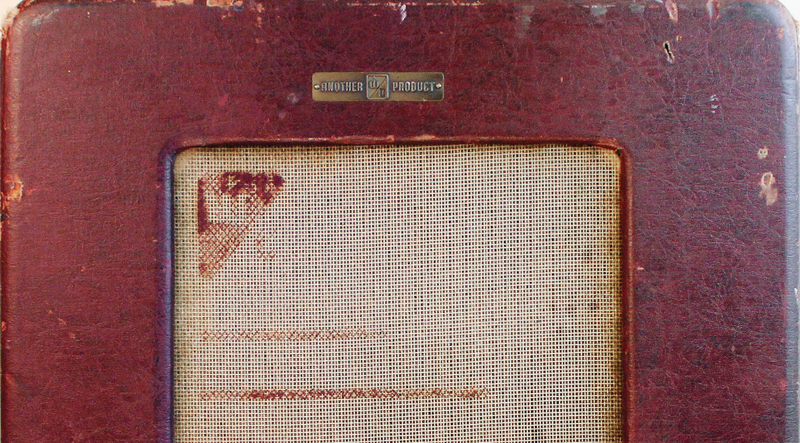
Amp courtesy of Gary Traversy. 1952 Webster-Chicago RMA 375 Model 166-1 • Preamp tubes: one 6AT6, one 12AX7 • Output tubes: two 6V6 • Rectifier: 5Y3 • Controls: Micro volume, Phono volume, Tone • Speaker: one 10″ Magnavox • Output: approximately 6 watts RMS +/–
Modified or repurposed amps generally don’t fit into our monthly discussion here, but some are representative enough of a certain standard to make an exception. Witness this gem from 1952.
Designed for general-purpose public address with a microphone or gramophone attached, as often as not you’ll find it reworked as a sweet-sounding tweed-style guitar amp or great harp amp for Chicago blues blowers with a hi-impedance crystal “bullet” mic – both of which have become common uses for this old tube-powered suitcase. For either, this stylish chunk of yesteryear presents an original voice not heard in the typical classic amps, and if you keep an eye peeled for a bargain, you’ll fork out little more than spare change. And it might even sound better than some more-collectible vintage makes of a similar size.
Ostensibly, this amp should be capable of producing more output than it does, but several elements place it among smaller, single-ended “Champ-like” amps than fully qualifying it for the push-pull/double-ended genus implied by its layout. It boasts one 6AT6 and one 12AX7 in the preamp, two 6V6 output tubes, and a 5Y3 rectifier. Dig out that schematic for Fender’s tweed Harvard combo of 1955-’61 and you’ll see the same tube complement. Did Webster-Chicago copy Fender? Of course not; this one was out several years before the 1×10″ combo from Fullerton. But it makes sense that any circuit needing only one preamp gain stage (phase inverter aside) would use a 6AT6 in the front end – a seven-pin, single-triode tube that performs similarly to those in the more common 12A–7 dual-triode family. Examine the Webster-Chicago’s schematic, though, and you’ll see its circuit is also a long way from the Harvard or any other conventional guitar amp of the era.
Though most guitarists who use the Model 166-1 have made a few changes to it, that didn’t mean ripping out the circuit and wiring in, well, a tweed Harvard. There’s a lot to be said for simply enjoying the oddball charms of this thing in as-close-to-original form as can be managed. The amp was designed and built with one signal path laid out for a microphone via one input and a second signal path for line-level source (such as gramophone) via the other input. The latter bypasses the first gain stage and goes straight on to the phase inverter, so the mic input is the one to adapt for guitar, as has been done with this example.
The inside of the amp’s cramped chassis exhibits true point-to-point wiring, with nary a circuit board or terminal strip for support. Note, too, that this example’s output configuration has been modified somewhat.
As such, signal enters the 6AT6, then departs via an .02µF coupling cap to that channel’s Volume control. From there it goes to a paraphase inverter comprising the dual triodes of the 12AX7. The amp’s single Tone control positioned between the inverted and non-inverted legs of the signal, post-PI, which makes it not dissimilar to the “cut” control on many cathode-biased British-style amps. The paraphase PI was never known for great fidelity, and is one of the characteristics of the smooth, midrangey tone that we more often associated with octal-preamp-loaded guitar amps of the late ’40s and early ’50s. To keep this tendency from devolving toward total mud, however, Webster-Chicago has a few more tricks up its sleeve.
The 6V6s that receive the signal once it’s split and flipped at this paraphase PI are ostensibly cathode-biased, but this too is performed by a means we haven’t seen used in another conventional guitar amp. In a configuration intended to create some frequency suppression – much as seen with more common forms of negative-feedback loop, but achieved very differently here – each of the 6V6s’ cathodes are connected to the opposing sides of the Stancor output transformer’s secondary connections (i.e. the positive and negative signal terminals that also drive the speaker). The secondary’s common connection is wired to ground via the 200-ohm resistor and 10µF bypass cap we’d usually see connected jointly to pin 8 of each 6V6 in a cathode-biasing configuration. Equally unusual, and to further voice the output stage, a small network comprised of a 100k resistor and .0022µF capacitor wired in series connects one of the OT’s primary’s inputs to the other (note that these have been modified in our featured example).
If you acquire one of these intending to make alterations, you’ll notice a cramped rat’s nest in the chassis. This is point-to-point wiring in its truest sense – and not its best sense. Spend a few minutes tracing and re-wiring half a dozen of these connections and you’ll see why the circuit board was praised as high progress in the late ’40s and early ’50s.
With its custom-made art deco “W” knobs, the amp looks even older than its early-’50s origins. Note updated 1/4″ guitar input.
Add it up, and (no surprise) this combo sounds a lot different than our benchmark ’55 Fender Harvard or other amps of its ilk. Beyond that, though, it also puts out far less volume than you’d expect from its tube complement and general configuration, even accounting for its inefficient 10″ Magnavox Alnico speaker. The reason is found in large part in the low DC operating voltages on the plates of each tube. Where you’d find 120 to 160 volts DC on the plates of the first gain stage in most guitar amps of the era, this 6AV6 has only 45. The 12AX7 phase inverter sees 105 volts at each side (we’d expect 200+/–), and the 6V6s only around 280 (a Harvard would see around 310 there, a tweed Deluxe around 350). Lower voltages mean relatively less signal strength from each stage, but they also indicate a “browner” sound, which this amp delivers.
Fired up and introduced to a Telecaster, this amp proves appealingly warm and mellow, with a beautiful sweetness to the notes. The core sound is clear and round – not so brown it’s indistinct and mushy – yet there’s no irritating bite in the treble whatsoever, just a very ear-caressing tone. Turned up, it’s chunky and just a bit raw, with a great natural rock-and-roll overdrive. And if it’s not all that loud, well, that’s the goal so many of us are chasing these days anyway, right? Meaty, toothsome tone at basement-friendly levels? Yes, please – and delivered with ease by this lusciously retro chunk of oxblood-covered tubular goodness.
This article originally appeared in VG April 2018 issue. All copyrights are by the author and Vintage Guitar magazine. Unauthorized replication or use is strictly prohibited.
Guitarist Joel Shapira has released a string of fine recordings, but his latest, In Essence, is his first stab at solo guitar. While the concept has been percolating in his mind for quite some time, it was spurred into existence by a meeting with Greg Schutte, who engineered, mixed, and mastered the record.
“I knew of his studio and it had a great reputation. I told him I was thinking about doing a solo record. So, I set up a session with him to make it real. That’s the point where it goes from being an idea you’ve mulled over for a period of time to actually having a commitment.”
The record is a mix of standards and “newer” jazz tunes by the likes of Thelonious Monk, Joe Henderson, Wayne Shorter, and Miles Davis. “There wasn’t a bunch of preparation or anything.There are tunes I like and know well, so they were always on my mind. The takes on the record have similarities to how I play them live, but there is no guarantee they’ll sound the same the next time I play it. I have a basic idea how I approach them, but I want the song to take the most natural course, depending on the crowd. That’s why the CD is titled In Essence. I think it’s a reflection of what I do on those solo gigs.”
Shapira grew up in a house that had music in it, with stacks of records that he started listening to at the age of six. At that point, he discovered one that most six-year-old kids would likely skip over.
“I was mesmerized by the Mahavishnu Orchestra’s Inner Mounting Flame and a handful of other recordings,” he said. “And I guess I thought that all kids my age were listening to that type of music (laughs). What I figured out later is that the same thing that struck me about that record when I was young continued to have an effect on me as an adult, but obviously with a more-mature understanding of it.”
Later, he was also influenced by the pop and rock of the day; Jimmy Page and Led Zeppelin got him into the guitar.
“At 11 or 12, I played as much as I could,” he said. “I had a couple of friends with guitars, and we’d jam. I’d solo and thought to myself, ‘I can do this.’”
His turn toward jazz, he said, was a transition that had to happen. He played in high school jazz band and started closely listening to jazz players.
“My teachers pointed me to Joe Pass, and they couldn’t have given me better advice,” he recalled. “Then I saw Jim Hall in concert at about 15. A drummer friend and I went to that show, and from that point on, we wanted to play jazz.”
In 1987, he moved to Boston to attend Berklee College of Music. But, his stay was short. Wanting to play more, he went to New York.
“That was a huge dose of reality,” he said. “I loved New York City, but then moved back to my home town of St. Paul. I felt what I needed more than anything was experience. I needed to play with better players, and fortunately, the Twin Cities is a haven for great players.”
Aside from solo gigs, Shapira now plays in several quartets, his own trio, and he accompanies numerous vocalists including Charmin Michelle, with whom he has played for more than 20 years. He calls her his “greatest musical ally,” and together they’ve released two CDs.
The guitars on In Essence are the same he uses on gigs – a ’69 Gibson L-5, 2000 D’Angelico New Yorker, ’86 Ramirez Concert 180, and a steel-string Martin. He’s also recently acquired a Tele he uses on solo gigs.
For amps, he used a ’68 Fender Pro Reverb that Schutte has in his studio. His gig amps include a Carr Rambler 112 which he calls the nicest jazz amp he’s ever owned. He also likes his Henriksen Bud.
While he stays busy with gigs and teaching, Shapira continues to work on his playing at every opportunity.
“That’s part of being a musician – learning from other players. There are so many brilliant players out there.”
This article originally appeared in VG April 2018 issue. All copyrights are by the author and Vintage Guitar magazine. Unauthorized replication or use is strictly prohibited.








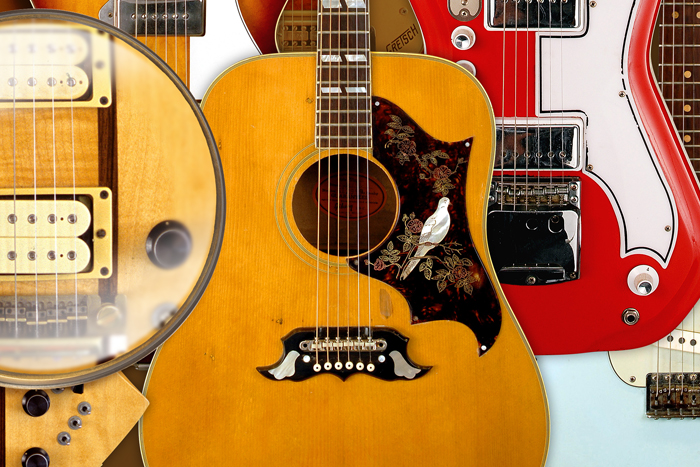
 When it comes to identifying guitars, basses, amps, and effects, nobody knows it all. Anyone save for the true specialist, whose interest is focused on a particular model, make, or era, knows there’s an impossible mountain of detail concerning materials, specs, and luthiery techniques for the thousands of vintage models.


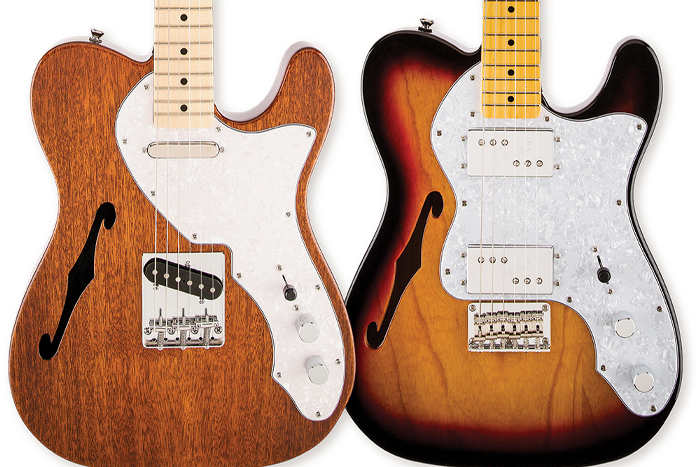


 Rossmeisl then turned to product manager Virgilio “Babe” Simoni, who suggested they cut a thin slice off the back of a body, use a router to hollow-out the bass and treble bouts, then glue the slice back in place. The end result weighed about half compared to a regular Telecaster body.

 Ostensibly, this amp should be capable of producing more output than it does, but several elements place it among smaller, single-ended “Champ-like” amps than fully qualifying it for the push-pull/double-ended genus implied by its layout. It boasts one 6AT6 and one 12AX7 in the preamp, two 6V6 output tubes, and a 5Y3 rectifier. Dig out that schematic for Fender’s tweed Harvard combo of 1955-’61 and you’ll see the same tube complement. Did Webster-Chicago copy Fender? Of course not; this one was out several years before the 1×10″ combo from Fullerton. But it makes sense that any circuit needing only one preamp gain stage (phase inverter aside) would use a 6AT6 in the front end – a seven-pin, single-triode tube that performs similarly to those in the more common 12A–7 dual-triode family. Examine the Webster-Chicago’s schematic, though, and you’ll see its circuit is also a long way from the Harvard or any other conventional guitar amp of the era.