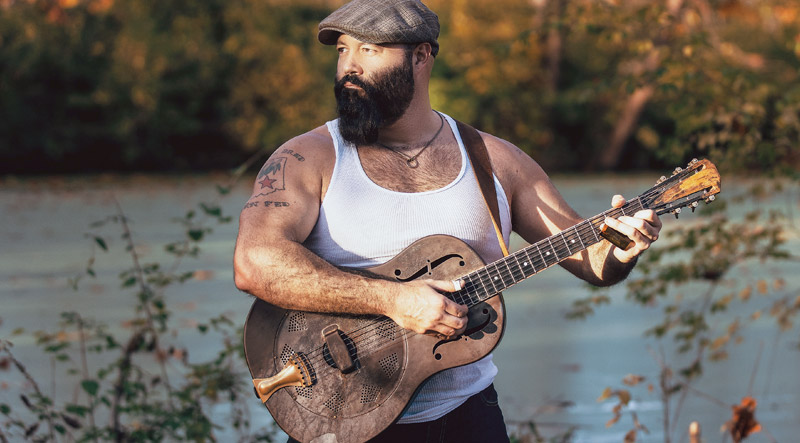
“I got all the ways/I just ain’t got the means,” 40-year-old Josh “Reverend” Peyton of Reverend Peyton’s Big Damn Band sings on Dance Songs for Hard Times, the blues and roots trio’s latest studio release that’s undeniably timely in the era of Covid-19.
That doesn’t necessarily mean misery. The accompanying “Ways and Means” video, filmed on a shoestring budget at a laundromat in Bloomington, Indiana, is a wonderfully strange yellow-and-green affair that offers a quirky Alice-In-Wonderland vibe – like if Quentin Tarantino’s edge was brought to a Katy Perry video.
The new album is a defiant, spirited acknowledgement of the pandemic that sickened the band (especially Reverend’s wife, Breezy, who plays washboard), made touring impossible and cast a pall over their future.
The new album’s lead single “Ways and Means,” feels like a nice summation of the band – a big, dense sound, a sticky slide part, and acknowledgement of certain influences.
That song is quintessential Reverend Peyton. It’s a nice mix of all different kinds of blues including a bit of hill country; there’s definitely that Robert Belfour influence. The slide is Charley Patton in a lot of ways. The way the song comes together, you almost have to tip your hat a bit to John Fogerty or Billy Gibbons for the riffs. I really wanted people to hear that song.
Did you have concerns about releasing the music in the middle of a global health crisis?
Yes, but we have concerns about everything. We have concerns about our career going forward, what the music business is gonna be in the next few months. Nobody knows. Ninety percent of the music business has been devastated. That’s unbelievable. I mean, what is the music business anymore? It’s hard to say what’s gonna be borne from the ashes of all this.
Beyond tangible things like money, what’s lost when a working band simply can’t work?
When you’re used to playing live pretty much every night, there’s an adrenaline rush that’s similar to being addicted to drugs or alcohol. Coming off of that has been tough. I didn’t realize just how much I lived for that adrenaline, that connection. When you’re playing into a camera over the internet, it’s not nothing, but the actual connection you get when staring a crowd in the face and everybody’s on the same wavelength. It becomes bigger than the sum of its parts. It’s a communal thing that borders on the religious. It’s magic. There’s just no replacement for it.
The album showcases a pretty dexterous approach to fingerstyle blues. A great example is “Too Cool to Dance,” which is a real retro-sounding rocker.
That’s kind of a weird song for us. It has this ’50s vibe to it… It’s a thing on the guitar that I always wanted to do more of, basically doing all that rhythm with my thumb while playing those Chuck Berry licks at the same time. It was sung and played at the same time, and cut live to eight-track analog tape.
On “Ways and Means,” you used the vintage Supro Dual Tone shown in the video. Which other guitars do we hear on the album?
That’s actually a unique guitar. It’s a prototype that pre-dates the Supro Dual Tone. We think it might actually be from 1952. Otherwise, I have different guitars that are set up for different tunings. I don’t necessarily capo – I like to put it in the tuning I want to play. On this album, I’m playing a ’49 Harmony H50, an early Kay Speed Demon from before they actually called them that; it has just one pickup. When I bought it, I was told it’s a ’55, but we can’t be 100 percent sure. It’s from somewhere around there.
There are also some resonators.
Yes, a very special 1930 National Triolian that has been with me a long time. There’s also a custom National from National Resophonic. They created that for me, and it’s beautiful. I love that instrument.
Is it hard to come up with ideas and keep sounding fresh when you’re using Delta blues as a base?
Yes, that it is a challenging thing. But the beauty of music is that even though there are those 12 chromatic notes, there’s a whole lot of music to be made between those frets. It’s infinite, and that’s really the beauty of it.
This article originally appeared in VG’s August 2021 issue. All copyrights are by the author and Vintage Guitar magazine. Unauthorized replication or use is strictly prohibited.
St. Louis’ own jazz-fusion mainstay Scott T. Jones runs through a few tunes – on a few different guitars – from his new album, “Fictional Characters.” Scott is interviewed in the March issue, and watch for our review in April! Read Now!
This month we feature Slash, Myles Kennedy, Ventures’ Don Wilson, J.D. Simo, Isaiah Mitchell, Luther Dickinson, Joe Satriani, Earl Hooker, Tinsley Ellis, Steve Vai and more!
Spotify is free, or available without ads via paid subscription. Go to www.spotify.com and search “Vintage Guitar magazine,”or if you already have an account Listen to the complete list HERE.
Don’t miss Vintage Guitar magazine’s monthly playlist on the music-streaming service Spotify. Each month, Karl Markgraf curates a playlist featuring artists and songs mentioned in the pages of VG, arranged in order to play along as you read the issue, or just enjoy on its own! Karl holds bachelor’s degree in Jazz Guitar from the University of Northern Colorado, and works as a performing and recording artist, producer, and educator in New York.
Also New On Spotify
Also on Spotify is VG’s “Have Guitar Will Travel” podcast, hosted by James Patrick Regan. The twice-monthly episodes feature guitar players, builders, dealers, and more, all sharing their personal stories, tales from the road, studio, or shop, and their love of great guitars and amps. CLICK HERE to listen.
Crimson Apple’s Shelby Benson and OTTTO
Episode 73 of “Have Guitar Will Travel” is a two-fer starting with guitarist Shelby Benson from the dark-pop band Crimson Apple, who dishes on how she learned to play, her gear, and how they monetize social media. Then, host James Patrick Regan talks with all three members of the L.A. thrash band OTTTO – guitarist/vocalist Bryan Ferretti, bassist Tye Trujillo, and drummer Ryan Duswalt talk about how they emerged from The Helmets, their gear, and the thrill of subbing for Korn on a tour of South America. Please like, comment, and share this podcast! Listen Here!
Molly Moore with her guitarist Ariel Bellvalaire and MUNA’s Josette Maskin
Episode 74 of “Have Guitar Will Travel” opens with host James Patrick Regan speaking with Molly Moore and her guitarist, Ariel Bellvalaire. Ariel grew up in the Connecticut and moved to L.A. when she was 15. Starting on guitar at 12 and influenced by Eddie Van Halen, Randy Rhodes, and Steve Vai, she studied at Musicians Institute and gigged at the Bitter End when she was 17. Molly’s new band came together through social media.
Also in the episode, James sits with Josette Maskin, guitarist for the electronic-pop band MUNA, who talks about her first guitars, early influences, how the group met almost 10 years ago as students at USC, and the thrill of recording at Electric Ladyland studio. As you’ll hear, she’s jazzed about the band’s upcoming tour with Kasey Musgraves. Please like, comment, and share this podcast! Listen Here!
Have Guitar Will Travel, hosted by James Patrick Regan, otherwise known as Jimmy from the Deadlies, is presented by Vintage Guitar magazine, the destination for guitar enthusiasts. Podcast episodes feature guitar players, builders, dealers and more – all with great experiences to share! Find all podcasts at www.vintageguitar.com/category/podcasts.
Each episode is available on Stitcher, iheartradio, Tune In, Apple Podcast, and Spotify!
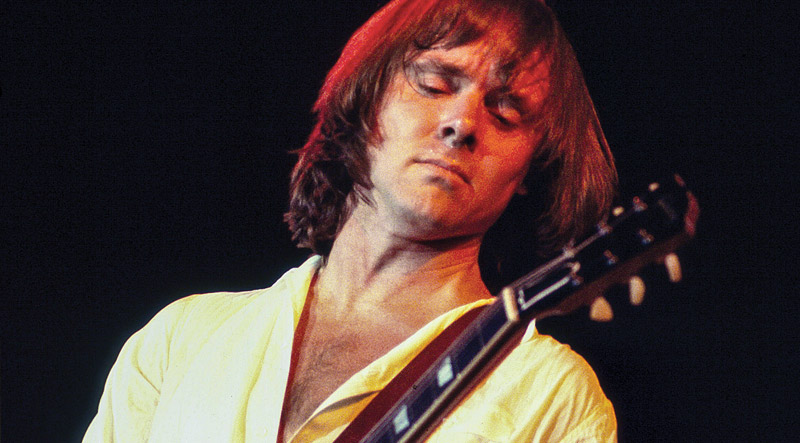
Ronnie Montrose onstage in 1978. Ronnie Montrose: Chris Walter/ Photofeatures/Zuma.
The cultural and musical hotbed that was San Francisco in the ’60s produced numerous important bands – Santana, Grateful Dead, Steve Miller, Quicksilver Messenger Service, Jefferson Airplane, Big Brother, and Moby Grape were homegrown answers to sounds pouring out of Britain, Los Angeles, and New York.
It all proved so irresistible that visitors like George Harrison were prompted to partake of the atmosphere, while others, like Paul Butterfield, made it a second home. By the early ’70s, hard rock supplanted psychedelic pop, jam bands, and regional folk-blues-jug band amalgams. S.F. responded with its own brand of metallic mayhem, and prime among the proponents was an outfit bearing its founder’s name, Montrose.
Ronald Douglas Montrose was born in San Francisco on November 29, 1947, but spent his childhood in Denver. He came to music later than most, at 18 (after holding a friend’s guitar), and quickly began learning songs by ear. His education was through riffs and licks learned from records by Elvis, the Beatles, Stones, Beach Boys, Roy Orbison, Chuck Berry, and others. He was recruited into a local band called Grim Reapers, where he played an unfriendly Danelectro 12-string, then worked with Daddy Longlegs before returning to San Francisco. His professional career began in ’69, with Sawbuck, which recorded a self-titled album for Fillmore Records in ’71. He then connected with David Rubinson, partner of promoter Bill Graham, who secured session work for Ronnie with luminaries like Van Morrison (on Tupelo Honey) and Herbie Hancock (Mwandishi). He performed briefly with Boz Scaggs, then joined the Edgar Winter Group in ’71 as lead guitarist, playing electric, 12-string acoustic, and mandolin on They Only Come Out at Night, with an all-star lineup that included Rick Derringer, Randy Jo Hobbs, and Dan Hartman. Produced by Bill Szymczyk (of Eagles fame), the disc boasted landmark tracks “Frankenstein” and “Free Ride.” Encouragement from Winter to “play heavier” led Montrose, then a journeyman session guitarist, to pursue a harder rock direction, harnessing the power of high-decibel amplification. It paved the path to Montrose, the band, which formed in ’73.
Montrose began its run with comparisons to the paragon of heavy groups, Led Zeppelin. Metal was in its infancy when the quartet debuted with vocalist Sammy Hagar, bassist Bill Church, and drummer Denny Carmassi. Produced and engineered by Ted Templeman and Donn Landee, the band’s first album was released on Warner Brothers, and though it didn’t initially attain hit status (partly due to insufficient marketing), it eventually garnered platinum status, international recognition, and remains one of the most-admired works in the genre. Touted as America’s first heavy-metal record, it was cited in Hit Parader’s Top 100 heavy-metal albums and voted fourth-best metal album of all time by Kerrang!. Montrose’s ’74 sophomore recording, Paper Money, was its most commercially successful, reaching #65 on Billboard. It found Alan Fitzgerald (later of Night Ranger) as bassist with studio keyboards by Mark Jordan and Nick DeCaro. Hagar departed to launch his solo career following a ’75 European tour and was replaced by Bob James, recruited from a Montrose cover band. The quartet became a quintet with keyboardist Jim Alcivar for Warner Bros. Presents Montrose, which reached #79. Jump On It was the band’s final album of the decade and featured James, Alcivar, Carmassi, and Montrose with additional studio bass work by Randy Jo Hobbs.
This burning phrase began the live version of “Good Rockin’ Tonight,” the opener at Montrose’s KSAN debut. Ronnie launches the tune with a free cadenza filled with virtuosic passagework which can only be called proto-shred. Like Van Halen, Rhoads, and many to follow, he develops a wealth of interesting sounds over a handful of introductory chords, here Bsus4 and Asus2 – two appropriately open and harmonically vague sonorities that invite decoration. And what decorating! Ronnie plays slippery modal runs in B minor, a rising sequential melody and wailing string bends with wide vibrato over the first chord. Over Asus2 he blends open-string diatonic legato figures, reminiscent of EVH’s flurries in “Eruption,” with some challenging chromatic moves that apply atonality and an excursion into D minor for an exotic twist before resolving back to A major. Quite daring in ’73, these sounds would become the norm in metal and hard rock within just a few short years, thanks to Ronnie.
After disbanding Montrose in ’77, Ronnie released his first solo album the following year; Open Fire was an instrumental recording cut from the same cloth as Jeff Beck’s Blow By Blow, and reflected his eclecticism with forays into jazz, power pop, semi-classical and electronic/acoustic timbres. Produced by Edgar Winter, it is definitive prog-rock fusion with Montrose’s guitar voice (electric and acoustic) weaving in and out of ambitious arrangements and varied orchestral settings. “Town Without Pity,” an inspired cover, became a theme heard at concerts. Open Fire reached across genres to attract Miles Davis’ drummer Tony Williams, who in July of ’78 invited Ronnie to participate in a Tokyo all-stars show alongside Brian Auger and Billy Cobham. The set included originals “Open Fire” and “Heads Up” as well as “Rocky Road” from the album. Ronnie issued various solo albums in the following years, epitomized by Territory, Bearings, and The Speed of Sound, cited as his favorite instrumental outing.
In ’79, Ronnie formed Gamma, favoring an AOR direction informed by prog rock and reveling in a blend of heavy guitar with new synthesizer technology. Its lineup changed through four self-titled albums recorded between ’79 and 2000, relying on singer Davey Pattison and musicians from earlier bands including Alcivar, Fitzgerald, and Carmassi augmented by Glenn Letsch, Mitchell Froom, and others. Gamma enjoyed periods of activity and minor hits like “I’m Alive” and “Right the First Time,” but disbanded in 2000, after Gamma 4.
Ronnie continued his solo career, briefly joined Seattle’s Rail in ’85, assembled a new Montrose in ’87, and guested as session player on albums by Hagar and Paul Kantner. After surviving prostate cancer in 2009, he died on March 3, 2012, from a self-inflicted gunshot wound in the wake of personal tragedies and having suffered clinical depression since childhood. A posthumous solo album, 10×10 (featuring 10 songs by 10 singers), was released in ’17. It completed tracks begun in the early 2000s with bassist Ricky Phillips (Styx) and drummer Eric Singer (Kiss), and featured Hagar, Winter, and Pattison on vocals along with Eric Martin, Glenn Hughes, Gregg Rolie, and guitarists Steve Lukather, Dave Meniketti, Phil Collen, Tommy Shaw, Mark Farner, Brad Whitford, and Joe Bonamassa. It stands as a glowing tribute to the Ronnie Montrose legacy.
“Make It Last” was a leading track on Montrose and favorite of Eddie Van Halen and many others. It boasts one of those “big chord riffs” Hagar cited as Ronnie’s forté. The main riff established the groove from the outset with its driving rhythms and use of space. It hinted at ’70s/’80s metal hooks with a thoughtful mix of root-fifth power chords and power dyads in perfect fourths. Note the connective single-note line acting as a pickup into A5 midway and muted string scrapes as well as the unusual addition of an F5 dyad in the progression that injects modal content into an otherwise blues-rock setting. The D5 dyads are given Ronnie’s signature vibrato treatment via his left-hand string bending.
INFLUENCES
Ronnie’s early influences include Mike Bloomfield and Elvin Bishop on Paul Butterfield Blues Band’s East West album. His listening expanded with Eric Clapton’s blues-rock on Fresh Cream and Jimi Hendrix’s futuristic exploits on Are You Experienced?; “Shoot Us Down” contains overt nods to Jimi’s “Foxy Lady,” while his singing Les Paul tone alludes to Slowhand’s Cream-era sound.
STYLE
A dedicated eclectic, Ronnie reconciled hard rock with power pop, electronica, and orchestral aspirations. His Montrose work strengthened the impression he was one of America’s most accomplished rock guitarists, however “Town Without Pity,” a model for Gary Moore’s instrumental outings, revealed his sensitivity in delivering a song sung on electric guitar and its navigation through orchestral arrangements. His efforts in Gamma found him changing gears to incorporate synth-driven textures in rock, going beyond precedents set by Foreigner and Journey. He later returned to straightforward melodic rock on The Speed of Sound.
Ronnie’s lead playing was influential beyond measure. Though never a household name, his effect on rock guitarists is self-evident. His singing lead sound is distinguished by exceptional intonation in string bends and the smooth vocal quality of his vibrato. The arpeggio ostinatos in “Make It Last” and “Shoot Us Down” (demo) are signatures that inspired similar figures in the work of Angus Young, Randy Rhoads, and Michael Schenker, et al, as well as the tap-on flurries in Van Halen’s “Eruption.” His superior technique was personified in blazing pentatonic/blues and diatonic runs, and double-timed note cascades that presaged shred trends, epitomized in the opening solo breaks in “I Got the Fire,” “You’re Out of Time” and Gamma’s “Solar Heat.” He was a risk-taking explorer on guitar. Consider the chromatic runs in “Roll Over, Beethoven” (4:16) and “Ready for Action” (2:15). Moreover, he set new trends with uncommon approaches to common devices. Case in point are the faux-pick-slide effects created by rubbing fingertip harmonics on roundwound strings, on the “Rock Candy” riff. Vibrato-bar antics on “Good Rockin’ Tonight” strike a middle ground between Jimi and Eddie, while harmony guitars on “I’m Alive” and muted technical passages in “Razor King” reveal deeper refinements gleaned from fusion. He applied conventional flatpicking and hybrid picking to lead and rhythm guitar.
Ronnie had his own approach to rock rhythm guitar, distinctly different from Clapton, Hendrix, Page or Beck. He was revered for big-chord riffs in driving tunes like “Rock the Nation” and “Make It Last.” Many of the signature riffs heard throughout his career are made of power dyads which he bent and vibrated with fingers not a whammy bar. He largely relied on standard tuning, however tuned his guitar to open D on “Bad Motor Scooter.” His arrangements and solo-guitar spots were sometimes colored with modern space-age sounds generated by a Theremin-equipped guitar. All the aforementioned elements were studied by a generation of nascent guitar heroes including a certain Ed Van Halen playing hard-rock fare in parties and clubs. The link between Van Halen and Montrose, two bands bearing the last name of their guitarist, is undeniable. Eddie was a devoted fan who insisted Templeman “get the Montrose sound” on their first record. Moreover, “Dancin’ Feet” was a VH staple at Pasadena backyard parties, “Make It Last” was on their set list during the Gazzari’s period, and “Rock Candy” was a song played live in ’86 when Hagar joined the ranks.
Ronnie’s powerful lead style was exemplified by solos like “I Got the Fire” on Paper Money. This telling phrase makes the case convincingly. Note the sense of musicianship and structure in his solo licks. The pentatonic/blues ideas introduced in measures 1 and 2 are imitated an octave higher in 3 and 4 where a string bend replaces the earlier notes, reached by sliding to them. That’s a typically slick variation heard in many of his solos. The double-timed blues-rock patterns in 5 are staples but the ascending chromatic line in 7-8, made of pull-offs on a single string, are a personal maneuver that adds an abstract touch to the hard-rock proceedings.
ESSENTIAL LISTENING Montrose is a classic, and the expanded edition is recommended for its demos and live tracks. The Very Best of Montrose offers a serviceable overview, however serious hard-rock fans should explore all four albums. Also essential are Ronnie’s first solo record, Open Fire, and Gamma 1.
ESSENTIAL VIEWING
Important online clips include a 20-minute ’74 Montrose performance from “The Old Grey Whistle Test,” definitive live version of “Town Without Pity” from ’78, and several telling guitar interviews.
SOUND
Ronnie is closely associated with a Les Paul and he first brandished a late-’60s Deluxe refitted with humbuckers. Touring with Winter, he befriended J. Geils, who helped him acquire a ’58 Standard that later was stolen then replaced with another ’58 that became his mainstay. He also played a black ’55 Custom with replaced PAFs and ’59 Junior with a DiMarzio pickup. Other guitars include a highly modified ’65 Strat refinished red with a bridge humbucker used throughout Paper Money, a ’58 Flying V, a modified Gibson 6/12 doubleneck, and a Theremin-equipped Veleno heard to good advantage on “Space Station #5.” He later played a Gene Baker B2 with maple top and mahogany body, and, in the new millenium, Jackson guitars with wide fretboards (17/8″ nut) and Duncan pickups.
Early on, he created a string set from two Gibson Sonomatic packages, using heavier strings on the bottom (.050/.040/.028), lighter on top (.016/.012/.009). He preferred a West German Mica nylon pick and 2″ glass slide.
For acoustic sounds in the the studio, Ronnie relied on Gibson J-45, a Southern Jumbo, a CF-100E, and a mandocello.
His amp was at first a 300-watt Ampeg SVT with SRO speakers, but by the mid ’70s he’d jumped to Marshall stacks. Later, he dabbled with Gibson LAB Series, then preferred a Bogner Shiva. Montrose was recorded with an overdriven 40-watt 3×10 tweed Fender Bandmaster with Jensen speakers. With Van Morrison, he employed a “…Princeton set on about 4.” Ronnie used effects sparingly; stompboxes include a Big Muff fuzz (notably on “Bad Motor Scooter” played on a Les Paul Junior), Ampeg Scrambler distortion, Crybaby wah, and Eventide TimeFactor delay.
Wolf Marshall is the founder and original editor-in-chief of GuitarOne magazine. A respected author and columnist, he has been influential in contemporary music education since the early 1980s. His books include 101 Must-Know Rock Licks, B.B. King: the Definitive Collection, and Best of Jazz Guitar, and a list credits can be found at wolfmarshall.com.
This article originally appeared in VG’s August 2021 issue. All copyrights are by the author and Vintage Guitar magazine. Unauthorized replication or use is strictly prohibited.
Jazz-rock fusion was vastly popular in the mid 1970s, but began to run out of steam as the “smooth jazz” of Spyro Gyra and Chuck Mangione simply became more lucrative. Even the superlative Weather Report had a radio hit with “Birdland.”
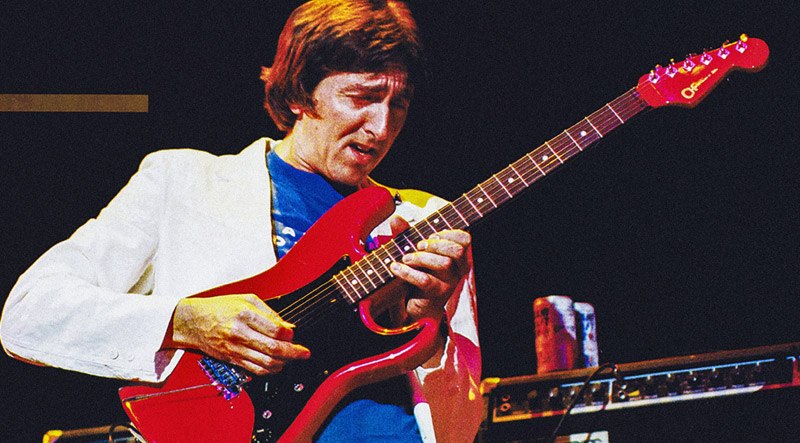
Bill Bruford was having none of it. The former Yes and King Crimson drummer had already cut one Bruford album with a crack band and, in ’79, got the same fusion aces together for another go. The resulting One of a Kind proved a masterpiece of the genre, moving away from long, wild improvisations and toward strong melodies with cracking performances from guitarist Allan Holdsworth and super-bassist Jeff Berlin. With four strong personalities, the sessions might have been chaotic, but renowned engineer Stephen W. Tayler (Tina Turner, Peter Gabriel, Rush, Jethro Tull) recalls that young Mr. Bruford had a firm grip on things.
“I’d worked with Bill on the first Bruford album, Feels Good to Me, as a young engineer,” he said when asked about the One of a Kind sessions at Trident studios in London’s Soho neighborhood. “He and keyboardist Dave Stewart (Hatfield & the North, National Health) did substantial pre-production, so by the time they arrived, Bill was organized and became the driving force. Studio time was expensive and we had a strict schedule. While most of the compositions and basic arrangements were predetermined, he allowed for a certain creative flexibility and development during the sessions.”
Another challenge was capturing each instrument clearly, as the music was complex and often uptempo. As such, Tayler deployed a classic studio tactic.
“The basic strategy was to capture live drums and bass as the basis for everything, with a guide keyboard and guitar track that could be expanded or replaced,” he said. “We were recording with 24 tracks, which meant drums were committed to five or seven tracks, bass on two others, leaving a number available for adding parts.
“Lead keyboard and guitar were added as overdubs – especially solo or feature parts,” he added. “Much of the composition was written or planned, with the exception of more-freely improvised solo work.”
At that moment in rock history, Holdsworth and Berlin were among the hottest fusion musicians alive, both fundamentally having changed the way players approached electric guitar and bass.
“Bass was usually captured by a combination of direct and amped recording,” Bruford said of recording most tracks at the Trident sessions. “I wasn’t particularly happy with the result of Jeff’s bass sound on this project, but we didn’t have a lot of time to make choices, especially at the mixing stage. The track ‘5G’ also had very early slap-bass and was a new experience at this time, but so many musicians were bending the rules, especially bass players like Jeff.”
The late Holdsworth was another challenge, as his brilliance was often counterweighted by self-criticism.
“Allan was quite the character,” Tayler remembers. “I first experienced his work on the Gong album Gazeuse, which I mixed, then I worked with him on Feels Good to Me and the U.K. album. He was extremely focused and critical of his contribution, but very insecure about his playing, and never that happy about a performance. He wanted to keep doing things over, so we had to encourage him and finally tell him we’d captured it!”
Today, Holdsworth is revered as a guitar legend, but to Bruton, cutting the tracks at the time was just another day in a busy studio.
“For overdubs, we started to have Allan play in the control room while feeding his signal to the studio floor. I usually recorded one microphone close to his cabinet, then I’d set up another at some distance to pick up the room sound to a separate track so I could create a balance. I remember recording Allan playing his Strat in the control room as we monitored really loudly so he could control tone and feedback.”
That likely was the Strat modded by Dick Knight with two DiMarzio humbuckers and a bound fretboard.
Forty years on, Tayler has amassed a top-tier discography of production and engineering credits, including albums for The Fixx, Kate Bush, and Howard Jones, as well as old fusion friends like Brand X. Among the jazz-rock projects he worked, however, One of a Kind remains a high point.
“It was a definitive album for Bill. He was in control of everything. We had to make albums under very strict limitations of time and budget. Those four musicians were quite astonishing to work with – committed, fearless, and focused – and it was an amazing experience. Looking back, I think about what a lucky chap I was!”
This article originally appeared in VG’s August 2021 issue. All copyrights are by the author and Vintage Guitar magazine. Unauthorized replication or use is strictly prohibited.
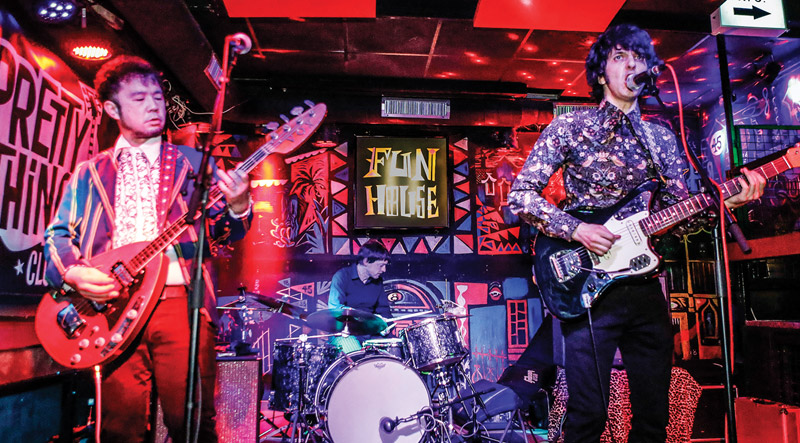
The Routes: Toru Nishimuta, Bryan Styles, and Chris Jack.
Color the Routes’ mastermind Chris Jack’s music how you like: vintage-y, psychedelia, joyfully and unapologetically garage. But be sure to color it outside the lines.
Jack is a musical mad scientist. Each release – whether it’s a full band outing or his stellar 2020 solo shot Miles To Go – charts varied directions, myriad influences, and new frontiers.
This is the eighth disc from the Routes, and if you haven’t been keeping score, the band is a bit of a musical-chairs game with a sound that’s never fixed. Jack’s infatuation with wacky vintage Brit and Japanese oddball guitars – the more curves, switches, glitter, and pickups the better – is matched by his love for experimenting with old-skool fuzzes and other oddball effects through classic amps you’ve only heard rumors of.
The title track is a swirling, rocking confection, while “Two Steps Ahead” rides a driving punky underground progression with classic trebly guitar tones; think of the Monks, 13th Floor Elevators, the Zombies, Japanese surf rock – but don’t get stuck there. The Routes’ trip is gloriously unpredictable.
This article originally appeared in VG’s August 2021 issue. All copyrights are by the author and Vintage Guitar magazine. Unauthorized replication or use is strictly prohibited.
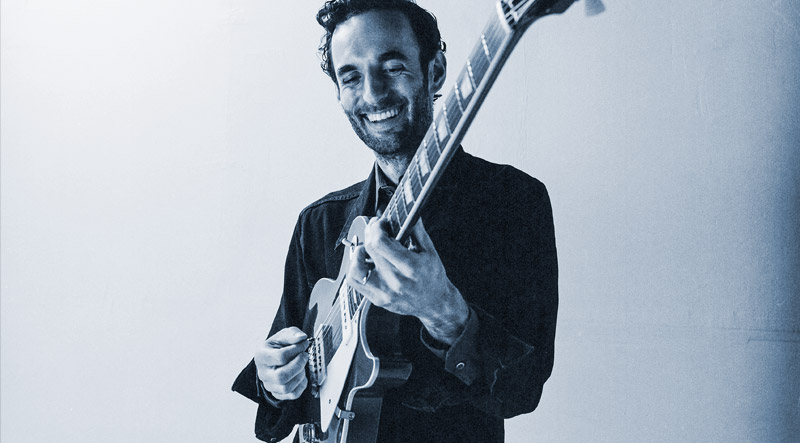
Julian Lage walks an intriguing line between jazz and rock-and-roll. On his latest – and first release on the stellar jazz label, Blue Note – he continues that tradition, and the result may be his deepest album yet. In part, this is thanks to none other than Wilco’s Jeff Tweedy, who may seem an odd influence for a jazz disc, but Tweedy reportedly inspired some of Lage’s crafting of songs.
On Squint, Lage is back with the usual suspects – his trio, including bassist Jorge Roeder and Bad Plus drummer Dave King. And their enduring work together results in tight interplay. “Saint Rose” is the album’s first single, an ode to Lage’s California hometown of Santa Rosa. The song brings to mind some of Grant Green’s playing, with a dark, almost mysterious sound to it and Julian’s deft, inventive fretwork.
“Boo’s Blues” may be the high point here, however. Influenced by bebop guitarists past, it’s all new, all Lage. The tune’s stylishly swinging melody line is set off by a fireworks of improvisation: you might hear echoes of Django and Wes, but also of the off-kilter timing and intervals of Thelonious Monk. Wow.
This article originally appeared in VG’s August 2021 issue. All copyrights are by the author and Vintage Guitar magazine. Unauthorized replication or use is strictly prohibited.
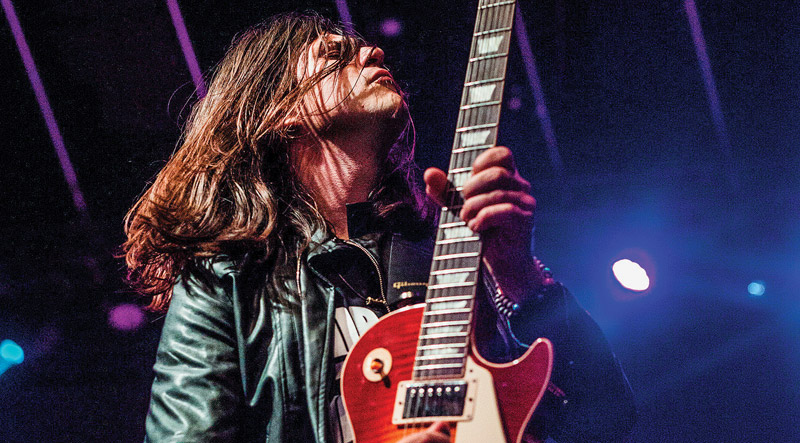
The “Is rock dead?” debate rears its head every few years. But with the emergence of new bands like Dirty Honey, good ol’ rip-roaring rock and roll is still very much alive – as evidenced by the band’s self-titled full-length debut. Driving the band’s sound are the durable guitar riffs provided by John Notto, who, it turns out, prefers vintage gear.
What was your guitar setup on the new album?
I like the fact that I got to use my #1 Les Paul a lot – a Custom Shop 1958 reissue. I take it on tour, too, so it’s kind of “my sound.” But I also had access to some old gems; I had the ’50s Les Paul Junior I played on our Instagram “Making of ‘California Dreamin’” video. I also got to use a ’65 or ’66 335 – that guitar was screaming. I kick myself that I didn’t use it on more solos.
I always play through my 1981 Marshall JCM800 head set basically clean because I want that brittle spike through its cabinet. I also had a couple of different plexi reissues that brought the warm/creamy overdrive. I love the variation of blending those.
For a lot of the solos, we opened the door to the amp booth and we’d turn on the mics in the drum room. I’d stand right up against the speakers so they’d start to get this kind of squeal. It changes the tone when you get close to that kind of volume – it’s pretty awesome. And I did use my Fulltone Octafuzz.
Which songs are you most proud of, guitar-wise?
The solo on “The Morning” is that 335, and I get into that Angus/Slowhand thing perfectly on that. The tone is through the roof. I love the riff of “California Dreamin’” so much, and I’m very proud of not just the solo but the structure of that part of that song, how it jumps a key. I think it’s a really well-written song. I’m really proud of the riff and the solo in “Gypsy”; it’s a fun “drive your car fast” kind of song. The solo on “Tied Up” is the least indulgent. It’s almost like “a part,” which was intentional because I thought it fit the song. It’s hard to choose because I pride myself on picking what’s best for the song rather than being, “Alright guys, time for me to rip.” I think that’s the brand of our music – it’s always musical, even when I’m taking a solo.
You play other instruments, too…
Not as well (laughs)! At home, I have this cool garage that was converted into a guest house, and we converted the guest house into a studio. I’ve got a drum set, a bass, and a piano, so I hack it out on those when it’s just me. If I have a riff, a verse, and a chorus idea, I’ll record it and play all the other parts, too. It certainly doesn’t sound like Dirty Honey, but it gets the point across. Especially for Marc [Labelle, singer], it gets him going. Once I get that green light, I take it to the others, and it becomes Dirty Honey.
You spent four years studying music at the University of Southern Maine.
Yeah. It was kind of a mix. In some ways, it was a detraction from my truth. But in other ways, it strengthened me as a musician. I just love guitar playing and music – I love harmony – but I don’t like being nerdy about it; I’m not obsessed with technique or technical stuff. But I can listen to a Chopin piece and be enthralled – excellence is excellence to me. Overall, there isn’t much of that education that I can directly point to in Dirty Honey music… at all. When you go to music school, they can’t teach you how to be an artist, to be creative, to find your own voice. They show you how to practice general musicianship. But being a musician helped me get work, move to L.A., and stay on my feet. And when I met Marc, we started working on his.
Who were your guitar influences?
It was really whatever was in my mom’s record collection – Jimmy Page, Jimi Hendrix, Duane Allman. A little bit of Aerosmith. And then I got into Brian May and Angus Young. And of course, Slash – he’s kind of like “the last guitar hero.” As a teenager, I liked Trey Anastasio a lot – I thought that was a unique, different approach. And I love Derek Trucks.
This article originally appeared in VG’s August 2021 issue. All copyrights are by the author and Vintage Guitar magazine. Unauthorized replication or use is strictly prohibited.
Paul Gilbert’s 16th solo album, Werewolves of Portland, is an ambitious DIY project where he plays all the instruments. From The Beatles to Pat Travers to Brian May, Gilbert’s fretboard imagination runs the gamut.
As he continues to move beyond his shredtastic origins, Gilbert is embracing a positive outlook, a sense of humor, and his lyrical side with new and expressive techniques, including slide guitar.
You’ve been playing a lot of slide lately.
It keeps getting more comfortable, but it was horrible when I started (laughs). Doing Mr. Big records, I’d get the veto from producer Kevin Elson when I’d try to do a slide solo. He used to be the sound engineer for Lynyrd Skynyrd, and those guys are real slide players, so he’d hear me and go, “Paul, play how you play… put that thing away.” (laughs)
But as I started listening to more blues, I’d hear more in what the slide was good at. In a way, that made the target a little more real. Before, I was trying to reproduce my scaley kind of playing, and slide isn’t particularly good for scales. Basically, you become a one-finger guitar player, but if you stick to chord tones, it works a little better. Also, most melodies are put together that way. It works great for melody. The other thing is I barely learned any slide licks. I love Johnny Winter and all the great slide players, but for whatever reason, I think I’m intimidated. Copying a real slide guitar player is scary.
Your slide style leans more toward George Harrison than Elmore James.
That’s because all the practicing I’ve done has been copying vocals. The first one that I aimed at was “Mercedes Benz,” by Janis Joplin. That was three years in, trying to learn all the slidey things. I get sick of hearing what I’ve been playing for the last 30 years. Slide is exciting because it’s a whole new personality and voice for me.
What compelled you to play all the instruments on Werewolves of Portland?
I was going to do it like I did on Behold Electric Guitar – live band in the studio, which was quick, easy, and fun. I had all the players, so why mess with it? But we did one rehearsal and the Covid thing hit. Suddenly, no one can be in the same room, breathing the same air. So, I put everything on hold. Hold got longer and longer, and I’d been pre-selling the record. I like working quickly, and there’s a certain energy you get when you make the music. So, I got the hare-brained scheme to play everything myself, and I started to get really excited. I love the drums, I can play bass, and I know keyboards well enough to play pads. So I got an engineer to set stuff up and I pounded away. I had to hire someone to do one little snare buzz roll because I don’t know how to do that. If you’re a marching-band person, you know how to do that. I don’t have sophisticated technique on drums.
Which guitars did you use?
I brought in a bunch. One is an Ibanez Roadstar II that feels like Van Halen I, before Eddie had the Floyd Rose. It has a longer bar and I used it on “A Thunderous Ovation Shook the Columns.” It’s got VHI style whammy, and the great thing about the ’80s Ibanezes is they’re pretty cheap. I also used my signature Ibanez Fireman, which is particularly resonant because it has a pretty big neck. I also used my Epiphone on the Brian May harmonies in “Hello North Dakota,” but I did minimal overdubbing.
I also used a Marshall JTM IC with an 8″ speaker and a Princeton Reverb. I ran them both totally clean and used three main distortion boxes – one is the JHS PG-14 Distortion Pedal, which is my signature pedal. The others were the TC Electronic MojoMojo Overdrive and a Supro Drive. Sometimes I use them in combination. Another pedal I used was the Mini Vent II, which is a Leslie simulator. Having a Leslie and a slide together can be a nice combination.
Werewolves of Portland is a very positive record despite the world’s social climate.
Before everybody went graffiti-crazy in Portland, I could feel it was an angry city. In my own life, I’m a grateful person. I wake up every morning and see all these guitars and say, “I get to do this!” My expectations are always pretty low (laughs). When good stuff happens to me, I’m thrilled. I look at my existence and go, “This is amazing!”
This article originally appeared in VG’s August 2021 issue. All copyrights are by the author and Vintage Guitar magazine. Unauthorized replication or use is strictly prohibited.
Episode 72 of “Have Guitar Will Travel” features host James Patrick Regan speaking with young R&B singer/songwriter Shannon Lauren Callihan, who grew up in Kentucky but moved to Nashville to immerse herself in the songwriters’ world. In September of ’21, she released an EP and has played several dates in support while also doing gigs as guitarist for Rozzi. They also talk gear and her online demos for Fender and Ernie Ball. Listen Here!
Have Guitar Will Travel, hosted by James Patrick Regan, otherwise known as Jimmy from the Deadlies, is presented by Vintage Guitar magazine, the destination for guitar enthusiasts. Podcast episodes feature guitar players, builders, dealers and more – all with great experiences to share! Find all podcasts at www.vintageguitar.com/category/podcasts.





 Don’t miss Vintage Guitar magazine’s monthly playlist on the music-streaming service Spotify. Each month,

 Have Guitar Will Travel, hosted by James Patrick Regan, otherwise known as Jimmy from the Deadlies, is presented by Vintage Guitar magazine, the destination for guitar enthusiasts. Podcast episodes feature guitar players, builders, dealers and more – all with great experiences to share! Find all podcasts at