Tag: features

  • Vahdah Olcott-Bickford and the Martin Style 00-44G

    Vahdah Olcott-Bickford and the Martin Style 00-44G

    Guitar photos by Jonathan Greco, instrument courtesy of Brian Chabza.

    Of the nearly 200 artists who have been granted a “signature” Martin guitar, only one was given their own style number. It wasn’t Clapton. It wasn’t Cash. Rather, it’s Vahdah Olcott-Bickford who ranks above all others.

    Perhaps the most famous American guitarist of the early 20th century, in her day and in her world – that of classical guitar – Olcott-Bickford was as renowned as any of today’s Martin signature artists.

    Born in 1885, Ethel Lucretia Olcott grew up in Los Angeles, where she began taking guitar lessons at the age of eight. At 17 or 18, she was invited to live with the family of guitar teacher Manuel Ferrer, in Berkeley. When Ferrer died in 1904, Ethel introduced herself to the classical-guitar world by publishing her first musical work, a set of variations on a theme from the Giovanni Paisiello opera “La Molinara.” Onstage, as chronicled in a concert program reprinted in The Crescendo magazine, she served up a mix of music ranging from Schumann to Verdi to her own compositions.

    A 1905 review in the Los Angeles Herald offered perspective on the guitar’s impending emergence as a solo instrument, noting it was a “hazardous experiment.” But, with good technique and full resonant tone, Olcott succeeded in garnering several encores. The review also said she, “…has a most attractive stage presence and she made a charming picture.”

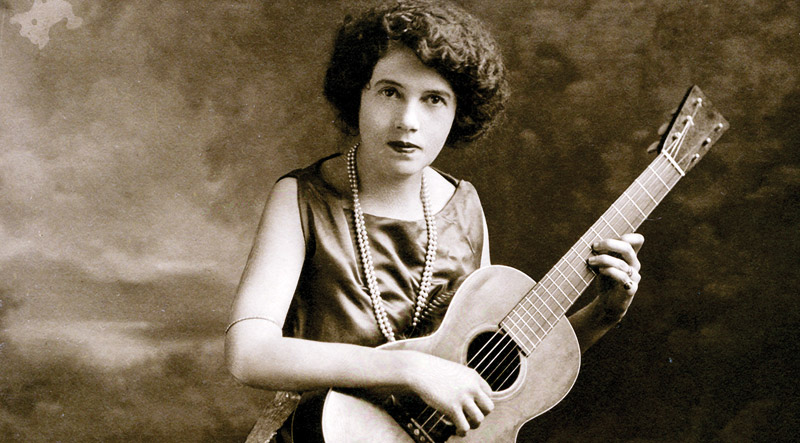
    Vahdah Olcott-Bickford, circa 1925.

    It was probably the combination of Olcott’s resonant tone and charming looks that attracted the attention of mandolin-orchestra leader Myron Bickford, from Springfield, Massachusetts. In 1908, The Crescendo announced Bickford’s newest composition, “The E.L.O. Schottische.” “E.L.O.” was, of course, Ethel Lucretia Olcott; Bickford had written the song for her.

    In ’09, The Crescendo brought them closer together (visually, at least) when it featured a short profile of Olcott followed by a profile of Bickford. In ’13, Olcott took over the magazine’s “Guitarists Round Table” column, and in June she devoted half of it to C.F. Martin, Sr., including a short lesson on the dates of Martin brand stamps. She closed by saying, “Martin guitars are among the best instruments manufactured, here and abroad.”

    The factory slip for this – the final Style 44. Notes include “1 Gtr 00-44G,” “For gut strings only,” “OM body, regular bracing,” “as light as possible,” “Slotted head, 12 fret neck,” “Stamped 6-3-39,” etc.

    Her column did not mention any specific reason for focusing on a guitar maker, other than the opportunity to present a “splendid portrait” of C.F. Martin, but it coincided with the first production of a new guitar. Presumably, Olcott asked Martin to build a model specifically for her students. Her specs were simple; she wanted the best woods (same used for a Style 45), and she wanted no frills, no ornamentation – no pearl trim, no herringbone purfling, no fretboard markers. Even the backstripe was toned down from the zigzag or zipper patterns of the higher models to simple black-and-white lines. Though Martin put a pearl soundhole ring on models as low as Style 27 and a pearl top border on Styles 40 and higher, the company presumably gave this new model a style number befitting the quality of its woods and status of the artist who designed it – Style 44. There was no product launch, and Martin never advertised it or listed it in a catalog.

    The idea of an “artist” model was nothing new at Martin. In the 1840s, it made guitars branded for New York guitarist and teacher John Coupa (branded “Martin and Coupa”) before they’d established a nomenclature system. In 1911, Martin had begun making a line of guitars for New Jersey teacher William Foden, though these “Foden Specials” were, arguably, not true Martins. They had their own model names, alphabetic from A to E, and did not have a Martin serial number.

    he Style 45 headstock inlay and fretboard markers are the sort of superfluous ornamentation Olcott-Bickford wished to avoid.

    Martin records show eight 0-44s and two 00-44s were made in 1913. For a new model, 10 instruments was an unqualified success. Consider that Martin made only 256 guitars in ’13, and the Olcott models accounted for just under four percent of total production. For perspective, Martin made 107,991 guitars in 2019; to have the same impact, a model today would have to sell 4,211 units. Many of Martin’s artist models fall short of announced limited runs of 50 or 100. The only artist who might come close to Ethel Olcott today would be Eric Clapton.

    While no one was graffitiing “Ethel Is God” on alley walls, Olcott’s career was gaining notice. In September ’13, she relocated to Cleveland – a seemingly odd choice for an artist on the rise. But, not coincidentally, she was leading a mandolin orchestra there. And though she announced a 1913-’14 winter tour with noted classical mandolinist William Place, Jr., by the beginning of ’14, she was performing with Bickford (who often provided piano accompaniment), billed as the Bickford-Olcott Duettists.

    An ad in the October ’14 Crescendo announced Olcott’s move to New York, and Bickford’s ads included his new location: New York. Olcott began working as personal secretary to Evangeline Adams, who became the first superstar of astrology after she was arrested for fortune telling (which was illegal in New York). Adams gave Olcott and Bickford new astrological names – Vahdah and Zarh certainly sound more mystical and exotic than Ethel and Myron, but the meanings of the names are unknown. It’s likely that they were made up based partly on sound and partly on numerological significance. Whatever the reason, in the April ’15 issue of The Crescendo, the name on Olcott’s column was changed to Vahdah (E.L.) Bickford.

    The Style 00-44G is one of the plainest Martin models, yet has one of the highest ornamentation indicators – just below the legendary Style 45. And unlike any other Martin signature model, it’s not a variation of an existing instrument like the D-35JC (Johnny Cash) or 000-42EC (Eric Clapton).
    Some touches on the 00-44G were borrowed from fancier models; at first glance, the logo on the back of the head seems out of place, but was also specified on the factory slip for one made in ’38. The zipper backstripe is counter to Olcott-Bickford’s desire for a basic student guitar.

    The importance of astrology in the Bickfords’ lives is evidenced by a letter from Frank Theodore Allen, head of the Astrological Research Society. Vahdah had written Allen, asking him to officiate her wedding. Allen replied that he had cast an astrological chart for their wedding date and she should not be worried about Saturn being in the ascendant. However, he was not aware that a Doctor of Astrology could perform weddings in California. The Crescendo announced the couple’s marriage in New York in September ’15. Going forward, Ethel went by Vahdah Olcott-Bickford and Myron went by Zarh Myron Bickford.

    After the Style 44’s initial splash, Olcott’s model all but disappeared. Though she was among the most prominent guitarists in the country (The Crescendo called her “our greatest lady guitarist”), Olcott had relocated twice in two years and increased her touring activity. It’s likely she had fewer students who would have been the main buyers of her model. In ’14 and ’15, Martin made no Style 44 guitars at all. Not until ’17 did production resume, but it was never more than a trickle after that – a single 000-44 in ’17 and one in ’18, followed by one 000-44 and one 00-44 in ’19. Production peaked in ’22 with two 0-44s and two 00-44s. A year later, Vahdah and Zarh relocated to Los Angeles.

    Vahdah never experienced a time when the guitar was in the forefront of popular music. When she took her first guitar lessons, the mandolin was just beginning its rise. By the time she married Zarh, the tenor banjo was on the rise. There were strong undercurrents of guitar music, to be sure, but the most popular guitar music through the first two decades of the 20th century was Hawaiian. And when the spotlight finally landed on a guitar in ’22, it was Nick Lucas’ decidedly non-classical, flatpicked solo work on “Pickin’ the Guitar” and “Teasing the Frets.” This overshadowing of the classical guitar prompted Vahdah to organize the American Guitar Society in 1923. She was its musical director, Zarh its vice president.

    As the guitar began making inroads to popular music styles, Vahdah continued to champion the classical guitar and even had stickers made, which she attached to correspondence, saying “Keep the guitar classical.” But even within the classical world, the instrument was changing. In ’28, Spanish-born Andrés Segovia performed in New York for the first time, introducing Americans to a more-robust style and a guitar (made in Germany by Hermann Hauser) built to be more responsive to it.

    It was the beginning of the modern classical-guitar era – and beginning of the end of the era represented by The Crescendo (which last published in ’33), the Guild of Banjoists, Mandolinists and Guitarists (which The Crescendo represented), Vahdah Olcott-Bickford, and Martin classical guitars. By the end of the ’20s, Martin was bracing its standard models for steel strings.

    From 1921 through ’31, Martin made only 16 Olcott-Bickford models. In ’38, after six years without producing one, it made two, stamping them 00-44G (the G denoting gut-string), a designation Martin had begun using in ’36. Both were sold by Schirmer’s music store, in New York.

    Associated exclusively with Vahdah Olcott-Bickford, the Style 44 is one of Martin’s rarest and most obscure styles. This one bears serial number 70469.

    The factory slip on this final Style 44 (serial number 70469) reveals the influence of the Hauser-style guitars in its specification for bracing. Though it was to be “regular” X-pattern (rather than the fan pattern that had endured and emerged as the standard for classicals), it was to be “as light as possible” for a more-robust response.

    The straight-grained Brazilian rosewood is consistent with the highest grade a Style 44 guitar would require (while highly figured Brazilian may have a higher aesthetic value, straight-grained Brazilian is considered better for tone and durability).

    It’s not known if Vahdah was involved in ordering this guitar. Her archives contain no correspondence with Martin about guitars (only about the American Guitar Society), but she likely was not involved, as the Style 45 inlays on the fretboard, headstock, and back stripe were just the sort of superfluous ornamentation she wished to avoid.

    The Martin decal on this guitar also seems out of place, but it was specified on the shop slip for the other 00-44G that came through Schirmer in ’38. Some earlier Style 44s had “Olcott-Bickford Artist Model” on the headstock, if they had anything at all. None had the decal because earlier ones were made before Martin introduced a silk-screened version in late ’31.

    This 00-44G ended Martin’s run of Style 44 guitars at 32 units. Though it made other G and later C (classical) models, Martin never had a significant presence in the modern world of classical guitar. Vahdah Olcott-Bickford remained active with the American Guitar Society and the Astrological Society. Zarh Bickford died in 1980 leaving her Style 44 guitars as a reminders of a largely forgotten part of the guiatr’s history in America.


    This article originally appeared in VG’s July 2022 issue. All copyrights are by the author and Vintage Guitar magazine. Unauthorized replication or use is strictly prohibited.
  • The Surfrajettes

    The Surfrajettes

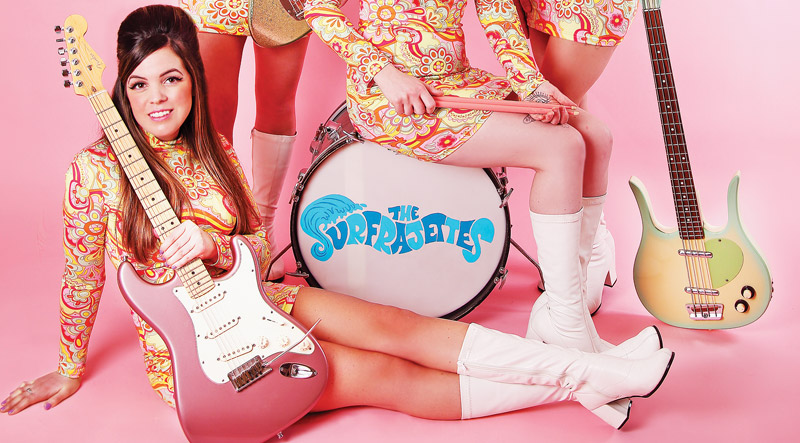
    The Surfrajettes: Nicole Damoff (left), Shermy Freeman, Samantha Maloney, and Sarah Butler. Surfrajettes photo courtesy of Hi-Tide Recordings.

    The Surfrajettes delight their fans with the perfect wave of jangly guitars, kooky kitsch, and ’60s fashion. After several years touring and releasing singles, their first full album, Roller Fink – a mix of originals and carefully picked covers – has finally rolled ashore. VG caught up with guitarists Shermy and Nicole to talk about their surf planks, reverb tanks, and twangy tones.

    What makes the Surfrajettes sound different from a thousand other instrumental bands?
    Shermy Freeman: I think we’ve always tried to write and play what we actually like, versus trying to fit into the “surf” box.
    Nicole Damoff: Also, our focus isn’t really on shredding solos. We mostly care if the song is good and if it has a melody that will work as an instrumental.

    Who plays what on the album?
    ND: That’s me in the left speaker most of the time. The divvying up of guitar parts happens pretty organically. One of us will say, “Hey, I have this melody or these chords – can you add something to go along with it?” It develops from there.
    SF: At this point we also know what everyone’s style is and what our strengths are, so parts are pretty much a no-brainer. Also, I’m in the right speaker and our production team has cooked up a secret stereo recipe that sounds extra dreamy.

    One cool aspect of “Roxy Roller” is how that chord part is the lead part.
    ND: We based our arrangement off of Suzi Quatro’s version of the song. I’m playing the background rhythm, which I believe is the keyboard riff in Quatro’s arrangement. But it translated quite well to a surfy, palm-muted guitar part.

    “Surfer’s Slide” has some fancy pickin’ and a beat that’s ready for a dance party.
    ND: That’s Shermy doing the fancy picking. We also added a harmony line over the main melody in one of the verses, which is one of my favorite parts about that song. It’s a really fun one to play, it’s so catchy.
    SF: I discovered the original by Richie Allen & the Pacific Surfers a few years ago, and knew it would be a ball to cover. The picking is tricky, for sure.

    “Train Kept-A Rollin’” has been covered countless times. How did you make it your own?
    ND: We made it our own by adding a ton of reverb, of course. I’ve loved The Yardbirds’ version for years, and our arrangement is almost a direct copy. It’s got one of the best guitar riffs of all time and is one of our favorites to play live – we usually close our set with it.
    SF: It’s definitely a banger and fan fave. My favorite part on the recording is Nicole’s “choo-choo” bends.

    Blondie’s “Heart of Glass” seems like a perfect surf jam. How did you stumble on that idea?
    SF: When we first thought of the roller skating concept for the album, our bass player, Sarah, told us how she used to have “Heart of Glass” on vinyl as a kid. She rollerskated around her basement to it. It was fun to pay homage to that.
    ND: Initially I wasn’t really sure how well it was going to work, but now it’s one of my favorite tracks on the album. We kept the disco feel with the bass and drums, but the guitars are pretty dreamy and surfy.

    The Surfrajettes are a super-tight band. How do you coordinate parts so you’re not stepping on each other’s toes.
    SF: Everyone is conscious of what others are playing. Additionally, if we do need to play the same chord in a section, we do different inversions, or octaves. Each player needs their time to shine.
    ND: Yes, we’re good at listening to each other and being aware of how each of our parts should complement the others. Thankfully, there’s a lack of ego in this band, and we’re all good with sitting back when the song calls for it.

    What gear did you use on Roller Fink?
    ND: My Strat is the only guitar I used on this album, played mostly through a Fender Excelsior amp. The reverb came from my EHX Canyon pedal. Our guitar tones remained pretty consistent throughout the sessions.
    SF: I used my Creston Electric Creature guitar, Fender Excelsior, and SolidGoldFX pedals for reverb, compression, and delay. I also have a ’64 blackface Fender Reverb Tank. In the studio, we’re also lucky to have use of an original stereo EMT 140 plate reverb from the ’60s.

    You gotta have reverb for surf, but what’s the sweet spot? Is there a point where it’s too much?
    ND: If there is indeed a point where there’s too much reverb, we haven’t recognized it yet.
    SF: I always double-check to make sure mine is maxxed.


    This article originally appeared in VG’s July 2022 issue. All copyrights are by the author and Vintage Guitar magazine. Unauthorized replication or use is strictly prohibited.
  • Check This Action: A Mess of Blues

    Check This Action: A Mess of Blues

    It doesn’t happen often, but I still encounter people who think the blues is strictly sad music. I tell them to listen to Hound Dog Taylor’s joyful “house-rockin’” blues. Or when guitar players assume that Jimmy Reed’s variation is dead simple, I quote Billy Gibbons from the January ’19 VG cover story. “I hate it when I hear people talk about blues being mindlessly simple, just three chords,” Rev. Willy stated. “Then you really listen to Jimmy Reed, and it’s three gazillion chords.”

    I’ve lately heard four captivating releases as different as night and day, demonstrating just some of the blues’ many hues.

    Ryan Lee Crosby studied Indian and African music, but was also mentored by Jimmy “Duck” Holmes, in the elder’s Bentonia style of blues, emanating from that part of Mississippi. On Winter Hill Blues, Crosby’s droning pulse is often hypnotic. “Was It The Devil?” and “Going To Bentonia” are sung falsetto, recalling the town’s native blues legend, Skip James, while “Institution Blues” rocks a new wrinkle on the oft-used riff from Jimmy Cobbs’ “You Don’t Love Me.” Crosby’s distorted electric is backed by drums and bass, while “Slow Down” is played solo on acoustic 12-string.

    “Wish I Was In Heaven Sitting Down” has been recorded by artists ranging from Fred McDowell and R.L. Burnside to Charlie Parr and Lisa Mills. Crosby delivers a fine lap-slide version, most reminiscent of Rev. Robert Wilkins’ recording.

    Nashville studio stalwart Kenny Greenberg has played Music City sessions from Toby Keith to Donny and Marie Osmond. But he’s also colored outside the country lines, working with Joan Baez and Etta James, Bob Seger, and Buddy Guy. Blues For Arash began life with Greenberg writing soundtrack music for a film that didn’t materialize. When it didn’t see the light of day, he thought the music would make a strong solo album on its own – and a wise decision it was.

    “The Citadel” showcases Greenberg’s electric slide (on a ’62 SG or DePinto Galaxie) – equal parts blues and Middle Eastern, atop a quasi-African rhythm. Juldeh Camara of Robert Plant’s Sensational Space Shifters plays one-string West African fiddle on “Nairobi, Mississippi,” in call and response with Greenberg’s resophonic bottlenecking and fellow Space Shifter Justin Adams’ percussion underpinning. But the straight-up shuffle “Just Because I Can” lands back on familiar ground, in what Kenny accurately describes as “sort of Elmore James meets the Fabulous Thunderbirds.”

    The two vocal tunes, “Memphis Style” and “Ain’t Got Me,” spotlight deep-voiced Wally Wilson, Greenberg’s collaborator and co-producer. It’s a safe assumption that Greenberg’s would-be soundtrack would’ve provided evocative music for the film that wasn’t, but it stands tall as a self-contained album.

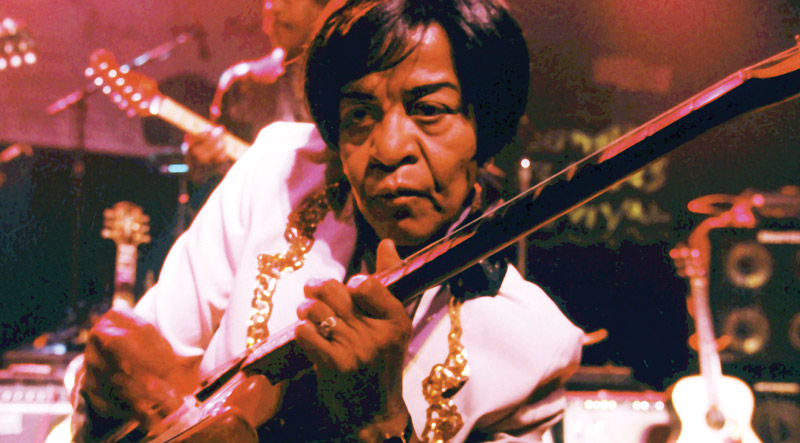
    Beverly “Guitar” Watkins passed away in 2019 at the age of 80, but thankfully not before the Music Maker Foundation, which helps artists in need with living and medical expenses as well as gigs and recordings, produced her first solo album, Back In Business. But her career went back to the ’50s, when she was hired by Atlanta-based Piano Red while she was still in high school. In 1962, as Dr. Feelgood & the Interns, Red recorded “Mr. Moonlight” with Watkins on guitar – to be covered by the Beatles two years later.

    Known for playing guitar behind her head, Watkins gets plenty of bite out of a Fender Mustang on the live In Paris. Her singing ranges from a growl to soft and mellow, as on “Melody Cruise,” a reworking of “Mr. Moonlight.” She will be sorely missed.

    Full disclosure regarding the next album: I was hired to write liner notes for Strange Time Blues by HowellDevine, and I confess I’d never heard of the trio before – rather embarrassing since this is their fifth outing. Two previous efforts were, in fact, released by the Arhoolie label. Its legendary head, Chris Strachwitz, remarked that their pitch was the first in years that he listened to from beginning to end, and artists singing the San Francisco-based group’s praises include Bonnie Raitt and Elvin Bishop.

    Collectively, guitarist/vocalist Joshua Howell, drummer Pete Devine, and upright bassist Joe Kyle, Jr. fall somewhere between country blues and electrified jug-band, between Chicago blues and jam-band. For instance, “East St. Louis” starts with the bottleneck riff from Fred McDowell’s original version, backed by brushes before Devine picks up the rhythm and Kyle alternately plucks and bows; it’s a study of theme and variation, of dynamics.

    There are covers of Muddy Waters (“Long Distance Call”), Blind Boy Fuller (“Untrue Blues”), R.L. Burnside (“Long-Haired Doney”), and Rev. Robert Wilkins’ “That’s No Way To Get Along,” a.k.a. “Prodigal Son.” “When The Levee Breaks” ignores Led Zeppelin and goes back to the source, Kansas Joe and Memphis Minnie.

    But like some topical blues classics, Howell’s somber “Smoke” deals with the wildfires in California, and the instrumental “Strange Time Meltdown” combines funky beats, jazzy harmony, and even a wah pedal. It dispels any “retro” pigeonhole, just as the blues evades monochromatic brush strokes.


    This article originally appeared in VG’s July 2022 issue. All copyrights are by the author and Vintage Guitar magazine. Unauthorized replication or use is strictly prohibited.

  • Harvey Valdes

    Harvey Valdes

    Harvey Valdes: Shervin Lainez.

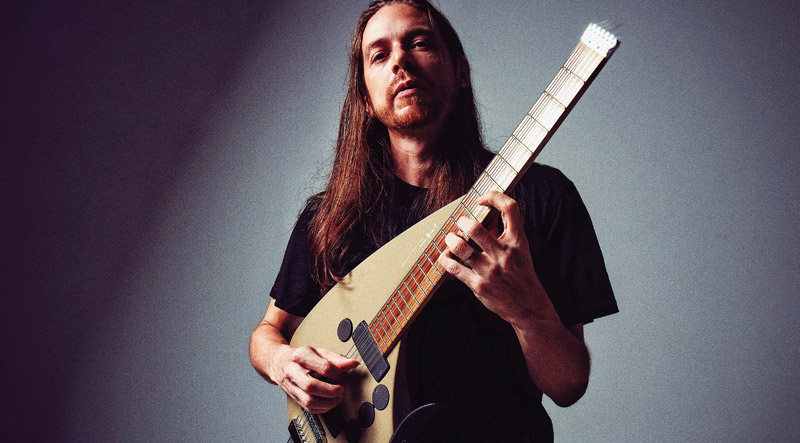
    Ever since Andrés Segovia elevated the nylon-string guitar to a serious classical instrument a century ago, players have been performing the music of J.S. Bach – the gold standard of classical-guitar literature. Today, Harvey Valdes is continuing the tradition, with one huge difference – he’s using a solidbody electric. On Novare: J.S. Bach Lute Works on Electric Guitar, Valdes displays a virtuoso’s approach on a Teuffel Tesla, a steel-string that sounds full and beautiful, yet is wholly electric. What would Maestro Segovia think?

    First, why Bach on electric guitar?
    The electric guitar has a tremendous amount of sonic range and I’m interested in exploring contrapuntal music on it. Obviously, it’s not the instrument of choice in interpreting works from the Baroque period, but I believe playing Bach on electric guitar widens the audience for that music, and breaks down the perceptions of how it should sound.

    Did you record the whole album with the Teuffel Tesla?
    Yes. I believe [builder] Ulrich Teuffel had clarity and resonance in mind when he designed the Tesla; it produces a clear, articulate, and balanced sound. The Tesla has two pickups – a single-coil in the neck position and humbucker in the bridge. There is no piezo. I played everything on the neck-position single coil.

    What do all the knobs and buttons do?
    It has a standard Volume and Tone knob, and a pickup selector. The three buttons below the strings are noise buttons; one activates 60-cycle hum, another is a kill switch, and the last activates a small mic under the neck pickup, for controllable feedback.

    Your tone is extraordinary for a plugged-in guitar. There’s a bold acoustic dimension.
    I spent a lot of time thinking about tone for this music. I wanted a full-bodied and focused clean tone, with reverb for dimension. I played everything on the neck pickup because it produces a full and open sound.

    The other part is the titanium saddles on the bridge. When I roll off the treble with the Tone knob, I get a warm sound, but retain a focused tone because of those saddles; it adds an acoustic presence, or shine, to the notes. I also use my right-hand nails and a bit of flesh on the string. I do daily maintenance to my nails – keep them filed, buffed, and at the right length. If they’re not maintained, my tone suffers significantly, even if things are dialed in properly on the gear side.

    What kind of electronic processing are we hearing?
    Essentially, I created a wet/dry/wet rig. I recorded the album in my home studio through a Fryette GP/DI 1-watt amp. The GP/DI has an analog-speaker simulation, and I sent the cab-sim signal to a channel into my DAW. I sent another signal to a Two Notes Torpedo VB-101, which is a rackmounted speaker-and-mic simulator. In that, I set up a stereo cabinet rig with two cab and microphone combinations panned hard left and right, and then sent that into my DAW. We used a Bricasti reverb, Lexicon 224 reverb, a touch of Roland Space Echo, a Highland Dynamics BG2 compressor, and Manley EQ. Finally, we bounced the mixes onto tape, which sweetened up the whole tonal spectrum.

    Was there one Bach piece that was particularly difficult?
    All the pieces have detail I had to contend with. For the bass notes in “Prelude, Fugue and Allegro in E-Flat Major, BWV 998,” I worked to keep them big and resonant, yet not to overpower everything else. I had to pay close attention to a balanced right-hand attack, so the bass never overpowered the melody. On “BWV 998 Allegro,” which is a really fast piece, I had to work on staying relaxed to play at a faster tempo and not have any notes jump out or sound louder in the phrases. Basically, the right hand dictates everything. If it’s not functioning, the music falls apart very quickly.

    How do you approach dynamics, which are so important to classical guitar.
    Again, there’s a bit of compression before the amp, and a little in post. I used it to fatten the tone and not squash the attack – the last thing I want is for a compressor to color the dynamics in my playing. I also do most of my practicing on a nylon-string classical because I enjoy its intimate relationship to sound production. I try to approximate that approach onto the electric guitar. Again, it all comes down to right-hand control, since that’s where the sound begins. With the Teuffel, I like to feel the guitar and amp working together as a breathable instrument.


    This article originally appeared in VG’s July 2022 issue. All copyrights are by the author and Vintage Guitar magazine. Unauthorized replication or use is strictly prohibited.
  • Rush

    Rush

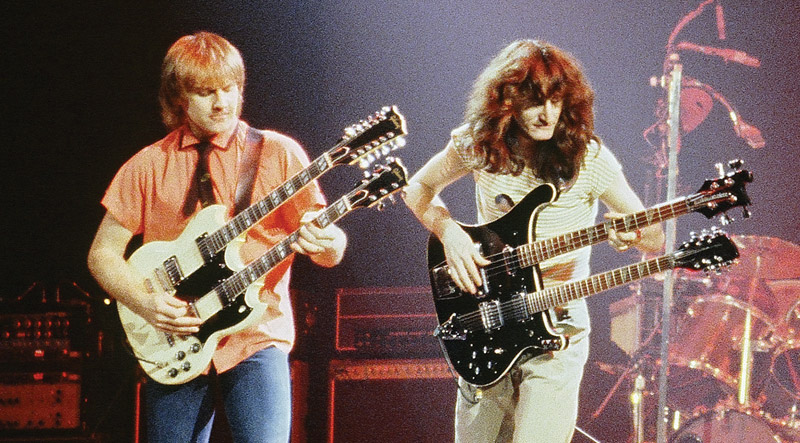
    If “The Spirit of Radio” helped Rush kick open the door to FM radio, its 1981 follow-up elevated them to blockbuster status. To mark the occasion, this 40th-anniversary Moving Pictures comes in tantalizing combinations of CD, Blu-Ray, ATMOS and 5.1 mixes, and vinyl.

    Along with the studio anthems, the jackpot is an unreleased ’81 concert taped in Rush’s stronghold of Toronto. This is a multi-track soundboard recording; the mix sounds like you have a prime floor seat at Maple Leaf Gardens. “Limelight” is ferocious, with Alex Lifeson’s solo bathed in deep echo, chorus, and distortion. A section of the Hemispheres suite sounds piped-in directly from Mount Olympus, a slab of god-like prog. This alone is worth the price of admission.

    Live takes of “The Camera Eye” and “Vital Signs” reveal Rush’s interest in British post-punk, mixing Geddy Lee’s minimalist synthesizer with Lifeson’s modulation-drenched white Strat. “YYZ” finds Lee assaulting his black Jazz Bass with fusion virtuosity. Alex’s classical-guitar performance of “Broon’s Bane” leading into “The Trees” is rapturous. The same can be said for this entire studio/live box; if you love Rush, it’s just about mandatory.


    This article originally appeared in VG’s July 2022 issue. All copyrights are by the author and Vintage Guitar magazine. Unauthorized replication or use is strictly prohibited.

  • Fretprints: Fran Beecher

    Fretprints: Fran Beecher

    Beecher/Haley: Starstock/Photoshot/Avalon/Zuma Press.

    The ripples that anticipated a rock-and-roll tsunami were in motion in the 1940s, when pop, “race records,” and country converged to produce rock’s first wave. Until then, pop music ranged from Top 40 crooner fare and swing jazz to Latin and novelty numbers. Race records – blues, gospel, boogie-woogie and prototype R&B – and country/western, hillbilly, folk, and honky tonk typified the sound of black and white musical forms brewing in the south and southwestern U.S.

    Each contributed to the rise of rock; during Charlie Christian’s tenure with Benny Goodman (1939-’41), jazz brought riff-based tunes that had colossal effect on first-generation rock-and-roll guitarists – furthered by T-Bone Walker’s merging of swing and blues. Other factors resided in the growing social/musical interaction of black and white populations and burgeoning youth culture. Francis Eugene Beecher was part of that beginning.

    Born September 29, 1921, in Norristown, Pennsylvania, Beecher started on his sister’s ukulele at age eight. By 12, he took up guitar at a time when there were no obvious role models, teaching himself through listening to cowboy music on the radio. In his teens, he studied with Eugene Claycomb at the Honolulu Conservatory of Music, and his first group was a country sextet called The Buckaroo Ramblers. He soon graduated to working with more-professional acts like the Four Sharps, a variety band led by singer/pianist Buddy Greco (veteran of Benny Goodman’s bebop group).

    The amalgam of jazz and country suited Beecher, who’d come of age in country music and by the late ’40s was equipped (and inclined) to tackle jazz-inflected material with Greco, as heard on his ’47-48 singles “Baby, I’m True to You” and “A Stranger in Town.” When Greco’s group disbanded, Beecher and the rhythm section joined Benny Goodman’s “modern” combo; he recorded in the studio and performed on live broadcasts like “Toast of the Town,” in ’48 and ’49, during the leader’s excursion into bebop, leaving behind the albums Modern Benny and Benny Goodman at the Hollywood Palladium.

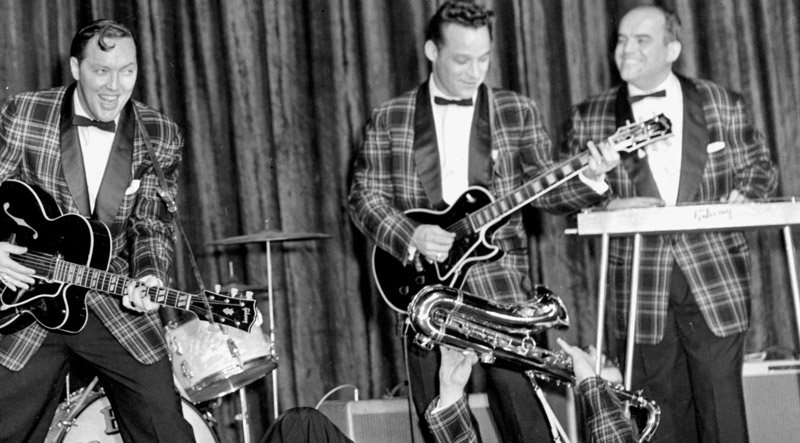
    An established and influential player on the Philadelphia/Reading scene, in the fall of ’54, Beecher was tagged to cover sessions for Bill Haley after the untimely demise of Danny Cedrone (“Fretprints,” March 2019). His earliest contributions were to “Dim, Dim The Lights” (#11, November ’54) where he was requested to simplify his approach and play a more-basic, country-inflected style that came to be rockabilly. As session player, he lent genre-defining guitarisms to Haley’s Top 40 hits “Mambo Rock” (#17) and “Birth of the Boogie” (#26). He performed “Rock Around the Clock” with Haley on TV in August of ’55, and formally became a Comet in time for film appearances in Rock Around the Clock and Don’t Knock the Rock. The rock-and-roll art form, its guitar component, and Beecher’s legacy were established with a string of Top 40 hits that heralded popular acceptance of the new music; “Razzle Dazzle” (#15, July ’55) flaunted prominent guitar moments, as did “Burn That Candle” (#9, November ’55), “See You Later, Alligator” (#6, January ’56), “The Saints Rock ‘N’ Roll” (#18, April ’56), “R-O-C-K” (#16, April ’56), “Rip It Up” (#25, September ’56), “Rudy’s Rock” (#34, November ’56), “Skinny Minnie” (#22, April ’58), and the entire Strictly Instrumental album of ’59.

    Rock-and-roll guitar in its earliest incarnation is capsulated in Beecher’s intro to “Goofin’ Around.” This instrumental was a Beecher original and is prominent in the early biopic Don’t Knock the Rock. He mixed bebop and swing-jazz sounds with boogie-woogie and Western influences, making for a potent brew. The opening melody is a familiar boogie riff in A, it gives way to series of arpeggio-based major-pentatonic theme melodies taken up in half steps from A to Db then back, reflecting the chromaticism of modern jazz. Note the fragmenting of the figures and syncopation while descending in measures 9-11. The phrase ending back in A is a classic Western-swing line, reimagined.

    Moreover, possessing the ability to raise his voice into a child’s range, Beecher was valuable as a novelty singer on “See You Later, Alligator,” “Billy Goat,” “Rip It Up,” and conspicuously in “A.B.C. Boogie,” a duet with Haley. He also wrote several tunes in the band’s catalog, claiming composer credits on “Blue Comet Blues,” “Goofin’ Around,” “The Catwalk,” and “Shaky.”

    In ’58, Beecher and the Comets (sans Haley) recorded for the East West label as The Kingsmen, releasing the Beecher originals “Catwalk” and “Week End” (later covered by Link Wray), which climbed the pop charts. He left the Comets in ’60 to work with the Merri-Men, recording “Big Daddy”/“St. Louis Blues” on Apt, but rejoined briefly in ’61 to participate in a live session that became Twisting Knights at the Roundtable. After his monumental innovations in Haley’s band, he returned to Pennsylvania in ’62 to lead a domestic life, extant in a 60-year marriage, working at a costume shop by day and playing local engagements at night with his quartet (guitar, sax, bass, drums). In ’66, the group secured a residency at the Inn of the Four Falls, purveying Fran’s blend of jazz, country, Latin and standards. He participated in Comets’ reunions in ’81, and in ’87 appeared and recorded with a reconstituted Comets lineup until his official retirement in 2006. Already honored in the Rockabilly Hall of Fame (’97), in 2012, Beecher became a member of the Rock and Roll Hall of Fame by special committee, righting a wrong denied during the Haley/Comets recognition in ’87. He played guitar into his 90s and was 92 when he died of natural causes on February 24, 2014.

    STYLE
    Rock-and-roll guitar was invented on seminal recordings with Haley and the Comets. Prompted by Haley, Beecher streamlined the bebop influences he brought to guitar solos and folded jazz rhythms into shuffling rockabilly grooves suggesting Western swing. This formula yielded commercial success and the sonic recipe for early rock. Fran is renowned for his mix of jazz, blues, and country, as well as their transplantation into the music. He was an adept and inventive soloist, demonstrated by his intricate licks in “Razzle Dazzle” and “Goofin’ Around,” and a solid ensemble player, providing counter melodies and bluesy/jazzy fills behind Haley’s vocals throughout “Saints Rock ’N Roll” and “Dim, Dim The Lights.” He was often called to double sax riffs, as in “Razzle Dazzle,” “Burn That Candle,” and the first verse of “R-O-C-K.” Beecher’s improvisations relied largely on single-note and double-stop phrases. On rare occasions, he alternated textures and approaches; “Skinny Minnie” is exemplary, where he juggles the fanfare of a tremolo-picked chord riff with double-stops and boogie-woogie bass-register lines. In Comets arrangements, Haley strummed rhythm on an acoustic archtop, leaving Beecher on electric to fill with melody, comp, punch partial chords, or add triads that often suggested repurposed big-band figures (“Rudy’s Rock”), defining distinct rhythm and lead-guitar roles at rock’s inception.

    A versatile, colorful lead guitarist, the blues informed much of Beecher’s innovation, and he was fluent with the swing, urban, and jump-blues vocabulary. In solos and fills, he tempered jazz inclinations with earthy blues elements, often juxtaposing them for an intriguing blend. Consider the Chuck Berry-inspired double-stops and T-Bone-based triplet runs, pentatonic/blues melody and string bends in “Blue Comet Blues” and “A.B.C. Rock.” Though he favored a jazz approach in phrasing and tone, he routinely fused country and blues mannerisms with more-sophisticated ideas, driving the point further with his ’73 reference to Howard Roberts, citing him as an influence “…because he plays with soul.” That open mindset, guided by feel, is ubiquitous in Beecher’s playing. Many of his landmark moments bear a similar blues-jazz-country pedigree and soulful execution. Check out the quick riffs in “Burn That Candle,” “Saints Rock ’N Roll,” and “Rock-A-Beatin’ Boogie,” which are reinterpretations of a swing-blues motif and a recurring idea in his solos. The line became a staple of rockabilly guitar, passed around and reprised by Brian Setzer in “Rock This Town.” “Razzle Dazzle” features a serpentine fiddle-tune melody in a solo belying country roots, albeit tremolo-picked with an energetic rock attitude set into blues changes. In the “R-O-C-K” solo, his lead riff applied a single country-flavored pentatonic line to blues changes. Unlike Scotty Moore, et al, his country influence arose from Western swing rather than the Merle Travis/Chet Atkins school. Haley’s songs were typically built on 12-bar blues and variants with characteristic I-IV-V chord progressions as is traditional in the genre, creating an organic repository for Beecher’s improvisations. He clung to these precepts in “Catwalk,” “Shaky” (which exploits a guitar riff reminiscent of “Peter Gunn”), “Goofin’ Around,” and “Blue Comet Blues.” The structure, riffs and attitude in those pieces exemplify rockabilly’s blues origins.


    “Razzle Dazzle” continued the evolution begun with “Rock Around the Clock.” In this flight, the virtuosity of Danny Cedrone in the earlier solo was answered by Beecher’s intricate lines. Like many tunes in the Haley playlist, the piece is built on the 12-bar blues form, here in C. This excerpt, at 1:13, takes place over the IV-I-V-I changes of the progression; F7-C-G7-C. Note Beecher’s quick tremolo-picked approach, which alternates attacking repeated notes for an aggressive feeling in measures 1-2 over F7 to a florid fiddle-tune lick in 3-4 over C. He completes the chorus with riff-based swing-blues ideas exploiting the C major-pentatonic and leading tones over 5-8.

    Beecher applied jazz sounds sparingly (but effectively) with Haley, reflecting time spent with Greco, Goodman, and others. Several examples make the case; the opening phrases in “Goofin’ Around” contain modulating chromatic lines leading to a breezy Western-swing landing phrase. The chromatic motion and content is modern and horn-like in conception, revealing his comfort with jazz melody cells. In “Saints Rock ’N Roll,” he handled solo changes with the mentality of a bebop player, outlining the harmony with updated Dixieland jazz melodies. And the ending phrase of “Rock-A-Beatin’ Boogie” boasted undisguised jazz connotations in its chromaticism and swing-blues delivery colored by an appropriately edgy overdriven tone.

    ESSENTIAL LISTENING
    Bill Haley & His Comets 20th Century Masters is a serviceable compilation containing most of the famed tracks with Beecher. Also recommended is Strictly Instrumental, which reveals his versatility and depth.

    ESSENTIAL VIEWING
    Numerous vintage clips of Beecher with Haley herald the arrival of rock. Among the best are “Goofin’ Around,” “Hot Dog Buddy Buddy,” “Rip It Up,” “See You Later, Alligator,” from Don’t Knock the Rock, as well as performances from “The Ed Sullivan Show,” “American Bandstand,” “Saints Rock ’N Roll,” “Shake Rattle and Roll” and “Rudy’s Rock” from Belgium (’58).

    Rock guitarists from Alvin Lee and Jeff Beck to Brian Setzer and Eddie Van Halen have borrowed the energetic riff-based lines that open Beecher’s “Rock-A-Beatin’ Boogie” solo – if not the actual notes, certainly the intent of the assertive take-off phrase. This example is played over the first half of a 12-bar blues in Eb taken at a fast rock tempo. The solo begins with rapid flurries emphasizing a repeated blues motif in measures 1-3. Note the presence of A, C, and Gb in the melody. The repeated notes and bluesy descent in measures 4-5 set up IV chord (Ab7) sounds in 6 and 7. Note the half-step pre-bend and continued use of C. The return to I (Eb) is made with a slick major-mode swing-blues passage.

    SOUND
    Early on, Beecher played a Gibson L-5C with a floating DeArmond pickup, heard on Greco records. With Goodman, he switched to a ’40 Epiphone Soloist Emperor with a DeArmond, also seen in his debut Sullivan TV performance of “Rock Around the Clock” with Haley. In ’52, he purchased a new L-5CES. Haley’s band was endorsed by Gibson, which provided Beecher with a number of Les Paul Customs, most notably a ’56 with P-90s, the neck having Alnico magnets. In ’60, he played a black ’59 ES-345 on “American Bandstand,” and had a blond ’59 ES-350T. He strung both with Fender semi-flatwound jazz strings. In later years, he favored a cherry sunburst ES-137 Classic.

    Beecher used a small tortoiseshell plectrum, adjusted his picking hand to play over the end of the fretboard for a mellower sound, and occasionally plucked with thumb, index, and middle fingers.

    In the ’50s, Beecher played Gibson’s GA-70, GA-77, GA-200, and GA-400 combo amps, routinely at full volume. By ’73, he preferred a Kustom Sidewinder with a 15″ speaker. Though largely a purist, he experimented with amp tones, tremolo effects, and dabbled with a wah pedal (though not on recordings).


    Wolf Marshall is the founder and original editor-in-chief of GuitarOne magazine. A respected author and columnist, he has been influential in contemporary music education since the early 1980s. His books include 101 Must-Know Rock Licks, B.B. King: the Definitive Collection, and Best of Jazz Guitar, and a list credits can be found at wolfmarshall.com.


    This article originally appeared in VG’s July 2022 issue. All copyrights are by the author and Vintage Guitar magazine. Unauthorized replication or use is strictly prohibited.
  • Prodigal Sunburst

    Prodigal Sunburst

    Guitar photos by Nate Westgor.

    A master of delivering crystal-clear musical messages with an off-kilter wit, whether talking, singing, picking, or sliding on guitar, everything Joe Walsh does brings an undeniable charisma.

    For decades, Walsh lived the ultimate rock-star life, wrote hit songs about it, emerged alive, sobered up, and all the while held on to his considerable musical skill. In April, he welcomed this ’59 Les Paul Standard back to his world.

    More than most guitar superstars, the man responsible for showing Glenn Frey the warm-up lick that starts “Life In The Fast Lane,” swapped solos with Don Felder in “Hotel California,” learned slide from Duane Allman, and dished out heavy sardonicism in “Life’s Been Good,” Walsh is familiar with the nuances of vintage Les Paul Standards. What’s more, his taste in them played a major role in their extraordinary collectibility.

    When Led Zeppelin toured the U.S. in 1969, Walsh’s band, James Gang, opened a half-dozen shows. One day, Jimmy Page told Walsh that for their next album, he wanted to step away from the tones of his Telecaster and into a “sunburst.”

    “At the time, I happened to have two (’59s),” Walsh told VG in 2012. “One I liked better than the other, so I kept my best one and gave him the other, which had a slightly smaller neck. He liked it a lot, and it became the one he played on a lot of Led Zeppelin music – his #1.”

    Page’s taste in Les Pauls had been formed thanks to his first – a 1960 Custom (VG, November ’20) that had a smaller neck with slight V shape, so the late-’59 from Walsh was well-suited.

    After the Custom was stolen during a U.S. tour in 1970, the ’59 indeed became Page’s famous “#1.” Meanwhile, Walsh used the other to record with Barnstorm (formed after he moved to Colorado in ’72), and through his early days as a solo artist.
    Amongst the throng of Walsh fans is Nate Westgor, owner of Willie’s American Guitars, St. Paul.

    “I saw the Rolling Stones at Milwaukee County Stadium in June of ’75 – their first tour with Ron Wood, which was exciting because Ronnie was one of my guitar heros,” he said. “Rufus opened, then the Eagles played, and one of the things that really stands out in my memory was that they did a three-song encore, which was odd for a backup band. They came back out and said, ‘We’d like to introduce our friend, Joe Walsh,’ and the crowd went nuts. They played ‘Rocky Mountain Way,’ ‘James Dean,’ and ‘Take it Easy.’ Joe hadn’t yet been announced as a member, so it was a real surprise.

    “I borrowed binoculars from a stranger to take a look at Joe, and he was playing a sunburst Les Paul with humbuckers; in ’75, that meant it had to be old, and I think it was this one.”

    A happy Joe Walsh with his reacquired

    It’s believed Walsh bought this guitar in the mid ’70s, and it became one of his primaries for writing and recording. While he can’t be certain, “I’m pretty sure I played it on the live [You Can’t Argue with a Sick Mind] album,” he said. A couple decades later, when the ’Burst market began to ascend beyond the reach of mortals and a figured top brought a super-premium, he sold this guitar “to get a prettier one with more flame, and hang tags.”

    During the Arlington guitar show in 2003, Walsh (through a broker) sold this guitar to vintage dealer Eliot Michael for between $250,000 and $275,000. Soon after entering the realm of ’Burst collectors, it became known as a standout. Proprieter of Rumble Seat Music, Michael wanted it for his personal collection, and it instantly became a cherished piece.

    “I bought it because it was Joe’s,” he said. “But, I fell in love with everything about it; I prefer the necks on 1960 Les Pauls, and this one was close, plus it had double-white PAFs.”

    While he had every intention of holding it, in 2007, Michael took a call from recording engineer/studio owner John Kuker, asking about a ’61 Les Paul Custom listed in his shop’s ad. Kuker also asked about the Walsh guitar, and made a legitimate offer for it. At first, Michael resisted, but eventually, Kuker was talking numbers he couldn’t refuse.

    The guitar then spent the next several years in Kuker’s studios. A revered homegrown engineer, he worked with Minnesota acts Semisonic and Jonny Lang in the late ’90s before opening his own studio, Seedy Underbelly. Circa 2004, he opened another studio in Los Angeles, then in 2011 bought and revived the well-known Pachyderm Studios, south of Minneapolis, which (prior to his ownership) recorded Nirvana’s In Utereo as well as albums by Soul Asylum and P.J. Harvey.

    Kuker was just 40 when he died of a heart attack in February of 2015.

    “John had golden ears,” said Westgor, who counted Kuker as a customer and friend. “He heard things other people didn’t, and because this guitar has killer tone, he invited anyone who would appreciate a ’59 Standard to use it. John was generous with his well-groomed guitar collection, so his guitars never sat in a closet.”

    In late 2021, the guitar re-emerged thanks in part to a Rolling Stones tour stop in Minneapolis, during which Pierre de Beauport, the band’s engineer/producer and right-hand-man to Mick Jagger and Keith Richards, was enjoying dinner with Westgor at Nico’s Tacos. It wasn’t long before they got to talking guitars.

    “Pierre told me about how Eliot considered the Joe Walsh ’Burst ‘the one that got away,’” said Westgor. “I paused for a second, wondering if he was messing with me and somehow had found out that I knew the guitar was here in Minnesota, because I had only mentioned it to my closest friends. I said, ‘I know who has that,’ but he kept talking about how it wasn’t flamed but had magic tone. I tried again, saying, ‘It’s odd you bring that up. My friend bought it 15 years ago. Wanna see it?’

    Walsh with the guitar during an Eagles tour stop in Houston, November ’76. Also enjoying the Les Paul party are guitar wrangler Brian Brock and Don Felder (left) with a ’58 ’Burst belonging to dealer Tony Dukes (right), who’s holding a rare two-pickup Custom “Black Beauty.”

    “His hand went up; ‘Check, please!’”

    They were soon bound for Willie’s, where the guitar and a few favorite tweed amps stood ready. “Any time I’d hand the guitar to someone, I’d remind them to really feel the neck,” Westgor said. “It has a slight V; it’s chunky, but not huge. You can tell it’s the work of a person, not the V shape hinted at by the CNC necks on reissues. And of course, old wood on a guitar that’s played as much as this one just sounds better – period.

    “Pierre has great ears, and as he started playing, he clearly got lost in its charm. He would play, laugh, play more, laugh more. It was fun. And we were there out of complete serendipity, only because he’d mentioned it at dinner.”

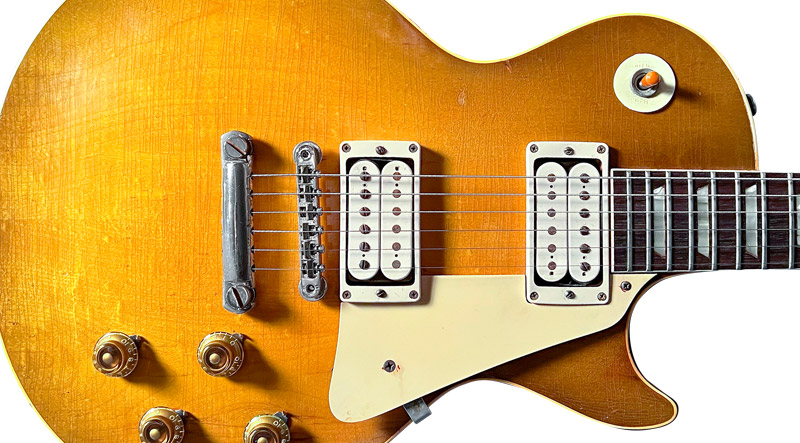
    While its resonance, weight (just over eight pounds), and neck make this ’Burst a joy to hold, the pickups are key to its musical magic; Walsh was known for favoring double-white PAFs.

    “He was part of the cult that made people notice white-coil PAFs in the late ’70s,” noted Westgor. “I remember reading interviews where he’d talk about their tone, and this one really does have a crisp, defined magic; it’s beyond what you expect, even from a ’Burst.”

    Former owner Michael agreed, saying, “It’s definitely in the top three of the 40-some vintage Les Pauls I’ve owned.”

    In an interview with Vintage Guitar in 2012, Walsh recalled experimenting with the pickups in his Les Pauls.

    “I went back and forth a lot about whether [removing the covers] made any difference, and in the end, I decided it did,” he said. “I also tried screwing the poles all the way down and bringing the pickup a quarter-turn below where it would cause the string to ring. I’ve always felt that gave the most signal.”

    Before his passing, Kuker had spoken to Westgor about selling this guitar.

    The tell-tale “twin lakes” of rift-sawn wood and circular clear-coat blemish at the waist help ID this as the guitar Walsh played in the ’70s and ’80s. The neck-pickup cavity (right) hints that the guitar has what collectors call a “dark burst” finish, the type noted in Yasuhiko Iwanade’s The Beauty of the Burst as a variation with a bit of blue added to the red pigment. As it fades, the lacquer yellows, giving a nearly imperceptible green tint.

    “John’s true passion was recording. He’d owned this guitar for several years and loved it, but he also loved great recording gear, and classic Rupert Neve decks are expensive.

    Sometimes, you let stuff go.“After he passed away, there was no real caretaker for the guitar, so selling it became logical to the family.”

    Once the decision was made, Westgor set about finding a buyer.

    “At first, we did a ‘slow show’ with it,” he said. “It’s kinda complicated, but there are collectors who will not buy a high-end item unless nobody knows about it. Once it’s advertised, they’re not interested.”

    After conversations with a few potential buyers, he bought a full-page ad in VG.

    “That was what really caught attention, and I’m pretty sure Joe’s eye,” he said. “Others started making inquiries, too.”

    Walsh’s involvement reveals how even superstars are careful with – and experience doubts about – such purchases.

    “The first time we talked, Joe said, ‘I want it.’ But then I didn’t hear from him for a few days,” Westgor recalled.

    At a glance, a bad strike with the ink printer might lead one to think this is a ’58. But close inspection confirms it’s 9 1081.

    “I went through a couple head trips when I heard it resurfaced,” Walsh confirmed. “At first, I wasn’t sure it was mine, so Nate sent pictures, and when I saw them, I saw that yes, it was. But the pictures were depressing because the guitar got the s**t beat out of it. The body and headstock are water-damaged, the pickup mounting screws are rusty.”

    Understanding his aversion to impulse, Westgor gave Walsh more time, and fielded two legitimate offers. Then, he sent an impromptu video of Los Lobos frontman/guitarist David Hidalgo, playing it through a ’55 Fender Deluxe at Willie’s. Walsh called back.

    “I thought, ‘You know what? [The Eagles are] having a great tour, and it will haunt me forever if I don’t get it. I finally said to Nate, ‘Let’s go.’

    “I’d also called Rudy’s Music, in New York, and they had one in perfect shape – showroom quality – for about the same price. I arranged to play it for a couple days, but it had the smaller frets. So, I called Rudy and asked if I could give it back, and he said, ‘Sure,’ because he’s a buddy.”

    “Joe was doing what all of us do when looking at a guitar,” Westgor noted. “That painstaking process of comparing it, considering the finish, the case, fretwear, and vibe.”

    Another push may have come from the Willie’s website, which showed a page from A.R. Duchossoir’s Gibson Electrics, Vol. 1 showing Walsh in 1976 with Eagles bandmate Don Felder, each holding a ’Burst. Walsh has this one.

    As the deal closed, Westgor was treated to a dose of that famous Walsh wit.

    “He told me, ‘It does seem odd that Joe Walsh is paying a premium for a guitar owned by Joe Walsh.’ And it’s true, but in the end I think its prodigal-son story can only help its future value,” Westgor said. “The guitar is magic, and everyone who owned it played the hell out of it. It has earned its grey hairs, and I love the poetry of Joe getting it back.”

    “It sounds great,” Walsh said. “The neck pickup isn’t too fat – it’s really clear. It’s just a beauty. I’m cleaning it up a bit. I got a lot of other peoples’ yuck out of it (laughs).”

    And while the right hands could repair it with nary a trace, because the damage is cosmetic, he says, “I’m just gonna keep it, because it plays great. It’s a hoot, getting it back. It’s like meeting an old friend I hadn’t seen in a long time. I appreciate that Nate went out of his way to get it to me.”

    Bloomfield, Clapton, Green, and Richards influenced a generation of budding guitar stars to chase “old” Les Paul Standards. But, Walsh giving Page his #1, combined with Page’s status as a superstar guitar hero, cemented the ’Burst as an icon. And while wire and wood do matter, Westgor reminds us that the human element is always foremost.

    “Many see a ’Burst as a magic wand,” he said, “But, without the hands of a wizard, it’s just sculpture. So, thank you, Joe Walsh.”


    Special thanks to Albert Molinaro and Brian Brock.


    This article originally appeared in VG’s July 2022 issue. All copyrights are by the author and Vintage Guitar magazine. Unauthorized replication or use is strictly prohibited.

  • Fender Nile Rodgers Hitmaker Stratocaster

    Fender Nile Rodgers Hitmaker Stratocaster

    Price: $2,599.99
    www.fender.com

    Guitarists know Nile Rodgers as funkmaster general of Chic, but he looms even larger as a Grammy-winning producer whose skill has helped sell more than 500 million albums. Fender’s Artist Series Hitmaker Stratocaster honors him with a reproduction of the guitar he used on countless hit songs.

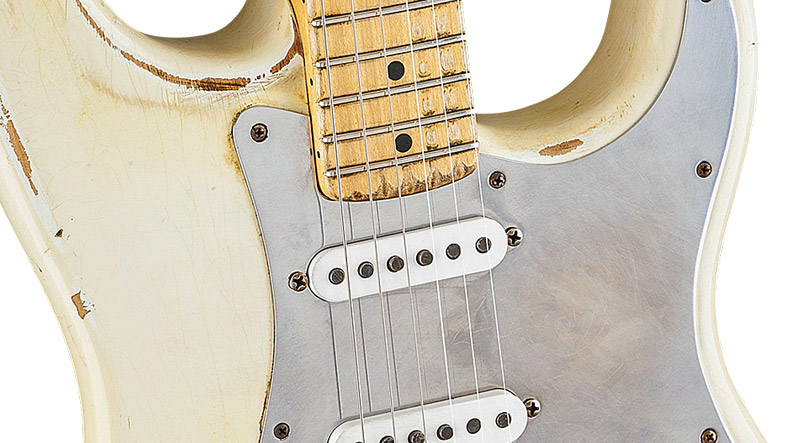
    The Olympic White alder body on Nile’s hardtail guitar varied from a typical ’60s Strat, being slightly smaller, thinner, and more-contoured. This one follows on all counts. Also per the Niles guitar, its one-piece maple neck (with maple fretboard) carries the 1959 version of a C shape, with a 9.5″ radius, medium jumbo frets, satin finish, and a Nile Rodgers/Chic logo on the back of the headstock. The three single-coil pickups are custom-voiced to replicate the originals, and sit in a mirrored/chrome-plated brass pickguard with white Gibson-style “speed” knobs. It also boasts Sperzel locking tuners.

    Plugged in, the Hitmaker is a no-nonsense funk machine that delivers all the goodies one would expect. It’s comfortable, though the smaller neck width brings a different feel that may not appeal to larger hands. It has an authentic Strat sound yielding all kinds of cluck, quack, chime, and nuance. The string-through-body gives a solid tone that stays in tune.

    Perfect for chord work of any genre, the Hitmaker is also great for soloing; its sounds sparkle when touched by overdrive, delivering tones with the expected clarity.


    This article originally appeared in VG’s July 2022 issue. All copyrights are by the author and Vintage Guitar magazine. Unauthorized replication or use is strictly prohibited.

  • Have Guitar Will Travel 084 – Greg Koch

    Have Guitar Will Travel 084 – Greg Koch

    Guitarheads the world over know Greg Koch is a big guy who plays monster licks. In the new episode of “Have Guitar Will Travel,” host James Patrick Regan talks with the guitar wizard on a range of topics, including how much he loves and appreciates playing in front of his fans. A longtime endorser with a few signature Reverend guitars, he’s also a busy ambassador at NAMM shows and on tours spanning the U.S. and Europe. And of course they dig into his guitars, effects, and amps, along with his adventures in Hawaii, instructional videos for Wildwood, and much more. Please like, comment, and share this podcast! Listen Here!

    Each episode is available on Stitcher, iheartradioTune In, Apple Podcast, YouTube and Spotify!


    Have Guitar Will Travel, hosted by James Patrick Regan, otherwise known as Jimmy from the Deadlies, is presented by Vintage Guitar magazine, the destination for guitar enthusiasts. Podcast episodes feature guitar players, builders, dealers and more – all with great experiences to share! Find all podcasts at www.vintageguitar.com/category/podcasts.

  • 2023 March Issue on Spotify

    2023 March Issue on Spotify

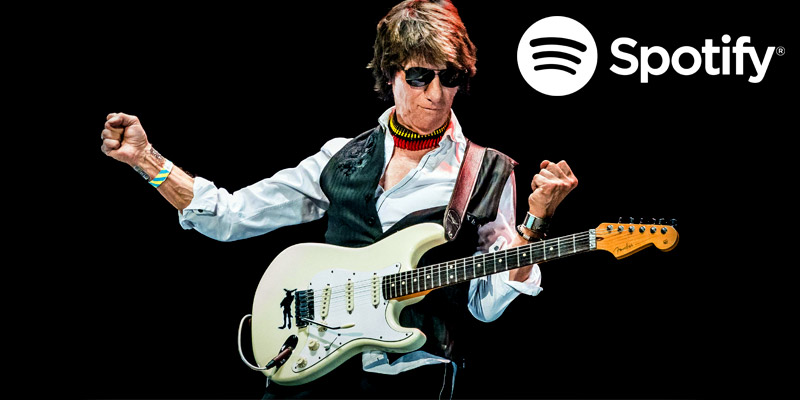
    This month we feature Jeff Beck, Kenny Wayne Shepherd, Savoy Brown, Uriah Heap, King Crimson, The Yard Birds, The sons of Adam, La Pompe Attack, The wilson Brothers, Dallas Perkins, and more!

    Spotify is free, or available without ads via paid subscription. Go to www.spotify.com and search “Vintage Guitar magazine,”or if you already have an account Listen to the complete list HERE.

    Don’t miss Vintage Guitar magazine’s monthly playlist on the music-streaming service Spotify. Each month, Karl Markgraf curates a playlist featuring artists and songs mentioned in the pages of VG, arranged in order to play along as you read the issue, or just enjoy on its own! Karl holds bachelor’s degree in Jazz Guitar from the University of Northern Colorado, and works as a performing and recording artist, producer, and educator in New York.


    Also On Spotify

    Also on Spotify is VG’s “Have Guitar Will Travel” podcast, hosted by James Patrick Regan. The twice-monthly episodes feature guitar players, builders, dealers, and more, all sharing their personal stories, tales from the road, studio, or shop, and their love of great guitars and amps. CLICK HERE to listen.

    Greg Koch

    Guitarheads the world over know Greg Koch is a big guy who plays monster licks. In the new episode of “Have Guitar Will Travel,” host James Patrick Regan talks with the guitar wizard on a range of topics, including how much he loves and appreciates playing in front of his fans. A longtime endorser with a few signature Reverend guitars, he’s also a busy ambassador at NAMM shows and on tours spanning the U.S. and Europe. And of course they dig into his guitars, effects, and amps, along with his adventures in Hawaii, instructional videos for Wildwood, and much more. Please like, comment, and share this podcast! Listen Here!


    Have Guitar Will Travel, hosted by James Patrick Regan, otherwise known as Jimmy from the Deadlies, is presented by Vintage Guitar magazine, the destination for guitar enthusiasts. Podcast episodes feature guitar players, builders, dealers and more – all with great experiences to share! Find all podcasts at www.vintageguitar.com/category/podcasts.
    Each episode is available on Stitcher, iheartradioTune In, Apple Podcast, and Spotify!