The PRS Mark Holcomb signature model is based on the Custom 24, but has a 25.5”-scale maple neck with ebony fretboard and 20” radius, a new plate-style bridge, green abalone “J” bird inlays, Hipshot O-ring controls, glow-in-the-dark side dots, and the guitarist’s signature Seymour Duncan Alpha and Omega pickups. It has a carved, figured-maple top, mahogany back, 24-fret Pattern Thin neck, PRS Phase III locking tuners, and a five-way blade switch. Read more at www.prsguitars.com.
While Yes is still a working band, it’s mostly in name only. This three-CD set, taken from a 2004 Massachusetts concert, shows the classic mid-’70s lineup featuring guitarist Steve Howe, bassist Chris Squire, singer Jon Anderson, keyboard wizard Rick Wakeman, and drummer Alan White.
Compared to today’s meek-sounding band, this lineup still had the fire and played many of their best tracks nearly as well as they ever could. Another critical difference were the vocals of Anderson, whose breathy, soaring tenor hadn’t yet been diminished by the severe asthma attack in ’08 that nearly ended his career.
Yesheads will particularly dig rarities like the Rickenbacker-bass-fueled “Ritual,” “South Side Of The Sky,” “Going For The One” (featuring Howe’s hot steel guitar), and even the three-part “Mind Drive,” a late-era prog suite from the ’90s.
Negatives include a pair of Trevor Rabin-era tracks that have nothing to do with Howe or Wakeman, and “Roundabout,” which is turned into a trashy cocktail-lounge number.
The joyous spirit of the remaining cuts and each members’ superb performances more than make up for these, though. If you consider that 1973’s Yessongs was Yes’ first great triple live album, then Songs From Tsongas is probably their last. Grab it.
This article originally appeared in VG‘s February ’15 issue. All copyrights are by the author and Vintage Guitar magazine. Unauthorized replication or use is strictly prohibited.
Dunlop’s Fuzz Face Mini Distortion Pedals
Price: $129.99 (Germanium, street);$99.99 (Silicon and Jimi Hendrix, street)
Contact: www.jimdunlop.com.
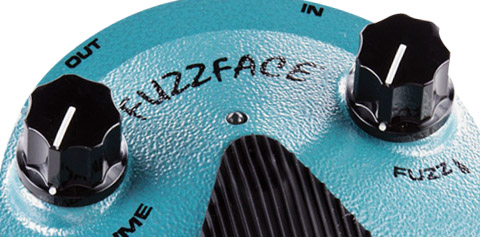
When it comes to fuzz pedals, the one that comes to mind for most players is the iconic Fuzz Face. With its cool, round spaceship design and classic fuzz tone, it’s been a favorite of legends like Jimi Hendrix and modern shredders like Eric Johnson and Joe Bonamassa.
While most love the look, vibe, and tone of a classic Fuzz Face, it does take up a lot of real estate on a pedal board. It also lacks a few critical modern features. So the folks at Dunlop put the Fuzz Face on a diet, shrinking its diameter in half, from 7″ down to 3.5″. During this shrinking process, Dunlop took care to retain the cool round shape, classic textured enamel paint finish, funky rubber foot pad, and retro knobs of the original, while adding a few modern features like a no-tools battery door, an on/off status LED, and a 9-volt AC power jack. To top it all off, Dunlop offers the Fuzz Face Mini Distortion Pedals in three varieties: a version featuring a pair of slightly mismatched germanium transistors like the original Fuzz Face; a version with silicon transistors like the later ’70s Fuzz Face; and a version of the JHF1 Jimi Hendrix Fuzz Face.
We plugged them in between a Fender Custom Shop 1960 Relic Stratocaster and a Marshall JCM 900 head and a Celestion-loaded 4×12 cab.
The Germanium Mini offered the classic warm-fuzz sound with a moderate amount of gain and a nice percussive pick attack. The Silicon Fuzz Face Mini exhibited more gain/sustain with more of the midrange scooped out and a more biting top-end. The Jimi Hendrix Fuzz Face Mini combined the best of both – a lot of sustain, great percussive pick attack, and a smooth-yet-aggressive sound – and it worked well both as a stand-alone fuzz and as an added drive on top of the Marshall’s overdrive. All three pedals maintain good note separation and clarity, even with the fuzz control cranked. There’s no mushy low-end or overly scratchy highs – all are very musical and articulate.
True to the intent of the folks at Jim Dunlop, Fuzz Face Minis are pedal-board-friendly versions of classics with some modern features. Most importantly, they don’t sacrifice any classic Fuzz Face sound or vibe – and they accomplish it at half the size.
This article originally appeared in VG May 2014 issue. All copyrights are by the author and Vintage Guitar magazine. Unauthorized replication or use is strictly prohibited.
Fender Musical Instruments Corporation (FMIC) announced today that its subsidiary KMC Music, Inc. has sold its Ovation guitar brand along with all of its percussion brands, including Gretsch Drums and Gibraltar Hardware, to Drum Workshop, Inc., the manufacturer of DW drums, hardware, and accessories.
“We are extremely proud of our team’s effort to nurture and grow each of the individual brands and are enthusiastic for their future,” said FMIC’s interim CEO and board member Scott Gilbertson. “We recognize the strategic opportunity for DW and are confident that they will be champions of the brands moving forward.”
“This is an amazing opportunity to extend our passion and commitment for the art of drumming,” said Chris Lombardi, CEO of Drum Workshop, Inc. “We’re excited to welcome these legendary American brands to the DW family.”
Financial and other terms of the deal were not disclosed.
Maybe it’s sour grapes, but it sometimes seems jazz guitarists – in comparison with pianists and horn players – never get the recognition they’re due among the music’s diehard cognoscenti. On the other hand, few guitarists of any stripe receive the kind of tribute accorded to Tal Farlow in this staggering new book.
The tribute comes thanks to Parisian jazz fan Jean-Luc Katchoura, who worked with Farlow’s widow Michele Hyk-Farlow in compiling the story and copious illustrations. The book is the first title published by the world-renowned jazz mecca, Paris Jazz Corner.
Where to begin? Quite simply by saying this is a masterpiece, period.
The book chronicles Farlow’s life from his birth in Greensboro, North Carolina, to his death at age 77 in 1998. Inspired by Django Reinhardt and Charlie Christian, Farlow’s music ultimately took form under the influence of Art Tatum, Charlie Parker, Dizzy Gillespie, and others. The book tells of his years as one of the premier bop guitarists, as well as his sign painting and art. With his wife helping out, Katchoura’s text (in both English and French) is ripe with insights others may never have garnered.
The biography gives way to a detailed discography as only jazz buffs – especially, French jazz buffs – know how. Not only does it chronicle the usual American releases, but also worldwide pressings, including the fine period cover art.
It’s the art, photos, and illustrations throughout that really set this book apart. A hefty, oversize hardcover of 344 pages, it includes more than 400 images, 150 of which have never before been seen. The photos set the scene, including concert posters, ads, programs, and family snapshots from Farlow’s early days with Red Norvo to the 52nd Street bebop clubs of the early ’50s to recording sessions up until the end. The image collection is without par.
In the center of the book is a selection of photos of some Farlow’s personal guitars. Included here is Farlow’s early Gibson ES-250, first prototype Tal Farlow model with three pickups, and two other production Tals that he owned and played.
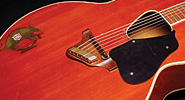
Also included is his red-painted ES-140, which was a true oddball – and one with a fascinating story. Set to play with the Red Norvo Trio on one of the first TV shows to be transmitted in color, the producers asked Tal to pick a red guitar. He refused to paint his own guitar red, but the TV people called Gibson who seized the moment, painted a diminutive ES-140, and shipped it to Farlow for the show.
The book also includes a CD of unreleased home recordings featuring Farlow and friends Jimmy Raney, Red Mitchell, Gene Bertoncini, and Jack Wilkins.
This article originally appeared in VG‘s February ’15 issue. All copyrights are by the author and Vintage Guitar magazine. Unauthorized replication or use is strictly prohibited.
The case for the Tender Mercies Rancher was dressed with stickers courtesy of the movie’s props department. Photo: Greg Barnhart.
In the years immediately after World War II, Americans were settling into a new way of life, and plunging headlong toward an economic prosperity never before experienced by everyday people. Change was also afoot among the nation’s guitar manufacturers.
Having been restricted by materials shortages and/or re-tooling to bolster the war effort, guitar makers like Gibson and Gretsch rolled out of the war with a renewed sense of adventure that was quick to take advantage of changes in popular music – fading quickly were big-band music, swing, and be-bop, replaced by simpler, more aggressive types of music that would eventually take on labels like “rock and roll,” “rockabilly,” “country and western,” “folk,” and “blues.”
The predominant trend among guitar builders at the time was the shift to electricity and (a bit later) the solidbody guitar. But there were more nuanced changes, as well, like the burgeoning popularity of folk music, which in 1947 spurred Gretsch to design three flat-top acoustic guitars – the 16″ Sierra Synchromatic 75 (model number 6007), the 17″ Jumbo Synchromatic 125F (model 6021), and the 18″ 400F (6042). Though none went on to achieve status as truly noteworthy collectibles, the 125F evolved to become the most popular Gretsch acoustic ever made.
In 1954, Gretsch removed the word “Synchromatic” from the headstock of the 125F and re-named it the Town and Country. Still a fairly well-dressed critter, it retained the 6021 model number, 17″ body, maple back and sides, laminated spruce top with natural finish, ladder bracing, multi-ply binding on its top and back, and bound fretboard with block inlays. It also carried over certain design elements from the Jumbo Synchromatic, some functional (arched maple back, height-adjustable bridge), others downright funky, like the triangular sound hole, triangular rosewood bridge, and slanted metal string-anchor plate.
Introduced alongside the Town and Country, the 6022 Rancher was simply a 6021 dressed up in what Gretschheads call the “cowboy” treatment – Amber Red (a.k.a. “Western Orange”) finish, a tortoiseshell pickguard with engraved steer head, “G brand” logo on the lower bass bout, “cows and cactus” inlays, and the steer-head inlay on the face of the headstock.
Robert Duvall with the Rancher and co-star Allan Hubbard in the lobby card for Tender Mercies.
Not exactly renowned for their sound or playability, the Rancher and Town and Country are today viewed much more favorably for their catchy looks.
“They are both artistically avant-garde interesting pieces of art,” said George Gruhn, co-author of Gruhn’s Guide to Vintage Guitars. “However, their laminated top construction, heavy bracing, and bridge design are not conducive to producing good acoustic sound. While they have some appeal as collector’s items, I view them as musical stage props.”
“I agree,” added Walter Carter, Gruhn’s Guide co-author and author of several other books that chronicle guitar brands and models. “You have to string it up with the heaviest strings you can find and play it as hard as you can. That’s the only way to get any sound out of one!”
So it was that the Rancher mostly languished in terms of popularity, and thus was subject to Gretsch’s treatment of similarly dressed guitars (the company also slapped the “cowboy” dressing on the 6120 Chet Atkins Hollow Body, the 6121 Chet Atkins Solid Body, and the 6130 Roundup – the last two were essentially Duo Jet models in Rancher duds) when bits of the “cowboy” detail were dropped from the Rancher with each passing year. Not cool, but certainly better than the fate suffered by the Town and Country, which Gretsch dropped from the line by ’59.
Sans cowboy attire, the Rancher sallied forth, lasting in its original form until 1973, when it was discontinued for two years, reintroduced, then discontinued again in 1980.
The 1955 Gretsch Rancher that “co-starred” with Robert Duvall in Tender Mercies. Photo: Greg Barnhart.
While its story is mostly unexciting, one particular 1955 Rancher did become a Hollywood movie star, of sorts, when it appeared in the hands of actor Robert Duvall in his portrayal of has-been country singer Mac Sledge in the 1982 film Tender Mercies. The character is an alcoholic who seemingly lives out the lyrics of a country song by drinking away his career and family before one day waking up on the floor of a motel in Texas, fresh off an ass-whoopin’. Flat broke, he is forced (or allowed) to “work off” his bill, and the subsequent story of redemption centers around his relationship with the widowed hotel owner, played by Tess Harper, and her son, played by Allan Hubbard.
Lauded by critics, the film scored five Oscar nominations including best director, picture, actor, original screenplay, and original song. It is also regarded as one of Duvall’s finest performances, and marked the only time in six nominations that he was awarded the Oscar for Best Actor. And the Rancher played a significant role in his role.
The guitar Duvall used in the film now belongs to Claude Armentrout and his son, Randy, both of whom are fans of Duvall and the film.
“In 2005, I bought a reissue single-cut Rancher simply because it reminded me of the one in the movie,” Randy said. “But of course I never expected to own the real thing.
“The two play and sound amazingly similar,” he added. “I was impressed to find the ’55 was still in excellent playing condition, with clean, low action that’s as quick and light as any guitar I’ve played. Its sound is thin and bright, but very well balanced, similar to a J-series Gibson, but not as deep.
“Both have the neck contours common to all Gretsches I’ve played, which is my favorite thing about a Gretsch.”
Obviously delighted, Armentrout recalls that after acquiring it, questions abounded about various oddities. So he set out on a mission to gather its history, and his search eventually put him in contact with every person who has owned the guitar since the mid ’60s. Here’s what he has learned so far…
History
Though its earliest history is unknown, in the mid ’60s, concert promoter/record collector Edward Guy bought the guitar, used, from New York’s famed Manny’s Music.
“I liked it because it was very different in color, and because of the shape of the sound hole,” Guy recently told VG. “It had a good neck and a hardy bass sound. Plus, it had the G brand on its top, which just happened to be my last initial!”
A friend of Duvall since the mid ’50s, in 1982, the actor asked Guy if he could use it in a movie because of its authentic, “seasoned” appearance.
“Bobby had a Martin D-28 that his fiance at the time time, Gail Youngs, had given him. But he felt it was too common-looking, and wanted to use a distinctive guitar for the film.” So the guitar made its way to Duvall, who used it “…for six months or more,” Guy said, while preparing for the role in some fairly “method” ways. Guy recounts that Duvall drove more than 600 miles through Texas, recording local accents and sitting in with local country bands.
Two other guitars that were given the “cowboy” treatment include the 1955 6130 Roundup (left) (which was the only one given a “belt buckle” tailpiece), and the model 6120 Chet Atkins Hollow Body.
Guy also invited Duvall to attend the 1982 Waterloo Bluegrass Festival, where Duvall spent time with musical legends like Bill Monroe and Charlie Waller, studying their performances and watching as they interacted with fans and fellow players. When invited, he’d hang out on tour buses.
Guy’s input also affected a certain behavioral trait of Duvall’s character.
“I contacted the Country Music Hall of Fame and obtained a rare video of Hank Williams on the ‘The Kate Smith Show’ in 1952,” Guy recalled. “I found out that Hank never removed his hat because his hair was thinning. Bobby thanked me for that tidbit, and said he would thereafter keep his hat on for the majority of the film.”
Finally, Guy and his partner, George Argast, arranged for Duvall to perform with the guitar as the opening act for Don Williams at a concert in Morristown, New Jersey.
The roadwork apparently paid off, as Duvall then sang the songs for the Tender Mercies soundtrack, and even had a hand in writing some of them.
Shortly after, the guitar was one of three at a party hosted by Duvall in his New York apartment following a screening of the film. Cast members, along with Willie Nelson, reportedly played it as guitars were passed around.
“Bobby had me smuggle in two guitars and hide them upstairs, to avoid being too presumptuous with Willie,” Guy said. “But Willie didn’t need any encouragement. He asked, ‘Does anyone got a guitar?’ and he played and sang for hours… to the frustration of his wife, Connie, who left, somewhat unhappy!”
In 1983, Guy moved to the West Coast, where the guitar was routinely present at jam sessions and parties at Duvall’s home in Malibu, attended by music industry luminaries such as Nelson, Waylon Jennings, Johnny Cash, and Steve Goodman.
In the mid ’70s, Guy replaced the pickguard with a custom version. “The original pickguard dampened the sound,” he remembered. “So I had Matt Umanov replace it.” In ’81, its tuning machines were replaced with Grovers. “I did that because one of the strings kept slipping out of tune. Plus, the gold Grovers really dressed up the guitar, and I wanted it to look good for Duvall.”
The Lone Star Beer Armadillo decal was partially placed over the G brand by the film’s props department, looking to avoid legal/usage issues. Today, it is as it appeared in the film.
Before sending the guitar “on the road” with Duvall, Guy bought a more-durable Guild case to better protect the instrument. Though the case was in like-new condition when it later arrived on the film’s set, the props department (in a move decades ahead of its time!) “relic’d” it and applied backstage-pass stickers, all in the name of authenticity!
In the mid 2000s, the guitar was sold to Peter Trauth at AJ’s Music, in Las Vegas, who sold it to the Armentrouts in 2010. Randy recalls how right after they scored the guitar, he and a friend got completely geeked out with it one night. “We put in the Tender Mercies DVD and I played along with Duvall in the kitchen scene,” he said. “It was spooky how you could tell it was the same guitar, just by the sound! We’d look at the screen, then down at the guitar… it was truly surreal.”
Fans of The History Channel’s “Pawn Stars” reality series might also recognize the guitar, as Trauth appeared with it on a 2009 episode titled “Sink or Sell,” where head honcho Rick Harrison politely declined to pay $10,000 for it.
The guitar will soon be displayed along with other film memorabilia as part of an exhibit at the Country Music Hall of Fame.
This article originally appeared in VG January 2011 issue. All copyrights are by the author and Vintage Guitar magazine. Unauthorized replication or use is strictly prohibited.
CLICK HERE for Tender Mercies scene with Gretsch Rancher.
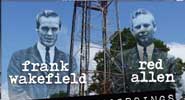
Washington, D.C. and vicinity, known for forward-thinking bluegrass bands like the Country Gentlemen and the Seldom Scene, also had staunch traditionalists, among them the team of mandolin virtuoso Frank Wakefield (a one-time Stanley Brothers and Jimmy Martin sideman) and former Osborne Brothers singer-guitarist Red Allen.
In 1963, the pair, along with banjoist-vocalist Pete Kuykendall and bassist Tom Morgan, recorded an album for Folkways Records, performed at Washington-area clubs and on bluegrass-friendly WDON radio in Wheaton, Maryland.
The 22 songs from those broadcasts largely reflect a mainstream ’50s and ’60s bluegrass repertoire blending traditional tunes, country hits, and gospel with unexpected twists like the Bailes Brothers’ “I Guess I’ll Go On Dreaming.” Wakefield’s pyrotechnics, which inspired David Grisman and Ronnie McCoury, stand out on “Deep Elem Blues” and the dazzling “Red Apple Rag.”
Powerful vocals aside, Allen was a gifted rhythm guitarist and Kuykendall a fluent banjoist. Morgan provided a solid, syncopated bass rhythm rarely heard in today’s bluegrass.
While Allen died in 1993, Wakefield, now 80, continues performing and recording. Kuykendall is the founder of Bluegrass Unlimited magazine. Morgan remains a respected Tennessee luthier.
These intense, vibrant live performances, unleashed after half a century, epitomize an era of bluegrass long gone but well worth revisiting.
This article originally appeared in VG‘s February ’15 issue. All copyrights are by the author and Vintage Guitar magazine. Unauthorized replication or use is strictly prohibited.
1970s Ernie Ball Volume Pedal built with an aluminum chassis.1970s Ernie Ball advertisement.In the early years of Dire Straits, Knopfler utilized a Morley volume pedal before switching to what became his mainstay, the venerable Ernie Ball unit.
In crafting his subtle guitar sound, Mark Knopfler relied on one of the most basic musical elements – volume. And the lack of it. From his early days with Dire Straits, he employed a volume pedal, the most simple of guitar “effects.” He used it, however, in a way never intended.
From some of the first fill licks in “Sultans Of Swing” played on his Stratocaster through the solo lines of “Brothers In Arms” with his Les Paul Standard, Knopfler used volume pedals to create swells and dives that colored his phrasing in a way no stompbox or rack effect could. Combined with his fingerpicking, rapid hammer-ons and pull-offs, and a powerful bluesman’s vibrato, the tremulous volume of key notes made expressive music.
Ernie Ball’s Volume Pedal was not so much a guitar effect as it was a fundamental tool. Yet Knopfler was not the first – or last – to use it as a true effect.
Roland Sherwood Ball began as a pedal-steel player, gigging around Los Angeles with the Tommy Duncan Band and playing dance music and Western swing. Duncan had been lead vocalist with Bob Wills’ Texas Playboys, so he knew how to swing! Fearing their pedal-steel guitarist’s name lacked that swing, the band nicknamed him “Ernie.”
In 1953, Ball heard tell of an upstart radio repairman who was making pedal steels and amplifiers, and set out to Fullerton to meet Leo Fender. Ball was an instant convert to Fender’s wares and their possibilities. He not only became a Fender pedal-steel endorsee, but opened a teaching academy for budding electric guitarists, and in ’57 opened (in Tarzana) what he would later claim was the world’s first music store devoted to electric guitars.
Righthand side of the volume pedal with the input and output jack sockets and the single control knob.At the dawn of the ’60s, Ball introduced his Super Slinky strings with the all-important G string made in a light gauge, for easy bending. His first converts included Merle Travis and the Ventures before Jimi Hendrix and others made them famous as rock-and-roll’s favored strings.
The Ball volume pedal arrived in 1975, according to company history. The concept likely came from Ernie’s days playing pedal steel in a band; he was accustomed to the pedal controls on his “electric table,” so he built his own foot control, which allowed him to adjust volume to play solos, then ease back to play behind the band.
The original pedal’s chassis used two pieces of angle iron welded together. A strong string with a spring connected to the top plate drove the potentiometer, adjusting the output. The pedal was that simple. And that brilliant.
Ernie Ball’s Volume Pedal quickly earned a reputation for being reliable, durable, and basically indestructible. Truly, the only component that could easily break was the string, and you didn’t need to be a pro guitar tech or lab engineer to replace that. In fact, Ball received an endorsement from a customer who used his two volume pedals as car jacks; according to Ernie Ball Artist Relations and Marketing man Kevin Scoles, he carefully positioned the pedals in his driveway, and drove his automobile up onto them so he could replace an ailing starter motor.
The simple and brilliant string-drive controlling the single volume potentiometer.The basics of the pedal changed little over the decades. The original’s side-mounted input sockets were moved to the front. The angle iron soon was replaced by a simple – and much lighter – aluminum chassis. It could probably still be used for car repairs, but it wasn’t advised.
While the volume pedal did not change in fundamental operation, it did evolve in sophistication. Ernie Ball began offering a range of models, including mono and stereo units plus pedals for use with passive or active electronics. But that was it. The simple foot pedal became a staple in many guitarists’ studio and road rigs.
Most guitarists used the volume pedal as Ball intended – a basic control to allow them to increase their volume to take a solo between verses, then back off, all without pulling their fingers away from the business at hand. The volume pedal might lack the sex appeal of a fuzz, phaser, or octave duplicator, but it did its job. And did it well, night after night.
Knopfler and others found further (and more creative) uses for the simple pedal. Some guitarists attempt to create volume swells by adjusting their guitar’s Volume knob with their pinky as they play. But that’s a test of dexterity many could never manage. The foot control solved that.
For the anthemic “Brothers In Arms,” Knopfler played with one foot almost always on the volume pedal. In fact, he used it as continuously – and as quintessentially to the song – as Hendrix used his wah in “Voodoo Child (Slight Return).” Knopfler could enhance notes with volume surges, add dynamics to phrases, create an organ-like tone in others. The Ernie Ball Volume Pedal helped give his Les Paul a voice.
This article originally appeared in VG December 2012 issue. All copyrights are by the author and Vintage Guitar magazine. Unauthorized replication or use is strictly prohibited.
VG reader Jesse Moreno has tried his share of phaser effects and says, “I’ve never really come across another quite like the ’70s Electro-Harmonix Polyphase. With six stages of LDR-modulated analog goodness that rival the sound of the most sought-after phase effects ever made, it has all the aspects that make for a great vintage effect. Not many were made and it’s difficult to clone because it uses light-dependent resistors, which are long out of production. And not only does it sound fantastic; it just looks really cool in one of those big EHX boxes!
The Polyphase takes your classic phasing sounds to a new dimension by activating its envelope mode. With controls for sensitivity, modulation, and modulation rate, you can dial in anything from funky envelope filter sounds to some of the best Leslie rotating speaker tones I’ve heard in a solidstate floor unit. If you want to play that awesome intro to ‘No Quarter,’ this will get you there.”
Jeff Golub, a multi-genre guitarist whose career included stints with Rod Stewart, Billy Squier, Sonny Landreth, Robben Ford, Marc Cohn, Tina Turner, and many others, died January 1. He was 59. In late 2013, he was diagnosed with Progressive Supranuclear Palsy (PSP), a degenerative brain disease that at first caused him to lose his eyesight and later impacted his ability to speak and control his movements. There is no treatment or cure.
Golub was born in Ohio, took up guitar as a child, and played his first gig at age 12, inspired by Eric Clapton, Jeff Beck, and Jimi Hendrix. As a teen, he heard Wes Montgomery music and later studied at the Berklee College of Music. In 1988, he released the first of more than a dozen albums as a soloist and leader of Avenue Blue Band.
In June, 2011, Golub became blind due to the collapse of his optic nerves. In September, 2012, he fell on the tracks of a subway in New York City, and suffered minor injuries. His final album, made with keyboardist Brian Auger, was Train Kept A Rolling; its title was inspired by the incident. He was most recently interviewed by Vintage Guitar for the January ’14 issue Here.
Golub is survived by his wife and two sons. A tribute concert is scheduled for January 21 at B.B. King’s Blues Club, in Manhattan.

 The PRS Mark Holcomb signature model is based on the Custom 24, but has a 25.5”-scale maple neck with ebony fretboard and 20” radius, a new plate-style bridge, green abalone “J” bird inlays, Hipshot O-ring controls, glow-in-the-dark side dots, and the guitarist’s signature Seymour Duncan Alpha and Omega pickups. It has a carved, figured-maple top, mahogany back, 24-fret Pattern Thin neck, PRS Phase III locking tuners, and a five-way blade switch. Read more at www.prsguitars.com.







 Jeff Golub, a multi-genre guitarist whose career included stints with Rod Stewart, Billy Squier, Sonny Landreth, Robben Ford, Marc Cohn, Tina Turner, and many others, died January 1. He was 59. In late 2013, he was diagnosed with Progressive Supranuclear Palsy (PSP), a degenerative brain disease that at first caused him to lose his eyesight and later impacted his ability to speak and control his movements. There is no treatment or cure.