Year: 2014

  • Tweedy

    Tweedy

    Jeff Tweedy
    Jeff Tweedy: Zoran Orlic.

    Where does time go? In 1996, the liner notes to Being There, Wilco’s masterful two-disc paean to American music, included a dedication from ringleader Jeff Tweedy to his wife and their newly born son, Spencer. Fast-forward 18 years and we find Wilco’s frontman releasing another double LP – this one with Spencer and under the eponymous handle “Tweedy.” Having originally intended Sukierae to be his first proper solo record, Tweedy the Elder reconsidered his firstborn’s role behind the drum kit and decided to bill the project as a duo.

    Whatever moniker it goes under, Sukierae is, of course, a record for Wilco fans. And upon their first few listens, even some among that adoring legion might be inclined to cite the old maxim that every double album is a missed opportunity at an even better single album. Indeed, double LPs throughout rock history have suffered artists with too much time and resources at their disposal. And this one was, after all, recorded at the Loft, Wilco’s well-stocked Chicago clubhouse. But a bit of patience reveals two thoughtfully paced albums with plenty of ear candy.

    The proceedings kick off with the urgent and angular “Don’t Let Me Be So Understood” (interesting, and no doubt coincidental, side note: Being There launched with the alt-country-meets-aggro “Misunderstood”). Disc one also features the flighty rocker “Low Key,” featuring gorgeous background vocals from Jess Wolfe and Holly Laessig of Lucius. Young Fresh Fellow and R.E.M. fifth man Scott McCaughey also pops up here and elsewhere to lend a hand on keys.

    But Tweedy the Duo always keeps it interesting, following “Low Key,” for example, with “Pigeons,” which finds Pa Tweedy presumably addressing Spencer (“Now that you’re older, now that you’re grown/Now that you’re getting to know the unknown”). The equally reflective “Nobody Dies Anymore” (“I’m going to where nobody dies anymore… no badge knock on the dark front door”) is one of the release’s best tracks.

    But such sober fare is always countered. Disc two includes the sunshiny pop of “Summer Noon,” complemented by rootsy numbers like “Flowering,” “New Moon,” and “Fake Fur Coat.” It should be noted that while Jeff Tweedy has long performed solo during downtime from Wilco, it’s a treat to hear a proper release in which he completely steps out from the shadow of that brilliant ensemble, and Sukierae offers a nice combo platter of his loud guitars, fine flatpicking, and even a tasteful Willie Nelson-like flourish or two (e.g., “Wait for Love”).

    In the past, Jeff Tweedy has been justly dismissive of descriptions of Wilco as “dad rock.” Here, he – and his son – have subverted that reductive tag by giving it quite literal meaning.


    This article originally appeared in VG‘s November ’14 issue. All copyrights are by the author and Vintage Guitar magazine. Unauthorized replication or use is strictly prohibited.


  • Godin

    Godin

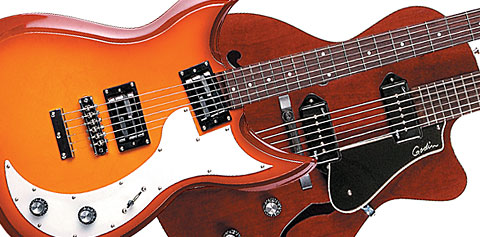
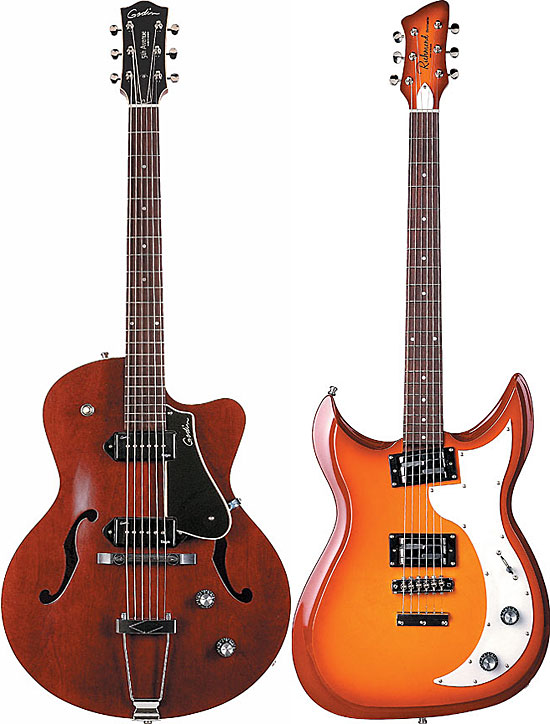
    Godin’s 5th Avenue CW Kingpin II and Richmond Dorchester
    Godin’s 5th Avenue CW Kingpin II and Richmond Dorchester

    We’re living in a golden age of retro guitars – a period when you can barely turn around without tripping over some cool, vintage-styled plank. Granted, the retro fad has become a bit cliché. But who cares? An avalanche of rose-tinted guitars sure beats the pointy, heavy-metal binge of the ’80s or the bottomless pit of Strat copies we suffered in the ’90s! In that light, let’s have a look at two “oldies” from Godin.

    The 5th Avenue CW Kingpin II is a cutaway variation on the popular 5th Avenue archtops. Beyond the cutaway, Godin added two P-90 pickups to conjure a guitar that evokes the vintage jazzboxes of the post-war era (before Seth Lover’s humbucking pickup irrevocably altered the guitar landscape in 1957). The Kingpin II has a top, back, and sides made of Canadian wild cherry – an unusual guitar wood, but functional. Its neck is maple with a rosewood fingerboard shaped with a 16” radius. The guitar has a 24.84” scale – a hair longer than a Les Paul. The suitably simple electronics include the two P-90s, a master volume and tone, and a three-way toggle. There’s also an adjustable Tusq bridge by GraphTech.

    The Kingpin II works as an acoustic or electric guitar, so it’s handy for practicing alone or in a live-band situation. Still, the guitar projects reasonably well unplugged. The neck also feels more like an acoustic, perhaps due to the unbound fingerboard, and is also quite slim and easy to play – unlike post-war archtops with necks like baseball bats. Plugged in, the Kingpin has a nice array of tones, from warm and jazzy to twangy and funky. Stylistically, you can cover a lot of ground with this guitar – pretty much anything you can think of minus high-volume rock. But rockabilly, roots rock, alt-country, blues, modern rock, and jazz inflections galore can be conjured up on this guitar. While the mid-price archtop market is fairly crowded right now, the clever addition of P-90s clearly puts the Godin 5th Avenue CW Kingpin II in a different light. Also, the guitar comes in Godin’s “thermally regulated instrument case” (TRIC), which is lightweight and durable.

    Richmond is a sub-brand of Godin, and specializes in British Invasion-styled axes like the Belmont, which came out a few years ago. The Dorchester is their latest, and it’s another 45-year trip back in time to the days of Beatles haircuts, garage bands, and cheapo Italian, Japanese, and German axes. This, however, is a well-crafted axe that’s made in Canada. Finished in a orange-y Cherry Burst reminiscent of vintage Rickenbackers (it also comes in black), the Dorchester has a chambered maple body with poplar wings. Its 251/2”, rock-maple, two-piece neck is fitted with either an “Ergocut” rosewood or maple fingerboard that is beveled on the sides for a worn-in, comfortable feel. Hardware includes a chrome roller bridge with fixed tailpiece and some very hip-looking Lace Alumitone humbuckers – the neck pickup also has a sexy slant to it, adding to the ’60s hipster allure of the Dorchester.

    Running through a Mack tube amp and a Line 6 digital rig, the Dorchester exuded a snappy, twangy sound that seemed perfect for anything from surf to a Fab Four medley. The unique four-position pickup selector is another interesting twist and brought up more twangy tones. The neck position, however, wires the pickups in series for a fatter, beefier tone. Overall, the guitar sounds great, especially for clean or slightly gritty material; even molten overdrive sounds are on the money. Its 21-fret neck is perfectly shred-fast, but doesn’t have much personality – it’s the standard, rosewood-on-maple neck you see on hundreds of guitars these days. Far more impressive is the Dorchester’s angular body design and those cool Alumitone pickups. Paired with some pointy-toed Italian boots and a Farfisa organ, the Dorchester will rock the roof off.

    Godin 5th Avenue CW Kingpin II, Richmond Dorchester

    Price: $1,195 (5th Avenue Kingpin II), $1,250 (Dorchester)

    Contact: Godinguitars.com.


    This article originally appeared in VG May 2010 issue. All copyrights are by the author and Vintage Guitar magazine. Unauthorized replication or use is strictly prohibited.
  • Henry Garza

    Henry Garza

    Henry GarzaLos Lonely Boys’ new album, Revelation, draws from several influences while retaining the band’s Texas/Mexican identity. Collaborating with a group of top-tier tunesmiths, Revelation weaves pop, reggae, soul, and conjunto influences. It follows guitarist Henry Garza’s recovery from a violent fall from the concert stage. After a stretch in the hospital, he’s excited about getting busy on the guitar.

    Vintage Guitar:You’ve figured out how to mix your culture with accessible, guitar-driven pop. Was that the plan?

    Henry Garza:Every one of the songs sounds different, and is in its own world. That’s the way we wanted to record; we didn’t want to push a song into sounding like something it wasn’t. We let the song lead us and didn’t detour; if it needed Texican country, rock, pop, soul, R&B, heavy – we didn’t fight it.

    Was there discussion about using outside songwriters?

    Yes. We’ve been doing are own production for a while, and our management gave us a list of people who wanted to write with us and were pretty successful. The plan was to write with people, get a producer, and bring more energy and excitement. Still, though, me and my brothers are real tight – nobody gets between us – and our music is an extension of that.

    Have producers tried to change your sound?

    Yeah, but we’ve been doing this so long we never felt like we needed anyone’s help. We’re not trying to write hits, but business is business and you have to make good decisions. We’re a real-life family that plays music for a living. That’s how we paid the bills – with our Pops and brothers and sisters, sticking together. It’s never been about making records or being famous. It’s been about playing to survive.

    How do you balance that with writing songs for the radio?

    That’s what every artist is looking for – having something that fits into where the world seems to be going. When you hear a song like “Blame It On Love,” you can hear that Texican sound and know it’s Los Lonely Boys – that’s us coming right through. You can also hear other influences, and that’s being who we are. That’s getting something on the radio with blues, rock, or country, and creating it for the now.

    Talk about your accident.

    [I fell into an] orchestra pit that was 12 feet deep. We had finished the show and I ran out to shake some hands [but] didn’t know there was a hole. The momentum shot me forward and I torpedoed onto my face and was told that because I didn’t know I was falling, I didn’t tense up or brace myself, which probably saved my life. I had a fractured neck, herniated discs, and bulging discs. I’m alive and doing a lot better. I’m a spiritual dude; I put it in God’s hands.

    What are you playing now?

    Tejana is my number one guitar. She’s a Mexican Strat I put together with my tech, Ish Flores, and has Texas Special pickups, which I love. We do it like we do our cars – make them into lowriders and put our own flash on them (laughs)!


    This article originally appeared in VG Acoustic no.001 e-newsletter. All copyrights are by the author and Vintage Guitar magazine. Unauthorized replication or use is strictly prohibited.


  • Pete Seeger

    Pete Seeger

    Pete Seeger

    Renowned folk singer/songwriter, musicologist, organizer, and political activist Pete Seeger died January 27 at a hospital in New York City. He was 94 and passed from natural causes.

    Seeger was born in 1919 to Charles Seeger, Jr. and his wife, Constance. Charles Seeger is credited with helping found the academic discipline of ethnomusicology in his work for the University of California. Constance was a concert violinist who also taught at the Julliard School. After his parents divorced in the mid 1920s, Charles married Ruth Crawford, a music student and composer who later contributed to Carl Sandburg’s influential folk-music anthology, The American Songbag.

    Pete Seeger began playing the ukulele as a schoolboy, and at 17 discovered the five-string banjo when the family, while researching rural American folk music, attended  the Mountain Dance and Folk Festival in North Carolina. Enthralled, Pete asked his father to arrange for him to learn basic strokes on a five-string banjo from festival organizer Bascom Lamaar Lunsford. He then spent the next several years focused on learning the instrument.

    After finishing prep school, Seeger attended Harvard, studying to be journalist. There, he started a political newspaper and joined the Young Communist League. He left college after two years and moved to New York City, where he helped Alan Lomax catalog and transcribe music at the Archive of American Folk Song at the Library of Congress.

    Seeger’s life was always immersed in folk music and the socioeconomic realities of those who created it. As a result, he became a political figurehead who performed songs for the grass-roots audiences at labor rallies, anti-war rallies, civil rights marches, colleges, and folk festivals. He typically played banjo or guitar during these performances, and was known for adapting spirituals and other traditional songs and encouraging the audiences to sing along with him.

    In 1942, he was drafted to the U.S. Army and trained as an airplane mechanic, but then assigned to a unit of performers in the Pacific Theater. After the war, he resumed performing and in ’49 helped form The Weavers, a folk group that also included Lee Hays, Ronnie Gilbert, and Fred Hellerman. By the early ’50s, the band had sold some four million singles and albums, but Seeger’s membership in the Communist Party (which he had disavowed prior to forming the band) came back to haunt him when a pamphlet was published listing performers with known Communist ties. It essentially blacklisted the group, which then broke up. Seeger was subsequently called to testify before the U.S. House of Representatives and, after refusing to answer questions about his political beliefs, was charged with contempt, indicted, and sentenced to a year in prison. The indictment, however, was overturned.

    His discography ultimately included more than 100 albums and several hit songs, mostly via his time with The Weavers.  The ’60s saw a new generation of performers find inspiration in Seeger’s life and work. Among them were Bob Dylan, Don McLean, and others involved in the “folk boom,” including the Byrds, who in ’65 scored a major hit with “Turn, Turn, Turn,” which was written by Seeger.

    Seeger remained very active, professionally and politically, throughout his career. A co-founder of the Newport Folk Festival, he was integral to the folk-music revival of the ’60s. By the mid ’60s, he began to call attention to environmental issues, which he championed through the remainder of his life. In 1996, he was inducted to the Rock and Roll Hall of Fame. In ’97, he won a Grammy Award for best traditional folk album. He won the award again in 2009, and then in 2011 won in the children’s music category. Vega and Martin have both issued instruments that carry his name; Vega the Pete Seeger Longneck banjo, Martin the JSO and J12SO! Sing Out Pete Seeger model guitars.

    “Seeger was one of the most influential and iconic performers in the history of American traditional and folk music,” said VG contributor George Gruhn. “He combined music with political and social activism influencing millions of people. He helped to promote the careers of numerous musicians including Woody Guthrie and Leadbelly. During the late 1950s through the mid ’60s, Pete was one of the major catalysts for the increased popularity of five-string banjos and 12-string guitars in folk and popular music. His legacy is vastly greater than the sum of his recorded music.”

    Seeger is survived by a son, two daughters, a half-sister, and six grandchildren.


    This article originally appeared in VG May 2014 issue. All copyrights are by the author and Vintage Guitar magazine. Unauthorized replication or use is strictly prohibited.


  • Off Stage Offers BodyDouble Guitar Surround

    Off Stage Body DoubleOff Stage Products’ BodyDouble is an ABS polymer shell that protects the body of a Gibson or Epiphone Les Paul while also allowing the guitar to sit higher on a player’s lap, for a more-stable playing position when seated. It has a 15″ bout and 2″ depth that mimics the feel of a 335-sized guitar. Learn more at www.offstageproducts.com.


  • Chris Poland

    Chris Poland

    CHRIS_POLAND_01

    Chris Poland’s signature legato was born from tragedy. As a teen, his left hand accidentally punched through a plate-glass window and cut tendons in his fingers. He lost the ability to bend his index finger, and lost feeling in his pinkie. As a result, he learned unique fretting techniques that set the bar for inventive metal soloing on the first two Megadeth albums, and an impressive collection of solo and band projects.

    Today, he leaps from jazz with Polecat to metal with Queensryche and Lamb of God to fusion with Ohm.

    Fans of your playing in Megadeth think of you as a metal guy, but you’re actually from the Mahavishnu Orchestra school.
    I ripped off all that stuff. On “Sister Cheryl,” the ascending chord part is basically half the section from “Electric Dreams.” I learned all the chords from “Birds Of Fire” and a lot of the chords from “Inner Mounting Flame.” McLaughlin does a lot of triads with his thumbs doing bass roots here and there. I was so into the band that I incorporated those chords into whatever I do.

    How did you develop that fluid legato?
    The outro solo on Led Zeppelin’s “Good Times Bad Times” has ascending and descending lines that got me started. Once I began listening to jazz and fusion, I started listening to a lot of Wayne Shorter and Michael Brecker. I don’t have their harmonic knowledge, but when you listen to something long enough, you emulate it a bit. I just like the way it sounds. I’m a huge Holdsworth fan.

    How did Ohm come together?
    I tried some vocal projects with my brother and different guys and it was always so contrived, except for Damn The Machine, which was heartfelt. We tried best we could, but it just didn’t fly. One day, I called Pag [bassist Robertino Pagliari] because we played in a band called The New Yorkers and were into the fusion thing that was happening with Billy Cobham, Tony Williams, Return To Forever, and those bands. Pag was into Brand X.

    We were doing well around town, then The Knack came out and L.A. decided that they didn’t like our music anymore. So we quit. I went through all these bands trying to get record deals. I called Pag and I said, “Let’s just play music we like and work jobs.” Otherwise, you’re just standing around wondering why you’re not playing. It’s the same way I felt in Megadeth. For a while it was fun, but after a while you’re like, “I can’t write anything with the band because it all has to be in this pigeonholed thing.” Now we do what we do. We’re never going to make any money, but I don’t think anybody is.

    You’ve played on records by Lamb of God, Geoff Tate’s last Queensryche record, and jazz with Polecat. Which is the most challenging?
    I played on Michael Angelo’s record and it was the fastest thing I’ve ever played! (Laughing) It was the fastest rhythm section I have ever heard in my life, and I know it was played by human beings! It just freaked me out!


    This article originally appeared in VG Febuary 2014 issue. All copyrights are by the author and Vintage Guitar magazine. Unauthorized replication or use is strictly prohibited.


  • Marty Stuart

    Marty Stuart

    Marty Stuart
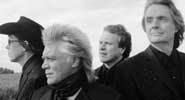
    Marty Stuart and his Fabulous Superlatives.
    The title of Marty Stuart’s two-disc album originates in a longstanding Southern paradox: the notion of raising hell, boozing, and partying on a Saturday night, usually in a barroom or dancehall – then shaking it off for a worshipful Sunday of church and fellowship.

    Working with his Fabulous Superlatives – guitarist Kenny Vaughan, bassist Paul Martin and drummer Harry Stinson – and joined by select guests, Stuart creates an effective tapestry spanning both worlds, with consistent sound and feel. Most songs are Stuart originals; others are traditional numbers or smartly chosen covers.

    Saturday Night opens with “Jailhouse,” a churning, Chuck Berry-inspired ditty with fiery guitar interplay between Stuart and Vaughan. The explosive, raw rockabilly of “Geraldine” features infectious riffs with an added attraction – guest Mickey Raphael playing the Little Walter-style blues harp he seldom gets to play with Willie Nelson.

    Stuart delivers “I’m Blue, I’m Lonesome,” co-written by Bill Monroe and Hank Williams Sr. This version is amplified yet retains the haunting feel of Monroe’s 1950 original. He unleashes Clarence White’s string-bending Tele in the middle, quickly answered by Vaughan.

    “Rough Around The Edges” has the feel of Jerry Lee Lewis’ ’60s honky-tonk ballads, complete with a cameo by Lewis fiddler Kenny Lovelace. While Stuart’s original “Look At That Girl” has a ’60s rock feel, three others are country tunes from that decade: the obscure 1965 George Jones ballad “Old, Old House,” Warner Mack’s 1966 hit “Talkin’ To The Walls” (with Gary Carter’s pedal steel and veteran Nashville A-Team pianist Pig Robbins), and Charlie Rich’s classic 1969 ballad “Life’s Little Ups And Downs.” The acoustic rocker “Streamline” featuring guest picker Tommy Emmanuel ends the disc.

    The timeless Staple Singers hymn “Uncloudy Day” begins Sunday Morning, with harmonies from Mavis Staples and Stuart playing haunting, Pop Staples-style reverb- and tremolo- drenched chords on Pop’s own Tele.

    On the slower tunes, especially “Heaven,” “Angels Rock Me To Sleep,” and “Long Walk To Heaven,” Stuart’s passionate vocals are telling reminders of his deep gospel roots. But he rocks hard as well, especially on “Boogie Woogie Down The Jericho Road,” driven by John Lee Hooker riffs.

    That’s also the case on Vaughan’s vocal showcase “That Gospel Music,” “Cathedral,” the instrumental “Good News,” and the traditional “Keep On The Firing Line,” sung by Martin. Stuart and Vaughan, both powerful, intense pickers, create shimmering textures behind the vocals.

    Stuart and the Superlatives have worked together long enough to develop an intuitive cohesion both onstage and in the studio. This is, without question, his most ambitious effort in some time, and one that succeeds – from barstool to pew – without once losing its joy or fervor.


    This article originally appeared in VG‘s December ’14 issue. All copyrights are by the author and Vintage Guitar magazine. Unauthorized replication or use is strictly prohibited.


  • Leslie West

    Leslie West

    Leslie West
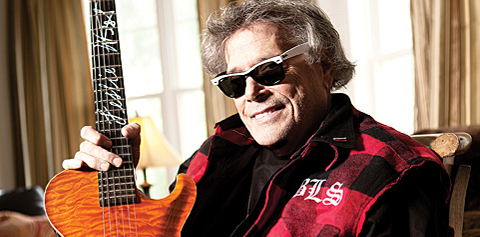
    Leslie West is renowned for his iconic tone and revered as a forefather of classic rock. A true survivor, he’s adjusting after a life-saving leg amputation, but forging ahead and inspired to continue making music. West filled us in with a rundown of the tracks on his aptly titled latest release, Still Climbing.

    “I started recording a year ago,” he said. “I wanted this album to be a progression of Unusual Suspects, and I wanted to take my time putting everything together. I had some good ideas for riffs and didn’t want to be redundant in guitar solos. My wife, Jenni, wrote some great lyrics and my friend, Jon Tiven, helped with some others. My co-producer and engineer, Mike Goldberg, played drums, and Rev Jones played bass.

    “I started with ‘When A Man Loves A Woman,’ the track with Jonny Lang. We sat in the control room, and played and sang together. I love the way Jonny sings and plays. He sings from his chest with a lot of feeling. He sounds like he could be a 50-year-old bluesman. Then I did ‘Dyin’ Since the Day I Was Born,’ which Mark Tremonti played on. He’s a fast player, but very melodic. ‘Tales Of Woe’ is just me with an acoustic guitar and a slide. That’s one of my favorites. It’s not a pity party, but I’ve had some ‘tales of woe’ in the last year; my friend David Biglin played the acoustic intro that sounds like a Spanish guitar. David also played acoustic, keyboard, and B3 on ‘When A Man Loves A Woman’ and ‘Feeling Good.’ He plays great acoustic and does things that I’m not so great at. I’d rather have him play those parts so I can play lead or slide over them. Next was ‘Feeling Good’ with my friend, Dee Snider. People don’t realize he’s not just a screamer. We trade lines in a couple of places and when we sang together, sometimes you can’t tell who’s who.

    “I’d heard ‘Fade Into You’ on the [television] show ‘Nashville.’ A guy and girl did it acoustic, and I thought it was great. I started fooling around and changed it up by starting off acoustic, then really ripping into it heavy when the chorus comes up. I was surprised by how good it came out. ‘Hatfield Or McCoy’ also came from Jenni and I watching TV. She started writing lyrics, then I started playing slide and it came together quickly. That one was a lot of fun. The female vocals were Elaine Caswell. She did a great job.

    “Johnny Winter played on ‘Busted, Disgusted Or Dead.’ He wrote a couple of songs with me before, and I’d done a track on his album, so I thought it would be great to have Mike go to the studio in Connecticut where Johnny works, and record him. He plays the middle solo and we made it sound like we’re playing together.

    “‘Don’t Ever Let Me Go’ has a guest spot by Dylan Rose, who plays with James Durbin from ‘American Idol.’ My manager said he sounds kind of like me, so I let him play the ride-out. He has melody, but to me, he sounds like a Mark Tremonti or Zakk Wylde.

    “I re-recorded ‘Long Red’ because of all the people who sampled it! It’s one of the most sampled hip-hop songs of all time. That blew my mind! Lana Del Rey, Nas, Depeche Mode, Jay Z., Kanye West… This is the way I do it now. It’s a lot heavier. Who knew when I wrote it in 1969 that it was hip-hop? My brother, Larry, played bass on it.

    “My favorite track on the album is ‘Not Over You At All.’ Oh, boy, I love the riff on that song!

    “For the gear, I changed amps on this album. I started using a Blackstar Series One 100 head with the channel-switching footpedal for clean, fat clean, slightly dirty, and then full-out gain. Mike Goldberg didn’t EQ my guitar, so what you hear is the sound from the amp. For effects, I used a TC Electronic digital delay and an octave pedal.

    “I played four Dean guitars, which all have my MOT Mountain of Tone pickup. It sounds like a P-90, but it’s a humbucker. The new Mudflap Mama model has a stainless-steel mudflap girl inlaid on the neck, and it has the biggest sound. The Mississippi Queen sounds different altogether and its graphics are amazing. I used a Dean V for slide with a Joe Perry Boneyard porcelain slide – porcelain works really well. You don’t hear the squeaking or clanking of metal. The acoustic is a Larrivee jumbo. It has a great sound for recording. I’m really happy with the way everything came out – from the songs to the sounds!”


    This article originally appeared in VG May 2014 issue. All copyrights are by the author and Vintage Guitar magazine. Unauthorized replication or use is strictly prohibited.


  • Ohana Ukuleles

    Ohana Ukuleles

    Ohana Ukueles

    Ohana Ukuleles
    Price: $249 (SK-35, CKP-70R); $259 (SK-28)
    Info: www.ohana-music.com
    .

    Just like guitars, ukuleles come in all quality levels, from uke-shaped objects made of plastic, composite board, and unidentifiable materials, to solid-wood professional-grade instruments. Ohana Ukuleles’ offerings are definitely in the latter category, geared toward the serious amateur and professional player on a budget who demands a solid-wood instrument capable of tuning and playing easily, staying in tune, and projecting well.

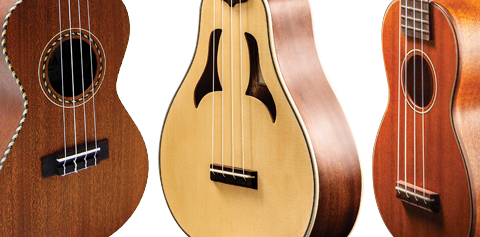
    Three examples from Ohana’s current lineup – the SK-35, the SK-28, and the CKP-70R – all share a very similar price, but have three very different body styles and differing details. All three use bone nuts and saddles, Aquila strings, and precision friction tuners. Other shared characteristics include a similar high level of fit and finish. The Ohana satin finish is three coats of polyurethane and polyethylene with prep stages between each, and it’s virtually impossible to hide signs of wood filler or other “fixes.”

    Ohana uses wood from various sources, including spruce, cedar, redwood, and myrtle from the United States, and mahogany and Indian rosewood from Africa and Asia. According to Ohana’s founder and owner, Louis Wu, all woods used by Ohana are certified sustainable and compliant with regulations like the U.S. Lacey Act for forest conservation. The wood used for the tops, backs, and sides of all three ukes displayed tight, straight, grain patterns the likes of which one wouldn’t be surprised to see on a top-echelon guitar or mandolin. All three displayed an excellent level of fit and finish, with no obvious flaws. The finish on the back of the neck was especially smooth and comfortable, fret ends were well-finished and didn’t protrude from the fretboard, and all three were set up well so they played easily with no dead spots or intonation issues. Finally, binding details were impeccable; even the intricate rope and herringbone binding on the SK-28 is virtually seamless. The SK-35, least ornate of the three, is dressed with elegant four-ply binding on its top, three-ply on its headstock.

    The bracing, which is just as important to a ukulele’s overall sound as it is to a guitar’s, varies from model to model, and is based mainly on three factors: body shape and size, wood combinations used, and the thickness of wood specified for the instrument. Some models have the more standard fan-bracing pattern, while others use different and unique bracing schemes.

    Ohana’s luthiers, who work at the company’s factory workshop in China and develop the build details of each model, look at each new instrument design independently to achieve a balanced tone and durable structure (though Ohana tries to stay true to the original bracing design on its vintage reissue models).

    As one might expect from solid-wood instruments with different body styles and bracing, all three sounded different. The CKP-70R has the least traditional body style (it’s modeled on a Vita-Uke, with a pear-shaped body) but was the loudest of the three, with the best projection, dynamic range, more bass extension and a more harmonically complex tonality, especially in its lower midrange.

    If you’re in the market for a pro-level ukulele, give Ohana ukuleles a look and listen. They’re serious instruments that are, most definitely, made to be played.


    This article originally appeared in VG May 2013 issue. All copyrights are by the author and Vintage Guitar magazine. Unauthorized replication or use is strictly prohibited.


  • Henretta Engineering Pedals

    Henretta Engineering Pedals

    Henretta Engineering Pedals

    Henretta Engineering Pedals
    Prices: Green Zapper, Bluebird, and Purple Octopus, $125 each; Chord Blaster, $140
    Info: www.henrettaengineering.com.

    Bigger is not necessarily better – especially when you have a pedal board full of stompboxes, but still need room for just one more effect. In this case, miniscule can rule.

    Enter Henretta Engineering and its unique lineup; eight analog pedals handmade here in the good old U.S.A., each with just a 2×2-inch footprint. Small is indeed beautiful.

    Their square shape allows these little fellows to squeeze into spaces typically uninhabitable on pedalboards, and they are easily rotated to position their 9-volt jacks right to left, left to right, up to down, or down to up.

    Add to this one more novel feature: These mini stompboxes are “no-knobbers.” Each has an on/off footswitch, but that’s it. Sound parameters are dialed in with internal trimmers; then the player can simply forget about the settings. It’s that easy.

    Mastermind Kevin Henretta offers the Orange Whip Compressor, Bluebird Fuzz, Green Zapper Auto Filter, Mr. White Tweak Boost, Pinkman Dirty Boost, Crimson Tremolo, Purple Octopus Octave Up, and Emerald Prince Preamp. The concept, of course, is a nod to vintage Dan Armstrong mini pedals like the Blue Clipper and Orange Squeezer, but Henretta’s creations are simpler, rock-solid, and brand-spanking-new.

    Henretta sets up all of the pedals for a Telecaster with vintage-inspired medium-output pickups. Users playing a similar axe may never need to open up these effects for tweaking. Otherwise, adjustment is simple, and the sound can be customized to the user’s rig.

    Several Henretta pedals were tested in their stock settings with a ’55 Esquire, ’56 Strat, and Gretsch 6120 reissue through a vintage tweed Deluxe and Grammatico LaGrange amps.
    On its factory trim settings, the Green Zapper proved closer to a compressor than a high-powered Mu-Tron III. To get more oomph, we re-trimmed the sound and dialed in a nice little funk chunk for a Bootsy Collins-approved vibe.

    The Bluebird Fuzz gave a subtle yet sublime overdrive, adding teeth to the sound without distorting the tone, which is certainly something that can’t be said of all fuzz pedals. Think of it like an Ibanez Tube Screamer enriching that special tube-amp voice.

    Henretta Engineering Pedals

    Finally, Henretta’s Purple Octopus worked well in adding overtones that rang clear, especially on the higher strings. It’s quite sensitive to the touch and picking on the guitar, but when you get those octave notes, it sings like a heavenly choir. Combining the Bluebird Fuzz and Purple Octopus inline proved great fun, resulting in a fine Octavia-like sound that would have made Mr. Hendrix smile.

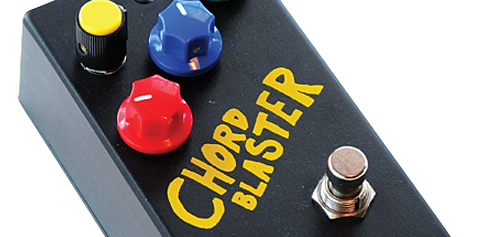
    But wait, there’s more. Henretta also offers a full-size stompbox. The Chord Blaster, is also handmade and all-analog. Sure, the world may not need another distortion box, but this one offers something special. The Chord Blaster boasts two differently voiced gain controls that work independently and together for a wide range of sounds. This dual distortion control is coupled with a simple Tone control of the see-saw type in which the bass is boosted on one end, the highs on the other. The yellow Blast knob distorts the upper mids while the red Chord knob distorts the lower mids.

    Upon Henretta’s sage advice, the blue Tone and green Volume controls were set to noon. Then the Blast knob could be dialed up to the level of distortion and upper mid presence desired. From there, the Chord control filled up the bottom end. It doesn’t take much touch to intensify the fuzziness as it’s dialed up past 9 o’clock.

    Gain is definitely the Chord Blaster’s thing. Again, it can be used like a TS9 Tube Screamer to add some edge to your amp, or tweak it until it shakes the spider webs out of your attic and dusts your house for you. Talk about almost unlimited options for shaping your sound! It’s difficult to think of another stompbox that offers so many ways to personalize your distortion.


    This article originally appeared in VG May 2014 issue. All copyrights are by the author and Vintage Guitar magazine. Unauthorized replication or use is strictly prohibited.