The DBT tell great stories. That continues to be true on their latest album as well. From the workingman’s stomp of “Sh*t Shots Count” that opens the record to the melancholy but majestic closer “Grand Canyon,” the lyrical content is as good as it gets.
Patterson Hood and Mike Colley split the writing and singing duties pretty much down the middle, and each has a way with words. It’s not often a band can lose a writer like Jason Isbell, and still supply such a great list of songs.
On the musical end, this album is a little sparser than some past DBT outings. There’s plenty of great guitar, thankfully. A chord arpeggio serves as the musical hook that keeps swirling in your brain on “Primer Coat.” “When He’s Gone” has a grungy riff that highlights the lyrics about an off-kilter relationship. Slinky slide and quirky dissonant guitar are featured in “Hearing Jimmy Loud.”
This article originally appeared in VG‘s June ’14 issue. All copyrights are by the author and Vintage Guitar magazine. Unauthorized replication or use is strictly prohibited.
Gruhn Guitars is set to offer for sale the earliest known custom-color black Fender Stratocaster. Musician Howard Reed, Jr. (1937–’81) ordered the guitar in 1955 through McCord Music Company, in Dallas. In ’58, Reed joined Gene Vincent and His Blue Caps and used the Strat as his primary guitar onstage. He also used it on “The Big D Jamboree,” on CBS Radio in Dallas. It carries a neck date of 11-55, and tape in the control cavity signed by Gloria (one of Fender employee who assembled it). Reed applied three stickers with his initials “H A R” to the upper bass bout.
Howard Reed onstage with the Strat in 1958.
The guitar was on display at the Rock and Roll Hall of Fame and Museum from January, ’98, through May of 2013. For more, visit guitars.com.
Precision Bass has been offered in a myriad of models in its 50 years of existense, including a number of “reissues.”
One of the more intriguing variants was the Elite II, which was introduced in mid-1983, and disappeared when Fender was purchased from CBS in early ’85. While subsequent variants of Precision models would have two pickups, the Elite II was the first to offer twice the sonic output of a normal P-Bass. But the Elite II was a bit more complicated…
The early ’80s saw Fender in a tailspin. Its marketplace viability and quality control were suspect. And though the Elite line’s innovative features were oriented toward serious/professional players, bassists were more interested in the no-frills, reliable setup of classic Fender instruments – as the success of the company’s first reissues (also introduced in the early ’80s) averred.
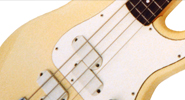
The Elite lineup included a Stratocaster, a Telecaster, and a Precision Bass Elite I (one pickup) and Elite II (two pickups). All models had active circuitry, as well as white pickup covers without exposed polepieces. The Precision Bass Elite had the classic silhouette of the post-’57 P-Bass, as well as a traditional Precision pickguard profile.
In fact, the single pickup on the Elite I as well as the surrounded-by-the-pickguard pickup on the Elite II are found exactly where the pickup would be located on a standard, passive Precision, but that’s where the similarity ends. What’s more, Elites were not the first Fender basses to feature active circuity – that distinction belonged to the Precision Bass Special, made from 1980 to ’83, and which was supplanted by the Elites.
The Elite II’s second pickup (also a split model) is located by the bridge. The controls include two volume knobs, a tone knob, and two three-way mini-toggle switches; one a pickup selector, the other (as described in Klaus Blasquiz’s The Fender Bass) a “tone assign” switch.
One historical fact that might cause some “who-copied-whom” conjecture concerns the frontline two-pickup bass manufactured at the time by Fender’s nearby competitor, G&L, whose L-2000 was introduced in early ’81, and like the P-Bass Elite II, featured a second pickup near the bridge (compared to the single-pickup L-1000). Standard production L-2000s had knobs and mini-toggles laid out in a configuration similar to the P-Bass Elite II,though their operation was different from Elites.
Construction and hardware on the Precision Bass Elites were also state-of-the-art and included Bi-Flex truss rod neck reinforcement, die-cast tuners (which were “plump”), and a fine-tuning mechanism on each bridge saddle.
The Precision Bass Elite II was an intriguing step for the floundering Fender company in those times, and makes a good utilitarian bass for players who prefer traditional look and feel.
In spite of its innovations and sonic options, the Elite II tends to be unfairly stereotyped with other Fenders from the company’s notorious ’70s and early ’80s period.
This article originally appeared in VG May 2003 issue. All copyrights are by the author and Vintage Guitar magazine. Unauthorized replication or use is strictly prohibited.
Goodwin onstage with Joe Cocker and his early-’70s Gibson ES-335. Cocker and Goodwin image courtesy of Julian Bean.
Cliff Goodwin was catapulted into the big time on a decade-long stint with Joe Cocker that began in the late ’70s and during which he relied heavily on an early-’70s Gibson ES-335.
After growing up playing a Kapa Continental, a Silvertone Twin Twelve, and a Vox Super Beatle, Goodwin acquired a ’67 Gibson ES-335 – but it was stolen in 1973. “The day after, I bought a new one,” he said, and he used the Cherry Red instrument for a decade with Jon Butcher Axis, Cocker, to record parts of Robert Palmer’s Secrets album, and on gigs with his own American Standard Band.
The Cocker gig came about via the two artists’ managers, initiated by Cocker’s search for a backing unit that was ready to play – and had “no bad habits!” The singer supplemented the American Standard Band with saxophonist Bobby Keys and keyboardist Nicky Hopkins and, after a few weeks of rehearsal, they were on tour in New Zealand and Australia.
A favorite memory from his time with Cocker derives from recording the hit “Fun Time,” from Luxury You Can Afford.
“The band flew to Miami to cut tracks, and we were given no demos to work from. Allan Toussaint, the producer, sang a verse and chorus for us, then left the building! The version you hear is the one we came up with after an hour of jamming, working only from what he sang. I’m very proud of the guitar interplay between myself and Mitch Chakour.”
Other guitars used by Goodwin during the Cocker era included a custom 335-shaped solidbody with a Strat neck, which is, “a beast to play… heavy and awkward, but it screamed!,” and a Yamaha SG2000 that was part of an endorsement deal.
“I’ve played SG2000s from 1981 to now, alternating with a kit guitar,” he said. “I sold the 335 in ’83, thinking I had no need for it. Big mistake! The Strat had a more pointed sound, and the Yamaha is very much a Les Paul, so perhaps I thought the 335 was too middle-of-the-road.”
Last September, however, good fortune smiled upon him…
“I was attending a guitar show in Worcester, when a man from the local scene told me, ‘I think I have a guitar that might have been yours.’ When he brought out this case with stickers all over it, I removed some and my name was stenciled on it – ‘Cliff Goodwin, Worcester, MA, American Standard Band – Joe Cocker Band.’ There it was, exactly as I had sold it, buckle wear and all. He was so gracious enough to sell it to me for what he had in it!”
Today, Goodwin stays busy working with Christine Ohlman, Rebel Montez, the Mohegan All-Stars, the Silverbacks, and other artists, and he’s a consultant for Bose. His greatest “guitar journey,” though, appears to have reached a conclusion.
“That 335 was with me through so many of my best musical life experiences. I must say it is not for sale anymore!”
This article originally appeared in VG September 2013 issue. All copyrights are by the author and Vintage Guitar magazine. Unauthorized replication or use is strictly prohibited.
Wilko Johnson was having quite a run. In 2009 he stole the show in Oil City Confidential, Julien Temple’s acclaimed rock doc about Johnson’s old band, Dr. Feelgood. In 2011 he began appearing as a mute executioner in the cable series “Game of Thrones.” In 2012, he released his autobiography Looking Back at Me, followed by Fender’s launch of a Europe-exclusive Wilko Johnson Signature Telecaster.
Then in January 2013 came the diagnosis of pancreatic cancer. Given 10 months to live, Johnson refused treatment, telling BBC Radio 4 that the circumstances actually made him feel “vividly alive.” Wilko fans should be grateful for the inexactitude of the medical profession: Not only is Johnson still of this realm (as of this writing), but he’s also teamed with Roger Daltrey for this new release mostly comprising fresh takes on tracks from throughout Wilko’s canon.
Going Back Home had its genesis at a 2010 awards show, where Johnson and Daltrey bonded over their mutual admiration of Johnny Kidd and the Pirates. Johnson has explained in the past that his singular technique was the result of a failed attempt to emulate the Pirates’ Mick Green. Nowhere on the album does the Green lineage and Johnson’s trademark “red-guard” Tele get more out front than on the workout of the ’80s-era Wilko solo track “Ice On The Motorway,” with its riff quoting the Pirates’ signature song, “Shakin’ All Over.” There’s also the title track (perhaps the album’s standout), a chugging Feelgoods rave-up from ’75 co-written with Green (i.e., “Old Johnny Green, he asked me in. We watched his TV and we drank a little gin”).
The album features Johnson’s touring band; Blockhead bassist Norman Watt-Roy and drummer Dylan Howe, with keys by Mick Talbot (exStyle Council and Dexy’s Midnight Runners). For his part, Daltrey turns in a stellar performance, often times seeming to channel late Feelgoods front man Lee Brilleaux, especially on that band’s chestnut, “All Through The City.”
Hardcore Wilko fans will appreciate the first proper release of the ballad “Turned 21.” The only oddity is also the album’s lone non-Wilko track, a take on the 1965 Dylan single “Can You Please Crawl Out Your Window.” Then again, perhaps the line “How can you say he will haunt you” is intended to convey Johnson’s gallows humor.
Wilko’s distinctive duck walk, thousand-yard stare, and pudding-basin haircut all succumbed to middle age, but his chops have lost none of the freneticism that helped make him a missing link between ’60s British R&B and ’70s punk. Going Back Home is both a serviceable Wilko Johnson primer and a must-have for longtime fans.
This article originally appeared in VG‘s June ’14 issue. All copyrights are by the author and Vintage Guitar magazine. Unauthorized replication or use is strictly prohibited.
Fargen’s John Lennon Signature JL-15 and Micro Plex
Price: $2,700 (JL-15), $999 (Micro Plex)
Info: www.fargenamps.com.
From 50-watt monsters to 5-watt heads, Fargen Amplification is known for building amplifiers intended for working players. Two of Fargen’s more recent releases – the John Lennon Signature JL-15 combo and the Micro Plex head – may seem miles apart in concept and application, but as it turns out, both uphold their maker’s reputation for quality, functionality, and innovation.
The John Lennon JL-15 is a combo powered by two EL84s and featuring an 8-ohm 12″ Fargen-designed ceramic speaker. The amp’s immediate visual calling card, of course, is its grille cloth featuring a large print of Lennon’s iconic self-portrait. Top-mounted Tone, Volume, and Master Volume knobs are on a plate featuring Lennon’s signature and, most notably, Fargen’s two-way Liverpool/Plastic Ono “Decade” control. The amp is made in the United States and is constructed using a tag board with vintage carbon-comp resistors and ’60s-style mustard tone caps. It also features a proprietary bracket to isolate and reduce tube rattle. The cabinet is made from Baltic birch and is covered in black tolex with decorative white piping. The JL-15’s 15-watt output is channeled through either an 8- or 16-ohm speaker output on the underside of the chassis.
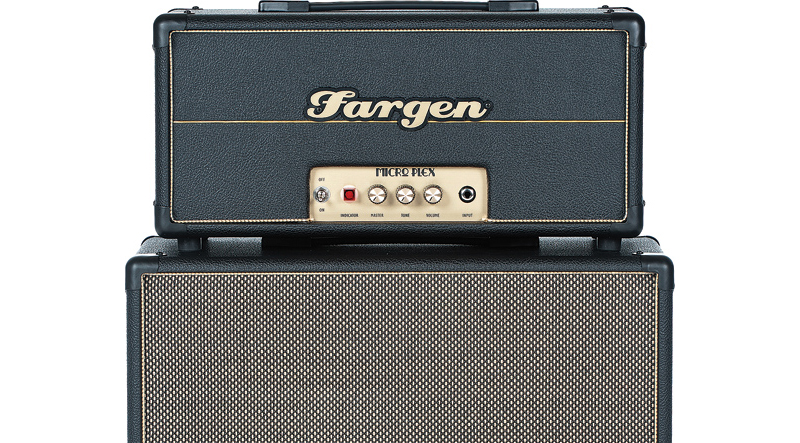
The Micro Plex is a 5-watt Class A single-ended design utilizing a lone 6L6 for power, along with a 12AX7 to cover the preamp duties. For those who like to tinker, the amp can utilize any octal power tube, from the demure 6V6 to the mighty 6550. The head-only amplifier has Volume, Tone, and Master controls, along with push/pull controls for Gain Boost, and Tone Shift. The single speaker out can handle from 4 to 8 ohms. The Micro Plex features construction similar to the JL, also utilizing carbon comp resistors and SoZo mustard caps, along with a U.S.-built transformer.
Both Fargen amps were tested with a ’67 Telecaster and a Gibson Les Paul ’59 reissue. The J-15 delivered instant gratification. For those who are understandably skeptical of a Lennon amp, wondering if it might be standing on name recognition alone rather than its own merits, rest assured that this is not the case with the JL-15. The two-position Decade switch truly gives the amp a twin personality. In Liverpool mode, the amp is firmly planted in AC15 territory – plenty of chime and grind depending on knob positioning and the guitar used. In Plastic Ono mode, it shifts deftly into blackface Fender territory – more lows, a bit more headroom, and smoother highs. The tonal variation provided by the Decade switch is a knockout. Additionally, the Volume, Master, and single Tone knobs offered smooth tapers and plenty of tonal variation to complement both the Tele and the Paul. Volume-wise, the JL-15 is certainly club-friendly but humble, nonetheless. Its toneful 15 watts might require reinforcement when playing with a higher-decibel group.
Plugging into the Micro Plex, the Tele was switched to the neck pickup position to test the clean headroom. With Volume halfway up, Master on full, and Tone at 9 o’clock, a nice semi-clean platform was achieved that could be dirtied up simply by digging in a bit more with the pick. The Tone had to be kept on the low side with the Tele or it could quite easily get into Bakersfield-treble territory. Playing the Gibson, the clean headroom quickly dissipated, but it was replaced by a fat, grinding tone. Turning up the Gain produced even more smooth distortion that never got even a hint ratty, even with the pull Gain or with the Tone turned up. With the Les Paul on the neck pickup, the volume on full, gain boost on, and the master pegged, the amp produced the long sustain and singing tone that one usually only finds over a 100 dB.
In the JL-15 and the Micro Plex, Fargen offers two incredible player-friendly amplifiers. The Lennon has an eye-catching look and versatile tone that make it much more than a tribute amp. Its AC15-to-blackface quick-change makes it the perfect amp for the many who swear by these tones. The Micro Plex has the tweed-Champ-meets-plexi tone that will crunch hard at bedroom levels and sing when paired with a humbucker-equipped guitar.
This article originally appeared in VG August 2013 issue. All copyrights are by the author and Vintage Guitar magazine. Unauthorized replication or use is strictly prohibited.
AXL USA Hand-Aged Bulldog
Price: $699.99 (street)
Contact: www.axlguitars.com
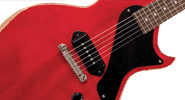
Unabashedly inspired by the classic Les Paul Junior, AXL Guitars’ limited-edition USA Hand-Aged Bulldog is a single-pickup guitar with a slab mahogany body and set neck. Crucial assembly tasks are performed in AXL’s California workshop, where the Bulldog is fretted, set up, tricked out, and whipped into relic’d submission.
Hardware components on the Hand-Aged Bulldog are first-class throughout. A Lindy Fralin dog-ear P-90 is wired through CTS pots with an orange drop capacitor on the push-pull Tone knob, which also functions as a “bite” switch to bypass the tone control. A 111/16″ Graph Tech nut, a TonePros featherweight wraparound bridge, and vintage-style three-to-a-strip TonePros/Kluson Deluxe tuners (also made by Graph Tech) fill out the specs.
The Bulldog’s relic’ing is a noteworthy work of luthiery. Artful and individualized, the test Bulldog had some serious “belt-buckle wear” trespassing through the poly Transparent Red finish and into the one-piece body, its subtly rounded bass-side cutaway splitting the difference between the original single-cut 1954 Les Paul Junior and the ’58 double-cut. The tuners and bridge looked ancient, but with brand-new functionality. While the test guitar’s neck was worn all along the playing length, showing off its straight-grain flamed timber, the 243/4″-scale-length rosewood fingerboard was flawless and outfitted with well-dressed new frets. Topped with a black headstock wih AXL’s retro shield logo in pearl, the Bulldog’s neck is outfitted with a truss rod that is adjusted in classic LP fashion beneath a black-over-white cover.
Aged as it was, the C-shaped neck felt substantial and smooth, thanks to a light coat of oil applied after relic’ing. The setup was easy playing, with no buzzes or concerns. Some players might wish the wraparound bridge was more adjustable, but its location allows for good intonation across the strings.
Plugged full out into a late-’50s Ampeg Jet, the Fralin P-90 had plenty of gain and enough cut to bring down a forest of blues and rockabilly licks, with some punk attitude thrown in. The single-pickup Bulldog was not a one-trick puppy, though. Manipulating the Tone control coaxes out a kinder, gentler rhythm sound. With the Tone knob rolled off completely, a fat ’50s jazz timbre is possible. The handy push-pull Tone pot allows the Bulldog to quickly roar back into a classic lead sound.
With the appeal – and prices – of vintage Les Paul Juniors not dropping anytime soon, the AXL USA Hand-Aged Bulldog is an affordable and tuneful alternative, offering plenty of its inspiration’s sonic and visual vibe.
This article originally appeared in VG September 2013 issue. All copyrights are by the author and Vintage Guitar magazine. Unauthorized replication or use is strictly prohibited.
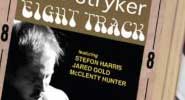
The title of the latest record from jazzer Dave Stryker refers to the eight-track cartridges many of us grew up with in the ’70s. The concept might seem odd, but it ends up working perfectly. Here are 10 pop, soul, and rock songs you’d have listened to on eight-tracks, reinvented for what amounts to an organ trio with an added vibraphonist.
While some of these songs ring true, there are others that don’t seem obvious but defy expectations. Curtis Mayfield’s “Pusherman/Superfly” gets a funky reworking with soulful guitar from Stryker, organ from Jared Gold, and amazing vibes from Stefon Harris. “Aquarius” swings hard and features a stunning bop solo from Stryker.
On the flip side, “Wichita Lineman” sounds like an outtake from a 1967 Wes Montgomery record, with a beautiful arrangement accented by chordal and octave work that fits perfectly.
Other highlights include a brilliant cover of Stevie Wonder’s “Where Were You When I Needed You” (mistitled on the cover as “Superwoman,” a song it was coupled with in a Wonder medley), and a swinging version of the Spinner’s “I’ll Be Around.”
Stryker’s latest takes a quirky and bold step into the past and comes out sounding fresh and modern.
This article originally appeared in VG‘s June ’14 issue. All copyrights are by the author and Vintage Guitar magazine. Unauthorized replication or use is strictly prohibited.
Breedlove Stringed Instruments Discovery Series guitars were, the company says, created to support newcomers to the instrument. They have a radiused fretboard, slimmer neck profile, and pinless bridge and are available in dreadnought and concert-style bodies with no cutaway or electronics, or with cutaway and Fishman ISYS-T electronics. The Concert is designed for the fingerstylist to be well-balanced, compact, and comfortable, while the Dreadnought is slightly more rounded than traditional dreadnoughts. Breedlove’s Pinless Bridge eliminates the need for drilled string holes and provides a gentler string-break angle from the bridge to the top of the saddle, reducing saddle strain. See them at www.breedlovemusic.com.
Nashville Pussy marks its territory of trailer-park Southern rock with lowbrow humor and infectious charisma. The band consists of the husband-and-wife team of Blaine Cartwright on vocals and guitar and Ruyter Suys on guitar. This salty, riff-rockin’ duo is complimented by the contributions of bassist Bonnie Buitrago and drummer Jeremy Thompson.
This is the band’s first album in five years. They’re refreshed, buzzed, grimy, and have created an addictive juxtaposition of AC/DC, Drive-By Truckers, and Motörhead hopped up on white lightning.
Humor plays a big role in the band’s sound, but never overshadows its ability to serve up a monstrous wall of fierce piss-and-vinegar rock. Amidst hard-charging riffs reminiscent of ’70s-era Ted Nugent, sound bites erupt about getting high, being 10 months pregnant, and more.
The album features 13 self-produced songs that showcase the guitar prowess of Suys. She brings a refreshingly filthy swagger and pentatonic bitchiness to such gems as “The South Is Too Fat To Rise Again,” “Before The Drugs Wear Off,” and “Pussy’s Not A Dirty Word.” Keep your eyes peeled for Ruyter Suys.
This article originally appeared in VG‘s June ’14 issue. All copyrights are by the author and Vintage Guitar magazine. Unauthorized replication or use is strictly prohibited.


 The DBT tell great stories. That continues to be true on their latest album as well. From the workingman’s stomp of “Sh*t Shots Count” that opens the record to the melancholy but majestic closer “Grand Canyon,” the lyrical content is as good as it gets.
 Gruhn Guitars is set to offer for sale the earliest known custom-color black Fender Stratocaster. Musician Howard Reed, Jr. (1937–’81) ordered the guitar in 1955 through McCord Music Company, in Dallas. In ’58, Reed joined Gene Vincent and His Blue Caps and used the Strat as his primary guitar onstage. He also used it on “The Big D Jamboree,” on CBS Radio in Dallas. It carries a neck date of 11-55, and tape in the control cavity signed by Gloria (one of Fender employee who assembled it). Reed applied three stickers with his initials “H A R” to the upper bass bout.







 Breedlove Stringed Instruments Discovery Series guitars were, the company says, created to support newcomers to the instrument. They have a radiused fretboard, slimmer neck profile, and pinless bridge and are available in dreadnought and concert-style bodies with no cutaway or electronics, or with cutaway and Fishman ISYS-T electronics. The Concert is designed for the fingerstylist to be well-balanced, compact, and comfortable, while the Dreadnought is slightly more rounded than traditional dreadnoughts. Breedlove’s Pinless Bridge eliminates the need for drilled string holes and provides a gentler string-break angle from the bridge to the top of the saddle, reducing saddle strain. See them at www.breedlovemusic.com.