To the rest of the world, the Swampers are best known from the cryptic verse in Lynyrd Skynyrd’s “Sweet Home Alabama.” And while they might have picked up Mr. Van Zant when he was feeling blue, most folks can’t say the same.
But that’s simply because most folks couldn’t name a song the Swampers played on if their life depended on it. For better or worse, that’s the way the world turns for most good studio musicians.
And the Swampers – a.k.a. the Muscle Shoals Rhythm Section – are indeed good. Most all guitar players and true music fans can list many a song for which they created their trademark soulful, snappy, and downright swampy backline, including tunes by Wilson Pickett, Aretha Franklin, Etta James, Percy Sledge, the Rolling Stones, Elton John, Bob Seger, and yes, Lynyrd Skynyrd.
Happily, the Swampers and the Muscle Shoals, Alabama, recording studio they called their sweet home is now getting its due amongst the rest of the world thanks to director and producer Greg “Freddy” Camalier’s phenomenal documentary film. As the subtitle states, it’s indeed “The Incredible True Story of a Small Town With a Big Sound.”
The four founding Swampers are guitarist Jimmy Johnson, bassist David Hood, drummer Roger Hawkins, and the late keyboardist Barry Beckett. They were later joined by guitarmen Pete Carr and Eddie Hinton and keyboardist Spooner Oldham, among others. Their nickname came thanks to one of their biggest fans, Leon Russell.
The rhythm section was created by Rick Hall, owner of Fame Studios. The town became one of the most famous and influential music meccas in the world. Think of just some of the songs cut there: “Mustang Sally,” “When A Man Loves A Woman,” “Brown Sugar,” and a take of “Freebird.”
Fame and the Swampers’ subsequent studio at 3614 Jackson Highway also stood at a crossroads of race. Here, in the heart of the Deep South, a backline of all-white musicians supported black singers like Wicked Wilson and the Queen of Soul in crafting some of America’s most influential music. Muscle Shoals became a melting pot. And a magic cauldron.
If the documentary can be criticized for anything, it’s a reliance on too many interviews with “name” musicians – ironic, in a way, given the “nameless” sessionmen who played such a key role in making the music. But all of the stars pay homage where homage is due. Included are Mick Jagger and Keith Richards, James and Sledge, Greg Allman, Bono, Clarence Carter, and Jimmy Cliff. Still, it’s the interviews with Hall and the Swampers that really add the insight into the studio’s and music’s story.
Muscle Shoals is beautifully filmed and told. And, as might be expected, it’s bolstered by a phenomenal soundtrack. If you only see one film this year…
This article originally appeared in VG‘s May ’14 issue. All copyrights are by the author and Vintage Guitar magazine. Unauthorized replication or use is strictly prohibited.
The TV Jones Brian Setzer signature pickup uses a proprietary design based on the TV Jones Classic humbucker, which was in turn developed via dissection and study of a vintage Gretsch Filter’Tron. It has custom-made bobbins and alloy pole screws the company says highlight the response of the magnet and offer more clarity with punch low-end mid response. It is available in chrome, nickel and gold finishes. It is hand-built in the U.S. using American components. Visit www.tvjones.com.
What makes these two Martins remarkable is not necessarily their rarity or historical importance, though both would be welcome additions to any serious collection.
Martin has offered sunburst finishes as an option since the 1930s.The earliest Martin catalog reference is a 1932 C-1 archtop with a “top shaded golden brown;” sunburst R-series archtops and dreadnoughts followed in 1933 and ’34, respectively. It was also a popular finish on Martin’s O-18H and 00-40H Hawaiian guitars during this period.
Over the years, however, most Martins have been finished in clear nitrocellulose lacquer, which ages to a mellow golden color. So the occasional sunburst has always been something of a rarity and a special treat.
Sunbursting is truly an individual art, the most spectacular examples have a subtlety – a delicate blending of colors – that only comes from years of practice. To my knowledge, Martin sunbursts have always been two-tone, either tobacco (natural to brown or black) or, more recently, cherry (natural to red). But in the hands of a master airbrush artist, you’d swear the finishes are three- or even four-tone. Martin sunburst finishes exist in just about every imaginable shade and hue – yellow, amber, brown, black, gold, red, light, dark, medium, and on and on.
In the ’60s, even Martin’s F-series acoustic, electrics featured a unique “shaded honey maple” top, with a natural center and caramel color feathering.
Surprisingly, many feel sunburst finishes are used primarily to hide poor materials or sloppy workmanship. That may be the case with other companies, but not Martin. Their sunburst finishes re, for the most part, translucent so there’s not much top area to “hide” anything. Certainly, a top that is less than perfect, cosmetically, would benefit from sunbursting, but Martin grades its top wood by model, with the most expensive receiving higher-grade wood.
This article originally appeared in Vintage Guitar Classics No. 2 issue. All copyrights are by the author and Vintage Guitar magazine. Unauthorized replication or use is strictly prohibited.
For all of his decades of noteworthy guitar work, Robby Krieger isn’t resting on his laurels.
In 2002, Krieger and Doors keyboardist Ray Manzarek formed Doors of the 21st Century (and they still perform as Manzarek-Krieger), but the guitarist’s newest album, Singularity, is an ambitious instrumental effort that expands on his desire to create music with numerous instruments and musicians.
Throughout his solo career, Krieger has crafted tightly arranged songs, avoiding meandering jams. Those on Singularity underscore that reputation.
Named after a Krieger painting that graces its cover, he described singularity as “…a profound event such as the big bang… I could have started with something smaller, such as, say, the destruction of a galaxy or two, but I figured ‘What the hell?’ Hopefully, the music evokes thoughts along those lines.”
Singularity is more cohesive and melodic than his previous solo disc, Cinematix, and while there are plenty of guitars to be heard (Krieger used a ’59 Fender Stratocaster, a Gibson SG, a ’59 Gibson Les Paul, and his three vintage mono ES-355s), reeds, horns, drums, acoustic bass, a Hammond B-3 organ, etc. get to solo, as well.
“I think it’s a little less fusion-y than Cinematix,” said the guitarist. “It’s got a bit more of a Spanish flavor, and more traditional jazz.”
As if to underline Krieger’s “Spanish” musical inclinations, the first track, “Russian Caravan Intro,” is a solo flamenco-guitar piece of the sort he has been wanting to record for many years. He used a 1953 Ramirez. It’s followed by “Russian Caravan,” a 10-minute, almost-orchestral work that incorporates trumpet, flugelhorn, trombone, sax, flute, and acoustic bass, in addition to traditional small-combo instruments. It doesn’t even pick up a tempo until the 2:50 mark, and the tempos noticeably shift for the balance of the song. An overdriven electric guitar played by Krieger can be heard harmonizing with a flute.
(LEFT) Robby Krieger is recognized as a Gibson SG player. With the Doors, he played a ’67 Standard that served as the basis for Gibson’s new Krieger signature SG. Its neck profile was modeled after a Les Paul Junior, and its pickups are wired out-of-phase. “Other than that, the guitar is a copy of my ’67,” Krieger said.
“I actually started writing the song about 15 years ago, when Miles Davis died,” Krieger recounted. “My friend, Arthur Barrow – who wrote most of the songs with me – and I decided to do some kind of Miles tribute; maybe something like (Davis’ 1960 album) Sketches of Spain. And we kind of forgot about it until we resurrected it for this record.”
“Southern Cross” is a Latin-tinged easy-listening tune that features slide work by Krieger, playing Barrow’s old Kay, often very high on the fretboard. “The guitar had a big cutaway on the back, so I could go way up on the neck,” he noted. For the majority of slide parts, Krieger relied on a ’54 Les Paul.
There’s more flamenco on “Event Horizon Intro,” followed by what Krieger calls “a soundtrack vibe” on “Event Horizon.” Other songs on Singularity have a small-combo jazz feel.” Numerous instruments get to solo, which is exactly how Krieger wanted each song to develop. For example, the opening melody of “Trane Running Late” (inspired by saxophone legend John Coltrane) is carried by sax, and when it came to solo parts for the other instruments, Krieger was laissez-faire. “I didn’t tell [the other musicians] what to play,” he said.
The final track, “House of Bees,” has a be-bop feel, with more than one instrument playing melodies with each other, note-for-note. There’s even a low-end sax solo, a la Gerry Mulligan.
He was meticulous getting the album exactly as he wanted it, with its extensive instrumentation and arrangements. Recording and producing it, he recalled, took “…a couple of years. It wasn’t something we could do all at once. I’d been playing the Doors stuff with Ray so much that I wondered when I’d get (Singularity) done. But I love the way it turned out.”
Krieger plans to tour in support of the new album, and continue performing with Manzarek.
This article originally appeared in VG January 2011 issue. All copyrights are by the author and Vintage Guitar magazine. Unauthorized replication or use is strictly prohibited.
Roy Orbison waxed optimistic about life and music on December 4, 1988, the day he played a concert near Cleveland and did a video interview discussing his dramatically revived career. Two days later, he suffered a fatal heart attack at his mother’s home outside Nashville.
This CD/DVD package includes a CD of the final show (previously issued in 2009) and a DVD with the final interview and seven performances (all Orbison standards), four from a 1981 California concert and three from a never-seen 1986 Texas show.
Never recorded to be released, the Ohio concert is mainly a historical document with notable fluctuation in vocal levels. One upside: compared with earlier versions, you can now hear what the band is doing.
Son Alex Orbison’s essay notes that his dad used his custom black Gibson ES-335 onstage while guitarist Bruce Pearson used Roy’s backup 335, having broken a string before the show. Vocals aside, Roy’s capable picking emerges on the other tunes. Orbison used the 335 on the Texas material, a black Strat on the earlier California tunes.
This is not the fabulous Black and White Night (which Legacy also recently reissued), but an interesting footnote for true fans.
This article originally appeared in VG April 2014 issue. All copyrights are by the author and Vintage Guitar magazine. Unauthorized replication or use is strictly prohibited.
Korg’s Rimpitch acoustic-guitar tuner attaches to the sound hole and its LED tuning meter is positioned in the player’s line of sight when looking at the guitar. It has a piezo pickup that detects sound from the body of the guitar, and can be left attached when not in use. Learn more at www.korg.com.
Ampeg’s redesigned BA Series of bass combo amps employ front-facing controls, a 60-degree monitoring angle, a new cab design, and the new Bass Scrambler overdrive circuit on models BA-110 and up, which includes separate Drive and Blend controls. All have three-band EQ along with Drive and Blend controls in addition to master Volume, 1/8″ stereo auxiliary input, 1/8″ stereo output, powder-coated all-metal chassis, and front-panel backlighting. Visit www.ampeg.com.
Dean Markley’s XM Series transducer pickup mounts to the soundboard of an instrument without adhesives, hardware, or modification. It is designed to accommodate traditional acoustic instruments and can be used to amplify hollowbody jazz guitars without sound holes or electronics. Made in the U.S., it uses a 24″ low-noise cable, terminates at a ¼” jack, where a strap-button mount allows connection to any instrument cable or wireless system, and mounts using the Dean Markley’s XM connection system. Learn more at www.deanmarkley.com.
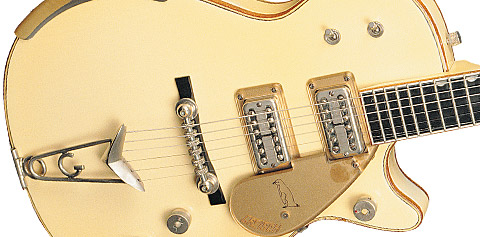
1958 Gretsch 6134 White Penguin, serial number 26389. Photo courtesy Gruhn Guitars.
There’s no doubt the White Penguin is one of the rarest Gretsch instruments. It is estimated that no more than a few dozen were made from the introduction of the model in 1955 through 1964, when it was discontinued, though exact production totals for early Gretsch guitars are not available.
The Penguin appears in no Gretsch catalogs or literature other than the 1959 price list (in which it was offered for $490, while the White Falcon was $675) and a ’58 flyer, which mentioned the White Penguin along with the introduction of Project-O-Sonic stereo electronics, FilterTron pickups, space-control bridge with rollers to adjust string spacing, and the “neoclassical” fingerboard with “thumbprint” inlays.
List prices for White Penguins and White Falcons insured both would be extremely rare. By comparison, in 1958 and ’59, a sunburst Les Paul Standard with patent-applied-for humbucking pickups listed at $265 and the Les Paul Custom with three PAFs listed for $375. The Penguin, in spite of being cheaper than the Falcon, is extraordinarily more rare if only because it was not shown in catalogs and wasn’t promoted by the company to any significant extent. Original list price is not necessarily a determinant of current value on the vintage instrument market. New, the Penguin cost less than the Falcon, but today it’s much more rare, and viewed by many collectors as the holy grail of Gretsch instruments.
The Penguin and Falcon evolved in much the same manner. The Falcon featured body and neck dimensions the same as the Country Club model, with the exception of a larger and differently shaped peghead, while the Penguin featured Duo Jet-type structural features with the exception of the peghead. The Falcon and Penguin models shared ornamentation; with white finish, gold-sparkle edge trim, gold-plated hardware, Gretsch’s “Cadillac” tailpiece, and red rhinestones set into the volume knobs.
Early Falcons and Penguins featured hump-top block inlays with engraving, and the vertical gold-sparkle-inlaid Gretsch peghead logo with wings to the side. A metal armrest is typical of the Penguin, though some lack the feature. Early Penguins and Falcons have a Melita bridge, single-coil DeArmond pickups, one three-position toggle pickup selector, and a master volume knob on the upper bout, and two volume knobs and one tone knob on the lower bout.
In 1958, Gretsch introduced its FilterTron double-coil pickups, space-control bridge, and changed the wiring such that the Penguin and Falcon (and other Gretsches from that time onward) feature a three-position pickup selector and three-position tone switch on the upper bass bout, a master volume knob on the upper treble bout, and two volume knobs on the lower bout.
The Penguin shown here is a 1958 model featuring the early vertical peghead logo, “thumbprint” fingerboard inlays, and FilterTron pickups spaced in the Project-O-Sonic stereo position, with the middle pickup close to the rhythm pickup. However, this guitar is wired in mono. A couple of Project-O-Sonic stereo Penguins have been found, almost undoubtedly custom-order instruments. In fact, because the Penguin didn’t appear in Gretsch literature, it’s reasonable to assume that virtually all Penguins were custom orders.
While most Penguins appear to feature virtually the same electronic and ornamental specifications as Falcons of the same time period, the positioning of the lead pickup on Penguins with FilterTron pickups varied more than on most other Gretsches.
By late ’58, the vertical peghead logo was discontinued on the Falcon and Penguin, and the more typical horizontal Gretsch logo was introduced. Falcons and Penguins were also then fitted with a metal model logo and serial number plate on the front of the peghead, similar to that on the Country Gentleman. By ’62, the single-cutaway design was discontinued on the Penguin in favor of the new double-cutaway design introduced on the Duo Jet. The double-cut version of the Penguin is the rarest of all, though rarity, desirability, and market price are not necessarily linked.
The White Penguin is such a rare instrument that it’s difficult to apply to normal standards of supply, demand, and precedent in appraising them. However, there’s no doubt Penguins have commanded higher prices than any other Gretsch guitars, with some selling for more than $80,000. It’s especially noteworthy that this has been achieved in spite of the fact that not only is this model extremely rare, but with the exception of Dan Fogelberg, one would be hard-pressed to name any major artist who has made significant use of a vintage White Penguin onstage or in the studio. The appeal of the model is its extreme rarity and the fact that it was the most deluxe Gretsch guitar in this body size.
A 1962 double-cut Gretsch White Penguin. Photo:VG Archives.
While the Penguin and its larger hollowbody companion are undoubtedly of as fine quality as any electric guitars ever made by Gretsch, functionally, a White Falcon is virtually identical to the much less expensive Country Club model, since the body size, neck shape, and electronics (and virtually all structural features that have anything to do with playability or sound) are the same.
Conversely, the Penguin is virtually identical to the Duo Jet, sharing the same body construction, neck dimensions (except for the peghead), and the same electronics and other structural components that would affect playability or sound. It’s therefore possible to get the same functional result from another Gretsch of the same era for a fraction of the cost. By contrast, it is not possible to get the sound of a Fender Telecaster or a Fender Stratocaster from a dramatically less expensive Fender guitar of the same era, nor is it possible to get the sound of a late-’50s Gibson Les Paul Standard, Flying V, or Explorer from a dramatically less expensive Gibson model from the same era.
The vintage collectibles market is not driven by utilitarian function alone. Just as an original Van Gogh, Rembrandt, or Picasso painting has no greater functional utility than many far less expensive paintings, but still brings a huge price, there’s more to the vintage musical instrument market than function alone. The Penguin and Falcon, however, are perhaps among the most dramatic examples of fretted musical instruments, either acoustic or electric, in which the ornamental appeal and rarity of the model push prices exceedingly beyond that of other models of virtually identical functional appeal made during the same era, by the same maker.
This article originally appeared in VG’s February 2005 issue. All copyrights are by the author and Vintage Guitar magazine. Unauthorized replication or use is strictly prohibited.
Eighteen years of embroidered cowboy suits, stellar alt-country songcraft, and stylish guitar work has made legends of Blackie and the Rodeo Kings. Now they’re back with their eighth album, the rich and rewarding South.
Think of the band as the Canadian version of the Flatlanders, but don’t get them confused. Like the Texas band, this trio sports three frontmen who also juggle solo careers, other bands, and sideman duties. But Blackie and the Rodeo Kings have their own unique sound, far from that of the Lone Star state: The band blends Canadian roots music with Americana, creating a more laidback, northof-the-border vibe.
The trio includes singer-songwriters Stephen Fearing and Tom Wilson (former lead singer of Junkhouse), along with guitarist-producer Colin Linden. The fretman has also cut several killer solo albums and served as a sideman to the stars, including Bob Dylan, Lucinda Williams, Bruce Cockburn, Emmylou Harris, and Robert Plant and Alison Krauss.
South owes its name to the southerly locale of Linden’s Nashville studio, where the band cut the album. The process proved to be a journey for the band. They initially planned to record one original and one cover by each of the trio, yet the originals proved the strongest material and so the album grew from there.
The collection is mostly acoustic, a change, too, from past forays. This stripped-down sound seems to have rejuvenated the band with fresh inspirations and a return to their sources. Throughout, their tone is rich in warm, resonant tones with plenty of Linden’s slidework. They’re backed by bassist Johnny Dymond and drummer Gary Craig, creating a full-tilt altcountry band once again.
The album opens with Wilson’s rollicking “North,” an infectious country melody spiced with Linden’s bottleneck playing. Linden’s title track is autobiographical, reflecting on following his parents’ footsteps in moving his family from Canada to the United States.
The uptempo “I’m Still Loving You” finds Linden unleashing country Dobroi-nflected slide that drives the song with banjo-style rolls. “Reinventing The Wheel Of Love” is catchy country rock.
The album closes with the sole cover, “Drifting Snow” by Willie P. Bennett, the Canadian folk legend who inadvertently inspired the band’s creation 18 years back.
South is both classic Blackie and the Rodeo Kings and at the same time, signals a new direction. Either way, it’s a fine album of alt-country and great guitar work.
This article originally appeared in VG April 2014 issue. All copyrights are by the author and Vintage Guitar magazine. Unauthorized replication or use is strictly prohibited.

 To the rest of the world, the Swampers are best known from the cryptic verse in Lynyrd Skynyrd’s “Sweet Home Alabama.” And while they might have picked up Mr. Van Zant when he was feeling blue, most folks can’t say the same.
 The TV Jones Brian Setzer signature pickup uses a proprietary design based on the TV Jones Classic humbucker, which was in turn developed via dissection and study of a vintage Gretsch Filter’Tron. It has custom-made bobbins and alloy pole screws the company says highlight the response of the magnet and offer more clarity with punch low-end mid response. It is available in chrome, nickel and gold finishes. It is hand-built in the U.S. using American components. Visit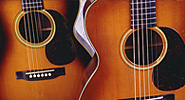




 (LEFT) Robby Krieger is recognized as a Gibson SG player. With the Doors, he played a ’67 Standard that served as the basis for Gibson’s new Krieger signature SG. Its neck profile was modeled after a Les Paul Junior, and its pickups are wired out-of-phase. “Other than that, the guitar is a copy of my ’67,” Krieger said.

 Korg’s Rimpitch acoustic-guitar tuner attaches to the sound hole and its LED tuning meter is positioned in the player’s line of sight when looking at the guitar. It has a piezo pickup that detects sound from the body of the guitar, and can be left attached when not in use. Learn more at www.korg.com.
 Ampeg’s redesigned BA Series of bass combo amps employ front-facing controls, a 60-degree monitoring angle, a new cab design, and the new Bass Scrambler overdrive circuit on models BA-110 and up, which includes separate Drive and Blend controls. All have three-band EQ along with Drive and Blend controls in addition to master Volume, 1/8″ stereo auxiliary input, 1/8″ stereo output, powder-coated all-metal chassis, and front-panel backlighting. Visit www.ampeg.com.
 Dean Markley’s XM Series transducer pickup mounts to the soundboard of an instrument without adhesives, hardware, or modification. It is designed to accommodate traditional acoustic instruments and can be used to amplify hollowbody jazz guitars without sound holes or electronics. Made in the U.S., it uses a 24″ low-noise cable, terminates at a ¼” jack, where a strap-button mount allows connection to any instrument cable or wireless system, and mounts using the Dean Markley’s XM connection system. Learn more at