Month: January 2014

  • Renaissance T-200G

    Renaissance T-200G

    1980 Renaissance T-200G
    1980 Renaissance T-200G

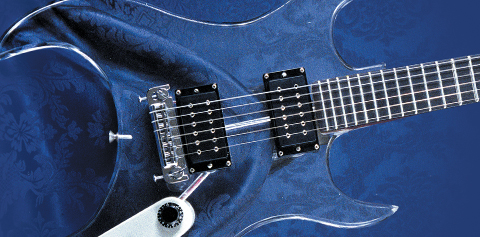
    What is it about Plexiglas? It’s so cool. You can see through it onstage. It’s dense, yet resonant. You’d think it would be the perfect medium for a mean rock and roll machine. And it’s not like people haven’t tried! But for some mysterious reason(s), practically every attempt to make a successful Plexiglas guitar has ended in, if not failure, at least some sort of debacle. Like with this 1980 Renaissance T-200G. The Renaissance guitar company was one of the latter instances, a debacle.

    Plexiglas (or Lucite, both trade names), a clear polyacrylic thermoplastic made from acrylic acid, was developed during World War II. Plexiglas first showed up on guitars as trim in the 1950s, as fingerboards on lap steels and butterfly tuner buttons on some Klusons. Magnatone used a remarkable sandwich of blue-tinted plexiglas and aluminum on its spectacular Model 216 lap steel.

    But as far as we know, the first use of Plexiglas for the body of a guitar was the so-called “Swan” made by EKO and a few one-offs by Fender in the early 1960s. These were basically promotional guitars made for music trade shows, not really production models available to the public, although the guitar seen here is hardly much different.

    The first production Plexiglas guitar was the famous Ampeg Dan Armstrong “see-through” guitar offered from 1969 to ’71. Indeed, some of the first Japanese “copy” guitars introduced in 1970 were knock-offs of the Ampeg, including versions by Ibanez, Aria, Univox, and St. Louis Music’s The Electra, which became their brand name in the ’70s, They were pretty close but didn’t have removable pickups or the weird Danelectro bridges. To be honest, those knock-offs were a little lighter and often played better than the Ampeg original!

    Despite use by Keith Richard, the Plexiglas idea had limited uptake. But the notion didn’t die. The idea was revived in 1977 in the then pretty rural Philadelphia suburb of Malvern, Pennsylvania, in the form of Renaissance guitars and basses. The man who initiated Renaissance was John Marshall, a local guitarist who learned guitarmaking from Eric Schulte and Augie LoPrinzi, both Philadelphia-area luthiers. He hooked up with two other partners, Phil Goldberg, who had a music store and was involved with a local recording studio, and Dan Lamb, a local studio guitarist. After some discussion, the decision was made to build in Plexiglas. Marshall designed the guitar and bass, which was a sort of cross between a Les Paul and Telecaster. Production commenced in 1978. Both guitars and basses had active circuitry with DiMarzio pickups. They were offered in Clear, Smokey Grey, and Black Plexi.

    Renaissance had big plans for national distribution, but progress was slow and the brand never got much further than the Mid-Atlantic region. After about a year, trouble began to brew. Marshall, disgruntled, left the company to become a luthier for Martin. Renaissance began to have financial troubles.

    In 1979, Renaissance recruited another area guitarist and music store owner from Newtown Square, Pennsylvania, John Dragonetti, to invest in the company. It proved a disastrous financial decision!

    No sooner had Dragonetti been convinced to put in some hard-earned cash, the business exploded. His money had gone to pay bills and the I.R.S. was zeroing in. By 1980 he found himself in complete control of the company – but not in control of much. To try to save things, Dragonetti set about redesigning the line. He wasted a lot of time addressing player complaints that the guitars wouldn’t hold their tune due to expansion of the Plexiglas. And the guitars were just too expensive to make given their wholesale price, which was around $350.

    His first solution was the guitar shown here, inspired by the B.C. Rich Bich. Active-electronics guitars had not been very popular, so he switched to passive DiMarzios, which allowed him to lighten the guitar by making it thinner, making players happy and saving on material. The original Renaissance company had been making its own components, including bridges and even knobs. Dragonetti switched to standard parts. He even tried outsourcing all or part of production, but had no luck.

    Despite the cost-saving efforts, this is still a pretty deluxe guitar. In addition to the labor-heavy body, it sports a solid mahogany neck and an ebony fingerboard. In keeping with the style of the time, its fretboard side dots and nut are brass. This guitar has a Leo Quan Badass bridge, and pickups are DiMarzio X2N humbuckers, similar to Super Distortions popular at the time.

    In addition to this model, Renaissance offered a corresponding bass and another shape without the scoop on the butt-end and a wavy lower bout. This latter model came with one or two pickups and in a bass version, as well.

    John Dragonetti’s efforts actually briefly looked like they might be successful. At the summer NAMM show of 1980, Sunn amplifiers, enamored of Renaissance basses, approached him about building a line of guitars. Just at that moment, another company’s sales rep knocked a bass over and broke it, pointing out how poorly made it was. Sunn got spooked and backed out. Which probably was okay, because they promptly went out of business. And Renaissance’s number finally came up at the I.R.S. By the fall of ’80, Renaissance guitars were no more.

    All Renaissance guitars and basses are pretty rare. Only 250 to 300 of the original design were produced, about two thirds of those basses, putting the guitars probably a little south of 100. Of the Dragonetti designs, only about 18 wavy guitars were built. Only five or six of the guitar shown here were ever made, making it about as rare as you can get.

    The Plexiglas concept didn’t die with Renaissance. Recently, St. Louis Music reissued the original Ampeg guitar. B.C. Rich, inspiration of this design, offered a Plexi version of its Bich. And to celebrate the Milennium, Ibanez produced about 100 Plexi Joe Satriani guitars. Who knows? Maybe one day one of these will be a huge success! Then again, we wouldn’t have these rare birds to keep our eyes peeled for!


    This article originally appeared in VG‘s February 2009 issue. All copyrights are by the author and Vintage Guitar magazine. Unauthorized replication or use is strictly prohibited.


    You can receive more great articles like this in our twice-monthly e-mail newsletter, Vintage Guitar Overdrive, FREE from your friends at Vintage Guitar magazine. VG Overdrive also keeps you up-to-date on VG’s exclusive product giveaways! CLICK HERE to receive the FREE Vintage Guitar Overdrive.
  • Carvin’s AE185-12

    Carvin’s AE185-12

    Carvin_AE185-12_01

    Carvin’s AE185-12
    Price: $1,239 (base retail)
    Info: www.carvinguitars.com
    .

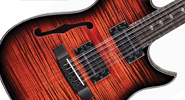
    Most guitarists love the sound of a 12-string, but the thought of owning one often raises several questions. Should you get an acoustic or an electric? What about controlling feedback onstage? And aren’t they hard to tune? Carvin attempts to answer all of these questions with the AE185-12, a 12-string with both electric and piezo/acoustic pickups.

    At first, the AE185-12 seems too good to be true: a thinline 12-string with both acoustic and electric tones, and weighing only 6.25 pounds. Moreover, this Carvin sports 24 frets on a thinner electric-style neck with the kind of super-low action the company is famous for. The guitar also has some formidable electronics. Interested? Thought so.

    The test guitar was highly customized, featuring a mahogany body with a super-flamey maple top and a single f-hole (the stock version comes with an Englemann spruce top; see the website for available custom options). The AE185-12 neck is a through design and also made of mahogany. Its 24-fret ebony fingerboard has a 14″ radius and Carvin’s popular 25″ neck scale. The neck also features a 1.69″ nut and TUSQ saddle, with the strings feeding through the body. The headstock has Carvin’s new 19:1 locking tuners (six per side), so any tuning concerns flew out the window – the AE185-12 stays in tune like a champ. The test instrument also had chrome hardware (standard), abalone diamond inlays (white pearl dots are standard), tortoise body binding (another custom touch), and an abalone Carvin logo on the headstock.

    For electronics, the test AE185-12 was equipped with standard Carvin humbuckers (C22J neck and C22B bridge; again, custom options abound), as well as an LR Baggs Ribbon Transducer for acoustic tones. No surprise, this puppy runs on active power, so a 9-volt battery compartment is located in the rear. For controls, there’s a master volume and active tone for the humbuckers, along with a three-way pickup selector. The Baggs piezo system has an active tone circuit, and a Pan control to blend the acoustic and electric sounds. Even sweeter are the separate output jacks for acoustic and electric signals, allowing the player to route them to different amps or PA inputs. There’s even a mono output to combine them for everyday convenience.

    In the hand, the AE185-12 exhibits all the qualities that Carvin is famous for: a slim, super-fast neck with Carvin’s Rapid Play setup, a light body that hangs comfortably on a strap, and controls that are conveniently located for tweaking on the fly. The neck profile is a flatter “C” shape and very comfy to grip, even over the 15th fret (all 22 frets are easily accessible). The 25-inch scale is a joy, and the string spacing is great for both fingerpicking and flatpick work. The fast neck is also perfectly shred-ready – burning up and down the fingerboard is no problem.

    Sound-wise, the AE185-12 offers myriad tones, from shimmering electric to fairly realistic acoustic. From the Beatles to the Byrds to “Stairway to Heaven” and any number of tracks from Yes, Genesis, or R.E.M., the AE185-12 can be mined for a world of 12-string textures. Granted, the guitar’s “acoustic” dimension doesn’t have the same depth as the genuine article, but for the gigging and recording player, this guitar could be a lifesaver. In fact, many listeners will never notice the difference.

    Like most Carvins, the AE185-12 gets predictably high marks in sound, playability, and overall value. You have to admire Carvin designers for spending so much time figuring out the things that players really want and then making them reality. Certainly, George Harrison’s Rickenbacker 360/12 and Jimmy Page’s Gibson EDS-1275 were incredible instruments, but it’s quite likely that George and Jimmy would have drooled over the AE185-12. It’s a terrific reinvention of the 12-string guitar and one that will appeal to electric and acoustic enthusiasts equally.


    This article originally appeared in VG August 2013 issue. All copyrights are by the author and Vintage Guitar magazine. Unauthorized replication or use is strictly prohibited.


  • Lenny Breau

    Lenny Breau

    Lenny BreauJazz and R&B great Phil Upchurch said, “Lenny Breau was the most innovative guitarist since Wes Montgomery.” Considering that Montgomery is widely regarded as the third link in the chain of jazz guitar’s greatest stylists, after Django Reinhardt and Charlie Christian, it’s a lofty claim – but one with which Pat Metheny, Martin Taylor, and Tommy Emmanuel would likely agree.

    Born in 1941, Breau was playing country music with his parents’ act at 12. After he’d absorbed and incorporated jazz, he was signed to RCA in ’69 by his initial inspiration, Chet Atkins. While his albums were dissected in hushed tones by fellow guitarists (his beautiful arpeggiated harmonics, his use of a custom seven-string with a high A), substance abuse accounted for his relative obscurity.

    On August 12, 1984, Breau was the victim of a murder that remains unsolved. Thus, the discovery of tapes of a live gig barely two months prior is a major event. The guitar mastery on display in this intimate trio setting supports Upchurch’s declaration. The double-CD’s repertoire is mostly standards, but he takes a song like “My Funny Valentine” from ballad to smoking bebop, displaying colossal chops but even greater musicality. A fitting coda to a career cut far too short.

    This article originally appeared in VG‘s February ’13 issue. All copyrights are by the author and Vintage Guitar magazine. Unauthorized replication or use is strictly prohibited.

  • Takamine Introduces Hand-Crafted LTD2014

    Takamine LTD2014Takamine’s new LTD2014 limited-edition acoustic/electric guitar has a slope-shoulder dreadnought cutaway design with a neck joined at the 12th fret. It combines a solid Sitka spruce top with a flame-maple back and maple sides, Takamine’s dual-channel CT4-DX preamp and Palathetic under-saddle pickup, ivoroid binding with abalone body and headstock purfling, abalone rosette, ebony fingerboard, bone nut, rosewood bridge with split bone saddle, black tuners, and a Black Burst finish. Its fingerboard and pickguard are adorned with imagery of the the snow grouse, or raicho, a bird that inhabits the Hida Mountains, which provided the inspiration for the Takamine name. Visit www.takamine.com.

  • Les Paul Foundation Announces 2014 Grants

    LP Foundation announces grantsThe Les Paul Foundation, formed by the late guitarist/inventor to encourage young people to pursue their interests in music, sound and engineering, has announced its latest round of grants. Organizations set to receive them include the VH1 Save the Music Foundation, to provide schools with instruments; the Wisconsin Foundation for School Music, for its garage-band competition (Launchpad) and Music Biz Day program for young musicians in Wisconsin schools; the Soulsville Foundation/Stax Music Academy of Memphis, for its Les Paul Spring Break Workshops program, which provides classes and clinics to middle- and high-school students; Guitars for Vets, which shares the healing power of music with military veterans by providing free private guitar lessons and a guitar to each student; the Waukesha County Historical Society and Museum, which houses a permanent exhibit in honor of Paul and operates the Les Paul Sound Lab for children; the Mahwah Museum in New Jersey, which hosts an exhibit on Paul that includes visual displays, interactive elements, artifacts and educational programs.
    “We feel privileged and excited to support these organizations with [these] grants,” said Michael Braunstein, Executive Director of The Les Paul Foundation. “Throughout Les’ life, he remained steadfast in his belief that everyone deserved the opportunity to experience, enjoy, learn or heal through the gift of music. We know that the support we are providing will help continue his legacy through the programs and services being offered by these recipients.”

    Paul supported music education, engineering, innovation, medical research and several other causes throughout his life. For more on the foundation and this year’s grants recipients, go to www.lespaulfoundation.org.

  • Etched in Time

    Etched in Time

    Christian Roebling’s 1984 Les Paul.
    Christian Roebling’s 1984 Les Paul.

    In 1984, Christian Roebling went from being just another guy watching TV to creating what was likely the first television program to focus on and feature guitar players and builders. Though few outside of New York City knew of its existence, in its six years on the air, “The Guitar Show” played host to some of the heaviest hitters in guitardom.

    The show essentially began one night when Roebling tuned to Manhattan Cable television and saw “…a guy doing a live show and taking phone calls from viewers.” That guy happened to be Jim Chladek, owner of Metro Access and a pioneer in cable television. Roebling called in and, on the air, asked, “How can somebody do a show?”

    Soon after, he visited Chladek in the studio and was offered a job. “Back then, on-the-job training was the only way to learn,” he said. “So I started pulling cables, sweeping floors, doing audio, operating the camera – I learned every job in the studio.”

    Though his salary was far from a king’s ransom, Roebling was attracted to the gig because it was a wonderful opportunity to learn, and provided a creative outlet via the element that sealed the deal – two hours of studio time each week. A certifiable guitarhead, Roebling knew exactly what he wanted to do.

    “The concept was simple; a weekly show dedicated to the guitar, its players, and manufacturers,” he said. “All I had to do was look in The Village Voice to see who was playing around town – there was no shortage of players on any given week.”

    While his expectations may have been realistic, his thoughts for a first guest were, he admits, a bit “pie in the sky.”

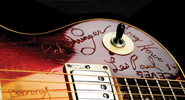
    “I knew my first guest had to be Les Paul,” he said. “Les played every Monday night at Fat Tuesdays in New York City, so I went to see him on August 20. I remember sitting there, amazed at watching him play and tell these wonderful stories. He was generous with his time and talked to everyone who approached after his set. And he would sign anything – guitars, pickguards, photographs – smiling the whole time.

    “I waited until after his last set, so I could ask him to be on the show. I thought he’d ask ‘Who are you?’ or say ‘Get away from me, kid!’ or ‘Sure, and bring lots of money!’ – which I didn’t have! But when I told him about that show and how I thought he would be the perfect first guest, he said, ‘Sure, bring your crew next week.’

    “So, on August 27, he let us film his entire set. Afterward, he spoke to everyone in the club, then sat to talk while the bartender stacked chairs. Les never rushed, and talked as long as I had questions.”

    Roebling left the club that night on an undeniable (and justified) “success high.” But of course one episode – stellar though it may be – didn’t mean he had a “show.” There would have to be other guests, and he faced a daunting challenge finding a suitable follow-up, but…

    “I had a friend who knew Rick Derringer,” he said. “Rick was a favorite of mine since his early hits and I remember seeing him tear the roof off of The Spectrum in Philadelphia in 1972 with Johnny Winter And. So I gave him a call. At first, he played the role of rock star – a bit standoffish, like, ‘I dunno… Who’s been on?’ When I told him Les Paul was on the first episode, he totally changed! He was like, ‘Let me know when and where!’ He was wonderful to be around, and as a guest he was fantastic.”

    Lining up artists for subsequent episodes, the first question was usually like Derringer’s; “Who’s been on?” But once told who had appeared in episodes one and two, they signed on. Larry Coryell was third, and for 50 episodes, Roebling says he never had trouble filling guest slots.

    ’88 J-200, replete with signatures carved into virtually every inch of their bodies, front and back.
    ’88 J-200, replete with signatures carved into virtually every inch of their bodies, front and back.

    “One of the highlights for me was booking Jimmy Page,” he recalled. “That episode was taped at Les Paul’s house when Led Zeppelin had reunited to play Live Aid. Jimmy brought all of his guitars for the show, including his iconic Gibson doubleneck, the Fender ‘Bender,’ and his Les Paul Standard, and he got to hang with one of his idols! I don’t know how it could have gotten any better than that.”

    “The Guitar Show” didn’t discriminate when it came to genres. Legends from the jazz realm appeared, including Joe Pass, Tal Farlow, Jim Hall, Charlie Byrd, John Scofield, Bill Frisell, Larry Coryell, Emily Remler, and others. Fans of the blues got to enjoy Roebling’s talks with Johnny “Clyde” Copeland, John Hammond, Duke Robillard, Ronnie Earl, Joe Louis Walker, and others, while rock fans saw Roebling sit with idols like Page, Derringer, Paul Gilbert, Jay Jay French and Eddie Ojeda of Twisted Sister, and Phil and Dave Alvin from The Blasters. Even classical guitarists were represented by Sharon Isbin, Benjamin Verdery, and Carlos Barbosa-Lima. Then there were those who trended toward uncategorizable, like Richie Havens, Cornell Dupree, Adrian Legg, John Fahey, and Danny Gatton.

    Today, Roebling keeps alive the memories of the show by way of the internet (search youtube.com for Front Row Music NYC) and two pieces of memorabilia he holds very close to his heart – guitars given to the show. The first is an ’84 Les Paul that Roebling obtained by contacting Norlin Industries, Gibson’s parent company at the time. “I asked if they wanted to be on the first show, since Les Paul was going to be the guest. I suggested they appear to talk about new products and, of course, Les. In return, I asked them to leave a guitar so I could have future guests engrave their autographs into it.”

    Paul did indeed engrave his signature, along with the date. “Clarence ‘Gatemouth’ Brown signed the Les Paul along the entire fretboard!” said Roebling. “Danny Gatton signed it under the strings, and as he was doing so, he jokingly said, ‘I should be behind bars!’”

    By 1988, its body surfaces started running out of space, Roebling called Gibson and then-new CEO Henry Juszkiewicz to see if he wanted to be a guest, and donate another guitar. “I told Henry we needed a larger guitar to hold a lot of signatures, so I requested a black J-200.” Juszkiewicz and Gibson obliged.

    Les Paul was the first guest on “The Guitar Show,” and the first to engrave his signature on Roebling’s Les Paul.
    Les Paul was the first guest on “The Guitar Show,” and the first to engrave his signature on Roebling’s Les Paul.

    Other manufacturers who appeared included Bill Kaman, president of Ovation, as well as Steve Grom from Fender, Paul Reed Smith from PRS, Rich Lasner and Bill Cummiskey from Ibanez, Jim Funada from Yamaha, Ned Steinberger, Chris Martin, Seymour Duncan, and Dennis Berardi from Kramer.

    The final episode of “The Guitar Show” aired in 1990 and when he looks back today, Roebling is well aware that beyond having Les Paul do the first show (“Without Les, none of it would have happened,” he says), the world – and TV production – were very different in the mid ’80s.

    “The whole system was simpler – I had a free studio, the airtime on Manhattan Cable TV was free, the director and crew were my friends, who worked for free! I only had to pay for the tape stock and spend a bit of money to edit the show.”

    Roebling went on to produce a video magazine called “GuitarVisions” (1990-’91), which featured Steve Stevens, Michael Hedges, Ralph Towner, John Fahey, “Gatemouth” Brown, Birelli Lagrene, and others, followed by “Guitar Masters,” (’92) where he interviewed Jeff Golub, Reeves Gabrels, John Petrucci, and Sonny Landreth, a video documentation of Scott Chinery’s Blue Guitar Party (’96) where Roebling interviewed Scotty Moore, Steve Howe, Bob Brozman, and others, and video for the “JVC Jazz Tribute To Johnny Smith” (’99). Since 2000, he has worked with Stefan Grossman, helping produce instructional videos by Rory Block, Martin Taylor, and Grossman himself. He also directed a series of “Guitar Artistry” videos for David Bromberg, Woody Mann, and Geoff Muldaur.

    Today, Roebling is an experienced gigging guitarist/singer/songwriter who plays reguarly around NYC and recently recorded an album titled Leave Here Runnin.’ “Making ‘The Guitar Show’ was an incredible experience,” he said. “It was the only weekly television show dedicated to the guitar. I had a front-row seat to the world’s greatest guitar players.” Today, he regularly fields requests to re-start the series, and agrees its time may have come.


    This article originally appeared in VG August 2013 issue. All copyrights are by the author and Vintage Guitar magazine. Unauthorized replication or use is strictly prohibited.

  • Tremcaster Single Ninety

    Tremcaster Single Ninety

    Tremcaster Single Ninety
    Price: $1,250
    Info: www.tremcaster.com

    Today’s guitar market is one of extreme preferences. For some, the idea of countless options and exotic woods and craftsmanship is the name of the game. For others, the tendency is more toward “aged” instruments that recall days gone by. What often seem to be missing on this spectrum are instruments that fall somewhere in the middle. This is where Ohio luthier John Mosconi and his team have found their niche – making handcrafted guitars with vintage inspiration, but with basic, modern functionality. Their latest offering is the Tremcaster Single Ninety, a minimalist’s dream.

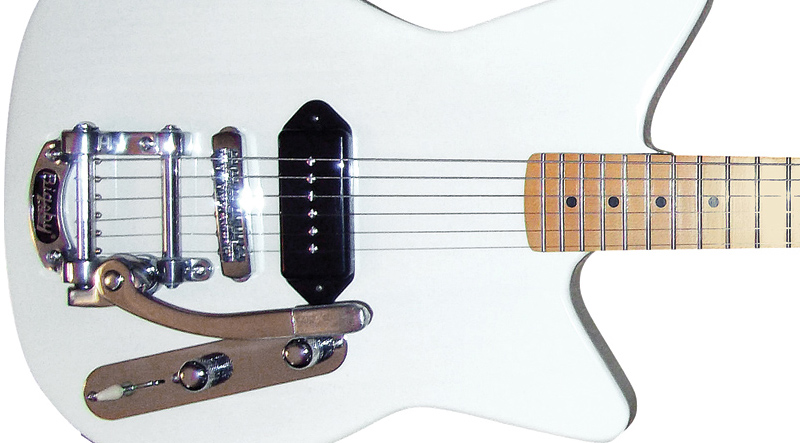
    The Single Ninety uses Tremcaster’s patented body and headstock styling with a super-lightweight pine body bolted to a maple-on-maple honey-lacquered neck. An optional rosewood fingerboard is available for those who desire a little deeper tone and midrange. The headstock is finished in a honey lacquer reminiscent of other amber-tinted finishes on the market. Gotoh vintage-style tuners have a classic nickel finish, and a hand-cut bone nut rounds out the neck’s traditional appointments.

    The Single Ninety’s body continues the guitar’s minimal, straightforward approach. There is no binding but a range of classic colors recall the ’50s and ’60s. The test model came in a nicely sprayed vintage white with just the right hint of cream. The body hardware also exhibited a vintage flair, as well as pro-quality components, including a Schaller roller bridge and a Bigsby tailpiece.

    Giving the Single Ninety its oomph are electronics designed to rock. A Gibson P-90 holds the guitar’s lone pickup position, giving it the spirit of a Junior but also added versatility, thanks to a three-way switch with bassy, normal, and hot positions, allowing much more diversity than normally found in P-90-style instruments. The attention to detail is taken even further with the use of Switchcraft controls and CTS potentiometers. The end result is a handcrafted, American-made instrument that won’t break the bank.

    The Single Ninety was put through its paces both live and in the studio. The process proved just how diverse the aforementioned features make this instrument. For a single-pickup guitar, the tonal options were impressive. The bassier setting truly offered the most applications for non-rock styles. The roundness was right at home for cleaner tones. Here, blues and chicken-picked country seemed to excel, and even clean runs for modern jazz styles and even fusion.

    The normal setting was classic P-90 and tailored to the needs of more classic rock styles. With a slightly compressed setting, some spring reverb with tremolo, and application of the Bigsby, let there be no question that the Tremcaster Single Ninety will transport the player to Surf Central. In fact, it might be difficult to not want to just “hang ten” all day on the Single Ninety, but this guitar definitely has more to offer.

    As hinted at earlier, if there is one thing that this guitar can do it is rock out. Without fail, the Single Ninety kept driving and the harder it was pushed the more it liked to open up. The hotter switch position on the Single Ninety translates to a superb, souped-up Junior tone. Aggressive but with plenty of bite, the guitar can flat out demolish power chords. The pine body surprisingly gives it a nice top end, preventing the P-90 from getting either muddy or overly twangy. Pine has never been a popular option for instruments, but the Single Ninety makes an argument for it being used more often.

    Kudos to Tremcaster for offering a unique and straightforward instrument in the Single Ninety. Its styling may not be for everyone, but the guitar can hang in there with any rocker and is a lot more diverse than what might initially meet the eye. The best part is the price – at just over a grand this is an American-made instrument priced like similar import models. Who wouldn’t prefer to support our own when it comes to a handbuilt low-production-run guitar?


    This article originally appeared in VG August 2013 issue. All copyrights are by the author and Vintage Guitar magazine. Unauthorized replication or use is strictly prohibited.


  • Taylor T3

    Taylor T3

    TAYLOR-T3

    The Taylor T3

    Price: $2,998
    Info: www.taylorguitars.com
    .

    Some guitar players never touch a tone knob, while others view it as the Holy Grail of guitar controls. If that sounds like you, put up your antenna and tune to the Taylor T3, a semi-hollowbody electric that provokes many tonal questions. Is it a rock axe? Jazz or blues box? A country plank? Maybe it’s all of them. Let’s take a twang to find out.

    The T3 is a made of sapele back and sides with a maple top. Its sapele neck has a scale of 247/8″ (slightly longer than a Les Paul), and sports a 21-fret ebony fingerboard with dot inlays. It has a single-cutaway design with a Venetian cut and white binding on its body and fingerboard. The nut and saddle are from Tusq, while the stop tailpiece, bridge, tophat knobs, and other hardware are chrome. Part of the guitar’s subtle Art Deco aesthetic are reflected in its very “moderne” sound holes.

    The heart of the T3’s sound are its Taylor HD humbuckers with coil-splitting functions. This is where things get intriguing. On the surface, these are excellent – capable of delivering meaty tones from clean to crunch, and all controlled by a three-way switch. Yet for you tone hounds, pull up the Volume knob and you suddenly have a full range of single-coil tones to choose from (neck, neck/bridge, and bridge). In this mode, the Tone controls act a bit differently, too: instead of a simple passive tone roll-off, it can accentuate the midrange with an extra boost. Next comes the kicker – pull up the Tone knob and you have yet another range of frequencies to explore. Taylor put another capacitor in the circuit, which is triggered by the push/pull pot. Some of the tones this circuit generates can sound like a Strat, while others resemble an acoustic guitar. More startling is the overall power and reactiveness of the T3’s Tone and Volume knobs. You might think it’s a battery-powered active circuit, but incredibly, the circuit is all-passive. It’s just done really well, providing a dramatic range of tonal colors.

    Plugged in, the T3 feels comfortable in the hand. The neck is slim yet wide, speaking to Taylor’s acoustic-guitar lineage. The body is nicely balanced and didn’t slip off the lap. Though the T3 can rock hard, you probably wouldn’t put it in the hands of a metal player; for any other genre, however, you can clearly see a niche; country guys will dig the spank of the single-coil sounds and its sparkling tonal range. It also sounds great for any manner of Travis-style, banjo roll, or claw fingerpicking. Jazzers will love noodling with the darker tone textures and experimenting between humbucker and single-coil tones of the post-war archtop era. Blues rippers will dig the attitude of the humbuckers and single-coils, as well as how the guitar sounds when you pull and pop the strings. Rock/pop players will love all of the above, plus its ability to handle overdrive. You can even simulate the clean DI sounds of an electric guitar plugged straight into a mixer, like those heard on the vaunted Chester & Lester album from Chet Atkins and Les Paul. After a while, you may lose count of the sound and tone possibilities.

    The T3 is an immaculately built semi-hollowbody that will appeal to a variety of gigging pros, studio cats, and home-based pickers, particularly to those for whom a mere quarter-turn of the Tone knob is the difference between night and day, between success and failure.


    This article originally appeared in VG January 2013 issue. All copyrights are by the author and Vintage Guitar magazine. Unauthorized replication or use is strictly prohibited.


  • Fender Adds Vaporizer Amp to Pawn Shop Series

    Fender Vaporizer ampsFender has expanded its Pawn Shop Special series of guitar amplifiers to include the Vaporizer. Inspired by the Space Race and the beginnings of garage rock, it produces 12 watts output through two 6BQ5/EL84 power tubes and two 10″ 16-ohm Special Design Vaporizer speakers. Additional features include a spring reverb circuit independent of the amp’s Volume control and a single-button “wedge” footswitch that selects the amp’s Vaporizer mode, which bypasses the Volume and Tone controls. Go to fender.com.
  • Forty Quid of Klunk

    Forty Quid of Klunk

    The H-22’s pickguard raised eybrows.
    The H-22’s pickguard raised eybrows.

    Duh-Duh-Duh-Duh-Duh, Klunk!

    It’s not the most artful musical introduction, but it was effective. And by the time a screaming Hammond organ slides in over the pounding bass-and-drums, most listeners are hooked. The song is “Gimme Some Lovin” by the Spencer Davis Group, and the 1966 record is a showcase not only for the vocals and organ of a young Steve Winwood, but the sound of the Harmony H-22 bass in the hands of his brother, Muff.

    While budget-priced four-strings are rarely given their due, the hollowbody H-22 has more than once proven a surprisingly efficient low-end tool – and made its mark on classic recordings.

    The H-22 Hi-Value was Harmony’s first electric bass, debuting in 1962 and featured on the catalog cover. The name was descriptive, if unromantic (like Kay’s Value Leader), still, Harmony was the largest student-level guitar maker in the country and this model helped make the electric bass obtainable for kids everywhere. It had been a long time coming – 10 years after Fender’s first bass and local rival Kay’s response. Kay was America’s premier upright bass maker, and in a quick reaction to this new low-end idea created the hollowbody bass in late ’52 with the flat-top/arched back K-162 Electronic Bass. The H-22 bore a general resemblance to the original, but at a much lower price – and it hit just in time for the ’60s rock explosion.

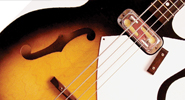
    The H-22 was well-conceived despite being built with price as a primary consideration. “The value built into it is unsurpassed!” claimed the catalog, and it’s hard to argue. A full/16″ body – thin-rimmed, flat-topped, and hollow (it almost looked like an archtop) – gave the instrument better balance than many short-scale basses. There was a lot of space between the simple wooden adjustable bridge and the tailipece, so it required long-scale strings though its scale was just 30″. And it’s hard to imagine a pickup design simpler than the DeArmond Golden Tone Indox mounted near the fingerboard; a flat single-coil with an internal magnet, it puts out a surprisingly powerful tone with plenty of definition. Indeed, the Harmony offered a much clearer sound than the upscale Gibson EB-2 and Epiphone Rivoli basses, with more output than similar Höfner, Kay, or Framus instruments. The wiring was basic but functional, with Volume and Tone knobs and a lever-activated Klunk switch for a baritone effect.

    Muff Winwood; gimme some thumbpick! “Plonk” Lane and his battered Harmony.
    Muff Winwood; gimme some thumbpick! “Plonk” Lane and his battered Harmony.

    The H-22’s oddest feature was a large white plastic pickguard that covered much of its face, with a vaguely batwing shape along the lower edge. This carried a rosewood finger rest below the strings, and both were often removed. One of the best features was the maple neck with an “ebonized” fingerboard and Gibson-style truss rod that keep it functional long after many other cheap bass necks of the era had packed it in. The instrument’s weakest point was its tuning pegs – instead of tuners with large shafts, it was given the same open-back Waverly strip units Harmony used on banjos. In this, Harmony followed Danelectro, the other notable purveyor of bargain basses.

    Overall, the design was visually similar to a Kay and Gibson, but closer in price to the Dano – a Lincoln look at a Ford price!

    In action, the H-22 was very light, handy, and surprisingly professional-feeling bass. It debuted at $95 in 1962, only $10 more than the boxy shorthorn Danelectro model and $15 more than Kay’s Value Leader 5961, which had a 24″ guitar-scale neck and felt more like a toy. Other lower-end four-strings like Danelectro’s Longhorn, Supro’s Pocket Bass, and Kay’s full-scale 5965 Pro were $150 or more. Harmony’s price rose to $99.50 in March of ’63, then $104.50 in ’65 and 109.50 by ’67. Even with the increases, the H-22 was still the best value on the market – lending truth to Harmony’s slogan, “The best you can buy… for the money you spend!”

    Harmony introduced the H-22 with this page in its 1962 catalog. The H-22 –under 40 quid!
    Harmony introduced the H-22 with this page in its 1962 catalog. The H-22 –under 40 quid!

    The H-22 was produced in fairly large quantities in the mid ’60s. Along with Danelectro and Silvertone basses, it was a popular choice to equip the first-time bassists of many budding surf and garage bands across the U.S., including the pre-“Wipe Out” Surfaris. One notable user was the San Diego combo Count 5, remembered for the 1966 hit “Psychotic Reaction.” Still, if they kept at it, many young bassists would buy a Fender or other professional-quality bass as soon as they were able, leaving the Harmony in the garage.

    However, such was not always the case across the pond!

    The Harmony line was marketed in England by Boosey & Hawkes; the H-22 was listed in ’62 at just under £40, up to £45 by mid ’65. Either way, it was one of the best values in a bass for the U.K. in the mid ’60s. Professional-level semi-hollow U.S.-made choices like the EB-2, Rivoli, or Gretsch cost four times that – even a Fender Precision was triple the price. Others in that range were mostly dodgy imports from Europe or Japan. At 31 guineas, Selmer’s single-pickup Höfner Senator was the only similar bargain, and arguably neither as good-sounding nor as hardy. Whether for economic or stylistic reasons, two soon-to-be-celebrated R&B groups embraced the H-22 and took it with them to the top of the charts – and into pop history.

    The $199 Harmony H-27.
    The $199 Harmony H-27.

    Birmingham’s Spencer Davis Group started in mid ’64, playing American R&B, and soon caught a buzz among musicians and critics as one of the country’s best unsung bands. Throughout ’65 it was tipped for success if it could just score the elusive hit single. Even at this early stage, bassist Mervyn “Muff” Winwood and the other members (including Spencer Davis) were rather in the shadow of Muff’s younger brother, Stevie. After all, the kid could sing like Ray Charles and play organ like Jimmy Smith! Still, the hits which lifted them to the top of the U.K. charts in late ’65 – “Keep on Runnin’” and “Somebody Help Me” owed a lot to the bass player’s contributions. Both were Jamaican-influenced numbers written by island expat songsmith Jackie Edwards, but the records were powered by the thudding hammer of Muff’s bass riffing under Stevie’s powerhouse vocal and trendy fuzz guitar. Unusually, the group had recorded a full LP before gaining hit status, but the two singles made them bona fide stars in the U.K. This was repeated with the worldwide breakout of “Gimmie Some Lovin’” and “I’m a Man” a year later, which made them a top act in the U.S. Both were produced and co-written by Jimmy Miller, who would go on to produce Steve Winwood in Traffic and Blind Faith, then work with the Rolling Stones. By the spring of ’67, Steve Winwood had moved on to form Traffic, bringing about the end of the original Davis band. During the group’s two-year run, Muff Winwood was occasionally seen with other basses (like a Höfner 500/1), but the Harmony remains his signature instrument, visually and sonically. The whole band was even Harmony-equipped for a while – Davis himself brandished a Stratotone Jupiter, as did Steve Winwood for a time, before picking up a Fender Jaguar (and most famously the Hammond organ).

    The H-22 was also the instrument of choice for a London band, the Small Faces, which broke on their home turf at nearly the same time. Bassist Ronnie “Plonk” Lane was nearly always seen with a Harmony – his first H-22 was the spark that ignited the group to begin with. The core of The Small Faces, considered the ultimate mod band, met when Lane went to the J160 Music Bar in east London looking for his first bass. He bought the H-22 from fast-talking salesman Steve Marriott – at “A whacking great discount!” Marriott glommed the Gretsch Tennessean Lane had intended to trade in, and the two struck up a musical rapport that would carry them through the ’60s. Marriott and Lane became the creative team that powered the Small Faces, writing and singing their increasingly sophisticated material. While they never became stars in the U.S. (despite a top 40 hit with “Itchycoo Park” in ’67) the original Small Faces are revered as one of the finest of all English pop groups.

    The 1968-’69 Harmony bass line.
    The 1968-’69 Harmony bass line.

    Thanks to a fiercely energetic stage show, their gear took a lot of abuse. The group also showed no compunction about modifying instruments. Mariott’s Gretsch guitars changed finish and hardware over time, and Lane’s H-22 took a beating. As 1966 went on, the bass lost its knobs, the pickguard became black, then went missing entirely. “The… thing to suffer is the equipment,” Lane reported to Beat Instrumental in May of ’66. “My Harmony bass has been through so much action – there were no Volume controls left and I had to turn the volume up and down with a pair of pliers. I’ve just bought another couple…. The old friend is being renovated.” Lane’s loyalty to the H-22 is unusual, but he stayed true to his first love at least until he met her posher sister!

    By late ’66, Harmony expanded its bass line to three instruments. The H-22’s price dropped to $99.50 again as it gained two classier siblings. The H-27 was much fancier; it kept the 16″/thin-rimmed form but as double-cutaway, fully arched, laminated maple hollowbody with a honey-brown sunburst finish. “Styled and electronically equipped to meet the highest professional bass tone standards,” was how Harmony announced it. The H-27 carried two fancier DeArmond pickups, each with a double row of adjustable poles in an interesting variation on Fender’s offset-bobbin idea. The strings terminated on a nifty metal bridge and tailpiece with adjustable saddles and detachable covers. There was no pickguard but two body-mounted finger rests with tortoise celluloid tops and a conventional four-knob/one-switch wiring rig. The maple neck led to a large oddly droopy Fenderesque headstock, also faced in tortoise plastic and equipped (at last!) with actual bass tuning machines. In a sign of the times, these were of Japanese origin. The H-27 listed at $199.50 – double the price of the H-22, but by the standards of ’66 still an excellent value. While it feels classier, the H-27 does not handle or balance as well due mostly to the heavier headstock and different bridge placement.

    The first H-27 in England, on display at the British Music Trade Show in September, 1966. A skinny Plonk with low-slung H-27 in 1968.
    The first H-27 in England, on display at the British Music Trade Show in September, 1966. A skinny Plonk with low-slung H-27 in 1968.

    The new model did find one enthusiastic fan – Lane bought the first H-27 into England from central London’s St. Giles Music Centre, fresh off Boozey & Hawkes’ display stand at the September ’66 British Music Trade Show. “Plonk has gone for the very first of a new line in harmony Bass guitars,” reported Beat Instrumental. This bass can be seen (and heard with a persistently flat E string!) on the band’s September, 1966, German TV “BeatBeatBeat” broadcast, available on DVD, which captures them at peak power. “The sound I want is chunky and sharp,” Lane explained, and based on this footage, he succeeded! The bass in the hands of a prominent player created a buzz, but few other pros took up the H-27. And while they are rarer than the H-22, today they are also far less sought-after.

    Also introduced around that time was the solidbody H-25, given the ungainly moniker, Silhouette Solid Body Deluxe Multi-Voice Electric Bass. This was a vaguely Fender-shaped solidbody initially built with a centrally located pickup and rocking tone switches – a second pickup was soon added. Neither distinctive or attractive as its hollowbody sisters, The H-25 was never popular and saw few professional users. At $139.50, it remained a budget instrument, but had none of the stylish look (or distinctive feel) of its hollowbody siblings. Offering little advantage over many similar imported Fender-like basses in the late ’60s, the rather warped looking (if decent-playing/-sounding) H-25 made minimal impact.

    In the meantime, the original H-22 moved through the decade with a few changes. The tailpiece, originally a block of rosewood screwed to the top under a metal cover (the same stamped metal piece seen on Gibson lap steels before World War II!) became a cheaper integral unit that performed both functions. The major change came in ’68, when the H-22 went to a double-cutaway body shape. This made little functional difference, but the classic look was lost a bit. By the early ’70s – dawn of the era of stadium volume – hollowbody basses fell out of favor. Former user Muff Winwood had laid down his upon leaving Spencer Davis in ’67, moving into production as an A&R man for Chris Blackwell’s Island Records. Among his notable production credits are Sparks and the first Dire Straits album. Ronnie Lane (no longer going by “Plonk”) stayed with the Small Faces in ’69, after Steve Marriott departed (replaced by Rod Stewart and Ron Wood). Lane’s love affair with Harmony ended as well, and he switched to Fender then Zemaitis basses. Lane left the renamed Faces in ’73, but his enduring talent and charm were much admired on the English music scene, despite an aesthetic allergy to commercial success and slow decline in health due to Multiple Sclerosis.

    The H-22 was gone by Harmony’s 1972 catalog; the other basses remained, but in an era of cheaper imports the once-mighty Harmony faced a shrinking market and ceased operation in ’75. They outlasted domestic competition from Kay, Valco, and the like, but could not compete with the increasingly sophisticated Japanese product that eventually cornered all but the highest levels of the market. The mostly forgotten H-22 became a pawnshop prize or garage-band revivalist’s trophy in the ’70s and ’80s.

    After this long period of obscurity, there has recently been a revived interest in the H-22, from younger bassists taken by its vintage sound and look. There’s even an Asian-made reissue. Somehow, the H-22’s unique visual and sonic character summons a time when the electric bass was more fun, before rock got “heavy.” Really not a bad legacy for 40 quid!


    This article originally appeared in VG August 2013 issue. All copyrights are by the author and Vintage Guitar magazine. Unauthorized replication or use is strictly prohibited.