John Oates has partnered with online platform Creative Allies to launch a contest that allows fans the chance to design the cover of his upcoming album, Good Road To Follow, which will feature a three-disc set of genre-specific EPs titled Route 1, Route 2, and Route 3. Artists have the opportunity to submit designs online and the public can vote at http://www.creativeallies.com/contests/917-design-an-album-cover-for-john-oates.
Oates will personally select his favorite design. “I’m so excited to see what people come up with,” he said. “This is a unique way to get the fans involved in the process and I think it will be beneficial for the both of us.” The winner will receive $500, a prize package, and an autographed copy of the CD with his or her design on the cover.
Oates suggests that the cover should be organic in style and “reflect the overall vibe of a musical journey on a road that never ends.” Designers are invited to submit artwork through Oates’ page on Creative Allies. Submissions for the contest will be open through Friday, January 31.
Good Road To Follow is set to release March 18 with the lead single “Stone Cold Love” written and produced with OneRepublic’s Ryan Tedder. Other collaborations range from the pop band Hot Chelle Rae, to country icon Vince Gill, and bluegrass legend Jerry Douglas.
The B.C. Rich Mockingbird Plus FR uses a Floyd Rose bridge on one of the most popular body shapes in the company’s line. It has a mahogany body with Black Vapor finish, figured maple top, 24-fret ebony fretboard with a 12″ radius, diamond inlays, and the traditional B.C. Rich three-and-three headstock. The new set-neck design adds a contour designed to be as comfortable as a neck-through. Other highlights include traditional Mockingbird electronics configuration – dual humbuckers with a master Volume control, a master Tone, and a three-way toggle selector. The Floyd Rose bridge, control knobs, strap buttons, locking nut, and die-cast tuners are all finished in a gloss black. Visit www.bcrich.com.
Uncle Neil’s at it again, issuing the seventh disc in his live Archives Performance Series. Once more he’s alone with his Martins and a piano (a “really outta sight” Steinway), this time post-Thanksgiving 1970 at the erstwhile D.C. club in the title.
For those keeping score, Cellar Door is Disc 2.5 in the series. Culled from a six show residency, the set leans heavily on the just-released After the Gold Rush. But fodder for fanatics includes a pre-Harvest “Old Man” and a piano-accompanied “Cinnamon Girl.” Somewhat of a bummer, Young includes “Bad Fog Of Loneliness” and “See The Sky About To Rain,” both featured on the previously released Disc 3 recorded just seven weeks later. And except for a bit of period-perfect laconic stoner charm before Buffalo Springfield’s “Flying On The Ground Is Wrong,” there’s little between-song patter.
What makes Cellar Door well worth the price of admission, however, is its intimacy. Muffled coughs, three-dimensional hammer-ons and pull-offs, time tapped out on a soundboard, even fret buzz – the audio is fantastic (despite what Young tells us about digital) and underscores the songs’ timelessness.
Young fans are fortunate Winnipeg’s finest had the foresight to be an obsessive archivist.
This article originally appeared in VG‘s March ’14 issue. All copyrights are by the author and Vintage Guitar magazine. Unauthorized replication or use is strictly prohibited.
The Pigtronix Echolution 2 uses analog tone shaping and digital signal processing, offering an expanded palette of delay effects in a programmable, MIDI-controllable package. It has a 24-bit, variable-clock, full-stereo delay line that creates echoes from 10ms to 10 seconds in duration. Any two subdivisions of the master delay time can be selected to create an array of polyrhythmic multi-tap patterns. The echoes are then further animated by eight filter modes, multiple LFOs, freeze, reverse, bit-crushing and totally original cascading octave effects created by the Halo and Jump functions. Musicians can exert real-time control via assignable expression pedal and envelope mapping for every knob, as well as complete MIDI control of every function. Sounds can be saved and recalled using its footswitches or optional remote switch. A dedicated PC/MAC application enables the import and export of presets for sharing with other musicians who use Echolution 2. The application also delivers future firmware upgrades and provides users with real-time access to advanced functionality. For more, visit Pigtronix.com.
Mike Bloomfield, 1965. Mike Bloomfield: Sony Archives.
It’s difficult to critique compilations, especially those that include material from various labels: you never know what licensing restrictions were imposed, which cuts the A&R folks would’ve included but weren’t able to. It’s even harder when the artist in question changed your life.
Mike Bloomfield had that effect on people. For a Jewish kid playing the blues in the mid ’60s, that’s no mean feat. But regardless of who his influences were and how proficient he became at various styles that preceded him, there was guitar playing before Bloomfield and guitar playing after Bloomfield. It’s as simple as that.
This Columbia/Legacy threeCD/one-DVD box is the biggest overview ever devoted to blues and rock’s first real guitar hero. Eric Clapton, Jeff Beck, and later Jimmy Page would wear that mantel, but Bloomfield perfected the blues while re-energizing it, melding it with rock, and then taking it to uncharted territory. And you can ask George Gruhn or Dan Erlewine who singlehandedly not only raised the prices of Les Pauls but essentially created a market for vintage electrics that hadn’t previously existed.
In the 36-page booklet and hour-long DVD, Bloomfield’s praises are sung by everyone from Clapton to Bob Dylan to Miles Davis. But there’s already plenty of proof in the 45 tracks that make up the guitar pudding.
It’s understandable that much of the material comes from Columbia’s vaults. Bloomfield was signed by the label’s Svengali, John Hammond, and recorded with Dylan. His band the Electric Flag, his groundbreaking Super Session, and subsequent live recordings with co-adventurer (and this box’s producer) Al Kooper were on the label. Between his Hammond sessions (included here for the first time are his audition tapes, along with two cuts by his band with Charlie Musselwhite, only released posthumously) and the Flag and Super Session was when Bloomfield made the most impact, with the Paul Butterfield Blues Band. They simply stormed out of Chicago, ruled the Fillmore circuit, and turned rock music on its head. Only three Butterfield cuts are included (one being the 13-minute tour de force, “East-West”), so, buy the first two Butterfield albums and concentrate on this show.
Besides the Hammond audition showing Bloomers’ acoustic prowess (which he’d return to late in his career), some of the more interesting gems here are a Kooper remix of the “Like A Rolling Stone” backing track and a scathing alternate take of Dylan’s “Tombstone Blues,” two unreleased live cuts by the short-lived Flag, Bloomfield/Kooper taking on a T-Bone Walker slow blues, and Bloomfield’s slide reunited with Dylan in 1980 for “The Groom’s Still Waiting At The Altar.”
Sweet Blues, the DVD documentary, is well done, with rare footage and current and archival interviews with Dylan, Kooper, Musselwhite, Bill Graham, B.B. King, Elvin Bishop, Carlos Santana, Nick Gravenites, Jorma Kaukonen, Jack Casady, and Bloomfield’s mother and brother, as well as Michael himself. The only criticism of the DVD is that it will leave Bloomfield fans wanting more (please release this as a separate DVD with bonus material – namely the rest of these interviews!).
Bloomfield’s drug problems were well-known, and he overdosed in 1981, only 37 years old. As Kooper sings in a hidden-track tribute, “They just don’t make ’em like that anymore.”
This article originally appeared in VG‘s March ’14 issue. All copyrights are by the author and Vintage Guitar magazine. Unauthorized replication or use is strictly prohibited.
Toby Keith’s previous two albums – Bullets in the Gun (2010) and Clancy’s Tavern (2011) – were two of his finest, enhanced by first-rate original material, powerful vocals, and restrained, hard-edged production. His skill at writing miniature dramas has served him well and does so again. The title song, a bartender’s thoughtful musings on the troubled souls he serves carries emotional clout, bookended by the lighthearted “The Size I Wear,” a sly paean to barroom pickups.
The tale of “Scat Cat,” a reprobate hellraiser unable to stay out of trouble, holds together nicely, its rocking arrangement enhanced by Eric Darken’s slashing guitar. The philosophical “Get Got,” by Keith and frequent writing partner Bobby Pinson, cleverly incorporates time-tested homilies about life. The ballads are equally strong. “Haven’t Seen The Last Of You,” “Missed You Just Right,” and the Keith-Scotty Emerick tune “You Ain’t Alone” are all pained, passionate reflections on lost love.
He can afford to bypass two of Nashville’s three most over-recorded and clichéd current song topics: hot women and beer (the third involves pickup trucks). Unfortunately, “I Like Girls That Drink Beer” and the chugging “Haven’t Had A Drink All Day,” are Keith and Pinson at their most formulaic. At least the latter has some first-rate guitar from Brent Mason, Kenny Greenberg, and Russ Pahl. But not even Mason, Greenberg, and an engaging Dixieland arrangement can save “Cold Beer Country,” which is more beer commercial than drinking song.
Acts at the peak of Nashville stardom, who own their own label and produce themselves, are free to do what they please. Keith uses that freedom wisely and the album’s high points prove it. He doesn’t need to waste time writing and recording throwaways. Leave that to the many lightweight writers and singers on Music Row.
This article originally appeared in VG‘s Feb. ’13 issue. All copyrights are by the author and Vintage Guitar magazine. Unauthorized replication or use is strictly prohibited.
The EarthQuaker Pitch Bay is a three-part polyphonic harmonizer and distortion generator that can be adjusted by stepped semitones, from one to 12 semitones (full octave) above and below the root. Each voice (Pitch up, Pitch down, and Root) has an adjustable mix that can be cut or boosted. It also has an adjustable input gain, all-analog signal path, all-digital pitch shifting, and true-bypass switching.
The EarthQuaker Terminal Fuzz adapts the company’s JAX fuzz, allowing control over gain, fine-tuning the EQ, and a giving it adjustable volume boost. The Voice knob controls upper and lower midrange, while Treble adjusts top-end response. It also has a control for Fuzz, all-analog signal path, and true-bypass switching. For more, go to www.earthquakerdevices.com.
The Rio Grande Pickups Vintage Tallboy Twangbucker can be wired with a push/pull pot or mini toggle that allows selection of a humbucking sound or straight single-coil mode. It includes a custom-made nickel-plated bridge and is available in several colors. Learn more at http://riograndepickups.com.
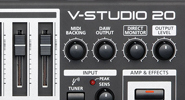
Home digital recording has come a long way in the last 20 years, to the point where top bands are cutting full albums at home. But there is still a learning curve for the uninitiated, and the software and hardware choices are dizzying. Enter Roland, whose V-Studio 20 is notable because it’s absurdly easy to use, yet has ample pro features. Let’s roll tape.
The V-Studio 20 plugs into a computer with a USB cable and is very user-friendly, with real sliders and knobs like an analog mixer. The unit also features built-in stereo mics and a conventional “tape transport” layout. The inputs accommodate a direct guitar/bass line, a pair of 1/4-inch line cables, and an XLR-type microphone. One disappointment is that the speaker outputs are RCA phono plugs and not 1/4-inch jacks for real studio monitors (thus, you may need adapters), but there are standard connections for headphones and an expression pedal.
The package comes with Cakewalk’s Guitar Tracks program, which is a simplified version of its popular Sonar (note that it’s PC only; Mac users will need their own program). Guitar Tracks is an audio sequencer that will capture, edit, and mix music, and – good news – it’s joyously simple to use. With a guitar plugged into the V-Studio 20 box, users can watch their tracks unfold onscreen as they record.
One of the great assets of the V-Studio 20 is that all the effects any user will likely need are already inside the unit. A virtual multi-effects pedalboard using the company’s COSM modeling presets pops up onscreen, where the user can use their mouse to tweak tones and effects. And the 36 internal Boss effects are very good – from clean to crunch, there’s a number of excellent amp tones, as well as loads of compression, reverb, chorus, flange, delay, and more. There’s also more than 1GB of drum tracks and loops to help build tracks further.
Perhaps the best aspect of the Roland V-Studio 20, however, is that it is highly intuitive. Even those who haven’t delved into digital recording will be able to get onboard quickly. It should be noted, though, that it’s important to have a decent PC with an up-to-date operating system. Guitar Tracks was tested on a Windows XP machine with no problem (it also works on Windows Vista and Windows 7). In all, the Roland V-Studio 20 is one of the best recording packages for the newbie out there, as well as a useful tool for more experienced players who want a simple system without the headaches.
This article originally appeared in VG August 2013 issue. All copyrights are by the author and Vintage Guitar magazine. Unauthorized replication or use is strictly prohibited.
Born in rural Kentucky in 1954, Ricky Skaggs (named for “I Love Lucy’s” Ricky Ricardo) stands today as a supremely versatile musician. With his band Kentucky Thunder and his own record label, he focuses on the traditional bluegrass that nurtured him from boyhood on. That journey, from bluegrass child prodigy to admired young sideman to ’80s mainstream country star, balanced by the ups and occasional downs of his personal life, makes for interesting reading.
Among memories of various Nashville stars, his recollections of the pillars of bluegrass particularly stand out. A friend of Bill Monroe, Flatt and Scruggs, his former boss Ralph Stanley and one-time Stanley bandmate Keith Whitley, he captures their human and their lighter sides.
His memories of fine instruments like his first Gibson mandolin and a 1924 F-5 Loar he took out a bank loan to purchase are especially enjoyable.
Reflecting on the excitement of discovering Django Reinhardt, Skaggs recalls marveling at his music’s similarities to bluegrass. Any musician can relate to his ’80s dilemma of lacking a lead guitarist for one tour and having to get his own guitar chops up to speed. Too often, such memoirs give the music short shrift. Not this time.
This article originally appeared in VG‘s February ’13 issue. All copyrights are by the author and Vintage Guitar magazine. Unauthorized replication or use is strictly prohibited.


 The B.C. Rich Mockingbird Plus FR uses a Floyd Rose bridge on one of the most popular body shapes in the company’s line. It has a mahogany body with Black Vapor finish, figured maple top, 24-fret ebony fretboard with a 12″ radius, diamond inlays, and the traditional B.C. Rich three-and-three headstock. The new set-neck design adds a contour designed to be as comfortable as a neck-through. Other highlights include traditional Mockingbird electronics configuration – dual humbuckers with a master Volume control, a master Tone, and a three-way toggle selector. The Floyd Rose bridge, control knobs, strap buttons, locking nut, and die-cast tuners are all finished in a gloss black. Visit

 The Pigtronix Echolution 2 uses analog tone shaping and digital signal processing, offering an expanded palette of delay effects in a programmable, MIDI-controllable package. It has a 24-bit, variable-clock, full-stereo delay line that creates echoes from 10ms to 10 seconds in duration. Any two subdivisions of the master delay time can be selected to create an array of polyrhythmic multi-tap patterns. The echoes are then further animated by eight filter modes, multiple LFOs, freeze, reverse, bit-crushing and totally original cascading octave effects created by the Halo and Jump functions. Musicians can exert real-time control via assignable expression pedal and envelope mapping for every knob, as well as complete MIDI control of every function. Sounds can be saved and recalled using its footswitches or optional remote switch. A dedicated PC/MAC application enables the import and export of presets for sharing with other musicians who use Echolution 2. The application also delivers future firmware upgrades and provides users with real-time access to advanced functionality. For more, visit




 The EarthQuaker Pitch Bay is a three-part polyphonic harmonizer and distortion generator that can be adjusted by stepped semitones, from one to 12 semitones (full octave) above and below the root. Each voice (Pitch up, Pitch down, and Root) has an adjustable mix that can be cut or boosted. It also has an adjustable input gain, all-analog signal path, all-digital pitch shifting, and true-bypass switching.
 The EarthQuaker Terminal Fuzz adapts the company’s JAX fuzz, allowing control over gain, fine-tuning the EQ, and a giving it adjustable volume boost. The Voice knob controls upper and lower midrange, while Treble adjusts top-end response. It also has a control for Fuzz, all-analog signal path, and true-bypass switching. For more, go to www.earthquakerdevices.com.
 The Rio Grande Pickups Vintage Tallboy Twangbucker can be wired with a push/pull pot or mini toggle that allows selection of a humbucking sound or straight single-coil mode. It includes a custom-made nickel-plated bridge and is available in several colors. Learn more at